FineArtFriday: Holiday on the Hudson by George Luks ca. 1912

George_Luks_(American,_1866–1933)_-_Holiday_on_the_Hudson_-_1933.2291_-_Cleveland_Museum_of_ArtArtist: George Luks  (1867–1933)

Title: Holiday on the Hudson

Date: circa 1912

Collection: Cleveland Museum of Art

What I love about this painting:

These are the working-class people of New York on a sunny Sunday in high summer. Fishing has been good, and while the oyster boats and small fishing dories have seen heavy use, they’ve been tidied up a bit, and everyone is looking forward to a carefree day on the water. The fishermen in their sleeveless shirts are quickly moving ropes and gear around to make room for the ladies.

I love the life instilled in the painting, the action, the colors, the intensity, and the way it shouts, “Freedom beckons,” even if that freedom is only temporary.

I see a story here, a historical romance. I imagine that some of this group of friends are the servants of the rich enjoying their half-day off. Besides the fishermen, we have footmen, maids, cooks, and housekeepers. I like to think they’re heading to a favorite beach for a clambake, that time-honored seaside picnic that even the poor working-class could afford.

Who is courting whom? Will they get married?

About the artist, via Wikipedia:

George Benjamin Luks (August 13, 1867 – October 29, 1933) was an American artist, identified with the aggressively realistic Ashcan School of American painting.

After travelling and studying in Europe, Luks worked as a newspaper illustrator and cartoonist in Philadelphia, where he became part of a close-knit group, led by Robert Henri, that set out to defy the genteel values imposed by the influential National Academy of Design. His best-known paintings reflect the life of the poor and hard-pressed on Manhattan’s Lower East Side. [1]

For more about George Luks, I highly recommend continuing to read his biography here: George Luks – Wikipedia


Credits and Attributions:

IMAGE: Wikimedia Commons contributors, “File:George Luks (American, 1866–1933) – Holiday on the Hudson – 1933.2291 – Cleveland Museum of Art.jpg,” Wikimedia Commons, https://commons.wikimedia.org/w/index.php?title=File:George_Luks_(American,_1866%E2%80%931933)_-_Holiday_on_the_Hudson_-_1933.2291_-_Cleveland_Museum_of_Art.jpg&oldid=779825858 (accessed June 27, 2024).

[1]Wikipedia contributors, “George Luks,” Wikipedia, The Free Encyclopedia, https://en.wikipedia.org/w/index.php?title=George_Luks&oldid=1217710156 (accessed June 27, 2024).

Comments Off on FineArtFriday: Holiday on the Hudson by George Luks ca. 1912

Filed under #FineArtFriday

Subtext, Mood, and Atmosphere #writing

A reader’s perception of a narrative’s reality is affected by emotions they aren’t even aware of, an experience created by the layers of worldbuilding.

mood-emotions-1-LIRF09152020Mood and atmosphere are separate but entwined forces. They form subliminal impressions in the reader’s awareness, subcurrents that affect our personal emotions.

The emotions evoked in readers as they experience the story are created by the combination of mood, atmosphere, and subtext.

SUBTEXT_Def_06222024LIRFSubtext is a complex but essential aspect of storytelling. It lies below the surface and supports the plot and the conversations. It is the hidden story, the secret reasoning we deduce from the narrative. It’s conveyed by the images we place in the environment and how the setting influences our perception of the mood and atmosphere.

Emotion is the experience of contrasts, of transitioning from the negative to the positive and back again. Mood, atmosphere, and emotion are part of the inferential layer of a story, part of the subtext. When an author has done their job well, the reader experiences the emotional transitions as the characters do. It is our job to make those transitions feel personal.

The atmosphere of a story is long-term. Atmosphere is the aspect of mood that is conveyed by the setting as well as the general emotional state of the characters.

The mood of a story is also long-term, but it is a feeling residing in the background, going almost unnoticed. Mood shapes (and is shaped by) the emotions evoked within the story.

Scene framing is the order in which we stage the people and the visual objects we include in a scene, as well as the sequence of scenes along the plot arc. It shapes the overall mood and atmosphere and contributes to the subtext. We choose the furnishings, sounds, and odors that are the visual necessities for that scene, and we place the scenes in a logical, sequential order.

3-Ss-of-worldbuilding-LIRF07182021We want to avoid excessive exposition, and good worldbuilding can help us with that. Let’s say we want to convey a general atmosphere of gloom and show our character’s mood without an info dump. Environmental symbols are subliminal landmarks for the reader. Thinking about and planning symbolism in an environment is key to developing the general atmosphere and affecting the overall mood.

Barren landscapes and low windswept hills feel cold and dark to me. The word gothic in a novel’s description tells me it will be a dark, moody piece set in a stark, desolate environment. A cold, barren landscape, constant dampness, and continually gray skies set a somber tone to the background of the scene.

A setting like that underscores each of the main characters’ personal problems and evokes a general atmosphere of gloom.

ALLEGORY06222024LIRFWhen we are designing the setting of a scene, which aspect of atmosphere is more important, mood or emotion? As I have said before, both and neither because they are entwined. Our characters’ emotions affect their attitudes toward each other and influence how they view their quest. This, in turn, shapes the overall mood of the characters as they move through the arc of the plot. And the visual atmosphere of a particular environment may affect our protagonist’s personal mood. Their individual attitudes affect the emotional state of the group—the overall mood.

What tools in our writer’s toolbox are effective in conveying an atmosphere and a specific mood? Once we have chosen an underlying theme, it’s time to apply allegory and symbolism – two devices that are similar but different. The difference between them is how they are presented.

  • Allegory is a moral lesson in the form of a story, heavy with symbolism.
  • Symbolism is a literary device that uses one thing throughout the narrative (perhaps shadows) to represent something else (grief).

What are some examples? Cyberpunk, as a subgenre of science fiction, is exceedingly atmosphere-driven. It is heavily symbolic in worldbuilding and often allegorical in the narrative. We see many features of the classic 18th and 19th-century Sturm und Drang  literary themes but set in a dystopian society. The deities that humankind must battle are technology and industry. Corporate uber-giants are the gods whose knowledge mere mortals desire and whom they seek to replace.

The setting and worldbuilding in cyberpunk work together to convey a gothic atmosphere, an overall feeling that is dark and disturbing. This is reflected in the subtext, which explores the dark nature of interpersonal relationships and the often criminal behaviors our characters engage in for survival.

 No matter what genre we write in, we can use the setting to hint at what is to come. We can give clues by how we show the atmosphere with the inclusion of colors, scents, and ambient sounds. We choose our words carefully as they determine how the visuals are shown.

Hydrangea_cropped_July_11_2017_copyright_cjjasperson_2017 copyWe can create an atmosphere and mood that underscores our themes and highlights plot points without resorting to info dumps. We can lighten the mood as easily as we can darken it. When we design a setting, color brightens the visuals, and gray depresses them. Those tones affect the atmosphere and mood of the scene.

Sunshine, green foliage, blue skies, and birdsong go a long way toward lifting my spirits, so when I read a scene that is set in that kind of environment, the mood of the narrative feels lighter to me.

Worldbuilding can feel complicated when we are trying to convey subtext, mood, and atmosphere but the reader won’t be aware of the complexities. All they will know is how strongly the protagonist and her story affected them and how much they loved that novel.

1 Comment

Filed under writing

#FineArtFriday: La Mirenda (The Snack) by Elin Danielson-Gambogi 1904

Elin_Danielson-Gambogi_-_La_Merenda_(1904)Artist: Elin Danielson-Gambogi  (1861–1919)

Title: By the Sea – The Snack (La Merenda)

Date: 1904

Medium: oil on canvas

Dimensions: height: 102 cm (40.1 in)

Collection: K. H. Renlund art collection

What I love about this painting:

Elin Danielson-Gambogi gives us a perfect afternoon for an afternoon picnic by the sea with friends. An afternoon beside the surf and the company of friends—it doesn’t get any better.

The good years just prior to the outbreak of WWI seem golden in many ways. Women’s work was never done but they have the luxury of a little leisure time, and they are enjoying it. Two women have removed their headscarves as if they don’t care if they get a little sun-browned. The cast-off squares of cloth lie on the rocky beach as if blown by the wind.

The girl is very likely the artist’s niece, as she and her mother figure prominently in many of Elin’s paintings. I like to think she is pleased to have been included in the picnic, proud to be serving the snacks.

There is a pleasant warmth to this image, the peace of a Goldilocks day, that rare summer’s afternoon that is just right.

About the Artist, via Wikipedia:

Elin Kleopatra Danielson-Gambogi (3 September 1861 – 31 December 1919) was a Finnish painter best known for her realist works and portraits. Danielson-Gambogi was part of the first generation of Finnish women artists who received professional education in art, the so-called “painter sisters’ generation”. The group also included Helene Schjerfbeck (1862–1946), Helena Westermarck (1857-1938), and Maria Wiik (1853-1928).

In 1883 Danielson received a grant and moved to Paris. While there, she took lessons at the Académie Colarossi under Gustave Courtois and painted in Brittany during the summertime. A few years later she returned to Finland and lived with her relatives in Noormarkku and Pori. In 1888 she opened an atelier in Noormarkku. During the 1880s and 1890s she worked as a teacher in several art schools around Finland.  She also attended the artists’ colony Önningeby in Ålands.

In 1895, she received a scholarship and traveled to Florence, Italy. A year later she moved to the village of Antignano in Livorno where she met an Italian painter 13 years younger than herself, Raffaello Gambogi (1874–1943). They began working together and got married on February 27, 1898.  They held exhibitions in Paris, Florence (where she was awarded an art prize by the city) and Milan, and in many Finnish cities, and their paintings were also included in the 1900 World’s Fair in Paris, where she again won bronze medal. She also got to second place in the 1901 national portrait painting competition organized by the Finnish state.  In 1899, King Umberto purchased a painting from her. That same year, she participated in the Venice Biennale.

Their marriage was strained when Raffaello had an affair with Danielson’s Finnish friend Dora Wahlroos.  While the affair quickly ended, it had a lasting impact on the Gambogis’ marriage.  She moved to Finland for a while but returned to Antignano in 1903.  Because of World War I, her connection to her homeland was cut, and by the time she died, of pneumonia, at Antignano in 1919, she had been mostly forgotten in Finland.

Because of her choice of rare subject matters that often even caused some offence, Danielson is now seen as one of the central artists of the Golden Age of Finnish Art. Danielson-Gambogi was included in the 2018 exhibit Women in Paris 1850-1900. [1]


Credits and Attributions:

IMAGE: Wikimedia Commons contributors, “File:Elin Danielson-Gambogi – La Merenda (1904).jpg,” Wikimedia Commons, https://commons.wikimedia.org/w/index.php?title=File:Elin_Danielson-Gambogi_-_La_Merenda_(1904).jpg&oldid=848460780 (accessed June 20, 2024).

[1] Wikipedia contributors, “Elin Danielson-Gambogi,” Wikipedia, The Free Encyclopedia, https://en.wikipedia.org/w/index.php?title=Elin_Danielson-Gambogi&oldid=1203975014 (accessed June 20, 2024).

5 Comments

Filed under #FineArtFriday, writing

My checklist for creating societies #writing

Worldbuilding involves far more than the visible environment. We know worlds are comprised of plants, animals, and geology. But if intelligent life forms live in that world, societies will also exist.

WritingCraftWorldbuildingIntelligent creatures communicate in their own languages with each other, sounds that we humans interpret as random and meaningless or simply mating calls. But scientists are discovering their vocalizations must have meanings beyond attracting a mate, words that are understood by others of their kind. This is evident in the way they form herds and packs and flocks, societies with rules and hierarchies.

The BBC says that AI is learning the language patterns of other species. How will that change our view of the world? Will the Powers That Be persist in the view that humans are the only species with internal lives and emotional connections? How artificial intelligence is helping us talk to animals (bbc.com)

So, let’s talk about worldbuilding.

mindwanderingLIRF02212023We humans are tribal. We prefer living within an overarching power structure (a society) because someone has to be the leader. We call that power structure a government.

As a society, the habits we develop, the gods we worship, the things we create and find beautiful, and the foods we eat are evidence of our culture.

If your society is set in modern suburbia, that culture and those values will affect your characters’ view of their world. You will still have to build that world on paper. But the information and maps are all readily available, perhaps in your backyard.

If your story is set on another world, alternate earth, or even in a different era, you must create the background material to show your world logically and without contradictions. Are there specific places or environments where the different fantasy or alien races exist?

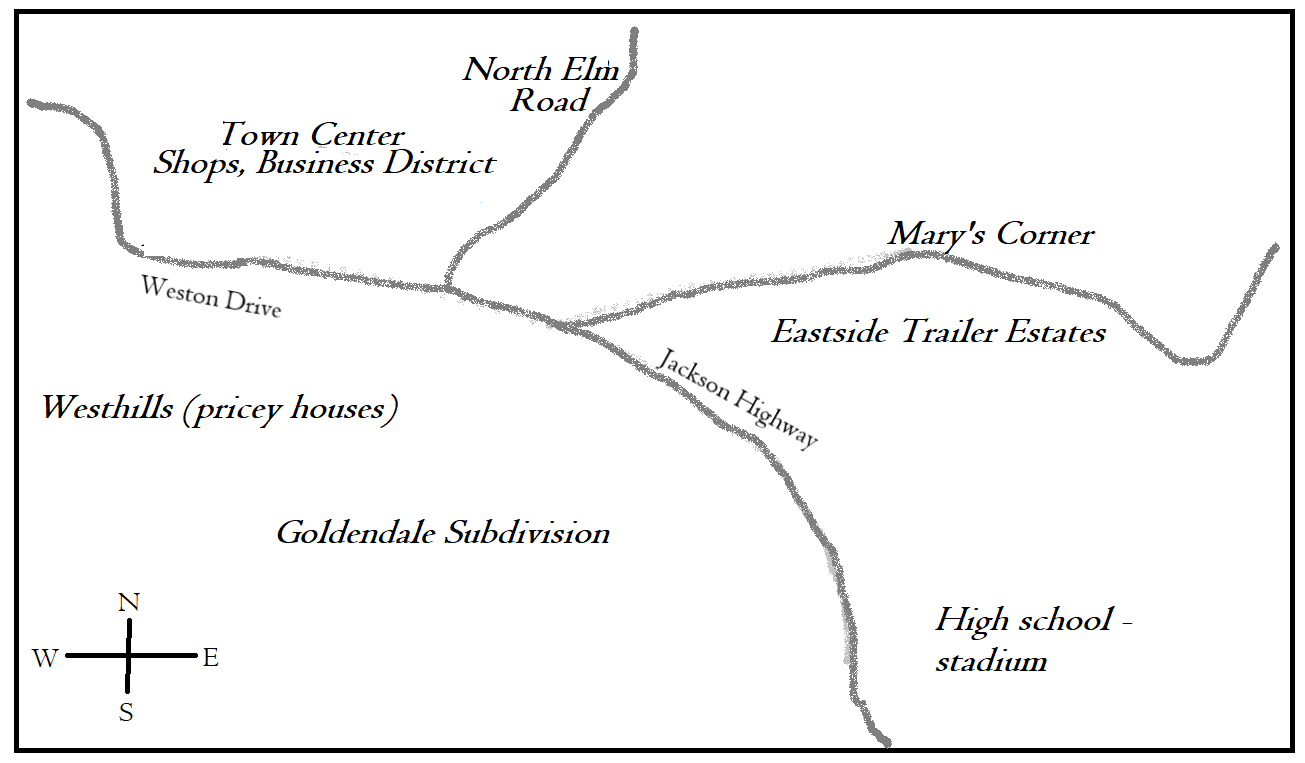
A common trope of fantasy is that elves are close to nature and prefer to live in the forests. If you have other races coexisting with humans, you need to make a map. Where do their territories border your protagonist’s country? Are they at peace with one another? How does this affect your story?

sample-of-rough-sketched-mapWorldbuilding requires us to ask questions of the story we are writing. I go somewhere quiet and consider the world my characters will inhabit. I have a list of points to consider when creating a society, and you’re welcome to copy and paste it to a page you can print out. Jot the answers down and refer back to them if the plot raises one of these questions.

Merchants, scientists, priests, soldiers, teachers, healers, thieves – no matter the setting, how is your society divided? Who has the wealth?

  • Is there a noble class?
  • Is there a servant class?
  • Is there a merchant class?
  • Is there a large middle class?
  • Who makes up the most impoverished class?
  • Who has the power, men or women—or is it a society based on mutual respect?

Ethics and Values: What constitutes morality, and how do we treat each other? Is marriage required?

  • How are women treated?
  • How are men treated?
  • How are the different races viewed?
  • Is there a cisgender bias or an acceptance of different gender identities?
  • How are same-sex relationships viewed?
  • How are unmarried sexual relationships seen in the eyes of society?
  • How important is human life?
  • How is murder punished?
  • How are betrayal, hypocrisy, envy, and avarice looked upon?
  • What about drunkenness?
  • How important is honesty?
  • What constitutes immorality?
  • How important is it to be seen as honest and trustworthy?
  • What is taboo? What is “simply not done” among that group?

Power structures are hierarchies and chains of command. A government is an overall system of restraint and control among selected members of a group. Think of it as a pyramid, a few at the top ruling over a broad base of citizens.

Excalibur London_Film_Museum_ via Wikipedia

Excalibur London_Film_Museum_ via Wikipedia

In a medieval-type society, the accepted age for when a child becomes legally an adult will be much younger than we consider it today. When the majority of people die before the age of forty, adulthood comes at the same time as puberty. Fourteen- and fifteen-year-olds have minimal life experience. They let their hormones do the thinking and are quick-tempered and volatile. When a teenager becomes king or queen, and all of their advisors are also teenagers or in their early thirties at most, a country could suffer. The ruling class might be uncaring of how their decisions affect the lower classes.

Wars take the laborers out of the fields and put them on the front lines, limiting food production. While this hurts everyone, it destroys trade, ruining the merchant class. War falls heaviest upon the peasant class, but the middle class pays most of the taxes. Without a good-sized middle class, one can’t pay an army.

Religion can be a sci-fi trope and often figures prominently in fantasy work. In sci-fi, science and technology frequently take the place of religion or are at odds with it. They both have similar hierarchies and fanatics but with different job titles.

Archbishop might be replaced with Head of Research and Development.

Cardinal or Pope might be replaced with GeneralAdmiral, or CEO (Chief Executive Officer).

Level of Technology: no matter the setting, each occupation has a specific technology. What tools and amenities are available to them? What about transport?

  1. Hunter/Gatherers?
  2. Agricultural/farming?
  3. Greco-Roman metallurgy and technology?
  4. Medieval metallurgy and technology?
  5. Pre-industrial revolution or late Victorian?
  6. Modern-day?
  7. Or do they have a magic-based technology?
  8. How do we get around, and how do we transport goods? On foot, by horse & wagon, train, or space shuttle?

Government: There will be a government somewhere, even if it is just the local warlord. Someone is always in charge because it’s easier for the rest of us that way:

  1. Is it a monarchy, theocracy, or a democratic form of government?
  2. How does the government fund itself?
  3. How are taxes levied?
  4. Is it a feudal society?
  5. Is it a clan-based society?
  6. How does the government use and share the available wealth?
  7. How do the citizens view the government?

Crime and the Legal System: What constitutes criminal behavior, and how are criminals treated?

Foreign Relations: Does your country coexist well with its neighbors?

  • If not, why? What causes the tension?

Waging War: This is another area where we have to ask what their level of technology is. Do the research and choose weaponry that fits your established level of technology.

  • What kind of weaponry will they use?
  • How are they trained?
  • Who goes to battle? Men, women, or both?
  • How does social status affect your ability to gain rank in the military?

A common trope in fantasy is magic, which brings up the need to train magic-gifted people. Do your sorcerers/mages rely on

  • dumb luck and experimentation?
  • apprenticing to sorcerers?
  • training by religious orders?
  • or, as in the case of Harry Potter, a school of some sort? What are the rules of your magic?

The Church/Temple is the governing power in many real-world historical societies. The head of the religion is the ruler, and the higher one rises within the religious organization, the more power one has. The same is true of both universities and research facilities.

Author-thoughtsPower in the hands of only a few people offers many opportunities for mayhem. Zealous followers may inadvertently create a situation where the populace believes their ruler has been anointed by the Supreme Deity. Even better, they may become the God-Emperor/Empress.

Some people are prone to excess when presented with the opportunity to become all-powerful.

Brainstorming worldbuilding is a good exercise if you have a character with a story that needs to be written. If you were unsure what your plot was before you got to this stage, now you might have a real villain, one presented to you by your society.

4 Comments

Filed under writing

#FineArtFriday: View of Bruges with City Hall by August Fischer

August_Fischer_Ansicht_von_Brügge_mit_Rathaus_1905Artist: August Fischer  (1854–1921) 

Title: English: View of Bruges with City Hall, Dansk: Udsigt til Brügge

Date: 1905

Medium: oil on canvas

Dimensions: height: 45 cm (17.7 in); width: 59 cm (23.2 in)

Inscriptions: Signed and dated lower right: Aug. Fischer, Bruges 05.

What I love about this painting:

We see history here, the city of Bruges as it was in 1905, before the outbreak of WWI. It was a prosperous town with many churches and a large middle class.

The boatman has a story. How old is he? Does he support his wife and children with what he earns ferrying people to and from? Or is he just starting out in life, working to earn enough to marry a certain girl? This is a fairytale painting, serene and yet concealing many secrets. I think it’s the perfect setting for fantasy romance.

Perhaps the future looks bright to him now, but in less than a decade, our boatman will be thrown in the most horrific war the world had ever seen. If he is young, he will be sent to the front. If he is old, his boat will be conscripted to ferry soldiers and munitions, and he will do what he must to survive.

More than a century has passed since this scene was recorded. Bruges is now the capital and largest city of the province of West Flanders in the Flemish Region of Belgium.

About the Artist: I could find no Wikipedia article about Fischer, but random searches at the websites of several auction houses yielded some information.

Johannes August Fischer (1854–1921) was a Danish landscape and architecture painter and the elder brother of the Danish artist, Paul Fischer. His parents were the master painter and varnish manufacturer Philip August Fischer (1817—1907) and Gustafva Albertina Svedgren (1827—83). The family was well off, upper middle class. While his father had started as a painter, he became financially successful as a manufacturer of paints and lacquers.

August Fischer was first apprenticed to a sculptor, but at the age of nineteen, he applied to the Royal Danish Academy of Fine Arts, making the switch to painting. His work debuted at the Charlottenborg Spring Exhibition in 1874, where he exhibited until his death in 1921.

August Fischer traveled abroad for much of his career. He lived and worked in Spain and Italy from 1883 to 1884. After that, he traveled to southern Germany and Italy. Several of his more well-known paintings were of Nuremberg and Rothenburg on the Tauber, and Venice and Florence.


Credits and Attributions:

Wikimedia Commons contributors, “File:August Fischer Ansicht von Brügge mit Rathaus 1905.jpg,” Wikimedia Commons, https://commons.wikimedia.org/w/index.php?title=File:August_Fischer_Ansicht_von_Br%C3%BCgge_mit_Rathaus_1905.jpg&oldid=807392532 (accessed June 12, 2024).

3 Comments

Filed under #FineArtFriday

The Impact of Names in #writing

Things have been a bit crazy here at Casa del Jasperson. When your spouse has Parkinson’s, life occasionally gets out of control, and writing falls to the bottom of the to-do list. Everything narrows to dealing with the emergency at hand. That is how things have been here; I’ve been in crisis mode for two months now, but life is settling into a new normal—as much as anything here will ever be.

MyWritingLife2021Talking about the craft of writing is soothing, something with solid rules. When everything else is chaos, writing is there, offering safety and escape.

I have been spending a lot of time in hospitals and waiting rooms, reading. One particular novel I just finished was—how shall I say this? Good in many ways but supremely difficult to follow.

One of the least of its problems was the number of named characters. I understand how that happens. When laying down a manuscript’s first draft, I tend to give every walk-on a name, right down to the dog.

However, in the second draft, I try to shave my cast of thousands down to a reasonable level. If I miss a few that are just fluff, my writing group will point them out.

This brings up the question of the optimal number of main characters for a book. Some say only four, others fifteen. In my opinion, you should introduce however many characters it takes to tell the story but use common sense.

I have three rules for deciding who should be named and who should not.

name quote, richard II shakespeareFirst, is this character someone the reader should remember? Even if they offer information the protagonist and reader must know, it doesn’t necessarily mean they must be named. Walk-through characters provide clues to help our protagonist complete their quest, but we never see them again. They can show us something about the protagonist and give hints about their personality or past—but when they are gone, they are forgotten.

Second, does the person return later in the story, or are they part of the scenery of, say, a coffee shop or a store? They don’t need a name if they are only a component of world-building.

Third, we should only give names to characters who return more than once to advance the plot or show us something important about people or places.

  • For example, perhaps a homeless woman who lives in the alley behind the protagonist’s apartment is seen three or four times over the course of the story. She is part of the scenery and might go by a name or not. As a way to show a compassionate side to our main character, they might take her coffee or sandwiches and worry when the weather is too cold or too hot. In return, the old lady might care about them and offer a bit of street gossip, which could be useful.

In my experience as a reader, the pacing an author is trying to establish comes to a halt when a character who is only included for the ambiance has too much time devoted to them.

When we are writing a scene that involves characters who are just set-dressing, we should ask these questions:

  • Do these people help or hinder the protagonist in some crucial way?
  • Do they provide essential background information we won’t get any other way?
  • Is their presence a necessary part of world-building?

storybyrobertmckeeNovelists can learn a lot from screenwriters about writing good, concise scenes. An excellent book on crafting scenes is Story by Robert McKee.

We want the reader to stay focused on the protagonist(s) and their story. We can remove side characters from the scene if they have nothing to contribute. Walk-on characters can be identified in general terms by their dress or appearance. The reader will move on and forget about them.

But how do names play out in real life? I’ve mentioned this before, but in my family, “Robert” is a recurring name.

My father was named Robert, and my two brothers are both named Robert (with different middle names). My mother’s younger brother is also a Robert, so yes, Bob’s my uncle.

My younger brother’s son is named Robert, and so is his son. We have a Bob, a Little Bob, a Rob, a Bobby, a Robby, and a Quatro. Two Bobs are no longer with us, but the confusion continues with each new generation of Roberts in our family.

BNF Front Cover 1I took this absurdity to an extreme in Billy Ninefingers. In Waldeyn, the most common boy’s name is William, which is why Billy MacNess embraces the name his mercenaries give him after the injury – Billy Ninefingers. In that novel, anyone named William (and there are a lot of them) generally goes by their last name or their trade. Think Mason, Sawyer, etc., etc.

Other than Billy Ninefingers, where the overuse of one name was intentional and integral to the story, my rule is “NEVER name two characters so that the first and last letters of their names are the same.”

I try never to have two names that begin with the same letter. However, since there are only twenty-six letters in the alphabet, some repetition of first letters might occur.

How do we decide who should go and who should stay? And what is the optimal number of characters for a book?

There is no hard and fast rule. I feel an author should introduce however many characters it takes to tell the story but should also use common sense.

namesOne final thing to consider is this: how will that name be pronounced when read aloud? You may not think this matters, but it does. Audiobooks are becoming more popular than ever. You want to write it so a narrator can easily read that name aloud.

And that brings up the problem of reading aloud. I read Tad Williams’ Memory Sorrow and Thorn series aloud to my youngest daughter when she was old enough to appreciate and understand it. I was too cheap to pay for cable television, and it kept her from being bored. I will just say that while his narrative is brilliant and engrossing, many of those names took some practice to say without stumbling.

Did I mention that names are also a component of world-building? Well, they are. Names offer an image of place and time.

This worked against me in one major way. While recording Tales from the Dreamtime, a novella consisting of three fairy tales, my narrator had trouble pronouncing the names of two characters. This happened because I had invented names that felt foreign and looked good on paper.

Dragonbone_ChairDespite my experience of reading fantasy books aloud to my children, it didn’t occur to me that the names were unpronounceable as they were written. We ironed that out, but that hiccup taught me to spell names the way they’re pronounced whenever possible.

In conclusion, don’t confuse your readers by giving unimportant walk-on characters names.

Never give two characters names that are nearly identical.

Consider making the spellings of names and places easily pronounceable because you might decide to have your novel made into an audiobook.

And whatever else you do, go forth and write! Create those worlds and wonderful people and tell those stories. Those of us in waiting rooms and sitting by hospital beds will be grateful that you did.

4 Comments

Filed under writing

#FineArtFriday: A second look at “Harvesters” by Anna Ancher, 1905

Anna_Ancher_-_Harvesters_-_Google_Art_ProjectArtist: Anna Ancher  (1859–1935)

Title: Harvesters

Date: 1905

Medium: oil on canvas

Dimensions: w56.2 x h43.4 cm (Without frame)

Collection: Skagens Museum

What I love about this painting:

While she normally painted interiors, Anna Ancher captured a perfect late summer morning beneath blue skies in this painting. One can almost hear the rustling of ripe grain moving with the breeze.

I like the placement of the three figures, two women and a man. Are they husband, wife, and daughter? There is a sense of movement in this painting. They enter the scene from the right, and you feel sure they will exit to the left, where the field that is to be cut that day is.

The man will scythe, the woman who follows third will rake, and the woman in the middle will stack the sheaves.

These are not poor people. These farmers are dressed modestly in clean work clothes that aren’t tattered and patched. They are doing well; the grain is high, and life is good in these years of plenty before the outbreak of WWI.

About the Artist, via Wikipedia:

Anna Ancher (18 August 1859 – 15 April 1935), born Anna Kirstine Brøndum, was born in Skagen, Denmark, was the only one of the Skagen Painters who was born and grew up in Skagen, where her father owned the Brøndums Hotel. The artistic talent of Anna Ancher became obvious at an early age and she became acquainted with pictorial art via the many artists who settled to paint in Skagen, in the north of Jylland.

While she studied drawing for three years at the Vilhelm Kyhn College of Painting in Copenhagen, she developed her own style and was a pioneer in observing the interplay of different colors in natural light. She also studied drawing in Paris at the atelier of Pierre Puvis de Chavannes along with Marie Triepcke, who would marry Peder Severin Krøyer, another Skagen painter.

In 1880 she married fellow painter Michael Ancher, whom she met in Skagen. They had one child, daughter Helga Ancher. Despite pressure from society that married women should devote themselves to household duties, she continued painting after marriage.

Anna Ancher was considered to be one of the great Danish pictorial artists by virtue of her abilities as a character painter and colorist. Her art found its expression in Nordic art’s modern breakthrough toward a more truthful depiction of reality, e.g. in Blue Ane (1882) and The Girl in the Kitchen (1883–1886).

Ancher preferred to paint interiors and simple themes from the everyday lives of the Skagen people, especially fishermen, women, and children. She was intensely preoccupied with exploring light and color, as in Interior with Clematis (1913). She also created more complex compositions such as A Funeral (1891). Anna Ancher’s works often represented Danish art abroad. Ancher has been known for portraying similar civilians from the Skagen art colony in her works, including an old blind woman.


Credits and Attributions:

Harvesters, Anna Ancher, Public domain, via Wikimedia CommonsWikimedia Commons contributors, “File:Anna Ancher – Harvesters – Google Art Project.jpg,” Wikimedia Commons, the free media repository, https://commons.wikimedia.org/w/index.php?title=File:Anna_Ancher_-_Harvesters_-_Google_Art_Project.jpg&oldid=371900766 (accessed October 14, 2021).

Wikipedia contributors, “Harvesters (Ancher),” Wikipedia, The Free Encyclopedia, https://en.wikipedia.org/w/index.php?title=Harvesters_(Ancher)&oldid=1047378795 (accessed October 14, 2021).

5 Comments

Filed under #FineArtFriday

Revisiting ‘that and which,’ two commonly misused words #writing

Grammar is still on my mind, and so today we are revisiting a post from August 17, 2017. While English is a language that constantly evolves, nothing has changed since this post was written.


MyWritingLife2021That and which are words we commonly misuse in real-life conversations. This habit rolls over into our writing because we are unsure which word is the right one for the job. Also, there is a LOT of talk in writing groups about unnecessary words, so we might get a bit crazy and take an ax to each instance of the word “that.”

When it comes to eliminating the word “that,” it’s crucial you look at each example of how it is used.  Sometimes, “that” is the only word for a given situation.

Don’t gut your prose just because some online guru tells you “that” is an unnecessary pronoun. If you remove every instance of the word “that” you’ll end up with a mess on your hands.

Something you need to know: “that” and “which” are not interchangeable so you can’t just use a global search to change every instance of “that” to “which.”

“That” is a pronoun used to identify a specific person or thing observed by the speaker, a determiner, an adverb, and a conjunction.

  1. “That’s his dog on the curb.” (Identifier)
  2. “Look at that red car.” (Determiner)
  3. “I wouldn’t go that far.” (Adverb)
  4. “She claimed that she was married.” (Conjunction)

In the case of number 4, the sentence would be stronger without it. Most of the time, the prose is made stronger when the word “that” is cut and not replaced with anything.

I say most, but not all of the time.

fitzgerald-great gatsby memeUse common sense and if a beta reader runs amok in your manuscript telling you to remove “this and that,” examine each instance of what has their undies in a twist and try to see why they are pointing it out.

There are cases where the word “that” is the only one that works. When do we use the word “that?” We use it when we have something called a ‘Restrictive Clause’:

Quote from Grammar Girl, “A restrictive clause is just part of a sentence that you can’t get rid of because it specifically restricts some other part of the sentence.”  She goes on to give a specific example of a restrictive clause: “Gems that sparkle often elicit forgiveness.”  See?  Not just any gems elicit forgiveness in this sentence. Only gems that sparkle bring about clemency. In this sentence, forgiveness is restricted to one kind of gem.

“Which” is a pronoun asking for information. It specifies one or more people (or things) from a particular set, and it is also a determiner:

  1. “Which are the best diapers for newborns?” (Pronoun)
  2. “I’m looking at a house which is for sale on Black Lake.” (Determiner)

Go lightly with “which” and “that” but use them when they are required.

The same common-sense approach goes for “very.” I seldom need to use it, but I do when it’s required. However, some people employ it too frequently, and it’s rarely needed, fluffing up the word count. As with every word, there are times when it’s the only one that will convey an idea crucial to your story.

Mark Twain had a perfect comment regarding overusing “very.”

“Substitute ‘damn’ every time you’re inclined to write ‘very;’ your editor will delete it, and the writing will be just as it should be.”

I’d love to be that editor.

to err is human to edit divineMany writers have beta readers look at their work before it is submitted. I would also suggest hiring a freelance editor. Besides having a person pointing out where you need to insert or delete a comma, hiring a freelance editor is a good way to discover many other things you don’t want to include in your manuscript, things you are unaware are in there:

  • They will point out when you use too many quantifiers “It was really big.” “It was incredibly awesome.”
  • Places where you “tell” the story instead of showing it: “Bert was mad.”
  • They will mention it when you swamp the reader with minute details: “Mary’s eyebrows drew together, her lips turned down, and her cheeks popped a dimple.”
  • They will comment when you ruin the taste of your work with prettily written descriptors: “-ly” words
  • They will make a comment when your characters natter on about nothing just to kill time.

ok to write garbage quote c j cherryhFreelance editors will point out these all things. We don’t like it when certain flaws in our work are pointed out, but we are better off knowing what needs addressing. When an editor guides you away from detrimental writing habits, they aren’t trying to change your voice. They’ve seen something good in your work, and they’re pointing out places where you can tighten it up and grow as a writer.

Remember, voice is how you use syntax, diction, punctuation, character development, and dialogue. When you receive an editor’s comments, it might sting, but in the process, you will develop better, more consistent writing habits.


Quoted Sources

Quick and Dirty Tips,  The Grammar Girl, Which vs. That, http://www.quickanddirtytips.com/education/grammar/which-versus-that-0 © Mignon Fogarty, 2008-2024.

3 Comments

Filed under writing

#FineArtFriday: Gassed by John Singer Sargent 1919 #memorialday

2560px-Sargent,_John_Singer_(RA)_-_Gassed_-_Google_Art_ProjectArtist: John Singer Sargent (1856–1925)

Title: Gassed

Date: 1919

Medium: oil on canvas

Dimensions: Height: 231 cm (90.9 in); Width: 611.1 cm (20 ft)

Traditionally in the US, May 30 was Decoration Day. For my father, it was a paid holiday in the middle of the week. My father would reluctantly take my grandmothers to the cemetery so they could take care of the graves of our family members, some of whom had fought in WWI, the war in which this scene was first conceived.

Dad would have preferred to go fishing. He had fought in WWII and didn’t like raking up bad memories. But it made my grandmothers happy, so he did it, despite the fact the two women didn’t really have anything else in common and had little to say to each other.

Ah, family dynamics.

Gramma Ethel and Gramma Florence were both raised in the Edwardian era and both adhered to a strict code of manners. The civility and politeness emanating from the back seat of the 1965 Chevy Impala station wagon could be overwhelming at times.

About Memorial Day from Wikipedia, the Fount of All Knowledge:

Memorial Day (originally known as Decoration Day[1]) is a federal holiday in the United States for honoring and mourning the U.S. military personnel who died while serving in the United States Armed Forces.[2] From 1868 to 1970, it was observed on May 30.[3] Since 1971, it is observed on the last Monday of May.

Many people visit cemeteries and memorials on Memorial Day to honor and mourn those who died while serving in the U.S. military. Many volunteers place American flags on the graves of military personnel in national cemeteries. Memorial Day is also considered the unofficial beginning of summer.[4]

What I love about this painting:

This painting is a deeply moving antiwar statement. John Singer Sargent was a complicated man, as most artists are. Famous as a portrait artist, he painted landscapes that conveyed a sense of mood and emotion that few of his contemporaries could match.

He was commissioned as a war artist by the British Ministry of Information. He illustrated numerous scenes from the Great War. Sargent had been affected by what he had seen while touring the front in France and by the death of his niece Rose-Marie in the shelling of the St Gervais church, Paris, on Good Friday 1918.

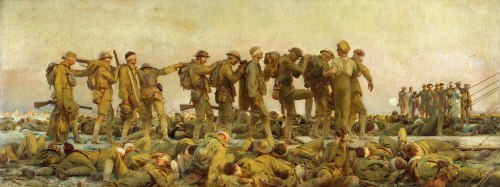
The colors are muted, and even the pastels are dark and dirty. The suffering of the maimed and injured men is laid bare. Through the legs of the walking wounded, the rising moon illuminates the desire of the uninjured to try to find some normalcy. Dwarfing the players and their game, the vast sea of dead and injured stretches as far as the eye can see.

Above, two tiny figures represent the clash of biplanes in the distance, the ever-moving machine of death and inhumanity that is war.

About this painting, via Wikipedia:

[1] Gassed is a very large oil painting completed in March 1919 by John Singer Sargent. It depicts the aftermath of a mustard gas attack during the First World War, with a line of wounded soldiers walking towards a dressing station. Sargent was commissioned by the British War Memorials Committee to document the war and visited the Western Front in July 1918 spending time with the Guards Division near Arras, and then with the American Expeditionary Forces near Ypres. The painting was finished in March 1919 and voted picture of the year by the Royal Academy of Arts in 1919. It is now held by the Imperial War Museum. It visited the US in 1999 for a series of retrospective exhibitions, and then from 2016 to 2018 for exhibitions commemorating the centenary of the First World War.

The painting measures 231.0 by 611.1 centimeters (7 ft 6.9 in × 20 ft 0.6 in). The composition includes a central group of eleven soldiers depicted nearly life-size. Nine wounded soldiers walk in a line, in three groups of three, along a duckboard towards a dressing station, suggested by the guy ropes to the right side of the picture. Their eyes are bandaged, blinded by the effect of the gas, so they are assisted by two medical orderlies. The line of tall, blind soldiers forms a naturalist allegorical frieze, with connotations of a religious procession. Many other dead or wounded soldiers lie around the central group, and a similar train of eight wounded, with two orderlies, advances in the background. Biplanes dogfight in the evening sky above, as a watery setting sun creates a pinkish yellow haze and burnishes the subjects with a golden light. In the background, the moon also rises, and uninjured men play association football in blue and red shirts, seemingly unconcerned at the suffering all around them.

The painting provides a powerful testimony of the effects of chemical weapons, vividly described in Wilfred Owen‘s poem Dulce et Decorum Est. Mustard gas is a persistent vesicant gas, with effects that only become apparent several hours after exposure. It attacks the skin, the eyes and the mucous membranes, causing large skin blisters, blindness, choking and vomiting. Death, although rare, can occur within two days, but suffering may be prolonged over several weeks.

Sargent’s painting refers to Bruegel’s 1568 work The Parable of the Blind, with the blind leading the blind, and it also alludes to Rodin’s Burghers of Calais.

About the Artist, via Wikipedia:

[2] John Singer Sargent (January 12, 1856 – April 14, 1925) was an American expatriate artist, considered the “leading portrait painter of his generation” for his evocations of Edwardian-era luxury. He created roughly 900 oil paintings and more than 2,000 watercolors, as well as countless sketches and charcoal drawings. His oeuvre documents worldwide travel, from Venice to the Tyrol, Corfu, the Middle East, Montana, Maine, and Florida.

Born in Florence to American parents, he was trained in Paris before moving to London, living most of his life in Europe. He enjoyed international acclaim as a portrait painter. An early submission to the Paris Salon in the 1880s, his Portrait of Madame X, was intended to consolidate his position as a society painter in Paris, but instead resulted in scandal. During the next year following the scandal, Sargent departed for England where he continued a successful career as a portrait artist.

From the beginning, Sargent’s work is characterized by remarkable technical facility, particularly in his ability to draw with a brush, which in later years inspired admiration as well as criticism for a supposed superficiality. His commissioned works were consistent with the grand manner of portraiture, while his informal studies and landscape paintings displayed a familiarity with Impressionism. In later life Sargent expressed ambivalence about the restrictions of formal portrait work, and devoted much of his energy to mural painting and working en plein air. Art historians generally ignored artists who painted royalty and “society” – such as Sargent – until the late 20th century. [2]


Credits and Attributions:

[1] Wikipedia contributors, “Gassed (painting),” Wikipedia, The Free Encyclopedia, https://en.wikipedia.org/w/index.php?title=Gassed_(painting)&oldid=1029966714 (accessed July 15, 2021).

[2] Wikipedia contributors, “John Singer Sargent,” Wikipedia, The Free Encyclopedia, https://en.wikipedia.org/w/index.php?title=John_Singer_Sargent&oldid=1032671314 (accessed July 15, 2021).

Image source: File:Sargent, John Singer (RA) – Gassed – Google Art Project.jpg – Wikipedia (accessed July 15, 2021).

2 Comments

Filed under #FineArtFriday

Revisiting the Apostrophe #writing

Some questions have been raised in an online writing group about the use and abuse of apostrophes, so I thought this would be a good day to revisit a post from February of 2019. Nothing has changed, and apostrophes remain as useful and confusing for new writers today as they were then. Hopefully, this rant will clear the murky waters of one of the English grammar’s most useful punctuations, the apostrophe.


The apostrophe has many uses, but I will only delve into the most common ways we use it in creative writing today.

comma or apostropheIn creative writing, the apostrophe is a small morsel of punctuation that, on the surface, seems simple. However, certain common applications can be confusing, so as we get to those I will try to be as concise and clear as possible.

First up, we all know that we use the apostrophe to denote possession:

  • This is George’s cat. (George owns this cat.)
  • This is Jorgensen’s cat. (A person who is going by the surname of Jorgensen owns the cat.)

Where this gets a little tricky is in the possessive form of a surname when it refers to the whole family. In this case, you insert a grammatical article (the) and make the name plural, and then add the apostrophe:

  • This is the Jorgensens’ cat. (The Jorgensen family owns the cat.)

If the Jorgensen family have a sign made for their front porch, they would have it made to read “The Jorgensens’ Home” (not “The Jorgensen’s Home,” as that would imply that only one Jorgensen lives there, and his legal name is “The Jorgensen.”)

When two or more people (or other entities such as businesses) are described as separately owning something, each name should be in the possessive form:

  • “Ralph’s and Janet’s cars are the same model.”

However, if Ralph and Janet share a possession, include an apostrophe and an s after the last name only:

  • “Ralph and Janet’s car is a Prius.”

In some cases, we need to use plurals of abbreviations. In a military thriller, you might need to say, “They disarmed several IEDs.” (We would not use an apostrophe.)

Writing a year numerically has been an area of confusion for me. This is because I rarely have had to write years in this way until recently and the use of an apostrophe for this is now considered outdated. However, this is how they should be written:

  • The tavern culture of the 1600s was flourishing. (1600’s would not be considered incorrect, just old fashioned.)
  • Dresses in the 1960s were shorter than in previous years.

An apostrophe should follow a number only if it is possessive.

  • It was 1985’s worst storm. (Some editors feel this is awkward, but I let it stand when I see it in a client’s manuscript.)

Numbers are frequently written numerically when writing books for middle grade and YA readers, as these stories often center around schools and sports.

A single digit, such as 7, is made plural with the addition of an s: 7s

Insert an apostrophe to denote possession when you must use a number to stand in for a person in an article, such as when an athlete is identified by a uniform number:

  • Number 8’s tackle won the day.

Contractions can be confusing. Two words made into one word are joined by an apostrophe:

  • Do not = don’t
  • We are = we’re
  • You are = you’re
  • They are = they’re

And so on. A list of contractions to watch for can be found at the fount of all knowledge, Wikipedia: Wikipedia: List of English contractions

Conjunctions also can be tricky.  Simply add an s, such as in the phrase “There are no ifs, ands, or buts about it” or “A list of dos and don’ts follows.” We do keep the contractive apostrophe in don’t and simply add an s to make it plural.

Sometimes a single letter looks awkward when we just use an s to indicate plurality.

  • “How many h’s do you spell shh with?” (just writing “hs” would look odd and be confusing.)

When pluralizing capital letters, we don’t use an apostrophe: Mike earned three Ds in English this year but still passed the class.

In a narrative, the two most common missions that apostrophes have are to denote possession or indicate a contraction.

  • Who’s is the contraction of “who is” or, less commonly, “who has.”
  • Whose is the possessive of “who” or, somewhat controversially, “which.”
  • Their(s) is the possessive of “they.” (They’re proud to own it, it’s theirs, and it’s not there.)
  • Its is the possessive of “it,” and “it’s” is a contraction of it is.

Note that for both they and it, there is no apostrophe in the possessive form.

  • The texture of the wall —it’s rough. (contraction: it is rough.)
  • I scratched myself on its surface. (possession: the wall’s surface.)

In most English words an apostrophe indicates possession but can also indicate a contraction. The difficulty arises in the fact that both it and they are frequently part of contracted words.

In the effort to standardize English usage, early linguists made a choice to eliminate the apostrophe in the possessive form. They did this in the (futile) hope of ending confusion.

  • It’s is the contraction of “it is” and sometimes “it has.”
  • Its denotes possession: It owns it.
  • Their: they own it
  • They’re: they are

As with so many things that “seemed like a good idea at the time,” its and it’s will always cause problems for new and beginning writers. Inadvertent misuse happens even for old hands like me when I’m zipping along laying down the first draft of a manuscript.

We have to be vigilant and ensure we have looked for proper usage of its and it’s during revisions. Even the big traditional publishing houses admit sneaky errors like those like to go unnoticed until after publication.

In closing, the most common uses of the apostrophe aren’t too difficult once we learn the rules. Remember, apostrophes are integral parts of the traffic control system, signals that keep your words moving along at the right rate. Using them the way they are intended (and which readers expect) keeps the reader from throwing your book away.

I always suggest you set some time aside for writing new words every day, even if only for fifteen minutes. When we force ourselves to think about and use the basic rules of grammar regularly, we retain what we have learned.


This post first appeared on Life in the Realm of Fantasy on 13 Feb 2019 as The Apostrophe. https://conniejjasperson.com/2019/02/13/the-apostrophe-amwriting/

1 Comment

Filed under writing