#FineArtFriday: The Plaza After the Rain by Paul Cornoyer

Paul_Cornoyer_-_The_Plaza_After_RainArtist: Paul Cornoyer  (1864–1923)

Title: The Plaza After Rain

Date: Before 1910

Medium: oil on canvas

Dimensions: 59 1/4 x 59 1/4 in. (150.5 x 150.5 cm)

Collection: Saint Louis Art Museum, Saint Louis, Missouri, United States

What I love about this painting:

Rain is a near-constant companion during a Pacific Northwest winter. Paul Cornoyer’s The Plaza After Rain depicts New York City, which is on the other side of the continent from me, and it takes place in a different era. But he shows the way rain is in early spring no matter where in the northern US you reside.

The sky is dark, but the trees are just beginning to leaf out. The rain is passing and the streets are wet, but a hint of blue is showing through the dark sky. When you see this painting, you see the story of a cold spring day. Yet, one has the feeling that sunshine could happen any minute.

Impressionism is flash fiction on a canvas. All the important things are there, everything the eye needs to have a perfect vision of the mood, the setting, and characters at that moment in time. The important things at that moment are depicted within the piece, but with economy.

The St. Louis Art Museum says this about The Plaza After the Rain:

A drizzling rain creates watery reflections on the streets and sidewalks along the Grand Army Plaza in Manhattan. The rain hampers our view down the vista, though the moody tones of pinks, grays, and blues make up for this loss. The light in the distance offers a hazy glimpse of the southeast corner of Central Park, with its beloved bronze statue of Civil War general William Tecumseh Sherman. [2]

About the Author, via Wikipedia:

Paul Cornoyer (1864–1923) was an American painter, currently best known for his popularly reproduced painting in an Impressionisttonalist, and sometimes pointillist style.

Born in St. Louis, Missouri, Cornoyer began painting in Barbizon style and first exhibited in 1887. In 1889, He moved to Paris, where he studied at the Académie Julian alongside Jules Lefebvre and Jean-Joseph Benjamin-Constant. After returning from his studies in Paris in 1894, Cornoyer was heavily influenced by the American tonalists. At the urging of William Merritt Chase, he moved to New York City in 1899. In 1908, the Albright–Knox Art Gallery (formerly the Albright Gallery) hosted a show of his work. In 1909, he was elected into the National Academy of Design as an Associate Academician. He taught at Mechanics Institute of New York and in 1917, he moved to Massachusetts, where he continued to teach and paint.

Cornoyer received a retrospective exhibition entitled Paul Cornoyer: American Impressionist at the Lakeview Center for the Arts and Sciences in Peoria, Illinois in 1973. The exhibit drew heavily from the collection of Dr. and Mrs. Lawrence Ashby, who loaned multiple paintings to the exhibit, as well as over 20 works on paper. [1]


Credits and Attributions:

IMAGE: The Plaza After the Rain by Paul Cornoyer PD|100, Wikimedia Commons contributors, “File:Paul Cornoyer – The Plaza After Rain.jpg,” Wikimedia Commons, https://commons.wikimedia.org/w/index.php?title=File:Paul_Cornoyer_-_The_Plaza_After_Rain.jpg&oldid=345336218 (accessed January 18, 2024).

[1] Wikipedia contributors, “Paul Cornoyer,” Wikipedia, The Free Encyclopedia, https://en.wikipedia.org/w/index.php?title=Paul_Cornoyer&oldid=1118249028 (accessed January 18, 2024).

[2] St. Louis Art Museum contributors, the Plaza After the Rain by Paul Cornoyer, The Plaza after the Rain – Saint Louis Art Museum (slam.org) (accessed January 18, 2024).

Comments Off on #FineArtFriday: The Plaza After the Rain by Paul Cornoyer

Filed under #FineArtFriday, writing

Submitting to Contests and Anthologies part 1 #amwriting

Today begins a two-part series on submitting your work to contests and anthologies. We’ve talked a lot about the nuts and bolts of writing short fiction. January is an excellent time to review your backlog of short works and see if you have something worth sending to a contest or a publication.

WritingCraft_short-storyYou can get your foot in the traditional publishing house door this way. Also, if you are happy as an indie author, having work that places as a finalist in a contest (or is accepted into a paying anthology) will increase your visibility and gain readers for your other work.

The first part of the year is when calls for new works begin appearing at Submittable or Submissions Grinder. Large publishing houses and reputable small and mid-size publishers willing to pay for your work use these platforms to advertise when they are open to reading work by new authors.

to err is human to edit divineMany contests and publications use the Submittable platform year-round to accept and review the large volume of manuscripts they receive from writers. It’s great for us as authors when a publisher uses this platform. The Submittable app allows us to track what we have submitted and where it currently is in the process.

Also, the website at SFWA has a list of reputable publications that you might want to check in with every few weeks or so. These publishers regularly post open calls for submission, so it pays to check each magazine and publisher’s website for opportunities.

Submitting to contests is an excellent way to grow as an author. Why is this? Writing for anthologies and contests forces us to fit an entire story into a specific length.

Often, you must base your narrative around a particular theme, one you might not have chosen. This forces us to use our imagination.

So, what do editors of anthologies and magazines look for? And how are contests judged?

Pw06First, let’s be clear–editors don’t enjoy sending out rejections. They want to find the best work by new authors because they love to read. If you have a story that was a contest winner, you may be able to sell it to the right publication.

I regularly read for several literary contests and have edited several anthologies. Your work will receive a far closer inspection than from a casual reader.

Contests have a pool of editors and authors reading for them. These readers do their best to judge each entry on their merits. In many contests, two people will read the submissions. Each reader will have looked at the technical aspects of the piece as well as the overall story and characters.

Contest readers judge an author’s technical skill and professionalism as well as the overall story:

  1. Plot: the sequence of events and the overall story arc.
  2. Setting: did the world-building include a location, time, hints of the weather, and hints of the environment? Was the world solid to the reader?
  3. Viewpoint/narrative mode: how was the story told? Was the POV consistent to one or two characters? Did the narrative drift between verb tenses, making it confusing? Was it consistently told in the first-person (or second, or third, or omniscient, etc.)?
  4. Characters: Were the characters believable, and did they have an arc?
  5. Dialogue: Did the dialogue, both spoken and internal, advance the story? Did each speaker have their own voice and style?
  6. Transitions and hooks: Did the opening lines hook the reader? Did the narrative move smoothly from scene to scene without jarring the reader out of the story? Did each transition hook the reader, enticing them to keep reading?
  7. Showing versus telling: did the author understand how to show the action?
  8. Mechanics: Did the author understand grammar, punctuation, and industry standards? Did they follow word count and length requirements and obey formatting directions as listed in the submission guidelines?

Editors for anthologies will look at each submission with the above guidelines in mind, but they will have two more caveats:

  1. Theme: did the author understand and incorporate the theme into their story?
  2. Appeal: did that story strike a chord? Did it make them want to read more of that author’s work?

Contest readers/judges read every word in each submission and base their opinions on how well the first eight conditions were met.

ok to write garbage quote c j cherryhEach editor for an Anthology or magazine will have a slightly different idea of what they will accept than a literary contest. Literary contests focus heavily on knowledge of craft as well as the ability to tell a story.

Anthologies and magazines will make some allowances in regard to grammar and mechanics for the sake of voice—as long as it is consistent and benefits the story.

The main difference between submitting your work to a contest and submitting to a publisher is the sheer volume of work they receive and the number of people/editors available to read it.

Anthologies and contests close on a specific date or after a certain number of submissions have been received.

The inbox of a large publisher fills up every day. Larger publishers may have gatekeepers reading submissions, but most editors do their own work. For this reason, the editor will look at the story’s first page, and based on what she sees there, she will decide whether to continue reading or reject it.

If all ten of the above criteria are clearly shown in the first paragraphs, the editor will read further. If the work continues to be engaging and professional, they will read it to the end. Each page she reads gets you closer to being published, so make those words count.

oopsSome contests charge a fee for submissions. I’ve said this before, but it bears mentioning again. You have wasted time and money if you don’t follow the prospective contest or publisher’s submission guidelines, which are clearly listed on the contest page on their website.

Following those steps demonstrates your level of professionalism. Editors at magazines, contests, and publishing houses have no time to deal with unedited, improperly formatted manuscripts. Their inboxes are full of well-written and professional-looking work, so they will reject the amateurs without further consideration.

If you have any doubts about the quality of your work, consider running it past your critique group to hear their opinions on characterization, story arc, and other features of your work.

Book- onstruction-sign copyIt’s hard to hear a critical view of something you have struggled with and labored over. We believe it to be perfect, but we don’t have an objective view of it. This is when you must step back and rethink certain aspects of a piece before you submit it. The external eye of your writing group can help you see the places that don’t work.

On Monday (next week), we will discuss the expectations of publications and contest editors regarding the work they want to read. I will show how most contests and publications want submissions formatted, offer screenshots, and explain why they have these uniform standards.

5 Comments

Filed under writing

Bad Grandma, the Bread Machine, and Murder #amwriting

One of my three works-in-progress is a murder mystery set in one of my established fantasy worlds. I am currently writing the antagonist’s story and meshing each event with the protagonist’s timeline via the calendar.

MyWritingLife2021BMy antagonist is a woman whom we’ll call Bad Grandma for the sake of this post. She takes what she wants and damn the consequences.

I see Bad Grandma as a pirate in the truest sense of the word. I’m writing her as having a career marked by violence and brutality. She is definitely not a Jack Sparrow sort of pirate.

I’m at the midpoint of the first draft of this story and can’t go any further on my protagonist’s thread. Bad Grandma’s story has to be written, including the end. Then, I can return to my protagonist and write the scenes connecting the dots.

This woman has no conscience or moral boundaries, which makes writing her exhausting.

I’m a Good Grandma—I only murder people on paper. So, between bursts of writing this evil woman’s story, I find myself cleaning and cooking, activities that help me organize my thoughts.

chocolate chip cookies, veganCooking has become a primary activity for me. The weather here at Casa del Jasperson has been cold, with a layer of frigid, applied to the general iciness of the Arctic blast. As I write this post, it is a warm and balmy 18 degrees (minus 8 Celsius). It is clear and sunny, and the thin layer of snow that fell four days ago, less than an inch, is still there.

I have been making soups in my crockpot and baking all sorts of tasty delights. After all, making and serving good food is my love language. With that said, I’m a lazy chef. I rarely cook on the stovetop, so nearly everything I serve comes from the crockpot or the oven.

I made bread nearly every day for most of my adult life because it was cheaper to make than to buy, and it tasted better. But now that it’s only Greg and I, we buy it as often as we bake it.

bread machineI’ve turned laziness into a fine art. I love my bread machine because it takes the work out of making the dough. However, I rarely bake my bread in the machine. It makes too large a loaf, and the crust can be a bit too crunchy.

Instead, I use the “dough” setting. Once the machine says the dough is made, I divide it in half and place it in prepared loaf pans. Sometimes, I make cinnamon rolls or cranberry walnut loaves once the machine has finished its part of the process. When the finished product emerges from the oven, it has the right texture and the house smells divine.

So, let’s get back to the murdering murderer. Our story is set in a riverport town. Bad Grandma is a drug smuggler who has murdered a mage, a Temple armsmaster. With the head peacekeeper in that town dead, she escapes justice for the moment, heading downriver. She stops in another port town two days later and is arrested the moment she steps off her stolen barge.

Book- onstruction-sign copyThe constable in that town is unaware that Bad Grandma has murdered a mage but knows she’s wanted for smuggling and other crimes. However, our Bad Grandma is slippery and escapes the noose by murdering the constable.

She decides to sneak back home to her long-abandoned family until things cool down, believing she has them cowed enough that they’ll hide her. But she’s been so abusive all their lives that her son throws her out and alerts the city watch that she’s back in town.

So now Bad Grandma is on the road, trying to escape justice. The only avenue of escape for her is a trail through the mountains. That road takes her back to the place where she had murdered the mage.

480px-Skull_and_crossbones_vector.svgAt this point in my writing process, I need to know what Bad Grandma is doing because my protagonist, the mage who is investigating the murders, has to respond to her actions and plan how to catch her. I am writing the scenes that she is featured in, and soon, I will have the ending of the novel written. Bad Grandma’s meeting with karma resolves the central problem in this tale of woe. Once I have that solved, winding up the other threads will be easy to write.

Or so I hope!

7 Comments

Filed under writing

#FineArtFriday: The Ninth Wave by Ivan Aivazovsky 1850

Hovhannes_Aivazovsky_-_The_Ninth_Wave_-_Google_Art_ProjectArtist: Ivan Aivazovsky (baptized Hovhannes Aivazovsky) (1817 – 1900)

Title: The Ninth Wave

Genre: marine art

Date: 1850

Medium: oil on canvas oil on canvas

Dimensions: height: 2,210 mm (87 in); width: 3,320 mm (10.89 ft)

Collection: Russian Museum

What I love about this painting:

Aivazovsky tells a story here, an epic tale showing the power and emotion of the situation. These sailors are lost at sea; their ship has gone down in a storm and even though the sun is shining in the distance, a wave of catastrophic proportions is bearing down on them.

It’s not the first such wave they’ve survived, and it won’t be the last. But that sun shining in the distances is a beacon, and they cling to hope as desperately as they do their broken mast.

About this painting via Wikipedia:

The title refers to an old sailing expression referring to a wave of incredible size that comes after a succession of incrementally larger waves.

It depicts a sea after a night storm and people facing death attempting to save themselves by clinging to debris from a wrecked ship. The debris, in the shape of the cross, appears to be a Christian metaphor for salvation from the earthly sin. The painting has warm tones, which reduce the sea’s apparent menacing overtones and a chance for the people to survive seems plausible. This painting shows both the destructiveness and beauty of nature. [1]

About the Artist via Wikipedia:

Ivan Aivazovsky was born on 29 July [O.S. 17 July] 1817 in the city of Feodosia (Theodosia), Crimea, Russian Empire. In the baptismal records of the local St. Sargis Armenian Apostolic Church, Aivazovsky was listed as Hovhannes, son of Gevorg Aivazian. He became known as Aivazovsky since c. 1840, while in Italy. He signed an 1844 letter with an Italianized rendition of his name: “Giovani Aivazovsky”.

After meeting Aivazovsky in person, Anton Chekhov wrote a letter to his wife on 22 July 1888 describing him as follows:

Aivazovsky himself is a hale and hearty old man of about seventy-five, looking like an insignificant Armenian and a bishop; he is full of a sense of his own importance, has soft hands and shakes your hand like a general. He’s not very bright, but he is a complex personality, worthy of a further study. In him alone there are combined a general, a bishop, an artist, an Armenian, an naive old peasant, and an Othello.

The house in Feodosia, where Aivazovsky lived between 1845 and 1892. It is now an art gallery.

After traveling to Paris with his wife, in 1892 he made a trip to the United States, visiting Niagara Falls in New York and Washington D.C. In 1896, at 79, Aivazovsky was promoted to the rank of full privy councillor.

Aivazovsky was deeply affected by the Hamidian massacres that took place in the Armenian-inhabited areas of the Ottoman Empire between 1894 and 1896. He painted a number of works on the subject such as The Expulsion of the Turkish Ship, and The Armenian Massacres at Trebizond (1895). He threw the medals given to him by the Ottoman Sultan into the sea and told the Turkish consul in Feodosia: “Tell your bloodthirsty master that I’ve thrown away all the medals given to me, here are their ribbons, send it to him and if he wants, he can throw them into the seas painted by me.”  He created several other paintings capturing the events, such as Lonely Ship and Night. Tragedy in the Sea of Marmara (1897).

He spent his final years in Feodosia. In the 1890s, thanks to his efforts a commercial port (ru) was established in Feodosia and linked to the railway network of the Russian Empire. The railway station, opened in 1892, is now called Ayvazovskaya [ru] and is one of the two stations within the city of Feodosia.

Aivazovsky also supplied Feodosia with drinking water. [2]


Credits and Attributions:

IMAGE: File: Hovhannes Aivazovsky – The Ninth Wave – Google Art Project.jpg Hovhannes Aivazovsky – The Ninth Wave – Google Art Project – The Ninth Wave – Wikipedia (accessed January 10, 2024).

[1]Wikipedia contributors, “The Ninth Wave,” Wikipedia, The Free Encyclopedia, https://en.wikipedia.org/w/index.php?title=The_Ninth_Wave&oldid=1160319059 (accessed January 10, 2024).

[2] Wikipedia contributors, “Ivan Aivazovsky,” Wikipedia, The Free Encyclopedia, https://en.wikipedia.org/w/index.php?title=Ivan_Aivazovsky&oldid=1194332468 (accessed January 10, 2024).

4 Comments

Filed under #FineArtFriday

Learning from Gatsby: conveying emotion #amwriting

Emotions are tricky to convey, and I’ve read a few books lately where this was poorly handled (he was angry, she was enraged, etc.). So, today, I want to revisit a post from August 2021 that examined this problem.

F Scott Fitzgerald on Good Writing LIRF07252022When we write about mild reactions, wasting words on too much description is unnecessary because mild is boring. But if you want to emphasize the chemistry between two characters, good or bad, strong gut reactions on the part of your protagonist are a good way to do so.

I often use examples of how to convey simple emotions from F. Scott Fitzgerald’s The Great Gatsby. First, you haven’t gotten the real story if you haven’t read the book but have seen the various movie adaptations. Adaptations are stories that have been reworked, so it never hurts to go to the source material and discover what the author intended.

The prose has power despite the fact it was written a century ago. I don’t feel qualified to get into the debate over whether Fitzgerald stole prose from Zelda or not. Their relationship was a hot mess. I’m a casual reader, not a scholar, so I leave that can of worms to those more knowledgeable.

However, we can learn from how the prose was constructed and how Nick Carraway sees the world. There are lessons here, things we can put into action in our own work.

About The Great Gatsby, via Wikipedia:

The Great Gatsby is a 1925 novel by American writer F. Scott Fitzgerald. Set in the Jazz Age on Long Island, near New York City, the novel depicts first-person narrator Nick Carraway‘s interactions with mysterious millionaire Jay Gatsby and Gatsby’s obsession to reunite with his former lover, Daisy Buchanan.

f scott fitzgerald The Great GatsbyThe novel was inspired by a youthful romance Fitzgerald had with socialite Ginevra King and the riotous parties he attended on Long Island’s North Shore in 1922. Following a move to the French Riviera, Fitzgerald completed a rough draft of the novel in 1924. He submitted it to editor Maxwell Perkins, who persuaded Fitzgerald to revise the work over the following winter. After making revisions, Fitzgerald was satisfied with the text, but remained ambivalent about the book’s title and considered several alternatives. Painter Francis Cugat‘s cover art greatly impressed Fitzgerald, and he incorporated aspects of it into the novel. [1]

If you are curious, an excellent book on Sara and Gerald Murphy, the people who inspired Fitzgerald’s novels (and a glimpse into the real world he introduces us to), is Everybody Was So Young: Gerald and Sara Murphy: A Lost Generation Love Story by Amanda Vail.

The following passages show us what is happening inside Nick Carraway, the protagonist. Every word is intentional, chosen, and placed so as to evoke the strongest reaction in the reader.

Here, Fitzgerald describes a feeling of hopefulness:

And so with the sunshine and the great bursts of leaves growing on the trees—just as things grow in fast movies—I had that familiar conviction that life was beginning over again with the summer.

Next, he describes shock:

It never occurred to me that one man could start to play with the faith of fifty million people—with the single-mindedness of a burglar blowing a safe.

Jealousy:

Her expression was curiously familiar—it was an expression I had often seen on women’s faces but on Myrtle Wilson’s face it seemed purposeless and inexplicable until I realized that her eyes, wide with jealous terror, were fixed not on Tom, but on Jordan Baker, whom she took to be his wife.

The discomfort of witnessing a marital squabble:

The prolonged and tumultuous argument that ended by herding us into that room eludes me, though I have a sharp physical memory that, in the course of it, my underwear kept climbing like a damp snake around my legs and intermittent beads of sweat raced cool across my back.

mood-emotions-1-LIRF09152020Fitzgerald shows us Nick’s emotions, AND we see his view of everyone else’s emotions. We see their physical reactions through his eyes and through visual cues and conversations.

Nick Carraway’s story is told in the first person, and Fitzgerald stays in character throughout the narrative.

I suggest playing with narrative POV until you find the best one. Sometimes, a story falls out of my head in the first person, and other times, not. Whether we are writing in the first-person or close third-person point of view, seeing the reactions of others is key to conveying the sometimes-tumultuous dynamics of any group.

Writing emotions with depth is a balancing act. The internal indicator of a particular emotion is only half the story. We see those reactions in the characters’ body language.

This is where we write from real life. When someone is happy, what do you see on the outside? When a friend looks happy, you assume you know what they feel.

I spend a great deal of time working on prose, attempting to combine the surface of the emotion (physical) with the deeper aspect of the emotion (internal). I want to write it so I’m not telling the reader what to experience.

Great authors allow the reader to decide what to feel. They make the emotion seem as if it is the reader’s feeling.

emotion-thesaurus-et-alIf you have no idea how to begin showing the basic emotions of your characters, a good handbook that offers a jumping-off point is The Emotion Thesaurus by Angela Ackerman and Becca Puglisi.

Their entire series of Writers Helping Writers books is affordable and full of hints for adding depth to your characters.

Just don’t go overboard. These books will offer nine or ten hints that are physical indications for a wide range of surface emotions. You can usually avoid dragging the reader through numerous small facial changes in a scene simply by giving their internal reactions a little thought.

I usually reread The Great Gatsby and several other classic novels in various genres every summer.

Fitzgerald’s prose is written in the literary style of the 1920s. It was a time in which we still liked words and the many ways they could be used and abused, hence the massive amount of Jazz Age slang that seems incomprehensible to us only a century later.

If you’re like me, you might need to find a bit of a translation for some of the slang: 20’s Slang | the-world-of-gatsby (15anniegraves.wixsite.com). The problem of slang falling out of fashion as quickly as it enters everyday speech is an excellent reason to avoid using it.

For example, one bit of slang confused me because of the context in which it was used: Police dog. It was a slang noun referring to a young man to whom one is engaged.

Myrtle Wilson said “I’d like to get one of those police dogs.”

When I read it the first time, I thought the speaker meant a German shepherd, and it didn’t make sense.

Ulysses cover 3Students taking college-level classes in literature and English are often required to read The Great Gatsby and other classic novels from that era, such as James Joyce’s Ulysses. Reading classic literature as a group and discussing every aspect is central to understanding it. Also, you get a glossary as part of the course, so that’s a bonus.

While these novels are too complex for most people’s casual reading, I wanted to understand how these books were constructed.

We twenty-first-century writers can learn something important from studying how Fitzgerald showed his characters’ thoughts and internal reactions. My personal goal is to improve how my first drafts read.

Who knows if I will succeed–but I’ll have fun trying.


Credits and Attributions:

[1] Wikipedia contributors, “The Great Gatsby,” Wikipedia, The Free Encyclopedia, https://en.wikipedia.org/w/index.php?title=The_Great_Gatsby&oldid=1190673325 (accessed January 10, 2024).

6 Comments

Filed under writing

Tension and asymmetric information #amwriting

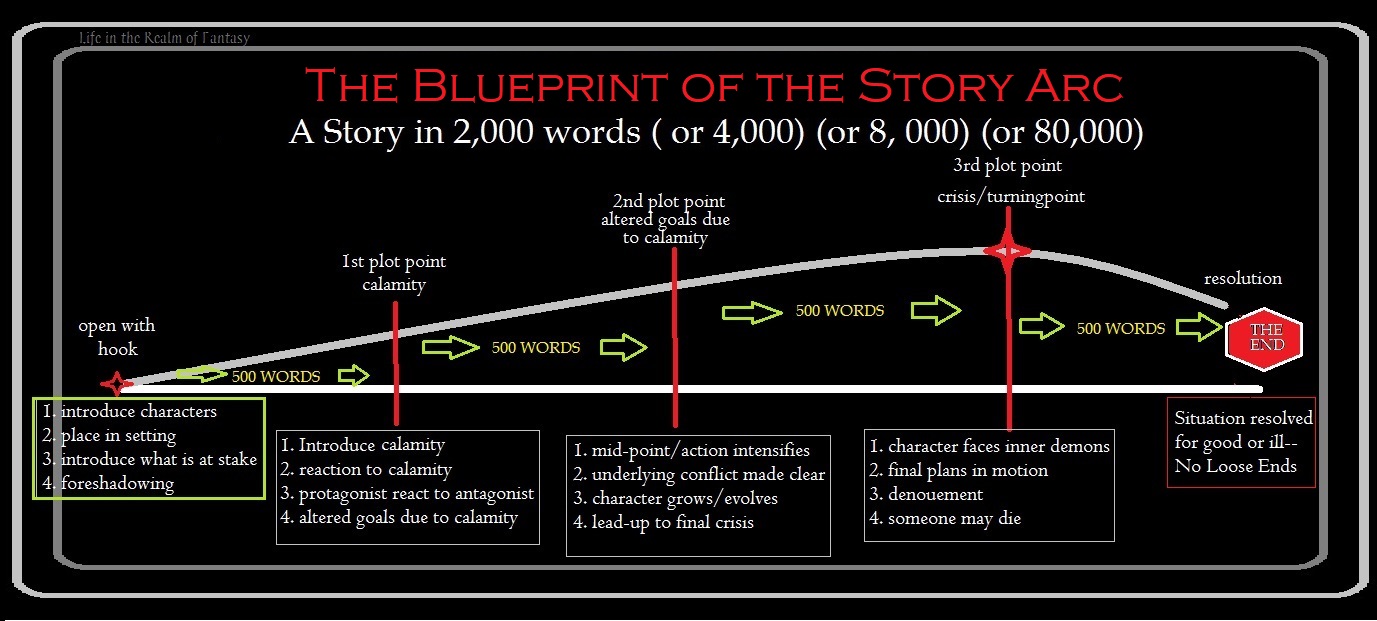
All writers begin as readers. As we read, we see an arc to the overall novel. It starts with exposition, where we introduce our characters and their situation. Then, we get to the rising action, where complications for the protagonist are introduced. The middle section is the action’s high point, the narrative’s turning point.

writing craft functions of the sceneAfter we survive the middle crisis, we have falling action. We receive the crucial information, the characters regroup, and we experience the unfolding of events leading to the conclusion. The protagonist’s problems are resolved, and we (the readers) are offered a good ending and closure.

I think of scenes as micro-stories. Each one forms an arch of rising action followed by a conclusion, creating a stable structure that will support the overall arc of the plot.  In my mind, novels are like Gothic Cathedrals–small arches built of stone supporting other arches until you have a structure that can withstand the centuries. Each scene is a tiny arc that supports and strengthens the construct that is our plot.

Each scene has a job and must lead to the next. If we do it right, the novel will succeed.

The key difference in the arc of the scene vs. the overall arc of the novel is this: the end of the scene is the platform from which your next scene launches. Each scene begins at a slightly higher point on the novel’s plot arc than the previous scene, pushing the narrative toward its ultimate conclusion.

ArcOfScenesLIRF04062024These small arcs of action, reaction, and calm push the plot and ensure it doesn’t stall. Each scene is an opportunity to ratchet up the tension and increase the overall conflict that drives the story.

My writing style in the first stages is more like creating an extensive and detailed outline. I lay down the skeleton of the tale, fleshing out what I can as I go. But there are significant gaps in this early draft of the narrative.

So, once the first draft is finished, I flesh out the story with visuals and action. Those are things I can’t focus on in the first draft, but I do insert notes to myself, such as:

  • Fend off the attack here.
  • Contrast tranquil scenery with turbulent emotions here.

My first drafts are always rough, more like a series of events and conversations than a novel. I will stitch it all together in the second draft and fill in the plot holes.

So, how do I link these disparate scenes together? Conversations and internal dialogs make good transitions, propelling the story forward to the next scene. A conversation can give the reader perspective if there is no silent witness (an omniscient presence). This view is needed to understand the reason for events.

Milano_Duomo_1856Transition scenes must also have an arc supporting the cathedral that is our novel. They will begin, rise to a peak as the necessary information is discussed, and ebb when the characters move on.

Transition scenes inform the reader and the characters, offering knowledge we all must know to understand the forthcoming action.

A certain amount of context can arrive through internal monologue. However, I have two problems with long mental conversations:

  • If you choose to use italics to show characters’ thoughts, be aware that long sections of leaning letters are challenging to read, so keep them brief.
  • Internal dialogue is frequently a thinly veiled cover for an info dump.

An example of this is a novel I recently waited nearly a year for, written by a pair of writers whose work I have enjoyed over the years. I was seriously disappointed by it.

The protagonist’s mental ramblings comprise the first two-thirds of the novel. Fortunately, the authors didn’t use italics for the main character’s mental blather.

This exhausting mental rant contained very little critical knowledge. Ninety percent of what the man ruminated on was fluff—it was all background covered in the broader series and didn’t push the story forward. At the midpoint, I considered not finishing the book.

AsymetricInformationLIRF01062024Plots are driven by an imbalance of power. The dark corners of the story are illuminated by the characters who have critical knowledge.  This is called asymmetric information.

The characters must work with a limited understanding of the situation because asymmetric information creates tension. A lack of knowledge creates a crisis.

It’s tempting to waffle on but a conversation scene should be driven by the fact that one person has knowledge the others need. Idle conversations can be had anywhere, and readers don’t want to read about them. Characters should discuss things that advance the plot in such a way that they illuminate their personality.

The reader must get answers at the same time as the other characters, gradually over the length of a novel.

I struggle with this, too. Dispersing small but necessary bits of info at the right moment is tricky because I know it all and must fight the urge to share it too early. Hopefully, all these bumps will have been smoothed out by the end of my second draft.

8ce052b8e7c8182a51dc4999859c1061When we write a story, no matter the length, we hope the narrative will keep our readers interested until the end of the book. We lure readers into the scene and reward them with a tiny dose of new information.

I have no idea whether the novel I’m working on today will be an engaging story for a reader or not. But I’m enjoying writing it.

And that is what writing should be about: writing the story you want to read.

2 Comments

Filed under writing

#FineArtFriday: An Out-of-Doors Study by John Singer Sargent (revisited)

Artist: John Singer Sargent  (1856–1925)

Title: An Out-of-Doors Study

Description: English: Paul César Helleu Sketching with his wife Alice

Signature bottom right: John S. Sargent

Date: 1889

Medium: oil on canvas

Dimensions: Height: 65.9 cm (25.9 ″); Width: 80.7 cm (31.7 ″)

The weather has been dark and dreary here in the Pacific Northwest. I need sunny day, and I remembered this image. An Out-of-Doors Study, 1889, is by expatriate American artist, John Singer Sargent. It depicts fellow artist and great friend, Paul César Helleu sketching with his wife Alice Guérin. What a lovely day it was, for them to be sitting on the grass, enjoying a carefree moment in life.

What I love about this painting:

This painting depicts a day in the life of two great artists. The grass looks very like that which grows beside streams in my part of the world. The colors are that mix of green and brown that long grass has when summer is just beginning. The blue sky is reflected in the water. They had taken advantage of a fine day in late May or June perhaps, fortunate to have an outing before high summer turns the meadow grass crisp and brown.

The quality of light that day was perfect for a picnic beside the water. One can imagine the two artists working on their individual projects and chatting, having a relaxing lunch, and then taking a quiet walk. We can even wonder if, later, they might have taken the canoe out.

January has been overcast and rainy with little chance of seeing sunshine. I could use a day like this, a picnic beneath blue skies, and a gathering of friends beside a quiet pond.

About the artist, via Wikipedia:

Sargent’s early enthusiasm was for landscapes, not portraiture, as evidenced by his voluminous sketches full of mountains, seascapes, and buildings. Carolus-Duran’s expertise in portraiture finally influenced Sargent in that direction. Commissions for history paintings were still considered more prestigious, but were much harder to get. Portrait painting, on the other hand, was the best way of promoting an art career, getting exhibited in the Salon, and gaining commissions to earn a livelihood.

In a time when the art world focused, in turn, on ImpressionismFauvism, and Cubism, Sargent practiced his own form of Realism, which made brilliant references to VelázquezVan Dyck, and Gainsborough.


Credits and Attributions:

Wikimedia Commons contributors, “File:Sargent – Paul Helleu Sketching with his Wife.jpg,” Wikimedia Commons, the free media repository, https://commons.wikimedia.org/w/index.php?title=File:Sargent_-_Paul_Helleu_Sketching_with_his_Wife.jpg&oldid=273586527 (accessed December 5, 2019).

Wikipedia contributors, “John Singer Sargent,” Wikipedia, The Free Encyclopedia, https://en.wikipedia.org/w/index.php?title=John_Singer_Sargent&oldid=927728162 (accessed December 5, 2019).

2 Comments

Filed under #FineArtFriday

Version control or how to save your sanity #amwriting

Here we are in the bright new year, and one way to help keep it bright and shiny is to never lose your manuscript.

MyWritingLife2021BIf you have been a computer user for any length of time, you know that hardware failure, virus attacks by hackers, and other computer disasters will happen. They’re like the Chelyabinsk meteor—hard to predict, difficult to recover from, and a horrible surprise when they happen.

Nothing is worse than discovering that all those hours of work on a labor of love were for nothing. A consistent system for saving and backing up the files in each project will save you time and tears.

As a municipal liaison for NaNoWriMo, I met many authors who didn’t know how to properly save files. They were new writers who didn’t understand how important it is to keep the old file and save it as a new one to work out of. They made massive cuts to the storyline, but instead of first renaming the file, they saved it and continued working. Those original sections were gone, along with the ideas and a lot of good prose that could have been reused elsewhere.

USB_DriveThis year, I met a young man who, being new to using a word processing program, forgot how he named his 2022 manuscript. He couldn’t find it when he decided to start writing again. I showed him how to search for files by date, taught him how to name documents, and taught him how to create a master file for all the files generated in the process of writing his book.

Also, keeping an external backup updated is crucial. If the computer dies, months of work won’t be lost forever. You will have a backup.

I generate work in a variety of subgenres, which complicates things. Each project is intended for submission to different places, so I have a large number of files in my writing folder. That’s why I use a cloud-based file hosting service.

  • I can’t misplace or lose it.

fileFolderI work out of Dropbox, so when I save and close a document, my work is automatically saved and backed up to the cloud. My files are always accessible even when working offline, so if the power goes out, I can access my work for as long as my computer’s battery holds out.

Many cost-free storage systems are available for your backup—Google Drive, OneDrive, or even a standard portable USB flash drive. Some people also purchase an external hard drive, which I have done for my images and graphics files.

Most people have never had a reason to learn how to label files consistently. It is a skill I developed, as properly filing things was part of my job. I was responsible for naming and saving my employers’ files in a consistent and manageable way. In 1993, when my office went from paper to PC, those skills transferred easily.

Each book will generate several files.

  • The original first draft manuscript and the subsequent drafts.
  • Documents detailing research and a list of sources and their links.
  • Random notes we generate in the process of creation.

Epic Fails signOne thing I hear from new writers is how surprised they are at how easily something that should be simple can veer out of control. The worst thing that can happen to an author is accidentally saving an old file over the top of your new file or deleting the file entirely.

Version control is a system that enables us to maintain an accurate history of changes to a file (or set of files) over time. We can return to specific versions as needed later, so nothing has been lost. 

The way you structure your filing system will evolve as you discover what works best for you. It will ultimately be centered around:

  • what you’re filing,
  • the number of files you are working with,
  • the various sub-categories (subfolders) your system needs to be broken down into.

A filing system is quite simple. For most documents, my system is a standard office-type system that consists of:

DIRECTORY> FOLDERS> SUB-FOLDERS> DOCUMENTS

My first draft of any manuscript will be given a Master File with a working title. That will be a handle to carry it by.

Within that master file, I have maps and every version of the original manuscript. The subfolders are clearly labeled and contain the old versions and any research that pertains to it.

Why do I keep so many versions of a manuscript? Every draft of that novel has some good things that I had to set aside for the sake of the story arc, but I never delete old files. You never know when you will need something you have already written.

  • The internet says using an underscore ( _ ) instead of a space in file names is a best practice. This is because some applications and computer scripts may not recognize spaces or will process your files differently when using spaces. If you intend to submit your work to a publisher, use the underscore to indicate spaces in the title to label any file you submit to them.

Screenshot_lennsStoryLIRF01022024I make a separate subfolder for my work when it’s in the editing process. That subfolder contains two subfolders, and one is for the chapters my editor sends me in their raw state with all her comments:

  • My editor saves each individual chapter as a separate new document, giving them a specific name: RoA_edit1_IL_01-10-22. (Ruins of Abeyon, Irene Luvaul edit 1, January 10, 2022.)

She does this because she edits one or two chapters a day and sends them to me that evening, and I save them in the subfolder for the raw edits. The other subfolder is for the finished work with the completed revisions:

  • I make the revisions Irene suggests and then save the chapter into that second folder: RoA_cjj_revised_jan-11-22. (Ruins of Abeyon, Connie J. Jasperson, revised January 11, 2022.)

We don’t lose the order of chapters because we have a reliable system for naming files, which we ALWAYS use. Consistency is critical when labeling files.

One thing to be aware of is to save it as a Word DOCUMENT and not a Template. If you save it as a template, you will keep getting a warning that the document is read-only and won’t let you save your changes.

screenshot_SaveAsDocumentLIRF01022024

Libraries’ is the screen that opens when you click “Save As” and is where you go to manage your documents, music, pictures, and other files. You can browse your files the same way you would in a folder or view your files arranged by properties like date, type, and author. These pictures, above and below, are of File Explorer libraries (Microsoft Windows file listing browser).

Name your files consistently and save each version in the master folder. Below is the master file for Lenn’s Story, the working title for my 2023 NaNoWriMo project (which still has no title).

You will create many versions of your manuscript. You will find the road much easier if you manage your versions well. And the event of equipment failure, you will have access to the most recent version of your work because it was regularly backed up to the cloud or an external drive.

File_names_save_master_file_screen_shot

4 Comments

Filed under writing

What I #amreading and #amwriting in the #HappyNewYear

Happy first day of 2024! The sun has been rising a few minutes earlier and setting a few later for a few days now, unnoticed because of the gloom and rain of a typical Pacific Northwest winter. Spring must be on the way because the internet says so.

MyWritingLife2021We are at the same latitude as Paris, Zurich, and Montreal but usually get a lot more rain than those cities. The North Pacific can be wild at this time of the year, which makes for some great storm-watching.

I read several books over the Christmas hiatus, two worth the time, and one—not so much.

The first two were written by the late mystery author Jane Haddam (Orania Papazoglou): Not a Creature Was Stirring (published in 1990) and Precious Blood (published in 1991). I had read both of these when they were first published, and let me say that they were every bit as great the second time as I thought they were the first.

The third book I read was on preorder for nearly a year, and I had been eagerly awaiting it. Published by one of the Big Traditional Publishers, it launched the second week of December 2023. The novel was written by one of my favorite fantasy author-duos. I’m not naming names because I don’t feel comfortable writing bad reviews. (That’s also why I don’t review books authors send to me.)

Unfortunately, this book is a masterclass in how NOT to structure a novel.

The book reads like something I might write when my mind is wandering, and I’m trying to figure out what to do next in a first draft. The first two-thirds of the novel is comprised of mental ramblings covering old ground and snippets of history. The lowest point comes when they spend ten pages dressing the main character for an important event, ten more pages covering the event, and three entire pages covering why the valet puts the ceremonial robes and tabards into storage.

CAUTION INFO DUMP ZONE AHEADBy the time the authors got to the meat of the matter (which was late in the second half) I no longer cared. Truthfully, when the fluff is carved away from this book, you might have 20,000 or so words of an interesting story—a novella.

This proves to me that everyone writes a stinker once in a while because we’re all human. I suspect the authors having to meet a firm deadline for completing this novel is why it’s not as good as the previous two in that series.

The Big Traditional Publishers expect great things from their stable of authors, but pushing them to force out two or three novels a year does no one any favors.

Anyone can shove out words at a fast clip when you must set down a certain number of them daily to meet a deadline. But what you have when that deadline is met might only be a pile of words.

Sometimes, a book isn’t a novel. Sometimes, a story works best as a novella, and stretching it just doesn’t work. What are the traditional lengths for novels, novellas, and novelettes?

The internet says: Here are the differences between novels, novellas, and novelettes:

  • A novelette is longer than a short story but shorter than a novella. The word count is usually between 7,500 words to 17,500 words.
  • A novella is longer than a novelette and is sometimes called a long short story or a short novel. It is usually around 20,000 words or more.
  • A novel is longer than a novella and is meant to be read over several days.
  • All tell a complete story within that length.
  • Traditionally, novelettes tended to focus on whimsical, sentimental themes. The modern-day novelette, though, is more like the novella because it can encompass different genres like sci-fi, drama, or historical short fiction.

The internet pulled the above information from this website: Learn the Differences Between Novelettes, Novellas, and Novels – 2023 – MasterClass. I highly recommend clicking on this link for a good article on the length, word count, and expected content of these literary forms. Who knows? You might want to take one of their masterclasses.

Writing long-form stories is a struggle at times. I have a “passel” of short-form stories and plan to format and publish two volumes of short stories, novelettes, and novellas sometime this year.

ICountMyself-FriendsI’m planning two volumes because one will feature stories set in the world of Neveyah, and the other will be random speculative short fiction pieces.

The New Year is upon us, and frankly, it’s getting off to a strange start.

Greg and I are in self-imposed quarantine because two days ago, we were exposed to Covid at close quarters.

I had planned to make an Avocado, Tomato, and Cucumber salad to take to last night’s annual New Year’s Eve party. Instead, we sat at home, watched a new episode of Vera, and watched New Year’s at the Space Needle: The Space Needle Dazzles the Pacific Northwest with Lights, Drones, and Fireworks for T-Mobile New Year’s at the Needle (yahoo.com).

The fireworks display over the Space Needle has become a Pacific Northwest tradition, and they went all out this year. The drones were amazing. I managed to stay awake long enough to watch it all.

Regardless of the plague, Greg and I enjoyed the evening. I hope your new year gets off to a great beginning. Wherever you are in this world, I wish you all the good things life can bring!

20191019_180732

8 Comments

Filed under writing

#FineArtFriday: The Merry Family, by Jan Steen (revisited)

Jan Steen was fond of painting peasants and ordinary people, and this picture is a good example of that.

What I love about this image is the chaos. Is this a New Year’s party? I hope so.

The clutter of pans and dishes heedlessly fallen to the floor, the boisterous enjoyment of wine and song, and the obvious lack of parental restraint is wonderfully depicted. The numerous children are smoking and drinking to excess, vices that weren’t acceptable diversions for youngsters in those days any more than they are now. The baby is exceedingly chubby, which was uncommon and represents the vice of gluttony–in one hand it holds bread and in the other it waves a spoon.

I suspect the children grew up with a similar love of wine and song as their parents.

The note on the wall contains the moral of the story. According to the Rijksmuseum website, “The note hanging from the mantelpiece gives away the moral of the story: ‘As the old sing, so shall the young twitter.’ What will become of the children if their parents set the wrong example?”

The Age of the Puritan had swept across Europe and while it was waning in the mid-seventeenth century, puritanism had influenced life in Holland as much as elsewhere. This painting is a wonderful visual exhortation reminding the good people to live a sober life. Steen himself was not a puritan, as he was born into a family of brewers and ran taverns and breweries off and on throughout his life. But he did need to sell his paintings as he was never a successful businessman, and his allegorical paintings were quite popular.

Quote from Wikipedia: Daily life was Jan Steen’s main pictorial theme. Many of the genre scenes he portrayed, as in The Feast of Saint Nicholas, are lively to the point of chaos and lustfulness, even so much that “a Jan Steen household,” meaning a messy scene, became a Dutch proverb (een huishouden van Jan Steen). Subtle hints in his paintings seem to suggest that Steen meant to warn the viewer rather than invite him to copy this behaviour. Many of Steen’s paintings bear references to old Dutch proverbs or literature. He often used members of his family as models, and painted quite a few self-portraits in which he showed no tendency of vanity.


Credits and Attributions:

The Merry Family, Jan Steen, 1668 PD|100 via Wikimedia Commons

Moral (English translation) quoted from Rijksmuseum website,  https://www.rijksmuseum.nl/en/collection/SK-C-229, accessed 17 May 2018.

Wikipedia contributors. “Jan Steen.” Wikipedia, The Free Encyclopedia. Wikipedia, The Free Encyclopedia, 3 Jan. 2018. Web. 17 May. 2018.

Comments Off on #FineArtFriday: The Merry Family, by Jan Steen (revisited)

Filed under #FineArtFriday