Conference Season #amwriting

I love writers’ conferences. I can immerse myself in the craft of writing and not feel like the odd duck. They can be expensive, but conferences help you make connections across both sides of the publishing industry, traditional and indie.

My Writing LifeYou might want to attend a conference but are worried about cost. I have ways to keep your expenses down.

If you are a regular here at Life in the Realm of Fantasy, you may have seen my two-part series on the business side of being an author. If not, and you are interested, I will put the links to those articles at the bottom of this post. In the meantime, here are some pointers for making attending a conference more affordable.

One: Join the association offering the conference because members get reduced conference fees, sometimes by as much as $100.00. Take advantage of the early-bird discount if you can. Members will often have opportunities for remote learning all year long. I belong to three writers’ associations, each offering virtual classes I can access all year.

Two: Small local events. Does your library system offer presentations on the craft of writing by local authors? These small classes will likely be free if it is a public library. If they don’t offer little seminars occasionally, suggest it to them. Perhaps they’ll be willing to ask some local authors to do such an event.

Three: Use the internet. Google “writers’ conferences in my area.” Local ones are great because you can eat food that fits your dietary needs and sleep at home. That way, you only pay for the conference itself.

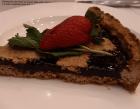
Vegan_DesertsFour: Did I mention food? If you are planning to attend a large convention or conference where you will need to stay in a hotel, take simple foods that can be prepared without a stove and are filling. As I am vegan, I’m an accomplished hotel-room chef. Most coffee bars don’t offer many plant-based options. If they do, there will likely only be one to choose from, and it may not interest you. While that bias is changing, I still travel prepared.

Conferences work for me as an extension of the self-education process. Most of what I know about the craft of writing, the genres I write in, and the publishing industry as a whole are things I could only learn from other authors.

I gained an extended professional network by joining The Pacific Northwest Writers Association in 2011. Every year since then, I have attended their annual conference. Even during the pandemic in 2020 and 2021, they held a virtual conference, which was an excellent example of what humans are capable of at short notice.

I attend the Science-fiction & Fantasy Writers of America (SFWA) Nebula Conference every year. The pandemic also inspired SFWA to move to a hybrid in-person and virtual conference, so my only cost is the conference fee itself. That cost is quite reasonable because I always take advantage of my membership and early bird discounts.

I am not a happy flyer, so a virtual conference is definitely my thing if I can’t drive there. However, since SFWA is a worldwide association of professional science fiction and fantasy authors, their conferences will also be available virtually for the foreseeable future.

I attended the Southwest Washington Writers Conference (SWWC) two weeks ago. This shindig is local enough that I can commute from my home. I was privileged to present a one-hour class on the character arc and layers of depth, Heroes and Villains – Who are they, and why should we care? I had a lot of fun talking to other writers and hearing what they struggle with. In the end, I hope what I had to say helped them through the rough spots.

This last weekend, I was in Seattle, Washington, attending PNWA’s 2023 conference. I expect the ideas and information I encountered will emerge in my posts over the next few months—after I’ve had time to distill it. Each time I’m exposed to a different way of looking at things, my creative thinking style is reshaped.

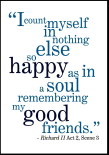
ICountMyself-FriendsI’m a small fish in a vast ocean. Attending local conferences puts me in contact with other authors and industry professionals, most of whom are successfully pursuing their craft. I meet people I don’t usually come into contact with as they hail from all over Washington State, Oregon, Idaho, and British Columbia.

The connections I make within the writing community often turn into friendships, which are sometimes the most valuable things I bring home from the conference.

Here are the two posts on the Business Side of the Business:

The Business Sequence for Writers, guest post by Ellen King Rice #writerlife | Life in the Realm of Fantasy (conniejjasperson.com)

The Business Side of the Business, part 2: Inventory #writerlife | Life in the Realm of Fantasy (conniejjasperson.com)

2 Comments

Filed under writing

#FineArtFriday: Autumn in North America by Frederic Edwin Church 1896

Autumn_in_North_America-Frederic_ChurchArtist: Frederic Edwin Church  (1826–1900)

Title: Autumn in North America

Genre: landscape art

Date: 1856

Medium: oil on board

Dimensions: height: 28.5 cm (11.2 in); width: 43.1 cm (17 in)

Collection: Thyssen-Bornemisza Museum

What I love about this picture:

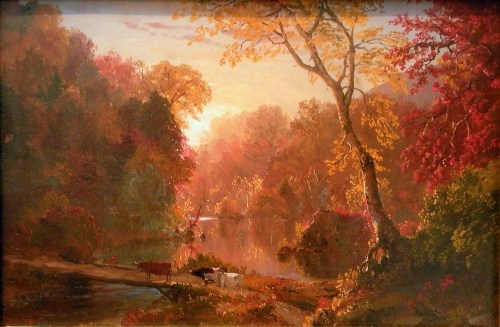
This is a New England autumn in full color, the way autumns never are here in my part of the world. Yes, non-native trees will turn these bright shades, but the only bright red fall color in native species will be vine maples. Staghorn Sumac is a non-native plant that has become a part of our local flora, and it turns bright red also. But we do have gorgeous golds and oranges beginning to show in our native deciduous forests.

Many years it is too wet for a colorful fall, and the leaves turn a soggy brown and drop off their trees, sodden masses nearly impossible to rake.

About the Artist, via Wikipedia:

Frederic Edwin Church (May 4, 1826 – April 7, 1900) was an American landscape painter born in Hartford, Connecticut. He was a central figure in the Hudson River School of American landscape painters, best known for painting large landscapes, often depicting mountains, waterfalls, and sunsets. Church’s paintings put an emphasis on realistic detail, dramatic light, and panoramic views. He debuted some of his major works in single-painting exhibitions to a paying and often enthralled audience in New York City. In his prime, he was one of the most famous painters in the United States. [1]


Credits and Attributions:

IMAGE: Wikimedia Commons contributors, “File:Autumn in North America-Frederic Church.jpg,” Wikimedia Commons, https://commons.wikimedia.org/w/index.php?title=File:Autumn_in_North_America-Frederic_Church.jpg&oldid=718218353 (accessed September 19, 2023).

[1] Wikipedia contributors, “Frederic Edwin Church,” Wikipedia, The Free Encyclopedia, https://en.wikipedia.org/w/index.php?title=Frederic_Edwin_Church&oldid=1162133197 (accessed September 19, 2023).

6 Comments

Filed under #FineArtFriday

Frustrations and blessings #amwriting

Microsoft has dispensed with using old traditional “straight” quotes (quotes without any curves or contours) as the default choice. Instead, it now uses curly “smart” quotes. Also, the most recent update changed my settings to Microsoft’s default choice, and I didn’t notice it for several days at least.

MyWritingLife2021Not every program or platform supports curly quotes, so those gurus who claim they are the only quotes you should use are wrong.

So, what is the problem? Why would I say such a thing? Smart quotes mess up the formatting in some files or on web pages. An example of what happens can be found here: Editing: The Problem with Smart Quotes | LinkedIn.

The most upsetting thing is this—I don’t know how many documents I messed up before I caught the problem. I have no clue which projects now sport straight quotes mingled with curly. I’ll have to resolve that document by document, using a global search and replace. It’s not the end of the world, but is inconvenient.

If you’re like me and prefer straight quotes because they’re less hassle, you will want to change the default curly quote setting in your Microsoft Office apps. Here is a link to a webpage that will walk you through the process: How to change ‘smart’ quotes to ‘straight’ quotes in Microsoft Word, Outlook and PowerPoint | Windows Central.

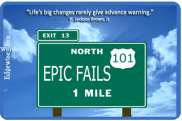
Epic Fails memeAnother frustration, this one of my own devising, is the mess I have deliberately created in a new project. I’d run into a wall with this story last winter, so I set it aside. Then, two weeks ago, I had the bright idea to change the viewpoint and make it present tense.

That change has injected life into the narrative. Unfortunately, it’s created a minor problem that I suspect my editor will chastise me for—verbs that somehow fell through the cracks and didn’t get changed from past tense to present. Went to goes, had to has or have—things I have spent hours on and will spend countless more when it gets out of the first draft stage.

And no matter how I comb for bloopers now, Irene will have her work cut out when she gets this mess.

The positive side of this self-imposed difficulty is the way the plot is unfolding. The words are pouring onto the paper now that my protagonist is telling the story.

One of the blessings I’m grateful for this week is a direct result of the pandemic: the fabulous people who do the shopping and deliver groceries to my door. I have never enjoyed shopping, and as I wend my way through the store, I forget what I intended to buy and bring home things I never knew I wanted. Hooray for the delivery people who bring the groceries I ordered to my door. I like this convenience so much that I even enjoy putting the food away.

Now, if only the laundry would do itself, that would immensely help.

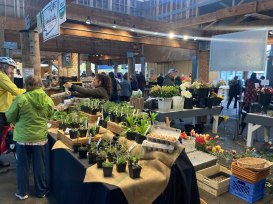
Olympia_Farmers_Market_04We do get out sometimes, though. We have a wonderful farmer’s market in this town. The hubby and I enjoy shopping for some things when they’re in season: locally crafted jams, honey, and mustard. We don’t get down there as often as we’d like, but we always find something delicious when we do. The last time, it was a fabulous lemon raspberry jam that was to die for from a local producer, Johnson Berry Farms.

Another blessing in our life is the number of restaurants in this town. Olympia is friendly to all dietary persuasions. Every restaurant has at least one plant-based option, and so far, they have all been delicious and thoughtfully prepared. Last night, we had dinner at Cynara, near the boardwalk and the Olympia Farmer’s Market.

It’s a fancy restaurant, with a fancy menu and a fancy tab—but an occasional splurge keeps life interesting. The food there is fabulous. Greg had a lamb dish, and I had their cauliflower. Both meals were eye-candy and every bit as delicious to eat as they were to look at.

As I write this, I’m preparing to head north to Seattle for the annual PNWA Writers Conference. I attend every year, and always feel bad about leaving my husband on his own. So, this year, Greg will go with me for some downtime in the hotel. The hotel we’ll be staying at has many amenities for a man hoping for a bit of relaxation; not the least is a decent sports bar serving good food.

chefSeptember is always a month of transition. The summer weather is changing to cooler days, and leaves are turning red and yellow. The days are growing shorter, and the traffic outside our windows during rush hour is a little more frantic.

This is the month when homemade bread and crockpot soups make the house feel cozy. We’re still spending time on the balcony and finding humor in watching the shenanigans of harried commuters as their cars fly by in excess of the speed limit. But soon, the rain will move in and drive us indoors.

Not to worry—we’ll have plenty of opportunities to pass judgment on their driving skills from our window.

That’s it for today. I hope your frustrations are minor, and may your blessings far outweigh them.


Credits and Attributions:

Image: Olympia Farmers Market, Wikipedia contributors, “Olympia, Washington,” Wikipedia, The Free Encyclopedia, https://en.wikipedia.org/w/index.php?title=Olympia,_Washington&oldid=1176094163 (accessed September 19, 2023).


5 Comments

Filed under writing

Weddings, equipment failures, industry news, and awesome sunrises #amwriting

This last week has been a productive week for writing despite the irritations. Yet, those bumps were quickly ironed out, and no one died.

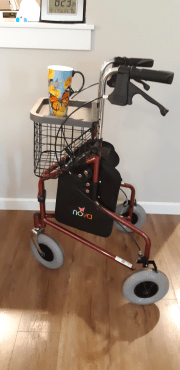
R2D2ServingTeaSomething we don’t think about when we’re young and healthy is that the equipment disabled people rely on can fail. The first thing that failed this week was his little walker for getting around in indoor spaces—I’ve named it R2D2 since it’s perfect for serving drinks on the space-yacht that is our home.

R2 is ideal for getting around inside restaurants and theaters. Unfortunately, one of the screws holding the bar that keeps it from collapsing while my husband is using it lost the washer and nut, so I spent the weekend making sure the screw stayed where it was supposed to, which was distracting. Fortunately, Amazon carries bolts, nuts, and washers and ships them overnight and it is now repaired.

Then, there was assembling the paperwork for getting our will redone, this time including a durable power of attorney and an advance healthcare directive. When we had our will made twenty years ago, it was a simple thing, merely a list of our assets, rights of survivorship, and on the survivor’s death, dividing what is left equally among our blended family of five children.

This time, we had to fill out a pre-appointment questionnaire that asked questions I felt were intrusive and had no bearing on the disposition of our not-so-vast fortune.

I became a bit testy.

My husband, ever a man of common sense, talked me into a more rational frame of mind. He explained we need to ensure no random claims arise that could hold up the disposition of any $$ and intellectual properties we might leave our children.

FileDocumentSo, we had to supply dates and names of previous marriages and divorces—which, in my case, involved getting copies of three divorce decrees from the county. (I’ve had a life, and while I could have done some things differently, I don’t regret it for a moment.)

My Gramma Ethel (born in 1909) stayed with me when I was going through some hard times, watching my kids while I worked two jobs. My grandmother, bless her, was a cleaning tornado. She threw things like Christmas cards and old legal documents out when she cleaned—without asking first. These things were over and done in her mind, so why keep junk you don’t need? She hated things that took up space and gathered dust.

It was a trivial failing. Every evening, I came home to a clean house, a hot meal, and happy children. She was the best, and I valued her wisdom and unconditional love more than I can say. She still influences me in all the best ways. (Except I don’t clean house as well as she did.)

But back to equipment failures. The next one is slightly hilarious–my husband’s “ejector chair” suddenly failed to eject. Greg is 6’3” and is not overweight. But he’s a big man. Trying to get him out of the chair stuck in the reclined position was complicated and entertaining. I could hardly breathe for laughing.

Just so you know, the chair does not move when it doesn’t have power, or if the controller fails, which is what happened.

He sleeps much of the night in that chair, and it enables him to be more mobile in his daily life. But the people at the store where we purchased it came to our home and fixed it immediately, so Grandpa is back in business.

We attended our nephew’s wedding on Friday—a happy day for the family. It was beautiful, romantic, and everything a wedding should be. It was held in a local venue, a barn converted to host large gatherings. Greg and I are especially close to this nephew, as he spent part of a summer with us when his brother was seriously injured in an off-road vehicle accident, and his parents had to make an emergency trip to Oklahoma.

(Getting R2 folded and stowed in my sister-in-law’s trunk – and out again – is where the loose screw became a bit of a pain. But as I mentioned above, the wedding wasn’t held in Midsomer County, so nobody died.)

But let’s talk about sunrises—oh my goodness. One thing I love about our apartment is the view of the morning sky. Some sunrises are spectacular, and I find a reason to see every sunrise I can. This morning, clouds were moving in, and the eastern horizon was lit with crimson fire—a sight that only lasted briefly. Still, brief though it was, remembering it makes me glad to be alive.

steampunk had holding pen smallBut enough chit-chat about me. Let’s talk about writing. This week, I made headway on a first draft I had set aside a year or so ago because I was stuck at the 30,000-word point. I changed the narrative tense from close third person omniscient to first person present tense for the protagonist and third person present tense for the side characters. That change kickstarted things and the plot is unfolding as it should.

I always have several projects in the works, so when creativity fails in one, I move on to another. I have been making the loose outline for my NaNoWriMo project to finish the second half of a duology.

And finally, Greg and I will be attending the Pacific Northwest Writers Conference in Seattle on Wednesday. I attend this conference every year. I benefit from the presentations as much as the networking. I will talk more about the two conferences of this month next week.

And now for a bit of publishing industry news:

We’re all trying to get our books noticed, and sometimes the blurb on the back of the book isn’t enough, so we turn to other authors who might be willing to give us an endorsement we can print on the cover or use on our Amazon page. For an interesting article on the usefulness (or not) of author endorsements, I recommend ‘A Plague on the Industry’: Book Publishing’s Broken Blurb System (msn.com).

An excellent article on creativity and AI is AI vs human: the publishing industry’s way through the AI revolution (msn.com).

If you haven’t watched “The Other Black Girl,” you might be interested in this article: Hulu thriller ‘The Other Black Girl’ mocks publishing industry: review (msn.com).

Finally, for an article on diversity and equal representation, I heartily recommend Latino Coalition Launched to Boost Latino Representation in the Publishing Industry – Latin Heat.

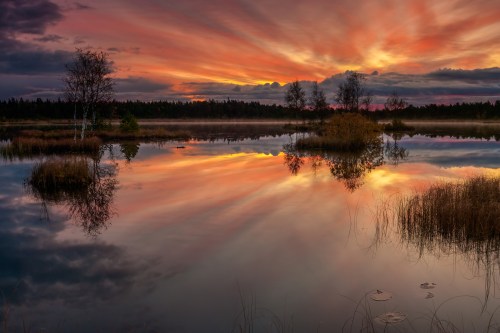
So, that’s the way the week was at Casa del Jasperson. May the week ahead be filled with all the good things, and may your words flow freely! What follows is an amazing image of sunrise, found on Wikimedia Commons just for you.

Laanemaa_järv_Orkjärve_looduskaitsealal

Sunrise at Lake Laanemaa at Orkjärve Nature Reserve, Estonia


Credits and Attributions:

IMAGE: Sunrise at Lake Laanemaa at Orkjärve Nature Reserve, Estonia.  Wikimedia Commons contributors, “File:Laanemaa järv Orkjärve looduskaitsealal.jpg,” Wikimedia Commons, https://commons.wikimedia.org/w/index.php?title=File:Laanemaa_j%C3%A4rv_Orkj%C3%A4rve_looduskaitsealal.jpg&oldid=801967887 (accessed September 17, 2023).

5 Comments

Filed under writing

#FineArtFriday: Autumn Landscape (September) by Lucas van Valckenborch

GG_5684.tif

Artist: Lucas van Valckenborch  (1535–1597)

Title: Autumn Landscape (September)

Date: 1585

Medium: oil on canvas

Dimensions: 116 x 198 cm Rahmenmaße: 131,5 x 214 x 6,5 cm

Collection: Kunsthistorisches Museum

What I love about this painting:

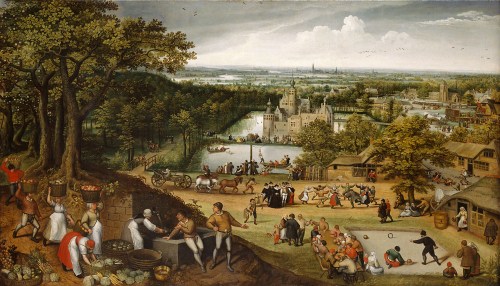
We see an entire view of ordinary autumn life in the 16th century, but better than that, Lucas van Valckenborch shows us the passage of time. He depicts the chronology of how people lived and celebrated each week of the changing season by showing us September in the Netherlands.

The way he shows us this chronology is ingenious and is a signature of his work. The early weeks of September are shown in the left foreground, with laborers bringing in the harvest. Others are working to dry and preserve foods. The colors he uses are vivid, the last shades of summer.

In the bottom to middle right, he shows us mid-September with people relaxing, feasting, bowling, and dancing. The harvest is in, and people have a little time to enjoy the last days of good weather. The colors he uses are more muted, with shades of brown dominating. The leaves are brown and falling. Yet, there is a vibrancy about it, a sense of life. People celebrate a successful harvest one last time before winter’s cold grip closes in.

In late September, people fish, and the market becomes the center of village life. People are less active, but the market draws customers. The end of September presages colder weather and hints at the beginning of winter. This is shown in cool shades of gray, as if in a black-and-white photograph.

He is known for using this trick of color to denote receding distances. But he deliberately places figures performing specific activities within those colors, showing us how people lived and the passage of their days as well as distance.

The first days of September are bright, days of plenty. Yes, we’re working hard, but we’ll be grateful for the bounty when winter comes.

We look forward to the middle of September, because once the rush of harvest is over we will party like it’s 1585.

In the distance, we know the cold dark days loom, but we are prepared. Our cellars will be full and we will hunt and fish while we can.

Lucas van Valckenborch’s body of work shows us that he was a brilliant storyteller as well as an artist. Many paintings of that time show us the poverty, but here we see the prosperity of a village during the early renaissance. It wasn’t all doom and gloom after all.

About the Artist and his work, via Wikipedia:

Lucas van Valckenborch or Lucas van Valckenborch the Elder (c. 1535 in Leuven – 2 February 1597 in Frankfurt am Main) was a Flemish painter, mainly known for his landscapes. He also made contributions to portrait painting, and allegorical and market scenes. Court painter to Archduke Matthias, the governor of the Spanish Netherlands in Brussels, he later migrated to Austria and then Germany where he joined members of his extended family of artists who had moved there for religious reasons.

In their mixture of fantasy and accurate topographical details, van Valckenborch’s landscape paintings offer a view of the world and man’s relationship to it. This is particularly clear in his rocky landscapes in which the diminutive people on the winding path are reduced by the monumental cliffs. An example is the Rocky Landscape with Travelers on a Path (c. 1570, Sotheby’s 6 July 2016, London lot 3) where the distant goatherd and the silhouettes of his charges seem ant-like in comparison to the vast distance, and the vertiginous perspective of the scene. This dramatic visual depiction is clearly intended as a commentary on man’s place within the universe.

He also painted, between 1584 and 1587, a series of large pictures depicting the labours of the months, probably on commission for Archduke Matthias. These compositions, of which seven survive (five of which are in the Kunsthistorische Museum), present the various months of the year by showing the changing landscape and the traditional activities of humans during each month. It is not clear whether the five missing paintings were never painted or are lost.[4] Due to their realistic setting these compositions carry a documentary interest. The work of Pieter Bruegel the elder, who had painted a series of 6 on the times of the year, was influential on van Valckenborch. Lucas van Valckenborch moved away from the tradition of painting the landscape in three cascading distances that were rendered in three different colours: brown, green and blue for each receding plane. Rather he often left out the green tone for the middle distance. He also innovated the thematic scenes by developing them into genre scenes with a stronger narrative depth. [1]


Credits and Attributions:

[1] Wikipedia contributors, “Lucas van Valckenborch,” Wikipedia, The Free Encyclopedia, https://en.wikipedia.org/w/index.php?title=Lucas_van_Valckenborch&oldid=1173224796 (accessed September 14, 2023).

IMAGE: Autumn Landscape (September) by Lucas van Valckenborch. Wikimedia Commons contributors, “File:Lucas van Valckenborch – Autumn landscape (September).jpg,” Wikimedia Commons, https://commons.wikimedia.org/w/index.php?title=File:Lucas_van_Valckenborch_-_Autumn_landscape_(September).jpg&oldid=618977280 (accessed September 14, 2023).

3 Comments

Filed under #FineArtFriday

#NaNoPrep: Discovering your writing style #amwriting

Are you a ‘pantser’ or a ‘plotter?’ For me, the answer lies somewhere in the middle. I plot, get two paragraphs in, and then find myself winging it, and the plot goes in a new direction. Then I replot and let it fly again.

crows-clip art clicker vector dot comAlso, my first drafts are not written linearly. I write what I am inspired to, skipping the spots I have no clue about. I fill in those places later. Even after completing the first draft, things will change structurally with each rewrite.

But what if you aren’t interested in writing a novel? What if you are a poet or your best skill is the short story?

In thirteen years of participating in NaNoWriMo, I have discovered that there is no one way that fits everyone. You’ve had this idea rolling around your head for a while now for something you’d like to read. You wish your favorite author would write it. In my experience, you must write it yourself, or it will never happen.

Your favorite author can only write so fast. Not only that, but what they’re in the mood to write might not be your wished-for book.

I’ve noticed a trend—most authors don’t live beyond 100 years of age. Unfortunately, dead authors rarely publish new books unless they are ghostwriters.

So, there you go–if you want that book, write it yourself.

My addiction to NaNoWriMo began innocently, as all good habits do: A young writer in the Philippines whom I had met through a gaming website mentioned he planned to do this writing challenge. I had never heard of it.

nano-computer-word-count

November’s Goal

It was a worldwide thing where hundreds of thousands of people began writing a novel on November 1, intending to have it finished by November 30.  The catch was that you couldn’t start until 12:01 a.m. on November 1st; it had to be at least 50,000 words long, but it could be longer. And you had to have it validated by 11:59 p.m. on November 30th to earn the coveted winners’ goodies.

I wasn’t sure I could do this crazy thing. All I had to do was write 1,667 words daily, which I felt I could do. I figured the worst that could happen was that I would fail to have anything to write about.

Fear of failure had never stopped me from ruining my life, so I googled the national website and signed up. I chose the handle dragon_fangirl.

At 6:30 a.m. on November 1, 2010, I looked at my laptop and had no idea what to do. I wrote the first line as if I were telling myself a fairy tale. Inspired by my misspent childhood reading such disparate works as Don Quixote and the heartily misogynistic adventures of Fafhrd and the Gray Mouser, I wrote:

There was a cabin in the woods.

Author-thoughtsIt wasn’t exactly literary brilliance, but it gave my idea a jumping-off point. I just began telling the story as it fell out of my mind. Surprisingly, I discovered my word count averaged 2,500 to 3,000 words daily. By day fifteen, I knew I would have no trouble getting to 50,000, and by November 21st, I had passed the 50,000-word mark.

At the 68,000-word point, I had completed my rollicking tale of snark and medieval derring-do. It was utterly unpublishable (say that hokey phrase three times!), but I didn’t know that until later.

What I did know was that I had written a complete novel and told the kind of tale I would have sought out at the bookstore.

All it needed was rewriting, editing, revising, rewriting, and putting it in a drawer, never to be seen again.

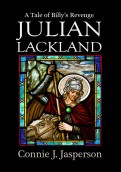
Julian_Lackland Cover 2019 for BowkersBut I took that incoherent mess apart, and over the next ten years, it became three books: Huw the Bard, Billy Ninefingers, and Julian Lackland.

One rule they tell you at NaNoWriMo is never to delete and don’t self-edit as you go along. This is all strictly stream-of-consciousness, so write how it falls out of your head. That was hard for me, but eventually, I got into the swing of things.

My rules for NaNoWriMo:

  1. Write at least 1,670 words every day. Technically, it’s three more words than the pros suggest, but it gives me a little cushion and takes about 2 hours. I’m not fast at this.
  2. Write daily whether you have an idea worth writing about or not. Write that grocery list if you have nothing else. When stuck, I work on my characters’ personnel files, visualizing them as people I might want to know. Every word counts toward your ultimate goal. We will talk about my approach to writer’s block next week.
  3. NANO CrestIt helps to check in on the national threads each day. Look at your regional threads on the national website to keep in contact with other local writers. You will find out when and where write-ins are scheduled.
  4. Be brave! Attend an in-person write-in or join a virtual write-in at NaNoWriMo on Facebook. The company of other writers keeps you enthused about your project.
  5. Try NOT to self-edit as you go. Just get that story down from beginning to end.
  6. Delete nothing. Passages you want to delete later can be highlighted, and the font turned to red or blue so you can easily separate them later.
  7. Remember, not every story is a novel. If your story ends, draw a line at the bottom of the page and start a new one in the same manuscript. You can always separate them later; that way, you won’t lose track of your total word count.
  8. Update your word count every day. It’s an honor system, but you get little badges for updating every day and achieving specific goals. One badge is for updating your word count more than once in one day. I try to earn all the badges, and most years I do.

In 2015, I took a different path from the usual novel-in-thirty-days approach. I named my project November Tales. I suffered from a bout of pneumonia and worked from my bed for most of the month. Even so, I managed 42 short stories, all fueled by Nyquil and desperation, totaling 107,000 words.

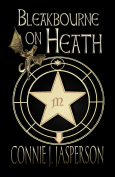
Bleakbourne front Cover medallion and dragon copyIncluded in this mess were ten dreadful poems, along with chapters 7 through 11 of Bleakbourne on Heath.

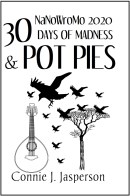
The following year began the same, this time with a severe case of bronchitis. I named my project November Tales 2016 – 30 Days of Madness and Pot Pies. I started by writing short stories, flash fiction, drabbles, and poems. Within five days, I was writing the first draft of a novel and managed to get 90,000 wonky, misspelled words.

That novel is still in the first draft stage, but I intend to finish it in this year’s NaNo rumble.

If you choose to join this writing free-for-all, go to www.nanowrimo.org and sign up! Pick your name, start your author profile, and look up dragon_fangirl (that’s me). Add me as your writing buddy, and I will be part of your writing posse, cheering you on when you need a morale boost.

3 Comments

Filed under writing

What is National Novel Writing Month, and should I participate? #NaNoWriMo

September is in full swing, and with it comes writers’ conferences. This last weekend, I attended the Southwest Washington Writers’ Conference in Centralia, Washington. I sat in on presentations by Lindsay Schopfer, Mellissa Hart, Elizabeth Goddard, and many other writers, all discussing the craft of writing. I also gave a small presentation on adding depth to our heroes and villains.

2020_nano_Project_coverConferences are excellent places to make good connections with other writers. You meet people you can talk to about every aspect of the experience of writing as well as craft. No one’s eyes glaze over when you try to explain your main character’s inner demons and you find people with struggles similar to your own.

You also meet industry professionals who will help you on your road to a finished project.

I have another conference in two weeks, this one in Seattle. After PNWA’s 2023 conference, I will plow through my notes for new info, as conferences always give me plenty of fodder for several blog posts.

September is also the time of year when I begin pulling together the characters and plot of my next novel. I’m a Municipal Liaison for NaNoWriMo (National Novel Writing Month).

If you haven’t heard of this, it’s a worldwide event taking place in November. Each year, thousands of people in all parts of the world dedicate themselves to writing a 50,000-word narrative in only thirty days.

NaNoWriMo is a contest in that you have achieved your goal if you write 50,000 words and have your word count validated through the national website. But it is not a contest in any other way as there are no monetary prizes or fame for those winners, only a PDF winner’s certificate that you can fill out and print to hang on your wall.

Depending on your intended audience, a manuscript of only 50,000 words is a short novel. It’s a good length for YA or romance but is only half a novel for epic fantasy or literary fiction.

nano-computer-word-count

November’s Goal

Regardless of the planned length of their finished novel, a dedicated author can get a book’s basic structure and storyline down in those thirty days. They sit for an hour or two each day and write at least 1667 words.

That’s all you need to do. At the end of 30 days, you will have written 50,000 words.

Author Lee French and I are co-MLs for the Olympia Region for NaNoWriMo. Every year, many writers in our area create profiles at www.nanowrimo.org and embark on the writer’s journey. Lee and I work together to ensure they have all the necessary tools and support to achieve their goals.

We’ve been doing this for a while and have seen a pattern among our writers. The first roadblock happens when reality sets in, and the writers realize that writing is work. This usually occurs within the first few days. A small percentage will never get more than 2,000 words written.

They discover writing isn’t their jam, after all.

The majority of new NaNo writers are people who “always wanted to write a book.” Often, they don’t know what they want to write and have no clue how to be disciplined enough to write any words, much less the number it takes to make a novel.

They start, get 30 to 1,000 words in, and realize they have nothing to say. But in our region, many people will reach the 10,000-word mark before they stop writing. That’s an achievement—it’s almost a novella.

NANO CrestSome new writers are completely fired up for their novels, obsessed. They go at it full tilt for a week or even two, and then, at the 20,000-word mark, they take a day off. Somehow, they never get back to it. These writers will continue to write off and on and may participate in NaNoWriMo again.

Even seasoned writers who have crossed the finish line at NaNoWriMo in previous years may find that the commitment to sit and write 1,667 words daily is not doable. Things come up—life happens, and it’s okay to set the writing aside. You can always come back to it later.

But by November 30th, a third of the writers in our region will make it to the 50,000-word mark. Some will reach above 80,000, and a few will exceed 100,000.

Some of these novels have complete story arcs and are ready for revisions. Most are not, but more work could make these proto-novels publishable.

It takes commitment and discipline to write 1,667 new words every day. You are not revising old work. Instead, you’re writing something new and not looking at what you wrote yesterday.

To do this, you must sit at the keyboard, open the document to where you left off, and begin writing forward. I have some tips and tricks to simplify this process, and we will discuss them later.

I’m not a good typist. The words that fall out of my head during NaNoWriMo are not all golden, just so you know. When writing stream-of-consciousness, many words will be garbled and miss-keyed.

This means that the revision process is a long and winding road for me.

I began writing Ruins of Abeyon, my forthcoming novel in November 2017, on the spur of the moment when I had a sudden flash of “what if.” I started with no outline, so the story arc evolved as I wrote the book. I listed the events in a separate document as I went. Later, when revising, it was easy to see the arc and make an outline. I could see when it was best to move certain events to more logical places and even when things needed to be cut.

Still, it has taken five years to get this book to where it is ready to be published.

Succeeding in writing even a short story gives one the confidence to continue.

If you have a novel in your soul and it’s bursting to get out, this might be your chance. However, planning for a successful NaNoWriMo is like preparing for a marathon.

We let our families know what we are planning well in advance and share how vital reaching our goal is to us. That way, we have their emotional support. We also plan ahead for meals and family time so the essential people in our lives aren’t neglected. In the US, this means fixing a Thanksgiving dinner on the last Thursday of November and enjoying the things that matter most.

Pumpkin-Pie-Whole-SliceCooking is my love language. I have many tips and ideas for getting word count and having a proper family feast. As a dedicated writer, I know how to plan for all aspects of life.

In many ways, we’re physically and mentally preparing for a marathon. We build our strength and get our families behind us by ensuring we have prepared well in advance.

Over the next few weeks, we will focus on laying the groundwork for our novels so that we will be ready and able to write when November comes.

Much of what I will discuss has emerged from my 13 years of experience and my co-ML Lee’s ideas for prep work.

I have made life-long friends through participating in my local NaNoWriMo group. The emphasis is on having fun and meeting personal goals, commiserating when goals can’t be met, and just enjoying the experience of creating something that is ours. We have the support and encouragement of the worldwide community of writers and people of all nations and walks of life.

Everyone has a story. Some people will write those stories, and I will be first in line at the eBook store, eager to read them.

NaNoWriMo-General-Flyer

3 Comments

Filed under writing

#FineArtFriday: Impression Sunrise by Claude Monet 1872, and the Fighting Temeraire by J.M.W. Turner 1839

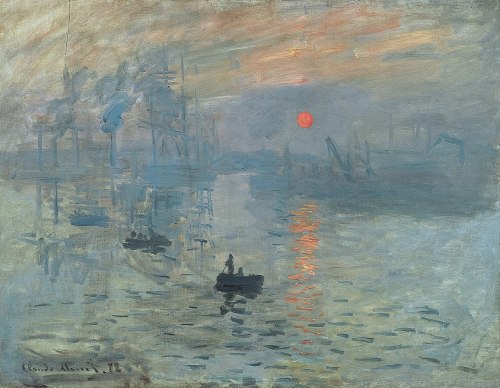
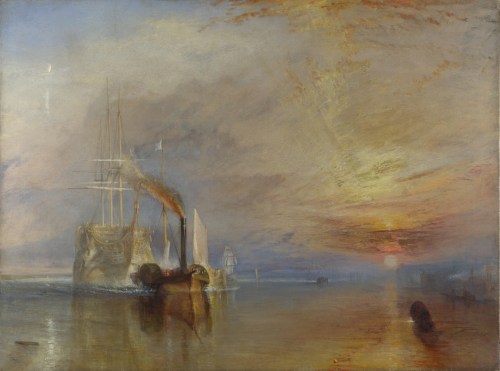
Today I am featuring two famous paintings, Claude Monet’s Impression Sunrise, the painting that gave  a name to an entire movement withing the artistic community. But Monet was not the first of the impressionists, and he freely admitted that he was an admirer of the radical and oft criticized (in his time) J.M.W. Turner.  Indeed, during the years Monet resided in England, he visited the National Gallery, viewing the works of Turner, whom he held in high regard. The painting that, in my opinion, belongs in the same room with Impression Sunrise is turner’s masterpiece, the Fighting Temeraire.

Both paintings are best viewed from a distance, and both have power. Both tell a story, and both artists faced the slings and arrows of critics who were unwilling to accept anything that strayed from traditional portraiture and landscape art.

Uncaring of the critics, both Monet and Turner wandered off in their own artistic direction, and we can be grateful for that stubborn desire to paint what they felt as well as what they saw.

Turner’s work influenced Monet, and both artists influenced generations of artists who followed them.

Claude_Monet,_Impression,_soleil_levant

Artist   Claude Monet  (1840–1926) 

Title    Impression, Sunrise

Genre  marine art

Date    1872

Medium          oil on canvas

Dimensions     height: 48 cm (18.8 in); width: 63 cm (24.8 in)

Collection       Musée Marmottan Monet  


The_Fighting_Temeraire,_JMW_Turner,_National_Gallery

Artist:  J. M. W. Turner  (1775–1851)  (by Joseph Mallord William Turner)

Title: The Fighting Temeraire 1839

Description: The Fighting Temeraire tugged to her last berth to be broken up, 1838

Date: 1839

Medium: oil on canvas  

Dimensions: height: 90.7 cm (35.7 in)

Collection: National Gallery 


Credits and Attributions:

Impression Sunrise, Claude Monet 1872 [Public domain], via Wikimedia Commons: Impression, Sunrise – Wikipedia accessed September 09, 2023.

The Fighting Temeraire, J. M. W. Turner: 1839 [Public domain], via Wikimedia Commons: The Fighting Temeraire – Wikipedia accessed September 09, 2023.

3 Comments

Filed under #FineArtFriday

Guest Post: Five or six things I’ve learned by Stephen Swartz #amwriting

My dear friend, author Stephen Swartz, has kindly agreed to share some of his wisdom with us. Stephen is a fellow co-founder of Myrddin Publishing Group and is the author of eighteen novels. He writes in whatever genre suits his mood, and his work is always original and bold. So, without further yak-yak on my part, here is Stephen.

>>><<<

I’ve been asked to write about five or six things I’ve learned about being a so-called Indie author. Probably it will be closer to five than six, but no more than seven, unless I get inspired. Inspiration is the hardest part, however. That’s one thing.

guest_post_LIRF09052023How to get inspiration? That translates to getting a story idea. I used to think up nifty situations and wondered how an average person would deal with it. That’s the good ol’ what-if set-up you find mostly used in sci-fi stories. The problem with focusing on the cool idea is that usually the characters who have to deal with it become rather cardboard. That’s fine when you’re a young writer or producing a first draft. Slap it down and keep going. You can come back later to beef up the character, add description details, and so on. Whatever the idea is, get it out of your head at any cost.

I think a lot of new writers get hung up trying to write perfectly from the start. That will eat you alive, so stop doing that. Write whatever, as dumb or meaningless as it may come out of you. It won’t be the final version. You can fix it up later. I was already doing that when I came upon a quote (attributed to poet William Stafford), that goes a little bit like this: “When the writing gets hard, I lower my standards.” So I have a file of unfinished stories I dabble with whenever I need to work the gears a bit before I get to my serious writing – or when I hit a wall and need to pause before continuing the serious writing.

fluSeasonBookOfMomWhat is serious writing? Even if it’s comedy, it’s the writing you take seriously. What you want readers to admire, no matter the genre. That is all well and good, but you will find that what you think is good isn’t always what readers think is good. Got nothing to do with what you’re writing or how well you write it, it’s just the way it is. So don’t take yourself too seriously; you can take your writing seriously, of course. The idea is that the writing will get better for readers each time you go through a manuscript and revise and edit it. How many times you go through it is your decision. It helps to get someone else’s eyes on it at some point, especially if you are new at writing. You can look at a map but until you get to your destination you can’t be sure that map is accurate and you’re going the right way. Sounds like another thing I learned.

Characters are the bane of my existence, so I put them through Hell and only some come back. Can’t be afraid to bust some noses. We aren’t all Mary Sue and her pretty dolls to whom nothing even remotely bad ever happens. Real people are flawed, make mistakes, say stupid things, miss a lot, sin like there’s no tomorrow, take wrong turns, and get lost. They fret and regret and get down on themselves. You have to show all of that through description (body language, including nods and sighs) and dialog that matches the character. If writing in such a way that you can pop into the character’s head, you can slip in some thoughts and feelings and backstory to add richness to the character’s presence in the story. Every scene is an opportunity to broaden a character into a full-fledged person you’d want to sit down and have a cup of coffee with…right up until you kill ’em off. That’s the one big thing I learned in my long-ago MFA program in Creative Writing: interesting characters will draw your readers in better than a cool idea or weird setting.
fluSeason2I started reading a long time ago. Started writing soon after, making up my own stories which I thought were better than the ones I read. I borrowed here and there – and in later writing had to tone it down so as not to sound like the sources I borrowed from (sci-fi authors, mostly). You develop your own style eventually if you write enough. So write a lot; you don’t have to show it to anyone. I like to try writing in different styles, too. I like trying to have characters speak in different ways, some slang, vernacular, accents, different levels of education, just for my own amusement – which is cruel, I’ll admit. But trying different things is good for a writer. Read different styles, too, and try to imitate them. Read the juicy parts aloud, let them get stuck in your head. Consider what is special about the style the author uses. Compare and contrast with other authors you read, and with your own writing. Most of all, read a lot in different genre and different writing styles. How much you absorb from that differs for everyone, but try it.

You may hear about story arcs and how to outline a story (or novel) and think you have to do that, too. You don’t. Well, awrighty, if you read a lot then you don’t. You’ll pick up a sense of pacing from reading a lot, and you’ll know when to let things happen. It’s not a perfect system but, if you got it in you (i.e., a plot ‘clock’ ticking away, urging you to pull that trigger already) it’ll work. I seldom outline more than scribbling a few notes about what happens next. I do get to the middle and have to pause and look ahead to see how to get to the end, but that’s the fun part of writing. I know how the final scene will be usually by the time I’ve written a fifth of the way into the novel (about 20,000 words). I think I’ve changed what happens at the end only twice in 18 novels.

If it helps, think of a movie, the kind we find these days: the action hook, the backstory & character development, then we get on with the story, reach the mid-point, more action, crisis after crisis…. Well, you get to know what to expect every few moments. That’s not interesting. So shake it up. Sure, keep enough that it looks like it’s supposed to for the audience’s sake, but do some things differently for variety. Same with a book: keep enough of the genre features so that readers know what genre it is (maybe!) but change or add some things that keep the reader guessing. I like to mash-up my novels: two or more genre together. First of all, it’s simply more interesting for me to write. Second, I like for readers to get something unexpected (or so I’ve been told I tend to believe!). Like a crime thriller (my novel EXCHANGE) with that age-gap romance in the later chapters that turns creepy by the end. Didn’t see that coming, did you?

fluSeason3Finally you have a complete story (or novel) from beginning to end and the plot is satisfying, characters compelling, dialog crisp, and so on. What next? Read and revise at least three times, but put it away at least a few days between each reading (a month is optimal; go get some coffee). Yes, I know you’re eager to get into it again but make yourself wait. Go to your slush file and work on that erotica. Now back to your masterpiece. Try to read it as a reader who’s never seen it before: what would the average reader think and feel in this scene or on that page? You’re no longer thinking of how to write the story so now you focus on how someone you don’t know might understand it. (Sure, go ahead and correct those pesky mistypes as you find them. No rule saying you have to do that in a separate pass.) I like to look at scenes in isolation: every scene should do something, even if it is “only” showing a character’s personality. I read dialog aloud (or, recently, have my computer read it to me); I catch a lot of mistakes and sloppy or weak sentences that way. Run spellchecker until it’s about to fall off the rails but understand it is not actually reading and still will miss errors. You must read your manuscript with your own eyes and ears more than twice. Look for pet-peeve errors (e.g., I type ‘form’ a lot when I mean ‘from’; obviously the spellchecker will not catch it because ‘form’ is correctly spelled, just the wrong word). I run a search for them. Most importantly, never ever hit “replace all”!

I’ve lost count on the number of advice things. Maybe this is enough to get you started. Some is common sense, of course, some you’ve likely heard before. Much is just my personal routine which may or may not work for other writers. I know myself, my foibles and tendencies, so I can more or less keep them in check or know what to look for when editing. Know thy self is another advice thing.

Lastly, I think the two biggest flaws in the writing of “new authors” I have read are: 1) a dull story, and 2) a flat cast. In the MFA program I suffered through (that’s a separate blog post) the professor once told me, when a story I’d written wasn’t working: “Get a better idea.” Yes, there are some ideas that just don’t make good stories – or, in the alternative, you or I just can’t pull it off satisfactorily. Even with a good idea, a cast of characters that are like cardboard won’t keep a reader reading. Yes, it’s true, no matter how long I insisted. A good idea is only as good as the crafting of the story, that is, the writing itself. More than writing correctly, it should have a flavor, a style, a particular way of letting the words flow – and that is up to the author, perhaps with some help from the narrator.

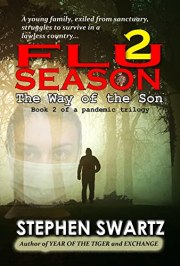
In my most recent novels, FLU SEASON*, a trilogy focused on the hardships of a family trying to survive a 9-year pandemic and the lawlessness that follows, an autistic teen son narrates the first two books while his daughter narrates the third book. Each has a unique way of speaking which I let out freely, including poor grammar and Southern vernacular. It builds the personality of the character and adds flavor to the setting. They absolutely cannot, should not, speak with perfect grammar. As I work on a sequel to the trilogy, I have a character who has more education so he speaks with more correctness than those before him.

Now I’ve gone past my nap time. Add up the advice and it probably comes down to do your own thing, keep doing it, share as much as you are comfortable doing, and read a lot for ideas.


*FLU SEASON, a pandemic trilogy:

Book 1: The pandemic of 2020-22 has ended, but what if its worst days extended into 6 years? Follow autistic teen Sandy and his single Mom (& her tuba) as they flee a city in collapse for the hope of sanctuary with relatives, a plan which doesn’t succeed. (Nov. 2022)

Book 2: Sanctuary from a pandemic is only good if you can stay there. When Sandy and his young family are exiled from the island, he struggles to find a way to save them while they face the worsening situation. Without Mom to guide him, Sandy must take on all the responsibilities for survival in the lawless outerlands. (May 2023)

Book 3: There is no safe space – except maybe hiding away in the forest of a national park. But when others have the same idea, Sandy’s family faces a variety of opportunities and challenges. As the post-pandemic world recovers, it is his daughter who must carry the family forward, no matter the difficulties she and her sisters must face. (Sept. 2023)

You can read more about this trilogy here:
http://stephenswartz.blogspot.com/2023/08/flu-season-3-dawn-of-daughters.html

and here (with more about writing process):

http://stephenswartz.blogspot.com/2023/05/the-flu-season-trilogy-doing-what-i-do.html

About the Author
stephen-swartzStephen Swartz is the author of literary fiction, science fiction, fantasy, romance, and contemporary horror novels. While growing up in Kansas City, he dreamed of traveling the world. His novels feature exotic locations, foreign characters, and smatterings of other languages–strangers in strange lands. You get the idea: life imitating art.

After studying music and even composing a symphony, Stephen planned to be a music teacher before turning to fiction writing, and taught writing at a university in Oklahoma. Stephen Swartz has published poetry, stories, essays, and articles for scholarly journals in the U.S. and Japan

3 Comments

Filed under writing

#BookReview: Scrapings and Leavings by Dennis Mansker

I love short story collections. In high school, I could hardly wait for my father to finish his copy of the annual anthology of award-winning short stories. Some of the best work I have ever read has been in the form of short stories. George Saunders’s brilliant Tenth of December comes to mind.

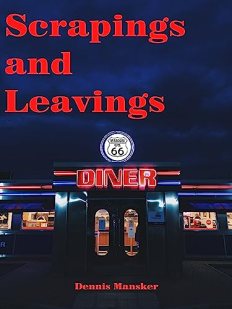
But I don’t only read fantasy or science fiction. I read in all genres, and one recent compilation of short stories that I feel good about recommending is Scrapings and Leavings by Dennis Mansker. This collection includes stories and plays written over the course of many years. Each story or play offers the reader food for thought.

I liked that he included background as to why he chose the title and also why he wrote each story or play.

scrapings and leavings by dennis manskerMansker takes us into some of the darker days of the 1960s and 70s, sometimes introducing us to people we may not want to know and situations we don’t want to be in. Some protagonists are endearing, and some not so much—but all are intriguing, and all kept me reading.
The story that really stood out to me was My Summer of Crime. It details the youthful misadventures of Farnsworth, who later becomes the protagonist of his novel, A Bad Attitude, which is set during the Vietnam War.

You can find this book of short stories and Dennis Mansker’s other work at  Amazon.com: Dennis Mansker: books, biography, latest update.


About the Author

Dennis Mansker considers himself at 78 one of the latest of late bloomers. He published his first book, A Bad Attitude: A Novel from the Vietnam War, in 2002 at the age of 57. His second book, Scrapings and Leavings, will be published in 2023, and he is hard at work on his third book, Destiny in Dallas, which is on track to be published early in 2024.

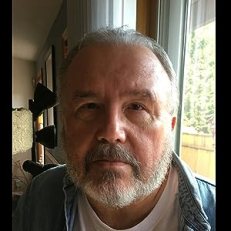
Dennis Mansker author photoHe was born in Longview WA, spent five years on a dairy farm near Bristow OK, and is a 1973 graduate of Western Washington University in Bellingham WA.

He was drafted into the army in 1967, and spent nearly a year in Vietnam as company clerk of two US Army Transportation Corps trucking companies, an experience which formed the basis for the plot of his first book.

He retired after 31 years of state service with the Employment Security Department. He is responsible for producing four children, nine grandchildren and seven great-grandchildren (so far).

He lives in Olympia WA with his long-suffering wife Susan and two cats, who generously allow their humans to think that they are in charge.

Comments Off on #BookReview: Scrapings and Leavings by Dennis Mansker

Filed under writing