
Moving into our new apartment has eaten heavily into my writing time but after today, our work in the old house is done. But due to my time constraints, today we are revisiting a post from January 16th, on words and the way we use them. If you have already seen this post, thank you for stopping by! Next week we will talk about sci-fi and fantasy maps and discuss mapmaking.
Warping words and abusing the rules of grammar can be exhilarating, but no matter what our native language, some speech habits are ingrained in us. We want our written conversations to sound natural, so here are a few speech habits native speakers of English learn from birth:
Syntax is defined as the arrangement of words and phrases to create well-formed sentences in a language. English has certain standard rules of speech that are learned so early on in life that they are instinctual.
 No matter the level of our education or the dialect we speak, we use these rules and don’t realize we are doing so.
Several years ago, I found three delightful quotes on these rules from linguist Steven Pinker, editor Stan Carey, and Tim Dowling, a journalist for The Guardian.
The Jolly Green Giant rule:
The rule is that multiple adjectives are always ranked accordingly: opinion, size, age, shape, colour, origin, material, purpose. Unlike many laws of grammar or syntax, this one is virtually inviolable, even in informal speech. You simply can’t say My Greek Fat Big Wedding, or leather walking brown boots. And yet until last week, I had no idea such a rule existed. Tim Dowling, for The Guardian, 13 September 2016. [1]
My editor often finds and points out words whose order must be rearranged to sound natural. Some sentences seem clumsy when she reads them because when I first wrote that section, I was going too fast and put my words in the wrong order.
I didn’t notice it during the revision process. Some hokey phrasing goes unnoticed by me through upwards of six revisions.
Why do we overlook typos and errors in our work? StudySkills.com tells us:
… the more familiar our brains are with the content in print, the less we are able to focus on details. It’s how our brains are designed to work. We often cannot see our own writing mistakes. (Susan Kruger Winter, CEO & Founder of SOAR Learning, Inc. Why We Can’t See Our Own (Writing) Mistakes, 22 July 2018) [2]
It happens because, in the first draft, I am madly getting the words out of my head. My ability to use a pen or run the keyboard can’t keep up with the stream of words falling from my mind.
- (Wrong) My red large Cadillac is fun to drive.
- (Right) My large red Cadillacis fun to drive.
Actually, my small blue KIA Soul is fun to drive. (Grandma’s imaginary red Ferrari would be a lot more fun, but no one would be safe on the road.)
 Muddled phrasings often slip by when I revise my work because my mind sees the words as if they were in the correct order. This is the writer’s curse—the internal editor knows what should be there, and the eye skips over what we actually wrote.
This ability to see our work as if it were finished is a necessary aspect of creativity. We have an image of what it should look like and know what needs to be done to shape it that way. However, after so many hours of laboring on a manuscript, our brains can trick us into seeing what we intended to write, overlooking the flaws.
When I first began writing, I had a naïve belief in the perfection of my work. I was soon shown differently, and (once I grew a thicker skin) I found a good editor.
In every language, native speakers automatically order their words in specific ways. In English, we order them this way:
- opinion,
- size,
- age,
- shape,
- color,
- origin,
- material,
- purpose
Stephen’s dark blue wool jacket was left behind.
Another rule I love is the Mishmash rule:
“Reduplication” is when a word or part of a word is repeated, sometimes modified, and added to make a longer term, such as aye-aye, mishmash, and hotchpotch. This process can mark plurality or intensify meaning, and it can be used for effect or to generate new words. The added part may be invented or it may be an existing word whose form and sense are a suitable fit. (Stan Carey, A hotchpotch of reduplication, MacMillan Dictionary Blog 2012.) [3]
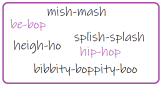 I adore mishmash words. They’re poetic and musical and roll off the tongue with a satisfying rhythm. Sadly, while I regularly bore my grandchildren with them, I hardly ever get to write them. Mishmash. Hip-hop.
The Hip-Hop rule:
Have you ever wondered why we say fiddle-faddle and not faddle-fiddle? Why is it ping-pong and pitter-patter rather than pong-ping and patter-pitter? Why dribs and drabs rather than vice versa? Why can’t a kitchen be span and spic? Whence riff-raff, mishmash, flim-flam, chit-chat, tit for tat, knick-knack, zig-zag, sing-song, ding-dong, King Kong, criss-cross, shilly-shally, seesaw, hee-haw, flip-flop, hippity-hop, tick-tock, tic-tac-toe, eeny-meeny-miney-moe, bric-a-brac, clickey-clack, hickory-dickory-dock, kit and kaboodle, and bibbity-bobbity-boo? The answer is that the vowels for which the tongue is high and in the front always come before the vowels for which the tongue is low and in the back. (Pinker, The Language Instinct, 1994:167) [4]
Verbs are power words. The order in which we place them affects how readers see our work. Sometimes we frontload our sentences with fluff: In any situation, Charlotte runs toward danger.
Moving the action to the beginning of the sentence and losing a few words makes it stronger. Nouns followed by verbs make active prose: Charlotte runs toward danger, never away.
First drafts are the place where we might write something like: Running toward danger, Charlotte was happy. This kind of awkwardness says what we mean but does it poorly. It might slip through many revisions because the internal editor rearranges them correctly, and we don’t see it as written.
 “Ing” words are a terrible temptation to those of us raised on Tolkien. He was writing a century ago, but that style of lush prose has fallen out of fashion. We open the gate to all sorts of verbal mayhem when we lead off with an “ing” word at the front of a sentence.
So, you now have a mishmash of words and a bunch of rules that native speakers of English use without consciously thinking about it. Wonky word order is one more thing to watch for when revising our manuscript.
But it’s easier to notice strange syntax when we are reading another author’s work.
CREDITS AND ATTRIBUTIONS:
[1] Tim Dowling, Order force: the old grammar rule we all obey without realizing, © The Guardian 2016, https://www.theguardian.com/commentisfree/2016/sep/13/sentence-order-adjectives-rule-elements-of-eloquence-dictionary (accessed 13 January 2023).
[2] Susan Kruger Winter, CEO & Founder of SOAR Learning, Inc. Why We Can’t See Our Own (Writing) Mistakes, 22 July 2018 (accessed 13 January 2023).
[3] Stan Carey, A hotchpotch of reduplication, MacMillan Dictionary Blog 2012 © Macmillan Publishers Limited 2009-2023. http://www.macmillandictionaryblog.com/a-hotchpotch-of-reduplication (accessed 13 January 2023).
[4] Steven Pinker, The Language Instinct, Pinker, Steven. 1994. The Language Instinct. New York: HarperPerennial.
 I have been following the adventures of Keltin Moore and his friends since the first novel,
 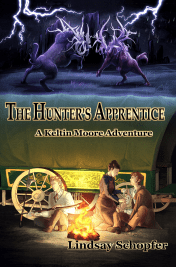 Beasts and weaponry abound in this installment of Keltin Moore’s adventures. The story opens with Keltin trying to keep his fledgling business afloat and pay the bill it incurs. It details the journey of his apprentice, Jaylocke. Jaylocke is a Weycliffe Wayfarer, a young man seeking to regain his status within his clan, by participating in a ritual called the Proving.
 Lindsay Schopfer is the award-winning author of The Adventures of Keltin Moore, a series of steampunk-flavored fantasy novels about a professional monster hunter. He also wrote the sci-fi survivalist novel Lost Under Two Moons and the fantasy short story collection Magic, Mystery and Mirth. Lindsay’s workshops and seminars on the craft of writing have been featured in a variety of Cons and writing conferences across the Pacific Northwest and beyond.
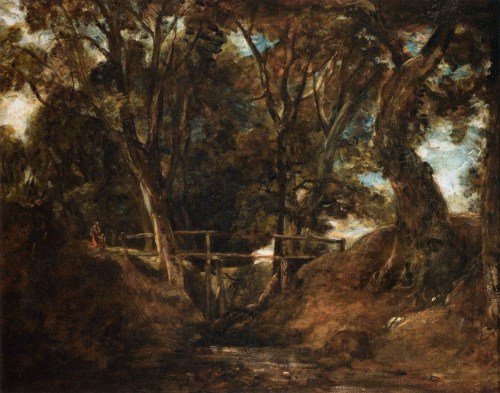 Artist: John Constable (1776–1837)
 It’s been over ten years since I first started writing my series about the adventures of a professional monster hunter. With the release of
 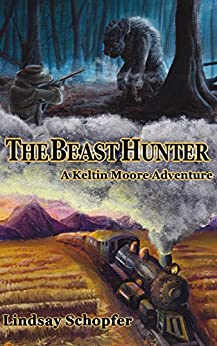 One of my most treasured experiences in writing The Adventures of Keltin Moore has been meeting the fantastic subject experts in the course of my research. I already mentioned panning for gold, but there have been so many more generous, enthusiastic people I’ve spoken to on subjects ranging from big game hunters to horse-pulled wagons. In particular, I feel blessed to have known Gordon and Nancy Frye. The Fryes are a fantastic wealth of historical information, particularly regarding the development and implementation of firearms over the centuries. If you ever read something in my stories and thought that something involving guns was particularly cool, you can probably thank the Fryes for contributing to it!
 The movers came on Friday to take what furniture we could gracefully fit into the new apartment. They loaded the van far more quickly than I thought they would. The main hiccup in that day came in the form of the elevator in our building. We are in building C but must go in through the main lobby in building B, take the elevator to our floor, and cross to our building via the sky bridge. It’s a long trek.
 Over the next week, we have to donate as much as possible to be reused, and the rest will be hauled away by the junk removal company. They will not only take the junk but also clean the garage floor. (!!!)
 On the good side, it is easy to write here. I have been writing bits and bobs here and there on old unfinished manuscripts between bursts of unpacking, writing whenever I sit down to rest my back. It keeps me from fidgeting.
 In literary terms, this uneven distribution of knowledge is called asymmetric information. We see this all the time in the corporate world.
 Jared is hilarious, charming, naïve, a bit cocky, and completely unaware that he’s an arrogant jackass. He is a young man who is exceptionally good at everything and is happy to tell you about it. Jared has no clue that his boasting holds him back, as no one wants to work with him.
 When I started writing this story, I had the core conflict: Jared’s misguided desire to be important. I had the surface quest: rescuing the kidnapped kid. I had the true quest: Jared learning to laugh at himself and developing a little humility.
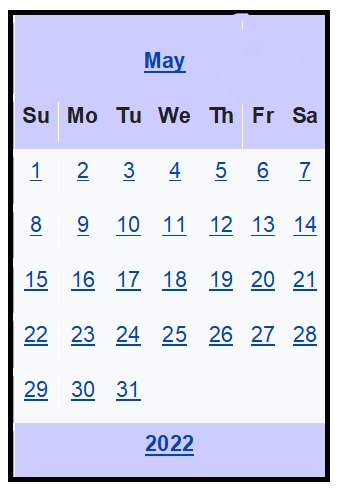 Calendar time is a layer of world-building. It sets the story in a particular era and shows the passage of time.
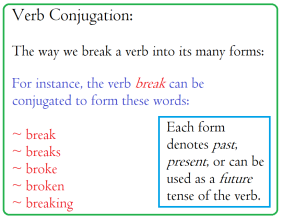 Consider the following sentences: “I eat,” “I am eating,” “I have eaten,” and “I have been eating.”
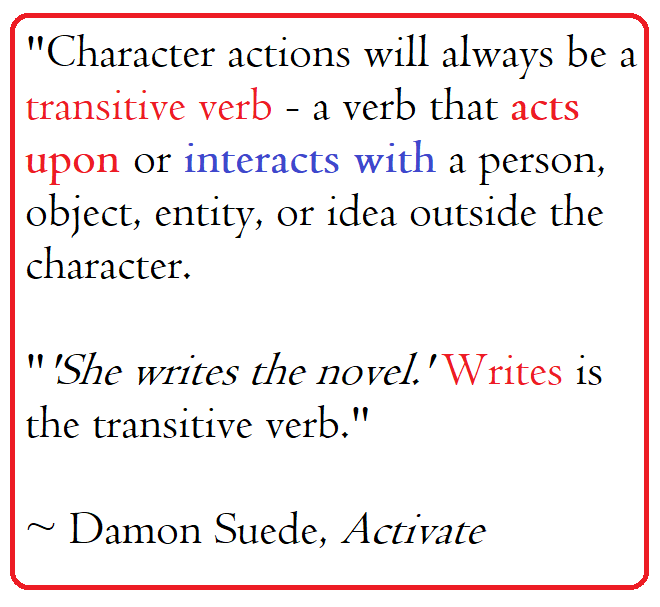 Every story is unique; some work best in the past tense, while others must be set in the present.
 If I were writing a story starring me as the main character, I would open it in the year 2005 with a couple of empty-nesters buying a house in a bedroom community twenty miles south of Olympia.
 The city center is isolated, twelve miles from the freeway and twenty miles away from every other town in the south county. If a fictional story were set in this town, it would feature the same political and religious schisms that divide the rest of our country. There are other tensions. Some families have been here for generations, and a few don’t appreciate the influx of low-paid state workers buying cookie-cutter tract homes (like mine) here.
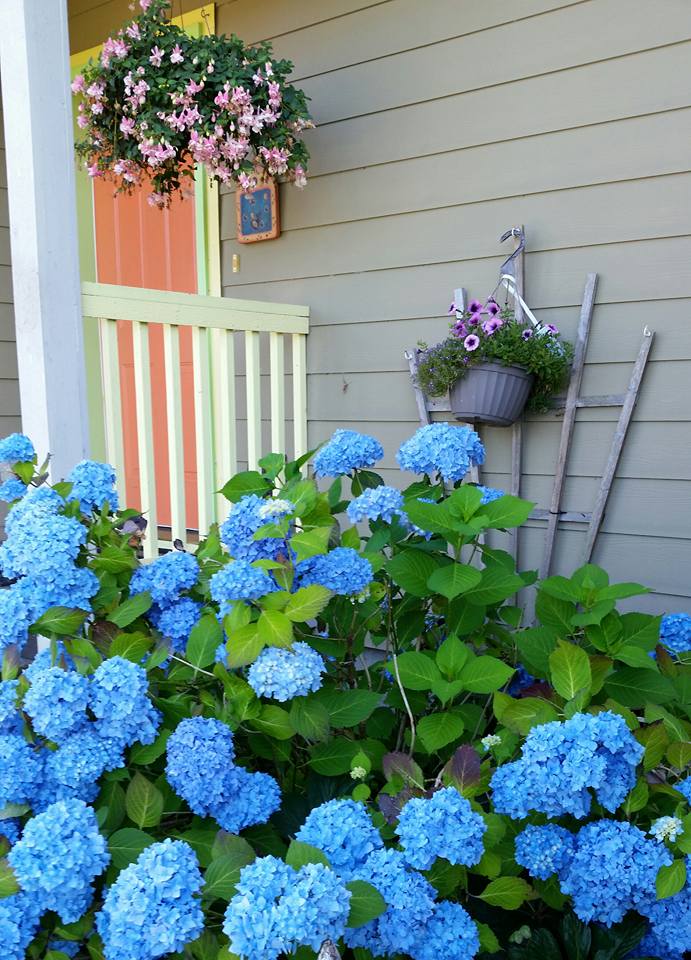 Two inches of rain fell the day we moved into our brand-new home in 2005, making moving our furniture into this house a misery. Our new house had no landscaping and rose from a sea of mud and rocks. With a lot of effort, we made a pleasant yard. When the housing bubble burst in 2008, many people on my side of the street lost their jobs, and some homes went into foreclosure.
 Our main street, Sussex, passes through a historic district. The buildings are all built from sandstone quarried at the old quarries. Many of the old buildings are home to antique stores. The masonic lodge is made of Tenino sandstone.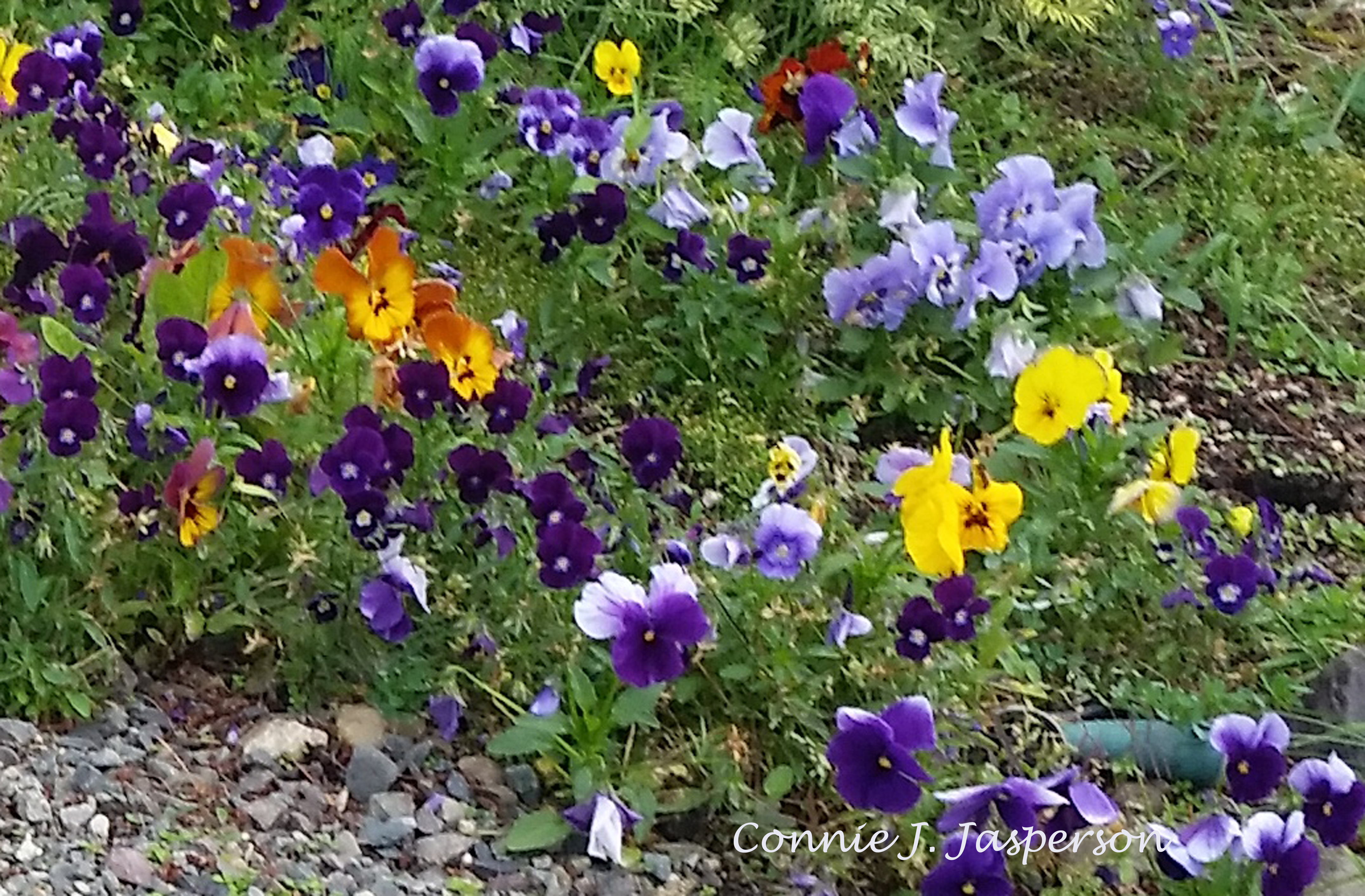


 Life in the Realm of Fantasy
