#FineArtFriday: In Flanders’ Fields, by John McCrae #MemorialDay (revisited)

Here in the US, we are celebrating Memorial Day. Originally known as Decoration Day, it’s a federal holiday dedicated to honoring those who died while serving in the US military. It used to be observed on May 30 regardless of the day of the week but in 1970 it was moved to the last Monday in May.

The beautiful image of poppies that graces this post is by Tijl Vercaemer from Gent, Flanders and was found on Wikimedia commons. The beauty and serenity of the poppies, rising from the fields where such terrible conflict once happened, is a fitting accompaniment for the poem, In Flanders Fields, by John McCrae, the text of which follows the picture.

From Wikipedia:  “In Flanders Fields” is a war poem in the form of a rondeau, written during the First World War by Canadian physician, Lieutenant-Colonel John McCrae. He was inspired to write it on May 3, 1915, after presiding over the funeral of friend and fellow soldier Alexis Helmer, who died in the Second Battle of Ypres. According to legend, fellow soldiers retrieved the poem after McCrae, initially dissatisfied with his work, discarded it. In Flanders Fields was first published on December 8 of that year in the London-based magazine Punch.

In Flanders Fields and Other Poems, a 1919 collection of McCrae’s works, contains two versions of the poem: a printed text as below and a handwritten copy where the first line ends with “grow” instead of “blow.” (…)

In Flanders fields the poppies blow
Between the crosses, row on row,
That mark our place; and in the sky
The larks, still bravely singing, fly
Scarce heard amid the guns below.

We are the Dead. Short days ago
We lived, felt dawn, saw sunset glow,
Loved and were loved, and now we lie
In Flanders fields.

Take up our quarrel with the foe:
To you from failing hands we throw
The torch; be yours to hold it high.
If ye break faith with us who die
We shall not sleep, though poppies grow
In Flanders fields.

While bed-ridden and recovering in the Veterans Administration Hospital in Vancouver, Washington, after World War II, my father had little to do but read or crochet. To keep busy, he and the other recovering soldiers in his ward made endless numbers of Remembrance Poppies to commemorate fallen American soldiers. Dad always wore his poppy on his left lapel, as it was close to his heart.

Memorial Day is more than just the official launch of Summer here in the US, more than just an Indy car race. Families have always cared for their family graves, but it became a designated day after the American Civil War in 1868, established  as “Decoration Day.” It was a specific time for the nation to decorate the graves of the war dead with flowers. Every family had soldiers who served and gave their lives in the never-ending wars, as we do today.

Officially, Memorial Day is a 3-day holiday weekend. Banks are closed on Monday, and the US Postal Service is also closed. The American flag is traditionally set at half-staff until noon to honor all those whose lives have been given in the service of our country. At noon, it is raised to the top of the staff, signifying that we, as a nation, will rise again.

My paternal grandmother never failed to keep our family’s graves neat and tidy, bringing flowers every week for my uncle, who had died while serving in the Korean War. As she got older, this tradition aggravated my father, who just wanted to listen to the Indianapolis 500 car race on the radio. He couldn’t bear dwelling on the loss of his brother, or the friends he had lost in France in WWII.

But he took her to the cemetery, anyway.

After each great and terrible war of the last two centuries, the hope was always that we had fought a “war to end all wars.” World War I, also known as The Great War, was spoken of in literature as just that: a war to end all wars.

With each conflict we still hope, but we are less able to believe it, today less than ever.


Sources and Attributions

In Flanders Fields, by Lieutenant Colonel John McCrae, MD, PD|75 years

John McCrae died of pneumonia January 28, 1918, near the end of the Great War. In Flanders’ Fields is a staple poem for Memorial Day services.

Wikipedia contributors. “In Flanders Fields.” Wikipedia, The Free Encyclopedia. Wikipedia, The Free Encyclopedia, 1 May. 2018. Web. 24 May. 2018

Poppies Field in Flanders, image By Tijl Vercaemer from Gent, Flanders #Belgium. File:Poppies Field in Flanders.jpg. (2018, January 13). Wikimedia Commons, the free media repository. Retrieved 15:55, May 24, 2018.

Comments Off on #FineArtFriday: In Flanders’ Fields, by John McCrae #MemorialDay (revisited)

Filed under #FineArtFriday, #FlashFictionFriday, Poetry

Layers of Depth: the uneven distribution of information

Plot points and conflicts are driven by the characters who have critical knowledge. The fact that some characters are working with limited information creates tension.

WritingCraftSeries_depth-through-conversationIn literary terms, this uneven distribution of knowledge is called asymmetric information. We see this all the time in the corporate world.

  • One party in a business transaction has more or superior information compared to another.
  • That inequality of information gives them an edge against the competition.

In a story, as in real life, a monopoly of information creates a crisis. An idle conversation will bore your reader to tears, so only discuss things that advance the plot. A conversation scene should be driven by the fact that one person has knowledge the others need.

The reader must get answers simultaneously as the characters, gradually over the length of a novel.

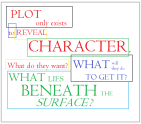
When I am writing a scene, I ask my characters three things:

The first question I ask is: “What is the core of the problem?” In the case of one story that was begun several years ago and never taken beyond the first draft stage, the core of the problem is Jared, my main character. The story is set in the World of Neveyah, and one of the canon tropes of stories set in that world is that all mages are trained by and work for the Temple of Aeos.

The_Pyramid_Conflict_Tension_PacingJared is hilarious, charming, naïve, a bit cocky, and completely unaware that he’s an arrogant jackass. He is a young man who is exceptionally good at everything and is happy to tell you about it. Jared has no clue that his boasting holds him back, as no one wants to work with him.

This boy is both the protagonist and the antagonist of this story.

The second question I ask is: “What do the characters want most?” Jared is a mage, and as such, he is a member of the Clergy of Aeos. He wants to be just like his childhood hero, or better. Jared needs approval and admiration to bolster his sense of self-worth. Everything he does is an effort to be seen as worthy.

Unfortunately, the leaders of the Temple of Aeos have plenty of heroes on hand and just want a mage who can be relied upon to get a job done well and with no fanfare.

The third question I ask my characters is this: “What are they willing to do to get it?” Jared has boasted many times that he will meet and overcome any obstacle, no matter how difficult the path to success is.

His mentors like him, but despair of his ever succeeding as a mage. They devise a simple (and on the surface) heroic seeming quest tailored to improve his attitude. They layer it with dirty and disgusting obstacles that he hasn’t planned for. Jared meets and works his way through these roadblocks one by one. His mentors ensure that when he does “rescue the kid,” he gets their message quite clearly. This is where the asymmetric information comes into play. Jared’s innocent assumptions make for a wonderfully wicked plot arc.

How will Jared’s story end? It ends in a satisfying mess with all the acclaim the young hero could ask for—along with a large serving of humble pie. But nothing can keep Jared down for long—he takes that embarrassment and embraces it with his own personal flair.

Epic Fails meme2When I started writing this story, I had the core conflict: Jared’s misguided desire to be important. I had the surface quest: rescuing the kidnapped kid. I had the true quest: Jared learning to laugh at himself and developing a little humility.

I had all the pieces and the completed first draft, but other projects had more priority. Then the pandemic hit, and this story was shelved.

Now, with all the hustle and bustle of moving to a new home, I need something short and sweet to work on for relaxation, and I came across Jared’s story. It needs serious revisions, but it’s one of my favorite Neveyah stories, as it is not dark as they usually are. Jared’s tale of woe is full of gallows humor, detailing the deeds of a hero who becomes a man.

4 Comments

Filed under writing

Layers of Depth: getting a grip on narrative time

Narrative time and calendar time are separate entities. They are team members working on the same project but with different tasks. Point of view and narrative time work together to create an author’s voice.

calendarCalendar time is a layer of world-building. It sets the story in a particular era and shows the passage of time.

Narrative time is the grammatical placement of the story’s time frame in the past or the present, i.e., present tense (we go) or past tense (we went).

Narrative time works with point of view to shape the reader’s perception of a scene’s atmosphere and ambiance.

Once the reader passes the first page or two of a novel, a reader becomes used to the way the author has chosen to deliver the story. Narrative time and point of view fade into the background, becoming a subtle layer that goes unnoticed on a conscious level.

How does narrative time relate to “past” or “present” tense?

In grammartense is a word referencing time. Tenses are usually shown by how we use the forms of verbs, particularly in their conjugation patterns. The main tenses found in most languages include the pastpresent, and future.

We create depth by combining narrative time with two closely related components of a story:

  • Narrative point of view (or the perspective) is a personal or impersonal “lens” through which a story is communicated.
  • Narrative voice, or how a story is communicated, is an author’s fingerprint. Narrative voice or style arises from the words we choose and how we combine them. It is formed by our deeply held beliefs and attitudes. We may or may not consciously intend to do it, but our convictions emerge in our writing, shaping character and plot arcs.

The way that narrative tense affects a reader’s perception of the characters is subtle, an undercurrent that goes unnoticed after the first few paragraphs. It shapes the reader’s view of events on a subliminal level.

Every story is different and requires us to use a unique narrative time. Tense conveys information about time. It relates the time of an event (when) to another time (now or then). The tense you choose indicates the event’s location in time.

Verb ConjugationConsider the following sentences: “I eat,” “I am eating,” “I have eaten,” and “I have been eating.”

All are in the present tense, indicated by the present-tense verb of each sentence (eatam, and have).

Yet, they are different because each conveys slightly different information (or points of view) about how the action pertains to the present moment.

I regularly “think aloud” in writing the first draft. When writing by the seat of my pants, passive phrasings find their way into the raw narrative. I think of these words as traffic signals for when I begin revisions.  a shorthand that helps me write the story before I lose my train of thought.

  • In the rewrite, we look for the code words (passive phrasing) that tell us what the scene should be rewritten to show.

Many writers avoid the third person omniscient mode because it takes more work to make the prose active. But some stories work best in that mode.

Which sentence feels stronger, more pressing? Each sentence says the same thing, but we get a different story when we change the narrative tense, point of view, and verb choice.

  • He was hot and thirsty. (Third-person omniscient, past tense, passive phrasing.)
  • Henry trudged forward, his lips dry and cracked, yearning for a drop of water. (Third-person omniscient, past tense, active phrasing.)
  • struggle toward the oasis with dry, cracked lips and parched tongue. (First-person present tense, Active phrasing.)
  • You stagger toward the oasis, dizzy with thirst. (Second-person, present tense, active phrasing.)

The way we show this moment in time for these thirsty characters is important. If we write a sentence that says a character is hot and thirsty, we leave nothing to the reader’s imagination. The reader is on the outside, looking in. When we write that experience of thirst using active phrasing, no matter what narrative tense we write in, it changes everything.

Sometimes the only way I can get into a character’s head is to write them in the first-person present tense. This is because the narrative time I am trying to convey is the now of that story. (This happens to me most often when writing short stories.)

In traditional first-person POV, the protagonist is the narrator. We must remember that no one ever has complete knowledge of anything, so the first-person narrator cannot be omnipotent.

transitive verb damon suede quoteEvery story is unique; some work best in the past tense, while others must be set in the present.

WARNING: When we begin writing a story using a narrative time unfamiliar to us, we may have trouble with drifting tense and wandering narrative points of view.

Drifting narrative tense and wandering POV are insidious. Either or both can occur if you habitually write using one mode but switch to another. For this reason, I must be vigilant when I begin in the first-person present tense but then switch to close third person.

For this reason, when you begin revisions, it’s crucial to look at your verb forms to ensure your narrative time doesn’t inadvertently drift between past and present.

So, where does voice come into it?

The way you habitually phrase sentences, how you construct paragraphs, the words you choose, and the narrative time you prefer to write in is your voice.

Summer is nearly upon us here in the Pacific Northwest. Packing and moving is going better than I thought it would. Time for writing is hit and miss this week, but by the second week of June, we will be settled in our new digs, and writing will be back on track. Life is good!

12 Comments

Filed under writing

#FineArtFriday: Dort or Dordrecht: The Dort packet-boat from Rotterdam becalmed by J. M. W. Turner 1818 (revisited)

B1977.14.77

Artist: J. M. W. Turner (1775–1851)

Title: Dort or Dordrecht: The Dort packet-boat from Rotterdam becalmed

Genre: marine art

Date: 1818

Medium: oil on canvas

Dimensions: Height: 157.5 cm (62 in); Width: 233.7 cm (92 in)

Collection: Yale Center for British Art

What I love about this painting:

The colors show us a windless evening in summer or fall, a time of day when the smoke from factories and chimneys lingers and turns the sky brown and gold, reflected on the waters.

This is a glimpse into the history of how we once moved goods and mail across long distances. Some packet boats were medium-sized ships, able to navigate shallow rivers and canals. Others were ocean-going vessels. Some were steam driven, but the one we see in this painting is an early ship, powered by the wind.

The wind has failed, and so the crew is being ferried off the ship via a smaller row-boat.

About this painting via Wikipedia:

The Dort, or Dort or Dordrecht: The Dort packet-boat from Rotterdam becalmed is an 1818 painting by J. M. W. Turner, based on drawings made by him in mid-September 1817.  It shows a view of the harbour of Dordrecht. It is the finest example of the influence of Dutch marine painting on Turner’s work.

It was exhibited at the Royal Academy in 1818, where it was described by The Morning Chronicle as “one of the most magnificent pictures ever exhibited, and does honour to the age”. In 1832, John Constable wrote of the picture, “I remember most of Turner’s early works; amongst them one of singular intricacy and beauty; it was a canal with numerous boats making thousands of beautiful shapes, and I think the most complete work of a genius I ever saw”.

It was purchased by Walter Fawkes for 500 guineas at the request of his son, and hung in the drawing room at Farnley Hall until it was bought by Paul Mellon in 1966. It was then donated to the Yale Center for British Art upon the founding of the centre. [1]

About the Artist, via Wikipedia:

Joseph Mallard William Turner was born in Maiden Lane, Covent Garden, London, to a modest lower-middle-class family. He lived in London all his life, retaining his Cockney accent and assiduously avoiding the trappings of success and fame. A child prodigy, Turner studied at the Royal Academy of Arts from 1789, enrolling when he was 14, and exhibited his first work there at 15. During this period, he also served as an architectural draftsman. He earned a steady income from commissions and sales, which due to his troubled, contrary nature, were often begrudgingly accepted. He opened his own gallery in 1804 and became professor of perspective at the academy in 1807, where he lectured until 1828. He travelled to Europe from 1802, typically returning with voluminous sketchbooks.

Intensely private, eccentric and reclusive, Turner was a controversial figure throughout his career. He did not marry, but fathered two daughters, Eveline (1801–1874) and Georgiana (1811–1843), by his housekeeper Sarah Danby. He became more pessimistic and morose as he got older, especially after the death of his father, after which his outlook deteriorated, his gallery fell into disrepair and neglect, and his art intensified. In 1841, Turner rowed a boat into the Thames so he could not be counted as present at any property in that year’s census. He lived in squalor and poor health from 1845, and died in London in 1851 aged 76. Turner is buried in Saint Paul’s Cathedral, London. [2]


Credits and Attributions:

Wikimedia Commons contributors, “File:DortorDordrecht.jpg,” Wikimedia Commons, the free media repository, https://commons.wikimedia.org/w/index.php?title=File:DortorDordrecht.jpg&oldid=554289467 (accessed October 28, 2021).

[1] Wikipedia contributors, “Dort or Dordrecht: The Dort packet-boat from Rotterdam becalmed,” Wikipedia, The Free Encyclopedia, https://en.wikipedia.org/w/index.php?title=Dort_or_Dordrecht:_The_Dort_packet-boat_from_Rotterdam_becalmed&oldid=1000618596 (accessed October 28, 2021).

[2] Wikipedia contributors, “J. M. W. Turner,” Wikipedia, The Free Encyclopedia, https://en.wikipedia.org/w/index.php?title=J._M._W._Turner&oldid=1050867512 (accessed October 28, 2021).

3 Comments

Filed under #FineArtFriday, writing

Layers of Depth – using the world you know #amwriting

If you have been following my blog, you might know my husband and I are selling our home of eighteen years and moving back to the town we both grew up in. Currently, we live in a small quarry town twenty miles south of the state capitol. It is historic and small. But it is a vibrant town, creative and open to entrepreneurs, and has a close-knit community.

MyWritingLife2021If I were writing a story starring me as the main character, I would open it in the year 2005 with a couple of empty-nesters buying a house in a bedroom community twenty miles south of Olympia.

But what sort of town is this?

Tenino (Teh-nine-oh) is situated at the southern edge of Thurston County. Many people working for the State of Washington live here because the commute isn’t too bad and homes here are affordable, whereas homes in Olympia are expensive. This town has a long history of boom and bust; quarrymen, loggers, and farmers settled here, and they are still hanging on. But government employees don’t earn as much as private sector employees, and they can afford to buy homes here. So, the demographic is slowly changing.

Timber is no longer king here. Nowadays, our town is famous for Wolf Haven Internationalsandstone art, crafted whiskey, and award-winning wine. We still have a few large cattle ranches out on the Violet Prairie, between Tenino and Interstate 5. But 5-to-7-acre executive “horse properties,” antique stores, cheese makers offering goat yoga, and soap-making classes have found fertile ground here.

In the early 20th century, bootlegging was an industry here (my maternal grandfather’s line of work during prohibition). The distilleries here are the legal continuation of an old tradition.

Only_in_TeninoThe city center is isolated, twelve miles from the freeway and twenty miles away from every other town in the south county. If a fictional story were set in this town, it would feature the same political and religious schisms that divide the rest of our country. There are other tensions. Some families have been here for generations, and a few don’t appreciate the influx of low-paid state workers buying cookie-cutter tract homes (like mine) here.

Other than those employed by the local businesses, most people commute to work in Olympia or Centralia.

My street is a stretch of rough blacktop with no sidewalks. Most of the driveways, including ours, are paved. Our street runs east and west, with a fabulous view of Mount Rainier rising at the east end.

Homes line our street on both sides, but it’s visually divided. A nicely landscaped manufactured home park is on the north side of the road, across from my front door. On the south side, my side, a long row of forty stick-built homes was tossed up in 2005, just before the housing bubble crashed.

And I do mean tossed up. Some things that went into building these houses were bottom-of-the-barrel bargains, cheap toilets, cheaper water heaters, and improperly installed bathtubs—all things that failed and were replaced over the last eighteen years.

The row of homes on my side is nearly identical to each other, as there are only two types of floor plans, one for three bedrooms (mine) or the four-bedroom version. People have made their homes as unique as possible. For a few years, we had the only house with an orange door, but now our door is white, as we had to replace it and never got around to painting it.

Orange_Door_with_Hydrangeas_©_Connie_Jasperson_2019Two inches of rain fell the day we moved into our brand-new home in 2005, making moving our furniture into this house a misery. Our new house had no landscaping and rose from a sea of mud and rocks. With a lot of effort, we made a pleasant yard. When the housing bubble burst in 2008, many people on my side of the street lost their jobs, and some homes went into foreclosure.

Flippers found a wealth of projects here. For several years, wherever there were two or more empty houses, it looked somewhat like a ghost town.

That has changed. Now we are bustling, people walking up and down the street to and from the store.

Tenino has one grocery store, which also has a hardware store inside. The market carries the basics, but the quality of their fresh produce can be iffy. You really have to check the pull dates on things like eggs, hummus, and cottage cheese. It’s far more affordable to shop in Olympia.

However, the meat department sources beef from a local ranch. Their meat department smokes their own ribs and other cuts. Carnivores love this place because the wind carries the smoky aroma all over the neighborhood.

Even Tenino is changing with the times, with more hybrid cars in the parking lots. A large wind farm graces the top of the hills south of here. The store has always carried tofu but has lately begun carrying some plant-based sources of protein and dairy-free ice cream. That discovery was a Hallelujah moment for those of us with milk sensitivity!

Violet Prairie in MayOur main street, Sussex, passes through a historic district. The buildings are all built from sandstone quarried at the old quarries. Many of the old buildings are home to antique stores. The masonic lodge is made of Tenino sandstone.

It’s a slice of rural America with a Northwest twist, a quiet town that is the perfect setting for a paranormal fantasy or a murder mystery.

What about my immediate environment? In the morning, birdsong fills the air. Robins, wrens, finches, hummingbirds, crows, Stellar’s jays, mourning doves – the neighborhood borders Scatter Creek and is alive with birds.

During the day, I can hear the children playing at the school. In the evening, the neighborhood is filled with the sounds of kids playing in each other’s yards.

Highway 507 passes through the center of town, becoming Sussex Street. The sounds of traffic, from semi-trucks to sirens, occasionally vie with the horns from freight trains passing at the west end of town.

Even so, it’s a quiet place, a good place to live.

We’re sad to leave here, but it’s the right thing to do. We have rented an apartment and will be completely resettled by the middle of June. Our new home is in a terrific neighborhood, with easy access to shops and restaurants. It will be intriguing to rediscover the world we left behind and to see how it has changed since we left there.

The setting of your story is a multipurpose layer embedded in the depths, and is itself comprised of layers: sounds, scents, and visual details. It shows the immediate area and conveys your characters’ society, political climate, and economic class. These aspects are subtle, yet they’re as fundamental to the story as the blood in your veins. And like that blood, we only notice it when something draws our attention to it—which usually happens at inconvenient moments.

As an exercise, visualize your own community and write a word picture of it as if you were telling me about it. Then imagine the community your characters live in and write a word picture of how they would describe their world. Feel free to post your word-pictures in the comments!

Free-Range Pansies photo credit cjjap copy

5 Comments

Filed under writing

Layers of depth: The use and abuse of modifiers #amwriting

Depth in a narrative is created by many layers. One layer we must look at involves prose, words we use, and how we phrase things. The way we use modifiers and descriptors plays a significant role in how our work is received by a reader.

depthPart1revisionsLIRF05252021In writing, we add depth and contour to our prose by how we choose and use our words. We “paint” a scene using words to show what the point-of-view character is seeing or experiencing. Yes, we do need to use some modifiers and descriptors.

Modifiers are like any other medicine: a small dose can cure illnesses. A large dose will kill the patient. The best use of them is to find words that convey the most information with the most force.

When we refer to modifiers, what do we mean?

Any word that modifies (alters, changes, transforms) the meaning and intent of another word is a modifier. Modifiers change, clarify, qualify, or limit a particular word in a sentence to add emphasis, explanation, or detail.

We also use them as conjunctions to connect thoughts: “otherwise,” “then,” and “besides.”

What are descriptors? Adverbs and adjectives, known as descriptors, are helper nouns or verbs—words that help describe other words. They are easily overused, so these words are often reviled by authors armed with a little dangerous knowledge.

What is a quantifier? They are nouns (or noun phrases) meant to convey a vague number or an abstract impression, such as: very, a great deal ofa good deal ofa lot, many, much. The important word there is abstract, which I think of as a thought or idea describing something without physical or concrete existence.

modifying-conjunctions-04262022One of the cautions those of us new to the craft frequently hear are criticisms about the number of modifiers (adjectives and adverbs) we habitually use. This can hurt, especially if we don’t understand what the members of our writing group are trying to tell us.

Perhaps the number of modifiers isn’t the problem, but the forms we use fluff up our narrative.

Perhaps you have been told you use too many “ly” words or descriptors. Examine the context. Have you used the word “actually” in a conversation? You may want to keep it, as dialogue must sound natural, and people use that word when speaking.

However, if you have used “actually” to describe an object, check to see if it is necessary. Is the sentence stronger without it?

  • The tree was actually covered in red leaves.
  • Red leaves covered the tree.

Many descriptors are easy to spot, often ending with “ly.” When I begin revising a first draft, I do a global search for the letters “ly.” A list will pop up in my lefthand margin. My manuscript will become a mass of yellow highlighted words.

  • “ly” words are code words – a kind of mental shorthand in a first draft. In the revision process, they tell us what we need to expand on to fully explore the scene as we originally envisioned.

It’s a daunting task, but I look at each instance and see how they fit into that context. If a word or phrase weakens the narrative, I change it to a simpler form or remove it and rewrite the sentence.

Think about it – bare is an adjective, as is barely.

Context is everything. Take the time to look at each example of the offending words and change them individually. You have already spent months writing that novel. Why not take a few days to do the job well?

Sentence structure matters. Where you place an adjective relative to the noun they are describing affects a reader’s perception. Adjectives work best when showing us what the point-of-view characters see, hear, smell, touch, and taste.

Sunlight glared over the ice, a cold fire in the sky that cast no warmth but burned the eyes.

Timid WordsIn the above sentence, the essential parts are structured this way: noun – verb (sunlight glared), adjective – noun (cold fire), verb – adjective – noun (cast no warmth), and finally, verb-article-noun (burned the eyes). Lead with the action or noun, follow with a strong modifier, and the sentence conveys what is intended but isn’t weakened by the modifiers.

The above scene could be shown in many ways, but a paragraph’s worth of world-building is pared down to 19 words, three of which are action words. This is an area I struggle with, and it occupies most of my attention during revisions.

Shakespeare understood the beauty and the power that contrasting modifiers can add to ordinary prose without making it artificial. Consider this line from his play, As You Like It, written in 1599:

It strikes a man more dead than a great reckoning in a little room. As You Like It, Wm. Shakespeare, 1599.

What brilliant imagery Shakespeare handed us—strong words with powerful meaning: dead, great, reckoning, little. His prose moves us as we read or hear it spoken because he uses words with visual impact.

Most writers know that participating in a critique group requires delicacy and dedication. They know it involves restraint and the ability to allow other authors to write their own work. Most groups don’t micromanage a manuscript because they know how too much input and direction can remove the author’s unique voice from a piece.

These are dedicated people who love reading and want your work to succeed.

As writers, we all want to be accepted and have others like our work, but we must write from the heart. That means using modifiers, descriptors, or quantifiers when they are needed. It’s a balancing act. We must be mindful of the form and the context of how a modifier fits into our phrasing.

The following image is a list of code-words I seek out and re-examine when I begin revising a first draft. Each word points me in the right direction. All I have to do is rephrase that sentence with stronger forms of the “ly” word.

List of common adverbs

12 Comments

Filed under writing

#FineArtFriday: the Song of Love by Georgio de Chirico

De_Chirico's_Love_SongArtist: Giorgio de Chirico, 1914,

Title: The Song of Love,

Genre: Metaphysical Art

Medium: oil on canvas, 73 x 59.1 cm,

Location: Museum of Modern Art, New York

About this painting, via Wikipedia:

Chirico presents a bust of a classical sculpture, a rubber ball, and a rubber glove on a canvas in between some buildings with a train passing by in a scene that spurs a sense of confusion. The bust could be a representation of Chirico’s love of classical art and a disappearing age. Chirico uses the rubber glove as a mold of a hand that implies the void of human presence. The buildings set up a scene that is reminiscent of the cityscapes of Chirico’s past. [1]

About the Artist,  via Wikipedia:

Giuseppe Maria Alberto Giorgio de Chirico; 10 July 1888 – 20 November 1978) was an Italian artist and writer born in Greece. In the years before World War I, he founded the scuola metafisica art movement, which profoundly influenced the surrealists. His best-known works often feature Roman arcades, long shadows, mannequins, trains, and illogical perspective. His imagery reflects his affinity for the philosophy of Arthur Schopenhauer and of Friedrich Nietzsche, and for the mythology of his birthplace.

After 1919, he became a critic of modern art, studied traditional painting techniques, and worked in a neoclassical or neo-Baroque style, while frequently revisiting the metaphysical themes of his earlier work.

The paintings de Chirico produced between 1909 and 1919, his metaphysical period, are characterized by haunted, brooding moods evoked by their images. At the start of this period, his subjects were motionless cityscapes inspired by the bright daylight of Mediterranean cities, but gradually he turned his attention to studies of cluttered storerooms, sometimes inhabited by mannequin-like hybrid figures. [2]

For more on the life and art of Georgio de Chirico, check out this video: Is This £1 Thrift Shop Painting By 20th Century Italian Master? | Fake Or Fortune | Perspective – YouTube


Credits and Attributions:

Image: Love Song by Georgio de Chirico, PD|100, courtesy Wikipedia Contributors, Wikipedia, The Free Encyclopedia https://en.wikipedia.org/wiki/File:De_Chirico%27s_Love_Song.jpg. (Accessed April 30, 2023.)

[1] Wikipedia contributors, “The Song of Love,” Wikipedia, The Free Encyclopedia, https://en.wikipedia.org/w/index.php?title=The_Song_of_Love&oldid=1146489854 (accessed April 30, 2023).

[2] Wikipedia contributors, “Giorgio de Chirico,” Wikipedia, The Free Encyclopedia, https://en.wikipedia.org/w/index.php?title=Giorgio_de_Chirico&oldid=1152305674 (accessed May 4, 2023).

2 Comments

Filed under #FineArtFriday

Layers of Depth – using atmosphere to emphasize emotion #amwriting

Writing emotions with depth is a balancing act, and simply showing the outward physical indicators of a particular emotion is only half the story. Every idea for a novel comes to me with an idea for the overall mood. That mood will underscore and emphasize the characters’ personal mood and changing emotions.

depth-of-characterIn his book, Story, Robert McKee tells us that emotion is the experience of transition, of the characters moving between a positive and negative. Beneath and behind the emotions that our characters experience is the atmosphere of the story, going unnoticed on the surface.

Atmosphere is the aspect of mood that setting conveys. It is only an ambiance, but it is a powerful tool for helping us show our characters’ emotional state.

When creating our characters, we find it easy to connect with vivid emotions, such as hate, anger, desire, and passion. These are loud emotions.

Volume control is a crucial part of the overall pacing of our story. “Loud” deafens us and loses its power when it’s the only sound. So, like the opening movement of Beethoven’s 5th Symphony, we must contrast loud against quiet to create the texture of our story.

When we first begin as writers, we find it difficult to convey our characters’ emotions without telling the reader what to feel. After receiving our share of abuse from other writers, we swing toward showing their every mood in minuscule detail.

emotionwordslist01LIRF06232020Truthfully, I find detailed descriptions of facial expressions to be boring and sometimes off-putting. Every author armed with a little knowledge writes characters with curving lips, stretching lips, and lips doing many things over, and over, and over … with little variation.

A happy medium between telling and showing can be achieved, but it takes work. We must choose words that show what we mean and use the environment to convey subtle feelings wherever possible. I say wherever possible because it is not practicable to always employ the setting in a narrative. We need to get inside the characters’ heads.

Severe emotional shock strikes us, and we have an immediate physical reaction.

Visceral reactions are involuntary—out of our control. We can’t stop our faces from flushing or our hearts from pounding. Visceral feelings are emotions we feel deeply. We find it difficult to control or ignore them because they are instinctive and not the result of thought.

We can pretend it didn’t happen or hide it, but we can’t stop it. An internal physical gut reaction is difficult to convey without offering the reader some information, a framework to hang the image on.

There will be an instant reaction. How does a “gut reaction” feel? We might experience nausea, gut punch, or a feeling of butterflies in our stomach. Think about how you respond to internal surprises, and write those feelings down.

I experience severe shocks this way:

  • disbelief—the OMG moment
  • a sinking feeling in the pit of my stomach, freezing in place, or a shout of “No!”
  • Years ago, on witnessing a horrific accident, I experienced disassociation or a feeling of viewing the scene from outside myself. This involuntary coping or defense mechanism is meant to minimize or help a person tolerate stress.

When we write mild reactions, offering a lot of emotional descriptions is unnecessary because mild is boring. A raised eyebrow, a sideways glance—small gestures show the attitude and mood of the character.

But good pacing requires balance. Quiet scenes enable us (and our characters) to process the events detailed in the louder scenes.

However, strong emotions are compelling. Highly charged situations are strengthened by the way we write the emotional experience. The way we show the setting reinforces each physical response.

The following is an excerpt from a work in progress:

Knowledge lay in Ivan’s belly, a cold ball of disaster. He had already failed as a shaman, and he wasn’t even a true seeker. But he couldn’t let Cai down, had to prove he could resolve it. He forced a smile, projecting confidence. “Look at that view. I’d heard the lake is so large one can’t see the southern shore from Neville, but I didn’t realize its truth. It seems as vast as the sky.”

As you can see, I struggle with these concepts as much as any other writer does. This scene is set on an early spring morning with cold winds shuttling heavy clouds across a blue sky. Rain moves in later in the day, underscoring Ivan’s dark mood. Sometimes I do well at conveying atmosphere and emotion; other times, I don’t. But I keep trying because it takes effort to succeed in anything.

When I write a scene, I ask myself why this character is reacting this way. Emotions without cause have no basis for existence, no foundation. They’re a lot of noise about nothing.

The emotion hits, and the character processes it. From a different work in progress:

It would have been the first battle spell John had cast in years, but no. His battle abilities were still gone, as if the inferno he’d unleashed in the culvert had burned them away.

Timing is crucial, and this is the moment to slip in a brief mention of the backstory. That way, we avoid an info dump, but the reader has the information needed to make the emotion tangible.

On the heels of that thought, John was overcome by the remembered sounds, the roar of flames, the shrieks of the enemy …. he sagged to the curb, gagging and gasping, unable to breathe properly, panicking under the weight of it.

emotionwordslist02LIRF06232020Simplicity has an impact, but I struggle to achieve balance. When looking for words with visceral and emotional power, consonants are your friend. Verbs that begin with consonants are powerful.

Use forceful words, and you won’t have to resort to a great deal of description. Weak word choices separate the reader from the experience, dulling the emotional impact of what could be an intense scene.

If you are between projects and don’t know what to write, a good exercise is to create an intense and dramatic scene for characters you currently have no story for. Give them a setting, and use it to emphasize how they feel.

The key to writing a good scene is to practice. You may find a later use for these characters, and that scene could be the seed of a longer story. The more we practice this aspect of the craft, the better we get at it.

And the more we write, the more individual and recognizable our writing voice becomes.

17 Comments

Filed under writing

Layers of Depth: Mood and Emotion #amwriting

Readers and authors often use the word mood interchangeably with atmosphere when describing a scene or passage. Like conjoined twins, mood and atmosphere march along together—separate but intertwined so closely that they seem as one.

mood-emotions-2-LIRF09152020Mood is long-term, a feeling residing in the background, going almost unnoticed. Mood affects (and is affected by) the emotions evoked within the story.

Atmosphere is also long-term but is sometimes more noticeable as it is a worldbuilding component. Atmosphere is the aspect of mood that setting conveys.

Emotion is immediate and short-term. It exists in the foreground but contributes to the overall atmosphere and mood.

In his book, Story, Robert McKee tells us that emotion is the experience of transition, of the characters moving between a positive and negative. “Story” by Robert McKee,

Much of my information comes from seminar videos on the craft of writing found on YouTube and posted by Robert McKee. He is an excellent teacher, and his textbook is a core component of my personal library. A wonderful 6-minute lesson on the difference between mood and emotion can be found at:

Robert McKee, Q&A: What Is the Difference Between Mood and Emotion?

While emotions are immediate, they can be subtle. I look for books where emotions are dynamic, because that is when the character’s internal struggle becomes personal to me.

Mood is a large word serving several purposes. It is created by the setting (atmosphere), the exchanges of dialogue (conversation), and the tone of the narrative (word choices, descriptions). It is also affected by (and refers to) the emotional state of the characters—their personal mood.

Mood-and-atmosphere-LIRF04302023Undermotivated emotions lack credibility and leave the reader feeling as if the story is flat. In real life, we have deep, personal reasons for our feelings, and so must our characters.

A woman shoots another woman. Why? Add in the factor of her child having been accidentally killed by the woman she murders, and you have high emotion and high drama. Therefore, just as in real life, the root cause for a character’s emotions is a fundamental motivation for their actions.

Which is more important, mood or emotion? Both and neither. Characters’ emotions affect the overall mood of a story. In turn, the atmosphere of a particular environment may affect the characters’ personal mood. Their individual attitudes affect the emotional state of the group.

Because emotion is the experience of transition from the negative to the positive and back again, emotion changes a character’s values, and they either grow or stagnate. This is part of the inferential layer, as the audience must infer (deduce) the experience. You can’t tell a reader how to feel. They must experience and understand (infer) what drives the character on a human level.

What is mood? Wikipedia says:

In literature, mood is the atmosphere of the narrative. Mood is created by means of setting (locale and surroundings in which the narrative takes place), attitude (of the narrator and of the characters in the narrative), and descriptions. Though atmosphere and setting are connected, they may be considered separately to a degree. Atmosphere is the aura of mood that surrounds the story. It is to fiction what the sensory level is to poetry.[1] Mood is established in order to affect the reader emotionally and psychologically and to provide a feeling for the narrative.

What is atmosphere? It is created by our word choices and is intangible, but it affects how the reader perceives the story. The setting contributes to the atmosphere, so it is a component of worldbuilding. But we should note that the setting is only a place; it is not atmosphere. Atmosphere comes into play when we place certain visual elements into the scenery with the intention of creating a mood in the reader.

  • Tumbleweeds rolling across a barren desert.
  • Waves crashing against cliffs.
  • Dirty dishes resting beside the sink.
  • A chill breeze wafting through a broken window.

Atmosphere is created as much by odors, scents, ambient sounds, and visuals as by the characters’ moods and emotions. It is a component of the environment but is also an ambiance because it is intentional.

We build atmosphere into a setting with the aim of creating a specific frame of mind or emotion in the reader.

I love it when an author drops me into an atmosphere that colors their world and shapes the characters’ moods.

So, now we know that atmosphere is environmental, separate but connected to the general emotional mood of a piece. From the story’s first paragraph, we want to establish a feeling of atmosphere, the general mood that will hint at what is to come.

storybyrobertmckeeRobert McKee tells us that the mood/dynamic of any story is there to make the emotional experience of our characters specific. It makes their emotions feel natural. After all, the mood and atmosphere Emily Brontë instilled into the setting of Wuthering Heights make the depictions of mental and physical cruelty seem like they would happen there.

Happy, sad, neutral—atmosphere and mood lend a flavor to the emotions our characters experience, giving them emphasis and making them real to the reader.

For me, as a writer, the inferential layer of a story is complicated. Creating a world-on-paper requires thought even when we live in that world. We know how the atmosphere and mood of our neighborhood feel when we walk to the store. But try conveying that mood and atmosphere in a letter to a friend – it’s harder than it looks.

Next up: a closer examination of emotions and why showing is so much more difficult (and sometimes dangerous) than telling.


Credits and Attributions:

Wikipedia contributors, “Mood (literature),” Wikipedia, The Free Encyclopedia, https://en.wikipedia.org/w/index.php?title=Mood_(literature)&oldid=1147399122 (accessed April 30, 2023).

13 Comments

Filed under writing

#FineArtFriday: What Remains? by Eberhard Marx 2016

Eberhard Marx

Title: (Deutsch) Was bleibt?

Title: (English) What remains?

Artist:  Eberhard Marx

Description: (Deutsch) surrealistisches Gemälde mit der Himmelsscheibe von Nebra

Description: (English) surrealist painting with the Nebra Sky Disc

Date:   19 May 2016

Today we are looking at Surrealism in art, as painted by a contemporary German artist, Eberhard Marx. This image comes from Wikimedia Commons, as does most of the work featured here.

When viewing surrealist art, the viewer can decide the intent of each element and how they are placed in the composition. The historical importance of the Nebra sky disc, the antiquity of the disc itself, and the craftsmanship that went into its making have always intrigued me, so this painting really caught my eye.

I visited the artist’s website and found where he offers us a way to view his works:

“Eberhard Marx wishes the viewer to take a walk in his paintings. The works are not botanical gardens with descriptions, but rather a bewitched park.” [1]

I have been enjoying doing just that!

About the Nebra sky disc, via Wikipedia:

The Nebra sky disc is a bronze disc of around 30 cm (12 in) diameter and a weight of 2.2 kg (4.9 lb), having a blue-green patina and inlaid with gold symbols. These symbols are interpreted generally as the Sun or full moon, a lunar crescent, and stars (including a cluster of seven stars interpreted as the Pleiades). Two golden arcs along the sides, interpreted to mark the angle between the solstices, were added later. A final addition was another arc at the bottom with internal parallel lines, which is usually interpreted as a solar boat with numerous oars, though some authors have also suggested that it may represent a rainbow, or the Aurora Borealis.

Nebra_disc_1The disc was found buried on the Mittelberg hill near Nebra in Germany. It is dated by archaeologists to c. 1800–1600 BCE and attributed to the Early Bronze Age Unetice culture.Various scientific analyses of the disc, the items found with the disc, and the find spot have confirmed the Early Bronze Age dating.

The Nebra sky disc features the oldest concrete depiction of astronomical phenomena known from anywhere in the world. In June 2013, it was included in the UNESCO Memory of the World Register and termed “one of the most important archaeological finds of the twentieth century.” [2]

About Surrealism in Art, via Wikipedia:

Surrealism is a cultural movement that developed in Europe in the aftermath of World War I in which artists depicted unnerving, illogical scenes and developed techniques to allow the unconscious mind to express itself. Its aim was, according to leader André Breton, to “resolve the previously contradictory conditions of dream and reality into an absolute reality, a super-reality”, or surreality. It produced works of painting, writing, theatre, filmmaking, photography, and other media.

Works of Surrealism feature the element of surprise, unexpected juxtapositions and non sequitur. However, many Surrealist artists and writers regard their work as an expression of the philosophical movement first and foremost (for instance, of the “pure psychic automatism” Breton speaks of in the first Surrealist Manifesto), with the works themselves being secondary, i.e., artifacts of surrealist experimentation. Leader Breton was explicit in his assertion that Surrealism was, above all, a revolutionary movement. At the time, the movement was associated with political causes such as communism and anarchism. It was influenced by the Dada movement of the 1910s.

The term “Surrealism” originated with Guillaume Apollinaire in 1917. However, the Surrealist movement was not officially established until after October 1924, when the Surrealist Manifesto published by French poet and critic André Breton succeeded in claiming the term for his group over a rival faction led by Yvan Goll, who had published his own surrealist manifesto two weeks prior. The most important center of the movement was Paris, France. From the 1920s onward, the movement spread around the globe, impacting the visual arts, literature, film, and music of many countries and languages, as well as political thought and practice, philosophy, and social theory. [3]

I highly recommend a visit to the artist’s website, HOME | EBERHARD MARX (eberhard-marx.eu). You will find many more of his amazing paintings, or you can purchase prints if something interests you.


Credits and Attributions:

Image: Was bleibt? ( English: what remains?). Wikimedia Commons contributors, “File:Was bleibt.jpg,” Wikimedia Commons, https://commons.wikimedia.org/w/index.php?title=File:Was_bleibt.jpg&oldid=528401859 (accessed April 27, 2023).

[1] Quote from Eberhard Marx website, HOME | EBERHARD MARX (eberhard-marx.eu) (accessed April 27, 2023)

2 Comments

Filed under #FineArtFriday