
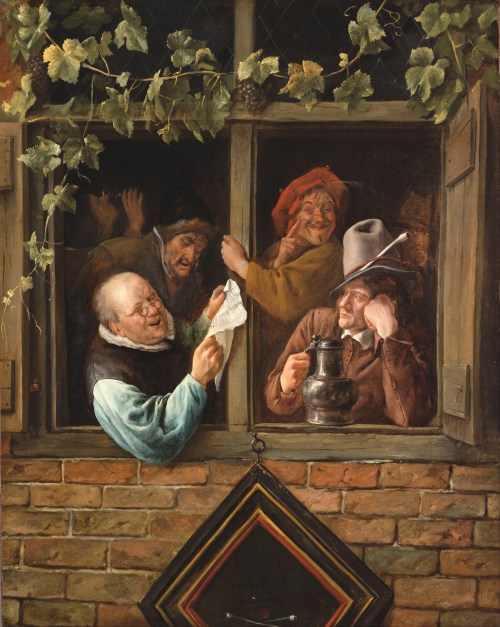
Artist: Jan Steen (1625/1626–1679)
Title: Rhetoricians at a Window
Genre: genre art
Date: c. 1661-66
Medium: oil on canvas
Dimensions: Height: 759.46 mm (29.90 in); Width: 586.23 mm (23.07 in)
Collection: Philadelphia Museum of Art
Today we’re looking to art for ideas, and our prompt is Rhetoricians at a Window by the Dutch master, Jan Steen.
What I love about this painting:
This is one of my all-time favorite Dutch genre paintings. It has inspired some the characters who pass through my stories, people my protagonists meet along the way. These jolly rogues have such vivid personalities that the viewer immediately feels a kinship to them. Who were they? Did they keep their day jobs?
The reading of a poem or play was clearly the opportunity for the performers to have a good time. From the drinker in the shadows of the background, to the grapevines growing around the window, Steen tells us that wine and rhetoric are clearly entwined.
I love the inclusion of both “the critic” who leans his head on his hand and listens analytically, and the man behind him, who is clearly “a little over the limit,” and supports himself by grasping the window frame and heartily agreeing with some point.
The actor who reads is clearly enjoying himself, as are the others.
About the Artist (Via Wikipedia):
Jan Havickszoon Steen (c. 1626 – buried 3 February 1679) was a Dutch Golden Age painter, one of the leading genre painters of the 17th century. His works are known for their psychological insight, sense of humour and abundance of colour.
Daily life was Jan Steen’s main pictorial theme. Many of the genre scenes he portrayed, as in The Feast of Saint Nicholas, are lively to the point of chaos and lustfulness, even so much that “a Jan Steen household”, meaning a messy scene, became a Dutch proverb (een huishouden van Jan Steen). Subtle hints in his paintings seem to suggest that Steen meant to warn the viewer rather than invite him to copy this behaviour. Many of Steen’s paintings bear references to old Dutch proverbs or literature. He often used members of his family as models, and painted quite a few self-portraits in which he showed no tendency of vanity.
Steen did not shy from other themes: he painted historical, mythological and religious scenes, portraits, still lifes and natural scenes. His portraits of children are famous. He is also well known for his mastery of light and attention to detail, most notably in Persian rugs and other textiles.
Steen was prolific, producing about 800 paintings, of which roughly 350 survive. His work was valued much by contemporaries and as a result he was reasonably well paid for his work. He did not have many students—only Richard Brakenburgh is recorded—but his work proved a source of inspiration for many painters. [2]
About this painting, Via Wikipedia:
Chambers of rhetoric (Dutch: rederijkerskamers) were dramatic societies in the Low Countries. Their members were called Rederijkers (singular Rederijker), from the French word ‘rhétoricien’, and during the 15th and 16th centuries were mainly interested in dramas and lyrics. These societies were closely connected with local civic leaders and their public plays were a form of early public relations for the city. [1]
In 1945, Sturla Gudlaugsson, a specialist in Dutch seventeenth-century painting and iconography and Director of the Netherlands Institute for Art History and the Mauritshuis in The Hague, wrote The Comedians in the work of Jan Steen and his Contemporaries, which revealed that a major influence on Jan Steen’s work was the guild of the Rhetoricians or Rederijkers and their theatrical endeavors.
It is often suggested that Jan Steen’s paintings are a realistic portrayal of Dutch 17th-century life. However, not everything he did was a purely realistic representation of his day-to-day environment. Many of his scenes contain idyllic and bucolic fantasies and a declamatory emphasis redolent of theater.
Jan Steen’s connection to theater is easily verifiable through his connection to the Rederijkers. There are two kinds of evidence for this connection. First, Jan Steen Steen’s uncle belonged to the Rhetoricians in Leiden, where Steen was born and lived a substantial part of his life. Second, Jan Steen portrayed many scenes from the lives of the Rederijkers, an example being the painting Rhetoricians at a Window of 1658–65. The piece is currently held in the Philadelphia Museum of Art which was established in February 1876. The humanity, humor and optimism of the figures suggest that Jan Steen knew these men well and wanted to portray them positively.
With his lavish and moralising style, it is logical that Steen would employ the stratagems from theater for his purposes. There is conclusive evidence that the characters in Steen’s paintings are predominantly theatrical characters and not ones from reality. [2]
Credits and Attributions:
This post first appeared here on Life in the Realm of Fantasy in September of 2020.
[1] Wikipedia contributors, “Jan Steen,” Wikipedia, The Free Encyclopedia, https://en.wikipedia.org/w/index.php?title=Jan_Steen&oldid=950709901 (accessed September 10, 2020).
[2] Wikipedia contributors, “Chamber of rhetoric,” Wikipedia, The Free Encyclopedia, https://en.wikipedia.org/w/index.php?title=Chamber_of_rhetoric&oldid=975283829 (accessed September 10, 2020).
Wikimedia Commons contributors, “File:Jan Steen, Dutch (active Leiden, Haarlem, and The Hague) – Rhetoricians at a Window – Google Art Project.jpg,” Wikimedia Commons, the free media repository, https://commons.wikimedia.org/w/index.php?title=File:Jan_Steen,_Dutch_(active_Leiden,_Haarlem,_and_The_Hague)_-_Rhetoricians_at_a_Window_-_Google_Art_Project.jpg&oldid=355150081 (accessed September 10, 2020).
 Every world in which every story is set is imaginary. This is true whether it is a memoir, a cookbook, a math book, a sci-fi novel, a contemporary novel set in London, or an encyclopedia.
 When writing our narrative, we want to avoid contradicting ourselves about our protagonist’s world. Keeping it all in your head is not a good idea, especially if you’re like me—too much data means I regularly have the eternal loading screen when trying to recall something. (I’ll never forget what’s-his-name.)
 Just like we do when creating our characters, we want to begin with a paragraph that might be the encyclopedia explanation of where the action takes place. I write fantasy, so here is the one paragraph I might start with:
 If I were to write a thriller set in the current
  The internet has information about every kind of environment that exists on Earth. All we have to do is use it.
 These exercises will only take a few minutes unless you want to spend more time on them. They’re just a warmup, getting you thinking about your writing project. Each post will tackle a different aspect of preparation and won’t take more than ten or fifteen minutes to complete. By the end of this series, my goal is for you to have a framework that will get your project started.
 I recommend you create a file that contains all the ideas you have in regard to your fictional world, including the personnel files you are creating. I list all my information in an Excel workbook for each book or series, but you can use any kind of document, even handwritten. You just need to write your ideas down. See my post,
  So, who is the protagonist of my intended story? Truthfully, in some aspect or another, they will be the person I wish I were. That is how it always is for me—living a fantasy in the safe environment of the novel. Bilbo was J.R.R. Tolkien’s younger self, an inexperienced man discovering the broader world through his wartime experiences. Luke Skywalker was the hero George Lucas always wanted to be.
 If we know their void, we should write it down now, along with any quirky traits they may have. Next, we decide on verbs that will be the driving force of their personality at the story’s opening. Add some adjectives to describe how they interact with the world and assign nouns to show their characteristics.
 Making lists of names is essential. You want their spellings to remain consistent and being able to return to what you initially planned is a big help later on. When we commence writing the actual narrative, each character will have an arc of growth, and sometimes names will change as the story progresses. Do remember to make notes of those changes.
 Short story collection

 Next, check out the community tabs. The tabs will be across the top if you are in full screen. If you have the screen minimized, the button for the dropdown menu will be in the upper right corner and will look like the blue/green and black square to the left of this paragraph.
 By the time November arrives, I hope that those who want to “do NaNoWriMo” will have the tools they need and the confidence to get it done.
 As we progress into November, we will make that prep work into a coherent book.
 Three-Part Point of View Seminar was offered by
 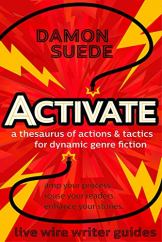 Damon Suede, on the other hand, is fireworks. If you aren’t prepared for it, the amount of information he delivers can be overwhelming. His handouts are thorough and closely follow the content of his classes, which is essential for me as I have trouble learning without visual aids.
 Unfortunately (for them) on that survey, there was a box where we could write detailed opinions about the catering. I’m a writer, so I took advantage of that opportunity.
 So, for the two final weeks of November and the first two weeks of December, we will be firing up the Starship Hydrangea (our hydrangea-blue Kia Soul) and driving 30 miles a day to and from the clinic. This will happen four out of five days a week, barring snow.
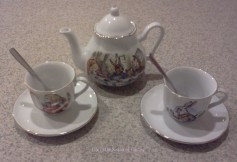 I have no problem getting the first draft done with the aid of a pot of hot, black tea and a simple outline to keep me on track. All that’s required is for me to sit down for an hour or two each morning and write a minimum of 1667 words per day.
 The real work begins after November. After writing most of a first draft, many people will realize they enjoy writing. Like me, they’ll be inspired to learn more about the craft. They discover that writing isn’t about getting a particular number of words written by a specific date, although that goal was a catalyst, the thing that got them moving.
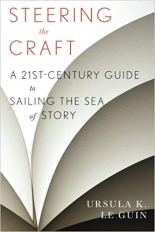 A good way to educate yourself is to attend seminars. By meeting and talking with other authors in various stages of their careers and learning from the pros, we develop the skills needed to write stories a reader will enjoy.
 I aspire to write like my heroes, authors who create characters who come alive. While I’m in that world, I see the people and their stories as sharply as the author intends.
 Polarity gives the important elements strength. It provides texture but often goes unnoticed while it influences a reader’s perception.
 I use the
 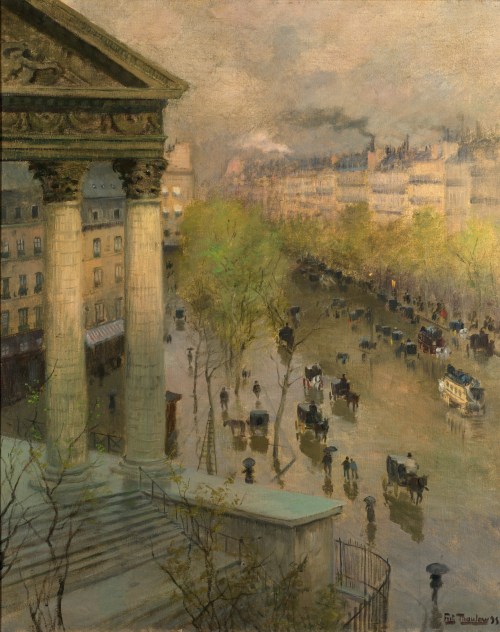 Title: Boulevard de la Madeleine in Paris by Frits Thaulow


 Life in the Realm of Fantasy

.jpg)