
This week we are continuing the discussion of verbs and how they shape the narrative. Last week I mentioned that I use verbs when creating a character, seeking out the action words each character embodies. Those words illuminate the gut reactions of each character and how they will act and react in each situation.
 Now that I have identified who most of my characters are, I am designing the structure of the plot. I need to use actions and events to show the story, but I also must bring out the backstory for my two MCs. I have to shed light on the friction and the attraction and force them together in situations they don’t want to be in. I also have to show them as individuals, independent of each other. As I work on the plot, the verbs that each character embodies will come to me.
Sentences are a marriage of words. A noun is one partner, and the verb is the other. The union of noun and verb will produce offspring—sentences. Modifiers are the in-laws, necessary but meddlesome. They often try to take over and guide the children against the parents’ wishes.
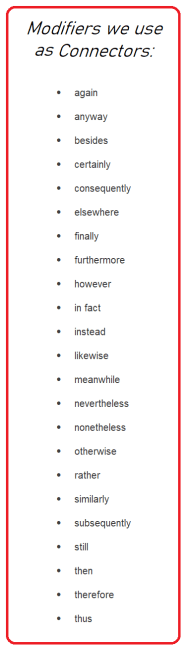
So, to minimize the damage done by intrusive modifiers, we rely on strong verbs and allow the modifiers to have their say only when necessary.
So why are verbs so crucial in shaping the tone and atmosphere of a narrative?
Think about this sentence: Nelson walked away.
We have three words indicating someone has departed, but they don’t show his mood.
Nelson is a person (noun). He performs an action (verb).
That action affects both Nelson and his objective: leaving. Away is an adverb (modifier) denoting distance from a particular person, place, or thing. It modifies the verb, giving Nelson a direction in which to go.
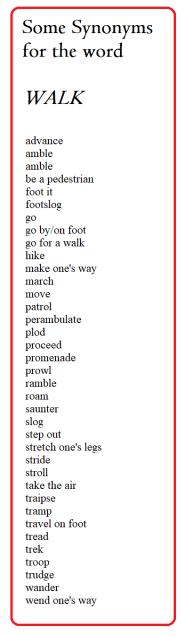 We can write it several different ways still using only three words, and all of them would indicate that Nelson has left the scene. Each time we substitute a synonym for the word walked, we change the atmosphere of that scene.
Nelson sauntered away. (He departed in a carefree, leisurely manner.)
Nelson strode away. (He walked decisively in a particular direction.)
Nelson stomped away. (Nelson left the scene in a bad mood.)
Nelson ambled away. (He walked slowly.)
Nelson slogged away. (He departed but had to work at it.)
Nelson slipped away. (Nelson departed, but sneakily.)
This is why it’s so important to have a good thesaurus on hand—I want my words to say what I envision. If I choose the correct verbs, my sentences will express my ideas with fewer modifiers.
Many verbs cannot impact a character or object directly. These are called intransitive verbs. They are just as important as transitive verbs because they show a mood or condition, a state of being, or a reflex (instinctive response).
Consider the word “mope.” Mope is an intransitive verb that means dejected and apathetic. It’s an action word that is going nowhere.
Nelson moped. (He was dejected and apathetic.)
We can have our character in a bad mood, but with many nuances that might say what we mean in a more particular way.
Nelson pouted. (He was whiney.)
Nelson languished. (He did nothing and stagnated.)
Nelson sulked. (He was angry and self-pitying.)
Nelson fretted. (He was in a neurotic mood.)
Some intransitive verbs in the family of “mope” are more robust and carry greater force:
Nelson brooded. (He was in a dark mood, obsessing.)
Nelson agonized. (He couldn’t stop thinking about it, suffering.)
When we add a strong intransitive verb to a powerful transitive verb, we have action and mood:
Nelson strode away, brooding. (He left the scene, and someone will suffer.)
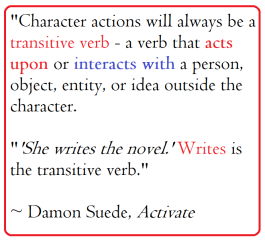 The above examples are basic, a bald telling of actions and moods. They are the core of the paragraph, the central idea. When we strip away the surrounding words, we can see how the variations of a primary verb can change the reader’s perception of an action scene.
Every year, I write the first draft of a novel in November, starting the actual writing on November 1st.
I always begin with an idea for a plot. Usually, I can’t actually visualize how it works until I see who the protagonists are. So, I jot down the premise and start from there. I choose to create a plot with my cast of characters having their primary characteristics in place.
I hope the conflicts and roadblocks will appear to arise organically as if that is what would happen to those people. Up to the end, my MCs must feel uncertain about the outcome. They must fear that failure looms but can’t give up. They must have a well of determination to draw upon.
I must do a certain amount of prep work if I hope to have a coherent plot and believable situations on November 1st. I do this gradually, working on it whenever I’m at a standstill on the current work in progress.
Everyone has hiccups in life, things that take over temporarily and make creative thinking a bit tough. But my work moves ahead because I can always do the technical stuff like plotting and worldbuilding, even when I can’t figure out how to say what I mean.
Previous posts on this subject:
Books I own and recommend for further research:
 The Conflict Thesaurus: A Writer’s Guide to Obstacles, Adversaries, and Inner Struggles (Volume 1) (Writers Helping Writers Series Book 8) by Angela Ackerman and Becca Puglisi.
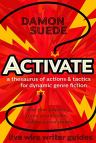 Activate: a thesaurus of actions & tactics for dynamic genre fiction by Damon Suede.
 Artist:
  Unfortunately, although we asked for a ground-floor condo, we were assigned a second-floor unit. My husband is managing the stairs – slowly. On the good side, we have the god’s-eye view of a wide stretch of beach, the perfect deck overlooking it all.
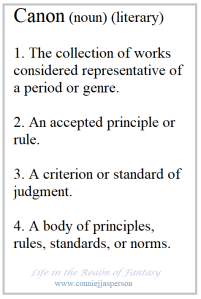 Writing is going as well as ever, a little up and down. I’m building the framework for a new story, which I will begin writing on November 1st. The world is already built; it’s an established world with many things that are canon and can’t be changed. So, I’m working my way through the bag of tricks that help me jar things loose.
 Protagonist HER: Anna Lundquist, an unemployed game developer. She inherited an old farm and has moved there. She embarks on creating her own business designing anime-based computer games. Anna is shy, not good with men unless discussing books or computer games. VOID: Loss of family. VERBS: Create, Build, Seek, Defend, Fight, Nurture. Modifiers: Adaptable, ambitious, focused, independent, industrious, mature, nurturing, private, resourceful, responsible, simple, thrifty.
 Antagonist HIM: Matt Gentry, owner of MGPopularGames and Anna’s former boss, is angry at Anna for leaving his firm. On a skiing trip with an old fraternity brother who owns an art supply store in Starfall Ridge, he sees her entering Nic’s coffeeshop. Matt discovers that Anna is now living in that town. He learns she has started her own company and is building an anime-based RPG. He goes back to Seattle and files an injunction to stop her, claiming that he owns the rights to her intellectual property. VOID: Narcissist. VERBS: Possess, Control, Desire, Covet, Steal, Lie, Torment.


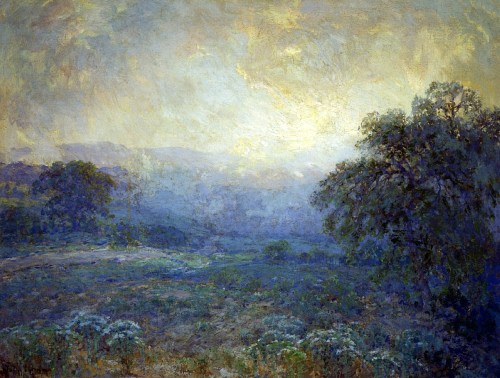
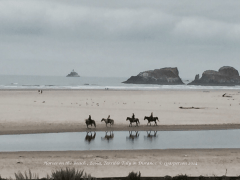 The view from our condo is one that never fails to soothe me. Tillamook Head is just off to the north. A mile out to sea, resting atop a sea stack of basalt, is the notorious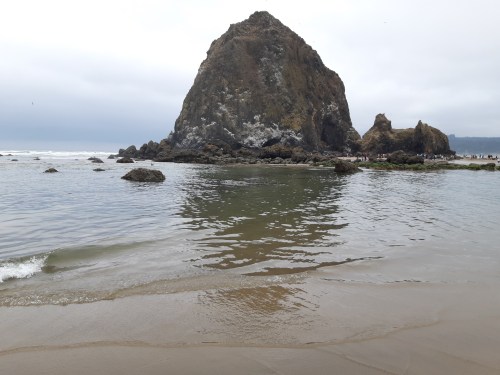
 Description: Best Nature Picture of the Day, by Guruspsingh
 The final aspect of narrative voice or style arises from our deeply held beliefs and attitudes. We may or may not consciously intend to do it, but our convictions emerge in our writing, shaping character and plot arcs.
 Whether or not we are aware of it, our societal and religious beliefs emerge in our writings. Subliminal fears of climate change, worry about a world on the edge of economic collapse, and our hopes for a better society come out in our plot arcs and world-building. How they appear may have nothing to do with real life, but they add color to our worlds.

 Why do I say such a terrible thing? It’s true. All stories are derived from a few basic plots, and we have only so many words in the English language with which to tell them.
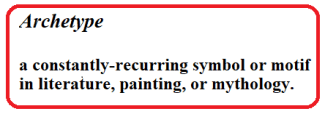 Overcoming the monster
 For that reason, I have the
  Noisy
Noisy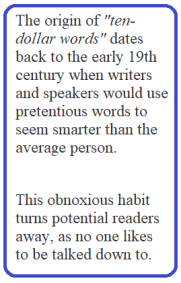 My Texan editor refers to those convoluted morsels of madness as “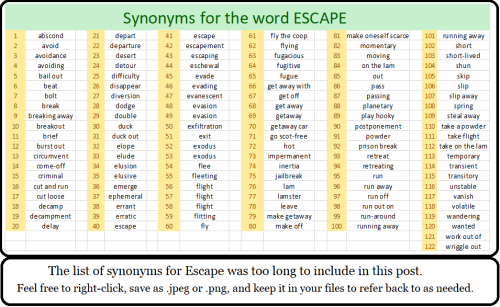
 Today’s post focuses on word choice. What do you want to convey with your prose? This is where the choice and placement of words come into play. Active prose is constructed of nouns followed by verbs or verbs followed by nouns.
 The second draft revisions are where I do the real writing. It involves finetuning the plot arc, character arcs, and most importantly, adjusting phrasing.
 Some types of narratives should feel highly charged and action-packed. Most of your sentences should be constructed with the verbs forward if you write in genres such as sci-fi, political thrillers, and crime thrillers.
 What clues should you look for when trying to see why someone says you are too wordy?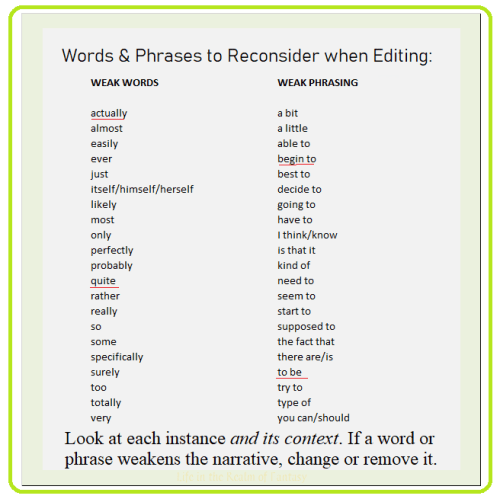
 Some authors are forceful in their style and throw you into the action. They have an in-your-face, hard-hitting style that comes on strong and doesn’t let up until the end.
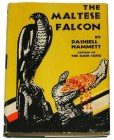 “I’m going to send you over. The chances are you’ll get off with life. That means you’ll be out again in twenty years. You’re an angel. I’ll wait for you.” He cleared his throat. “If they hang you I’ll always remember you.” [1]
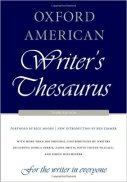
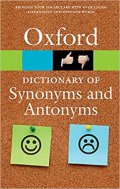 But I prefer to keep my research in hardcopy form, rather than digital.
  As we become confident in our writing, we learn more about grammar and punctuation in our native languages. We learn to write so others can understand us.
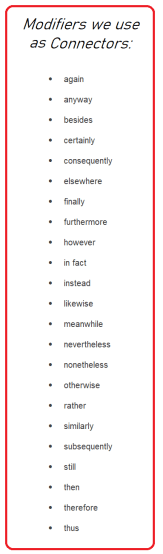
 However, quantifiers have a bad reputation because they can quickly become habitual, such as the word very.
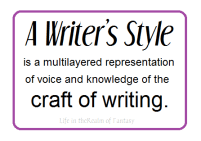
 Our narrative voice comes across in our choice of hard or soft words and where we habitually position verbs in a sentence. Where we automatically place the words in the sentence is a recognizable fingerprint.


 Life in the Realm of Fantasy