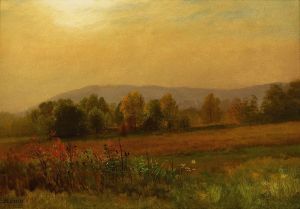
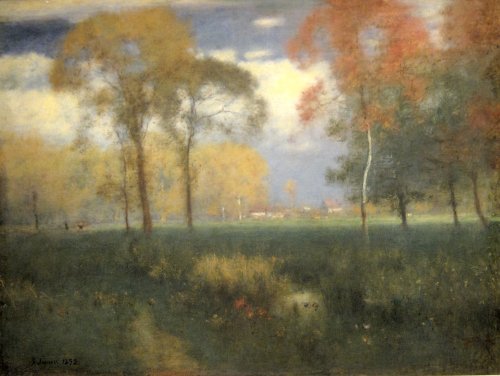
#FineArtFriday: Sunny Autumn Day by George Inness, 1892

Sunny Autumn Day, by George Inness

Date: 1892

Medium: oil on canvas

Dimensions: Height: 81 cm (31.8 in); Width: 106 cm (41.7 in)

Collection: Cleveland Museum of Art 


What I love about this painting:

This was painted toward the end of the artist’s life. We are given the impression of a beautiful day in September, with the leaves just beginning to turn color, still clinging to their trees. It’s warm enough to go without a jacket, one of the last good days before the weather turns cold. A dreamlike quality softens the edges, as if it depicts a scene viewed through the mystical glass of memory.

About the Artist, via Wikipedia:

George Inness (May 1, 1825 – August 3, 1894) was a prominent American landscape painter.

One of the most influential American artists of the nineteenth century, Inness was influenced, in turn, by the Old Masters, the Hudson River school, the Barbizon school, and, finally, the theology of Emanuel Swedenborg, whose spiritualism found vivid expression in the work of Inness’s maturity (1879–1894).

A master of light, color, and shadow, he became noted for creating highly ordered and complex scenes that often juxtaposed hazy or blurred elements with sharp and refined details to evoke an interweaving of both the physical and the spiritual nature of experience. In Inness’s words, he attempted through his art to demonstrate the “reality of the unseen” and to connect the “visible upon the invisible.”

After Inness settled in Montclair, New Jersey in 1885, and particularly in the last decade of his life, this mystical component manifested in his art through a more abstracted handling of shapes, softened edges, and saturated color (October, 1886, Los Angeles County Museum of Art), a profound and dramatic juxtaposition of sky and earth (Early Autumn, Montclair, 1888, Montclair Art Museum),  an emphasis on the intimate landscape view (Sunset in the Woods, 1891, Corcoran Gallery of Art), and an increasingly personal, spontaneous, and often violent handling of paint. It is this last quality in particular which distinguishes Inness from those painters of like sympathies who are characterized as Luminists.

In a published interview, Inness maintained that “The true use of art is, first, to cultivate the artist’s own spiritual nature.” His abiding interest in spiritual and emotional considerations did not preclude Inness from undertaking a scientific study of color, nor a mathematical, structural approach to composition: “The poetic quality is not obtained by eschewing any truths of fact or of Nature…Poetry is the vision of reality.”


Credits and Attributions:

Wikimedia Commons contributors, “File:’Sunny Autumn Day’ by George Inness, 1892.JPG,” Wikimedia Commons, the free media repository, https://commons.wikimedia.org/w/index.php?title=File:%27Sunny_Autumn_Day%27_by_George_Inness,_1892.JPG&oldid=428214252  (accessed October 2, 2020).

Wikipedia contributors, “George Inness,” Wikipedia, The Free Encyclopedia, https://en.wikipedia.org/w/index.php?title=George_Inness&oldid=975996784 (accessed October 2, 2020).

2 Comments

Filed under #FineArtFriday

Autumn, and thoughts of #NaNoWriMo2020

September is ending. Here in my native northwestern forests, the colors of the big-leaf maples and alders paint the landscape in shades of yellow and gold.  Lower in the canopy, bursts of red and scarlet from our sumac and vine-maples shout that autumn has arrived, and summer is leaving.

In the high country, golden larches surprise those hikers who’ve never seen a deciduous conifer. They might think the forest is dying when really, it’s just going to take a long nap.

The autumn forest feels mysterious, a place of change and shadows, with depths we can’t really know.

The sky is also changing. Our days are shorter, and while the sun is shining this week, the monsoon months approach. Rain will be our most constant companion, or heaven forbid, lowland snow.

I don’t mind the snow now that I don’t have to drive in it, but something about the slightest dusting sends the Northwest into a panic. By the middle of October, gray overcast skies seem to linger unending, eternal.  Visitors from sunnier places wonder if the sun will ever shine again.

I always tell them to wait a day or two. When the clouds finally part, they reveal a shade of blue so beautiful that words can fail me.

These are the writing months, the mad dash to finish that first draft, and the build-up to NaNoWriMo. These are the days when inspiration knocks on the door, calling “Trick or treat!”

In October, I begin prepping for the month of intensive writing.

If I am going to be effective, I will need to make an outline of the basic story arc. I will make one even when my novel could end in several different ways.

Writing a story as it falls out of my head can be fun in short bursts. However, my years of experience with NaNoWriMo have taught me that I will quickly run out of ideas of what to do next if I don’t have some sort of guide.

In some novels, it feels as if the authors became desperate at the halfway point. Random sex and violence occur without any real feeling. It’s a terrible temptation to kill someone just to stir things up and raise the emotional stakes.

I don’t want to be faced with that dilemma. I intend to begin writing on November 1st with a solid notion of  who the story is about, what their problem is, and where the story will go. For me, good preparations are the key to a finished first draft. Sometime toward the middle of October, I will share some of my simple nano-prep ideas.

There are times when someone must die to advance the plot or fire up the protagonist, but readers get angry with authors who kill off too many characters they have grown to like.

Autumn and winter are also my reading days. In October I immerse myself in reading, mingled in with the writing I ordinarily do. I admit that some days I get so into what I’m reading that I forget to cook dinner.

Oops.

Today’s autumn glory will intensify and linger for a few short weeks. Then, the rain we Northwesterners are famous for will move in.

Those few leaves fortunate enough to go unraked will become soggy and moldy, waiting for the wind to set them flying. They will huddle in the gutters and against the foundations of buildings, seeking warmth and perhaps regretting their freedom.

And when the skeletal remains have turned to soil as all leaves must, perhaps a seed will take root. Maybe one day, the seedling-tree, nurtured by this year’s broken remains, will shade me as I walk.

In autumn, my ideas for stories are like fallen leaves. I cast them flying in the wind that is NaNoWriMo, letting them go where they will against the framework of my world and plot outline.

All I can hope is they come to rest in a place where they will nourish the seeds of the story I intend to write when November 1st arrives.


Credits and Attributions

Albert Bierstadt – Autumn Landscape PD|100 via Wikimedia Commons

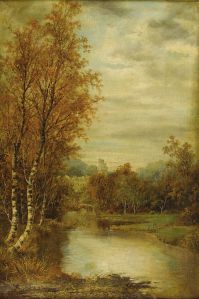
Autumn Landscape with Pond and Castle Tower-Alfred Glendening, 1869 PD|100 via Wikimedia Commons

2 Comments

Filed under writing

Navigating the different ways in which we learn #amwriting

I went to school in a small town in Washington State and graduated in 1971. I don’t exactly know how that happened, as I was the most undereducated and socially ignorant student ever given a diploma from Tumwater High School.

While I didn’t thrive in school, I was a boomer, so I suppose they passed me along to make room for the next year’s students.

For the most part, I didn’t like school. Everything happened so fast and moved so quickly that I rarely understood what was going on, or what we were doing. I was the odd duck in the pond, never quite aware of the proper social cues, and always out of step.

Teachers regularly pointed out that I was an underachiever.

Music was my refuge, my guaranteed A. When it came to reading, English, and literature, I was ahead of the class. Because social studies/history and science were so reading-intensive, I managed to get decent grades in those classes too.

I was funneled down the college path by my parents, despite the fact I didn’t have a clue about algebra. Proficiency in advanced mathematics was a requirement for admission into any college or university.

No amount of private tutoring could do more than barely keep me from failing. Getting a “D” was the best I could do in that subject. But I did understand bookkeeping math, and because I could see why everything added up, I liked it. I was a bookkeeper for most of my working life.

In 1993, the company I worked for finally bought a computer. All the Microsoft products in those days came with a large book, but I needed to move my files from paper to Excel as quickly as possible. Out of desperation, I brought my then-fourteen-year-old son in on a Saturday, and he showed me how to transfer my handwritten spreadsheets to Excel.

Once Daniel began showing me how it worked, it was as if a supernova had gone off in my mind. All those wacky algebra equations I had never understood suddenly made sense.

In Excel, I had a visual system before me that showed me how it worked. A workbook has several spreadsheets in it, each made of rows and columns of cells. You must use the right language, such as =sum(A1+A2). But once I learned the language, the bookkeeping world was my oyster.

Best of all, if I changed the values in cells A1 and A2, the sum in A3 automatically updated.

And I could link cells between spreadsheets in the same workbook!
Hallelujah! The Income & Expense report automatically updated every time an entry was made in the check register, accounts receivable, or accounts payable.

No more poring over a 32-column spreadsheet with a yardstick and calculator for half a day only to be 3 pennies off at the end. Mistakes were easily and quickly dealt with, saving an incredible amount of time.

As an adult, I discovered that I am a visual learner. In other words, I don’t do abstract well at all. In 1997, I was diagnosed with a learning disability that no one ever thought about in my era. But it is actually pretty common: attention deficit disorder without hyperactivity (ADD).

So, I was not a lazy student, as my report cards all said. I really was working hard, trying to keep my head above water.

I was just unable to see the shore I was swimming toward.

And what does all that mean? I don’t see it as a disability, because for me, it can be worked around.

I just have a different way of learning that didn’t lend itself to the way traditional public school systems taught during the time I was growing up.

College was easier for me to navigate in some ways. As an adult, in classroom situations, I get confused easily when hearing verbal instructions.

However, college-level textbooks aren’t as ambiguous as those we had in elementary school. If I am given handouts with the high points written out in plain English, I can take the time I need to research and absorb the information.

Despite my less than happy years in public schools, I love learning. All my adult life, I have been educating myself, sometimes formally, but mostly via the internet. Being able to learn at my pace and not have to wonder what I missed is sheer heaven.

This is why writer’s conferences are good for me. Yes, most lectures are delivered verbally, but they are short, and the presenters are willing to answer questions. Also, having a laptop gives me the ability to take readable notes as the presentation goes along. And most presenters give useful handouts or direct you to books that illustrate their subject.

I did enjoy the PNWA virtual conference this last weekend and was able to sit in on many excellent seminars. Much of what I heard reinforced previous knowledge.

However, every new concept I was exposed to is still fermenting, rolling around in my mind, and will probably emerge in a blogpost. I heard several different ways of looking at one aspect of writing craft or another, but I still need to think about them.

Yes, even virtual conferences are a test of my endurance.

I still feel confused as I sit in a Zoom meeting, taking notes and trying to understand the finer distinctions between simple things that everyone else grasps right away.

But that no longer paralyzes me.

I now know how to navigate the way I learn. I go back to my notes to see what I want to investigate further. Then I go out to the internet and seek information from more than one source. By having several differently phrased explanations, something I didn’t quite understand will be made clear.

I absorb and remember information in a different way than the majority of people do, but I no longer panic over it. You may learn in yet another way.

None of us fit into that box in the center of the learning spectrum, the one labeled “normal.” The key is to relax and absorb the information in the way you feel most comfortable.

Being diagnosed with a learning disability at the age of 44 was a surprise, but it explained so much. I’d gone through life feeling like the lone puzzle piece from a jigsaw puzzle with a similar but different picture that had been put into the wrong box. And now I knew why I didn’t fit.

That diagnosis in 1997 gave me the tools I needed to educate myself. It also gave me the confidence to accept how I am different and be a little more outgoing. I still lack certain social skills, but I’m improving there too.
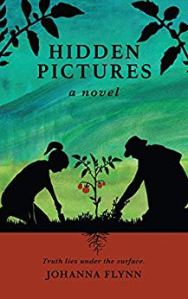
And one final update on the PNWA conference: my dear friend and fellow member of the Tuesday Morning Rebel Writers, Johanna Flynn won the Nancy Pearl award for her book, Hidden Pictures. This is so meaningful, beyond the cash prize, as it is an award that is voted on by librarians.

So, keep writing, and keep submitting your work. Educate yourself in the way you feel most comfortable and have faith in yourself. We never know what lies just around the corner.

4 Comments

Filed under writing

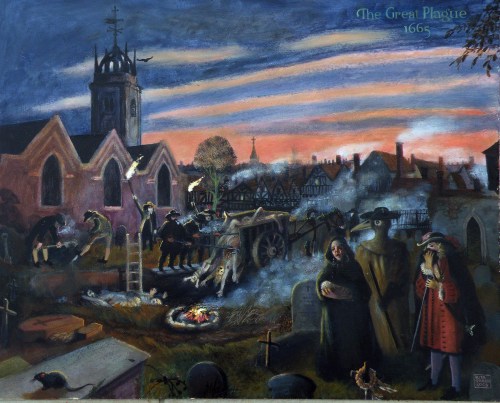
#FineArtFriday: The Great Plague 1665 by Rita Greer 2009

Title: The Great Plague 1665, by Rita Greer 2009

Description (via Wikimedia Commons): Like many who could afford to, Robert Hooke left London for six months during the worst of the bubonic plague. All cats and dogs were destroyed as a preventive measure. This allowed rats to flourish and spread the disease which was carried by their fleas. The image shows a scene of horror. After sunset carts were driven through the streets to collect the dead. They were taken to the nearest graveyard to be buried in plague pits. Fires burned to make smoke. Pipes of tobacco were smoked, posies of herbs worn, and faces covered with masks. This was thought to be protection against contagion. London was overwhelmed with fear, terror and grief. It is thought that as many as 100,000 perished in London alone.

Date: 2009

Source/Photographer: The original is an oil painting on board by Rita Greer, history painter, 2009. This was digitized by Rita and sent via email to the Department of Engineering Science, Oxford University, where it was subsequently uploaded to Wikimedia.

What I love about this painting:

Rita Greer paints history as if she lived it, with meticulous detail. In this street scene, she manages to capture the despair and hopelessness that pervaded London with the advent of the plague. This scene is dark, and filled with emotion. Death walks the smoke-hazed streets, feeding on tragedy. Grief and fear are the driving forces, and no one’s family is spared.

This year, 2020, feels like an apocalypse year, in many ways. It helps to keep in mind that for London and all the great cities of Europe, 1665 was worse.

About the artist:

Rita Greer is a history artist, goldsmith, graphic designer, food scientist and author/writer. On retirement in 2003 Rita began the Robert Hooke project, “to put him back into history.” Much her work is available to be viewed at Wikimedia Commons, Category: Paintings by Rita Greer.


Credits and Attributions:

Wikimedia Commons contributors, “File:20 The Great Plague.JPG,” Wikimedia Commons, the free media repository, https://commons.wikimedia.org/w/index.php?title=File:20_The_Great_Plague.JPG&oldid=450173019 (accessed September 24, 2020).

Comments Off on #FineArtFriday: The Great Plague 1665 by Rita Greer 2009

Filed under #FineArtFriday

Virtual Conferences #amwriting

We are now entering the virtual convention season. PNWA (the Pacific Northwest Writers’  Association Conference) kicks off on Thursday the 24th. This will be the first year they’ve been virtual.

I will miss the people I usually see there and hope that next year we can meet in person.

However, while the in-person conference was a lot of fun, this is much gentler on the budget. I don’t have to rent a room for three nights, and I can prepare my own food as I normally do, which is not an easy thing for a vegan on the road.

I’m really looking forward to the awards night, as my good friend, author Johanna Flynn is up for the prestigious Nancy Pearl Award for her book, Hidden Pictures—and that is a big deal.

I was a reader in the short story category, and one of the stories I read is up for an award—this makes me happy. I love it when I come across a brilliant piece of writing, and some of the entries I read this year just shone.

The Nebulas were a virtual conference this last May, and I enjoyed how easy it was to navigate the whole thing. I wouldn’t have attended the Nebulas had it not been virtual, as the total cost for air-fare and rooms and dining would have been prohibitive. It was a real joy to be involved, even if only on a virtual level.

The reason I love conferences is simple. You meet people and make connections, and sometimes you forge friendships. If anything is missing from a virtual conference, it is that little touch of humanity.

However, much can be gained, even in these challenging times. This year, Brit Bennett, New York Times best-selling author of The Vanishing Half and The Mothers,  will be giving the keynote speech. I’m looking forward to an inspiring evening.

The master’s classes are included in the basic fee this year since it is a virtual conference. I’ve always enjoyed these classes when I had the extra money, but there were years when I couldn’t afford them. Many people have wanted to attend master’s classes but couldn’t find the extra money, so this year they will have that chance.

I am interested in writing craft seminars (of course). Still, I will be attending workshops on negotiating the rough waters of the business side of writing. Sunday will focus on screenwriting.

PNWA is offering both 20 minute and 1-hour seminars, which allows folks the chance to walk around and stretch their legs. I think a shorter meeting will encourage people to remain at their computers and engaged.

I hope to have a lot of new ideas for posts on craft and the business of writing in general. Some years I come home fired up about specific topics that were covered, in both craft and business. I hope to end this conference with new viewpoints on what sometimes feels like old dogmas.

I love learning. Discovering fresh ideas, seeing new ways of looking at things we take for granted—these are the reasons I attend writers’ conferences.

3 Comments

Filed under writing

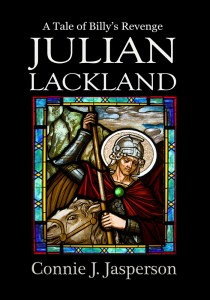
Julian Lackland #new #amwriting

Tomorrow, September 22, 2020, would be my father’s 96th birthday. In honor of the man whose library of speculative fiction and classics inspired me to write, I chose that day for my new novel, Julian Lackland, to leave the nest.

Lackland began life in November of 2010, as my NaNoWriMo novel. Since then, he has been through many changes.

This is the original novel from which both Huw the Bard and Billy Ninefingers grew, and it was both my greatest joy and my worst mistake.

In 2010 I made my word count and became a firm believer in the principals behind NaNoWriMo—that if you sit down and write at least 1667 words every day, you will complete your novel.

What I didn’t know was that while that novel might be complete, it isn’t finished. The year that followed was filled with mistakes and struggles. There were some low points, a devastating falling out with my first publisher, and the grim realization that the book should be left in a drawer to rot.

When we formed Myrddin Publishing Group, our lead editor, Alison DeLuca, gave me great advice. Rather than abandon it, I should completely dismantle it and start over. It was a low point and seemed like a mountain. Alison’s courage in the face of disaster gave me the strength to put the publishing nightmare behind me and rebuild the novel from the ground up, writing it the way it should have been done in the first place.

I’ve been fortunate to have a village of brilliant editors along the way. My dear friend, sci-fi author Dave Cantrell, gave so much of himself to this project. Dave was the structural editor for Billy Ninefingers and The Wayward Son, and his eye for flow and logic influenced the first two drafts of this new manuscript.

Unfortunately, Dave was ill for most of 2019 and died this last summer. But a part of him lives on in the shape of this novel.

Once the new manuscript was in the final stages, Johanna Flynn was a kind but firm beta reader. I was fortunate to have Irene Roth Luvaul’s eye on the final draft, as the Texas Tornado is a brilliant line editor.

The support and advice from my writing posse has been and always will be invaluable. The international group of authors and editors at Myrddin Publishing are a well of knowledge, support, and advice.

Here in my local community, I am a member of a professional writer’s group, The Tuesday Morning Rebel Writers. The group is comprised of about nine novelists. Several are successful and award-winning authors, like Lee French, Ellen King Rice, and Johanna Flynn. The rest of us are in various stages of our writing careers.

I can’t thank these authors enough. Between them, Myrddin Publishing and the Rebel Writers dragged me gently to the finish line.

Julian’s story was born on November 1st, 2010. Two days before the start of the month, I had accepted a challenge to “do” something called “NaNoWriMo,” a.k.a. National Novel Writing Month. I’d never heard of it, but a challenge is a challenge.

I had written the storyline for an RPG and many short stories. A proto novel was rambling along at 250,000 words, so I thought, “How hard can it be to write 1667 words a day?”

I had the vague notion of writing a story about a rollicking band of mercenaries, so I began with no outline and no plot. In the way that NaNoWriMo novels often go, I got caught up in the character of Julian “Lackland” De Portiers, but also in several others.

I soon discovered that writing 1667 words a day is easy.

I also discovered that writing a coherent novel with no plot, no outline, and no maps is not my strong suit.

But there was a good story there, buried beneath the crap. I began by dividing out the stories that didn’t pertain to Julian, and that was how Billy Ninefingers came into existence.

Then I focused on the core of the story, and gradually I came to realize that the true adversary in this tale is Lackland’s naïve belief that good will always triumph.

Julian is the landless second son of a minor baron and relegated to the sidelines at court because he has no land. His own brother, jealous of his knightly skill and charisma, named him “Lackland” as a way to keep him in his place.

Lackland embraced the name, realizing that it meant he had the freedom to do as he wished and owed nothing to anyone but the king. King Henri just happens to be his second cousin on his mother’s side.

Julian leaves the court and joins the mercenary crew known as the Rowdies. He intends to do a little good in the world, and Billy Ninefingers wants more knights like him in his Rowdies. They have an arrangement where Julian will be available whenever his royal cousin needs him.

Highly skilled at arms and cursed with the ability to plan a war better than anyone, the king pulls Julian Lackland out of his toolkit whenever the job is impossible or too dirty for an ordinary knight to accomplish.

Lackland has a remarkable knack for finding trouble, but he meets good people along the way. Love is always a problem, but Julian Lackland just lives as well as he can.

Julian is and always will be my favorite character because he is so complicated, so conflicted, and so ethical. His story is that of perseverance in the face of catastrophe, but it is also the story of human frailty and resilience.

Originally, I wanted to write a epic fantasy novel that my father would read, one that I might have stolen from his nightstand.

I believe I have succeeded.


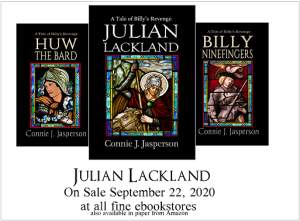
Julian Lackland by Connie J. Jasperson

Julian “Lackland” De Portiers is the last good knight in Waldeyn. Everyone knows he’s brilliant…

…Everyone knows he’s mad.

How does a Hero gracefully retire from the business of saving the world?

Once upon a time, Julian “Lackland” De Portiers had the strength to save what mattered most. Once he had companions and twice, he fell passionately in love.

One terrible night in the forest, everything changed.

Who will rescue the rescuer when darkness falls, and the voices begin?

Julian Lackland is an enduring tale of confusion, sorrow, and triumph set in an alternate medieval world.

Purchase Julian Lackland in eBook for $4.99 or paper for $12.99 at Amazon

Not a fan of Amazon? Purchase Julian Lackland from these fine eBook sellers for $4.99

15 Comments

Filed under writing

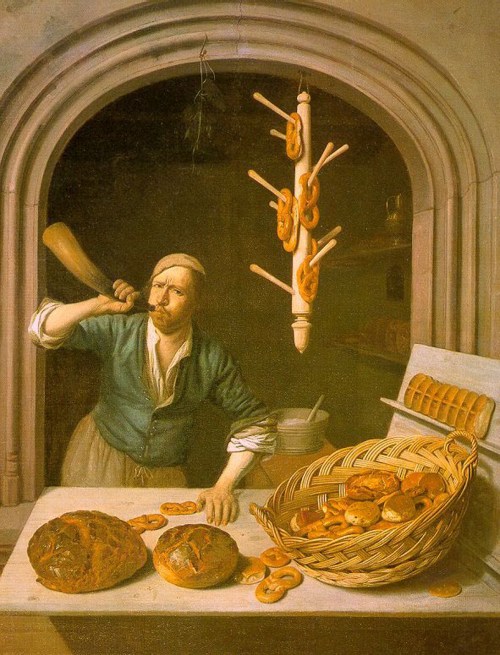
#FineArtFriday: The Baker by Job Adriaenszoon Berckheyde, circa 1681

Title: The Baker

Genre: self-portrait

Artist: Job Adriaenszoon Berckheyde

Date: 1681

Medium: oil on canvas

Collection: Worcester Art Museum

What I like about this painting:

Berckheyde painted several pictures of bakery shops. These genre paintings of bakeries were popular as a subject for Dutch artists from around 1650.

When I first saw this image, I wondered why our baker is blowing a horn. I discovered that was how some bakers announced the morning’s freshly baked bread.

Like most merchants in 17th century Holland, bakers often worked out of their own homes. However, their ovens were well-known fire threats. Entire cities would go up in a raging conflagration that no one could out run or stop, often burning for days. For this reason, many neighbors didn’t really want a baker going into business next door to them.

To minimize the fire risk, some towns and cities required bakers to live and do business in stone buildings. This law explains the artist’s rather monumental choice of architecture as the background for The Baker. It looks the the entrance to a cathedral.

Berckheyde chose to make this a self-portrait. I like this decision, for he was honest in how he presented himself, He is not too handsome, but is surrounded by a wide, tempting assortment of goods, including pretzels. The wooden rack they’re displayed on would be at home in any bakery shop today.

I would definitely buy my family’s bread from this baker.


About the Artist, via Wikipedia:

Job Berckheyde, baptized 27 January 1630 and died 23 November 1693, was born in Haarlem and was the older brother of the painter Gerrit who he later taught to paint.

He was apprenticed on 2 November 1644 to Jacob Willemszoon de Wet. His master’s influence is apparent in his first dated canvas, “Christ Preaching to the Children” (1661), one of his few biblical scenes.

Golden-age historian Arnold Houbraken claimed that Job had been trained as a bookbinder by his father, and could not discover who taught him to paint.

What is not in doubt is that Gerrit learned from his older brother. Job’s teacher must have been a Haarlem master, and some claim it was Frans Hals, but Houbraken claimed he travelled as a journeyman between Leiden and Utrecht offering his services as a portrait painter and learned by doing.

During the 1650s the two brothers, Job and Gerrit, made an extended trip along the Rhine to Germany, stopping off at Cologne, Bonn, Mannheim and finally Heidelberg, following the example of their fellow guild member Vincent van der Vinne.

The brothers worked in Heidelberg for Charles I Louis, Elector Palatine (with Job producing portraits and hunting scenes, and receiving a gold chain from the Elector in reward) but were ultimately unable to adapt to court life and so returned to Haarlem, where they shared a house and perhaps a studio.

He became a member of the Haarlem rederijkersgilde ‘De Wijngaardranken’ in 1666–1682. He is registered in Amsterdam 1682–1688, where he became a member of the Guild of St Luke there in 1685–1688. Berckheyde was buried in Haarlem.

He could paint landscapes in the same style as his brother, but seems to have preferred interiors and genre works, whereas his brother’s oeuvre consists mostly of outdoor scenes. The Elector’s gold chain may be the one he wears in his early Self-portrait (1655), his only documented work from the 1650s.

Job is better known for his later work, which consists mainly of interior views of the Sint-Bavokerk in Haarlem and simple genre scenes recalling those of his Haarlem contemporaries Adriaen van Ostade and Jan Steen.

Less prolific than his brother, but more varied in his output, Job produced bible and genre scenes as well as cityscapes. Confusion between their works may have resulted from the similarity of their signatures, where Job’s j resembles Gerrit’s g. Job also signed his work with an H (for Hiob or Job) and with the monogram HB.


Credits and Attributions:

Wikimedia Commons contributors, “File:Berckheyde, Job – The Baker – 1681.jpg,” Wikimedia Commons, the free media repository, https://commons.wikimedia.org/w/index.php?title=File:Berckheyde,_Job_-_The_Baker_-_1681.jpg&oldid=463054921 (accessed September 17, 2020).

Wikipedia contributors, “Job Adriaenszoon Berckheyde,” Wikipedia, The Free Encyclopedia, https://en.wikipedia.org/w/index.php?title=Job_Adriaenszoon_Berckheyde&oldid=947928424 (accessed September 17, 2020).

Wikipedia contributors, “Gerrit Berckheyde,” Wikipedia, The Free Encyclopedia, https://en.wikipedia.org/w/index.php?title=Gerrit_Berckheyde&oldid=933563068 (accessed September 17, 2020).

Comments Off on #FineArtFriday: The Baker by Job Adriaenszoon Berckheyde, circa 1681

Filed under #FineArtFriday

Character Building: Writing Subtly Positive Emotions #amwriting

Most writers find it easy to connect with the flamboyant emotions, such as hate, anger, desire, and adoration. However, emotions have “volume” ranging from soft to loud. Today we are looking at generally positive emotions, but at low volume.

The volume control is a crucial part of the overall pacing of your story. “Loud” deafens us and loses it’s power when it’s the only sound. However, like the opening movement of Beethoven’s 5th Symphony, the entire range of volume can be effectively used to create a masterpiece.

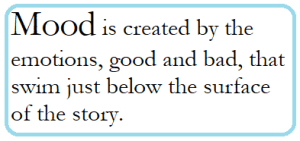
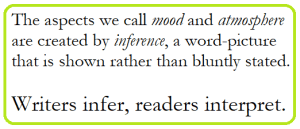
These subtle emotions convey the mood of the piece.

As we said in the previous post, Writing Subtly  Negative Emotions, low-key shades of emotion can go almost unnoticed, but they lend solidity to the world. Under the surface, vibes, positive or negative, give us a rounded view of a character, making them less of a cardboard-Barbie and more of a real person.

We’re all aware of one positive emotion that can go bad—love. When love is reciprocated, it’s a positive feeling, and we all enjoy a good love story.

However, when love starts out with promise and then goes terribly wrong, you have the makings of a deep, dark story filled with possibilities.

But none of that—we’re focusing on the less intense, but still good, vibes today.

Another positive emotion with many nuances is Joy. The way we feel joy ranges from mild to overwhelming, from a slight smile to an experience so profound that tears spring to one’s eyes.

Subtle emotions don’t stand out and grab the reader.

They are there under the surface, tinting the reader’s opinions about the story and the characters. Small, quiet emotions linger, and if they are positive, they leave an impression we can’t describe, but we are happier for having experienced them.

These feelings are difficult for a writer to articulate. However, if you want to forge a connection between your reader and the characters in your narrative, you must include small indicators that individuals in the cast sometimes experience a sense of:

  • Competence
  • Confidence in their friends
  • Cooperation
  • Courage
  • Decisiveness
  • Discovery
  • Group ethics
  • Happiness
  • Individual moral courage
  • Purposefulness
  • Revelation
  • Satisfaction
  • Self-confidence
  • Serenity
  • Strength
  • Success
  • Sufficiency
  • Trust

These are good vibes that are rarely articulated, but they suffuse the scene and color the way in which the characters interact with each other.

Some positive emotions can be more intense, yet still not overpowering. Those moments can be shown by an immediate physical reaction, combined with internal dialogue or conversations. We  use the same 1 – 2 – 3  trick of word order when describing a mild experience as we do with louder emotions.

  1. Start with the visceral response. There will be an instant reaction. Good emotions are felt first in the chest, in varying degrees, from a feeling of warmth to the stronger, heart-pounding sensation. But we’re keeping it subdued, here.
  2. Follow up with a thought response. If it is a mild reaction, give it a moderate thought response. “Ah hah!” Whatever your style and word choices are, showing small moments of relatable happiness or pleasure makes our protagonist more sympathetic.
  3. Third, finish up with body language. That is how emotions hit us. We feel the shock then experience the mental reaction as we process the event. Our body language reflects these things.

What if you are writing a story where one of the antagonists will eventually become part of the protagonist’s inner circle? Including small positive thoughts early on in their narrative can foreshadow that this character may turn out to be the ally that turns the tide.

I’ve pointed out many times that conflict is what keeps the protagonist from achieving their goals. Large emotions are easy to write. But frequently, in real life, our smaller joys have a longer-lasting impact, and the memory of these can be the impetus that keeps the soldier fighting during the darkest hours.

Allowing ourselves and our characters to feel joy over small things, to experience a sense of accomplishment is a gift to the reader. The reader will experience those emotions as if they are theirs, and the book will be that much more meaningful to them.

6 Comments

Filed under writing

Character Building: Writing Subtly Negative Emotions #amwriting

Most writers find it easy to connect with the “loud” emotions, such as anger and hate. However, negative emotions have nuances the same way that positive emotions do.

Subtle shades of emotion give us a rounded view of a character, making them less of a cardboard-Barbie and more of a real person.

One negative aspect of our human character is a tendency for us to experience an uncharitable emotion known as schadenfreude. We are all familiar with it, as we experience it on a personal level every now and then. Some people take great joy in this, gaining a sense of superiority.

About schadenfreude, Via Wikipedia:

Schadenfreude is a complex emotion, where rather than feeling sympathy towards someone’s misfortune, schadenfreude evokes joyful feelings that take pleasure from watching someone fail. This emotion is displayed more in children than adults; however, adults also experience schadenfreude, though generally concealed.

In other words, we know it’s an unkind emotion, and we don’t like it in others. Like theft and lying, it is a fundamental aspect of our survival mechanisms that was hardwired into us before we came down from the trees. Primates in the wild have been observed exhibiting our most negative behaviors. 10 Facts About Chimpanzees That Hold A Dark Mirror To Humanity

For most of human history, popular humor has had an aspect of schadenfreude to it. Charlie Chaplin, The Three Stooges, and Jerry Lewis were all popular comedy acts of the 20th century who employed physical comedy that evoked a feeling of schadenfreude in the audience.

We don’t like admitting it, and we try to rise above it. This is one easily relatable emotion you can use to show that your protagonist or others in the cast are real.

Another negative emotion with many nuances is envy. Envy can take the form of wishing one had that lovely thing. Allowed to rage out of control, jealousy becomes the propellant fueling a violent takeover.

Subtle emotions are the kind that prey on you. These feelings are difficult for a writer to articulate. However, if you want to keep raising the tension in your narrative, you must include small indicators of:

  • Anguish
  • Anxiety
  • Defeat
  • Defensiveness
  • Depression
  • Indecision
  • Jealousy
  • Ethical Quandaries
  • Inadequacy
  • Paranoia
  • Powerlessness
  • Regret
  • Resistance
  • Temptation
  • Trust
  • Unease
  • Weakness

These are emotions that can be shown by an immediate physical reaction, combined with internal dialogue or conversations.

As with louder emotions, we want to create a sympathetic response in the reader. So, we use a simple 1 – 2 – 3  trick of word order when describing the character’s experience.

  1. Start with the visceral response. How does a “gut reaction” feel? Nausea, gut-punch, butterflies…how do you respond to internal surprises?
  2. Follow up with a thought response. If it is a mild reaction, it might be on the order of “Heck!” or “Oh dear….” Whatever your style and word choices are, showing their dismay makes them human.
  3. Third, finish up with body language. That is how emotions hit us. We feel the shock then experience the mental reaction as we process the event. Our body language reflects these things.

What if you are writing a story where the antagonist begins as part of the protagonist’s inner circle? Including small negatives like envy and schadenfreude in their narrative can foreshadow that this character may turn out to be the skunk in the laundry hamper.

Conflict is what keeps the protagonist from achieving their goals. Large conflicts and emotions are easy to write. But frequently, in real life, our smaller, more internal conflicts create greater roadblocks to success than any antagonist might present.

These tiny inner voices of self-destruction that hold us back are crucial to creating relatable characters.

8 Comments

Filed under writing

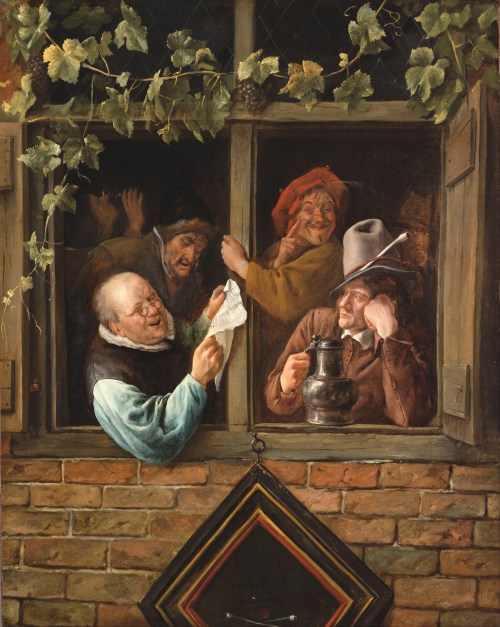
#FineArtFriday: Rhetoricians at a Window by Jan Steen ca. 1666

Artist: Jan Steen  (1625/1626–1679)

Title: Rhetoricians at a Window

Genre: genre art

Date: c. 1661-66

Medium: oil on canvas

English: Oil on canvas

Dimensions: Height: 759.46 mm (29.90 in); Width: 586.23 mm (23.07 in)

Collection: Philadelphia Museum of Art

What I love about this painting:

The reading of a poem or play was clearly the opportunity for the performers to have a good time. From the drinker in the shadows of the background to the grapevines growing around the window, Steen tells us that wine and rhetoric are clearly entwined.

I love the inclusion of both “the critic” who leans his head on his hand and listens analytically, and the man behind him, who is clearly “a little over the limit,” and supports himself by grasping the window frame and heartily agreeing with some point.

The reader is clearly enjoying himself, as are the others.

About the Artist (Via Wikipedia):

Jan Havickszoon Steen (c. 1626 – buried 3 February 1679) was a Dutch Golden Age painter, one of the leading genre painters of the 17th century. His works are known for their psychological insight, sense of humour and abundance of colour.

Daily life was Jan Steen’s main pictorial theme. Many of the genre scenes he portrayed, as in The Feast of Saint Nicholas, are lively to the point of chaos and lustfulness, even so much that “a Jan Steen household”, meaning a messy scene, became a Dutch proverb (een huishouden van Jan Steen). Subtle hints in his paintings seem to suggest that Steen meant to warn the viewer rather than invite him to copy this behaviour. Many of Steen’s paintings bear references to old Dutch proverbs or literature. He often used members of his family as models, and painted quite a few self-portraits in which he showed no tendency of vanity.

Steen did not shy from other themes: he painted historical, mythological and religious scenes, portraits, still lifes and natural scenes. His portraits of children are famous. He is also well known for his mastery of light and attention to detail, most notably in Persian rugs and other textiles.

Steen was prolific, producing about 800 paintings, of which roughly 350 survive. His work was valued much by contemporaries and as a result he was reasonably well paid for his work. He did not have many students—only Richard Brakenburgh is recorded—but his work proved a source of inspiration for many painters. [2]

About this painting, Via Wikipedia:

Chambers of rhetoric (Dutch: rederijkerskamers) were dramatic societies in the Low Countries. Their members were called Rederijkers (singular Rederijker), from the French word ‘rhétoricien’, and during the 15th and 16th centuries were mainly interested in dramas and lyrics. These societies were closely connected with local civic leaders and their public plays were a form of early public relations for the city. [1]

In 1945, Sturla Gudlaugsson, a specialist in Dutch seventeenth-century painting and iconography and Director of the Netherlands Institute for Art History and the Mauritshuis in The Hague, wrote The Comedians in the work of Jan Steen and his Contemporaries, which revealed that a major influence on Jan Steen’s work was the guild of the Rhetoricians or Rederijkers and their theatrical endeavors.

It is often suggested that Jan Steen’s paintings are a realistic portrayal of Dutch 17th-century life. However, not everything he did was a purely realistic representation of his day-to-day environment. Many of his scenes contain idyllic and bucolic fantasies and a declamatory emphasis redolent of theater.

Jan Steen’s connection to theater is easily verifiable through his connection to the Rederijkers. There are two kinds of evidence for this connection. First, Jan Steen Steen’s uncle belonged to the Rhetoricians in Leiden, where Steen was born and lived a substantial part of his life. Second, Jan Steen portrayed many scenes from the lives of the Rederijkers, an example being the painting Rhetoricians at a Window of 1658–65. The piece is currently held in the Philadelphia Museum of Art which was established in February 1876. The humanity, humor and optimism of the figures suggest that Jan Steen knew these men well and wanted to portray them positively.

With his lavish and moralising style, it is logical that Steen would employ the stratagems from theater for his purposes. There is conclusive evidence that the characters in Steen’s paintings are predominantly theatrical characters and not ones from reality. [2]


Credits and Attributions:

[1] Wikipedia contributors, “Jan Steen,” Wikipedia, The Free Encyclopedia, https://en.wikipedia.org/w/index.php?title=Jan_Steen&oldid=950709901 (accessed September 10, 2020).

[2] Wikipedia contributors, “Chamber of rhetoric,” Wikipedia, The Free Encyclopedia, https://en.wikipedia.org/w/index.php?title=Chamber_of_rhetoric&oldid=975283829 (accessed September 10, 2020).

Wikimedia Commons contributors, “File:Jan Steen, Dutch (active Leiden, Haarlem, and The Hague) – Rhetoricians at a Window – Google Art Project.jpg,” Wikimedia Commons, the free media repository, https://commons.wikimedia.org/w/index.php?title=File:Jan_Steen,_Dutch_(active_Leiden,_Haarlem,_and_The_Hague)_-_Rhetoricians_at_a_Window_-_Google_Art_Project.jpg&oldid=355150081 (accessed September 10, 2020).

2 Comments

Filed under #FineArtFriday