Julian Lackland #new #amwriting

Tomorrow, September 22, 2020, would be my father’s 96th birthday. In honor of the man whose library of speculative fiction and classics inspired me to write, I chose that day for my new novel, Julian Lackland, to leave the nest.

Lackland began life in November of 2010, as my NaNoWriMo novel. Since then, he has been through many changes.

This is the original novel from which both Huw the Bard and Billy Ninefingers grew, and it was both my greatest joy and my worst mistake.

In 2010 I made my word count and became a firm believer in the principals behind NaNoWriMo—that if you sit down and write at least 1667 words every day, you will complete your novel.

What I didn’t know was that while that novel might be complete, it isn’t finished. The year that followed was filled with mistakes and struggles. There were some low points, a devastating falling out with my first publisher, and the grim realization that the book should be left in a drawer to rot.

When we formed Myrddin Publishing Group, our lead editor, Alison DeLuca, gave me great advice. Rather than abandon it, I should completely dismantle it and start over. It was a low point and seemed like a mountain. Alison’s courage in the face of disaster gave me the strength to put the publishing nightmare behind me and rebuild the novel from the ground up, writing it the way it should have been done in the first place.

I’ve been fortunate to have a village of brilliant editors along the way. My dear friend, sci-fi author Dave Cantrell, gave so much of himself to this project. Dave was the structural editor for Billy Ninefingers and The Wayward Son, and his eye for flow and logic influenced the first two drafts of this new manuscript.

Unfortunately, Dave was ill for most of 2019 and died this last summer. But a part of him lives on in the shape of this novel.

Once the new manuscript was in the final stages, Johanna Flynn was a kind but firm beta reader. I was fortunate to have Irene Roth Luvaul’s eye on the final draft, as the Texas Tornado is a brilliant line editor.

The support and advice from my writing posse has been and always will be invaluable. The international group of authors and editors at Myrddin Publishing are a well of knowledge, support, and advice.

Here in my local community, I am a member of a professional writer’s group, The Tuesday Morning Rebel Writers. The group is comprised of about nine novelists. Several are successful and award-winning authors, like Lee French, Ellen King Rice, and Johanna Flynn. The rest of us are in various stages of our writing careers.

I can’t thank these authors enough. Between them, Myrddin Publishing and the Rebel Writers dragged me gently to the finish line.

Julian’s story was born on November 1st, 2010. Two days before the start of the month, I had accepted a challenge to “do” something called “NaNoWriMo,” a.k.a. National Novel Writing Month. I’d never heard of it, but a challenge is a challenge.

I had written the storyline for an RPG and many short stories. A proto novel was rambling along at 250,000 words, so I thought, “How hard can it be to write 1667 words a day?”

I had the vague notion of writing a story about a rollicking band of mercenaries, so I began with no outline and no plot. In the way that NaNoWriMo novels often go, I got caught up in the character of Julian “Lackland” De Portiers, but also in several others.

I soon discovered that writing 1667 words a day is easy.

I also discovered that writing a coherent novel with no plot, no outline, and no maps is not my strong suit.

But there was a good story there, buried beneath the crap. I began by dividing out the stories that didn’t pertain to Julian, and that was how Billy Ninefingers came into existence.

Then I focused on the core of the story, and gradually I came to realize that the true adversary in this tale is Lackland’s naïve belief that good will always triumph.

Julian is the landless second son of a minor baron and relegated to the sidelines at court because he has no land. His own brother, jealous of his knightly skill and charisma, named him “Lackland” as a way to keep him in his place.

Lackland embraced the name, realizing that it meant he had the freedom to do as he wished and owed nothing to anyone but the king. King Henri just happens to be his second cousin on his mother’s side.

Julian leaves the court and joins the mercenary crew known as the Rowdies. He intends to do a little good in the world, and Billy Ninefingers wants more knights like him in his Rowdies. They have an arrangement where Julian will be available whenever his royal cousin needs him.

Highly skilled at arms and cursed with the ability to plan a war better than anyone, the king pulls Julian Lackland out of his toolkit whenever the job is impossible or too dirty for an ordinary knight to accomplish.

Lackland has a remarkable knack for finding trouble, but he meets good people along the way. Love is always a problem, but Julian Lackland just lives as well as he can.

Julian is and always will be my favorite character because he is so complicated, so conflicted, and so ethical. His story is that of perseverance in the face of catastrophe, but it is also the story of human frailty and resilience.

Originally, I wanted to write a epic fantasy novel that my father would read, one that I might have stolen from his nightstand.

I believe I have succeeded.


Julian Lackland by Connie J. Jasperson

Julian “Lackland” De Portiers is the last good knight in Waldeyn. Everyone knows he’s brilliant…

…Everyone knows he’s mad.

How does a Hero gracefully retire from the business of saving the world?

Once upon a time, Julian “Lackland” De Portiers had the strength to save what mattered most. Once he had companions and twice, he fell passionately in love.

One terrible night in the forest, everything changed.

Who will rescue the rescuer when darkness falls, and the voices begin?

Julian Lackland is an enduring tale of confusion, sorrow, and triumph set in an alternate medieval world.

Purchase Julian Lackland in eBook for $4.99 or paper for $12.99 at Amazon

Not a fan of Amazon? Purchase Julian Lackland from these fine eBook sellers for $4.99

15 Comments

Filed under writing

#FineArtFriday: The Baker by Job Adriaenszoon Berckheyde, circa 1681

Title: The Baker

Genre: self-portrait

Artist: Job Adriaenszoon Berckheyde

Date: 1681

Medium: oil on canvas

Collection: Worcester Art Museum

What I like about this painting:

Berckheyde painted several pictures of bakery shops. These genre paintings of bakeries were popular as a subject for Dutch artists from around 1650.

When I first saw this image, I wondered why our baker is blowing a horn. I discovered that was how some bakers announced the morning’s freshly baked bread.

Like most merchants in 17th century Holland, bakers often worked out of their own homes. However, their ovens were well-known fire threats. Entire cities would go up in a raging conflagration that no one could out run or stop, often burning for days. For this reason, many neighbors didn’t really want a baker going into business next door to them.

To minimize the fire risk, some towns and cities required bakers to live and do business in stone buildings. This law explains the artist’s rather monumental choice of architecture as the background for The Baker. It looks the the entrance to a cathedral.

Berckheyde chose to make this a self-portrait. I like this decision, for he was honest in how he presented himself, He is not too handsome, but is surrounded by a wide, tempting assortment of goods, including pretzels. The wooden rack they’re displayed on would be at home in any bakery shop today.

I would definitely buy my family’s bread from this baker.


About the Artist, via Wikipedia:

Job Berckheyde, baptized 27 January 1630 and died 23 November 1693, was born in Haarlem and was the older brother of the painter Gerrit who he later taught to paint.

He was apprenticed on 2 November 1644 to Jacob Willemszoon de Wet. His master’s influence is apparent in his first dated canvas, “Christ Preaching to the Children” (1661), one of his few biblical scenes.

Golden-age historian Arnold Houbraken claimed that Job had been trained as a bookbinder by his father, and could not discover who taught him to paint.

What is not in doubt is that Gerrit learned from his older brother. Job’s teacher must have been a Haarlem master, and some claim it was Frans Hals, but Houbraken claimed he travelled as a journeyman between Leiden and Utrecht offering his services as a portrait painter and learned by doing.

During the 1650s the two brothers, Job and Gerrit, made an extended trip along the Rhine to Germany, stopping off at Cologne, Bonn, Mannheim and finally Heidelberg, following the example of their fellow guild member Vincent van der Vinne.

The brothers worked in Heidelberg for Charles I Louis, Elector Palatine (with Job producing portraits and hunting scenes, and receiving a gold chain from the Elector in reward) but were ultimately unable to adapt to court life and so returned to Haarlem, where they shared a house and perhaps a studio.

He became a member of the Haarlem rederijkersgilde ‘De Wijngaardranken’ in 1666–1682. He is registered in Amsterdam 1682–1688, where he became a member of the Guild of St Luke there in 1685–1688. Berckheyde was buried in Haarlem.

He could paint landscapes in the same style as his brother, but seems to have preferred interiors and genre works, whereas his brother’s oeuvre consists mostly of outdoor scenes. The Elector’s gold chain may be the one he wears in his early Self-portrait (1655), his only documented work from the 1650s.

Job is better known for his later work, which consists mainly of interior views of the Sint-Bavokerk in Haarlem and simple genre scenes recalling those of his Haarlem contemporaries Adriaen van Ostade and Jan Steen.

Less prolific than his brother, but more varied in his output, Job produced bible and genre scenes as well as cityscapes. Confusion between their works may have resulted from the similarity of their signatures, where Job’s j resembles Gerrit’s g. Job also signed his work with an H (for Hiob or Job) and with the monogram HB.


Credits and Attributions:

Wikimedia Commons contributors, “File:Berckheyde, Job – The Baker – 1681.jpg,” Wikimedia Commons, the free media repository, https://commons.wikimedia.org/w/index.php?title=File:Berckheyde,_Job_-_The_Baker_-_1681.jpg&oldid=463054921 (accessed September 17, 2020).

Wikipedia contributors, “Job Adriaenszoon Berckheyde,” Wikipedia, The Free Encyclopedia, https://en.wikipedia.org/w/index.php?title=Job_Adriaenszoon_Berckheyde&oldid=947928424 (accessed September 17, 2020).

Wikipedia contributors, “Gerrit Berckheyde,” Wikipedia, The Free Encyclopedia, https://en.wikipedia.org/w/index.php?title=Gerrit_Berckheyde&oldid=933563068 (accessed September 17, 2020).

Comments Off on #FineArtFriday: The Baker by Job Adriaenszoon Berckheyde, circa 1681

Filed under #FineArtFriday

Character Building: Writing Subtly Positive Emotions #amwriting

Most writers find it easy to connect with the flamboyant emotions, such as hate, anger, desire, and adoration. However, emotions have “volume” ranging from soft to loud. Today we are looking at generally positive emotions, but at low volume.

The volume control is a crucial part of the overall pacing of your story. “Loud” deafens us and loses it’s power when it’s the only sound. However, like the opening movement of Beethoven’s 5th Symphony, the entire range of volume can be effectively used to create a masterpiece.

These subtle emotions convey the mood of the piece.

As we said in the previous post, Writing Subtly  Negative Emotions, low-key shades of emotion can go almost unnoticed, but they lend solidity to the world. Under the surface, vibes, positive or negative, give us a rounded view of a character, making them less of a cardboard-Barbie and more of a real person.

We’re all aware of one positive emotion that can go bad—love. When love is reciprocated, it’s a positive feeling, and we all enjoy a good love story.

However, when love starts out with promise and then goes terribly wrong, you have the makings of a deep, dark story filled with possibilities.

But none of that—we’re focusing on the less intense, but still good, vibes today.

Another positive emotion with many nuances is Joy. The way we feel joy ranges from mild to overwhelming, from a slight smile to an experience so profound that tears spring to one’s eyes.

Subtle emotions don’t stand out and grab the reader.

They are there under the surface, tinting the reader’s opinions about the story and the characters. Small, quiet emotions linger, and if they are positive, they leave an impression we can’t describe, but we are happier for having experienced them.

These feelings are difficult for a writer to articulate. However, if you want to forge a connection between your reader and the characters in your narrative, you must include small indicators that individuals in the cast sometimes experience a sense of:

  • Competence
  • Confidence in their friends
  • Cooperation
  • Courage
  • Decisiveness
  • Discovery
  • Group ethics
  • Happiness
  • Individual moral courage
  • Purposefulness
  • Revelation
  • Satisfaction
  • Self-confidence
  • Serenity
  • Strength
  • Success
  • Sufficiency
  • Trust

These are good vibes that are rarely articulated, but they suffuse the scene and color the way in which the characters interact with each other.

Some positive emotions can be more intense, yet still not overpowering. Those moments can be shown by an immediate physical reaction, combined with internal dialogue or conversations. We  use the same 1 – 2 – 3  trick of word order when describing a mild experience as we do with louder emotions.

  1. Start with the visceral response. There will be an instant reaction. Good emotions are felt first in the chest, in varying degrees, from a feeling of warmth to the stronger, heart-pounding sensation. But we’re keeping it subdued, here.
  2. Follow up with a thought response. If it is a mild reaction, give it a moderate thought response. “Ah hah!” Whatever your style and word choices are, showing small moments of relatable happiness or pleasure makes our protagonist more sympathetic.
  3. Third, finish up with body language. That is how emotions hit us. We feel the shock then experience the mental reaction as we process the event. Our body language reflects these things.

What if you are writing a story where one of the antagonists will eventually become part of the protagonist’s inner circle? Including small positive thoughts early on in their narrative can foreshadow that this character may turn out to be the ally that turns the tide.

I’ve pointed out many times that conflict is what keeps the protagonist from achieving their goals. Large emotions are easy to write. But frequently, in real life, our smaller joys have a longer-lasting impact, and the memory of these can be the impetus that keeps the soldier fighting during the darkest hours.

Allowing ourselves and our characters to feel joy over small things, to experience a sense of accomplishment is a gift to the reader. The reader will experience those emotions as if they are theirs, and the book will be that much more meaningful to them.

6 Comments

Filed under writing

Character Building: Writing Subtly Negative Emotions #amwriting

Most writers find it easy to connect with the “loud” emotions, such as anger and hate. However, negative emotions have nuances the same way that positive emotions do.

Subtle shades of emotion give us a rounded view of a character, making them less of a cardboard-Barbie and more of a real person.

One negative aspect of our human character is a tendency for us to experience an uncharitable emotion known as schadenfreude. We are all familiar with it, as we experience it on a personal level every now and then. Some people take great joy in this, gaining a sense of superiority.

About schadenfreude, Via Wikipedia:

Schadenfreude is a complex emotion, where rather than feeling sympathy towards someone’s misfortune, schadenfreude evokes joyful feelings that take pleasure from watching someone fail. This emotion is displayed more in children than adults; however, adults also experience schadenfreude, though generally concealed.

In other words, we know it’s an unkind emotion, and we don’t like it in others. Like theft and lying, it is a fundamental aspect of our survival mechanisms that was hardwired into us before we came down from the trees. Primates in the wild have been observed exhibiting our most negative behaviors. 10 Facts About Chimpanzees That Hold A Dark Mirror To Humanity

For most of human history, popular humor has had an aspect of schadenfreude to it. Charlie Chaplin, The Three Stooges, and Jerry Lewis were all popular comedy acts of the 20th century who employed physical comedy that evoked a feeling of schadenfreude in the audience.

We don’t like admitting it, and we try to rise above it. This is one easily relatable emotion you can use to show that your protagonist or others in the cast are real.

Another negative emotion with many nuances is envy. Envy can take the form of wishing one had that lovely thing. Allowed to rage out of control, jealousy becomes the propellant fueling a violent takeover.

Subtle emotions are the kind that prey on you. These feelings are difficult for a writer to articulate. However, if you want to keep raising the tension in your narrative, you must include small indicators of:

  • Anguish
  • Anxiety
  • Defeat
  • Defensiveness
  • Depression
  • Indecision
  • Jealousy
  • Ethical Quandaries
  • Inadequacy
  • Paranoia
  • Powerlessness
  • Regret
  • Resistance
  • Temptation
  • Trust
  • Unease
  • Weakness

These are emotions that can be shown by an immediate physical reaction, combined with internal dialogue or conversations.

As with louder emotions, we want to create a sympathetic response in the reader. So, we use a simple 1 – 2 – 3  trick of word order when describing the character’s experience.

  1. Start with the visceral response. How does a “gut reaction” feel? Nausea, gut-punch, butterflies…how do you respond to internal surprises?
  2. Follow up with a thought response. If it is a mild reaction, it might be on the order of “Heck!” or “Oh dear….” Whatever your style and word choices are, showing their dismay makes them human.
  3. Third, finish up with body language. That is how emotions hit us. We feel the shock then experience the mental reaction as we process the event. Our body language reflects these things.

What if you are writing a story where the antagonist begins as part of the protagonist’s inner circle? Including small negatives like envy and schadenfreude in their narrative can foreshadow that this character may turn out to be the skunk in the laundry hamper.

Conflict is what keeps the protagonist from achieving their goals. Large conflicts and emotions are easy to write. But frequently, in real life, our smaller, more internal conflicts create greater roadblocks to success than any antagonist might present.

These tiny inner voices of self-destruction that hold us back are crucial to creating relatable characters.

8 Comments

Filed under writing

#FineArtFriday: Rhetoricians at a Window by Jan Steen ca. 1666

Artist: Jan Steen  (1625/1626–1679)

Title: Rhetoricians at a Window

Genre: genre art

Date: c. 1661-66

Medium: oil on canvas

English: Oil on canvas

Dimensions: Height: 759.46 mm (29.90 in); Width: 586.23 mm (23.07 in)

Collection: Philadelphia Museum of Art

What I love about this painting:

The reading of a poem or play was clearly the opportunity for the performers to have a good time. From the drinker in the shadows of the background to the grapevines growing around the window, Steen tells us that wine and rhetoric are clearly entwined.

I love the inclusion of both “the critic” who leans his head on his hand and listens analytically, and the man behind him, who is clearly “a little over the limit,” and supports himself by grasping the window frame and heartily agreeing with some point.

The reader is clearly enjoying himself, as are the others.

About the Artist (Via Wikipedia):

Jan Havickszoon Steen (c. 1626 – buried 3 February 1679) was a Dutch Golden Age painter, one of the leading genre painters of the 17th century. His works are known for their psychological insight, sense of humour and abundance of colour.

Daily life was Jan Steen’s main pictorial theme. Many of the genre scenes he portrayed, as in The Feast of Saint Nicholas, are lively to the point of chaos and lustfulness, even so much that “a Jan Steen household”, meaning a messy scene, became a Dutch proverb (een huishouden van Jan Steen). Subtle hints in his paintings seem to suggest that Steen meant to warn the viewer rather than invite him to copy this behaviour. Many of Steen’s paintings bear references to old Dutch proverbs or literature. He often used members of his family as models, and painted quite a few self-portraits in which he showed no tendency of vanity.

Steen did not shy from other themes: he painted historical, mythological and religious scenes, portraits, still lifes and natural scenes. His portraits of children are famous. He is also well known for his mastery of light and attention to detail, most notably in Persian rugs and other textiles.

Steen was prolific, producing about 800 paintings, of which roughly 350 survive. His work was valued much by contemporaries and as a result he was reasonably well paid for his work. He did not have many students—only Richard Brakenburgh is recorded—but his work proved a source of inspiration for many painters. [2]

About this painting, Via Wikipedia:

Chambers of rhetoric (Dutch: rederijkerskamers) were dramatic societies in the Low Countries. Their members were called Rederijkers (singular Rederijker), from the French word ‘rhétoricien’, and during the 15th and 16th centuries were mainly interested in dramas and lyrics. These societies were closely connected with local civic leaders and their public plays were a form of early public relations for the city. [1]

In 1945, Sturla Gudlaugsson, a specialist in Dutch seventeenth-century painting and iconography and Director of the Netherlands Institute for Art History and the Mauritshuis in The Hague, wrote The Comedians in the work of Jan Steen and his Contemporaries, which revealed that a major influence on Jan Steen’s work was the guild of the Rhetoricians or Rederijkers and their theatrical endeavors.

It is often suggested that Jan Steen’s paintings are a realistic portrayal of Dutch 17th-century life. However, not everything he did was a purely realistic representation of his day-to-day environment. Many of his scenes contain idyllic and bucolic fantasies and a declamatory emphasis redolent of theater.

Jan Steen’s connection to theater is easily verifiable through his connection to the Rederijkers. There are two kinds of evidence for this connection. First, Jan Steen Steen’s uncle belonged to the Rhetoricians in Leiden, where Steen was born and lived a substantial part of his life. Second, Jan Steen portrayed many scenes from the lives of the Rederijkers, an example being the painting Rhetoricians at a Window of 1658–65. The piece is currently held in the Philadelphia Museum of Art which was established in February 1876. The humanity, humor and optimism of the figures suggest that Jan Steen knew these men well and wanted to portray them positively.

With his lavish and moralising style, it is logical that Steen would employ the stratagems from theater for his purposes. There is conclusive evidence that the characters in Steen’s paintings are predominantly theatrical characters and not ones from reality. [2]


Credits and Attributions:

[1] Wikipedia contributors, “Jan Steen,” Wikipedia, The Free Encyclopedia, https://en.wikipedia.org/w/index.php?title=Jan_Steen&oldid=950709901 (accessed September 10, 2020).

[2] Wikipedia contributors, “Chamber of rhetoric,” Wikipedia, The Free Encyclopedia, https://en.wikipedia.org/w/index.php?title=Chamber_of_rhetoric&oldid=975283829 (accessed September 10, 2020).

Wikimedia Commons contributors, “File:Jan Steen, Dutch (active Leiden, Haarlem, and The Hague) – Rhetoricians at a Window – Google Art Project.jpg,” Wikimedia Commons, the free media repository, https://commons.wikimedia.org/w/index.php?title=File:Jan_Steen,_Dutch_(active_Leiden,_Haarlem,_and_The_Hague)_-_Rhetoricians_at_a_Window_-_Google_Art_Project.jpg&oldid=355150081 (accessed September 10, 2020).

2 Comments

Filed under #FineArtFriday

The Author Blog #amwriting

Sometimes, I find it difficult to pull my creative mind together long enough to write a coherent sentence. This is not an unusual thing. Actually, I do battle with it daily. However, I can always talk about writing craft here on Life in the Realm of Fantasy.

The “looming deadline” of my self-imposed  schedule keeps me focused. Blogging is an affordable way to connect with readers. It’s a platform where you can advertise your books and discuss your interests. See my 3-part series that posted on 30 May 2018, Creating Your Author Blog.

Today’s image is a picture  my husband, Greg, shot of me reeling in my little kite in 2018, during a time when we could still walk freely on the beach. I always suggest finding good photographs for your blog post, as images break up the wall of words and keep things interesting. However, it’s essential to keep it legal, so see my post of 08 January 2020, Using Pictures and Quotes.

Author Johanna Flynn is just building her website. She has an affinity for benches and their diverse settings, featuring various images of them on her website.

Ellen King Rice features mushrooms and other fungi on hers.

Both of these authors’ websites are eye candy.

I write two essays a week on the craft of writing. These articles help me clarify my thoughts on those points.

Friday is art day, my favorite day of the week. Exploring the brilliant art that emerged from the Netherlands in the early-to-late renaissance is something I can do despite not having a formal education, thanks to the internet and Wikimedia Commons.

At first, I was torn because whenever I do research in either field, I learn something new and I want to talk about it.

One day, I realized I could do both. After all, art and literature are inseparable, and where you find one you will find the other, along with music and dancing.

Regularly writing blogposts has made me a “planning” author, as well as a “pantser.” A good length for a blog post ranges from about 500 words to around 1,100, give or take. Limits require me to keep my area of discussion narrow, and not get sidetracked.

Blogging never fails to keep me humble. I use several tools to proofread my own work before I schedule it to publish. I make use of spellcheck, Grammarly, and rely heavily on the Read-Aloud function that MS WORD comes with.

Nothing bursts your bubble of self-importance like discovering gross errors and bloopers several days after you published the post.

Yet, it happens to me all too regularly.

For me, writing blog posts isn’t that difficult. I can knock one out in an hour if I’m fired up about the subject.

During the week, I make a note of any interesting topic that might make a good blog post. If there is a lot of research involved, I make footnotes with citations and sources as I come across the information. When that is the case, getting the week’s articles ready could take the whole day. Usually, writing the posts for the week only involves the morning.

If you are a blogger who only posts once a week to give potential fans an update of what you are doing, writing your essay should take less than an hour.

I always pre-schedule my posts. By using the tools each platform offers (be it WordPress or Blogger) to schedule in advance, they will post without my having to babysit them. Having that ability allows me the rest of the week to work on my real job, which is writing fiction.

Many of you have blogs that are languishing in limbo. You’ve lost interest because it’s challenging to gain readers when your website is new. It can be discouraging, but you must keep at it.

When we have a limited audience, we feel a little defeated in our efforts to gain readers. In the world of blogging, as in everything else, we start out small and gain readers as we go along. I began with four hits a day and celebrated the day I reached twenty.

The algorithms are such that those who keep the content updated regularly gain more views and readers. New content shows up at the top of the WordPress reader, so publishing regularly keeps your site in front of readers.

I use the WordPress Publicize options to automatically post my blog to Twitter, LinkedIn, and Tumblr.

On the left of your Blog title, under the words “My Sites,” click the dropdown menu. Scroll all the way to the bottom and open the WP ADMIN menu. This is the menu I use for posting everything on this website because it never changes and I don’t have to get used to a new dashboard every time the bored geniuses at WordPress decide to liven things up.

Step One: In that menu, scroll down to “Settings” and open that menu.

Step Two: In the Settings menu, open “sharing” and click on it. That will take you to the “Sharing Settings” page. Click on the button that says, “Publicize Settings.”

That opens a list of what I think of as blog warehouses, places that collect blogs and offer them to their regular readers. You want to activate as many of them as you can.

Because authors want to gain readers, we need to use every platform available to get the word out. Updating our website blogs twice a month offers us many opportunities to do just that and keeps us in touch with the people who count—our readers.

But most importantly, writing a 500-word blog post means that you wrote 500 words. For some of us, that is a huge accomplishment in these trying times.

If you are an author, you really should be blogging too, but you don’t have to post as frequently as I do.

Think about this: your website is your store, your voice, and your discoverable public presence. Readers will find you and your books there.

So, offer people a reason to stop by. Be nice, and don’t give your work the hard sell.


Credits and Attributions

The Pink Angelfish Kite, image by Greg Jasperson ©2018, All Rights Reserved

Comments Off on The Author Blog #amwriting

Filed under writing

Revisited: the Hyperlinked Table of Contents #amwriting

Every now and then we need to create a table of contents (TOC) for an eBook. Some readers like to have it hyperlinked for ease of negotiation in the book. Right now, I am creating the TOC for my new book, Julian Lackland, which will launch on September 22.

These instructions are for MS WORD, which is my preferred word-processing program. I assume the steps are similar in Google Docs but they will differ in ways I’m unfamiliar with.

I know of several high-end book-designing programs out there that will create the TOC and many other aspects of the finished product, but I have never used them. If you have the money and intend to publish a lot of books, one of those would be a good investment.

Also, before we begin, Draft2Digital can do this for you at no charge if your TOC is a straightforward thing. I heartily recommend their services for all aspects of creating a simple manuscript. Their end products look very nice and are easy to read.

However, if your book is divided into titled sections and has a map, you should either build the linked table of contents yourself or have your book-design service create it.

I have the skill, this costs me nothing, and while it is a time  consuming project, it’s not difficult.

The most serious thing to watch out for in this task is boredom. Inattentiveness will make a mess out of your manuscript, so stay alert and focus.

The first thing you want to do is create a plain list of what you want in your table of contents. A table of contents can take any form you want it to. Numbers or titled chapter headings – it’s your choice.

Make sure the finished list looks the way you want it to, and then insert it into the manuscript. I put the TOC in front, but some publishers put them as part of the back matter in eBooks.

The following sample images are from the article I wrote on this same subject and posted on August 31, 2016.

With that done, we create our first bookmark.

First, highlight the words  “Table of Contents” and then go to your ‘Insert’ tab.  Click on ‘Bookmark’ and when the pop-out menu opens, type in the words: ref_TOC

Then click “Add”.  In every manuscript it is important to name the Table of Contents bookmark exactly that, including the underscore: ref_TOC, because that’s what Smashwords looks for and it is simply a good practice to have a uniform system for naming files.  See the next picture for how it will look:

ref_TOC_screenshot2

Now it’s time to bookmark the first chapter, or the prologue if you have one. We’ll give this pretend book the title of Billy’s Revenge, in honor of Billy Ninefingers. Thus, the initials BR will be featured in all my bookmark names.

Scroll down to your prologue or first chapter and do it exactly the same way as you bookmarked the TOC, but for this manuscript I will name it BR_ch_1. (Billy’s Revenge chapter 1)

You will name yours with your manuscript’s initials and the word prologue or chapter 1: MS_chapter_1

See the picture below:

ref_TOC_screenshot3

As long as you have the chapter title highlighted, click “insert Hyperlink” on the “insert” tab of the ribbon.

On the left of the dropdown menu, you want to click Link to:  Place in this Document.  That will bring up your bookmarks.

Select ‘ref_TOC’  and click OK.  This will turn your heading blue, and is called a ‘hyperlinky’.

You will need to test it, so press control and click on the link. This will take you back to the table of contents heading. Once you have used the hyperlinky it will turn purple.

ref_TOC_screenshot5

Now that you are back at the Table of Contents, highlight either Prologue or Chapter 1, which ever you are starting your book with, and click “insert Hyperlink” on the ribbon.

Again, on the left of that menu, you want to click Link to: Place in this Document, which will will bring up your bookmarks.

Select the bookmark for your first section, either prologue or “MS_chapter_1” and click OK.  That will turn it blue.

Press control and click on the link. it will take you back to the heading of your prologue or the first chapter. Remember, once you’ve used a hyperlinky, it will turn purple.

Scroll down your manuscript to the next chapter, and highlight the chapter heading, just as you did the first time. Repeat the steps you did for the first section.

Do this for the entire table of contents, always remembering to link your chapter heading back to “ref_TOC”, and test each link as you go.

As I said earlier, creating your hyperlinked table of contents can be time consuming, and it requires you to pay attention. Even so, it is a simple process and makes your eBook a nicer experience for the reader.

ref_TOC_screenshot6

7 Comments

Filed under Self Publishing, writing

#FineArtFriday: The Arnolfini Portrait by Jan van Eyck 1434

Artist: Jan van Eyck  (circa 1390 –1441)

Title: The Arnolfini Portrait

Genre: portrait

Date: 1434

Medium: oil on panel

Dimensions: Height: 82 cm (32.2 in); Width: 59.5 cm (23.4 in)

Collection: National Gallery

About this painting, via Wikipedia:

The Arnolfini Portrait (or The Arnolfini WeddingThe Arnolfini Marriage, the Portrait of Giovanni Arnolfini and his Wife, or other titles) is a 1434 oil painting on oak panel by the Early Netherlandish painter Jan van Eyck. It forms a full-length double portrait, believed to depict the Italian merchant Giovanni di Nicolao Arnolfini and his wife, presumably in their residence at the Flemish city of Bruges.

What I love about this painting:

The painting is signed, inscribed, and dated on the wall above the mirror: “Johannes de eyck fuit hic 1434” (Jan van Eyck was here 1434).  This signature, made to look as if it were an inscription explaining the mirror over which it is centered, is a shining example of the sharp wit the later Netherlandish painters frequently inserted into their pictures.

I suspect his inclusion of subtle humor in his works gave permission to those painters who followed in his footsteps, such as the great Bruegel dynasty.

The colors of the garments are deep and rich. These were expensive clothes, completely befitting a wealthy merchant and his wife. In regard to the controversy which is explained below – yes, this painting is steeped in allegory and symbolism, down to the clogs in the left hand corner placed as if they are going out of the picture. In some cultures, a pair of shoes placed like that symbolizes an imminent departure, usually death.

All van Eyck’s work was heavily symbolic. But she appears to be in the late stages of a pregnancy. To me, given the societal norms of the Netherlands in the year 1434, this means the picture shows a married couple. If they were not actually married, it seems unlikely they would have commissioned a portrait showing her in that condition. In fact, and this will probably expose my self-taught ignorance of art history, it makes me wonder why there is a controversy about their marital status at all.

And the mirror…oh my. That mirror is brilliant.

The Controversy, via Wikipedia:

In 1934 Erwin Panofsky published an article entitled Jan van Eyck’s ‘Arnolfini’ Portrait in the Burlington Magazine, arguing that the elaborate signature on the back wall, and other factors, showed that it was painted as a legal record of the occasion of the marriage of the couple, complete with witnesses and a witness signature. Panofsky also argues that the many details of domestic items in the painting each have a disguised symbolism attached to their appearance. While Panofsky’s claim that the painting formed a kind of certificate of marriage is not accepted by all art historians, his analysis of the symbolic function of the details is broadly agreed, and has been applied to many other Early Netherlandish paintings, especially a number of depictions of the Annunciation set in richly detailed interiors, a tradition for which the Arnolfini Portrait and the Mérode Altarpiece by Robert Campin represent the start (in terms of surviving works at least).

Since then, there has been considerable scholarly argument among art historians on the occasion represented. Edwin Hall considers that the painting depicts a betrothal, not a marriage. Margaret D. Carroll argues that the painting is a portrait of a married couple that alludes also to the husband’s grant of legal authority to his wife. Carroll also proposes that the portrait was meant to affirm Giovanni Arnolfini’s good character as a merchant and aspiring member of the Burgundian court. She argues that the painting depicts a couple, already married, now formalizing a subsequent legal arrangement, a mandate, by which the husband “hands over” to his wife the legal authority to conduct business on her own or his behalf (similar to a power of attorney). The claim is not that the painting had any legal force, but that van Eyck played upon the imagery of legal contract as a pictorial conceit. While the two figures in the mirror could be thought of as witnesses to the oath-taking, the artist himself provides (witty) authentication with his notarial signature on the wall.


Credits and Attributions:

Wikimedia Commons contributors, “File:Van Eyck – Arnolfini Portrait.jpg,” Wikimedia Commons, the free media repository, https://commons.wikimedia.org/w/index.php?title=File:Van_Eyck_-_Arnolfini_Portrait.jpg&oldid=446521642 (accessed September 4, 2020).

Wikimedia Commons contributors, “File:The Arnolfini Portrait, détail (2).jpg,” Wikimedia Commons, the free media repository, https://commons.wikimedia.org/w/index.php?title=File:The_Arnolfini_Portrait,_d%C3%A9tail_(2).jpg&oldid=428220496 (accessed September 4, 2020).

Wikimedia Commons contributors, “File:Arnolfini Portrait 3.jpg,” Wikimedia Commons, the free media repository, https://commons.wikimedia.org/w/index.php?title=File:Arnolfini_Portrait_3.jpg&oldid=428554231 (accessed September 4, 2020).

2 Comments

Filed under #FineArtFriday, writing

Prepping for NaNoWriMo during the pandemic #amwriting

The first week of September is upon us already. This is when I will begin prepping for my tenth year of participating in November’s National Novel Writing Month, a.k.a. NaNoWriMo, and my ninth as a municipal liaison.

The primary goal of NaNoWriMo is to write a 50,000 word (or more) novel in 30 days. Of course, the end result will require serious rewriting and editing, the same as any first draft. But having the bones of a novel finished, with a beginning, middle, and end is a huge accomplishment.

That month of merry madness forces me to become disciplined, to lose the bad writing habits I slip into during the rest of the year.

Most importantly, having to maintain daily word count output forces me to ignore the inner editor, that unpleasant little voice that slows my productivity down and squashes my creativity.

Also, for this one month of the year, nothing comes before writing. In past years flu season hit me hard despite having gotten my flu shots, and I was unable to attend write-ins for part of the time.

Nevertheless, I still wrote and got my word count. Trying to use my laptop while obeying orders to stay in bed gave me an impetus to get well quick.

This year will be very different. Due to the pandemic, NaNoWriMo headquarters has declared that there will be no sanctioned in-person write-ins. My co-liaison, author Lee French, and I agree whole-heartedly with this the sense behind the decision.

Instead, we will meet via a service called Discord, which we began using last year. We may do some through Zoom Video Conferencing or Google Meet. I also have MS Teams, which I personally think is the best of the bunch.

Coming together to write might seem like an awkwardly silent meeting. Still, these meetings help push word counts and get writers closer to their finished manuscript. Writing in a group situation, even in a virtual environment, enables participants to stay connected. It lessens the feeling of aloneness that writers have historically suffered from since long before Covid19 made everyone else feel isolated.

This sense of belonging keeps us on track and helps us to burn through the roughest spots, days when all we can think to write looks like so much “blah blah blah.”

Our Facebook page will be a place for staying connected, and in past years we’ve had many fun writing sprints and virtual write-ins there.

I’ve posted these before, but here are my rules for succeeding at writing a 50,000 word novel in 30 days:

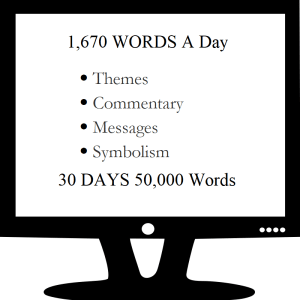
Write at least 1,670 words every day (three more than is required). This takes me about 2 hours because I’m not fast at this.

Write every day, no matter if you have an idea worth writing about or not. If you are really committed, you will do it even if you have to get up at 4:00 am to find the time. Don’t let anything derail you.

If you are stuck for what to write next, talk about how your day went and how you are feeling about things that are happening in your life, or write that grocery list. Use this time as a brainstorming session and just write about the direction you would like to take your story. This will loosen up your ideas, and you will be fired up all over again.

Don’t delete those ruminations, though. Every sentence you write counts toward your goal of 50,000 words. Passages you want to delete later can be highlighted, and the font turned to red or blue, so you can easily separate them out later.

Check-in on the national threads at http://www.NaNoWriMo.org and also your regional thread. You need to keep in contact with other writers, and the forums are fun to participate in.

Join a virtual write-in at NaNoWriMo on Facebook. This will keep you enthused about your project.

Remember, not every story is a novel. If your story comes to an end and you are only at 7,000 words, start a new story in the same manuscript. Use a different font or a different color of font, and you can always separate the sections later. That way, you won’t lose your word count.

Validate your word count every day on the national website. You will gain achievement badges for this, but more importantly, you will know if your word-processor counts the same way as the Validator App at NaNoWriMo. You don’t want to get an ugly surprise at midnight on November 30th!

As writers, we go through stages where we tend to focus too much on the quality of what we have already written and forget that output is important too. NaNoWriMo reminds us that if we don’t write new material every day, we stagnate. Nothing is worse than going over the same stale passages and wondering why you can’t move the story forward.

I write to a loose outline, but the pressure of having to get my word count means I don’t always follow it. The act of sitting down and just writing whatever comes into your mind is liberating.

Even if you don’t want the world to see what you write during the 30 days of NaNoWriMo, you have an outlet for your creative mind, a sounding board for your opinions and ideas. Rant about politics and religion to your heart’s content—no one will be offended if you are only writing for yourself.

If you are getting into genealogy through Ancestry, this is your golden opportunity to write about what you have learned, compiling the information for your own records.

Watching TV and playing video games all evening long doesn’t allow for creative thinking.  Your mind doesn’t get to rest from the daily grind.

Creative thinking—assembling puzzles, quilting, writing, painting, building Lego cities—these activities are far more relaxing than vegetating in front of the TV. Putting together jigsaw puzzles is a great way to organize your mind and sort out plot points.

Something I have found over the years is that by getting away from the TV for a while, your mind becomes sharper. By doing something different, you give your active mind a vacation. You rest better, and your whole body benefits from having done something positive and restful in your free time.

Over the next 60 days, I will be plotting several short stories and a novella, all of which I hope to write in November. They may all get written, or some may be shelved, but either way, I will finish November with new fodder for my short-story submission mill.

10 Comments

Filed under writing

Revisions: Transitions #amwriting

When we rewrite something, we are making revisions. I love the word revision.

re + vision = to envision again.

When I’m making revisions, I try to look carefully at my transitions. These are the small connections that are woven into the larger narrative.

When we begin revising our manuscript, we are looking at small passages of our work with new eyes and seeing how they might be changed to better fit the story. Most times, I can condense them, but sometimes these scenes get expanded.

If it takes more than a paragraph to make the transition, I must be vigilant in my revision. If I must give information, I look for and change all the passive “code words” to active prose. I’ve posted this list before, but if you didn’t copy it then, here is your opportunity.

  • This is an image. Feel free to right-click and save this list as a .png or .jpg for your private use.

    All forms of To be (see the graphic to the right)–>

  • basically
  • Too many emdashes
  • Exclamation points (usually not needed)
  • Finally
  • I think
  • -ing
  • Its / it’s
  • –ize –ization (global search)
  • just
  • Like
  • -ly (global search)
  • now
  • Okay
  • Only
  • Really
  • Said (decide if speech tags can be eliminated and shown by actions)
  • Seem
  • Still
  • Suddenly
  • That (often not needed)
  • The
  • Then (often not needed)
  • There was (a subjunctive)
  • –tion (global search)
  • Very (usually not needed)
  • Which (not a substitute for ‘that’)

For example, when I see the word “went,” I immediately know someone is on the move.

They went, but how did they go?” Went can be changed to any number of verbs:

  • they walked (to the next room, or down the street, or to Mordor.)
  • they drove (a car, a wagon, a spaceship.)
  • they rode (a horse, donkey, motorcycle, or dragon.)
  • they took a plane (bus, ferry, space shuttle, or sleeping pill.)
  • they teleported (vanished into the ether)

Regrouping after an encounter with the antagonist or some other roadblock to success makes a logical transition scene. I see these transitions as opportunities to move the plot forward through conversation or introspection.

When the characters are trying to survive amid chaos, there must be order in the layout and pacing of the narrative, or the reader will become lost. This is called pacing, and it is a key aspect of good transitions.

Pacing is the rise and fall of the action, drama and transition, the ebb and flow of conversations.

  • action,
  • processing the action,
  • action again,
  • another connecting/regrouping scene

Regrouping transitions allow the reader to process what just happened in “real-time,”  experiencing it as if they were the characters.

Transitions provide us with opportunities to ratchet up the tension. They are also where we justify the events and show motives, making them believable.

Unfortunately, these are also places where it is easy to accidentally jump into the headspace of a  different point-of-view character, also known as head-hopping.

For this reason, in the revision process, it’s important to pay attention to who is talking and make sure we are only in their head for the entire scene.

One useful kind of transition is introspection, usually shown with internal dialogue. When done right, internal dialogue offers an opportunity, a brief segue in which new information necessary to the story can emerge.

  1. Introspection also allows the reader to see who the characters think they are. This is critical if you want the reader to bond with them.
  2. Introspection shows that the characters are self-aware.

I do suggest you keep the scenes of internal dialogue brief, or they can meltdown into an info dump. Also, as I’ve said elsewhere if you use italics to set thoughts off, I suggest your characters don’t do too much “thinking.” A wall of italics is hard to read, and we want the reader to stay with the story.

The overuse of weak words can derail transitions. These are any kind of qualifier or quantifier: just, a little, a bit, somewhat—these are words that show indecision. Active prose should not be indecisive.

Also, weak words can be action-stopping words: started to, began to— these are word combinations that slow and stall the action. They are passive, so if you want to write active prose, go lightly with them. Your characters shouldn’t begin to move. Have them move and be done with it.

And never forget to look for and possibly remove words that end in the letters ly: probably, actually, sympathetically, magically … etc.

These are weak, telling words. I spend a lot of time thinking of how to show what I mean rather than telling it. I go to the Oxford Dictionary of Synonyms and Antonyms and find stronger words that more clearly show what I am trying to say.

Whether you are ending a chapter or connecting a series of shorter scenes, dramatic passages have universal commonalities:

  • All scenes have an arc to them: rising action, climax, reaction.
  • These arcs of action and reaction begin at transition point A and end at transition point B.
  • Each scene will end at a slightly higher point of the overall story arc.

In some ways, I find that transitioning from one scene to the next is the most challenging aspect of making revisions. We can choose to end the scene with a hard break and start a new chapter, or smoothly flow into the next scene.

Either way, I hope I’ve written the scenes in such a way that they blend smoothly into the one that follows. This sometimes takes several attempts before I get it right, so if you also struggle with this, you are not alone.

6 Comments

Filed under writing