The Character Arc part 1 #amwriting

We who write fiction spend a lot of time plotting the events a character will go through. We may write to an outline, or we might keep it in our head, but most of the action is usually known before we write it.

Even if you don’t plot in the traditional sense of the word, you should give some advance consideration to character development.

The term character arc is used to describe the personal growth and transformation of a character throughout a story. In narratives with a strong character arc, the protagonist begins as one sort of person. Through the events they experience, they are transformed. Often the change is for the better, but sometimes they change for the worse.

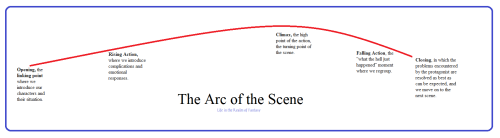
Great writing contrasts the relative security of the characters’ lives as they were in the opening paragraphs against the hazards of their life when they are in the midst of change.

Give me the book that immerses me in the uncertainty, fear, and anger—let me experience the emotional journey as well as the events of the narrative.

The novels that have the most influence on me as a writer are those that allow the reader to experience the characters’ journey.

These authors introduced me to characters who were multi-dimensional. They were people with a past and a present, and who hoped to survive long enough to enjoy a future.

In the opening act, the characters are introduced, and the scene is set. A great story evolves when the antagonist and protagonist are strong but not omnipotent. Both must have character arcs that show either

  1. Personal growth over the length of the story
  2. Stagnation or the inability to grow

Stagnation is a kind of death. This is a creative ploy to use for an antagonist who is unable to see their fatal flaw.

Each scene is an opportunity to advance the events of the story. But every small arc of action is also an opportunity to illuminate the motives of the characters.

The characters begin to be changed by the events they experience. How you show their emotional state is critical at this point because emotions engage readers. If you want a reader to experience the sense of crisis that you believe your story deserves, you must

  1. Foreshadow or hint at knowledge the characters don’t have, information that affects the outcome of the plot.

Very few people are evil for no reason at all. Sometimes they are likable, people who appear innocuous, even loving. If this is the case in your story, you need to insert small clues for the reader early on about the negative aspect of their personality. This is so that their despicable behavior isn’t seen as unexpected and contrived.

Fleshing out the antagonist and making their motives realistic is essential. They are as central to the story as the protagonist because their actions force change.

It’s important to remember that at no point in the narrative can people be sitting around idly chit-chatting about the changes they have been through in their life unless it affects the action at that moment.

Instead, they should be dealing with the consequences of the decisions they have just made and trying to make better plans.

Consequences are central to the forward momentum of the plot.

If consequences are to have meaning, motivations are crucial. What drives the characters to endure the results of their poor planning? What keeps them focused on achieving their goal?

Just as importantly, what will they NOT do? What is out of character for them? If you know that, you won’t muddy the narrative with look-alike and sound-alike characters.

The obstacles your characters face and the choices they make in those situations are the story.

Sometimes, in the first draft of my manuscripts, the motives of my protagonist haven’t quite come into focus for me. I tend to allow a character’s choices to push their personal growth, and then in a later draft, I have to sort out why they have made that decision.

Agency is the power of an individual to act independently. When we give the characters agency, we allow them to make their own free choices.

Giving your characters an active role and allowing them agency can make writing their story a joy. Remember, we write as much for ourselves as we do for a potential reader.

At times, I have a character I just can’t figure out. I make a character study, a personal history. Once I know their past, I understand what drives them and what triggers their emotions.

I then decide what personal revelations must come out about them in foreshadowing and figure out how to make it emerge organically.

In the character study, I ask the most important question of all: what does the character discover about herself?

When I have the answers about why, I look at the final event, the situation that ends the story to see if it passes the logic test. These people’s personal quirks and characteristics, their moral compass influenced the decisions that led them to that place.

Did I keep those clues distinct to each character, or was there a blurring of personalities within the group?

Most importantly, do my characters have recognizable motivations? Sure, we want to be subtle and not drop a ton of backstory on the reader. However, we can’t be too obscure in trying to keep the air of mystery.

If a beta reader can’t follow our protagonist’s reasoning, we haven’t done our job.

Creating intrigue yet making it believable is a balancing act.

Reading is the key. Every novel that leaves a mark on my heart has unique, individual characters that I can relate to.

When I stumble upon a book that engrosses me, I study that author’s work even if I don’t like one of their characters. I want to see how they fit the backstory into the narrative, ensuring their characters’ motivations made sense.

Their good writing habits help me improve in my own work. In my next post, I’m going to discuss the influence of novels that I once loved, and how they shaped my writing for good and for ill.

8 Comments

Filed under writing

#FineArtFriday: The Great Fish Market by Jan Brueghel the Elder 1603

Title: Great Fish Market

Artist: Jan Brueghel the Elder  (1568–1625)

Date: 1603

Medium: oil on canvas

Dimensions:  Height: 59 cm (23.2 in); Width: 92 cm (36.2 in)

Collection: Alte Pinakothek  Current location: room 19

Inscriptions: Signature and date, bottom left: BRVEGHEL 1603

What I love about this painting:

Here we see a composite of all the places Jan Brueghel the Elder had visited. The scene is a fusion of his Flemish homeland and impressions of places he’d sketched on his travels.

In the middle of the picture is the Neapolitan Castel dell’ Ovo, on the right, in the distance, is St. Peter’s Basilica in Rome. We have a little of Italy thrown in with the Flemish, his effort to create the feeling of a busy, prosperous market. He shows his imaginary city from a high perspective, the god-like view.

In writing, this would be the omniscient point of view.

The elements presented in this painting, the harborscape, the ruins, and even the sections that are simply landscapes are all features that later became genres in their own right.

The scene contains many elements of Mannerist landscape painting. According to the Tate website, mannerist is a sixteenth-century style of art and design characterized by artificiality, elegance, and an aesthetic portrayal of the human figure.

In other words, they painted fantasy. And why not?

Flemish genre painting is strongly tied to the traditions of Pieter Bruegel the Elder. It was a style that continued directly into the 17th century through copies and new compositions made by his sons Pieter Brueghel the Younger and Jan Brueghel the Elder.

In this painting, the story opens with a view across a downward-sloping foreground. It teems with life, hundreds of figures of many races, grouped around the stalls and booths of a fish market. The group at the center of the foreground is thought to be a self-portrait of the artist and his family. It was common for artists to insert self-portraits in their works, and Jan often included his family.

One of Jan Brueghel’s most significant contributions to the craft of painting landscapes was how he depicted perspective. The eye is drawn towards the harbor in the background. We look out across the bay, along the coastline, and see entire towns, with ruins, wharves, and castles. Beyond that, we see distant mountains, painted with a blue that merges with the blue of the sea.

This blending of shape and color into the distance is how a landscape appears in real life.

These painters, and the Brueghel family in particular, were the generation who paved the way for artists like Rembrandt. Their works were the foundation upon which the masterpieces of the middle-to-late 17th century were built.

About the Artist, via Wikipedia:

Jan Brueghel was the son of the eminent Flemish Renaissance painter Pieter Brueghel the Elder.  A close friend and frequent collaborator with Peter Paul Rubens, the two artists were the leading Flemish painters in the first three decades of the 17th century.

He was born in Brussels as the son of Pieter Brueghel the Elder and Maria Coecke van Aelst. His mother was the daughter of the prominent Flemish Renaissance artists Pieter Coecke van Aelst and Mayken Verhulst. His father died about a year after Jan’s birth in 1569. It is believed that after the death of his mother in 1578, Jan, together with his brother Pieter Brueghel the Younger and sister Marie, went to live with their grandmother Mayken Verhulst, who was by then widowed. Mayken Verhulst was an artist in her own right. The early Flemish biographer Karel van Mander wrote in his Schilder-boeck published in 1604 that Mayken was the first art teacher of her two grandsons. She taught them drawing and watercolor painting of miniatures. Jan and his brother may also have trained with local artists in Brussels who were active as tapestry designers.

Jan Brueghel the Elder is regarded as an important innovator of landscape art. By introducing greater naturalism in his Alpine mountain settings, his father had expanded on the world landscape tradition that had been founded mainly by Joachim Patinir. Some of Pieter the Elder’s works also foreshadowed the forest landscape that would start to dominate landscape painting around the turn of the 16th century. Pieter the Elder also developed the village and rural landscape, placing Flemish hamlets and farms in exotic prospects of mountains and river valleys.

Jan developed on the formula he learned from his father of arranging country figures traveling a road, which recedes into the distance. He emphasized the recession into space by carefully diminishing the scale of figures in the foreground, middle-ground, and far distance. To further the sense of atmospheric perspective, he used varying tones of brown, green, and blue progressively to characterize the recession of space. His landscapes with their vast depth are balanced through his attention to the peasant figures and their humble activities in the foreground.

Like his father, Jan Brueghel also painted various village landscapes. He used the surrounding landscapes as the stage for the crowds of anecdotal, colorfully dressed peasants who engage in various activities in the market, the country roads and during the rowdy kermesses. Jan Brueghel’s landscape paintings with their strong narrative elements and attention to detail had a significant influence on Flemish and Dutch landscape artists in the second decade of the 17th century. His river views were certainly known to painters working in Haarlem, including Esaias van de Velde and Willem Buytewech, whom Brueghel may have met there when he accompanied Peter Paul Rubens on a diplomatic mission to the Dutch Republic in 1613.

Jan Brueghel was, along with artists such as Gillis van Coninxloo one of the prime developers of the dense forest landscape in the 17th century. Jan Breughel in fact experimented with such works before Coninxloo’s first dated wooded landscape of 1598. In his forest landscapes Brueghel depicted heavily wooded glades in which he captured the verdant density, and even mystery, of the forest. Although on occasion inhabited by humans and animals, these forest scenes contain dark recesses, virtually no open sky and no outlet for the eye to penetrate beyond the thick trees.


Credits and Attributions:

Wikimedia Commons contributors, “File:Jan Brueghel the Elder-Great Fish market.jpg,” Wikimedia Commons, the free media repository, https://commons.wikimedia.org/w/index.php?title=File:Jan_Brueghel_the_Elder-Great_Fish_market.jpg&oldid=406069557 (accessed July 9, 2020).

Wikipedia contributors, “Jan Brueghel the Elder,” Wikipedia, The Free Encyclopedia, https://en.wikipedia.org/w/index.php?title=Jan_Brueghel_the_Elder&oldid=963723468 (accessed July 9, 2020).

1 Comment

Filed under #FineArtFriday

Need and Technology #worldbuilding #amwriting  

Need is an aspect of the world our characters inhabit.

The props we place in the setting our characters inhabit, the tools they use, the objects they must acquire – these things form a layer that grows out of need.

First, no matter what genre you are writing in, you must establish the level of technology. Whatever you do, don’t stray from it

The Romans had running water, central heating, and toilets in their homes. So did the Minoans. However modern-seeming their architectural creations were, they were low-tech.

In the environment of any genre, cups will be cups, bowls will be bowls. The materials they are made of might be different, but those items will always be needed. If you took a Minoan and transplanted them into modern-day Seattle, a bowl or cup would be instantly recognizable for what it is.

Furnishings will be similar from society to society—people need somewhere to sit or sleep, whether it is a pile of straw, cushions, or a bunk. They need a place to cook and somewhere to store preserved food:

  • A fire pit and baskets in a hut
  • A fireplace and shelves with baskets and clay jars in a cabin
  • A modern kitchen and pantry in a ranch house
  • A starship’s galley or food replicator

Settings are like Barbie clothes. The clothes of Soldier Barbie fit Corporate Barbie… and Malibu Barbie… and Star Wars Barbie. The outer garments might be changed for each genre but Barbie is still the protagonist.

We change settings to fit the genre, to create a setting with all the right tropes. Genre defines the visuals, but the characters are paper dolls we dress to fit the society we have placed them in.

You can take your protagonist and place them in one of three kinds of settings: fantasy, sci-fi, or contemporary, and they would still be who they are. In any setting, there are certain commonalities with only minor literary differences.

Take a soldier as an example. They need garments, weapons, armor, and sustenance. Those are tailored to fit your genre—sci-fi, fantasy, or contemporary military thriller. But you can also use those things to offer visual clues about your protagonist’s personality.

Whether the weapon is a rifle, a sword, or a phaser is dependent on the level of technology you have established.

Logic and the established level of technology determines how each need is met. In the case of weapons, you’ll find many varieties of each within each category.

Which kind of hand-held weapon your protagonist will use is dependent on their skill level and physical strength as well as what is stocked in the armory.

When it comes to weaponry, if you are writing about them, you need to research them to know what is logically possible. Within each genre, one thread remains the same: strength and skill are determining factors when it comes to weapons.

A cutlass is an efficient blade, but is shorter than a claymore. Also, a one-handed blade allows the wielder to carry a shield. In terms of firearms, a pistol weighs less than a machine-gun but isn’t as effective.

As many of you know, I’m an avid gamer. One of my all-time favorite games is Square-Enix’s 1999 Final Fantasy VIII, made for the PlayStation. It was challenging and fun to play, with entertaining side quests. I loved the music and the deep storyline. The characters were compelling and believable.

The one element that seemed illogical was Squall’s weapon, the Gunblade. Nevertheless, other fans loved it. However, while logic isn’t a thing when it comes to anime RPG weapons (witness Cloud’s Buster Sword in Final Fantasy VII), it must be considered if we want believability in our written work.

When it comes to weapons, it’s important that you research what might be most useful to your characters. Consider their strength and skills. Don’t introduce an illogical element, no matter how much you like it.

Writers of fantasy and historical fiction should do some fact checking:

Nerds on Earth’s Clave Jones says: So what would have kept a woman from wielding a longsword throughout history? Honestly, the only thing that kept more women from using swords is that they rarely got the training. It wasn’t the weight, certainly. And it wasn’t the awkwardness of the swing as swords were designed to be well-balanced and agile. [1]

Sci-fi writers, I suggest that for advanced weaponry, you should do the research into proposed future applications of lasers, sonic, and other theoretically possible weapons. Sci-fi readers know their science, so if you don’t consider the realities of physics, your work won’t appeal to the people who read in that genre.

For soldiers of any technology level, from Roman to medieval, to contemporary, to futuristic—armor will always consist of the same components: breast and backplate, shin guards, vambraces, a helmet of some sort, and maybe a shield.

These elements won’t differ much in their use. However, the materials they’re made of will vary widely from technology to technology.

For the sake of expediency and logic, garments that go under the armor must be close-fitting.

Expediency affects logic, which affects need.

The same is true for any occupation your protagonist might have–bookkeeper, lawyer, home-maker–the visual surroundings changes from genre to genre, but the fundamental requirements for each occupation remain the same.

In every aspect of a world, expediency decides what must be mentioned and how important it is.

Beneath the obvious tropes of a particular literary genre is a human being. No matter what genre you are writing or the level of technology, their actions and reactions will be recognizable and relatable to the reader.

We’ve mentioned the soldier, so let’s look more closely at their requirements.

For instance, in a battle situation, food must be extremely compact, lightweight, and must provide nutrients the soldier needs.

Nutrition bars, jerky, whatever you choose, soldiers must eat, and battles don’t pause for dinner. Think about the battle rations, how much the soldier carries, and how she carries them. Weight and the amount of space rations take up are what limits the soldier’s supply on hand.

How do you fit a soldier’s battle rations into world-building? Casually, with one sentence, a few words. She unwrapped a ration bar and ate, ignoring the sawdust-like texture.

What basic things do you need in the real-world? You need food, water, clothing, and shelter, and a means of providing those things.

Concept art, Cloud Strife with Buster Sword

Characters need these things too, but they only come into existence at the time they are in use. Place the character in a room and call it a kitchen, and the reader will immediately imagine a kitchen. Mention the coffeemaker, and the reader’s mind will furnish the cups.

Need manifests in other, more subtle ways.

Do you require a way to communicate with others quickly? Messengers, letters, telephones, social media, or telepathy? Choose a method for long-distance communication that fits your technology and stick to it.

In world-building, how you fulfill the character’s needs shows the level of technology, the society they inhabit, and their standing within that culture.

This layer is easy to construct in many ways, but if you aren’t careful, it can be a stumbling block to the logic of your plot.


Credits and Attributions:

[1] The History Of Medieval Swords (And The Women Who Wielded Them) by Clave Jones, © 2016 Clave Jones for  Nerds on Earth (https://nerdsonearth.com/2016/02/women-and-swords/ accessed 08 July 2020).

Excalibur, Eduardo Otubo / CC BY (https://creativecommons.org/licenses/by/2.0), Wikimedia Commons contributors, “File:London Film Museum (5094934492).jpg,” Wikimedia Commons, the free media repository, https://commons.wikimedia.org/w/index.php?title=File:London_Film_Museum_(5094934492).jpg&oldid=273444520 (accessed July 7, 2020).

Squall Leonhart, Final Fantasy VIII, Square Enix ©1999 Fair Use

Cloud Strife, Final Fantasy VII, Square Enix  © 1997 Fair Use

3 Comments

Filed under writing

Plot, Politics, Religion, and the Science of Magic #worldbuilding #amwriting

It takes me about four years to take a novel from concept to completion, which is why I always have several works in progress at varying stages of development.

Much of that time is devoted to world-building, although for the first few drafts of writing, I don’t realize that is what I am doing.

The layers of plot, politics, religion, and magic/science must be interwoven with bits of history, and the images and odors of the physical environment. Together, these layers help create the setting of any world.

I began one of my current projects with an idea for a character. I knew what the ultimate end of this story is because it is a prequel and is already canon in the Tower of Bones series.

This is the plot, the core conflict: Politics and religion shape three cultures. Two of the societies are strong enough to absorb the third, and one of them will do just that.

In that regard, neither the protagonist nor the antagonist is on the high ground morally—both consider it their right to impose their rule on the weaker society.

The first hurdle arose in the area of world-building. Because it is the origin story, I had to devise a post-apocalyptic culture. Religion was the first layer I worked on.

In the time of the Tower of Bones series, the Temple of Aeos is a finely-tuned machine that serves to distribute food and medical care to the poor, provides education to everyone, provides military protection when needed, and maintains the roads that connect the communities.

The Temple’s primary function is to find mage-gifted children before their untrained gift wreaks havoc in their communities. Untrained mages have a high chance of becoming the tool of the Bull God, Tauron.

This is bad because Tauron is the Mad God, the one who demands excessive sacrifices, often human. The word sacrifice means to surrender something of value, and the Mad God’s reign over his people is twisted. His religion is a reflection of his madness.

Thus, the Goddess Aeos’s mages are sworn to serve and protect the people of Neveyah from the depredations of Tauron, no matter the personal cost.

In the current work-in-progress, the Temple, as an institution, doesn’t exist. It is born out of the struggle between the two larger-than-life characters and the events of this book.

Both characters believe their deity has the right to rule Neveyah, and both know the Barbarian Tribes are the key to winning. At times, the line between what is moral and immoral is blurred.

Just as in real life, both men and the societies they lead are fundamentally flawed.

Both the antagonist and protagonist in this novel will do whatever it takes to achieve their goals. However, of the two, only my protagonist is burdened with regrets for the choices he makes.

Every society, fantasy, sci-fi, or real-world, must have an overarching political structure—a government of some sort. Humans are tribal. We are comfortable when we have a hierarchy of decision-makers to guide the tribe.

The politics of any society are an invisible aspect of world-building that affects the story, even when not directly addressed. This is because our characters have a place within that structure.

When you know what that place is, you write their story accordingly. In writing fiction, if you know your characters’ social caste, you know if they are rich or poor, hungry or well-fed. This will shape them throughout the story.

We know that hunger drives conflict in our modern world, so a segment of society that lives on the edge of starvation will be swayed to the side of whoever offers food first. This is a key part of the plot for my work-in-progress.

Another aspect of world-building that was crucial at the start of this series was the choice to use magic rather than science as the primary technology.

First of all, let me get this out there: Science is not magic. It is logical, rooted in the realm of real theoretical physics. The writers of true science fiction know the difference between reality and fantasy.

However, magic should be believable. The science of magic is an underlying, invisible layer that is part of my world-building process. In my stories, magic is only possible if certain conditions have been met:

  • if the number of people who can use it is limited.
  • if the ways it can be used are limited.
  • if the majority of mages are limited to one or two kinds of magic and only certain mages can use every type of magic.
  • if there are strict, inviolable rules regarding what each kind of magic can do and the conditions under which it will work.
  • if there are some conditions under which the magic will not work.
  • if the damage it can do as a weapon or the healing it can perform is limited.
  • if the mage or healer pays a physical/emotional price for the use.
  • if the mage or healer pays a hefty price for abusing it.
  • if the learning curve is steep and sometimes lethal.

This layer of world-building is where writers of science and writers of magic come together.

  • Magic and the ability to wield it confers power.
  • Superior technology does the same.

This means the enemy must have access to equal or better Science/Magic. So, if the protagonist and their enemy are not from the same “school,” you now have two systems to design for that story.

Authors must create the rules of magic or the limits of science for both the protagonist and antagonist.

Take the time to write it out and be sure the logic has no hidden flaws.

In creating science technologies and magic systems, you are creating a hidden framework that will support and advance your plot. Within either science or magic, there can be an occasional exception to a rule, but there must be a good reason for it. It must be clear to the reader why that exception is acceptable.

Having said all that, the only time the reader needs to know these systems exist is at the moment it affects the characters and their actions.

The best background information comes out naturally in conversations or in other subtle ways. By not baldly dropping it on the reader in paragraph form, the knowledge becomes a normal part of the environment rather than an info dump.

Limitations are the key to a good character arc. Roadblocks to success force ordinary people to become more than they believe they are.

That is when an ordinary person becomes a hero.

7 Comments

Filed under writing

#FineArtFriday: Rembrandt as Shepherd with Staff and Flute, by Govert Flink 1636

About the artist: Born at Kleve, capital of the Duchy of Cleves, which was occupied at the time by the United Provinces, Govert Flinck was apprenticed by his father to a silk merchant, but in 1627 he was sent to Leeuwarden, where he boarded in the house of Lambert Jacobszoon. Jaobszoon was a Mennonite (one of the historic peace churches known for their commitment to pacifism). While Jacobszoon is better known as a preacher, he was a talented painter and an excellent teacher.

While studying there, Flinck met some of Jacobszoon’s neighbors, relatives of Saskia van Uylenburgh, who had married Rembrandt in 1634. That same year he began studying with Rembrandt.

Flinck is acknowledged as one of Rembrandt’s best pupils.

I really enjoy this romantic painting of Rembrandt dressed as a shepherd, holding a flute, and thinking about…what? Rembrandt’s contemplative expression seems peaceful.  The details are wonderful – from the finely worked trim on his garments down to the jewel dangling from his right ear, a gem that softly glows. The grains of the wood in both the flute and staff are subtle and real. The light falls perfectly – Flinck captured the personality of the master as a handsome young man during the happiest time of his life, and it seems as if Rembrandt himself enjoyed posing for it.

For more than a decade, Flinck’s work echoed that of Rembrandt, clearly influenced by the master’s style in the work which he executed between 1636 and 1648. As time passed, he began to desire to be a history painter, a genre in painting that  is defined by its subject matter rather than artistic style, and turned to the work of Peter Paul Rubens. In later years, Flinck had great commercial success, receiving many commissions for official and diplomatic paintings.


Credits and Attributions:

Wikimedia Commons contributors, “File:Rembrandt als herder met staf en fluit Rijksmuseum SK-A-3451.jpeg,” Wikimedia Commons, the free media repository, https://commons.wikimedia.org/w/index.php?title=File:Rembrandt_als_herder_met_staf_en_fluit_Rijksmuseum_SK-A-3451.jpeg&oldid=225225289 (accessed August 16, 2018).

Comments Off on #FineArtFriday: Rembrandt as Shepherd with Staff and Flute, by Govert Flink 1636

Filed under #FineArtFriday

Plot and Theme #amwriting

The basic premise of any story I want to write can be explained by answering eight questions. Each answer is simply one or two lines, guideposts for when I draft the outline.

A plot idea I’ve used before as an example is an idea I’ve had rolling around for a while. I hope to write it as a novella (about 12,000 words) in November. This little tale features a pair of thieves-for-hire, set in an alternate renaissance reality.

  1. Who are the players? Pip and Scuttle. Two orphaned brothers who grew up on the streets of Venetta, a medieval city, but who have a strong moral code. When the story opens, they are adults. The pair has become what is known as “Discreet Thieves,” professional retrievers-for-hire who reunite their clients with their lost or stolen valuables.
  2. Who is the POV character? Scuttle, the older brother.
  3. Where does the story open? In a pawn shop.
  4. What does the protagonist have to say about their story? Scuttle swears they aren’t thieves. They are believers in God and the laws of the Church. They only retrieve items belonging to noble clients with impeccable reputations and do it with no fuss or drama.
  5. What is the inciting incident? A highly placed Cardinal has hired them to retrieve an item, neglecting to tell them:
  • It is equipped with a curse that affects all who would steal it from the rightful owner. (Haven’t figured out what the curse is yet.)
  • It didn’t belong to the Cardinal in the first place.
  • He intends to use it to depose the true Pope and become the ruler of both the Church and Venetta.
  1. At the midpoint, what do the protagonists want and what are they willing to do to get it? They will do anything to get the curse removed from themselves and prevent the evil Cardinal from using the object against the Good Pope.
  2. What hinders them? The Cardinal has kidnapped Mari, Scuttle’s wife, and holds her in his dungeon, forcing Scuttle to do his bidding.
  3. How does the story end? Not sure. Is there more than one way this could go? Yes. I list each possible ending as they occur to me.

At the beginning of the story, what does our protagonist want that causes them to risk everything to acquire it? How badly do they want it, and why? The answer to that question must be that they want whatever it is desperately.

Question number six is an important question to consider. What ethical dilemma will the protagonist be faced with in their attempt to overcome the odds and achieve their objective?

In this story, one hard moral choice I could write would be to have Scuttle pressured to become a spy for the Cardinal.

Or, he could be pressured to sell out Pip.

How would he respond to either of these situations? I could write both and choose the one that works best. If I do that, I’ll make a note of the divergent path on my outline.

The answer to question number seven is vitally important because the story hinges on how the protagonist overcomes adversity. What hinders them? Is there an antagonist? If so, who are they, and why are they the villain of the piece?

“There has to be evil so that good can prove its purity above it.” The Buddha said it, but it’s a fundamental truth we writers of genre fantasy must consider when devising plots. J.R.R. Tolkien understood this need for a hero quite clearly.

Answering question eight is crucial if I want to have a complete novel with a beginning, middle, and end.

Endings are hard and complicated to write because I can see so many different outcomes. I write as many endings as I need to and save them in separate files.

Sometimes, even if we have plotted in advance, we can’t identify the central theme of the story. Theme is what the story is about on a deeper level than what is seen on the surface. It’s the big meaning, a thread that is woven through the entire story, and sometimes it is an unstated moral for the reader to infer.

Many final objectives don’t concern issues of morality. However, if you are writing genre fiction, achieving all final objectives should have consequences and should involve a struggle.

Regardless of the theme, the struggle must be personal. Why would Frodo and Sam go to the depths of Mordor and suffer the hardships they endured in their effort to destroy the One Ring and negate the power of Sauron?

Frodo and Sam saved the world because it was the only way to save The Shire and the people they loved from Sauron, who was the embodiment of evil.

No matter how careful I am when building my outline, there is always a point where I am writing by the seat of my pants. I am usually a linear plotter, but things come along that change the direction a tale goes in.

This is where making use of scene breaks can be your friend. In the NaNoWriMo manuscript, I simply head that section (in bolded font) with the words Possible Ending 1 or 2, or however many endings I have come up with.

No matter if you are writing a NaNoWriMo novel or not, your finished novel will look vastly different from the block of stone you carved it from. Yet, it will be the core of the stone, the hidden story that was waiting for you to bring it to light.

Many times, I find myself re-evaluating a nearly complete manuscript because the story isn’t working. I go back and ask myself the same eight questions. If the story has gone in a new direction by midpoint, a different roadmap to the final scene can help you keep things logical.

However, a plot is just the frame upon which the themes of a story are supported. Knowing the main theme at the outset makes writing the first draft much easier.

When your writing mind has temporarily lost its momentum, and you are stretching the boundaries of common sense, it’s time to stop and consider the central themes. It helps to remind myself of the elements that really drive a plot.

Subthemes help keep the story interesting. The image at the bottom of this post is a visual tool, a circular list of themes and subthemes that I made a few years ago.

It’s a picture that you can save (right click>save as>png or jpeg) print out and tape to your desk. Whenever you have lost your way, rather than resort to a sudden influx of something far-fetched, feel free to refer back to this picture and see if a better idea presents itself.

Hopefully, you won’t have to resort to killing anyone you might need later.

7 Comments

Filed under writing

July is Camp NaNoWriMo Month #amwriting

July is Camp NaNoWriMo. Many people in my region are showing interest already. (NaNoWriMo = National Novel Writing Month.) Why, you ask, would you want to do two NaNoWriMos in one year?

First of all, Camp is relaxed, not an ordeal. You aren’t tied to anything more than loose goals. You can choose any kind of project, whatever word count goal you feel comfortable with, and there is no pressure.

Two years ago, I declared I would write 10,000 words, which turned out to be four short stories. You could declare your intention to write as few as 100 words.

The reason camp exists is that if you plan to write a 50,000 word novel in the month of November, you may find it harder to make time for writing than you planned. It helps if you develop some time management skills in advance.

Writing daily is more manageable once it becomes a habit. Making the best use of your time requires a little self-discipline, something we all could use a bit more of.

If you are interested in participating, the link for that is https://nanowrimo.org/what-is-camp-nanowrimo

To participate in Camp, just announce a project, then make sure to check “Associate with a NaNoWriMo Event” and select the current Camp NaNoWriMo event.

You can announce your project starting in June for July’s Camp NaNoWriMo session.

Once you’ve done that, you should be ready to start your project. You’ll be able to start tracking your writing on July 1 on their website.

When you reach your writing goal, the site will automatically confirm your win. You will receive a certificate celebrating your achievement, along with a bunch of other winner goodies.

Do you want to become part of the broader NaNoWriMo writing community?  Check out the Camp NaNoWriMo forums.

Headquarters offers authors options to start or join an existing writing group. Check out the “Writing Groups, Assemble” forum for open groups, and more.

Whenever we begin talking about NaNoWriMo, I always feel the need to mention saving your files.

If you are a new author, or unfamiliar with using a computer or electronic notepad, saving your files is an important habit to develop. If you value your hard work, you won’t be lazy or slapdash about this.

  1. Even if you don’t have a title, name your manuscript with a good, descriptive working title, such as The_Dinosaur_Story. You can call it something else later.
  2. Never delete a manuscript. If you suddenly decide you need to make such radical changes that you need to start over, save it in the same master file but with a new descriptive name: The_Dinosaur_Story_version_2.  Save each new version separately so that if you change your mind, you don’t lose work you might need later.
  3. Losing your files is a traumatic experience. Some authors lose several years of work in a surprise computer crash – an unimaginable tragedy. Entire manuscripts can go missing when a thumb-drive is lost, or a hard drive is corrupted.

You must save regularly. If you are using a Chromebook or working out of Microsoft’s OneDrive, this won’t be a problem. However, if you’re using an ordinary word-processing program such as Word or Open Office, you do need to be conscientious.

I use a file hosting service. I have a lot of images on file, so I pay for an expanded version, but they do have a free version that offers you as much storage as a thumb drive. I like using a file hosting service because my work can’t be lost or misplaced, and is always accessible from my desktop, laptop, or Android. I work out of those files, so they are automatically saved and are where I want them when I close my programs.

You can use any storage system that is free to you–Google Drive, OneDrive, or a standard portable USB flash drive.

Save regularly.

Did I mention that you should save consistently?

Did I suggest that you DON’T put off saving to a backup of some sort? PLEASE, do it every day before you close your files.

The manuscript I am currently working on is set in the Tower of Bones world. I’m on Version 11, just so you know. Sometimes a significant section has to be rewritten as it doesn’t fit the original intent of the story.

All the previous versions are good but took the story in the wrong direction. With character name changes, two of my outtakes became novellas set in that world.

The option to repurpose work that no longer fits is why I never discard any manuscript.

My next series will cover the way I devise a plot, build a world, and create characters. I take a couple of days to do these things.

Many of these things are basic, and perhaps you have your own system. Or maybe you prefer to write by the seat of your pants. That is the way I write poetry, so I understand “the joy of pantsing,” and I will talk about that too.

In my case, if I have the idea for a novel, good prep means I don’t lose sight of my story arc when I sit down to write it in November.

2 Comments

Filed under writing

#FineArtFriday: The Money Changer and His Wife by Quentin Matsys, 1514

  • Artist: Quentin Matsys  (1456/1466–1530)
  • Title: The Moneylender and his Wife
  • Date: 1514
  • Medium: oil on panel
  • Dimensions: Height: 70.5 cm (27.7 in)
  • Current location: Louvre Museum
  • Inscriptions: Signature and date

The Money Changer and His Wife is a 1514 oil on panel painting by the Flemish renaissance artist Quentin Matsys.

What I love about this painting:

The colors are rich and vivid, and the lines sharp and clean. The artist included the smallest details in the prayer book, the pewter plate in the background, and the crystal jar by the man’s right hand, showing a prosperous, well-educated young couple. In some ways, Matsys’ style reminds me of the work of the lesser known Flemish painter, Pieter Brueghel the Younger, who was born long after Matsys’ death, but whose original works also leaned toward caricatures and grotesques.

About this painting, via Wikipedia:

A man, who is weighing the jewels and pieces of gold on the table in front of him, sits next to his wife who is reading a book of devotion with an illustration of the Virgin and Child. The couple is not dressed as members of nobility, but rather as well-to-do burghers of Antwerp, where the painting was made. At the time, Antwerp had grown with the influx of many southern immigrants fleeing the Spanish Inquisition. Among this international community there was a demand for money-changers and money-lenders, as international commerce was increasing in the port city.

About the Artist, via Wikipedia:

Most early accounts of Matsys’ life are composed primarily of legend and very little contemporary accounts exist of the nature of his activities or character. According to J. Molanus’ Historiae Lovaniensium, Matsys is known to be a native of Leuven with humble beginnings as an ironsmith. One of four children, Matsys was born to Joost Matsys (d. 1483) and Catherine van Kincken sometime between 4 April and 10 September 1466. Legend states that Matsys abandoned his career as a blacksmith to woo his wife, who found painting to be a more romantic profession, though Karel van Mander claimed this to be false, and the real reason was a sickness during which he was too weak to work at the smithy and instead decorated prints for the carnival celebrations.

Matsys work is considered to contain strong religious feeling—characteristic of traditional Flemish works—and is accompanied by a realism that often favored the grotesque. Matsys’ firmness of outline, clear modelling and thorough finish of detail stem from Van de Weyden’s influence; from the Van Eycks and Memling by way of Dirck Bouts, the glowing richness of transparent pigments. Matsys’ works generally reflect earnestness in expression, minutely detailed renderings, and subdued effects in light and shade. Like most Flemish artists of the time he paid a great deal of attention to jewelry, edging of garments, and ornamentation in general.


Credits and Attributions:

The Money Changer and His Wife by  Quentin Matsys, 1514 Public domain. The work of art depicted in this image and the reproduction thereof are in the public domain worldwide. The reproduction is part of a collection of reproductions compiled by The Yorck Project. The compilation copyright is held by Zenodot Verlagsgesellschaft mbH and licensed under the GNU Free Documentation License.

Wikipedia contributors, “The Money Changer and His Wife,” Wikipedia, The Free Encyclopedia, https://en.wikipedia.org/w/index.php?title=The_Money_Changer_and_His_Wife&oldid=937629150 (accessed June 26, 2020).

Wikipedia contributors, “Quentin Matsys,” Wikipedia, The Free Encyclopedia, https://en.wikipedia.org/w/index.php?title=Quentin_Matsys&oldid=960328863 (accessed June 26, 2020).


Comments Off on #FineArtFriday: The Money Changer and His Wife by Quentin Matsys, 1514

Filed under #FineArtFriday

Emotion: it’s complicated, part 2 #amwriting


Authors are regularly admonished to “show-don’t-tell.” Let’s ignore the know-it-all bludgeoning you with that rule for the moment, because nothing is worse than an unbalanced narrative.

If you have no idea how to begin showing the underlying emotions of your characters, a useful handbook that offers a jumping-off point is The Emotion Thesaurus by Angela Ackerman and Becca Puglisi.

This book is quite affordable and is full of hints that you can use to give depth to your characters. They will offer nine or ten suggestions that are physical indications for each of a wide range of surface emotions.

Do your readers a favor. Choose only one physical indicator per emotion per scene.

Showing must be balanced with some telling, or it becomes all about eye-rolling and forehead creasing. Showing mixed with telling makes for a smoother narrative.

Some telling can be done in conversations, through internal thoughts, and the observations of others in a scene.

Writing emotions is a balancing act. Most times, you can get away without dragging the reader through five or six small facial changes in a scene, simply by giving their internal reactions a little thought.

If you only show the outward physical indicators of a particular emotion, you only wrote half the story.

When something “strikes home” with us, it happens on a visceral (physical) level. In other words, emotions that hit us hard evoke sudden feelings deep within our guts as well as in our hearts and minds.

Yes, these feelings can be reflected in our expressions. However, facial contortions alone don’t show what is going on inside the character.

Visceral reactions are involuntary.

We can’t stop our face from flushing or our heart from pounding.

We might be able to hide our reactions from others, but we can’t stop how these emotions feel.

This internal physical gut reaction is difficult to convey without offering the reader some information, a framework to hang the image on. You must tell the reader the character’s face went hot, or their stomach knotted up.

One way to create a sympathetic response in the reader is to use a simple 1 – 2 – 3  trick of word order when describing the character’s experience.

  1. Start with the visceral response. How does a “gut reaction” feel? Nausea, gut punch, butterflies—what?
  2. Follow up with a ‘thought’ response. “Oh my god!” That is how it hits us, right? Gut punch then mental reaction as we process the event.
  3. Third, finish up with body language.

Severe emotional shock strikes us physically with a three-way punch:

  • disbelief—the OMG moment
  • knocking knees, shaking hands, or a shout of “No!”
  • disassociation—a coping or defense mechanism meant to minimize or help a person tolerate stress.

When we write mild reactions, it’s not necessary to offer a lot of emotional description because ‘mild’ is boring. A raised eyebrow, a sideways glance—small gestures show the attitude and normal condition of the character.

However, strong emotions are compelling. Highly charged situations are strengthened by the way we write the emotional experience.

If you want to emphasize a particular chemistry between two characters, good or bad, employing their visceral reactions is the way to do so.

Most authors who have been in writing groups for any length of time become adept at writing emotions on a surface level.

They don’t merely write, “He smiled.” Their characters’ facial expressions are an ever-moving display of lips curving up or pulling down beneath twinkling, hard-eyed glares. Eyebrows raise or draw together, foreheads crease, shoulders slump and hands tremble, dimples pop, eyes spark—and so on and so on.

Taken individually and combined with other clues, some description is necessary.

However, nothing is more aggravating than trying to enjoy a narrative where facial expressions and body slumping take center stage.

This is why I feel as concerned with what is happening to my characters internally as I do about describing the outward display.

Combining the surface of the emotion (physical) with the deeper aspect of the emotion (internal) requires thought. We struggle to balance showing the external with telling the internal so that the reader isn’t baldly told what to experience.

We write it, and sweat over it, searching for the right words to show what we intend. Many times, we come back later and rewrite it.

By using this twofold approach of mixing showing with telling, we hope the reader will become immersed in the lives of our characters.

Some emotions are complicated and deeply personal, difficult to show, and even more challenging to express internally. These are the gut-wrenching moments that make our work speak to the reader.

Each of us experiences emotional highs and lows in our daily lives. We have deep-rooted, personal reasons for our emotions, and so must our protagonist.

Writing genuine emotions requires practice and thought. Motivation is critical.

WHY does the character react in that way? Emotions without cause have no basis for existence, no foundation. They lack credibility and leave us, the reader, feeling as if the story is shallow, a lot of noise about nothing.

Timing and pacing are essential.

The emotion hits and the character is processing it.

That is the moment to slip in a brief mention of the backstory. That way, you avoid an info dump, but the reader can extrapolate the information needed to make the emotion real.

Simplicity has impact. When looking for words with visceral and emotional power, consonants are your friend. Verbs that begin with consonants are powerful.

Use forceful words, and you won’t have to resort to a great deal of description. Weak word choices separate the reader from the experience, dulling the emotional impact of what could be an intense scene.

A good exercise for writing deep emotions is to create character sketches for people you currently have no story for. Just as in all the many other skills necessary to the craft of writing a balanced narrative, practice is required.

The key is to practice writing emotions, and you may find a later use for these practice characters. The more we practice this aspect of the craft, the better we get at it.

And the more we write, the more individual and recognizable our writing-voice becomes.


Credits and Attributions:

Sir Galahad, by Herbert Gustave Schmalz, 1881 via Wikimedia Commons contributors, “File:Schmalz galahad.jpg,” Wikimedia Commons, the free media repository, https://commons.wikimedia.org/w/index.php?title=File:Schmalz_galahad.jpg&oldid=363278568 (accessed June 23, 2020).

5 Comments

Filed under writing

Emotion: it’s complicated #amwriting

When we discuss our work with other writers, the word mood is sometimes used interchangeably with atmosphere. I see those two aspects of story as conjoined twins, marching along together. They are separate but intertwined so closely that they seem as one.

Mood happens in the background over the length of the story. Mood allows the emotions the writer instills into the story to be more specific, more intensely colored.

Atmosphere is also long-term but is part of worldbuilding. Atmosphere is conveyed by setting, which affects the overall mood of a piece.

Together, atmosphere and mood have the power to intensify the reader’s impression of the emotions experienced by the characters.

Emotion is immediate, short term. It exists in the foreground but works best when in conjunction with the overall atmosphere/mood.

Robert McKee, one of my favorite teachers on craft, tells us that “emotion is the experience of transition, of the characters moving between a positive and negative.”

As we read, we become invested in the characters and experience their emotional highs and lows. These transitions range in intensity from subtle to forceful.  I like books where emotions are dynamic, but where the character’s internal struggle becomes personal to me.

Despite being comprised of only four letters, mood is a vast word serving several purposes. It is created by the setting (atmosphere), by the exchanges of dialogue (conversation), and the tone of the narrative (word choices, descriptions). It is also affected by (and refers to) the emotional state of the characters—their personal mood.

Emotions that are undermotivated lack credibility and leave us, the reader, feeling as if the story is flat. We have deep, personal reasons for our passions and hates, and so must our characters.

Thus, emotions drive the characters’ actions and create a sense of urgency. If we don’t feel some emotional intensity connected to the deeds and actions taken by our protagonists, we don’t care about them.

In Martha Grimes’ book, The Knowledge, a man, wearing a bright red scarf, steps out of a taxi in front of a nightclub. He has barely left the vehicle when he shoots and kills a couple who are waiting to get in. This is an apparently random act. Why?

Martha Grimes shows us this scene through the taxi driver’s eyes. We experience it in his shocked disbelief and horror.

Then, making no effort to disguise himself, the shooter gets back in the cab and forces the driver (at gunpoint) to take him to Waterloo Station.

All during the ride, we feel the driver’s terror, applaud his resourcefulness, and hope like hell he won’t be murdered.

In a stunning, baffling end to that scene, the man pays the driver, gives him a large tip, and disappears into the crowd at Waterloo and walks straight to the parking lot.

The assassin then gets into a Porsche and drives to Heathrow, where he casually boards a plane to Dubai. Before takeoff, he unwittingly helps an underage detective who is following him become a stowaway on the flight.

What? Why?

I need to know why, and I need to know right now! This story is compelling because it is about emotions as much as it is about the action.

Which is more important, mood or emotion?

Both and neither.

The emotions our characters experience have an effect on the overall mood and atmosphere of a story.

In turn, as I showed in my post, Mood and Atmosphere: Where Inference meets Interpretation, the atmosphere of a particular environment has a significant effect on the characters’ personal mood.

Just as in real life, the individual moods of our characters collectively affect the emotional state of the group.

We know that emotion is the experience of transition from the negative to the positive and back again. Experiencing intense emotion should change a character’s values. Characters should have an arc to their lives, over which they either grow or regress.

This is part of the inferential layer as the audience must infer (or deduce) the experience. Our task is to make the emotions real, but not maudlin.

You can’t tell a reader how to feel. Readers must experience what the character feels and understand their reasons and motives on a human level.

What is mood? Wikipedia says:

In literature, mood is the atmosphere of the narrative. Mood is created through the setting (locale and surroundings in which the narrative takes place), the attitude (of the narrator and of the characters in the narrative), and the descriptions.

Although atmosphere and setting are connected, they may be considered separately to a degree. Atmosphere is the aura of mood that surrounds the story. It is to fiction what the sensory level is to poetry. Mood is established to affect the reader emotionally and psychologically and to provide a feeling for the narrative.

In other words, the setting can contribute to the atmosphere. However, setting is only a place. Setting is context, not atmosphere.

How is atmosphere separate from setting? It’s part of the world, the environment, right? It’s just worldbuilding.

Yes and no. Atmosphere is associated with the environment but is a created ambiance, written to evoke a specific frame of mind or emotion in the reader.

Atmosphere is created of layers and applied to the setting. It is comprised of the odors, ambient sounds, and visuals you write into the environment. It is influenced by how you write the characters’ moods and emotions as they move through the setting.

Atmosphere is environmental, separate but connected to the general emotional mood of a piece.

From the first line of the first paragraph of a story, we want to establish the feeling of atmosphere, the general mood that will hint at what is to come.

Robert McKee tells us that the mood/dynamic of any story is there to make the emotional experience of our characters specific. Happy, sad, neutral—the overall environmental mood is no substitute for the characters’ emotions. However, the two, overall mood and emotion, must work together to draw the reader in.

This inferential layer of any story is the place where we have connected the dots and drawn an outline that shows what our story is.

Filling the outline of the story with color requires thought on our part. Emotions are the colors we use to show a picture.

In my next post we’ll discuss the tricky dance of show and tell—the art of conveying specific emotions without bludgeoning the reader with them.


Credits and Attributions:

Much of my information comes from watching seminar-videos on the craft of writing found on YouTube and posted by Robert McKee. He is an excellent teacher, and YouTube University is a free resource for the struggling author. His book,  “Story” by Robert McKee, is a core textbook of my personal library. Robert McKee on YouTube

Wikipedia contributors, “Mood (literature),” Wikipedia, The Free Encyclopedia, https://en.wikipedia.org/w/index.php?title=Mood_(literature)&oldid=895686542 (accessed July 7, 2019).

6 Comments

Filed under writing