Character Building: Writing Subtly Negative Emotions #amwriting

Most writers find it easy to connect with the “loud” emotions, such as anger and hate. However, negative emotions have nuances the same way that positive emotions do.

Subtle shades of emotion give us a rounded view of a character, making them less of a cardboard-Barbie and more of a real person.

One negative aspect of our human character is a tendency for us to experience an uncharitable emotion known as schadenfreude. We are all familiar with it, as we experience it on a personal level every now and then. Some people take great joy in this, gaining a sense of superiority.

About schadenfreude, Via Wikipedia:

Schadenfreude is a complex emotion, where rather than feeling sympathy towards someone’s misfortune, schadenfreude evokes joyful feelings that take pleasure from watching someone fail. This emotion is displayed more in children than adults; however, adults also experience schadenfreude, though generally concealed.

In other words, we know it’s an unkind emotion, and we don’t like it in others. Like theft and lying, it is a fundamental aspect of our survival mechanisms that was hardwired into us before we came down from the trees. Primates in the wild have been observed exhibiting our most negative behaviors. 10 Facts About Chimpanzees That Hold A Dark Mirror To Humanity

For most of human history, popular humor has had an aspect of schadenfreude to it. Charlie Chaplin, The Three Stooges, and Jerry Lewis were all popular comedy acts of the 20th century who employed physical comedy that evoked a feeling of schadenfreude in the audience.

We don’t like admitting it, and we try to rise above it. This is one easily relatable emotion you can use to show that your protagonist or others in the cast are real.

Another negative emotion with many nuances is envy. Envy can take the form of wishing one had that lovely thing. Allowed to rage out of control, jealousy becomes the propellant fueling a violent takeover.

Subtle emotions are the kind that prey on you. These feelings are difficult for a writer to articulate. However, if you want to keep raising the tension in your narrative, you must include small indicators of:

  • Anguish
  • Anxiety
  • Defeat
  • Defensiveness
  • Depression
  • Indecision
  • Jealousy
  • Ethical Quandaries
  • Inadequacy
  • Paranoia
  • Powerlessness
  • Regret
  • Resistance
  • Temptation
  • Trust
  • Unease
  • Weakness

These are emotions that can be shown by an immediate physical reaction, combined with internal dialogue or conversations.

As with louder emotions, we want to create a sympathetic response in the reader. So, we use a simple 1 – 2 – 3  trick of word order when describing the character’s experience.

  1. Start with the visceral response. How does a “gut reaction” feel? Nausea, gut-punch, butterflies…how do you respond to internal surprises?
  2. Follow up with a thought response. If it is a mild reaction, it might be on the order of “Heck!” or “Oh dear….” Whatever your style and word choices are, showing their dismay makes them human.
  3. Third, finish up with body language. That is how emotions hit us. We feel the shock then experience the mental reaction as we process the event. Our body language reflects these things.
What if you are writing a story where the antagonist begins as part of the protagonist’s inner circle? Including small negatives like envy and schadenfreude in their narrative can foreshadow that this character may turn out to be the skunk in the laundry hamper.

Conflict is what keeps the protagonist from achieving their goals. Large conflicts and emotions are easy to write. But frequently, in real life, our smaller, more internal conflicts create greater roadblocks to success than any antagonist might present.

These tiny inner voices of self-destruction that hold us back are crucial to creating relatable characters.
8 Comments

Filed under writing

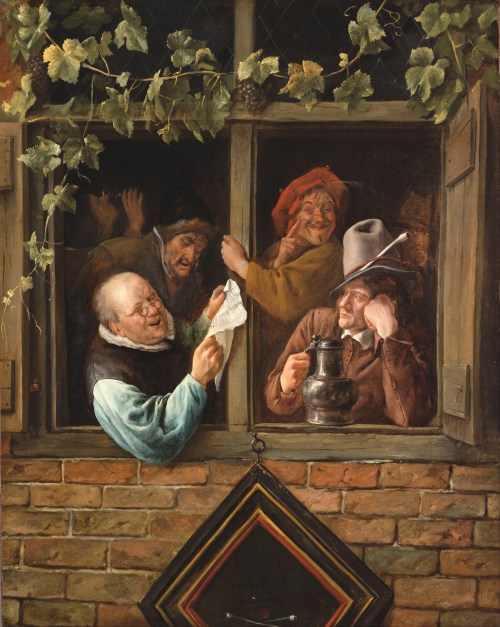
#FineArtFriday: Rhetoricians at a Window by Jan Steen ca. 1666

Artist: Jan Steen  (1625/1626–1679)

Title: Rhetoricians at a Window

Genre: genre art

Date: c. 1661-66

Medium: oil on canvas

English: Oil on canvas

Dimensions: Height: 759.46 mm (29.90 in); Width: 586.23 mm (23.07 in)

Collection: Philadelphia Museum of Art

What I love about this painting:

The reading of a poem or play was clearly the opportunity for the performers to have a good time. From the drinker in the shadows of the background to the grapevines growing around the window, Steen tells us that wine and rhetoric are clearly entwined.

I love the inclusion of both “the critic” who leans his head on his hand and listens analytically, and the man behind him, who is clearly “a little over the limit,” and supports himself by grasping the window frame and heartily agreeing with some point.

The reader is clearly enjoying himself, as are the others.

About the Artist (Via Wikipedia):

Jan Havickszoon Steen (c. 1626 – buried 3 February 1679) was a Dutch Golden Age painter, one of the leading genre painters of the 17th century. His works are known for their psychological insight, sense of humour and abundance of colour.

Daily life was Jan Steen’s main pictorial theme. Many of the genre scenes he portrayed, as in The Feast of Saint Nicholas, are lively to the point of chaos and lustfulness, even so much that “a Jan Steen household”, meaning a messy scene, became a Dutch proverb (een huishouden van Jan Steen). Subtle hints in his paintings seem to suggest that Steen meant to warn the viewer rather than invite him to copy this behaviour. Many of Steen’s paintings bear references to old Dutch proverbs or literature. He often used members of his family as models, and painted quite a few self-portraits in which he showed no tendency of vanity.

Steen did not shy from other themes: he painted historical, mythological and religious scenes, portraits, still lifes and natural scenes. His portraits of children are famous. He is also well known for his mastery of light and attention to detail, most notably in Persian rugs and other textiles.

Steen was prolific, producing about 800 paintings, of which roughly 350 survive. His work was valued much by contemporaries and as a result he was reasonably well paid for his work. He did not have many students—only Richard Brakenburgh is recorded—but his work proved a source of inspiration for many painters. [2]

About this painting, Via Wikipedia:

Chambers of rhetoric (Dutch: rederijkerskamers) were dramatic societies in the Low Countries. Their members were called Rederijkers (singular Rederijker), from the French word ‘rhétoricien’, and during the 15th and 16th centuries were mainly interested in dramas and lyrics. These societies were closely connected with local civic leaders and their public plays were a form of early public relations for the city. [1]

In 1945, Sturla Gudlaugsson, a specialist in Dutch seventeenth-century painting and iconography and Director of the Netherlands Institute for Art History and the Mauritshuis in The Hague, wrote The Comedians in the work of Jan Steen and his Contemporaries, which revealed that a major influence on Jan Steen’s work was the guild of the Rhetoricians or Rederijkers and their theatrical endeavors.

It is often suggested that Jan Steen’s paintings are a realistic portrayal of Dutch 17th-century life. However, not everything he did was a purely realistic representation of his day-to-day environment. Many of his scenes contain idyllic and bucolic fantasies and a declamatory emphasis redolent of theater.

Jan Steen’s connection to theater is easily verifiable through his connection to the Rederijkers. There are two kinds of evidence for this connection. First, Jan Steen Steen’s uncle belonged to the Rhetoricians in Leiden, where Steen was born and lived a substantial part of his life. Second, Jan Steen portrayed many scenes from the lives of the Rederijkers, an example being the painting Rhetoricians at a Window of 1658–65. The piece is currently held in the Philadelphia Museum of Art which was established in February 1876. The humanity, humor and optimism of the figures suggest that Jan Steen knew these men well and wanted to portray them positively.

With his lavish and moralising style, it is logical that Steen would employ the stratagems from theater for his purposes. There is conclusive evidence that the characters in Steen’s paintings are predominantly theatrical characters and not ones from reality. [2]


Credits and Attributions:

[1] Wikipedia contributors, “Jan Steen,” Wikipedia, The Free Encyclopedia, https://en.wikipedia.org/w/index.php?title=Jan_Steen&oldid=950709901 (accessed September 10, 2020).

[2] Wikipedia contributors, “Chamber of rhetoric,” Wikipedia, The Free Encyclopedia, https://en.wikipedia.org/w/index.php?title=Chamber_of_rhetoric&oldid=975283829 (accessed September 10, 2020).

Wikimedia Commons contributors, “File:Jan Steen, Dutch (active Leiden, Haarlem, and The Hague) – Rhetoricians at a Window – Google Art Project.jpg,” Wikimedia Commons, the free media repository, https://commons.wikimedia.org/w/index.php?title=File:Jan_Steen,_Dutch_(active_Leiden,_Haarlem,_and_The_Hague)_-_Rhetoricians_at_a_Window_-_Google_Art_Project.jpg&oldid=355150081 (accessed September 10, 2020).

2 Comments

Filed under #FineArtFriday

The Author Blog #amwriting

Sometimes, I find it difficult to pull my creative mind together long enough to write a coherent sentence. This is not an unusual thing. Actually, I do battle with it daily. However, I can always talk about writing craft here on Life in the Realm of Fantasy.

The “looming deadline” of my self-imposed  schedule keeps me focused. Blogging is an affordable way to connect with readers. It’s a platform where you can advertise your books and discuss your interests. See my 3-part series that posted on 30 May 2018, Creating Your Author Blog.

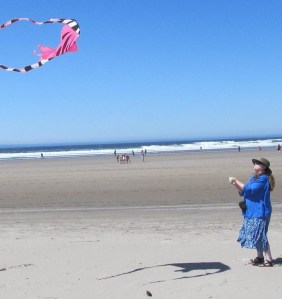
Today’s image is a picture  my husband, Greg, shot of me reeling in my little kite in 2018, during a time when we could still walk freely on the beach. I always suggest finding good photographs for your blog post, as images break up the wall of words and keep things interesting. However, it’s essential to keep it legal, so see my post of 08 January 2020, Using Pictures and Quotes.

Author Johanna Flynn is just building her website. She has an affinity for benches and their diverse settings, featuring various images of them on her website.

Ellen King Rice features mushrooms and other fungi on hers.

Both of these authors’ websites are eye candy.

I write two essays a week on the craft of writing. These articles help me clarify my thoughts on those points.

Friday is art day, my favorite day of the week. Exploring the brilliant art that emerged from the Netherlands in the early-to-late renaissance is something I can do despite not having a formal education, thanks to the internet and Wikimedia Commons.

At first, I was torn because whenever I do research in either field, I learn something new and I want to talk about it.

One day, I realized I could do both. After all, art and literature are inseparable, and where you find one you will find the other, along with music and dancing.

Regularly writing blogposts has made me a “planning” author, as well as a “pantser.” A good length for a blog post ranges from about 500 words to around 1,100, give or take. Limits require me to keep my area of discussion narrow, and not get sidetracked.

Blogging never fails to keep me humble. I use several tools to proofread my own work before I schedule it to publish. I make use of spellcheck, Grammarly, and rely heavily on the Read-Aloud function that MS WORD comes with.

Nothing bursts your bubble of self-importance like discovering gross errors and bloopers several days after you published the post.

Yet, it happens to me all too regularly.

For me, writing blog posts isn’t that difficult. I can knock one out in an hour if I’m fired up about the subject.

During the week, I make a note of any interesting topic that might make a good blog post. If there is a lot of research involved, I make footnotes with citations and sources as I come across the information. When that is the case, getting the week’s articles ready could take the whole day. Usually, writing the posts for the week only involves the morning.

If you are a blogger who only posts once a week to give potential fans an update of what you are doing, writing your essay should take less than an hour.

I always pre-schedule my posts. By using the tools each platform offers (be it WordPress or Blogger) to schedule in advance, they will post without my having to babysit them. Having that ability allows me the rest of the week to work on my real job, which is writing fiction.

Many of you have blogs that are languishing in limbo. You’ve lost interest because it’s challenging to gain readers when your website is new. It can be discouraging, but you must keep at it.

When we have a limited audience, we feel a little defeated in our efforts to gain readers. In the world of blogging, as in everything else, we start out small and gain readers as we go along. I began with four hits a day and celebrated the day I reached twenty.

The algorithms are such that those who keep the content updated regularly gain more views and readers. New content shows up at the top of the WordPress reader, so publishing regularly keeps your site in front of readers.

I use the WordPress Publicize options to automatically post my blog to Twitter, LinkedIn, and Tumblr.

On the left of your Blog title, under the words “My Sites,” click the dropdown menu. Scroll all the way to the bottom and open the WP ADMIN menu. This is the menu I use for posting everything on this website because it never changes and I don’t have to get used to a new dashboard every time the bored geniuses at WordPress decide to liven things up.

Step One: In that menu, scroll down to “Settings” and open that menu.

Step Two: In the Settings menu, open “sharing” and click on it. That will take you to the “Sharing Settings” page. Click on the button that says, “Publicize Settings.”

That opens a list of what I think of as blog warehouses, places that collect blogs and offer them to their regular readers. You want to activate as many of them as you can.

Because authors want to gain readers, we need to use every platform available to get the word out. Updating our website blogs twice a month offers us many opportunities to do just that and keeps us in touch with the people who count—our readers.

But most importantly, writing a 500-word blog post means that you wrote 500 words. For some of us, that is a huge accomplishment in these trying times.

If you are an author, you really should be blogging too, but you don’t have to post as frequently as I do.

Think about this: your website is your store, your voice, and your discoverable public presence. Readers will find you and your books there.

So, offer people a reason to stop by. Be nice, and don’t give your work the hard sell.


Credits and Attributions

The Pink Angelfish Kite, image by Greg Jasperson ©2018, All Rights Reserved

Comments Off on The Author Blog #amwriting

Filed under writing

Revisited: the Hyperlinked Table of Contents #amwriting

Every now and then we need to create a table of contents (TOC) for an eBook. Some readers like to have it hyperlinked for ease of negotiation in the book. Right now, I am creating the TOC for my new book, Julian Lackland, which will launch on September 22.

These instructions are for MS WORD, which is my preferred word-processing program. I assume the steps are similar in Google Docs but they will differ in ways I’m unfamiliar with.

I know of several high-end book-designing programs out there that will create the TOC and many other aspects of the finished product, but I have never used them. If you have the money and intend to publish a lot of books, one of those would be a good investment.

Also, before we begin, Draft2Digital can do this for you at no charge if your TOC is a straightforward thing. I heartily recommend their services for all aspects of creating a simple manuscript. Their end products look very nice and are easy to read.

However, if your book is divided into titled sections and has a map, you should either build the linked table of contents yourself or have your book-design service create it.

I have the skill, this costs me nothing, and while it is a time  consuming project, it’s not difficult.

The most serious thing to watch out for in this task is boredom. Inattentiveness will make a mess out of your manuscript, so stay alert and focus.

The first thing you want to do is create a plain list of what you want in your table of contents. A table of contents can take any form you want it to. Numbers or titled chapter headings – it’s your choice.

Make sure the finished list looks the way you want it to, and then insert it into the manuscript. I put the TOC in front, but some publishers put them as part of the back matter in eBooks.

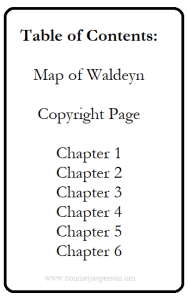
The following sample images are from the article I wrote on this same subject and posted on August 31, 2016.

With that done, we create our first bookmark.

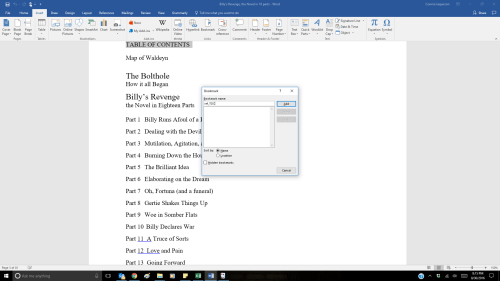
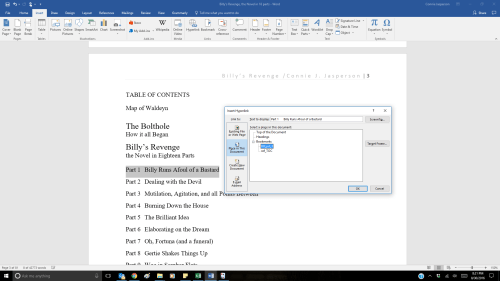
First, highlight the words  “Table of Contents” and then go to your ‘Insert’ tab.  Click on ‘Bookmark’ and when the pop-out menu opens, type in the words: ref_TOC

Then click “Add”.  In every manuscript it is important to name the Table of Contents bookmark exactly that, including the underscore: ref_TOC, because that’s what Smashwords looks for and it is simply a good practice to have a uniform system for naming files.  See the next picture for how it will look:

ref_TOC_screenshot2

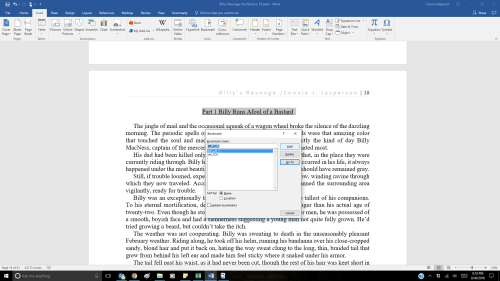
Now it’s time to bookmark the first chapter, or the prologue if you have one. We’ll give this pretend book the title of Billy’s Revenge, in honor of Billy Ninefingers. Thus, the initials BR will be featured in all my bookmark names.

Scroll down to your prologue or first chapter and do it exactly the same way as you bookmarked the TOC, but for this manuscript I will name it BR_ch_1. (Billy’s Revenge chapter 1)

You will name yours with your manuscript’s initials and the word prologue or chapter 1: MS_chapter_1

See the picture below:

ref_TOC_screenshot3

As long as you have the chapter title highlighted, click “insert Hyperlink” on the “insert” tab of the ribbon.

On the left of the dropdown menu, you want to click Link to:  Place in this Document.  That will bring up your bookmarks.

Select ‘ref_TOC’  and click OK.  This will turn your heading blue, and is called a ‘hyperlinky’.

You will need to test it, so press control and click on the link. This will take you back to the table of contents heading. Once you have used the hyperlinky it will turn purple.

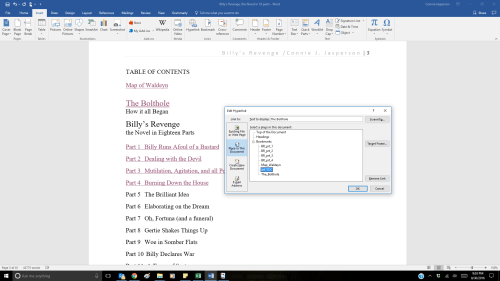
ref_TOC_screenshot5

Now that you are back at the Table of Contents, highlight either Prologue or Chapter 1, which ever you are starting your book with, and click “insert Hyperlink” on the ribbon.

Again, on the left of that menu, you want to click Link to: Place in this Document, which will will bring up your bookmarks.

Select the bookmark for your first section, either prologue or “MS_chapter_1” and click OK.  That will turn it blue.

Press control and click on the link. it will take you back to the heading of your prologue or the first chapter. Remember, once you’ve used a hyperlinky, it will turn purple.

Scroll down your manuscript to the next chapter, and highlight the chapter heading, just as you did the first time. Repeat the steps you did for the first section.

Do this for the entire table of contents, always remembering to link your chapter heading back to “ref_TOC”, and test each link as you go.

As I said earlier, creating your hyperlinked table of contents can be time consuming, and it requires you to pay attention. Even so, it is a simple process and makes your eBook a nicer experience for the reader.

ref_TOC_screenshot6

7 Comments

Filed under Self Publishing, writing

#FineArtFriday: The Arnolfini Portrait by Jan van Eyck 1434

Artist: Jan van Eyck  (circa 1390 –1441)

Title: The Arnolfini Portrait

Genre: portrait

Date: 1434

Medium: oil on panel

Dimensions: Height: 82 cm (32.2 in); Width: 59.5 cm (23.4 in)

Collection: National Gallery

About this painting, via Wikipedia:

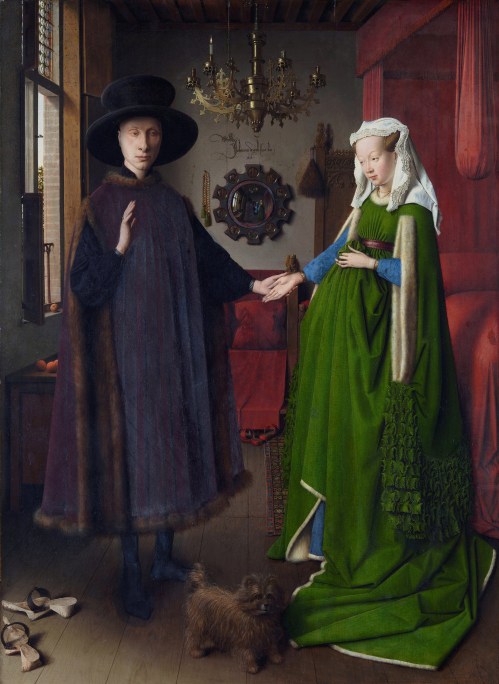
The Arnolfini Portrait (or The Arnolfini Wedding, The Arnolfini Marriage, the Portrait of Giovanni Arnolfini and his Wife, or other titles) is a 1434 oil painting on oak panel by the Early Netherlandish painter Jan van Eyck. It forms a full-length double portrait, believed to depict the Italian merchant Giovanni di Nicolao Arnolfini and his wife, presumably in their residence at the Flemish city of Bruges.

What I love about this painting:

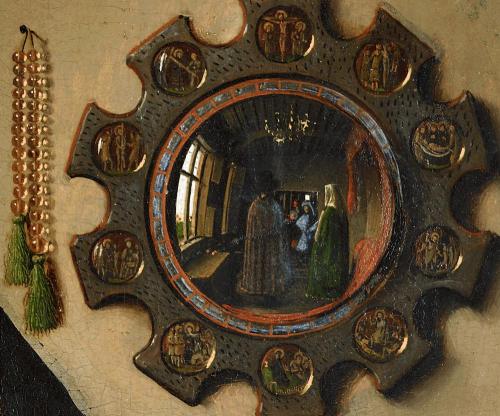
The painting is signed, inscribed, and dated on the wall above the mirror: “Johannes de eyck fuit hic 1434” (Jan van Eyck was here 1434).  This signature, made to look as if it were an inscription explaining the mirror over which it is centered, is a shining example of the sharp wit the later Netherlandish painters frequently inserted into their pictures.

I suspect his inclusion of subtle humor in his works gave permission to those painters who followed in his footsteps, such as the great Bruegel dynasty.

The colors of the garments are deep and rich. These were expensive clothes, completely befitting a wealthy merchant and his wife. In regard to the controversy which is explained below – yes, this painting is steeped in allegory and symbolism, down to the clogs in the left hand corner placed as if they are going out of the picture. In some cultures, a pair of shoes placed like that symbolizes an imminent departure, usually death.

All van Eyck’s work was heavily symbolic. But she appears to be in the late stages of a pregnancy. To me, given the societal norms of the Netherlands in the year 1434, this means the picture shows a married couple. If they were not actually married, it seems unlikely they would have commissioned a portrait showing her in that condition. In fact, and this will probably expose my self-taught ignorance of art history, it makes me wonder why there is a controversy about their marital status at all.

And the mirror…oh my. That mirror is brilliant.

The Controversy, via Wikipedia:

In 1934 Erwin Panofsky published an article entitled Jan van Eyck’s ‘Arnolfini’ Portrait in the Burlington Magazine, arguing that the elaborate signature on the back wall, and other factors, showed that it was painted as a legal record of the occasion of the marriage of the couple, complete with witnesses and a witness signature. Panofsky also argues that the many details of domestic items in the painting each have a disguised symbolism attached to their appearance. While Panofsky’s claim that the painting formed a kind of certificate of marriage is not accepted by all art historians, his analysis of the symbolic function of the details is broadly agreed, and has been applied to many other Early Netherlandish paintings, especially a number of depictions of the Annunciation set in richly detailed interiors, a tradition for which the Arnolfini Portrait and the Mérode Altarpiece by Robert Campin represent the start (in terms of surviving works at least).

Since then, there has been considerable scholarly argument among art historians on the occasion represented. Edwin Hall considers that the painting depicts a betrothal, not a marriage. Margaret D. Carroll argues that the painting is a portrait of a married couple that alludes also to the husband’s grant of legal authority to his wife. Carroll also proposes that the portrait was meant to affirm Giovanni Arnolfini’s good character as a merchant and aspiring member of the Burgundian court. She argues that the painting depicts a couple, already married, now formalizing a subsequent legal arrangement, a mandate, by which the husband “hands over” to his wife the legal authority to conduct business on her own or his behalf (similar to a power of attorney). The claim is not that the painting had any legal force, but that van Eyck played upon the imagery of legal contract as a pictorial conceit. While the two figures in the mirror could be thought of as witnesses to the oath-taking, the artist himself provides (witty) authentication with his notarial signature on the wall.


Credits and Attributions:

Wikimedia Commons contributors, “File:Van Eyck – Arnolfini Portrait.jpg,” Wikimedia Commons, the free media repository, https://commons.wikimedia.org/w/index.php?title=File:Van_Eyck_-_Arnolfini_Portrait.jpg&oldid=446521642 (accessed September 4, 2020).

Wikimedia Commons contributors, “File:The Arnolfini Portrait, détail (2).jpg,” Wikimedia Commons, the free media repository, https://commons.wikimedia.org/w/index.php?title=File:The_Arnolfini_Portrait,_d%C3%A9tail_(2).jpg&oldid=428220496 (accessed September 4, 2020).

Wikimedia Commons contributors, “File:Arnolfini Portrait 3.jpg,” Wikimedia Commons, the free media repository, https://commons.wikimedia.org/w/index.php?title=File:Arnolfini_Portrait_3.jpg&oldid=428554231 (accessed September 4, 2020).

2 Comments

Filed under #FineArtFriday, writing

Prepping for NaNoWriMo during the pandemic #amwriting

The first week of September is upon us already. This is when I will begin prepping for my tenth year of participating in November’s National Novel Writing Month, a.k.a. NaNoWriMo, and my ninth as a municipal liaison.

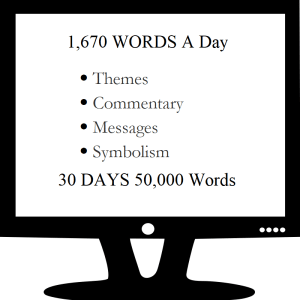
The primary goal of NaNoWriMo is to write a 50,000 word (or more) novel in 30 days. Of course, the end result will require serious rewriting and editing, the same as any first draft. But having the bones of a novel finished, with a beginning, middle, and end is a huge accomplishment.

That month of merry madness forces me to become disciplined, to lose the bad writing habits I slip into during the rest of the year.

Most importantly, having to maintain daily word count output forces me to ignore the inner editor, that unpleasant little voice that slows my productivity down and squashes my creativity.

Also, for this one month of the year, nothing comes before writing. In past years flu season hit me hard despite having gotten my flu shots, and I was unable to attend write-ins for part of the time.

Nevertheless, I still wrote and got my word count. Trying to use my laptop while obeying orders to stay in bed gave me an impetus to get well quick.

This year will be very different. Due to the pandemic, NaNoWriMo headquarters has declared that there will be no sanctioned in-person write-ins. My co-liaison, author Lee French, and I agree whole-heartedly with this the sense behind the decision.

Instead, we will meet via a service called Discord, which we began using last year. We may do some through Zoom Video Conferencing or Google Meet. I also have MS Teams, which I personally think is the best of the bunch.

Coming together to write might seem like an awkwardly silent meeting. Still, these meetings help push word counts and get writers closer to their finished manuscript. Writing in a group situation, even in a virtual environment, enables participants to stay connected. It lessens the feeling of aloneness that writers have historically suffered from since long before Covid19 made everyone else feel isolated.

This sense of belonging keeps us on track and helps us to burn through the roughest spots, days when all we can think to write looks like so much “blah blah blah.”

Our Facebook page will be a place for staying connected, and in past years we’ve had many fun writing sprints and virtual write-ins there.

I’ve posted these before, but here are my rules for succeeding at writing a 50,000 word novel in 30 days:

Write at least 1,670 words every day (three more than is required). This takes me about 2 hours because I’m not fast at this.

Write every day, no matter if you have an idea worth writing about or not. If you are really committed, you will do it even if you have to get up at 4:00 am to find the time. Don’t let anything derail you.

If you are stuck for what to write next, talk about how your day went and how you are feeling about things that are happening in your life, or write that grocery list. Use this time as a brainstorming session and just write about the direction you would like to take your story. This will loosen up your ideas, and you will be fired up all over again.

Don’t delete those ruminations, though. Every sentence you write counts toward your goal of 50,000 words. Passages you want to delete later can be highlighted, and the font turned to red or blue, so you can easily separate them out later.

Check-in on the national threads at http://www.NaNoWriMo.org and also your regional thread. You need to keep in contact with other writers, and the forums are fun to participate in.

Join a virtual write-in at NaNoWriMo on Facebook. This will keep you enthused about your project.

Remember, not every story is a novel. If your story comes to an end and you are only at 7,000 words, start a new story in the same manuscript. Use a different font or a different color of font, and you can always separate the sections later. That way, you won’t lose your word count.

Validate your word count every day on the national website. You will gain achievement badges for this, but more importantly, you will know if your word-processor counts the same way as the Validator App at NaNoWriMo. You don’t want to get an ugly surprise at midnight on November 30th!

As writers, we go through stages where we tend to focus too much on the quality of what we have already written and forget that output is important too. NaNoWriMo reminds us that if we don’t write new material every day, we stagnate. Nothing is worse than going over the same stale passages and wondering why you can’t move the story forward.

I write to a loose outline, but the pressure of having to get my word count means I don’t always follow it. The act of sitting down and just writing whatever comes into your mind is liberating.

Even if you don’t want the world to see what you write during the 30 days of NaNoWriMo, you have an outlet for your creative mind, a sounding board for your opinions and ideas. Rant about politics and religion to your heart’s content—no one will be offended if you are only writing for yourself.

If you are getting into genealogy through Ancestry, this is your golden opportunity to write about what you have learned, compiling the information for your own records.

Watching TV and playing video games all evening long doesn’t allow for creative thinking.  Your mind doesn’t get to rest from the daily grind.

Creative thinking—assembling puzzles, quilting, writing, painting, building Lego cities—these activities are far more relaxing than vegetating in front of the TV. Putting together jigsaw puzzles is a great way to organize your mind and sort out plot points.

Something I have found over the years is that by getting away from the TV for a while, your mind becomes sharper. By doing something different, you give your active mind a vacation. You rest better, and your whole body benefits from having done something positive and restful in your free time.

Over the next 60 days, I will be plotting several short stories and a novella, all of which I hope to write in November. They may all get written, or some may be shelved, but either way, I will finish November with new fodder for my short-story submission mill.

10 Comments

Filed under writing

Revisions: Transitions #amwriting

When we rewrite something, we are making revisions. I love the word revision.

re + vision = to envision again.

When I’m making revisions, I try to look carefully at my transitions. These are the small connections that are woven into the larger narrative.

When we begin revising our manuscript, we are looking at small passages of our work with new eyes and seeing how they might be changed to better fit the story. Most times, I can condense them, but sometimes these scenes get expanded.

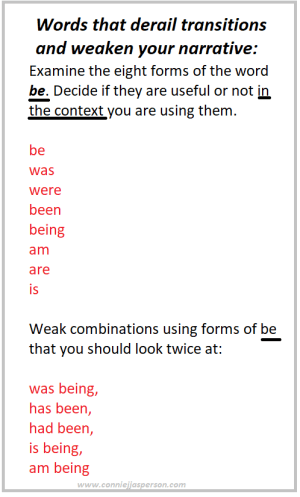
If it takes more than a paragraph to make the transition, I must be vigilant in my revision. If I must give information, I look for and change all the passive “code words” to active prose. I’ve posted this list before, but if you didn’t copy it then, here is your opportunity.

  • This is an image. Feel free to right-click and save this list as a .png or .jpg for your private use.

    All forms of To be (see the graphic to the right)–>

  • basically
  • Too many emdashes
  • Exclamation points (usually not needed)
  • Finally
  • I think
  • -ing
  • Its / it’s
  • –ize –ization (global search)
  • just
  • Like
  • -ly (global search)
  • now
  • Okay
  • Only
  • Really
  • Said (decide if speech tags can be eliminated and shown by actions)
  • Seem
  • Still
  • Suddenly
  • That (often not needed)
  • The
  • Then (often not needed)
  • There was (a subjunctive)
  • –tion (global search)
  • Very (usually not needed)
  • Which (not a substitute for ‘that’)

For example, when I see the word “went,” I immediately know someone is on the move.

They went, but how did they go?” Went can be changed to any number of verbs:

  • they walked (to the next room, or down the street, or to Mordor.)
  • they drove (a car, a wagon, a spaceship.)
  • they rode (a horse, donkey, motorcycle, or dragon.)
  • they took a plane (bus, ferry, space shuttle, or sleeping pill.)
  • they teleported (vanished into the ether)

Regrouping after an encounter with the antagonist or some other roadblock to success makes a logical transition scene. I see these transitions as opportunities to move the plot forward through conversation or introspection.

When the characters are trying to survive amid chaos, there must be order in the layout and pacing of the narrative, or the reader will become lost. This is called pacing, and it is a key aspect of good transitions.

Pacing is the rise and fall of the action, drama and transition, the ebb and flow of conversations.

  • action,
  • processing the action,
  • action again,
  • another connecting/regrouping scene

Regrouping transitions allow the reader to process what just happened in “real-time,”  experiencing it as if they were the characters.

Transitions provide us with opportunities to ratchet up the tension. They are also where we justify the events and show motives, making them believable.

Unfortunately, these are also places where it is easy to accidentally jump into the headspace of a  different point-of-view character, also known as head-hopping.

For this reason, in the revision process, it’s important to pay attention to who is talking and make sure we are only in their head for the entire scene.

One useful kind of transition is introspection, usually shown with internal dialogue. When done right, internal dialogue offers an opportunity, a brief segue in which new information necessary to the story can emerge.

  1. Introspection also allows the reader to see who the characters think they are. This is critical if you want the reader to bond with them.
  2. Introspection shows that the characters are self-aware.

I do suggest you keep the scenes of internal dialogue brief, or they can meltdown into an info dump. Also, as I’ve said elsewhere if you use italics to set thoughts off, I suggest your characters don’t do too much “thinking.” A wall of italics is hard to read, and we want the reader to stay with the story.

The overuse of weak words can derail transitions. These are any kind of qualifier or quantifier: just, a little, a bit, somewhat—these are words that show indecision. Active prose should not be indecisive.

Also, weak words can be action-stopping words: started to, began to— these are word combinations that slow and stall the action. They are passive, so if you want to write active prose, go lightly with them. Your characters shouldn’t begin to move. Have them move and be done with it.

And never forget to look for and possibly remove words that end in the letters ly: probably, actually, sympathetically, magically … etc.

These are weak, telling words. I spend a lot of time thinking of how to show what I mean rather than telling it. I go to the Oxford Dictionary of Synonyms and Antonyms and find stronger words that more clearly show what I am trying to say.

Whether you are ending a chapter or connecting a series of shorter scenes, dramatic passages have universal commonalities:

  • All scenes have an arc to them: rising action, climax, reaction.
  • These arcs of action and reaction begin at transition point A and end at transition point B.
  • Each scene will end at a slightly higher point of the overall story arc.

In some ways, I find that transitioning from one scene to the next is the most challenging aspect of making revisions. We can choose to end the scene with a hard break and start a new chapter, or smoothly flow into the next scene.

Either way, I hope I’ve written the scenes in such a way that they blend smoothly into the one that follows. This sometimes takes several attempts before I get it right, so if you also struggle with this, you are not alone.

6 Comments

Filed under writing

#FineArtFriday: Spanish Blacksmiths by Ernst Josephson 1882 (revisited)

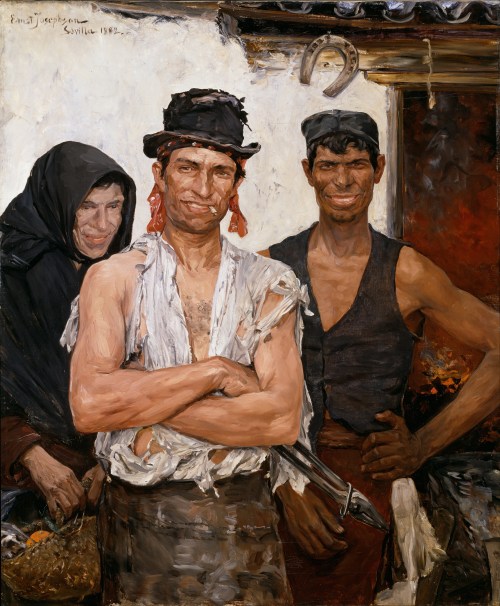
Spanish Blacksmiths, by Ernst Josephson

  • Date: 1882
  • Medium: oil on canvas
  • Dimensions : width: 107 x height: 128.5 cm

What I love about this image:

This powerful painting is one of my all-time favorites. Josephson captures the boundless self-confidence and personalities of these young men. He has managed to portray their cock-of-the-walk swagger, and he has shown us the truth of their craft: that sparks fly and ruin their clothes; that the work is hard and their muscles strong. These men are full of life.

The influence of Josephson’s having studied Rembrandt’s works closely can be seen here in the style with which he has painted their features. He has painted the men with truth—they are not classically handsome, but they are in the prime of life and have immense charisma. They wear their burned and ragged hats with pride. These men are good at what they do, and they know it. Their eyes dance and flirt outrageously with you across the years—they are full to bursting with machismo, daring you to just try to walk past and not notice them.

About the Artist, Via Wikipedia

(Ernst Josephson) was born to a middle-class family of merchants of Jewish ancestry. His uncle, Ludvig O. Josephson (1832-1899) was a dramatist and his uncle Jacob Axel Josephson (1818-1880) was a composer. When he was ten, his father Ferdinand Semy Ferdinand Josephson (1814-1861) left home and he was raised by his mother, Gustafva Jacobsson (1819-1881) and three older sisters.

At the age of sixteen, he decided to became an artist and, with his family’s support, enrolled at the Royal Swedish Academy of Fine Arts. His primary instructors there were Johan Christoffer Boklund and August Malmström. He was there until 1876, when he received a Royal Medal for painting.

After leaving the Academy, he and his friend and fellow artist Severin Nilsson (1846-1918) visited Italy, Germany and the Netherlands, where they copied the Old Masters. His breakthrough came in Paris, where he was able to study with Jean-Léon Gérôme at the École des Beaux-Arts. He soon began concentrating on portraits, including many of his friends and fellow Swedes in France. For a time, he shared a studio with Hugo Birger (1854–1887). His personal style developed further during a trip to Seville with his friend, Anders Zorn, from 1881 to 1882.

His private life did not go well, however. By his late twenties, he was afflicted with syphilis. His romantic life suffered as a consequence, as he was forced to break off a promising relationship with a young model named Ketty Rindskopf.


Credits and Attributions:

Spanish Blacksmiths by Ernst Josephson 1882 PD|100,  First published on Life in the Realm of Fantasy on August 16, 2019

Wikimedia Commons contributors, “File:Ernst Josephson – Spanish Blacksmiths – Google Art Project.jpg,” Wikimedia Commons, the free media repository, https://commons.wikimedia.org/w/index.php?title=File:Ernst_Josephson_-_Spanish_Blacksmiths_-_Google_Art_Project.jpg&oldid=354761584 (accessed August 16, 2019).

Wikipedia contributors, “Ernst Josephson,” Wikipedia, The Free Encyclopedia, https://en.wikipedia.org/w/index.php?title=Ernst_Josephson&oldid=888815743 (accessed August 16, 2019).

Comments Off on #FineArtFriday: Spanish Blacksmiths by Ernst Josephson 1882 (revisited)

Filed under #FineArtFriday

Challenges in writing and selling short stories #amwriting

If you have been writing for any length of time, you have probably discovered that there is an art to both writing and selling short stories.

It is only when we begin reading widely, and in many different genres, that we discover a painful truth: great writing is not merely a matter of following rules.

As an editor and a voracious reader, I often find a special kind of life in a manuscript that has broken some of the rules.

However, poorly constructed work will be rejected by all publishers, and no reason will be given.

Grammar rules exist for a purpose, and haphazard breaking of them can destroy a reader’s enjoyment of a story. I guarantee you won’t find a publisher for that story.

If you want to sell your work, you must know the rules of grammar and have a basic understanding of mechanics. These rules exist for the comfort and convenience of the reader, so don’t think that they don’t matter.

The four fundamental laws of comma use are not open to interpretation, but are simple and easy to learn. Be consistent in their use.

1) Never insert commas “where you take a breath” because everyone breathes differently.

2) Do not insert commas where you think it should pause, because every reader sees the pauses differently.

3) Use commas to join two independent clauses when they are joined by a conjunction. The independent clause is a complete stand-alone sentence.

  • Edgar worships the ground I walk on, but his adoration bores me.

4) Don’t use a comma to join a dependent clause to an independent clause.

  • Edgar worships the ground I walk on and brings me my coffee.

If you understand those four concepts, you are probably ahead of the competition.

Unfortunately, it is easy to murder what began as a beautiful story. Consider those writers who spend years carefully combing every spark of accidental passion out of their work, creating textbook-perfect sentences that are flat, toneless.

Other authors randomly have characters swear, not consistently, but off and on, apparently for the shock value. Others might inject a little graphic violence or sex into the spots where they couldn’t think of what to do next.

When you do anything that breaks a rule, you must do it consistently and with purpose.

“Shock” for the sake of shock has no value to offer. However, a well-written manuscript may shock and challenge you.

When you understand how a story is constructed, you’re able to find creative ways to phrase things and still keep the story interesting.

When the way you write prose goes against the accepted practice, do it intentionally.

Be sure to tell your editor what rules you are choosing to ignore and why, and she will make sure you are consistent.

We all begin at the same place as writers, all of us mortals with flaws and our own way of doing things.

So now that we understand we all begin as novices, I must ask you this question:

Are you writing because you’re burning to tell a story? If you are not writing for the joy of writing, quit now. You’ll never sell a story you don’t believe in.

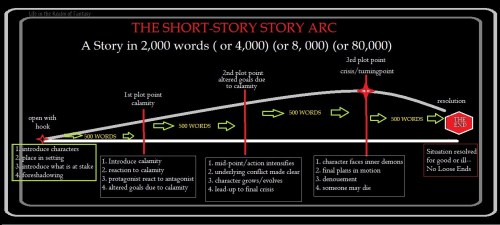
Otherwise, keep writing. Only by continued practice and attention to learning the craft will you develop the balance you know you need. Purchase the Chicago Guide to Grammar Usage and Punctuation, and learn how sentences and paragraphs are constructed. Then learn how to fit those sentences and paragraphs into a story arc.

That way, when you break a rule, you will be knowledgeable and do it with style.

The best way to gain a handle on all aspects of writing fiction is by writing short stories and essays.

With each short-story you write, you increase your ability to tell a story with minimal exposition and intentional prose. This is especially true if you limit yourself to writing the occasional practice story, telling the whole story in 1000 words or less. These practice shorts serve several purposes:

  • You have a finite amount of time to tell what happened, so only the most crucial of information will fit within that space.
  • You have a limited amount of space, so your characters will be restricted to just the important ones.
  • There is no room for anything that does not advance the plot or influence the outcome.
  • You will build a backlog of short stories and characters to draw on when you need a good story to submit to a contest.

For me, the most difficult challenge is to write flash fiction, where I have less than 1,000 words to tell a story. This means we only include the most essential elements of a story. All my stories are either shorter or longer than 1,000 words and require weeks of effort to get them to fit that parameter.

As a poet, I find it far easier to tell a story in 100 words than in 1,000. That 100-word story is called a drabble and is an art form in itself.

Many people have asked how to find places that are accepting submissions. That can be a challenge, but these are links to two groups on Facebook where publishers post open calls for short stories.

Open Submission Calls for Short Story Writers (All genres, including poetry)

Open Call: Science Fiction, Fantasy & Pulp Market (speculative fiction only)

You do have to apply to be accepted into these groups and answer specific questions to prove you are legitimately seeking places to submit your work. Once you are approved, certain rules must be followed for a happy coexistence.

Some open calls are for anthologies that are not paid, others pay royalties. I would carefully check out the unpaid ones to make sure there is a good reason why it is unpaid, and that the publisher is reputable.

Be sure any contracts limit the use to that volume only, and you retain all other rights.

Also, you should retain the right to republish that story after a finite amount of time has passed, usually 90 days after the anthology publication date.

SFWA has a wonderful list of predatory publishers that you should avoid doing business with. They also have useful information on things that might be found in predatory contracts. You don’t need to be a member to access these. https://www.sfwa.org/

You can find publications with open calls at Submittable. Unfortunately, that has lately become not as useful regarding speculative fiction as it was several years ago. Still, many poetry collections, literary anthologies, and contests use Submittable, so that is an option. https://www.submittable.com/

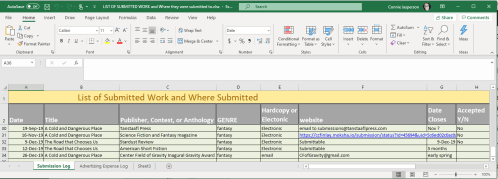
All in all, you have to kiss a lot of frogs, so to speak, before you find that prince of a publisher that is looking for your work. Don’t let one rejection stop you. Keep that submission mill running, and for the love of Isaac Asimov, keep track of who you sent what to, what day you sent it, and whether or not it was accepted.

7 Comments

Filed under writing

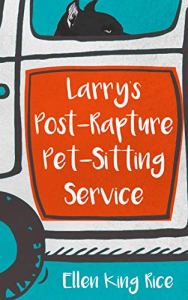
Larry’s Post-Rapture Pet-Sitting Service, By Ellen King Rice #bookreview #beachread

While I was on vacation, I read Ellen King Rice’s new book, Larry’s Post-Rapture Pet-Sitting Service. What a hoot!  As with her previous books, it’s set in the South Puget Sound area of the Pacific Northwest. This book is a joy.

So, without further yak-yak, here is my review of

Larry’s Post-Rapture Pet-Sitting Service: A loser’s account of surviving the righteous and other afflictions, by Ellen King Rice

  • Publisher:Undergrowth Publishing (August 20, 2020)
  • Publication Date:August 20, 2020

But First, the Blurb:

One man with highly flexible morals and a dodgy past.

His mother, in dire need of beer and pretzels.

A history-mad teenager in search of a job.

And cats. Lots of cats.

As the alleged man of the house, Larry has to make ends meet, one way or another.

Selling post-Rapture pet care insurance seems simple enough.

Until Larry crosses paths with a left-behind televangelist looking to carve a new domain. Out of his hide, if he lets her.

Review: “A large and colorful cast of characters fills the novel, and their experiences and coping mechanisms in the rapture-altered world give the story a welcome variety of perspectives.” – Kirkus Reviews

 >>><<<

My Review:

I’m still smiling about this book. Larry is the most perfectly imperfect man ever. Marjorie is a wonderful person, a little rough around the edges, but possessing a heart of gold. Every cloud has a silver lining, but sometimes you have to hustle to get there first. Marjorie excels at keeping her son hustling.

Larry is accustomed to not flying first-class, so to speak, so he’s not surprised that he was left behind. He loves life and all the pickles he’d have missed had he been raptured or sent the other way.

I loved the notion that all the dogs went to Heaven.

Abigail Ross is a credible villain. The varying degrees of devotion her entourage of now-unenthusiastic minions feels for their employer since the rapture began is well-drawn. The many snake-like ways she tries to thwart Larry’s success kept me turning the page. I had to find out how everything was resolved.

Larry attracts a good posse. Every character in this group and their circumstances are unique, and yet they fit together, becoming stronger by virtue of being not quite saintly enough for the rapture.

I laughed out loud in many places, worried for Larry and his crew, and celebrated when certain animals were rescued.

If you like humor, dark or otherwise, and love thought provoking character-driven novels, this is one you should read.


About Ellen King Rice: Ellen  usually writes mysteries with mycological elements, but recent political events have drawn her out of the woods to admire the resilience of the people of the Pacific Northwest. Call it a Menippean satire for the modern era, or a rollicking tale of imperfect people surviving in uncertain times, this is a story of doggedness and pickles. Winner of a 2020 IPPY Gold medal for Best Regional Fiction for “Lichenwald” (and a 2019 Silver Medal IPPY award for “Undergrowth” and a Wishing Shelf Book Awards finalist for “The EvoAngel”) Ellen King Rice is a former wildlife biologist with passions for epigenetics and fungi. In her younger years she served as a wildlife conservation officer, a big game manager, an endangered species biologist and as a lobbyist for environmental issues.

You can find Ellen and her books at https://www.ellenkingrice.com/

2 Comments

Filed under writing