#FineArtFriday – a second look at “Fishing for Oysters at Cancale” by John Singer Sargent 1878

2560px-John_Singer_Sargent_-_CancaleArtist: John Singer Sargent (1856–1925)

Title: En route pour la pêche (Setting Out to Fish) Fishing for Oysters at Cancale

Date: 1878

Medium: oil on canvas

Dimensions: height: 77 cm (30.3 in); width: 121.6 cm (47.8 in)

Inscription: Signed and Dated: John S. Sargent Paris 1878

Collection: National Gallery of Art

What I love about this picture:

Every time I see a painting by John Singer Sargent, I love him more. He is rapidly becoming one of my favorite artists of all time. (Don’t be jealous, Rembrandt. You are still number one in my heart.)

Sargent paints a perfect summer day for us, a good day to be out near the water. John Singer Sargent was a complicated man, as most artists are. Famous as a portrait artist, he painted landscapes that conveyed a sense of mood and emotion that few of his contemporaries could match. One of Sargent’s great skills was the ability to convey the sensory impressions of an environment.

He found beauty and drama in the lives of ordinary people and showed his characters outdoors in all the seasons. His paintings of working-class people didn’t romanticize how they dressed, conveyed their moods. Sargent showed the environment they lived and worked in, no matter how good or bad the weather.

Sargent had a gift for painting rare and expensive fabrics, yet no one is dressed in finery in this painting. On the contrary, the women are dressed in shabby clothes that protect them from the sun and salty wind, garments that have seen a great deal of wear. The children are bare-legged and barefoot, while the fishers wear clogs. These women carry baskets and the hope that they will find enough oysters and other shellfish to not only feed their family but have plenty to sell to the fishmonger.

About this picture via MFA Boston: Sargent’s choice of subject was not revolutionary – a similar scene of oyster harvesters had previously won a medal at the Salon. However, his ability to paint the reflections in the tidal pools and the light sparkling on the figures and clouds dazzled viewers, clearly demonstrating that his talents extended beyond portraiture. [1]

About the artist, via Wikipedia:

John Singer Sargent (January 12, 1856 – April 14, 1925) was an American expatriate artist, considered the “leading portrait painter of his generation” for his evocations of Edwardian-era luxury. He created roughly 900 oil paintings and more than 2,000 watercolors, as well as countless sketches and charcoal drawings. His oeuvre documents worldwide travel, from Venice to the TyrolCorfu, Spain, the Middle East, MontanaMaine, and Florida.

Born in Florence to American parents, he was trained in Paris before moving to London, living most of his life in Europe. He enjoyed international acclaim as a portrait painter. An early submission to the Paris Salon in the 1880s, his Portrait of Madame X, was intended to consolidate his position as a society painter in Paris but instead resulted in scandal. During the year following the scandal, Sargent departed for England, where he continued a successful career as a portrait artist.

From the beginning, Sargent’s work is characterized by remarkable technical facility, particularly in his ability to draw with a brush, which in later years inspired admiration as well as criticism for its supposed superficiality. His commissioned works were consistent with the grand manner of portraiture, while his informal studies and landscape paintings displayed a familiarity with Impressionism. In later life, Sargent expressed ambivalence about the restrictions of formal portrait work and devoted much of his energy to mural painting and working en plein air. Art historians generally ignored society artists such as Sargent until the late 20th century.

The exhibition in the 1980s of Sargent’s previously hidden male nudes served to spark a reevaluation of his life and work, and its psychological complexity. In addition to the beauty, sensation and innovation of his oeuvre, his same-sex interests, unconventional friendships with women and engagement with race, gender nonconformity and emerging globalism are now viewed as socially and aesthetically progressive and radical.


Credits and Attributions:

IMAGE: Wikimedia Commons contributors, “File:John Singer Sargent – Cancale.jpg,” Wikimedia Commons, https://commons.wikimedia.org/w/index.php?title=File:John_Singer_Sargent_-_Cancale.jpg&oldid=745727074 (accessed April 25, 2025).

[1] Quote: MFABoston contributors, Fishing for Oysters at Cancale – Works – Museum of Fine Arts, Boston (mfa.org) (accessed April 25,2025).

[2] Wikipedia contributors, “John Singer Sargent,” Wikipedia, The Free Encyclopedia, https://en.wikipedia.org/w/index.php?title=John_Singer_Sargent&oldid=1223506386 (accessed April 25, 2025).

Comments Off on #FineArtFriday – a second look at “Fishing for Oysters at Cancale” by John Singer Sargent 1878

Filed under #FineArtFriday

Idea to story part 12 – theme, plot, and the character arc #writing

Two months ago, we began our series, Idea to Story. The previous eleven installments are listed below. We have created a sample story, a romantasy. We have met our protagonists and the ultimate antagonist. We know what their world is like and have given them a worthy quest, and we discovered what genre we are writing by paying attention to the tropes that arose as we were laying down the plot.

Now, we’re going to examine the themes that have emerged. We will strengthen the story arc and make the characters more vivid by ensuring a strong central theme is woven through the story.

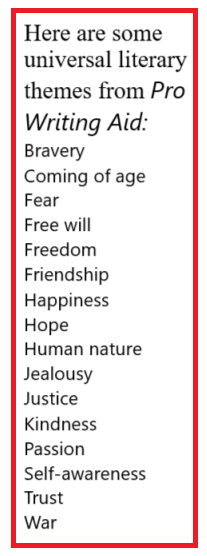
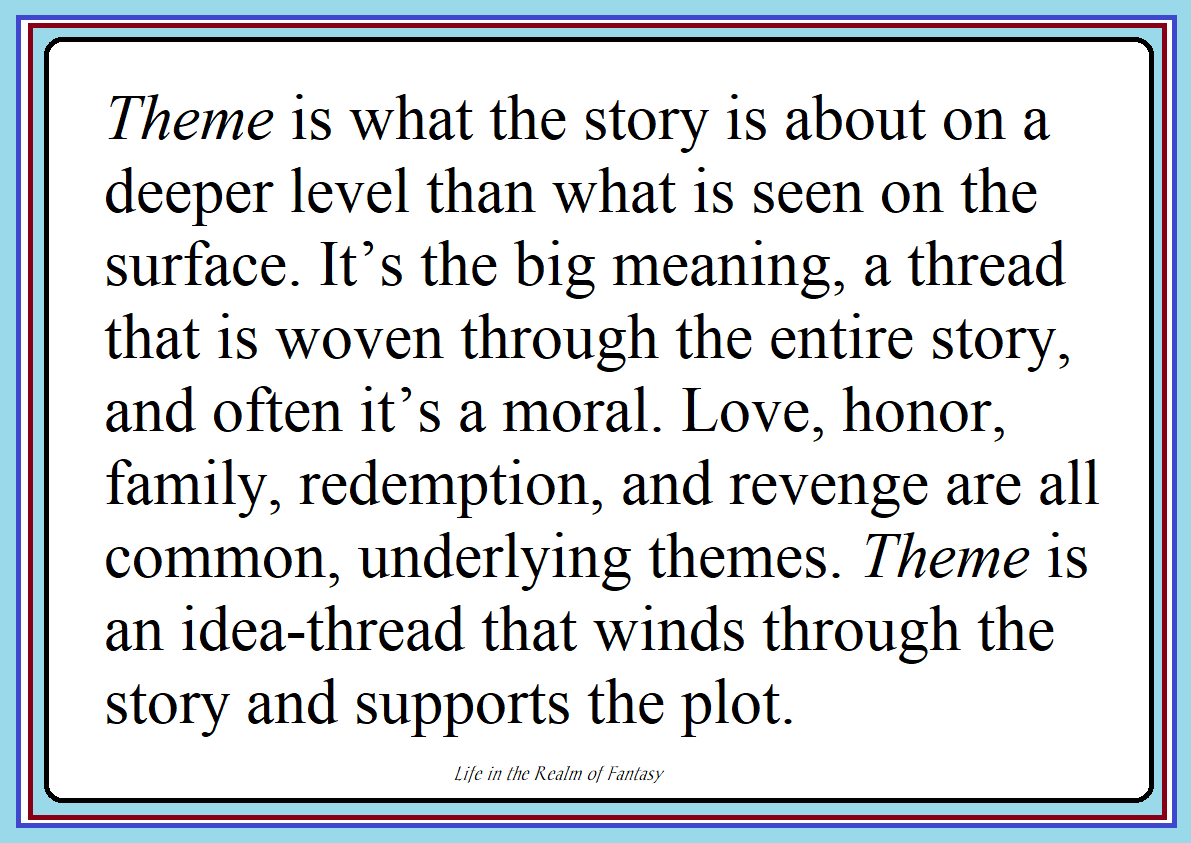
But first, what is a theme? It is an idea, an unspoken message that winds through the arc of the story and generates action. Themes are subtle but move the characters to action and define why the action happens. For an incredible list of themes, go to A Huge List of Common Themes – Literary Devices.

Before we talk about the themes we want to incorporate in our story, let’s look at how the master of themes, Henry James, wove them into his work.

Henry James is a 19th-century writer you might have heard of but never read. However, he can teach us so much about using a story’s themes to create memorable characters. You may be familiar with the titles of some of his works, such as The Turn of the Screw and The Golden Bowl. Filmmakers and playwrights are still turning his work into movies and plays.

Henry James was a master at writing one common theme into a story—lust. Lust for sex. Lust for money. Lust for control.

Lust for power.

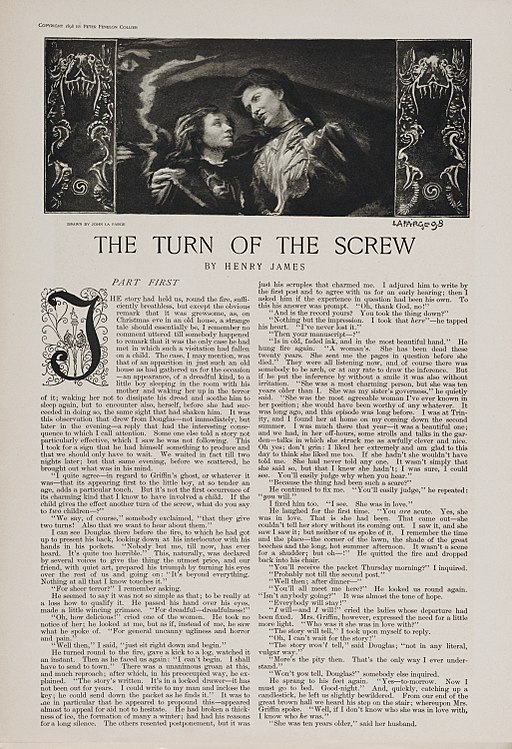
Henry James wrote one of the most famous novellas ever published, the Turn of the Screw.

On the surface, the Turn of the Screw is a gothic horror story. The four main themes are the corruption of the innocent, the destructiveness of heroism, the struggle between good and evil, and the difference between reality and fantasy. A fifth theme is the perception of ghosts. Are the ghosts real or the projection of the governess’s madness?

However, there are several subthemes interwoven into the fabric of the narrative:

  • Secrecy.
  • Deception.
  • The lust for control.
  • Obsession.

What I take home from the longevity of Henry James’s work is this: find a strong theme and use it to underscore and support our characters’ motives.

So, now we know that literary themes are a pattern, a “melody” that recurs in varying forms throughout a story. They emphasize mood and shape the plot.

The main theme of our story is the struggle between good and evil. In Donovan’s well-planned manipulation of Kai under the guise of brotherly mentoring, we have the subthemes of deception and the corruption of the innocent. In Val and Kai, we have the dangers of ignorance and the subthemes of arrogance and class prejudice.

Our three main characters are people. In real life, people are a mix of good and bad at the same time. Some lean more toward good, others toward bad. Either way, their intentions are logical, and they desperately want what they think they deserve.

Most importantly, our characters lie to themselves about their own motives and obscure the truth behind other, more palatable truths. These unspoken truths are the themes we must weave into the fabric of our story by subtly showing a pattern.

Two themes we want to emphasize in Donovan are the desire for power and the use of fear as a means of control. However, at first, we want the tug-of-war for control of the child king, Edward, to be focused on the regents, Kai Voss and Valentine.

The story opens from Val’s point of view, so we lean a bit toward her. But not entirely, as Kai’s chapter shows he has good intentions.

By hinting at the pattern of Donvan’s actions in the first quarter of the book, his lust for power becomes clear. We hope to create in the reader a sense of helplessness to stop what we see coming. This is emphasized as clues appear, indicating that Val and Kai are acting on misinformation that is deliberately fed to them.

Once Val and Kai find themselves in the dungeon, new themes will join the story. Both are in their mid-thirties and are established and respected in their respective peer groups. However, both must have a coming-of-age arc. Despite their apparent adulthood, they each have a lot to learn about real life.

But what about young King Edward? For Val and Kai, the theme of parental love is shown in their actions of caring for him from the beginning. While he is not their child, he is in their care and both love him as if he were their son and are secretly jealous of each other. They have differing goals for him, which causes friction, but the reader doesn’t doubt their sincere love for the boy.

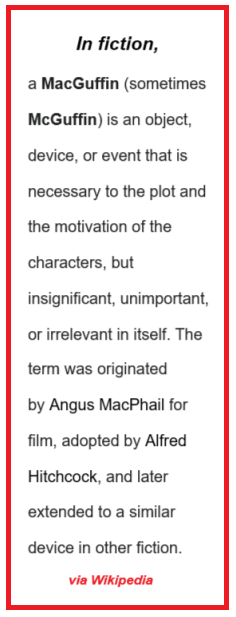
Edward is sickly, cursed with a wasting disease. All through this tale, he has been a McGuffin, the object of the quest and a pawn in Donovan’s game of power. His character arc is limited because he is bedridden and unaware of the war for control centered on him.

When she wakes up in the dungeon, Val realizes who truly set the curse on Edward and who murdered the boy’s parents in the first place. She realizes that if she can’t rescue Edward, Donovan’s curse will kill him, and Donovan will become king. She is miserably aware that she will need a wizard to counter Donovan’s sorcery. Unfortunately, the only sorcerer she has access to is Kai, which means she must rescue him first, something she despises having to do.

Conversely, Kai is glad to be free but not pleased that it is Valentine who has rescued him. He doubts her motives and refuses to believe his brother betrayed him, until they overhear the guards talking.

Val and Kai must learn to work together. As they do, the theme of romantic love will emerge.

What other themes might emerge as we write our story? How will we recognize and underscore the patterns, the melodies that appear in the narrative?

This is where writing becomes a craft, and to excel at any craft, we must work at it.

Thank you for sticking with me as we worked our way through this long and involved process of taking an idea for a story and building the characters, the world, and the plot.

While the story of Val and Kai is just a sample plot for demonstration, I have used these weeks to reexamine the different aspects of my current work in progress. Talking my way through a plot with my friends really helps, so thank you!


Previous in this series:

Idea to story, part 1: novel, poetry, memoir, or short story? #writing | Life in the Realm of Fantasy

Idea to story part 2: thinking out loud #writing | Life in the Realm of Fantasy

Idea to story part 3: plotting out loud #writing | Life in the Realm of Fantasy

Idea to story part 4 – the roles of side characters #writing | Life in the Realm of Fantasy

Idea to story part 5 – plotting treason #writing | Life in the Realm of Fantasy

Idea to story part 6 – Plotting the End #writing | Life in the Realm of Fantasy

Idea to story part 7 – Building the world #writing | Life in the Realm of Fantasy

Idea to story part 8 – world-building and society #writing | Life in the Realm of Fantasy

Idea to story part 9 – technology and world-building #writing | Life in the Realm of Fantasy

Idea to Story part 10 – science and magic as world-building #writing | Life in the Realm of Fantasy

Idea to story part 11: Genre and expected tropes #writing | Life in the Realm of Fantasy

5 Comments

Filed under writing

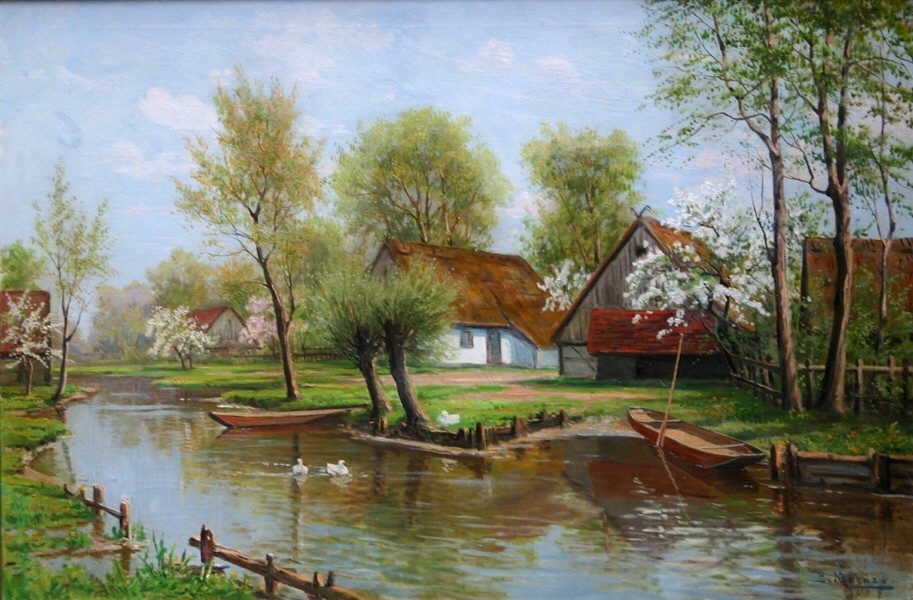
#FineArtFriday: a second look at “Canal in the Spreewald in Spring” by Bruno Moras

Artist: Bruno Moras, (1833 – 1939)

Title: Kanal im Spreewald im Frühling (Canal in the Spreewald in Spring)

Medium: oil on canvas

Dimensions Height: 79 cm (31.1″); Width: 119 cm (46.8″)

What I love about this picture:

I first featured this painting in March of 2020. I particularly like how comforting this scene is, how ordinary and yet how special. I grew up in a house on the shores of a lake, and waterside homes attract me. I would love to live beside this canal.

Spring is a hopeful season for me, a time of promise. Trees that have slept all winter are waking and blossoming, bringing color to the dark, gray world.

Moras captured the trees as they are when the leaves first burst forth, with a bright, yellow-green. The apple and plum trees, the first signs of spring around here, are blossoming. The water reflects the  colors of the world, yet a slight breeze moves it. The small boats drawn up to the shore can carry one or two fisher folk comfortably.

About the artist:

I have been unable to find much about Bruno Moras, other than he was the son of Walter Moras, was born, lived, and died in Berlin, and never achieved the fame his father had. This is too bad, as his works are just now becoming more in demand at auctions.

Still, his work survives. In a time when modern art was moving away from traditional landscape painting, Moras painted beautiful images of what he loved most: the countryside of his Germany.

Credits and Attributions:

Wikimedia Commons contributors, “File:Bruno Moras – Kanal im Spreewald im Frühling.jpg,” Wikimedia Commons, https://commons.wikimedia.org/w/index.php?title=File:Bruno_Moras_-_Kanal_im_Spreewald_im_Fr%C3%BChling.jpg&oldid=835727555 (accessed April 16, 2025).

2 Comments

Filed under #FineArtFriday, writing

Idea to story, part 11: Genre and expected tropes #writing

Two months ago, we began our series, Idea to Story. The previous ten installments are listed below, but over the last ten weeks, we have met our protagonists and the ultimate antagonist. We know what their world is like and have given them a worthy quest. Also, we know how this story must end.

As we were meeting the characters, we realized that the sample plot is for a “Romantasy,” a subgenre of Fantasy, and we gave it a title that plays to that category, Valentine’s Gambit. If we choose to publish this story, we know which “shelf” (category) in the e-bookstore will best fit it: Fantasy Romance.

We will want to read books in that genre by well-known authors. This way we will know what our target market wants. The tropes may be anticipated by the reader, but we want our novel to incorporate them in a creative and unique way.

The expected tropes we have included when we plotted the story arc are:

  • Enemies to lovers Romance
  • Child in jeopardy
  • Quest
  • Gaining control of magic
  • Wise mentor
  • Battling the powerful enemy

This will ensure our novel fits its genre and subgenre. But what exactly are genres? Publisher and author Lee French puts it this way, “Literary genres are each a collection of tropes that create expectations about the media you consume.”

For a deep dive into the many genres that exist, go to List of writing genres – Wikipedia. Be prepared to spend some time looking into every aspect of the category you think you write in. If you do the research, you will be better able to market your work to its intended audience.

Genre and tropes are intertwined. If we are going to find readers for this novel, we must understand who we’re trying to sell it to.

We need to know what that reader expects to find in their favorite kind of book. Genres are like a display of fruit at the grocery store. Each kind of fruit has it’s own spot in the display, such as bananas and oranges and grapes. But each kind of fruit, such as apples, are divided into several varieties, and each variety of apple is a little different from its neighbor.

In novels, the different subgenres (flavors) within a genre are created by the tropes the author has chosen to include in the narrative.

Mainstream (or general) fiction is an all-purpose term that publishers and booksellers use to describe works that should appeal to the broadest range of readers and has a chance for commercial success. Mainstream authors often blend genre fiction stylistic practices with those considered unique to literary fiction. It will be both plot- and character-driven and may have a narrative style that is not as lean as modern genre fiction, but won’t be pretentiously stylistic.

Science fiction features futuristic settings, science, and technology, along with space travel, time travel, faster-than-light travel, parallel universes, and extraterrestrial life.

  • Hard Sci-fi is characterized by attention to detail in theoretical physics, chemistry, and astrophysics. Accurately depicting worlds that more advanced technology may make possible is critical.
  • Soft Sci-fi leans toward the social sciences, exploring psychology, economics, political science, sociology, and anthropology.
  • Other main sub-genres of Sci-fi include Space-operasCyberpunk, Time Travel, Steampunk, Alternate history, Military, Superhuman, Apocalyptic, and Post-Apocalyptic. Go to the internet and look up the typical tropes of these subgenres. Then write me an awesome Space Opera – my favorite sci-fi subgenre.

The main thing to remember is this: Science and Magic cannot coexist in the genre of science fiction. The minute you add magic to the story, you have Fantasy.

Fantasy is a fiction genre that commonly uses magic and other supernatural phenomena as a primary plot element, theme, or setting. The genre of Fantasy has its share of snobs when it comes to defining the sub-genres, the same way sci-fi and literary fiction do. The tropes are:

  • High Fantasy is set in an alternative, fictional world rather than the real world. It often includes elves, fairies, dwarves, dragons, demons, magic or sorcery, wizards or magicians, invented languages, quests, and coming-of-age themes. Readers expect and demand multi-volume series. Often, the prose is more literary, and the primary plot is slowed by many side quests. Think William Morris and J.R.R. Tolkien.
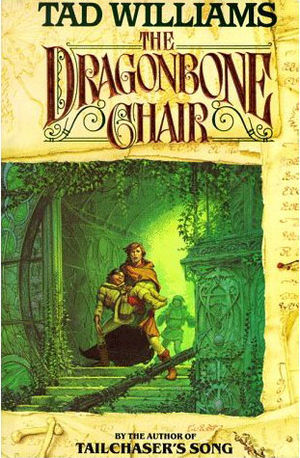
  • Epic Fantasy can be dark and serious but is always epic in scope. It usually explores the struggle against supernatural, evil forces. Epic fantasy shares some typical characteristics of high fantasy, and its readers also demand multi-volume narratives. Tad Williams’s Memory Sorrow and Thorn is a classic Epic Fantasy.
  • Paranormal Fantasy often focuses on romantic love. It includes elements beyond scientific explanation. Think ghosts, vampires, and the supernatural.
  • Urban Fantasy can be set in historical, modern, or futuristic periods, and the settings may include fictional elements. It must be primarily set in a city.
  • Romantasy contains all the elements of a classic fantasy story. However, the developing relationship between the two main characters is as central to the story as the primary quest. It must have a happy ending for the protagonists.

Every genre has a subgenre of horror. In Romance, the horror subgenre might be Gothic or Paranormal, but the focus must be on a developing romance. The roadblocks will not feature blood or gore, but terror and a perception of danger will be a feature the pair must overcome.

Romance—Novels of this type of genre fiction place their primary focus on the relationship and romantic love between two people and must have an emotionally satisfying and optimistic ending. The story will be character-driven, and the roadblocks must be believable but surmountable. There must be a happy ending for the couple, or it will not be received well by readers of Romance.

I mention Classic (Literary) Fiction last because it is the most complicated and least understood genre of all. These works are considered difficult to read because the style of the prose uses a wide range of vocabulary and may be experimental. This requires the reader to go over certain passages more than once, which many readers dislike doing. However, these books can be satisfying as they present ideas that require the reader to think beyond their usual bounds. Stylistic writing, heavy use of allegory, and the deep exploration of themes and ideas are strongly represented in these novels.

Our final installment in this series will explore how to recognize and make use of the themes that emerge in our work. We will focus on the themes in our sample Romantasy, idea threads that will wind through the narrative, and subtly reinforce our characters’ stories.


Previous in this series:

Idea to story, part 1: novel, poetry, memoir, or short story? #writing | Life in the Realm of Fantasy

Idea to story part 2: thinking out loud #writing | Life in the Realm of Fantasy

Idea to story part 3: plotting out loud #writing | Life in the Realm of Fantasy

Idea to story part 4 – the roles of side characters #writing | Life in the Realm of Fantasy

Idea to story part 5 – plotting treason #writing | Life in the Realm of Fantasy

Idea to story part 6 – Plotting the End #writing | Life in the Realm of Fantasy

Idea to story part 7 – Building the world #writing | Life in the Realm of Fantasy

Idea to story part 8 – world-building and society #writing | Life in the Realm of Fantasy

Idea to story part 9 – technology and world-building #writing | Life in the Realm of Fantasy

Idea to Story part 10 – science and magic as world-building #writing | Life in the Realm of Fantasy

3 Comments

Filed under writing

#FineArtFriday: A closer look at “A Boating Party” by John Singer Sargent ca. 1889

RISDM 78-086

Artist: John Singer Sargent (1856–1925) 
Title: A Boating Party

Date: circa 1889

Dimensions: height: 88.3 cm (34.7 in) width: 91.4 cm (35.9 in)

Collection: Rhode Island School of Design Museum  

What I Love About this Painting:

This painting first appeared here in last autumn, and my mind keeps going back to it. This is one my favorite paintings by John Singer Sargent. He created this scene early in his career, but already his ability to show the many moods of water and the personalities of his characters is a strength.

Sargent painted portraits for commissions and was highly successful. However, he painted informal studies like today’s scene for himself, painting for sheer love of it. This scene seems like the perfect visual prompt for writers searching for inspiration.

We’re looking at a fine day toward the end of summer. The day is warm enough that light jackets are all that are needed. The trees along the riverbank have begun to turn, and some leaves have fallen. One thing that stands out to me is the way he shows the shrubbery along the bank. 

One thing I have always appreciated about John Singer Sargent’s subjects is the way he captures people in the act of doing something. The eye immediately goes to the lady in white who is carefully stepping from the riverbank and into a boat, aided by a man in the shadows on the bank. Her reflection on the still waters is masterfully done.

In the right foreground, a man lounges in another boat that is tied up at the pier, with his leg thrown over both the boat’s gunwale and the dock’s rail. Beside him, another lady sits on the pier. Judging from the way Sargent has positioned them, I feel they are a married couple, and they are in no hurry to go anywhere.

About the Artist, via Wikipedia:

[1] John Singer Sargent (January 12, 1856 – April 14, 1925) was an American expatriate artist, considered the “leading portrait painter of his generation” for his evocations of Edwardian-era luxury. He created roughly 900 oil paintings and more than 2,000 watercolors, as well as countless sketches and charcoal drawings. His oeuvre documents worldwide travel, from Venice to the Tyrol, Corfu, the Middle East, Montana, Maine, and Florida.

Born in Florence to American parents, he was trained in Paris before moving to London, living most of his life in Europe. He enjoyed international acclaim as a portrait painter. An early submission to the Paris Salon in the 1880s, his Portrait of Madame X, was intended to consolidate his position as a society painter in Paris, but instead resulted in scandal. During the next year following the scandal, Sargent departed for England where he continued a successful career as a portrait artist.

From the beginning, Sargent’s work is characterized by remarkable technical facility, particularly in his ability to draw with a brush, which in later years inspired admiration as well as criticism for a supposed superficiality. His commissioned works were consistent with the grand manner of portraiture, while his informal studies and landscape paintings displayed a familiarity with Impressionism. In later life Sargent expressed ambivalence about the restrictions of formal portrait work, and devoted much of his energy to mural painting and working en plein air. Art historians generally ignored artists who painted royalty and “society” – such as Sargent – until the late 20th century. [1]


Credits and Attributions:

IMAGE: Wikimedia Commons contributors, “File:John Singer Sargent – A Boating Party – 78.086 – Rhode Island School of Design Museum.jpg,” Wikimedia Commons, https://commons.wikimedia.org/w/index.php?title=File:John_Singer_Sargent_-_A_Boating_Party_-_78.086_-_Rhode_Island_School_of_Design_Museum.jpg&oldid=809452828 (accessed April 10, 2025).

[1]Wikipedia contributors, “John Singer Sargent,” Wikipedia, The Free Encyclopedia, https://en.wikipedia.org/w/index.php?title=John_Singer_Sargent&oldid=1283813769 (accessed April 11, 2025).

2 Comments

Filed under #FineArtFriday, writing

Idea to Story part 10 – science and magic as world-building #writing

I can’t deny my sincere love of all things sci-fi or fantasy. While I read in every genre, speculative fiction is my “comfort food.” I purchase both indie and traditionally published work and read them all.

Two months ago, we began our series, Idea to Story. The previous nine installments are listed below, but throughout the series, we have built our two main characters. Val, (Valentine), is a lady knight and captain of the Royal Guard. The initial enemy, Kai Voss, is the court sorcerer. Both are regents for the sickly, underage king. Most of the other characters are in place.

I must be honest—both sides of the publishing industry, indie and traditional, are guilty of publishing novels that aren’t well thought out. Thus, we are planning our novel so that we can avoid contradictions.

Inconsistencies in the science or magic system are usually only one aspect of haphazard plotting and world-building. When an author or publisher skimps on the revisions or ignores the beta reader’s concerns, they can be unaware of the contradictions built into the narrative. If they rush it to publication, the book fails the reader.

Magic must be treated the same way science is. It must be presented as a naturally occurring aspect of the world our characters inhabit.

  • Magic and the ability to wield it gives a character power.
  • Science and superior technology also give our characters power.

Power and how we confer it is the layer of world-building where writers of science and writers of magic must follow the same rules.

Science is not magic, and it should not feel to a reader as if it were. It is logical, rooted in the realm of both factual and researchable theoretical physics. Science is limited by the boundaries of human knowledge and our ability to build technology.

However, an author’s imaginative exploration of theoretical physics makes the possibilities boundless.

In my opinion, magic should be like science. It should follow certain natural laws and have limits. Magic is believable when the ways it can be used are restricted and most sorcerers are constrained by the laws of nature to mastering only one or two kinds.

But why restrict your beloved main character’s abilities? The obvious answer is to allow your character to grow, to give them a true character arc. No one has all the skills in real life, no matter how good they are at their job. Limits create tension, and tension keeps the reader reading. When too many people are given superior powers, you make things too easy.

I have read many sci-fi and fantasy novels featuring characters with empathic gifts.

  • In fantasy, it is portrayed as a form of magic.
  • In science fiction, it’s portrayed as a mysterious property of the quantum universe that some people can access.

If an empathic gift has entered your narrative, ask yourself these questions: what sort of empathic gift does your character have? Are they good at emotion reading, mind reading, healing, or foresight?

  • How common or rare is this gift?
  • How did they discover they had it?
  • What can they do with it?
  • What can they NOT do with it?
  • Is there formal training for gifts like theirs?
  • What happens to people who use their empathy to abuse others?
  • Has society made laws regulating how empaths are trained and controlled?

Are you writing a book that features magic? I have a few questions that you may want to consider:

  1. How do they learn to fully use their gifts? Apprenticeship? Trial and error? A formal school, ala Harry Potter?
  2. Are there some conditions under which the magic will not work? Is the damage magic can do as a weapon, or is the healing it can perform somehow limited?
  3. Does the mage or healer pay a physical/emotional price for using or abusing magic? Is the learning curve steep and sometimes lethal?

When you answer the above questions, you create the Science of Magic.

So, what about superpowers?

Superpowers are both science and something that may seem like magic, but they are not. Think Spiderman. His abilities are conferred on him by a scientific experiment that goes wrong.

Like science and magic, superpowers are believable when they are limited in what they can do.

If you haven’t considered the challenges your characters must overcome when wielding magic or weapons technology, now is a good time to do it.

  • How is their self-confidence affected by this inability?
  • Do the companions face learning curves, too?
  • How can they remedy this situation?

These limits are the roadblocks to success. Overcoming them offers opportunities for action and growth.

In the story we have been plotting for the last nine weeks, Kai is the court sorcerer. At their father’s behest, he was trained in the art of sorcery by his half-brother. Donovan is slick, always playing the long game. He made sure that Kai does not have full knowledge of the craft, although, at the outset, Kai is unaware of this treachery. When Donovan makes his move, Kai is utterly defeated and ends up in the dungeon.

Val springs him from the dungeon when she escapes, but then what? How can we resolve Kai’s knowledge gap and give him an edge his brother can’t detect? We need to find him another teacher or two.

Valentine’s grandmother is an herb woman blessed with some empathic abilities. She has knowledge Kai could benefit from. She also has friends who are practitioners of a way of magic that is considered beneath the formal school Donovan and Kai were trained in. If Kai can stop being a spoiled rich boy, he can learn what he needs to know.

Val has no magic but has knowledge of available military technology and ideas for how it can be used in unexpected ways. All she has to do is stop looking down her nose at Kai and work with him.

Her grandmother will resolve that situation with a sharp dose of reality for both our protagonists.

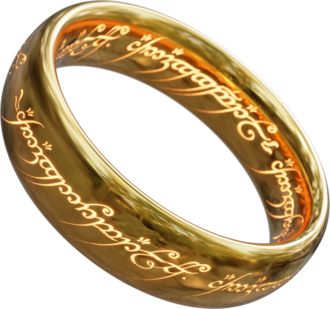
Excalibur London Film Museum via Wikipedia

The limits of their magic and technology force Kai and Val to be creative. If they are going to rescue the boy king from Donovan’s clutches, they need to use that creativity. Our characters must become more than they believe they are.

Whether your story is set in a medieval castle or a space station, limiting the personal power of the protagonist creates tension, raises the stakes, and makes the story more believable.

Next up – Genre, Themes, and the Expected Tropes of our story


Previous in this series:

Idea to story, part 1: novel, poetry, memoir, or short story? #writing | Life in the Realm of Fantasy

Idea to story part 2: thinking out loud #writing | Life in the Realm of Fantasy

Idea to story part 3: plotting out loud #writing | Life in the Realm of Fantasy

Idea to story part 4 – the roles of side characters #writing | Life in the Realm of Fantasy

Idea to story part 5 – plotting treason #writing | Life in the Realm of Fantasy

Idea to story part 6 – Plotting the End #writing | Life in the Realm of Fantasy

Idea to story part 7 – Building the world #writing | Life in the Realm of Fantasy

Idea to story part 8 – world-building and society #writing | Life in the Realm of Fantasy

Idea to story part 9 – technology and world-building #writing | Life in the Realm of Fantasy

2 Comments

Filed under writing

#FineArtFriday: Boys in a Dory by Winslow Homer 1873

Artist: Winslow Homer (1836–1910)

Title: Boys in a Dory

Date: 1873

Medium: Watercolor washes and gouache over graphite underdrawing on medium rough textured white wove paper

Dimensions: 9 3/4 x 13 7/8 in. (24.8 x 35.2 cm)

Collection: Metropolitan Museum of Art

Inscription: signed Homer 1873

What I love about this image:

Here we have four boys out for a summer’s day on the water. Are they brothers? They all wear similar long-sleeved lightweight cotton shirts and straw hats as protection against the sun.

The two youngest ride, while the older boys row. The water is calm, perfect for a sunny afternoon of freedom. Do they plan to fish or are they just out for the fun of it?

I especially like how Homer paints the water. He depicts the reflections perfectly, showing us how they mirror on the soft movement of the water’s surface. He shows us the sailing craft in the distance with minimal strokes, clearly showing the other boats heading out for a day’s fishing or pleasure boating.

About this painting via Wikipedia:

Boys in a Dory is one of Homer’s first watercolors. According to the Met’s description of the painting, the artist’s initial style of watercolors resulted in Boys being simple and direct.

The painting was rendered by Homer while he was in Gloucester, Massachusetts. [1]

About the dory, via Wikipedia:

The dory can be defined as a small boat which has:

  • a flat bottom, with the bottom planks fastened lengthwise (bow to stern).
  • a hull shape defined by the natural curve of a sawn plank (never steam-bent).
  • planks overlapping the stem at the front of the boat and an outer “false” stem covering the hood ends of the planks.
  • (with some exceptions) a fairly narrow transom often referred to as the “tombstone” due to its unique shape.

The hull’s bottom is transversely flat and usually bowed fore-and-aft. (This curvature is known as “rocker”.) The stern is frequently a raked narrow transom that tapers sharply toward the bottom forming a nearly double-ended boat. The traditional bottom is made from planks laid fore and aft and not transverse, although some hulls have a second set of planks laid over the first in a pattern that is crosswise to the main hull for additional wear and strength.

As the need for working dories diminished, the Swampscott or beach dory types were modified for pleasure sailing. These sailing dories became quite popular at the beginning of the 20th century around the town of Marblehead, Massachusetts. They were generally longer yet remained narrow with low freeboard and later were often decked over. Another common distinctive feature of the sailing dory was a long boom on the rig that angled up with a mainsail that was larger along the foot than the luff.  [2]

About the Artist via Wikipedia:

Winslow Homer (February 24, 1836 – September 29, 1910) was an American landscape painter and illustrator, best known for his marine subjects. He is considered one of the foremost painters of 19th-century America and a preeminent figure in American art in general.

Largely self-taught, Homer began his career working as a commercial illustrator. He subsequently took up oil painting and produced major studio works characterized by the weight and density he exploited from the medium. He also worked extensively in watercolor, creating a fluid and prolific oeuvre, primarily chronicling his working vacations. [3]


Credits and Attributions:

IMAGE: Boys in a Dory by Winslow Homer. Wikimedia Commons contributors, “File:Boys in a Dory MET DT5026.jpg,” Wikimedia Commons,  https://commons.wikimedia.org/w/index.php?title=File:Boys_in_a_Dory_MET_DT5026.jpg&oldid=928781177 (accessed April 3, 2025).

[1] Wikipedia contributors, “Boys in a Dory,” Wikipedia, The Free Encyclopedia, https://en.wikipedia.org/w/index.php?title=Boys_in_a_Dory&oldid=1249874568 (accessed April 3, 2025).

[2] Wikipedia contributors, “Dory (boat),” Wikipedia, The Free Encyclopedia, https://en.wikipedia.org/w/index.php?title=Dory_(boat)&oldid=1281846716 (accessed April 3, 2025).

[3] Wikipedia contributors, “Winslow Homer,” Wikipedia, The Free Encyclopedia, https://en.wikipedia.org/w/index.php?title=Winslow_Homer&oldid=1277975900 (accessed April 3, 2025).

Comments Off on #FineArtFriday: Boys in a Dory by Winslow Homer 1873

Filed under #FineArtFriday, writing

Idea to story part 9 – technology and world-building #writing

Today, we’re going to look at how the available technology affects the believability of our narrative. Eight weeks ago, we began our series, Idea to Story. The previous installments are listed below, but over the course of the series, we have built our two main characters, Val (Valentine), a lady knight, and the initial enemy, Kai Voss, a court sorcerer. Both are regents for the sickly, underage king.

We also have our ultimate enemy, Donovan Dove, Kai’s half-brother, and most trusted advisor. The basic story arc has been plotted (an enemies-to-lovers romance), and we have a working title that speaks to the genre of romantasy (fantasy romance), Valentine’s Gambit. We may keep the title, or we might not.

When we began this journey, we allowed the characters to tell us the story as they saw it. They showed us snippets of their world, and we started placing the set dressing in each scene. Our characters’ place in society has been determined, so we have an idea of their preconceived notions and cherished prejudices.

At the outset, the characters and the plot leaned toward a pseudo-medieval type of society. A large segment of the fantasy genre is set in a pseudo-medieval era. The most common failure I see in this type of fantasy is the assumption that only minimal technology can exist in a medieval era.

Yes, sewers were often open trenches, but while much of the available tech was reserved for the upper classes, it did exist. One can only admire our ancestors. Their creations are the foundations of what we consider modern amenities.

So, let’s talk about the level of technology for your novel. No matter the genre or era you set it in, no matter the world, each occupation has a specific historically available technologyWhat tools are available to them?

  1. Hunter/Gatherers?
  2. Agricultural/farming?
  3. Greco-Roman metallurgy and technology?
  4. Medieval metallurgy and technology?
  5. Pre-industrial revolution or late Victorian?
  6. Modern day?
  7. Or do they have magic-based technology?
  8. How do we get around, and how do we transport goods? On foot, by horse & wagon, trains, or space shuttle?

Our sample story is set in a pseudo-medieval era, so what sort of technologies are available to Val, Kai, and young King Edward?

We must do the research.

Sanitation: In Europe, how was public sanitation handled during medieval times? We can go back to the Etruscans for this, circa fifth century BCE. In the better parts of town, folks had covered sewers. According to Wikipedia:

Sanitation in ancient Rome, acquired from the Etruscans, was very advanced compared to other ancient cities and provided water supply and sanitation services to residents of Rome. Although there were many sewers, public latrines, baths and other sanitation infrastructure, disease was still rampant. The baths are known to symbolize the “great hygiene of Rome”.

Around AD 100, direct connections of homes to sewers began, and the Romans completed most of the sewer system infrastructure. Sewers were laid throughout the city, serving the public and some private latrines, and also served as dumping grounds for homes not directly connected to a sewer. It was mostly the wealthy whose homes were connected to the sewers, through outlets that ran under an extension of the latrine. [1]

These modern amenities traveled with the aristocracy to all the lands conquered by Rome and remained available into the Middle Ages and the Renaissance.

What other amenities might our quarreling couple have? In the article,  Medieval Technology, Hanna Woody at Clemson University tells us that these (and many more) technologies we think of as modern appeared and were in use during medieval times. [2]

Thus, if the plot goes the way we planned, Val and Kai will have all the conveniences of a Tudor Castle, an herb woman’s forest cottage, and a mud hut. Valentine’s Gambit will be nothing if not classy.

If you are writing about a craft that you are unfamiliar with, DO THE RESEARCH. You will interpret your research and will either get it right or be way off the mark. Either way, it’s your story, but readers will point out where you got it wrong.

Are you writing science fiction?

TED Talks are a fantastic resource for information on current and cutting-edge technology.

ZDNet Innovation is an excellent source of existing tech and future tech that may become current in 25 years.

Tech Times is also a great source of ideas.

Nerds on Earth is a source of valuable information about swords and how they were used historically.

Digital Trends

If you are writing a contemporary novel, you need to know what interests the people in the many different layers of our society. Go to the magazine rack at your grocery store or the local Big Name Bookstore and peruse the many publications available to the reading public. You can find everything from mushroom hunting to culinary, survivalist, and organic gardening. If people are interested in it, there is a magazine for it. An incredible amount of information can be found in these publications.

If you seek information about how people farmed and worked in historical societies from post-Roman times through to the late Edwardian era, Lost Country Life by Dorothy Hartley is still available as a second-hand book and can be found on Amazon. This textbook was meticulously researched and illustrated by a historian who personally knew the people she wrote about.

Resources to bookmark in general:

www.Thesaurus.Com (What’s another word that means the same as this but isn’t repetitive?)

Oxford Dictionary (What does this word mean? Am I using it correctly?)

Wikipedia (The font of all knowledge. I did not know that.)

Looking things up on the internet can suck up an enormous amount of your writing time. Do yourself a favor and bookmark your resources, so all you have to do is click on a link to get the information you want. Then, you can quickly get back to writing.

Next week, we will look at science and magic and talk about how limitations offer opportunities for action.


PREVIOUS IN THIS SERIES:

Idea to story, part 1: novel, poetry, memoir, or short story? #writing | Life in the Realm of Fantasy

Idea to story part 2: thinking out loud #writing | Life in the Realm of Fantasy

Idea to story part 3: plotting out loud #writing | Life in the Realm of Fantasy

Idea to story part 4 – the roles of side characters #writing | Life in the Realm of Fantasy

Idea to story part 5 – plotting treason #writing | Life in the Realm of Fantasy

Idea to story part 6 – Plotting the End #writing | Life in the Realm of Fantasy

Idea to story part 7 – Building the world #writing | Life in the Realm of Fantasy

Idea to story part 8 – world-building and society #writing | Life in the Realm of Fantasy


Credits and Attributions

[1] Wikipedia contributors, “Sanitation in ancient Rome,” Wikipedia, The Free Encyclopedia, https://en.wikipedia.org/w/index.php?title=Sanitation_in_ancient_Rome&oldid=1277682552 (accessed March 28, 2025).

[2] CC0 (Creative Commons Zero) license. To the extent possible under law, Clemson University has waived all copyright and related or neighboring rights to Science Technology and Society a Student Led Exploration, except where otherwise noted. (Accessed March 28, 2025.)

4 Comments

Filed under writing

#FineArtFriday: Seal Rock by Albert Bierstadt

Artist: Albert Bierstadt (1830–1902)

Title: Seal Rock

Genre: marine art

Date: 1880s

Medium: oil on canvas

Dimensions:   height: 105 cm (41.3 in)

What I love about this painting:

It is a blustery day on the cold, wild sea. The sun briefly shines through, illuminating the rocks, glowing through a cresting wave. This is a masterful depiction of the scene, painted later in his life. It is dynamic and dramatic, conveying the power of the waves and the emotion of the scene.

Despite the efforts of the sea to wash them away, the rocks stand strong, offering a safe place for the seals.

As an avid watcher of nature shows, I love this painting.  Bierstadt captures these seals doing all the things seals do. They are fishing, lounging, and several pairs are apparently arguing.

Not unlike my family when we go out to lounge on a rock beside the sea.


About the Artist, via Wikipedia:

Albert Bierstadt (January 7, 1830 – February 18, 1902) was a German American painter best known for his lavish, sweeping landscapes of the American West. He joined several journeys of the Westward Expansion to paint the scenes. He was not the first artist to record the sites, but he was the foremost painter of them for the remainder of the 19th century.

Bierstadt was born in Prussia, but his family moved to the United States when he was one year old. He returned to study painting for several years in Düsseldorf. He became part of the second generation of the Hudson River School in New York, an informal group of like-minded painters who started painting along the Hudson River. Their style was based on carefully detailed paintings with romantic, almost glowing lighting, sometimes called luminism. Bierstadt was an important interpreter of the western landscape, and he is also grouped with the Rocky Mountain School. [1]


Credits and Attributions:

IMAGE: Seal Rock by Albert Bierstadt, Wikimedia Commons contributors, “File:Seal Rock by Albert Bierstadt, c. 1872-1887, oil on canvas – New Britain Museum of American Art – DSC09221.JPG,” Wikimedia Commons, https://commons.wikimedia.org/w/index.php?title=File:Seal_Rock_by_Albert_Bierstadt,_c._1872-1887,_oil_on_canvas_-_New_Britain_Museum_of_American_Art_-_DSC09221.JPG&oldid=975772252 (accessed March 27, 2025).

[1] Wikipedia contributors, “Albert Bierstadt,” Wikipedia, The Free Encyclopedia, https://en.wikipedia.org/w/index.php?title=Albert_Bierstadt&oldid=1277160716 (accessed March 27, 2025).

2 Comments

Filed under #FineArtFriday

Idea to story part 8 – world-building and society #writing

We have been plotting a novel for the last seven weeks in our series, Idea to Story. The previous installments are listed below, but at this point, we have our two main characters, Val (Valentine), a lady knight, and the enemy, Kai Voss, a court sorcerer. Both are regents for the sickly, underage king.

We also have our ultimate enemy, Donovan Dove, Kai’s half-brother and most trusted advisor. We have plotted our basic story arc (an enemies-to-lovers romance) and have a working title that speaks to the genre of romantasy (fantasy romance), Valentine’s Gambit.

We have allowed the characters to tell us the story, and we have begun building their world, placing the set dressing in each scene.

But we have more world-building to do. This is background info that will be hinted at in the narrative, shown in small ways rather than dumped. But this is crucial information for us, the author, as it tells us why our characters see things in a certain way and what their gut reactions will be.

A character’s place in their society affects the way they interact with each other and how they interact with people they meet. Whether they hold a position of privilege or grub the soil on an absentee lord’s estate, they will have assumptions to overcome. Social class is the window through which they view the world, the root of their gut reactions and judgments.

Val (Valentine) comes from a lower middle-class background, having worked her way up through the ranks of the Royal Guard. She was raised by her grandmother, a respected herb-woman and healer for their village. Gran gave Val the best education she could, teaching her to read and write and count coins, insisting she speak properly. “People don’t respect you when you use gutter-talk.”

The fact that she was educated in the basics and taught early in life to speak properly is why she was able to rise through the ranks to become Captain of the Royal Guard.

Val’s regional accent gives away the area she grew up in, and she speaks more like a member of the merchant class than a peasant. A soldier at heart, she dislikes court dinners but attends them because she is one of Edward’s guardians.

Let’s just say that Val has a lot to learn about her assumptions.

Kai is the sheltered heir to an earldom. He is highly educated but completely ignorant of many things that the majority of people in their society are familiar with. Our sorcerer is fully at home at court, the epitome of what a nobleman of his society should be. He will lose everything he has ever known, and like Val, his most cherished assumptions will be challenged entirely by the time we reach the midpoint of the story.

In most communities, a family’s social class determines their level of education and the neighborhood in which they grow up. Local dialect forms their casual speech habits and regional accents.

No one “has no accent,” although some will claim that. We all have an accent that reflects our roots.

We sound like the people in our hometown unless we make a conscious effort to erase our roots. If dialect is holding us back, we might retrain ourselves to sound more like what we perceive as the upper echelons of society, to make ourselves sound “posh.”

World-building requires us to ask questions of the story we are writing. I go somewhere quiet and consider the world my characters will inhabit. I have a list of points to consider when deciding where my characters fit in in their society. Here are a few of them:

First, who has the wealth?

  • Is there a noble class?
  • Is there a servant class?
  • Are those who enter religious orders a separate class?
  • Is there a large middle class?
  • Who makes up the most impoverished class?
  • Who has the power, men or women—or is it a society based on mutual respect?

Ethics and Values: What constitutes morality, and how do we treat each other? Is marriage required?

  • What is taboo? What is “simply not done” among that group?

In any village or town, someone is always in charge. There will be a government of some sort, an overall system of restraint and control. Think of it as a pyramid, a few at the top ruling over a broad base of citizens.

Something to consider if you are writing historical fiction or fantasy: In a medieval-type society, the accepted age for when a child becomes legally an adult will be much younger than we consider it today. When the majority of people die before the age of forty, adulthood comes at the same time as puberty. This includes kings and queens.

  • Regardless of their age, the ruling class might be unaware of how their decisions affect the lower classes.

Val is determined to raise young King Edward to understand even the lowest of his subjects and have compassion for them. At first, Kai doesn’t think sheltering him from the realities of peasant life is a problem, but by the end of the story, he will be Val’s strongest ally.

This is because Kai will see firsthand that war breaks up families. It takes the laborers out of the fields and puts them on the front lines, limiting food production.

He will understand that while this hurts everyone in one way or another, it destroys trade, harming the merchant class. The toils of war fall heaviest upon the peasant class, but the middle class pays society’s bills.

A common trope in fantasy is magic, which brings up the need to train magic-gifted people like Kai and Donovan. Will our sorcerers/mages rely on dumb luck and experimentation? Will they apprentice themselves to other sorcerers?

  • Or, as in the case of Harry Potter, are they graduates of a school of some sort?

Magic does come into Val and Kai’s story, so we will discuss how magic can make or break a fantasy before the end of this series.

The Church/Temple is the governing power in many real-world historical societies. Some religions shape how their followers view and interact with the world.

Religion does not come into Val and Kai’s story other than in a peripheral way, but it might in yours.

Some people are prone to excess when presented with the opportunity to become all-powerful. If you were unsure what your plot was before you got to this stage, now you might have a real villain, one presented to you by your society.

Donovan is our ultimate villain. He is highly educated and privileged but has been shaped by the way his society views his illegitimacy. Beneath the urbane exterior he presents to the world is a man who profoundly resents his father’s casual assumption that he is satisfied to be subordinate to Kai—just because his younger brother was born from the right mother.

We DO NOT want to turn him into a cartoon villain, but he needs to be very dark and complicated.

Next week, we will look at how to ensure that the available technology we write into the narrative fits the era in which we set the story as well as the genre we choose to write in.


PREVIOUS IN THIS SERIES:

Idea to story, part 1: novel, poetry, memoir, or short story? #writing | Life in the Realm of Fantasy

Idea to story part 2: thinking out loud #writing | Life in the Realm of Fantasy

Idea to story part 3: plotting out loud #writing | Life in the Realm of Fantasy

Idea to story part 4 – the roles of side characters #writing | Life in the Realm of Fantasy

Idea to story part 5 – plotting treason #writing | Life in the Realm of Fantasy

Idea to story part 6 – Plotting the End #writing | Life in the Realm of Fantasy

Idea to story part 7 – Building the world #writing | Life in the Realm of Fantasy

8 Comments

Filed under writing