#FineArtFriday: The Chess Game, by Sofonisba Anguissola ca. 1555

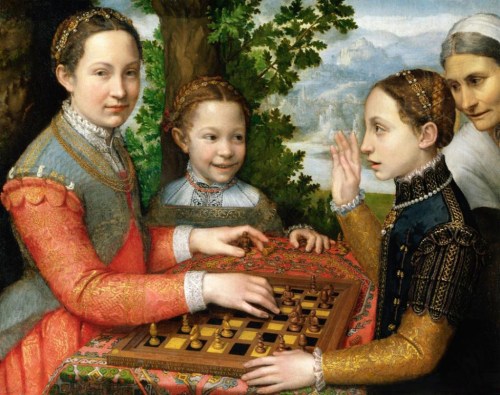
Title: The Chess Game (Portrait of the artist’s sisters playing chess)

Artist: Sofonisba Anguissola

Date: 1555

Medium: oil on canvas

Dimensions: Height: 72 cm (28.3 ″) Width: 97 cm (38.1 ″)


What I love about this painting:

The colors are vibrant,

Because it is a game of war and strategies for winning a war, chess has historically been considered a predominantly male game. That Anguissola’s sisters are playing it at so young an age is a testimony to the atmosphere of education surrounding the home.

Their features are modern in the way they are shown with a roundness that is unusual in early renaissance portraits, which were often so highly formal that they were visually flat. These girls could be my granddaughters.

Anguissola has captured the emotions and happiness of a family at play. Her sisters’ personalities are clearly shown. The older sister has taken a pawn, the younger fears she might lose the game to a more experienced player. The youngest is enjoying the game immensely, seeing the sister who sometimes bosses her around being handed her own medicine.

About the Artist, via Wikipedia:

Sofonisba Anguissola (c. 1532 – 16 November 1625), also known as Sophonisba Angussola or Anguisciola, was an Italian Renaissance painter born in Cremona to a relatively poor noble family. She received a well-rounded education, that included the fine arts, and her apprenticeship with local painters set a precedent for women to be accepted as students of art. As a young woman, Anguissola traveled to Rome where she was introduced to Michelangelo, who immediately recognized her talent, and to Milan, where she painted the Duke of Alba. The Spanish queen, Elizabeth of Valois, was a keen amateur painter and in 1559 Anguissola was recruited to go to Madrid as her tutor, with the rank of lady-in-waiting. She later became an official court painter to the king, Philip II, and adapted her style to the more formal requirements of official portraits for the Spanish court. After the queen’s death, Philip helped arrange an aristocratic marriage for her. She moved to Sicily, and later Pisa and Genoa, where she continued to practice as a leading portrait painter.

On 12 July 1624, Anguissola was visited by the young Flemish painter Anthony van Dyck, who recorded sketches from his visit to her in his sketchbook.[25] Van Dyck, who believed her to be 96 years of age (she was actually about 92) noted that although “her eyesight was weakened”, Anguissola was still mentally alert.[24] Excerpts of the advice she gave him about painting survive from this visit,[26] and he was said to have claimed that their conversation taught him more about the “true principles” of painting than anything else in his life.[1][2] Van Dyck drew her portrait while visiting her.

About this painting, via Wikipedia:

Although Anguissola enjoyed significantly more encouragement and support than the average woman of her day, her social class did not allow her to transcend the constraints of her sex. Without the possibility of studying anatomy or drawing from life (it was considered unacceptable for a lady to view nudes), she could not undertake the complex multi-figure compositions required for large-scale religious or history paintings.

Instead, she experimented with new styles of portraiture, setting subjects informally. Self-portraits and family members were her most frequent subjects, as seen in such paintings as Self-Portrait (1554, Kunsthistoriches Museum, Vienna), Portrait of Amilcare, Minerva and Asdrubale Anguissola (c. 1557–1558, Nivaagaards Malerisambling, Niva, Denmark), and her most famous picture, The Chess Game (1555, Muzeum Narodowe, Poznań), which depicted her sisters Lucia, Minerva and Europa.

Painted when Sofonisba was 23 years old, The Chess Game is an intimate representation of an everyday family scene, combining elaborate formal clothing with very informal facial expressions, which was unusual for Italian art at this time. The Chess Game explored a new kind of genre painting which places her sitters in a domestic setting instead of the formal or allegorical settings that were popular at the time.[17] This painting has been regarded as a conversation piece, which is an informal portrait of a group engaging in lively conversation or some activity .


Credits and Attributions:

Wikimedia Commons contributors, “File:The Chess Game – Sofonisba Anguissola.jpg,” Wikimedia Commons, the free media repository, https://commons.wikimedia.org/w/index.php?title=File:The_Chess_Game_-_Sofonisba_Anguissola.jpg&oldid=359367567 (accessed September 12, 2019).

Wikipedia contributors, “Sofonisba Anguissola,” Wikipedia, The Free Encyclopedia, https://en.wikipedia.org/w/index.php?title=Sofonisba_Anguissola&oldid=908120352 (accessed September 12, 2019).
Comments Off on #FineArtFriday: The Chess Game, by Sofonisba Anguissola ca. 1555

Filed under #FineArtFriday

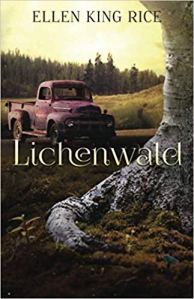
Lichenwald, by Ellen King Rice #amreading

I always enjoy reading novels set in the Pacific Northwest, the part of the world where I live. I especially enjoy it when the author understands how the forests here really work. I read in all genres, and the most recent book was Lichenwald, the third book in Ellen King Rice’s Mushroom Thriller series.

A former wildlife biologist, Ellen King Rice knows her stuff. Her books are terrific novels to while away a rainy day with.

BUT FIRST, the blurb:

Lichenwald is the newest “mushroom thriller” by Ellen King Rice. This science-based adventure delves into the vibrant diversity of the Pacific Northwest with a story of the power in lichens and their relationships.

At the edge of exhaustion, lichenologist Zinnie Fazail struggles to maintain a professional life as her mother descends into dementia. Ursula Fazail insists on wandering the neighborhood, looking for a vaguely remembered blue mushroom while lapsing into the language of her childhood.

Zinnie is desperate for a health aide who can keep up with her mother’s excursions. When May Belle Pope moves in with promises to “Take care of things,” Zinnie learns that Evil can be a roommate with small barking dogs.

As Ursula bonds with a blind Cocker Spaniel, Zinnie realizes May Belle will exploit any situation to her advantage. Zinnie has to act before hearts and bodies are broken, especially once May Belle has access to the home computer and family accounts.

How can Zinnie protect her mother and her home when what she knows are lichens?

Lichenwald includes illustrations of local lichens by Olympia artist Duncan Sheffels.

Part adventure, part science class, and totally fungi and lichen friendly, Lichenwald takes the reader into a place of friendships and intertwining ecosystems.

My review:

I found Zinnie Fazail an immediately relatable character. The story opens in the fictional Summit College where she works. While much of the focus is on mushrooms, lichens, and fungi, the cast of characters, their problems, and their relationships are the heart of the story.

Ellen King Rice’s understanding of human nature is spot on. Laurel’s youthful insecurity, Marvin and Allie’s wary father-daughter relationship, and Zinnie’s frustrations are real.

German-born Ursula’s slipping into dementia is poignant and is shown with truth and sensitivity. New to the neighborhood, Allie was raised in Germany. Her immediate attachment to the German grandmother is genuine and well portrayed.

Things get complicated when a woman with suspect credentials accepted into Zinnie’s home and agrees to care for Ursula. May Belle Pope is a frightening woman even at her most ingratiating.

May Belle’s criminal sense of entitlement is boundless, and her casually callous behavior evokes real anger in the reader. The twists and turns of her nefarious plans are  both real and frightening. I kept thinking “This could happen to any family, even mine.”

The illustrations are really well done and informative. I enjoyed Lichenwald and found myself thinking about the events and the characters long after I finished it.

Each book in Ellen King Rice’s Mushroom Thriller series is a standalone novel featuring a different cast of characters, so you can start with any book and not be confused.

Comments Off on Lichenwald, by Ellen King Rice #amreading

Filed under writing

Schadenfreude and Humor #amwriting

September is conference month for me. I just finished attending the Southwest Washington Writers’ Conference in Centralia, Washington. On Thursday the 12th of September, I will be in Seattle for four days at the Pacific Northwest Writers’ Association Conference.

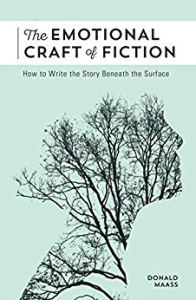
I will be attending a masters’ class offered by Donald Maass, on exploring depth with The Emotional Craft of Fiction.

Writers’ conferences are great ways to connect with agents and publishers, but they are also excellent ways to connect with other writers. A good conference offers the best education a new and beginning author can get.

This last Saturday, while in a seminar on injecting humor into the narrative, I reconnected with an old word that is making a resurgence in the English language: Schadenfreude (shah-den-froid-deh) This word from our Germanic roots describes the experience of happiness or self-satisfaction that comes from witnessing or hearing about another person’s troubles, failures, or humiliation.

I discovered this lovely (Deutsch) German word years ago while in college and had forgotten it. However, we are all familiar with it, as we experience it on a personal level quite often.

About schadenfreude, Via Wikipedia:

Schadenfreude is a complex emotion, where rather than feeling sympathy towards someone’s misfortune, schadenfreude evokes joyful feelings that take pleasure from watching someone fail. This emotion is displayed more in children than adults; however, adults also experience schadenfreude, though generally concealed.

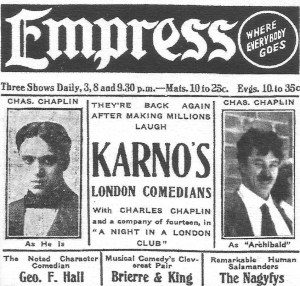
In other words, we know it’s an uncharitable emotion, and we don’t like it in others. But for many centuries, popular humor had an aspect of schadenfreude to it. Charlie Chaplin, The Three Stooges, and Jerry Lewis were all popular comedy acts of the 20th century who employed physical comedy that evoked a feeling of schadenfreude in the audience.

Since the ancient Greeks, Chinese, and Egyptians began writing plays, people have always enjoyed seeing other people’s missteps and pratfalls as long as the comedian recovers with a smile and “keeps on keepin’” on. Aristotle said that we are amused when we feel superior to others.

Dr. Adam Potthast, in his 2016 thesis on the Ethics of Slapstick Humor discussed how the recurring themes of clowns and idiots in popular slapstick comedy evoke a subtle feeling of superiority and also desensitizes us to violence. It makes bullying acceptable.

And, until recent years, dealing with bullying has been a common theme of childhood that teachers and parents, all former victims of bullying, weren’t equipped to deal with. According to Andy Luttrell in his post for Social Psych Online, psychologists believe we find something funny when it’s a “benign violation.” In other words, we are amused by things and incidents that violate the way we think things should work and which do so in a non-threatening manner.

In our current society, we don’t want to promote bullying or harassment as a positive thing in any form. But in the narrative, we do want to inspire that feeling of “payback” in the reader whenever roadblocks—instant karma—temporarily halt the Antagonist. If we can inject a little humor into a narrative, the reader feels an extra burst of endorphins and keeps turning the pages.

Exchanges of snarky dialogue (mocking irreverence and sarcasm) liven up regrouping scenes, transitions from one event to the next.

Humor and what is hilarious can vary widely from person to person. E. B. White wrote, “Humor can be dissected, as a frog can, but the thing dies in the process, and the innards are discouraging to any but the purely scientific mind.”

He was right. I can’t know what you find humorous, but I do know what makes me smile. I like snark and witty comments. I like things that surprise me, and which take a sudden detour from the expectations of normal.

Some of us have an earthy sense of humor, while others are more cerebral. For me, humor occurs when conventional rules are undercut or warped by incongruity. I have never liked slapstick as a visual comedy, but Horror authors often have it right: in the narrative, putting your characters through a little comedic disaster now and then can’t hurt.

When I was growing up, my family ran on “gallows humor” and still does, to a certain extent. We put the “fun” in dysfunctional.

That grim and ironic tendency to find humor in a desperate or hopeless situation is a fundamental human emotion.

This is why I often find myself writing gallows humor into my own work. We all need something to lighten up with now and then.

Adding a little humor can add both depth and pathos to the characters, humanizing them without your having to resort to an info dump. Each individual character’s sense of humor (or lack thereof) shows more of who they are and why the reader should care about them.

For many reasons, humor is an aspect of depth in the narrative that is impossible to fully define, but which adds a little fresh air at places where the story arc could otherwise stall.

Humor in literature occurs on an organic level, arising during the first draft before the critical mind has a chance to iron it out. Have you found yourself writing the occasional hilarity into your work? If not, why not? What holds you back from expressing this aspect of your personality in your work?

Comments Off on Schadenfreude and Humor #amwriting

Filed under writing

#FineArtFriday: Margaret Mill at Husum by Richard von Hagn

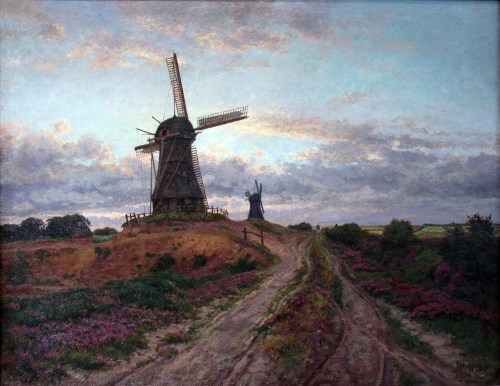
Margaret Mill at Husum by Richard von Hagn

What I like about this Painting:
The artist has captured the blustery feel of a fall or spring day—the sort of day where cold rain falls, interspersed with bright sunshine. His sky is perfect.

Artist: Richard von Hagn (1850–1933)
Title :English: Margaret mill Husum
Deutsch: Margaretenmühle vor Husum
Object type painting
Date: 1930
Medium: oil on canvas
Collection: NordseeMuseum Husum

About the Artist via de.Wikipedia (translated page):
“In his old age the following confession was not always easy for him, but he also showed his affection for a new topic in the spirit of the new German nationalism and the passing away of romanticism : “Yes, in my youth it always had to be Venice. Only much later did we realize that our homeland is just as beautiful, and actually much nicer for us. ” [6]


Credits and Attributions:

Wikimedia Commons contributors, “File:1930 Hagn Margaretenmühle vor Husum anagoria.JPG,” Wikimedia Commons, the free media repository, https://commons.wikimedia.org/w/index.php?title=File:1930_Hagn_Margaretenm%C3%BChle_vor_Husum_anagoria.JPG&oldid=351391992 (accessed September 6, 2019).
Page “Richard von Hagn”. In: Wikipedia, The Free Encyclopedia. Processing status: May 10, 2019, 04:04 UTC. URL: https://en.wikipedia.org/w/index.php?title=Richard_von_Hagn&oldid=188410554 (accessed: September 6, 2019, 12:46 UTC)

Comments Off on #FineArtFriday: Margaret Mill at Husum by Richard von Hagn

Filed under #FineArtFriday

Three Book Reviews—what I read this Summer #amreading

Here in the northern hemisphere, summer is winding down. The fall quarter of school begins today, and pumpkin spice lattes are suddenly available everywhere. During the summer I read several books that I would like to share with you.

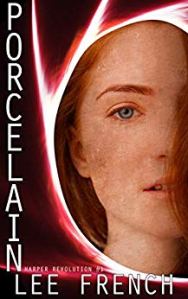
First off, I chain-read the first two books in the sci-fi Harper Revolution series by Lee French.

Publisher: Clockwork Dragon

Publication Date: June 26, 2018

The series opens with the book Porcelain. Eighteen-year-old Emma Harper is struggling. Her beloved older brother joined the Marines and has been declared missing in action. To please her emotionally distant father, she is slated to attend a college she doesn’t want, to follow in his footsteps in a field she has no affinity for—accounting. Emma is a math whiz and an inventor. She loves all things physics and science. She has a mechanical mind and can build anything. She reads and absorbs every new paper that is published in the field of physics. Unfortunately, since her brother’s disappearance, she has fallen in with a bad crowd, ‘friends’ who bully and torment her, a boyfriend who regularly forces himself on her. She has developed bulimia. She knows it’s not right but can’t seem to stop the cycle of binging and spending much of her time purging—hence the title of the book, Porcelain. One bad day, Emma is looking in a mirror when a portal opens, taking her to a mysterious living spaceship where she finds her brother and the soldiers who remain in his unit. Using the alien technology that had originally kidnapped them, her brother, Ethan, had been trying to return home but ended up transporting Emma to them. Her skills as an engineer become integral to their plan to return to Earth. This series continues with Crawlspace, which raises the stakes.

Emma is a compelling character with genuine real-world problems. I must admit—I can’t wait for the next book in this series.

***

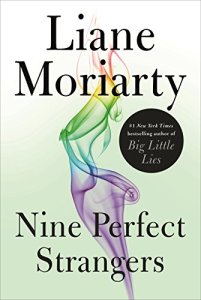
After this, I read Nine Perfect Strangers by Australian author, Liane Moriarty.

Publisher: Flatiron Books

Publication Date: November 6, 2018

The book details the experiences of nine people booked into an exclusive Australian health spa, and three members of the staff.

Moriarty introduces us to The Cast of Characters by opening with Yao and his experience as an EMT and introducing us to Masha as she suffers a heart attack.

The story picks up ten years later when nine people meet at an exceedingly remote health spa that promises to change their lives and completely transform them in ten days. The recommendations by their friends and the reviews they have read are glowing, but none explain how the transformation will be accomplished.

Each guest arrives with secrets and personal reasons for wanting to be remade into something better that what they believe they are. Masha is later revealed as the benevolent antagonist, and Yao has become her disciple.

Liane Moriarty’s characters are intensely compelling. At the outset, she establishes each as an individual and endows them with a mystery. Immediately the reader is hooked.

I hated setting the book down, wanting to know everyone’s dark secrets, curious as to what led each one to book themselves into that very unusual health spa. Structurally, it’s a bit jerky, and the ending is a series of short infodumps, but it works. By the time I reached the startling conclusion, I was looking forward to the informational epilogues just because I didn’t want to let the characters go.

***

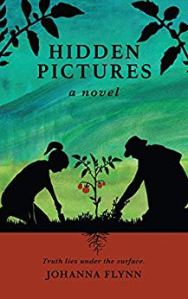
My final book of the summer, which I only just finished, was Hidden Pictures, a debut novel by Johanna Flynn.

Publisher: Palatine Press

Publication Date: August 27, 2019

This novel takes us into the shadowy places of the soul, laying bare the dark events and incidents that change our lives. The story gives you pause, exposing the moral issues we choose to ignore. Gordon Carlson is an engaging character. His strength and resilience are tested again and again, despite the bullying, as is Olivia’s.

While this book is set in the 1990s, it has a strong connection to present day issues. The cycle of abuse is explored, showing how sometimes victims become predators as a way of coping.

Themes of predatory sexual behavior and the myriad forms of violence, both mental and physical, that bullies often employ to keep control of their victims are dealt with in an open and respectful way. The wide spectrum of victim shaming is laid bare, deftly and with compassion. This is a touching story, one that stayed with me long after I finished reading it.

I highly recommend this book, and if you are looking for your next book club read, this is the book for you.

***

All in all, it was a great summer for reading as well as writing. I don’t have the chance to read as much as I used to, but I manage to fit a few books into my schedule. I have two more books on tap and will talk about them in the coming weeks. In the meantime, I highly recommend each of these books. Enjoy!

4 Comments

Filed under Book Reviews

Structure of the Word-Pond #amwriting

Today we’re winding down my summer blogpost series, The Word-Pond. We’ve explored the myriad aspects of ‘depth,’ the wide inferential layer of Story. Depth isn’t easy to categorize, nor can we point to one aspect and say, “Get this right, and you’ve got a story with depth.”

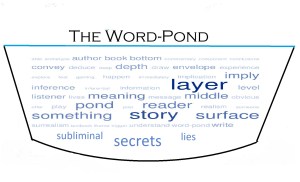
I’ve described Story as a pond filled with words and discussed the three layers:

Surface: The Literal Layer; the what-you-see-is-what-you-get layer. Characters live, and events happen. These are reflected in the surface of the story. The ways in which we play with the surface layer are by choosing either Realism or Surrealism, or a blend of the two.

Middle: The Inferential Layer, where Inference and Implication come into play. This is an area of unknown quantity filled with cause and effect: the reasons why these lives are portrayed, and why events happened. This is where emotions muddy the waters.

Bottom: The Interpretive Layer. This level is not only foundational; it contains and shapes the story:

  • Themes
  • Commentary
  • Messages
  • Symbolism
  • Archetypes

The words in this pond behave like the waters of a pond in nature. While close scrutiny reveals that the waters of a pond are separated into layers by temperature, salinity, microbial life, or by the sheer weight and pressure of the volume of water, the overall structure is one large, important thing: a hole filled with water.

Without water, a pond is a depression in the ground filled with possibilities only.

In our word pond, the one large thing containing our words is “story.” So now we want to form these layers into a coherent, meaningful story. We need a container for our words, the hole in the ground for the story to flow into.

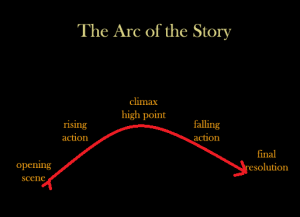
This container is the story arc.

Many people say they have a book in them, one they’d love to write. They begin, get a chapter or so into it, and lose the thread. They can’t see how to get the story from the beginning, to the crisis, to the resolution.

This is where the skills I’ve developed through my years of participating in National Novel Writing Month (NaNoWriMo) has paid off.  If you want to write a novel, it’s best to sit down and get that first draft out of you while the story is fresh in your mind. You’ll spend a year or more rewriting it, but if you don’t get the original ideas down while they’re fresh, you’ll lose them.

A story begins with an idea for a character. That character usually comes to me along with a problem. This is the seed from which the story grows.

I sit down and draft a story plan in four acts. First, I tell myself how I believe the story will go. This only takes half an hour and gives me finite plot points to write to. Once I have the four acts, I know where the turning points are, and what should happen at each. This ensures there is an arc to both the overall story and to the characters’ growth.

I’m going to use the original plot idea for a work in progress as my example. My WIP is a short story, 5000 words in length, but you can plot any length of story.

The story: Our Protagonist is a courier, transporting a valuable artifact. This artifact brings her to the attention of the Antagonist who intends to seize it, no matter the cost.

You must know what the surface of the Story looks like before you can explore the depths. A good way to discover what you are writing is to “think out loud.” Divide the story into four acts:

Act 1: the beginning: We show the setting, the protagonist, and the opening situation.

  1. Setting: a village near a crossroads.
  2. The weather is unseasonably cold.
  3. The protagonist is carrying a jewel reputed to enable a mage to control the weather.
  4. The protagonist must travel alone, as her partner was killed.
  5. Unbeknownst to her, a traitor in her employer’s court has designs on the artifact. By possessing it, the Antagonist will have the power to usurp the throne.
  6. She is wary, knowing the danger of traveling alone. She conceals the artifact by sewing it inside her shirt.

Act 2: First plot point: The inciting incident.

  1. The Antagonist’s hired thugs capture her.
  2. She is thrown into prison.
  3. A fellow prisoner has overheard that her partner was murdered to ensure she would be traveling alone.
  4. This fellow prisoner believes he has a plan to enable their escape.
  5. The protagonist isn’t sure she should trust him but refuses to let the artifact fall into the Antagonist’s hands.

Act 3.: Mid-point: We show their dire condition and how they deal with it.

  1. Seeing no other way, our Protagonist agrees to the Sidekick’s plan.
  2. He is on the verge of managing an escape but needs help with one last thing.
  3. By working together for several days, they manage to complete the escape route.
  4. Timing the rotation of their guards is critical to the success of their plan.
  5. Just as they are about to make their escape, the Antagonist makes a surprise visit to the dungeon and roughs up our Protagonist. He batters her physically and mentally, attempting to force her to tell him the whereabouts of the jewel, but she manages to keep her secret. When he leaves, her shirt is torn, but the jewel is still safe.

Act 4: Resolution:

  1. They must wait for another rotation of the guards, giving the Protagonist a chance to rest. She is injured but can still do what she must.
  2. The two make their escape but find themselves emerging near the kennels.
  3. The Sidekick gives the watchdogs the food he had saved for their journey, distracting the dogs and allowing them to escape over the walls.
  4. The Protagonist and the Sidekick manage to keep ahead of their pursuers and arrive back at court, where she delivers the artifact and reveals the identity of the traitor.
  5. The Employer is grateful, and the Protagonist and her Sidekick are all set for another adventure—perhaps a novel.

You have an idea for a story. Take a moment to analyze and plan what needs to be said by what point in the story arc. This method works for me because I’m a linear thinker.

If you know the length of a book or story you intend to write, you know how many words each act should be. Once you have the map, you can get to the nitty-gritty of turning that far-fetched tale of woe into a good story.

As you write each event and connect the dots, the plot will evolve and change. You begin to explore the deeper aspects of the story. Emotions, both expressed and unexpressed, secrets withheld, truths discovered—all these details that emerge as you write will shape how the characters react to each other. In turn, these interactions will alter the shape of the larger story.

This is why we never really know how a story will go, even if we begin with a plan. The plan serves to keep us on track with length and to ensure the action doesn’t stall.

Draft a short plan for a 50,000 word manuscript. 50,000 words is the industry standard for a novel. Write 1,667 words a day that connect those events together, and in thirty days you will have written a 50,000 word first draft of your novel.

To see more of what National Novel Writing Month is all about, go to: www.nanowrimo.org

I am dragon_fangirl there. Look me up and become a writing buddy!

3 Comments

Filed under writing

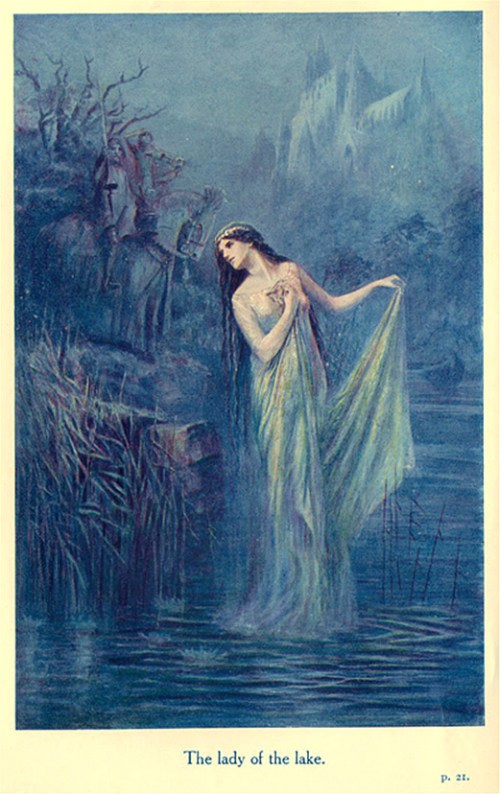
#FineArtFriday: The Lady of the Lake by Lancelot Speed 1912

Today’s image is that of The Lady of the Lake, Lancelot Speed‘s illustration for James Thomas Knowles’ The Legends of King Arthur and His Knights (1912), 9th edition. Ed. Sir James Knowles, K. C. V. O. London; New York: Frederick Warne and Co., Publication Date: 1912.

An area of art I intend to explore more thoroughly is that primary reason why I buy books: the illustrations.

The artwork that went into many books in the 19th and early 20th centuries was exquisite, created by masters. Yet, these illustrators remained unknown for the most part and unsung. Books are fragile things that don’t always stand the test of time. They become worn, and their contents become outdated. Younger readers see nothing of value in them and they go to rummage sales, or worse: recycling.

They are rarely passed on from one generation to the next.

Thanks to Wikimedia Commons and all the intrepid contributors who find and upload scanned images into that media repository, the works of many brilliant artists have not been lost. They will be there for us to admire, for as long as we are able to access the internet.

About the artist:

Lancelot Speed (13 June 1860 – 31 December 1931) was a British illustrator of books in the Victorian era, usually showing fantasy or romantic subjects. He is best-known for his illustrations for Andrew Lang‘s fairy story books. Speed is credited as the designer on the 1916 silent movie version of the novel She by H. Rider Haggard, which he had illustrated.

In 1912, he provided twenty illustrations, both color and black-and-white, for a new edition of Sir James Thomas Knowles’s The Story of King Arthur and His Knights of the Round Table.

Lancelot Speed was also the director of a number of early British silent films. Born into an exceedingly wealthy family, Speed died in 1931, leaving less than £300.

About the Image:

Artist: Lancelot Speed (1860-1931)

Title: The Lady of the Lake

Description: scan of illustration at title page in a book, The Legends of King Arthur and His Knights, 1912., 9th edition. Ed. Sir James Knowles, K. C. V. O. London; New York: Frederick Warne and Co., Publication Date: 1912.


Credits and Attributions:

Wikimedia Commons contributors, “File:The Lady of the Lake by Speed Lancelot.jpg,” Wikimedia Commons, the free media repository,  https://commons.wikimedia.org/w/index.php?title=File:The_Lady_of_the_Lake_by_Speed_Lancelot.jpg&oldid=328850056  (accessed August 29, 2019).

Wikipedia contributors, “Lancelot Speed,” Wikipedia, The Free Encyclopedia https://en.wikipedia.org/w/index.php?title=Lancelot_Speed&oldid=883335674  (accessed August 29, 2019).

2 Comments

Filed under #FineArtFriday

Transitions #amwriting

We love reading dramatic stories. However, in order for the events of the drama to be meaningful, we need to see it in context to understand what is going on. We need just enough artfully inserted exposition to show us what is really going on.

Within the narrative, moments of transition are critical, yet they are often done clumsily. These linking scenes can be too long, conveying far too much unneeded information. Conversely, they can be nearly omitted.

Neither of  those well-meaning faux pas serves the story.

Good transitions establish many things. The opening paragraphs are a critical transition. They show us

  • the general location (Alternate world, London, Seattle, a space station, etc.)
  • the setting (the immediate environment),
  • the era (past, present, future) in which the narrative takes place.

These first paragraphs are the doors through which the reader takes the first tentative steps from their real world and enters our invented world.

When a reader opens the book, they are a visitor, but they’re searching for something, questing for a good story. They hope you have supplied whatever it is they are looking for in the pages of that book.

Good opening paragraphs sink the hook and suck your reader into your world.

As the narrative moves beyond the opening scene, more transitions come along. These are the places where we must end one dramatic scene and open another—and do it gracefully. Sometimes it’s a moment where we must show the passage of time between events. Whatever the case, with each transition, we want the reader to remain engaged.

Transitions are more doors for the reader, portals that open at the end of the dramatic scene. By moving through them, we arrive at the next event.

Transitions are critical. Without good transitions, dramatic scenes have no context. Instead of progressing in an arc, the narrative leaps and falls along to a conclusion that may make no sense.

But transitions can be fraught with danger for me as a writer because this is where the necessary information, the exposition, is offered to the reader. This is the “how much is too much” moment.

In my first draft, the narrative is sometimes almost entirely exposition. This is because I am telling myself the story, trying to get the events down before I forget them.

In the second draft, I look at words like “went.” In my personal writing habits, “went” is a code word for the transition. In fact, all passive phrasing is code for the author. It is the code laid down in the first draft that indicates to the author that the characters are in the process of transition. They, or their circumstances, are undergoing a change. Is this change something the reader must know?

For example, when I see the word “went,” I immediately know someone goes somewhere.

I ask myself, “How did they go?” Went can be changed to

  • they walked (to the next room, or down the street, or to Mordor.)
  • they drove (a car, a wagon, a space ship.)
  • they rode (a horse, donkey, motorcycle, or dragon.)
  • they took a plane (bus, ferry, space shuttle, or sleeping pill.)
  • they teleported (vanished into the ether)

You get the idea. I have to find the “telling” paragraphs that connect my dramatic scenes together and decide what will stay and what should be cut. If the necessary information requires a paragraph, I have to consider how to rewrite it so that it is interesting and not a mind-numbing wall of words.

Many times, a transition can be cut to only a sentence or two because the necessary information it imparts can be consolidated.

This is where being a part of a writing group is most beneficial. Within the writing group, you will find a person you can bounce ideas off, someone you can trust and who will say, “This is not needed as it doesn’t advance the story” or “this scene seems to come out of nowhere. It needs more foreshadowing.”

Consolidating the transition into a sentence or two is optimal but isn’t always possible.

If it takes more than a paragraph to make the transition, I must be vigilant in my revision, and if I must give information, I must find and change all the passive code words to active prose. To that end, I look for these codes:

  • All forms of To be (see my post on subjunctives)
  • basically
  • Too many emdashes
  • Exclamation points (usually not needed)
  • Finally
  • I think
  • -ing
  • Its / it’s
  • –ize –ization (global search)
  • just
  • Like
  • -ly (global search)
  • now
  • Okay
  • Only
  • Really
  • Said (decide if speech tags can be eliminated and shown by actions)
  • Seem
  • Still
  • Suddenly
  • That (often not needed)
  • The
  • Then (often not needed)
  • There was (a subjunctive)
  • –tion (global search)
  • Very (usually not needed)
  • Which (not a substitute for ‘that’)

We know that each scene can be a chapter, or a chapter can consist of several scenes. In this regard, each author constructs the layout of the story the way they feel works best. The reader gets into the swing of it and rarely notices the overall structure. Whether a chapter or a series of scenes, dramatic passages have universal commonalities:

  • All scenes have an arc to them: rising action, climax, reaction.
  • These arcs of action and reaction begin at transition point A and end at transition point B.
  • Each scene will end at a slightly higher point of the overall story arc.
  • Each scene must blend so smoothly to the one that follows that the reader doesn’t notice the transition.
  • Pacing is the rise and fall of the action, drama and transition, the ebb and flow of conversations.

Conversations make great transitions. Inserting the necessary information into conversations and then fading to black and beginning a new chapter/scene can be the key to making the transition unobtrusively.

When we rewrite something, we are making revisions. Think about that word, revision.

re vision = to envision again.

Transitions are small connections that are woven into the larger narrative. When we begin revising them, we are looking at small passages of our work with new eyes and seeing how they might be changed to better fit the story—usually condensed, but sometimes expanded.

On the surface, it’s a daunting task, but it’s one of the most important parts of the writing process.


Credits and Attributions

Tavern of the Crescent Moon by Jan Miense Molenaer [Public domain or Public domain], via Wikimedia Commons

Wikimedia Commons contributors, “File:Jan Miense Molenaer 003.jpg,” Wikimedia Commons, the free media repository, https://commons.wikimedia.org/w/index.php?title=File:Jan_Miense_Molenaer_003.jpg&oldid=302686494 (accessed November 9, 2018

Wikimedia Commons contributors, “File:David Teniers de Jonge – Peasant Wedding (1650).jpg,” Wikimedia Commons, the free media repository, https://commons.wikimedia.org/w/index.php?title=File:David_Teniers_de_Jonge_-_Peasant_Wedding_(1650).jpg&oldid=225700063 (accessed November 2, 2018).

Autumn on Greenwood Lake, ca. 1861, by Jasper Francis Cropsey [Public domain], via Wikimedia Commons


Comments Off on Transitions #amwriting

Filed under writing

The Inferential Layer: Drama #amwriting

Whether you are writing a screenplay, a short story, or a novel, you are writing something that you hope will resonate with the reader and move them. A lesson that screenwriters learn early on is that each scene must be viewed as a mini-story; a complete story within the larger story. They learn this early because they don’t have the luxury of space that we who write novels have. The entire story of a screenplay must be told within a finite framework of time, so the writer must wring the most emotional impact out of the least amount of words.

I’m still working on this, myself. But I’m getting there.

So, where do we start? We begin with the most fundamental reason people purchase books or go to plays and movies—drama. The inferential layer of the Word-Pond we call Story is all about the drama, and I’m not talking over-the-top hysterics here. We combine emotional highs and lows with action and reaction in each passage to create dramatic scenes that leave a mark on the reader.

Of course, we understand large, emotionally charged, outwardly noisy dramatic scenes. They impact us and leave us reeling. But the only way those events have power is if they have context. They must be balanced by quieter, more introspective moments.

Drama can happen in the mildest of scenes, places where it looks as if nothing important is happening. The follow-up/regrouping scenes are places where you have the opportunity to waylay the reader with something unexpected. This is where you show the reader what is happening beneath the surface, the inner demons and fears the characters now face.

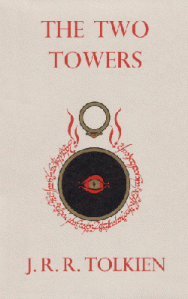
Consider  The Two Towers by J.R.R.Tolkien. Let’s look at the emotional impact of the scene that takes place in Shelob’s Lair. Frodo and Sam have survived incredible hardships and have made it to Cirith Ungol.  The passage is an excellent example of the dramatic story within a story that advances the overall plot.

Drama is the hope we feel in the moment when Frodo faces Shelob with the Phial of Light. Drama is the moment Frodo fails, the moment he is stung.

It is the shock, the horror, the moment where Sam reluctantly takes up Frodo’s sword, Sting.

It is triumph when Shelob impales herself on Sting, a weapon made of Mithril and a sword in the hands of a hobbit. But really, Sting is only a long-knife, and despite its mythic properties, it is not long enough to kill the giant arachnid, Shelob.

Still, she is wounded and scuttles away.

Drama is in the despair, the quiet moment afterward, where Samwise realizes that everything they have just endured was for nothing.

Drama is the moment of sharp introspection, the internal conversation when Sam fears his own weakness; the moment when his faith is not just shaken—it is lost. It is that moment of profound despondency in Shelob’s Lair, the dark night of the soul where Sam believes the spider has killed Frodo.

What about love? Few emotions have as much dramatic potential as that of love. It has many shades, from friendship to affection, to desire, to passion, to obsession, to jealousy, to hate.

Let’s look at the Pulitzer Prize winning short story, Brokeback Mountain, by Annie Proulx (synopsis via Wikipedia):

In 1963, two young men, Ennis del Mar and Jack Twist, are hired for the summer to look after sheep at a seasonal grazing range on the fictional Brokeback Mountain in Wyoming. Unexpectedly, they form an intense emotional and sexual attachment, but have to part ways at the end of the summer. Over the next twenty years, as their separate lives play out with marriages, children, and jobs, they continue reuniting for brief liaisons on camping trips in remote settings.

Ennis and Jack are tied to each other, but they love their wives and children. They are products of their society, and their personal reactions to the intensity of their relationship are both hurtful and understandable in the context of their time and situation. People have love affairs in books all the time, and we often find them forgettable. It is the complexity of external societal pressure and deep, confusing emotion that makes Ennis and Jack’s attachment memorable.

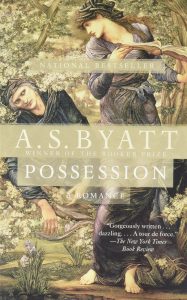
Then there is the novel, Possession, by A.S. Byatt, winner of the 1990 Booker prize. This is a complex relationship that begins in a rather boring manner – it opens in a library when Roland Michell, a scholar and professional man of high morals commits a crime: he steals the original drafts of letters he has come across in his research. This act has the potential of becoming his professional suicide. The synopsis via Wikipedia:

(Roland Mitchell) begins to investigate. The trail leads him to Christabel LaMotte, a minor poet and contemporary of Ash, and to Dr. Maud Bailey, an established modern LaMotte scholar and distant relative of LaMotte. Protective of LaMotte, Bailey is drawn into helping Michell with the unfolding mystery. The two scholars find more letters and evidence of a love affair between the poets (with evidence of a holiday together during which – they suspect – the relationship may have been consummated); they become obsessed with discovering the truth. At the same time, their own personal romantic lives – neither of which is satisfactory – develop, and they become entwined in an echo of Ash and LaMotte. The stories of the two couples are told in parallel, with Byatt providing letters and poetry by both of the fictional poets.

Love, whether unacknowledged or returned, physical or platonic, is complicated. The sections of movies, books, and short stories where the arc of the scene showcases true emotional complexity stick with me. I find myself contemplating them long after the story has ended.

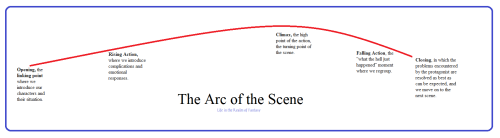
In all three literary examples, The Lord of the Rings, Brokeback Mountain, and Possession, it is the interpersonal relationships entwined with the action that illuminates the drama. Action scenes require some sort of emotion to give them context, to shape them into an arc:

  1. Opening, the linking point where we introduce our characters and their situation.
  2. Rising Action, where we introduce complications and emotional responses.
  3. Climax, the high point of the action, the turning point of the scene.
  4. Falling Action, the “what the hell just happened” moment where we regroup.
  5. Closing, in which the problems encountered by the protagonist are resolved as best as can be expected, and we move on to the next scene.

The resolution of one scene is the linking point to the next, the door that takes us further into the story. The dramatic arc of each scene ends at a higher point in the overall story arc.

The emotions surrounding the drama in our literature attracts us, captivates us, keeps us interested. In every story, drama is the moment you, the reader, realize you must take up the hero’s task; you must carry the evil One Ring to Mount Doom.

Drama done well can take the reader from joy to despair to resignation and back to hope within the arc of the scene. This is good pacing and urges the reader to keep turning the page to see what is coming next.


Credits and Attributions:

Wikipedia contributors, “Brokeback Mountain (short story),” Wikipedia, The Free Encyclopedia, https://en.wikipedia.org/w/index.php?title=Brokeback_Mountain_(short_story)&oldid=902058091 (accessed August 24, 2019).

Wikipedia contributors, “Possession (Byatt novel),” Wikipedia, The Free Encyclopedia, https://en.wikipedia.org/w/index.php?title=Possession_(Byatt_novel)&oldid=909067002 (accessed August 24, 2019).

The Two Towers, by J.R.R. Tolkien, first edition cover, Publisher George Allen & Unwin, © 11 November 1954, Fair Use.

Possession by A.S. Byatt, first edition cover, Publisher Chatto and Windus, © 1990, Fair Use.

Comments Off on The Inferential Layer: Drama #amwriting

Filed under writing

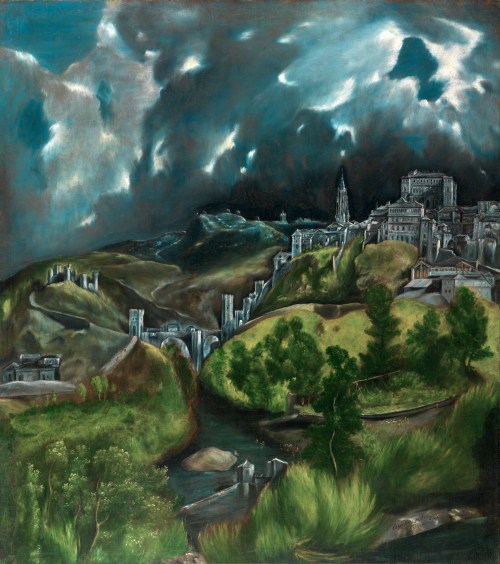
#FineArtFriday: View of Toledo by El Greco, ca. 1599


Title: View of Toledo

  • Artist: El Greco
  • Genre: landscape art
  • Date: between circa 1598 and circa 1599
  • Medium: oil on canvas
  • Dimensions: 47.7 × 42.7 ″ (121.2 × 108.5 cm)
  • Collection: Metropolitan Museum of Art

About this painting (via Wikipedia):

View of Toledo (c. 1596–1600, oil on canvas, 47.75 × 42.75 cm, Metropolitan Museum of Art, New York) is one of the two surviving landscapes of Toledo painted by El Greco.

View of Toledo is among the best known depictions of the sky in Western art, along with Vincent van Gogh‘s The Starry Night and the landscapes of J. M. W. Turner and Claude Monet, among others. Most notable is the distinct color contrast between the dark and somber skies above and the glowing green hills below. While influenced by the Mannerist style, El Greco’s expressive handling of color and form is without parallel in the history of art. In this painting, he takes liberties with the actual layout of Toledo insofar as certain building locations are re-arranged. However, the location of the Castle of San Servando, on the left, is accurately depicted. El Greco’s signature appears in the lower-right corner.

About the Artist, via Wikipedia

Doménikos Theotokópoulos (Greek: Δομήνικος Θεοτοκόπουλος [ðoˈminikos θeotoˈkopulos]; October 1541 – 7 April 1614), most widely known as El Greco(“The Greek”), was a Greek painter, sculptor and architect of the Spanish Renaissance. “El Greco” was a nickname, a reference to his Greek origin, and the artist normally signed his paintings with his full birth name in Greek letters, Δομήνικος Θεοτοκόπουλος, Doménikos Theotokópoulos, often adding the word Κρής KrēsCretan.

El Greco was born in the Kingdom of Candia, which was at that time part of the Republic of Venice, and the center of Post-Byzantine art. He trained and became a master within that tradition before traveling at age 26 to Venice, as other Greek artists had done. In 1570 he moved to Rome, where he opened a workshop and executed a series of works. During his stay in Italy, El Greco enriched his style with elements of Mannerism and of the Venetian Renaissance taken from a number of great artists of the time, notably Tintoretto. In 1577, he moved to Toledo, Spain, where he lived and worked until his death. In Toledo, El Greco received several major commissions and produced his best-known paintings.

El Greco’s dramatic and expressionistic style was met with puzzlement by his contemporaries but found appreciation in the 20th century. El Greco is regarded as a precursor of both Expressionism and Cubism, while his personality and works were a source of inspiration for poets and writers such as Rainer Maria Rilke and Nikos Kazantzakis. El Greco has been characterized by modern scholars as an artist so individual that he belongs to no conventional school. He is best known for tortuously elongated figures and often fantastic or phantasmagorical pigmentation, marrying Byzantine traditions with those of Western painting.


Credits and Attributions:

Wikipedia contributors, “El Greco,” Wikipedia, The Free Encyclopedia, https://en.wikipedia.org/w/index.php?title=El_Greco&oldid=911718617 (accessed August 23, 2019).

Wikipedia contributors, “View of Toledo,” Wikipedia, The Free Encyclopedia, https://en.wikipedia.org/w/index.php?title=View_of_Toledo&oldid=873435033 (accessed August 23, 2019).

2 Comments

Filed under writing