Tag Archives: 16th-century Netherlandish paintings

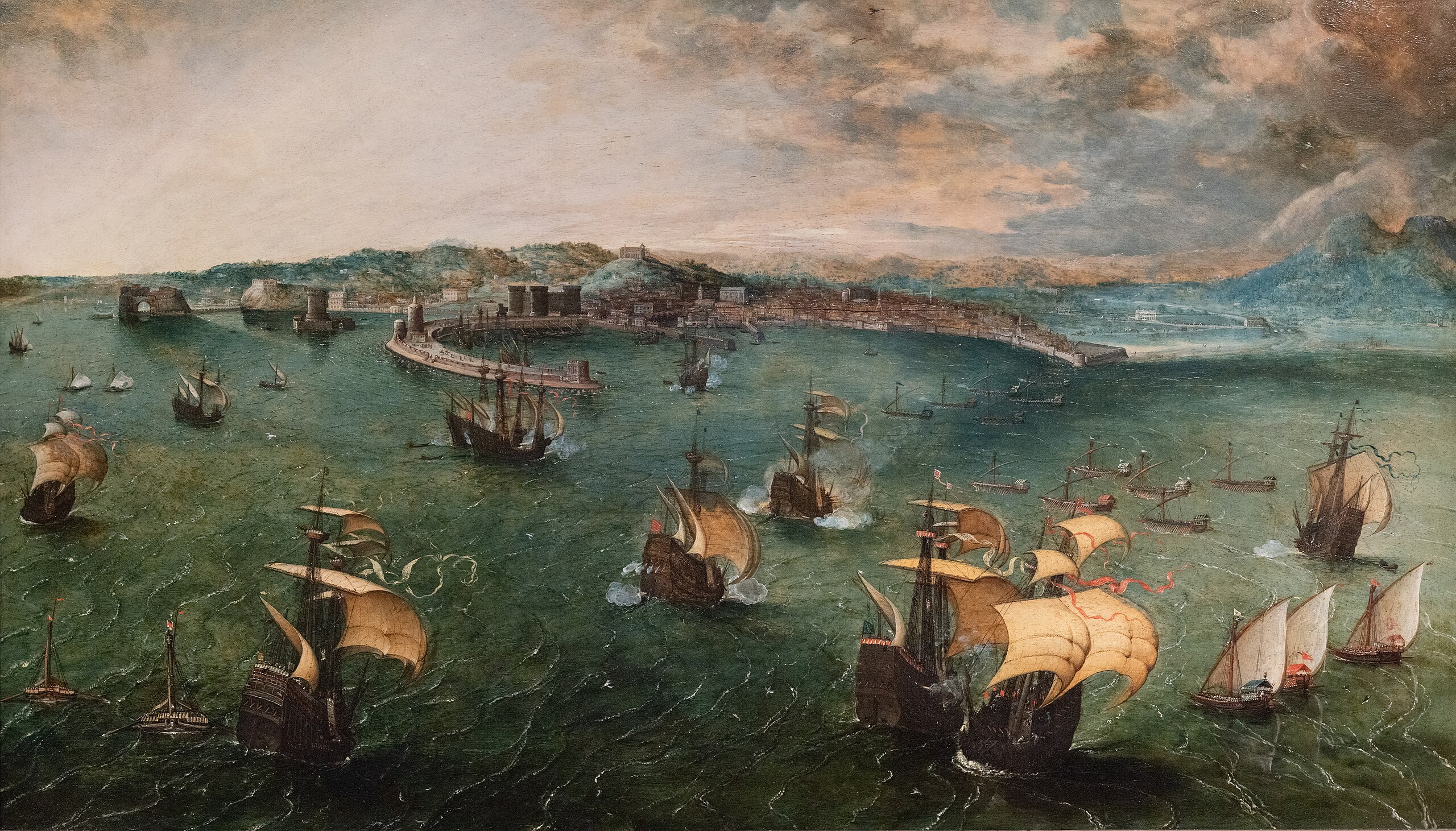
#FineArtFriday: Naval Battle in the Gulf of Naples by Pieter Bruegel the Elder ca. 1556 – 1558

Artist: Pieter Brueghel the Elder (1526/1530–1569)

Title: View of the Bay of Naples

Description: English: Bruegel — Naval Battle in the Gulf of Naples

Date: 1556 / circa 1558 / between 1550 and 1559

Medium: oil on panel

Dimensions: height: 42.2 cm (16.6 in)

Collection: Galleria Doria Pamphilj

What I love about this painting:

Bruegel shows us a stylized version of the Battle of the Gulf of Naples, which took place some three hundred year before the time of his painting. It was a historic victory for Roger of Lauria, who commanded the AragoneseSicilian fleet against the AngevinNeopolitan fleet, led by Prince Charles of Salerno.

Pieter Bruegel the Elder was famous for inserting subtle political and (sometimes snide) social commentaries into his paintings, and also for creating fantasy landscapes that he peopled with his contemporary peasants and tradesfolk. Many of his paintings that are set in his native Brabant feature mountains – and the Netherlands is a flat country, one that has no mountains.

In this painting he gives us a fantasy naval battle, featuring the sort of ships he was familiar with, and canon fire. Some ships are sinking, and others are closing in on them. He knew what ships looked like but had never actually seen a battle at sea.

About this painting, via Wikipedia:

Bruegel traveled to the Italian peninsula, with Abraham Ortelius, in 1551 and 1553. They stopped in Rome, Naples, and Messina. Many drawings were produced, including one depicting a naval confrontation in the Straits of Messina, which was turned into an engraving by Frans Huys. The veduta takes historical and topographical licenses: no such battle occurred in precisely this setting, nor does the harbor resemble Bruegel’s depiction. The exact date of the composition is disputed; scholars do agree, however, that the volcano and its positioning seem to reflect Bruegel’s neoplatonic pantheism.

In the foreground, a naval battle is perhaps taking place; it involves several vessels (sailing ships, galleys and smaller rowing boats), amidst puffs of smoke and barely legible trajectories of cannonballs, which make it difficult to unambiguously define the scene.

The background of the painting is the Gulf of Naples, with Mount Vesuvius visible at the right; it is depicted with a raised horizon, over half the painting, typical of the Flemish artists, which allows the view to have a particularly broad scope. Several monuments can be recognized: on the left, the remains of Castel del’Ovo, the Castel Nuovo, the lost Torre San Vincenzo and the semicircular piers. The last detail is an imaginative creation of the artist, since in the topographical maps of the time the port appears to be rectangular in shape: this “softening” perhaps derives from his wish to make the view more elegant and dynamic. [1]

ABOUT THE AUTHOR, via Wikipedia Commons:

Pieter Bruegel (also Brueghel or Breughelthe Elder, 1525–1530 to 9 September 1569) was among the most significant artists of Dutch and Flemish Renaissance painting, a painter and printmaker, known for his landscapes and peasant scenes (so-called genre painting); he was a pioneer in presenting both types of subject as large paintings.

Van Mander records that before he died he told his wife to burn some drawings, perhaps designs for prints, carrying inscriptions “which were too sharp or sarcastic … either out of remorse or for fear that she might come to harm or in some way be held responsible for them”, which has led to much speculation that they were politically or doctrinally provocative, in a climate of sharp tension in these areas. [2]]


Credits and Attributions:

IMAGE: Wikimedia Commons contributors, “File:Bruegel — Naval Battle in the Gulf of Naples.jpg,” WikimediaCommons, https://commons.wikimedia.org/w/index.php?title=File:Bruegel_%E2%80%94_Naval_Battle_in_the_Gulf_of_Naples.jpg&oldid=1037815605 (accessed July 9, 2025).

[1] Wikipedia contributors, “Naval Battle in the Gulf of Naples,” Wikipedia, The Free Encyclopedia, https://en.wikipedia.org/w/index.php?title=Naval_Battle_in_the_Gulf_of_Naples&oldid=1292197650 (accessed July 11, 2025).

[2] ABOUT THE AUTHOR: Wikipedia contributors, “Pieter Bruegel the Elder,” Wikipedia, The Free Encyclopedia, https://en.wikipedia.org/w/index.php?title=Pieter_Bruegel_the_Elder&oldid=1299614602 (accessed July 9, 2025).

Comments Off on #FineArtFriday: Naval Battle in the Gulf of Naples by Pieter Bruegel the Elder ca. 1556 – 1558

Filed under #FineArtFriday

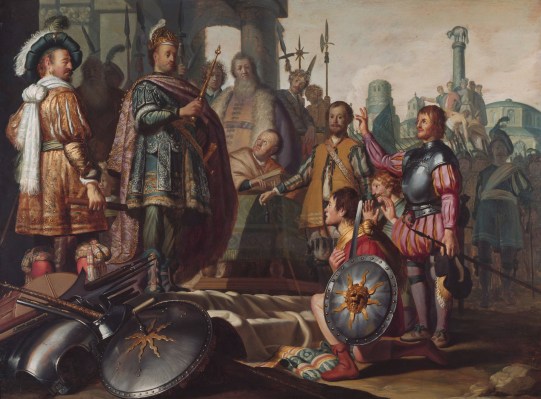
#FineArtFriday: a closer look at ‘History Painting, Titus (with self portrait)’ by Rembrandt Harmenszoon van Rijn 1626

History Painting, Titus (with self portrait of Rembrandt) by Rembrandt Harmenszoon van Rijn 1626

  • Artist: Rembrandt  (1606–1669) Rembrandt Harmenszoon van Rijn
  • Title: Historical Scene.
  • Inscriptions: Monogram and date bottom right: RH 16[2]6
  • Object type: painting
  • Genre: history painting
  • Depicted people: Titus
  • Date: 1626
  • Medium: oil on oak panel
  • Dimensions: Height: 89.8 cm (35.3 in); Width: 121 cm (47.6 in)
  • Collection:   Museum De Lakenhal

What I love about this Painting:

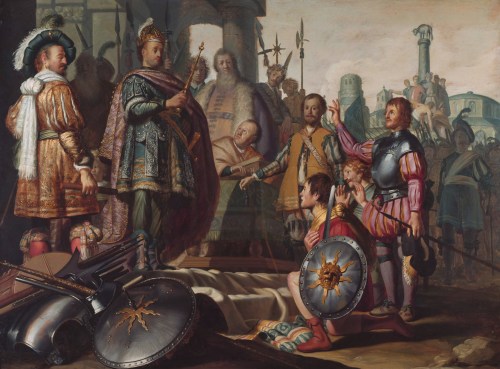
This is one of Rembrandt’s earliest history paintings. The young artist went all out to compose and execute this painting. I love the enthusiasm he had for this subject–he believed this painting would make his name as an artist.

Rembrandt scoured the city for props and found old armor and weapons. Then he dressed the players richly in the finest garments of his own day, so as to befit a beloved and respected emperor.

Wikipedia says: Rembrandt’s portraits of his contemporaries, self-portraits, and illustrations of scenes from the Bible are regarded as his greatest creative triumphs. His self-portraits form a unique and intimate biography, in which the artist surveyed himself without vanity and with the utmost sincerity.

The level of detail in the weaponry and richly worked garments is remarkable, as are the faces and features of each of the players. Emperor Titus is portrayed as slightly larger than life, noble, wise, and kind.

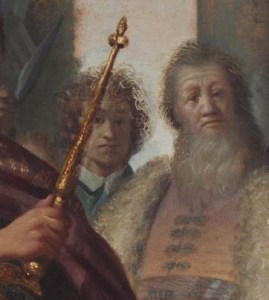
In the background, hidden by the scepter, we find Rembrandt himself, the witness who happened to come upon the scene and is looking on with wonder. Of the witnesses, he alone is shown dressed in the unadorned muted gray woolen clothing of a common man.

We know Rembrandt was well educated in history, and admired the Emperor Titus greatly, as he named his only surviving son after him.

About the Roman Emperor Titus, the Subject of this Painting (via Wikipedia):

Vespasian died of an infection on 23 June 79 AD, and was immediately succeeded by his son Titus. As Pharaoh of Egypt, Titus adopted the titulary Autokrator Titos Kaisaros Hununefer Benermerut (“Emperor Titus Caesar, the perfect and popular youth”). Because of his many (alleged) vices, many Romans feared that he would be another Nero. Against these expectations, however, Titus proved to be an effective Emperor and was well loved by the population, who praised him highly when they found that he possessed the greatest virtues instead of vices.

One of his first acts as Emperor was to order a halt to trials based on treason charges, which had long plagued the principate. The law of treason, or law of majestas, was originally intended to prosecute those who had corruptly “impaired the people and majesty of Rome” by any revolutionary action. Under Augustus, however, this custom had been revived and applied to cover slander and libel as well. This led to numerous trials and executions under TiberiusCaligula, and Nero, and the formation of networks of informers (Delators), which terrorized Rome’s political system for decades.

Titus put an end to this practice, against himself or anyone else, declaring:

“It is impossible for me to be insulted or abused in any way. For I do naught that deserves censure, and I care not for what is reported falsely. As for the emperors who are dead and gone, they will avenge themselves in case anyone does them a wrong, if in very truth they are demigods and possess any power.”

Consequently, no senators were put to death during his reign; he thus kept to his promise that he would assume the office of Pontifex Maximus “for the purpose of keeping his hands unstained.” The informants were publicly punished and banished from the city. Titus further prevented abuses by making it unlawful for a person to be tried under different laws for the same offense.  Finally, when Berenice returned to Rome, he sent her away.

As Emperor he became known for his generosity, and Suetonius states that upon realizing he had brought no benefit to anyone during a whole day, Titus remarked, “Friends, I have lost a day.” [1]


Credits and Attributions:

History Painting, Titus (with self portrait of Rembrandt) by Rembrandt Harmenszoon van Rijn 1626

[1] Wikipedia contributors, “Titus,” Wikipedia, The Free Encyclopedia, https://en.wikipedia.org/w/index.php?title=Titus&oldid=1275447925 (accessed February 28, 2025).

INSET IMAGE: Wikimedia Commons contributors, “File:Rembrandt Historical Painting 1626 (Detail, with self-portrait).jpg,” Wikimedia Commons, https://commons.wikimedia.org/w/index.php?title=File:Rembrandt_Historical_Painting_1626_(Detail,_with_self-portrait).jpg&oldid=694606337 (accessed February 28, 2025).

Comments Off on #FineArtFriday: a closer look at ‘History Painting, Titus (with self portrait)’ by Rembrandt Harmenszoon van Rijn 1626

Filed under #FineArtFriday

#FineArtFriday: The Peasant and the Nest Robber by Pieter Bruegel the Elder 1568

The_Peasant_and_the_Birdnester_Pieter_Bruegel_the_Elder_1568Artist: Pieter Brueghel the Elder (1526/1530–1569)

Title:  “The Peasant and the Nest Robber”

Date: 1568

Medium: oil on oak wood

Dimensions: 59.3 × 68.3 cm (23.3 × 26.8 in)

Collection: Kunsthistorisches Museum

What I love about this painting

Pieter Brugel the Elder was a man with a sharp eye for the humorous and the ability to wield allegory and symbolism like a knife. He cuts to the heart of things, pointing out the hubris and vanities of people from all walks of life.

Pieter Brugel the Elder was earthy and honest in his depictions of village life in his time. He painted what he saw and celebrated the ups and downs of the human condition. Today, his art is an important source of evidence about the social mores and values governing 16th-century life.

This painting details his favorite subject of human frailty, but he’s taken a different approach, narrowing his usual cast of thousands to just two.

In this case, he is pointing out that people are opportunists. We either have the knowledge and nerve to take what we need or the knowledge and sly desire to point out the failings of others.

Both men in this scene are taking the opportunity to advance themselves. One gains eggs and a good meal, and the other gains a sense of moral superiority.

Neither man feels guilty.

About this painting, via Wikipedia:

This unusual subject apparently illustrates a Netherlandish proverb:

Dije den nest Weet dijen weeten, dijen Roft dij heeten
He who knows where the nest is, has the knowledge, he who robs, has the nest.

The painting presents a moralising contrast between the active, wicked individual and the passive man who is virtuous in spite of adversity (a similar theme appears in his drawing The Beekeepers)] And lastly it could be suggested that the pointing man is making judgement on the robber whilst not aware that he is nearly stepping into the water in front of him.

It has been suggested that, with his knowledge of Italian art, Bruegel intended the peasant’s gesture as a profane parody of the gesture of Leonardo‘s St John. [1]

About the Artist, via Wikipedia:

Pieter Bruegel (also Brueghel or Breughelthe Elder c. 1525–1530 – 9 September 1569) was the most significant artist of Dutch and Flemish Renaissance painting, a painter and printmaker from Brabant, known for his landscapes and peasant scenes (so-called genre painting); he was a pioneer in making both types of subject the focus in large paintings.

He was a formative influence on Dutch Golden Age painting and later painting in general in his innovative choices of subject matter, as one of the first generation of artists to grow up when religious subjects had ceased to be the natural subject matter of painting. He also painted no portraits, the other mainstay of Netherlandish art. After his training and travels to Italy, he returned in 1555 to settle in Antwerp, where he worked mainly as a prolific designer of prints for the leading publisher of the day. Only towards the end of the decade did he switch to make painting his main medium, and all his famous paintings come from the following period of little more than a decade before his early death, when he was probably in his early forties, and at the height of his powers.

Around 1563, Bruegel moved from Antwerp to Brussels, where he married Mayken Coecke, the daughter of the painter Pieter Coecke van Aelst and Mayken Verhulst. As registered in the archives of the Cathedral of Antwerp, their deposition for marriage was registered 25 July 1563. The marriage itself was concluded in the Chapel Church, Brussels in 1563.

Pieter the Elder had two sons: Pieter Brueghel the Younger and Jan Brueghel the Elder (both kept their name as Brueghel). Their grandmother, Mayken Verhulst, trained the sons because “the Elder” died when both were very small children. The older brother, Pieter Brueghel copied his father’s style and compositions with competence and considerable commercial success. Jan was much more original, and very versatile. He was an important figure in the transition to the Baroque style in Flemish Baroque painting and Dutch Golden Age painting in a number of its genres. He was often a collaborator with other leading artists, including with Peter Paul Rubens on many works including the Allegory of Sight.

Other members of the family include Jan van Kessel the Elder (grandson of Jan Brueghel the Elder) and Jan van Kessel the Younger. Through David Teniers the Younger, son-in-law of Jan Brueghel the Elder, the family is also related to the whole Teniers family of painters and the Quellinus family of painters and sculptors, through the marriage of Jan-Erasmus Quellinus to Cornelia, daughter of David Teniers the Younger. [2]


Credits and Attributions:

[1] IMAGE and Quote about this picture: Wikipedia contributors, “The Peasant and the Nest Robber,” Wikipedia, The Free Encyclopedia, https://en.wikipedia.org/w/index.php?title=The_Peasant_and_the_Nest_Robber&oldid=1160869804 (accessed September 12, 2024).

[2] Wikipedia contributors, “Pieter Bruegel the Elder,” Wikipedia, The Free Encyclopedia, https://en.wikipedia.org/w/index.php?title=Pieter_Bruegel_the_Elder&oldid=1218696694 (accessed September 12, 2024).

2 Comments

Filed under #FineArtFriday

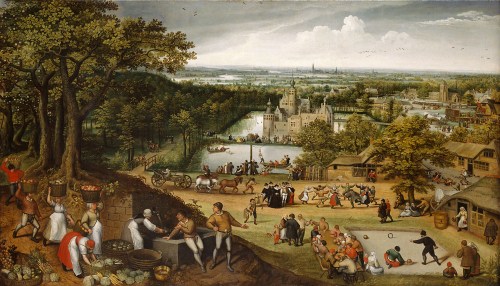
#FineArtFriday: Autumn Landscape (September) by Lucas van Valckenborch

GG_5684.tif

Artist: Lucas van Valckenborch  (1535–1597)

Title: Autumn Landscape (September)

Date: 1585

Medium: oil on canvas

Dimensions: 116 x 198 cm Rahmenmaße: 131,5 x 214 x 6,5 cm

Collection: Kunsthistorisches Museum

What I love about this painting:

We see an entire view of ordinary autumn life in the 16th century, but better than that, Lucas van Valckenborch shows us the passage of time. He depicts the chronology of how people lived and celebrated each week of the changing season by showing us September in the Netherlands.

The way he shows us this chronology is ingenious and is a signature of his work. The early weeks of September are shown in the left foreground, with laborers bringing in the harvest. Others are working to dry and preserve foods. The colors he uses are vivid, the last shades of summer.

In the bottom to middle right, he shows us mid-September with people relaxing, feasting, bowling, and dancing. The harvest is in, and people have a little time to enjoy the last days of good weather. The colors he uses are more muted, with shades of brown dominating. The leaves are brown and falling. Yet, there is a vibrancy about it, a sense of life. People celebrate a successful harvest one last time before winter’s cold grip closes in.

In late September, people fish, and the market becomes the center of village life. People are less active, but the market draws customers. The end of September presages colder weather and hints at the beginning of winter. This is shown in cool shades of gray, as if in a black-and-white photograph.

He is known for using this trick of color to denote receding distances. But he deliberately places figures performing specific activities within those colors, showing us how people lived and the passage of their days as well as distance.

The first days of September are bright, days of plenty. Yes, we’re working hard, but we’ll be grateful for the bounty when winter comes.

We look forward to the middle of September, because once the rush of harvest is over we will party like it’s 1585.

In the distance, we know the cold dark days loom, but we are prepared. Our cellars will be full and we will hunt and fish while we can.

Lucas van Valckenborch’s body of work shows us that he was a brilliant storyteller as well as an artist. Many paintings of that time show us the poverty, but here we see the prosperity of a village during the early renaissance. It wasn’t all doom and gloom after all.

About the Artist and his work, via Wikipedia:

Lucas van Valckenborch or Lucas van Valckenborch the Elder (c. 1535 in Leuven – 2 February 1597 in Frankfurt am Main) was a Flemish painter, mainly known for his landscapes. He also made contributions to portrait painting, and allegorical and market scenes. Court painter to Archduke Matthias, the governor of the Spanish Netherlands in Brussels, he later migrated to Austria and then Germany where he joined members of his extended family of artists who had moved there for religious reasons.

In their mixture of fantasy and accurate topographical details, van Valckenborch’s landscape paintings offer a view of the world and man’s relationship to it. This is particularly clear in his rocky landscapes in which the diminutive people on the winding path are reduced by the monumental cliffs. An example is the Rocky Landscape with Travelers on a Path (c. 1570, Sotheby’s 6 July 2016, London lot 3) where the distant goatherd and the silhouettes of his charges seem ant-like in comparison to the vast distance, and the vertiginous perspective of the scene. This dramatic visual depiction is clearly intended as a commentary on man’s place within the universe.

He also painted, between 1584 and 1587, a series of large pictures depicting the labours of the months, probably on commission for Archduke Matthias. These compositions, of which seven survive (five of which are in the Kunsthistorische Museum), present the various months of the year by showing the changing landscape and the traditional activities of humans during each month. It is not clear whether the five missing paintings were never painted or are lost.[4] Due to their realistic setting these compositions carry a documentary interest. The work of Pieter Bruegel the elder, who had painted a series of 6 on the times of the year, was influential on van Valckenborch. Lucas van Valckenborch moved away from the tradition of painting the landscape in three cascading distances that were rendered in three different colours: brown, green and blue for each receding plane. Rather he often left out the green tone for the middle distance. He also innovated the thematic scenes by developing them into genre scenes with a stronger narrative depth. [1]


Credits and Attributions:

[1] Wikipedia contributors, “Lucas van Valckenborch,” Wikipedia, The Free Encyclopedia, https://en.wikipedia.org/w/index.php?title=Lucas_van_Valckenborch&oldid=1173224796 (accessed September 14, 2023).

IMAGE: Autumn Landscape (September) by Lucas van Valckenborch. Wikimedia Commons contributors, “File:Lucas van Valckenborch – Autumn landscape (September).jpg,” Wikimedia Commons, https://commons.wikimedia.org/w/index.php?title=File:Lucas_van_Valckenborch_-_Autumn_landscape_(September).jpg&oldid=618977280 (accessed September 14, 2023).

3 Comments

Filed under #FineArtFriday

#FineArtFriday: The Hay Harvest by Pieter Bruegel the Elder, 1565 (reprise)

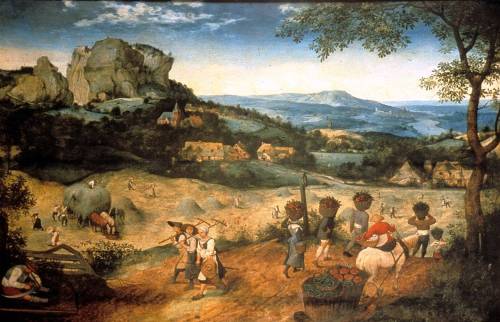
Haymaking,_Pieter_Brueghel_the_Elder (1)Artist: Pieter Bruegel the Elder (1526/1530–1569)
Title: The Hay Harvest

Genre: genre art

Date: 1565

Medium: oil on panel

Dimensions: Height: 117 cm (46 in) Width: 161 cm (63.3 in)

According to the Web Gallery of Art, Haymaking, also known as The Hay Harvest, belongs to the Series of the Months. All the other panels in this series are dated 1565. July and August are the months when most summer crops are harvested. This painting and the August panel (The Corn Harvest) show the bringing-in of the harvest.

I first featured this painting in August of 2021, but it is well worth a second look. Workers scythe grain in the large field toward the center of the painting. In the foreground, other laborers harvest vegetables and pick berries. Everyone works to bring in the food, men, women, and children, as winter isn’t that far away, and the hay will sustain the draft animals in the long cold months ahead.

While each painting in the series shows the traditional occupation of that month, Bruegel’s real subject is the landscape itself, its ever-changing appearance.

I have always loved Bruegel the Elder’s work because he portrays the gathering of food as a fundamental human activity. He shows us that the quantity of food we have on our tables is determined by the knowledge and labor of others.

The variety of foods we have available to us is dictated by the form of the landscape. To carve a living from the earth a farmer must understand and care for the land that sustains them. They must know what areas of soil will be best for each crop and use that knowledge when laying out how the fields will be planted, as each crop has different nutrient requirements.

Within one valley, many types of soils will exist, so what serves to grow hay may not work for more delicate vegetables.

In the lush bounty of this painting, Bruegel the Elder shows us the wisdom of farmers, knowledge that sustains us to this day. He illustrates the way all people who grow and gather our food are bound to the land.

Those who grow food in their back gardens understand and respect the labors of those small farmers who grow produce for our local markets.

About the series, Months of the Year, via Wikipedia:

(Bruegel’s) famous set of landscapes with genre figures depicting the seasons are the culmination of his landscape style; the five surviving paintings use the basic elements of the world landscape (only one lacks craggy mountains) but transform them into his own style. They are larger than most previous works, with a genre scene with several figures in the foreground, and the panoramic view seen past or through trees. Bruegel was also aware of the Danube School‘s landscape style through prints.

The series on the months of the year includes several of Bruegel’s best-known works. In 1565, a wealthy patron in Antwerp, Niclaes Jonghelinck, commissioned him to paint a series of paintings of each month of the year. There has been disagreement among art historians as to whether the series originally included six or twelve works. Today, only five of these paintings survive and some of the months are paired to form a general season. Traditional Flemish luxury books of hours (e.g., the Très Riches Heures du Duc de Berry; 1416) had calendar pages that included the Labours of the Months, depictions set in landscapes of the agricultural tasks, weather, and social life typical for that month.

Bruegel’s paintings were on a far larger scale than a typical calendar page painting, each one approximately three feet by five feet. For Bruegel, this was a large commission (the size of a commission was based on how large the painting was) and an important one. In 1565, the Calvinist riots began and it was only two years before the Eighty Years’ War broke out. Bruegel may have felt safer with a secular commission so as to not offend Calvinist or Catholic. Some of the most famous paintings from this series included The Hunters in the Snow (December–January) and The Harvesters (August). [1]

About the Artist, Via Wikipedia:

Pieter Bruegel (also Brueghel or Breughelthe Elder c. 1525–1530 – 9 September 1569) was the most significant artist of Dutch and Flemish Renaissance painting, a painter and printmaker, known for his landscapes and peasant scenes (so-called genre painting); he was a pioneer in making both types of subject the focus in large paintings.

He was a formative influence on Dutch Golden Age painting and later painting in general in his innovative choices of subject matter, as one of the first generation of artists to grow up when religious subjects had ceased to be the natural subject matter of painting. He also painted no portraits, the other mainstay of Netherlandish art. After his training and travels to Italy, he returned in 1555 to settle in Antwerp, where he worked mainly as a prolific designer of prints for the leading publisher of the day. Only towards the end of the decade did he switch to make painting his main medium, and all his famous paintings come from the following period of little more than a decade before his early death, when he was probably in his early forties, and at the height of his powers.

As well as looking forwards, his art reinvigorates medieval subjects such as marginal drolleries of ordinary life in illuminated manuscripts, and the calendar scenes of agricultural labours set in landscape backgrounds, and puts these on a much larger scale than before, and in the expensive medium of oil painting. He does the same with the fantastic and anarchic world developed in Renaissance prints and book illustrations.

He is sometimes referred to as “Peasant Bruegel”, to distinguish him from the many later painters in his family, including his son Pieter Brueghel the Younger (1564–1638). From 1559, he dropped the ‘h’ from his name and signed his paintings as Bruegel; his relatives continued to use “Brueghel” or “Breughel”. [2]


Credits and Attributions:

Wikimedia Commons contributors, “File:Haymaking, Pieter Brueghel the Elder.jpg,” Wikimedia Commons, the free media repository, https://commons.wikimedia.org/w/index.php?title=File:Haymaking,_Pieter_Brueghel_the_Elder.jpg&oldid=431869636 (accessed August 10, 2023).

[1] Wikipedia contributors, “Pieter Bruegel the Elder,” Wikipedia, The Free Encyclopedia, https://en.wikipedia.org/w/index.php?title=Pieter_Bruegel_the_Elder&oldid=1028859234 (accessed August 10, 2023).

[2] Wikipedia contributors, “Pieter Bruegel the Elder,” Wikipedia, The Free Encyclopedia, https://en.wikipedia.org/w/index.php?title=Pieter_Bruegel_the_Elder&oldid=1028859234 (accessed August 10, 2023).

1 Comment

Filed under #FineArtFriday

#FineArtFriday: History Painting, Titus (with self portrait) by Rembrandt Harmenszoon van Rijn 1626 (revisited)

History Painting, Titus (with self portrait of Rembrandt) by Rembrandt Harmenszoon van Rijn 1626

  • Artist: Rembrandt  (1606–1669) Rembrandt Harmenszoon van Rijn
  • Title: Historical Scene.
  • Inscriptions: Monogram and date bottom right: RH 16[2]6
  • Object type: painting
  • Genre: history painting
  • Depicted people: Titus
  • Date: 1626
  • Medium: oil on oak panel
  • Dimensions: Height: 89.8 cm (35.3 in); Width: 121 cm (47.6 in)
  • Collection:   Museum De Lakenhal

What I love about this Painting:

This is one of Rembrandt’s earliest history paintings. The young artist went all out to compose and execute this painting. He scoured the city for props, and found old armor and weapons. Then he dressed the players richly in the finest garments of his own day, so as to befit a beloved and respected emperor.

Wikipedia says: Rembrandt’s portraits of his contemporaries, self-portraits, and illustrations of scenes from the Bible are regarded as his greatest creative triumphs. His self-portraits form a unique and intimate biography, in which the artist surveyed himself without vanity and with the utmost sincerity.

The level of detail in the weaponry and richly worked garments is remarkable, as are the faces and features of each of the players. Emperor Titus is portrayed as slightly larger than life, noble, wise, and kind.

In the background, hidden by the scepter, we find Rembrandt himself, the witness who happened to come upon the scene and is looking on with wonder. Of the witnesses, he alone is shown dressed in the unadorned muted gray woolen clothing of a common man.

We know Rembrandt was well educated in history, and admired the Emperor Titus greatly, as he named his only surviving son after him.

About the Roman Emperor Titus, the Subject of this Painting (via Wikipedia):

Vespasian died of an infection on 23 June 79 AD, and was immediately succeeded by his son Titus. As Pharaoh of Egypt, Titus adopted the titulary Autokrator Titos Kaisaros Hununefer Benermerut (“Emperor Titus Caesar, the perfect and popular youth”). Because of his many (alleged) vices, many Romans feared that he would be another Nero. Against these expectations, however, Titus proved to be an effective Emperor and was well loved by the population, who praised him highly when they found that he possessed the greatest virtues instead of vices.

One of his first acts as Emperor was to order a halt to trials based on treason charges, which had long plagued the principate. The law of treason, or law of majestas, was originally intended to prosecute those who had corruptly “impaired the people and majesty of Rome” by any revolutionary action. Under Augustus, however, this custom had been revived and applied to cover slander and libel as well. This led to numerous trials and executions under TiberiusCaligula, and Nero, and the formation of networks of informers (Delators), which terrorized Rome’s political system for decades.

Titus put an end to this practice, against himself or anyone else, declaring:

“It is impossible for me to be insulted or abused in any way. For I do naught that deserves censure, and I care not for what is reported falsely. As for the emperors who are dead and gone, they will avenge themselves in case anyone does them a wrong, if in very truth they are demigods and possess any power.”

Consequently, no senators were put to death during his reign; he thus kept to his promise that he would assume the office of Pontifex Maximus “for the purpose of keeping his hands unstained.” The informants were publicly punished and banished from the city. Titus further prevented abuses by making it unlawful for a person to be tried under different laws for the same offense.  Finally, when Berenice returned to Rome, he sent her away.

As Emperor he became known for his generosity, and Suetonius states that upon realizing he had brought no benefit to anyone during a whole day, Titus remarked, “Friends, I have lost a day.”


Credits and Attributions:

History Painting, Titus (with self portrait of Rembrandt) by Rembrandt Harmenszoon van Rijn 1626

Wikipedia contributors, “Titus,” Wikipedia, The Free Encyclopedia,  https://en.wikipedia.org/w/index.php?title=Titus&oldid=950453618 (accessed April 24, 2020).

Wikimedia Commons contributors, “File:Rembrandt Historical Painting 1626 (Detail, with self-portrait).jpg,” Wikimedia Commons, the free media repository, https://commons.wikimedia.org/w/index.php?title=File:Rembrandt_Historical_Painting_1626_(Detail,_with_self-portrait).jpg&oldid=369318658 (accessed April 24, 2020).

Comments Off on #FineArtFriday: History Painting, Titus (with self portrait) by Rembrandt Harmenszoon van Rijn 1626 (revisited)

Filed under #FineArtFriday

#FineArtFriday: The Dutch Proverbs by Pieter Bruegel the Elder, revisited

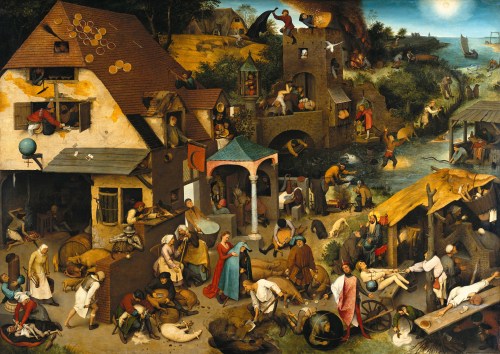
Pieter_Brueghel_the_Elder_-_The_Dutch_Proverbs_-_Google_Art_ProjectToday I’m revisiting one of the best allegorical paintings of all time, The Netherlandish Proverbs (also known as The Dutch Proverbs) by Pieter Brueghel the Elder, which was painted in 1559. A master at humor, allegory, and pointing out the follies of humanity, Brueghel the Elder is one of my favorite artists.

Artist: Pieter Bruegel the Elder
Year: 1559
Medium: Oil-on-panel
Dimensions: 117 cm × 163 cm (46 in × 64 in)
Location: Gemäldegalerie, Berlin

Quote from Wikipedia:

Critics have praised the composition for its ordered portrayal and integrated scene. There are approximately 112 identifiable proverbs and idioms in the scene, although Bruegel may have included others which cannot be determined because of the language change. Some of those incorporated in the painting are still in popular use, for instance “Swimming against the tide”, “Banging one’s head against a brick wall” and “Armed to the teeth”. Many more have faded from use, which makes analysis of the painting harder. “Having one’s roof tiled with tarts”, for example, which meant to have an abundance of everything and was an image Bruegel would later feature in his painting of the idyllic Land of Cockaigne (1567).

The Blue Cloak, the piece’s original title, features in the centre of the piece and is being placed on a man by his wife, indicating that she is cuckolding him. Other proverbs indicate human foolishness. A man fills in a pond after his calf has died. Just above the central figure of the blue-cloaked man another man carries daylight in a basket. Some of the figures seem to represent more than one figure of speech (whether this was Bruegel’s intention or not is unknown), such as the man shearing a sheep in the centre bottom left of the picture. He is sitting next to a man shearing a pig, so represents the expression “One shears sheep and one shears pigs”, meaning that one has the advantage over the other, but may also represent the advice “Shear them but don’t skin them”, meaning make the most of available assets.

You can find all of the wonderful proverbs on the painting’s page on Wikipedia, along with the thumbnail that depicts the proverb.

My favorite proverbs in this wonderful allegory?

Horse droppings are not figs. It meant we should not be fooled by appearances.

He who eats fire, craps sparks. It meant we shouldn’t be surprised at the outcome if we attempt a dangerous venture.

Now THAT is wisdom!


Credits and Attributions:

The Netherlandish Proverbs (Also known as The Dutch Proverbs) by Pieter Brueghel the Elder 1559 [Public domain], via Wikimedia Commons.

Wikipedia contributors, “Netherlandish Proverbs,” Wikipedia, The Free Encyclopedia, https://en.wikipedia.org/w/index.php?title=Netherlandish_Proverbs&oldid=829168138  (accessed November 24, 2022).

4 Comments

Filed under #FineArtFriday, writing

#FineArtFriday: The Hay Harvest by Pieter Bruegel the Elder, 1565

Haymaking,_Pieter_Brueghel_the_Elder (1)Artist: Pieter Bruegel the Elder (1526/1530–1569)

Title: The Hay Harvest

Genre: genre art

Date: 1565

Medium: oil on panel

Dimensions: Height: 117 cm (46 in) Width: 161 cm (63.3 in)

According to the Web Gallery of Art, Haymaking, also known as The Hay Harvest, belongs to the Series of the Months. All the other panels in this series are dated 1565. July and August are the months when most summer crops are harvested. This painting and the August panel (The Corn Harvest) show the bringing-in of the harvest.

Workers scythe grain in the large field toward the center of the painting. In the foreground, other laborers harvest vegetables and pick berries. Everyone works to bring in the food, men, women, and children, as winter isn’t that far away, and the hay will sustain the draft animals in the long cold months ahead.

While each painting in the series shows the traditional occupation of that month, Bruegel’s real subject is the landscape itself, its ever-changing appearance.

I have always loved Bruegel the Elder’s work because he portrays the gathering of food as a fundamental human activity. He shows us that the quantity of food we have on our tables is determined by the knowledge and labor of others.

The variety of foods we have available to us is dictated by the form of the landscape. To carve a living from the earth a farmer must understand and care for the land that sustains them. They must know what areas of soil will be best for each crop and use that knowledge when laying out how the fields will be planted, as each crop has different nutrient requirements. Within one valley, many types of soils will exist, so what serves to grow hay may not work for more delicate vegetables.

In the lush bounty of this painting, Bruegel the Elder shows us the wisdom of farmers, knowledge that sustains us to this day. He illustrates the way all people who grow and gather our food are bound to the land.

In this regard, we who grow food in our back gardens understand and respect the labors of those small farmers who grow produce for our local markets.

About the series, Months of the Year, via Wikipedia:

(Bruegel’s) famous set of landscapes with genre figures depicting the seasons are the culmination of his landscape style; the five surviving paintings use the basic elements of the world landscape (only one lacks craggy mountains) but transform them into his own style. They are larger than most previous works, with a genre scene with several figures in the foreground, and the panoramic view seen past or through trees. Bruegel was also aware of the Danube School‘s landscape style through prints.

The series on the months of the year includes several of Bruegel’s best-known works. In 1565, a wealthy patron in Antwerp, Niclaes Jonghelinck, commissioned him to paint a series of paintings of each month of the year. There has been disagreement among art historians as to whether the series originally included six or twelve works. Today, only five of these paintings survive and some of the months are paired to form a general season. Traditional Flemish luxury books of hours (e.g., the Très Riches Heures du Duc de Berry; 1416) had calendar pages that included the Labours of the Months, depictions set in landscapes of the agricultural tasks, weather, and social life typical for that month.

Bruegel’s paintings were on a far larger scale than a typical calendar page painting, each one approximately three feet by five feet. For Bruegel, this was a large commission (the size of a commission was based on how large the painting was) and an important one. In 1565, the Calvinist riots began and it was only two years before the Eighty Years’ War broke out. Bruegel may have felt safer with a secular commission so as to not offend Calvinist or Catholic. Some of the most famous paintings from this series included The Hunters in the Snow (December–January) and The Harvesters (August). [1]

About the Artist, Via Wikipedia:

Pieter Bruegel (also Brueghel or Breughelthe Elder c. 1525–1530 – 9 September 1569) was the most significant artist of Dutch and Flemish Renaissance painting, a painter and printmaker, known for his landscapes and peasant scenes (so-called genre painting); he was a pioneer in making both types of subject the focus in large paintings.

He was a formative influence on Dutch Golden Age painting and later painting in general in his innovative choices of subject matter, as one of the first generation of artists to grow up when religious subjects had ceased to be the natural subject matter of painting. He also painted no portraits, the other mainstay of Netherlandish art. After his training and travels to Italy, he returned in 1555 to settle in Antwerp, where he worked mainly as a prolific designer of prints for the leading publisher of the day. Only towards the end of the decade did he switch to make painting his main medium, and all his famous paintings come from the following period of little more than a decade before his early death, when he was probably in his early forties, and at the height of his powers.

As well as looking forwards, his art reinvigorates medieval subjects such as marginal drolleries of ordinary life in illuminated manuscripts, and the calendar scenes of agricultural labours set in landscape backgrounds, and puts these on a much larger scale than before, and in the expensive medium of oil painting. He does the same with the fantastic and anarchic world developed in Renaissance prints and book illustrations.

He is sometimes referred to as “Peasant Bruegel”, to distinguish him from the many later painters in his family, including his son Pieter Brueghel the Younger (1564–1638). From 1559, he dropped the ‘h’ from his name and signed his paintings as Bruegel; his relatives continued to use “Brueghel” or “Breughel”. [2]


Credits and Attributions:

Wikimedia Commons contributors, “File:Haymaking, Pieter Brueghel the Elder.jpg,” Wikimedia Commons, the free media repository, https://commons.wikimedia.org/w/index.php?title=File:Haymaking,_Pieter_Brueghel_the_Elder.jpg&oldid=431869636 (accessed August 5, 2021).

[1] Wikipedia contributors, “Pieter Bruegel the Elder,” Wikipedia, The Free Encyclopedia, https://en.wikipedia.org/w/index.php?title=Pieter_Bruegel_the_Elder&oldid=1028859234 (accessed August 5, 2021).

[2] Wikipedia contributors, “Pieter Bruegel the Elder,” Wikipedia, The Free Encyclopedia, https://en.wikipedia.org/w/index.php?title=Pieter_Bruegel_the_Elder&oldid=1028859234 (accessed August 5, 2021).

Comments Off on #FineArtFriday: The Hay Harvest by Pieter Bruegel the Elder, 1565

Filed under #FineArtFriday

#FineArtFriday: The Dutch Proverbs by Pieter Bruegel the Elder, revisited

Pieter_Brueghel_the_Elder_-_The_Dutch_Proverbs_-_Google_Art_ProjectOne of the best allegorical paintings of all time is The Netherlandish Proverbs (also known as The Dutch Proverbs) by Pieter Brueghel the Elder, which was painted in 1559. A master at humor, allegory, and pointing out the follies of humanity, Brueghel the Elder is one of my favorite artists.

Artist: Pieter Bruegel the Elder
Year: 1559
Medium: Oil-on-panel
Dimensions: 117 cm × 163 cm (46 in × 64 in)
Location: Gemäldegalerie, Berlin

Quote from Wikipedia:

Critics have praised the composition for its ordered portrayal and integrated scene. There are approximately 112 identifiable proverbs and idioms in the scene, although Bruegel may have included others which cannot be determined because of the language change. Some of those incorporated in the painting are still in popular use, for instance “Swimming against the tide”, “Banging one’s head against a brick wall” and “Armed to the teeth”. Many more have faded from use, which makes analysis of the painting harder. “Having one’s roof tiled with tarts”, for example, which meant to have an abundance of everything and was an image Bruegel would later feature in his painting of the idyllic Land of Cockaigne (1567).

The Blue Cloak, the piece’s original title, features in the centre of the piece and is being placed on a man by his wife, indicating that she is cuckolding him. Other proverbs indicate human foolishness. A man fills in a pond after his calf has died. Just above the central figure of the blue-cloaked man another man carries daylight in a basket. Some of the figures seem to represent more than one figure of speech (whether this was Bruegel’s intention or not is unknown), such as the man shearing a sheep in the centre bottom left of the picture. He is sitting next to a man shearing a pig, so represents the expression “One shears sheep and one shears pigs”, meaning that one has the advantage over the other, but may also represent the advice “Shear them but don’t skin them”, meaning make the most of available assets.

You can find all of the wonderful proverbs on the painting’s page on Wikipedia, along with the thumbnail that depicts the proverb.

My favorite proverbs in this wonderful allegory?

Horse droppings are not figs. It meant we should not be fooled by appearances.

He who eats fire, craps sparks. It meant we shouldn’t be surprised at the outcome if we attempt a dangerous venture.

Now THAT is wisdom!


Credits and Attributions:

The Netherlandish Proverbs (Also known as The Dutch Proverbs) by Pieter Brueghel the Elder 1559 [Public domain], via Wikimedia Commons.

Wikipedia contributors, “Netherlandish Proverbs,” Wikipedia, The Free Encyclopedia, https://en.wikipedia.org/w/index.php?title=Netherlandish_Proverbs&oldid=829168138  (accessed May 3, 2018).

Comments Off on #FineArtFriday: The Dutch Proverbs by Pieter Bruegel the Elder, revisited

Filed under #FineArtFriday, writing

#FineArtFriday: History Painting, Titus (with self portrait of Rembrandt) by Rembrandt Harmenszoon van Rijn 1626

History Painting, Titus (with self portrait of Rembrandt) by Rembrandt Harmenszoon van Rijn 1626

  • Artist: Rembrandt  (1606–1669) Rembrandt Harmenszoon van Rijn
  • Title: Historical Scene.
  • Inscriptions: Monogram and date bottom right: RH 16[2]6
  • Object type: painting
  • Genre: history painting
  • Depicted people: Titus
  • Date: 1626
  • Medium: oil on oak panel
  • Dimensions: Height: 89.8 cm (35.3 in); Width: 121 cm (47.6 in)
  • Collection:   Museum De Lakenhal

What I love about this Painting:

This is one of Rembrandt’s earliest history paintings. The young artist went all out to compose and execute this painting. He scoured the city for props, and found old armor and weapons. Then he dressed the players richly in the finest garments of his own day, so as to befit a beloved and respected emperor.

Wikipedia says: Rembrandt’s portraits of his contemporaries, self-portraits, and illustrations of scenes from the Bible are regarded as his greatest creative triumphs. His self-portraits form a unique and intimate biography, in which the artist surveyed himself without vanity and with the utmost sincerity.

The level of detail in the weaponry and richly worked garments is remarkable, as are the faces and features of each of the players. Emperor Titus is portrayed as slightly larger than life, noble, wise, and kind.

In the background, hidden by the scepter, we find Rembrandt himself, the witness who happened to come upon the scene and is looking on with wonder. Of the witnesses, he alone is shown dressed in the unadorned muted gray woolen clothing of a common man.

We know Rembrandt was well educated in history, and admired the Emperor Titus greatly, as he named his only surviving son after him.

About the Roman Emperor Titus, the Subject of this Painting (via Wikipedia):

Vespasian died of an infection on 23 June 79 AD, and was immediately succeeded by his son Titus. As Pharaoh of Egypt, Titus adopted the titulary Autokrator Titos Kaisaros Hununefer Benermerut (“Emperor Titus Caesar, the perfect and popular youth”). Because of his many (alleged) vices, many Romans feared that he would be another Nero. Against these expectations, however, Titus proved to be an effective Emperor and was well loved by the population, who praised him highly when they found that he possessed the greatest virtues instead of vices.

One of his first acts as Emperor was to order a halt to trials based on treason charges, which had long plagued the principate. The law of treason, or law of majestas, was originally intended to prosecute those who had corruptly “impaired the people and majesty of Rome” by any revolutionary action. Under Augustus, however, this custom had been revived and applied to cover slander and libel as well. This led to numerous trials and executions under TiberiusCaligula, and Nero, and the formation of networks of informers (Delators), which terrorized Rome’s political system for decades.

Titus put an end to this practice, against himself or anyone else, declaring:

“It is impossible for me to be insulted or abused in any way. For I do naught that deserves censure, and I care not for what is reported falsely. As for the emperors who are dead and gone, they will avenge themselves in case anyone does them a wrong, if in very truth they are demigods and possess any power.”

Consequently, no senators were put to death during his reign; he thus kept to his promise that he would assume the office of Pontifex Maximus “for the purpose of keeping his hands unstained.” The informants were publicly punished and banished from the city. Titus further prevented abuses by making it unlawful for a person to be tried under different laws for the same offense.  Finally, when Berenice returned to Rome, he sent her away.

As Emperor he became known for his generosity, and Suetonius states that upon realizing he had brought no benefit to anyone during a whole day, Titus remarked, “Friends, I have lost a day.”


Credits and Attributions:

History Painting, Titus (with self portrait of Rembrandt) by Rembrandt Harmenszoon van Rijn 1626

Wikipedia contributors, “Titus,” Wikipedia, The Free Encyclopedia,  https://en.wikipedia.org/w/index.php?title=Titus&oldid=950453618 (accessed April 24, 2020).

Wikimedia Commons contributors, “File:Rembrandt Historical Painting 1626 (Detail, with self-portrait).jpg,” Wikimedia Commons, the free media repository, https://commons.wikimedia.org/w/index.php?title=File:Rembrandt_Historical_Painting_1626_(Detail,_with_self-portrait).jpg&oldid=369318658 (accessed April 24, 2020).

2 Comments

Filed under #FineArtFriday