Tag Archives: 19th century art

#FineArtFriday: Twilight Confidences by Cecilia Beaux 1888 #prompt #

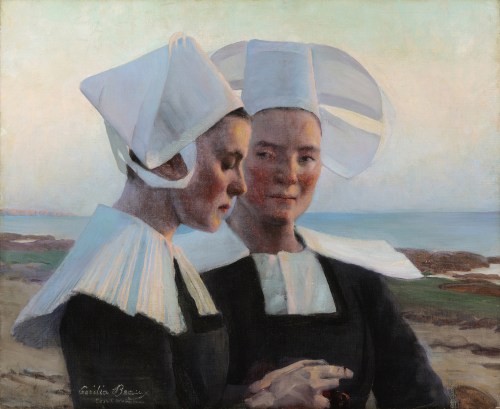
Twilight_Confidences_by_Cecilia_BeauxTwilight Confidences by Cecilia Beaux  (1855–1942)

Date: 1888

Medium:  oil on canvas

Dimensions: 23 1/2 x 28 inches, 59.7 x 71.1 cm

Inscriptions: Signed and dated: Cecilia Beaux

What I love about this painting:

This is one of my all-time favorite paintings. It is not merely a portrait of how two women looked on a summer’s day; it tells us a story. What that story is will be up to you, but in this very simple scene, two women beside the sea, Cecelia Beaux tells us many things.

First, we see brilliant world building in what Beaux has chosen to focus on: their expressive features, and the lonely stretch of beach where they can talk and not be overheard. The artist hasn’t cluttered it up with anything that is not necessary.

We know this was painted toward the end of Beaux’s time in France. The two women may be nurses, or they may be sisters of a religious order. Or, their dress and headwear may be a fashion of their local area, but I’m leaning toward young nurses.

There is an honesty, a real sense of intimacy depicted here. The feeling of sisterhood between the two women is conveyed across the years–they find it safe to confide in each other.

One holds an object with a personal meaning, perhaps a gift from a young man who is absent. She tells the other something about that object, a secret she feels she may be judged for. The other takes in what she has been told and accepts it for what it is.

About this painting via Wikimedia Commons:  

Cecilia Beaux was a leading figure and portrait painter and one of the few distinguished and highly recognized women artists of her time in America. Her figures are frequently compared to Sargent’s, but her style relates also to other international leaders of late-19th Century portraiture, including Anders Zorn, Giuseppe Boldini, Carolus-Duran and William Merritt Chase. She was born and lived mostly in Philadelphia, traveling frequently to Europe, especially France from a young age, and exhibited widely in Paris, Philadelphia, New York and elsewhere. Her first acclaimed work, Les Derniers jours d’enfance, a mother and child composition, was exhibited at the Paris Salon in 1887, and Beaux followed it there the next year, spending the summer of 1888 at the art colony at Concarneau in Brittany. Here she painted her remarkable Twilight Confidences of 1888, preceded by numerous studies, which are in the collection of the Pennsylvania Academy of the Fine Arts. Lost for many years, this much admired canvas is Beaux’s first major exercise in plein-air painting, in which the figures and the seascape are artfully and exquisitely juxtaposed, and sunlight permeates the whole composition. [1]

Beaux was highly educated and had a brilliant career as one of the most respected portrait artists of her time. To read about this amazing woman’s life, go to Cecilia Beaux – Wikipedia.


Credits and Attributions:

IMAGE: Twilight Confidences, Cecilia Beaux, Public domain, via Wikimedia Commons

[1] Wikimedia Commons contributors, “File:Twilight Confidences by Cecilia Beaux.jpg,” Wikimedia Commons, https://commons.wikimedia.org/w/index.php?title=File:Twilight_Confidences_by_Cecilia_Beaux.jpg&oldid=355146645 (accessed October 30, 2025).
 

2 Comments

Filed under #FineArtFriday

#FineArtFriday: A closer look at “The Alyscamps,” or “The Three Graces at the Temple of Venus” by Paul Gauguin 1888

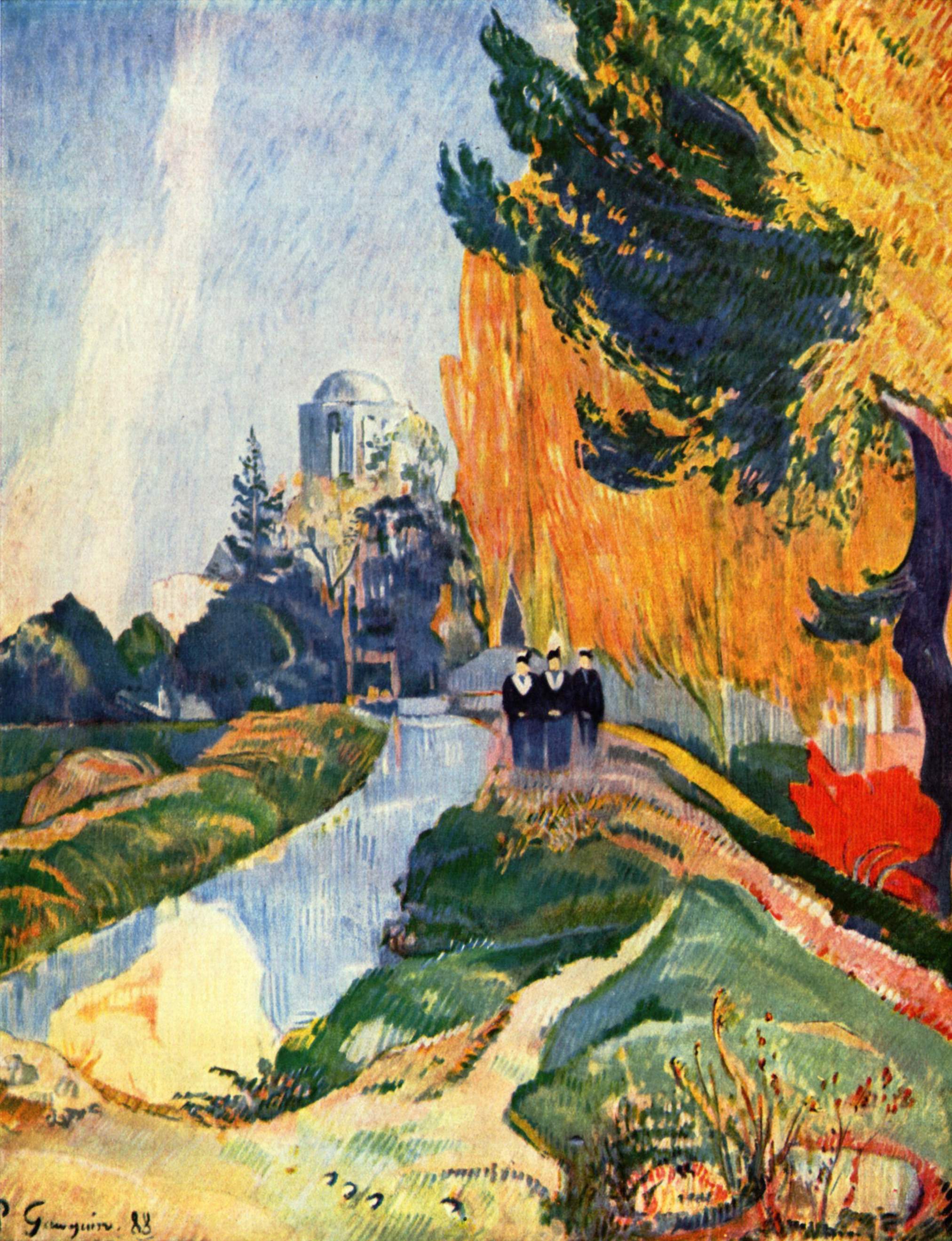
Paul_Gauguin_les_alyscamps085

Artist: Paul Gauguin (1848–1903)

Title:  (English)The Alyscamps, or The Three Graces at the Temple of Venus

French: French: Les Alyscamps, ou Les Trois grâces au temple de Venus

Date: 1888

Medium: oil on canvas

Dimensions: height: 91.6 cm (36 in); width: 72.5 cm (28.5 in)

Collection: Musée d’Orsay

What I love about this painting:

Color! I love the vivid colors contrasted against the pale sky. The Three Graces in classical mythology are the goddesses of charm, beauty, nature, human creativity, goodwill, and fertility. They have come to symbolize faith, hope, and charity.

According to the internet, the traditional mythology Paul Gauguin explores in this composition demonstrates his early education and his appreciation of classical art. And truthfully, although he never trained formally, he did know his stuff. Before he became an artist, he was both a stockbroker and an art dealer/collector.

Gauguin is known for his use of bold colors, simplified forms, and strong lines. Again, according to the internet, this painting is a prime example of his study of form and color.

And he tells us a story. First, the eye is drawn to the vertical lines of the temple standing tall on the hill behind the figures. They are also depicted with a sense of height, and the hills beyond are tall and narrow.

A calm stream flows from beneath the temple, the river of time. The three women stand almost in the background, yet they are commanding, observing us and our lives as time passes them. They are as strong and unmovable as the rocky hills and the temple.

Gauguin tells us that time may pass, and things may change, but the Temple of Venus rises above it all. Does this Temple of Venus represent “agape,” a love that is selfless and unconditional? A kind of love that is spiritual in nature?

Maybe, and maybe not.

Paul Gauguin was a famously complicated man, conflicted and tormented by the contrasts of 19th century morality and the realities of his life.

Who knows what that temple meant to him on the day he created it? Either way, Gauguin’s Three Graces, Faith, Hope, and Charity, stand almost in the shadows, offering him comfort. They are as solid and eternal as time.

And who or what, I wonder, is the immense dark, nearly indistinct fourth shadow who peers over their left shoulder? It seems like a person’s form. Is it another of the Fates? Is it Death? There is so much to consider in this painting.

Paul Gauguin lived an eventful life. For a wonderful documentary on the man and his life, go to:

Why Is Gauguin So Controversial? (Waldemar Januszczak Documentary) | Perspective – YouTube

Also, check out Paul Gauguin – Wikipedia.


Credits and Attributions:

Image: Wikimedia Commons contributors, “File:Paul Gauguin 085.jpg,” Wikimedia Commons, https://commons.wikimedia.org/w/index.php?title=File:Paul_Gauguin_085.jpg&oldid=710795058 (accessed September 24, 2025).

Comments Off on #FineArtFriday: A closer look at “The Alyscamps,” or “The Three Graces at the Temple of Venus” by Paul Gauguin 1888

Filed under #FineArtFriday

#FineArtFriday: a second look at “Street Scene on a Rainy Day” by Francesco Miralles Galup (ca. 1891)

Title: Escena de carrer en un dia de pluja (Eng: Street Scene on a rainy Day)

Artist: Francisco Miralles Galup

Date: circa 1891

What I love about this painting:

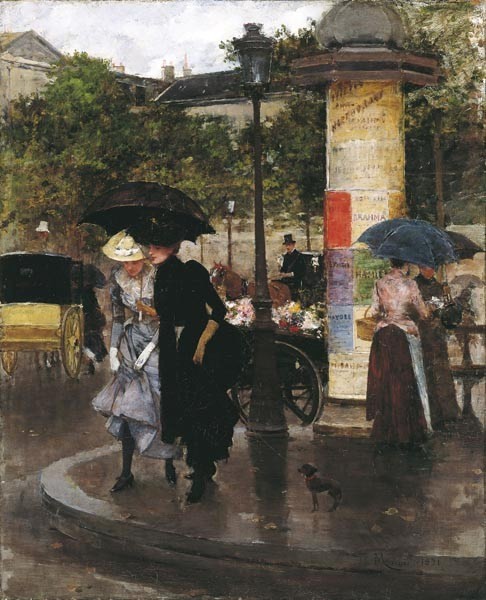
Francesco Miralles Galup understood how to show the reality of weather, especially weather that was only mildly uncomfortable. We see a perfect rainy spring afternoon in a busy cosmopolitan city. It could have been any large city at the end of the 19th century. The sky is gray, the street is busy, full of carriages, and pedestrians must be careful where they step.

A cart full of flowers passes in the background, headed for the market. Two well-dressed ladies dodge puddles in their effort to cross the street. Around them, people stop to gossip, and umbrellas abound.

Like every chihuahua I’ve ever known, the little dog is miserable, unhappy with the damp.

I think this may be one of my favorite paintings of that era, one showing real people and their social lives. It was an era before refrigeration, so people went to the market each day to purchase whatever food they planned to serve. The market is where they met up with their friends and heard news of both the wider world and the local gossip.

He shows us ordinary people, happy and living their best lives.

About the Artist, via Wikipedia:

Francesco Miralles Galup was born Francesc Miralles i Galaup (6 April 1848, Valencia – 30 October 1901, Barcelona). He was a Catalan painter, best known for his realistic scenes of bourgeois life and high society.

When he turned eighteen, he received parental permission (and financial support) to study in Paris, where he would remain until 1893, with occasional visits home. During his first years there, he copied masterworks at the Louvre and may have worked briefly with Alexandre Cabanel. He eventually had several small studios in Montmartre and on the Rue Laffitte.

He exhibited regularly at the Salon and the Sala Parés, back home in Barcelona. He also became a client of the well-known art dealership Goupil & Cie, attracting wealthy buyers throughout Europe and America. This was a relief to his family, who had initially been concerned that they might have to support him indefinitely. Their ability to do so had been compromised as they had lost much of their fortune in the Panic of 1866 and were losing more of it as they paid off their debts. In fact, they eventually moved to Paris so he could help support them. [1]


Credits and Attributions:

IMAGE: Escena de carrer c1891, Francisco Miralles Galup / Public domain. Wikimedia Commons contributors, “File:Francesco Miralles Galup – Escena de carrer c1891.jpg,” Wikimedia Commons, https://commons.wikimedia.org/w/index.php?title=File:Francesco_Miralles_Galup_-_Escena_de_carrer_c1891.jpg&oldid=1039428081 (accessed August 28, 2025).

[1]Wikipedia contributors, “Francesc Miralles i Galaup,” Wikipedia, The Free Encyclopedia, https://en.wikipedia.org/w/index.php?title=Francesc_Miralles_i_Galaup&oldid=1291581678 (accessed August 28, 2025).

Comments Off on #FineArtFriday: a second look at “Street Scene on a Rainy Day” by Francesco Miralles Galup (ca. 1891)

Filed under #FineArtFriday

#FineArtFriday: a closer look at “Calais Pier by J.M.W. Turner, 1803”

Calais_pier_Joseph_Mallord_William_Turner_024

Artist: J. M. W. Turner (1775–1851)

Title: Calais Pier

Date: 1803

Medium: oil on canvas

Dimensions: height: 172 cm (67.7 in); width: 240 cm (94.4 in)

Collection: National Gallery

What I love about this painting:

The art of Joseph Mallord William Turner holds a large place in my heart. His originality, his later lack of deference to artistic conventions of the day often made his life hard. But what wonderful works emerged from his view of the world. Much like Van Gogh would do thirty years later, Turner’s work eventually evolved into a style that was original and sheer genius. His ability to paint what he saw and felt rather than the accepted classic literal depiction of a scene inspired the next generation of artists, the Impressionists.

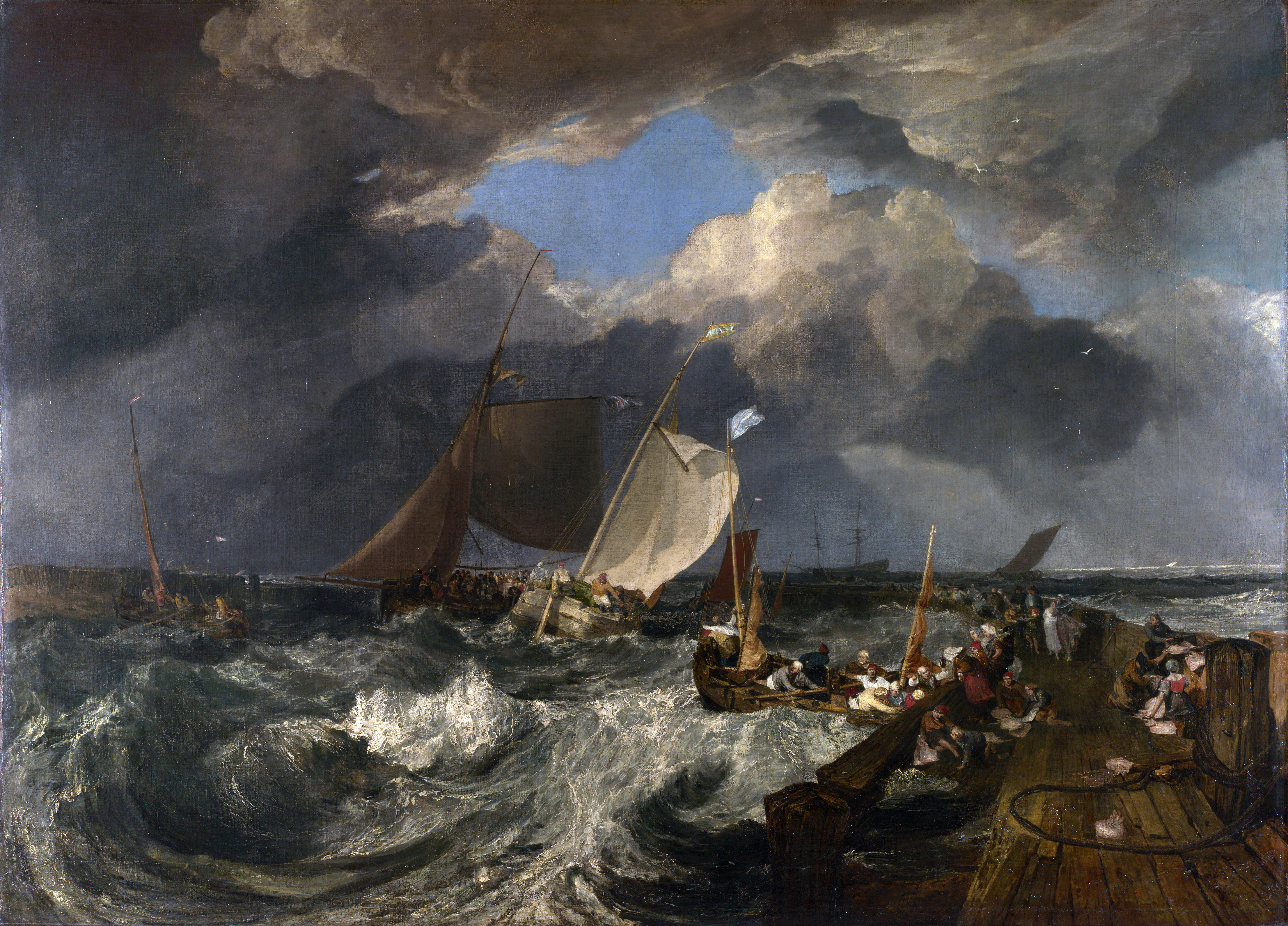
Caiais Pier is one of his earlier works, painted when he was still influenced by his classical training. And yet, it is an emotion-packed image, the scene of a near-tragedy. The packet boat has arrived at Calais with a full load of passengers. The storm dominates the scene with lowering clouds and a heavy swell, but the sun breaks through and lights on the sail. A shaft of light shines down to the sea illuminating the center of the composition.  The young artist put his experience and terror into the image, depicting the ferocity of the sea and the violence of the landing.

The National Gallery website says of this picture, “Although it had a mixed response when first exhibited at the Royal Academy in 1803, the critic John Ruskin declared it to be the first painting to show signs of ‘Turner’s colossal power’. Calais Pier is based upon an actual event. On 15 July 1802, Turner, aged 27, began his first trip abroad, travelling from Dover to Calais in a cross-channel ferry (a packet) of the type shown here. The weather was stormy, and Turner noted in his sketchbook: ‘Our landing at Calais. Nearly swampt.’” [1] Joseph Mallord William Turner | Calais Pier | NG472 | National Gallery, London

About the Artist, Via Wikipedia:

Joseph Mallord William Turner RA (23 April 1775 – 19 December 1851), known in his time as William Turner, was an English Romantic painter, printmaker and watercolorist. He is known for his expressive coloring, imaginative landscapes and turbulent, often violent marine paintings. He left behind more than 550 oil paintings, 2,000 watercolors, and 30,000 works on paper. He was championed by the leading English art critic John Ruskin from 1840 and is today regarded as having elevated landscape painting to an eminence rivalling history painting.

Turner was born in Maiden Lane, Covent Garden, London, to a modest lower-middle-class family and retained his lower class accent, while assiduously avoiding the trappings of success and fame. A child prodigy, Turner studied at the Royal Academy of Arts from 1789, enrolling when he was 14, and exhibited his first work there at 15. During this period, he also served as an architectural draftsman. He earned a steady income from commissions and sales, which due to his troubled, contrary nature, were often begrudgingly accepted. He opened his own gallery in 1804 and became professor of perspective at the academy in 1807, where he lectured until 1828. He travelled around Europe from 1802, typically returning with voluminous sketchbooks.

Intensely private, eccentric, and reclusive, Turner was a controversial figure throughout his career. He did not marry, but fathered two daughters, Evelina (1801–1874) and Georgiana (1811–1843), by his housekeeper Sarah Danby. He became more pessimistic and morose as he got older, especially after the death of his father in 1829; when his outlook deteriorated, his gallery fell into disrepair and neglect, and his art intensified. In 1841, Turner rowed a boat into the Thames so he could not be counted as present at any property in that year’s census. He lived in squalor and poor health from 1845, and died in London in 1851 aged 76. Turner is buried in St Paul’s Cathedral, London. [2]


Credits and Attributions:

“Calais Pier” by J.M.W. Turner, 1801. Wikipedia contributors, “Calais Pier,” Wikipedia, The Free Encyclopedia, https://en.wikipedia.org/w/index.php?title=Calais_Pier&oldid=1287504024 (accessed May 9, 2025).

[1] National Gallery contributors, Calais Pier, Joseph Mallord William Turnerhttps://www.nationalgallery.org.uk/paintings/joseph-mallord-william-turner-calais-pier (accessed May 9, 2025).

[2] Wikipedia contributors, “J. M. W. Turner,” Wikipedia, The Free Encyclopedia, https://en.wikipedia.org/w/index.php?title=J._M._W._Turner&oldid=1289276733 (accessed May 9, 2025).

2 Comments

Filed under #FineArtFriday

#FineArtFriday: Fisherwomen, Cullercoats by Winslow Homer 1881, a second look

Homer,_Winslow_-_'Fisherwomen,_Cullercoats',_1881,_graphite_&_watercolor_on_paperArtist: Winslow Homer  (1836–1910)

Title: Fisherwomen, Cullercoats

Date:   1881

Medium: watercolor and graphite on paper

Dimensions: height: 34.2 cm (13.4 in); width: 49.2 cm (19.3 in)

Collection: Honolulu Museum of Art

What I love about this painting:

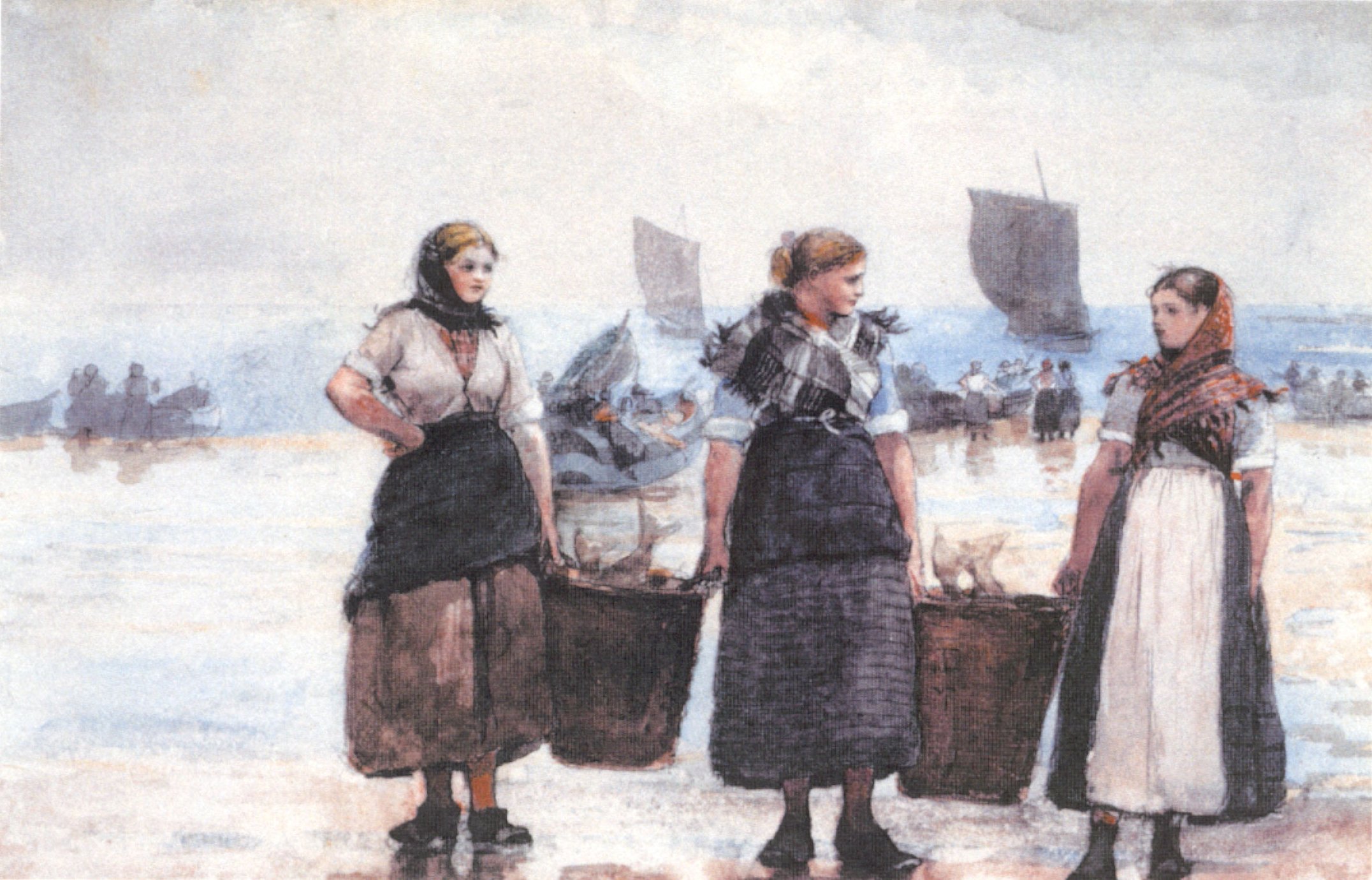
Homer shows us a foggy morning at the beach, capturing the quality of light on the strand at Cullercoats, Tyne and Wear, England. He paints the background with an impressionist’s eye and gives us realistic portraits of the working women whose labors fed the country.

The fish baskets are heavy, but they share the load. Their sleeves are rolled up for work, and skirts are shorter than if they were in town—no one wants wet skirts dragging around their ankles.

I love the way he shows these women as they were that day, treating them with respect. During his lifetime, Winslow Homer depicted men and women of all races, slaves and former slaves, and soldiers. He showed us people who worked hard, not giving us caricatures but painting portraits of real people.

Homer loved the sea and traveled widely, painting everywhere he went. Critics sometimes dismiss his work as “calendar art, appealing to the unschooled masses.” But think about it – calendars and magazines often were the only art poor and working-class people had in their homes. If you don’t have access to art, how can you become “schooled” in it? Some art critics are a little too schooled.

If you are interested in knowing more about the art of Winslow Homer, this documentary is excellent: FAKE OR FORTUNE SE1EO4 WINSLOW HOMER – YouTube

About the Artist, via Wikipedia:

Homer started painting with watercolors on a regular basis in 1873 during a summer stay in Gloucester, Massachusetts. From the beginning, his technique was natural, fluid and confident, demonstrating his innate talent for a difficult medium. His impact would be revolutionary. Here, again, the critics were puzzled at first, “A child with an ink bottle could not have done worse.” Another critic said that Homer “made a sudden and desperate plunge into water color painting”. But his watercolors proved popular and enduring, and sold more readily, improving his financial condition considerably. They varied from highly detailed (Blackboard – 1877) to broadly impressionistic (Schooner at Sunset – 1880). Some watercolors were made as preparatory sketches for oil paintings (as for “Breezing Up”) and some as finished works in themselves. Thereafter, he seldom traveled without paper, brushes and water based paints.

As a result of disappointments with women or from some other emotional turmoil, Homer became reclusive in the late 1870s, no longer enjoying urban social life and living instead in Gloucester. For a while, he even lived in secluded Eastern Point Lighthouse (with the keeper’s family). In re-establishing his love of the sea, Homer found a rich source of themes while closely observing the fishermen, the sea, and the marine weather. After 1880, he rarely featured genteel women at leisure, focusing instead on working women. [1]


Credits and Attributions:

Image: Fisherwomen, Cullercoats by Winslow Homer 1881. Wikimedia Commons contributors, “File:Homer, Winslow – ‘Fisherwomen, Cullercoats’, 1881, graphite & watercolor on paper.jpg,” Wikimedia Commons, https://commons.wikimedia.org/w/index.php?title=File:Homer,_Winslow_-_%27Fisherwomen,_Cullercoats%27,_1881,_graphite_%26_watercolor_on_paper.jpg&oldid=721923030 (accessed August 3, 2023).

[1] Wikipedia contributors, “Winslow Homer,” Wikipedia, The Free Encyclopedia, https://en.wikipedia.org/w/index.php?title=Winslow_Homer&oldid=1168361459 (accessed August 3, 2023).

2 Comments

Filed under #FineArtFriday

#FineArtFriday: Christmas Eve, Chromolithograph by Joseph C. Hoover & Sons (revisited)

No_Known_Restrictions_Christmas_Eve_by_J._Hoover,_no_date_LOC_2122063062

Description: Christmas Eve, chromolithograph by J. C. Hoover and Sons

Date: 1880

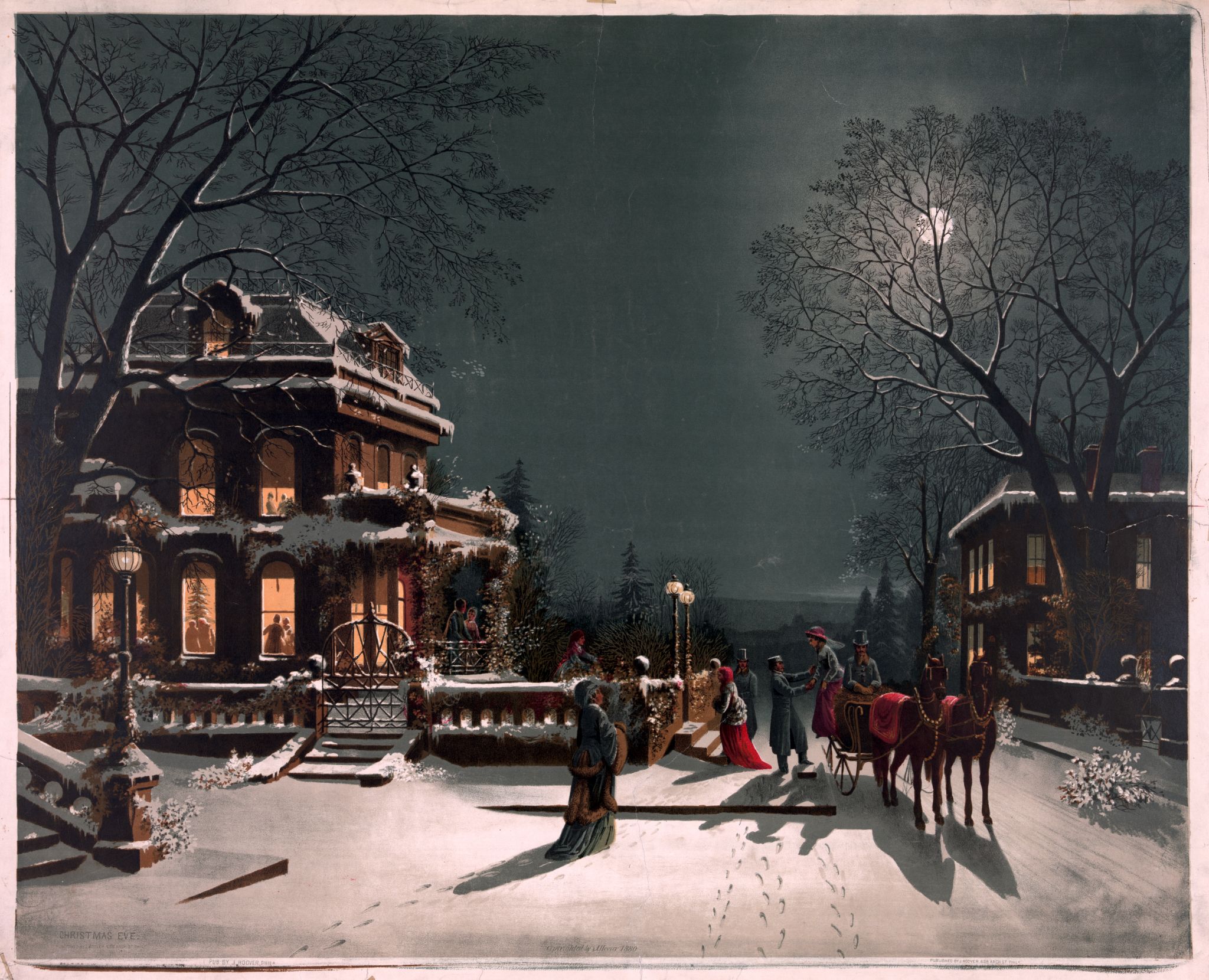
This is a quintessential calendar or Christmas card picture, and I love it. It appeals to every sentiment a viewer might have of home and community and Christmas traditions.

This painting has many nostalgic style elements, which is why I find it so appealing. It has a Courier and Ives feel to it, and is reminiscent of George Henry Durie’s work, although it was painted seventeen years after his death. I don’t know who the artist was that painted this picture as he or she isn’t credited. It could have been one of the sons, or one of the many women artists employed in the industry at the time.

A significant number of artists employed in the publishing industry during the 19th and early 20th century were women. They painted illustrations for greeting cards, books, magazines, and newspapers. Often women were not acknowledged as the original creators, although some, like Mary Cassatt, did achieve fame and credit for their work.

About the publisher, via Art and Antiques Gallery’s website:

Hoover & Sons issued popular prints for the masses in the last decade of the 19th century and the first decade of the 20th century. This was a business much like Currier & Ives, though Hoover & Sons issued chromolithographs. Joseph Hoover was one of the few native-born Americans who achieved success with chromolithography. Hoover started by making elaborate wood frames in Philadelphia in 1856, but within a decade or so he began to produce popular prints. Initially he mostly worked for other publishers, including Duval & Hunter, and he worked with noted Philadelphia artist James F. Queen. He also issued a few hand-colored, popular prints of considerable charm. During the Centennial, Hoover won a medal for excellence for his chromolithographs after Queens renderings.

In the 1880s, Hoover began to print chromolithographs, installing a complete printing plant by 1885. By the end of the century, his firm was one of the largest print publishers in the county, with an average annual production of between 600,000 to 700,000 pictures. Using chromolithography, Hoover was able to produce attractive, colorful prints that were still affordable for anyone to use as decoration for home and office. The audience for Hoover’s prints was quite wide, extending throughout the United States, and overseas to Canada, Mexico, England and Germany. The subjects issued by the firm are extensive, including genre scenes, still life images, views of American locations, and generic landscapes, including a series of charming winter scenes. [1]

About Chromolithography, via Wikipedia:

Chromolithography is a chemical process. The process is based on the rejection of water by grease. The image is applied to stone, grained zinc or aluminium surfaces, with a grease-based crayon or ink. Limestone and zinc are two commonly used materials in the production of chromolithographs, as aluminium corrodes easily. After the image is drawn onto one of these surfaces, the image is gummed-up with a gum arabic solution and weak nitric acid to desensitize the surface. Before printing, the image is proofed before finally inking up the image with oil-based transfer or printing ink. In the direct form of printing, the inked image is transferred under pressure onto a sheet of paper using a flat-bed press. The offset indirect method uses a rubber-covered cylinder that transfers the image from the printing surface to the paper.

Alois Senefelder, the inventor of lithography, introduced the subject of colored lithography in his 1818 Vollstaendiges Lehrbuch der Steindruckerey (A Complete Course of Lithography), where he told of his plans to print using colour and explained the colours he wished to be able to print someday. Although Senefelder recorded plans for chromolithography, printers in other countries, such as France and England, were also trying to find a new way to print in colour. Godefroy Engelmann of Mulhouse in France was awarded a patent on chromolithography in July 1837, but there are disputes over whether chromolithography was already in use before this date, as some sources say, pointing to areas of printing such as the production of playing cards. [2]


Credits and Attributions:

[1] Quote from Art and Antiques Gallery https://www.pbase.com/artandantiquesgallery/joseph_hoover_and_sons_prints (accessed December 24, 2021).

[2] Wikipedia contributors, “Chromolithography,” Wikipedia, The Free Encyclopedia, https://en.wikipedia.org/w/index.php?title=Chromolithography&oldid=1058870233 (accessed December 24, 2021).

Image Credit: Public Domain. Library of Congress via pingnews. Additional information from source: TITLE: Christmas Eve CALL NUMBER: PGA – Hoover, J.–Christmas Eve (D size) [P&P] REPRODUCTION NUMBER: LC-DIG-01601 (digital file from original print) LC-USZ62-49683 (b&w film copy neg.) RIGHTS INFORMATION: No known restrictions on publication. MEDIUM: 1 print. CREATED/PUBLISHED: [no date recorded on shelflist card]

2 Comments

Filed under #FineArtFriday, writing

#FineArtFriday: Calais Pier by J.M.W. Turner, 1803

Calais_pier_Joseph_Mallord_William_Turner_024

Artist: J. M. W. Turner (1775–1851)

Title: Calais Pier

Date: 1803

Medium: oil on canvas

Dimensions: height: 172 cm (67.7 in); width: 240 cm (94.4 in)

Collection: National Gallery

What I love about this painting:

This is an emotion-packed image, the scene of a near-tragedy. The packet boat has arrived at Calais with a full load of passengers. The storm dominates the scene with lowering clouds and a heavy swell, but the sun breaks through and lights on the sail. A shaft of light shines down to the sea illuminating the center of the composition.  The young artist put his experience and terror into the image, depicting the ferocity of the sea and the violence of the landing.

The National Gallery website says of this picture, “Although it had a mixed response when first exhibited at the Royal Academy in 1803, the critic John Ruskin declared it to be the first painting to show signs of ‘Turner’s colossal power’. Calais Pier is based upon an actual event. On 15 July 1802, Turner, aged 27, began his first trip abroad, travelling from Dover to Calais in a cross-channel ferry (a packet) of the type shown here. The weather was stormy, and Turner noted in his sketchbook: ‘Our landing at Calais. Nearly swampt.’” [1] Joseph Mallord William Turner | Calais Pier | NG472 | National Gallery, London

About the Artist, Via Wikipedia:

Joseph Mallord William Turner RA (23 April 1775 – 19 December 1851), known in his time as William Turner, was an English Romantic painter, printmaker and watercolorist. He is known for his expressive coloring, imaginative landscapes and turbulent, often violent marine paintings. He left behind more than 550 oil paintings, 2,000 watercolors, and 30,000 works on paper. He was championed by the leading English art critic John Ruskin from 1840 and is today regarded as having elevated landscape painting to an eminence rivalling history painting.

Turner was born in Maiden Lane, Covent Garden, London, to a modest lower-middle-class family and retained his lower class accent, while assiduously avoiding the trappings of success and fame. A child prodigy, Turner studied at the Royal Academy of Arts from 1789, enrolling when he was 14, and exhibited his first work there at 15. During this period, he also served as an architectural draftsman. He earned a steady income from commissions and sales, which due to his troubled, contrary nature, were often begrudgingly accepted. He opened his own gallery in 1804 and became professor of perspective at the academy in 1807, where he lectured until 1828. He travelled around Europe from 1802, typically returning with voluminous sketchbooks.

Intensely private, eccentric, and reclusive, Turner was a controversial figure throughout his career. He did not marry, but fathered two daughters, Evelina (1801–1874) and Georgiana (1811–1843), by his housekeeper Sarah Danby. He became more pessimistic and morose as he got older, especially after the death of his father in 1829; when his outlook deteriorated, his gallery fell into disrepair and neglect, and his art intensified. In 1841, Turner rowed a boat into the Thames so he could not be counted as present at any property in that year’s census. He lived in squalor and poor health from 1845, and died in London in 1851 aged 76. Turner is buried in St Paul’s Cathedral, London. [2]


Credits and Attributions:

“Calais Pier” by J.M.W. Turner, 1801. Wikimedia Commons contributors, “File:Joseph Mallord William Turner 024.jpg,” Wikimedia Commons, https://commons.wikimedia.org/w/index.php?title=File:Joseph_Mallord_William_Turner_024.jpg&oldid=618399843 (accessed October 7, 2023).

[1] National Gallery contributors, Calais Pier, Joseph Mallord William Turnerhttps://www.nationalgallery.org.uk/paintings/joseph-mallord-william-turner-calais-pier (accessed  October 11, 2023).

[2] Wikipedia contributors, “J. M. W. Turner,” Wikipedia, The Free Encyclopedia, https://en.wikipedia.org/w/index.php?title=J._M._W._Turner&oldid=1179617592 (accessed October 11, 2023).

Comments Off on #FineArtFriday: Calais Pier by J.M.W. Turner, 1803

Filed under #FineArtFriday

#FineArtFriday: Fisherwomen, Cullercoats by Winslow Homer 1881

Homer,_Winslow_-_'Fisherwomen,_Cullercoats',_1881,_graphite_&_watercolor_on_paperArtist: Winslow Homer  (1836–1910)

Title: Fisherwomen, Cullercoats

Date:   1881

Medium: watercolor and graphite on paper

Dimensions: height: 34.2 cm (13.4 in); width: 49.2 cm (19.3 in)

Collection: Honolulu Museum of Art

What I love about this painting:

Homer shows us a foggy morning at the beach, capturing the quality of light on the strand at Cullercoats, Tyne and Wear, England. He paints the background with an impressionist’s eye and gives us realistic portraits of the working women whose labors fed the country.

The fish baskets are heavy, but they share the load. Their sleeves are rolled up for work, and skirts are shorter than if they were in town—no one wants wet skirts dragging around their ankles.

I love the way he shows these women as they were that day, treating them with respect. During his lifetime, Winslow Homer depicted men and women of all races, slaves and former slaves, and soldiers. He showed us people who worked hard, not giving us caricatures but painting portraits of real people.

Homer loved the sea and traveled widely, painting everywhere he went. Critics sometimes dismiss his work as “calendar art, appealing to the unschooled masses.” But think about it – calendars and magazines often were the only art poor and working-class people had in their homes. If you don’t have access to art, how can you become “schooled” in it? Some art critics are a little too schooled.

If you are interested in knowing more about the art of Winslow Homer, this documentary is excellent: FAKE OR FORTUNE SE1EO4 WINSLOW HOMER – YouTube

About the Artist, via Wikipedia:

Homer started painting with watercolors on a regular basis in 1873 during a summer stay in Gloucester, Massachusetts. From the beginning, his technique was natural, fluid and confident, demonstrating his innate talent for a difficult medium. His impact would be revolutionary. Here, again, the critics were puzzled at first, “A child with an ink bottle could not have done worse.” Another critic said that Homer “made a sudden and desperate plunge into water color painting”. But his watercolors proved popular and enduring, and sold more readily, improving his financial condition considerably. They varied from highly detailed (Blackboard – 1877) to broadly impressionistic (Schooner at Sunset – 1880). Some watercolors were made as preparatory sketches for oil paintings (as for “Breezing Up”) and some as finished works in themselves. Thereafter, he seldom traveled without paper, brushes and water based paints.

As a result of disappointments with women or from some other emotional turmoil, Homer became reclusive in the late 1870s, no longer enjoying urban social life and living instead in Gloucester. For a while, he even lived in secluded Eastern Point Lighthouse (with the keeper’s family). In re-establishing his love of the sea, Homer found a rich source of themes while closely observing the fishermen, the sea, and the marine weather. After 1880, he rarely featured genteel women at leisure, focusing instead on working women. [1]


Credits and Attributions:

Image: Fisherwomen, Cullercoats by Winslow Homer 1881. Wikimedia Commons contributors, “File:Homer, Winslow – ‘Fisherwomen, Cullercoats’, 1881, graphite & watercolor on paper.jpg,” Wikimedia Commons, https://commons.wikimedia.org/w/index.php?title=File:Homer,_Winslow_-_%27Fisherwomen,_Cullercoats%27,_1881,_graphite_%26_watercolor_on_paper.jpg&oldid=721923030 (accessed August 3, 2023).

[1] Wikipedia contributors, “Winslow Homer,” Wikipedia, The Free Encyclopedia, https://en.wikipedia.org/w/index.php?title=Winslow_Homer&oldid=1168361459 (accessed August 3, 2023).

Comments Off on #FineArtFriday: Fisherwomen, Cullercoats by Winslow Homer 1881

Filed under #FineArtFriday

#FineArtFriday: Dort or Dordrecht: The Dort packet-boat from Rotterdam becalmed by J. M. W. Turner 1818 (revisited)

B1977.14.77

Artist: J. M. W. Turner (1775–1851)

Title: Dort or Dordrecht: The Dort packet-boat from Rotterdam becalmed

Genre: marine art

Date: 1818

Medium: oil on canvas

Dimensions: Height: 157.5 cm (62 in); Width: 233.7 cm (92 in)

Collection: Yale Center for British Art

What I love about this painting:

The colors show us a windless evening in summer or fall, a time of day when the smoke from factories and chimneys lingers and turns the sky brown and gold, reflected on the waters.

This is a glimpse into the history of how we once moved goods and mail across long distances. Some packet boats were medium-sized ships, able to navigate shallow rivers and canals. Others were ocean-going vessels. Some were steam driven, but the one we see in this painting is an early ship, powered by the wind.

The wind has failed, and so the crew is being ferried off the ship via a smaller row-boat.

About this painting via Wikipedia:

The Dort, or Dort or Dordrecht: The Dort packet-boat from Rotterdam becalmed is an 1818 painting by J. M. W. Turner, based on drawings made by him in mid-September 1817.  It shows a view of the harbour of Dordrecht. It is the finest example of the influence of Dutch marine painting on Turner’s work.

It was exhibited at the Royal Academy in 1818, where it was described by The Morning Chronicle as “one of the most magnificent pictures ever exhibited, and does honour to the age”. In 1832, John Constable wrote of the picture, “I remember most of Turner’s early works; amongst them one of singular intricacy and beauty; it was a canal with numerous boats making thousands of beautiful shapes, and I think the most complete work of a genius I ever saw”.

It was purchased by Walter Fawkes for 500 guineas at the request of his son, and hung in the drawing room at Farnley Hall until it was bought by Paul Mellon in 1966. It was then donated to the Yale Center for British Art upon the founding of the centre. [1]

About the Artist, via Wikipedia:

Joseph Mallard William Turner was born in Maiden Lane, Covent Garden, London, to a modest lower-middle-class family. He lived in London all his life, retaining his Cockney accent and assiduously avoiding the trappings of success and fame. A child prodigy, Turner studied at the Royal Academy of Arts from 1789, enrolling when he was 14, and exhibited his first work there at 15. During this period, he also served as an architectural draftsman. He earned a steady income from commissions and sales, which due to his troubled, contrary nature, were often begrudgingly accepted. He opened his own gallery in 1804 and became professor of perspective at the academy in 1807, where he lectured until 1828. He travelled to Europe from 1802, typically returning with voluminous sketchbooks.

Intensely private, eccentric and reclusive, Turner was a controversial figure throughout his career. He did not marry, but fathered two daughters, Eveline (1801–1874) and Georgiana (1811–1843), by his housekeeper Sarah Danby. He became more pessimistic and morose as he got older, especially after the death of his father, after which his outlook deteriorated, his gallery fell into disrepair and neglect, and his art intensified. In 1841, Turner rowed a boat into the Thames so he could not be counted as present at any property in that year’s census. He lived in squalor and poor health from 1845, and died in London in 1851 aged 76. Turner is buried in Saint Paul’s Cathedral, London. [2]


Credits and Attributions:

Wikimedia Commons contributors, “File:DortorDordrecht.jpg,” Wikimedia Commons, the free media repository, https://commons.wikimedia.org/w/index.php?title=File:DortorDordrecht.jpg&oldid=554289467 (accessed October 28, 2021).

[1] Wikipedia contributors, “Dort or Dordrecht: The Dort packet-boat from Rotterdam becalmed,” Wikipedia, The Free Encyclopedia, https://en.wikipedia.org/w/index.php?title=Dort_or_Dordrecht:_The_Dort_packet-boat_from_Rotterdam_becalmed&oldid=1000618596 (accessed October 28, 2021).

[2] Wikipedia contributors, “J. M. W. Turner,” Wikipedia, The Free Encyclopedia, https://en.wikipedia.org/w/index.php?title=J._M._W._Turner&oldid=1050867512 (accessed October 28, 2021).

3 Comments

Filed under #FineArtFriday, writing

#FineArtFriday:The Alyscamps, or The Three Graces at the Temple of Venus by Paul Gauguin 1888

Paul_Gauguin_les_alyscamps085

Artist: Paul Gauguin (1848–1903)

Title:  (English)The Alyscamps, or The Three Graces at the Temple of Venus

French: French: Les Alyscamps, ou Les Trois grâces au temple de Venus

Date: 1888

Medium: oil on canvas

Dimensions: height: 91.6 cm (36 in); width: 72.5 cm (28.5 in)

Collection: Musée d’Orsay

What I love about this painting:

Color! I love the vivid colors contrasted against the pale sky. The Three Graces in classical mythology are the goddesses of charm, beauty, nature, human creativity, goodwill, and fertility. They have come to symbolize faith, hope, and charity.

The traditional mythology Paul Gauguin explores in this composition demonstrates his early education and his appreciation of classical art. Before he became an artist, he was both a stockbroker and an art dealer/collector.

Although he never trained formally, Gauguin is known for his use of bold colors, simplified forms, and strong lines. This painting is a prime example of his study of form and color.

The eye is drawn to the vertical lines of the temple standing tall on the hill behind the figures. They are also depicted with a sense of height, and the hills beyond are tall and narrow.

A calm stream flows from beneath the temple, the river of time. The three women stand almost in the background, yet impressive, observing as time passes them. They are as strong and unmovable as the rocky hills and the temple.

Gauguin tells us that time may pass, and things may change, but the Temple of Venus rises above it all. Does this Temple of Venus represent “agape,” a love that is selfless and unconditional? A kind of love that is spiritual in nature? Paul Gauguin was a complicated man, conflicted and tormented by the contrasts of morality and the realities of his life.

Who knows what that temple meant to him on the day he created it, but either way, Gauguin’s Three Graces, Faith, Hope, and Charity stand almost in the shadows, offering him comfort. They are as solid as the mountains and eternal as time. And who is the dark, mysterious fourth who peers over their shoulder?

Paul Gauguin lived an eventful life. For a wonderful documentary on the man and his life, go to:

Why Is Gauguin So Controversial? (Waldemar Januszczak Documentary) | Perspective – YouTube

Also, check out Paul Gauguin – Wikipedia.


Credits and Attributions:

Image: Wikimedia Commons contributors, “File:Paul Gauguin 085.jpg,” Wikimedia Commons, https://commons.wikimedia.org/w/index.php?title=File:Paul_Gauguin_085.jpg&oldid=710795058 (accessed April 6, 2023).

7 Comments

Filed under #FineArtFriday