
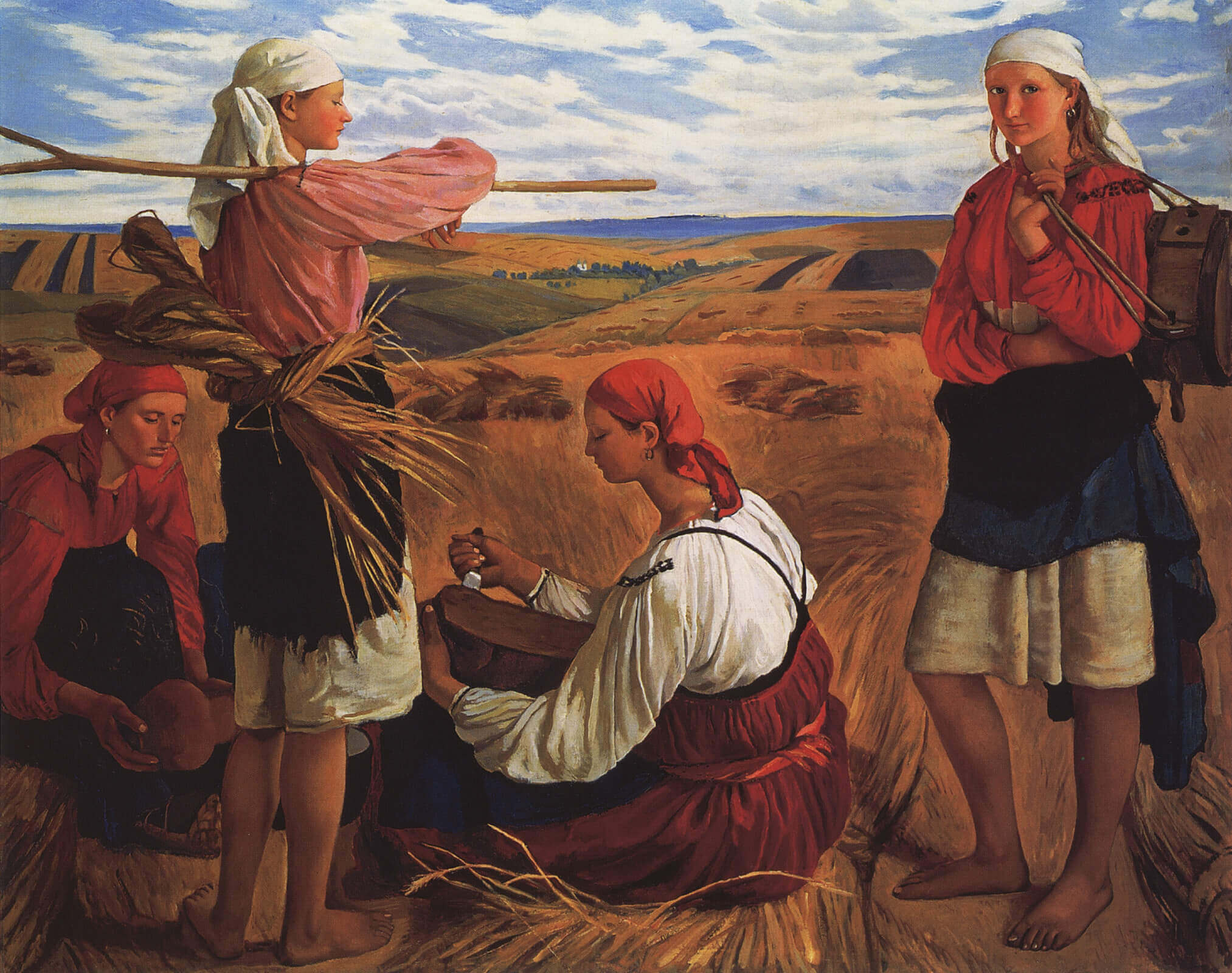
 Artist: Zinaida Serebriakova (1884–1967)
Title: Harvest 1915
Description: English: Harvest (Français: Moisson) (Русский: Жатва)
Date: 1915
Collection: Odesa Fine Arts Museum
What I love about this painting:
I love that Zinaida Serebriakova paints women at work in the field, getting the harvest in. They are taking a midday break from raking hay. These women are barefoot, and their skirts are tied up around their waists, leaving them more able to walk easily in the fields of tall grain and field grass.
No men are there, as Russia had entered WWI a year earlier in 1914. Just like in Brittain and elsewhere, the farms were worked by the women, children, and old people.
Women managed livestock, plowed, planted, and harvested, ensuring their husbands, sons, and brothers had food on the front lines.
Their skirts are shown in shades of red, black, and brown, standing out from the field of gold. The sky overhead shows of high white clouds drifting across the afternoon sky.
Serebriakova shows us strong young women doing what women have always done: making sure that whatever needs doing gets done.
About the Artist Via Wikipedia:
Zinaida Yevgenyevna Lansere was born on 10 December [O.S. 28 November] 1884 on the estate of Neskuchnoye near Kharkov in the Russian Empire. Her father, Yevgeny Aleksandrovich Lansere (1848–1886), was a sculptor. Her mother, Yekaterina Lansere, was a painter and came from the artistic Benois family.
Serebriakova’s most famous self-portrait, At the Dressing-Table (1909, Tretyakov Gallery), was painted while she was snowed in at her family home and models from a nearby village were unable to travel there. Her brother Yevgeny encouraged Serebriakova to enter the painting in an exhibition mounted by Mir iskusstva in 1910, where it was received with enthusiasm and purchased for the Tretyakov Gallery collection.
After the outbreak of the October Revolution in 1917, Serebriakova’s life changed for the worse. In 1918, her country estate was burned to the ground. Her husband Boris was arrested, and in 1919, he died of typhus. She was left without any income, responsible for her four children and her sick mother. All the reserves of Neskuchnoye had been plundered, so the family suffered from hunger. She had to give up oil painting in favour of the less expensive techniques of charcoal and pencil. This was the time of her most tragic painting, House of Cards, which depicts their four fatherless children.
In the autumn of 1924, Serebriakova went to Paris, having received a commission for a large decorative mural. On finishing this work, she intended to return to the Soviet Union, where her mother and the four children remained. However, she was not able to return, and although she was able to bring her children, Alexandre and Catherine, to Paris in 1926 and 1928 respectively, she could not do the same for her two other children, Yevgeny and Tatiana, and did not see them again for many years.
To read more about this amazing woman’s powerful and sometimes tragic life, go to Zinaida Serebriakova – Wikipedia.
Credits and Attributions:
IMAGE: Harvest by Zinaida Serebriakova. Wikimedia Commons contributors, “File:Serebryakova Harvest 1915.jpg,” Wikimedia Commons, https://commons.wikimedia.org/w/index.php?title=File:Serebryakova_Harvest_1915.jpg&oldid=1160900234 (accessed May 9, 2026).
[1] Wikipedia contributors, “Zinaida Serebriakova,” Wikipedia, The Free Encyclopedia, https://en.wikipedia.org/w/index.php?title=Zinaida_Serebriakova&oldid=1352183665 (accessed May 9, 2026).


