Tag Archives: #amwriting

Pantsing vs. Plotting or Somewhere in the Middle #NaNoWriMo2017 #amwriting

A friend of mine recently said, “I did what some gurus suggested for NaNoWriMo and planned out my book. All the joy is off the idea now, and I want to do something different.” This is not an uncommon occurrence. For some people, planning the outline makes them feel they have already written the story and they lose their enthusiasm.

I am a plotter, but I am also a pantser. A great article on this subject can be found at The Write Practice.

Quote: Simply put, a plotter is someone who plans out their novel before they write it. A pantser is someone who, “flies by the seat of their pants,” meaning they don’t plan out anything or plan very little.

Planning what events your protagonist will face is called plotting, and I make an outline for that.

“Pantsing it,” or writing using stream-of consciousness can produce some amazing work. That works well when we’re inspired, as ideas seem to flow from us. But for me, that sort of creativity is short-lived, unless I have a brief outline to follow, a road map of some sort.

Participating in NaNoWriMo has really helped me grow in the ability to write on a stream-of-consciousness level, but that only works for so long before I need a reminder of what my story was about in the beginning. My storyboard gets me back on track without making me feel like the creativity is already done.

One NaNoWriMo joke-solution often bandied about at write-ins is, “When you’re stuck, it’s time for someone to die.” Sadly, assassinating beloved characters whenever we run out of ideas is not a feasible option because we will soon run out of characters.

As devotees of Game of Thrones will agree, readers (or TV viewers) get to know characters and bond with them. When cherished characters are too regularly killed off, the story loses good people, and we must introduce new characters to fill the void. The reader may decide not to waste his time getting invested in a new character, feeling that you will only break their heart again.

The death of a character should be reserved to create a pivotal event that alters the lives of every member of the cast and is best reserved for either the inciting incident at the first plot point or as the terrible event of the third quarter of the book. So instead of assassination, we should resort to creativity.

This is where the outline can provide some structure, and keep you moving forward.  I will know what should happen in the first quarter, the middle, and the third quarter of the story. Also, because I know how it should end, I can more easily write to those plot points by filling in the blanks between, and the story will have cohesion.

Think about what launches a great story:

The protagonist has a problem.

You have placed them in a setting at a given moment, and shown the environment in which they live.

You have unveiled the inciting incident.

You know what they want, but you aren’t sure how far they will go to achieve it.

Now you need to decide what hinders the protagonist and prevents them from resolving the problem. While you are laying the groundwork for this keep in mind that we want to evoke three things:

  • Empathy/identification with the protagonist
  • Believability
  • Tension

We want the protagonist to be a sympathetic character whom the reader can identify with; one who the reader can immerse themselves in, living the story through his/her adventures.

But for NaNoWriMo, speed is everything. I need to get my 1,667 words every day, and I can’t take the time to sit back and ponder what to write next.

I find that this is where a loose outline helps me write quickly. Readers want the hindrances and barriers the protagonist faces to feel real. A loose guide helps me develop setups for the central events. This enables me to quickly lay down the narrative that shows the payoffs (either negative or positive) to advance the story: action and reaction.

Some authors resort to “idle conversation writing” when they are temporarily out of ideas.  If you can resist the temptation, please do so—it’s fatal to an otherwise good story. Save all your random think-writing off-stage in a background file, if giving your characters a few haphazard, pointless exchanges helps jar an idea loose. (However, for purposes of wordcount, if you wrote it, you can count it!)

One failing of NaNo Novels in their rough draft form is their unevenness. Try not to introduce random things into a scene unless they are important. Remember, to show the reader something is to foreshadow it, and the reader will wonder why a casual person or thing was so important they had to be foreshadowed.

Both over planning and under planning can lead to a book that is stalled and a writer who believes they have ‘writers’ block.’ For me a happy medium lies in a general outline, done as a brief storyboard:

What has prevented you from writing in the past? Did you get busy? Did you sleep in? Did you feel uncreative? These are mental roadblocks we all experience. The whole point of NaNoWriMo is to develop the ability to work through these hindrances.

Remember, you are a superhero with a keyboard, slaying the monsters of indolence and lack of creativity.

My dear friend, author Stephen Swartz, had this to say on the subject of over planning: “The story is your ship, the NaNo your ocean. Let the keyboard be your wind! May metaphors drive you to new lands!”

I completely agree. Do a little planning, but write like the wind, and let the story take you where it will.


Credits and Attributions

The Pros and Cons of Plotters and Pantsers by The Magic Violinist, The Write Practice, http://thewritepractice.com/plotters-pantsers/ © 2017
5 Comments

Filed under writing

Writing to a Theme #NaNoWriMo2017 #amwriting

November 1st begins the merry month of madness known as NaNoWriMo. Once again, as I have for the last seven years, I will spend the thirty days of November on an intensive writing binge.

Every day I will sit and write at least 1,667 NEW words on my current work in progress. If I do only that, I will have 50,000 words by Nov. 30th, which will bring the rough draft of that book nearly to completion.

But I generally manage between 2,000 and 4,000 words a day, and I work on several different projects. This year, while I WILL work on the rough draft of my current work-in-progress, my official project is another collection of short stories, poems, and flash fictions, all of which will be written to a variety of different themes.

The reason I need to build the backlog with a wide variety of themes is that most anthologies and many publications will call for submissions based around a central idea–such as  redemption, bridges, asylum–a large concept that  unifies the disparate stories.

So, my plan is to write to as many different themes as I can think of. Hopefully, if an opportunity presents itself later, I will have the perfect story ready, one that will only need some revising and editing.

One question I hear often is “how do I identify the theme of my story?” I have discussed this before, but it bears mentioning again. Theme is what the story is about on a deeper level than what is seen on the surface. It’s the big meaning, a thread that is woven through the entire story, and often it’s a moral. Love, honor, family, redemption, and revenge are all common, underlying themes.

Sometimes it’s difficult to write a short story unless you start out with a theme in mind. The same can be said for novels, although the theme can emerge more slowly than in short stories. For me, writing to a theme makes the process easier because half the work is done—I know what I’m writing about.

Several of the stories I will be working on are for themed anthologies with open calls for submission, but whose closing dates are rapidly approaching. When I made my list of proposed stories, I searched Submittable for open calls, so I know the desirable themes in advance. Some publications have submission dates that are quite a ways out, some have short deadlines.

Knowing the trending themes publishers are asking for is crucial to building your backlog with salable stories, so if you don’t have a Submittable account, you should get one.

What I hope to do in each story is to layer character studies, allegory, and imagery to emphasize the central theme and support the story arc. Sometimes I am successful, other times, not so much, but I still keep trying.

Most of my books are based around the hero’s journey, and how the events my protagonists experience shape their reactions and personal growth. The hero’s journey allows me to employ the theme of good vs. evil and the sub-themes of brotherhood, and love of family.

These concepts are important to me on a personal level, and so they find their way into my writing.

What themes are important to you? When you look for a book, what catches your interest? I am not talking genre here, I am speaking of the deeper story. When you look at it from a distance, what do all the stories you love best have in common?

Political thrillers: Set against the backdrop of a political power struggle. Political corruption, terrorism, and warfare are common themes.

Romance Novel: Two people as they develop romantic love for each other and work to build a relationship. Both the conflict and the climax of the novel are directly related to that core theme of developing a romantic relationship, although the novel can also contain subplots that do not specifically relate to the main characters’ romantic love.

Literary fiction focuses on the protagonist of the narrative, creating introspective. These are in-depth character studies featuring interesting, complex and developed characters. Action and setting are not the primary drivers of the story arc here. Instead, action and setting are carefully developed in such a way they frame the character, and provide a visual perspective. Allegory is a featured motif in many literary fiction novels.

Science Fiction: realistic speculation about possible future events, based solidly on adequate knowledge of the real world, past and present, and on a thorough understanding of the nature and significance of the scientific method. Science and technology are a dominant theme but based on current reality. Characters are still subject to sub-themes such as morality and love, but setting and science are the main themes.

Fantasy: Often set in alternate Earths, medieval times, or ancient worlds, the common themes are good vs. evil, hero’s journey, coming of age, morality, romantic love. Can also be set in urban settings with paranormal tropes.

On the surface, these types of books look widely different but all have one thing in common–they have protagonists and side-characters. These imaginary people will all have to deal with and react to the underlying theme of the book.

Morality, love, coming of age–these ideas can be found in nearly every book on my shelves or in my Kindle. These are the themes that were most powerfully depicted in the books that rocked my early reading world and are the sort I still seek out.

4 Comments

Filed under writing

Crafting Worlds #amwriting

I write in many different worlds with widely varying levels of technology and forms of government. I’m an avid reader, and always have been. Some of the worst books I have read were bad because the setting made no sense or was unclear. This has been as true of stories set in modern New York City as well as fantasies set in wholly imagined worlds.

The author is responsible for making the setting clear and real in the mind of the reader. To do that, the author must pay attention to building that world, even if that world is a well-known city. I can’t write about Seattle if I have no idea what it is like to live there. I can’t stress this enough: do the research.

Because I had noticed these shortcomings in some less than stellar traditionally published works, I made a list of questions to consider when I begin constructing a new society. The Tower of Bones series began as the core story for an anime-based RPG that was cancelled before it was built. For the game’s original concept, I made a checklist of questions about the world and used the answers to write the story of the community the game’s protagonist would live in, a word-picture of about 2000 words.  This is the method I still use today.

Answering the questions posed by the following list of ideas always leads to my considering a kajillion other rather large concepts that combine to make up a civilization.

Level of Technology: What tools and amenities do this society have available to them? What about transport?

  • Hunter/Gatherers?
  • Agrarian/farming
  • Greco-Roman metallurgy and technology?
  • Medieval metallurgy and technology?
  • Pre-industrial revolution or late Victorian?
  • modern day?

How do we get around and how do we transport goods?

  • On foot?
  • By horse & wagon?
  • By train?
  • By space shuttle?

Social Organization: Society is always composed of many layers and classes. How is your society divided? Who has the wealth? Are there

  • Nobility?
  • A servant class?
  • A merchant class?
  • A large middle class?
  • Who makes up the poorest class?
  • Who has the power, men, women—or is it a society based on mutual respect?

Every society that has merchants also has some form of accounting. The need to account for stores of food and goods may actually have given rise to the earliest forms of written languages. It has been postulated that simple accounting systems came before words.

Quote from Wikipedia:

The earliest known writing for record keeping evolved from a system of counting using small clay tokens. The earliest tokens now known are those from two sites in the Zagros region of Iran: Tepe Asiab and Ganj-i-Dareh Tepe.[6]

To create a record that represented “two sheep”, they selected two round clay tokens each having a + sign baked into it. Each token represented one sheep. Representing a hundred sheep with a hundred tokens would be impractical, so they invented different clay tokens to represent different numbers of each specific commodity, and by 4000 BC strung the tokens like beads on a string.[7] There was a token for one sheep, a different token for ten sheep, a different token for ten goats, etc. Thirty-two sheep would be represented by three ten-sheep tokens followed on the string by two one-sheep tokens.

Ask yourself:

  • How is monetary wealth calculated?
  • Do they use coins? What is their monetary system?

If you are inventing the monetary system, keep it simple. Otherwise, go with a traditional form of money if your society is low-tech. (For my low-tech worlds I generally use gold coins, divided into tens: 10 coppers=a silver / 10 silvers=a gold.) Conversely, use good old-fashioned electronic currency if your world is high-tech.

Language and the written word: Do they have a written language? This is important if you are setting your people in a medieval world or in a low-tech society because it determines how knowledge is passed on. Low-tech generally equals an oral tradition with only the elite able to read and write.

  • How are people educated?
  • Who is allowed to learn to read and write?
  • How are bards, storytellers and other disseminators of knowledge looked upon?

Government: There will be a government somewhere, even if it is just the local warlord. Someone is always in charge because it’s easier for the rest of us that way:

  • Is it a monarchy, theocracy, or a democratic form of government?
  • How does the government fund itself?
  • How are taxes levied?
  • Is it a feudal society?
  • Is it a clan-based society?
  • Warlord, President, or King/Queen?
  • How does the government use and share the available wealth?
  • How is the government viewed by the citizens?

Foreign Relations: Does your country coexist well with its neighbors?

  • If not, why? What causes the tension?

Waging War: This is another area where we have to ask what their level of technology is. It is critical for you as the author to understand what sort of weapons your characters will bring to the front, and what the enemy will be packingDo the research and choose weaponry that fits your established level of technology.

  • What kind of weaponry will they use?
  • How are they trained?
  • Who goes to battle? Men, women, or both?
  • How does social status affect your ability to gain rank in the military?

Ethics and Values: What constitutes morality?

  • Is marriage required?
  • How are women treated? How are men treated?
  • How are same-sex relationships viewed?
  • How are unmarried sexual relationships seen in the eyes of society?
  • How important is human life? How is murder punished?
  • How are treachery, hypocrisy, envy, and avarice looked upon?
  • What about drunkenness?
  • How important is the truth?
  • What constitutes immorality?
  • How important is it to be honest and trustworthy?

Crime and the Legal System: What constitutes criminal behavior and how are criminals treated?

Religion and the Gods: How important is religion in this tale? If it is central, ask yourself: Is there one god/goddess or many? If the worship of a deity is a key part of your tale, you must design the entire theology. You must know the rituals and know how their deity holds their hearts. You must know how that deity considers his/her worshipers.

  • What sort of political power does the priestly class wield?
  • What is the internal hierarchy of the priesthood?
  • Who has the power?
  • Is this religion a benevolent entity or all-powerful, demanding, harsh?
  • How does the priesthood interact with the community?
  • Who can join the priesthood?
  • Do people want to join the priesthood or do they fear it?
  • How is the priesthood trained?

You are welcome to use this roster as the jumping-off point to form your own inventory of ideas for world building.

When you have cemented the society in your mind, the world your characters inhabit will feel real and solid, and your protagonists will fit into it organically. Their society will be visually real to the reader, even if the world it evokes in their minds isn’t exactly your vision of it. You will have done your job, by giving them a solid framework to imagine the story around.


Credits and Attributions:

Wikipedia contributors, “History of ancient numeral systems,” Wikipedia, The Free Encyclopedia, https://en.wikipedia.org/w/index.php?title=History_of_ancient_numeral_systems&oldid=799316402 (accessed October 8, 2017).

13 Comments

Filed under writing

#NaNoPrep Season: Learning Your Pre-writing Style #NaNoWriMo

Today I am featuring a post by my good friend, and fellow Municipal Liaison for NaNoWriMo, Lee French. Lee poses the question: Are you a ‘pantser’ or a ‘plotter?’ For me, the answer lies somewhere in the middle. I plot, then I wing it, then I replot, and let it fly. Without further ado, here is Lee’s post.  I heartily suggest you read it all and click on through to finish the post on her page.

Lee French's avatarLee French

There are many writers who claim to pants their stories. That is, fly by the seat of their pants, aka no plan, no outline, no nothing before starting to write. The other option is planning, which consists of drawing up a complete outline, character bios, detailed setting documents, and so on.

Pantser vs. Plotter

I wish to submit two controversial opinions:

  1. Pantsing and plotting are not two options, but rather two ends of a spectrum.
  2. As with many linear scales, most of us fit most comfortably somewhere between the two extremes.

The popularized term for folks who do “both” is Plantser. My argument is that we are all plantsers. Or, at least, the majority of us are.

Planster

The hitch: until you start writing, you have no real idea where you fit on that spectrum. You may think you’re on the Pantser end, then you get stuck on Day 4…

View original post 322 more words

3 Comments

Filed under writing

#FineArtFriday: Albert Bierstadt, The Rocky Mountains, Landers Peak 1860

When I sit down to write, my work is usually fiction. Even so, I want my work to have authenticity, although I might never have experienced what I am writing about. Whether a piece is set in an alternate world, or in this one, or if it is in the past, present, or future, a source of visual information you can use to fire your imagination exists on the internet–Wikimedia Commons.

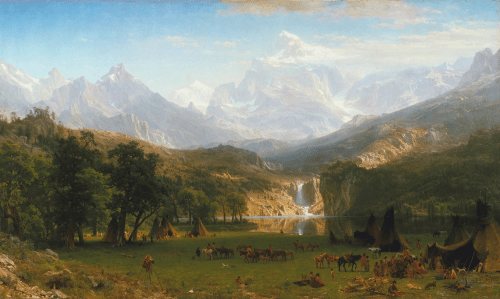
For example, today’s image is a landscape painting by Albert Bierstadt, an American painter best known for his lavish, sweeping landscapes of the American West.  This painting shows what tribal life after a successful hunt might be like, and if you are writing about any group of people who hunt or gather food, this particular painting contain a wealth of historically accurate visual information. He painted what he saw. In all of Bierstadt’s work, you will find a world that existed 150 years ago, complete with children playing and dogs barking.

Wikipedia has this to say about the painter:

Born in Germany, Bierstadt was brought to the United States at the age of one by his parents. He later returned to study painting for several years in Düsseldorf. He became part of the Hudson River School in New York, an informal group of like-minded painters who started painting along the Hudson River. Their style was based on carefully detailed paintings with romantic, almost glowing lighting, sometimes called luminism. An important interpreter of the western landscape, Bierstadt, along with Thomas Moran, is also grouped with the Rocky Mountain School.

The life of the American West of the 19th century can be directly translated into a science fiction novel, or a fantasy novel–because the elements of hunting and gathering remain the same no matter what world you set it in. A great many people were involved in taking down a few animals–two antelope, one mountain sheep, and one bear. Hunts of this nature, even with modern weapons, are difficult and fraught with danger. For this reason, the take from this hunt will supply the entire camp of perhaps 100 people for one or two weeks., so foraging for roots, berries, and greens was an important task, as was fishing.

In this painting, you see how the tribe’s homes were constructed, and how the camp was laid out–the butchering party is well away from the rest of the camp, which is on the banks of a river. Everything that was important to the lives of these people is laid out in detail, exactly how it was the day the artist set up his easel in the wilderness and began painting.

Go to history for your world building, and go to art for your history. Don’t be afraid to ‘waste time’ looking at paintings and examining them for minute details, because your imagination will run with it, and your work will have a sense of realism.


Wikipedia contributors, “Albert Bierstadt,” Wikipedia, The Free Encyclopedia, https://en.wikipedia.org/w/index.php?title=Albert_Bierstadt&oldid=793302910 (accessed August 11, 2017).

The Rocky Mountains, Landers Peak; Albert Bierstadt 1863 [Public domain], via Wikimedia Commons, https://commons.wikimedia.org/wiki/File%3AAlbert_Bierstadt_-_The_Rocky_Mountains%2C_Lander’s_Peak.jpg, accessed August-11-2017.

Comments Off on #FineArtFriday: Albert Bierstadt, The Rocky Mountains, Landers Peak 1860

Filed under #FineArtFriday, writing

#amwriting: give your characters agency

In literature, the word agency is used to define an active vs. a reactive character. Active characters have agency, where passive characters are pushed into predictable actions and boring outcomes.

Chuck Wendig, in his wonderful post on this subject, nails down the heart of this issue: Character agency is, to me, a demonstration of the character’s ability to make decisions and affect the story. This character has motivations all her own. She is active more than she is reactive. She pushes on the plot more than the plot pushes on her. Even better, the plot exists as a direct result of the character’s actions.”

In other words, the character must drive the plot. Until you nail down just who your characters are and what they want, your plot will go nowhere. In this regard, you must give your characters permission to NOT BE PASSIVE.

I am an ‘outliner,’ but I am also a ‘pantser.’ By this I mean that I have an idea, a “What if…” moment, and that evolves into an outline, a guide that is the jumping off point. Once I begin writing, the story goes through a radical evolution, driven by the personalities who inhabit that world.

Because my work evolves drastically over the course of four drafts, the moment I set pen to paper, I start building a stylesheet, also known in the industry as a ‘bible,’ a list of names, places, and relationships, updating it as I go. This is critical so that in the editing process any subtle shifts of spellings or names (and a multitude of other horrible things) can be rectified and made consistent.

We begin with a static idea for the story. We think we know who goes where, what our characters will do, and we think we know how it will end.

You must give your plot structure. In other words, create a good story arc to begin with, but allow your characters to surprise you, taking the story indirections you didn’t originally envision.

We know that the way to avoid obviousness in a plot is to introduce a big threat. How our characters react to that threat should be unpredictable because they have agency.

When we give our characters agency, this threat removes the option of going about life as normal but leaves characters with several consequential choices, the final one of which will be made in a stressful situation.

I used the word consequential relating to the choices your characters must make. I chose that word intentionally. If there are no consequences for bad decisions a character might make, what is the story about?

Why would a random trip to a convenience store interest a reader if something out of the ordinary does not occur? After all—we go out for bread every day, and it’s not too exciting. Frankly, I’m not interested in reading about Bubba buying a loaf of bread. But make him the witness to a robbery and things begin to get interesting. Better yet, give him options:

  1. Bubba can hide and wait for the intruders to leave.
  2. Bubba can decide to be a hero.
  3. What other options does Bubba have? What does he see when he looks around the store?

Whatever Bubba chooses to do, there will be consequences. If things go awry, he could become a hostage. If he goes unnoticed but tells the police what he knows, he and his family could be in danger.

Once he is in the middle of these consequences, Bubba will have more crisis points to face, and a lack of bread for toast will only be one of them. He will have many decisions to make, and each choice will drive the plot.

The obstacles your characters face and the choices they make in those situations are the story. Giving your characters an active role and allowing them agency is what drives a great, absorbing story.


Quotes and Attributions:

Quote from JUST WHAT THE HUMPING HECK IS “CHARACTER AGENCY,” ANYWAY? ©2014 Chuck Wendig, posted June 03, 2014  http://terribleminds.com/ramble/2014/06/03/just-what-the-humping-heck-is-character-agency-anyway/ accessed July 25, 2017.

#amwriting: ensuring consistency: the stylesheet, © 2016 Connie J. Jasperson, posted August 3, 2016 https://conniejjasperson.com/2016/08/03/amwriting-ensuring-consistency-the-stylesheet/ accessed July 25, 2017.

7 Comments

Filed under writing

#amwriting: regaining the mojo

Events in my family during May, June, and most of this month have hampered my mojo, stalling my creative mind. Many projects and plans have fallen by the way and I don’t really mind. This year I will not have my books in the bookstore at the PNWA conference (which kicks off on Thursday), as I just had no time and no way of getting them to the right people by the due date. But that isn’t a big deal, really—I will go to the signing event and visit my friends’ tables and buy their books, so all will be well.

Now, with my son on the mend and back in his own home, I am somewhat at sea. For four weeks, I spent two hours every morning doing wound care on his injured hand, and the rest of the day cooking, cleaning, and entertaining a houseguest. That became my schedule, and writing took the back seat, limited to writing blog posts on the fly—writing if and when I had the time.

Now, I have no demands on my time, no rigid schedule to adhere to. In a way, it’s like suddenly finding myself retired again, only this time I’m not killing time by painting flowerpots. (The last time, it looked like a Mexican pottery stand exploded on our front steps.)

Things have settled back to normal here, and I am struggling to get back into the habit of creative writing. While I have been inspired to write technical posts on writing craft for this blog, and do revisions on my finished novel as my editors ask for them, the rough draft of my new work in progress has languished, receiving erratic, haphazard attention.

Once again, just as I did years ago when I first challenged myself to ‘win’ NaNoWriMo, I am forcing myself to sit down and write from 6:00 am until noon. For me this kind of self-discipline is critical—other people may work better with a less rigid schedule, but I need to keep office hours to be productive.

I work “back and forth” when writing, rather than writing in a linear fashion, although each manuscript starts out in linear way. Each section is written when I am inspired to work on that part of the tale. Like assembling a quilt, I write connecting scenes to ‘stitch’ the sections together when the draft is complete. This is why I make a detailed outline, so I won’t get lost. Now  am revisiting what I have already done on the first draft of this book, finding that I have written the framework for a pretty good story. My notes are all detailed, and the backstory is on file in a separate file so I can access it or update when I have questions. This ensures I will know why certain things are happening.

The maps are drawn, and cover art has been selected—all these things were done in May. The first 50,000 words are written; the book is at the ½ point. The story arc has pretty much followed the original outline with only a few major divergences. The stylesheet is up to date because each change to the originally outlined story was noted as the changes were made. This means I know exactly where I left off in May, and what must happen to these characters to complete this book.

I am itching to get back to it as I want this first draft finished before November, if possible.  I need to have it done by then because November is NaNoWriMo, a month of divine madness—each year I write a patchwork of short stories, novellas, and doggerel, all of which become fodder for the rest of the year.

As an author, I am self-employed. This means I succeed or fail by my own efforts. I choose to succeed, and for me, that means finishing each book to the best of my ability. I am inherently lazy, a self-confessed slacker who would rather read a book or play video games than work—thus I must enforce the puritan work ethic my ancestors brought to America and which somehow passed me by.

10 Comments

Filed under writing

#amwriting: lay, lie, laid

A few days ago, a discussion in an  author’s’ online chat room raised a question, “Is it lay, lie, or what?”

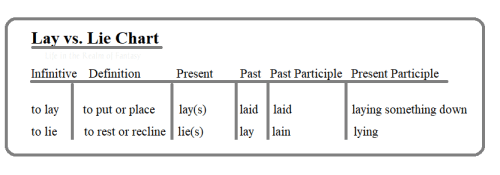
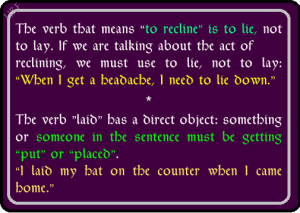
Thus, it’s time to revisit my post on one of the more misused verbs in the English language: the verb lay.’ In my own work, I often have to stop and make sure I am using it correctly. Do I mean to lay down or lie down? It boils down to a simple concept: is the object of the verb RECLINING  or was it PLACED THERE?

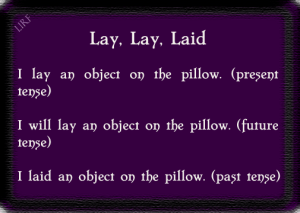
“Lay” is a verb meaning to put or place something somewhere. It has a direct object. Its principal parts are “lay,” “laid,” “laid,” and “laying.”

What the words refer to is the action: If you set it (object) there, it is laying there. Lay it there. Lay it on the pillow.

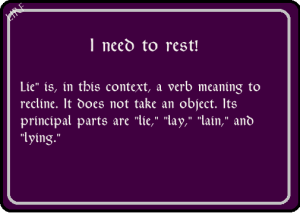
If it is resting or reclining, it is lying there. Lie down. Lying down. Lie down, Sally. (Clapton had it wrong? Say it isn’t so!)

The internet is your friend. Quote from the wonderful website Get it Write: The verbs to lie and to lay have very different meanings. Simply put, to lie means “to rest,” “to assume or be situated in a horizontal position,” and to lay means “to put or place.” (Of course, a second verb to lie, means “to deceive,” “to pass off false information as if it were the truth,” but here we are focusing on the meaning of to lie that gives writers the most grief.)

This is where things get tense: present, past, and future.

A ring lay on the pillow. 

But I needed to rest:

So what this all boils down to is:


But just to confuse things:

A living body lies down and rests as is needed.

A dead body is cleaned up and laid out by other people if said corpse was important to them. However, after having been laid out the corpse is lying in state to allow mourners to pay their respects.


Attributions and Credits:

This post first appeared on Life in the Realm of Fantasy on July 15, 2015, as Lay, Lie, Laid, © 2015-2017 by Connie J. Jasperson, all rights reserved.

Quote from: To Lie, or To Lay, Get it Write online, http://www.getitwriteonline.com/archive/051402lielay.htm, accessed July 11, 2017

4 Comments

Filed under writing

#amwriting: What Editors Want

My Writing LifeToday we are discussing a particular kind of editor: the submissions editor. When I first began this journey, I didn’t understand how specifically you have to tailor your submissions when it comes to literary magazines, contests, and anthologies. Each publication has a specific market of readers, and their editors look for new works their target market will buy.

In the publishing world, there are several different kinds of editors:  line editors, structural editors, submissions editors, and so on. Each does a specific job within the industry. When you look at the annual salaries, you can see that none of these jobs pay well, so it’s clear that, while they like to eat and pay the mortgage as much as any other person, editors in all areas of publishing work in the industry because they love a good story.

I’m just going to lay it out there for you: it’s not worth a publisher’s time to teach you how to be a writer. You have to learn that on your own.

So, if they aren’t going to edit your work, what does the editor for that publisher do?

According to Lynne Barrett in her article for The Review Review: A magazine editor is a person who enjoys bringing new writing to the world in a publication that will be seen, read, appreciated, and talked about.

Editors for contests and large publishers of books do the same—they find and bring work they enjoyed to the public. If your work has made it into that first part of their process, they may ask you for revisions to enable the book to sell better, but they won’t offer you technical advice.

This is because they shouldn’t have to. You must have the technical skill down before you submit your work to an agent or submissions editor. But if the gatekeeper wants perfect work, how do you get your work inside the gate?

You must do the work of submitting a clean manuscript that is marketable to the readers of the publication you are courting.

I know! If we have to do all the work why bother? For the indie author, magazines, contests, and anthologies are the most logical places for getting their names out to the reading world.

Large publications have wide readerships. The more people who read and enjoy a short piece by you, the more potential readers you have for your novels. These people likely read novels and guess what? If you have done your work as an indie publisher well, your novels are available as both paper and ebooks through Amazon, Barnes and Noble, and other digital booksellers.

When you have a great story that you believe in, you must find the venue that might be interested in your sort of work. This means you must buy magazines, read them, and write to those standards. For those of us who are not able to buy magazines, you can go to websites like Literary Hub, and read excellent pieces culled from various literary magazines for free.This will give you an idea of what you want to achieve and where you want to submit your work.

Go to the publisher’s website and find out what their submission guidelines are and FOLLOW THEM. (Yes, they apply to EVERYONE, no matter how famous, even you.) If you skip this step, you can wait up to a year to hear that your manuscript has been rejected, and they most likely won’t tell you why.

Formatting your manuscript is crucial. If you are unsure how that works, see my blogpost of July 24, 2015,  How to Format Your Manuscript for Submission.

Lascaux 2015For an excellent article that explains the expectations magazine publishers AND authors have and our symbiotic relationship, I suggest you read What Editors Want; A Must-Read for Writers Submitting to Literary Magazines by Lynne Barrett. This article touches on every aspect of the relationship between authors and submissions editors for ALL sorts of magazines, anthologies, and publishers in general:

  • The Editor’s Job
  • Your Job
  • Submission
  • How to Receive a Rejection
  • How To Respond To A Minimally Encouraging Rejection
  • How To Respond To A Longer, More Personal Rejection
  • Acceptance: Dos and Don’ts
  • How To Greet The Issue Your Work Is In

As I’ve said before, I have enough rejections to wallpaper my house, but I have also had a few short pieces accepted.  Not everyone will love your work–you don’t love everything you read either.

You have to keep trying, keep improving as an author, and keep believing in yourself and in your work. Most importantly, you must never give up.

25 Comments

Filed under writing

#amwriting: The External Eye

Quill_pen smallI’m in the depths of revisions on two manuscripts. Both are set in the same world. Both manuscripts had flaws that were caught by my friend Dave, who reads my work before I bother an editor with it. Addressing these flaws was not a problem, as I had someone to help me brainstorm it.

Dave has great ideas, but his mind doesn’t work the way mine does. While they are excellent, his fixes usually don’t fit what I envision my story to be. However, his suggestions fire my own inspiration and show me the way I need to go to quickly resolve these issues. Without his insight, I wouldn’t have thought of the right fix.

In the process of rewriting certain events to remove  fatal plot-holes, and then going through and altering later scenes to make them match, I found several places where I meant to change the wording of a scene, so it reflected what I wanted for my protagonist(s). I had noticed these places earlier but was sidetracked, and the intended alterations were never made. Thus, their motivations were murky and didn’t ring true.

Now I am also making these changes, and checking the manuscripts to make sure I have removed any inconsistencies.

My original view of my protagonist, Billy Ninefingers, was more callous, more of a pirate than he is today. His story was begun in 2010, but I ran out of steam on it, and nothing seemed to make sense. I decided to scrap it and move on to writing Huw the Bard, which was set in that world, with many of the same characters, but which was a more intriguing story to me at the time. (I’m still in love with Huw.) Billy appears toward the end, much as he is today. But, instead of going back to Billy, I wrote three more novels in the Tower of Bones series, and many short stories, both contemporary and fantasy.

In the back of my mind, I always intended to get back to Billy Ninefingers, but never really did until just this last year. Over the course of six years  I used him as a character in several other works set in his world, which set him and his circumstances more clearly in my mind. Through that process, my protagonist became less two-dimensional, less of a cartoon. Four years after writing the first draft of Billy’s story, a short story featuring him was published. It was written for a themed anthology, and adhering to that theme changed Billy and his motives for the better. The short story for the anthology fired me up, gave me ideas as to what had to happen to make the real story be what I knew it could be.

I went back and pulled the original manuscript out of storage and rediscovered a character I had always loved, but didn’t know well. With a new goal in mind, I began rewriting it.

Thus, some of what I had already written didn’t dovetail with the story as I now see it, and Dave pointed that out. Having a trusted reader who will tell me where I have gone off the rails is critical to my writing process.

In my experience, when I read my work after having written it, if there is something that doesn’t ring true, a reliable first reader will be able to identify it for me.

Every Tuesday morning I meet with a group of published authors, and we talk about everything, from what we are writing to how our children are coping with the slings and arrows of modern life. These authors give me support when I need it most. I regularly Google-chat about life, the universe, and writing with Dave, who lives in another state far from me. Dave and I have never met in person, but we’ve become close friends through the wonders of the internet.

Talking with fellow authors, both in my area and from around the world, is the most important thing I do for me—it’s a “spa treatment” for my writing craft.

Writing is a lonely craft. I recommend you go to Writers’ Conferences and Workshops. The networking is important, as are the workshops, but I have made lifelong friends through the Pacific Northwest Writers Association Conference, and also the Southwest Washington Writers Conference.

If you need feedback but don’t know where to turn, sit in on local critique groups to see if they might be a good fit for you. You don’t have to share anything until you feel you can trust them to be fair and honest with you. If the group you are visiting doesn’t seem like a good fit, you’re under no obligation to return, and you can move on to a different group. You can find these groups usually through the local newspaper, Google, or even find their public pages through Facebook by searching for your town’s name and adding the word “writers.”

My Coffee Cup © cjjasp 2013One of the surest ways to find these local groups is by joining NaNoWiMo, and searching out your local region. Look at the threads of conversation, or message your local Municipal Liaison to ask where these groups might be.

Having an external eye to help me see my work with a less jaundiced view is the most exhilarating part of writing. It never fails to rekindle the fire I have for a particular story. Right now, thanks to my friends, I wake up every morning, chafing to get started writing.


Attributions:

Quill Pen, PD|by its author, BWCNY at English Wikipedia.

My Favorite Cup, Author’s Own Photo

2 Comments

Filed under writing