Tag Archives: #amwriting

#FlashFictionFriday: The Dog’s Tale

I used to spend a lot of time in the backyard, howling. What can I say? I was young and impulsive in those days.

However, Dave bought me this new collar, which, while it’s really nice to look at, has an inherent flaw. It becomes terribly uncomfortable when I howl or announce the arrival of that vandal who shoves trash through the slot in our door. He seems to be targeting our house. Since I can no longer yell at him to go away, I nip at his fingers through the slot. But he’s crafty now and doesn’t get close enough for me to do any damage.

I’m not complaining, though. I’m no different than any other girl. I’m quite partial to jewelry, and since Dave is my human, I always show my appreciation for his thoughtfulness, even though he has no idea what sort of collar I’d really like. It’s the thought that counts.

However, I hope he understands that the new cover he puts on the sofa when he leaves is not very comfy at all. It buzzes and zaps me when I step on it, so I have to sleep on the floor. At least he doesn’t put me in the kennel when he’s gone, the way some humans do. Bonzo, the dachshund from next door, spends all day in his kennel. I’m only forced to sleep in mine when Dave and that woman have a sleep-over.

It took a while, but I have Dave trained pretty well now. He’s a considerate man, and never forgets to feed me, and he has never once left me alone in the car on a hot day. It’s a good life.

I’m feeling sleepy now, so I’ll just go nap by the front door, and wait for the vandal. He shows up nearly every day just before noon. Today, if he’s careless, maybe I’ll finally draw blood, and he’ll stop throwing trash into our house.

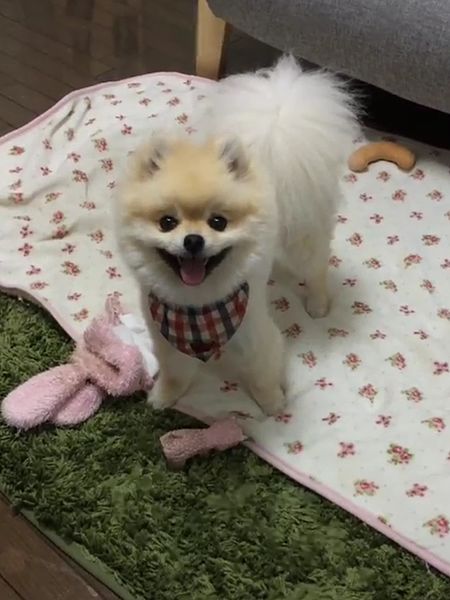
pomeranian-tb2


The Dog’s Tale, © Connie J. Jasperson, 2017

This little bit of flash fiction was inspired by the above photo, found on Wikimedia Commons.

Image: Pomeranian, By Chunbin (Own work) [CC BY-SA 4.0 (http://creativecommons.org/licenses/by-sa/4.0)%5D, via Wikimedia Commons

1 Comment

Filed under #FlashFictionFriday, writing

#amwritng: The #NanoNovel: the mechanics of writing dialogue

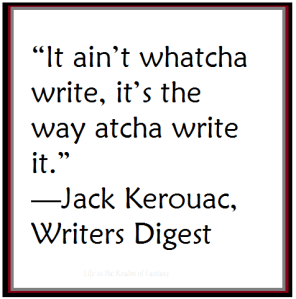
jack-kerouac-quote-memeEveryone has read books that inspire them to become writers. But many authors just starting out don’t know how to write the kind of book they envision.

Consider writing conversations: it’s just people talking, right? No big deal.

Wrong. Many authors just starting out don’t know where the periods (full stops) and commas go, inside or outside the quotation marks. They are inconsistent where they put them throughout the manuscript because they are unsure of what way is right.

They send me things with the punctuation inside the quotation marks sometimes, outside sometimes, and with quote marks missing half the time. I always decline those editing jobs, as it would take a year of my time to get that work into shape. But I do tell them why I couldn’t accept it, and how to correct it so an editor could work with them.

Wrong: “dorothy flew over the rainbow in a house”. Said Toto. I went with her”.

Right: “Dorothy flew over the rainbow in a house,” said Toto. “I went with her.”

1. Always begin what is actually spoken (dialogue) with a capitalized word, no matter where in the sentence it begins.

  • Mary glanced over her shoulder and said, “I’m sorry. I can’t go with you.” 

However, interrupted dialogue, when it resumes, is not capped, although the rules of punctuation and quotation marks still apply.

  • “I’m sorry to tell you,” said Mary, “but I can’t go with you.”

2. Direct dialogue is someone speaking to you or someone else and requires quotation marks.

  • I’m sorry. I can’t go with you,” said Mary.

I’m a US author, so I used double quotes, also called closed quotes. The UK usage is different and often uses apostrophes, or what they call inverted commas.

Regardless of whether you are a UK or US author, be consistent and make sure ALL punctuation goes inside the quote marks.

Yes, I did say All punctuation.

3. How does one set off a quote from someone else within dialogue?

Set it apart with single quotes (apostrophes, inverted commas) and keep it inside the closed quotes. You can do this two ways:

George said, “When I asked her, Mary replied ‘I can’t go.’ But I’m sure she was lying.”

George said, “When I asked, Mary replied ‘I can’t go.'”

Note that in the second sentence 3 apostrophes are placed after the period (full stop): 1 apostrophe and 1 double (closed) quote mark. This is in keeping with the rule that all punctuation in dialogue goes inside the quotation marks.

4. Indirect dialogue is a recapping of dialogue that someone previously spoke.

  • When asked, George said Mary couldn’t go.

Note there are no quotes used in indirect dialogue. Also in the above sentence, the word that is implied between said and Mary.

Dialogue tags, or attributions (said, replied) can come before the dialogue, especially if you want the dialogue tag to be noticed. To make them less noticeable put them in the middle or at the end of sentences. In my own work, I want the dialogue and not the attribution to stand out. However, when more than two people are involved in a conversation, I move the dialogue tags further to the front, so the reader isn’t left wondering who is speaking.

5. You can skip using dialogue tags altogether for a back-and-forth or two, but

  • not if there are more than two speakers in the scene, and
  • not for more than a few exchanges.

Readers want to be able to track who is saying what.

Sometimes it’s okay to miss a few beats. Beats are what screen-writers call the little bits of physical action that is inserted into dialogue. Small actions showing the mood of a character are often best placed where there is a natural break in the dialogue, as they allow the reader to experience the same pause as the characters. They’re an effective tool and are essential to good dialogue, but don’t overdo it. If your characters are fluttering their eyelashes, gazing into the distance or opening their laptops between every second line of conversation, the scene becomes about the action and not the dialogue, and the impact is diluted or lost entirely.

This means that when we add gestures and actions to the conversation we want it to be meaningful,.  Otherwise, just use a simple dialogue tag, like said, or replied.

Please don’t make the mistake of getting rid of attributions entirely because the verbal exchanges become confusing and the action takes over, making the dialogue fade into the background noise of foot shuffling and paper rattling.

I’ve mentioned before that I prefer simple attributions such as said, replied, and answered because they are not as likely to stop the reader’s eye. Some things to consider:

6. People don’t

  • snort,
  • smirk,
  • smile,
  • or frown dialogue as it is physically impossible.

They can say it with a smile, but the smile is a facial expression and does not speak.

Avoid verbal tics like “hmmm…” and “ahhh…” as they just take up space and add fluff to your narrative. When people in real life preface all of their sentences with drawn-out ahs and hmms it can be aggravating to listen to them. Consider how irritating it would be to read it.
writing_conventions_meme_lirf20167. Sometimes we have two ideas in a sentence that we think are one, and we connect them with commas.  But closer examination shows they are not.

  • “Hello, sir, we bathed your dog,” she said.

The above dialogue contains a run-on sentence, despite its shortness. We may actually speak it in this fashion, words run together, but for a reader, punctuation clarifies ideas.

The dialogue contains two separate ideas. “Hello, sir,” is an acknowledgment and a greeting. “We bathed your dog,” indicates an action was taken regarding his dog. It should be:

  • “Hello, sir. We bathed your dog,” she said.
  • “Hello sir,” she said. “We bathed your dog.”

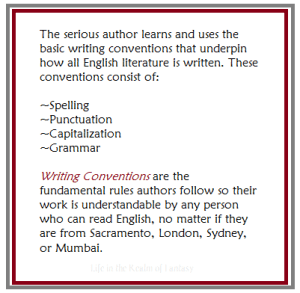
We can take some style and voice liberties with dialogue, and indeed, we should, but adhering to the accepted standard rules of punctuation makes your work readable by anyone who speaks or reads English.


Researched Source:

Section six, Punctuation, pages 306-310: The Chicago Manual of Style, 16th Edition, University of Chicago Press, © 2010

4 Comments

Filed under writing

#amwriting: Thoughts on #NaNoWriMo2016

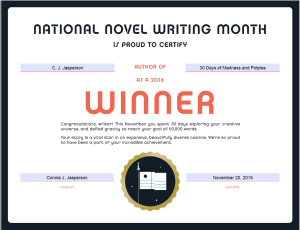
winners-certificateIt is the final day of NaNoWriMo for 2016. I wrote 96,603 words: ten short stories and fifteen chapters on my next novel set in the world of Neveyah. I had my winners certificate by the 23rd, but I write everyday and update my wordcount. More than sixty of the 265 participants in my region will also get their winner’s certificates, which is a very good year. Some years only thirty participants in our region make it to the finish line. On average, 7 out of ten entrants will fall by the way in any given year, because 50,000 words is a difficult goal to achieve in only 30 days, if you are not completely fired up by your novel.

Those who fall by the way are authors who discover that having an idea that would be a good book and writing that book are two radically different things. They are daunted by the amount of work that is involved.

NaNoWriMo (National Novel Writing Month) is a contest in the sense that if you write 50,000 words and have them validated through the national website you ‘win.’ But it is not a contest in any other way as there are no huge prizes or great amounts of acclaim for those winners, only a PDF winners certificate that you can fill out and print to hang on your wall.

It is simply a month that is solely dedicated to the act of writing a novel.

Now lets face it–a novel that is only 50,000 words long is not a very long novel. That falls more into the line of a long novella and is only half a novel, in my opinion. But a dedicated author can get the basic structure and story-line of a novel down in those thirty days simply by sitting down for an hour or two each day and writing a minimum of 1667 words per day.

That is not too hard. In this age of word processors, most authors can double or triple that.

As always, there is a downside to this free-for-all style of writing. Just because you can sit in front of a computer and spew words does not mean you have the ability to write a novel that others want to read.

Over the next few months many cheap or free eBooks will emerge testifying to this fundamental truth.

The good thing is, over the next few months many people will realize they enjoy the act of writing. They will find that for them this month of madness was not about getting a certain number of words written by a certain date, although that goal was important. For a very few, participating in NaNoWriMo has fired them with the knowledge that they are authors. For them it was about writing and completing a novel they had wanted to write for years, something that had been in the back of their minds for all their lives.

These are the people who will join writing groups and begin the long journey of learning the craft of writing. They may go back to school and get their MFA.

These authors will take the time and make the effort to learn writing conventions (practices). They will attend seminars, they will develop the skills needed to take a story and make it a novel with a proper beginning, a great middle and an incredible end.

They will properly polish and edit their work and run it past critique groups before they publish it.

These are books I will want to read.

It’s not easy. Sometimes what we hear back from our readers and editors is not what we wanted to hear. The smart authors haul themselves to a corner, lick their wounds, and rewrite it so it’s more readable. They will be successful, for a variety of reasons, all of them revolving around dedication and perseverance.

But when we write something that a reader loves–that is a feeling that can’t be described.

Authors must keep their day jobs, because success as an author these days can’t be measured in cash. It can only be measured in what satisfaction you as an author get out of your work. Traditionally published authors see a smaller percentage of their royalties than indies, but if they are among the lucky few, they can sell more books.

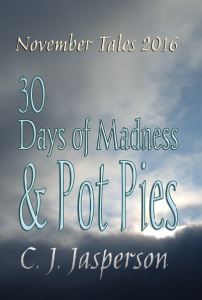
2016-placeholder-book-cover-smallThe fact your book has been picked up by a traditional publisher does not guarantee they will put a lot of effort into pushing a first novel by an unknown author. You will have to do all the social media footwork yourself. You may even have to arrange your own book signing events, just as if you were an indie.

Going indie or aiming for a traditional contract—it’s a conundrum many new authors will be considering in the new year.

However, if you don’t write that book, you aren’t an author, and you won’t have to worry about it. The concept of NaNoWriMo will jump-start many discussions about this very issue.

Today marks the end of NaNoWriMo 2016.  For many, it will be a mad scramble between now and midnight to get their 50,000 words and earn that certificate.

Some of us have completed our first draft, and some of us still have a ways to go. But we are all walking a path that is more rewarding than any high-paying job I’ve ever had.

nanowrimo_2016_webbanner_winner_congrats

7 Comments

Filed under writing

#amwriting: the truth about #NaNoWriMo

NaNoWriMo-General-FlyerEvery author knows that writing is about so much more than merely laying words down on a page.   Most people with a minimal education can do that, and can even whack out a creditable paragraph or two. However, sustaining the momentum and carrying that vision through an entire story is quite another thing.

Over the years, I’ve seen disparaging articles where people have expressed their scorn and disdain of authors who participate in Nation Novel Writing Month, mocking the notion of a “competition.”

But these naysayers are overlooking one important point: to write a novel one must begin a novel and then complete it.

If it takes a special month of writing and a group frenzy to get some people fired up about an idea they’ve had rolling around in their heads, who am I to complain?  I am a reader as much as I am an author, and I say the more, the merrier!

Take a look at some of the most well-known “NaNo Novels” of all time:

  1. Water for Elephants, by Sara Gruen. On the best-seller lists for over a year, turned into a movie starring Reese Witherspoon and Robert Pattinson, started as a NaNo novel.
  2. The Night Circus, by Erin Morgenstern. What eventually became The Night Circus began life in 2004, seven years before it was finally published, started as a NaNo novel.
  3. Wool, by Hugh Howey. Howey’s dystopian sci-fi novel is one of those credited with putting self-publishing on the map, started as a NaNo novel.

I’m not bothered by the “poo-poo on the contest” noise. Whatever gets a writer fired up and writing is fine by me, and we are all the better for the experience.

The real thing that causes angst among the elite is the notion that anyone with an idea can sit down and write the bare bones of a book in 30 days. Being an author is not being in a private club anymore, and it secretly bothers some of the stodgier “real” authors that a person of any background, religion, or ethnicity can dare to write meaningful or entertaining work, even people with minimal education.

Fear and Loathing, we call that. It’s irrational, but then no one ever accused authors of being rational! There will always be a need for more authors and more books, as once a book has been read, the dedicated reader wants a new book. It is the law of supply and demand, and publishing is a business.

The fact is, most people who begin a novel in November do not reach their goal of 50,000 words and never finish those novels. They do not have the discipline to sit down every day and dedicate a portion of their time to this project.

A great number of Nano Authors discover that doing NaNoWriMo is just like doing karaoke. They love to read, and they want to write the next Gone with the Wind, but their work reads like a tone-deaf drunk sounds when singing Wind Beneath my Wings.  They are not talented writers. But so what? The cream always rises to the top, my grandma used to say.

Because of NaNoWriMo, many truly talented people are now embarking on learning a craft, committing their time and resources to educating themselves about how to write a novel that others will want to read. Several years down the road, who knows what wonderful works of fiction will have emerged from this year’s madness?

NANO CrestI only know that I am always looking for a good book, and so I will be first in line, hoping to be blown away by a fresh, new work of art. This is why I volunteer as a Municipal Liaison for NaNoWriMo. Every year we have new, young writers, with fresh, amazing ideas. But we also have many new older people who are writing their first novel, embarking on a dream they always had but never thought they could do.

Most who begin their novel this year will never write again. But every year a few writers  in each age group continue on after the month of madness is over. When I talk to them and hear how fired up and passionate they are, I am proud to have been a part of their writing life. They see the goal, and and are filled with the desire to finish what they started.

They have embarked on the quest to learn how to write well.

2 Comments

Filed under NaNoWriMo, writing

#amwriting: Midpoint in the Character Driven Novel

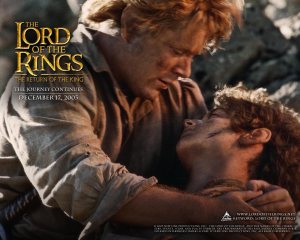
LOTR advance poster 2Some novels are character-driven, others are event-driven.

ALL novels follow an arc.  For my personal reading pleasure, I prefer literary fantasy, which has a character-driven plot. Events happen, often in a fantasy setting, but the growth of the characters is the central theme, and the events are just the means to enable that growth.

You may have built a great world, created a plausible magic system or, conversely, you may have created an alien world with plausible technologies based on advanced scientific concepts. You may have all sorts of adventures and hiccups for your protagonist to deal with. All that detail may be perfect, but without great, compelling characters, setting and action is not reason enough for a reader to stick with your story.

Despite your amazing setting and the originality of your plot, if you skimp on character development, readers won’t care about your protagonist. You must give them a reason to stick with it.

In a character driven novel, the midpoint is the place where the already-high emotions really intensify, and the action does too. From this point on, the forces driving the plot are a train on a downhill run, picking up speed. There is no  turning back now. The characters continue to be put to the test, and the subplots kick into gear.

Of course, plotting and pacing of your entire story arc is critical, but it is especially so from midpoint to the third plot point.

As you approach midpoint of the story arc, the personal growth for the protagonist and his/her friends begins to drive the plot. These are the events that tear the hero down, break him emotionally and physically so that in the final fourth of the book he can be rebuilt, stronger, and ready to face the villain on equal terms.

How does the protagonist react to the events? What emotions drive him/her to continue toward the goal?

In a character -driven novel, this is the place where the protagonists suffer a loss of faith or have a crisis of conscience. It may be a time when the main character believes they have done something unfair or morally wrong, and they have to learn to live with it.

What personal revelations come out about the protagonist, or conversely what does he discover about himself?

This part of the novel is often difficult to write because the protagonist has been put through a personal death of sorts–his world has been destroyed or shaken to the foundations. You as the author are emotionally invested in the tale and are being put through the wringer as you lay it down on the paper.

What has happened? Remember, the protagonist has suffered a terrible personal loss or setback. Perhaps she no longer has faith in herself or the people she once looked up to.

  • How is she emotionally destroyed by the events?
  • How was her own personal weakness responsible for this turn of events?
  • How does this cause the protagonist to question everything she ever believed in?
  • What makes her pull herself together and just keep on going?
  • How is she different after this personal death and rebirth event

LOTR advance posterThe truth underlying the conflict now emerges. Also, the villain’s weaknesses become apparent. The hero must somehow overcome her own personal crisis and exploit her opponent’s flaws. It’s your task to convey the hard decisions she must make, and show that she truly does have the courage to do the job. The villain has had his/her day in the sun, and they could possibly win.

This low point is a crucial part of the hero’s journey, the place during which she is taken down to her component parts emotionally, and rebuilds herself to be more than she ever believed she could be.

At this point in the novel, if you have done it right, your reader will be sweating bullets, praying that Frodo and Sam can just hold it together long enough to make it to Mt. Doom.

2 Comments

Filed under writing

#amwriting: choosing an effective writing group

MSClipArt MP900390083.JPG RF PD

As it is November, and I am attending a lot of write-ins with people just beginning their writing careers, I am frequently asked if I am a member of a writing group. I am, but it is not a traditonal group, by any means. We are all published authors and are more of an author-support beta-reading group. But what the new author is asking, is how to find a group that will be a good fit for them. To answer that question, I am revisiting a post from March of 2015, originally titled “Critique groups vs beta reading groups.”


Every writer needs honest, constructive feedback in order to grow in their craft. Many will join critique or beta reading groups. These groups come in all sorts and sizes, some specializing in general fiction and some in genres like mystery, science fiction, fantasy, or romance.

Most communities have clusters of authors—after all, nowadays everyone either is an author or has a couple in the family . In your community you will find groups for beginners, or some that cater to more advanced crowds. I guarantee there will be one to fit your needs.

We’ve all heard the horror stories regarding critique groups, and perhaps even experienced one. Making a poor choice in writing groups can be devastating—it can undermine a budding author’s confidence and destroy a person’s joy in the craft. The seas are rough out there but many writing groups are really good, supportive gatherings of authors who stay for years and welcome new authors into their group with open arms.

Other groups can be cliquish, unwelcoming, and daunting to new arrivals. Authors just beginning to explore this necessary part of the craft will not come back to one of these groups if they were given the cold-shoulder the first time.

I suggest that you sit in on a group in your area. Do not offer your work on the first time, but do take notes, paying special attention to these points:

  1. Do they treat the submitted work with respect, or do they nitpick it to shreds?
  2. Do they allow discussion of a critiqued work or is the author supposed to sit there and silently take the punishment?

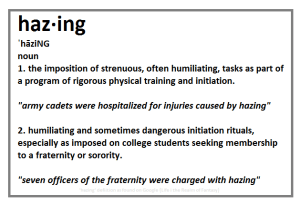
hazing-definitionIf the latter is the case, that group is engaged in a subtle form of hazing, more than in critiquing. Thank them for allowing you to sit in, and walk away from them.

There is a difference in types of writing groups, too. Some are traditional critique groups, people who usually read a few pages aloud at their sessions and discuss it in detail in a round-table fashion. This sort of focus can be just right for some authors, especially those in the final stages of making their manuscript submission-ready.

Because traditional critique groups focus only on 3 or 4 pages at a time, they lack the context to be able to discern if your protagonist has developed sufficiently along his character arc by the first 1/4 of the tale. However, they can tell you if you have made editing errors, and discuss small points of technique within those few pages, which you can then apply to the overall manuscript.

This is an important aspect of the process, but is not always the kind of input an author is seeking.

The one flaw these sorts of groups have is they don’t have the ability to properly critique the larger picture—pacing, overall story arc, worldbuilding, character development, and on, and on–because these things can only be judged in larger context. So if, like me, that is the sort of input you are looking for, my advice is to find a beta reading group.

Critique groups cannot do what beta readers can.

But how do you select a group? Before you join a writing group, you have the right to know what that group focuses on.

A beta reading group will focus on these questions:

  1. Where did my chapter bog down?
  2. What did they think about my characters?
  3. Where did they get confused and what did they have to read twice?
  4. Did it become unbelievable or too convenient at any point?
  5. What do they think will happen to the characters now?

Then after you have sat in on one of their sessions and observed how they treat each others’ work, ask yourself, “What kind of vibes did I get from this group of people? Will I benefit from sharing my work with this group? Did the comments they made to each other sound helpful?” Hopefully, the answer to those questions will be a resounding “yes.”

If the answer is anything other than a resounding “yes,” run now. Run far, far away.

Red Flags to Watch For:

There are common negatives to watch out for in all writing groups: If you have stumbled into a group where the most visible member is a self-important, read-all-the-books-on-writing-so-I-know-it-all kind of a person, don’t bother joining or you’ll be subjected to many accounts of how their writing group in Minnesota was so much better than this pathetic group.

Another author you might watch out for is the ubiquitous Famous-Author-Name-Dropper, a person who must be important because she has been to a great many seminars and conventions with these famous people, and hung out in the bar with one of them once. If it turns out she is in your prospective group, it may not be the group you are looking for. Sometimes they are the same person, sometime not, but either one of these wannabe-famous authors are poison—in their eyes the group only exists to admire them, and they will casually cut your work to shreds, dismissing it as merely amateur in the face of their “professional” experience.

When you are considering joining a group, ask the leader/chairperson these questions:

  1. If the group is a beta reading group focused on first drafts, what do they consider a first draft? Do you have to hire an editor and have it thoroughly edited before you submit it to this group? I say this because a fully edited manuscript is not a first draft, and that group would be a waste of your time.
  2. Will you receive insights into your manuscript on points you hadn’t considered, or will the focus of the discussion centered on minor editing issues that you are already aware of?
  3. Ask the leader to define for you the specific areas that readers will be looking at:
  1. Character development,
  2. pacing the arc of the scene,
  3. pacing the arc of the conversation,
  4. worldbuilding,

So let’s say you have found a group who seems to a good bunch of people, and yes, they read and write in your genre. You trust them enough to submit your first piece to the group. After the session is over, ask yourself:

  1. Do I still feel positive about my work or do I feel like my work was treated as being less than important?
  2. Did I gain anything from the experience that would advance the plot or did I just hear a rehash of arm-chair editing from a wannabe guru?

that which does not kill meThe answers to these questions have to be that you feel good about your work, that you saw through their eyes the weaknesses, and that they can be fixed.

New authors join writing groups feeling a great deal of trepidation, filled with uncertainty and fear. They fear being belittled and told their work is crap, and sometimes that happens. At the end of the day, you have to feel as if you have gained something from the experience.

Hopefully you will be as fortunate as I have been, and find a group of beta readers you can mesh with, people who will support and nurture you in the same way that you will them.


This post was first published March 2, 2015, under the title “Critique groups vs beta reading groups” by Connie J. Jasperson

7 Comments

Filed under writing

What reference guide is right for what I #amwriting?

The_Chicago_Manual_of_Style_16th_editionNovember is a difficult month for me because I have a specific goal to accomplish, and I’ve set the bar high. It’s National Novel Writing Month and I have many activities involved with that. I need to add writing time to my already packed schedule, attempting to rebuild my stockpile of short fiction and essays, and am letting everything else fall by the way to do it. Trader Joe and the Microwave are providing my husband with hot meals because I have been known to forget to cook.

For my NaNoWriMo project this year I am writing a variety of short pieces, some technical essays on writing craft, some essays on life and travel, and some short fiction. I am writing for three different markets and we will get to why that distinction is important a little further on.

I’m on the road a lot, and have limited time to get my wordcount. Sometimes I get two or three pages of writing done in the 20 or 30 minutes before I have to leave the house for an appointment. There is something about the pressure of knowing I will have to quit at a certain time that forces me to be more productive than I would ordinarily be.

Why is this? When I am pressed for time I use every second to get those ideas out of my head. I don’t have the luxury of stopping to research grammar and questions of style on the good, old, time-wasting internet. Instead I refer to hardcopy reference manuals, unless I absolutely must go out to the internet to research something.

Some references have to be in hardcopy, such as The Chicago Manual of Style, which is the most comprehensive style guide geared for writers of essays, fiction, and nonfiction. Strunk and White’s Elements of Style is an acceptable beginner style guide, but the information there must be looked at with a critical eye as it is presented in an arbitrary, arrogant fashion and sometimes runs contrary to commonly accepted practice.

Instead I always recommend The Chicago Manual of Style to authors who are writing fiction they someday hope to publish, and who want to know about sentence construction. The researchers at CMOS realize that English is a living changing language, and when generally accepted practices within the publishing industry evolve, they evolve too.

Writing is not a one-size-fits-all kind of occupation. There is no one style guide that will fit every purpose. Each essay and book may be meant for a different reader, and each should be written with the style that meets the expectations of the intended readers.

The Chicago Manual of Style is written specifically for writers, editors and publishers and is the publishing industry standard. All the editors at the major publishing houses own and refer back to this book when they have questions.

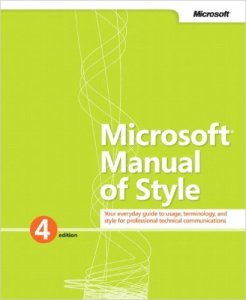
micosoft-manual-of-styleWhat is the best style guide for writing technical user manuals?

Are you writing for a newspaper? AP style was developed for expediency in the newspaper industry and is not suitable for novels or for business correspondence, no matter how strenuously journalism majors try to push it forward. If you are using AP style you are writing for the newspaper, not for literature. These are two widely different mediums with radically different requirements.

For business correspondence, you want to use the Gregg Reference Manual.

If you develop a passion for the words and ways in which we bend them, as I have done, you could soon find your bookshelf bowing under the weight of your reference books.

Some of my best ideas have come about under a time crunch.  Normally when I am writing on a stream-of-consciousness level, I can key about fifty words a minute, which I know is paltry compared to today’s authors who grew up keying their homework rather than writing it in cursive.

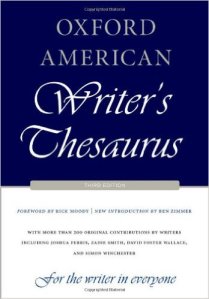
ozford-american-writers-thesaurusI do admit that just because I can key those words does not mean they will all make sense, or be worth reading. That is why we are driven to look at what we just wrote the day after we wrote it. Did it say what I meant? How many times did I use the word “sword” in that particular paragraph and where am I going to find six different alternatives for such a unique weapon? Sword? Blade? Steel? After all, an epee is not a claymore, nor is it a saber. Any reader with a small amount of knowledge will know that, so I have to be careful what synonyms I use. My characters swing a claymore-style of sword which is rarely referred to as “steel.” In literature, that term is more commonly used for epees and rapiers.

It’s a jungle in my head sometimes, and my ancient  student edition of Roget’s Thesaurus is no longer my friend. But neither is the modern, online version cutting it. I need more synonyms. Lots, and lots more! Thus I have the Oxford American Writers’ Thesaurus on my desk and I refer to it regularly. It saves time to use the hardcopy book rather than the internet because I am not so easily distracted and led down the bunny trail of “Wow! I never knew that!”

All in all, I like the way being forced to produce words in a short time helps me lay down a rough draft. But I admit, I do look forward to the end of November, when I can look back on my accomplishments and go back to my normal writing routine of wasting time on the internet researching important things like the life cycle of sand dollars. Who knew those little creatures were so intriguing?

2 Comments

Filed under writing

#amwriting: circumstance, objective, and the story arc

Book- onstruction-sign copyIf you intend to write a novel, especially a fantasy novel, a little pre-planning and at least a smidge of an outline is really beneficial.

Consider the beginning: At the outset of any good story, we find our protagonist, and see him/her in their normal surroundings. An event occurs (the inciting incident) and the hero is thrown out of his comfort zone and into the Situation, which is the core idea of your plot.

This is the circumstance in which your protagonist finds himself at the beginning of the story. Some things for you consider before you you begin writing:

  • How will the story start?
  • What is the hero’s personal condition (strength, health) at the beginning?
  • How will that condition be changed, for better or worse, by the hero himself or by the antagonistic force?
  • What could possibly entice him out of his comfort zone?

Now we come to the core of your story: Objective. Without this, there is no story.

In every class I’ve taken on plot development, the instructors have emphasized that a protagonist has no reason to exist unless he/she has a compelling objective. If your main character doesn’t want something badly enough to do just about anything to achieve it over the next couple hundred pages, then he doesn’t deserve to have a story told about him.

That harsh edict is true because everything you will write from the moment of the inciting incident to the last page will detail that quest. Your protagonist must desire nothing more than to achieve that objective. Every scene and conversation will push the protagonist closer to either achieving that goal or failing, so if you make it a deeply personal quest, the reader will become as invested in it as you are.

In the book, Tower of Bones, Edwin wants to free Marya from captivity in Mal Evol. It’s a mission that begins as a somewhat noble desire to help his friends free a healer he has never met, but along the way he realizes she is the girl he has been dreaming about for several years. Once he realizes that, it becomes personal, and he becomes driven. That is when it becomes a real story.

When writing fantasy, you need a broad outline of your intended story arc, and you really need to know how it will end. If you try to “pants” it, you might end up with a mushy plot that wanders all over the place and a story that may not be commercially viable.

  • What will be your inciting incident?
  • What is the goal/objective?
  • At the beginning of the story, what could the hero possibly want to cause him to risk everything to acquire it?
  • How badly does he want it and why?
  • Who is the antagonist?
  • What moral (or immoral) choice is the protagonist going to have to make in his attempt to gain that objective?
  • What happens at the first pinch point?
  • In what condition do we find the group at the midpoint?
  • Why does the antagonist have the upper hand? What happens at the turning point to change everything for the worse?
  • At the ¾ point, your protagonist should have gathered his resources and companions and should be ready to face the antagonist. How will you choreograph that meeting?

These are just a few things to think about when you are planning to write a fantasy novel, because so much goes into world building and creating magic systems that it is easy to get involved in large info dumps and bunny trails to nowhere.

Some people are able to visualize a story in its entirety and can write a coherent first draft without even a minimal outline.

I am not one of those people, nor are the majority of writers. An outline will tell you what you need to have happen next to arrive at the end of the book in a reasonable number of words: 100,000 to 125,000 for a first epic fantasy novel. You don’t have to go into detail, but if you give yourself a rough outline, you will know how many words you have to accomplish each task within the story line.

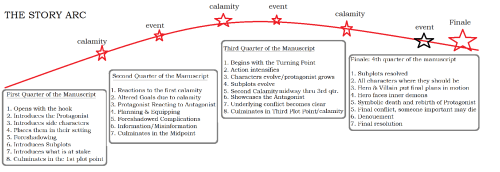
The Story Arc

You want to have a smoothly functioning story arc, so you don’t become desperate and resort to killing off characters just to stir things up.  That doesn’t really help, because you run out of characters, and people don’t like it when you kill off someone they liked.

Besides, you might need that character later.

2 Comments

Filed under Fantasy, Literature, writing

#amwriting: bloated conversations are bad for business

SUPPORT YOUR LOCAL AUTHORSBeing an author is a business. It is a retail business, and you must look at it from that point of view, even if your work isn’t selling like hotcakes at the local diner. Big, fat books that are full of bloated exposition and conversations to nowhere are more expensive to publish and are unlikely to sell once the prospective reader has leafed through them.

Once you have a book published, you have a business, whether you are an Indie or traditionally published, and you must think about it from that angle. Wouldn’t you like to see some money from your work? Your best chance of this is at trade shows and book signing events. However,

  • In the real world, authors must pay for each book that is stocked on their table.

“This won’t apply to me,” you say.  “I’m going the traditional route. Once I sell my book to that Big Publisher in the Sky, he will provide me with all the copies of my books that I will ever need when I do signings, at no cost to me.”

Not so, my deluded friend.

A traditional publisher who is really excited about your book might arrange for you to have a table at a convention and will advance you copies of the books for you to sell and sign, but the cost of those books will come out of your earned royalties. You will see no money from your publisher until your book has out-earned all the advances they have paid you. So, just like an Indie, you pay for the books for your table at trade shows, conventions, and at most book-signings. The fact is, many traditionally published authors never out-earn their advances. Retail sales at shows are where they stand the most chance of bringing home money from book sales.

Consider how many copies of each book you can afford to take to the book signing event. You must weigh this cost against what you think the demand will be. Books that cost YOU more than $5.99 each are not a good thing for an Indie, because you must pony-up the cash at the time you order them. If you buy too many and they don’t sell, you have a lot of cash tied up in stock-on-hand that is earning you nothing.

For an indie who writes epic fantasy, it’s most cost-effective to keep your work to between 90,000 and 120,000 words if you intend to print through CreateSpace, which prints my paper books. If you have written a 300,000-word epic fantasy, consider dividing it into three volumes of 100,000 words each. Otherwise, you will be required to charge $17.99 to $20.00 per book just to make a minimal profit through Amazon.

How do we keep this cost down? We get a grip on the fluff that has worked its way into our work, and trust me, I didn’t understand this when I first began writing full time.

In the first draft, we have created a large amount of backstory. This is because we needed it to get a grip on the characters, their world, and the situation in order to write it. This is work the reader does not need to know the minuscule details of. To avoid info dumps and yet deploy the background as it is needed, we write conversations.

We need to exercise restraint. In the second draft, we decide what is crucial to the advancement of the plot and what could be done without. In recent years, I have begun cutting entire chapters that, when I looked at them realistically, were only background. In some cases, it was my favorite work, but when looked at with an independent eye, it didn’t do anything but stall the forward momentum of my book.

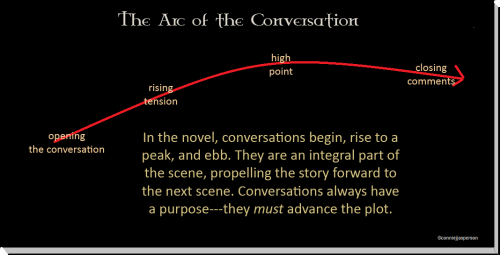
So how do we convey a sense of naturalness and avoid the pitfalls of the dreaded info dump and stilted dialogue? First, we must consider how the conversation fits into the arc of the scene.

The Arc of the Conversation

It begins, rises to a peak, and ebbs, an integral part of the scene, propelling the story forward to the launching point for the next scene. A good conversation is about something and builds toward something. J.R.R. Tolkien said, “Dialogue has a premise or premises and moves toward a conclusion of some sort. If nothing comes of it, the dialogue is a waste of the reader’s time.”

First, we must identify what must be conveyed in our conversation.

  1. Who needs to know what?
  2. Why must they know it?
  3. How many paragraphs do you intend to devote to it?

My rule of thumb is, keep the conversations short and intersperse them with scenes of actions that advance the plot. Think like a screenwriter–visualize the conversation as if you are viewing it on a stage. Does the thought of two heads yammering about the weather for half an hour really interest you? No. Show the weather and spend your conversations on the important things. Walls of conversation don’t keep the action moving and will lose readers.

Author James Scott Bell says dialogue has five functions:

  1. To reveal story information
  2. To reveal character
  3. To set the tone
  4. To set the scene
  5. To reveal theme

So now that we know what must be conveyed and why, we arrive in the minefield of the manuscript:

  • Delivering the backstory.

CAUTION INFO DUMP ZONE AHEADDon’t give your characters long paragraphs with lines and lines and lines of uninterrupted dialogue. Those can become info dumps laced with useless fluff and are sometimes seen as a wall of words by the reader.

When the dialogue is trying to tell the reader too much, characters end up saying a lot of unnatural and awkward things. Characters go back and forth explaining precisely what they are feeling or thinking, and it doesn’t seem remotely real.

  • Background information must be deployed on a “need to know” basis. If it is not important at that moment, the reader does not need to know it.
  • The only time exposition works is when both the reader and the character being spoken to do not know the information being artfully dumped.

When reading, even dedicated readers will skip over large, unbroken blocks of words. Elmore Leonard famously said, “Try to leave out the part that readers tend to skip.”

I feel this goes double for dialogue.

4 Comments

Filed under Publishing, writing

#amwriting: the importance of foreshadowing

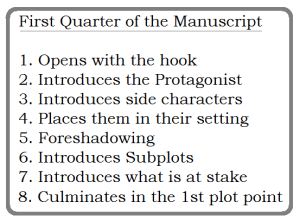
Elements of the Story 1st Quarter of the MSForeshadowing is part of the craft of writing, and is a useful tool a when an author is writing fiction. It is a critical trope when writing fantasy. In the first quarter of the story, you should have a few clues embedded in the narrative, something to subliminally alert the reader, little warnings signs of future events.

The key to good foreshadowing is to not spoil the surprise, yet allow the reader to say in retrospect, “I should have seen that coming.”

We insert small hints, little offhand references to future events, briefly, almost offhandedly mentioned, but almost immediately overlooked or ignored. Some readers will fail to notice the suggested possibility just as the unsuspecting characters do, and others will guess what is going on. In a well-written narrative, both kinds of readers will stick with it as they will want to see how it plays out.

We have many reasons to pursue good foreshadowing skills. They help us to avoid inadvertently employing the clumsy Deus Ex Machina (pronounced: Day-us ex Mah-kee-nah) (God from the Machine) to miraculously resolve an issue. A Deus Ex Machina occurs when, toward the end of the narrative, an author inserts a new event, character, ability, or otherwise resolves a seemingly insoluble problem in a sudden, unexpected way.

Then, there is the opposite ungainly literary device: the Diabolus Ex Machina (Demon from the machine). This is the bad guy’s counterpart to the Deus Ex Machina. In this instance, the author suddenly realizes the evil his character faces isn’t evil enough and wham! We see the sudden introduction of an unexpected new event, character, ability, or object designed to ensure things suddenly get much worse for the protagonists.

We have to avoid cases where a character suddenly gets a new skill or knowledge without explanation. In screenplays and TV shows, when a character suddenly gets a new skill without explanation, it’s usually explained away as a Chekhov’s Skill.

In a book, you need to mention prior examples of the characters using, or having received training in that skill. If you don’t briefly foreshadow it, the character doesn’t have it. If the reader realizes the character never possessed that skill before, it becomes unbelievable.

Wm Shakespeare author central portraitHow has literature and the expectations of the reader changed over the centuries? Nowadays, in genre fiction especially, a prologue may or may not be a place for foreshadowing, as modern readers don’t have the patience to wade through large chunks of exposition dumped in the first pages of a novel.

Consider William Shakespeare’s Romeo and Juliet, a play that is heavy with both exposition and foreshadowing. According to Philip Weller, Professor of English at Eastern Washington University, on his site, http://www.shakespeare-navigators.com:

“Technically, the Prologue (of Romeo and Juliet) is not foreshadowing. Foreshadowing hints at what will happen later, but in the Prologue, the Chorus doesn’t hint — he tells. The second quatrain of the Chorus’ sonnet sums up the plot of the play:


From forth the fatal loins of these two foes

A pair of star-cross’d lovers take their life;

Whose misadventured piteous overthrows

Do with their death bury their parents’ strife (Prologue 5-8)


“The next quatrain repeats the same message, and because this message is hammered home early, the later foreshadowings in the play are ominously recognizable.” (end quoted text.)

There is a difference between foreshadowing and telling. How does Shakespeare foreshadow the larger events? Larger events may be foreshadowed through the smaller events that precede them. Again, we will examine Romeo and Juliet. Early in the first act, when Benvolio is trying to talk Romeo out of his infatuation for Rosaline, he tells him,

“Take thou some new infection to thy eye,

And the rank poison of the old will die.”  

As we see later, Benvolio’s advice is correct because as soon as Romeo lays eyes on Juliet, his obsession with Rosaline disappears. More foreshadowing occurs later, in the third act, when Benvolio brings the news that Mercutio is dead. Romeo says,

“This day’s black fate on more days doth depend;  

This but begins the woe, others must end.”

Again, Philip Weller explains,

“It’s as if Romeo is envisioning the death of Mercutio as a dark thunderhead, racing across the sky above him and into the unknown future. Romeo knows he has reached a point of no return; he will fight Tybalt to avenge Mercutio, but he knows that won’t be the end of anything. Then, after he has fought and killed Tybalt, cries out, “O, I am fortune’s fool!” (3.1.136). Here “fool” means “plaything” or “dupe.” Romeo knows he is no longer in control of his fate. (end quoted text.)

William Shakespeare understood the difference between foreshadowing and telling the story, and he made use of both techniques to good advantage.

Modern authors writing genre fiction must be gentler with their foreshadowing than Shakespeare was required to be. Foreshadowing should be woven into the narrative in such a way that the story flows smoothly, allowing the reader to remain immersed, but tantalizing them with hints that will keep them reading.

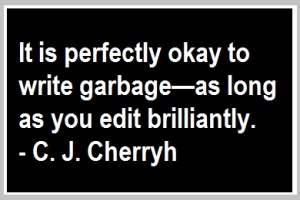
ok to write garbage quote c j cherryhSmoothness is the key word here. I’ve seen manuscripts that seem schizophrenic as if they were “Frankensteined” together. The author begins by telling one story, and somewhere around the middle, we find ourselves reading a completely different novel as if it were two manuscripts inexpertly sewn together and reworked into one. Foreshadowing, if there was any, seemed like a thread to nowhere.

Clumsy foreshadowing, or neglecting to foreshadow are things we do when laying down the first, rough draft, of our story. These flaws are a fundamental part of the creative process and are why we never publish a rough draft. Let it rest for several weeks and work on something else, then come back to it. In the second draft we check for, and iron out, these kinds of issues. During the second draft, if you have used subtle foreshadowing in advance of the events (usually in the first quarter of the story arc, before the first plot-point) the novel really begins to take shape.


Weller, Philip. Romeo and Juliet Navigator.

Shakespeare Navigators, n.d. Web. 20 Sept. 2016.
<http://shakespearenavigators.com/romeo/index.html>

>>><<<

Shakespeare, William. Romeo and Juliet. Ed. Philip Weller.

Hamlet Navigator. Shakespeare Navigators, n.d.
Web. 20 Sept. 2016. <http://shakespearenavigators.com/romeo/index.html>

3 Comments

Filed under writing