Tag Archives: blogging

The wisdom of the ages

Caution this sign has sharp edges meme funny-image-2598-600x512

Memes–the internet is rife with them. I love them! Snarky little one-liners, inspiring quotes, cute kitty pictures–memes are the guru at the top of the mountain, waiting to dispense the wisdom of the ages! I especially love book-oriented memes. How do these people know what I am thinking?

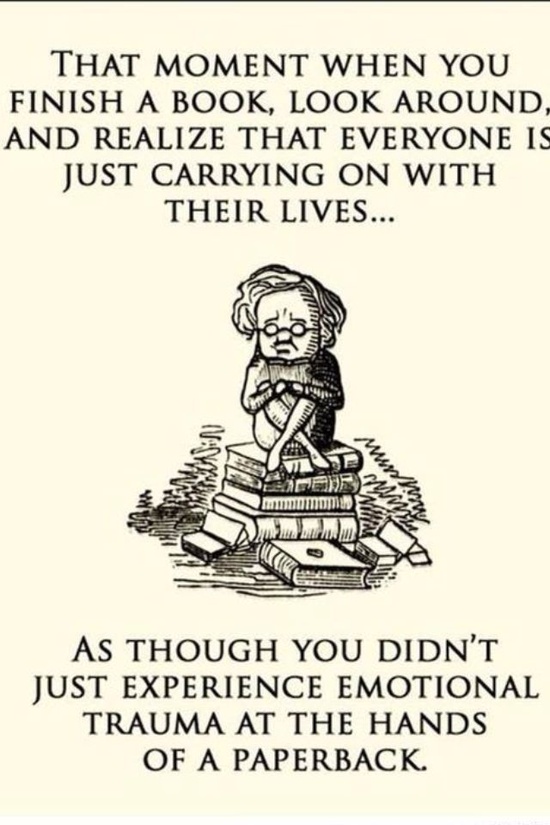
book hangover

Wow meme writer–I know! I have the same trouble!

i read because meme

True dat!

And my personal favorite:

BQ5

Ooohh!  Here’s a good one for all you devoted Percy Jackson fans!!

rick riordan tumblr_mczecjFqas1r2ycgu

But life isn’t complete without a Harry Potter meme!

piseed-off-harry-meme-generator-harry-potter-grammar-wizard-gets-really-ticked-off-when-people-don-t-use-commas-correctly-2cdeb5

Comments Off on The wisdom of the ages

Filed under Books, Fantasy, Humor, Literature, Publishing, Self Publishing, Uncategorized, writer, writing

Virtual unreality

midnight-new-years-champagneWhat are your New Years traditions? Normally my hubby and I do something a little fun to celebrate, but this year we were pretty low-key. I’ve been suffering from a flu-like virus, and I was finally fairly mobile, enough to go out to dinner at the local Mexican restaurant we like so much.

Then we spent New Year’s eve at an all-night party with friends from all over the world. I love the virtual reality of the internet universe. You’re never alone unless you log off Facebook.

canapes (1)My publisher, Myrddin Publishing threw a great virtual New Year’s party on Facebook where the authors and readers got to meet and have a rollicking time in the virtual universe. For a short time (until Sunday Jan 4th 2015) kindle downloads of Huw the Bard and Tales From The Dreamtime are on sale for .99 cents.

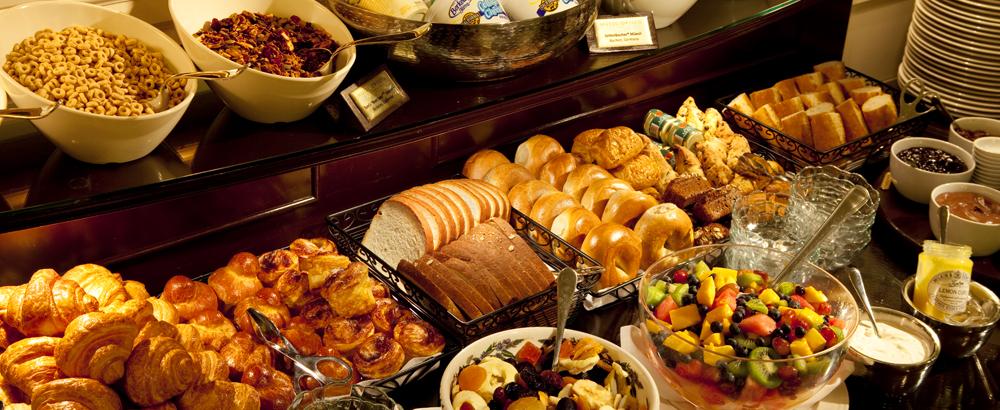
breakfastThe party is still going on today, with a virtual breakfast being served, and people popping in and out. I’ve had a lot of fun with that, despite being under the weather. And this morning on New Years Day, I actually feel good.

So what are my goals for this new year that looms fresh and untrammeled before us?

My goal is to create and implement a marketing plan for my books.  This is something I have attempted, but have always become side-tracked by life, and never got back to it. From what I’ve read on the internet this involves a combination of things:

1. During January I’m going to create a plan-of-action, and map out my strategy. Once I know the answers to the next two questions I will be able to develop a plan of attack.

2. I will identify my audience.  This is hard–I write for my own amazement, so I’m not sure what my audience is! But I will spend some  time figuring that out, and I will blog about the process.

2. I will figure out what makes my books different from all the other books out there, aside from their obvious, amazing wonderfulness. This is also difficult! I wrote these things while in a trance, apparently, as the minute someone asks me about them, my mind goes blank and I have no idea how they got here, or what they’re about. I will probably blog about that process too.

3. I will budget $$ for Google ads and Goodreads ads, and see how they perform. My Goodreads ad seems to get a lot of clicks, but I’m not sure it translates into sales. I haven’t done a Google ad yet.

Possibilites copyI’m pretty lousy at blatant self-promotion. But I intend to make this a good year for honing my marketing skills in such a way that I can sell a few books without annoying my friends!

It’s a brand new beginning, with endless possibilities. In completing and publishing my books, I’ve already achieved dreams I never thought possible, and now a new year lies before me. How wonderful to know that anything can happen!

Comments Off on Virtual unreality

Filed under Adventure, Battles, Books, Fantasy, Humor, Literature, Publishing, writer, writing

The author’s voice

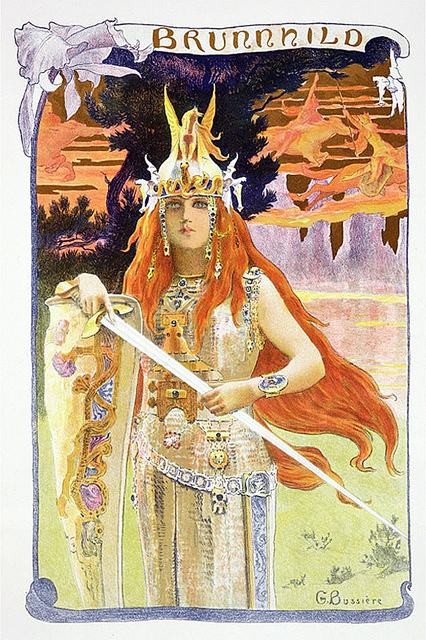
Brunhild_(Postkarte),_G._Bussiere,_1897All authors have a voice, although many can’t sing. I have 8 good notes and I’m not afraid to use them in singing the odd song now and again. Tad Williams can sing, and has the cd to prove it.

But what do I really mean when I speak of an author’s voice?

We become attached to certain authors because when we read their works, we hear their “voice.” We hear them speaking to us.

Each author writes with a certain style, or in other words, the words he or she habitually uses that makes his or her writing unique. “Voice” conveys the author’s attitude, personality, and character.

You have all heard me say that having a manuscript properly edited before publishing it is crucial for the indie author’s credibility. You may ask, “what is this process, and how do I retain my voice, and control of my work when someone else is intent on hijacking it?”

First of all, a good editor will never try to hijack your work. Writers intentionally use symbolism and thematic consistency. We sometimes intentionally repeat certain words for emphasis. These things are significant to us, and a good editor will recognize that.

So what does an editor look for in a manuscript?

Indies are looking for an editor who “helps a writer develop a book from idea or outline or initial draft. Makes sure the book will meet the needs of the publisher and its readers. Will work with the author through any number of drafts. Often works with writers of non-fiction. Guides the writer in topics to be covered in or omitted from the book.” quoted from the Editors Blog.

In other words indies want a structural editor.  What will this editor do for them?

The professional freelance editor will read your manuscript, looking for the rough spots and inconsistencies that work their way into every final draft. They will suggest you correct certain grammatical errors and habits that interfere with the flow of your work, and give you an idea of how those corrections could be made. They will also point out things that are unnecessary background–info-dumps that have slipped through, and suggest you remove them.

Also a structural editor may suggest that a section be moved to a different, more appropriate place in the manuscript. This editor will devote a month or more of their time to your manuscript. This is a hefty commitment on their part, and is one that is not lightly made.

Raymond chandler quote split infinitivesA good editor will not try to take over your manuscript and erase your voice.

You, as the author, have the final say on your manuscript–it is after all your intellectual property. If you don’t want to change something you feel is intrinsic to what you are trying to express, you don’t have to.

Sometimes editors don’t see the forest for the trees–and a good conversation with the author will straighten those areas out. If your editor does not respond to your emails, or indicate in some way that they have heard your concerns, you should not work with them.  

The best part of being an indie is having the control of your work. A good relationship with your editor is crucial to turning out a good product.

7 Comments

Filed under Adventure, Battles, Blogger, blogging, Books, Fantasy, Humor, Literature, Publishing, Self Publishing, WordPress, writer, writing

Plug in to The Matrix


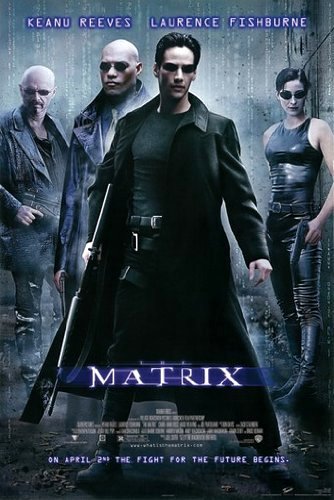
the Matrix PosterNovels have layers. Theme is what the story is about on a deeper level than the plot details. It’s the big meaning, and often it’s a moral meaning. Love, honor, family, and revenge are all some common, underlying themes.

I think of the scenes in my books as if they were scenes in a movie. Each conversation is a scene.

Sometimes, we find ourselves in Outer Mongolia as we wrangle our words. Our mind is off chasing squirrels, and our fingers are madly keying dialogue. It happens, and then we find ourselves writing paragraphs of discussion regarding the vase on the kitchen table. Why are we discussing this vase?  If there is a reason that will emerge later, keep it. If it is just idle fluff, lose it.

I actually have a scene in one of my forthcoming books where the characters do just that. They are discussing a vase that was made by a child, but the conversation is not important for the sake of the vase, nor is it really about that object. It is there to expose how important an absent person is to one of the speakers, and the brief interaction between the two speakers endears to the reader one of the characters who will later meet a sad end. The underlying themes of this book are brotherhood, family, romantic love, honor, duty. The obvious theme is the successful resolution of a quest. The core plot device around which the story evolves is an ongoing War of the Gods, and the world in which the tale is set in is their battleground, offering all sorts of opportunities for mayhem.

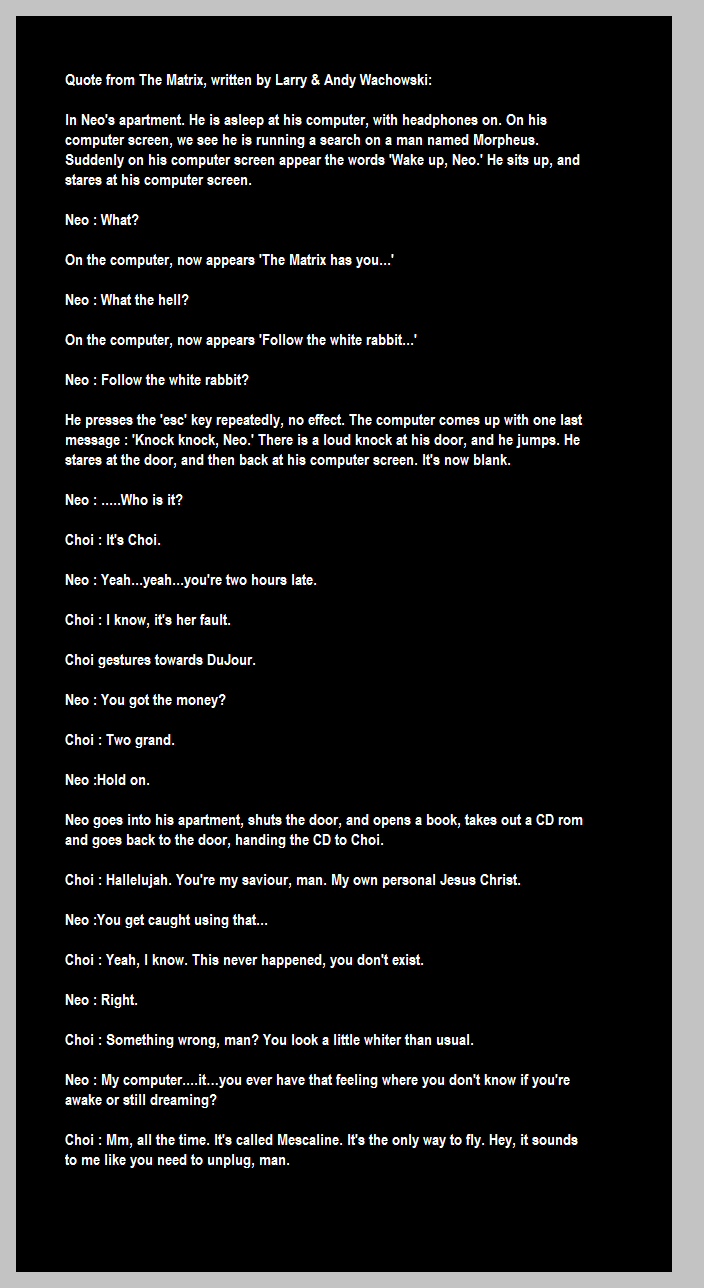
Consider the first scene of one of my favorite movies of all time, The Matrix. This movie has a lot of action, but it has a lot of dialogue also, and that dialogue advances the plot and never loses the theme of the story.

Quotes from the matrix

The conversation concerns a drug deal, but the underlying theme is never lost. The key words are in the first line, written on the computer, The Matrix has you, the third line, follow the white rabbit, and in that very last line, telling Neo to unplug. The Matrix is all about waking up, about what reality is, and about Neo as the potential savior of the world, which has been enslaved by a virtual reality program. It is about escaping that program. The conversations that happen in the course of the film all advance that theme, even the minor interactions, from the first conversation to the last.

The Arc of the StoryWe must approach conversations in our novels as if they were scenes in a movie. In a good movie, we don’t notice it, but there is an arc. In a story arc, a character undergoes substantial growth or change. It ends with the denouement in the last third or quarter of a story. The end of a narrative arc is the denouement, the final resolution. It shows what happens as a result of all the conflict that the characters have gone through.

If we don’t keep the arc of the story moving with each scene, we will lose our reader, and to that end, each conversation must reflect the underlying themes of the story without beating the reader over the head with it. As in real life, some of the people know more than others, and to advance the plot and the theme, small clues must come out over the course of each scene, each scene building to the finale.

I876MilanoDuomo‘ve said this before, but we must build the overall arc of the story from scenes, each of which is a small arc, in the same way a gothic cathedral is constructed of many arches that all build toward the top.  The underlying arches strengthen the overall construction. Without arches, the cathedral wouldn’t remain standing for very long. The novel is a cathedral and your scenes are the arches that hold it up. The conversations that form those scenes are miniature arches, each with a beginning, a high point, and a resolution.


4 Comments

Filed under Adventure, Battles, blogging, Books, Fantasy, Humor, Literature, mythology, Publishing, Self Publishing, Uncategorized, WordPress, writer, writing

Yes, but how do you really feel?

x - y chromosomesI love writing and I love my characters, but they are so stubborn about some things. Of course, many of them have ‘Y’ chromosomes, but still…. It’s frustrating because they don’t want to to talk about how they’re feeling.

Oh, for the love of Tolstoy–don’t they get it? I’m  a woman. I need you people to talk to me. Tell me what’s going on in your imaginary head.

It’s difficult to show the characters’ emotions and thought processes when it’s so much easier to just say he felt, or she was some emotion.  These thoughts and feelings are central to making our characters feel real. But describing them from a distance, as an author must do, may disconnect the reader from that character.

Sometimes, descriptions don’t allow the reader to experience the moment with the character. Instead, the author is telling them how the character feels.What we must ensure is that our readers remain immersed in the narrative, that no ‘speed-bumps’ come along to knock them out of it. Heart Search cover

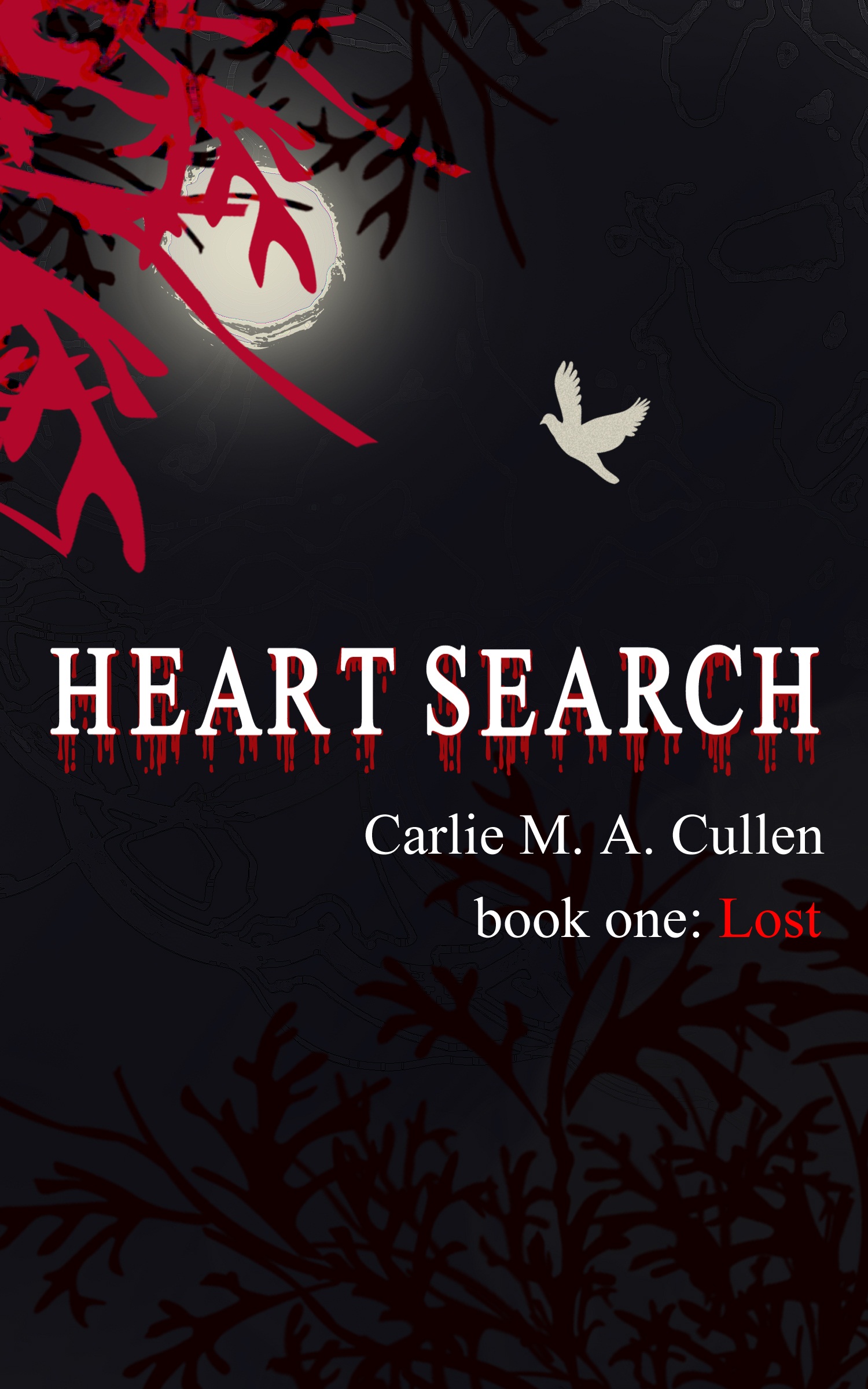
One of the best at this is Carlie M.A. Cullen, whose urban fantasy series Heart Search  featuring a coven of vampires is gaining in popularity. I think her books are so compelling because of her ability to draw a reader into the character without going over the top. So, how does she do it?

The opening line of chapter one of Heart Search Book 1, Lost reads like this: The sun, a ferocious golden orb, burnt into his skin as Joshua wandered aimlessly through the country park.

She could have just written The sun was hot and Joshua was killing time in a park.

But she didn’t, and the story is better for it–AND she showed you both the scene and Joshua’s mood in that one sentence.

So what can we learn from reading our favorite authors? We can see how they craft their tales, and we can learn those skills. Painters do this all the time, and we paint with words. 480px-Schmalz_galahad

Let’s pretend we’re writing a fantasy novel. We can go over the top, like a painting by Herbert Gustave Schmalz, or we can find a happy medium between too much and too little. There is no need to sink into overly sentimental and exaggerated pathos in order to inject feeling into our work.

Here we have a character who is on the run from a creature of some sort. 1. He was afraid. He was terrified to look back.

Example one tells the reader how the character feels. We might write this in our first draft when we are just trying to get the story out of our heads. An unskilled writer would consider it just fine the way it is, as it expresses his thoughts perfectly.

However, it tells the reader how to feel, and readers really don’t like being told what to do.

2. He wiped the sweat from his brow with a trembling hand, fear from his narrow escape coursing through his veins. Heart pounding, he leaned against the wall, listening for any sounds that shouldn’t be there before chancing a glance around the corner.

Personally, I would read book number two over book number one, because it’s more interesting and makes me want to know more about this character and his problems. We need to use physical symptoms a character might experience combined with their actions, but  we need to describe them in such a way that it is a natural part of the scene.

John slid down the wall, sitting in the mud, his breaths coming in hard, ragged gasps. Something trickled down his cheek, and wiping it, his hand came away with blood.

Another example: Theodor_Hosemann_Weinstube_1858

Lord Deccan’s fist hit the table. “Wine now, you miserable worm–or I’ll cut off your other ear!”

The one-eared innkeeper scuttled to the cellar. He quickly searched the shelves filled with dusty jars of cheap wine, settling at last on a vintage he thought might suffice.

Baldric’s guests normally drank from wooden tankards, but he knew that wouldn’t suit. There was a goblet, one he’d come by in a peculiar way, but it was a fine cup and would do well enough to stave off a tantrum of the lordly variety.

His shoulders hunched in anticipation of trouble, he approached the angry lord’s table. Setting the only goblet before the nobleman, he left the bottle and stepped away, bowing with feigned obeisance. Baldric had  survived  the  war with all but his left ear intact, and intended to remain that way.

Sir Paul McCartney, image from Rolling Stone MagazineWhat we are doing here is exactly like interpreting what our loved one is telling us, when he/she refuses to use their words. Seeing them sitting slouched in the chair, clicker in hand and numbly flipping through channels is a good indication of their mood. So we must picture the scene and describe it .

We must show the emotions as they are reflected by the physical cues our characters give us, but don’t tell them–a difficult trick to master but one we must all do if we want our work to engage the reader.

7 Comments

Filed under blogging, Fantasy, Humor, Publishing, Self Publishing, Uncategorized, WordPress, writer, writing

The Girl With the Tolstoy Tattoo

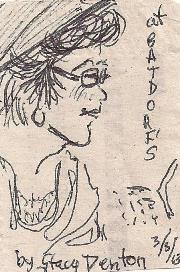
extra small caricature of connie  by street artist Stacey DentonYour blog is up. The Template is as well laid out as you could make it. You have your books or relevant social media listed in the sidebar. You have the catchiest blog title on the block. Now all you need to do is start blogging!

1. If you are using WordPress CHOOSE A CATEGORY NOW for your post–do it 1st so that you don’t forget to do it. I published this blog in the categories of Blogging, Self Publishing, Books, Fantasy, Literature, Humor, Publishing, and Writing.  Each blog post may have a different category. If you should forget to choose the category, it will go into the ‘uncategorized’ pile–the dreaded WordPress slush pile where blogs go to die.

Also in WordPress, chose a few TAGS now so that you do not forget to tag the post. That button is below the Categories list. Chose tags that most represent the core of your post, so that searcher for that subject will find it. For this post I am using ‘Blogging, Writing, Self Publishing, Humor, WordPress, Blogger’.   Also, ‘The Girl With the Tolstoy Tattoo.”

blogging 1.1

If you are using Blogger, PICK YOUR LABELS NOW–Blogger doesn’t use categories, so your labels are very important. On the right hand side, click on ‘LABELS’ and simply type your key words into the BOX, separated by commas. In Blogger, LABELS are what TAGS are in WordPress, so use words that are the core of what you are blogging about so that interested searcher will find your blog:

blogging 2.1

Now that you have that out-of-the-way, it’s time to blog!

2. Hook me with that catchy blog post title!  Today’s post is called “The Girl With the Tolstoy Tattoo” — for a multitude of reasons. I have a tattoo (it’s not Tolstoy) but we are all struggling authors, even those of us who blog on the most random subjects. And if you are ever at a writer’s convention, there is no better icebreaker in the autograph line than to offer to show Tad Williams your Tolstoy tattoo. (If you have one, and if you are insane.) (Be sure to add ‘Tad Williams’ to the Tags or Labels for that post.)

3. Put that catchy title in the White box at the top of the page:blogging 3.1

Now there are two paths for you.   You can wing it, keying directly into the Post box as I am doing now, or you can write it on a WORD document and copy and paste it into the body of the post.  I don’t do that often, because word is rife with HINKY FORMATTING that screws up your blog posts for both Blogger and WordPress, and then you have to use the handy “REMOVE FORMATTING” button that is located in the ribbon (tool box) of both Blogger and WordPress:

blogging 3.2

blogging 3.3

Both Blogger and WordPress have spell check functions, and both will save at times as you go, but as in everything, it is up to you to click “SAVE DRAFT” and save your work fairly frequently.

Play around with it. Practice uploading images and inserting them, playing with it until you feel comfortable and know how to ensure the image will appear where you want it, and will be the size you want it to be:

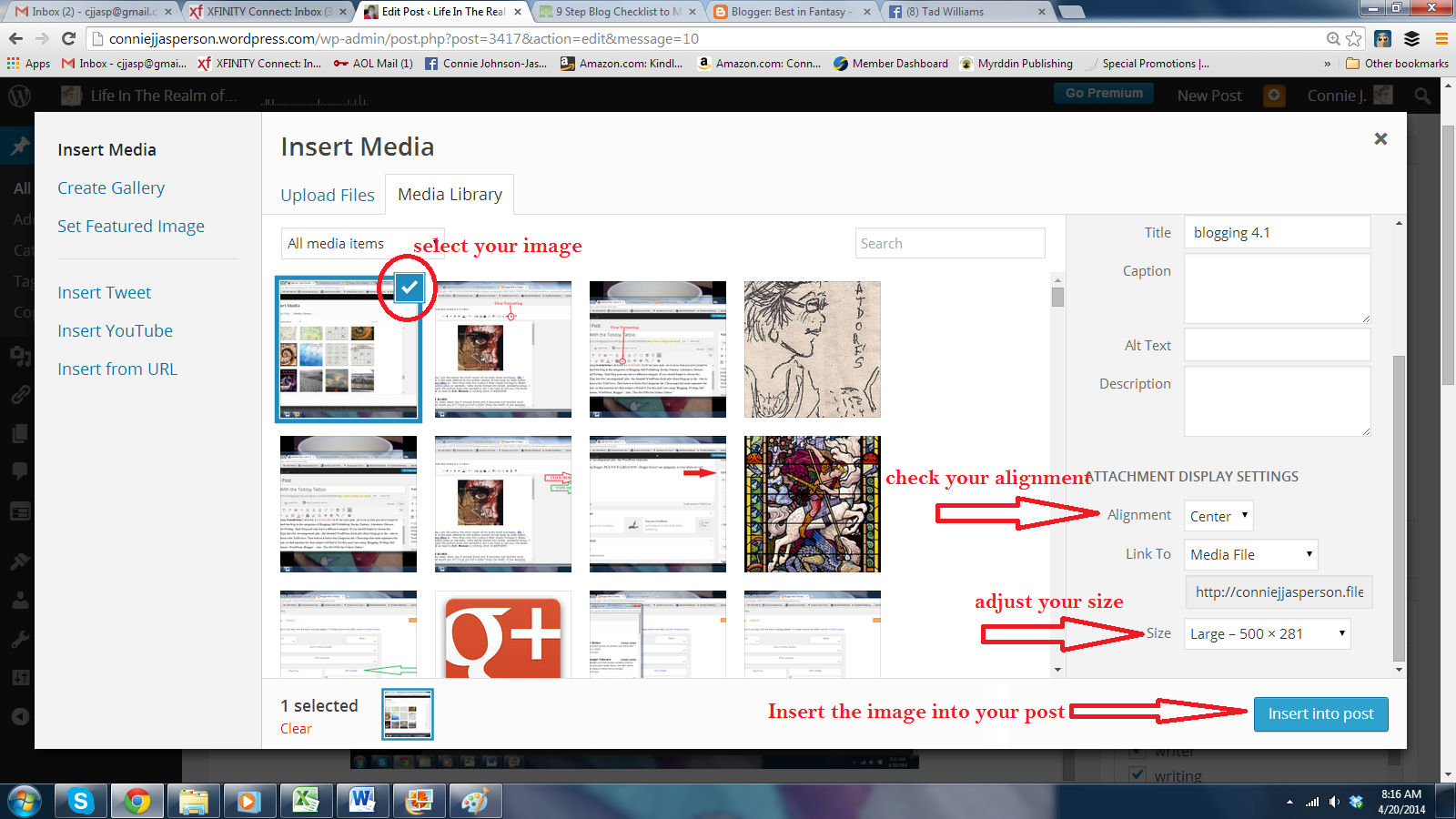
In WordPress, place your cursor in the body of the blog post and click once at the spot where you will want the image. Then scroll up to the left side of the ribbon (tool box) and click on “ADD MEDIA.” This menu will appear:


blogging 4.1

If this is your first blog post, you won’t have anything in your media library yet, so Click on “Upload Files.” Select the image you want to post,  then check your alignment, i.e. left, right, or center. Adjust your size options to fit your need for the image in that post (those requirements vary from post to post.) Then click ‘INSERT INTO POST.”

blogging 5.1


In Blogger you click on the little Picture in the ribbon (when you hover your mouse over it, it will say ‘insert image’). A pop-up menu will appear, and then you will upload the image, decide the placement and the size.  This nearly foolproof simplicity is why most people who have “never done this before” like Blogger.

blogging 6.1


Now your picture of your Tolstoy tattoo is right there, illustrating your hilarious post where you discuss why getting that tattoo while drinking vodka shots at the “Fans of Great Russian  Authors” convention wasn’t as good an idea as it seemed at the time, and that maybe the T-Shirt would have been a better investment.

leo_tolstoy_t_shirt-r207720cff4e14b059c7bba5cdb41c6c9_804gs_512 from Zazzle


All you have to do now is post your links to Twitter, Facebook, Tumbler and all other  social media you can think of and Voilà! You are a blogger. Do this regularly, and you will build up a following, and you will develop credibility as an author. Your name will be searchable on Google and Bing, and all other search engines.

3 Comments

Filed under Blogger, blogging, Books, Fantasy, Humor, Literature, Publishing, Self Publishing, WordPress, writer, writing

Blogger for the Beginner

science of relationships dot comLife in the Realm of Fantasy’ is a WordPress blog, i.e. I use WordPress, a free, open-source blogging tool and content management system.  This means that with very few skills,  I can post a decent blog at no cost to me, using the fine tools and templates provided by the wonderful people at WordPress.

The thing that is so awesome about it is that it is in what my husband the programmer calls ‘wysiwyg’ (pronounced wizzy-wig) or ‘what-you-see-is-what-you-get’ so the user does not have to know any programming or coding–all that is done for you already, and you just organize it the way you want it, within certain limitations.

wordpress logoI really enjoy WordPress, and have become quite fluent in it.  But what other free and open-source content management systems are out there?  Well, I just happen to have a weekly book review blog hosted by a Google company, called Blogspot. Their tools are called Blogger, and I have become fairly adept at using that particular system too, and while it’s not as versatile as WordPress, I like it a lot.  A friend of mine is new to Blogger and had some questions so I thought this would be a good topic for this blog.

First you sign up for a Google account. Then go to  https://www.blogger.com/features and click on the orange button at the top right.

blogger screen 1


Then you select the URL, or place your blog will forever be found on web searches by.

My Blogger blog, Best in Fantasy, is located at: http://bestinfantasy.blogspot.com

So if you are an author, use your author name as the URL. This WordPress blog is my author blog, so it is https://conniejjasperson.wordpress.com.

I also have a blogger address, http://conniejjasperson.blogspot.com.  That takes readers to another book blog, Billy’s Revenge, which showcases Huw the Bard and all things pertaining to Billy’s Revenge in the world of Waldeyn. A third blogger blog is http://neveyah.blogspot.com , which is the Tower of Bones showcase.

Whenever you are logged out of blogger, you can access your blog by going to the top right hand corner of your gmail mailbox and clicking the little group of squares up on the right hand side–the apps icon:

apps icon

This will open a menu filled with icons for every Google app like YouTube, or the calendar. Down at the bottom under ‘more’ will be the Blogger icon. Click on that and you will go to your blogger page:

blogger icon


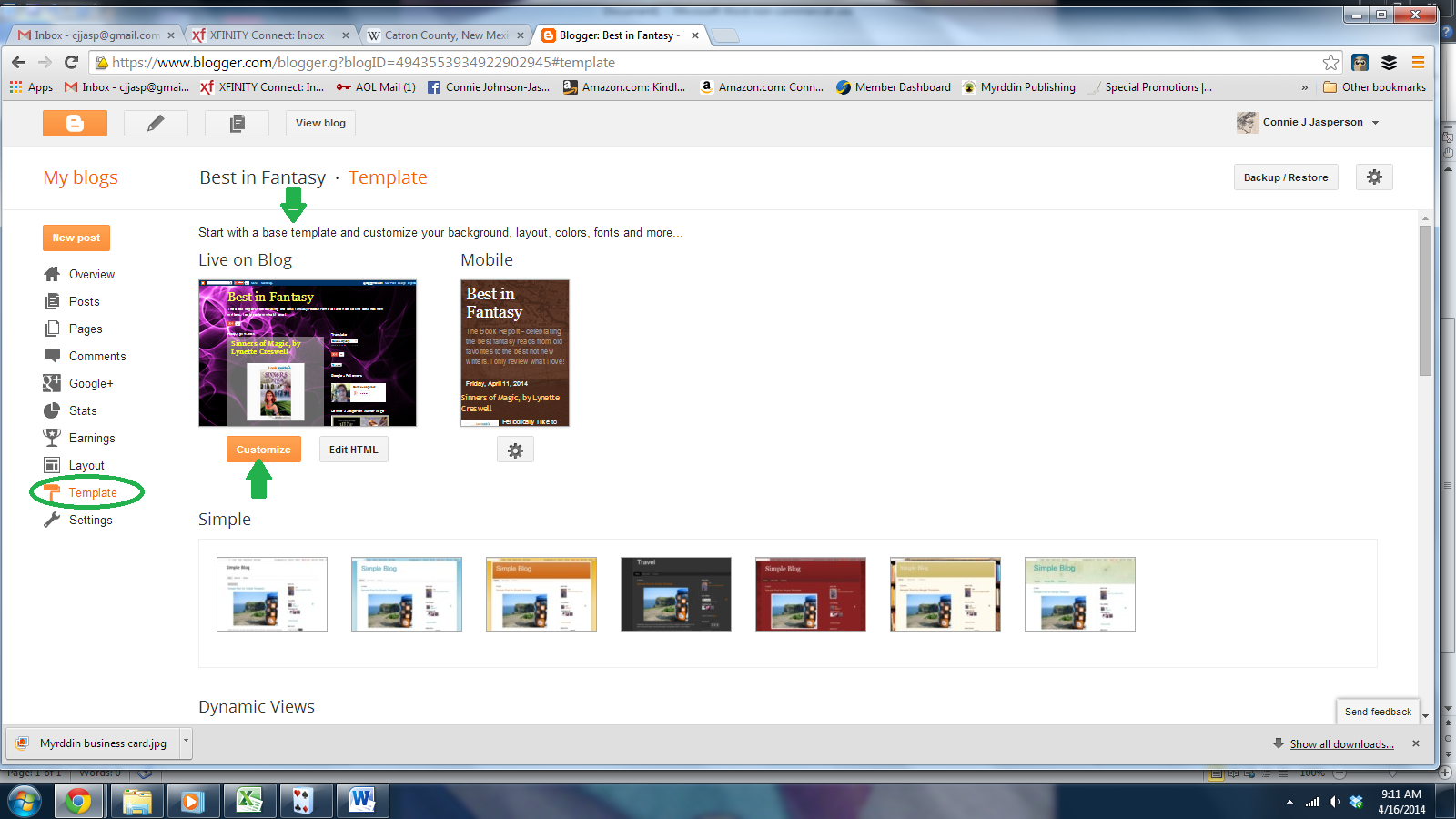
Once you have your URL selected, you can move on to building your blog. We start with choosing a template.  This is a lot of fun,  I think. Click on the orange “Customize” button.

Blogger screen 2

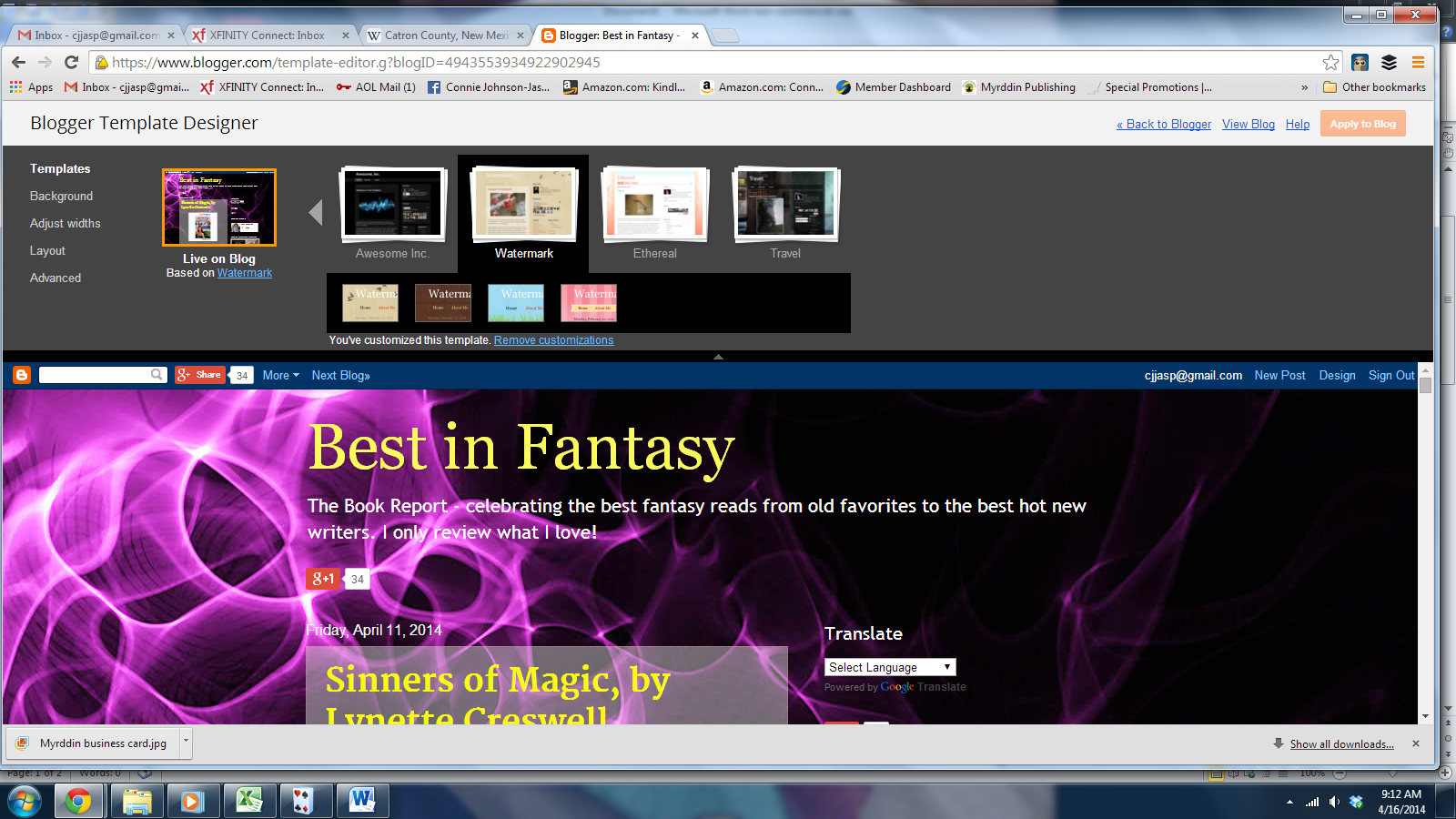
You will come to a screen with many options, and I suggest you just start at the top of the menu where it says template, and begin playing around with it, until you find the look and style you like best. You will be able to see most of your changes in the area below the Template Designer.  I pretty much keep the template simple, just because it is easier for people to read it when it is simple.

Blogger screen 3


Once you have decided on that catchy title for your blog, and have figured out the color of your fonts and background are all organized, decide the layout. You can make it one column with no sidebar, or with one or two side bars. Sidebars are good places for advertising your books and book trailers, along with many other things you want to share with the world, such as blogs that you follow, and gives a place for those who wish to follow your blog a place to sign up. The trick with sidebars is to keep them from junking up the blog, which I have a tendency to do.

Any way, once that is done click “Apply to Blog” in the upper right-hand corner. This should take you back to the Blogger page, where you will look in the menu on the left and click on the “Layout” button, just above the orange Template button. this will take you to the part where you REALLY customize the look of your blog.
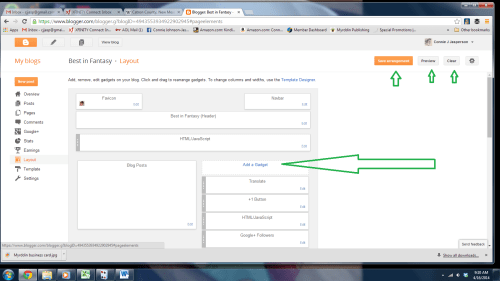
Blogger screen 11


On the right hand side (yours may be different, depending on how you chose to display sidebars) click on add a gadget:

Blogger screen 10

This will open a menu that contains 28 ‘gadgets’ you can choose from to add to your blog. (In  WordPress they are called ‘widgets’ but they do the same thing.) These will  dress it up and help gain visibility:

1. A – g+ button (very important)

There are a lot of things, from images to ways to add html code for embedding videos and things.  In that regard, Blogger has a one-up on WordPress, because it is  difficult to embed videos, if not impossible on template I am using, which is free–at least I’ve never found a successful way to do so. I just post the links here on this blog and hope for the best, because so far I have been unable to get any code to work. THAT is why many people prefer Blogger to WordPress, despite the fact that WordPress offers so many more templates and options.

I suggest you take some time to play around with arrangements. You can click the save arrangement icon in the upper right hand corner, and then preview it, but if you accidentally hit publish, no worries– because until you add content and tell folks its out there, no one will see your mistakes. Take as long as you need to get comfortable with the system, and remember that anything you don’t like can be undone.

My next post will conclude the series on ‘Blogger”, detailing how to make your post, tricks to fine tune your layout, and get the word out that you are blogging. I will also have several posts on what I have discovered about WordPress. Authors should blog even if at first they have few followers, because the act of blogging is writing on the wing–and we must write every day or we are not really serious about the craft.


4 Comments

Filed under Books, Fantasy, Literature, Publishing, Uncategorized, writer, writing

HUW the BARD launch date set

Map of Eynier Valley © Connie J. Jasperson 2014

Map of Eynier Valley © Connie J. Jasperson 2014

I am pretty excited about things right now!  HUW THE BARD will be officially launched on March 31, 2014. I’m having a virtual launch party and everything–with virtual canapes and margaritas.

On Friday, March 28, 2014 we will be revealing the cover, on both Carlie M.A. Cullen’s blog and on this place, right here.  I can hardly wait!

It has been a long journey, to get Huw to this point. I began writing him in November 2011, and had the first draft complete by November of 2012.
I have the good fortune to have a friend, Irene Roth Luvaul, who is a professional author and a fine dedicated editor, go over it, helping me to make the manuscript submission ready. (That process is an entire blogpost in and of itself!)

Inset Bekenberg Trail to Castleton

Bekenberg Trail to Castleton © Connie J. Jasperson 2014

At that point, Huw was sent to the fine ladies at Eagle Eye Editors, where he was thoroughly scrutinized and we went through the editing process. Because of the sometimes difficult things Huw must deal with, that was frequently an emotional ordeal, but Carlie, Maria, and Irene nursed me through it.

In the end, the final product is a book we can all be proud of.

In the meantime–here is the blurb that is on the back of the book:

*

Huw Owyn is the last true bard in Waldeyn.

Fleeing a burning city,

Everything he ever loved in ashes behind him,

Penniless and hunted, no place is safe.

Abandoned and alone, eighteen-year old Huw the Bard must somehow survive.

 It’s two-hundred leagues to safety,

And then two-hundred more.

A lot can happen to a man on a journey like that.

Map of Waldeyn © Connie J. Jasperson 2014

Map of Waldeyn © Connie J. Jasperson 2014

9 Comments

Filed under Adventure, Books, Fantasy, Humor, Literature, Publishing, Uncategorized, writing

It’s smart and clickable!

MH900314342As you know I have been working on the nuts-and-bolts end of the indie publishing business for a while now, but not really long in terms of my career. I only dove into this in 2011, and in the last two years of sometimes floundering I’ve picked up a few useful tricks.  One of the most useful in terms of a finished manuscript is how to create a table of contents for your eBook that is “clickable”, a Smart TOC.

When I read an e-book I really like it when I can easily navigate within the ms by using the hyperlinks embedded in the table of contents. This is a “Smart TOC” and is very easy to create when you are formatting your ms for publication.

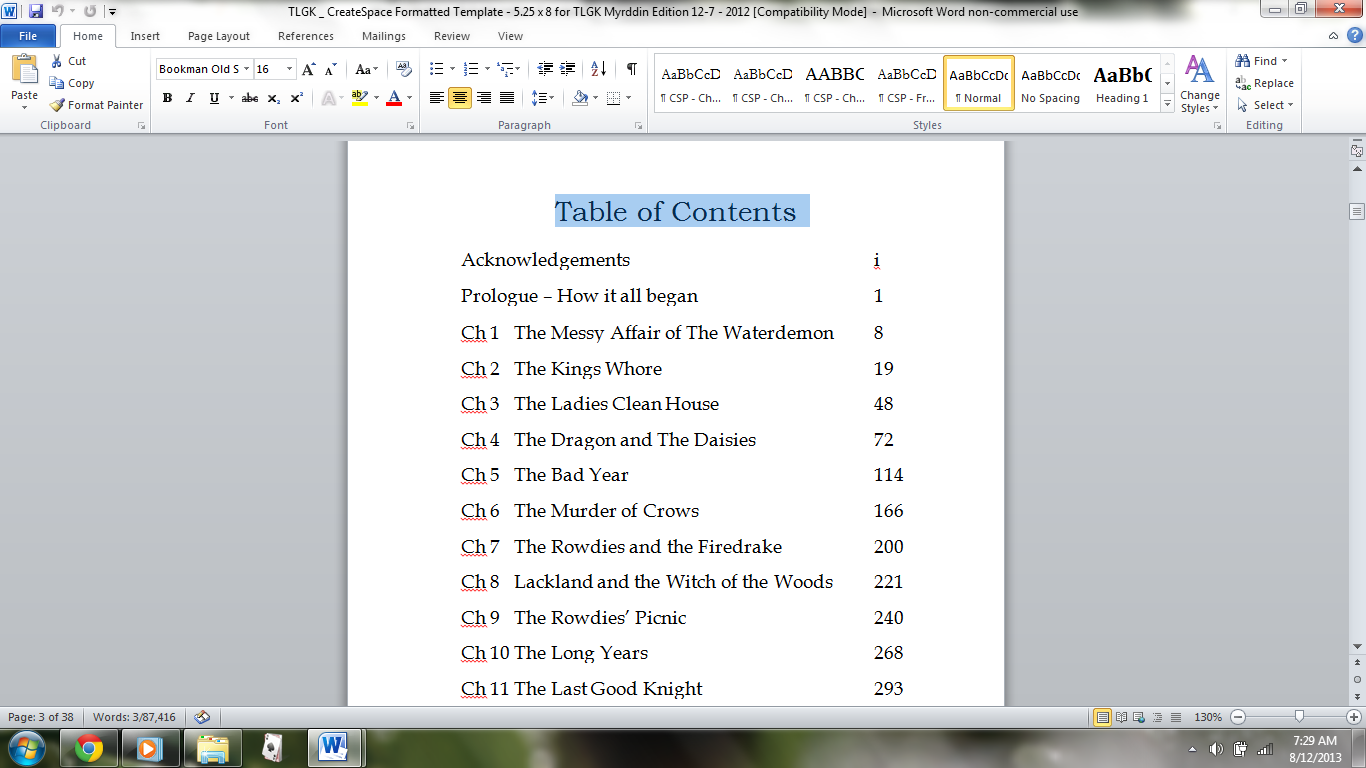
First make your table of contents. The one I am using for this is an old file for the original version of Billy’s Revenge, so ignore the page numbers. I didn’t know that page numbers are like prisoners—they just weigh you down! 

Your print manuscript will most likely not have a TOC as most novels don’t waste precious pages on such things. Technical manuals and textbooks must include a TOC, but every page you can do without when publishing your novel in paper form will keep the final cost down and make your paperback more affordable for your prospective reader. Very few people will pay $18.99 for a book by an unknown author.

prnt scrn SMART TOC 1

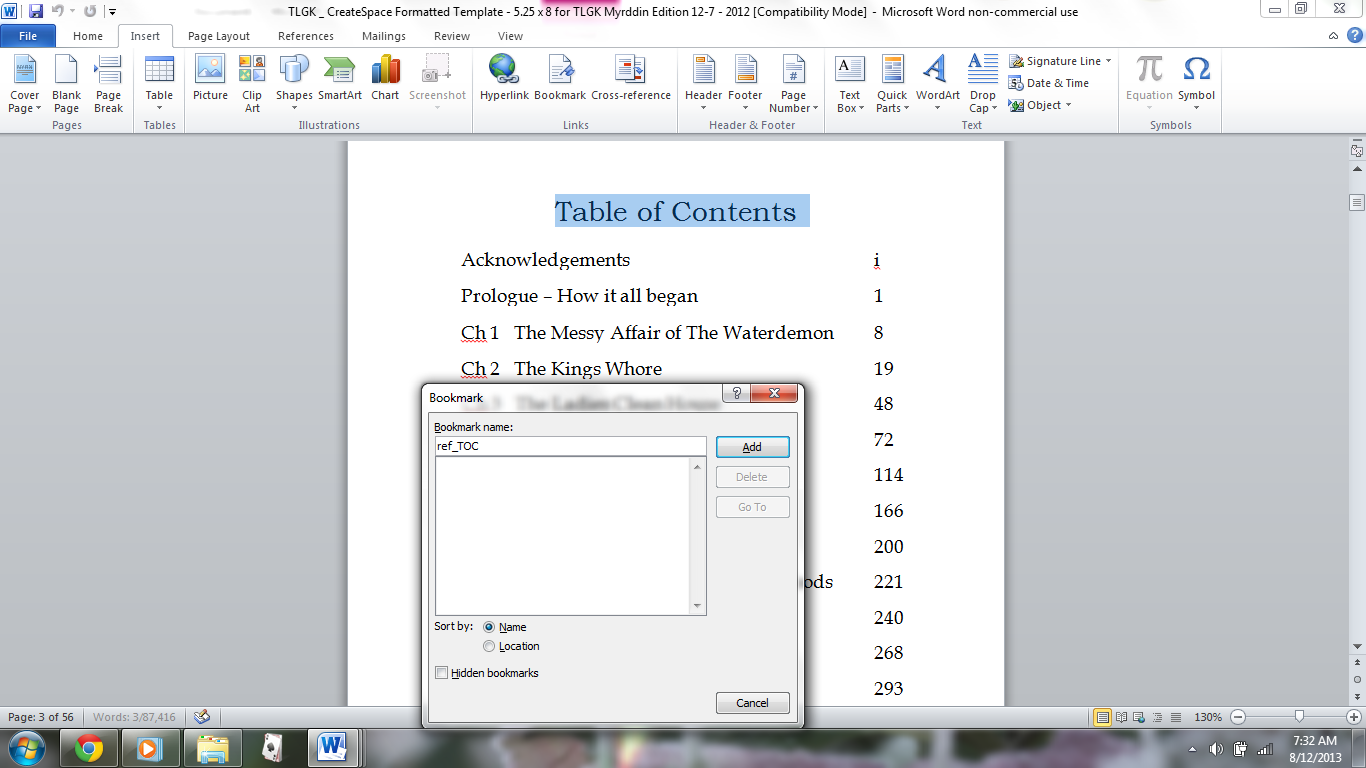
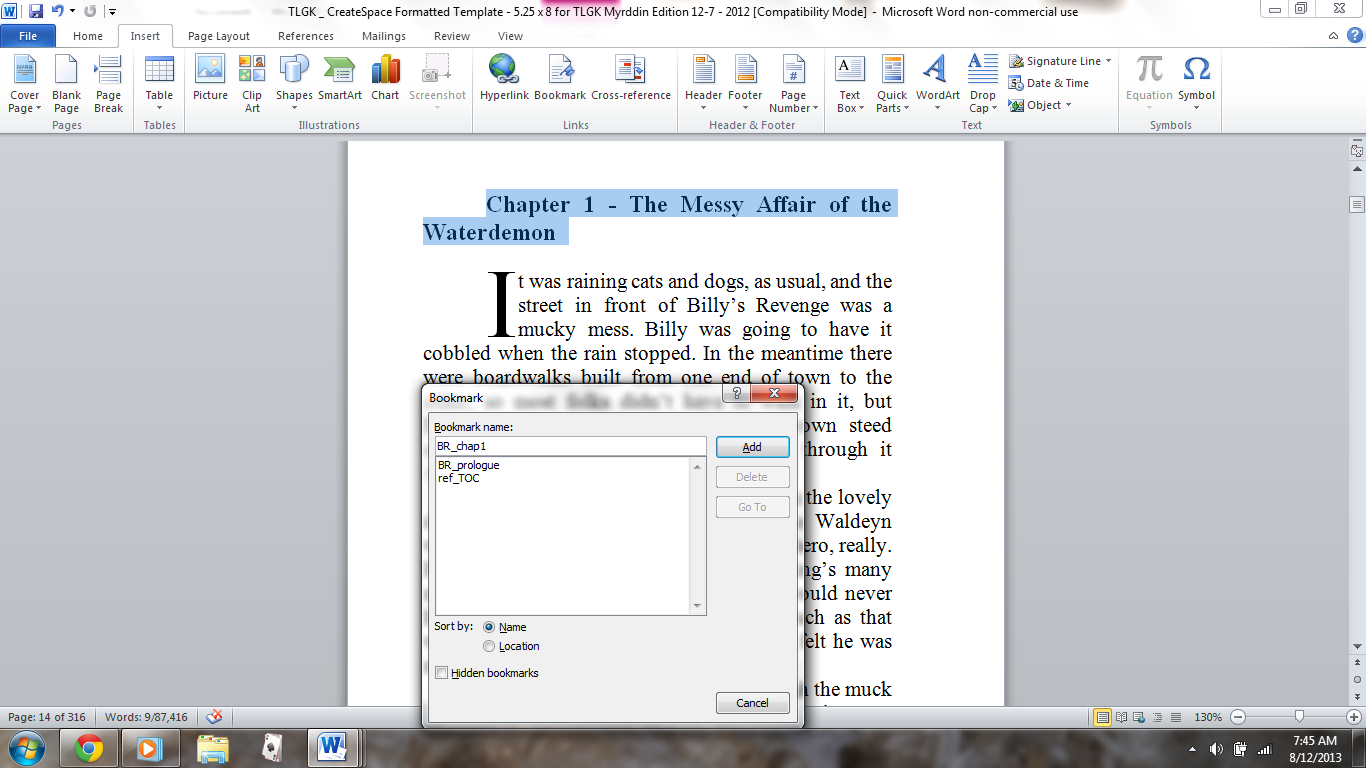
The first thing you want to do is create a bookmark.  First highlight the words  “Table of Contents” and then go to your ‘Insert’ tab.  Click on ‘Bookmark’ in that ribbon. Type in the words ref_TOC

Then click “Add”.  In every ms it is important to name the Table of Contents bookmark exactly that, including the underscore, because that’s what Smashwords looks for and it is simply a good practice to have a uniform system for naming files.  See the next picture for how it will look and ignore the page numbers:

prnt scrn SMART TOC 2

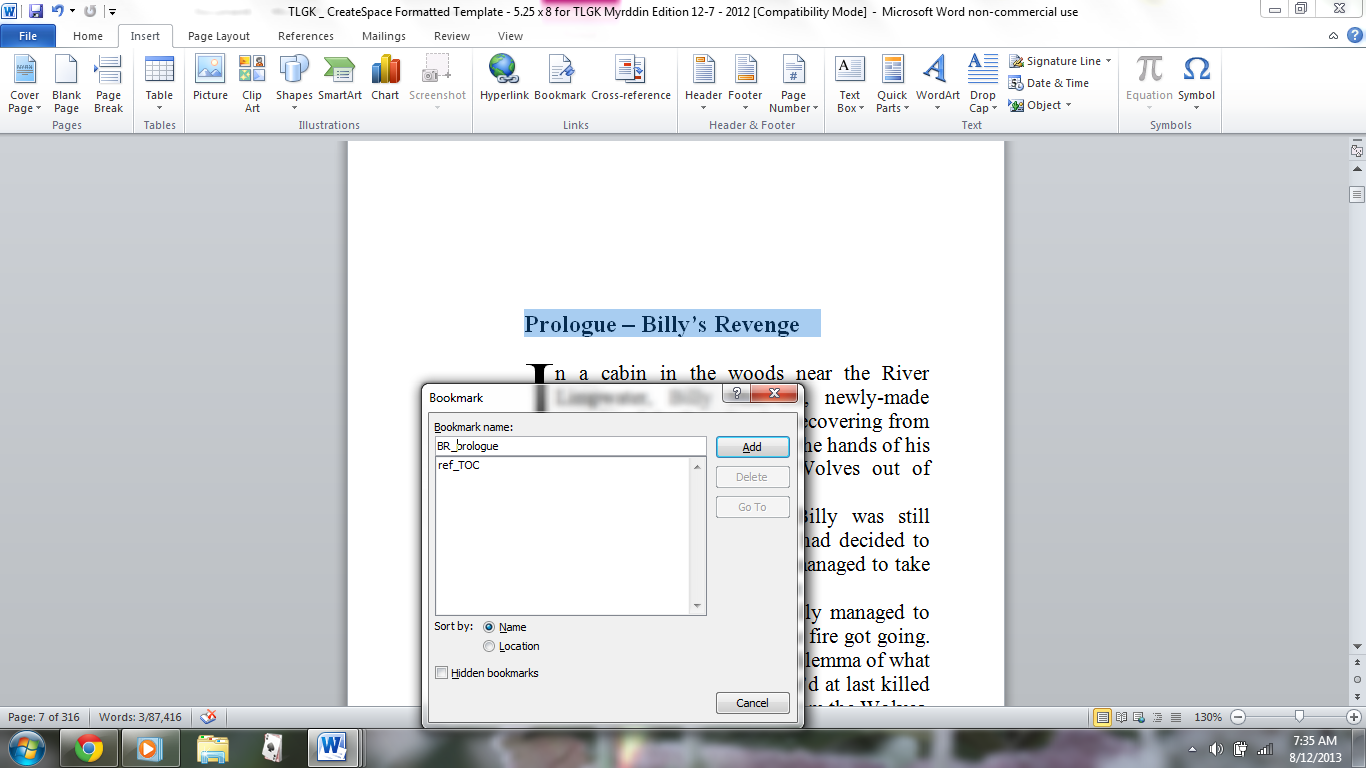
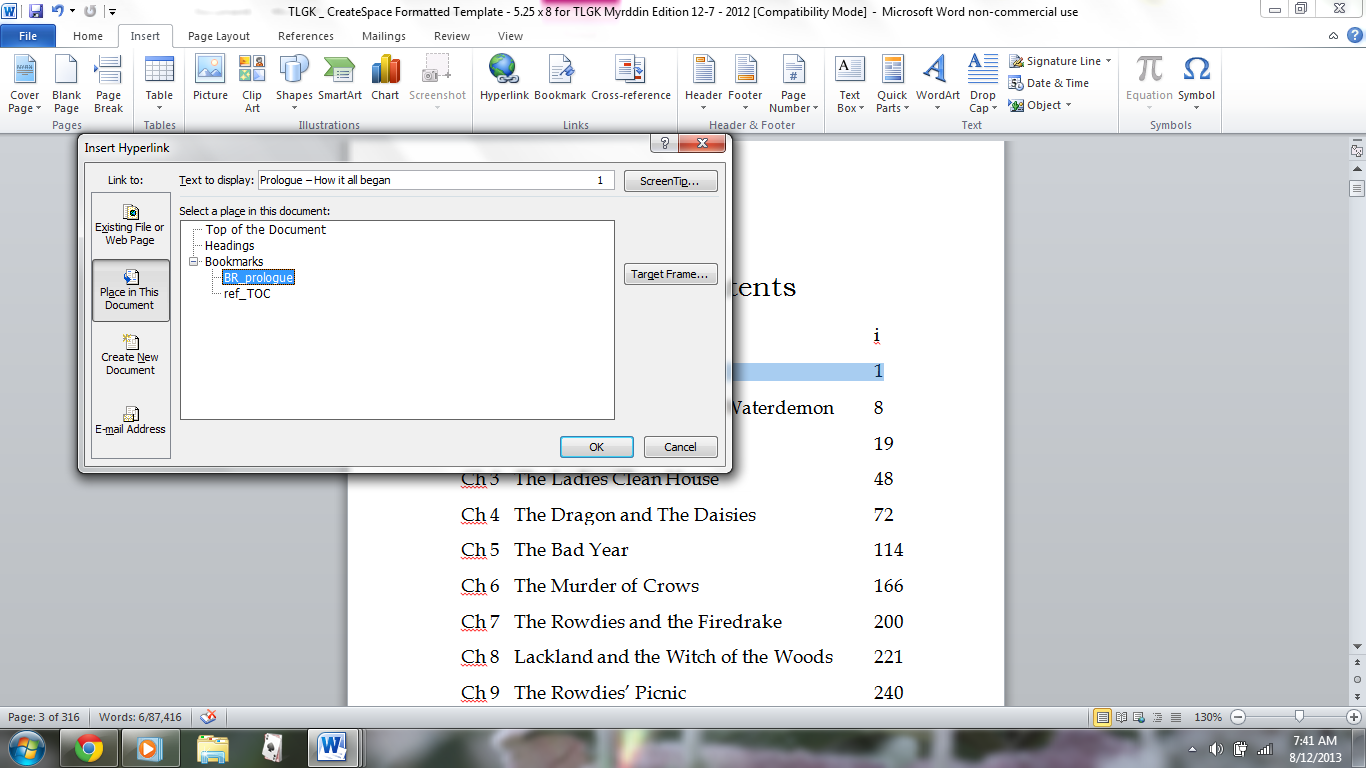
Now it’s time to bookmark  the prologue. Scroll down to your prologue and do it exactly the same way as you bookmarked the TOC, but for this ms let’s name it BR_prologue. You will name yours with your ms initials and the word prologue. If you have no prologue, skip this step.  See the picture below:

prnt scrn SMART TOC 3

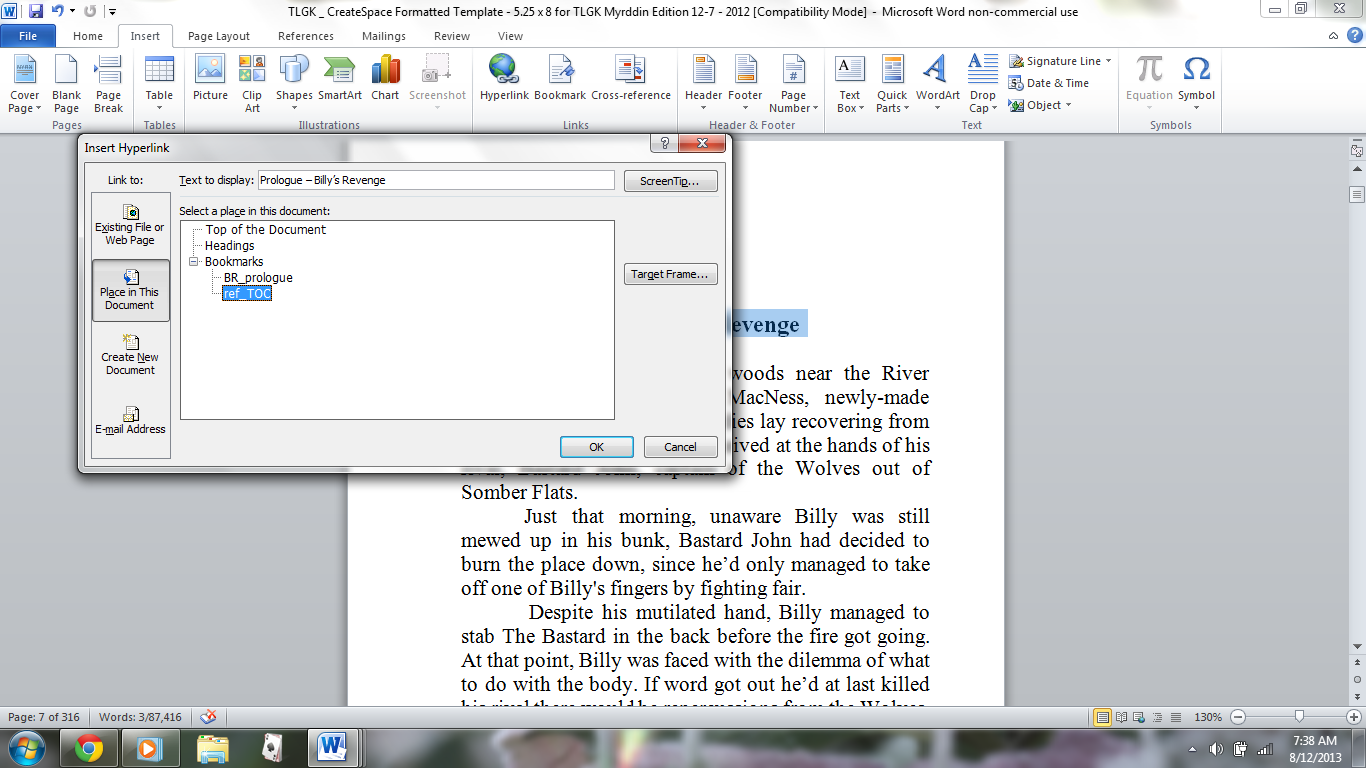
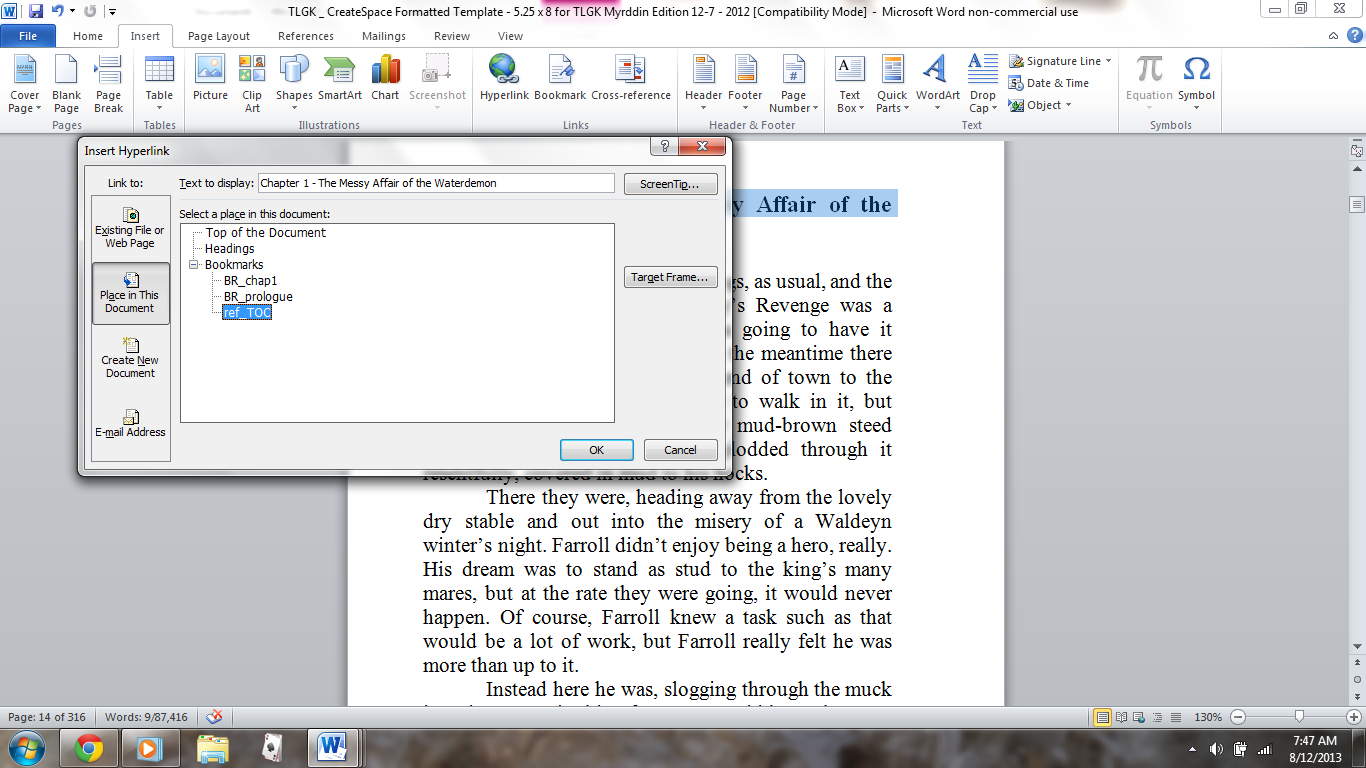
As long as you are there, with the chapter title highlighted, click “insert Hyperlink” on the ribbon. On the left, you want to ‘Link to:’  “Place in this Document”.  That will bring up your bookmarks. Select ‘ref_TOC’  and click OK.  This will turn your heading blue, which is called a ‘hyperlinky’. Press control and click on the link. it will take you back to the table of contents. Once you have used the hyperlinky it will turn purple. How cool is that! This is how that screen looks:

prnt scrn SMART TOC 4

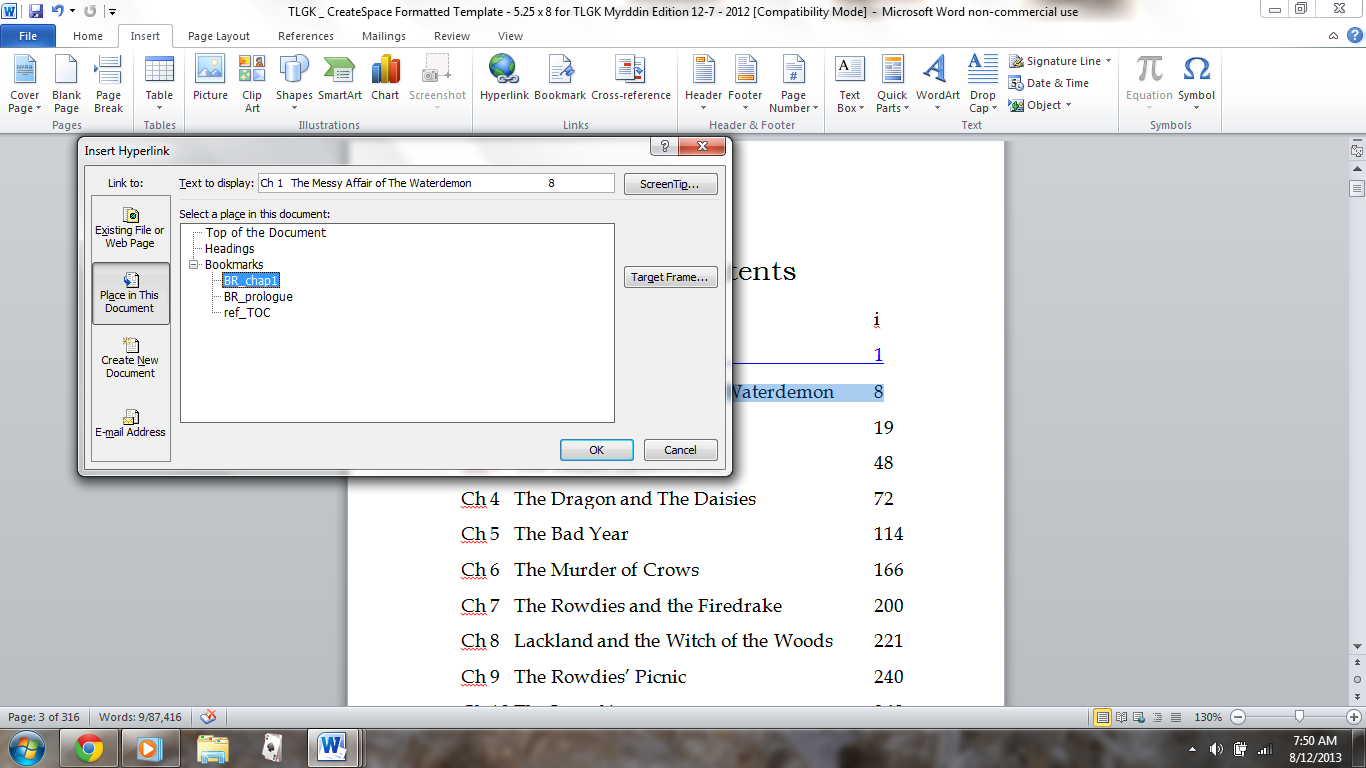
Now that you are back at the Table of Contents, highlight “Prologue and click “insert Hyperlink” on the ribbon. On the left, you want to ‘Link to:’  “Place in this Document”. That will bring up your bookmarks. Select ‘BR_prologue’  and click OK.  That will turn it blue. Press control and click on the link. it will take you back to the heading of your prologue.

Do this for the entire table of contents, always remembering to link your chapter heading back to “ref_TOC”, and test each link as you go.  Four more pictures just to help you remember:

prnt scrn SMART TOC 5

prnt scrn SMART TOC 6

prnt scrn SMART TOC 7

prnt scrn SMART TOC 8

I hope this helps you in formatting your eBook manuscript. I just redid all my books so that they have Smart TOCs and will be building the TOC into my future manuscripts as I go.  This is an incredibly useful too to help you navigate within any long manuscript, and although I had used book marks before in the course of my work, I didn’t realize that the fancy TOCs I admired so in other people’s e-books was such a simple thing.

But that’s the way it always goes–things that seem like they should be hard are often the most simple, while something that should be easy turns into a drama of epic proportions.

Here’s to less drama and more simplicity! Learning how to format an e-book isn’t really that hard, and the wonderful people at both Smashwords and at Amazon have a lot of information freely available to you. Remember, as an indie, you are your own publisher, and what you put out there has to be the best you can make it.

Making use of the free information that is out there on the internet can only help you in this regard!

Comments Off on It’s smart and clickable!

Filed under Books, Fantasy, Food, Humor, Literature, Uncategorized, writer, writing

‘Like’ me

Frustrated Woman at Computer With Stack of PaperThis weekend my professional Facebook page was suddenly ‘liked’ by 6 people in the space of 5 minutes.   I was sort of wondering what was going on, as it was a little unusual. It gets a few likes each week  under normal circumstances but this was different.

A few minutes later I got a fb personal message from an author I met through Goodreads.  It read:

“This LIKE is being sent along with another like from J***, on behalf of our friend, M*******. She left for a 6 week writing vacation, so we are wanting to surprise her with hopefully 25 more page likes. If you’ll like her page, you’ll get 2 fer 1, and possibly 3 likes for your one to her page. 

**PS. Please remember to like from your personal page as likes from fan page to fan page do NOT roll the counter.

>Thank you in advance, especially if you’ve already liked her page. Best of Luck with your writing:) 
M***”

I felt like I had just been shaken down for my lunch money.  But then I thought, “This is a kind gesture on the part of her friends, but the wrong way to go about it.”

Don’t get me wrong, I like M*******, and while she writes romances, which usually don’t attract me, she writes well enough.

I just don’t like being coerced, and that is what I felt her friends did. It’s all about manners, in this business.

Office Workers Clapping at Office PartySO – how do we encourage people to ‘like’ our professional Facebook page?  After all, we are all trying to get exposure for our books.

In my opinion, people will look you up and like your page as they become fans of your work. You will gain followers, just not real rapidly.

Identify your target market.  Are you trying to sell books only to other authors?  That is what you are doing when the only place you post the link to your page is in a page-swap forum.  If the only people who are ‘liking’ your fan-page are authors, you are shooting yourself in the foot. You are limiting your visibility to a small number of people who most likely won’t buy your book, as they’ve books of their own to write, and you don’t write in their genre.

You need to make it easy for your fans to like your page by posting the link on your blog, and on your Goodreads or Smashwords profile.  Have the link on your Amazon author page too!  Those places are where people who buy your books will look, and that is how fans will find you.

Identify who your target audience is.  Make sure your Facebook link is prominently displayed and let it do its thing.

We live in a society where instant gratification is the norm, and everything wonderful has to happen right now. I wondered, “Do we get some sort of award for having a lot of likes on our fan page?” Not that I am aware of–it’s only a number. The higher your number, the more likely fb will boost your visibility in the news feeds.  You earn that visibility gradually.

But for those who are too impatient to wait, they can join a Goodreads page-swapping event, where the participants all go out and like each others’ pages.  This is voluntary and I’ve been involved with that.  I liked about 50 authors and 15 liked me back. 6 of them used their fan page despite being asked to use their personal page, and their likes didn’t raise my count.

So, that didn’t go as well as I thought it would.

Portrait of Vsevolod Mikhailovich Garshin by Ilya RepinAnd don’t even get me started about the inconsiderate authors who posted links to their books and pages smack dab in the middle of MY fan-page.

Delete.

Delete. Delete. Delete.

(Die! Die! Die!)

Most of the indie authors I know are lovely people, polite and sensitive. They have a basic understanding of manners. They are a joy to work with, and I would do anything for them because of that. They make up 98% of the authors I have met.

There are those few who are as delicate as battering-rams, and they ruin it for everyone. They are the same people professionally that they are in the real world–immature, selfish, and rude. They meet other aspiring authors in forums and then make all sorts of small requests, expecting that you will drop everything and go out of your way for them, because they are so damned important.

If you choose to be kind to them, don’t expect anything in return, because it’s just not going to happen. The next time you see them will be when they need some other small service from you. “Tweet my book.” “Interview me.” “I just need five more likes….”

The Facebook Fan-page is a thing we have to do in this modern world of self promotion, but it sucks.

I have one and I am keeping it, but I am feeling quite rebellious about it just now.

4 Comments

Filed under Adventure, Books, Fantasy, Humor, Literature, Uncategorized, writing