Tag Archives: fantasy

#FlashFictionFriday: The Author’s Dilemma—Milking the Dragon

Milking the Dragon was first published in its proto form here in May of 2012. It was one of the first flash fictions I posted here, and with a little polishing and reshaping, it has become one of my favorites.


Writing fantasy has its drawbacks. For one thing, your creativity must never flag, which is my current dilemma. My work-in-progress is stalled. I keep repeating the same old crisis with slight variations. Readers notice when you milk an idea over and over, no matter how you change the scenery around it. Unfortunately, my head is stuck on dragons, and I’m not sure what to do at this point. It’s a medieval fantasy, and dragons are the medieval thing, right?

I could probably do better without all the interruptions, though.

“Ahem. You there.” Sir Belvedere stands at my elbow, looking over my shoulder. “Are you the person plotting this book?”

Surprised, I nod, wondering where this is going. Usually, my heroes just leave me to the task of writing and don’t feel compelled to harass me.

“Well, the dragon is dead. Did you notice?”

Again, I nod my head. “Yes. I wrote that scene, and if I do say so myself, you were magnificent.” Heroes require obscene amounts of praise, or they become sulky, and Sir Belvedere is no exception.

“Thank you,” he replies, attempting to appear modest and failing. “Well, the thing is, Lady Penelope has thrown herself into wedding preparations.”

“Yes, I did know that,” I reply. “I’m designing the dress.”

“Well, I’ve been booted outside. Apparently, no one needs the groom until the big day so, heh-heh, here I am… bored… looking for something to do.”

I never noticed it before, but my hero is rather unhandsome when he scowls. Note to self: give Sir Belvedere a charming pout to disguise his serious lack of a chin.

Sir Belvedere taps his foot. “Well, really, what sort of author are you? Here we are 32,527 words into your novel, and you’ve already shot the big guns! You wasted the big scene! I mean really, unless this romantic comedy is a novella, you just blew it big time.” Apparently, he also whines.

I’m shocked that this man who owes his very existence to my creative genius should speak to me thusly. “What are you talking about? I have lots of adventures and deeds of daring-do just waiting to leap off the page, and occupy your idle hands.” See? I can give a dirty look too, and I don’t whine about it.

“We-e-ell?”

I despise sarcastic heros.

“You have 70,000 or so words left, and I hope to heck you don’t intend to spend them on wedding preparations.” He looks at me expectantly. “I have nothing to do! Find me a Quest! With a capital ‘Q.’”

By golly the man is right. I have timed my big finale rather poorly, and now I must come up with something new for him to do. Hmm… maybe trolls. No, too reminiscent of Tolkien… I know! A magic ring! Nope, still to Tolkienesque.

I need to reflect on this for a while. I gaze at Sir Belvedere, wondering what I was thinking when I designed this air-headed piece of eye candy in a tin suit. “I can’t work with you staring over my shoulder, so find something to do for a few minutes.” Good Lord, I should have made him less impatient and given him a few more social graces. “Look, why don’t you sit here, and play a little ‘Dragon Age’ for a while?” I park him in front of the TV and give him the game controller.

“What the hell is this?” he looks first at me and then at the object in his hand. “I’m sure you find this odd-looking thing quite entertaining, but what is it?”

Sighing, I show him how to turn it on, and help him set up a character file. For some reason, the palladin wants to play as a dwarf-mage. That takes an hour.

Go figure.

Finally, I can sit down and invent a few more terrifying plot twists to keep this bad boy busy. The trouble is, all I can think of is dragons, but he’s already fought one, and killed it. Reviewers turn vicious when you milk plot twists. Of course, that means he has acquired a certain amount of skill in dragon molesting… heh-heh… but what good is that sort of expertise?

“Ahem.”

I look up, only to see Lady Penelope’s stepmother, Duchess Letitia, standing at my elbow. “Yes?”

“I’m sorry to bother you, but we’re in desperate need of a certain magical ingredient for my special anti-aging cream.” She looks at me expectantly. “My stepdaughter’s wedding is a big deal. As you’re no doubt aware, I’m being forced into retirement after this, as the plot you originally designed said Belvedere and Penelope will assume the throne upon their marriage. You published it on your website, so it’s canon now. That means I’m done, kicked to the curb in the prime of my life.” She dabs the corners of her squinty eyes with a silken handkerchief. Her voice turns crafty. “Since this wedding is doubling as my retirement party, I simply MUST have my beauty cream.”

“And that ingredient is…?” I hope it’s not a complicated thing because now I have two bored characters nagging the hell out of me.

She beams and says, “Dragon’s milk.”

How odd. Another thing I never realized until this moment—Penelope’s stepmother looks positively evil when she smiles like that.

“I’m sure our dear Sir Belvedere can get me some since he’s just sitting around pretending to be a dwarf.”

Duchess Letitia’s malicious smirk offers me no end of possibilities. I consider this for a moment.

I could rewrite the original battle scene, add a bit here, tweak a bit there, and subtract the dead dragon part… ooh! Sir Belvedere could get singed milking the dragon… Lady Penelope would have to rescue herself and then him… but what the hell, he’s a hero, right? Bad days at the office come with the territory.

I look over at Sir Belvedere, who is now bashing my coffee table with the game controller. Okay, this boy definitely needs to get outside and play in the fresh air. “HEY! Sir Belvedere, I have a task for you! Take this bucket and get some dragon’s milk. It’s a matter of life and death.”

Yes, folks, I have decided to milk the dragon.

He looks up, wild-eyed and sweaty. “I will in a minute. I need to get to a place where I can save. Gah! No, no, no! I only have one health potion left!”

That’s another good plot twist. Note to self: have Duchess Letitia volunteer to supervise the stocking of Sir Belvedere’s kit with “medical supplies.”


Credits and Attributions:

The Author’s Dilemma—Milking the Dragon, by Connie J. Jasperson, © 2012-2017 All Rights Reserved. Milking the Dragon was published in its first incarnation on Life in the Realm of Fantasy in May of 2012

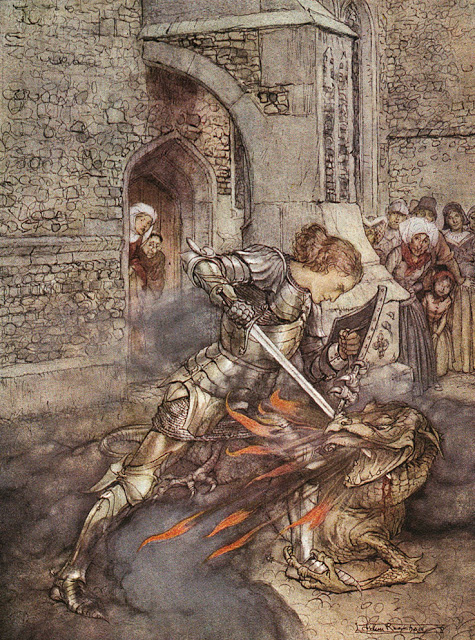
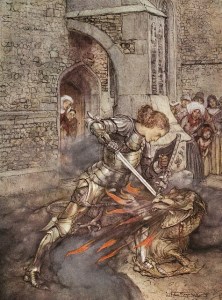
Illustration from The Romance of King Arthur (1917). Abridged from Malory’s Morte d’Arthur by Alfred W. Pollard. Illustrated by Arthur Rackham. This edition was published in 1920 by Macmillan in New York. [Public domain], via Wikimedia Commons https://upload.wikimedia.org/wikipedia/commons/f/fe/324_The_Romance_of_King_Arthur.jpg

2 Comments

Filed under #FlashFictionFriday, Dragon Age, Dragons

#FlashFictionFriday: Cats and the Laws of Physics


Today I am reprising a piece from May 2014, a  flash fiction containing a hairball of truth. Enjoy!


I realized the other day that I am a cat lady. Oh, I don’t own a cat or even a dog for that matter, but I am still a cat lady.  I love cats… ceramic cats. I have 3 of them.

They are the perfect companions. Their demeanor is a little aloof, but what do you expect from a cat?  They rarely meow, eat very little, require only an occasional dusting, and never try to hijack my laptop.

I’ve never yet had to clean up a hairball.

That said, there is something lacking in my relationship with these strangely well-behaved creatures.

Alas, I am a lazy woman. The amount of vacuuming a living cat introduces into my life breaks the laws of physics. Let’s do the math–I’m an author, so we’ll do it with a story-problem:

Mr. & Mrs. Catpeople are humans who currently have 0 cats. They are ordinary people, not too messy, and not too tidy. Normally, they only have to vacuum their bungalow once a week. One spring day Mrs. Catpeople loses her suburban mind and decides to bring home a cat. If she only had to vacuum the house 1 time a week when two humans resided in her home, how many times will she vacuum with the addition of a cat?

Okay… 2 people + 1 cat = 3 creatures.  So, if she cleans once a week when there are 2 creatures in the house, with the addition of a third creature, and assuming you can’t half-vacuum (although you can vacuum half-assed), it should mean she has to vacuum twice a week.

But the fur on the sofa appears every day as if by magic, increasing exponentially with the arrival of guests, which requires her to vacuum morning and evening… so that = 14 times a week that Mrs. Catpeople must haul out the Hoover.

See? I’ve done the math, and it doesn’t add up. Of course, I failed traditional math classes regularly, but according to my calculations,  Mrs. C will be up to her eyeballs in cat fluff inside of two weeks, because no normal human being can keep up with that amount of flying fur.

The only reasonable conclusion one can come to is that cats clearly do not obey the same rules of physics as humans do. After all, when it stands on your chest at 3:25 a.m., does your 7 lb cat not gain 25 lbs?

And when they see the invisible object of their desire at the top of the new drapes, are cats not able to travel faster than the speed of light?

Cats are like subatomic particles.  They are here and not here, both before and after, and only exist when you are looking at them.

But, while math, or indeed physics, was never my forte, extrapolating stories always was, so here is the true ending of our story-problem, the one math teachers never tell you:

One day while eating his organic Cheerios, Mr. Catpeople suddenly realizes the cat is speaking to him. At first, it seems fun, but gradually he realizes the evil creature is shooting feline thought-rays at him, trying to take control of his mind. Every where he turns, the cat is looking at him.   “Get an ax… Kill the dog….”

Mr. Catpeople sets his spoon down, and his remaining Cheerios go soggy while he wrestles with this directive. It seems reasonable, but… “Um, we don’t have a dog.”

“Did I say ‘dog?’ Sorry. I meant you should kill the annoying woman with the evil vacuum….”

So the true answer to the problem is Mrs. Catpeople will vacuum the house ‘0’ times a week because after the funeral Mr. Catpeople will be doing all the vacuuming.


Cats and the Laws of Physics was originally published as Cats and the Physical Laws of the Known Universe, © 2014-2017 by Connie J. Jasperson, published May 25, 2014 on Life in the Realm of Fantasy

Comments Off on #FlashFictionFriday: Cats and the Laws of Physics

Filed under #FlashFictionFriday

#amwriting: Tolkien, one-star reviews, and our shifting language

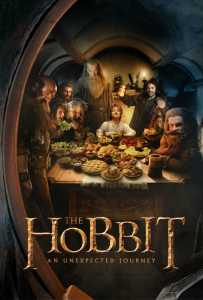
the hobbit movie poster 3Tolkien did NOT use too many words in The Hobbit, and the movie was NOT better.

The book is one thing, and the movies are something else completely. The movies, while they are awesome, exciting, and great fun, do bear some relation to the actual book. The basic plot, some of the high points, and various characters are all taken from the book. However, the movie most certainly does not chronicle the tale as Tolkien originally wrote it.

In the book (for starters) while elves are long lived and it is accepted that he must have been alive at the time, Legolas was not a character. Therefore, he did not have a love interest featured in the book. So, no– Tauriel did not exist in the book, The Hobbit. But she did in the movie, The Desolation of Smaug, and she was a great character there. In reality, no female elves are featured in the original book, The Hobbit, in more than passing, so that pretty much scotched any chance of romance for Kili in the novel.

If you read the credits at the end of the movies, you will see it clearly says “BASED ON” the book, The Hobbit by J.R.R. Tolkien.

Now, let me address the concept of “too many words,” a direct quote from one of the many one-star reviews of the book,  The Hobbit by J.R.R. Tolkien, and posted on Amazon several years ago:

J.R.R. Tolkien was a Professor of Anglo-Saxon Studies at Pembroke College, Oxford. That tells us he was educated, but he was writing stories for his children when he wrote The Hobbit and developed the world of Middle Earth. Because of that connection to his children, we know he was writing at a level they could understand. A master of languages, he invented the elfin language. We should assume he had a moderately good grasp of the English language as well.

What modern readers may not realize is this: Tolkien was writing in the early part of the twentieth century. He served in the British army during the First World War, the notorious War To End All Wars. That war was fought one hundred years ago.  Things were different then, he wrote in the literary style of his time.

The problem with the book is not in Tolkien’s writing. It is in the eye of the modern beholder who has no appreciation for the literary style of that era. That is a fair consideration, as reading the literature of this era takes time and persistence, and many readers don’t have the patience. No reader should feel guilty for not enjoying a book their friends loved. It happens to me all the time.

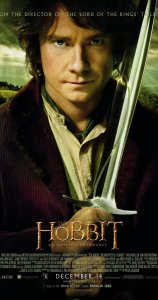
the hobbit movie posterThe Hobbit remains a classic of modern literature because it details that intrinsic thing all great novels consider, the search for self. That quest to discover who we are and what we are capable of is what drives Bilbo to keep going, even in the face of terrible events. Underneath the trappings of fantasy, the elves and goblins represent humanity in all its many imperfections, as does the hobbit himself.

Writers of modern fantasy might try to read what the early masters of the genre wrote, and discover what made their work classics. It will be difficult because the gap between the style and usages of today’s English versus the English of even one hundred years ago is widening with each passing year.

Readers must be patient and set aside their knowledge of what works in today’s literature. In other words, stop looking AT the words as disparate parts that you could write better, and read them in context. You might be surprised at what you will find.

Writers are always readers, and Tolkien often discussed his fondness for the work of William Morris (b.1834 – d.1896). Morris was an English textile designer, artist, writer, and socialist associated with the Pre-Raphaelite Brotherhood and English Arts and Crafts Movement. Tolkien and many of his contemporaries loved Morris’s prose- and poetry-romances.

Tolkien himself said his own work followed the general style and approach of Morris’s work. The Desolation of Smaug portrays dragons as detrimental to landscape, a motif borrowed directly from Morris. Tolkien had what he considered an accepted canon for how dragons should behave to work from.

But exactly what does “canon” mean in the context of a literary genre?

Wikipedia says, “In fictioncanon is the material accepted as officially part of the story in an individual universe of that story. It is often contrasted with, or used as the basis for, works of fan fiction. The alternative terms mythologytimeline, and continuity are often used, with the former being especially to refer to a richly detailed fictional canon requiring a large degree of suspension of disbelief (e.g. an entire imaginary world and history), while the latter two typically refer to a single arc where all events are directly connected chronologically. Other times, the word can mean “to be acknowledged by the creator(s).”

The modern image and mythology of the elf as he is written into most of today’s fantasy has been directly modeled on the elves of Tolkien’s Rivendell, whether the author knows it or not. Even the elves we find in the onslaught of modern urban-fantasy-romances are created in Tolkien’s image—close to the earth, immortal, and somehow nobler and more clever than we mere humans.

The love of a beautifully crafted tale will always endure. While future generations may have to learn to read and understand English as we speak it today, a true appreciation of Tolkien’s influence on modern epic fantasy literature will live on.

hobbit-battle-five-armies-bilbo-posterWhen I decided to read Chaucer’s Canterbury Tales in their original form, I had to take a college class. In that class we learned to read and understand Middle English, and then wrote our own modern translations. It was a lot of fun, but many great modern translations are out there if you don’t have the patience to read the original.

In the future, modern translations of Tolkien’s work will be published, and new fans of his work will emerge, just as in the case of Cervantes’ Don Quixote, a novel fully titled The history of the valorous and wittie Knight-Errant Don-Quixote of the Mancha. It was written in early modern Spanish (the equivalent of Shakespearean English) by Miguel de Cervantes Saavedra. Published in two volumes, in 1605 and 1615, Don Quixote is considered one of the greatest novels of all time. New translations are published every few decades.

So, Tolkien didn’t use too many words, and the movies were not better than his books. They were good, but they were different stories, one based on the other, but not following it.


Wikipedia contributors, “Canon (fiction),” Wikipedia, The Free Encyclopedia,  https://en.wikipedia.org/w/index.php?title=Canon_(fiction)&oldid=760595154  (accessed January 17, 2017).

1 Comment

Filed under Books, writing

#amwriting: Midpoint in the Character Driven Novel

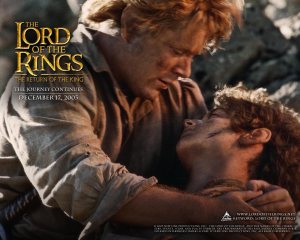
LOTR advance poster 2Some novels are character-driven, others are event-driven.

ALL novels follow an arc.  For my personal reading pleasure, I prefer literary fantasy, which has a character-driven plot. Events happen, often in a fantasy setting, but the growth of the characters is the central theme, and the events are just the means to enable that growth.

You may have built a great world, created a plausible magic system or, conversely, you may have created an alien world with plausible technologies based on advanced scientific concepts. You may have all sorts of adventures and hiccups for your protagonist to deal with. All that detail may be perfect, but without great, compelling characters, setting and action is not reason enough for a reader to stick with your story.

Despite your amazing setting and the originality of your plot, if you skimp on character development, readers won’t care about your protagonist. You must give them a reason to stick with it.

In a character driven novel, the midpoint is the place where the already-high emotions really intensify, and the action does too. From this point on, the forces driving the plot are a train on a downhill run, picking up speed. There is no  turning back now. The characters continue to be put to the test, and the subplots kick into gear.

Of course, plotting and pacing of your entire story arc is critical, but it is especially so from midpoint to the third plot point.

As you approach midpoint of the story arc, the personal growth for the protagonist and his/her friends begins to drive the plot. These are the events that tear the hero down, break him emotionally and physically so that in the final fourth of the book he can be rebuilt, stronger, and ready to face the villain on equal terms.

How does the protagonist react to the events? What emotions drive him/her to continue toward the goal?

In a character -driven novel, this is the place where the protagonists suffer a loss of faith or have a crisis of conscience. It may be a time when the main character believes they have done something unfair or morally wrong, and they have to learn to live with it.

What personal revelations come out about the protagonist, or conversely what does he discover about himself?

This part of the novel is often difficult to write because the protagonist has been put through a personal death of sorts–his world has been destroyed or shaken to the foundations. You as the author are emotionally invested in the tale and are being put through the wringer as you lay it down on the paper.

What has happened? Remember, the protagonist has suffered a terrible personal loss or setback. Perhaps she no longer has faith in herself or the people she once looked up to.

  • How is she emotionally destroyed by the events?
  • How was her own personal weakness responsible for this turn of events?
  • How does this cause the protagonist to question everything she ever believed in?
  • What makes her pull herself together and just keep on going?
  • How is she different after this personal death and rebirth event

LOTR advance posterThe truth underlying the conflict now emerges. Also, the villain’s weaknesses become apparent. The hero must somehow overcome her own personal crisis and exploit her opponent’s flaws. It’s your task to convey the hard decisions she must make, and show that she truly does have the courage to do the job. The villain has had his/her day in the sun, and they could possibly win.

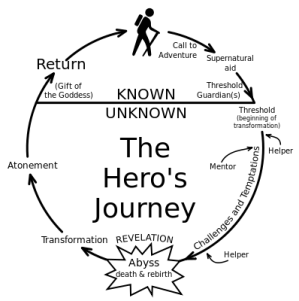
This low point is a crucial part of the hero’s journey, the place during which she is taken down to her component parts emotionally, and rebuilds herself to be more than she ever believed she could be.

At this point in the novel, if you have done it right, your reader will be sweating bullets, praying that Frodo and Sam can just hold it together long enough to make it to Mt. Doom.

2 Comments

Filed under writing

#amwriting: Interview with author Stephen Swartz

Today is the final installment in my series of interviews with working authors who are also teaching writing craft. This has been a wonderful series, as each approaches the craft from a different angle, and my final guest has a great deal to offer.

stephen-swartzA little background on today’s guest, author Stephen Swartz. He is a Professor of English at a major Midwestern university, and is a world traveler, often spending his summers teaching in Beijing, China at the University of International Business and Economics. Also, he is the author of numerous short stories and novels, and is a fellow founding author of Myrddin Publishing. He has also published poetry and written for scholarly journals on the subject of composition and identity, linguistics, and psychology.

CJJ: What do you enjoy the most about teaching?  Conversely, what would you change about your job if you were able?

SS: I’m rather parental when it comes to teaching. I like seeing my students become excited about writing and push themselves to explore their potential. I enjoy seeing their writing improve paper by paper, not only technically but also in showing their deeper thought processes. As it is, there are constraints on what I think would be best when it comes to writing instruction. Partly, it is a matter of budgeting, enrollment, and accreditation requirements. It is also a matter of what students are interested in career-wise; many do not think they will need to write in their careers. So I have limitations I must work within. And, of course, each semester brings a new mix of students so I must constantly adapt the lessons to accommodate them; it really is like reinventing the wheel. Writing fiction keeps me balanced.

CJJ: As you know, many authors are writing for children, preteens (middle-grade), and YA. In a comment on this blog recently, you said, “Meanwhile, the style (I think) should match the nature of the story and especially the mindset and education level of the narrator.” Can you expand on that idea a little?

SS: What I think I meant was in reference to the sophistication of the language the narrator of a story uses. That’s the author’s responsibility. If the narrator of a story is well-educated (for example, see my vampire novel A Dry Patch of Skin), he would speak in a well-educated manner, with sophisticated style and a large vocabulary. A less educated character (or a child) would speak differently, using simpler vocabulary and often incorrect sentence constructions. A foreign character speaking English would have similar language limitations; the dialog should show those limitations. However, we cannot let the language be too authentic if doing so would cause the reader difficulty. I once wrote a character who was supposed to speak with a Scottish accent; the result was rather bad. Having just enough (a particular repeating word or phrase) to hint at the accent would have been enough. I’ve been fortunate to have both studied linguistics and foreign languages as well as listened to speakers of varying ages and accents. I lived in Japan for five years and teaching English there taught me how non-native speakers “butcher” the language. I think I captured that effect well in my novel Aiko, set in Japan. Besides formal training, I also think I have a good ear for speech and so I do my best to replicate the character’s way of speaking based on the real speaking I’ve heard.

aikoCJJ: You have published eight books, in a variety of genres, and are now finishing up an epic fantasy novel (of EPIC proportions!). Yet, none of your characters have a sameness to them. How do you visualize your characters when you begin to place them in their story?

SS: Excellent question. My answer must, however, be simple. I’m schizophrenic. My mental defect allows me to grab pieces of other people’s lives, behavior, speech, and motivations which I then craft into plausible, even realistic, fictionalized personas. I recognize I have a few stock-in-trade character I use over and over with names changed and perhaps a quirk switched for a different quirk. I suppose I take one of my stock characters and customize him/her for the role I need him/her to play.

The hardest character to write is the protagonist because that character usually starts as a version of myself. The challenge is to let the hero act as the hero would naturally act (following his/her motivations and typical behavior) and not as I, the real me, would likely act. When I wrote out the story of a friend of mine who grew up in Greenland, I was writing a female protagonist—and using the first-person point of view. That novel was based on her life so I could imitate her way of speaking from interviews with her. The challenge for me in writing that novel was to make her language style change from her childhood to her teenage years to her adulthood.

For my current work-in-progress, the epic fantasy, I returned to a basic male protagonist, a hunky dragonslayer, and cobbled together a bit of a movie star, a little of me, and a pieces of other people I know to create the singular hero.

CJJ: In your upcoming novel, EPIC FANTASY *WITH DRAGONS, you portray a variety of races in a fantasy environment, each with unique cultures. What tips can you give in regard to keeping fantasy cultures diverse, and yet not devolving into too much backstory?

 SS: Not truly different races, not in the sense that Tolkien has them with dwarves and hobbits. I tried to keep the ethnicity in my story more subtle. Given the setting (no spoilers here), there is a wide variety of “types” among the cast members, not just to make a politically correct checklist but because they mix well in interesting ways. One famous author (I think it was Dostoevsky but it may be a more modern writer) liked to think up unique people and ponder how they might interact if put in a room together. I did the same with my epic fantasy only on the larger stage of the story world.

Regarding the world-building, I cheated a bit in this novel by setting it in a familiar setting (again, no spoilers here). Readers may recognize it eventually but it is not explicitly “given away” in the text. Even so, as I traced the path my hero would take on his quest, I marked certain locations on the map as being “different” societies with unusual customs—not different races or ethnicities. Like all good epic fantasy tales based on a quest, there is a series of episodes—self-contained mini-story arcs, strung together, one adventure after another—so the structure is easy to arrange. Following the geographical layout of the setting, what “can happen” to our hero necessarily changes from location to location.

A better example of world-building may be my science-fiction trilogy The Dream Land, which involves a pair of nerdy teens who discover a doorway to another world—which I created as a fully realized planet with continents, oceans, history and culture, and several different races, as well as unique flora and fauna. The world-building was half the fun of writing those novels; pushing my hero and heroine into this new world and watching them figure things out was the other fun part.

I think the key to “keeping fantasy cultures diverse, and yet not devolving into too much backstory” is to remember that, to the characters in the story, it is all known and common (usually) so they should speak and act toward everything there as though it was all common to them. You have to find creative ways of introducing ideas and details without them coming out as a “Let’s go meet Bill, your cousin, who, as you know, is also my long-lost brother” kind of writing. In my current epic fantasy novel, I can get away with some of that “messaging” because my hero is on a quest and does not know about the places he visits, so having a local character explain things is quite natural. People like to talk, so I let these “local yokels” ramble on and the history and customs of the place come out in a more natural way.

CJJ: In all of your novels, there is a certain amount of world building, even the novels set in contemporary environments. What advice can you give regarding making the settings feel real to the reader while keeping the backstory minimal?

SS: Research, if it is a real place. Read other books about the location, fiction or non-fiction. As I wrote A Girl Called Wolf, which is set in Greenland, I also read a very evocative book on the travels of early explorers written by a woman undertaking her own contemporary travels there. Her writing and descriptions painted such vivid pictures for me that I could describe the locations both accurately and passionately.

The most realistic setting I’ve ever used was my own city in the set in the same year I was writing it. I’m referring to my vampire novel, set in Oklahoma City with places named, set in 2014, when I was actually writing it so what happened in real time happened in the book. That was a fun exercise. But then our hero goes to Europe so I went back to researching.

For make-believe worlds, I think it’s simply a matter of transposing what we know of real locations to an imaginary location. For example, in The Dream Land Trilogy, I would think of an Earth animal and reinvent it as something more exotic: the common mount, a horse, became a 3-toed donkey with a dewlap, stripes on half its body, long rabbit ears, and a rat tail. Similarly, I’m more science-focused so even in a fantasy story I remain concerned with such things as the distance of the planet from its sun and the ratio of land to ocean, and so on. Even in my epic fantasy, a genre where magic is required, I have magic operating on scientific principles but it is explained in highly metaphorical language—but it still looks like magic!

CJJ: Thank you for indulging my curiosity, Stephen. I love talking craft with you around the virtual water cooler at Myrddin, and enjoy your blog, The DeConstruction of the of the Sekuatean Empire.

>>><<<

You can find Stephen Swartz at any of these places:

Stephen Swartz Amazon Author Page

Website: The DeConstruction of the Sekuatean Empire

Stephen Swartz  Myrddin Publishing page

Twitter: @StephenSwartz1

Stephen Swartz’s FB Author Page

2 Comments

Filed under writing

#FlashFictionFriday: Edna’s Garden, Part 2

I’m packing up to move. Selling the house was more work than I thought it would be. My agent assured me the large sum of money I spent replacing the old carpets with laminate, and getting new, natural-stone counter-tops would more than pay for itself when I found the right family to sell the place to. Frank Lanier, my real estate agent, has known me for years. He accepts that I believe more is at stake than mere money and was willing to write some unusual clauses into the contract.

My daughter doesn’t know this, but I told Frank that if the right people wanted the house, I would accept any offer they made, even if it was a little low.

The problem is, I’ve buried two husbands, and now I’ve outlived my handyman, Jasper. He seemed so healthy too. But he dropped dead of a heart attack at the young age of only eighty-two. Jasper did everything I couldn’t for the last thirty years, mowing the grass, cleaning the gutters, fixing the wonky electric system, or repairing the roof. I don’t want to have to train some young know-it-all in how things should be done, such as not running the lawnmower over the sprinkler heads. I’ve accepted that I can’t care for the place anymore.

But I do have a responsibility to see to it the right family moves in here. They must be able to see past the expected, must have an imagination, and absolutely must be committed to preserving…nature.

Marjorie, my daughter, is only in her seventies and, unfortunately for her husband, she’s as healthy as a racehorse. The way she carries on about every minor ailment, you’d think she was at death’s door. Arthur, Marjorie’s husband, is the least spirited man I’ve ever met. I suppose forty-eight years of being tied to her has long since beaten anything resembling a backbone out of him. Marjorie has the notion her life will be much easier if they sell everything and move to Florida.

I know what my extraordinarily lazy daughter is up to.  By purchasing a condominium in a resort for well-heeled seniors, Marjorie will have housekeepers to order around and will never have to cook again. They could eat every meal in the community dining room. I’m sure Arthur sees that as a point in her favor since Marjorie can’t even boil water without burning it.

It sounds like a cruise ship but without the Norovirus. However, she needs me to foot the bill, because she always spent her and her husband’s salaries faster than they could earn it, and then she insisted on retiring early. So, they’re out of money now, but she has a new retirement plan–me. She’s been pretending I’m senile and petitioned the court to be given custodial power over me and my assets “for my best interests.”

That will never happen. She now hates my lawyer, because he made it clear that I am in complete possession of my wits, and the judge rather bluntly asked her what she was hoping to gain. She became quite offended, saying it was her duty to care for me in my declining years.

Of course, she came apologizing afterward, trying to convince me to move in with them, but I told her I had plans that involved having a life. Marjorie got that pouty look, the one she wears anytime she’s balked. After we had left the court, I did tell Violet that booking myself into the lowest-rated nursing home in a Bombay slum would be preferable to putting myself and my money in Marjorie’s power. Violet knows Marjorie, and had to agree.

With Jasper’s untimely death, I had to do something about the house, but I have a responsibility to the “guests” in my garden. I didn’t tell Frank why I wanted only a certain kind of family, but the truth is, whoever purchased this place had to be people with an open mind. They had to be able to see my fairies and understand they are an endangered species and that they have a sacred duty to protect them. That’s why I had Frank put the clause in the contract that the new owners must never cut the hedge.

Frank finally found the right people. Kaitlyn and Martha fell in love with it. When they looked at the garden, Kaitlyn spotted the fairies and got all excited, pointing and whispering to Martha that this was the place for them to build their life together, and she had to have it, no matter what.

Martha agreed.

So now, that perfectly sweet couple will live here, and my fairies will be safe.

As the judge advised me to, I’m spending Marjorie’s inheritance. Frank found me the perfect little condo downtown near the senior center, and I can bring my cat, Rufus. It’s only a few blocks from the farmer’s market, and it’s on the bus line so I can sell my car, which will make my insurance agent happy.

Once I get settled there, Violet and I will take a two-week trip to Italy. We have a lot of plans, and making a pilgrimage to Fabio’s birthplace is just the beginning.

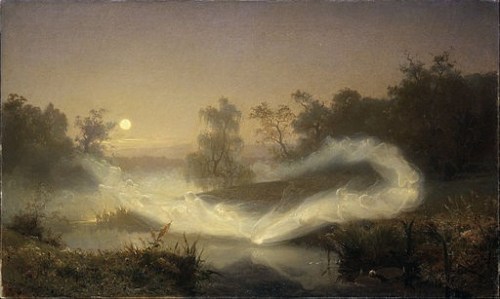
512px-August_Malmström_-_Dancing_Fairies_-_Google_Art_Project


Edna’s Garden, Part 2 © 2016 Connie J. Jasperson, All Rights Reserved

Click here to read part one of Edna’s Garden 

Comments Off on #FlashFictionFriday: Edna’s Garden, Part 2

Filed under #FlashFictionFriday, Fairies, Fantasy, writing

#FridayFiction: The Bolthole, part 2

The next morning, Eddie, Gertie, and Billy packed what few possessions they had and made ready to leave The Powder Keg, meeting Walter and his son Willie on the way downstairs. Severely hungover, the Bastard sputtered and cursed, but finally agreed that he could make a bit more gold if more merchants were able to travel. By mid-morning, they had made their goodbyes and were on the road north to Eddie’s lodge.

A storm was blowing fiercely atop Windy Ridge, which made the narrow, muddy road treacherous, slowing them. It was late afternoon when they arrived home, although the thick forest of tall firs made it seem later.

>>><<<

Just after noon on the fifth day of Eddie’s new venture, five mercenaries he’d ridden with during his tenure with the Wolves rode in, bringing all their possessions, hoping to sign on with Eddie’s new crew. They asked him what he was naming his mercenary band, and he confessed he hadn’t picked a name yet.

To his son’s rather visible joy, one of the new recruits was Dame Bess, a noblewoman who claimed no last name. Another was Alan Le Clerk, a younger merc of Billy’s age. Lady Barbara (Babs) Gentry, Lily Rhys, and George Finch rounded out the crew.

Dame Bess was the coldest woman Eddie had ever met, hard as steel. He wasn’t sure what his son saw in her, but the lad was completely smitten, despite the fact she ignored him the way she did every man, or woman for that matter. Still, she was one of the best sword-swingers in the business, level headed when anything bad went down, and a quick thinker in an ambush. He counted himself lucky to have her on his crew.

After they picked their bunks and settled their things upstairs, they sat down to supper, pleasantly surprised at the meal Eddie’s son, Billy, set before them. Alan said, “I never knew you could cook.”

“This is good. Better than Marien’s.” Bess took a few more bites of fish-stew, then said,”There’ll be one or two more Wolves coming along in the next day or so. They’re taking their time, wanting to see how the Bastard changes things up, so they’re working without a contract until they make up their minds. They have until the day after tomorrow before they have to make a commitment.”

George Finch, the younger son of a baron, spoke up, his clipped, northern nobleman’s accent sharp with indignation. “You got your son out there just in time, Walter. Guess who turned up, right after you left? Good old Bloody Bryan. He showed up as soon as he knew Marien was safely in the ground.”

Lily nodded. Her thick Eynierish accent was hard to follow, and an angry look marred her darkly attractive features. “Sure enough, the Bastard took him back, claiming he was shorthanded because you had taken half the crew and started your own ‘band of thieves and rowdies.’”

George’s scorn could have peeled the bark from a woodwraith. “After what that degenerate did, ruining our good name—”

Eddie snorted. “The Bastard always did have the worst taste in friends, but taking Bloody Bryan back…I don’t understand it.” He shrugged. “Anyway, I hope you’re aware that I have no jobs yet. We might be doing a lot of fishing here if we can’t find work.”

Lily’s grin lit up the room. “I love to fish—I’d rather do that than anything else. Besides, I wouldn’t spend another night in the Powder Keg, now Bryan is there no matter how hard things get here.”

Bess smiled, and when she forgot to be hard, she was pretty. “Just so you know, the Bastard is already referring to us as a bunch of highwaymen and rowdies whenever anyone asks and telling folks our shack is naught but a bolthole in the woods.”

The whole group laughed, Eddie most of all. “A bolthole–I like that. Coming from him it’s a compliment. You have to admit, it’s a pretty solid shack.”

“This place is a lot sturdier than the Powder Keg,” Walter said. “I hated living upstairs there during a high-wind storm. The top floors shake so bad, it’s like the whole place will blow down.”

“You have that right, Walter.” George leaned back against the wall, taking in his surroundings. “This is a damned log palace, compared the Powder Keg. Plus, the Keg get’s flooded every year when the river rises. This place is dry, with no moldy smell. I don’t care if I do have to share quarters—I can live without the mold.”

The next morning, just after midday, a knock sounded at the door. Eddie answered it. A merchant he recognized, John Caskman, stood there. “Hello, Eddie. I was just in Somber Flats and heard the news about Marien. The Bastard tells me you’re leading a new band of mercs called the Rowdies? If so, I have a job, for you, leaving Monday next. It’s a small wagon train for you to escort to Galwye, from Dervy. Three wagons, so I’ll need six guards for six days.”

Eddie shook his hand, and a smile split his face. “Yes, I think we can fit you into our schedule.” That evening he hung a shingle over the front steps:

the bolthole sign

With that, the names were established, and the Rowdies settled into a routine.

>>><<<

Five weeks had passed since Mad Marien’s funeral. The court papers had arrived at the end of the second week, and Eddie MacNess was officially granted a patent to form a mercenary outfit, the Rowdies. Things had gone far better than Eddie had dreamed they would, and even the Bastard had been forced to admit business was better than ever with the Rowdies funneling paying customers his way. Eddie now had sixteen Rowdies, including a trained provisioner,  a runaway sailor from Lanqueshire named Romy. Business was good and the Rowdies were working all the time.

It was a clear day, with blue skies and birds singing. Eddie, George, Allan, and Billy had just arrived back at the Bolthole. Eddie dismounted, handing his horse’s reins to young Willie. He’d just realized the birds had stopped singing, when the sounds of horses galloping caught his attention, and he looked up, seeing five knights in royal colors riding as hard as they could, heading for the safety of the barn.

The knight leading the group shouted, “Dragon! Get your livestock under shelter.”

Eddie caught the bridle as the man leaped from his horse. “Where was it last?”

The knight in charge was Lord Mat St. Coeur. “Just north of Psalter Pass. We were fighting it, but the damned thing flew away. Do you have any livestock?”

“Just a few chickens, which we keep in the barn. We keep the horses in the paddock by the stable because I haven’t had a chance to repair the main stockade yet. Where was it headed? I have a crew of Rowdies who should be coming home this afternoon, and they may already be on the Galwye road.” Gertie, Lily, Bess, and Babs had guarded a small merchant caravan from Dervy to Galwye and back. Eddie looked at the sun, thinking they should have just left the quarry town. They would be about two or three hours away, depending on the weather up in the hills. A ball of lead formed in his stomach as he realized he had no way to warn them, but he stuffed down his panic. “Was it wounded?”

“Yes, but he was still able to fly. He was headed this way, then disappeared. I think he may have landed, but he could still be flying around out there.”

Both men jumped deeper into the shadows of the stable as an immense shadow crossed the stableyard, flying low. Eddie’s bowels turned to water. The roar of flames lit the clearing, and the shadow passed.

The flickering light of a fire, however, did not. Willie grabbed Eddie’s arm. “Look to the house, Captain Eddie! The thatch is alight!”

St. Coeur leaped to action. To Eddie, he said, “Fetch a ladder and rakes.” He turned to Willie. “Boy—get everyone out of the house. Tell them to bring out every bucket and container they can find.” He turned back to Eddie. “I’ll go up on the roof and rake the burning thatch down to the ground. Once I have it on the ground you lads put out the flames.”

Young Willie’s eyes were terrified, but he had himself under control and ran to the house as instructed.

Racing to the tool shed for the ladder and rakes, Eddie called over his shoulder, “St. Coeur, you’re a fool! You’ll be right up there where the dragon can get you.”

Following Eddie, St. Coeur shuddered. “If so, I’ll be his dinner. We need to save your house. It’s the only dry shelter for miles!”

Willie emptied the house of people. Billy joined St. Coeur on the roof, working as fast as they could, raking and dragging every last bit of burning thatch off the roof. Down on the ground Eddie and the others had formed a bucket brigade, passing water up to the men on the roof while Willie and Romy drizzled water  and stamped on what St. Coeur and Billy threw to the ground.

Finally, the fire was out. One whole side of the house had no thatch, bare to the split-rails laid over the rafters, but the smoke had cleared, and the house was saved.

The two men carefully examined the rest of roof, to make sure no embers were hiding, pouring buckets of water over it, just in case.

Eddie stood in the clearing, staring up at the thatchless side of his house. His heart sank at the thought of the work ahead of him in repairing the damage over the next few days, but at least he still had his home.

However, that disaster paled in comparison to his real worry. What if the dragon had passed over Gertie’s crew? There was nothing he could do about her and the other ladies, so he forced himself to keep on working.  “I guess we’d best see if we can find enough canvas to keep the rain out of the attic while we get this fixed.” His jaw was clenched to keep his teeth from chattering. Visions of his lady being snatched up or trying to fight an enraged dragon kept stopping him in his tracks.

At last, he found several good-sized tarpaulins, canvases for covering freight-laden wagons. He sent Billy up on the roof with St. Coeur to help the knight secure the sheets of canvas. The two men bound them tightly to the rafters with stout hemp cords so the wind wouldn’t blow them off during the night. Finally, they were back down on the ground.

Billy grabbed his father’s arm. “Dad—we’ve done what we can here. I want to go look for the ladies.” He was demanding, it, and wouldn’t hear “no” if Eddie said it.

Eddie wanted nothing more, but he was captain. It was his duty to make sure everything was in order before he went looking for his lover.

Billy tried again. “Please? It’s Gertie, Dad…and Bess.”

Caving in to his own fear, Eddie nodded and turned to the knights. “St. Coeur, Romy will feed you and your lads, and get you settled for the night. I have a crew on the Galwye Road I need to go meet.” He turned to the Rowdies. “Alan, Lonnie, and Walter—you’re with Billy and me. Willy, let’s get these horses saddled.”

However, the thunder of hooves announced Gertie’s crew returning. The ladies rode hard into the stableyard but pulled up when they saw all was well. Once in the barn, Gertie jumped down, and Eddie grabbed and swung her, relief making him giddy.

Laughing as he set her down, Gertie said, “We saw a dragon flying off to the north. Then we saw a column of smoke rising from here and feared the worst.”

St. Coeur said, “Which way was he headed?”

Gertie shivered. “North along the foothills, below the Western Range. He wasn’t flying too well, and he was far away, but we stayed hidden under the forest.”

“Too right, we hid,” said Babs, winking at St. Coeur. “We had no intention of dancing swords with a dragon. Hello, Mat. Remember me from court? Lady Barbara Gentry.”

“I do remember you, Babs—and how well you got along with the queen regent.” Mat covered his laugh with a cough. “The snake in her dressing table was a lovely parting gift when you left to marry the elderly Earl of Grandon. I never knew you’d taken up the sword, though.”

Babs laughed. “To my noble father’s eternal embarrassment, I’m not really cut out to be a countess, so the night before the wedding I eloped with my sword.”

St. Coeur eyed Babs appreciatively, but said to Eddie. “The dragon’s lair is likely up in those mountains, then. They’re pretty smart. Maybe he won’t come this close to civilization again—we did manage to wound him.”

“What are you lads going to do about him?” Eddie couldn’t get the size of the shadow out of his mind. “We can’t fight something like that. You have those bespelled shields and majik amulets.”

St. Coeur nodded. “And even with those to assist us, we lost two men. We were about six men short to have a proper chance at killing him. But I suppose we’ll be sent on a dragon hunt up in the wilds. We don’t just let those sorts of creatures roam freely.”

Babs linked her arm with St. Coeur’s, smiling up at him through dark lashes. “Mat darling, have you ever considered becoming a mercenary? We have so much more fun than you noble younger sons who must do all the dirty work with so little appreciation from her royal bitchiness.”

Mat replied, “Well, I did receive an offer from the Ravens last week, and I may take them up on it. Outside of the occasional dragon hunt, court life bores the hell out of me.”

“You’ll be an asset to them, and if things don’t work out there, I’m sure Eddie could keep you busy here. We’re never bored.” She drew the knight toward the lodge, their voices dwindling as they left the stable.

>>><<<

Later that night, alone in the privacy of his room Eddie held Gertie, overcome by the thought that he’d nearly lost his home. But more importantly, during the ruckus, once everyone was safely out of the burning house all Eddie had been able to think about think about was that Gertie was on the Galwye Road, and the dragon was heading her way.

“I love you, Gertie Smith,” he said, kissing her forehead.

“I love you too. But I’m not giving up the sword.”

“I know, and I don’t care.” And he didn’t. He had as much of his lover as he ever would. He had his mercenary crew, he still had the Bolthole, partially roofless though it was, and he still had his son. No one had died. He didn’t need anything more than that to make him happy.

Gertie slept in his arms, and he laid there listening to the unfamiliar sound of rain hissing on the canvas that now protected his attic. Eddie had no idea what the next day would bring but at that moment he was filled with contentment. Still smiling, Eddie fell asleep.


To read part one of The Bolthole, click here

“The Bolthole, in two parts” © 2016 Connie J. Jasperson, All Rights Reserved

Comments Off on #FridayFiction: The Bolthole, part 2

Filed under #FlashFictionFriday, Fantasy

#FlashFictionFriday: Astorica

800px-Ladies_safety_bicycles1889Chance Jensen approached The Duck Walk Inn, aiming for the front door. It was classier than most of Astorica’s cocktail lounges, and was the third place she’d looked that afternoon. She entered, peering around to see if Jack was there.

He was, and ignoring the worried glances from the few men who were present in the otherwise empty bar, she walked toward him.

Stella, the bartender, chatted with Chuck Moore, Astorica’s lone hooker. Chuck’s clientele was comprised mostly of lonely, blue-collar laborers, women who worked in the shipyard. Stella nodded at Chance, as she lit Chuck’s cigarette.

Chuck exhaled a cloud of smoke, and glared at Chance. “You’ve been neglecting him, Chance Jensen. Don’t take your husband for granted. You’re a lucky woman to have a man like Jack. He shouldn’t be sitting in a place like this.”

“I know. I’ll do better, I promise.” She did have to smile, getting advice on her marriage from the local whore. But, she supposed, Chuck had seen plenty of marriages fail.

“Good. I don’t want to have this conversation again.” With a flounce, Chuck turned back to Stella.

The nervous-looking men at the corner table had moved their handbags to hide their cocktails, obviously regretting their decision to be so daring as to go into a cocktail lounge unaccompanied.

Jack looked out of place at the bar, dressed in his usual proper, suburban, house-husband style. He glanced up from his iced-tea. “What do you want? I’m not going back unless you’ve changed your mind.”

“Jack, we had a quarrel. I’m sorry I shouted. But, you can’t file for a divorce, as you don’t have grounds. I don’t beat you or cheat on you. You’re just angry because I can’t afford to buy you a bicycle like Loris did her husband.”

Jack straightened his sweater and crossed his trouser-clad legs. “You’re right, I am unhappy about that. I might not be able to get a divorce, but I don’t need one. I’m not interested in dating, so I have no desire to be single. But no law says I have to share your roof. If I got a job as a waiter or a housekeeper, I could support myself and buy my own bicycle. One with a good-sized basket for carrying things.”

Chance attempted to reason with him. “Jack, if you took a job outside our home what would people think? They’d think I can’t manage on my salary. I’m just starting out with this company. I don’t need that kind of image dogging me, holding me back, or I’ll never be promoted. They’re assigning me better routes now, so things will improve. I promise.”

He burst out, “I have needs too, you know. I want to go places, and do things. I’m tired of being cooped up, with nothing to do but slave away, making sure that when you come home, you find a clean house and a hot meal. Where’s the joy in that?” Jack wiped a tear, a sure sign he was really worked up. His voice, however, was calm. “It’s just, if we had a child, I would feel needed. I don’t have a purpose, Chance.” He met her eyes. “Give me a purpose, and I’ll stay.”

Chance sighed. It always came back to that. “I’d like a child too. I don’t know why we haven’t been blessed. We’re both healthy. There’s no reason we haven’t conceived.”

Jack looked around the room. “See? They’re the same as me. We’re bored stiff. Playing bridge on Tuesdays and going to Tupperware parties just doesn’t fill the void. It’s not just us. Fewer and fewer babies—something’s wrong with this world, and no one will admit it.” He stared down at his handbag. “It’s more than that. It’s everything. I get up at five to cook  breakfast and fix your lunch. The darkest corners in our house are so clean they glow in the dark! I do laundry. I wash windows. Every day, the same things.”

Chance started to agree, but Jack cut her off.

“At ten I get all dressed up and take the bus to the market, then I haul the groceries home and put them away. Once that’s done, I change and go out to work in the flower beds, because God forbid the neighbors should see an untidy yard! Once every bloody just-sprouting weed has been yanked, I prepare your dinner, and fifteen minutes before you get home I get all dolled up, just to look good while I serve you dinner. Then I have to clean the kitchen. The next day it starts all over again. My life revolves around cooking, cleaning, and what the damned neighbors might think of us.”

Hoping to calm him, Chance said,“I know it’s difficult for you, depending on public transportation. But I’m a truck driver. You knew that when you married me. Maybe I’m not as romantic or rich as the wives in your soap operas, but I do try. Don’t I give you a large enough allowance? I never ask how you spend it. I don’t care if you have lunch out with the boys, or have your hair done twice a week. I love you! I married you for keeps, and I respect the vows we took.”

“You could tell me you love me more often.” Jack sat  hunched in on himself.

“I know. I’m not good at saying how I feel.” Chance put her hand on his shoulder. “I’ll try to do better.”

Jack burst out, “I could learn to drive, but men aren’t allowed to. I could vote and help pass laws that would improve society, but no, men aren’t allowed to. We’re too emotional, too high strung to be allowed the same privileges as women.”

Desperate to head off the men’s emancipation argument, Chance said, “I know you’d be great at all those things, better than some women if I’m truthful. But it’s the way things are, and we have to live with it. And guess what—I got a raise, today.”

Jack’s eyes it up. “Really? That’s wonderful.”

Pressing her advantage, Chance said, “You know what that means? We can save up for your bicycle. If we’re careful, next month you can buy it.”

Picking up his handbag, Jack stood up. “Let’s go home. I’ll make a pie to celebrate your raise.”

Relief flooded Chance. Taking his elbow, she opened the door for Jack and guided him across the parking lot, reminding herself that men were the fairer sex, and required gentle handling. Chuck was right–she had been neglecting Jack’s emotional needs. She resolved to be more attentive.

She loved Jack , but he confused her. He had an overabundance of paternal instincts. It occurred to her that a puppy might take Jack’s mind off things. And, it just so happened Chance’s new boss, Carol, was trying to find homes for six dachshund puppies.

That was a brilliant idea. She’d gain favor with the boss and surprise Jack with a puppy, solving both problems in one swoop. Smiling, Chase opened the car door for her husband, helping him into the sedan.


“Astorica” © 2016 Connie J. Jasperson, All Rights Reserved
4 Comments

Filed under #FlashFictionFriday, Fantasy, writing

#flashfictionfriday: October Sky

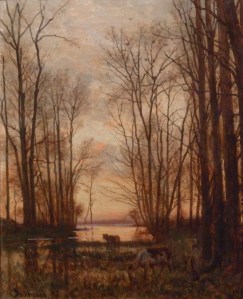
Louis_Français-CrépusculeIt had been the coldest October I could remember. Rafts of ice floated up and down the lake, blown by the winds, breaking up and re-forming as if dancing a ballet. The leaves had been off the trees since the end of September, almost as if they couldn’t fall fast enough.

It was in the last, quiet hour before sunset when the real beauty of my rustic lake home was revealed to me. The sun drifted its way behind the hills as the wind died off to nothing. The lake became a mirror reflecting the pink-blue-purple-gold of the sky and the deep green of the evergreen forested hills. It was a green so deep that it appeared to be black.

I would sit at my frozen picnic table with a steaming mug of coffee warming my hands, watching the snow geese and the western grebes. Only the voices of the loons and the geese pierced the blanket of peace I had wrapped about myself.

When the colors had faded, and I could no longer feel my fingers, I would go back into the house and stoke up the fire, still in the thrall of the lake’s spell. Then, only when I had absorbed the tranquility of my lake, would I pick up a brush and enter my world of canvas and color.

On the first morning I saw the naked trees stark against the incredible sky, I knew I had to somehow capture the power. Attempt followed attempt and soon my house was littered with the “almosts.” The bones of the trees were right, but the essence of the sky was missing. Each night I worked longer and more feverishly until one day I realized that I had to back off and gain some perspective.

And so it was that in the small hours before dawn one morning I put away the brushes and paints, and covered the canvasses, frustrated by my inability to capture the essence of the lake and the sky that was mirrored in it. Exhausted, I fell into my bed drained and unable to concentrate, yet sleep escaped me. My mind was filled with the loons and the trees and their sky.

At last, knowing it was futile to try to sleep I rose and made myself tea. Wrapping a blanket about myself I walked out to my small sitting room to watch the trees greeting the pale dawn. The warmth and fragrance of the steaming cup of tea made me feel rested as my bed never had, and the familiarity of the ritual soothed away my frustrations.

The serenity of the moment deepened, a sense of sacredness pervaded the garden. Willingly, I gave myself to the experience, allowing the essence of the moment to seep into my soul.

The air felt strange, alive and crystalline, and the trees beckoned to me. I could feel them calling me to come out and greet the sun with them, and bemused, I answered their call. Stepping outside, still wrapped in my blanket, I walked through the frozen grass, until I was in the orchard among the trees on the shore of the lake.

Looking west to the black-forested hills, I held my breath, overcome by the feeling of anticipation that infused me. Something told me I stood on the verge of an event, vast and unfathomable, though what it could be I couldn’t imagine.

Gradually I realized that the ground was vibrating, and had been for a while, shaking as if a giant walked nearby. As I became aware of the vibrations beneath my feet, a deep rumbling began to penetrate my reverie, shattering the peace. The unfamiliar thunders grew louder with every moment, and the birds fell silent as if waiting to see what approached.

Huddling nervously in my blanket, my eyes were drawn to the north and there, emerging from the mist I saw machines—great, huge, monstrous machines I had no words to describe. They came slowly and relentlessly down the middle of my lake. The waters rolled and boiled around them as they passed me by, paying me less attention than they did the trees. The ice floes broke and tipped crazily, riding the waves that danced about the giant treads.

The line of machines continued south, grinding through the swamp, going I knew not where and coming from where I could not imagine. As they came, the waters grew, and waves began splashing at my feet and then my knees. At last, realizing that I was in trouble, I turned and raced for the higher ground and the safety of my house.

Still the waters rose, following me, and still the machines came rolling down from the north.

I closed the door and stood to gaze out the window at the rising waters and the monstrous machines that continued their unrelenting journey south. The waters rose, and my house began swaying, creaking and groaning under the water’s assault.

I fell to my knees praying to the God I didn’t believe in, but he wasn’t listening.  My house shook and rocked, and lifted with the rising water, turning slowly as if to say goodbye to the lake and the hills to the west. Dishes and furniture careened off paintings and walls—my life in small objects passing before my eyes. I looked, disbelieving, through the shattered windows and saw the inconceivable sky spinning around like a child’s top spins.

I covered my head, and screamed my prayer, but the only answer I received was the sure and profound sound of breaking glass and furniture shattering.  At last, when I believed it would never stop, the floor I clung to gave a great lurch and the noise of destruction stuttered into silence, a silence every bit as loud as the din had been.

Throwing back my blanket, determined to get out of the wreckage while I could, I saw the last of the machines going south into the broken swamp. The trail they blazed through the marshland was a great scar that would never heal, and I wept at the sight of it.

I surveyed the damage to my home with stunned eyes. My house was now perched all askew upon a slight rise that had been perhaps fifty feet behind it before. Everything I had ever owned was now in full view of anyone who might choose to make a leisurely visit to my remote home. Every item of clothing, every bit of dish, smashed or whole, everything dangled from the branches of the broken trees, displayed everywhere.

Despite the carnage, the sky hung pink-blue-purple-golden and unchanged while the naked trees made lewd gestures with my most personal of possessions. The ridiculousness of the situation penetrated my shock, and I began laughing, and falling to my knees I laughed until I couldn’t breathe. Eventually, my laughter became sobs, and I howled until I was spent.

The silence was too much, making me intensely aware of my frail mortality. Stepping through the rubble, I gathered my canvasses, paints, and brushes. Miraculously my easel was untouched, and so I did the only thing I could think of.

I painted the pathetic wreck of my house reflected in the perfection of the lake and the hills.

I painted the obscene trees against the incredible sky as they proudly displayed the debris of my life.

And then I painted those awesome machines as they paraded past me, not realizing that I was there and not caring.

When I was done, three paintings leaned against my ruined fireplace. Exhausted, I found my bed and righted it. Crawling into it I finally fell asleep, resting dreamlessly.

When my eyes opened, I was disoriented. I awoke in my bedroom and looking around, I could see no signs of the previous day’s events. In disbelief, I went to the kitchen and found all my kitsch and accumulated knick-knacks still to be there, whole and in their tasteless entirety. There were no broken dishes, no broken furniture.

Awed and amazed at the power of the dream I had just experienced I set about preparing my breakfast. “Idiot,” I muttered, still feeling rather giddy. I wondered what my sister would say when I called to tell her about it.

Making a cup of coffee, I went to sit by the window in the sitting room.

As I passed the fireplace I froze. Three pictures leaned against the uninjured hearth.

One was of obscene trees decorated with my personal possessions, silhouetted against an incredible sky. In the second picture, my sad house perched askew on the hill, broken and sad, framed by the astounding sunset.

And the third picture was a terrifying image of gigantic, grotesque machines tearing up my lake, plowing through the swamp with the waters roiling wildly about the monstrous treads, beneath the sky that had eluded my skills until that night.

Even I had to admit that the power of the paintings was overwhelming.


October Sky © Connie J. Jasperson 2016 All Rights Reserved

Written circa 1992 and originally published On Wattpad, December 2012

Republished on Edgewise Words Inn, April 2015

8 Comments

Filed under #FlashFictionFriday, writing

#amwriting: the rough draft

My Writing LifeI have begun a new novel set in Neveyah. It is the “how it all began” novel and takes place at the beginning of their recorded history. It’s been rolling around my head, and bits of this story are alluded to at various points all through the Tower of Bones series and also Mountains of the Moon.

The protagonist of this story is mentioned regularly in the Tower of Bones series as a character featured in children’s books. He’s portrayed as a kind of superhero, doing many impossible things.

But as always, there was a real man and real events at the core of the mythology.

I am taking the mythical man and giving him his place in history as the founder of the City of Aeoven, the College of Warcraft and Magic, and the first leader of the Temple of Aeos. I had the basic story drawn up back in 2009 when I began devising the world of Neveyah—three lines mentioning their childhood heroes.

The events that launch Aelfrid down the path of the mythic hero are all laid out. Now I must connect the dots and bring him to life.  If the story grows too large, it will be published as a two volume set, but my intention is to keep it to the same length as Valley of Sorrows.

As an indie, I must pay CreateSpace up front for my stock whenever I go to book fairs or signing events, so keeping my costs down is critical. CreateSpace costs are dependent on the length of the book, so if I have to pay $6.99 for each book, it limits  how much stock I can afford to keep on hand. I don’t want to run short of books, so I try to keep my costs to below  $5.00 per book. This also makes donating them to libraries and shelters affordable.

Even though Tower of Bones was published first, the rough draft of Mountains of the Moon was actually written first. In early 2009 I had been asked to write an epic fantasy story-line for a Final Fantasy-style anime-based RPG that was never built. For that reason, the world building was super-heavy.

Before I even had a story, I had to spend months

  • devising history and mythology
  • designing all the many environments where the story would take place
  • drawing maps
  • designing the creatures the characters do battle with
  • I also had to design the rules for magic, including its limitations

Having all these things so well-drawn and documented has been a bonus, as I can just write the story. The setting is clear in my head, laid out in a style sheet for that world, and the terrain is detailed on maps.

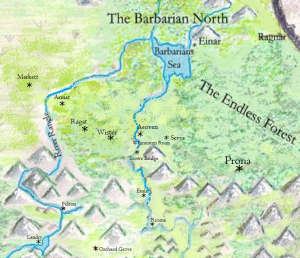
The north in the time of AelfridI have learned from the mistakes of others. Unlike the Saga of Recluce series, my maps for the early days detail the world as it was then, so there is no struggling to guess where the major towns are. (See my post, of  March 10, 2014, Spanking L.E. Modesitt Jr.)

I would definitely do two things differently, if I were to create that world today: the calendar, and the names of the days. I wouldn’t go with a 13-month lunar calendar, and I wouldn’t name the days after Norse gods.

But the calendar is canon now, and just as in real life, you must work with what you have. So, right now I am nearing the first plot point, where the first calamity occurs. Since this is the rough draft, everything to this point is really sketchy—a lot of “he said,” and “he went,” just to get the ideas down and everything in place.

These “telling and not showing” places are road marks, to guide me when I sit down to write the true first draft. My synopsis was about 3000 words. This rough draft will top out at about 55,000 words, and the first draft of the novel itself will be around 90,000 to 100,000 words.

398px-Heroes journey by Christopher Vogler

Hero’s Journey, by Christopher Vogler, via Wikipedia

What I am doing at this point is setting the scene, introducing and developing the characters, and finding the reasons why they are who they are as people. I have a grip on my mentor’s character, and also the side characters.

I know my protagonist fairly well, although what initially motivates him is still a bit of a mystery. His personality and what he has to do are clear, but I haven’t yet discovered what lies within him that pushes him to achieve this thing. That is part of the journey for me.

For this book, I know exactly who my villain is, and how he came to be that person. He is new to me, but his motivation is clear and easy to imagine. I feel a real connection to him.

Altogether, if everything goes according to plan, writing this book will take about a year for me to get it to the final draft and into the editing process.

3 Comments

Filed under writing