Tag Archives: humor

Sweeney Todd, or Gutting the Beast

Anne_Anderson05 - Beauty sat down to dinner with the Beast illustration PDArt - Wikimedia CommonsThis is the 3rd and final installment in the series “WORD, A Shifty Beast,” which focuses on helping you get the most out of using Microsoft WORD as your word-processing program when writing a novel.

You have saved all your raw files in a folder labeled in such a way that you know it contains your background work. You have formatted your final manuscript exactly the way the chosen editor’s submission guidelines want. You sent in the work to the highly rated  Sweeney Todd Editing Services and Sweeney loves it!

You came to an agreement regarding payment, and you paid the first half of the editing fee. NOW you are waiting for your first email, containing those dreaded revision requests. At last the email arrives and you see one or two attachments. The email may or may not be encouraging, some editors are very businesslike and some are chatty.

The first thing you discover is that Sweeney Todd has brutally dismembered your carefully formatted manuscript into its separate chapters, and named the files according to his system. You will now use his system for naming your files. Let’s say Sweeney sent you two files:

Elf Madness-JDoe-ch1-ST edit rnd 1.docx

Elf Madness-JDoe-ch2-ST edit rnd 1.docx

This file name says: Your book–your author name–chapter–editor name-round one.  

You will create a new folder within your Elf Madness folder, this one titled EM Rnd1 Edits S.Todd, and you will save the chapters that Sweeney has sent you in this folder. They will remain exactly the way Sweeney sent them so that you can refer back to them if needed.

Now, inside the EM Rnd1 Edits S.Todd folder you will create a new folder, this one titled EM Rnd1 Edits JD complete. This sub-folder is where you will save the first round of your revisions.

Next you will open the first file Sweeney sent you, Elf Madness-JDoe-ch1-ST edit rnd 1.docx. You will immediately click ‘SAVE AS’ and you will save it as Elf Madness- ch1- rnd 1 edit JDoe complete .docx.

NOW you are ready to make your revisions as your editor has requested.

Unfortunately, this is where you find yourself looking at a sea of red or blue with your stomach churning, and fear and loathing in your heart. There is a column on the right hand side of the manuscript and it is chock full of comments, not all of them complimentary.

With a sense of disbelief you realize your beautiful manuscript was not perfect!

Prnt scrn editng tab for WORD

This is the first step to becoming a real author.

Now you will address each comment individually:

  1. On the ribbon at the top of the page, click on the Review Tab:
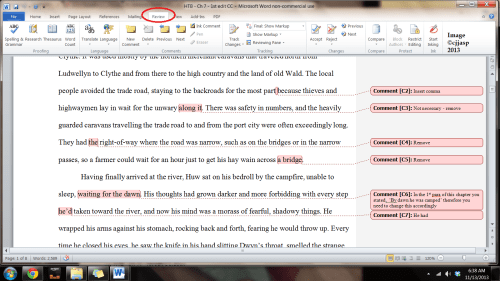
  1. Prnt scrn editng tab for WORD 1
  2. Next, click on the comment to highlight it. This way you can see exactly what it pertains to, and you can make that correction. Make the correction
  3. With the comment highlighted, click the Delete button, and that comment will go away. Continue doing this all the way through the chapter.

Prnt scrn editng tab for WORD 3

Suddenly, you have come to a place, where what you have written is what you want to keep – “OH NO!!!” But all is not lost. Leave Sweeney’s comment there and highlight the part you want to keep. At the top of the page, click ‘New Comment.’ In the comment box that will open below Sweeney’s comment, explain why you want that particular thing to stay. When your editor opens that file for the second round of edits, he will see what you said, and will proceed accordingly.

Prnt scrn editng tab for WORD 4

You will attach the revised file to an email and return it to Sweeney promptly. This way he will see you are serious about your book. He will take your revised file, and that will be the basis for the next round of editing. This will be repeated until you have completed to entire process according to your agreement with Mr. Todd.

This is the way the editing process that I have been involved in works.  My editors NEVER make changes in my manuscript for me–they make suggestions and I am responsible for making those changes and sending the revisions back to them. I’ve experienced this process both ways, and having an editor who goes in and makes  changes and doesn’t show you what those changes are, OR ask your opinion regarding those changes is simply NOT acceptable. I will never again allow such a thing to happen to my work.

I currently have 3 manuscripts in the editing mill. I find it’s like getting a tattoo—it hurts like hell and you can’t wait until it’s over, but before it has even healed, you’re already planning your next one. (Do you like my Tolstoy tattoo?)

I hope this series on how an author can use Microsoft WORD has helped you get your own manuscript ready for the submission process. It is the most commonly used word-processing program and is actually not too difficult to learn the basics of.  Every word-processing program has a learning-curve, and some programs, while free, don’t offer an author or the editor the ability to do the simple things WORD does.  Most editors agents and publishers only accept WORD files, if they are accepting electronic submissions.


3 Comments

Filed under Battles, Books, Fantasy, Humor, Literature, Uncategorized, writer, writing

Version Control, or The Name of the Beast

Anne_Anderson05 - Beauty sat down to dinner with the Beast illustration PDArt - Wikimedia CommonsThis is the 1st post in the series “WORD—A Shifty Beast,” focusing on helping authors of both fiction and non-fiction get the most out of using Microsoft Word, if that is your chosen word-processing program.

I use MS Word as my word-processing program. It is a reasonably priced thing, although if I could afford to buy a different program I would use  Corel WordPerfect. It is much easier to find the hinky formatting errors in your manuscript with WP, but that is a blog post for another day.

Microsoft WORD is a versatile program and has many wonderful tricks for writing letters, making awesome presentations and pretty brochures. It is good in a business setting.

However, for the author, Word is a shifty beast at best. One must learn how to make it work, and there is a learning curve. Just like every other product out there, WORD is the creation of many layers. It has had many incarnations, and some were more successful than others, and there are inherent flaws in the design. All that aside, of all the versions of WORD I have used, I like the 2007 – 2010 version best.

Most authors are using some form of WORD, whether it is the free version, or the inexpensive student version I use.  I’ve had to do a lot of desktop support for various clients via chat and cell-phone lately, so today we begin a series on using MS WORD as your word-processing program.

When we first begin to write seriously we learn how critical it is to have proper naming of our files to ensure version control.  The most recent file will usually be the best edited unless you have accidentally saved an earlier version over it.

Oh, the Agony….  Experience is a hard teacher.

ALWAYS use a separate file-folder for each version, and ALWAYS use consistent file labeling practices to avoid this tragedy!

You would be amazed at how many authors I meet who don’t know how to properly save files, and the reason they don’t know is they have never worked as an office manager using WORD, so they have no concept of how easily something that should have been simple can veer out of control.

I am a structural editor, and as such I deal with a lot of different authors and am responsible for saving their files in a consistent and manageable way. I spent many years as an office manager for a charter-bus company, and here is where my hard-earned knowledge of how to use my word-processing program comes in:

  1. I create a master folder for each individual author in my CJJASP Editing folder. That folder is inside the CJJasperson Writing folder in my dropbox account, which is what I write from at all times.
  2. I never use the documents library on my computer for saving anything important. I use dropbox because my work is always saved into the cloud and I can access it from a computer at the public library if my computer is toast for any reason. My work is also always available on my desktop if the internet is down so I can save it to a thumb drive, and when internet access is reestablished, the files I have changed will be saved automatically. GoogleDocs is also free, and many people use it successfully.

Dropbox is free, gives you as much storage as a thumb drive and is always accessible.

DB screenshot

I have an icon on my desktop that takes me directly to a standard library of files (menu) when I click on it. But I can access this menu on the main website from any computer by going to dropbox dot com and entering my email and password. Yes, it is password protected, and a good 6 to 8 combination of letters and numbers is best.

  1. I use a specific sort of naming system. For any new master-folder, the file-name will ALWAYS be:  Book_ AuthorName_script.doc .   This is the main file folder for this book and this author! every thing pertaining to this book will be in this file in sub-folders.

There will be at least two sub-folders in this file, and there may be up to eight. (One for each step of the editing process.) Version control is critical, so proper naming of the files is absolutely essential.

First: The original raw manuscript in its entirety is saved in this folder. Lets use Joan Hazel’s wonderful book, Burdens of a Saint for example:  I will name it this way:

Burdens of a Saint-JHazel-script  (It will look like Book_ AuthorName_script.doc)

Word will automatically add the .doc as the extension.

There will be 2 folders for every step of the process this manuscript goes through with me: One folder will contain files from the author’s desk to me, and the other will be from my desk to the author.

  1. Inside of the master file is a folder labeled:  1st Round Edits JH (Book initials>version>author initials)

I will copy and save each individual chapter to a new document, and I will give them a specific name. Yes, I am separating each chapter out of the whole ms, but we will not lose their order because we have a reliable system for naming files and will ALWAYS use it!

save as screen shot

First of all, be sure to save it as an actual Word DOCUMENT and not a Template.  If you save it as a template, you will keep getting a warning the document is read only and it won’t let you save it.

I will do each chapter one at a time, saving them and closing them out. Any time I am confused as to what chapter I am supposed to be on, I look at the library of files to see what I have already saved, and go the next chapter.  (Libraries are the menus you get when open “Save As” and are where you go to manage your documents, music, pictures, and other files. You can browse your files the same way you would in a folder, or you can view your files arranged by properties like date, type, and author.  The picture below is of a Windows Explorer library.)

As I save each chapter, they will automatically sort themselves into the proper order as long as you name them this way:

Book title initials>Chapter # > author initials  –  it will look like this:

BOAS chapt 1 JH submitted.doc 

This  tells me: it is chapter 1 of Burdens of a Saint, by author Joan Hazel, and is the raw unedited version. This is important to save it this way, in case we need to refer back to it. This file will remain unaltered.

Each consecutive raw chapter will be named in this way and the list will look like this:

Folder shot

Inside  BOAS beta 1st Round Edits JH,  I create a second folder, this one labeled: 1st Round Edits CJJASP complete. It will be at the top of the list and will look like this:

These are the first edits of the individual chapters, with my comments and suggestions in the right-hand column, and are what I send to the author for their consideration. These I will name like this:

BOAS beta chapt 1 cjjasp edit 1.doc   Again, each consecutive chapter will be named in this way, and the library will look the same as the one in the image above.

  1. The Author will make the changes or not as they see fit, and will send me each corrected chapter back.  When those chapters come back to me, that is the beginning of round 2.  The files will be named with the number 2.

BOAS 2nd Round Edits JH  (sub-folder name for files submitted by author)

BOAS chapt 1 JH rnd 2.doc   (document name for each document in the folder)

BOAS chapt 2 JH rnd 2.doc   (see the pattern here?)

2nd Round Edits CJJASP complete (folder name for files edited 2nd round)

BOAS chapt 1 cjjasp 2nd rnd edit.doc (and so on)

You, as an author, will create many versions of your manuscript. YOU MUST manage your versions with meticulous care, or you will lose files, have to rewrite sections you just wrote (and which were brilliant) or any number of horrible, irritating situations will arise.

These situations were not caused by your word processing program, so don’t blame Bill Gates.  They were caused by you not knowing how to prevent them from happening.

But that’s not a problem now, right?

4 Comments

Filed under Books, Fantasy, Literature, Uncategorized, writer, writing

Cover Reveal: The South Sea Bubble, by Alison Deluca

Alison DeLuca TNWE myrddinAs I have mentioned before, I am in love with fabulous art, and I totally adore beautiful book covers.  I have been working on covers for my own books,and was thrilled to find some of the best art in the world in the public domain, free and with a creative commons license allowing it to be remixed and used in anyway.  While my books have always had great graphics, thanks to the awesome Ceri Clark, prior to Tales from the Dreamtime, the art I have found for her to work with  wasn’t what I really wanted, and I wasn’t sure how to achieve what I wanted to see on my book covers. Beginning this year ALL my books will have much more appropriate art, eye-candy (in my opinion.)

Selecting art to cover your book is apparently a common problem, as I have seen some fairly awful book covers sold under the auspices of major publishing houses, so I don’t feel too badly in regard to my own sad efforts.

Alison DeLuca HeadshotToday my dear friend and fellow co-founder of Myrddin Publishing Group, Alison Deluca is revealing the cover to her new book, The South Sea Bubble, the 4th and final installment in her wonderful steampunk series, The Crown Phoenix Series. The book is due to be released on November 5th, 2013.

Alison’s bio doesn’t do her any justice:

“Alison DeLuca is the author of several steampunk and urban fantasy books.  She was born in Arizona and has also lived in Pennsylvania, Illinois, Mexico, Ireland, and Spain.

Currently she wrestles words and laundry in New Jersey.”

This woman is so much more than those few words tell! She is a rock to those of us who rely on her wisdom and sharp humor to get us through the twists and turns of the publishing world.  Today, she has agreed to let me give you all a sneak peak at The South Sea Bubble and the beautifully conceived and put together cover cover!

But first–the Blurb:

An Edwardian hospital hides many secrets:

A mysterious patient lurks in the cellar…

A secret passage leads to danger…

Coded messages reveal new riddles..

Visions of danger haunt the people of Grimstead Manor…

Lizzie and Miriam find horror, adventure, and romance surrounding the strange vessel known as The South Sea Bubble.

“Compulsive reading!”

“Addictive steampunk.”

BUT  wait…. I’ve read the first three books in the series and I’m DYING to read this book.  Let’s have just a teensy look inside:

Oh, stop the dramatics,” Simon groaned. “What on earth are you talking about? Of course I’m not leaving until we sort all of this out and you tell me what – is – going – on!” His voice rose in volume on each successive word.

Miriam looked at him. Her eyes were dark and very direct. “No, Simon.” Her lower lip trembled, but she took a deep breath and seemed to recover. “I will not.”

“Oh, is that so?” His voice dripped with sarcasm. “And I suppose you think I’m just going to waltz off and forget all about you, Lampala, and last summer.” He raised one finger and stabbed the air in her direction. “I’m not going to, my girl, and don’t you forget it. I will not give up on you, although apparently you have given up on me.”

Okay. They’re grownups now…. having a bit of a tiff…. This book intrigues me already. I’m all about it!

I pressed Alison to talk to me about how she and her cover designer worked together to come up with the cover.

My cover artist throughout the Crown Phoenix series is Lisa Daly, my best friend from high school. We continued the theme of showcasing main characters on the front, although this one shows Simon, the first male cover.

Lisa and I chose the model because not only does he embody Simon’s physical characteristics (good looks, blond hair) but also his strong-willed, hot-tempered personality. No wonder Miriam found herself dreaming about him at night.

We got permission from Joachim Muller, a German photographer, to use his image of the lovely octopus in the lower left corner. Also, the bathysphere, which is the South Sea Bubble, frames Simon – a theme within the story.

Thank you so much for allowing me to showcase this on your blog, Connie!

***
And here, my friends, is the gorgeous cover, revealed at last:
The south sea bubble Alison Deluca
Due to be released November 5, 2013

1 Comment

Filed under Battles, Books, Fantasy, Humor, Literature, Steampunk, writer, writing

Dash it all

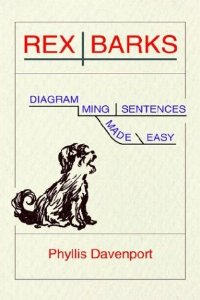
Rex BArksI am a product of 1960’s American public school system.  The foundation of my knowledge of the English language is that of American English from forty years ago.

When I was a student in elementary school and even in high-school, we “diagrammed sentences,” and in doing so, it was thought that we bored students would learn the proper way to write a compound sentence, and even to combine our sentences into paragraphs. Had I ever paid attention in class, I suppose I would have learned something.

Alas, I spent more time staring out the window, or reading my contraband ‘Lensman Series’ books concealed inside my textbooks than I did studying.

Sentence diagramming is defined as a method of grammar instruction that relies on a standardized framework of lines and branches to reveal the syntactic structure of a sentence.

Example:Image17

Years and years spent diagramming sentences and at the end of it all I had learned little, if anything, about grammar. Even in high-school I had no clue what the diagram meant or why we were doing it. It was like hearing Merlin mumbling a magic spell. I didn’t understand it, but I knew it must mean something.

But I could quote lengthy passages from any of Tolkien’s works.

Many people still swear by this arcane and mysterious craft. There are entire websites devoted to teaching grammar to people blessed with  more patience and free time than I. If you are interested, here is one I came across:

Basic Sentence Parts, Phrase Configurations

Over the years, as I’ve become a professional writer, I have learned what I know about my craft by not only experiencing the editing process, but by availing myself of both the Chicago Manual of Style, and Strunk and White’s Elements of Style. I have also invested in many books written by editors and famous authors, all in my quest to write as well as I can.

In the last year I have noticed a plague of sorts–a plethora of hyphens and dashes, as annoying as a wall of italics and they show up in both indie and traditionally published works.  I don’t really like them, as a reader, but I find myself using them almost habitually. I have resolved to break that habit.

Elements of StyleIn informal writing, such as notes or Facebook posts, hyphens and dashes are common, and are like the ubiquitous ‘F’ word–one hardly notices it anymore. (See?)

Hyphens and dashes are used in several ways. One is the ‘en dash’, which is the width of an ‘n’. It is written space hyphen space.  Another is the ’em dash’, which is the width of an ‘m’. It is written this way: word–word (or word dash dash word) and when using the MS-WORD program for word-processing, it makes a long dash. The en dash seems to be more British, and em dash more American, but they have become interchangeable.

I have read an amazing number of books written by wonderful authors who all seem to use em or en dashes in lieu of proper punctuation when they are trying to emphasize a particular thought.  I also tend to do that in blogging and in Facebook posts, but I hate to see it used in a novel.  I DON’T like them because some authors rely on them too heavily. It is too distracting to see an em dash in every paragraph or even on every page. If we think about it, it is like any other repetitive word in a manuscript. It is useful to emphasize certain ideas, but needs to be used sparingly and creatively.

Properly, an author should use a comma, a semi colon, or a period to create that dramatic break, because too many em dashes are like too many curse words: they lose their power when used too freely.  Lynn Truss, author of Eats, Shoots and Leaves: the Zero Tolerance Approach to Punctuation, has been quoted as saying “People use the em dash because they know you can’t use it wrongly—which for a punctuation mark, is an uncommon virtue.”  

So what are these alternative forms of punctuation to create that dramatic pause?

MSClipArt MP900390083.JPG RF PD

PERIOD = a full stop. End of Sentence. That’s all folks.

SEMICOLON:Use a semicolon in place of a period to separate two sentences where the conjunction has been left out. Call me tomorrow; we’ll go dancing then. ( The AND has been left out.)

COLON: Use the colon after a complete sentence to introduce a list of items when introductory words such as namelyfor example, or that is do not appear.

Hyphens, en dashes and em dashes are like crack. Authors and editors become addicted to using them. Perhaps this plague of dashes has occurred because they don’t understand the basic rules of the road regarding periods, colons and semi-colons.

I love this quote from a wonderful blog on the website Slate.com. The blog post, called “The Case—Please Hear Me Out—Against the Em Dash,” is by the witty Noreen Malone, staff writer for The New Republic:

“What’s the matter with an em dash or two, you ask?—or so I like to imagine. What’s not to like about a sentence that explores in full all the punctuational options—sometimes a dash, sometimes an ellipsis, sometimes a nice semicolon at just the right moment—in order to seem more complex and syntactically interesting, to reach its full potential? Doesn’t a dash—if done right—let the writer maintain an elegant, sinewy flow to her sentences?”

That wonderful paragraph says it all for me.  I will have to work harder to develop my writing chops, and find ways to set certain phrases off within the framework of a sentence without resorting to the hyphen, the dash, the em dash or the en dash.

Dash it all.

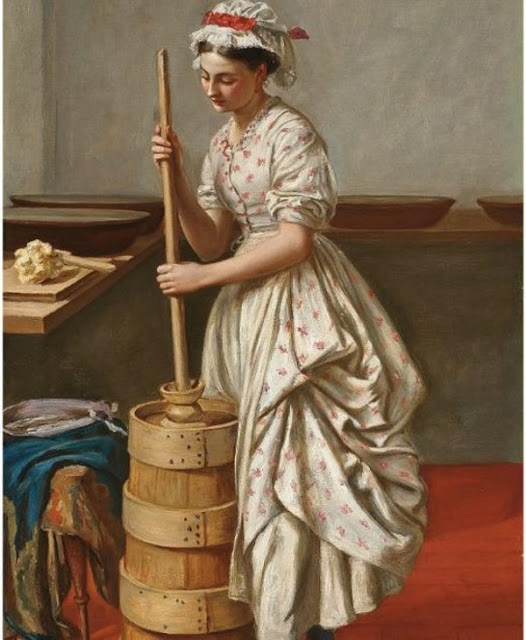
The butter churn

7 Comments

Filed under Battles, Books, Fantasy, Humor, Literature, Uncategorized, writer, writing

Art for the great cover-up

Medieval_forest wikimedia commons PD 100 yrsI love great fantasy art.  Fantasy art has been around for thousands of years, and examples of it can be found all over the globe. Some of the finest examples of fantasy art are in the heroic paintings from medieval times that were meant to describe the daily  lives of people. Like good fantasy, they were based in reality, but with a bit of a fairy-tale quality added, to lend a bit of interest to what they considered ordinary pursuits.

I’ve been spending a lot of time looking at art, with the intention of buying. I have the notion to redo all my book covers this next year, if I can get the hang of Photoshop.  I love good book covers and am always buying books based on them.  The graphics on my books are always done by the amazing Ceri Clark, but in my Tower of Bones series I’ve given her less than optimal art to work with. She has worked a miracle with what she has been given. Now I’ve amassed a really large database of affordable art, much of which will speak well to my books.

Tiepolo,_Giambattista_-_Die_Unbefleckte_Empfängnis_-_1767_-_1768_-_Drachen Giovanni Battista Tiepolo [Public domain], via Wikimedia CommonsThis has all come about because I have completely rewritten my first published novel and am now designing the new cover for it, based on its new title. This cover is critical, because there are two books currently based in that world, and a third is partially written. The covers for all three must relate to each other.

I think I was successful in getting the right art for Tales from the Dreamtime. Ceri’s graphics are perfect and make it intriguing.

This quest for great cover art is what I must do for my Tower of Bones series too.  There are two books currently published in that series, and one more in the editing pipeline at Eagle Eye Editors. (Actually, they currently have three books of mine in their pipeline, and Tower of Bones is one of them.)

Quaglio_Kipfenberg

The best art for a book tells some of the story but also make the eye go “Oh yeah, baby!”  For me, that means it is colorful and mysterious, something that makes me think about the image.  I have comps of all the art I’ve ever wanted and now I must go through each image and decide which  image will be purchased. It is difficult to find great art for reasonable prices, but not impossible.

Many of my friends go to DeviantArt.com, and many others go to iStock and Dreamstime.  I have gone to all of these places, and I’ve found many pieces that will combine well to build my covers. It will not be free, but it will be fun!

All I have to do, is learn how to use Photoshop.  I am now an old dog, learning a new trick!

1 Comment

Filed under Adventure, Battles, Books, Dragons, Fantasy, Humor, Literature, mythology, Vegan, writer, writing

National Pot-pie Month

We’re approaching November once more.  November is the month where for 30 days, people all over the world from all walks of life will spend their free moments writing a novel. All over the world, families will dine on microwaved pot-pies as people steal minutes from their day to get 1650 words written, to keep up their word-count.

They will strive to get their word-count of 50,000 words in total, or more, and will hopefully have a novel with a beginning, a middle and an ending by the time November 30th arrives.

Leah in Las VegasThis year is really special for me. My oldest daughter, Leah, is participating for the first time, and she will be writing in the area of contemporary women’s fiction.  As you can see from her picture she is lovely and glamorous–nothing like her frumpy old mama.  Leah is passionate about her characters and is fully committed to developing the story that has been rolling around her head for years. It’s a fun and hilarious story, one that so many young women will identify with.

What Leah really wants to do is write a screenplay, and once she has the story written, she will be able to turn her book into a screenplay with no problems.  After all, great movies begin with great stories.

I can’t even begin to describe the feeling of having a child who wants to follow in your footsteps, who wants to work at the craft you love so much. It is a mixture of pride, amazement and mystification–and by that I do mean mystification.

It’s a lonely job, one others find interesting in theory, but rather useless. It pays little or nothing for years, usually. On vacations she will be as determined as I am to get those precious writing moments in and others will think she is being selfish and ignoring them. Her chosen path is not an easy one, but Leah has the backbone and the balls to do this crazy thing, and to make it work.

I have begun writing my story descriptions, and have created the basic synopsis for my NaNoWriMo novel this year.  The working title for the book is “UNDERGROUNDERS”.

It is a hard science fiction novel and grew out of a short-story I wrote called “Alpharse Run.” That tale is an old-fashioned Gene Roddenberry type of  “Space-Opera.”  I began researching the physics for this project in 2010 for Alpharse Run.  My science is all based on current theories, and all my technology is physically possible according to current physics.

We humans could do all this now–we just haven’t got the hardware or the funding to do this monumental an undertaking at this time in our history. Getting the hardware right is the most critical thing, for people living in an alien environment. I’ve spent a great deal of time designing the technology that will make or break my tale.

Short Synopsis for UNDERGROUNDERS:

A retired fighter pilot and leading researcher in the field of terraforming and adapting earth-type plants to alien environments, Professor Elena Brend has been invited to continue her work at the University on the distant colony-world of Alpharse.

But all is not as serene as she had been told–the ecology of Alpharse is both fragile and dangerous. Handsome shuttle-pilot, Braden Langley wants more of Elena’s life than she is willing to give and she will have to make a decision that could break two hearts.

Two factions within the community now fight for dominance as Alpharse is cut off from the rest of the human worlds.

Can Elena survive in this new world of power, politics and brinkmanship?

????????????????????????????????????????One of the first things I found myself doing this time was creating a possible book cover for the book, before it is even written.  I’ve never done that sort of thing before, and,  of course, I messed up on the word “Dream.” But there is something about having made a cover (bad though it may be) that forces you make the interior.

This is not the final cover, but is a mock-up pointing in the general direction of what I envision the completed book to look like, something to keep my mind on the right path.

I’ve been creating bios and descriptions for all the characters, and building the world.  I’ve a great story in my mind, and it takes place in a completely alien environment so I have been asking myself questions.

1. What is their new world really like? What is the composition, the atmosphere, the indigenous life, microbial and complex? Can the colonists live on the surface or must they live in special habitats?

alien-worlds from NightTransmissions.com copyrighted material private use only2. What have they had to do to adapt to this new world? What sort of monumental task was it to get to the point where they have a university at all? How far out of the pioneering phase is their society?

3. Who is Elena Brend and what made her that person?

4. Who is Braden Langley and what makes him tick?

5. How does my protagonist fit into her new society? Who are her friends, and who feels threatened by her? Who resents her intrusion into their closed community, and why?

6. What is the problem? Why is this a problem?

7. Who profits from the situation as it currently exists?

8. Who stands to lose if this problem is resolved, and what will they lose? To what lengths are they willing to go to ensure they don’t lose this battle?

I will have everything ready to go by November 1st so I can pound out this new tale, of wonder and new worlds.  The great thing about this for me is the knowledge my daughter Leah is doing the same thing, preparing and educating herself about the people and their environment, the problems and the triumphs they will go through. Her book takes place in  a truly alien environment–Las Vegas. I’m excited about her story. I can’t wait to see what she comes up with!


2 Comments

Filed under Adventure, Battles, Books, Fantasy, Humor, Literature, Vegan, writer, writing

Flung Poo, or the Tao of Fantasy

fire MH900370240What the heck is it with this particular thread in my personal time stream?

Last week my stove went mad and tried to burn down my house. The self-cleaning function went berserk and my husband had to shut it off at the breaker as it wouldn’t shut off on its own. That was the last straw for that particular appliance. We decided to bite the bullet and raid the savings to purchase a fancy new one, with a convection oven and everything.

This week my son had another tonic-clonic seizure and ended up in the hospital, but he’s home and doing well again. This time he was taking his meds faithfully, but they need adjusting, so we are working with that. In the meantime I am staying at his house north of Seattle off and on until he’s back to feeling like being on his own again. So no driving for Dan, which is a bit difficult, but not impossible.

The republicans in the United States Congress went off their meds and made decisions that put my husband partially out of work. Heck, no worries, we still had a couple bucks in our savings after the stove, so it’s all good. (Bastards.)

He doesn’t work for them, but his job is federally funded, so there you go.  Well of course CONGRESS will still be paid, so no worries, struggling homeowner! This agony must be happening for some good reason…after all, reasonable people would never…oh, right. Never mind.

Between  the conservative  crack-pots in the US Congress and the twists and turns of fickle fate, I need an escape! Boy, am I grateful to have so many affordable and great indie books  to read and a great tale of my own to write!

children of the elementi ceri clarkOne of my all-time favorites was re-released this week: Children of the Elementi by UK author Ceri Clark.

The Blurb:

From the ashes of an ancient empire, five must save the future. 

Jake: Last in line to the Elementi High King throne, sent through time and space to be brought up in an alien world, he has no knowledge of his past. 

Mirim: As the caretaker of the mysterious Citadel which hosts the dying crystal mind of the Matrix, her air power is the only link to the old world. 

Kiera: A Romani foundling with growing powers over nature, she is searching for a better life away from her criminal past. 

They must find the other two heirs and reunite all their elemental powers over earth, air, fire, and water together with the Matrix to defeat the Empire that conquered their parents. 

With a fire demon on his trail, can Jake bring together the last of the Elementi in time?

meteorite_bombardment via www dot indiana dot eduOh yeah!  Grandma’s all about the magic! I loved it the first time I read it, and I’m reading it again!

There is nothing like the zen of a good book in my kindle, and a cozy corner of the sofa to curl up and escape the chunks of falling sky.

I’ve been around this world for a long while. I know everything will right itself and we’ll all be back on track: the oven, my son, and the US government. Life is amazing and when it’s all good, its awesome, so I’ll just sit here with my glass half full, reading a good book and ignoring the things that are transient in the overall scheme of things.

2 Comments

Filed under Books, Epilepsy, Fantasy, Humor, Literature, Uncategorized, Vegan, writer, writing

Dinosaurs Among the Birds

200px-Hippie_bug!_(1043753793)We go through life and things happen. Friends drift apart and then we drift back together. When we meet again, we are all so curious about each other’s lives and where the road has taken us, curious about the visible changes and not-so-visible ones. Forty-odd years ago we were young and wild, determined to carve our path in the world and desperate to get on with living. We were tired of the war, tired of politics, and tired of being told what to think by media controlled by pin-headed men in suits. We were tired of congress selling us out.

We were going to change the world.

250px-Woodstock_posterWe did change the world, but not exactly the way we naively believed we would. Even though we were unable to solve all the problems we wanted to, we did manage to make some positive changes. Unfortunately, we were too few, voices shouting in the wind.

And now we are somewhat jaded. The country is still divided, big money still buys votes. Congress is still selling out, and the media is still owned by pin-headed men in suits. There is always a war somewhere, and it is never done with.

We cling to our belief that we will see positive changes, but we don’t believe we will live long enough to enjoy them. But change is inevitable, and it will happen, even if, like Moses and the promised land,  we stand on the opposite shore and see only what yet may be.

My old friends and I are not exactly who we were in those wild days. Now we are an amalgamation of everything we once believed would happen and everything that really happened. We are people who survived Reaganomics, who survived raising children through the MTV years. We held down three part-time jobs because trickle-down economics didn’t really trickle down the social ladder to our rung, and we had kids to feed. We survived the Bush years with some of our dignity intact, and didn’t fold under the “you’re with us or you’re against us” propaganda designed to shut us up.

194px-LennonWallImagineWe are jaded, but we have hope, we old hippies; we old women and men who are dinosaurs among the birds of the modern, hyper-connected world. We still believe the world can be a better place for everyone. The difference is now we know we can change the world…just not in the way we thought we would.

Now we put our money where our mouth is, donating to charities and spending our retirement years volunteering in schools and hospitals. We do it in small ways, chipping away, and little by little we have a positive effect.

We lost the battle to make the world a simpler, kinder place. Our parents won the war with their firm, 20th century belief that only through technology would mankind benefit, and that somewhere  was a miracle drug just waiting to cure every disease known to man.  It just hadn’t been discovered yet.

We were conquered, despite the struggle to keep it simple. We old hippies now embrace the technology and make it ours, because we must either adapt or die, and I am not ready to die. We are a wired society, and we old people have the luxury of a little free time and occasionally, extra money.

Writing is my opportunity to live in the world as I would like it to be, and it is my chance to get away from the war, from politics, and from crazy family issues. Adult children with complicated epilepsy issues, grandchildren having babies too young (did they learn nothing from my trials and errors?) –writing is my escape.  And when I am not reinventing the world, I donate my time and money to advancing humanity. My husband and I give to charities, both locally and internationally.

I support creativity and free-thinking on a local level. I volunteer as municipal liaison for NaNoWriMo. I encourage people from all walks of life, and from every point of view to write. It doesn’t matter to me if we agree politically or not. Everyone has a story to tell. Some stories are real and incredibly moving, and all they need is the skill to tell that story the way it should be told.

Generic-180x180They can gain that skill through participating in NaNoWriMo, National Novel Writing Month. Children and schools benefit year round from writing programs sponsored by this organization. November is coming, and for me November is the busiest month of the year. I will be meeting and getting to know many new people, and I will be writing the framework for a new novel.  For one month, thousands of people will be too busy writing to spend their evening in front of the electronic altar, being fed mindless pap in the form of ‘entertainment.’ Instead, they will entertain themselves and find they are so much more than they ever thought they could be.

With every new story that is told, the world opens its eyes a bit more, seeing more possibilities. There is more awareness that we are not islands disconnected from society, cocooned in our dark living-rooms unable to look away from the poorly crafted mind-porn we are force-fed to fill the void.

I am an old hippy, I admit it. But I am water, wearing away at society’s monument to ignorance, helping  the world learn how to tell its story one person at a time.  

Andreas_Achenbach_-_Felsige_Küste

4 Comments

Filed under Battles, Books, charity, Epilepsy, Fantasy, Food, Humor, Literature, Uncategorized, Vegan, writer, writing

Crafting the tale

Power of Words

Back-story happens as an author writes the tale. In my early works I left the back-story in, not realizing how it interfered with the flow of the story.  Now I am rewriting my first published novel, removing the info dumps and using the skills I have developed in writing my last four novels to tell the story through scenes and dialogue.

Sometimes writing is like pulling a rabbit out of my hat–Voila!!!  And there it is, the best scene I’ve ever written.  I see it fully formed in my head and it falls out of my fingers as if I were seeing it before me.

The spring thaw was heralded by the hissing of rain on the frozen fir trees.  Five men swathed in heavy cloaks rode miserable horses north, braving the eternal damp of a chill April morning, riding through snow heavy with slush, splashing through myriad puddles as the snowy landscape of the northern winter slowly melted under the assault of the spring rains.

Other times, it takes days and hundreds of failed attempts to figure out what it was I really wanted to say, what that one crucial paragraph needs to tell the reader in as few words as is possible.

The older merchant’s face darkened at the mention of the prince’s name and quickly looking over his shoulder at the other guests in the common room, he hushed his sons. “We’ll have no more mention of them at this table. If the wrong person overhears such talk we’ll all end our days in our own beds with our throats slit!”

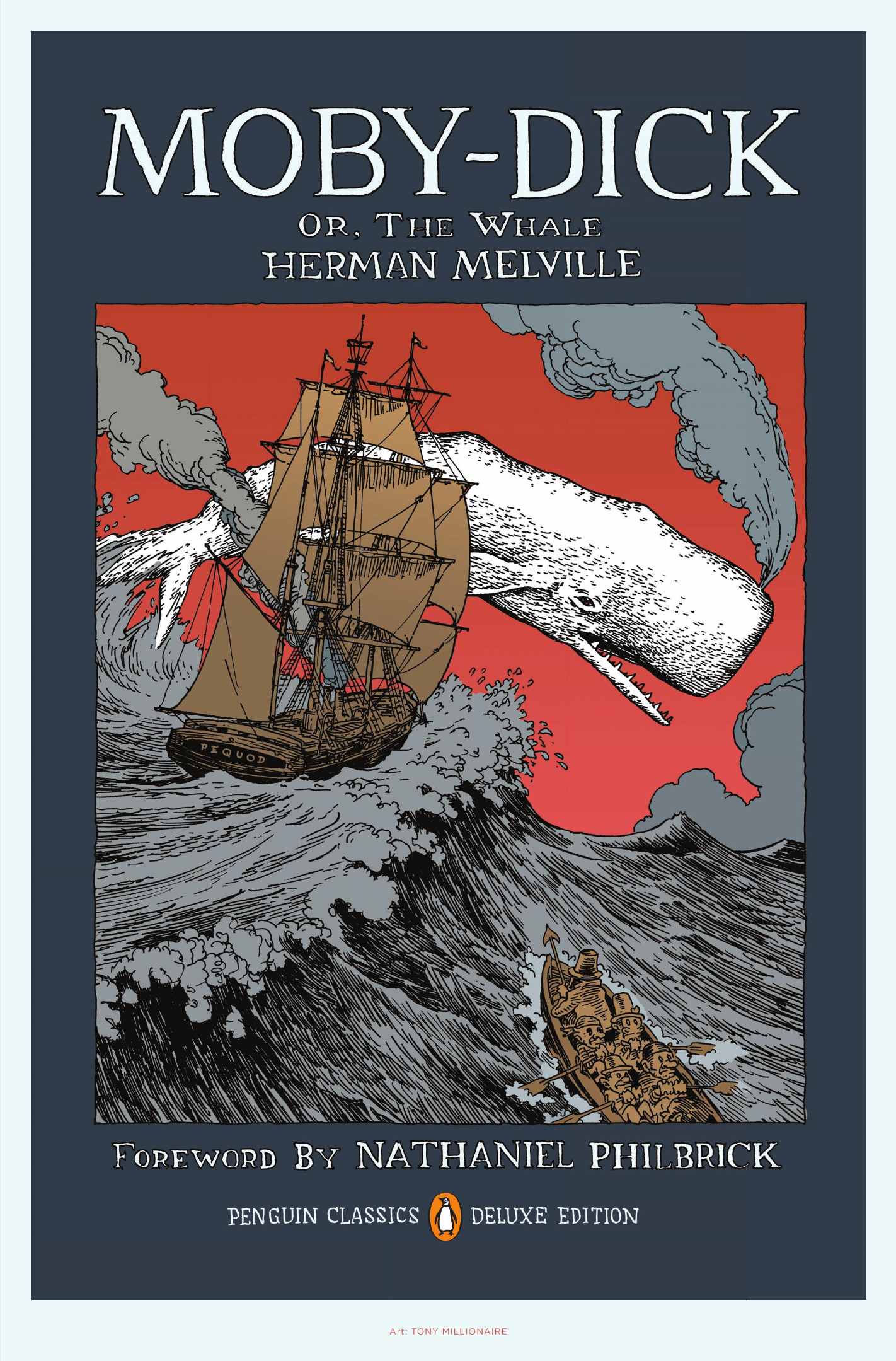
MobyDickTonyMillionaireCoverPosterGetting the back-story into the tale without spewing pages of detail is critical.  In order for the reader to understand the action, they must understand the back-story. However, long info-dumps are no longer the fashion–the days of Herman Melville and J.R.R. Tolkien are gone: the modern reader has a leaner taste in literature.

Thus the author must find ways to insert the back-story in such a way the reader is intrigued.

I’ve lately attempted to read several tales where the authors have been humiliated in their writing groups by the snarky guru (you know the one I am talking about) to the point they now put no back-story at all into their tale. The jealous, rudely sarcastic diva has accomplished his mission–once again he’s made a more talented author afraid to write.

Back-story is critical, because action must happen for a reason. When things happen for no reason at all, the story is nothing but random, senseless actions. Without back-story we don’t care about the protagonist, no matter how handsome and witty he is.

An author once told me he put no back-story in because he wanted the reader to find out what was happening at the same time the protagonist discovered it.  I found his work to be random, and senseless, which was too bad, because just a little insight into WHY the action was happening would have made it so much more interesting.

When I read a book, I become involved with the characters if there is a sense of history, if I want to know this person. Having some knowledge of what makes this person tick intrigues me. Why did Maldred order Geoffrey murdered? A snippet here and there, artfully inserted into to the scenery and the dialogue will inform the reader in such a way they don’t realize they are being informed.

Thus the author must craft the tale.

According to Jon Sprunk at Tor.Com: “Most aspects of back-story can be inferred by the reader. For example, if your main character is a cop, most readers will understand that she knows police procedure, the laws of her jurisdiction, and how to handle a firearm. You don’t need to walk us through every day of her academy training to tell us this.” 

MR-writers-block-guy-Google ImagesA good way to dole out the back-story and still leave the reader’s imagination intact is to write in such a way the information is slipped  into the story in small chucks to spread it out.

Having characters discuss important events of the past is another effective way to get the information to the reader. However, you must use this tool wisely so as to not to fall into the trap of using dialogue to tell the story.

It’s a balancing act. This is where the craft of writing comes into play. We learn through writing and from getting proper feedback on our work.Writing is like cooking–experience will give you some idea of how much seasoning is too much.

A writing group, whether online or in your community is an excellent place to begin sharing your work and getting feedback. Don’t be afraid of criticism, because even the snarky guru has a point–he just has a bad way of displaying it. Also, don’t expect to ever write to THEIR satisfaction, because it won’t happen.  However, you can learn a great deal there if you choose to.

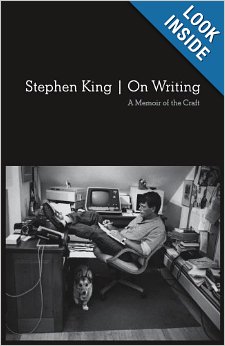
on writingA great book for new writers is Stephen King’s On Writing-A Memoir of the Craft. He tells us of his own life up to his well-known near-death experience, which is gripping in itself. But more importantly he tells us about the craft of writing, and how to develop the tools you will need, and the skills to use those tools.

Back-story is like perfume.  A hint is awesome, and makes you curious.

Too much overwhelms the senses and drives away the reader.

Write for yourself, but write as well as you can. And never stop growing as a writer.

8 Comments

Filed under Adventure, Books, Fantasy, Humor, Literature, writer, writing

Dad’s Leg

cover_art_Billy_39_s_RevengeWords are awesome. I love obscure, weird words.  J.K. Rowling uses the word ‘snogging’ in her Harry Potter series, to describe couples who were engaged in prolonged kissing, or as we sometimes say where I come from,  ‘canoodling.’ My friend Irene has a new favorite word: ‘kerfuffle,’  a Briticism for a  noisy disturbance or commotion. Americans would say a ‘dust-up.’ 

Words are the color palette an author uses to paint his image of the world.  In English, which is a mash-up language, we have so many wonderful, wild words it is impossible to use them all in one book.

Heck–William Shakespeare loved words so much that when he ran out of words to fit a particular sentence, he invented them!

To say my father was an interesting man would be an understatement.  Born September 22, 1923, he was a product of depression-era America. A farm-boy and big for his age, he enlisted in the US Army in 1938 at the age of 15. He thought he’d found his career, but he was injured in a motorcycle accident while riding dispatch in 1945, near the end of WWII. Nearly every bone in his body was broken, and in the hurry to save his life, his left leg was set crooked. A year later, they went in and re-broke it in order to reset it straight, but he developed osteomyelitis.

va logoDad spent the next 7 years after the war in and out of VA hospitals.   For 7 years, the army surgeons tried to save his leg but in 1954 he lost his left leg,.The US Army officially forced him to retire, at the age of 30.  Unfortunately, Dad was never able to wear the artificial leg the VA provided him with, although we children did find some creative uses for it. It stood in the hall closet in our house in Ballard, and we charged the neighbor kids  25 cents to look at it. In Olympia it was good for scaring our cousins. When I first married and left home, it stood in the corner of my living room holding plastic flowers, a conversation piece like no other.

There he was in 1952, a single guy with rather visible disability,  wearing a heavy leg-brace, living in a world that hid the disabled under a rug and pretended everything was perfect. It was 1952, after all.

For some people, that would have been the end of everything. But not my Dad. When things began going bad with his leg, he knew he would be forced in to early retirement. He was aware that dropping out of school in the 10th grade to join the army had limited his employment choices to logging or farming, all manual labor. Dad used that time he’d spent on extended medical leave getting his high-school diploma, and then going to college. He met my mother and the rest was history.

So what does Dad’s leg (or lack thereof) have to do with weird words?  Stick with me and you will see.

Dad was a voracious reader. He read everything from Tolkien to Tolstoy, and he remembered what he had read. Dad was a draftsman, and cartooning was his hobby. He played the guitar, played in a rockabilly band and partied with Les Paul and Mary Ford. Dad bought the Encyclopedia Britannica, the entire collection of Great Books of the Western World, Grolier’s Book of Knowledge, and a wonderful little collection of books called “Lands and Peoples.

Fred+Flintstone+FredFlintstoneDad was larger than life. He was loud, boisterous, opinionated, wide-open, a generous host, and he was always the center of attention. He made his own wine and brewed beer.  He was a ham radio operator (his call number was W7NEY) and had a First Class Radiotelephone Operator License. Every year his vegetable garden grew more food than we could possibly eat, no matter how much we canned.

Dad was Fred Flintstone on Steroids.

Dad Loved Words. Big words, small words, short words, long words–Dad loved them all. He spun hilarious yarns about the ‘Kamaloozi Indians’, a non-existent tribe whose beloved Chief, Rolling Rock had gone missing, The tribe was so distraught they posted signs in every mountain pass that read “Watch for Rolling Rock.”

Everything in his toolbox had a name that was his own invention: Screwdrivers were ‘Skeejabbers.

Dad loved words so much he mangled them just because he loved the way they sounded. Sometimes he became so frustrated he lost his words and resorted to creative cursing.

Dad’s birthday is coming up, September 22. He died in 1991 at the age of 66, from complications of Osteomyelitis. He would have been 90 years old this next Sunday. He is gone, but definitely he will never be forgotten. His love of words and of reading, art and music had an impact on me and my siblings we will never live long enough to outgrow.

What better environment for a future bender-of-words like me to grow up in than a home where any book was fair game, and reading was not only encouraged, it was required?

The word for the day is ‘querl’–which means to twist or curl. And that is what my family all loves to do with words!

rolling rocks sign

4 Comments

Filed under Adventure, Battles, Fantasy, Food, Humor, Literature, Uncategorized, Vegan, writer, writing