Tag Archives: indie publishing

#flashficfriday: TED (a drabble)

large dragon courtesy www.wallpaperfreehd.com

large dragon courtesy http://www.wallpaperfreehd.com

Drabbles are little short stories of 100 words in length, and writing them is good exercise.

Each time you write a drabble, you create possibilities that could evolve into larger stories. In 2013 I participated in a challenge to write a drabble every day for the month of May. The original prompt went as follows:

Write A 100 Word Story (“Drabble”) . . . although a 100 word story will probably take longer than expected, it can be done in a manageable amount of time.

To make a drabble work,
-Choose one or two characters
-Take one single moment/action/choice and show us how it unfolds
-Give one or two vibrant details in as few words as possible
-Hint at how this moment/action/choice is more significant than the characters probably realize in the moment

 Here is my first drabble, written May 1st, 2013:

TED

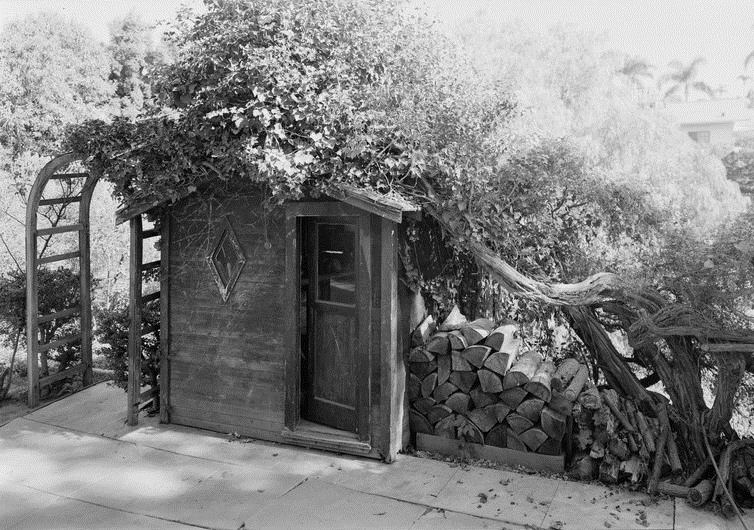
Edna stirred her coffee and looked out the window toward the shed.

“Did you feed the chickens?” Marion always asked, despite knowing Edna had.

Edna tore her gaze from the shed. “Of course.” Her eyes turned back to the small building. “We won’t be able to keep him in there much longer. He’s growing too big. We should have a barn built for him.”

“Ted was always a greedy boy.” Marion stirred her coffee. “I warned him he behaved like a beast, and now look.”

A rumbling bellow shook the shed. A long green tail snaked out of the door.

Garden Shed, Albatross Cottages, San Diego Public Domain Via Wikimedia

>><<<

I love that scene. I keep wondering about the two ladies, and also Ted. Who is he in relation to them, who are they in relation to each other, and what is their life like, apart from the secret in the shed?

Ted will become a longer short story in November, as part of my NaNoWriMo project. I will be writing a book of short stories this year, as I need to build my repertoire. I hope to have fifteen or twenty new short tales of 2000 to 5000 words in length by November 30.

Comments Off on #flashficfriday: TED (a drabble)

Filed under #FlashFictionFriday, Humor, Literature, Uncategorized, writing

#amwriting: getting the word out

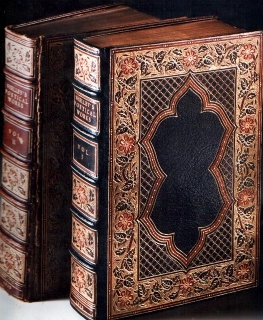
Old Restored booksYou have finished your book. It has been professionally edited and proofed. You hired an expensive cover designer to make the perfect cover that is both professional and eye-catching. You’ve done all the important things at Amazon and Goodreads, making author pages at both places.

You made a professional Facebook page, you are blogging once a week, you’ve joined twitter and use TweetDeck or Hootsuite to schedule tweets, and check it every day and sometimes retweet interesting things for other folks you are following. You’ve even joined Pinterest and  Instagram.

This all good, but even so, after the first rush, sales have dwindled off, and now you are at a loss of what to do to increase the visibility of your work.

Some folks join mutual promotion groups on Facebook. I have found them to be more aggravating than helpful as I get spammed by the same two authors daily–they are nice people, but they have no sense of how irritating that is. People on Facebook lose interest when they see the same books all the time.

Also, I have found the “99 cent boost groups” to be not as beneficial in the long-run as they promote themselves to be.

I’ve not figured out the magic key to gaining traction rapidly, but I do know that my Goodreads ad pays off in terms of sales, as when I receive more clicks on the ad, I sell more of those books.

Writing short stories and publishing my work gets my name out there, and each time I publish a chapter of the Bleakbourne on Heath series, on Edgewise Words Inn, I see a jump in sales. From what I can see, the only way to get your author name out there is to publish your work.

Shaun Allan has had great success getting his name out via WattPad, as has Paul Coelho. Yes, you are giving your work away, but it introduces YOUR work to potential readers who will buy your other work–and these two authors’ sales are excellent.

Asking other authors to promote your work is not really a good idea, because they have their own work to promote, and your agenda doesn’t always mesh with theirs.

If you have been out in the indie world for any length of time, you may have observed this scenario: Author A, charming and talented Facebook friend, asks Author B to be a part of their personal fan-club, working to get Author A more recognition. Author B does not have time for that–he is trying to get his own name out there. The author who was ‘recruited’  is shocked, and saddened that a friend has so little understanding and such a lack of respect for his work that she would expect that of him, but he doesn’t want to be unfriendly and thinks “well, maybe it’s only this once.”

But it’s not only the once. It’s a never-ending stream of “push my book, push my book.”

When he realizes he is being used as her personal assistant and free publicity agent, he refuses, as he feels that she has no respect for him as an author. She has a temperamental fit and unfriends him. He warns his other friends to beware of that author. While her rudeness may have been unintentional, it was a bit of an eye-opener to those who know her casually, a clue about her true character.

I’ve seen that scenario unfold several times–sometimes talented people are supremely egotistical and only associate with others if they will gain something from that association. Once they have achieved what they wanted, they have no further use for their ‘friend’ and quickly move on to more important pastures.

I try to stay away from toxic professional relationships, and believe me, the opportunities for that are plentiful in many author groups. When I like another author’s work, I would love to see that author succeed. If we are friends and they need a signal boost for a new book or an event, I will gladly tweet and perhaps mention what I like about their work on my blog. I will even mention that they are having an event, and will be signing books.

But I will not be their private publicity agent.

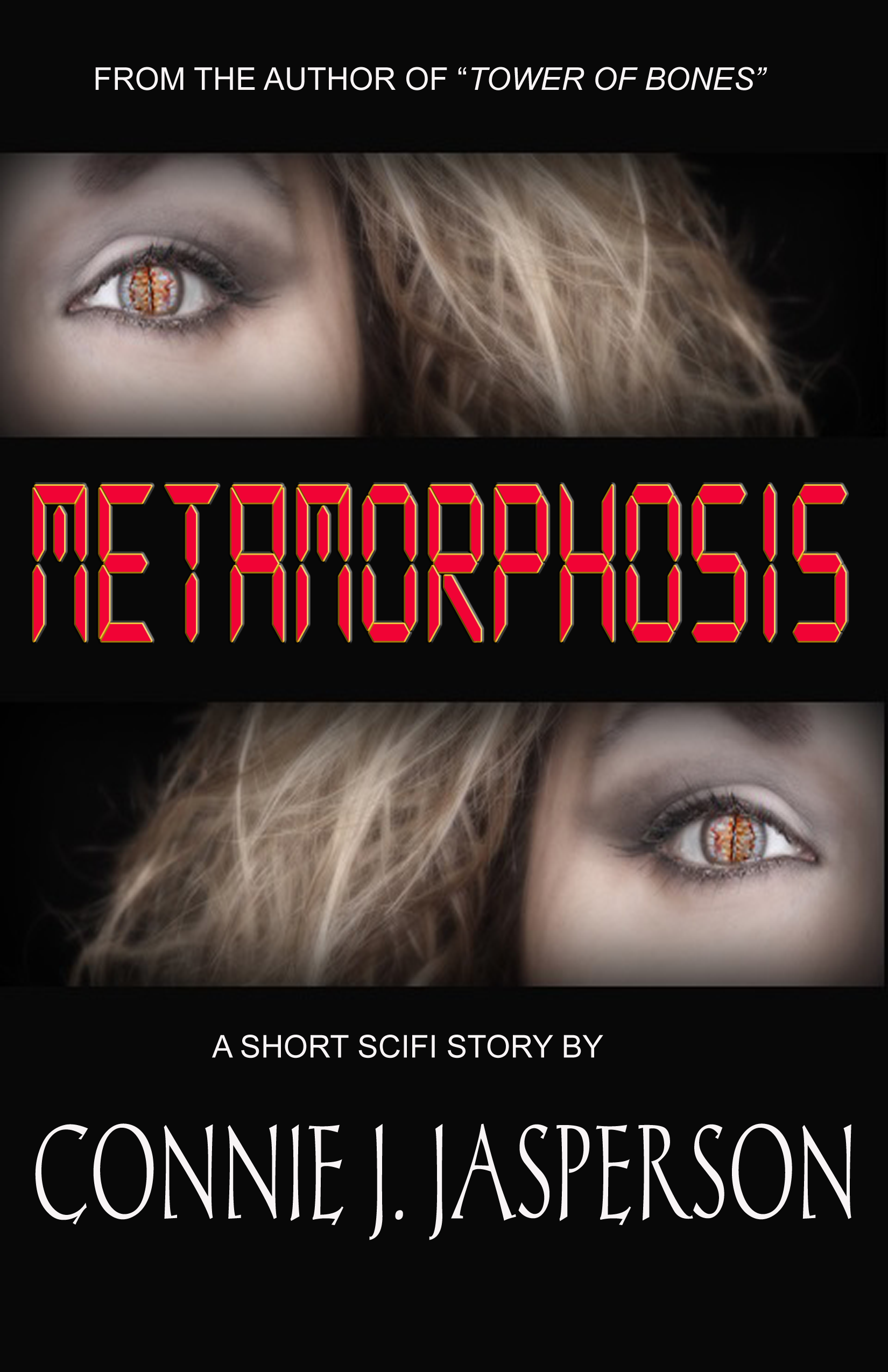
MetaMorphosis cover for WattPad copySo even though you desperately want to increase your visibility and sales, you have to be careful how you go about it. For indies, this is the sort of thing that has to flow two ways–Author A must support Author B as much as he/she expects Author B to support him/her.  Boosting the signal is a real bonus, and if a friend does this for you it should be reciprocated.

So do yourself a favor: post short stories on WattPad, and keep submitting to magazines and anthologies. Success is rarely an overnight thing–it is the culmination of the long hours and efforts you put into it.

Read METAMORPHOSIS on WattPad.

4 Comments

Filed under Publishing, Uncategorized, writing

#amwriting: the external eye

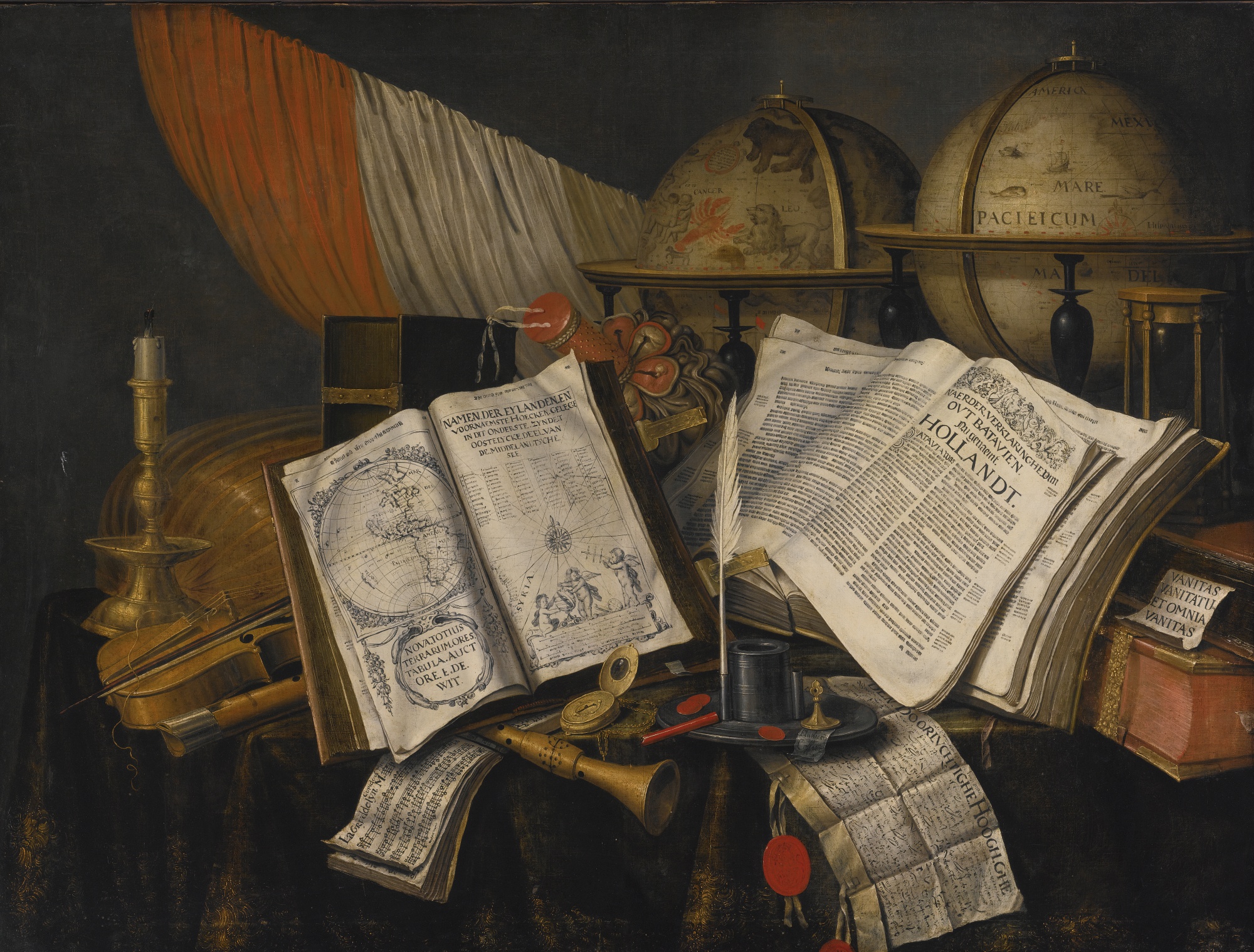
EDWAERT_COLLIER_VANITAS_STILL_LIFEMore people than ever are writing books. In today’s marketplace, every author must find ways to get his/her manuscript in as perfect shape as they can before they begin shopping for agents and publishers.  At every seminar I attend this one fact is stressed most firmly.

What this tells me is that agents and editors at the large publishing houses see so many submissions on a daily basis that they don’t have time to do more than look at the first page or two before deciding to look further. If it is not formatted to industry standard, or if it is a rough draft, it goes into the trash, based on that quick glance. (See my post, How to Format Your Manuscript for Submission.)

Therefore, we make our manuscript as good as we can before we send it off to an agent or a large publishing house, or take the plunge and self publish. To this end, during the second or third draft we may consult what has become known as the beta-reader, volunteers who read our work, knowing it is in its infancy.

You can find many good freelance editors who offer this service, but I do recommend you ask them what it involves and what kind of report you will get back before you commit your funds to it. I can also recommend Critters Writers Workshop, a free author-driven service. Or you may have a spouse or good friends who will help you with this.

A word to the wise: Editors and other authors make terrible beta readers, because it is their nature to dismantle the manuscript and tell you how to fix it.

But what if you don’t have the luxury of a reader who both likes the kind of work you write and who also is willing to spend the time reading your work?  Consider asking them to read a selected chapter, instead of asking them to read the whole thing.

I suggest this, because reading the rough-draft of an entire novel is a huge commitment to ask of someone. It is not reading for pleasure, although we hope they enjoy it.

Give your reader this list of questions, and ask him/her to please answer them, explaining that you can’t continue until you hear back from them:

  1. Were the characters likable?
  2. Where did the plot bog down and get boring?
  3. Were there any places that were confusing?
  4. What did the reader like? What did they dislike?
  5. What do they think will happen next?

You need a reader who reads your genre, reads fairly quickly, and won’t devolve into an editor.  Questions two and three are the most important: Where is it boring, and where is it confusing? Having it read in small chunks will give you a good idea of what you need to do with the ms as a whole.

I usually send my  manuscripts  in short pieces to my trusted crew when I need to know if I am on the right track. But the final ms in the Tower of Bones series is different. I hope to have it ready for publication by spring, so I have taken the plunge and sent Valley of Sorrows to David Cantrell for a structural edit. Dave and I have worked together on many projects.

Structural editing is digging deep. This is a tricky novel, because it tells two separate but entwined story-lines, Edwin’s and Lourdan’s, so I need an interested, but surgical, eye on it before I begin the final revisions. Dave has read Tower of Bones, and knows the world, the magic system, and the characters.

I hear you asking, what if he asks me to cut something I think is an integral part of the piece? I will have to decide what to do after I:

  • Re-read the section in question: Is it garbled? Was my intention not clear when I wrote it?
  • Look at the section in the context of the entire manuscript: Will losing this section change the story in a way that I don’t want? Or will cutting that section allow a more important point to shine?
  • Decide how married I am to that plot point. Sometimes divorce is the only answer.

In my own work I have discovered that if a passage seems flawed, but I can’t identify what is wrong with it, my eye wants to skip it.

But another person will see the flaw, and they will show me what is wrong there. That is why I rely on the external eye, and work with a structural editor.

4 Comments

Filed under Literature, Publishing, Uncategorized, writer, writing

#amwriting: Write like a pansy

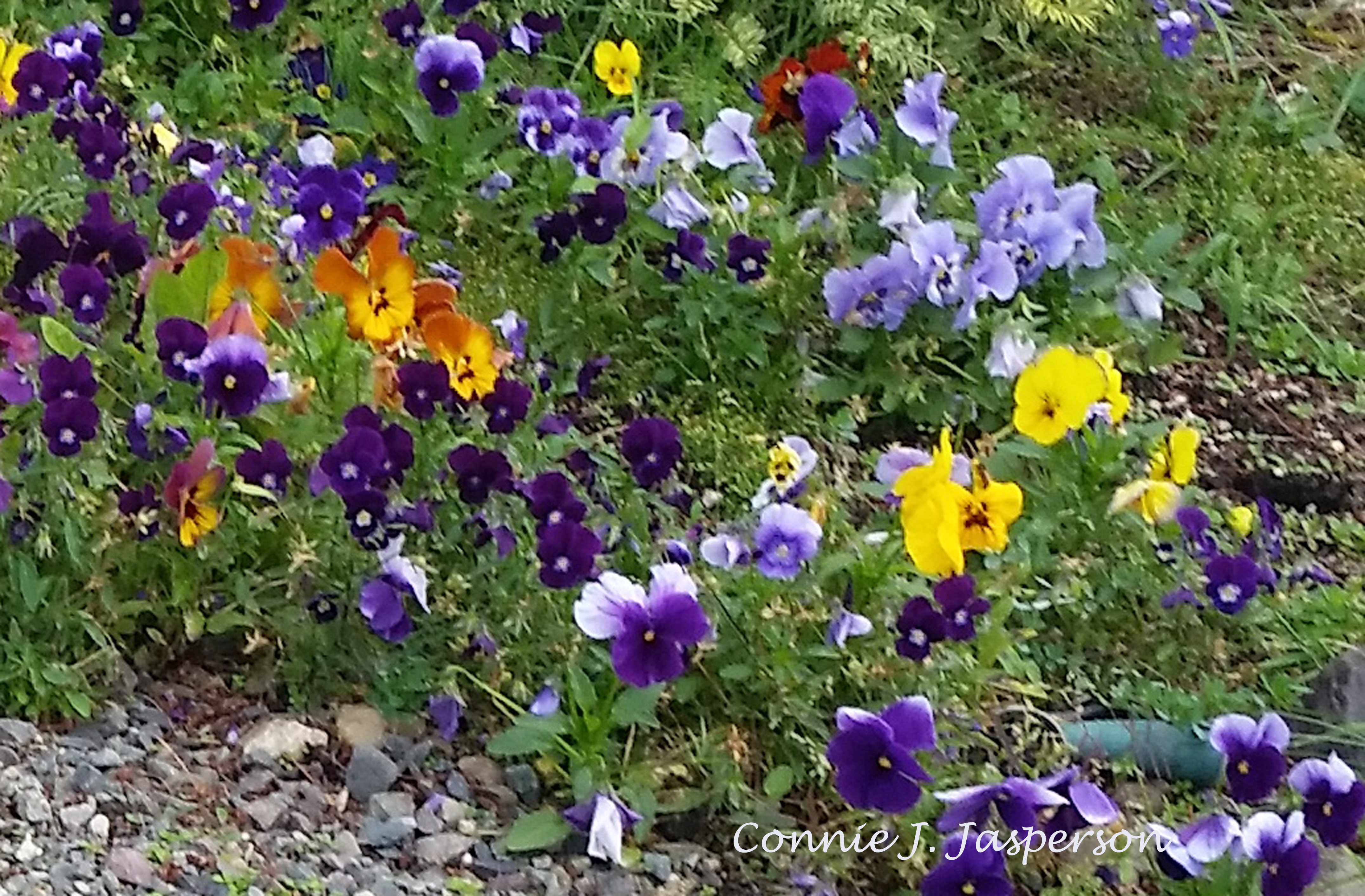
Free-Range Pansies photo credit cjjap copyMy favorite books are written by fearless writers. These authors dare to write because they have something to say, not because they have something they think will sell.

So how does that concept of fearlessness tie in with the title of this blog post? It does say “pansy,” right?

Don’t sell pansies short.

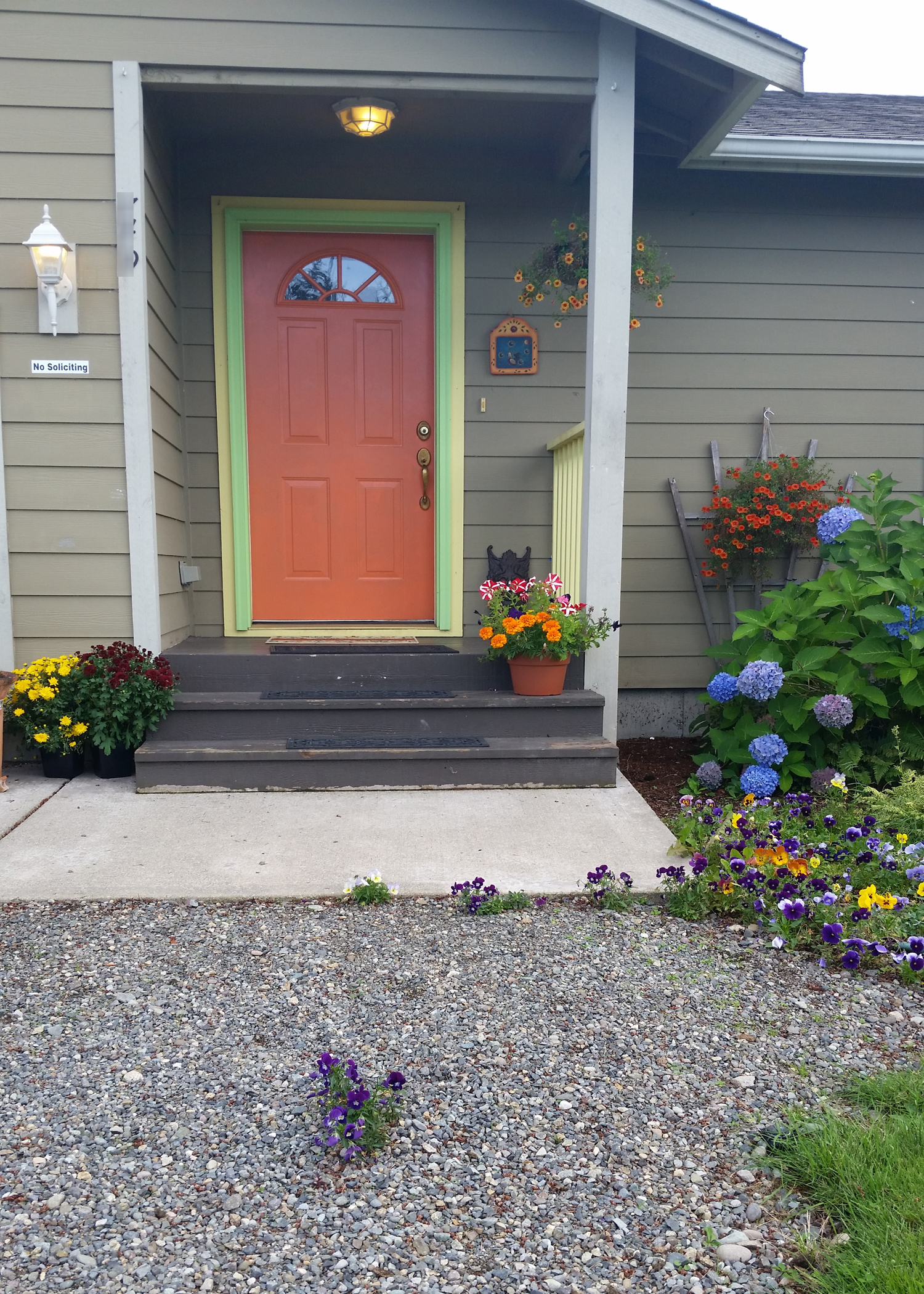
Pansies are fearless plants. They thrive in the strangest places–at least in our yard they do. My husband is an avid gardener, but he really doesn’t plant a lot of annuals. He does get a few hanging baskets and sets a few pots on the front steps for color. Other than that, our yard has large shrubs, lilacs and hydrangeas.

But it wasn’t always that way:

This story began ten years ago, when we bought our house. It was just a brand new tract-house, sticking out of the rocky, Northwest mud. No grass, no plants, nothing but mud everywhere. What we didn’t know then is that we sit on glacial tilllots of rock, and very little soil.

The house came with no landscaping, although a month after we moved in, the builder did spray hydro-seed over the scant inch of topsoil where our front…lawn…would attempt to grow. We were a little strapped for funds, so we  bought $100.00 worth of annuals, and a few perennials, and had a few yards of topsoil for berms brought in so  at least the front of the house would look decent.

Some of those annuals that made our yard look okay that year were pansies.

Ten years and a professional landscaping later, those few pansies that were just for fill that first year are still going strong, reseeding themselves and expanding their reach every year.

During those ten years, we have had deep freezes, we’ve nearly been flooded, and this year we have had an unprecedented drought.

?

And every year, those pansies have grown bolder, and stronger. They’ve thrived  when nothing else did, and this year they have staked out new territory–our driveway.

Yep! The soil they like the best is the driveway gravel. It’s harsh and dry, with few nutrients. Apparently pansies are like authors: adversity makes them strong.

My husband and I like our free-range pansies–and we’re pretty much treating them the way we do our grand-kids:

If that’s where they want to grow, fine. Just don’t break anything.

That is pretty fearless, setting down roots where a Subaru Forester is regularly parked by a man who may forget you’re there and park on top of you.

And what does this tale of resilience and free-range gardening have to do with writing?

Be fearless in your writing. Write because you have a story to tell, and only you can tell it.  If the story takes you to uncomfortable places, but you can’t stop writing it, just go with it. Sometime the best work is a little edgy, and a lot scary to write.

What you do with your work after you’ve written it is up to you, but I’ve always been glad that the bold writers dared to publish their work.

300px-JohnSteinbeck_TheGrapesOfWrath


3 Comments

Filed under Humor, Publishing, Uncategorized, writing

#amwriting: keeping short stories short, when all your stories want to be long

Autumn Landscape With Pond And Castle Tower-Alfred Glendening-1869

Autumn Landscape With Pond And Castle Tower-Alfred Glendening-1869

Over the summer I posted several times about why we need to write short stories, and each time I’ve talked about writing them to build stock for submissions to magazines, anthologies, or to enter into contests. Today, I want to talk about the art of keeping a story short.

First, decide what length you want to write to–if you have no specific contest in mind, 2000 to 4000 is a good length that will fit into most submission guidelines.

For those of you who have trouble writing short works for contests and anthologies with rigid word-count limits, this is where mapping your story becomes really important.

Let’s say you want to write a story that can be no longer than 2,000 words. You know what the story is, but when you sit down and begin writing, it’s like there is way too much story for only 2,000 words. You need to map it out.

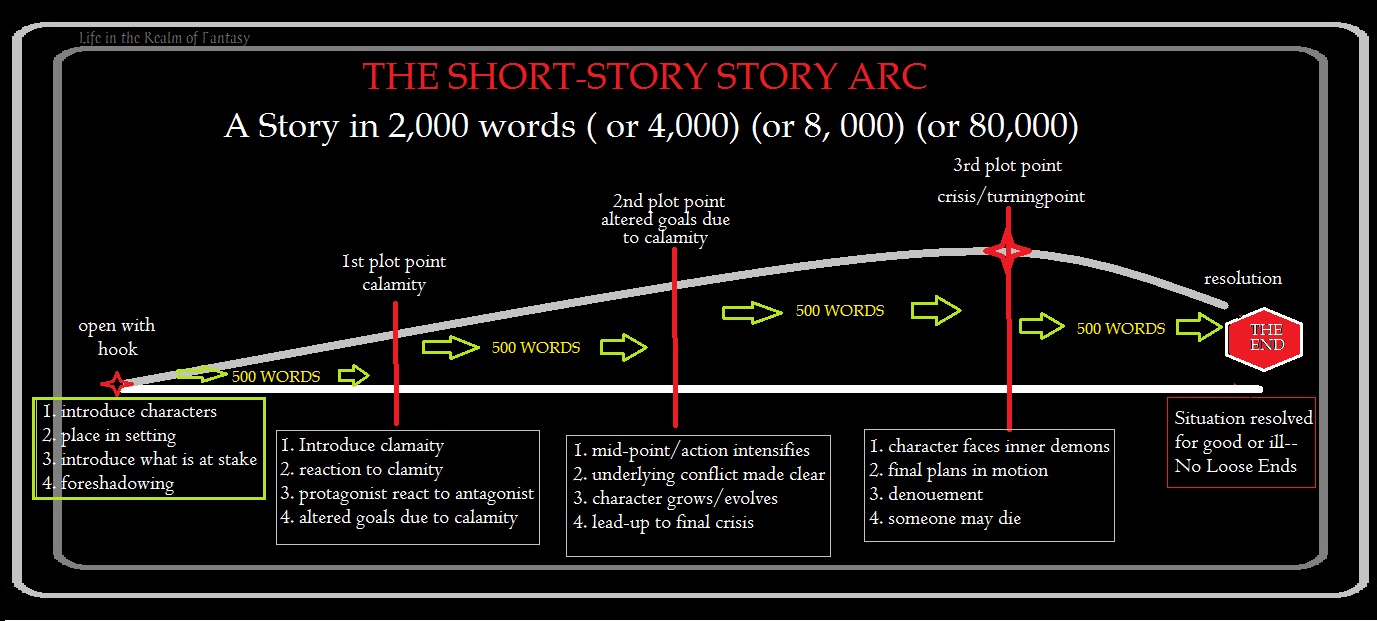
Short-stories are just like novels, in that they have an arc, and you can make it work for you.  By looking at it from the perspective of the story arc, you can see what you have to accomplish, and how many words you have to accomplish it in.

short story arc

Every word in a 2000 word story is critical and has a specific task–that of advancing the the plot. To that end, in a story of only 2,000 words:

  1. No subplots are introduced
  2. Minimal background is introduced
  3. The number of characters must be limited to 2 or 3 at most
  4. Every sentence must propel the story to to the conclusion

Lets say you are writing a fantasy, titled, A  Song Gone Wrong. Because he was a bit too specific when a putting a local warlord’s fling with another man’s wife into a song, our protagonist  is now a wanted man. Divide your story this way:

Act 1: the beginning: You have 500 words to show these plot points

  1. setting: the village of Imaginary Junction,
  2. the weather is unseasonably cold
  3. In an alley, a bard, Sebastian, is  hiding from the
  4. Soldiers of the lord he has inadvertently humiliated

Act 2: First plot point: You have 500 words to tell how

  1. the soldiers surround and capture Sebastian
  2. he is hauled before the angry lord and
  3. thrown into prison, sentenced to hang at dawn, but now you are at:

Act 3.: Mid-point: You have 500 Words to explain how

  1. Sebastian meets a dwarf, Noli, also sentenced to die
  2. Noli is on the verge of managing an escape, but needs help with one last thing
  3. Noli and Sebastian manage to complete the escape route
  4. but the guard seems suspicious, hanging around their cell door, hampering their escape

Act 4: Resolution–you have 500 words to show how

  1. The smart guard finally is relieved by a less wary guard, which
  2. allows Sebastian and Noli to squeeze through the escape route
  3. They are spotted at the last minute, but Noli’s friends are waiting, and
  4. they are whisked to a dwarf safe-house, leading to Sebastian’s next short-story adventure

Once you have parsed out what needs to be said by what point, and in how many words, you can then get to the nitty-gritty of turning that far-fetched tale of woe into a good short-story.

You will see that in order to keep to the strict limit of words, you will have to choose your words carefully. You will have to find words that really convey what you want to say, concisely in one or two sentences. Sebastian can’t give Noli a recap  of his troubles in your hearing–all that will have to be off-stage. On-screen conversations are critical–they will convey the personalities and the minimal backstory of the piece.

After a few times of creating short stories this way, you won’t need to think about it. When you know the length a given tale has to be, you can mentally divide it into acts and just write for fun.

2 Comments

Filed under Publishing, Uncategorized, writer, writing

Elements of the story: showing the mood

My Writing LifeMost of us, if you are reading this blog, are writers who love to read for pleasure. We each enjoy different sorts of books, but all our favorite reading has one thing in common: the story, whether fictional or true, moves us in some deeper way, making us think about it long after the final page has been read.

In order for the reader to be moved by a story, his imagination must have been completely engaged in the work. Thus, the writer must perform a tightly controlled balancing act, walking the fine line between giving too much description and not enough.

As writers we are constantly admonished to show, not tell. This can be taken to extreme, and the result is a boring, unimaginative walk-though of a character’s most minute expressions. For example:

Gordon’s brow furrowed, and his eyes narrowed. His eyebrows nearly met in the middle. His lips turned down at the corners. He screamed, “You bloody idiot.”

Well, duh. Pick one, and let the reader imagine the rest.

Gordon appeared angry.

That doesn’t do it either. That is simply telling the reader Gordon was upset, rather than showing it. Perhaps Gordon’s face darkened and his voice was harsh. Or, Gordon’s eyes narrowed. “You bloody idiot!” 

If your character is angry, please don’t have them hiss their dialogue. People do not snort, hiss, or spit dialogue, no matter how angry they are unless they are a snake or a camel.

The writing world has several good handbooks on showing emotions, and these two are  in my library:

It’s good if you have bought a book on this subject and are using it to help show what is going on in  your character’s minds rather than telling it. But use some common sense. If there are fifteen ways to show dejection, please don’t use them all to describe one moment. Simply have your character sit slumped, or refuse to engage the others.

Readers don’t want to be told in minute detail what to imagine. They will put your boring book down and walk away with only one regret–that they bought it in the first place.

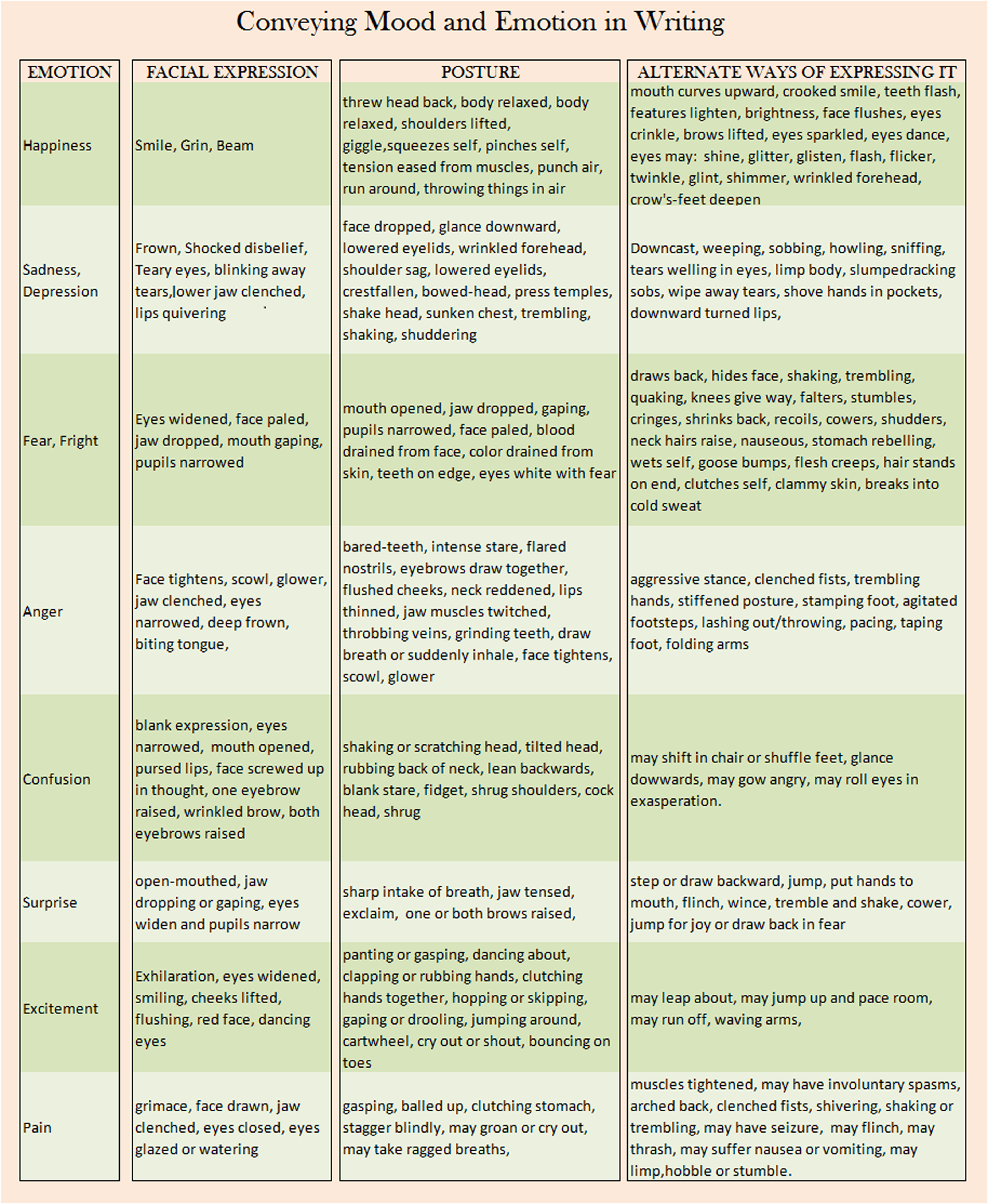
I’ve put together a little cheat sheet for showing emotions. Be sparing–show just enough to keep your readers engaged and the story moving along. If you provide a good framework and allow the reader’s imagination to do the rest, you will engage the reader. That, my friends, is priceless.

Cheat sheet for showing emotion and mood

Cheat sheet for showing emotion and mood

5 Comments

Filed under Humor, Publishing, Uncategorized, writing

Elements of the story: making effective revisions

puppy happy dance via pinterestThere is no feeling of accomplishment like that of having completed a novel, or a shorter piece. Once that final sentence is written, there is that happy-dance moment, where we are shouting and the world is singing.

Following that, we have the urge to immediately look the finished manuscript over and see where some revisions could be made.

I know it’s tempting, but don’t do it. We need to gain some distance from our work in order to see it more clearly, so put it aside. If you work on something else for a couple of weeks, or even a month or two, you will gain a better perspective on what you just finished, and your revisions will bring out the best in your work.

But when we do get back to it, where do we start?

Stephen King said it so eloquently in his book, On Writing: “I got a scribbled comment that changed the way I rewrote my fiction once and forever. Jotted below the machine-generated signature of the editor was this note: ‘Not bad, but PUFFY. You need to revise for length. Formula: 2nd Draft = 1st Draft – 10%. Good luck.’ — Stephen King, On Writing, 2000

This means we must cut the fluff.  If your 1st draft is 100,000 words, try to cut 10,000 words out of it, making it 90,000. The following is a list of things to consider:

  1. Dialogue pitfalls: Search for clichés. Speaking as a reader, do a global search for the word alabaster. If you have used it to describe a woman’s skin, get rid of it, and find a different way to describe her. It’s an overused word that has become cliché. Find different ways to say what you want, unless you have a character who uses clichés–if so, he’d better have a good reason. Even then, don’t go overboard. Click here for a looooong list of common clichés: ProWriting Aid.
  2. Try to make your sentences do without these words: very, that, just, so, and literally. There will be places where they are the only words that will work, and you will use them in that instance. Usually just cutting them out of the sentence and adding nothing makes the sentence stronger. Fluffy, over-blown prose weakens the narrative.
  3. Flowery prose, even in a medieval setting, is off-putting to a reader. Do a global search (Cntrl F) for two letters: ly. This will bring up all the adjectives  (oops adverbs, thank you David Cantrell) because they end in ly. Look at each instance and if it is possible, get rid of them. Often the sentence is stronger without that extraneous word. Find a way to show the idea without flowery prose. This is where you grow as a writer–you give visual clues that enhance the story.
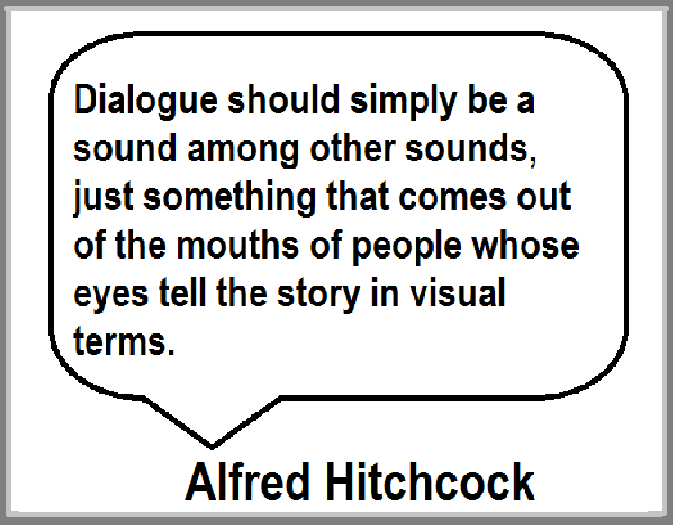
  4. Alfred Hitchcock quote re dialogueExamine the ms for conversations that are opportunities for info dumps. Info is good, but don’t dump it–dole it out as needed, and only when needed.
  5. Are people long-winded, and ranting on and on, with nary a pause for breath?  Decide what is really important in what they are saying and cut everything else.  Conversation in literature must have a purpose, or it is as boring as hell. Cut those marathon speeches down to where they sound like normal people talking, not like orators.
  6. Conversation must pertain to and advance the story. Small talk and verbal tics are obnoxious, and should be avoided at all cost. DO NOT have your characters preface sentences with “Hmmm…” and DO NOT have them use the name of the person they are speaking to, unless there are more than two characters in the scene. You can avoid things like “Well, Bill, it was like this…” just by having the speaker turn to Bill, and say it.

And now for my pet peeve: People do not smile, snort, or smirk dialogue. I mean really: “That’s a lovely dress,” snorted Clara. (eeew. )  Stick to simple dialogue tags, such as said and replied. In fact, it is often best to do away with speech tags (attributions) altogether for a few exchanges every now and then, if:  A. you have only 2 speakers, and B. you have clearly established who is speaking. You can also show who is speaking in other ways:

  1. Miss a few beats. Beats are little bits of physical action inserted into dialogue: John fell quiet and stared out the window. Halee turned and walked out the door. Used sparingly, these pauses serve to punctuate the dialogue, to give the scene movement, and to maintain a strong mental picture in the absence of description. They’re best placed where there is a natural break in the dialogue, because they allow the reader to experience the same pause as the characters.
  2. Don’t over do the action within the conversation. If your characters are rattling pans, slicing apples or staring out the window between every line of dialogue, the scene becomes about the action and not the dialogue, and the impact of the conversation can be lost entirely.

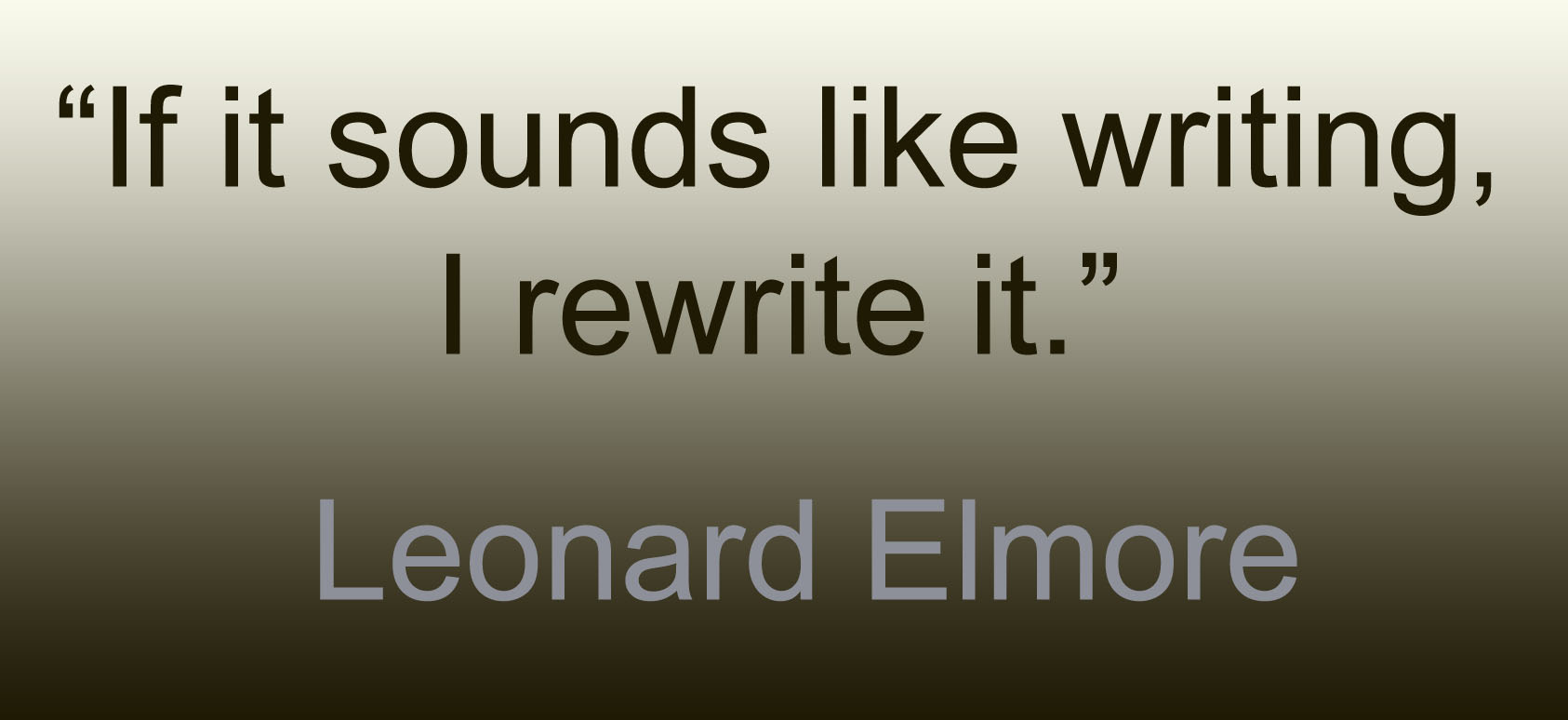
leonard elmore quoteIn our first draft we are trying to make our point, and we inadvertently repeat ourselves. A good way to find where you are repeating yourself is to read a chapter from the bottom up, one paragraph at a time. My editors frequently  tell me, “You said it once, that’s enough.”

In my own work, I hear repetitions and other things I need to cut, if I read it aloud to someone else. I think that’s because when another person is listening, we are more aware of how a given passage sounds.

Also, consider not including a prologue. About half of the readers see the word “prologue” and assume it will be a boring info dump, so they skip it.

This begs the question, “Why go to the trouble of writing it if they aren’t going to read it?” If you must have a prologue, consider calling it Chapter 1– and make it clear that is occurring twenty years before the present day (or whatever). Make it immediately exciting, make it a true first chapter. And don’t do an excerpt from a Holy Book as your prologue. I did that once, and it flew like an iron kite. So I moved my Holy Book to the appendices, and if a reader is interested, they can read it there.

These are just a few things to look for when you begin revisions. And just so you know, revisions are not editing, they are rewriting. If you are “editing” your own manuscript, you have a fool for a client. There is no such thing as self-editing–the best you can do is make revisions and admire your work. You may do very well at that–some people do.

You must make revisions before you hire an editor. Then, ask other authors who they might recommend as an editor and see if you can work well with that person. Your editor will likely point some things out that you didn’t see, but that a reader will. At that point, you will make revisions again. But the results will be so worth it!

5 Comments

Filed under Humor, Self Publishing, Uncategorized, writing

Mapping the Story

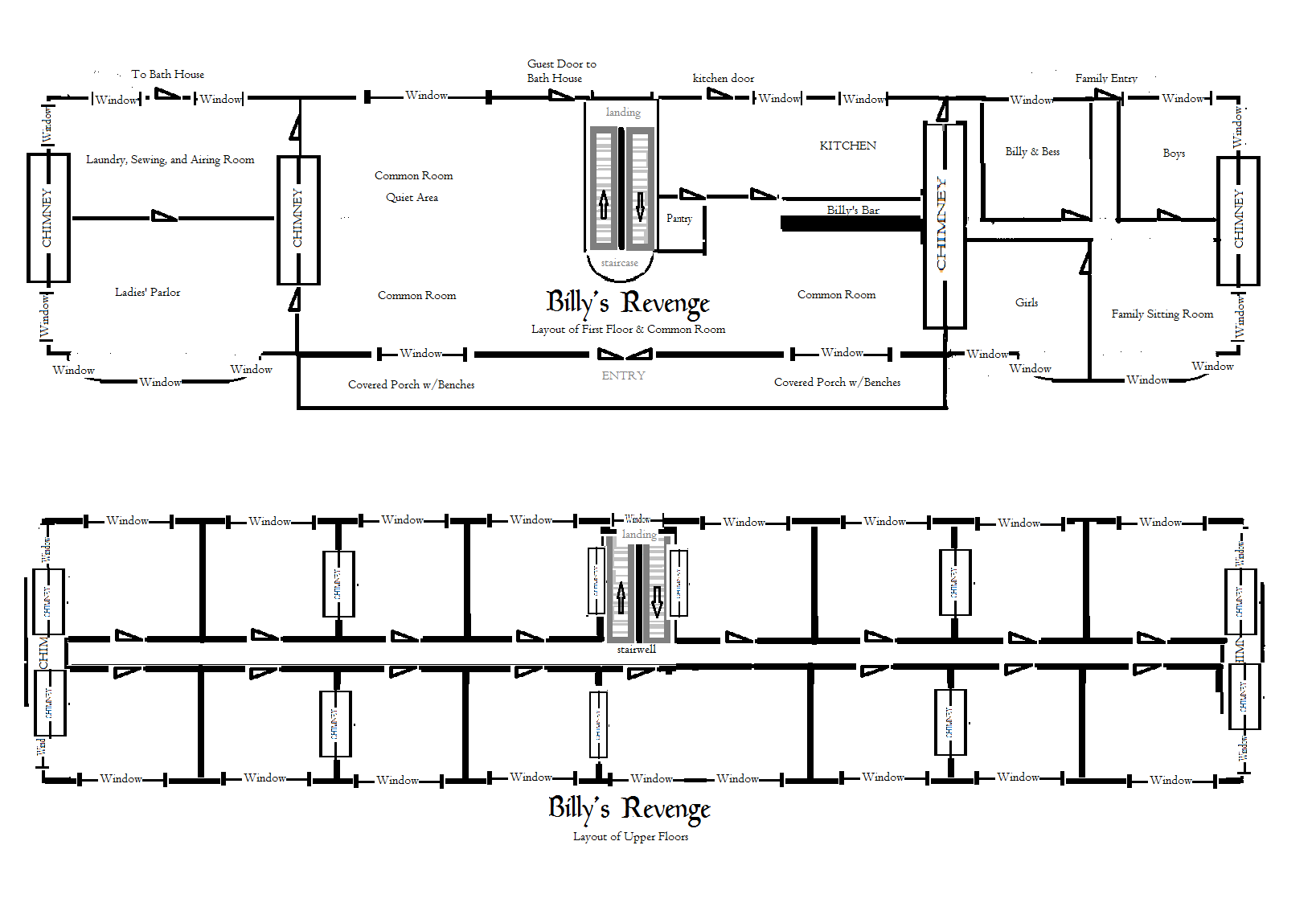
Billy's Revenge Floor plan ground floor

Billy’s Revenge © Connie Jasperson 2015

I was worried I wouldn’t have a blog post for today. The power was out most of Saturday due to a large storm here, and there have been times when that  lasts three days here.  When that happens I have no way to post my blog, although I hear you can post them from cell phones if you know the magic words.

I’ll just say that if I have to key my blog on a cell phone, it will take 5 years to get it ready for posting.  I am the world’s slowest text-message-er. Of course, if you have predictive texting set up, and make good use of auto-fill, you could have some real fun, and do it quickly! But that was another blog post.

After the power outage, my printer/scanner was not speaking to my computer, so I couldn’t print or scan. I did behave, no temper tantrums here. My IT man, (a.k.a. my beloved, long-suffering husband with the patience of a saint) took the time to rectify that situation. I was at the limits of my endurance with that thing.

So, because our power was out, I worked on a pencil sketch of a new map for an upcoming novel, Billy’s Revenge. On Sunday, I digitalized it. It isn’t complete, and is out of proportion in some places but when it is finished, it will tell me everything I need to know about Limpwater.

Map of Limpwater copy

Map of Limpwater, © Connie Jasperson 2015

I always have some sort of map to work with, even if it’s just scribbled, when I am writing in a world of my invention, and they all start out as pencil sketches. Eventually, they become the digital versions you see in my books.

That book will consist of 1 novel and 4 short stories that all revolve around the inn known as Billy’s Revenge. Huw the Bard returns, as does Julian Lackland. Billy Ninefingers has a few misadventures that threaten his career, mess with his chances  to convince Dame Bess to marry him, and set him on a path he never thought he would find himself traveling.

In the opening short story, we meet Eddie, Billy’s father, and see the origins of the Rowdies. Eddie’s story sets the stage for Billy’s trouble with Bastard John. Several short stories that were cut from The Last Good Knight will be included at the end of Billy’s novel, as they don’t pertain to Julian Lackland as much as they do the entire group of Rowdies, Billy Ninefingers included, and they are fun stories.

BNF sign

BR Pub Sign © Connie Jasperson

I’ve had the sign that will hang over the porch in front of Billy’s inn ready for quite a while–hanging it is going to be the trick.

When the power went out, I had Photoshop open and was working on the cover for Valley of Sorrows. But while I know how the graphics will be and I am happy with their layout, I’m not really happy with the art I have located so far, but it’s still early days. I will keep searching, which I enjoy doing.

Anyway Saturday  was not as productive as it could have been.

And Sunday was a busy, catch-up day. Fortunately, it rained off and on all day, so I was able to finish a lot of what I needed to get done.  Today will be as crazy as any Monday ever is, and I will simply have to make time for revisions.  All I need is an hour here and there. I am close to having it ready for editing. I will have Valley of Sorrows published in the spring of 2016, if all continues to go well.

4 Comments

Filed under Books, Publishing, Uncategorized, writer, writing

The clock, groceries, and a new thesaurus

Jetsonslogo640x480At times the world seems to be conspiring against me.  I have to drop what I’m doing, load up the van, and head up to town for something as mundane as groceries. Food should order itself, deliver itself, and put itself away.

But no. Where is my android butler and why is he not doing the shopping? Just like the flying car I was promised when I was child, my android butler is in the Jetsons‘ style garage of my imagination.

But sometimes I get two or three pages of writing done in the 20 or 30 minutes before I have to leave the house for an appointment. There is something about the pressure of knowing I will have to quit at a certain time that forces me to be more productive than I would ordinarily be.

Why is this? When I am pressed for time I use every second to get those ideas out of my head. I don’t stop and research on the good, old, time-wasting internet, and I don’t worry about whether or not I am overusing a word in the narrative. This is a rough draft–all of that can be ironed out when I have more leisure–the next day usually.

clockSome of my best ideas have come about under a time crunch.  Normally when I am writing on a stream-of-consciousness level, I can key about fifty words a minute–paltry compared to today’s young-uns who grew up keying their homework rather than writing it in cursive.

I do admit that just because I can key those words does not mean they will all make sense, or be worth reading. But that again is why we are driven to look at what we just wrote the day after we wrote it–did it say what I meant? How many times did I use the word “noose” in that particular chapter and where am I going to find six different alternatives for such a unique word?

Apricot poodle puppy portrait. Isolated on a white background (studio shoot), via Google Images

A little rephrasing here, cutting there, and voila! It looks like a poodle!

It’s a jungle in my head sometimes, and my ancient  student edition of Roget’s Thesaurus is my friend. But neither the old student version of the thesaurus from 40 years ago, nor the modern, online version is cutting it for me right now.

I need more synonyms. Lots, and lots more!

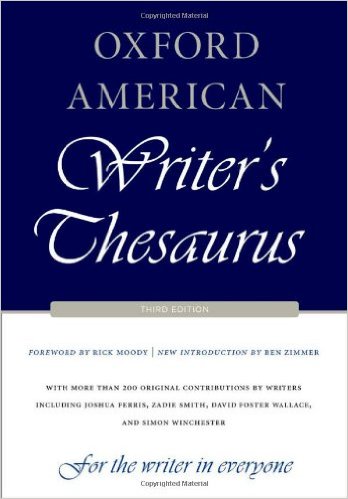
I have just now invested in a bigger, better, hardcover thesaurus. Thus I now have the Oxford American Writers’ Thesaurus winging it’s way to my doorstep. I expect the drone to drop it on Saturday.

ozford american writers thesaurusSome references have to be in hard-copy–such as The Chicago Manual of Style, which is the most comprehensive style guide geared for writers of essays, fiction, and nonfiction. Strunk and White’s Elements of Style is a good beginner style guide, but I found it hard to navigate and couldn’t always find what I wanted. The Chicago Manual of Style is written specifically for writers, editors and publishers and is the industry standard.

Just as a side note–if you are using AP style you are writing for the newspaper, not for literature–two widely different styles with radically different requirements. AP style was developed for expediency in the newspaper industry and is not suitable for novels or for business correspondence. For business, you want to use the Gregg Reference Manual.

Eternal_clock

Eternal Clock, Robbert van der Steeg CC|2.0 via Wikimedia Commons

All in all, I like the way being forced to produce words in a short time helps me lay down a rough draft. But being short on time is big pain when I am trying to revise and iron out stubborn, repetitive wrinkles in a narrative.

Summer is nearly over, and with that comes the long, dark days of the northern winter. I won’t be going as many places (I hope). But with the advent of September I will be spending longer hours editing for clients. My personal productivity will drop in regard to my own work, but I will still find time to write.

And I will also find time to revise. I am nearly at the end of two books written for the World of Neveyah series. Valley of Sorrows will wind up the Tower of Bones series–it is completed and is in revisions. The Wayward Son is nearly complete. While The Wayward Son is not actually a part of the Tower of Bones series, much of it does run concurrently with Forbidden Road, as it is the story of John Farmer’s redemption.

Today will be busy–groceries can wait until tomorrow. Today I am working as hard as I can, trying to get Valley of Sorrows ready to be edited, so that the ToB series will be complete, and also to get John’s story out there too.

2 Comments

Filed under Books, Humor, Literature, Publishing, writer, writing