
Scenes involving violence can be tricky because we feel pressured to make the events the story, leading to undeveloped, two-dimensional characters.
 We forget to consider how the action affects both the protagonist and the reader. The reader needs a small break between incidents to process what just happened, and the characters need a chance to regroup and make plans.
Pacing consists of action followed by aftermath, followed by action, followed by aftermath—and so on. This is often compared to how a skater crosses the ice: push, glide, push, glide.
When we insert a few quieter moments after the action, we create the places where conversations happen. When the characters pause to absorb what just happened and to consider the next step, background information emerges in an organic, natural way.
We want to keep the rhythm of the piece moving, but if we don’t allow the reader to process things, we risk losing them before they finish reading. The story becomes a wall of words and confusion, and they put the book down.
The story is the reader’s journey, and it is our job to make it a personal one.
We’re all familiar with the term ‘flatlined’ as a medical expression indicating the patient has died. Stories are composed of words strung together so the reader becomes emotionally involved in the arc of action. The reader stays involved when the plot arc moves forward at a good pace, but when it flatlines, the reader loses interest.
 Stories are a balancing act detailing the lives of engaging characters having intriguing and believable adventures. The reader lives and processes the action as it happens, suspending their disbelief.
When the story arc is imbalanced, it can flatline in two ways:
- The action becomes random, an onslaught of meaningless events that make no sense.
- The pauses become halts, long passages of random interior monologues that have little to do with the action.
We want to meet and know the characters on both sides of the action, protagonist and antagonist, and we do this through their introspections.
The trick is balancing the introspection and chaos, ensuring your contemplation doesn’t turn into info dumps where your character ponders everything that happens to him at length.
Some stories are meant to be more reflective than active, and some of my favorite literary classics are all about the character’s thoughts as they go through the events. Yet, even though the stories might be about what goes on in the characters’ heads more than the adventure, these narratives are not repetitive. The action, mental though it is, moves forward rather than backward.
 But if you are writing genre fiction, the market you are writing for expects more action than introspection. These stories are also character-driven, but the adventure, how the protagonist meets and overcomes the battles and roadblocks, is what interests the reader.
So, a sci-fi action adventure would have more extended action scenes separated by short scenes of introspection and conversation.
One way to avoid a flatlined story arc is through character interaction. Your characters briefly discuss what is on their minds and bravely muck on to the next roadblock. Conversations serve two important (in my opinion) functions:
- It tells us what they think. New information vital to the story emerges.
- The reader sees who the characters are and how they think.
 Conversations illuminate a group’s relationship with each other and sheds light on our characters’ fears. It shows that they are self-aware and should present information not previously discussed.
Interior monologues, or introspection, don’t have to be italicized if you make it clear that Character A is having a mental dialogue with themselves.
- Interior monologues (thoughts) serve to illuminate a character’s motives at a particular moment in time.
However, interior monologues should not make our characters appear all-knowing. They must show that our people are somewhat clueless about their flaws, strengths, or even their deepest fears and goals.
Your point-of-view character will be in the most danger of this. Avoid situations where the dialogue is too exact in predictions and character self-analysis. Too much foreshadowing ruins the mystery of the piece. The same follows for inner monologues, perhaps even more so.
As the character is forced to grow throughout the course of the story, these faults emerge gradually. The protagonist is pushed down the path to wisdom. Self-awareness should flower because of the “personal resurrection” that occurs near the end of the hero’s journey.
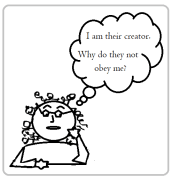 Great characters begin in an unfinished state, a pencil sketch, as it were. They emerge from the events of their journey in full color, fully realized in the multi-dimensional form in which you initially visualized them.
For the protagonist, surviving the journey to self-knowledge is as important as living through the physical journey.
The antagonist must also be self-aware. While their outcome may not be positive, their reasoning and ethical values should emerge as the story progresses.
But maybe you are writing an over-the-top story with a good vs. evil narrative. The supervillain’s backstory may not need more than a mention.
We need to know enough so the supervillain isn’t there simply for the sake of drama. We want them to present a real, tangible threat, and readers must see them as intelligent enough to be dangerous.
Character interactions should show that all the characters have depth. They have layers, and conversations and interior dialogues should reveal aspects the reader doesn’t know up front as the story progresses.
Repetition is easy to write into the first draft of the narrative because we’re telling ourselves the story as we write. But during revisions, we must focus on the rhythm of the story (pacing), as well as making the story arc logical.
It’s a balancing act, one that often takes many drafts for me to get right.






 Life in the Realm of Fantasy