I write in several genres, and I read nearly any book I come across. It’s a habit from the years of working two jobs. It was a time when I could only fit one book purchase a month into my meager budget, but I read the books in my favorite genres faster than the library could stock them. My small bit of excess cash was reserved for a $5.99 fantasy paperback and a $2.00 grocery bag of second-hand books with the covers torn off.
 I was always a sucker for great cover art. Nevertheless, a bag full of coverless books was like a treasure hunt. Chain Bookstores used to rip the covers off books that didn’t sell, and they often ended up in second-hand bookstores.
The bag could contain a wide range of novels that had been sitting on shelves for too long. There might be five Harlequin Romances a Jack Kerouac novel, two by Nora Lofts, three Regency bodice-rippers by Georgette Heyer, a Jaqueline Suzanne novel, an Ian Flemming’s James Bond novel, an ancient copy of Gone With the Wind, several Isaac Asimov novels, an Anne McCaffrey Brain and Brawn novel, and if I was really fortunate, a classic fantasy, such as a Gormenghast novel or a Jack Vance novel.
Oddly, I never found a Tolkien novel in one of those bags.
The books I loved the most were those that let us into the characters’ heads. I still gravitate toward character-driven books. I’m interested in what they think is going on and how they lie to themselves. I love an unreliable narrator and am hooked when the truth is dangled just out of reach.
I love characters who go through the events, with arcs that grow or decline as the facts are revealed. We have so many clues, and yet we don’t know what is really going on until the final pages, when the characters themselves discover or reveal the truth.
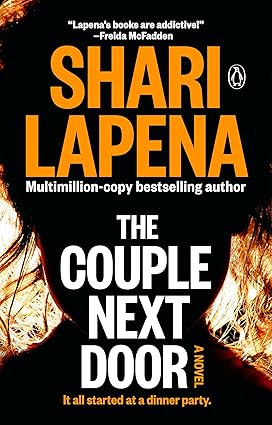 One modern writer who is a master at this is Canadian novelist Shari Lapena. I have read every book she has written since I first came across 2016’s The Couple Next Door. Lapena takes us through the crime, the victim, and the people surrounding them. She raises the blinds on what polite society allows the world to see, opening a window on what lies beneath the image of propriety and perfection.
Many people won’t like her style or the way she spends most of her time inside her characters’ heads. I like the way Lapena uses interior monologues to shed light on hidden sins and motives that drive an outwardly respectable person to commit murder.
Each character’s surface thoughts are open to us, yet not so open that we can guess the truth. As the book progresses, what is hidden is gradually revealed, illuminating less-than-flattering aspects of all the people involved and muddying the waters.
What I have learned by dissecting her work is that internal dialogue must never be an opportunity for an info dump. This is crucial for writers of mysteries. Yes, a character’s thoughts must show us their mental state in real time, but they will lie to themselves as often as they do to us. The thoughts and conversations of those surrounding them must offer some foreshadowing, small hints that all may not be as it appears. In a Lapena murder mystery, these hints gradually become unpleasant truths.
 Opinions abound in online writers’ forums regarding interior monologues. It’s true that beginning authors can rely too heavily on them as an easy way to dump information into a narrative, rather than deploying it. A few people are blunt and loud about their dislike of them, and while I disagree, I do see their point.
In Sci-fi, Fantasy, and YA novels, it is an accepted practice to italicize a protagonist’s thoughts, and readers expect them to be presented that way. However, we need to be aware of how daunting it is for a reader to face a wall of italics.
A rather vocal contingent at any gathering of authors will say that thoughts should not be italicized, as it creates greater narrative distance, setting readers outside the character and the events of the scene.
As an avid reader, I disagree with that statement when applied broadly and will argue the point, though more than a sentence or two of italics does exactly that. This is a personal style choice you, as an author, must make, based on the genre you are writing in and the preferences of your intended audience.
 So, what, in my opinion, is the best way to indicate that a sentence or two of interior monologue in the middle of a scene is the viewpoint character’s thoughts and not the narrator speaking?
We can write the thought in first person, present tense, which is the way we actually think them. This is how Shari Lapena writes them. OR we can write it in third person, past tense if that is the mode you are using for the rest of the text.
We can use italics or normal text, or a “she thought” tag. Or we can choose not to. I do not recommend using quotation marks to set interior monologues off, as that can confuse some readers and make them think it is spoken dialogue.
Interior monologues are crucial to the flow of novels in which the author wants the reader planted firmly in the protagonist’s mind. This is where skill, intention, and the ability to craft what we want our work to say comes into play.
For most of my work, the thoughts of my characters can be shown through their actions. However, this is a case where actions don’t always speak louder than words, so I do include internal monologues as needed.
The observations our characters make can be an aspect of worldbuilding. My opinion is that interior monologues are an organic component of some kinds of narratives, but not necessarily all narratives.
 I feel that when they are done well, interior monologues can create an intimate connection with the characters.
My final opinion is that italics should never be used for long passages, as long stretches of leaning letters are difficult for people with compromised vision to read.
How you choose to use interior dialogues is up to you. It is your work, and you know what you want to convey to the reader at each stage of the story. Now, go forth and write!