Tag Archives: Mannerist Landscape Paintings

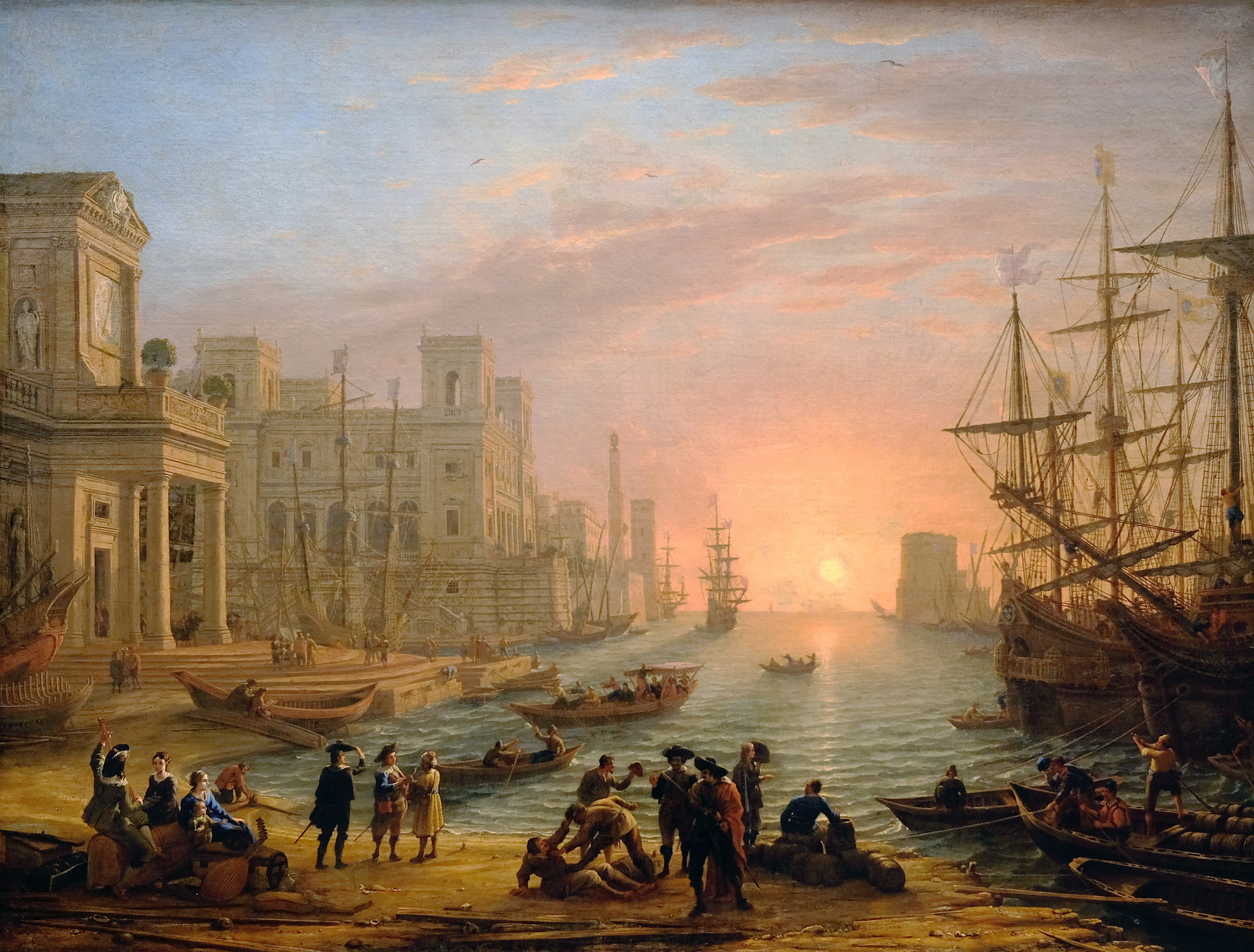
#FineArtFriday: Seaport at sunset by Claude Lorrain 1682

Artist: Claude Lorrain (1604/1605–1682)

Title:   Seaport at sunset

Genre: landscape painting

Date: 1639

Medium: oil on canvas

Dimensions: height: 1 m (40.5 in); width: 1.3 m (53.9 in)

What I love about this painting:

Wow! Where to start? This is what true genius looks like. The overall scene is masterfully done, one of the best seascapes I have seen. The waters are calm, allowing for goods and passengers to be transferred safely to shore. The sky is that incredible quality that nature sometimes offers us on a summer evening. A haze is rising, and ships are still entering the harbor, waiting for their turn to offload their cargoes and passengers. Waves lap softly at the shore, a gentle rhythm.

Claude shows us a thriving, prosperous seaport under a glorious sunset. In fact, the scenery is so beautiful, it’s easy to overlook the dramas playing out in the foreground. However, we shouldn’t, as that is where the real story he wanted to show us lies.

In the bottom left, a family is seated on an upturned boat. Are they waiting to board a ship? They seem to be musicians, as the man plays a cittern, and a lute rests beside the woman and child, along with a pile of baggage.

To their right, a pair of merchants discuss business with a foreign trader, whose clothing suggests he is from Persia. Are they negotiating the purchase of rare spices? Or are they attempting to sell him something?

In the bottom center, violence has erupted as a pair of ruffians have decided to settle their dispute the old-fashioned way. Sailors on shore leave? Too much to drink? Fighting over a woman? The onlookers are disgusted but do not step in to break it up. Apparently, someone “had it coming.”

To the right of the combatants and knot of friends, a pair of well-dressed men, one seated on an upturned boat and one standing, are clearly waiting for something. Perhaps these people are all waiting to board the same ship.

And finally, on the far right, we have several ships, accompanied by small boats called tenders, which are going to and from them. In the foreground, sailors row tenders to the strand. Will our passengers be rowed out to board their ship? This is a bustling harbor, and it’s clear that berths along the quayside are at a premium. Perhaps, rather than paying for a berth when his cargo consists of passengers rather than goods, this ship’s owner keeps his costs down by bringing supplies on board by tender and ferrying passengers to and from the shore.

Claude’s glorious sunset hints that hope lies beyond the horizon. Are the passengers embarking on a journey to the New World? Perhaps they are going to India, or even to the French colonies in the South Pacific. Wherever they are going, I hope their journey is peaceful and ends well.

About the artist, via Wikipedia:

Claude Lorrain (born Claude Gellée), called le Lorrain in French; traditionally just Claude in English; c. 1600 – 23 November 1682) was a painter, draughtsman and etcher of the Baroque era originally from the Duchy of Lorraine. He spent most of his life in Italy, and is one of the earliest significant artists, aside from his contemporaries in Dutch Golden Age painting, to concentrate on landscape painting. His landscapes often transitioned into the more prestigious genre of history paintings by addition of a few small figures, typically representing a scene from the Bible or classical mythology. [1]

To learn more about this artist go to Claude Lorrain – Wikipedia


Credits and Attributions:

IMAGE: Seaport at sunset by Claude Lorrain 1682. Wikimedia Commons contributors, “File:F0087 Louvre Gellee port au soleil couchant- INV4715 rwk.jpg,” Wikimedia Commons, https://commons.wikimedia.org/w/index.php?title=File:F0087_Louvre_Gellee_port_au_soleil_couchant-_INV4715_rwk.jpg&oldid=967103912 (accessed June 27, 2025).

[1] Wikipedia contributors, “Claude Lorrain,” Wikipedia, The Free Encyclopedia, https://en.wikipedia.org/w/index.php?title=Claude_Lorrain&oldid=1298367934 (accessed July 2, 2025).

2 Comments

Filed under #FineArtFriday, writing

#FineArtFriday: a closer look at “Forest Landscape” by Jan Brueghel the Elder

Title: Forest landscape

Artist: Jan Brueghel the Elder

Genre: landscape art

Date: between circa 1605 and circa 1610

Medium: oil on oak panel

Dimensions: 40 x 32 cm

What I love about this painting:

Today, we’re taking a closer look at the works of the Flemish artist, Jan Brueghel the Elder. I first featured this painting in July of 2020, and it is one that I love. The scene is peaceful and relaxing, a moment of calm for our turbulent times.

The level of detail down to the leaves and the bark on the trees is amazing, but the rich colors are what attracted me, drawing me in. The heron on the rock seems poised to take flight.  Beyond the heron, on the other side of the creek, a path leads deeper into the forest, calling to us to cross over and see where it leads. The scene is beautiful the way a fantasy is, likely because Brueghel most probably painted it from sketches and memory.

“In his forest landscapes Brueghel depicted heavily wooded glades in which he captured the verdant density, and even mystery, of the forest. Although on occasion inhabited by humans and animals, these forest scenes contain dark recesses, virtually no open sky and no outlet for the eye to penetrate beyond the thick trees.” via Wikipedia. [1]

In many ways, Jan Brueghel’s paradise landscapes paved the way for the great plein air painters of the 18th and 19th centuries. This is most definitely a Mannerist landscape painting, as it is highly romanticized.

About the Artist, via Wikipedia:

Jan Brueghel (also Bruegel or Breughelthe Elder  (1568 – 13 January 1625) was a Flemish painter and draughtsman. He was the son of the eminent Flemish Renaissance painter Pieter Brueghel the Elder. A close friend and frequent collaborator with Peter Paul Rubens, the two artists were the leading Flemish painters in the first three decades of the 17th century.

Brueghel worked in many genres including history paintings, flower still lifes, allegorical and mythological scenes, landscapes and seascapes, hunting pieces, village scenes, battle scenes and scenes of hellfire and the underworld.

He was an important innovator who invented new types of paintings such as flower garland paintings, paradise landscapes, and gallery paintings in the first quarter of the 17th century.

He also created genre paintings that were imitations, pastiches and reworkings of his father’s works, in particular his father’s genre scenes and landscapes with peasants.  Brueghel represented the type of the pictor doctus, the erudite painter whose works are informed by the religious motifs and aspirations of the Catholic Counter-Reformation as well as the scientific revolution with its interest in accurate description and classification.  He was court painter of the Archduke and Duchess Albrecht and Isabella, the governors of the Habsburg Netherlands.

The artist was nicknamed “Velvet” Brueghel, “Flower” Brueghel, and “Paradise” Brueghel. The first is believed to have been given him because of his mastery in the rendering of fabrics. The second nickname is a reference to his specialization in flower still lifes and the last one to his invention of the genre of the paradise landscape. [1]


Credits and Attributions:

IMAGE: Forest Landscape by Jan Brueghel the Elder / Public domain Wikimedia Commons contributors, “File:Jan Brueghel (I) – Forest landscape.jpg,” Wikimedia Commons, https://commons.wikimedia.org/w/index.php?title=File:Jan_Brueghel_(I)_-_Forest_landscape.jpg&oldid=1036257842 (accessed June 26, 2025).

[1] Wikipedia contributors, “Jan Brueghel the Elder,” Wikipedia, The Free Encyclopedia, https://en.wikipedia.org/w/index.php?title=Jan_Brueghel_the_Elder&oldid=1293540600 (accessed June 26, 2025).


4 Comments

Filed under #FineArtFriday

#FineArtFriday: Forest Landscape by Jan Brueghel the Elder

Title: Forest landscape

Artist: Jan Brueghel the Elder

Genre: landscape art

Date: between circa 1605 and circa 1610

Medium: oil on oak panel

Dimensions: 40 x 32 cm

What I love about this painting:

Today’s Fine Art Friday offering is a further exploration of the works of the Flemish artist, Jan Brueghel the Elder. I began this two part series last Friday with his painting, the Great Fish Market.

The level of detail down to the leaves and the bark on the trees is amazing, but the rich colors are what attracted me, drawing me in. The heron on the rock seems poised to take flight.  Beyond the heron, on the other side of the creek, a path leads deeper into the forest, calling to us to cross over and see where it leads. The scene is beautiful the way a fantasy is, likely because it is, in a way. Brueghel most probably painted it from sketches and memory.

I quoted this last week when discussing the Great Fish Market, but it bears repeating:

“In his forest landscapes Brueghel depicted heavily wooded glades in which he captured the verdant density, and even mystery, of the forest. Although on occasion inhabited by humans and animals, these forest scenes contain dark recesses, virtually no open sky and no outlet for the eye to penetrate beyond the thick trees.” via Wikipedia.

In many ways, Jan Brueghel’s paradise landscapes paved the way for the great plein air painters of the 18th and 19th centuries. This is most definitely a Mannerist landscape painting, as it is highly romanticized.

About the Artist, via Wikipedia:

Jan Brueghel (also Bruegel or Breughelthe Elder  (1568 – 13 January 1625) was a Flemish painter and draughtsman. He was the son of the eminent Flemish Renaissance painter Pieter Brueghel the Elder. A close friend and frequent collaborator with Peter Paul Rubens, the two artists were the leading Flemish painters in the first three decades of the 17th century.

Brueghel worked in many genres including history paintings, flower still lifes, allegorical and mythological scenes, landscapes and seascapes, hunting pieces, village scenes, battle scenes and scenes of hellfire and the underworld.

He was an important innovator who invented new types of paintings such as flower garland paintings, paradise landscapes, and gallery paintings in the first quarter of the 17th century.

He also created genre paintings that were imitations, pastiches and reworkings of his father’s works, in particular his father’s genre scenes and landscapes with peasants.  Brueghel represented the type of the pictor doctus, the erudite painter whose works are informed by the religious motifs and aspirations of the Catholic Counter-Reformation as well as the scientific revolution with its interest in accurate description and classification.  He was court painter of the Archduke and Duchess Albrecht and Isabella, the governors of the Habsburg Netherlands.

The artist was nicknamed “Velvet” Brueghel, “Flower” Brueghel, and “Paradise” Brueghel. The first is believed to have been given him because of his mastery in the rendering of fabrics. The second nickname is a reference to his specialization in flower still lifes and the last one to his invention of the genre of the paradise landscape.


Credits and Attributions:

Forest Landscape by Jan Brueghel the Elder / Public domain

Wikipedia contributors, “Jan Brueghel the Elder,” Wikipedia, The Free Encyclopedia, https://en.wikipedia.org/w/index.php?title=Jan_Brueghel_the_Elder&oldid=963723468 (accessed July 17, 2020).

Wikimedia Commons contributors, “File:Jan Brueghel (I) – Forest landscape.jpg,” Wikimedia Commons, the free media repository, https://commons.wikimedia.org/w/index.php?title=File:Jan_Brueghel_(I)_-_Forest_landscape.jpg&oldid=354133728 (accessed July 17, 2020).

Comments Off on #FineArtFriday: Forest Landscape by Jan Brueghel the Elder

Filed under #FineArtFriday