Tag Archives: mood and atmosphere in writing

Subtext, Mood, and Atmosphere #writing

A reader’s perception of a narrative’s reality is affected by emotions they aren’t even aware of, an experience created by the layers of worldbuilding.

mood-emotions-1-LIRF09152020Mood and atmosphere are separate but entwined forces. They form subliminal impressions in the reader’s awareness, subcurrents that affect our personal emotions.

The emotions evoked in readers as they experience the story are created by the combination of mood, atmosphere, and subtext.
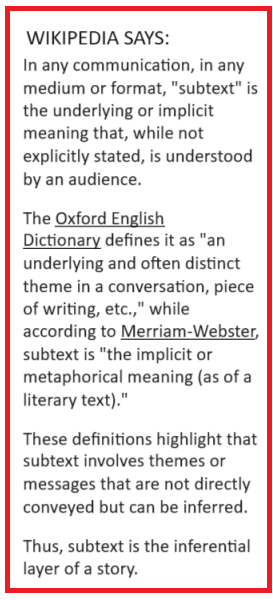
SUBTEXT_Def_06222024LIRFSubtext is a complex but essential aspect of storytelling. It lies below the surface and supports the plot and the conversations. It is the hidden story, the secret reasoning we deduce from the narrative. It’s conveyed by the images we place in the environment and how the setting influences our perception of the mood and atmosphere.

Emotion is the experience of contrasts, of transitioning from the negative to the positive and back again. Mood, atmosphere, and emotion are part of the inferential layer of a story, part of the subtext. When an author has done their job well, the reader experiences the emotional transitions as the characters do. It is our job to make those transitions feel personal.

The atmosphere of a story is long-term. Atmosphere is the aspect of mood that is conveyed by the setting as well as the general emotional state of the characters.

The mood of a story is also long-term, but it is a feeling residing in the background, going almost unnoticed. Mood shapes (and is shaped by) the emotions evoked within the story.

Scene framing is the order in which we stage the people and the visual objects we include in a scene, as well as the sequence of scenes along the plot arc. It shapes the overall mood and atmosphere and contributes to the subtext. We choose the furnishings, sounds, and odors that are the visual necessities for that scene, and we place the scenes in a logical, sequential order.
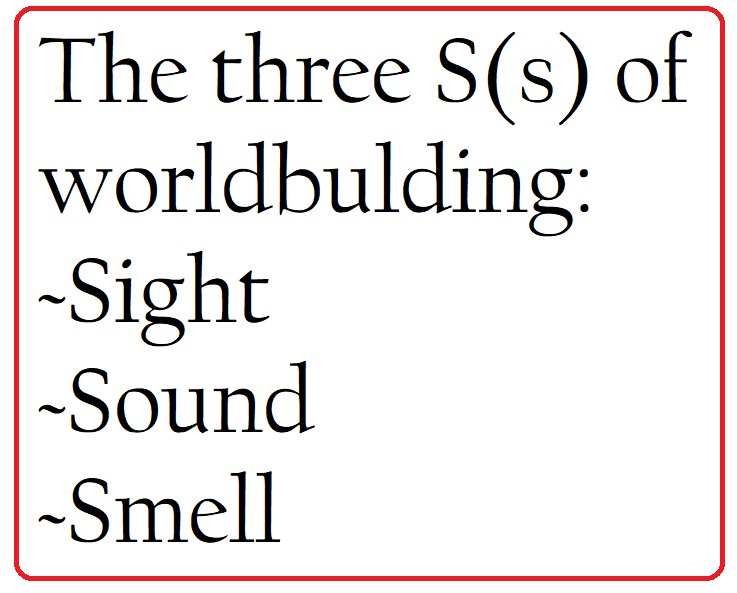
3-Ss-of-worldbuilding-LIRF07182021We want to avoid excessive exposition, and good worldbuilding can help us with that. Let’s say we want to convey a general atmosphere of gloom and show our character’s mood without an info dump. Environmental symbols are subliminal landmarks for the reader. Thinking about and planning symbolism in an environment is key to developing the general atmosphere and affecting the overall mood.

Barren landscapes and low windswept hills feel cold and dark to me. The word gothic in a novel’s description tells me it will be a dark, moody piece set in a stark, desolate environment. A cold, barren landscape, constant dampness, and continually gray skies set a somber tone to the background of the scene.

A setting like that underscores each of the main characters’ personal problems and evokes a general atmosphere of gloom.
ALLEGORY06222024LIRFWhen we are designing the setting of a scene, which aspect of atmosphere is more important, mood or emotion? As I have said before, both and neither because they are entwined. Our characters’ emotions affect their attitudes toward each other and influence how they view their quest. This, in turn, shapes the overall mood of the characters as they move through the arc of the plot. And the visual atmosphere of a particular environment may affect our protagonist’s personal mood. Their individual attitudes affect the emotional state of the group—the overall mood.

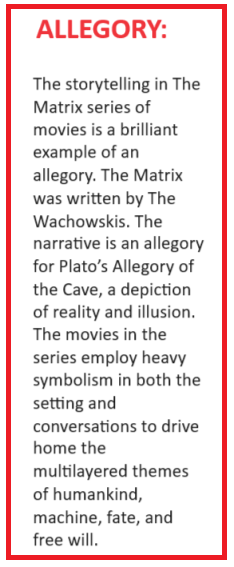
What tools in our writer’s toolbox are effective in conveying an atmosphere and a specific mood? Once we have chosen an underlying theme, it’s time to apply allegory and symbolism – two devices that are similar but different. The difference between them is how they are presented.

  • Allegory is a moral lesson in the form of a story, heavy with symbolism.
  • Symbolism is a literary device that uses one thing throughout the narrative (perhaps shadows) to represent something else (grief).

What are some examples? Cyberpunk, as a subgenre of science fiction, is exceedingly atmosphere-driven. It is heavily symbolic in worldbuilding and often allegorical in the narrative. We see many features of the classic 18th and 19th-century Sturm und Drang  literary themes but set in a dystopian society. The deities that humankind must battle are technology and industry. Corporate uber-giants are the gods whose knowledge mere mortals desire and whom they seek to replace.

The setting and worldbuilding in cyberpunk work together to convey a gothic atmosphere, an overall feeling that is dark and disturbing. This is reflected in the subtext, which explores the dark nature of interpersonal relationships and the often criminal behaviors our characters engage in for survival.

 No matter what genre we write in, we can use the setting to hint at what is to come. We can give clues by how we show the atmosphere with the inclusion of colors, scents, and ambient sounds. We choose our words carefully as they determine how the visuals are shown.

Hydrangea_cropped_July_11_2017_copyright_cjjasperson_2017 copyWe can create an atmosphere and mood that underscores our themes and highlights plot points without resorting to info dumps. We can lighten the mood as easily as we can darken it. When we design a setting, color brightens the visuals, and gray depresses them. Those tones affect the atmosphere and mood of the scene.

Sunshine, green foliage, blue skies, and birdsong go a long way toward lifting my spirits, so when I read a scene that is set in that kind of environment, the mood of the narrative feels lighter to me.

Worldbuilding can feel complicated when we are trying to convey subtext, mood, and atmosphere but the reader won’t be aware of the complexities. All they will know is how strongly the protagonist and her story affected them and how much they loved that novel.

1 Comment

Filed under writing

Worldbuilding and depth, part 2 – the inferential layer of mood and atmosphere #writing

Many new authors use the word mood interchangeably with atmosphere when describing a scene or passage. This is because mood and atmosphere are like conjoined twins. They are individuals but are difficult to separate as they share some critical functions. This is the layer of worldbuilding that lies just below the surface, a component of the inferential layer of the narrative.

mood-emotions-1-LIRF09152020Mood is long-term, a feeling residing in the background, going almost unnoticed. Mood shapes (and is shaped by) the emotions evoked within the story.

Atmosphere is also long-term but is sometimes more noticeable as it is a component of worldbuilding. Atmosphere is the aspect of mood that is conveyed by the setting.

Emotion is immediate and short-term and is also subtle and lurking in the background. The characters feelings affect the reader’s experience of the overall atmosphere and mood.

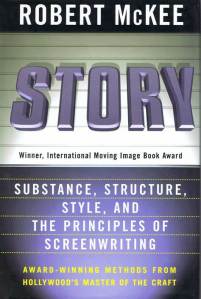
storybyrobertmckeeRobert McKee tells us that emotion is the experience of transition, of the characters moving between a state of positivity and negativity. “Story” by Robert McKee. Emotions are fluid, generating energy, and give life to the narrative.

I look for books where the author shows emotions in a way that feels dynamic. Our characters are in a state of flux, and their emotional state should also be. When the character’s internal struggle is turbulent, ranging from positive to negative and back, their story becomes personal to me.

Mood is a significant word serving several purposes. It is created by the setting (atmosphere), the exchanges of dialogue (conversation), and the tone of the narrative (word choices, descriptions). It is also affected by (and refers to) the emotional state of the characters—their personal mood.

Undermotivated emotions lack credibility and leave the reader feeling as if the story is flat. In real life, we have deep, personal reasons for our feelings, and so must our characters.

A woman shoots another woman. Why? What emerges as the story progresses is that a road accident occurred three years before in which her child was accidentally struck and killed by the woman she murdered.

My worldbuilding for that story should convey an atmosphere of shadows, sort of like a “film noir.” Everything my characters see and interact with should be symbolic, conveying a range of dark emotions in the opening pages in which the gun is fired, and the woman falls dead. If I do it right, I’ll have intense emotion and high drama.

In real life, people have reasons for their actions, irrational though they may be. The root cause of a person’s emotional state drives their actions. In the case of the above story, the driving force is a descent into a mad desire to avenge what was an unintentional tragedy. Every aspect of the setting should reflect that intense anger, the deep-rooted hatred, and the unfairness of it all.

plot is the frame upon which the themes of a story are supportedThese visuals can easily be shown. Grief manifests in many ways and can become a thread running through the entire narrative. That theme of intense, subliminal emotion is the underlying mood and it shapes the story:

  • Many people are affected by the murder, family members on both sides, and also the law enforcement officers who must investigate it.

How can we show it? We use worldbuilding to create an atmosphere of gloom. Outside each window, whenever a character must leave their home or office, the days are dark, damp, and chill. The lack of sunshine and the constant rain wears on all the characters involved on either side of the law.

  • The setting underscores each of the main characters’ personal problems and evokes a general sense of loss and devastation.

Which is more important, mood or emotion? Both and neither. Characters’ emotions affect their attitudes, which in turn shape the overall mood of a story. In turn, the atmosphere of a particular environment may affect the characters’ personal mood. Their individual attitudes affect the emotional state of the group.

As we have said before, emotion is the experience of transition from the negative to the positive and back again. Each evolution of the characters’ emotions shapes their conscious beliefs and values. They will either grow or stagnate.

Infer_Meme_LIRF06292019This is part of the inferential layer, as the audience must infer (deduce) the experience. You can’t tell a reader how to feel. They must experience and understand (infer) what drives the character on a human level.
What is mood in literature? Wikipedia says mood is established in order to affect the reader emotionally and psychologically and to provide a feeling of experience for the narrative.

What is atmosphere? It is worldbuilding, created by the words we choose. We can feel it, but it is intangible. But atmosphere affects how the reader perceives the story. The way a setting is described contributes to the atmosphere, and that description is a component of worldbuilding.

Atmosphere is the result of deliberate word choices. It comes into play when we place certain visual elements into the scenery with the intention of creating an emotion in the reader.

  • Tumbleweeds rolling across a barren desert.
  • Waves crashing against cliffs.
  • Dirty dishes resting beside the sink.
  • A chill breeze wafting through a broken window.

We show these conjoined twins of mood and atmosphere through subtle clues: odors, ambient sounds, and the surrounding environment. They are intensified by the characters’ attitudes and emotions. Mood and atmosphere are organic components of the environment but are also an intentional ambiance.

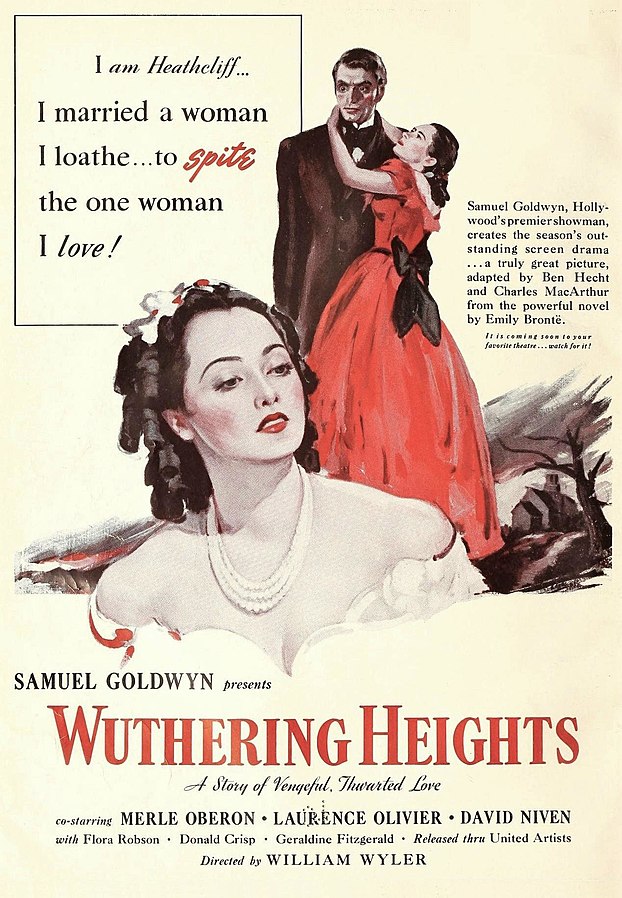
622px-Merle_Oberon_and_Laurence_Olivier_in_'Wuthering_Heights',_1939As we read, the atmosphere that is shown within the pages colors and intensifies our emotions, and at that point, they feel organic. Think about a genuinely gothic tale: the mood and atmosphere Emily Brontë instilled into the setting of Wuthering Heights make the depictions of mental and physical cruelty seem like they would happen there.
Happy, sad, neutral—atmosphere and mood combine to intensify or dampen the emotions our characters experience. They underscore the characters’ struggles.

For me, as a writer, conveying the inferential layer of a story is complicated. Creating a world on paper requires thought even when we live in that world. We know how the atmosphere and mood of our neighborhood feels when we walk to the store. But try conveying that mood and atmosphere in a letter to a friend – it’s more complicated than it looks.

Showing what is going on inside our characters’ heads is tricky. We will go a little deeper into that next week.

2 Comments

Filed under writing

Layers of Depth – using atmosphere to emphasize emotion #amwriting

Writing emotions with depth is a balancing act, and simply showing the outward physical indicators of a particular emotion is only half the story. Every idea for a novel comes to me with an idea for the overall mood. That mood will underscore and emphasize the characters’ personal mood and changing emotions.

depth-of-characterIn his book, Story, Robert McKee tells us that emotion is the experience of transition, of the characters moving between a positive and negative. Beneath and behind the emotions that our characters experience is the atmosphere of the story, going unnoticed on the surface.

Atmosphere is the aspect of mood that setting conveys. It is only an ambiance, but it is a powerful tool for helping us show our characters’ emotional state.

When creating our characters, we find it easy to connect with vivid emotions, such as hate, anger, desire, and passion. These are loud emotions.

Volume control is a crucial part of the overall pacing of our story. “Loud” deafens us and loses its power when it’s the only sound. So, like the opening movement of Beethoven’s 5th Symphony, we must contrast loud against quiet to create the texture of our story.

When we first begin as writers, we find it difficult to convey our characters’ emotions without telling the reader what to feel. After receiving our share of abuse from other writers, we swing toward showing their every mood in minuscule detail.

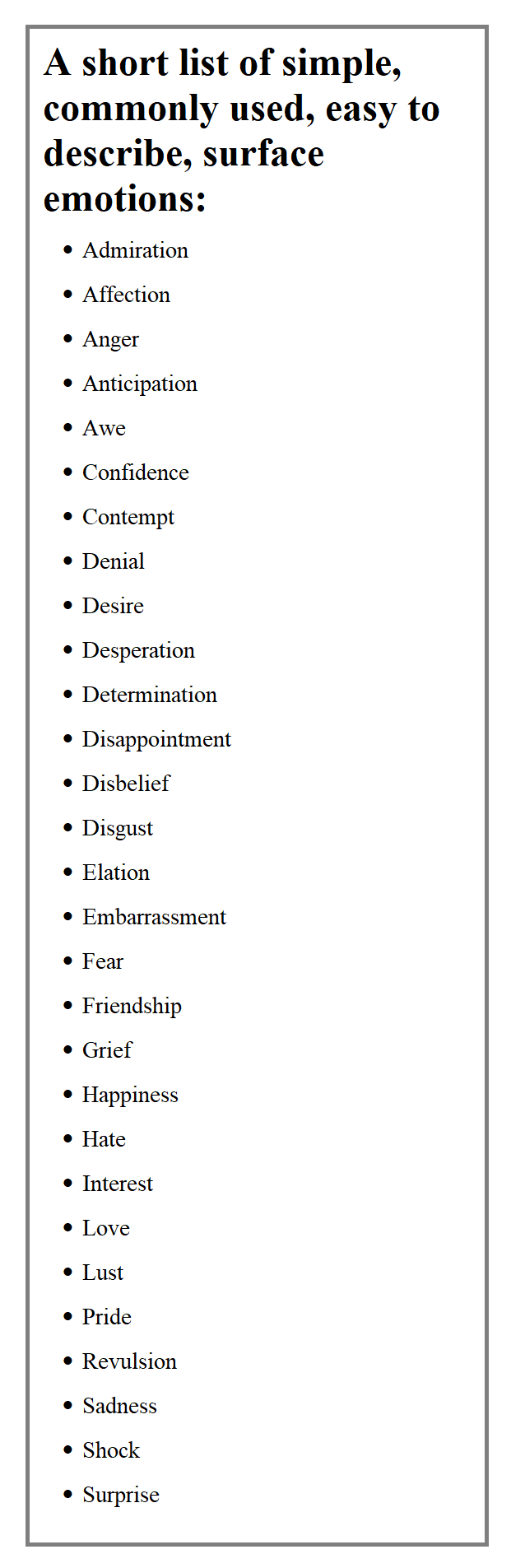
emotionwordslist01LIRF06232020Truthfully, I find detailed descriptions of facial expressions to be boring and sometimes off-putting. Every author armed with a little knowledge writes characters with curving lips, stretching lips, and lips doing many things over, and over, and over … with little variation.
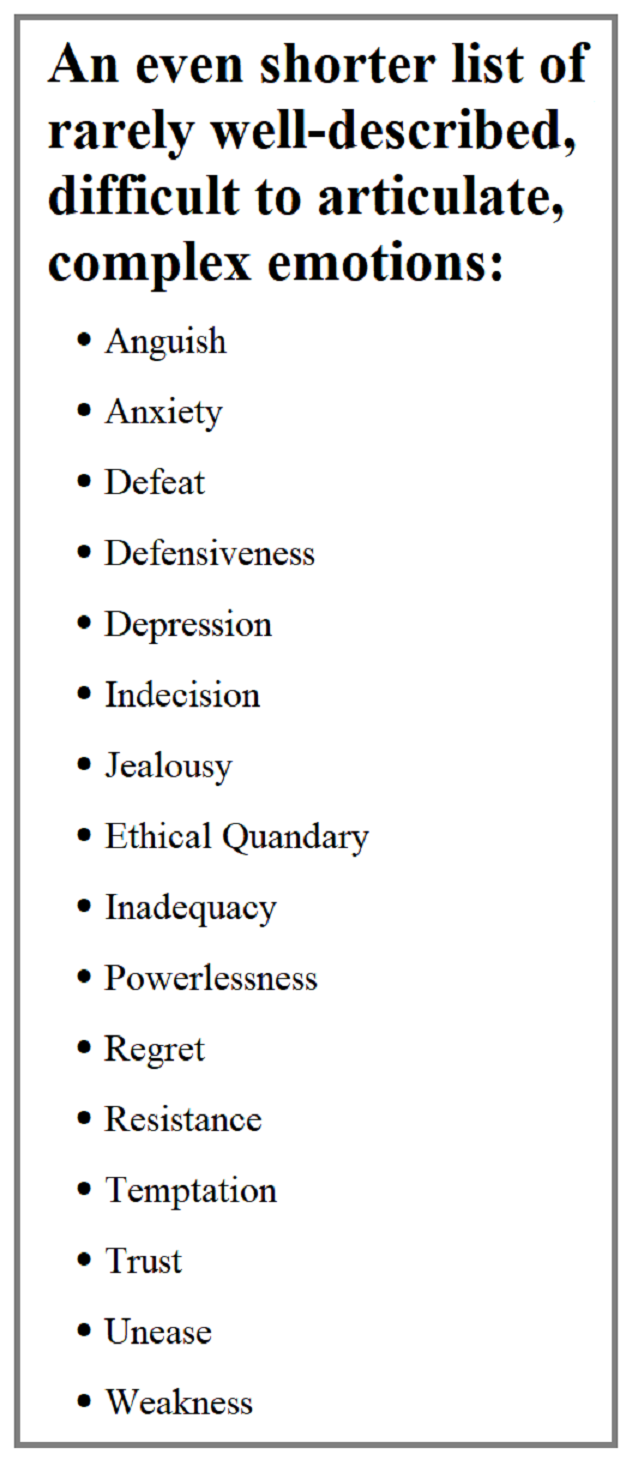
A happy medium between telling and showing can be achieved, but it takes work. We must choose words that show what we mean and use the environment to convey subtle feelings wherever possible. I say wherever possible because it is not practicable to always employ the setting in a narrative. We need to get inside the characters’ heads.

Severe emotional shock strikes us, and we have an immediate physical reaction.

Visceral reactions are involuntary—out of our control. We can’t stop our faces from flushing or our hearts from pounding. Visceral feelings are emotions we feel deeply. We find it difficult to control or ignore them because they are instinctive and not the result of thought.

We can pretend it didn’t happen or hide it, but we can’t stop it. An internal physical gut reaction is difficult to convey without offering the reader some information, a framework to hang the image on.

There will be an instant reaction. How does a “gut reaction” feel? We might experience nausea, gut punch, or a feeling of butterflies in our stomach. Think about how you respond to internal surprises, and write those feelings down.

I experience severe shocks this way:

  • disbelief—the OMG moment
  • a sinking feeling in the pit of my stomach, freezing in place, or a shout of “No!”
  • Years ago, on witnessing a horrific accident, I experienced disassociation or a feeling of viewing the scene from outside myself. This involuntary coping or defense mechanism is meant to minimize or help a person tolerate stress.

When we write mild reactions, offering a lot of emotional descriptions is unnecessary because mild is boring. A raised eyebrow, a sideways glance—small gestures show the attitude and mood of the character.

But good pacing requires balance. Quiet scenes enable us (and our characters) to process the events detailed in the louder scenes.

However, strong emotions are compelling. Highly charged situations are strengthened by the way we write the emotional experience. The way we show the setting reinforces each physical response.

The following is an excerpt from a work in progress:

Knowledge lay in Ivan’s belly, a cold ball of disaster. He had already failed as a shaman, and he wasn’t even a true seeker. But he couldn’t let Cai down, had to prove he could resolve it. He forced a smile, projecting confidence. “Look at that view. I’d heard the lake is so large one can’t see the southern shore from Neville, but I didn’t realize its truth. It seems as vast as the sky.”

As you can see, I struggle with these concepts as much as any other writer does. This scene is set on an early spring morning with cold winds shuttling heavy clouds across a blue sky. Rain moves in later in the day, underscoring Ivan’s dark mood. Sometimes I do well at conveying atmosphere and emotion; other times, I don’t. But I keep trying because it takes effort to succeed in anything.

When I write a scene, I ask myself why this character is reacting this way. Emotions without cause have no basis for existence, no foundation. They’re a lot of noise about nothing.

The emotion hits, and the character processes it. From a different work in progress:

It would have been the first battle spell John had cast in years, but no. His battle abilities were still gone, as if the inferno he’d unleashed in the culvert had burned them away.

Timing is crucial, and this is the moment to slip in a brief mention of the backstory. That way, we avoid an info dump, but the reader has the information needed to make the emotion tangible.

On the heels of that thought, John was overcome by the remembered sounds, the roar of flames, the shrieks of the enemy …. he sagged to the curb, gagging and gasping, unable to breathe properly, panicking under the weight of it.

emotionwordslist02LIRF06232020Simplicity has an impact, but I struggle to achieve balance. When looking for words with visceral and emotional power, consonants are your friend. Verbs that begin with consonants are powerful.

Use forceful words, and you won’t have to resort to a great deal of description. Weak word choices separate the reader from the experience, dulling the emotional impact of what could be an intense scene.

If you are between projects and don’t know what to write, a good exercise is to create an intense and dramatic scene for characters you currently have no story for. Give them a setting, and use it to emphasize how they feel.

The key to writing a good scene is to practice. You may find a later use for these characters, and that scene could be the seed of a longer story. The more we practice this aspect of the craft, the better we get at it.

And the more we write, the more individual and recognizable our writing voice becomes.

17 Comments

Filed under writing

Mood and atmosphere #amwriting

I refuse to self-edit my first drafts, especially during NaNoWriMo, so the prose in my current work is less than stellar. Because I am inventing the story as I write it, the early drafts for all my work are littered with ‘ly’ words and other telling words.

MyWritingLife2021Once the first draft is a complete novel, I will step away from it for a few weeks and work on other projects. Then when I come back to it, I use the global search (find option) to look for each instance of ‘ly’ words and rewrite those sentences to make them active.

Active prose injects impact into the narrative, but the first draft is littered with telling instead of showing, because I am telling myself the story.

I’ve said many times that words are the colors we use to show entire worlds. I am always looking for ways to use words for better impact.

Every idea for a novel comes to me with an idea for the overall mood, and that mood can be described with a word. Sometimes though, that word is difficult to identify.

I make use of the thesaurus. This is where you will find words to describe mood and atmosphere, along with synonyms and antonyms, words with the opposite meaning.

I make a new storyboard for every story I write. Once I know what the story I intend to write is, I go out and look for the words that will help jar my imagination, words that convey the mood and atmosphere that I want to instill in my work.

I include the list of mood words in the storyboard file so that I have them on hand.

It speeds up the writing process if I have a supply of descriptors to draw on to build my world without having to stop and look things up. It also helps me avoid crutch-words.

For the cash strapped author, the Merriam-Webster online thesaurus is your best friend. https://www.merriam-webster.com/thesaurus

You will find many words, some of which are uncommon. Do yourself a favor and choose words that most readers with an average education won’t have to stop and look up.

For example, if you are writing something with a Gothic mood, your inspiration word could be ominous. It is an adjective that conveys the impression that something bad or unpleasant is going to happen. The word ominous brings other dark thoughts to mind.

ozford-american-writers-thesaurusSynonyms for ominous that we could use: baleful, dire, direful, foreboding, ill, ill-boding, inauspicious, menacing, portentous, sinister, threatening.
Related words to subtly reinforce the mood: black, bleak, cheerless, chill, cloudy, cold, comfortless, dark, darkening, depressing, depressive, desolate, dim, disconsolate, dismal, drear, dreary, forlorn, funereal, gloomy, glum, godforsaken, gray/grey, lonely, lonesome, miserable, morbid, morose, murky, plutonian, saturnine, sepulchral, somber/sombre, sullen, sunless, threatening, wretched.

Other related words: discouraging, disheartening, hopeless, unfavorable, unpromising, unpropitious, ill-fated, ill-starred, star-crossed, troubled, unfortunate, unlucky, evil, malign, malignant.

Antonyms for ominous, opposites I can use to provide contrast, so the overall mood and atmosphere is made more explicit: unthreatening.

Near Antonyms for ominous: auspicious, benign, bright, encouraging, favorable, golden, heartening, hopeful, promising, propitious, prosperous.

Toward the end of my work, I want things to feel hopeful. So, we might want to research the word auspicious the same way we did ominous.

Auspicious: having qualities that inspire hope or pointing toward a happy outcome.

Synonyms for auspicious: bright, encouraging, fair, golden, heartening, hopeful, likely, optimistic, promising, propitious, rose-colored, roseate, rosy, upbeat.

Words related to auspicious: cheering, comforting, reassuring, soothing, assured, confident, decisive, doubtless, positive, sure, unhesitating, favorable, good.

Antonyms for auspicious: bleak, dark, depressing, desperate, discouraging, disheartening, dismal, downbeat, dreary, gloomy, hopeless, inauspicious, pessimistic, unencouraging, unlikely, unpromising.

Near Antonyms for auspicious: cheerless, comfortless, doubtful, dubious, uncertain, grim, negative, unfavorable, funereal, glum, gray/grey, miserable, wretched.

But you can do the same for any word that conveys mood:

Humorous, mysterious—you see what I mean. The overall mood-word you choose for your work will have many synonyms and antonyms and you can use them to your advantage.

WordItOut-word-cloud-4074543If you are writing any kind of genre work, the best way to use your descriptors is to find the word that conveys the atmosphere you want with the most force. That word will help you visualize the scene and enable your ability to spew the story.

I refuse to self-edit my first drafts, so my prose in my first drafts is sometimes a mess. Because I am thinking out loud as I write them, the early drafts for all my work are littered with ‘ly’ words.

In the first draft the most crucial thing is to get the idea down without self-editing. For this reason, we don’t publish our first drafts!

If you are like me in your first drafts, cleaning up the ‘ly’ words could take a while, especially in a large manuscript. However, that won’t be a problem unless you write that novel all the way to an end.


Credits and Attributions:

“Ominous.” Merriam-Webster.com Thesaurus, Merriam-Webster, https://www.merriam-webster.com/thesaurus/ominous. Accessed 23 Jan. 2021.

“Auspicious.” Merriam-Webster.com Thesaurus, Merriam-Webster, https://www.merriam-webster.com/thesaurus/auspicious. Accessed 23 Jan. 2021.

5 Comments

Filed under writing

Conveying Mood part 1: adjectives #amwriting

This week we are continuing our exploration of words. I’m on a quest to find ways to use fewer of them and make the most of the ones I do use.

I’ve said many times that words are the colors we use to show entire worlds. Today, I’m exploring the many ways we use words for better impact.

I like to find my information easily, so I make a new file for every story I write. Once I know what the mood for the story I intend to write is, I go out and look for the mood words I want to have on hand. I list them in a document that I will save in that file with a proper file name, such as: mood_words_Rainbows_End.

This takes very little time, and I have a supply of mood descriptors to draw on to build my world without having to stop and look things up. Having this list helps me avoid crutch-words.

Because I am currently writing several pieces with a Gothic mood, my example word last week was ominous. It is an adjective that conveys the impression that something bad or unpleasant is going to happen.

But first, what is an adjective? For those of us who can’t remember what we ate for dinner last night, much less what we learned in grade school, adjectives are words or phrases that modify a noun, which is a person, place, or thing. They add to (or grammatically relate to) a noun and act to modify or describe it.

We don’t want to get crazy with adjectives, because they’re like salt–too much and you’ve ruined your food.

However, they are a fundamental part of English grammar, and while we can be sparing with them, we can’t eliminate them because (again) they are like salt: some are essential.

I use the Oxford Dictionary of Synonyms and Antonyms. But if you don’t own a good thesaurus, the Merriam-Webster online thesaurus is your best friend. https://www.merriam-webster.com/thesaurus

You will find many words, some of which are obscure.

Do yourself a favor and choose words that are fairly common, ones most readers with an average education won’t have to stop and look up.

Synonyms for ominous I can use: baleful, dire, direful, foreboding, ill, ill-boding, inauspicious, menacing, portentous, sinister, threatening.

Related words to subtly reinforce the mood: black, bleak, cheerless, chill, cloudy, cold, comfortless, dark, darkening, depressing, depressive, desolate, dim, disconsolate, dismal, drear, dreary, forlorn, funereal, gloomy, glum, godforsaken, gray/grey, lonely, lonesome, miserable, morbid, morose, murky, plutonian, saturnine, sepulchral, somber/sombre, sullen, sunless, threatening, wretched.

Other related words:

discouraging, disheartening, hopeless, unfavorable, unpromising, unpropitious, ill-fated, ill-starred, star-crossed, troubled, unfortunate, unlucky, evil, malign, malignant.

Antonyms for ominous, opposites I can use to provide contrast, so my mood is made more explicit: unthreatening.

Near Antonyms for ominous:

auspicious, benign, bright, encouraging, favorable, golden, heartening, hopeful, promising, propitious, prosperous. [1]

Toward the end of my work, I will want things to feel hopeful. So, I have researched the word auspicious the same way as I did ominous.

Definition of auspicious: having qualities that inspire hope or pointing toward a happy outcome.

Synonyms for auspicious: bright, encouraging, fair, golden, heartening, hopeful, likely, optimistic, promising, propitious, rose-colored, roseate, rosy, upbeat.

Words related to auspicious:

cheering, comforting, reassuring, soothing, assured, confident, decisive, doubtless, positive, sure, unhesitating, favorable, good.

Antonyms for auspicious: bleak, dark, depressing, desperate, discouraging, disheartening, dismal, downbeat, dreary, gloomy, hopeless, inauspicious, pessimistic, unencouraging, unlikely, unpromising.

Near Antonyms for auspicious: cheerless, comfortless, doubtful, dubious, uncertain, grim, negative, unfavorable, funereal, glum, gray/grey, miserable, wretched. [2]

If you are writing any kind of genre work, the best way to deploy your descriptors is to find the word that conveys the atmosphere you want with the most force.

Sentence structure matters. Where you place an adjective relative to the noun they are modifying affects a reader’s perception. They work best when showing us what the point-of-view characters sees, hears, smells, touches, and tastes.

Sunlight glared over the ice, a cold fire in the sky that cast no warmth but burned the eyes.

In the above sentence, the essential parts are structured this way: noun-verb (sunlight glared) adjective-noun (cold fire), verb-adjective-noun (cast no warmth), and finally, verb-article-noun (burned the eyes).

The scene could be shown in a multitude of ways, but a paragraph’s worth of world-building is pared down to 19 words, three of which are action words (verbs).

In my next post, we will go deeper into the uses and abuses of modifiers.


Credits and Attributions:

[1] “Ominous.” Merriam-Webster.com Thesaurus, Merriam-Webster, https://www.merriam-webster.com/thesaurus/ominous. Accessed 23 Jan. 2021.

[2] “Auspicious.” Merriam-Webster.com Thesaurus, Merriam-Webster, https://www.merriam-webster.com/thesaurus/auspicious. Accessed 23 Jan. 2021.

4 Comments

Filed under writing

Emotion: it’s complicated #amwriting

When we discuss our work with other writers, the word mood is sometimes used interchangeably with atmosphere. I see those two aspects of story as conjoined twins, marching along together. They are separate but intertwined so closely that they seem as one.

Mood happens in the background over the length of the story. Mood allows the emotions the writer instills into the story to be more specific, more intensely colored.

Atmosphere is also long-term but is part of worldbuilding. Atmosphere is conveyed by setting, which affects the overall mood of a piece.

Together, atmosphere and mood have the power to intensify the reader’s impression of the emotions experienced by the characters.

Emotion is immediate, short term. It exists in the foreground but works best when in conjunction with the overall atmosphere/mood.

Robert McKee, one of my favorite teachers on craft, tells us that “emotion is the experience of transition, of the characters moving between a positive and negative.”

As we read, we become invested in the characters and experience their emotional highs and lows. These transitions range in intensity from subtle to forceful.  I like books where emotions are dynamic, but where the character’s internal struggle becomes personal to me.

Despite being comprised of only four letters, mood is a vast word serving several purposes. It is created by the setting (atmosphere), by the exchanges of dialogue (conversation), and the tone of the narrative (word choices, descriptions). It is also affected by (and refers to) the emotional state of the characters—their personal mood.

Emotions that are undermotivated lack credibility and leave us, the reader, feeling as if the story is flat. We have deep, personal reasons for our passions and hates, and so must our characters.

Thus, emotions drive the characters’ actions and create a sense of urgency. If we don’t feel some emotional intensity connected to the deeds and actions taken by our protagonists, we don’t care about them.

In Martha Grimes’ book, The Knowledge, a man, wearing a bright red scarf, steps out of a taxi in front of a nightclub. He has barely left the vehicle when he shoots and kills a couple who are waiting to get in. This is an apparently random act. Why?

Martha Grimes shows us this scene through the taxi driver’s eyes. We experience it in his shocked disbelief and horror.

Then, making no effort to disguise himself, the shooter gets back in the cab and forces the driver (at gunpoint) to take him to Waterloo Station.

All during the ride, we feel the driver’s terror, applaud his resourcefulness, and hope like hell he won’t be murdered.

In a stunning, baffling end to that scene, the man pays the driver, gives him a large tip, and disappears into the crowd at Waterloo and walks straight to the parking lot.

The assassin then gets into a Porsche and drives to Heathrow, where he casually boards a plane to Dubai. Before takeoff, he unwittingly helps an underage detective who is following him become a stowaway on the flight.

What? Why?

I need to know why, and I need to know right now! This story is compelling because it is about emotions as much as it is about the action.

Which is more important, mood or emotion?

Both and neither.

The emotions our characters experience have an effect on the overall mood and atmosphere of a story.

In turn, as I showed in my post, Mood and Atmosphere: Where Inference meets Interpretation, the atmosphere of a particular environment has a significant effect on the characters’ personal mood.

Just as in real life, the individual moods of our characters collectively affect the emotional state of the group.

We know that emotion is the experience of transition from the negative to the positive and back again. Experiencing intense emotion should change a character’s values. Characters should have an arc to their lives, over which they either grow or regress.

This is part of the inferential layer as the audience must infer (or deduce) the experience. Our task is to make the emotions real, but not maudlin.

You can’t tell a reader how to feel. Readers must experience what the character feels and understand their reasons and motives on a human level.

What is mood? Wikipedia says:

In literature, mood is the atmosphere of the narrative. Mood is created through the setting (locale and surroundings in which the narrative takes place), the attitude (of the narrator and of the characters in the narrative), and the descriptions.

Although atmosphere and setting are connected, they may be considered separately to a degree. Atmosphere is the aura of mood that surrounds the story. It is to fiction what the sensory level is to poetry. Mood is established to affect the reader emotionally and psychologically and to provide a feeling for the narrative.

In other words, the setting can contribute to the atmosphere. However, setting is only a place. Setting is context, not atmosphere.

How is atmosphere separate from setting? It’s part of the world, the environment, right? It’s just worldbuilding.

Yes and no. Atmosphere is associated with the environment but is a created ambiance, written to evoke a specific frame of mind or emotion in the reader.

Atmosphere is created of layers and applied to the setting. It is comprised of the odors, ambient sounds, and visuals you write into the environment. It is influenced by how you write the characters’ moods and emotions as they move through the setting.

Atmosphere is environmental, separate but connected to the general emotional mood of a piece.

From the first line of the first paragraph of a story, we want to establish the feeling of atmosphere, the general mood that will hint at what is to come.

Robert McKee tells us that the mood/dynamic of any story is there to make the emotional experience of our characters specific. Happy, sad, neutral—the overall environmental mood is no substitute for the characters’ emotions. However, the two, overall mood and emotion, must work together to draw the reader in.

This inferential layer of any story is the place where we have connected the dots and drawn an outline that shows what our story is.

Filling the outline of the story with color requires thought on our part. Emotions are the colors we use to show a picture.

In my next post we’ll discuss the tricky dance of show and tell—the art of conveying specific emotions without bludgeoning the reader with them.


Credits and Attributions:

Much of my information comes from watching seminar-videos on the craft of writing found on YouTube and posted by Robert McKee. He is an excellent teacher, and YouTube University is a free resource for the struggling author. His book,  “Story” by Robert McKee, is a core textbook of my personal library. Robert McKee on YouTube

Wikipedia contributors, “Mood (literature),” Wikipedia, The Free Encyclopedia, https://en.wikipedia.org/w/index.php?title=Mood_(literature)&oldid=895686542 (accessed July 7, 2019).

6 Comments

Filed under writing

Atmosphere and Mood, the Conjoined Twins of the Word-Pond #amwriting

Within the depths of the Word-Pond that we call Story is the inferential layer. This is the layer where the reader must infer (deduce, guess) many things, all of which form a subtle, invisible path to understanding and connecting with the story.

We have talked at length about conveying Emotions, Part 1 and Part 2. But the inferential layer is about far more than the immediate emotional condition of your characters. The mood of the piece also comes into play.

Mood and atmosphere are two separate but entwined forces that form subliminal impressions in the awareness of the reader. Where you find atmosphere in the setting, you also find mood in the characters. For this reason, when talking about depth in a narrative, the conjoined twins of mood and atmosphere are best discussed together.

We know that emotion is the character’s experience of transitioning from the negative to the positive and back again. The overall mood also changes over the course of the story. Mood is an emotional setting that begins with the characters and their experiences, and encompasses the reader as they immerse themselves in a story. It is developed by other aspects of the narrative: setting, theme, ambiance, and phrasing.

Emotion is a constant force in our lives. On the page, it must be truthful and based in reality or it becomes maudlin.

The same goes for atmosphere and mood–they must feel real; solid. The atmosphere/mood dynamic of any narrative is there to make the emotional experience of the story specific. The atmosphere of a setting is not a substitute for emotions you can’t figure out how to write. However, creating the right atmosphere leads to shaping the characters’ overall mood, and the right mood can help you articulate the specific emotions.

What do you want to convey? Let’s talk about one of the all-time masterpieces of atmosphere and mood: Wuthering Heights, the 1847 gothic novel by Emily Brontë.

Theme is the universal, fundamental ideas that are explored in a work. Theme is also an underlying aspect of mood. In Wuthering Heights, the two main themes are

  • The many aspects of love: obsession, hate, selfishness, and revenge. These are shown in the course of exploring the destructive power of obsession and fixated, unchanging love.
  • Social class, gender inequality, security and insecurity in a society where money and breeding matter.

World-building comes into it. Environmental symbols are subliminal landmarks that shape the reader’s mood. They give us hints about what we should feel.  In Wuthering Heights, the landscape is comprised primarily of moors. The depiction of these desolate places is wild and starkly beautiful; wide expanses high in elevation but also boggy, as they are made of peat.

Setting the story there immediately implies infertility and death. Moorland cannot be cultivated, and the desert-like lack of landmarks makes it easy to lose your way. In some places, the land is so waterlogged a person can drown. Becoming lost and drowning is a possibility that is raised several times over the course of the story. Thus, the moors symbolize the threat posed by untamed nature.

Houses are also symbolic in the piece: most of the action in the novel occurs at Wuthering Heights (the manor from which the novel takes its name) or Thrushcross Grange. Also, much of it happens on the vast stretch of moorland that lies between the two houses. All three locations are distant from neighboring towns, most especially from “the stir of society” (London) which emphasizes the loneliness of the setting.

Each house is symbolic of its inhabitants. Those who reside at Wuthering Heights tend to be strong, wild, and passionate—untamed like the moorlands. Conversely, the characters living at Thrushcross Grange are passive, civilized, and calm.

That underlying threat of danger in the environment affects the mood and emotions of the characters as well as affecting the overall atmosphere of the novel.

The mood/atmosphere of Wuthering Heights is dark and gothic.

Words are our tools, and they are also our Jedi mind trick–properly wielded, words put the reader into the story where they live it, becoming the characters.

In this quote from A Tale of Two Cities (1859) by Charles Dickens, we see how he uses words to convey a dark, ominous mood:

“There was a steaming mist in all the hollows, and it had roamed in its forlornness up the hill, like an evil spirit, seeking rest and finding none. A clammy and intensely cold mist, it made its slow way through the air in ripples that visibly followed and overspread one another, as the waves of an unwholesome sea might do.”

A gloomy setting creates an ominous atmosphere, which affects both how we perceive the characters and how they perceive themselves.

In Chapter Two of The Great Gatsby, (1925) F. Scott Fitzgerald’s opening paragraph runs like this:

About halfway between West Egg and New York the motor-road hastily joins the railroad and runs beside it for a quarter of a mile, so as to shrink away from a certain desolate area of land. This is a valley of ashes—a fantastic farm where ashes grow like wheat into ridges and hills and grotesque gardens where ashes take the forms of houses and chimneys and rising smoke and finally, with a transcendent effort, of men who move dimly and already crumbling through the powdery air. Occasionally a line of grey cars crawls along an invisible track, gives out a ghastly creak and comes to rest, and immediately the ash-grey men swarm up with leaden spades and stir up an impenetrable cloud which screens their obscure operations from your sight.  

This sets the tone for what follows. In reading these passages, we know that the way we present the setting impacts the mood. Also, the overall emotional life of the characters contributes to the mood of the piece. If they are tense, worried, then the narrative takes on an ambiance of tension.

Use your Jedi mind tricks. Set that interpersonal stress in the right environment, as Brontë, Dickens, and Fitzgerald did, and write a story that will compel the reader to keep turning the page.


Credits and Attributions:

Quotes from:

A Tale of Two Cities (1859) by Charles Dickens PD|100, originally published by Chapman & Hall.

The Great Gatsby, (1925) F. Scott Fitzgerald PD|75, originally published by Charles Scribner’s Sons.

Images:

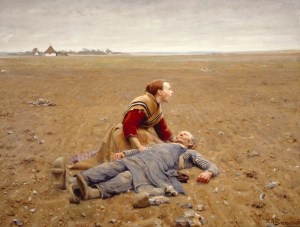
Worked to Death, H. A. Brendekilde. Wikimedia Commons contributors, “File:H. A. Brendekilde – Udslidt (1889).jpg,” Wikimedia Commons, the free media repository, https://commons.wikimedia.org/w/index.php?title=File:H._A._Brendekilde_-_Udslidt_(1889).jpg&oldid=355191092 (accessed July 16, 2019).

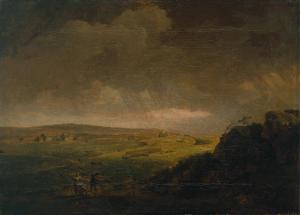
Moorland Landscape with Rainstorm by George Lambert. Wikimedia Commons contributors, “File:George Lambert – Moorland Landscape with Rainstorm (1751).jpg,” Wikimedia Commons, the free media repository,https://commons.wikimedia.org/w/index.php?title=File:George_Lambert_-_Moorland_Landscape_with_Rainstorm_(1751).jpg&oldid=234912081 (accessed July 16, 2019).

Ellen Berry McClung, by Lloyd Branson. Wikimedia Commons contributors, “File:Berry-ellen-mcclung-by-branson.jpg,” Wikimedia Commons, the free media repository, https://commons.wikimedia.org/w/index.php?title=File:Berry-ellen-mcclung-by-branson.jpg&oldid=324386360 (accessed July 16, 2019).

3 Comments

Filed under writing