Tag Archives: Renaissance Art

#FineArtFriday: a closer look at “Forest Landscape” by Jan Brueghel the Elder

Title: Forest landscape

Artist: Jan Brueghel the Elder

Genre: landscape art

Date: between circa 1605 and circa 1610

Medium: oil on oak panel

Dimensions: 40 x 32 cm

What I love about this painting:

Today, we’re taking a closer look at the works of the Flemish artist, Jan Brueghel the Elder. I first featured this painting in July of 2020, and it is one that I love. The scene is peaceful and relaxing, a moment of calm for our turbulent times.

The level of detail down to the leaves and the bark on the trees is amazing, but the rich colors are what attracted me, drawing me in. The heron on the rock seems poised to take flight.  Beyond the heron, on the other side of the creek, a path leads deeper into the forest, calling to us to cross over and see where it leads. The scene is beautiful the way a fantasy is, likely because Brueghel most probably painted it from sketches and memory.

“In his forest landscapes Brueghel depicted heavily wooded glades in which he captured the verdant density, and even mystery, of the forest. Although on occasion inhabited by humans and animals, these forest scenes contain dark recesses, virtually no open sky and no outlet for the eye to penetrate beyond the thick trees.” via Wikipedia. [1]

In many ways, Jan Brueghel’s paradise landscapes paved the way for the great plein air painters of the 18th and 19th centuries. This is most definitely a Mannerist landscape painting, as it is highly romanticized.

About the Artist, via Wikipedia:

Jan Brueghel (also Bruegel or Breughelthe Elder  (1568 – 13 January 1625) was a Flemish painter and draughtsman. He was the son of the eminent Flemish Renaissance painter Pieter Brueghel the Elder. A close friend and frequent collaborator with Peter Paul Rubens, the two artists were the leading Flemish painters in the first three decades of the 17th century.

Brueghel worked in many genres including history paintings, flower still lifes, allegorical and mythological scenes, landscapes and seascapes, hunting pieces, village scenes, battle scenes and scenes of hellfire and the underworld.

He was an important innovator who invented new types of paintings such as flower garland paintings, paradise landscapes, and gallery paintings in the first quarter of the 17th century.

He also created genre paintings that were imitations, pastiches and reworkings of his father’s works, in particular his father’s genre scenes and landscapes with peasants.  Brueghel represented the type of the pictor doctus, the erudite painter whose works are informed by the religious motifs and aspirations of the Catholic Counter-Reformation as well as the scientific revolution with its interest in accurate description and classification.  He was court painter of the Archduke and Duchess Albrecht and Isabella, the governors of the Habsburg Netherlands.

The artist was nicknamed “Velvet” Brueghel, “Flower” Brueghel, and “Paradise” Brueghel. The first is believed to have been given him because of his mastery in the rendering of fabrics. The second nickname is a reference to his specialization in flower still lifes and the last one to his invention of the genre of the paradise landscape. [1]


Credits and Attributions:

IMAGE: Forest Landscape by Jan Brueghel the Elder / Public domain Wikimedia Commons contributors, “File:Jan Brueghel (I) – Forest landscape.jpg,” Wikimedia Commons, https://commons.wikimedia.org/w/index.php?title=File:Jan_Brueghel_(I)_-_Forest_landscape.jpg&oldid=1036257842 (accessed June 26, 2025).

[1] Wikipedia contributors, “Jan Brueghel the Elder,” Wikipedia, The Free Encyclopedia, https://en.wikipedia.org/w/index.php?title=Jan_Brueghel_the_Elder&oldid=1293540600 (accessed June 26, 2025).


4 Comments

Filed under #FineArtFriday

#FineArtFriday: The Merry Family, by Jan Steen (revisited)

Jan Steen was fond of painting peasants and ordinary people, and this picture is a good example of that.

What I love about this image is the chaos. Is this a New Year’s party? I hope so.

The clutter of pans and dishes heedlessly fallen to the floor, the boisterous enjoyment of wine and song, and the obvious lack of parental restraint is wonderfully depicted. The numerous children are smoking and drinking to excess, vices that weren’t acceptable diversions for youngsters in those days any more than they are now. The baby is exceedingly chubby, which was uncommon and represents the vice of gluttony–in one hand it holds bread and in the other it waves a spoon.

I suspect the children grew up with a similar love of wine and song as their parents.

The note on the wall contains the moral of the story. According to the Rijksmuseum website, “The note hanging from the mantelpiece gives away the moral of the story: ‘As the old sing, so shall the young twitter.’ What will become of the children if their parents set the wrong example?”

The Age of the Puritan had swept across Europe and while it was waning in the mid-seventeenth century, puritanism had influenced life in Holland as much as elsewhere. This painting is a wonderful visual exhortation reminding the good people to live a sober life. Steen himself was not a puritan, as he was born into a family of brewers and ran taverns and breweries off and on throughout his life. But he did need to sell his paintings as he was never a successful businessman, and his allegorical paintings were quite popular.

Quote from Wikipedia: Daily life was Jan Steen’s main pictorial theme. Many of the genre scenes he portrayed, as in The Feast of Saint Nicholas, are lively to the point of chaos and lustfulness, even so much that “a Jan Steen household,” meaning a messy scene, became a Dutch proverb (een huishouden van Jan Steen). Subtle hints in his paintings seem to suggest that Steen meant to warn the viewer rather than invite him to copy this behaviour. Many of Steen’s paintings bear references to old Dutch proverbs or literature. He often used members of his family as models, and painted quite a few self-portraits in which he showed no tendency of vanity.


Credits and Attributions:

The Merry Family, Jan Steen, 1668 PD|100 via Wikimedia Commons

Moral (English translation) quoted from Rijksmuseum website,  https://www.rijksmuseum.nl/en/collection/SK-C-229, accessed 17 May 2018.

Wikipedia contributors. “Jan Steen.” Wikipedia, The Free Encyclopedia. Wikipedia, The Free Encyclopedia, 3 Jan. 2018. Web. 17 May. 2018.

Comments Off on #FineArtFriday: The Merry Family, by Jan Steen (revisited)

Filed under #FineArtFriday

#FineArtFriday: The Hay Harvest by Pieter Bruegel the Elder, 1565 (reprise)

Haymaking,_Pieter_Brueghel_the_Elder (1)Artist: Pieter Bruegel the Elder (1526/1530–1569)
Title: The Hay Harvest

Genre: genre art

Date: 1565

Medium: oil on panel

Dimensions: Height: 117 cm (46 in) Width: 161 cm (63.3 in)

According to the Web Gallery of Art, Haymaking, also known as The Hay Harvest, belongs to the Series of the Months. All the other panels in this series are dated 1565. July and August are the months when most summer crops are harvested. This painting and the August panel (The Corn Harvest) show the bringing-in of the harvest.

I first featured this painting in August of 2021, but it is well worth a second look. Workers scythe grain in the large field toward the center of the painting. In the foreground, other laborers harvest vegetables and pick berries. Everyone works to bring in the food, men, women, and children, as winter isn’t that far away, and the hay will sustain the draft animals in the long cold months ahead.

While each painting in the series shows the traditional occupation of that month, Bruegel’s real subject is the landscape itself, its ever-changing appearance.

I have always loved Bruegel the Elder’s work because he portrays the gathering of food as a fundamental human activity. He shows us that the quantity of food we have on our tables is determined by the knowledge and labor of others.

The variety of foods we have available to us is dictated by the form of the landscape. To carve a living from the earth a farmer must understand and care for the land that sustains them. They must know what areas of soil will be best for each crop and use that knowledge when laying out how the fields will be planted, as each crop has different nutrient requirements.

Within one valley, many types of soils will exist, so what serves to grow hay may not work for more delicate vegetables.

In the lush bounty of this painting, Bruegel the Elder shows us the wisdom of farmers, knowledge that sustains us to this day. He illustrates the way all people who grow and gather our food are bound to the land.

Those who grow food in their back gardens understand and respect the labors of those small farmers who grow produce for our local markets.

About the series, Months of the Year, via Wikipedia:

(Bruegel’s) famous set of landscapes with genre figures depicting the seasons are the culmination of his landscape style; the five surviving paintings use the basic elements of the world landscape (only one lacks craggy mountains) but transform them into his own style. They are larger than most previous works, with a genre scene with several figures in the foreground, and the panoramic view seen past or through trees. Bruegel was also aware of the Danube School‘s landscape style through prints.

The series on the months of the year includes several of Bruegel’s best-known works. In 1565, a wealthy patron in Antwerp, Niclaes Jonghelinck, commissioned him to paint a series of paintings of each month of the year. There has been disagreement among art historians as to whether the series originally included six or twelve works. Today, only five of these paintings survive and some of the months are paired to form a general season. Traditional Flemish luxury books of hours (e.g., the Très Riches Heures du Duc de Berry; 1416) had calendar pages that included the Labours of the Months, depictions set in landscapes of the agricultural tasks, weather, and social life typical for that month.

Bruegel’s paintings were on a far larger scale than a typical calendar page painting, each one approximately three feet by five feet. For Bruegel, this was a large commission (the size of a commission was based on how large the painting was) and an important one. In 1565, the Calvinist riots began and it was only two years before the Eighty Years’ War broke out. Bruegel may have felt safer with a secular commission so as to not offend Calvinist or Catholic. Some of the most famous paintings from this series included The Hunters in the Snow (December–January) and The Harvesters (August). [1]

About the Artist, Via Wikipedia:

Pieter Bruegel (also Brueghel or Breughelthe Elder c. 1525–1530 – 9 September 1569) was the most significant artist of Dutch and Flemish Renaissance painting, a painter and printmaker, known for his landscapes and peasant scenes (so-called genre painting); he was a pioneer in making both types of subject the focus in large paintings.

He was a formative influence on Dutch Golden Age painting and later painting in general in his innovative choices of subject matter, as one of the first generation of artists to grow up when religious subjects had ceased to be the natural subject matter of painting. He also painted no portraits, the other mainstay of Netherlandish art. After his training and travels to Italy, he returned in 1555 to settle in Antwerp, where he worked mainly as a prolific designer of prints for the leading publisher of the day. Only towards the end of the decade did he switch to make painting his main medium, and all his famous paintings come from the following period of little more than a decade before his early death, when he was probably in his early forties, and at the height of his powers.

As well as looking forwards, his art reinvigorates medieval subjects such as marginal drolleries of ordinary life in illuminated manuscripts, and the calendar scenes of agricultural labours set in landscape backgrounds, and puts these on a much larger scale than before, and in the expensive medium of oil painting. He does the same with the fantastic and anarchic world developed in Renaissance prints and book illustrations.

He is sometimes referred to as “Peasant Bruegel”, to distinguish him from the many later painters in his family, including his son Pieter Brueghel the Younger (1564–1638). From 1559, he dropped the ‘h’ from his name and signed his paintings as Bruegel; his relatives continued to use “Brueghel” or “Breughel”. [2]


Credits and Attributions:

Wikimedia Commons contributors, “File:Haymaking, Pieter Brueghel the Elder.jpg,” Wikimedia Commons, the free media repository, https://commons.wikimedia.org/w/index.php?title=File:Haymaking,_Pieter_Brueghel_the_Elder.jpg&oldid=431869636 (accessed August 10, 2023).

[1] Wikipedia contributors, “Pieter Bruegel the Elder,” Wikipedia, The Free Encyclopedia, https://en.wikipedia.org/w/index.php?title=Pieter_Bruegel_the_Elder&oldid=1028859234 (accessed August 10, 2023).

[2] Wikipedia contributors, “Pieter Bruegel the Elder,” Wikipedia, The Free Encyclopedia, https://en.wikipedia.org/w/index.php?title=Pieter_Bruegel_the_Elder&oldid=1028859234 (accessed August 10, 2023).

1 Comment

Filed under #FineArtFriday

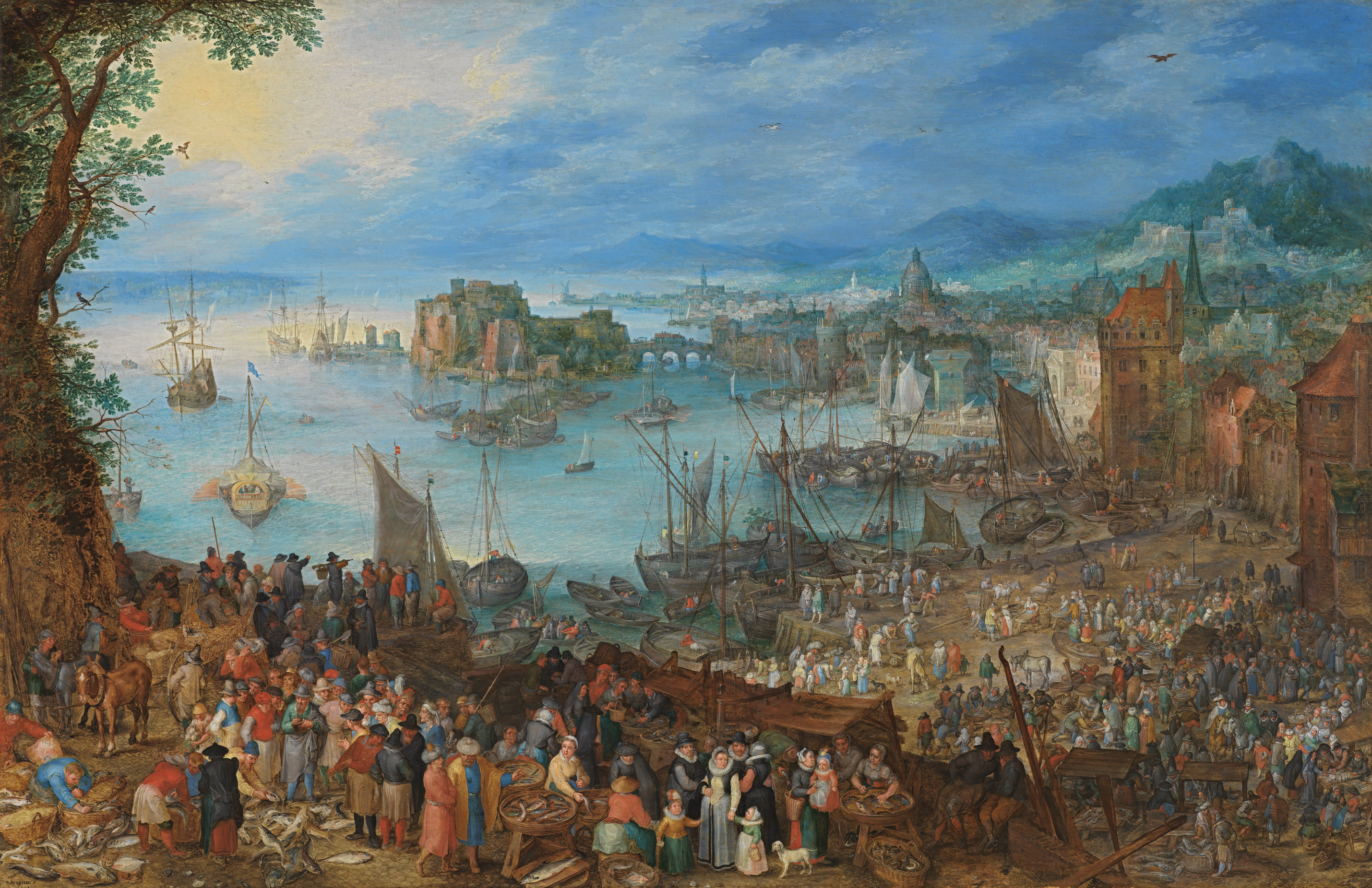
#FineArtFriday: The Great Fish Market by Jan Brueghel the Elder 1603 (revisited)

Title: Great Fish Market

Artist: Jan Brueghel the Elder  (1568–1625)

Date: 1603

Medium: oil on canvas

Dimensions:  Height: 59 cm (23.2 in); Width: 92 cm (36.2 in)

Collection: Alte Pinakothek  Current location: room 19

Inscriptions: Signature and date, bottom left: BRVEGHEL 1603

What I love about this painting:

This is one of my all-time favorite paintings. Here we see a composite of all the places Jan Brueghel the Elder had visited. The scene is a fusion of his Flemish homeland and impressions of places he’d sketched on his travels.

In the middle of the picture is the Neapolitan Castel dell’ Ovo, on the right, in the distance, is St. Peter’s Basilica in Rome. We have a little of Italy thrown in with the Flemish, his effort to create the feeling of a busy, prosperous market. He shows his imaginary city from a high perspective, the god-like view.

In writing, this would be the omniscient point of view.

The elements presented in this painting, the harborscape, the ruins, and even the sections that are simply landscapes are all features that later became genres in their own right.

The scene contains many elements of Mannerist landscape painting. According to the Tate website, mannerist is a sixteenth-century style of art and design characterized by artificiality, elegance, and an aesthetic portrayal of the human figure.

In other words, they painted fantasy. And why not?

Flemish genre painting is strongly tied to the traditions of Pieter Bruegel the Elder. It was a style that continued directly into the 17th century through copies and new compositions made by his sons Pieter Brueghel the Younger and Jan Brueghel the Elder.

In this painting, the story opens with a view across a downward-sloping foreground. It teems with life, hundreds of figures of many races, grouped around the stalls and booths of a fish market. The group at the center of the foreground is thought to be a self-portrait of the artist and his family. It was common for artists to insert self-portraits in their works, and Jan often included his family.

One of Jan Brueghel’s most significant contributions to the craft of painting landscapes was how he depicted perspective. The eye is drawn towards the harbor in the background. We look out across the bay, along the coastline, and see entire towns, with ruins, wharves, and castles. Beyond that, we see distant mountains, painted with a blue that merges with the blue of the sea.

This blending of shape and color into the distance is how a landscape appears in real life.

These painters, and the Brueghel family in particular, were the generation who paved the way for artists like Rembrandt. Their works were the foundation upon which the masterpieces of the middle-to-late 17th century were built.

About the Artist, via Wikipedia:

Jan Brueghel was the son of the eminent Flemish Renaissance painter Pieter Brueghel the Elder.  A close friend and frequent collaborator with Peter Paul Rubens, the two artists were the leading Flemish painters in the first three decades of the 17th century.

He was born in Brussels as the son of Pieter Brueghel the Elder and Maria Coecke van Aelst. His mother was the daughter of the prominent Flemish Renaissance artists Pieter Coecke van Aelst and Mayken Verhulst. His father died about a year after Jan’s birth in 1569. It is believed that after the death of his mother in 1578, Jan, together with his brother Pieter Brueghel the Younger and sister Marie, went to live with their grandmother Mayken Verhulst, who was by then widowed. Mayken Verhulst was an artist in her own right. The early Flemish biographer Karel van Mander wrote in his Schilder-boeck published in 1604 that Mayken was the first art teacher of her two grandsons. She taught them drawing and watercolor painting of miniatures. Jan and his brother may also have trained with local artists in Brussels who were active as tapestry designers.

Jan Brueghel the Elder is regarded as an important innovator of landscape art. By introducing greater naturalism in his Alpine mountain settings, his father had expanded on the world landscape tradition that had been founded mainly by Joachim Patinir. Some of Pieter the Elder’s works also foreshadowed the forest landscape that would start to dominate landscape painting around the turn of the 16th century. Pieter the Elder also developed the village and rural landscape, placing Flemish hamlets and farms in exotic prospects of mountains and river valleys.

Jan developed on the formula he learned from his father of arranging country figures traveling a road, which recedes into the distance. He emphasized the recession into space by carefully diminishing the scale of figures in the foreground, middle-ground, and far distance. To further the sense of atmospheric perspective, he used varying tones of brown, green, and blue progressively to characterize the recession of space. His landscapes with their vast depth are balanced through his attention to the peasant figures and their humble activities in the foreground.

Like his father, Jan Brueghel also painted various village landscapes. He used the surrounding landscapes as the stage for the crowds of anecdotal, colorfully dressed peasants who engage in various activities in the market, the country roads and during the rowdy kermesses. Jan Brueghel’s landscape paintings with their strong narrative elements and attention to detail had a significant influence on Flemish and Dutch landscape artists in the second decade of the 17th century. His river views were certainly known to painters working in Haarlem, including Esaias van de Velde and Willem Buytewech, whom Brueghel may have met there when he accompanied Peter Paul Rubens on a diplomatic mission to the Dutch Republic in 1613.

Jan Brueghel was, along with artists such as Gillis van Coninxloo one of the prime developers of the dense forest landscape in the 17th century. Jan Breughel in fact experimented with such works before Coninxloo’s first dated wooded landscape of 1598. In his forest landscapes Brueghel depicted heavily wooded glades in which he captured the verdant density, and even mystery, of the forest. Although on occasion inhabited by humans and animals, these forest scenes contain dark recesses, virtually no open sky and no outlet for the eye to penetrate beyond the thick trees.


Credits and Attributions:

Wikimedia Commons contributors, “File:Jan Brueghel the Elder-Great Fish market.jpg,” Wikimedia Commons, the free media repository, https://commons.wikimedia.org/w/index.php?title=File:Jan_Brueghel_the_Elder-Great_Fish_market.jpg&oldid=406069557 (accessed July 9, 2020).

Wikipedia contributors, “Jan Brueghel the Elder,” Wikipedia, The Free Encyclopedia, https://en.wikipedia.org/w/index.php?title=Jan_Brueghel_the_Elder&oldid=963723468 (accessed July 9, 2020).

Comments Off on #FineArtFriday: The Great Fish Market by Jan Brueghel the Elder 1603 (revisited)

Filed under #FineArtFriday

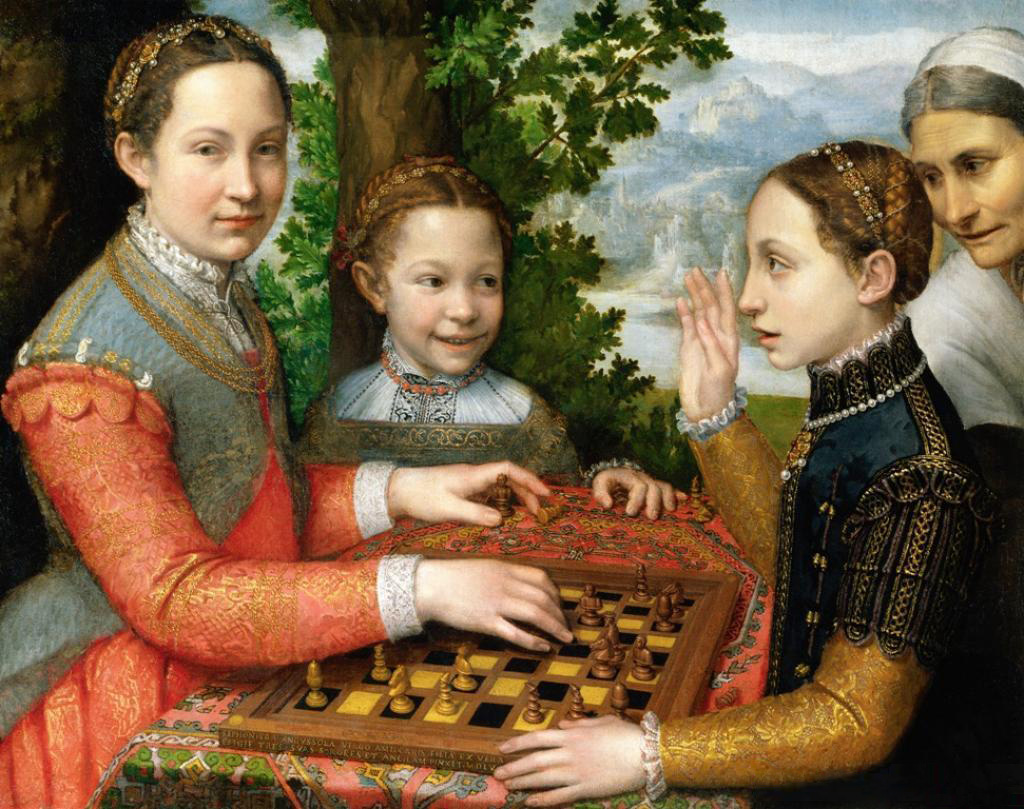
#FineArtFriday: The Chess Game, by Sofonisba Anguissola ca. 1555 (reprise)

Title: The Chess Game (Portrait of the artist’s sisters playing chess)

Artist: Sofonisba Anguissola

Date: 1555

Medium: oil on canvas

Dimensions: Height: 72 cm (28.3 ″) Width: 97 cm (38.1 ″)

Today we’re revisiting The Chess Game, which is a portrait of the artist’s sisters playing chess. This post first appeared here on September 13, 2019 and is a wonderful window into the personalities of three girls in an upper class family in the 16th century. Anguissola had a marvelous ability to capture the moods of her subjects.

What I love about this painting:

The colors are vibrant,

Because it is a game of war and strategies for winning a war, chess has historically been considered a predominantly male game. That Anguissola’s sisters are playing it at so young an age is a testimony to the atmosphere of education surrounding the home.

Their features are modern in the way they are shown with a roundness that is unusual in early renaissance portraits, which were often so highly formal that they were visually flat. These girls could be my granddaughters.

Anguissola has captured the emotions and happiness of a family at play. Her sisters’ personalities are clearly shown. The older sister has taken a pawn, the younger fears she might lose the game to a more experienced player. The youngest is enjoying the game immensely, seeing the sister who sometimes bosses her around being handed her own medicine.

About the Artist, via Wikipedia:

Sofonisba Anguissola (c. 1532 – 16 November 1625), also known as Sophonisba Angussola or Anguisciola, was an Italian Renaissance painter born in Cremona to a relatively poor noble family. She received a well-rounded education, that included the fine arts, and her apprenticeship with local painters set a precedent for women to be accepted as students of art. As a young woman, Anguissola traveled to Rome where she was introduced to Michelangelo, who immediately recognized her talent, and to Milan, where she painted the Duke of Alba. The Spanish queen, Elizabeth of Valois, was a keen amateur painter and in 1559 Anguissola was recruited to go to Madrid as her tutor, with the rank of lady-in-waiting. She later became an official court painter to the king, Philip II, and adapted her style to the more formal requirements of official portraits for the Spanish court. After the queen’s death, Philip helped arrange an aristocratic marriage for her. She moved to Sicily, and later Pisa and Genoa, where she continued to practice as a leading portrait painter.

On 12 July 1624, Anguissola was visited by the young Flemish painter Anthony van Dyck, who recorded sketches from his visit to her in his sketchbook. Van Dyck, who believed her to be 96 years of age (she was actually about 92) noted that although “her eyesight was weakened”, Anguissola was still mentally alert. Excerpts of the advice she gave him about painting survive from this visit, and he was said to have claimed that their conversation taught him more about the “true principles” of painting than anything else in his life. Van Dyck drew her portrait while visiting her.

About this painting, via Wikipedia:

Although Anguissola enjoyed significantly more encouragement and support than the average woman of her day, her social class did not allow her to transcend the constraints of her sex. Without the possibility of studying anatomy or drawing from life (it was considered unacceptable for a lady to view nudes), she could not undertake the complex multi-figure compositions required for large-scale religious or history paintings.

Instead, she experimented with new styles of portraiture, setting subjects informally. Self-portraits and family members were her most frequent subjects, as seen in such paintings as Self-Portrait (1554, Kunsthistoriches Museum, Vienna), Portrait of Amilcare, Minerva and Asdrubale Anguissola (c. 1557–1558, Nivaagaards Malerisambling, Niva, Denmark), and her most famous picture, The Chess Game (1555, Muzeum Narodowe, Poznań), which depicted her sisters Lucia, Minerva and Europa.

Painted when Sofonisba was 23 years old, The Chess Game is an intimate representation of an everyday family scene, combining elaborate formal clothing with very informal facial expressions, which was unusual for Italian art at this time. The Chess Game explored a new kind of genre painting which places her sitters in a domestic setting instead of the formal or allegorical settings that were popular at the time. This painting has been regarded as a conversation piece, which is an informal portrait of a group engaging in lively conversation or some activity .


Credits and Attributions:

Wikimedia Commons contributors, “File:The Chess Game – Sofonisba Anguissola.jpg,” Wikimedia Commons, the free media repository, https://commons.wikimedia.org/w/index.php?title=File:The_Chess_Game_-_Sofonisba_Anguissola.jpg&oldid=359367567 (accessed September 12, 2019).

Wikipedia contributors, “Sofonisba Anguissola,” Wikipedia, The Free Encyclopedia, https://en.wikipedia.org/w/index.php?title=Sofonisba_Anguissola&oldid=908120352 (accessed September 12, 2019).

Comments Off on #FineArtFriday: The Chess Game, by Sofonisba Anguissola ca. 1555 (reprise)

Filed under #FineArtFriday

#FineArtFriday: The Hay Harvest by Pieter Bruegel the Elder, 1565

Haymaking,_Pieter_Brueghel_the_Elder (1)Artist: Pieter Bruegel the Elder (1526/1530–1569)
Title: The Hay Harvest

Genre: genre art

Date: 1565

Medium: oil on panel

Dimensions: Height: 117 cm (46 in) Width: 161 cm (63.3 in)

According to the Web Gallery of Art, Haymaking, also known as The Hay Harvest, belongs to the Series of the Months. All the other panels in this series are dated 1565. July and August are the months when most summer crops are harvested. This painting and the August panel (The Corn Harvest) show the bringing-in of the harvest.

Workers scythe grain in the large field toward the center of the painting. In the foreground, other laborers harvest vegetables and pick berries. Everyone works to bring in the food, men, women, and children, as winter isn’t that far away, and the hay will sustain the draft animals in the long cold months ahead.

While each painting in the series shows the traditional occupation of that month, Bruegel’s real subject is the landscape itself, its ever-changing appearance.

I have always loved Bruegel the Elder’s work because he portrays the gathering of food as a fundamental human activity. He shows us that the quantity of food we have on our tables is determined by the knowledge and labor of others.

The variety of foods we have available to us is dictated by the form of the landscape. To carve a living from the earth a farmer must understand and care for the land that sustains them. They must know what areas of soil will be best for each crop and use that knowledge when laying out how the fields will be planted, as each crop has different nutrient requirements. Within one valley, many types of soils will exist, so what serves to grow hay may not work for more delicate vegetables.

In the lush bounty of this painting, Bruegel the Elder shows us the wisdom of farmers, knowledge that sustains us to this day. He illustrates the way all people who grow and gather our food are bound to the land.

In this regard, we who grow food in our back gardens understand and respect the labors of those small farmers who grow produce for our local markets.

About the series, Months of the Year, via Wikipedia:

(Bruegel’s) famous set of landscapes with genre figures depicting the seasons are the culmination of his landscape style; the five surviving paintings use the basic elements of the world landscape (only one lacks craggy mountains) but transform them into his own style. They are larger than most previous works, with a genre scene with several figures in the foreground, and the panoramic view seen past or through trees. Bruegel was also aware of the Danube School‘s landscape style through prints.

The series on the months of the year includes several of Bruegel’s best-known works. In 1565, a wealthy patron in Antwerp, Niclaes Jonghelinck, commissioned him to paint a series of paintings of each month of the year. There has been disagreement among art historians as to whether the series originally included six or twelve works. Today, only five of these paintings survive and some of the months are paired to form a general season. Traditional Flemish luxury books of hours (e.g., the Très Riches Heures du Duc de Berry; 1416) had calendar pages that included the Labours of the Months, depictions set in landscapes of the agricultural tasks, weather, and social life typical for that month.

Bruegel’s paintings were on a far larger scale than a typical calendar page painting, each one approximately three feet by five feet. For Bruegel, this was a large commission (the size of a commission was based on how large the painting was) and an important one. In 1565, the Calvinist riots began and it was only two years before the Eighty Years’ War broke out. Bruegel may have felt safer with a secular commission so as to not offend Calvinist or Catholic. Some of the most famous paintings from this series included The Hunters in the Snow (December–January) and The Harvesters (August). [1]

About the Artist, Via Wikipedia:

Pieter Bruegel (also Brueghel or Breughelthe Elder c. 1525–1530 – 9 September 1569) was the most significant artist of Dutch and Flemish Renaissance painting, a painter and printmaker, known for his landscapes and peasant scenes (so-called genre painting); he was a pioneer in making both types of subject the focus in large paintings.

He was a formative influence on Dutch Golden Age painting and later painting in general in his innovative choices of subject matter, as one of the first generation of artists to grow up when religious subjects had ceased to be the natural subject matter of painting. He also painted no portraits, the other mainstay of Netherlandish art. After his training and travels to Italy, he returned in 1555 to settle in Antwerp, where he worked mainly as a prolific designer of prints for the leading publisher of the day. Only towards the end of the decade did he switch to make painting his main medium, and all his famous paintings come from the following period of little more than a decade before his early death, when he was probably in his early forties, and at the height of his powers.

As well as looking forwards, his art reinvigorates medieval subjects such as marginal drolleries of ordinary life in illuminated manuscripts, and the calendar scenes of agricultural labours set in landscape backgrounds, and puts these on a much larger scale than before, and in the expensive medium of oil painting. He does the same with the fantastic and anarchic world developed in Renaissance prints and book illustrations.

He is sometimes referred to as “Peasant Bruegel”, to distinguish him from the many later painters in his family, including his son Pieter Brueghel the Younger (1564–1638). From 1559, he dropped the ‘h’ from his name and signed his paintings as Bruegel; his relatives continued to use “Brueghel” or “Breughel”. [2]


Credits and Attributions:

Wikimedia Commons contributors, “File:Haymaking, Pieter Brueghel the Elder.jpg,” Wikimedia Commons, the free media repository, https://commons.wikimedia.org/w/index.php?title=File:Haymaking,_Pieter_Brueghel_the_Elder.jpg&oldid=431869636 (accessed August 5, 2021).

[1] Wikipedia contributors, “Pieter Bruegel the Elder,” Wikipedia, The Free Encyclopedia, https://en.wikipedia.org/w/index.php?title=Pieter_Bruegel_the_Elder&oldid=1028859234 (accessed August 5, 2021).

[2] Wikipedia contributors, “Pieter Bruegel the Elder,” Wikipedia, The Free Encyclopedia, https://en.wikipedia.org/w/index.php?title=Pieter_Bruegel_the_Elder&oldid=1028859234 (accessed August 5, 2021).

Comments Off on #FineArtFriday: The Hay Harvest by Pieter Bruegel the Elder, 1565

Filed under #FineArtFriday

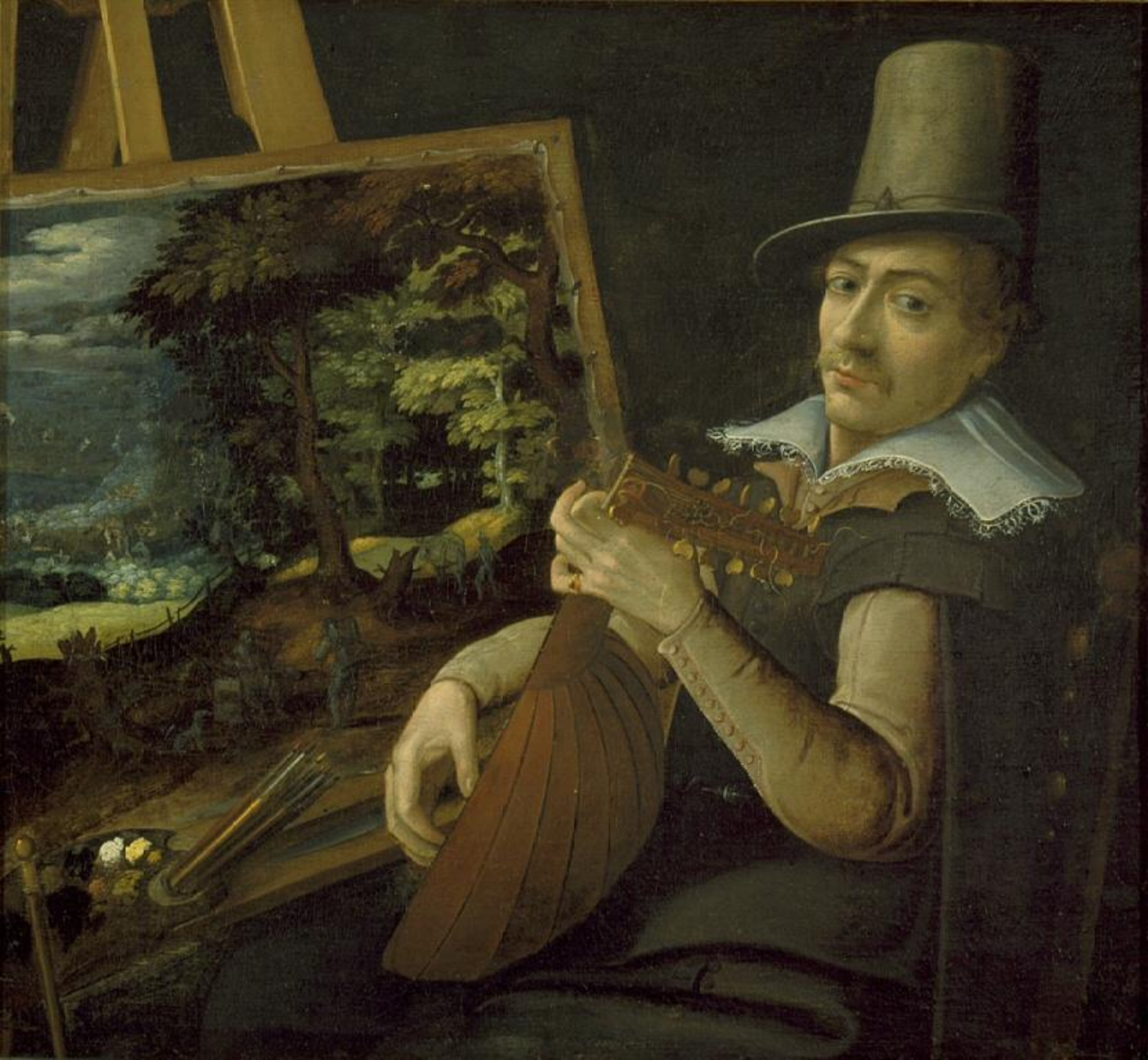
#FineArtFriday: Self-portrait, Paul Bril ca. 1595-1600

Artist: Paul Bril (circa 1553/1554–1626)

Title: Self-portrait

Genre: self-portrait

Date: between 1595 and 1600

Medium: oil on canvas

Dimensions: Height: 71 cm (27.9 in); Width: 78 cm (30.7 in)

About this painting, via Wikipedia:

The painting portrays the artist, elegantly dressed and holding a lute, sitting before his palette and easel, on which a landscape painting sits.

Bril is seen from the back, and is turning towards the viewer. He grasps the lute firmly, with active and jointed fingers. The landscape painting sitting on the easel is typical of Bril’s early work which is characterized by small figures, deep and shaded foregrounds and masses of silvery foliage, attributes that [Bril] shared with other Flemish painters. This has helped with the dating of the work to ca. 1595 – 1600. [1]

What I love about this image:

In this self-portrait Bril shows the viewer who he is and what he cares about, art and music. He is relaxed, at peace and sharing his two passions with us.


Credits and Attributions:

Paul Brill, Public domain, via Wikimedia Commons

[1] Wikipedia contributors, “Self-Portrait (Paul Bril),” Wikipedia, The Free Encyclopedia, https://en.wikipedia.org/w/index.php?title=Self-Portrait_(Paul_Bril)&oldid=1008810469 (accessed February 26, 2021).

Wikimedia Commons contributors, “File:Bril, Paul – Self-Portrait – 1595-1600.jpg,” Wikimedia Commons, the free media repository, https://commons.wikimedia.org/w/index.php?title=File:Bril,_Paul_-_Self-Portrait_-_1595-1600.jpg&oldid=527757876 (accessed February 26, 2021).

Comments Off on #FineArtFriday: Self-portrait, Paul Bril ca. 1595-1600

Filed under #FineArtFriday

#FineArtFriday: Forest Landscape by Jan Brueghel the Elder

Title: Forest landscape

Artist: Jan Brueghel the Elder

Genre: landscape art

Date: between circa 1605 and circa 1610

Medium: oil on oak panel

Dimensions: 40 x 32 cm

What I love about this painting:

Today’s Fine Art Friday offering is a further exploration of the works of the Flemish artist, Jan Brueghel the Elder. I began this two part series last Friday with his painting, the Great Fish Market.

The level of detail down to the leaves and the bark on the trees is amazing, but the rich colors are what attracted me, drawing me in. The heron on the rock seems poised to take flight.  Beyond the heron, on the other side of the creek, a path leads deeper into the forest, calling to us to cross over and see where it leads. The scene is beautiful the way a fantasy is, likely because it is, in a way. Brueghel most probably painted it from sketches and memory.

I quoted this last week when discussing the Great Fish Market, but it bears repeating:

“In his forest landscapes Brueghel depicted heavily wooded glades in which he captured the verdant density, and even mystery, of the forest. Although on occasion inhabited by humans and animals, these forest scenes contain dark recesses, virtually no open sky and no outlet for the eye to penetrate beyond the thick trees.” via Wikipedia.

In many ways, Jan Brueghel’s paradise landscapes paved the way for the great plein air painters of the 18th and 19th centuries. This is most definitely a Mannerist landscape painting, as it is highly romanticized.

About the Artist, via Wikipedia:

Jan Brueghel (also Bruegel or Breughelthe Elder  (1568 – 13 January 1625) was a Flemish painter and draughtsman. He was the son of the eminent Flemish Renaissance painter Pieter Brueghel the Elder. A close friend and frequent collaborator with Peter Paul Rubens, the two artists were the leading Flemish painters in the first three decades of the 17th century.

Brueghel worked in many genres including history paintings, flower still lifes, allegorical and mythological scenes, landscapes and seascapes, hunting pieces, village scenes, battle scenes and scenes of hellfire and the underworld.

He was an important innovator who invented new types of paintings such as flower garland paintings, paradise landscapes, and gallery paintings in the first quarter of the 17th century.

He also created genre paintings that were imitations, pastiches and reworkings of his father’s works, in particular his father’s genre scenes and landscapes with peasants.  Brueghel represented the type of the pictor doctus, the erudite painter whose works are informed by the religious motifs and aspirations of the Catholic Counter-Reformation as well as the scientific revolution with its interest in accurate description and classification.  He was court painter of the Archduke and Duchess Albrecht and Isabella, the governors of the Habsburg Netherlands.

The artist was nicknamed “Velvet” Brueghel, “Flower” Brueghel, and “Paradise” Brueghel. The first is believed to have been given him because of his mastery in the rendering of fabrics. The second nickname is a reference to his specialization in flower still lifes and the last one to his invention of the genre of the paradise landscape.


Credits and Attributions:

Forest Landscape by Jan Brueghel the Elder / Public domain

Wikipedia contributors, “Jan Brueghel the Elder,” Wikipedia, The Free Encyclopedia, https://en.wikipedia.org/w/index.php?title=Jan_Brueghel_the_Elder&oldid=963723468 (accessed July 17, 2020).

Wikimedia Commons contributors, “File:Jan Brueghel (I) – Forest landscape.jpg,” Wikimedia Commons, the free media repository, https://commons.wikimedia.org/w/index.php?title=File:Jan_Brueghel_(I)_-_Forest_landscape.jpg&oldid=354133728 (accessed July 17, 2020).

Comments Off on #FineArtFriday: Forest Landscape by Jan Brueghel the Elder

Filed under #FineArtFriday

#FineArtFriday: The Great Fish Market by Jan Brueghel the Elder 1603

Title: Great Fish Market

Artist: Jan Brueghel the Elder  (1568–1625)

Date: 1603

Medium: oil on canvas

Dimensions:  Height: 59 cm (23.2 in); Width: 92 cm (36.2 in)

Collection: Alte Pinakothek  Current location: room 19

Inscriptions: Signature and date, bottom left: BRVEGHEL 1603

What I love about this painting:

Here we see a composite of all the places Jan Brueghel the Elder had visited. The scene is a fusion of his Flemish homeland and impressions of places he’d sketched on his travels.

In the middle of the picture is the Neapolitan Castel dell’ Ovo, on the right, in the distance, is St. Peter’s Basilica in Rome. We have a little of Italy thrown in with the Flemish, his effort to create the feeling of a busy, prosperous market. He shows his imaginary city from a high perspective, the god-like view.

In writing, this would be the omniscient point of view.

The elements presented in this painting, the harborscape, the ruins, and even the sections that are simply landscapes are all features that later became genres in their own right.

The scene contains many elements of Mannerist landscape painting. According to the Tate website, mannerist is a sixteenth-century style of art and design characterized by artificiality, elegance, and an aesthetic portrayal of the human figure.

In other words, they painted fantasy. And why not?

Flemish genre painting is strongly tied to the traditions of Pieter Bruegel the Elder. It was a style that continued directly into the 17th century through copies and new compositions made by his sons Pieter Brueghel the Younger and Jan Brueghel the Elder.

In this painting, the story opens with a view across a downward-sloping foreground. It teems with life, hundreds of figures of many races, grouped around the stalls and booths of a fish market. The group at the center of the foreground is thought to be a self-portrait of the artist and his family. It was common for artists to insert self-portraits in their works, and Jan often included his family.

One of Jan Brueghel’s most significant contributions to the craft of painting landscapes was how he depicted perspective. The eye is drawn towards the harbor in the background. We look out across the bay, along the coastline, and see entire towns, with ruins, wharves, and castles. Beyond that, we see distant mountains, painted with a blue that merges with the blue of the sea.

This blending of shape and color into the distance is how a landscape appears in real life.

These painters, and the Brueghel family in particular, were the generation who paved the way for artists like Rembrandt. Their works were the foundation upon which the masterpieces of the middle-to-late 17th century were built.

About the Artist, via Wikipedia:

Jan Brueghel was the son of the eminent Flemish Renaissance painter Pieter Brueghel the Elder.  A close friend and frequent collaborator with Peter Paul Rubens, the two artists were the leading Flemish painters in the first three decades of the 17th century.

He was born in Brussels as the son of Pieter Brueghel the Elder and Maria Coecke van Aelst. His mother was the daughter of the prominent Flemish Renaissance artists Pieter Coecke van Aelst and Mayken Verhulst. His father died about a year after Jan’s birth in 1569. It is believed that after the death of his mother in 1578, Jan, together with his brother Pieter Brueghel the Younger and sister Marie, went to live with their grandmother Mayken Verhulst, who was by then widowed. Mayken Verhulst was an artist in her own right. The early Flemish biographer Karel van Mander wrote in his Schilder-boeck published in 1604 that Mayken was the first art teacher of her two grandsons. She taught them drawing and watercolor painting of miniatures. Jan and his brother may also have trained with local artists in Brussels who were active as tapestry designers.

Jan Brueghel the Elder is regarded as an important innovator of landscape art. By introducing greater naturalism in his Alpine mountain settings, his father had expanded on the world landscape tradition that had been founded mainly by Joachim Patinir. Some of Pieter the Elder’s works also foreshadowed the forest landscape that would start to dominate landscape painting around the turn of the 16th century. Pieter the Elder also developed the village and rural landscape, placing Flemish hamlets and farms in exotic prospects of mountains and river valleys.

Jan developed on the formula he learned from his father of arranging country figures traveling a road, which recedes into the distance. He emphasized the recession into space by carefully diminishing the scale of figures in the foreground, middle-ground, and far distance. To further the sense of atmospheric perspective, he used varying tones of brown, green, and blue progressively to characterize the recession of space. His landscapes with their vast depth are balanced through his attention to the peasant figures and their humble activities in the foreground.

Like his father, Jan Brueghel also painted various village landscapes. He used the surrounding landscapes as the stage for the crowds of anecdotal, colorfully dressed peasants who engage in various activities in the market, the country roads and during the rowdy kermesses. Jan Brueghel’s landscape paintings with their strong narrative elements and attention to detail had a significant influence on Flemish and Dutch landscape artists in the second decade of the 17th century. His river views were certainly known to painters working in Haarlem, including Esaias van de Velde and Willem Buytewech, whom Brueghel may have met there when he accompanied Peter Paul Rubens on a diplomatic mission to the Dutch Republic in 1613.

Jan Brueghel was, along with artists such as Gillis van Coninxloo one of the prime developers of the dense forest landscape in the 17th century. Jan Breughel in fact experimented with such works before Coninxloo’s first dated wooded landscape of 1598. In his forest landscapes Brueghel depicted heavily wooded glades in which he captured the verdant density, and even mystery, of the forest. Although on occasion inhabited by humans and animals, these forest scenes contain dark recesses, virtually no open sky and no outlet for the eye to penetrate beyond the thick trees.


Credits and Attributions:

Wikimedia Commons contributors, “File:Jan Brueghel the Elder-Great Fish market.jpg,” Wikimedia Commons, the free media repository, https://commons.wikimedia.org/w/index.php?title=File:Jan_Brueghel_the_Elder-Great_Fish_market.jpg&oldid=406069557 (accessed July 9, 2020).

Wikipedia contributors, “Jan Brueghel the Elder,” Wikipedia, The Free Encyclopedia, https://en.wikipedia.org/w/index.php?title=Jan_Brueghel_the_Elder&oldid=963723468 (accessed July 9, 2020).

1 Comment

Filed under #FineArtFriday

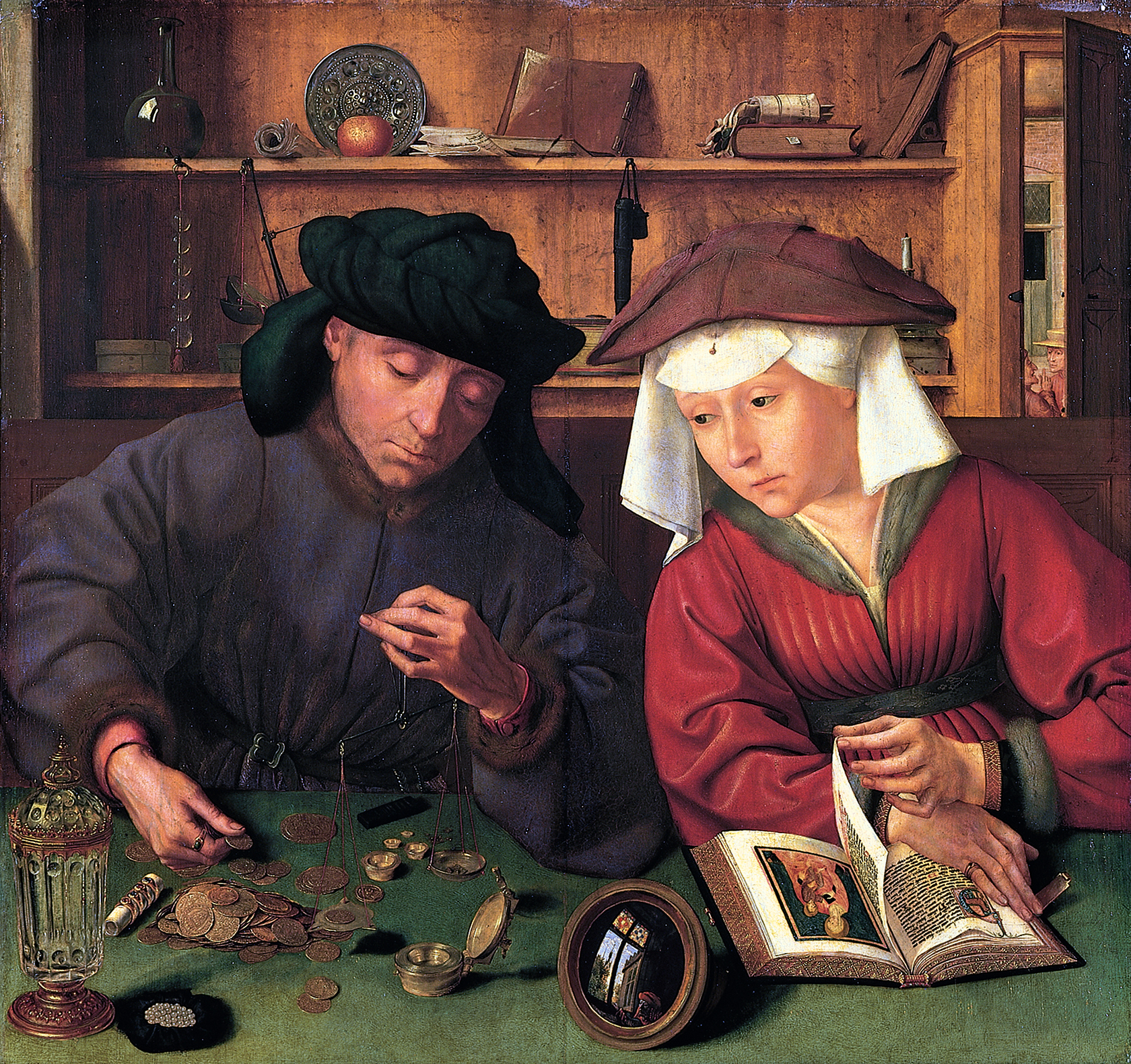
#FineArtFriday: The Money Changer and His Wife by Quentin Matsys, 1514

  • Artist: Quentin Matsys  (1456/1466–1530)
  • Title: The Moneylender and his Wife
  • Date: 1514
  • Medium: oil on panel
  • Dimensions: Height: 70.5 cm (27.7 in)
  • Current location: Louvre Museum
  • Inscriptions: Signature and date

The Money Changer and His Wife is a 1514 oil on panel painting by the Flemish renaissance artist Quentin Matsys.

What I love about this painting:

The colors are rich and vivid, and the lines sharp and clean. The artist included the smallest details in the prayer book, the pewter plate in the background, and the crystal jar by the man’s right hand, showing a prosperous, well-educated young couple. In some ways, Matsys’ style reminds me of the work of the lesser known Flemish painter, Pieter Brueghel the Younger, who was born long after Matsys’ death, but whose original works also leaned toward caricatures and grotesques.

About this painting, via Wikipedia:

A man, who is weighing the jewels and pieces of gold on the table in front of him, sits next to his wife who is reading a book of devotion with an illustration of the Virgin and Child. The couple is not dressed as members of nobility, but rather as well-to-do burghers of Antwerp, where the painting was made. At the time, Antwerp had grown with the influx of many southern immigrants fleeing the Spanish Inquisition. Among this international community there was a demand for money-changers and money-lenders, as international commerce was increasing in the port city.

About the Artist, via Wikipedia:

Most early accounts of Matsys’ life are composed primarily of legend and very little contemporary accounts exist of the nature of his activities or character. According to J. Molanus’ Historiae Lovaniensium, Matsys is known to be a native of Leuven with humble beginnings as an ironsmith. One of four children, Matsys was born to Joost Matsys (d. 1483) and Catherine van Kincken sometime between 4 April and 10 September 1466. Legend states that Matsys abandoned his career as a blacksmith to woo his wife, who found painting to be a more romantic profession, though Karel van Mander claimed this to be false, and the real reason was a sickness during which he was too weak to work at the smithy and instead decorated prints for the carnival celebrations.

Matsys work is considered to contain strong religious feeling—characteristic of traditional Flemish works—and is accompanied by a realism that often favored the grotesque. Matsys’ firmness of outline, clear modelling and thorough finish of detail stem from Van de Weyden’s influence; from the Van Eycks and Memling by way of Dirck Bouts, the glowing richness of transparent pigments. Matsys’ works generally reflect earnestness in expression, minutely detailed renderings, and subdued effects in light and shade. Like most Flemish artists of the time he paid a great deal of attention to jewelry, edging of garments, and ornamentation in general.


Credits and Attributions:

The Money Changer and His Wife by  Quentin Matsys, 1514 Public domain. The work of art depicted in this image and the reproduction thereof are in the public domain worldwide. The reproduction is part of a collection of reproductions compiled by The Yorck Project. The compilation copyright is held by Zenodot Verlagsgesellschaft mbH and licensed under the GNU Free Documentation License.

Wikipedia contributors, “The Money Changer and His Wife,” Wikipedia, The Free Encyclopedia, https://en.wikipedia.org/w/index.php?title=The_Money_Changer_and_His_Wife&oldid=937629150 (accessed June 26, 2020).

Wikipedia contributors, “Quentin Matsys,” Wikipedia, The Free Encyclopedia, https://en.wikipedia.org/w/index.php?title=Quentin_Matsys&oldid=960328863 (accessed June 26, 2020).


Comments Off on #FineArtFriday: The Money Changer and His Wife by Quentin Matsys, 1514

Filed under #FineArtFriday