Tag Archives: revising the first draft

Why #writers need to keep reading #NovelNovember

I have a favorite author, one who writes both sci-fi and fantasy. I really enjoy all his work, in both genres. However, I’m not going to name him because I am going to dissect what I love and don’t love about his work.

I never write a review for books I don’t love, and I have reviewed most, but not all, of his work. In this post, I’m going to point out things I notice with my editorial eye and which I want to avoid in my own work, so I’m not naming names.

Let’s start by saying this: the things I don’t love about his work come from having a contract with deadlines to produce two books every year, installments for two widely differing series. That is a commitment he is well able to honor, as he has been publishing two and sometimes three a year since the late 1980s.

The upside of his meeting his deadlines is this: I get an installment in my favorite series every year.

But the downside is that he has a contract and deadlines he must meet.

First, let’s talk about what I like:

His main characters are engaging from page one. I’m always hooked and want to see where he is going to take them.

The main character always has a good arc of growth and is easy to like.

In most installments of my favorite series, the author’s worldbuilding is excellent. One can easily visualize the settings, whether we are in a future space environment or a world where magic exists. He creates mood and atmosphere with an economy of words.

Science is always grounded in known and theoretical physics.

He has excellent systems for the two types of magic inherent in his fantasy world. They fit seamlessly into the story and feel plausible. They both have a learning curve, and even inadvertent misuse of magic can be lethal, so learning is required.

The societies in all his worlds, whether sci-fi or fantasy, are shown through the main character’s eyes. They are believable and feel personal.

What I don’t love about his work:

While I deeply enjoy his work, the author could use a sharp editor, one who’s not swamped with deadlines. The line editing is mostly adequate, but in recent books, one descriptor (sweetly) is used more than a few times and not to good advantage. “I thought so,” she said sweetly.

I dislike that phrasing because it diminishes the female love interest, making her sound a little snarky, as if she feels superior to the protagonist. I doubt that is the author’s intention, but that turn of phrase occurs more than a few times in more than one novel. Whether the main character is a man or a woman, the love interest is often two-dimensional, and this has been a thing throughout the last five or six books in this series.

I forgive that, because I like the main characters, the world, and love the plots.

Structurally, things can be a bit rough. The characters repeat what they have already done at every opportunity, covering old ground and stalling the momentum. Also, they frequently use the phrase “you deserve it” whenever the rewards of their accomplishments come up in conversation.

The main flaw that is showing up in the most recent installments would be fatal in an Indie’s work. It is something that would be ironed out if our author had a full year to take his manuscript through revisions, rather than only six months. Each time the MC is introduced to someone, his accomplishments are brought up and discussed with awe. Whenever he runs into a fellow officer, which is fairly often, they have heard of his exploits through the grapevine and feel compelled to rehash them.

This is aggravating and slows the pacing.

Finally, proofing the finished product seems to have been rushed. This author has a big-name publisher, so one would think they would put a little effort into the final product.

Overall, this author’s work is good and deserves publication. None of these issues occurs often enough to derail the books, and a reader who isn’t a writer would likely never notice them. I can see how they flew under the radar.

It is important for authors to re-read the books they fall in love with. We rarely notice flaws on a first time through. If we do, we ignore them in favor of the story.

When you read a beloved book a second time, look at it with a critical eye.

Analyze what you like about the structure, worldbuilding, and character creation, and apply those principles to your work.

Recognize what doesn’t work and make notes when you come across something that slows the pacing or diminishes a character. Look for those flaws in your own work during revisions.

I have been making headway with my writing goals this November. Most of the plot is finalized, but it is still in outline form and will likely change as the story evolves.

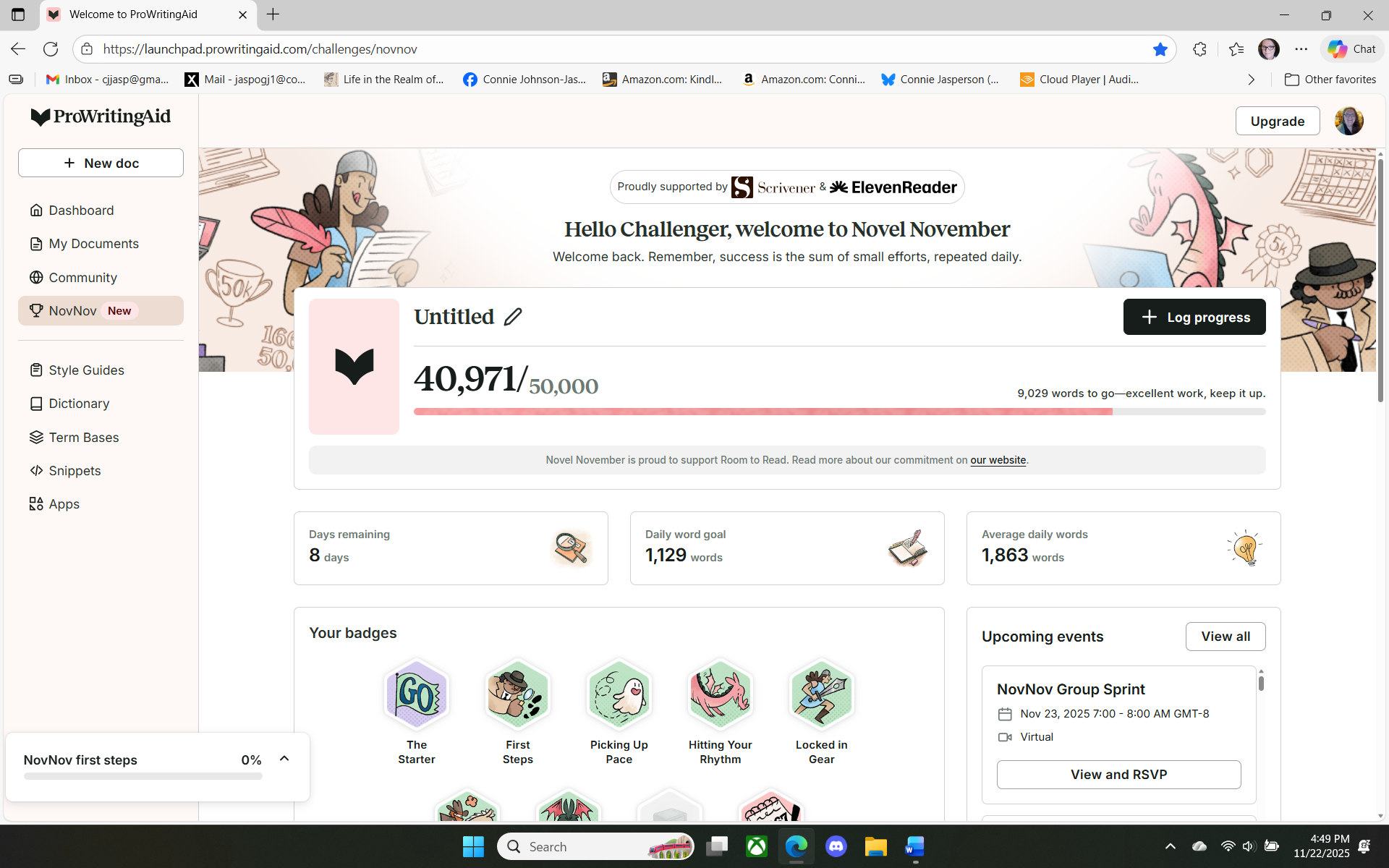
On Saturday, I crossed the 40,000-word mark at ProWritingAid’s Novel November. Most of what I’ve written (30,000 or so words) is background, stuff that won’t make it into the story but which helps me sort out the plot.

I have learned to write the background fluff in a separate document. When I begin filling out a now-skeletal plot, I have the information I need to flesh out a scene.

And hopefully, when I finally get this novel to the revisions stage, I will have an eye for the flaws. My writing group is sharp and when they beta read one of my manuscripts, they give me good advice.

The real trick is keeping the lid on my own repetitive words and gratuitous rehashing. Hopefully, in a year or two, my finished product will be a smooth read.

1 Comment

Filed under writing

The Second Draft: Decoding My Mental Shorthand #writing

Before we set the first words on a blank page, our minds have formed images of scenes we want to describe. Steven Pinker is a professor of psychology at Harvard University who specializes in visual cognition and developmental linguistics. He reminds us that we are not born with language, so we are NOT engineered to think in words alone. We also think in images.

depthPart1revisionsLIRF05252021It follows that certain words become a kind of mental shorthand, small packets of letters that contain a world of images and meaning for us. Code words are the author’s multi-tool—a compact tool that combines several individual functions in a single unit. One word, one packet of letters will serve many purposes and convey a myriad of mental images.
These words are sometimes used too often in the first draft as they are efficient. We write as fast as we can when we have the inspiration. Code words convey a wide range of information concisely, and because we use them, we can write the first draft of a story from beginning to end before we lose the fire for it.

In my current writing, I hope to portray my protagonists as I see them without bashing my readers with how I see their appearance. The big temptation is to go into detail about each person’s specific characteristics.

This is not necessary. We think in images, and so do our readers, who will fill in the details in a way that is pleasing to them. I want to convey their characteristics naturally and without beating the reader over the head.

A few years ago, I read a novel featuring a caterer who solves mysteries. She is continuously described as Junoesque, ample, vast, chubby, size eighteen, fat, large … and on and on. In every chapter, at least once and usually twice, we were given a visual description of her, along with indications of how she aroused the males around her.

Those constant descriptions were meant to emphasize the author’s perception of her protagonist as plump but irresistible to the males. However, as the book wore on, it became jarring and unnecessary. I skipped to the end and then set it aside, never to be read again.

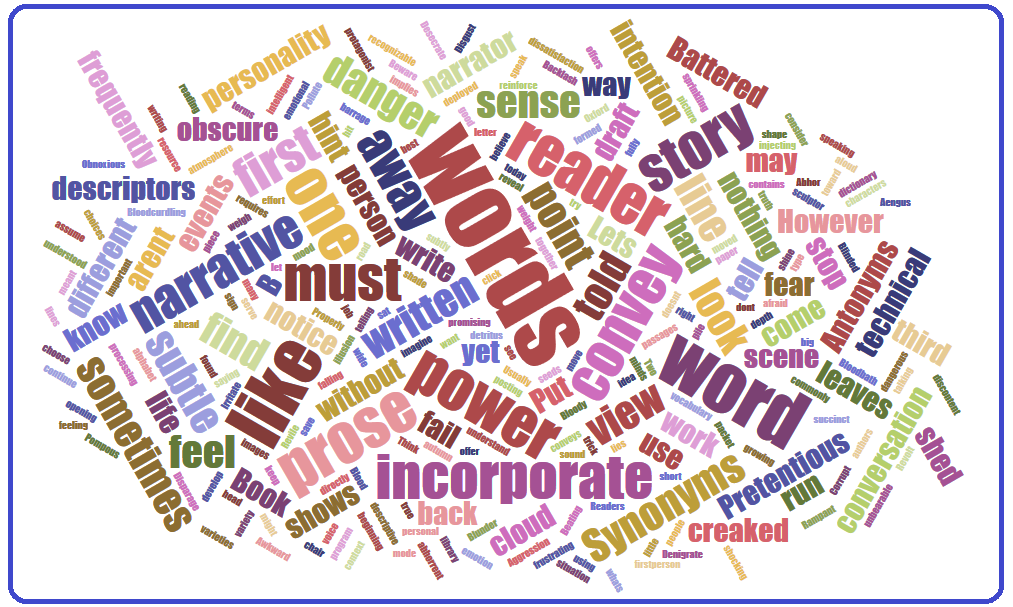
powerwordsWordCloudLIRF06192021I want to avoid that sin in my work, but what are my code words? What words are being inadvertently overused as descriptors? A good way to discover this is to make a word cloud. The words that see the most screen time will be the largest. Free online word cloud generator and tag cloud creator – WordClouds.com.

A word frequency search is also a good tool. Word Frequency Counter – Counts frequency of words in text, free online tool (charactercounter.com)

In my current work, a prominent side character is an important mentor. He is tall with dark skin and dark eyes. His hair is a wiry halo shot with white and trimmed close to his head. This is a mixed-race society, a world where “race” means “species.” One is a human born in the world of Neveyah, a large minotaur from the Bull God’s world, or a small person with rat-like features from the Mountain God’s world. Those are the only racial differences people notice.

So, when showing my people, I use general descriptors, and thanks to my use of word frequency search, the code words are now used only a few times. My hope is that a reader will make appropriate visualizations as needed.

Every author thinks a little differently, so your code words will be different from mine. Another way to find your secret code words is to have the Read Aloud tool read each section. I find many inadvertent crutch words that way.

One of the code words I subconsciously overuse is “felt.” My thesaurus says I could exchange felt for:

  • ozford-american-writers-thesaurusendured
  • experienced
  • knew
  • saw
  • suffered
  • tasted
  • underwent,
  • witnessed

The thesaurus offers some other words related to felt:

  • regarded
  • viewed
  • accepted
  • depended
  • trusted
  • assumed
  • presumed
  • presupposed
  • surmised

It’s natural to overuse certain words without realizing it, but that is where revisions come in.

As you go along, you’ll discover that some words have very few synonyms that work.

Consider the word “smile.” It’s a common code word, a five-letter packet of visualization. Synonyms for “smile” are few and don’t show what I mean:

  • beam
  • grin
  • leer
  • smirk

Each occurrence of the word “smile” in my work must be considered individually. Sometimes, this requires a complete re-visualization of the scene. It hurts my heart to murder my darlings, but I look for a different way to convey my intention.

We don’t have to drag the reader through a long list of ever-moving facial expressions, such as lips turning up, down, drawing to one side, etc.

When done sparingly and combined with a conversation, this kind of visual display can work.

By sparingly, I mean no more than one facial change per interaction, please.

oxford_synonym_antonymSometimes, the only thing that works is the brief image of a smile. Nothing is more boring than reading a story where a person’s facial expressions take center stage. As a reader, I want to know what is happening inside our characters and can be put off by an exaggerated outward display.
Once you become aware of your first draft code words, go to the thesaurus, find all the synonyms you can, and list them in a document for easy access. If it is a word such as smile or shrug, you have your work cut out, but it will speed things up if you make a small list of visuals that you can use and change up as needed.

A list of mood indicators can keep you from losing your momentum and will readily give you the words you need to convey all the vivid imagery you see in your mind. I saved my list to my desktop, so I don’t have to waste time searching for it.

Here are some instances of body language an observer would see if a character was wary.

  • Crossed arms.
  • A stiff posture.
  • Narrowed eyes.

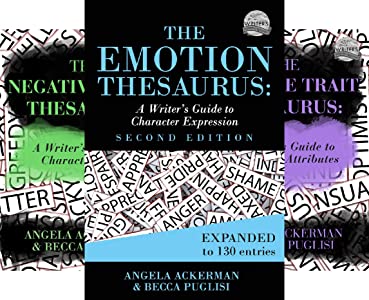
emotion-thesaurus-et-alIf you don’t have it already, a book you might want to invest in is The Emotion Thesaurus by Angela Ackerman and Becca Puglisi. Some of the visuals they list aren’t my cup of tea, but they understand how to use words that show what people are thinking.

This aspect of the revision process is sometimes the most difficult. It takes time to examine each instance of our code words. They don’t always need changing—sometimes, a smile is a smile, and that is okay.

6 Comments

Filed under writing

Revisions #TheStruggleIsReal #amwriting

Making revisions is quite different from editing, although some people don’t see it that way. Editing is a process that begins when I send the final draft to my editor, usually a year or two out from when the story first lands on paper.

depthPart1revisionsLIRF05252021For me, revisions begin with the second draft and sometimes involve radical changes to the storyline or character arcs. I may take a manuscript through many drafts before finally getting the story right.

The process of revision starts when I write the final lines, finishing the first draft. I’m smarter now than I used to be, so I let that mess sit for a few weeks.

Then I go back and begin reading what I have written. As I read, I make corrections to typos and garbled sentences that I come across, although I miss as many as I catch.

I also notice plot holes, and this is where the second draft becomes work. This is where I might discover I have written myself into a far-fetched corner and my original solution was less than graceful.

Or I may find there is no tension, and the story is nothing but a series of character sketches.

Fortunately, much of what I have written can be recycled into a different project, should the need arise.

fileFolderNEVER DELETE months of work. Don’t trash what could be the seeds of another novel. Save it in an outtakes file and use it later. I give the subfile a name like HA_outtakes_20Dec2022. That file name tells me the cut chapters were last changed on December 20, 2022.

The old manuscript, version 1, will also be in that file in its original entirety.

FileDocumentThen, I give the second draft a new file name: Heavens_Altar_version_2, which becomes the version I work on out of the main file folder.

Why not just delete it? When I get to the second draft stage, I have accomplished many important things with the 3 months of work I might cut from that novel.

  • The world is solidly built.
  • The characters are firmly in my head, so their interactions will make sense in the new context.
  • Some sections I cut can be recycled into the new version, just in a different place.

Sometimes when I’m involved in creating characters, I overlook the misfortunes and struggles that create opportunities for growth. A good storyteller places obstacles on the path, events that must force a transformation upon the protagonists and their companions.

Catastrophes, even small ones on the most personal of levels, are the fertile ground from which adventure springs. When making revisions, we must ensure these growth opportunities are clearly defined, logical, and in the right place.

Events from which there is no turning back are the impetus of change, and that change is what the book is about.

Midpoint in the story’s arc is often a place where a choice is made from which there is no turning back. From that point, the narrative rises to the third plot point, an event that is either an actual death or a symbolic death. If either of these events is a non-starter, I have to either improve them or find better catastrophes.

This major event is critical because it forces the protagonist to be greater than they believed they could be. Conversely, it can break them down into their component parts.

Author-thoughtsEither way, the characters will be profoundly changed from who they thought they were on page one, becoming who they are when the final sentence is written. The character arc is formed by their experiences.
How do I find those catalysts for change? Sometimes I need an external eye to point out where I have gone wrong, and I seek ideas from my writing group.

However, most of my writing disasters are preceded by one or more points of no return. Identifying and rectifying those moments takes time. It’s why I take so long to write a book.

When I finally see what must be changed, it may take several days to visualize how to resolve it. But that time spent mind-wandering on paper is not wasted. I will have a better plot arc for my characters and still arrive at the ending I want.

I believe in the joy of writing and the elation of creating something powerful. Sometimes we lose our fire for a story because another story has captured our imagination. If that happens, set the first one aside and write the story you are passionate about.

We who are indies have the freedom to write what we want, when we want. The only deadlines we have to meet are the ones we set for ourselves.

Book- onstruction-sign copyTrue inspiration is not an everlasting firehose of ideas. Sometimes there are dry spells. If you take another look at the work you have cut and saved in an outtakes file, you might see it with fresh eyes. You might see the seeds of a different story, and the fire for writing will be reignited.
I may take my first draft through many versions before I have the story written the way I want it. The end result should be worth it—I hope.

14 Comments

Filed under writing

Pacing and the Function of the Transition Scene #amwriting

The transition scene is the most challenging part of the narrative for me to devise in the first draft. I get stuck, trying to decide what information needs to come out and what should be held back. I forget that the first draft is only the foundation of the bigger picture.

transitionsWe add the details when we begin the revision process. One of the elements we look for in our narrative is pacing, or how the story flows from the opening scene to the final pages.
Our manuscript is finished in the regard that it has a beginning, middle, and ending, but it’s not yet ready for a reader. Now that we have the story’s skeleton, it’s time to flesh it out.

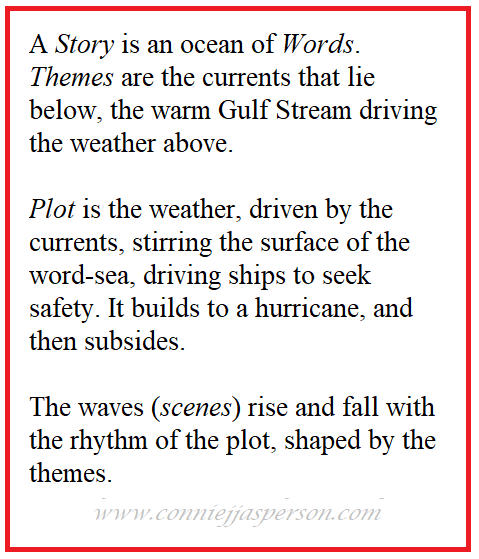
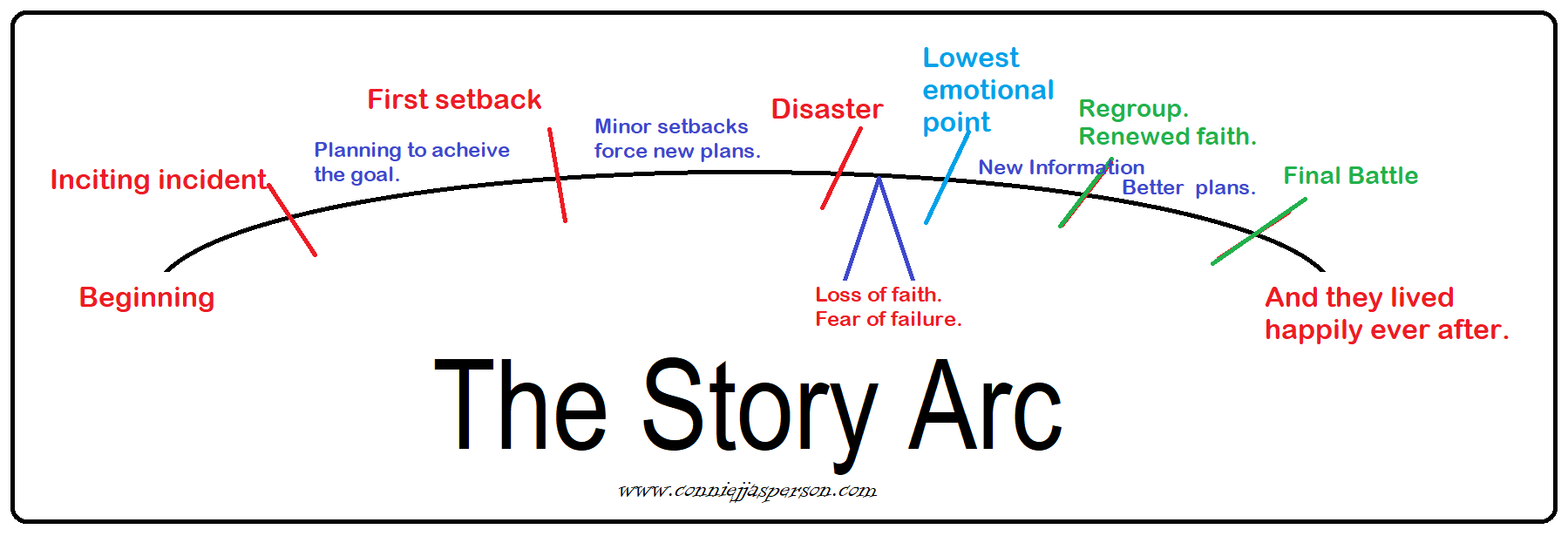
Stories are comprised of a string of moments that are connected by common themes. These moments are scenes, and when you put them together in the right order, they combine to form a narrative.

story as an ocean of wordsThis string of scenes is like the ocean. It has a kind of rhythm, a wave action we call pacing. Pacing is created by the way an author links actions and events, stitching them together with quieter scenes: transitions.
Genre fiction has one thing in common regardless of the tropes: characters we can empathize with are thrown into chaos-with-a-plot.

But while the characters might be immersed in turmoil, the reader needs an underlying order in the layout of the narrative. This pacing is subliminal, but without it, the book is chaos.

  • action,
  • processing the action,
  • action again,
  • another connecting/regrouping scene

The scene’s arc is like any other: it begins, rises to a peak, and ebbs, ending at a slightly higher point of the overall story arc than when it started.

If you ask a reader what makes a memorable story, they will tell you that the emotions it evoked are why they loved that novel. They were allowed to process the events, given a moment of rest and reflection between the action. The characters can take a moment to think, but while doing so, they must be transitioning to the next scene.

While I am not always successful, I work hard to make each scene as emotionally powerful as possible without going overboard.

Here are a few things a transition scene can show:

  • Capitulation (defeat, surrender, change of heart, retreat, giving in).
  • Catalyst (spark, stimulus, goad, incentive, the means by which we can fire things up).
  • Confrontation (disagreement, opposition, conflict, dispute, sorting things out).
  • Contemplation/Reflection (thinking things through, analyzing, seeing events from a different perspective).
  • Decision (making a choice for good or ill).
  • Emotions (Feelings, passions, reactions, sentiments).
  • Information (receiving or offering knowledge, news, the data we must have to go forward).
  • Negotiation (mediation, arbitration, “I’ll do this if you’ll do that”).
  • Resolution (answer, solution, end, outcome, upshot).
  • Revelation (the “oh my god” moment).
  • Turning Point (the “it’s now or never” moment).

Make one or more of these functions the core of the scene, and you will have a compelling story.

Plot points are driven by the characters who have vital knowledge. The fact that some characters are working with limited information can create high emotional tension.

A scene comprised only of action can be confusing if it has no context. A properly placed argument or dispute gives the reader the context needed to process the action and understand why it happened. The reader and the characters should receive information simultaneously when they need it.

What concessions will have to be made to achieve the final goal? A transition scene must reveal something new and push the characters toward something as yet unknown, but which is unavoidable.

I picked up my kit and looked around. No wife to kiss goodbye, no real home to leave behind, nothing of value to pack. Only the need to bid Aeoven and my failures goodbye. The quiet snick of the door closing behind me sounded like deliverance.

The character in the above transition scene completes an action (departing for somewhere). It reveals his mood and some of his history in 46 words. Don’t waste words on empty scenes. This is why I find the revision process the most challenging aspect of writing.

Don_Quijote_and_Sancho_Panza

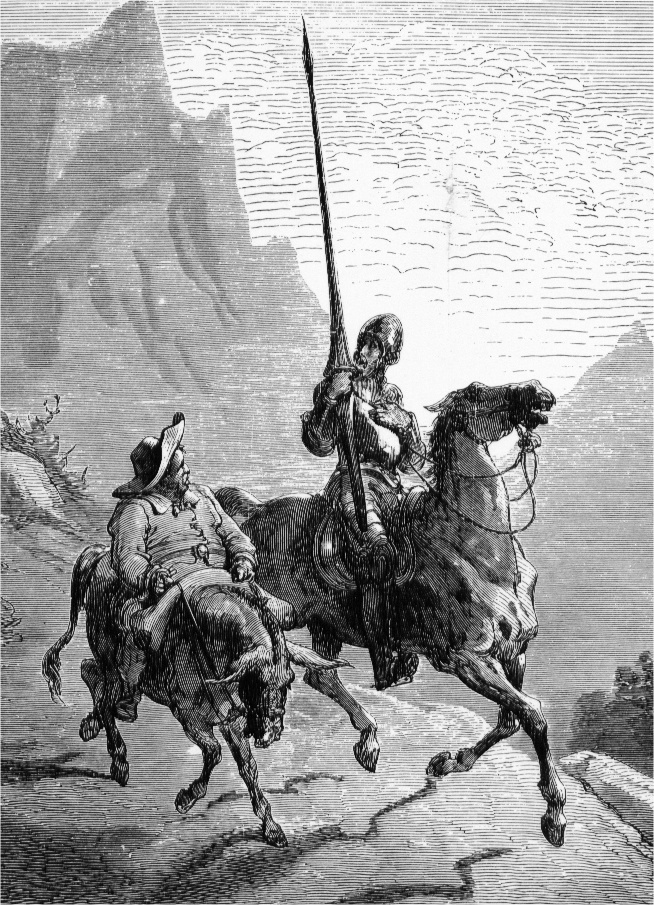
Don Quixote and Sancho Panza, Gustave Dore PD|100

We can’t natter on about nothing, but conversely, we can’t have non-stop action. Pandemonium is exhausting to write and more exhausting to read. The characters and the reader both need to process information, so the character arc should be at the forefront during these transitional scenes. That period of relative calm is when you allow your characters’ internal growth to emerge.

We allow the characters to justify the decisions that led to that point and plan their next move, making it believable.

The transition is also where you ratchet up the emotional tension. Introspection offers an opportunity for clues about the characters to emerge. It opens a window for the reader to see who they are and how they react. It illuminates their fears and strengths. It makes them real and self-aware.

Keep the moments of mind wandering brief. Go easy if you use italics to set your thoughts off. A wall of italics is hard to read, so don’t have your characters “think” too much if you use those.

Characters’ thoughts must illuminate their motives at a particular moment in time and explore information not previously discussed.

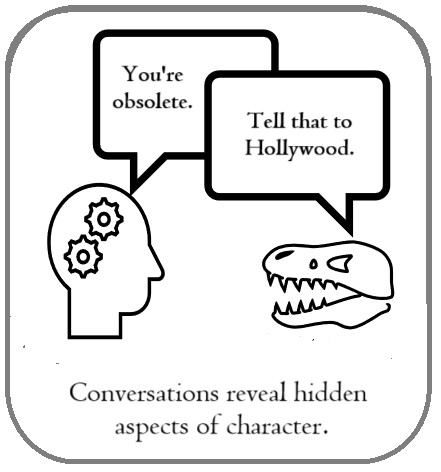
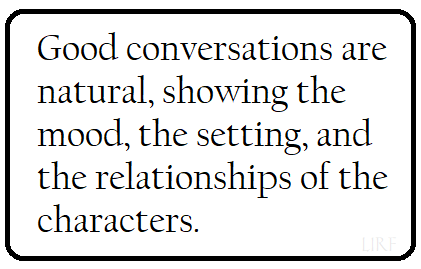
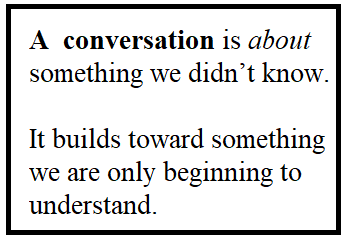
conversationsInternal monologues should humanize our characters and show them as clueless about their flaws and strengths. It should even show they are ignorant of their deepest fears and don’t know how to achieve their goals. With that said, we must avoid “head-hopping.” The best way to avoid confusion is to give a new chapter to each point-of-view character. Head-hopping occurs when an author describes the thoughts of two point-of-view characters within a single scene.
Visual Cues: In my own work, when I come across the word “smile” or other words conveying a facial expression or character’s mood, it sometimes requires a complete re-visualization of the scene. I’m forced to look for a different way to express my intention, which is a necessary but frustrating aspect of the craft.

Fade-to-black is a time-honored way of moving from one event to the next. However, I don’t like using fade-to-black scene breaks as transitions within a chapter. Why not just start a new chapter once the scene has faded to black?

One of my favorite authors sometimes has chapters of only five or six hundred words, keeping each character thread separate and flowing well. A hard scene break with a new chapter is my preferred way to end a fade-to-black.

Chapter breaks are transitions. I have found that as I write, chapter breaks fall naturally at certain places.

The struggle to connect my action scenes into a seamless arc with good pacing is why writing isn’t the most uncomplicated occupation I could have chosen. But it is the best job I’ve ever had.

storyArcLIRF10032021

5 Comments

Filed under writing

The three-step process for successful self-editing #amwriting

Last week I was asked about my self-editing/revision process. I do have a method that works for me, but it’s time-consuming. There is no magic bullet for this.

toolsIn some ways, novels are machines. Internally, each book is comprised of many essential components. If one element fails, the story won’t work the way I envision it.
So, what are these parts?

  • Characterization,
  • Dialogue,
  • Mechanics (grammar/punctuation),
  • Pacing,
  • Plot,
  • Prose,
  • Theme,
  • Transitions.

I began this journey knowing nothing about how a novel is constructed internally. I wanted to write stories, but they never came out the way I saw them in my head.

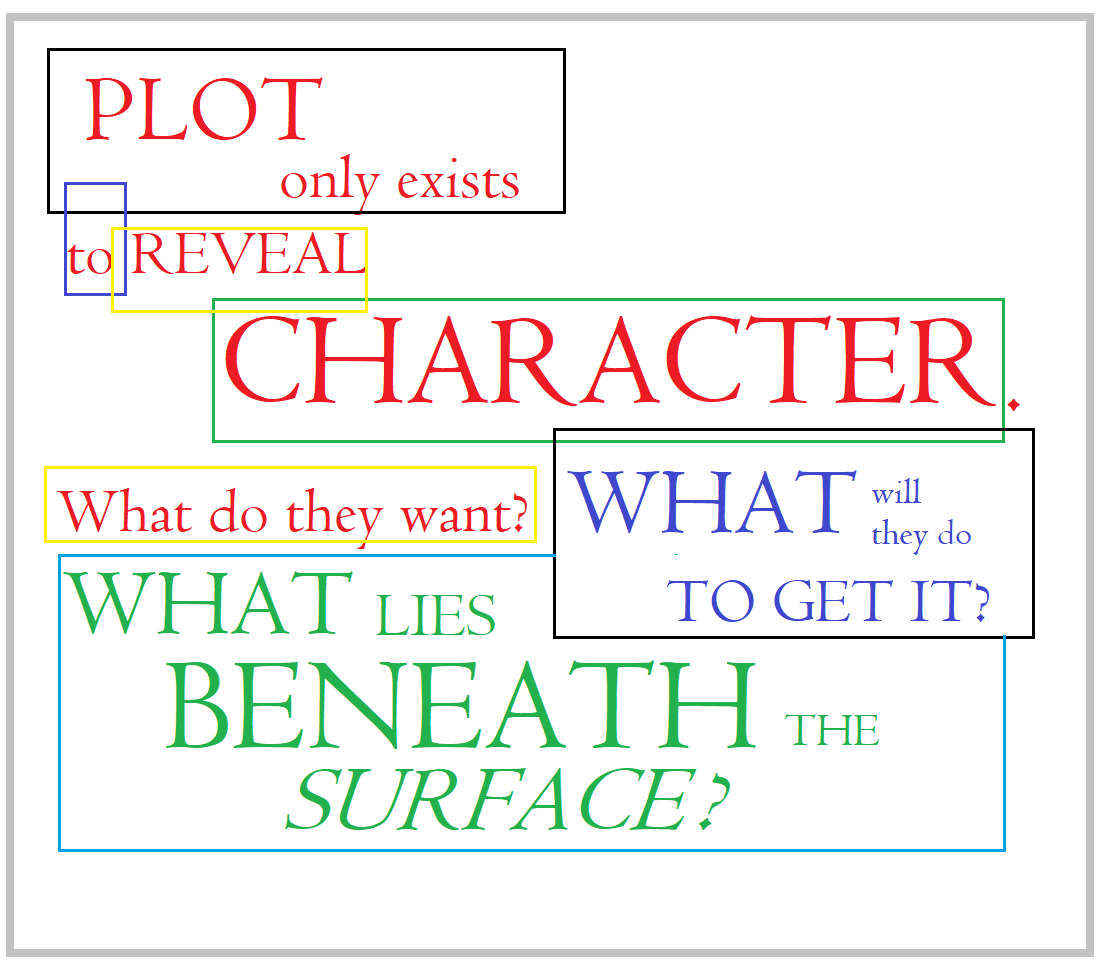
Plot-exists-to-reveal-characterSo, realizing I knew nothing was the first positive thing I did for myself. I made it my business to learn all I could, even though I will never achieve perfection.

Writing is a craft where the bar is raised with every success. Each achievement you make pushes the hope of perfection a bit higher, still just out of reach.

But I won’t stop trying.

As an editor, I’ve seen every kind of mistake you can imagine. This tendency to not see the flaws in our own work is why I have an editor. I can see the places that need work in your manuscript but need someone with a critical eye to see my work.

When prepping a novel to send to my editor, I use a three-part method. This requires specific tools that come with Microsoft Word, my word-processing program. I feel sure these tools are available for Google Docs and every other word-processing program.

Phase one: the initial read-through. Once I have completed the revisions suggested by my beta readers, this stage is put into action. After considering their suggestions and revising the manuscript, it looks finished. But it has only just begun the journey.

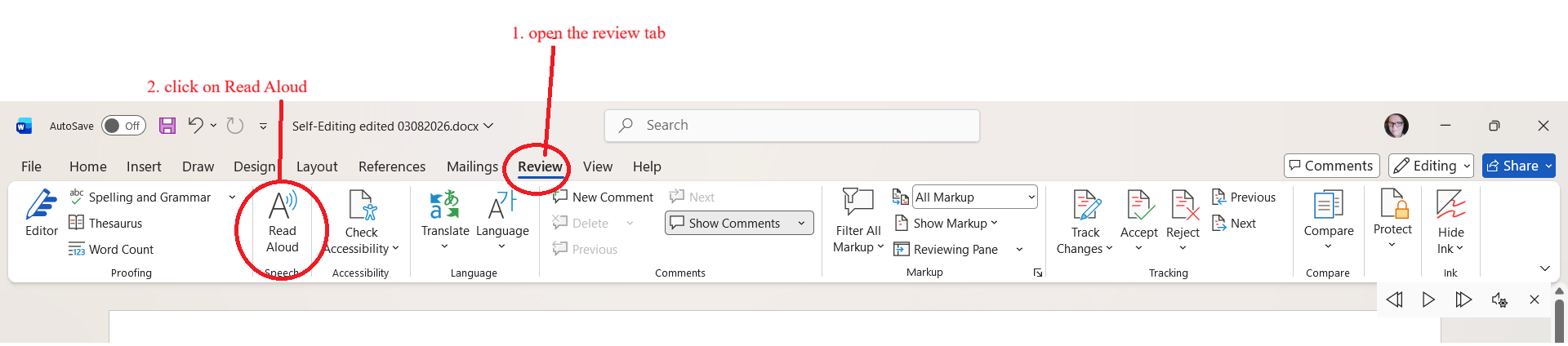
In Microsoft Word, on the Review Tab, I access the Read Aloud function and begin reading along with the mechanical voice. Yes, it’s annoying and doesn’t always pronounce things right, but this first tool shows me many places that need rewriting.

the review tabI use this function rather than reading it aloud myself, as I tend to see and read aloud what I think should be there rather than what is.
  • I habitually key the word though when I mean through. These are two widely different words but are only one letter apart. Most, but not all, miskeyed words will leap out when you hear them read aloud.
  • Most but not all run-on sentences stand out when you hear them read aloud.
  • Most but not all inadvertent repetitions also stand out.
  • Most of the time, hokey phrasing doesn’t sound as good as you thought it was.
  • Most of the time, you hear where you have dropped words because you were keying so fast you skipped over including an article, like “the” or “a” before a noun.

strange thoughts 2This is a long process that involves a lot of stopping and starting, taking me a week to get through an entire 90,000-word manuscript. I will have trimmed about 3,000 words by the end of phase one. I will have caught many typos and miskeyed words and rewritten many clumsy sentences.
But I am not done.

Phase Two: The Manual Edit

This phase is where I find my punctuation errors most often. I look for and correct punctuation and make notes for any other improvements that must be made. Usually, I cut entire sections, as they are riffs on previously presented ideas. Sometimes they are outright repetitions, which don’t leap out when viewed on the computer screen.

  • Open your manuscript. Break it into separate chapters, and make sure each is clearly and consistently labeled. Make certain the chapter numbers are in the proper sequence and don’t skip a number.
  • Print out the first chapter. Everything looks different printed out, and you will see many things you don’t notice on the computer screen or hear when it was read aloud.
  • Turn to the last page. Cover the page with another sheet of paper, leaving only the final paragraph visible.
  • Starting with the final paragraph on the last page, begin reading, working your way forward.
  • With a yellow highlighter, mark each place that needs correction.
  • Put the corrected chapter on a recipe stand next to your computer. Open your document and begin making the revisions you noted on your hard copy.

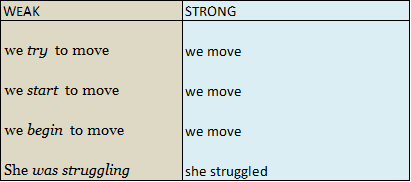
CAUTION INFO DUMP ZONE AHEADThis is the phase where I look for info dumps, passive phrasing, and timid words. These telling passages are codes for the author, laid down in the first draft. They are signs that a section needs rewriting to make it visual rather than telling. Clunky phrasing and info dumps are signals telling me what I intend that scene to be. I must cut some of the info and allow the reader to use their imagination.
I will have trimmed about 3,000 more words from my manuscript by the end of phase two.

Phase three is the step that only works if you understand grammar and industry practices. Be aware that understanding context is solely a human function at this stage in our technology.

You may have found that your word processing program has spellcheck and some minor editing assists. Spellcheck is notorious for both helping and hindering you. It may or may not alert you to an obvious error.

  • There, their, they’re.
  • To, too, two.
  • Its, it’s.

In this third phase, I go over each chapter using Grammarly. I have also used ProWriting AidEach program has strengths and weaknesses. There are several other programs available to writers, but I have only tried these two.

DangerEditing programs operate on algorithms and don’t understand context. I am wary of relying on Grammarly or ProWriting Aid for anything other than alerting you to possible problems. If you blindly obey every suggestion made by editing programs, you will turn your manuscript into a mess.
If your knowledge of punctuation is sketchy, don’t feel alone. By the time we begin writing as adults, most of us have forgotten whatever grammar we once knew. If this is your case, your best bet is to avoid these costly programs.

It takes far less money to invest in a book like the Chicago Guide to Grammar, Usage, and Punctuation and learn how grammar works.

Good editing software is expensive. For my specific needs, it has been a worthwhile investment. If you choose to invest in some, use common sense when reviewing the program’s suggestions.

My three-part self-editing process can take more than a month. When I’ve finished, I’ll have a manuscript that won’t be full of distractions. I will send it to my editor, and she’ll be able to focus on finding as much of what I have missed as is humanly possible.

And, if you read any books published by the large Traditional publishers, you know that a few mistakes and typos can and will get through despite our careful editing.

We are only human, after all.

14 Comments

Filed under writing

Fundamentals of Writing: Depth part 1 – identifying the weaknesses #amwriting

You have finished your first draft, successfully taken your characters from the opening pages through several disasters, and given them a smashing conclusion. You wrote “the end,” so now you’re finished! Time to upload it to Amazon and wait for the accolades to roll in.

depthPart1revisionsLIRF05252021STOP! If you value your reputation, you won’t rush to publish that mess just yet.

In my previous post, I outlined the stages of book construction using a traditional phased method of project management.

  1. The Concept. Make a note of that brilliant idea. Write it down, so you don’t forget it.
  2. The Planning Phase is where I create an outline. Some people don’t need this step, but I do.
  3. The Construction Phasewrite the first draft from beginning to the end.
  4. Monitoring and Controlling—For writers, this is actually a continuation of step three, a part of the construction phase. This is where you build quality into your product. If you are an outliner, this phase might go smoothly.
    • Create a style sheet as you go. See my post on style sheets here: Self-editing: Ensuring Consistency.
    • Find beta readers among your writing group and heed their concerns in the rewrites.
    • Take the manuscript through as many drafts as you must to have the novel you envisioned.
    • Employ a good line editor to ensure consistency in the quality of your product.
    • Find reliable proofreaders. (Your writing group is an invaluable resource.)
  5. Completion or Closing.

As you can see, when you write “the end” at the bottom of the last page, you have only completed the development and initial construction phase of this project.

800px-Singapore_Road_Signs_-_Temporary_Sign_-_Detour.svgNow you must set it aside, as you must gain a little distance from it to see it with a clear eye. This is where I seek an outside opinion on the strengths and weaknesses of my proto-novel. I am fortunate to have a local writing group of highly talented published authors. I also trade services with several editors. When the first draft of my manuscript is finished, I send it to a reader. While they are reading it, I work on something completely different.
You must ask your reader to look for and point out weaknesses. You need to know where you’ve over-explained, what needs to be expanded upon, and if the story has a satisfying conclusion. At this point, your manuscript needs line editing, but the first reader must understand that you aren’t at that stage yet. Beta readers must be able to look beyond those flaws and see the story as a whole.

Authors are thin-skinned. We are full of expectations that all readers will enjoy it and tell us how stellar it is. You must be prepared for your manuscript to come back with some critical observations. I have felt the sting and burn of honest criticism and was utterly crushed.

I had to put on my big-girl undies and grow up.

The real work begins when we get the first reader’s assessment back, and it isn’t what we thought we would hear.

If you had a conscientious reader, they noticed those massive info dumps. You know the ones, the long paragraphs of backstory we write to explain things.

Hopefully, your reader is familiar with your genre and knows about features such as horses, medicine, or police procedures. If so, they may tell you that more research is required.

Sometimes, the feedback we get means that we now have to completely rethink what we thought was the perfect novel.

Book- onstruction-sign copyAt this point, an amateur decides the beta reader missed the point and chooses to ignore their comments. Our unrealistic belief that our work is perfect as it falls from our minds is a failing that we must overcome if we want to engage readers.

When you have received your manuscript back with the reader’s comments, it’s time to begin the second draft. This is the area of construction where we straighten out confusing passages and make positive changes by adding or cutting scenes. We begin to add depth to our novel.

In my current manuscript, several areas were identified that needed attention.

First, my reader liked the overall story and found the characters engaging. However, she felt I hadn’t explored their relationships well enough to show their growing attraction. The eventual pairing seems to come out of nowhere. That relationship lacked depth.

Also, she pointed out where I had missed an excellent opportunity to inject real tension into the midpoint crisis. She also felt a lack of tension in the final pages.

In other words, the story lacks depth and tension at this point in its development. The work isn’t done; it’s only just begun.

This is where the intelligent author puts her reader’s observations to work. I took Alison’s comments to heart and considered the midpoint crisis. A solution presented itself, turning the story on its head. By doing that, an opportunity to make the final confrontation more perilous presented itself.

I added two chapters and trimmed back three. I slightly changed how the characters interact initially, making their mutual attraction a sub-thread that gradually grows from the moment when Character Two enters the story.

This novel tells the origin of an artifact that will be a strong thread in this series, but it is more focused on the internal battles we fight as part of the human condition. Each of us experiences emotional highs and lows in our daily lives. I must bring forward a specific layer of depth, the deep-rooted, personal reason for the emotions I want to portray.

Reactions must have a cause, something to react to. Depth can be instilled by adding a few well-chosen words, a sentence or two to show a flash of memory, a sensory prompt that a reader can empathize with.

But I'm not superstitious, LIRFIn my current work, the thoughts and motives of the characters are critical to the midpoint event and subsequent crisis of faith. Yes, who these people are, and their place in the story at the point where we meet them is crucial to the plot.
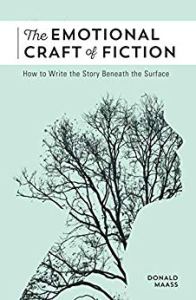
But the plot is only the surface. Below the surface, lending substance to the narrative, lies the layer of inference and implication. This layer conveys a sense of solidness, of complexity.

This layer must be handled deftly because you want the reader to feel like they have earned the information they are gaining. Yet, you must leave enough clues lying around that they can understand what you are implying. Readers can only extrapolate knowledge from information the author has offered them.

Depth is a vast word, considering that it consists of only five letters. Depth is complexity, intensity, and profoundness. These qualities are shown when each character’s sub-story is built upon who these characters think they are.

On Monday, we will take a closer look at some ways to build depth into the interactions of our characters.

2 Comments

Filed under writing

Revisions part 1: Spotting the Code Words and Mental Shorthand #amwriting

When we set the first words on a  blank page, our minds begin forming images, scenes we want to describe. In his book, The Language Instinct, Steven Pinker notes that we are not born with language, so we are NOT engineered to think in words alone—we also think in images.

It follows that certain words become a kind of mental shorthand, small packets of letters that contain a world of images and meaning for us. These words will be used with frequency in the first draft as they are efficient. We write as fast as we can when we are in the mood, and these words are a speedy way to convey a wide range of information.

Because we use them, we can get the first draft of a story written from beginning to end before we lose the fire for it.

One code word that slips into my first draft prose is the word “got.”

It is a word that serves numerous purposes and conveys so many images. “Got” is on my global search list of “telling words.” The words in the list are signals to me, indications that a scene needs to be reworded to make it a “showing” scene.

Got:”  He got the message = comprehension. He understood.

Some other instances where we use “got” as a code word for our second draft:

  • He got the dog into the car.
  • He got the mail.
  • He got

Code words are the author’s multi-tool—a compact tool that combines several individual functions in a single unit. One word, one packet of letters serves many purposes and conveys a myriad of mental images.

Every author thinks a little differently, so your code words will be different from mine. One way to find your secret code words is to have the Read Aloud tool read each section. I find most of my inadvertent crutch words that way.

Another code word on my personal list is “felt.” Let’s go to Merriam-Webster’s Online Thesaurus:

Synonyms:

  • endured
  • experienced
  • knew
  • saw
  • suffered
  • tasted
  • underwent,
  • witnessed

Words Related to felt:

  • regarded
  • viewed
  • accepted
  • depended
  • trusted
  • assumed
  • presumed
  • presupposed
  • surmised

It’s natural to overuse certain words without realizing it, but that is where revisions come in. Anytime I’m working on showing interactions between characters, certain words will be hauled into play over and over.

As you go along, you’ll discover that some words have very few synonyms that work.

Consider the word “smile.” It’s a common code word, a five-letter packet of visualization. Synonyms for “smile” are few and usually don’t show what I mean:

  • Grin
  • Smirk
  • Leer
  • Beam

When I come across the word “smile” in my work, it sometimes requires a complete re-visualization of the scene. I look for a different way to convey my intention, which can be a frustrating job.

Our characters’ facial expressions display happiness, anger, spite, and all the other emotions. Their eyebrows raise or draw together; foreheads crease and eyes twinkle; shoulders slump, and hands tremble.

I refuse to drag the reader through a long list of ever-moving facial expressions, lips turning up, down, drawing to one side, etc., but sometimes the brief image of a smile is what you need.

When done sparingly and combined with a conversation, this can work.

But… by sparingly, I mean no more than one facial change per interaction, please. Nothing is more boring than reading a story where a person’s facial expressions take center stage. We must be more concerned with what is happening inside our characters than about the melodramatic outward display.

When you discover one of your first draft code words, go to the thesaurus and find all the synonyms you can and list them in a document for easy access. If it is a word like smile or shrug, you have your work cut out, but consider making a small list of visuals.

Think about the expressions and body language an onlooker would see if a character were angry.

  • Crossed arms.
  • A stiff posture.
  • Narrowed eyes.

A little list of those mood indicators can keep you from losing your momentum and will readily give you the words you need to convey all the vivid imagery you see in your mind.

Literary agent Donald Maas has good advice in his book, the Emotional Craft of Fiction.

If you don’t have it already, another book you might want to invest in is The Emotion Thesaurus by Angela Ackerman and Becca Puglisi. Some of the visuals they list aren’t my cup of tea, but they do have a grip on how to show what people are thinking.

This aspect of the revision process is sometimes the most difficult.  It takes time when we look at each instance of our code words. They don’t always need changing—sometimes, a smile is a smile and that is okay.


Credits and Attributions:

Wikimedia Commons contributors, “File:Victorinox Multitool.jpg,” Wikimedia Commons, the free media repository, https://commons.wikimedia.org/w/index.php?title=File:Victorinox_Multitool.jpg&oldid=484117422 (accessed February 14, 2021).

6 Comments

Filed under writing

Revisions: Self-Editing #amwriting

Nowadays, all authors are financially responsible for getting their manuscript revised, edited, and proof-read, even if they intend to go the traditional route. Editors for the large publishing companies have a landslide of work to pick from, so they aren’t going to accept unedited messes, no matter how good the story is.

Hiring an editor is not cheap. Freelance editors are in business for themselves and must be paid for their work. Therefore, a 70,000 word manuscript can cost from around $700.00 or more to have edited, depending on the services you want.

An editor spends many hours combing the manuscript, so if you break their fees down to an hourly wage, they probably aren’t charging enough.

I always recommend that authors hire an editor if they can, because our eyes may skip typos and autocorrect errors in our own work. Those who are regular readers of my posts know that I am horrible at catching my typos and other errors.

We overlook the flaws in our work because we are as immersed in visualizing the scene as we were during the moments when we first wrote it. Our eyes see what we imagine to be there, rather than the typos or missing words.

Many editors offer a service called Beta Reading at a much more affordable price. Beta reads are helpful in identifying areas you may want to revise.

If you’re a member of a writers’ group, you have a resource of people who will beta read for you at no cost. As a member of that critique group, you will read for them too.

Be careful how you phrase your comments on their work. Be accurate and find positive things to point out as well as areas that need work. If you are harsh and dismissive, your work will receive that treatment in return.

Regardless, if you intend to publish what you write, you are responsible for making the line edits in your work.

If you are unable to afford a full professional edit, there is a way to make a pretty good stab at revising your own manuscript. However, it is time consuming, which is why an editor’s services are not cheap.

Open your Manuscript.

Break it into separate chapters by copying and pasting each individual chapter to a new document. Doing this preserves the original manuscript, and breaks it down into manageable chunks.

Save the chapters in a new file labeled with the word ‘revisions.’ For a current work-in-progress, I would label this new file: Barons_Hollow_revisions_02-12-2020

Clearly and consistently label each chapter. Make sure the chapter numbers are in the proper sequence, and that they don’t skip a number. For a work in progress, Baron’s Hollow, I labeled my individual chapter files this way:

  • BH_ch_1

Print out the first chapter. Everything looks different printed out, and you will see many things you don’t notice on the computer screen.

  • Turn to the last page. Cover the page, leaving only the last paragraph visible.
  • Starting with the last paragraph on the last page, begin reading, working your way forward.
  • Look for typos and garbled sentences.
  • With a yellow highlighter, mark each place that needs correction.

YOU MUST UNDERSTAND AND OBEY THE BASIC RULES OF GRAMMAR.

First, you need something called a style guide. As an editor, I regularly refer to my copy of The Chicago Manual of Style. If you are an author writing fiction you someday hope to publish, and have questions about sentence construction and word usage, this is the book for you.

The researchers at CMOS realize that English is a living changing language, and when generally accepted practices within the publishing industry evolve, they evolve too.

A less expensive option you might consider investing in is Bryan A. Garner’s Chicago Guide to Grammar, Usage, and Punctuation. This is a resource with all the answers to questions you might have regarding grammar and sentence structure. It takes the CMOS and boils it down to just the grammar.

For quick reference, here is a list of links to articles I’ve posted on the basics of grammar:

Authors are like everyone else. We get tired and sometimes take shortcuts.

Punctuation is not an area where we can cut corners. Punctuation serves as the traffic signals, keeping the words flowing at a good rate, and avoiding verbal chaos.

Those who  think the common rules of grammar don’t matter to readers are doing their work and their reputation a disservice.

You don’t have to be perfect, but readers want to enjoy the book, not struggle through rambling, garbled sentences.

Self-editing is not an easy task. As a rule, I don’t recommend it, because we authors see what we want to see. However, the costs of such services place severe constraints on some of us. This means that hiring an editor is out of reach for some.

With that in mind, on Monday we will look at how the placement of words, both nouns and verbs, affects the flow of our narrative.

13 Comments

Filed under writing

Revising the NaNoWriMo Novel Part 2 Word Choices #amwriting

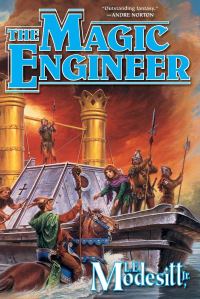
No one writes perfect prose every time. Occasionally, even award-winning authors write an awkward description in the middle of an otherwise gripping passage. Consider this pearl, a quote from one of my favorite books dropped in the middle of an otherwise powerful, well-conceived battle scene:

A screaming black arrow knocks down yet another attacker. [1]

The narrative is written in an unusual mode, one this particular author, L.E. Modesitt Jr., uses in many of his books: Third person present tense. I have read this book several times, and there are several proofing errors, but that line in the final battle has always tripped my eye.

It’s a “first draft” telling line, a signal to the author indicating an intensity of emotion he wanted to convey in a ship-to-ship battle. I suspect he was in the zone and writing as quickly as he could. The many proofing errors in this book, much as I love it, told me that editors, even those working for a publishing giant like Tor, are fallible human beings. When an author is pushed to become a book producing machine, proofing and editing can suffer.

So how could we write a scene about a hazardous inanimate object and convey a sense of imminent danger without resorting to words that don’t quite fit? First, we must understand that these are the places where getting the prose right takes time, and sometimes, many attempts.

In a conversation, it’s easy to convey a sense of fear and peril. Danger seen through a character’s eyes is easily done—describe the shock and gut reactions and move on.

Danger described from an outside view (third person) is more difficult. In a fight or battle, sounds, visuals, and smells must be employed.

And this is where it gets tricky: for me as a reader, the best fight or battle scenes have both personal witness and third person narrative.

Hollywood has been quite good at portraying battle scenes with some degree of accuracy, although not always. In the movies, arrows arc, rain down and sometimes flash. They whiz past, and sometimes they appear in the victim’s back, seemingly out of nowhere. In the movies, they travel slowly.

But, in real life the arrow strikes the target nearly immediately after leaving the bow, even at a longer distance. An arrow is not as fast as a bullet, but they are fast.

My friend Michael, who is an archer, tells me that arrows, both ancient and modern, do make a sound, depending on how they are fletched (the feathers). The hissing sound as it passes the human ear varies from nearly inaudible to soft, depending on who fletched them and what style of fletching they used.

What you will hear is the snapping sound the bow makes when the archer lets the arrow fly, followed closely by the sound the arrow makes when striking a hard target. An arrow striking a soft target like a human or animal would make a sickening sound, but one that is not loud.

In my opinion, screaming is the wrong sound for arrows.

But it is an appropriate sound for the victim that was shot by the arrow.

There must be a certain amount of telling. What is the balance between telling and showing?

In describing, we must choose our words carefully. Examine the logic of your descriptions. How do we both show and tell in a balanced way?

In War and Peace, Tolstoy conveyed the feeling of each cannon ball hitting the ground and exploding, without resorting to clichés and awkward descriptors. Andrew Kaufman is the author of Understanding Tolstoy and Give War And Peace A Chance says:

“You see, hear, and feel everything in Tolstoy’s world: glistening sunrises, whining cannonballs, exhilarating troika races, glorious births, brutal deaths, and everything in between.” [2]

Good, immersive prose requires showing in such a way that the reader isn’t blown out of the scene. This means a small amount of telling is required. For that, we’ll go to Tolstoy’s War and Peace again. This quote, written in the same third person present tense as Modesitt’s quote, is an observation, a way of both telling and showing the reader what is goes on in the subconscious mind.

“When a man sees a dying animal, horror comes over him: that which he himself is, his essence, is obviously being annihilated before his eyes — is ceasing to be.” [3]

In that one sentence, Tolstoy shows us that in Napoleon’s time, soldiers weren’t the only casualties of war. A cavalry is made up of soldiers on horses. This means that living animals went to battle and were killed too.

Tolstoy gives us the visceral experience of witnessing a horse’s death but allows us to contemplate what death means on a human level. He uses powerful words that evoke deep emotion: dying, horror, essence, annihilated.

Witnessing the death of a horse brings us closer to understanding how frail a soldier’s grasp on life is when in the midst of a battle.

Modern writers would cut the words obviously being, but despite having been written 160 years ago, the sentence has power.

Word choices are especially important in action adventures. Strong, powerful words can make or break a sentence. To revise properly, we must step back from the manuscript for several days or even weeks.

Then we come back to the manuscript and consider the visual logic of our descriptions.

We move verbs to the front of sentences, placing them before the nouns so that most sentences lead off with action words.

In the second draft, we eliminate the many insidious forms of was and to be. They’re insidious because they’re signals to the author, saying that something needs to be made active. But they can slide under the radar in the editing process and end up in the final product.

It takes work and perseverance, to find the words that correctly evoke the emotions we want to convey.

But that is what good writing is about.


Credits and Attributions:

[1] Quote from The Magic Engineer, by L.E. Modesitt Jr., 1994; A Tor Book, Published by Tom Doherty and Associates, LLC. Fair Use.

[2] Quote from Andrew Kaufman, The Only Classic Needed for Modern Times © 2014 Off the Shelf, Simon and Schuster, Inc. Fair Use.

[3] Quote from War and Peace by Leo Tolstoy, PD|100. First published by The Russian Messenger (serial).

2 Comments

Filed under writing

Revising the NaNoWriMo Novel #amwriting

Many new authors are basking in the glow of not only having met their hoped-for word count of 50,000 words in the month of November but exceeding it.

A large number of new authors have emerged from this manic writing rumble with a finished novel—something they never thought possible. But now, what do they do with it?

NOW is the time to go back and look at what you have written.

First, protect your work.

Create a new file folder in your writing files for all the background documents you will need as you get down to the real work of writing your novel. These include the original manuscript as it emerged from your head and any research. This file is where you will save future versions and also any cut scenes. I title my background file this way: Book_Title_Background

In this background file, save a copy of your original manuscript in its bloody, raw form with a file name that denotes exactly what it is.

  1. If you are using MS Word, your manuscript title will look like this: Book_Title.docx

Saving the original draft in a separate file on a thumb drive or in a file storage service such as Dropbox, Google Drive, or OneDrive means you have a fallback manuscript in case something happens to your working files.

Now that we have Version Control out of the way let’s move on to rewriting.

In the rush of laying down the ideas in the first draft, we will have written some scenes that will need to be moved to a more logical place in the story arc or cut completely. Still others don’t yet exist and will need to be written so that the ultimate outcome makes sense.

This is a good time to draw up a brief outline that shows you at a glance what you have written. The act of writing this outline will take the better part of a day but will speed the revision process up by a month or so.

The outline allows you to cut and paste events, moving and rearranging scenes. Making the decisions first on a small, easily manageable scale rather than the larger manuscript ensures that you don’t get confused when you begin cutting and moving scenes forward or back along the timeline in the second draft.

  1. Timeline: Make a list of all the decisions your protagonist made on their way to the final scene. Don’t omit any—you need to see her/his actions at a glance.
  2. Now, if these choices don’t seem to follow a logical path, rearrange the order to ensure these decisions follow a logical connective evolution. Randomness is not good plotting.
  3. Timeline: List the new order of decisions. Are they all necessary to achieve the final goal? Or are some fluff—scenes you wrote just for wordcount that don’t advance the plot and which the reader won’t care about?
  4. Consider cutting each fluff scene. Your readers will be grateful.

Now, look at the outline of your story structure again. Ask yourself these questions:

  • Who is the story about now? Is the main character still the original protagonist or has a side character stolen the show? If so, you need to choose and expand on the character that best serves the story.
  • What is the core conflict? Is it still the same conflict as when you started?
  • How high are the stakes if the protagonist fails?
  • What does the protagonist want most now?
  • Did the protagonist grow and evolve as a person? If not, why not? Or did they devolve, becoming an antihero or an antagonist? Is there a new hero?
  • Where are the pivotal places where something important to the logic is missing?
  • Again, examine what doesn’t need to be included. Remove all the scenes that impart no important information to the reader and the protagonist.

Ask yourself what would make the ultimate ending feel more logical. Insert the idea for the new scene into the outline and re-examine the logic of the story arc.

Many stories are not ultimately told in chronological order. The plot should still be the same logical chain, but the story might contain flashbacks or memories. Make a note of where these occur.

Some authors use “flash forwards,” which can easily make the story arc feel clumsy and unbelievable. Inserting a flash forward requires good planning, which is where the brief outline comes in handy. The same goes for daydreams or prophetic dreams a character might have.

Many authors reject the outline process in the first draft because they prefer to “wing it.” When I write the first draft without an outline, my story will have flashes and moments of inspired writing but will wander and skip its way to the conclusion.

For me, a manuscript that I wrote “by the seat of my pants” will always require more work than a piece written to an outline. Taking a day to write a brief summary of the entire first draft in an outline form makes the second version easier for my beta readers to read and follow.

At the end of the second draft, because I have taken the time to examine the logic of my storyline, the plot and my character’s actions will make sense to my beta readers.

They, in turn, will have good suggestions for minor changes that I will consider when I write the final version.

Next up: prose, and how your writing style shapes the narrative in the revision process.

Comments Off on Revising the NaNoWriMo Novel #amwriting

Filed under writing