Tag Archives: the revision process

The second draft: agency and consequences #writing

I plot my stories in advance, but once I begin writing, the characters sometimes take over. The plot veers far from what I had intended when I began writing it. Each time that happens, the code words we use to tell the story find their way into my manuscript, marking the places I need to revisit and rewrite to show the action. (See last week’s post, The Second Draft: Decoding My Mental Shorthand #writing | Life in the Realm of Fantasy (conniejjasperson.com).
WritingCraftSeriesAgencyLIRF01302022This happens because my characters have agency and sometimes run amok. Thus, in the second draft, I examine the freedom I give my characters to introduce their own actions and reactions within the story.

Usually, the ending remains the same as proposed, no matter what the characters do. However, the path to that place can diverge, making the middle quite different from what was initially intended.

This is called giving your characters “agency.” Agency is an integral aspect of the creative process. It allows the written characters to become real, the way Pinocchio wanted to be a real boy and not a puppet.

I want their uniqueness to remain central to the story, even when their motives and actions diverge from the original plot outline.

In literary terms, “agency” is the ability of a character to surprise the author and, ultimately, the reader. If you plan every action and response when you are writing them, the experience of writing might feel canned and boring.

Plotting, for me, means setting out an arc of events for a story that I hope to write. I do this in advance, creating it in the form of a list in a new Excel workbook that is the bible for that universe. My outline workbook will contain several spreadsheets. On one page, I create the characters and give them personality traits. On another, I list the order of events that I think will form the arc of the story. Another page will have a glossary of words and names that are unique to that story. There will be maps and calendars to help keep things logical.

tabs of a stylesheet

Some authors use whiteboards and sticky notes, and still others use Scrivener—a program my style of thinking doesn’t mesh with. Google Sheets works well, too, and it’s free. The way you plot your stories is up to you.

When my characters begin doing things that weren’t planned, the outline evolves. That way, I don’t lose control of the plot and go off on a side quest to nowhere. That is when I get to know my characters as people.

Author-thoughtsWhen the writing commences, the characters make choices and say things that surprise me. They can do this because I allow them agency.

Each character will be left with several consequential choices to make in every situation that arises along the timeline. I consider the personality and allow the characters’ reactions to fit who they are.

No matter how they respond, they will be placed in situations where they have no choice but to go forward. After all, I am their creator, the deity of their universe. I have an outline that predestines them to specific fates, and nothing they can do will stop that train.

The consequences my characters face for their choices affect the atmosphere and mood of the story as it emerges. Think about it—if there are no consequences for a character’s bad decisions, everyone goes home unscathed. What sort of story is that? Why bother writing at all?

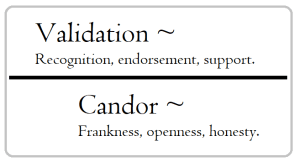
Let’s look at both the meanings and synonyms for the word consequences.
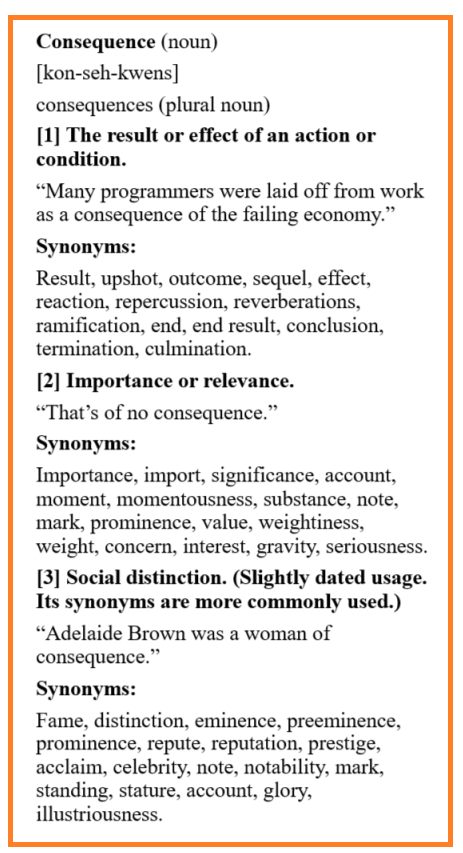
ConsequencesLIRF09142024

So now, let’s consider agency and the importance of choice. How will the consequences of their decisions affect our characters’ lives? After all, a story isn’t interesting without a few self-inflicted complications.

A story most fantasy authors are familiar with is J.R.R. Tolkien’s The Hobbit. Let’s have a closer look at Bilbo’s choices and his path to becoming the eccentric, eleventy-one-year-old hobbit who vanishes (literally), leaving everything, including the One Ring, to Frodo.

In the morning, after the unexpected (and unwanted) guests leave, he has two choices. He can stay in the safety of Bag End or hare off on a journey into the unknown. He chooses to run after the dwarves, and so begins the story of how a respectable hobbit embarked on a new career as a burglar and became a hero in the process.
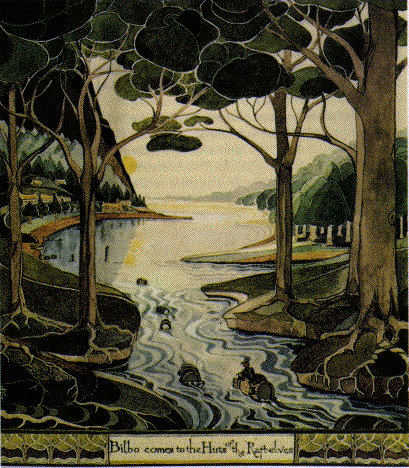
Bilbo comes to the huts of the raftelves by J.R.R. Tolkien

Bilbo comes to the huts of the raft elves by J.R.R. Tolkien

The consequences of Bilbo’s decision will shape his entire life afterward. Where he was once a staid country squire, the pillar of respectability who had inherited a comfortable income and existence, he is now expected to steal an important treasure from a dragon.

At the outset, that particular job doesn’t seem real, and he can’t imagine doing it. More immediate problems beset him. First of all, he has no clue about how a successful burglar works. He knows better than anyone that he is completely unfit for the task.

Second, he’s always been well-fed, highly respected, and not inclined to physical labor. Now, he is a novice on the expedition, so his opinions carry no weight. Not only that, meals are scant by his standards, and they must do way too much walking.

Bilbo’s long-suppressed desire for adventure emerges early when the company encounters a group of trolls. He is supposed to be a thief, so he is sent to investigate a strange fire in a forest. Reluctantly, he agrees. Upon reaching the blaze, he observes that it is a cookfire for a group of trolls.

Bilbo must make a choice. The smart thing would be to turn around at that point and warn the dwarves that they are in mortal danger. However, Bilbo’s bruised ego takes over, and he chooses to do something to prove his worth.

“He was very much alarmed as well as disgusted; he wished himself a hundred miles away—yet somehow he could not go straight back to Thorin and Company empty-handed.” [1]

Bilbo’s desire to impress the Dwarves causes him to make regrettable decisions. His choice leads to everyone nearly getting eaten, which is a negative consequence.
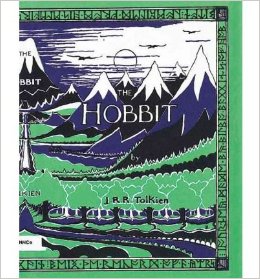
the hobbitFortunately, they are rescued by Gandalf. While he is hiding, Bilbo discovers several historically important weapons. One of them is Sting, a blade that fits Bilbo perfectly as a sword. This is a positive consequence, as the blade is crucial to Bilbo’s story and later to Frodo’s story.

It does not acquire its name until later in the adventure, after Bilbo, lost in the forest of Mirkwood, uses it to kill a giant spider and rescue the Dwarves. This is when Bilbo’s decisions become more thoughtful, and his courageous side begins to emerge.

Choices and consequences, both negative and positive, shape Bilbo’s character.

Sometimes, the decisions our characters make as we write surprise us. But if those choices make the story too easy, they should be discarded.

The best, most exciting moments I’ve had as an author are when my characters surprise me and take over the story. I can’t describe the feeling of exultation I experience when my characters choose to take the story in a different, much better direction than I had planned.

Ultimately, they end at the place I intended for them at the outset, but they always do it their own way and with their own style.
ConsequencesLIRF07122020


Credits and Attributions:

[1] Quote from The Hobbitor There and Back Again, by J.R.R. Tolkien, published 1937 by George Allen & Unwin, Ltd.
5 Comments

Filed under writing

Self-editing: Action, Events, and Introspection #amwriting

If you are a member of any writers’ forum on Facebook or through a private group, you know that today’s authors are constantly prodded to emphasize the action in their narratives. For new, inexperienced authors, this can lead to an imbalance, a narrative where the characters aren’t allowed time for introspection.

An editor looks at the scenes to see how they fit into the narrative and to ensure they are in the right order and flow into each other well.

Sometimes, I see a manuscript where it seems as if a horrific event has been inserted for the sake of shock value. In the revision process, you should examine these scenes to see if they do their job.

  • Was the event foreshadowed well, or did it come out of nowhere?
  • Is the scene necessary to force change and growth on the protagonist?
  • How are her fundamental ethics and ideals challenged by this event?

A structural editor will tell you that if there is no personal cost or benefit to the protagonist or antagonist, there is no need for that scene.

Writing these blind alleys is not a waste of time. You never know when you will need those ideas, so don’t throw them away—always keep the things you cut in a separate file. The fact that an idea doesn’t work for one book doesn’t mean it won’t work in another.

For my own work, I label that file “outtakes.” Having these unused scenes ready to adapt to other uses comes in handy when I need an idea to jump-start a new story.

In the rush of writing the first draft, it can be easy to focus on setting traps and roadblocks for our protagonist and her nemesis. We forget that readers need a chance to process what we have written.

Events must force the character to grow. Creepy scenes must have a purpose. If your story absolutely must contain that scene, it must deeply affect the characters involved in it. Events must be catalysts for the character’s evolution and growth.

We may think we have written evolving characters, but they remain stagnant if you don’t allow the reader time to see that evolution and process it.

We’re all avid readers. Consider how your favorite authors in these genres connect their underlying themes with the action and growth of their protagonists, and how they allow the reader to process each event.

Political thrillers are set against the backdrop of a political power struggle. They feature political corruption, terrorism, and warfare as common themes. How the protagonist negotiates these situations and is affected by them is the story. Introspection is key to the reader’s understanding of the events and their root cause.

Romance Novels detail the developing relationship between two people and show how they overcome the roadblocks to happiness. Both the conflict and climax of the novel are directly related to the core theme of a romantic relationship with a happy conclusion. Without small chances for introspection, the reader won’t feel connected to the protagonist and their story.

Literary fiction focuses on the protagonist of the narrative. This genre features introspective, in-depth studies of complex, fully developed characters. Action and setting are not the points here, although they frame the character and provide a visual perspective. In other words, opportunities for introspection are a key feature of literary fiction.

Science Fiction details realistic speculation about possible future events. All technology should be based solidly on knowledge of real world science, both past and present. A thorough understanding of the nature and significance of the Scientific Method is crucial. Events involving science and technology must be based on known and theoretically possible physics. Morality and the wider effects of  the choices we make are a strong theme in all science fiction. Without introspection, moral choices get lost.

Fantasy is my usual genre to write in. It is often set in an alternate, medieval, or ancient world. The common themes are good vs. evil, the hero’s journey, coming of age, morality, romantic love. Some fantasy is set in urban settings with paranormal tropes, but if that is the case, the author has similar constraints to those affecting the science fiction author. In urban fantasy, the reality must be true to life and contrast with the paranormal. This contrast highlights and emphasizes the fantasy elements.

These genres look widely different, but they all have one thing in common—they have protagonists and side characters who experience life-changing events. These moments become important to the reader.

In my mind, genre and setting are a picture-frame, a backdrop against which the themes that drive the action of the story are played out.

What is the underlying theme of your story? While you were laying down the first draft, did you notice a moral concept that was woven into the story? Was it love? Was it destiny? Was it the death of hope?

In the revision and editing process, we must identify the events that strengthen that theme, and frame them with moments of reflection.

Personal growth and the hero’s journey are often the central themes in my work. Those are the stories that hooked me as a young reader, and I still gravitate to them.

The idea of the heroic journey was first introduced by Joseph Campbell, the American mythologist, writer, and lecturer, in The Hero with a Thousand Faces (published in 1949). In this ground-breaking work, he discusses the monomyth or what is called “the hero’s journey.”

He describes how this motif is historically the common pattern of humanity’s myths and legends. Each of these tales involves an unlikely hero going on an adventure. This hero, in a decisive crisis, wins a victory, then returns home changed or transformed.

I often use Tolkien’s masterpiece, The Hobbit as an example. When Bilbo Baggins faces the giant spiders, he also faces his own cowardice. Bilbo is amazed to find he has the courage to fight them.

That scene was the first step in his realization that his bravery doesn’t depend on the magic ring he found earlier. He is afraid, but he is not afraid to be courageous. This is a core concept of this book, and of the entire Lord of the Rings series.

What is important to you? When you look for a book, what catches your interest? When you look at it from a distance, what do all the stories you love best have in common?

Those are the themes you should be writing to, what your events must support. You must allow your reader the chance to consider how those events affect the protagonist, to absorb the theme and deeper personal meaning of that character’s journey.

In that way, you will hook the reader and keep them firmly in your world.

4 Comments

Filed under writing

Revisions and Self-editing: repetition and inconsistency #amwriting

I just finished reading book two of a three-part sub-series, set within a larger 21-book series. I enjoyed it but would have liked it more had the protagonist not repeated his back story aloud every time he was asked. That was a flaw that ran deep into book three. All that repetition just padded the word count.

All through this 21-book series, numerous proofing errors and random cut-and-paste-mistakes make it clear to me that few people other than the author see these manuscripts, and they aren’t professional editors. Yet, his work sells because he has marvelous characters and compelling storylines. He is now putting out four or more books a year and is published by TOR.

The Big 5 publishing giants are just as tempted to rush a manuscript to publication as we indies are, and editing sometimes falls by the way. However, if an indie publishes work as badly edited as that, the entire indie community suffers abuse.

Since the large publishing houses aren’t doing editing the way we always thought they did, it’s up to us to find the flaws before we submit our work to them or publish it ourselves.

When we lay down the first draft, the story emerges from our imagination and falls onto the paper (or keyboard). Even with an outline, the story is forming in our heads as we are writing it. While we think it is perfect as is, it probably isn’t.

The revision process is about far more than merely grammar and word placement. It is about making sure the story arc doesn’t flat-line.

Those who regularly read my blog know that I frequently repeat an idea, phrased just a bit differently further down the post. My elderly brain seems determined to make that point, no matter what. We all do this in our first drafts, and very few things are more “first draft” than a blog post.

Inadvertent repetition causes the story arc to dip. It takes us backwards rather than forward.  What I have discovered in my own work is that the second version of that idea is usually better than the first.

Last week, in my post called Revisions: Self-Editing, I talked about the way I do my revisions, how I try to get an unbiased view of my work. Basically, I print out each chapter. Beginning with the last paragraph on the last page, I work my way forward with a yellow highlighter.

Then I put the corrected copy on a recipe stand beside my computer and make the revisions in a new file. (I never delete the old files, because we never know when we might need something we have already written.)

Here are a few things that stand out when I do this:

  • Repetition of entire ideas, each instance worded slightly differently.
  • Inadvertent shifts in the spelling of names for people and places, such as Dyljan becomes Dyjan. (Keeping a style sheet of how names and created words are spelled and doing a global search for each before publishing resolves that.)
  • Places where I have contradicted myself, such as a town being north of the main character’s location, but they travel south to get there. Making a simple hand drawn map resolves the location problem if you remember to look at it.
  • Punctuation errors and missing quotation marks also stand out when printed.

The style sheet can take several forms, but it is only a visual guide to print out or keep minimized on my desktop until it’s needed. I copy and paste every invented word, hyphenated word, or name the first time they appear in my manuscript, and if I am conscientious, I’ll be less likely to inadvertently contradict myself later on in the tale.

My editor is grateful that I make this list so that she doesn’t have to.

All the lists of words and things to look for, all my knowledge comes from having worked with editors who are passionate about writing. Many years ago, Maria gave me the list of weak words to watch for.

Carlie trained me out of using “that” as a crutch word.

Irene trained me to notice my inadvertent shifts in spelling and to love how grammar works. She kindled my desire to learn more about the craft.

Alison trained me not to be so thin-skinned and self-important.

If you have the resource of a good writing group, you are a bit ahead of the game. I suggest that you run each revised chapter by your group and hear what they have to say. Some of what you hear won’t be useful, but much will be.

And yes, you will have to make more revisions. I have discovered that the real work of writing comes after you have written the story.

3 Comments

Filed under writing

Revising the NaNoWriMo Novel #amwriting

Many new authors are basking in the glow of not only having met their hoped-for word count of 50,000 words in the month of November but exceeding it.

A large number of new authors have emerged from this manic writing rumble with a finished novel—something they never thought possible. But now, what do they do with it?

NOW is the time to go back and look at what you have written.

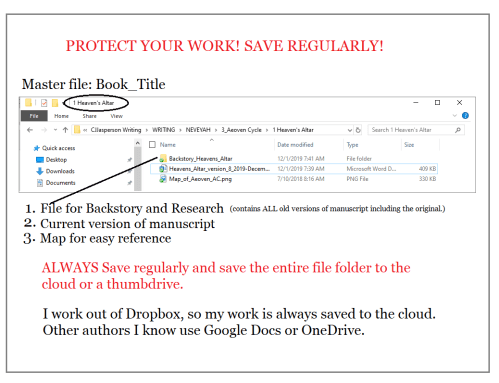
First, protect your work.

Create a new file folder in your writing files for all the background documents you will need as you get down to the real work of writing your novel. These include the original manuscript as it emerged from your head and any research. This file is where you will save future versions and also any cut scenes. I title my background file this way: Book_Title_Background

In this background file, save a copy of your original manuscript in its bloody, raw form with a file name that denotes exactly what it is.

  1. If you are using MS Word, your manuscript title will look like this: Book_Title.docx

Saving the original draft in a separate file on a thumb drive or in a file storage service such as Dropbox, Google Drive, or OneDrive means you have a fallback manuscript in case something happens to your working files.

Now that we have Version Control out of the way let’s move on to rewriting.

In the rush of laying down the ideas in the first draft, we will have written some scenes that will need to be moved to a more logical place in the story arc or cut completely. Still others don’t yet exist and will need to be written so that the ultimate outcome makes sense.

This is a good time to draw up a brief outline that shows you at a glance what you have written. The act of writing this outline will take the better part of a day but will speed the revision process up by a month or so.

The outline allows you to cut and paste events, moving and rearranging scenes. Making the decisions first on a small, easily manageable scale rather than the larger manuscript ensures that you don’t get confused when you begin cutting and moving scenes forward or back along the timeline in the second draft.

  1. Timeline: Make a list of all the decisions your protagonist made on their way to the final scene. Don’t omit any—you need to see her/his actions at a glance.
  2. Now, if these choices don’t seem to follow a logical path, rearrange the order to ensure these decisions follow a logical connective evolution. Randomness is not good plotting.
  3. Timeline: List the new order of decisions. Are they all necessary to achieve the final goal? Or are some fluff—scenes you wrote just for wordcount that don’t advance the plot and which the reader won’t care about?
  4. Consider cutting each fluff scene. Your readers will be grateful.

Now, look at the outline of your story structure again. Ask yourself these questions:

  • Who is the story about now? Is the main character still the original protagonist or has a side character stolen the show? If so, you need to choose and expand on the character that best serves the story.
  • What is the core conflict? Is it still the same conflict as when you started?
  • How high are the stakes if the protagonist fails?
  • What does the protagonist want most now?
  • Did the protagonist grow and evolve as a person? If not, why not? Or did they devolve, becoming an antihero or an antagonist? Is there a new hero?
  • Where are the pivotal places where something important to the logic is missing?
  • Again, examine what doesn’t need to be included. Remove all the scenes that impart no important information to the reader and the protagonist.

Ask yourself what would make the ultimate ending feel more logical. Insert the idea for the new scene into the outline and re-examine the logic of the story arc.

Many stories are not ultimately told in chronological order. The plot should still be the same logical chain, but the story might contain flashbacks or memories. Make a note of where these occur.

Some authors use “flash forwards,” which can easily make the story arc feel clumsy and unbelievable. Inserting a flash forward requires good planning, which is where the brief outline comes in handy. The same goes for daydreams or prophetic dreams a character might have.

Many authors reject the outline process in the first draft because they prefer to “wing it.” When I write the first draft without an outline, my story will have flashes and moments of inspired writing but will wander and skip its way to the conclusion.

For me, a manuscript that I wrote “by the seat of my pants” will always require more work than a piece written to an outline. Taking a day to write a brief summary of the entire first draft in an outline form makes the second version easier for my beta readers to read and follow.

At the end of the second draft, because I have taken the time to examine the logic of my storyline, the plot and my character’s actions will make sense to my beta readers.

They, in turn, will have good suggestions for minor changes that I will consider when I write the final version.

Next up: prose, and how your writing style shapes the narrative in the revision process.

Comments Off on Revising the NaNoWriMo Novel #amwriting

Filed under writing