Tag Archives: worldbuilding

Subtext, Mood, and Atmosphere #writing

A reader’s perception of a narrative’s reality is affected by emotions they aren’t even aware of, an experience created by the layers of worldbuilding.

mood-emotions-1-LIRF09152020Mood and atmosphere are separate but entwined forces. They form subliminal impressions in the reader’s awareness, subcurrents that affect our personal emotions.
The emotions evoked in readers as they experience the story are created by the combination of mood, atmosphere, and subtext.

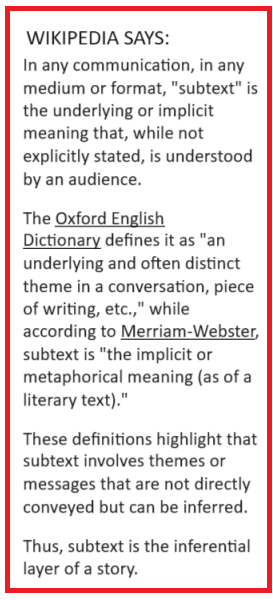
SUBTEXT_Def_06222024LIRFSubtext is a complex but essential aspect of storytelling. It lies below the surface and supports the plot and the conversations. It is the hidden story, the secret reasoning we deduce from the narrative. It’s conveyed by the images we place in the environment and how the setting influences our perception of the mood and atmosphere.
Emotion is the experience of contrasts, of transitioning from the negative to the positive and back again. Mood, atmosphere, and emotion are part of the inferential layer of a story, part of the subtext. When an author has done their job well, the reader experiences the emotional transitions as the characters do. It is our job to make those transitions feel personal.

The atmosphere of a story is long-term. Atmosphere is the aspect of mood that is conveyed by the setting as well as the general emotional state of the characters.

The mood of a story is also long-term, but it is a feeling residing in the background, going almost unnoticed. Mood shapes (and is shaped by) the emotions evoked within the story.

Scene framing is the order in which we stage the people and the visual objects we include in a scene, as well as the sequence of scenes along the plot arc. It shapes the overall mood and atmosphere and contributes to the subtext. We choose the furnishings, sounds, and odors that are the visual necessities for that scene, and we place the scenes in a logical, sequential order.

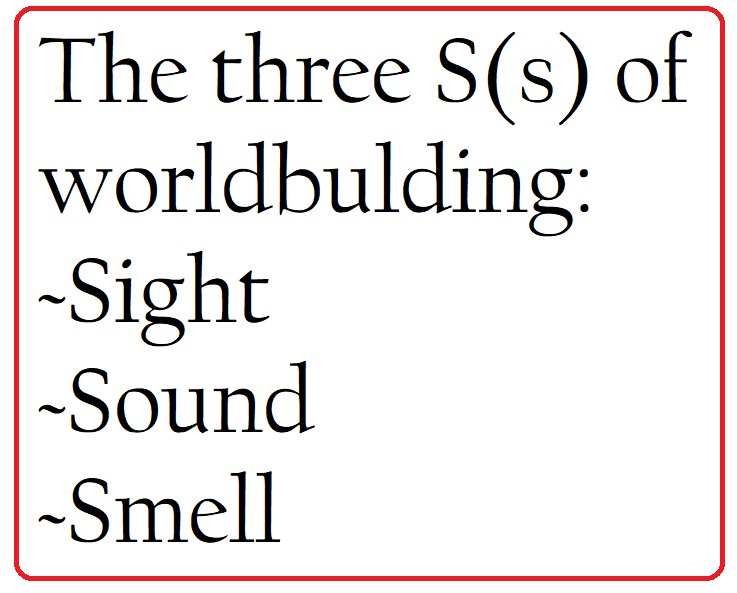
3-Ss-of-worldbuilding-LIRF07182021We want to avoid excessive exposition, and good worldbuilding can help us with that. Let’s say we want to convey a general atmosphere of gloom and show our character’s mood without an info dump. Environmental symbols are subliminal landmarks for the reader. Thinking about and planning symbolism in an environment is key to developing the general atmosphere and affecting the overall mood.
Barren landscapes and low windswept hills feel cold and dark to me. The word gothic in a novel’s description tells me it will be a dark, moody piece set in a stark, desolate environment. A cold, barren landscape, constant dampness, and continually gray skies set a somber tone to the background of the scene.

A setting like that underscores each of the main characters’ personal problems and evokes a general atmosphere of gloom.

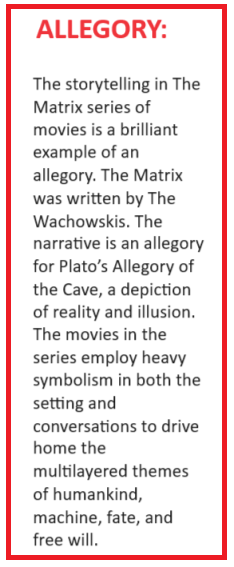
ALLEGORY06222024LIRFWhen we are designing the setting of a scene, which aspect of atmosphere is more important, mood or emotion? As I have said before, both and neither because they are entwined. Our characters’ emotions affect their attitudes toward each other and influence how they view their quest. This, in turn, shapes the overall mood of the characters as they move through the arc of the plot. And the visual atmosphere of a particular environment may affect our protagonist’s personal mood. Their individual attitudes affect the emotional state of the group—the overall mood.
What tools in our writer’s toolbox are effective in conveying an atmosphere and a specific mood? Once we have chosen an underlying theme, it’s time to apply allegory and symbolism – two devices that are similar but different. The difference between them is how they are presented.

  • Allegory is a moral lesson in the form of a story, heavy with symbolism.
  • Symbolism is a literary device that uses one thing throughout the narrative (perhaps shadows) to represent something else (grief).

What are some examples? Cyberpunk, as a subgenre of science fiction, is exceedingly atmosphere-driven. It is heavily symbolic in worldbuilding and often allegorical in the narrative. We see many features of the classic 18th and 19th-century Sturm und Drang  literary themes but set in a dystopian society. The deities that humankind must battle are technology and industry. Corporate uber-giants are the gods whose knowledge mere mortals desire and whom they seek to replace.

The setting and worldbuilding in cyberpunk work together to convey a gothic atmosphere, an overall feeling that is dark and disturbing. This is reflected in the subtext, which explores the dark nature of interpersonal relationships and the often criminal behaviors our characters engage in for survival.

 No matter what genre we write in, we can use the setting to hint at what is to come. We can give clues by how we show the atmosphere with the inclusion of colors, scents, and ambient sounds. We choose our words carefully as they determine how the visuals are shown.

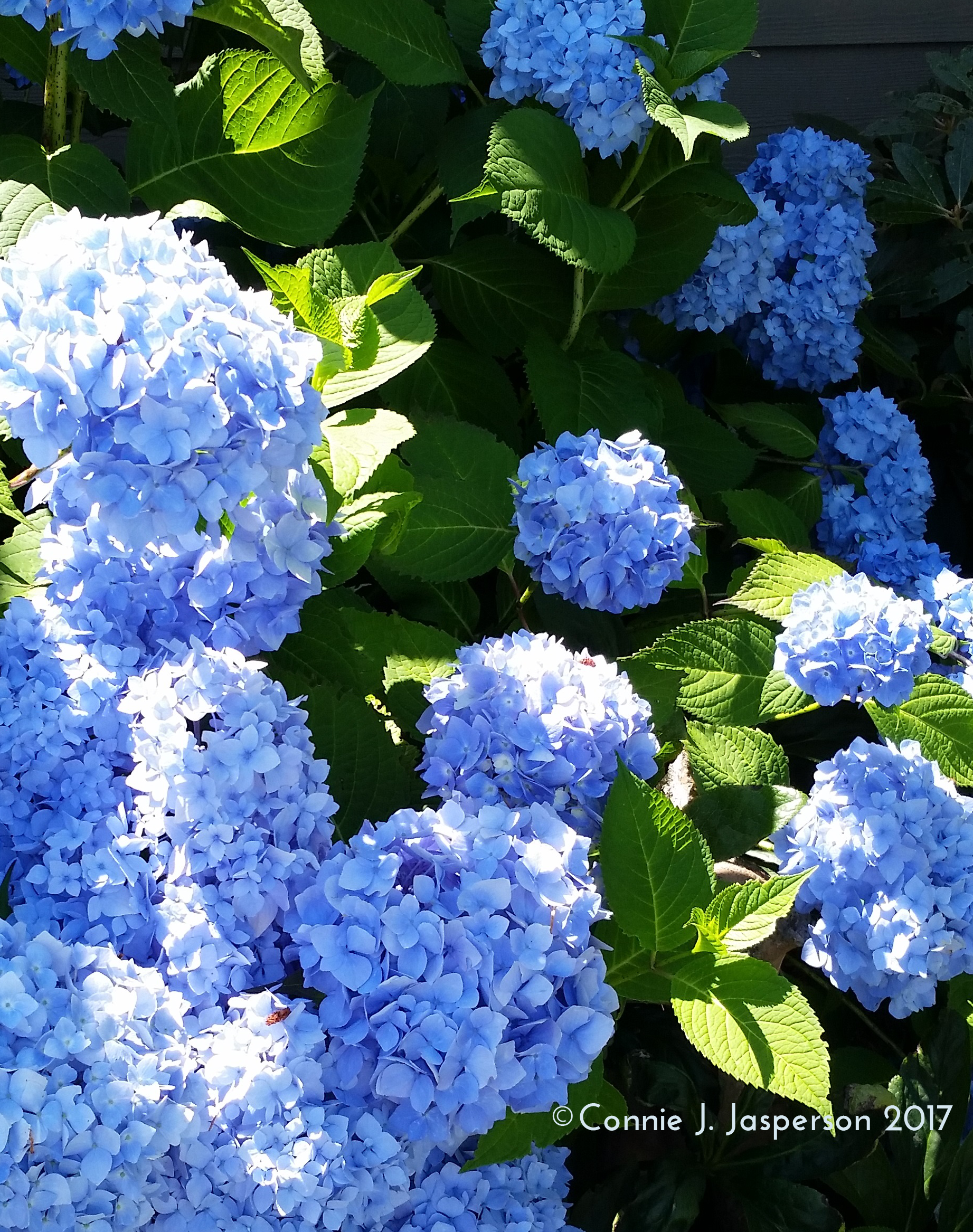
Hydrangea_cropped_July_11_2017_copyright_cjjasperson_2017 copyWe can create an atmosphere and mood that underscores our themes and highlights plot points without resorting to info dumps. We can lighten the mood as easily as we can darken it. When we design a setting, color brightens the visuals, and gray depresses them. Those tones affect the atmosphere and mood of the scene.
Sunshine, green foliage, blue skies, and birdsong go a long way toward lifting my spirits, so when I read a scene that is set in that kind of environment, the mood of the narrative feels lighter to me.

Worldbuilding can feel complicated when we are trying to convey subtext, mood, and atmosphere but the reader won’t be aware of the complexities. All they will know is how strongly the protagonist and her story affected them and how much they loved that novel.

1 Comment

Filed under writing

My checklist for creating societies #writing

Worldbuilding involves far more than the visible environment. We know worlds are comprised of plants, animals, and geology. But if intelligent life forms live in that world, societies will also exist.

WritingCraftWorldbuildingIntelligent creatures communicate in their own languages with each other, sounds that we humans interpret as random and meaningless or simply mating calls. But scientists are discovering their vocalizations must have meanings beyond attracting a mate, words that are understood by others of their kind. This is evident in the way they form herds and packs and flocks, societies with rules and hierarchies.

The BBC says that AI is learning the language patterns of other species. How will that change our view of the world? Will the Powers That Be persist in the view that humans are the only species with internal lives and emotional connections? How artificial intelligence is helping us talk to animals (bbc.com)

So, let’s talk about worldbuilding.

mindwanderingLIRF02212023We humans are tribal. We prefer living within an overarching power structure (a society) because someone has to be the leader. We call that power structure a government.
As a society, the habits we develop, the gods we worship, the things we create and find beautiful, and the foods we eat are evidence of our culture.

If your society is set in modern suburbia, that culture and those values will affect your characters’ view of their world. You will still have to build that world on paper. But the information and maps are all readily available, perhaps in your backyard.

If your story is set on another world, alternate earth, or even in a different era, you must create the background material to show your world logically and without contradictions. Are there specific places or environments where the different fantasy or alien races exist?

A common trope of fantasy is that elves are close to nature and prefer to live in the forests. If you have other races coexisting with humans, you need to make a map. Where do their territories border your protagonist’s country? Are they at peace with one another? How does this affect your story?

sample-of-rough-sketched-mapWorldbuilding requires us to ask questions of the story we are writing. I go somewhere quiet and consider the world my characters will inhabit. I have a list of points to consider when creating a society, and you’re welcome to copy and paste it to a page you can print out. Jot the answers down and refer back to them if the plot raises one of these questions.

Merchants, scientists, priests, soldiers, teachers, healers, thieves – no matter the setting, how is your society divided? Who has the wealth?

  • Is there a noble class?
  • Is there a servant class?
  • Is there a merchant class?
  • Is there a large middle class?
  • Who makes up the most impoverished class?
  • Who has the power, men or women—or is it a society based on mutual respect?

Ethics and Values: What constitutes morality, and how do we treat each other? Is marriage required?

  • How are women treated?
  • How are men treated?
  • How are the different races viewed?
  • Is there a cisgender bias or an acceptance of different gender identities?
  • How are same-sex relationships viewed?
  • How are unmarried sexual relationships seen in the eyes of society?
  • How important is human life?
  • How is murder punished?
  • How are betrayal, hypocrisy, envy, and avarice looked upon?
  • What about drunkenness?
  • How important is honesty?
  • What constitutes immorality?
  • How important is it to be seen as honest and trustworthy?
  • What is taboo? What is “simply not done” among that group?

Power structures are hierarchies and chains of command. A government is an overall system of restraint and control among selected members of a group. Think of it as a pyramid, a few at the top ruling over a broad base of citizens.

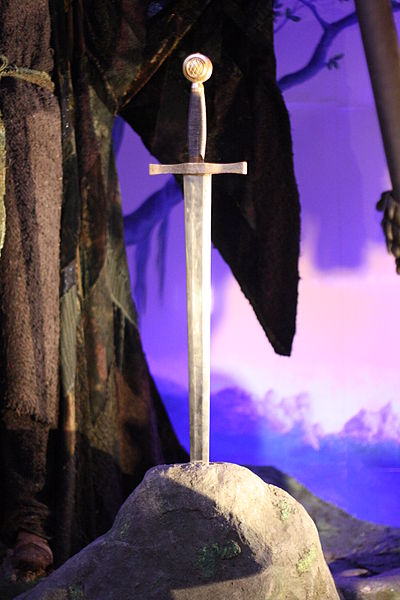
Excalibur London_Film_Museum_ via Wikipedia

Excalibur London_Film_Museum_ via Wikipedia

In a medieval-type society, the accepted age for when a child becomes legally an adult will be much younger than we consider it today. When the majority of people die before the age of forty, adulthood comes at the same time as puberty. Fourteen- and fifteen-year-olds have minimal life experience. They let their hormones do the thinking and are quick-tempered and volatile. When a teenager becomes king or queen, and all of their advisors are also teenagers or in their early thirties at most, a country could suffer. The ruling class might be uncaring of how their decisions affect the lower classes.

Wars take the laborers out of the fields and put them on the front lines, limiting food production. While this hurts everyone, it destroys trade, ruining the merchant class. War falls heaviest upon the peasant class, but the middle class pays most of the taxes. Without a good-sized middle class, one can’t pay an army.

Religion can be a sci-fi trope and often figures prominently in fantasy work. In sci-fi, science and technology frequently take the place of religion or are at odds with it. They both have similar hierarchies and fanatics but with different job titles.

Archbishop might be replaced with Head of Research and Development.

Cardinal or Pope might be replaced with GeneralAdmiral, or CEO (Chief Executive Officer).

Level of Technology: no matter the setting, each occupation has a specific technology. What tools and amenities are available to them? What about transport?

  1. Hunter/Gatherers?
  2. Agricultural/farming?
  3. Greco-Roman metallurgy and technology?
  4. Medieval metallurgy and technology?
  5. Pre-industrial revolution or late Victorian?
  6. Modern-day?
  7. Or do they have a magic-based technology?
  8. How do we get around, and how do we transport goods? On foot, by horse & wagon, train, or space shuttle?

Government: There will be a government somewhere, even if it is just the local warlord. Someone is always in charge because it’s easier for the rest of us that way:

  1. Is it a monarchy, theocracy, or a democratic form of government?
  2. How does the government fund itself?
  3. How are taxes levied?
  4. Is it a feudal society?
  5. Is it a clan-based society?
  6. How does the government use and share the available wealth?
  7. How do the citizens view the government?

Crime and the Legal System: What constitutes criminal behavior, and how are criminals treated?

Foreign Relations: Does your country coexist well with its neighbors?

  • If not, why? What causes the tension?

Waging War: This is another area where we have to ask what their level of technology is. Do the research and choose weaponry that fits your established level of technology.

  • What kind of weaponry will they use?
  • How are they trained?
  • Who goes to battle? Men, women, or both?
  • How does social status affect your ability to gain rank in the military?

A common trope in fantasy is magic, which brings up the need to train magic-gifted people. Do your sorcerers/mages rely on

  • dumb luck and experimentation?
  • apprenticing to sorcerers?
  • training by religious orders?
  • or, as in the case of Harry Potter, a school of some sort? What are the rules of your magic?

The Church/Temple is the governing power in many real-world historical societies. The head of the religion is the ruler, and the higher one rises within the religious organization, the more power one has. The same is true of both universities and research facilities.

Author-thoughtsPower in the hands of only a few people offers many opportunities for mayhem. Zealous followers may inadvertently create a situation where the populace believes their ruler has been anointed by the Supreme Deity. Even better, they may become the God-Emperor/Empress.
Some people are prone to excess when presented with the opportunity to become all-powerful.

Brainstorming worldbuilding is a good exercise if you have a character with a story that needs to be written. If you were unsure what your plot was before you got to this stage, now you might have a real villain, one presented to you by your society.

4 Comments

Filed under writing

Scene Framing, or how worldbuilding helps tell the story #writing

When I am reading, I become invested in the characters and their problems. The authors I like best use the environment to highlight the characters’ moods and darken or lighten the atmosphere. Their worldbuilding conveys a perception of drama with minimal exposition.

ScenesIn a novel or story, each scene occurs within the framework of the environment.
I think of the written narrative as a camera and visualize my narrative as a movie. The challenge of writing for me is discovering how to best use the set dressing to underscore the drama.

Scene framing is a necessary skill for writers of all stripes. Directors will tell you they focus the scenery so it frames the action. Their intent is that viewer’s attention is drawn to the subtext the director wants to convey.

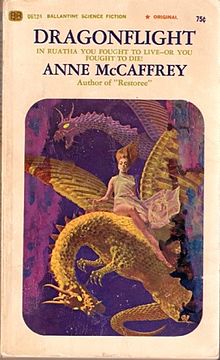
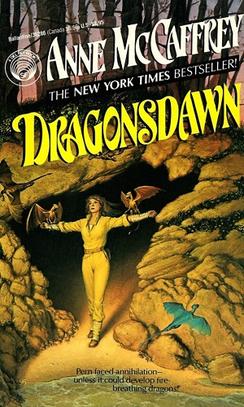
An example of how this works in literature is one I’ve used before, a pivotal scene from Anne McCaffrey’s 1988 novel Dragonsdawn

AnneMcCaffrey_DragonflightThe Dragonriders of Pern series is considered science fiction because McCaffrey made clear at the outset that the star (Rukbat) and its planetary system had been colonized two millennia before, and the protagonists were their descendants.
Some elements of the narrative are considered fantasy because they feature dragons and telepathy.

The early novels detail the gradual rediscovery of lost technology and the revelation of their forgotten history. The stand-alone novel I’m discussing today, Dragonsdawn, is a how-it-all-began novel, and it reinforces the science fiction nature of the series.

  • It explains the science behind McCaffrey’s dragons and why they were genetically engineered to be what they are.

The story follows several POV characters, giving us a comprehensive view of the colony’s successes and failures. For the first ten years, the planet Pern seemed a paradise to its new colonists, who were seeking to return to a less technologically centered, agrarian-based way of life. They believe Pern is the place where they can leave their recent wars and troubles behind.

A decade after arriving on the planet, however, a new threat appears. It is a deadly, unstoppable spore that periodically rains from the skies in the form of a silvery Thread that mindlessly devours every carbon-based thing it touches.

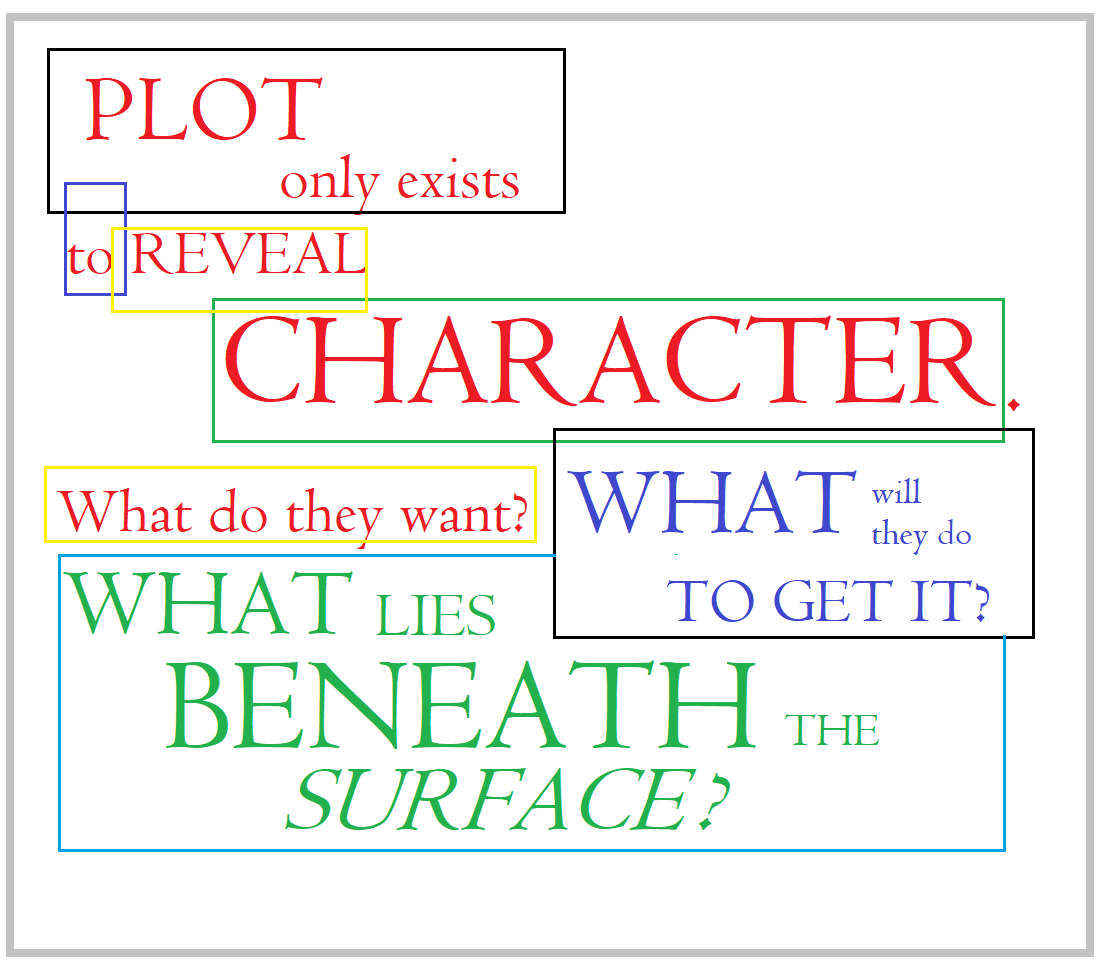
Plot-exists-to-reveal-characterThe scenes we are looking at today have two distinct environments to frame them. In both settings, the surroundings do the dramatic heavy lifting. This chapter is filled with emotion, high stakes, and rising dread for the sure and inevitable tragedy that we hope will be averted.
  • While there is high drama in Sallah Telgar‘s direct interaction with Avril Bitra, the visuals and sensory elements of each environment reinforce the perception of impending doom.

The story at this point: We are at the halfway point of the book. Before the advent of Thread, Avril disappeared, gathering resources and intending to leave the planet with as much treasure as she can carry. She has been pretty much forgotten by the others but has an agenda and refuses to be thwarted.

In the first scene of this chapter, we are focused on Sallah, one of our protagonists. We see her leaving her children at the daycare. Such a common, ordinary thing, dropping off your children on your way to work.

The focus zooms out, and we see Kenjo, the pilot, putting the last of the precious fuel into the only working shuttle, the Mariposa. This shuttle has been refitted for one last science expedition: to discover the source of the deadly Threads. He is to retrieve a sample, knowing that if this mission fails, there will be no other.

The focus returns to Sallah, who observes a woman she recognizes as Avril Bitra slipping through the abandoned shuttles on the landing grid.

Sallah wonders what Avril is up to. The view widens again as we see Avril following the pilot, Kenjo, who vanishes. We then see her entering the Mariposa alone.

Sallah makes a spur-of-the-moment decision to follow Avril to see what she’s up to. This plot point is an example of a point of no return, which we discussed last week,

Here is where the sparse visual mentions of the environment become crucial as they emphasize the stark reality of Sallah’s situation.

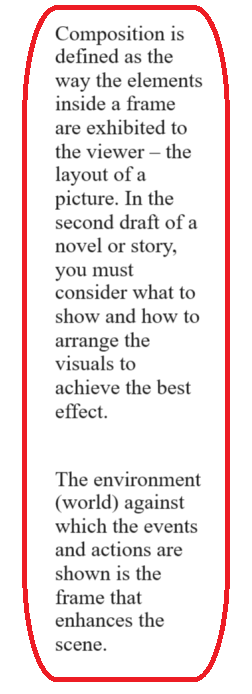
compositionANDsceneFramingLIRF03092024Sallah enters the shuttle just as the airlock door closes, catching and crushing her heel. She manages to pull it out so that she isn’t trapped, but she is severely injured.
Later, the dark, abandoned interior of the Yokohama reinforces Sallah’s gut-wrenching realization that her five children will grow up without a mother.

Something we haven’t talked about is subtext.

Subtext is what lies below the surface. It is the hidden story, the hints and allegations, the secret reasoning we infer from the narrative. It’s conveyed by the images we place in the environment and how the setting influences our perception of the mood and atmosphere.

Subtext supports the dialogue and gives purpose to the personal events.

Scene framing is the way we stage the people and visual objects. What furnishings, sounds, and odors are the visual necessities for that scene?

Whatever you mention of the environment focuses the reader’s attention when the characters enter the frame.

  • In this chapter of Dragonsdawn, we see the junk and scrap on the grid and the decaying shuttles.
  • Two shuttles have been dismantled and parted out. Their components are crucial in keeping the few cargo sleds that have been converted to Thread-fighting gunships in working order.
  • Only one shuttle remains in usable condition.
  • On the Yokohama, it is dark and frigid, and the interior has been partially gutted. Anything that could be carried away has been taken to the ground and repurposed.

Sensory details are vital, showing how the environment affects or is affected by the characters.

  • Conversely, not mentioning the scenery during a conversation brings the camera in for a close-up, focusing solely on the speaker or thinker.

A balance must be struck in how your characters are framed in each scene. We flow from wide-angle, seeing Salla floating in freefall, blood pooling in her boot. The camera moves in, a close-up showing Avril’s rage at the fact that she can’t control the course of the Mariposa, which is programmed to dock at the Yokohama.

We are there when Avril taunts Sallah for her matronly body. A feeling of helplessness comes over us as Avril ties a cord to Sallah’s crushed foot and forces her to make the navigational calculations for Avril’s escape. The camera moves in, and we hear the interaction.

Sallah pretends to do as Avril asks. But really, she sets her enemy’s doom in action. The camera moves to the wider view again, seeing her at the controls in the dark, using the last of her energy. Worst of all, we know she is dying, and she understands there is no rescue for her.

  • We hear the interaction with her frantic husband on the ground.

Dragonsdawn_coverThis is an incredibly emotional scene: we are caught up in her determination to seize this only chance, using her last breaths to get the information about the thread spores to the scientists on the ground.

We learn how to write from reading the masters. We learn by observing how others use the setting to support and reinforce the subtext of the conversations and events.

Scene framing is a cornerstone of worldbuilding, and when it is done right, it can make a scene feel powerful.

Next up: Transitions

6 Comments

Filed under writing

Worldbuilding and depth, part 2 – the inferential layer of mood and atmosphere #writing

Many new authors use the word mood interchangeably with atmosphere when describing a scene or passage. This is because mood and atmosphere are like conjoined twins. They are individuals but are difficult to separate as they share some critical functions. This is the layer of worldbuilding that lies just below the surface, a component of the inferential layer of the narrative.

mood-emotions-1-LIRF09152020Mood is long-term, a feeling residing in the background, going almost unnoticed. Mood shapes (and is shaped by) the emotions evoked within the story.

Atmosphere is also long-term but is sometimes more noticeable as it is a component of worldbuilding. Atmosphere is the aspect of mood that is conveyed by the setting.

Emotion is immediate and short-term and is also subtle and lurking in the background. The characters feelings affect the reader’s experience of the overall atmosphere and mood.

storybyrobertmckeeRobert McKee tells us that emotion is the experience of transition, of the characters moving between a state of positivity and negativity. “Story” by Robert McKee. Emotions are fluid, generating energy, and give life to the narrative.

I look for books where the author shows emotions in a way that feels dynamic. Our characters are in a state of flux, and their emotional state should also be. When the character’s internal struggle is turbulent, ranging from positive to negative and back, their story becomes personal to me.

Mood is a significant word serving several purposes. It is created by the setting (atmosphere), the exchanges of dialogue (conversation), and the tone of the narrative (word choices, descriptions). It is also affected by (and refers to) the emotional state of the characters—their personal mood.

Undermotivated emotions lack credibility and leave the reader feeling as if the story is flat. In real life, we have deep, personal reasons for our feelings, and so must our characters.

A woman shoots another woman. Why? What emerges as the story progresses is that a road accident occurred three years before in which her child was accidentally struck and killed by the woman she murdered.

My worldbuilding for that story should convey an atmosphere of shadows, sort of like a “film noir.” Everything my characters see and interact with should be symbolic, conveying a range of dark emotions in the opening pages in which the gun is fired, and the woman falls dead. If I do it right, I’ll have intense emotion and high drama.

In real life, people have reasons for their actions, irrational though they may be. The root cause of a person’s emotional state drives their actions. In the case of the above story, the driving force is a descent into a mad desire to avenge what was an unintentional tragedy. Every aspect of the setting should reflect that intense anger, the deep-rooted hatred, and the unfairness of it all.

plot is the frame upon which the themes of a story are supportedThese visuals can easily be shown. Grief manifests in many ways and can become a thread running through the entire narrative. That theme of intense, subliminal emotion is the underlying mood and it shapes the story:

  • Many people are affected by the murder, family members on both sides, and also the law enforcement officers who must investigate it.

How can we show it? We use worldbuilding to create an atmosphere of gloom. Outside each window, whenever a character must leave their home or office, the days are dark, damp, and chill. The lack of sunshine and the constant rain wears on all the characters involved on either side of the law.

  • The setting underscores each of the main characters’ personal problems and evokes a general sense of loss and devastation.

Which is more important, mood or emotion? Both and neither. Characters’ emotions affect their attitudes, which in turn shape the overall mood of a story. In turn, the atmosphere of a particular environment may affect the characters’ personal mood. Their individual attitudes affect the emotional state of the group.

As we have said before, emotion is the experience of transition from the negative to the positive and back again. Each evolution of the characters’ emotions shapes their conscious beliefs and values. They will either grow or stagnate.

Infer_Meme_LIRF06292019This is part of the inferential layer, as the audience must infer (deduce) the experience. You can’t tell a reader how to feel. They must experience and understand (infer) what drives the character on a human level.
What is mood in literature? Wikipedia says mood is established in order to affect the reader emotionally and psychologically and to provide a feeling of experience for the narrative.

What is atmosphere? It is worldbuilding, created by the words we choose. We can feel it, but it is intangible. But atmosphere affects how the reader perceives the story. The way a setting is described contributes to the atmosphere, and that description is a component of worldbuilding.

Atmosphere is the result of deliberate word choices. It comes into play when we place certain visual elements into the scenery with the intention of creating an emotion in the reader.

  • Tumbleweeds rolling across a barren desert.
  • Waves crashing against cliffs.
  • Dirty dishes resting beside the sink.
  • A chill breeze wafting through a broken window.

We show these conjoined twins of mood and atmosphere through subtle clues: odors, ambient sounds, and the surrounding environment. They are intensified by the characters’ attitudes and emotions. Mood and atmosphere are organic components of the environment but are also an intentional ambiance.

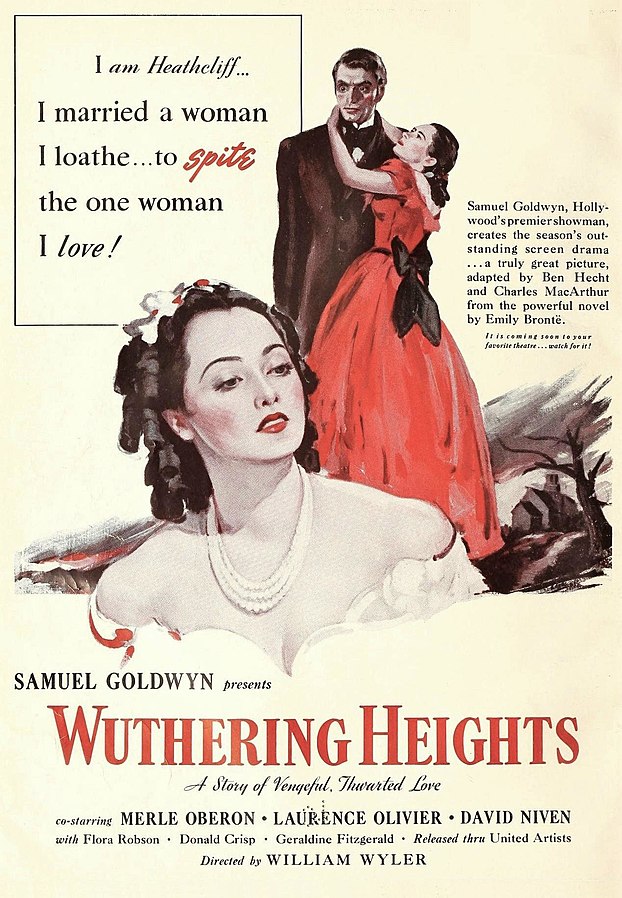
622px-Merle_Oberon_and_Laurence_Olivier_in_'Wuthering_Heights',_1939As we read, the atmosphere that is shown within the pages colors and intensifies our emotions, and at that point, they feel organic. Think about a genuinely gothic tale: the mood and atmosphere Emily Brontë instilled into the setting of Wuthering Heights make the depictions of mental and physical cruelty seem like they would happen there.
Happy, sad, neutral—atmosphere and mood combine to intensify or dampen the emotions our characters experience. They underscore the characters’ struggles.

For me, as a writer, conveying the inferential layer of a story is complicated. Creating a world on paper requires thought even when we live in that world. We know how the atmosphere and mood of our neighborhood feels when we walk to the store. But try conveying that mood and atmosphere in a letter to a friend – it’s more complicated than it looks.

Showing what is going on inside our characters’ heads is tricky. We will go a little deeper into that next week.

2 Comments

Filed under writing

Worldbuilding and depth, part 1 – what we see #writing

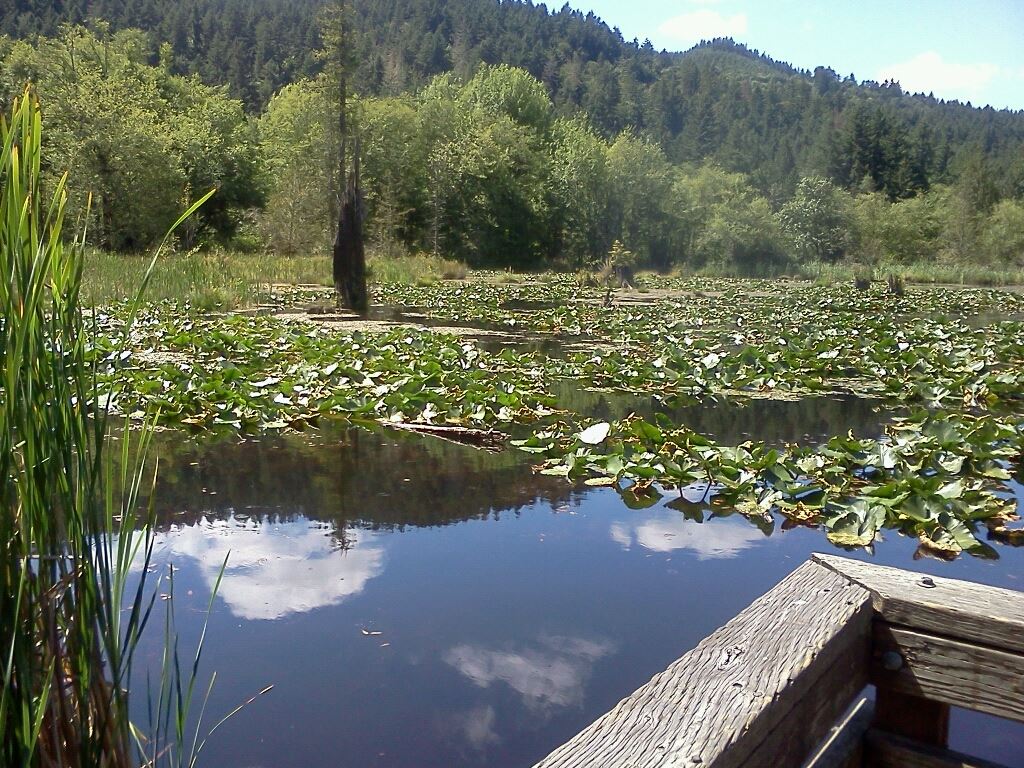
One of our favorite places to walk before my husband’s Parkinson’s limited his mobility was McLane Creek Nature Trail. The central feature of the reserve is the large beaver pond. While the trails that wind around the pond and through the woods are easy to walk for most, they aren’t really suited for people who must rely on a walker or wheelchair.

McLaine_Pond_In_July_©_2018_ConnieJJapsersonHowever, there is an accessible viewpoint just at the entrance, and we can go there and just absorb the peace. Several years ago, I shot this photo from that platform.
I grew up in a home that faced the shore of a lake, with a range of forested hills just beyond. Nature was my friend, my sanctuary. That’s why I feel such kinship for McLane Pond and bodies of water in general. They are creatures of many moods.

When you watch the water, you can see the effects of the world around it reflected on its surface. When a storm blows in, things change. The surface moves, and ripples and small waves stir things up down below. The waters turn dark, reflecting the turbulent sky.

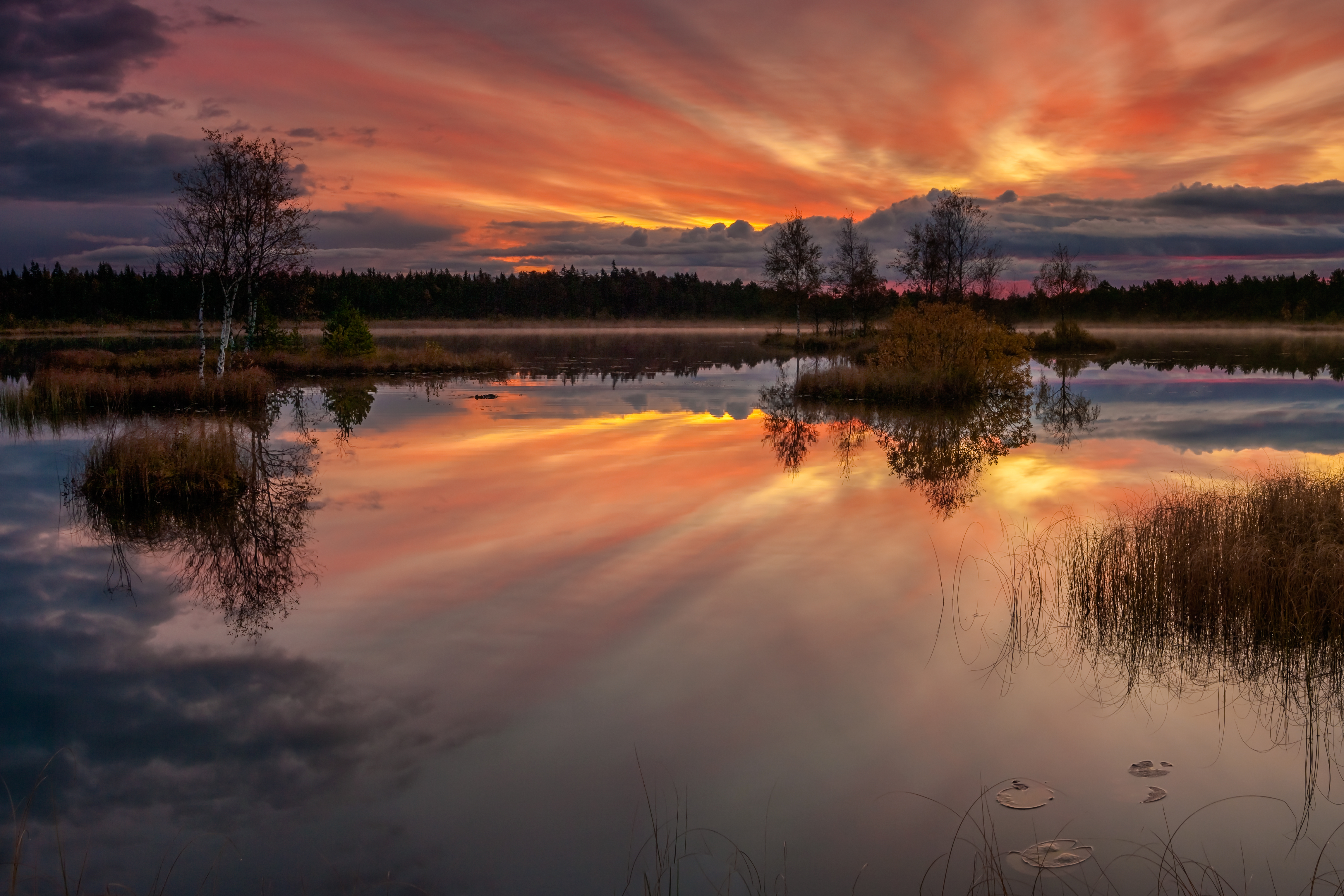
Laanemaa_järv_Orkjärve_looduskaitsealal

Sunrise at Lake Laanemaa at Orkjärve Nature Reserve, Estonia

And on a windless day, the pool will be calm and quiet. The sky and any overhanging trees will be reflected on its surface.

Just like the surface of a pond, the surface of a story is the literal layer. It is the what-you-see-is-what-you-get layer. It conceals what lurks in the depths but offers clues as to what lies below.

This layer is comprised of four aspects.

  • Genre
  • Setting
  • Action and interaction
  • All visual/physical experiences of the characters as they go about their lives.

Genre is an all-encompassing aspect of a story. It determines the shelf in the bookstore, such as General Fiction, fantasy, romance, etc. Those labels tell the reader what sort of story to expect.

Setting – I see the surface of a story as if it were the background in a painting. At first glance, we see something recognizable. The setting is the backdrop against which the story is shown. The setting is comprised of things such as:

  1. Objects the characters see in their immediate environment.
  2. Ambient sounds.
  3. Odors and scents.
  4. Objects the characters interact with, such as clothing, weapons, transportation, etc.
  5. Era (the story’s place in time).

Pieter_BRUEGHEL_Ii_-_The_tax-collector's_office_-_Google_Art_ProjectAction and interaction – we know how the surface of a pond is affected by the breeze that stirs it. In the case of our novel, the breeze that stirs things up is made of motion and emotion. These two elements shape and affect the structural events that form the plot arc.
  1. In the opening, the characters are going about their daily lives. Nothing too exciting, not worth writing about … however, two or three pages in, something happens.
  2. The inciting incident occurs, and daily life is thrown into disarray.
  3. To make things worse, the winds of change blow, driving rising waves of action and events in an uncomfortable direction.
  4. New characters are introduced, people who have parts to play for good or ill.
  5. Action and interaction occur between the protagonist and antagonist as they battle for position.
  6. Everyone and everything converge at the final showdown, and changed by our experiences, we return to the serene pond that was our life before.

So, the surface of the story, the world in which it exists, is shown at first by the visual/physical experiences of the characters as they go about their lives in the opening paragraphs. These can appear to be the story, but once a reader wades into the first few pages, they should discover unsuspected depths.

We shape this layer through worldbuilding. We can add sci-fi or fantasy elements, or we can stick to as natural an environment as possible.

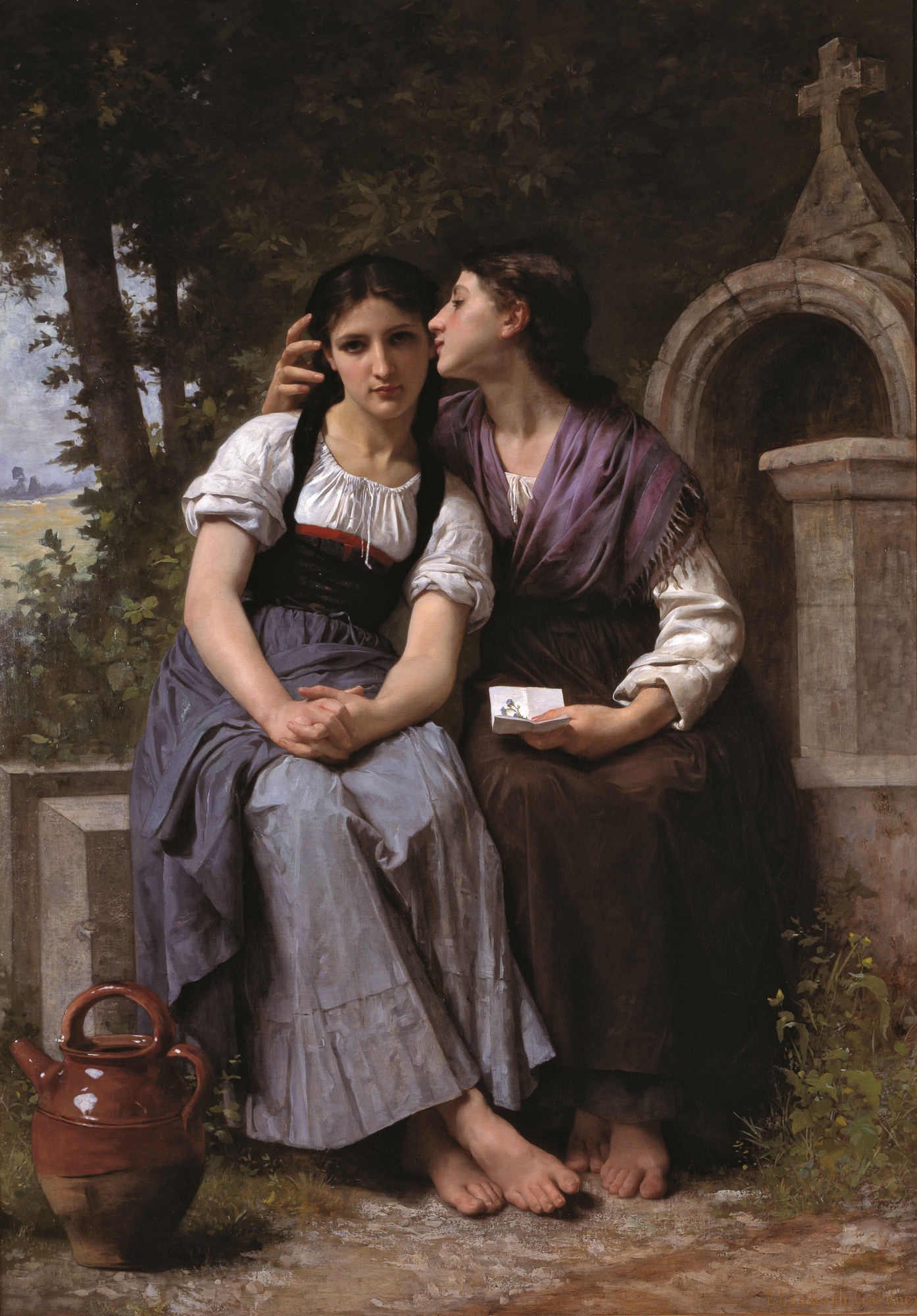
Elizabeth_Jane_Gardner_-_La_Confidence_(1880)So, how can we use the surface elements to convey a message or to poke fun at a social norm? In other words, how can we get our books banned in some parts of this fractured world?

In Alice’s Adventures in Wonderland, Lewis Carroll played with the setting by incorporating an unusual juxtaposition of objects and animals. His characters behave and interact with their environment as if the bizarre elements are everyday happenings. The setting has a slightly hallucinogenic feel, making the reader wonder if the characters are dreaming.

Yet, in the Alice stories, the placement of the unusual objects is deliberate, meant to convey a message or to poke fun at a social norm. We just don’t realize it because we’re having so much fun.

Most sci-fi and fantasy novels are set in recognizable worlds that are very similar to where we live. The settings are familiar, so close to what we know that we could be in that world. That is where good worldbuilding creates a literal layer that is immediately accepted by the reader.

Setting, action, and interaction—these components are the surface, and they support the deeper aspects of the story.

The depths of the story are shown in how our characters interact and react to stresses within the overall framework of the environment and plot.

  • Depth is found in the lessons the characters learn as they live through the events.
  • Depth manifests in the changes of viewpoint and evolving differences in how our characters see themselves and the world.

steampunk had holding pen smallCreating depth in our story requires thought and rewriting. The first draft of our novel gives us the surface, the world that is the backdrop.
In the first draft, all we are concerned with is getting the structure of the story down and the characters in place with their personalities. Our subconscious mind will insert clues, little breadcrumbs hinting at what lies in the depths below the surface of our story. We might think they are clearly shown, but a beta reader might tell you they need a little more clarification.

The first draft is only the framework of the story, even if you have written “the end.” The true depths of the narrative and the emotions experienced by our characters are yet to be discovered.

The mysterious things that lurk in the depths of the story will begin to reveal themselves in the second draft.

Once you have written “the end” on the first draft, set the narrative aside for a few weeks and then go back to it. That is when the real writing begins.

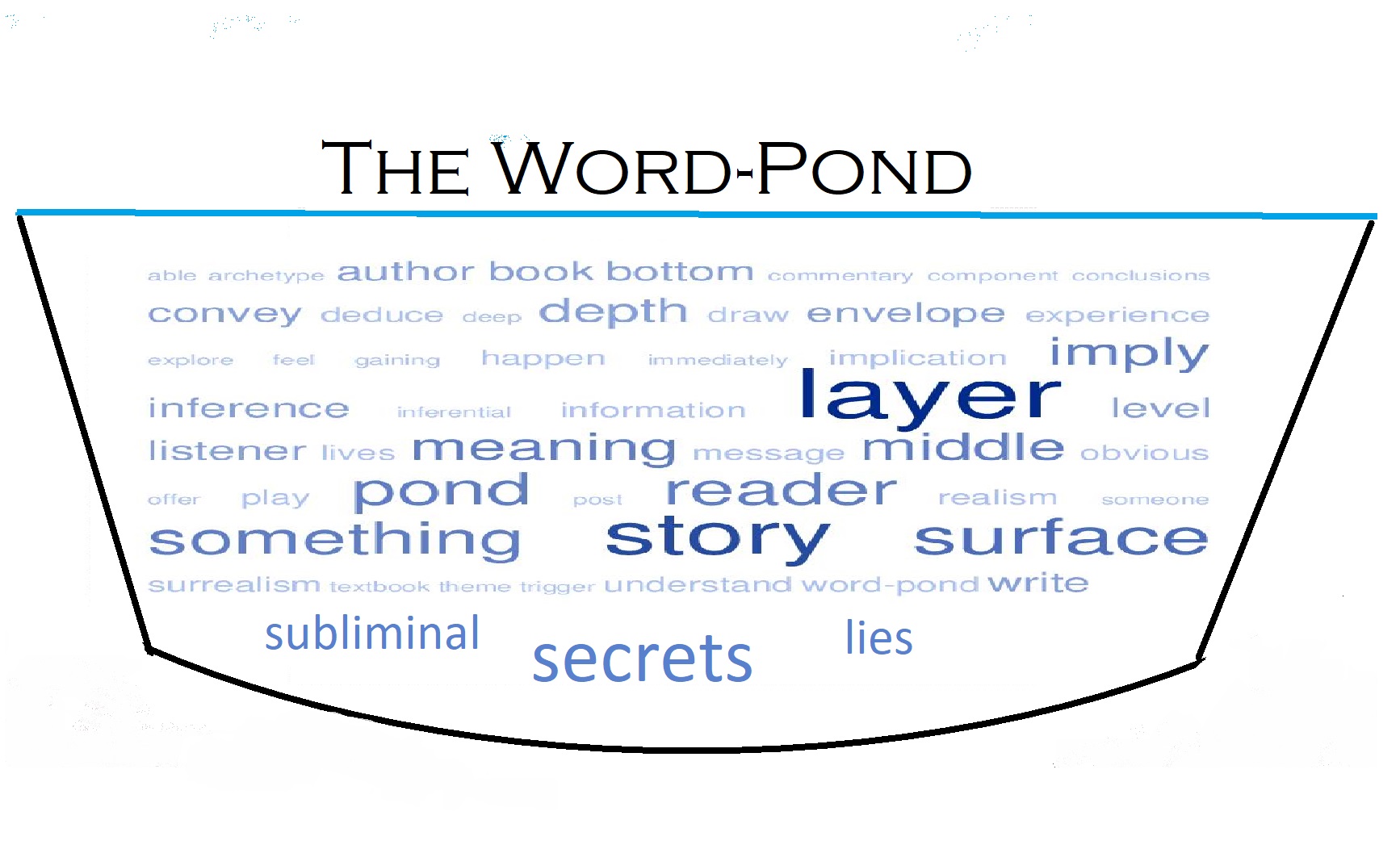
Depth_word_cloud (50 words)-page-001


Credits and Attributions:

IMAGE: Photograph, McLain Pond in July, © 2018 – 2024 by Connie J. Jasperson, from the author’s private photos.

IMAGE Wikimedia Commons contributors, “File:Pieter BRUEGHEL Ii – The tax-collector’s office – Google Art Project.jpg,” Wikimedia Commons, the free media repository, https://commons.wikimedia.org/w/index.php?title=File:Pieter_BRUEGHEL_Ii_-_The_tax-collector%27s_office_-_Google_Art_Project.jpg&oldid=708678946 (accessed December 9, 2022).

IMAGE: Sunrise at Lake Laanemaa at Orkjärve Nature Reserve, Estonia.  Wikimedia Commons contributors, “File:Laanemaa järv Orkjärve looduskaitsealal.jpg,” Wikimedia Commons, https://commons.wikimedia.org/w/index.php?title=File:Laanemaa_j%C3%A4rv_Orkj%C3%A4rve_looduskaitsealal.jpg&oldid=801967887 (accessed September 17, 2023).

IMAGE: Wikimedia Commons contributors, “File:Elizabeth Jane Gardner – La Confidence (1880).jpg,” Wikimedia Commons, the free media repository, https://commons.wikimedia.org/w/index.php?title=File:Elizabeth_Jane_Gardner_-_La_Confidence_(1880).jpg&oldid=540767709 (accessed April 22, 2021).

2 Comments

Filed under writing

Worldbuilding part 1 – checklist for creating societies #amwriting

Worlds are comprised of plants, animals, and geology. But if intelligent life forms live in that world, societies will also exist.

WritingCraftWorldbuildingWe humans are tribal. We prefer an overarching power structure leading us because someone has to be the leader. We call that power structure a government.

As a society, the habits we develop, the gods we worship, the things we create and find beautiful, and the foods we eat are evidence of our culture.

If your society is set in modern suburbia, that culture and those values will affect your characters’ view of their world. You will still have to build that world on paper. But the information and maps are all readily available, perhaps in your own backyard.

But what if you are writing a sci-fi or fantasy novel? You must create the background material to show your world logically and without contradictions.

  • Authors must know how society works in their created cities and towns.
  • They must know the technology whether it is set in a medieval world or on a space station.

Merchants, scientists, priests, soldiers, teachers, healers, thieves – no matter the setting, each occupation has specific technology. They may also have a place in the social hierarchy, people they can and cannot associate with.

Society is always composed of many layers and classes. Below is a list of what I think of as “porch questions.”

This is the stage where I sit on the back porch and consider the world my characters will inhabit. Going somewhere quiet and pondering these questions brings clarity to my vague ideas.

The following is a list of points to consider when creating a society. Feel free to copy and paste it to a page you can print out. Jot the answers next to the questions and refer back to it if the plot raises one of these questions.

How is your society divided? Who has the wealth?

  • Is there a noble class?
  • Is there a servant class?
  • Is there a merchant class
  • Is there a large middle class?
  • Who makes up the most impoverished class?
  • Who has the power, men or women—or is it a society based on mutual respect?

Ethics and Values: What constitutes morality, and how do we treat each other?

  • Is marriage required?
  • How are women treated?
  • How are men treated?
  • How are the different races viewed?
  • Is there a cisgenderbias, or an acceptance of different gender identities?
  • How are same-sex relationships viewed?
  • How are unmarried sexual relationships seen in the eyes of society?
  • How important is human life?
  • How is murder punished?
  • How are betrayal, hypocrisy, envy, and avarice looked upon?
  • What about drunkenness?
  • How important is the truth?
  • What constitutes immorality?
  • How important is it to be seen as honest and trustworthy?
  • What is taboo? What is “simply not done” among that group?

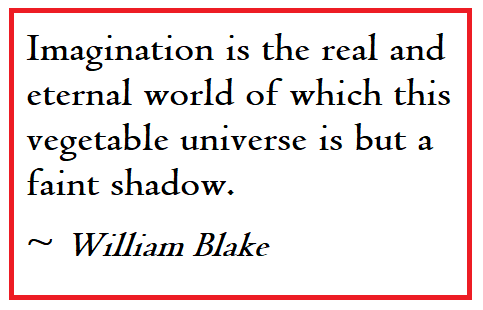
WilliamBlakeImaginationLIRF05072022Power structures are the hierarchies encompassing the leaders and the people with the power. Government is an overall system of restraint and control among selected members of a group. Think of it as a pyramid, a few at the top governing a wide base of citizens.
Religion is rarely a sci-fi trope but often figures prominently in fantasy work. In sci-fi, science and technology often take the place of religion or are at odds with it. They both have similar hierarchies and fanatics, but with different job titles.

Archbishop might be replaced with Head of Research and Development.

Cardinal or Pope might be replaced with GeneralAdmiral, or CEO (Chief Executive Officer).

Level of Technology: What tools and amenities are available to them? What about transport?

  1. Hunter/Gatherers?
  2. Agricultural/farming?
  3. Greco-Roman metallurgy and technology?
  4. Medieval metallurgy and technology?
  5. Pre-industrial revolution or late Victorian?
  6. Modern-day?
  7. Or do they have a magic-based technology?
  8. How do we get around, and how do we transport goods? On foot, by horse & wagon, train, or space shuttle?

Government: There will be a government somewhere, even if it is just the local warlord. Someone is always in charge because it’s easier for the rest of us that way:

  1. Is it a monarchy, theocracy, or a democratic form of government?
  2. How does the government fund itself?
  3. How are taxes levied?
  4. Is it a feudal society?
  5. Is it a clan-based society?
  6. How does the government use and share the available wealth?
  7. How do the citizens view the government?

Crime and the Legal System: What constitutes criminal behavior, and how are criminals treated?

Foreign Relations: Does your country coexist well with its neighbors?

  • If not, why? What causes the tension?

Excalibur London_Film_Museum_ via Wikipedia

Excalibur, London Film Museum via Wikipedia

Waging War: This is another area where we have to ask what their level of technology is. It is critical for you, as the author, to understand what weapons your characters will bring to the front. You must also know what the enemy will be packing. Do the research and choose weaponry that fits your established level of technology.

  • What kind of weaponry will they use?
  • How are they trained?
  • Who goes to battle? Men, women, or both?
  • How does social status affect your ability to gain rank in the military?

A common trope in fantasy is magic, which brings up the need to train magic-gifted people. Do your sorcerers/mages rely on

  • dumb luck and experimentation?
  • apprenticing to sorcerers?
  • training by religious orders?
  • or as in the case of Harry Potter, a school of some sort? What are the rules of your magic?

The Church/Temple is the governing power in many real-world historical societies. The head of the religion is the ruler, and the higher one rises within the religious organization, the more power one has. The same is true of both universities and research facilities.

Power in the hands of only a few people offers many opportunities for mayhem. Zealous followers may inadvertently create a situation where the leader believes they are anointed by the Supreme Deity. Even better, they may become the God-Emperor/Empress.

lute-clip-artThe same sort of God complex occurs among academicians and scientists. Some people are prone to excess when presented with the opportunity to become all-powerful.
If you were unsure what your plot was before you got to this stage, now you might have a real villain, one presented to you by your society.

What sort of society do you envision in your world? How does that culture shape your characters?

Being the leader means bearing responsibility when things go wrong. Scrambling to keep things afloat occurs far more often than basking in the glory.

When things are going well, it’s good to be the queen.

However, the Tiara of Shame weighs heavily when things go awry—and that is when we have a story.

19 Comments

Filed under writing

Post NaNoWriMo World Building part 1 – creating the physics of magic #amwriting

I read fantasy novels as much as I read in any other genre. In reading five books a week, I come across both indie and traditionally published work in all genres. Many are books I cannot recommend. A sad truth is, both sides of the publishing industry are guilty of publishing novels that aren’t well thought out.

How the written universe works magic and superpowers1Fantasy is and always has been my favorite genre. I became a fan when I first read the Hobbit at the age of nine. I have read countless works written by people who understood how to construct a plot and set it in a believable world. These classics trained me to notice contradictions in what I read, whether in a magic system or elsewhere in a book.
Inconsistencies are usually only one aspect of a poorly planned fantasy novel. One can see how an author was unaware of contradictions as they emerged during the writing process. They wrote the story as it came to them and didn’t check for logic or do much revising. They wrote the first draft, edited it, and published it, trying to keep to the three or four book a year schedule that many gurus tout as the way to gain readers.

I believe keeping to this kind of schedule is unreasonable and wish some of my favorite traditionally published authors weren’t contractually obligated to produce that many novels a year. It results in shallow, throw-away books written by people whose first books were brilliant, thought-provoking novels I wished I had written.

For me as a reader, the struggle is the story.

I like fantasy novels where the author has taken the time to devise a science of magic. When magic has limitations, story is forced to become character driven. It details how the protagonists develop the skills to overcome the roadblocks in their path and succeed in their quest.

Magic should exist as an underlying, invisible layer of your written universe, the way gravity exists in reality. We know gravity works and accept it as a part of daily life.

I use the physics of light photons as an example of how magic should behave. Photons can do some things, and they cannot do others. Magic is not science as we know it but should be logical and rooted in solid theories.

Several things to consider in designing a story where magic and superpowers are fundamental plot elements:

First, you must decide if the ability to use magic is either

  • learned through spells,
  • an inherent gift,
  • or both.

Your world should establish which kind of path you are taking at the outset.

magicI can suspend my disbelief when magic is only possible if certain conditions have been met. The most believable magic occurs when the author creates a system that regulates what the characters can do.

Magic is believable if 

  • the number of people who can use it is restricted to only a small number.
  • the ways it can be used is limited.
  • most mages are constrained to one or two kinds of magic.

It becomes slightly less believable when some mages can use every type of magic, but if the author explains that exception well and limits that kind of power to only a chosen few, I will keep reading.

Why restrict your beloved main character’s abilities? No one has all the skills in real life, no matter how good they are at their job.

Expertise in any field requires practice and dedication, working on the most minor details of technique.

  • Magicians and wizards should develop skills and abilities the way musicians do.

Virtuosity requires complete dedication and focus. Some are naturally talented but without practice they never rise to the top.

Magic becomes believable when the author defines what each kind of magic can and cannot do.

  • Those rules should define the conditions under which magic works.
  • The same physics should explain why it won’t work if those conditions are not met.

Are you writing a book that features magic? I have a few questions that you may want to consider:

  • Are there some conditions under which the magic will not work?
  • Is the damage magic can do as a weapon, or is the healing it can perform somehow limited?
  • Does the mage or healer pay a physical/emotional price for using or abusing magic?
  • Is the learning curve steep and sometimes lethal?

When you answer the above questions, you create the Science of Magic.

So, what about superpowers? Aren’t they magic?

scienceSuperpowers are both science and something that may seem like magic, but they are not. Think Spiderman. His abilities are conferred on him by a scientific experiment that goes wrong.
Like science and magic, superpowers are believable when they are limited in what they can do. These limitations provide excellent opportunities for plot development.

If you haven’t considered the challenges your characters must overcome when learning to wield their magic or superpower, now is a good time to do it.

  • Are they unable to fully use their abilities?
  • Why are they handicapped?
  • How does their inability affect their companions?
  • How is their self-confidence affected by this inability?
  • Do their companions struggle to master their skills too?
  • What has to happen before your hero can fully realize their abilities?

I want you to understand that these are only my opinions as a reader, and I employ these theories in my own work. The limits an author places on magic, science, or superpowers are barriers to success, and overcoming those roadblocks is what the story is all about

magicWhile an ordinary life is comforting to those of us who simply long for peace and stability in our daily lives, we read for adventure. The story must take an average person, someone who could be your friend, into an extraordinary future.

The struggle must push the characters we grow to love out of their comfortable environment. It must force them to be creative, and through that creativity, our favorite characters become more than they believe they are. I become invested in the outcome of the story.

The next post will delve into powers that are familiar tropes of speculative fiction and fantasy: healing and telepathy.

9 Comments

Filed under writing

Worldbuilding part 2: The Fantasy Map – Creating Geography #amwriting

Our modern lives are ruled by the geography of our area. Rivers, mountains, lakes, and ponds impede travel, forcing a road to go around them.

Untitled.pngworldbuilding-maps-LIRF07052022Unfortunately, maps have fallen out of favor thanks to satellite technology and the GPS in our cell phones. Many people don’t know how to read a map.
However, maps (and the ability to understand them) are a useful tool for authors of fantasy and speculative fiction, or indeed, any fiction set in any place and time.

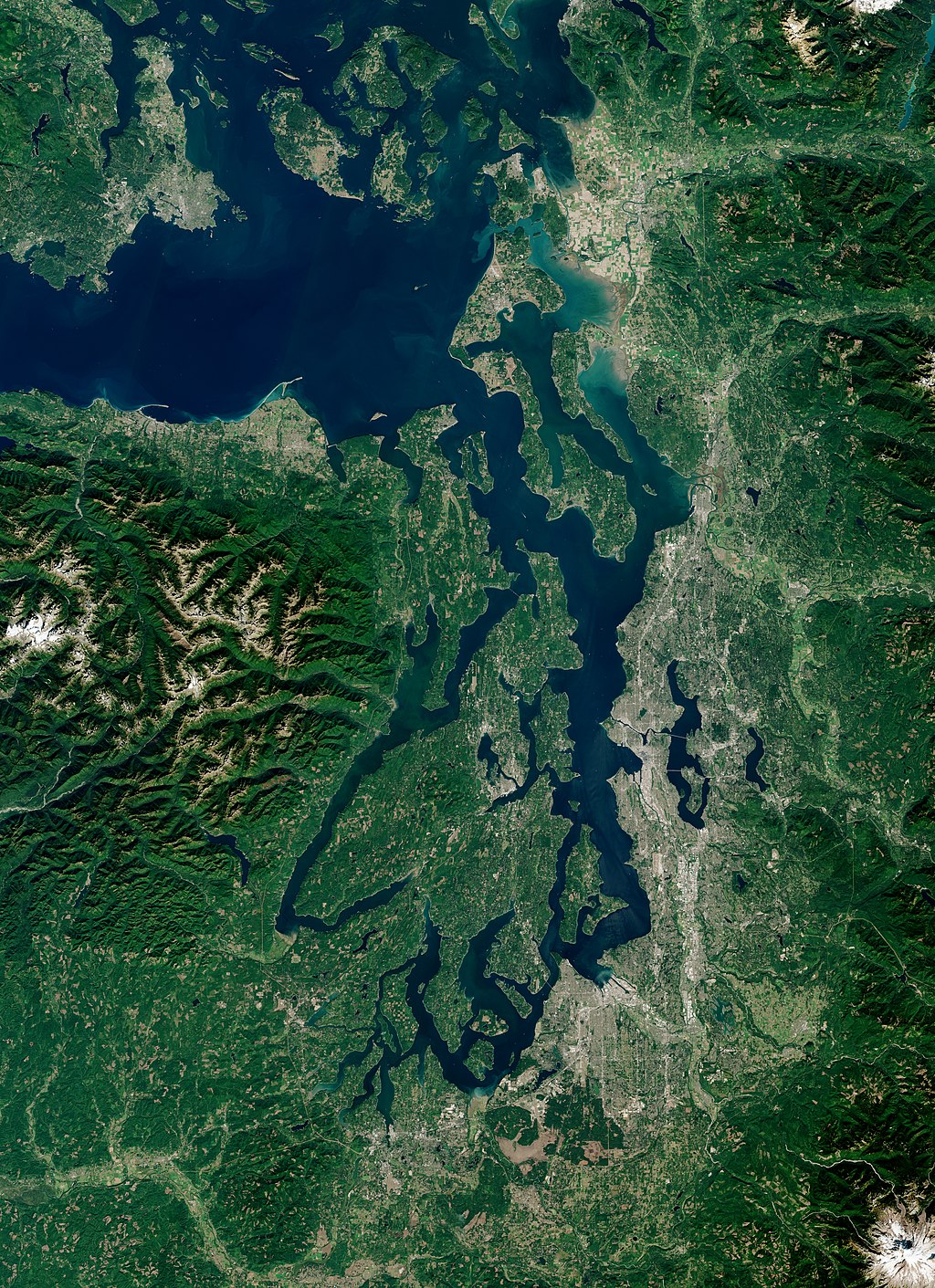
1024px-Puget_Sound_by_Sentinel-2,_2018-09-28_(small_version)

Satellite View of Puget Sound by Sentinel 2

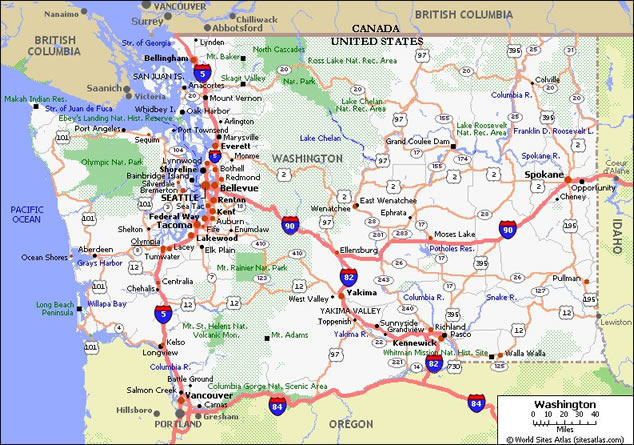
Where I live, Puget Sound‘s shoreline determines the interstate highway’s path and the locations of cities and towns. Those detours add to the distance we must travel and increase the time it takes to go from one place to another.

The stylesheet is one of the most valuable tools an author can have to aid them in worldbuilding. It costs nothing to create but is a warehouse of information about your work-in-progress.

I suggest you include a glossary of created words, names, a list of sites where you got your research, and myriad notes related to that novel. Those are bits of knowledge you will be glad you made a note of, as they will contribute to the believability of your narrative.

If you are writing a contemporary novel or historical work set in our real world, this is where you keep maps and maybe a link to Google Earth.

If you are interested, a post on creating a stylesheet is here: Designing the Story.

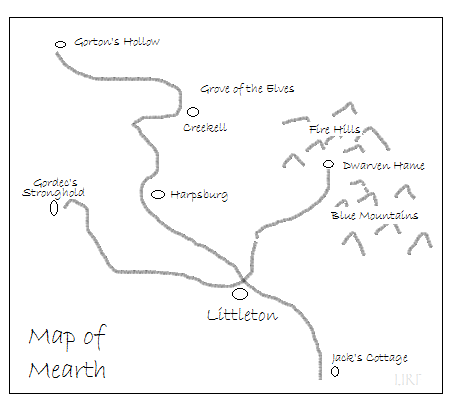
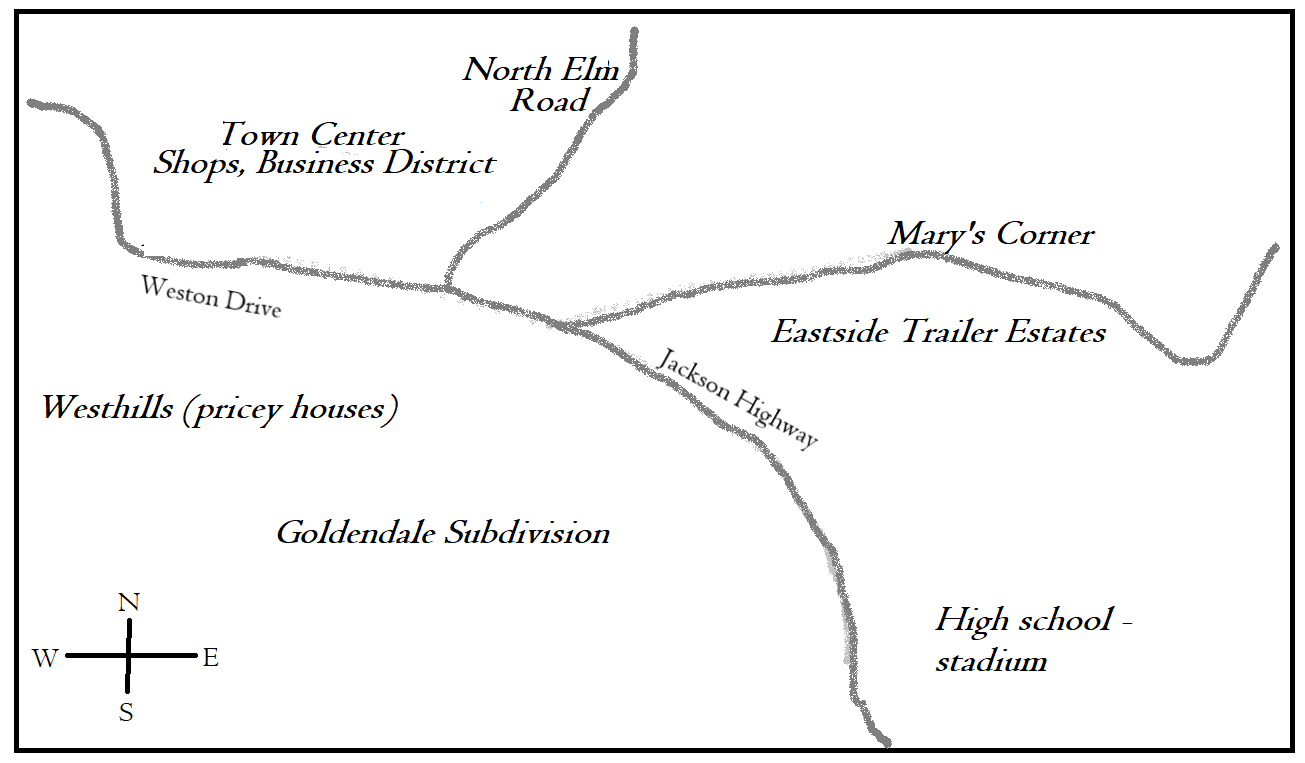
protomapIf you are designing a fantasy world, you only need a pencil-drawn map. Place north at the top, east to the right, south to the bottom, and west to the left. Those are called cardinal points and the position of north at the top and the directions east, south, and west following at 90-degree intervals in the clockwise direction is standard in modern maps.
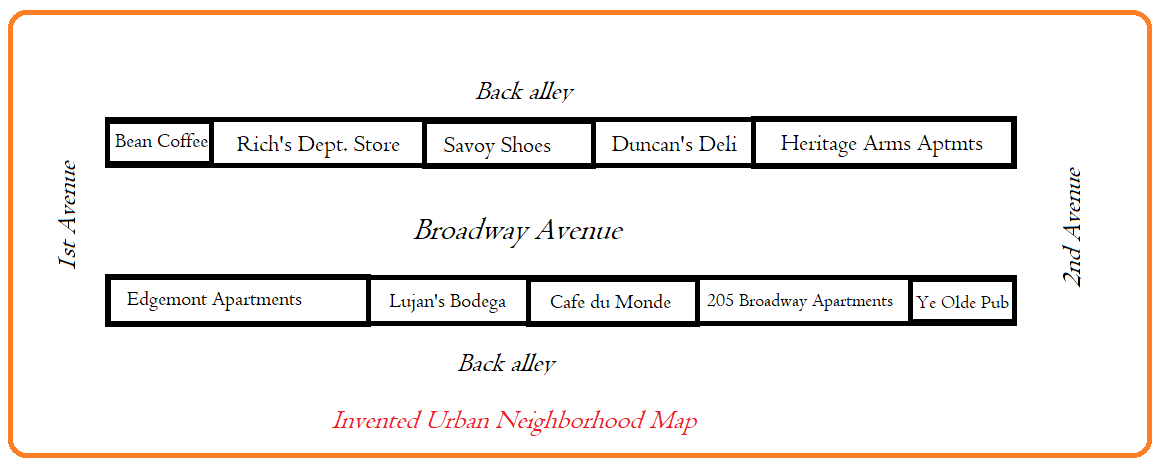
Even if your story is set in a town, you need to map it out. Knowing which direction your people are going at the outset is critical if your characters are going from one spot to another. The lines and scribbles you add to your map are the information you can use to check for consistency in your narrative.

If, in chapter one, Hero leaves home and follows the river north to the Big City of Smallville, he won’t reach home in time to save his mother if he then races east in chapter ten. He must return south, and your notes on your little map will help you remember this.

Or perhaps Hero lives in a city and wants coffee at the shop two blocks north of his apartment. He will have to return past the same shops and buildings he passed on the way. If some of the action occurs in those buildings, you want to have your map out and update it as needed.

proto_city_map_LIRF07052022Use a pencil, so you can easily note whatever changes during revisions. Your map doesn’t have to be fancy. Lay it out like a standard map with north at the top, east on the right, south at the bottom, and west on the left.
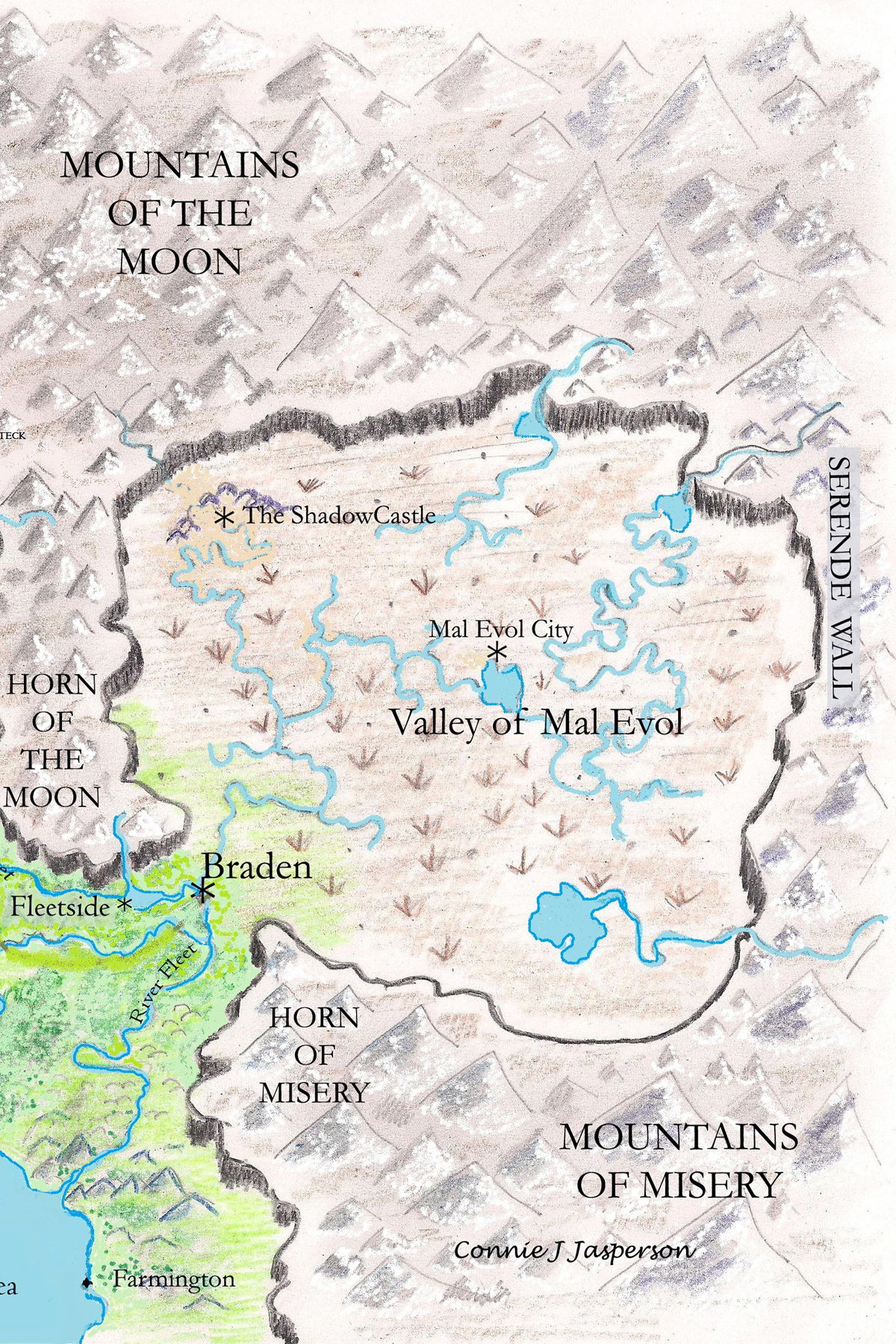
You may need to note where rivers and forests are situated relative to towns, or in the case of towns, what streets and cross streets our Heroes must travel.

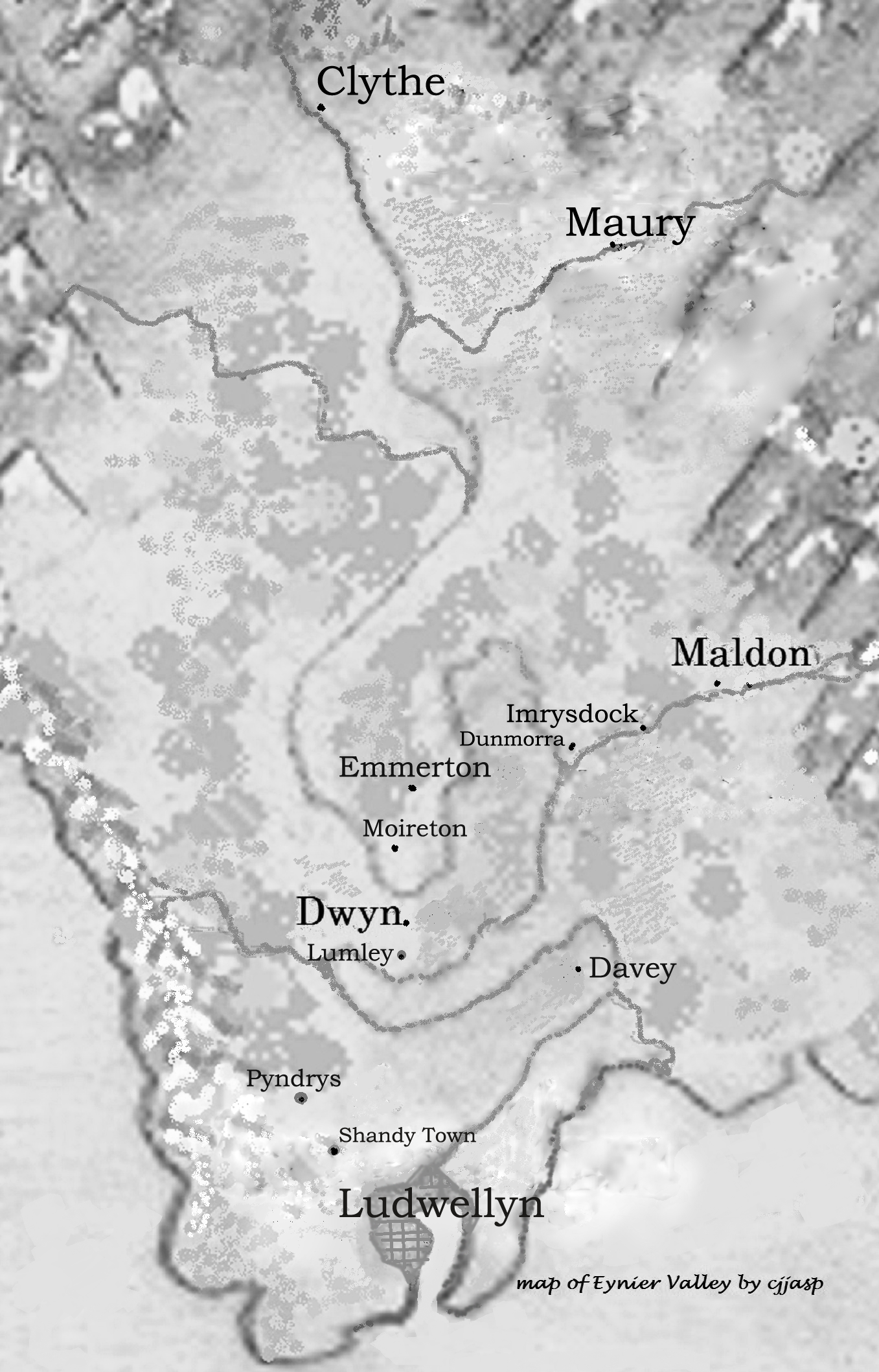
Map of Mal Evol, color full size, no roadsMany towns are situated on rivers. Water rarely flows uphill. While it may do so if pushed by the force of wave action or siphoning, water is a slave to gravity and chooses to flow downhill. When making your map, locate rivers between mountains and hills.
A river may emerge from a mountain spring or a glacier, but it will flow downhill to a valley where it will either continue on to the ocean or will pool and form lakes and ponds. Farms are usually situated near sources of water.

On your fantasy map, rivers, mountains, lakes, and ponds make travel difficult, forcing a road or trail to go around them. This creates opportunities for plot points, because the struggle is the story.

Those detours add to the distance and increase the time it takes to travel using the common mode of transportation.

Having a realistic grip on time is critical to keeping the narrative believable. I keep a calendar of events for each novel, which has saved me several times.

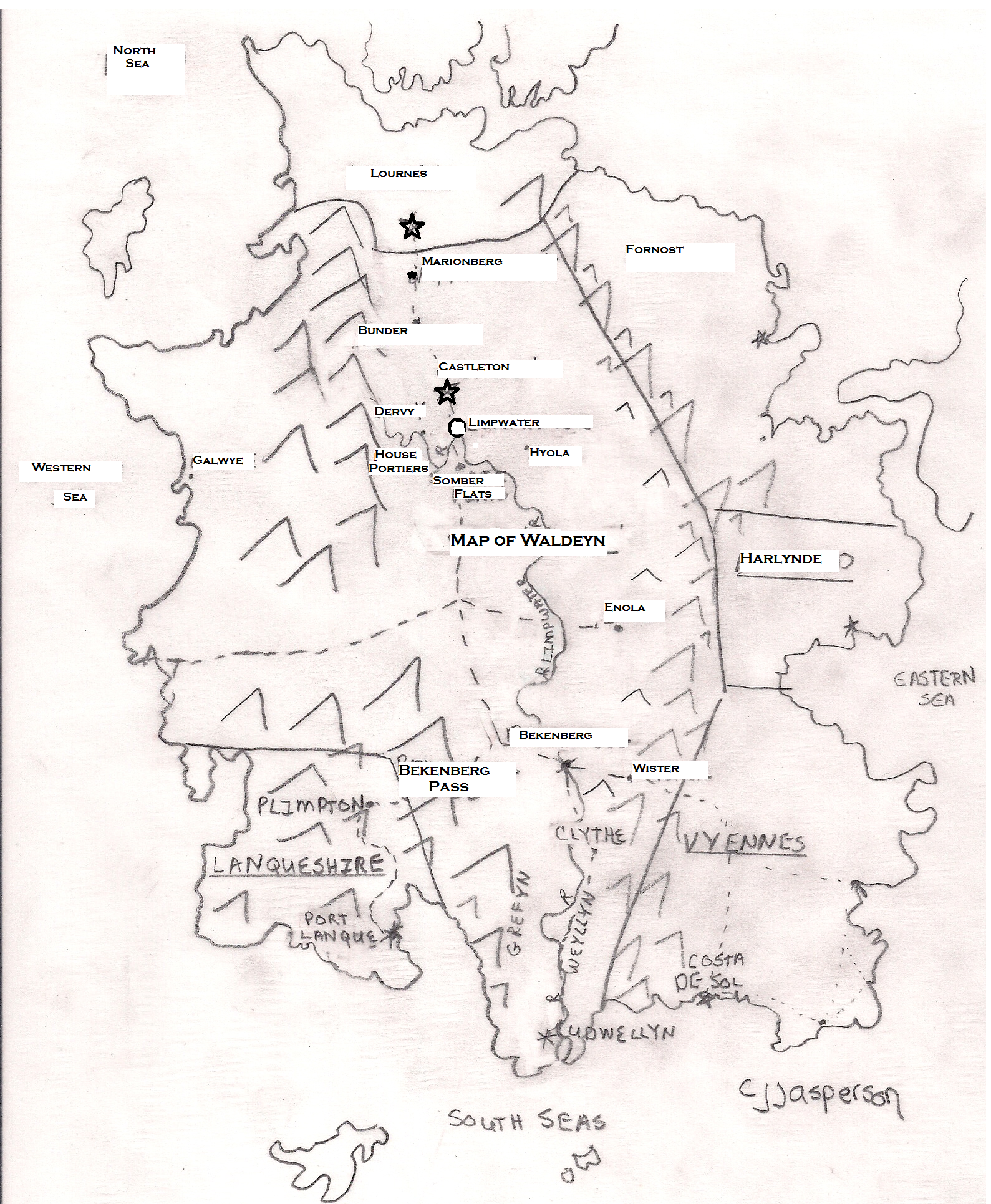
Map of WaldeynMaybe you aren’t artistic but will want a nice map later. In that case, a little scribbled map will enable a map artist to provide you with a beautiful and accurate product. An artist can give you a map containing the information readers need to enjoy your book.
Are changing seasons a part of your story?

In a first draft, it’s challenging to fit the visual world into a narrative without dumping it on the page because you are in the process of inventing it. Don’t worry about fine details when you are laying down the story. Go ahead and write “It was autumn” when you have an action scene that must be shown.

A blunt statement like that is a code embedded there for you to expand on in the second draft. It is there so that you can just get the story out of your head and move on.

However, in the revision process, I take those three words, it was autumn, and change them up, using them to lead into the action.

Ivan drew his cloak around himself, listening to the soft rattling of branches moving with the breeze. The occasional calls of night birds went on around him, as if he weren’t full of doubt and indistinct fears, as if he didn’t exist to them. Leaves fell, brown and harvest-dry, drifting, spiraling down to the forest floor.

3-Ss-of-worldbuilding-LIRF07182021In my part of the world, the native forest trees I see in the world around me are mostly Douglas firs, western red cedars, hemlocks, big-leaf maples, alders, cottonwood, and ash. Because I am familiar with them, these are the trees I visualize when I set a story in a forest.
When it comes to geography, the “three S’s” of worldbuilding are critical: sights, sounds, and smells. Those sensory elements create what we know of the world. What does your character see, hear, and smell? Taste rarely comes into it, except when showing an odor.

Silently, she ran back to the entrance, slipping from boulder to boulder until she disappeared into the shrubbery. Once hidden in the thick undergrowth, she breathed deeply. The metallic aftertaste of terror and bitter air lingered in her imagination, overriding the musty scents of earth and leaves.

What makes up your written world? How does your environment affect the way your characters live?

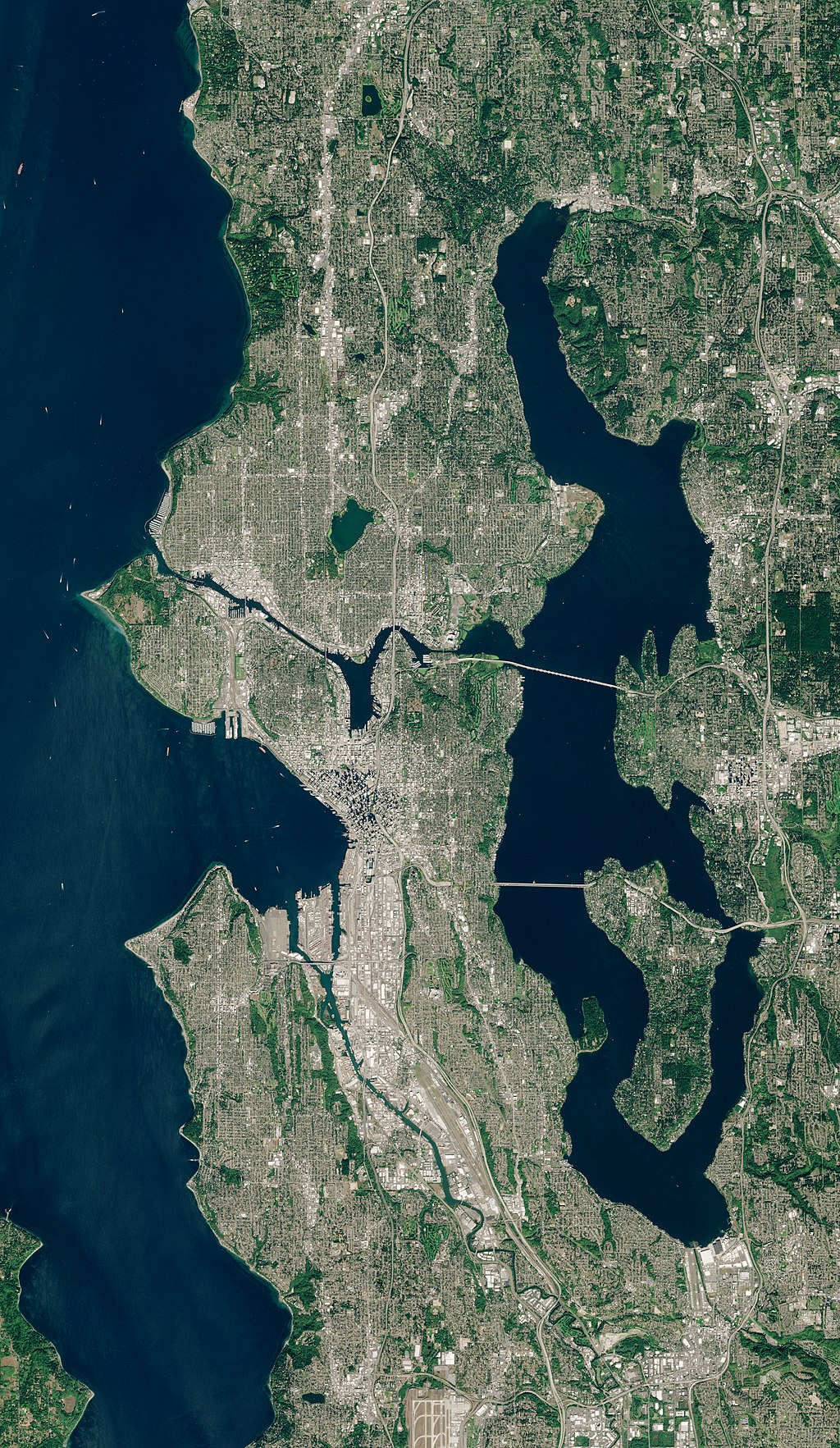
Seattle_by_Sentinel-2,_2018-09-28

Seattle, by Sentinel 2 Satellite

Cities have complex geography. It is created by the terrain the city was built on and its architecture.

The odors behind the Flamingo Bar and Grill offered a pungent counterpoint to the aromas of burgers and barbecue emanating from inside. Above the back door, the weak bulb flickered but remained on, illuminating the litter.

Seattle is built between the salty waters of Puget Sound, and the fresh waters of Lake Washington, the largest natural lake in western Washington. This geography affects our modern society by limiting where highways can be built, as well as determining the good places to raise tall buildings or create suburban neighborhoods.

Humans have always created communities where resources are plentiful. Rivers, forests, lakes–these geographical places provide resources that allow towns to become cities.

Your narrative will mention all the different terrains and obstacles your characters must deal with. A little map scribbled on notepaper will help you keep things on track.


Credits and Attributions:

Image: Satellite View of Puget Sound, Wikimedia Commons contributors, “File:Puget Sound by Sentinel-2, 2018-09-28 (small version).jpg,” Wikimedia Commons, the free media repository, https://commons.wikimedia.org/w/index.php?title=File:Puget_Sound_by_Sentinel-2,_2018-09-28_(small_version).jpg&oldid=670161517 (accessed July 4, 2022).

Image: Satellite View of Seattle, Wikimedia Commons contributors, “File:Puget Sound by Sentinel-2, 2018-09-28 (small version).jpg,” Wikimedia Commons, the free media repository, https://commons.wikimedia.org/w/index.php?title=File:Puget_Sound_by_Sentinel-2,_2018-09-28_(small_version).jpg&oldid=670161517 (accessed July 4, 2022).

6 Comments

Filed under writing

Worldbuilding part 1: Climate and How We Acquire Food #amwriting

When we sit down to write fiction, no matter what genre, we must consider two aspects of worldbuilding: food and how the climate affects what is served for our fictional meals.

WritingCraftWorldbuildingEvery fantasy world has a setting, and that environment has a climate. Certain climates limit the variety of foods available.

First, let’s look at real life. You can’t create a believable fantasy unless you have some idea of reality.

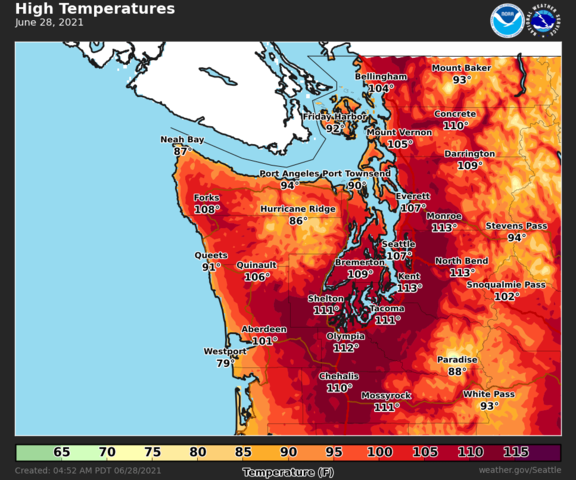
We had a normal June this year, with only one day rising into the 90s and the rest almost (but not quite) as they should be: overcast, rainy, and cool. Climate-wise, we Pacific Northwesterners usually have similar weather as those of you in Wales or England.

Washington_state_high_termperatures_June_28,_2021

United States National Weather Service via Twitter

Last year in June 2021, we had an unprecedented heat wave that killed much of our locally produced crops. How did that heat wave affect crop production here in the Pacific Northwest?

Wikipedia says:

Farms experienced serious losses, as the heat wave baked the fruits and berries or otherwise destroyed the crop and the drought conditions worsened.

10 million pounds of fruit a day were being harvested in the Pacific Northwest at the time the heat wave struck. Farmers in Eastern Washington, facing a loss of the cherry and blueberry crop, sent workers into orchards at night to avoid the heat in the day.

The British Columbia provincial fruit growers’ association estimated that 50 to 70 percent of the cherry crop was damaged, effectively “cooked” in the orchards.

Raspberry and blackberry farms in the Lower Mainland, Oregon and Washington also endured losses. In Whatcom County, Washington, which produces four-fifths of raspberries in the United States, estimates varied from quarter to half of the harvest; elsewhere, they went as high as 80-90%. Lettuce producers in the Okanagan Valley also reported crop losses, and so did those who grew Christmas trees and apples. [1]

This year, 2022, June had an overabundance of rain, but I didn’t complain because the memories of last year’s heat wave were still too strong. However, the excessive rain and lack of sunshine impacted our spring and early summer crops.

An article by Mai Hoang for Crosscut News (June 15, 2022) says:

This year, the cold and wet spring stunted the development of many cherries, leading to what looks to be the smallest crop of Northwest sweet cherries in nearly a decade. [2]

If I were writing a speculative fiction story set in Earth’s near future, I would look at current agricultural technology to see what is possible and to gauge future trends. After all, climate change is happening and must be accounted for, even in futuristic fiction.

Apples 8-25-2013We know from bitter experience that weather affects the food we produce and influences what is available in grocery stores. Abnormal heat waves across temperate states, category 4 hurricanes along the Atlantic seaboard and the Gulf of Mexico, and category 4 tornadoes down the center of the US and Canada, and even deep freezes in Texas and the deep south have been our lot in the last five years.
We humans must adapt our agriculture to withstand our increasingly unpredictable climate if we hope to survive. And, our fiction must reflect it, whether it is set in the current times or a not-too-distant future.

In real life, a new trend in agriculture is occurring. Farmers in Europe and Canada are increasingly turning to greenhouse agriculture, from small, owner-operated farms to industrial farms. Greenhouses in these countries reliably supply seasonal produce year-round, with far less need for chemical pesticides and highly efficient water use.

The Statistical Overview of the Canadian Greenhouse Vegetable Industry, 2019, tells us that the Canadian greenhouse vegetable sector is the largest and fastest-growing segment of Canadian horticulture. Greenhouse farming produces agricultural products in self-contained ‘controlled environments’ with systems supplying heat, water, and nutrients and often employing artificial lighting (in addition to sunlight) to nourish the plants. [3]

Wikipedia tells us: Greenhouses may be used to overcome shortcomings in the growing qualities of a piece of land, such as a short growing season or poor light levels, and they can thereby improve food production in marginal environments. Shade houses are used specifically to provide shade in hot, dry climates.

As they may enable certain crops to be grown throughout the year, greenhouses are increasingly important in the food supply of high-latitude countries. One of the largest complexes in the world is in AlmeríaAndalucíaSpain, where greenhouses cover almost 200 km2 (49,000 acres).

The Netherlands has some of the largest greenhouses in the world with around 4,000 greenhouse enterprises that operate over 9,000 hectares of greenhouses and employ some 150,000 workers. [4]

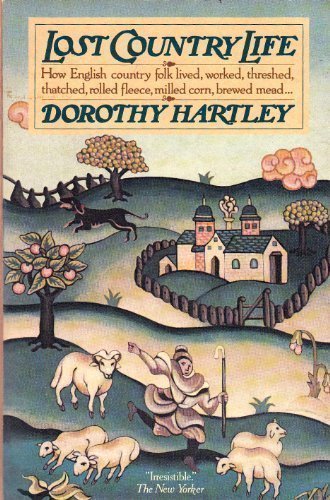
Lost_Country_Life_HartleyOnce you have decided your historical era, terrain, and overall climate, research similar areas of the real world to see how weather affects their approach to agriculture and animal husbandry. Look into the past to discover ancient agricultural methods to see how low-tech cultures fed their large populations:
Wikipedia says this about Incan Agriculture: Farmers usually had many different, scattered plots of land on which they planted a variety of crops. If one or more crops failed, others might be productive. In many areas of the Andes, farmers, communities, and the Inca state constructed agricultural terraces to increase the amount of arable land. [5]

Are you writing a narrative set in our current or near-future world? Post-apocalyptic stories often feature food shortages, detailing how starvation leads to civil unrest, making life unsafe for those clinging to their homeland. Refugees are driven to seek better lands where they may not be welcomed. This, in turn, often leads to more civil unrest.

Historical fiction must also be true to the type of food available in that area and era. Many common foods we now consume anywhere in the world were only available in South America, or in Europe, or in Asia, or in Africa. It wasn’t until after the time of Columbus that the cultivation and propagation of many now-common foods began to travel all over the world.

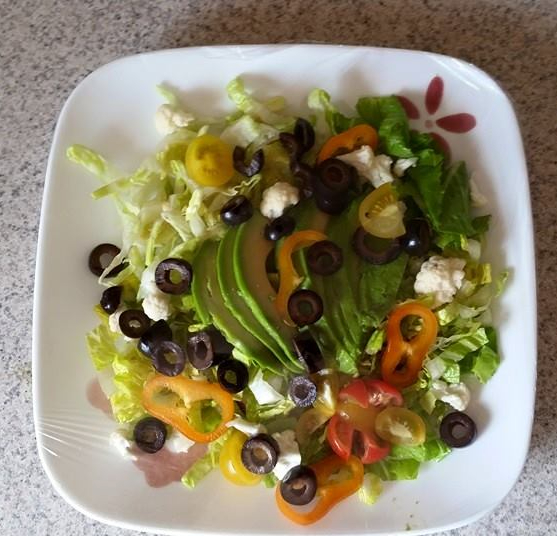
avacado dinner saladAlso, if your story is set in a particular era, how plentiful was food at that time? Famines occurring all across Europe and Asia over the last two-thousand years are well documented. Egyptian, Incan, and Mayan history is also fairly well documented so do the research.
Weather is a driving force in our real world. Rain, heat, storm, or drought—weather in its many forms destroys homes, destroys crops, and costs us billions of dollars annually.

How it affects our food supply is not just news for television. It is a reality our governments must consider if they hope to stave off civil unrest in the future. Subsidizing greenhouse agriculture could help resolve future food insecurity and make the best use of limited water resources.

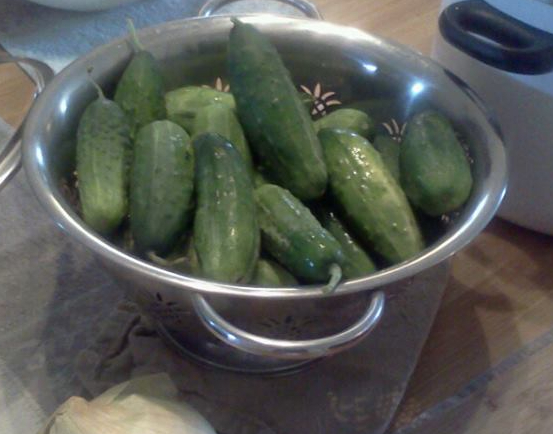
Cucumbers waiting to become picklesWe have witnessed monumental changes since the turn of the millennium. We know California teeters on the edge of disaster, that a water shortage threatens the lives of millions, as well as one of the largest agriculture industries in the US.

Food and water insecurity leads to volatile politics.

Sit and think about your world, about the climate and how it affects the society you are writing about. Let your mind wander with no apparent destination. You will be amazed at what a mind technically at rest can come up with when it’s allowed to roam.

How well will your fiction hold up in two decades? Will you have the foresight of those who founded the genre of speculative fiction? Will you write another Nineteen Eighty-Four or Fahrenheit 451? How much will you get right?

Build detail into your world in a separate document from your manuscript. Blend what you know about the real world into it. Write out all the details that will never make it into your story.

When you can see your written world as clearly as that which exists outside your windows, that vision will come across in your writing. The food they so casually serve, a meal that involves less than a paragraph, will be a part of the scenery. It won’t jar a knowledgeable reader out of the narrative.


Credits and Attributions:

[1] Wikipedia contributors. 2021 Western North America heat wave [Internet]. Wikipedia, The Free Encyclopedia; 2022 Jul 1, 03:55 UTC [cited 2022 Jul 2]. Available from: https://en.wikipedia.org/w/index.php?title=2021_Western_North_America_heat_wave&oldid=1095905315. (Accessed July 2, 2022.)

[2] Quote: NW cherry crop this year may be the smallest in nearly a decade, Mai Hoang June 15, 2022, ©2022 Cascade Public Media. All Rights Reserved. https://crosscut.com/news/2022/06/nw-cherry-crop-year-may-be-smallest-nearly-decade (accessed July 2, 2022). Fair Use.

[3] Statistical Overview of the Canadian Greenhouse Vegetable Industry, 2019, Statistical Overview of the Canadian Greenhouse Vegetable Industry, 2019 – agriculture.canada.ca updated, 2020-12-30. (Accessed July 2, 2022).

[4] Wikipedia contributors, “Greenhouse,” Wikipedia, The Free Encyclopedia, https://en.wikipedia.org/w/index.php?title=Greenhouse&oldid=1095255341 (accessed July 2, 2022).

[5] Wikipedia contributors, “Incan agriculture,” Wikipedia, The Free Encyclopedia, https://en.wikipedia.org/w/index.php?title=Incan_agriculture&oldid=1095070716 (accessed July 2, 2022).

9 Comments

Filed under writing

Food, culture, and what your characters eat #amwriting

I write books set in fantasy environments. An important part of worldbuilding includes the appropriate food for your level of technology.

feeding your fictional charactersSeveral years ago, I read a fantasy book where the author clearly spent many hours on the food of her fantasy world and the various animals. She gave each kind of fruit, bird, or herd beast a different, usually unpronounceable, name in the language of her fantasy culture.

The clumsy way she inserted the information into the narrative ruined what could have been a great book for me.

The book started out well, and I really liked the characters. It was a portal story, and the group had been dropped into a strange world. One of the local farmhands agreed to be their guide.

However, every time the protagonists halted their journey, they pulled some random fruit with a gobbledygook name out of the bag and waxed poetic about it. As they passed each field or forest, their guide would stop and explain the various fruits, herbs, and creatures in nearly scientific detail.

As a reader, I think Tolkien got the food right when he created the Hobbit and the world of Middle Earth. Food is an essential component of a culture but should be only briefly mentioned. Whether commonplace or exotic, it should be similar enough to known earthly foods to create an atmosphere a reader can easily visualize.

Plow_medievalAs many of you know, I have been vegan since 2012. However, during the 1980s, my second ex-husband and I raised sheep. Most of the meat we served in our home was raised on his family’s communal farm. Our chickens and rabbits roamed their yard and had good lives, and our family’s herd of twenty sheep was managed using simple, old-style farming methods.

We were self-employed in the photography industry and were able to rotate whose turn it was to spend a week caring for the animals. Fortunately, my sister-in-law’s husband was Palestinian. He ensured our sheep were raised and butchered according to halal dietary laws.

I could write a book about those five years, but no one would believe it.

I grew up fishing with my father and have a first-person understanding of what it takes to put meat, fish, or fowl on the table when a supermarket is not an option.

Take my word for this: getting a chicken from the coop to the table is time-consuming, messy, and stinks. We had as many vegetarian meals as we did those featuring meat of some kind.

Village_scene_with_well_(Josse_de_Momper,_Jan_Brueghel_II)

Village Scene with Well, Josse de Momper and Jan Brueghel II PD|100 via Wikimedia Commons.

That experience taught me many things. As far as food goes, in a medieval setting, meat, fish, and fowl won’t be served every day in the average person’s home.

Yes, it is a real job to slaughter and prepare it for the table, but other, more subtle factors come into play, things that affect the logic of your plot.

In the Middle Ages, the wool a sheep could produce in its lifetime was of far more value than the meat you might get by slaughtering it. For that reason, lamb was rarely served. The only sheep that made it to the table were usually rams culled from the herd.

Chickens were no different because you lose the many meals her eggs would have provided once a chicken is dead. Young roosters, however, were culled before they got to the contentious stage and were usually the featured meat in any stew that might be on a Sunday menu. Only one rooster was kept for breeding purposes and if he was too ill-tempered, he went into the stew pot and a young rooster with better manners took his place.

Cattle and goats were also more valuable alive. Cows were integral to a family’s wealth as they were milk producers and sometimes worked as draft animals. Only one bull would be kept intact for breeding purposes in a small herd. The others would be neutered, made into oxen and draft animals that pulled plows, pulled wagons, and did all the work that heavy farm machinery does today.

In medieval times, it was a felony for commoners in Britain to hunt for game on many estates. Poachers were considered thieves and faced hash penalties, horrific by our standards if they were caught.

However, most people were allowed to fish as long as they didn’t take salmon, so fish was on the menu more often than fowl, sheep, or cattle. Eels were a menu staple.

Pieter_Bruegel_the_Elder_-_Peasant_Wedding_-_Google_Art_Project_2

Pieter Bruegel the Elder – Peasant Wedding (1526/1530–1569) via Wikimedia Commons

Therefore, eels, eggs, dried beans and peas, grains, and vegetables were easy and figured most prominently on the menu. Pies of all sorts were the fast-food of the era, often sold by vendors on the street side or in bakeries.

Wheat was rare and expensive. For that reason, the grains most often found in a peasant’s home were barley, oats, and most importantly, rye.

Common vegetables in medieval European gardens were leeks, garlic, onions, turnips, rutabagas, cabbages, carrots, peas, beans, cauliflower, squashes, gourds, melons, parsnips, aubergines (eggplants)—the list goes on and on. And fruits?

Wikipedia says:

Fruit was popular and could be served fresh, dried, or preserved, and was a common ingredient in many cooked dishes. Since sugar and honey were both expensive, it was common to include many types of fruit in dishes that called for sweeteners of some sort. The fruits of choice in the south were lemons, citrons, bitter oranges (the sweet type was not introduced until several hundred years later), pomegranates, quinces, and grapes. Farther north, apples, pears, plums, and wild strawberries were more common. Figs and dates were eaten all over Europe but remained rather expensive imports in the north. [1]

For the most part, my characters eat a medieval/agrarian diet. In medieval times, peasants ate more vegetables, grains, fruits, and nuts than the nobility. The primary source of protein would be eggs and cheese, and fish. Herbal teas, ale, ciders, and mead were also staples of the commoner’s diet because drinking fresh, unboiled water was unhealthy. Medieval brews were more of a meal than today’s beers.

In my world of Waldeyn, the setting for Billy Ninefingers, when food is mentioned, it’s likely to be oat or bean porridge, soup or fish stew, ale or cider, or bread and cheese.

Billy is captain of a mercenary company and an innkeeper, and for most of his story, he does the cooking. I keep the food simple and don’t make too big a deal out of it. The conversations that happen while he is trying to feed the Rowdies are more important than the food. The food is the backdrop.

avacado dinner saladKnowing what to feed your people keeps you from introducing jarring components into your narrative. In Mountains of the Moon, set in the world of Neveyah, my people have a melding of familiar New World ingredients for their diet and do a lot of foraging. For a good list of what this diet might entail, go to this link: Indigenous cuisine of the Americas. You will be amazed at the variety of common foods that originated in the Americas.

When it comes to writing about meals, I feel it’s best to concentrate on the conversations. The food should be part of the scenery, a subtle part of worldbuilding. The conversations that occur around food are the places where new information can be exchanged, things we need to know to move the story forward.


CREDITS AND ATTRIBUTIONS:

[1] Wikipedia contributors, “Medieval cuisine,” Wikipedia, The Free Encyclopedia, https://en.wikipedia.org/w/index.php?title=Medieval_cuisine&oldid=896980025 (accessed Feb 06, 2022).

The Medieval Plow (Moldboard Plow) PD|100, File:Plow medieval.jpg – Wikipedia (accessed Feb 06, 2022).

Pieter Bruegel the Elder – Peasant Wedding (1526/1530–1569) PD|100 via Wikimedia Commons.

Village Scene with Well, Josse de Momper and Jan Brueghel II PD|100 via Wikimedia Commons.

4 Comments

Filed under writing