Tag Archives: writing craft

The transition scene #amwriting

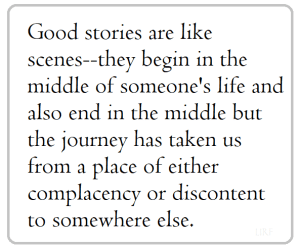
A well-paced narrative has a kind of rhythm. Instructors commonly refer to this as “push, glide, push, glide,” as if skating. What that means is that while the characters might be in the midst of chaos, there is order in the layout and pacing of the narrative.

  • action,
  • processing the action,
  • action again,
  • another connecting/regrouping scene

These “processing” scenes are transitions, moving the plot forward while allowing the reader to process what just happened.

We can’t have non-stop action, as that is exhausting to write and more exhausting to read. The character arc is often at the forefront during these transitional scenes as that period of relative calm is when you allow your characters’ internal growth to emerge.

We justify what just happened, making it believable. It is also where you ratchet up the tension.

When it comes to writing transitions between scenes, we have several paths to choose from.

Introspection:

  • Introspection offers an opportunity for new information important to the story to emerge.
  • It opens a window for the reader to see who the characters are, how they react and illuminates their fears and strengths. It shows that they are self-aware.

Keep the scenes of introspection brief, and go easy on them if you are given to using italics to set them off. A wall of italics is hard to read, so don’t “think” too much if you are using those.

  • Characters’ thoughts must serve to illuminate their motives at a particular moment in time.
  • In a conversation between two characters, introspection must offer information not previously discussed.
  • Internal monologues should not make our characters too wise. Humanize them, show them as a bit clueless about their flaws, strengths, or even their deepest fears and goals.

Conversations:

  • Conversations should not become clumsy info-dumps. “As you know….”
  • Each character must speak uniquely, sounding like themselves. Don’t dump conversations into a blender and pour out a string of commentary that makes them all sound alike.

Don’t get fancy with speech tags/attributions. It’s best for me as a reader when the author avoids words that take me out of the narrative. Some words are eye-stoppers. I recommend you stick with said, replied, answered—common and ordinary  tags that don’t leap out at the reader like ejaculated, disgorged, spewed, and so on. Occasionally, you can get away with more forceful tags, but keep them to a minimum. Make the characters’ actions and words show the force of their words. In my opinion, you can do away with speech tags for some brief exchanges if the scene contains only two characters.

Fade-to-black and hard scene breaks:

I’m in two minds about using fade-to-black scene breaks as transitions. Why not just start a new chapter?

One of my favorite authors, L.E. Modesitt Jr. sometimes has chapters of only five or six-hundred words, which keeps each character thread truly separate and flows well.

In a short story, a hard scene break is sometimes required, as you don’t have the option to do chapters. Use an asterisk or hashtag between scenes. * #

New chapter:

Each of the major players has a point of view. Some authors use the aftermath of an action scene as an opportunity to advance the antagonist’s story line. That is a good strategy, as we do need to show why the enemy is the enemy.

The key is to avoid “head-hopping,” and I feel like the best way to do that is to give a new chapter to the point-of-view character. Head-hopping occurs when an author switches point-of-view characters within a single scene. It happens most frequently when using a third-person omniscient narrative because the thoughts of every character are open to the reader.

My favorite authors will employ all the above listed transitions as they move their characters through the story arc. Each transition will lead us into a new scene, and when they are done right, we the readers won’t even notice that they are transitional.

The transition is the most difficult part of the narrative for me to formulate in the first draft. I get stuck, trying to decide what information needs to come out, and what should be held back.

Sometimes, a transition just will not work no matter what. This happens when a flaw in the logic exists in the scene preceding it. Usually, I can’t see it at that point, but my writing group will show me what the problem is.

This struggle to connect my action scenes into a seamless arc is why writing isn’t the easiest occupation I could have chosen. But when everything comes together, it is the most satisfying job.


Credits and Attributions:

Detail from: Journey of the Magi (East Wall) by Benozzo Gozzoli 1459Magi Chapel of Palazzo Medici-RiccardiFlorence, 1459–1461. Wikimedia Commons contributors, “File:Benozzo gozzoli, corteo dei magi, 1 inizio, 1459, 51.JPG,” Wikimedia Commons, the free media repository, https://commons.wikimedia.org/w/index.php?title=File:Benozzo_gozzoli,_corteo_dei_magi,_1_inizio,_1459,_51.JPG&oldid=179731811 (accessed April 24, 2019).

Wikimedia Commons contributors, “File:Sir Galahad (Watts).jpg,” Wikimedia Commons, the free media repository, https://commons.wikimedia.org/w/index.php?title=File:Sir_Galahad_(Watts).jpg&oldid=277887181 (accessed April 24, 2019).

9 Comments

Filed under writing

The author’s blog #amwriting

Today I want to encourage authors to make use of their websites, by blogging occasionally.

For an author, the goal of a website is not to gain “fans” – it is to gain readers. Your website is a resource that offers readers a place to meet you and see what you are interested in. It is also your storefront, a place where readers can find and buy your books.

Writing three times a week for this blog has helped me grow more confident as a writer. I can write using the “stream of consciousness” method, or I can write it several days in advance. Usually, I put together a quick outline and do the research on whatever aspect of writing has been on my mind, and soon I have written 700 or more words.

I have made many friends through blogging, people all over the world whom I may never meet in person, but who I am fond of, nevertheless. Readers love to talk about what they are reading, and authors want to talk about what they’re writing. Both subjects are obsessions for me.

And I can’t tell you how much I enjoy discussing my little passion for 16th and 17th century Netherlandish art. When I write about a particular artist or picture, I find some new bit of creativity to admire, things that make me almost feel the artist is someone I might know.

I think the best bloggers are those who are passionate about something and who have the courage to write about it. Here are only some blogs I follow:

Lee French – Finding Family in Strange Places

Sue Vincent’s Daily Echo

Aaron Volner

Stephen Swartz’s Deconstruction of the Sekuatean Empire

Chris the Story Reading Ape’s Blog

These are the just the blogs I can think of off the top of my head – in reality I follow many, many more. In fact, if you are already a regular blogger, I am probably following you and reading your posts!

Real life can be a rolling disaster, as everyone knows. This is why I occasionally write about the difficulties of traveling and how hard it is for a vegan to find food on a long road trip. At times, I write about the challenges of having two adult children with epilepsy.

I’ve sometimes written about the dysfunctionality of growing up with a father suffering from battle-related PTSD.

I have also talked about growing up in a family of word-nerds, and the shock of discovering we weren’t “normal.”

Whatever I am thinking about, I post a short piece on it.

If I can do it, so can you.

If you are an author, having a blog on your website and updating it at least twice a month is a good way to connect with your readers on a human level. Readers will enjoy hearing what your writing goals are.  They want to know where you will be signing books, or if you will be at a convention near them. Also, they love to know what you are reading.

I do recommend publishing short pieces occasionally. Bits of flash fiction are fun to write and readers enjoy them. These pieces can find their way into your larger work, as they are a great way to brainstorm ideas.

At the bottom of each flash-fiction piece, I post a disclaimer that it is copyrighted:

  • Bleakbourne on Heath, by Connie J. Jasperson, © 2016 All Rights Reserved

I suppose I am a compulsive blogger. I sometimes think about slowing down, but then I suddenly have an idea that I need to write about. In no time flat, I will have written 500 words. In fact, this post is around 600- 700 words long.

Not a bad length and not too long to write.


Image Credits:

Wikimedia Commons contributors, “File:Rembrandt – Rembrandt and Saskia in the Scene of the Prodigal Son – Google Art Project.jpg,” Wikimedia Commons, the free media repository, https://commons.wikimedia.org/w/index.php?title=File:Rembrandt_-_Rembrandt_and_Saskia_in_the_Scene_of_the_Prodigal_Son_-_Google_Art_Project.jpg&oldid=340120613 (accessed April 17, 2019).

7 Comments

Filed under writing

When creativity fails #amwriting

Every writer has moments when creativity fails them. We sit before our computer and the words refuse to come, or when they do, they seem awkward. At times like this, we feel alone and isolated. After all, an idea is jammed in our head and words should fall from our fingers like water from the tap.

I have suffered this, the same as every author does. However, it never gets too firm a grip on me because I have several exercises that help me write my way through the block. Something we sometimes forget is that the act of writing every day builds mental muscle tone and keeps you fit and in the habit of writing.

Every author suffers a dry spell now and then. Even so, this job requires us to practice, just like music or dancing. Doing well at anything artistic or sports related requires discipline. Just like a retired football player, when we stop writing for any reason, we lose our momentum and our purpose.

We lose our passion.

If you are in the middle of a manuscript and you lose your ability to go forward, save the file and close it. Walk away from that manuscript for a while.

Before we go any further, you must delete nothing. You will come back to your manuscript later with a fresh viewpoint and will be able to use some or all of it, so file it properly.

Occasionally, we get distracted by a different project that wants to be written. When that is the case, I always suggest you go ahead and work on the project that is on your mind. Let that creative energy flow, and you will eventually be able to become reconnected with the first project.

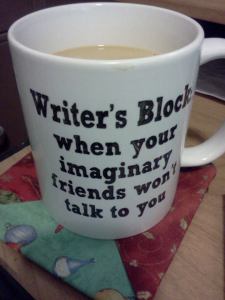
But what about those times when you need to write, you have to write, but the words won’t come? Trust me, it isn’t the end of your career. This is true writers’ block.

First, we have the element of fear to overcome. You are suddenly afraid that you have written everything good that you will ever write, and anything you write now is garbage.

It isn’t the end of everything. You will prove to yourself that you can write. This is a small exercise, very short. It should take you perhaps ten or fifteen minutes each day. My solution for this problem is a combination of mind-wandering and a a few simple writing exercises.

I got the idea for this while in a seminar on the craft of writing essays offered by the bestselling author of Blackbird, Jennifer Lauck.

In that class, Jennifer gave us prompts and asked us to write to them. I have never been good at writing to someone else’s prompts. My ideas don’t flow that way. To make it worse, we were going to have to share them with someone else in the class.

I felt panicky, terrified I wouldn’t be able to write, and would embarrass myself. My mind was blank.

When I saw what Jennifer’s prompt was, it occurred to me that I could do that. I had one of those bolt-of-lightning moments, a tangent to nowhere that didn’t pertain to her class. But it seemed important so I wrote it down. When I got home, I pondered a little more about it and put my thoughts into a short essay.

In that class, I realized that most of the time, writer’s block is a result of not being able to visualize what you want to write about. If you can’t visualize it, you can’t articulate it.

It hits us in two stages, two emotions that are so closely related, it feels like one horrible emotion.

  1. If you can’t visualize it, you can’t describe it. This can create a brief flash of panic.
  2. Once you have experienced that moment of complete inability, fear that it will happen again magnifies the problem until it paralyzes us.

This is the writing prompt Jennifer Lauck used as the first exercise in her class:

  1. Open a new document. At the top of this document type: Where I Am Today:

This is going to be a literal interpretation and description of your surroundings:

  • Look around you and see the place where you are.
  • Briefly describe the environment you are sitting in, what you see.
  • Describe how you feel sitting in that place.

Just give it two or three paragraphs. For me, sitting here at this moment and writing this post, it runs like this:

I sit in the small third bedroom of my home. It’s my office, a cluttered storeroom, known here as the Room of Shame. A cup of cooling coffee sits beside my elbow, as does my cell phone. My desk holds many books on the craft of writing and also my computer.  

Stacks of cardboard boxes filled with things that were, at one time, deemed important to keep, surround me. Filing cabinets full of legal papers, tax forms, and research take up space, all stuffed with the debris of our business life.

I could easily clean this space. It would take no time at all, perhaps a day at most. It’s a mountain I put off climbing.

See? At the end of this exercise, you have written a small short story.

But, more importantly, you have written the setting for a scene. Those paragraphs are around 120 words and are nothing special. But they were words and I wrote them, which keeps my mind functioning in a writing mode.

  1. For your next exercise, go somewhere else and take your notebook. Write three more paragraphs detailing what you are looking at, and how you fit into it, and how it makes you feel.

You could do that on your porch, in a coffee shop, or the parking lot at the supermarket, but go away from your normal writing space. Just write a few paragraphs about the space you have come to, what you see, and what you sense.

The third exercise is more abstract:

  1. Where do you want to be? Visualize and describe it the same way as you described the places you could see, a few short paragraphs. For me, I want to be flying my kite on Cannon Beach.

Your practice work is for your eyes alone. No one has to see it if you don’t want to share it.

If you do these three exercises at the same time every day, describing the environments and your perceptions in a different space each time, even when you have nothing to say that is worth reading, you are writing.

It’s a weird thing but writing about nothing in particular is like doodling. It is a form of mind-wandering. It can jar your creative mind loose. With perseverance, you will be writing your other work again.

The important thing is to write every day, even if it is only a few paragraphs. These are the exercises that work for me and which I recommend for working through writer’s block.

Remember, if you are suffering from a temporary dry spell, you are not alone. We all go through those times. When you want to talk about it, you will find friends here.

16 Comments

Filed under writing

Plotting and Agency #amwriting

Sometimes when I am writing the first draft of a novel, the characters take over, and the plot veers far away from what I had intended when I first began writing it. Even though I am a plotter, this happens because my work is character driven and sometimes, they’re erratic drivers.

When that happens, I have to sit down and look at my outline, then make adjustments. Usually, the ultimate ending never changes, but the path to that place can go quite far afield from what was originally intended. My task at that point is to keep the plot moving in such a way that it flows naturally. The characters must still act and speak as individually as I envision them.

This is called giving your characters “agency” and is an integral aspect of the craft of writing. Allowing your characters to make decisions that don’t necessarily follow the original plot outline gives them a chance to become “real.”

Many times, the way to avoid predictability in a plot is to introduce a sense of danger early, a response to an unavoidable, looming threat. How our characters react to that threat should feel unpredictable. When you let them act naturally, they will emerge as real, solid characters.

In literary terms, “agency” is the ability of a character to surprise the author, and therefore, the reader. If, when you are writing them you know their every response, it can feel canned, boring. Their reactions must surprise you occasionally.

For me, there are times when my characters drive the keyboard, making their own choices. Other times, they go along as I, their creator, has planned for them. Ultimately, they do what I intend for them, but always they do it their own way and with their own style.

Plotting, for me, means setting out an arc of events that I will then create connections to. Because my characters act independently, the order of events changes. New events are added. My plot outline must continually evolve with them so that I don’t lose control of the arc, and go off on a bunny trail to nowhere. This evolution of the outline happens because as I get to really know my characters, they make choices that surprise me.

They have agency.

When I begin planning a new novel, plotting is important because introducing an unavoidable threat early limits the habit I have of writing too much backstory. Plot outlines don’t allow much time for the characters to go about “life as normal” rather than going on an adventure. “Normal” is boring.

As they move through the events leading toward the final showdown each character will be left with several consequential choices to make in each situation. Allowing the characters to react to each incident that takes them out of their comfort zone is good.

The final event will happen in a situation where they have no choice but to go forward. By that point, their personalities are fully formed. How they react feels natural, because they have been growing as human beings over the course of the story.

Consequences are the most important aspect of any story when it comes to the choices my characters must make. I say this because if there are no consequences for bad decisions a character might make, everyone goes home unscathed and I won’t have much of a story.

So, while I am an outliner and plotter, I do fly-by-the-seat-of-my-pants to a certain extent. Those moments are beautiful, flashes of creativity that make this job the best job I ever had.

8 Comments

Filed under writing

Characterization #amwriting

The stories that interest me most have a strong character arc.  The protagonist begins as one sort of person, and through the events they experience, they are transformed. Often they change for the better, but sometimes the change is for the worse.

Each time I open a new book, I want to meet a circle new of friends, each of whom is distinguishable from the other characters. Every one of them must be a unique person with a distinctive thought process. What choices will they make, and how will those decisions affect their life?

Consequences are key to the forward momentum of the plot.

I have used the word consequences before when talking about the choices our protagonist must make. I use that word intentionally. If there are no consequences for bad decisions, what is the story about?

Equally, I want the side-characters and antagonist to be just as singular with their reactions and choices as the protagonist is.

A bit of unpredictability to a character’s nature keeps them interesting. They have an air of mystery—how will they react in a given situation? It must be slightly random, but please, keep it real and in character.

In other peoples’ work, I particularly notice when a protagonist or side-kick’s gut reaction causes them to act out-of-character for the person they have been portrayed as, up to that point. Am I able to see it in my own? I hope so.

Even in a fantasy setting, all the characters must be believable. If the author introduces an elf to me, I want to believe in that elf. I want to see him/her as if they are real throughout the entire story. I want to be invested in them for their entire arc, and I want to care what happens to them.

The motivations are crucial. What drives them and what will they do to achieve their goal. Just as importantly, what will they NOT do? What is out of character for them?

The obstacles your characters face and the choices they make in those situations are the story. Giving your characters an active role and allowing them agency is what drives a great, absorbing story. Agency is the power of an individual to act independently. When we give the protagonist/antagonist agency, we allow them to make their own free choices.

When I am first writing any story, giving my characters agency is difficult to do. This is because, in the first draft of my manuscripts, the motives of my protagonist haven’t quite come into focus for me. I tend to allow a character’s choices to push their personal growth.

At some point in every great novel, the protagonists may lose their faith or have a crisis of conscience. In the second draft, I see this moment as an opportunity to learn who they really are as individuals. The events leading to that point break the character, knocking them down to their lowest emotional state. How do they react? What keeps them pushing on in the face of such despair?

At times, I have a character I simply can’t figure out. I do a character study, and in that short document, one of the questions I ask myself is “What personal revelations come out about them?” Also, I ask, “What does he discover about himself?”

When those questions are answered, I look at the final event, the situation that ends the story. These people’s personal quirks and characteristics, their moral compass influenced the decisions that led them to that place.

Did I keep those clues distinct to that character, or was there a blurring of personalities, making the group all sound and look alike?

Most importantly, those people must have understandable motivations. We can’t be too obscure in trying to keep the air of mystery because if a reader can’t follow our protagonist’s reasoning, we haven’t done our job.

It’s part of the balancing act—creating intrigue yet making it believable. As I have said many times, this is a gig where I never stop learning and trying to grow in the craft. Reading is the key. Every story that leaves a mark on my heart has unique, individual characters that I can relate to. Even if I don’t like them, their motivations make sense because they are in line with how that character would think.

If I can visualize my characters as real people that I know and believe in, hopefully my readers will believe in them too.

8 Comments

Filed under writing

The Apostrophe #amwriting

Today we’re looking at the sometimes confusing apostrophe. It has many uses, but I will only delve into the most common ways we use it in creative writing today.

In creative writing, the apostrophe is a small morsel of punctuation that, on the surface, seems simple. However, certain common applications can be confusing, so as we get to those I will try to be as concise and clear as possible.

First up, we all know that we use the apostrophe to denote possession:

  • This is George’s cat. (George owns this cat.)
  • This is Jorgensen’s cat. (A person who is going by the surname of Jorgensen owns the cat.)

Where this gets a little tricky is in the possessive form of a surname when it refers to the whole family. In this case, you insert a grammatical article (the) and make the name plural, and then add the apostrophe:

  • This is the Jorgensens’ cat. (The Jorgensen family owns the cat.)

If the Jorgensen family have a sign made for their front porch, they would have it made to read “The Jorgensens’ Home” (not “The Jorgensen’s Home,” as that would imply that only one Jorgensen lives there, and his legal name is “The Jorgensen.”)

When two or more people (or other entities such as businesses) are described as separately owning something, each name should be in the possessive form:

  • “Ralph’s and Janet’s cars are the same model.”

However, if Ralph and Janet share possession, include an apostrophe and an s after the last name only:

  • “Ralph and Janet’s car is a Prius.”

In some cases, we need to use plurals of abbreviations. In a military thriller, you might need to say, “They disarmed several IEDs.” (We would not use an apostrophe: IED’s.)

Writing a year numerically has been an area of confusion for me. This is because I rarely have had to write years in this way until recently and the use of an apostrophe for this is now considered outdated. However, this is how they should be written:

  • The tavern culture of the 1600s was flourishing. (1600’s would not be considered incorrect, just old fashioned.)
  • Dresses in the 1960s were shorter than in previous years.

An apostrophe should follow a number only if it is possessive.

  • It was 1985’s worst storm. (Some editors feel this is awkward, but I let it stand when I see it in a manuscript.)

Numbers are frequently written numerically when writing books for middle grade and YA readers, as these stories often center around schools and sports.

A single digit, such as 7, is made plural with the addition of an s: 7s

Insert an apostrophe to denote possession when you must use a number to stand in for a person in an article, such as when an athlete is identified by a uniform number:

  • Number 8’s tackle won the day.

Contractions can be confusing. Two words made into one word are joined by an apostrophe:

  • Do not = don’t
  • We are = we’re
  • You are = you’re
  • They are = they’re

And so on. A list of contractions to watch for can be found at the fount of all knowledge, Wikipedia: Wikipedia: List of English contractions

Conjunctions also can be tricky.  Simply add an s, such as in the phrase “There are no ifs, ands, or buts about it” or “A list of dos and don’ts follows.” We do keep the contractive apostrophe in don’t and simply add an s to make it plural.

Sometimes a single letter looks awkward when we just use an s to indicate plurality.

“How many h’s do you spell shh with?” (hs would look very odd.)

When pluralizing capital letters, we don’t use an apostrophe: Mike earned three Ds in English this year but still passed the class.

In a narrative, the two most common missions apostrophes have are to denote possession or indicate a contraction.

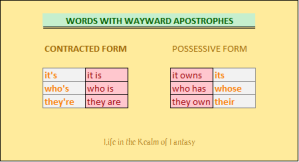
  • Who’s is the contraction of “who is” or, less commonly, “who has.”
  • Whose is the possessive of “who” or, somewhat controversially, “which.”
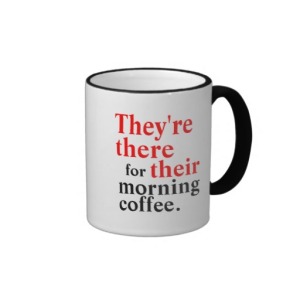
  • Their(s) is the possessive of “they.” (They’re proud to own it, it’s theirs, and it’s not there.)
  • Its is the possessive of “it,” and “it’s” is a contraction of it is.

Note that for both they and it, there is no apostrophe in the possessive form.

  • The texture of the wall —it’s rough. ( contraction: it is rough.)
  • I scratched myself on its surface. (possession: the wall’s surface.)

In most English words an apostrophe indicates possession but can also indicate a contraction. The difficulty arises in the fact that both it and they are frequently part of contracted words.

In the effort to standardize English usage, early linguists made a choice to eliminate the apostrophe in the possessive form. They did this in the (futile) hope of ending confusion.

  • It’s is the contraction of “it is” and sometimes “it has.”
  • Its denotes possession: It owns it.
  • Their: they own it
  • They’re: they are

As with so many things that “seemed like a good idea at the time,” its and it’s will always cause problems for new and beginning writers. Inadvertent misuse happens even for old hands like me when I’m zipping along laying down the first draft of a manuscript, especially during NaNoWriMo.

We have to be vigilant and ensure we have looked for proper usage of its and it’s during revisions. Even the big traditional publishing houses admit sneaky errors like those like to go unnoticed until after publication.

In closing, the most common uses of the apostrophe aren’t too difficult once we learn the rules. Remember, apostrophes are integral parts of the traffic control system, signals that keep your words moving along at the right rate. Using them the way they are intended (and which readers expect) keeps the reader from throwing your book away.

I always suggest you set some time aside for writing new words every day, even if only for fifteen minutes. When we force ourselves to think about and use the basic rules of grammar regularly, we retain what we have learned.

26 Comments

Filed under writing

Honesty in Writing #amwriting

As writers, we are entertainers. We write books for people who want a diversion from the daily grind. No matter what the subject or genre is, we write escapes, windows into other lives, other places, other realities. When we offer the book to the public, we hope the reader will stay with us to the end, hope they find the same life in the narrative that we thought we were imparting when we wrote it.

This can only happen if we are honest. When I first started out, I wrote poetry, lyrics for a heavy metal band. I was young, sincere, and convinced I had to impart a message with every word. I didn’t know until twenty years later when I came across my old notebook—my poems weren’t honest. I wasn’t honest with myself, and when I looked back at my work, I could see the falseness clearly. My words were contrived, formed too artfully. They shouted, “Look at me! I’m young and full of angst, but I’m talented and artsy!”

When I began writing stories for my children, I still wrote crap, but it was honest crap. I no longer had anyone to impress—children are never impressed by parents who write. They are also quite honest about where a story fails to impress them, and why. I began to write fairy tales that were honest, but not written by an educated author.

With that as my training ground, learning how to make my writing enjoyable became a goal. It was there that I discovered that, besides writing honestly, an author needs to be consistent with punctuation. I had no idea I was uneducated—after all, I had done well in school.  Even so, I had to re-learn the fundamentals of American English grammar because my first real editor pointed out that I hadn’t retained much of what I was taught in elementary school.

As Ursula K. LeGuin said in her wonderful book, Steering the Craft, A 21st Century Guide to Sailing the Sea of Story, “If you aren’t interested in punctuation, or are afraid of it, you’re missing out on some of the most beautiful, elegant tools a writer has to work with.”

My rule is to embrace what I fear, so I embraced grammar. I’m not perfect, but I make an effort.

I have always been a reader, enjoying books in every genre and style.  While the books I love are scattered all across the spectrum, they have one thing in common—they are all written by authors with an understanding of the basic rules of punctuation. Sure, they break other rules of grammar with style and abandon, but they do pay attention to punctuation.

This is because punctuation is the traffic signal telling the reader to go, slow, pause, yield, go again, or stop. Punctuation at most of the right places allows the reader to forget they are reading and encourages them to suspend their disbelief.

Writers begin as readers. In his book, On Writing, Stephen King gives us permission to read for six hours a day, should we so desire. Reading is how we come to understand writing and the art of story. (He also admonishes us to learn the fundamentals of punctuation and grammar.)

In my quest to understand the art of story I have come across some pretty awful books. I don’t consider “hard to read because it is written in an old-fashioned style” awful. However, I do consider “hard to read because the author wasted my time” awful.

Contrived prose is not poetic. Hokey and forced situations are not exciting. Perfectly beautiful people bore me. Long passages about clothing and furnishings bore me.

Write me an honest story about “real” people with real problems, one that comes from your deepest soul. Set it in outer space, or the Amazon Jungle—I don’t care. I read all genres and all settings. I will forgive imperfect grammar and punctuation for a great story that rings of truth and touches my heart.

Let me sink into your story. Let me forget the world—let me become so into the book I forget to cook dinner.


Credits and Attributions:

Quote: Ursula K. LeGuin, Steering the Craft, A 21st Century Guide to Sailing the Sea of Story, ©1999 Ursula K. LeGuin, First Mariner Books Edition 2015, page 11.

10 Comments

Filed under writing

The sound of the narrative #amwriting

Reading aloud is a great way to quickly discover the places I want to revise. I have always read portions of my work aloud, a page or two at a time. The places where I stumble are usually always the places that need ironing, so to speak.

In the past, I have only gone to this trouble with sections that I felt had some indefinable thing wrong with them. But lately, I’ve been printing out each chapter in its entirety a day or two after I finish writing it, trying to hear where the prose doesn’t work. I use a yellow highlighter on the places that feel rough.

I’m a slow writer, but I have several looming deadlines for contests and anthologies. This seemed like a good way to speed up development, getting short stories from rough draft to finished in a timely fashion.

As anyone who regularly reads this blog knows, I rarely have a piece that is perfectly clean. I am the only eye that sees it before posting. Despite my best efforts, I catch many things the day after something was posted. I always check through my work on the computer screen, and I catch a lot there, but the eye sees what I intended to write.

This bleeds over into my other work. But if I wait a day or two and then read the paper printout with fresher eyes, I find repeated words, dropped words, and all sorts of typos. Even better, reading the printout aloud exposes the rough areas, the places where the words “fight with each other.”

When you are trying to pronounce the words, run-on sentences really stand out, and clunky prose won’t flow well. The narrative reads well for a long stretch, and then it hits a stumbling point.

That yellow highlighter of mine really gets a work out—maybe I’ll have to buy a case of them.

Another thing I have discovered by reading the entire chapter rather than just a page here and there—I can see where I am repeating entire ideas. This is a common problem for me in the first draft.

Having Natural Reader or another reading program do the reading for you helps, and I have made use of that many times. But this experience has shown me that while these wonderful programs are incredibly useful, they don’t do the job quite as well as a human voice does. They often mispronounce words that are heteronyms—words that are spelled the same as another word, but which are pronounced differently and have different meanings.

  • Read (pronounced reed) as in the act of reading
  • Read (pronounced red) as in having already finished reading the book.

Natural Reader rarely guesses those sorts of words correctly. The cadence and rhythm of the narrative is not as clearly heard when the mechanical voice does the reading, even if you are reading along silently. It tends to be rather flat, a monotone.

I’m not talking poetry here, but good prose has movement when it is read out loud. Sometimes it’s fast, sometimes slow, but it should have no rough spots for the reader to stumble over.

What I love about listening to audio books is the way prose sounds when it’s read aloud by an experienced narrator. Some narratives are beautiful when read aloud, and some are not.

If you intend to have your work made into an audio book, you want to make your work easy for the narrator to read without faltering.

So, now I will add ‘printing out and reading entire chapters aloud and marking places that need correction with a yellow highlighter’ as a regular tool in my writer’s toolbox. As long as the old printer keeps limping along, doing its job, this should speed things up.

21 Comments

Filed under writing

Conflict #amwriting

Winter has embraced my Northern home. For the last two weeks, cold and clear days have been followed by freezing, foggy nights. Each morning the roads have been covered with black ice, making the morning commute an adventure. We expect black ice here, but we don’t enjoy it.

The sun was so brilliant I had to locate my sunglasses when I went to my writing group last week. Driving east as the sun rose was like driving into a solar flare.

Alas, this week the rains have returned. But I am warm and dry here in the Room of Shame. I am now rewriting what was spewed forth during NaNoWriMo, turning garbage into something marketable, I hope.

I am taking a piece set in Neveyah, my Tower of Bones world, and rewriting it, so it is a story. This is something that happens to me all the time—4,000 words of a character talking, with no reason for them to be there. I loved the character that emerged, and I wrote what I thought was a story, but something was lacking.

Situations like this are why it is good to have a group of fellow writers whose opinions you value, and who can be trusted to see your work with unbiased eyes. I sensed something was wrong with it but didn’t know what, so I showed it to two of my writing friends, and they both gave me good insights.

What I had written was a character study. My characters are engaging, but there is no obvious obstacle for them to overcome, other than a minor quest for self-knowledge. So, now I am taking these people and that quest and turning it into a larger quest, making it a real story.

The story is for an anthology and can be only 5,000 words long so only one quest will be explored. That quest will not be the obvious quest, in which the hero believes he must free a kidnapped girl. The real quest will be for self-knowledge, and for his superiors, who see promise in him, to help him develop humility.

If I do this one right, there should be ample opportunity for hilarity.

So how do we create conflict in an established story?

We must ask our characters three things:

  1. What is the core of the problem? In the case of my story, the core of the problem is my Main Character is a cocky, arrogant sort, a young man who is good at everything and is quite “honest” about it. His Mentors fear his boasting will hold him back, as no one wants to work with him.
  2. What do the characters want most? The Main Character wants to be just like his childhood hero, or better. He desires approval and admiration. Everything he does is calculated to make him look like a hero. His Mentors have plenty of heroes on hand and just want a mage that can be relied upon to get a job done well and with no fanfare.
  3. What are they willing to do to get it? The Main Character has boasted many times that he will overcome any obstacle no matter how difficult the path to success is. His Mentors devise a simple quest with dirty and disgusting obstacles that he hasn’t planned for, and they ensure that when he does “rescue the hostage,” he gets their message quite clearly.
  4. How will it end? Quite messily, and with all the acclaim the young hero could ask for. But somehow, he won’t feel quite as proud as he thought he would. (Cue the evil laughter.)

I started with the core conflict: his arrogance. I didn’t see the way to take that arrogance and make it a story until my writing friends showed me what it was lacking. They didn’t tell me what to write, but their input gave me that “Ah hah!” moment where I knew just what had to be done. I think this will be one of my favorite Neveyah stories, as it is not dark—it’s full of gallows humor, detailing the deeds of a hero who becomes a man.


Credits and Attributions:

The Green Knight, by N.C,Wyeth [Public domain], via Wikimedia Commons. Wikimedia Commons contributors, “File:Boys King Arthur – N. C. Wyeth – p82.jpg,” Wikimedia Commons, the free media repository, https://commons.wikimedia.org/w/index.php?title=File:Boys_King_Arthur_-_N._C._Wyeth_-_p82.jpg&oldid=304597062  (accessed December 9, 2018).

6 Comments

Filed under writing

Slang, Colloquialisms, and Clichés #amwriting

Words are awesome. I love obscure, weird words. J.K. Rowling used the word ‘snogging’ in her Harry Potter series, to describe couples who were engaged in prolonged kissing, or as we sometimes say where I come from,  ‘canoodling.’

Another good word is ‘kerfuffle,’  a Briticism for a  noisy disturbance or commotion. That word has become more common in American conversation over the last few years.

Words are how authors convey the imaginary world to the reader. Artistry comes into play in the way the author assembles their chosen words into sentences and paragraphs. In reading those words, the reader finds themselves in a new reality, a mental picture painted by the author.

English is a mash-up language. It is old Latin glued to an evolving language with completely different roots, Frisian, with a bunch of words and usages invented by William Shakespeare added in.

Thanks to the human drive to explore new worlds, English, the mish-mash language, went to America where it absorbed many words from the various languages it encountered among the people already living there.

English also went to Australia where the same thing happened. Each of the many dialects of English contains wonderful, wild words that are unique to their local population.

Colloquialisms are fun, informal things, but truthfully, they are much like clichés. Unless we are writing a contemporary piece where words unique to a particular culture are part of the world building, we shouldn’t rely on them to tell the story.

Sometimes, we find ourselves using words that are what I think of as subtle clichés. They are subtle because they feel so natural sitting in that sentence. Consider “damn fool.”

It was a common thing adults would say about a particularly reckless or impulsive neighbor when I was growing up. But would I write it into a narrative? Maybe, if using that cliché showed the personality of a minor character whose only onscreen time was shown in that brief conversation.

The problem comes with word evolution, and how common phrases evolve differently from place to place, and sometimes even in the same town.

That was a damn fool thing. This was how I would hear that phrase as a child.

So, if that is a concept that we are trying to convey, how do we say it? If you listen carefully, people say it just a bit differently depending on where they are from. Some say it with two words, some make it one, and others give damn an “ed” ending as if the suffix adds a sense of finality.

Do we spell it damn fool, damnfool, or damned fool?

According to the Urban Dictionary

damned fool

  • A person who is extremely foolish. Their actions are not only irresponsible to themselves but can possibly be harmful towards others.
  • If a guy tries to talk you out of using a condom, he is a damn fool. (You can’t make this stuff up–you have to go to the internet for it.)
  • Did you see that damned fool? He was swerving all over the road.(end quoted text)

And just for fun, let’s see what Wiktionary has to say:

  • damn fool (adjective)
  • damnfool 
  1. (informal) Contemptibly (end quoted text)

He was a damned fool.

How I see it:

  1. He was a damned fool. (I just cursed him to hell.)
  2. He was a damn fool. (He was contemptibly foolish)
  3. He did a damnfool thing. (He was contemptibly foolish, and I will curse him to hell.)

If you absolutely must use that colloquialism, write it the way that seems right to you, and it will be fine.

But when you look at the meanings of the various clichés we use in our daily speech, you can see there are better ways to say what you mean without making your work feel dated.

He was contemptibly foolish would be a good choice, as it isn’t a cliché and it says what you mean.

If we want our work to be meaningful to more than just the reader of today, we must use words that won’t lose their relevance, or fall out of fashion as within a decade. Did I hear you say, “Groovy?” Far out.

We want to write well, and we don’t want our prose to be stale or boring, but we also don’t want it to be annoyingly full of jargon.

Consider The Great Gatsby, by F. Scott Fitzgerald. The slang his characters use in their casual conversation is specific to the nineteen twenties of America, and while it was well understood in that time, using those words in that context has fallen out of favor. This makes understanding that novel difficult for the modern reader, yet the prose of the narrative outside the conversations is truly beautiful.  Some words used in conversation that have lost their relevance today:

  • Mop (indicates a handkerchief)
  • Niffy (great, wonderful)
  • Noodle Juice (tea – a weak drink for weak people)
  • Quilt (indicated a drink meant to warm someone up)

Having the characters use slang stamps a novel with a date, setting it squarely in a known period.

For that reason, I feel it’s best to avoid slang and clichés even though finding the right words to convey those thoughts can be a struggle. When I am reading a new book, originality wins over hackneyed prose any day.

16 Comments

Filed under writing