Tag Archives: writing craft

Layers of a scene: Action #amwriting

Scenes are often comprised of people talking, a little action, and then more talking. Sometimes the action is minor, taking the characters from one place to another. Two characters talking in a coffee shop would have minimal action, but a lot of dialogue.

Other times the dialogue is minimal, and the action is violence. It can be sudden, as in a car wreck, or planned as in a battle.
At the outset of any story, our characters are in a comfortable place. An incident/event occurs, throwing them out of what they know and into disarray, beginning the real story.

Once they recover from the first obstacle, they realize they must do or find something important. Only a certain object or person will resolve the situation. To acquire what they need, the protagonist and their companions must enter unfamiliar circumstances.

They must struggle and make mistakes until they become accustomed to their new situation. This is where the action comes into the story.

I have read books were the author was so involved in setting traps and roadblocks for the protagonist and their nemesis that the story line wandered off and got lost. The author failed to entertain me.

Action scenes must fulfil several requirements:

  • They must entertain the reader.
  • They must create new circumstances.
  • They must force the character to grow and change.

The events the protagonist experiences must push the plot forward. In the process, the action should force the characters involved in it to become greater than they were, to find something within themselves they didn’t know existed.

I’m just going to get this out into the open: long, drawn-out fight scenes bore me to tears.

So many authors get hung up on the technical side of the fight—how the combatants were dressed, who hacked, who slashed, and so on. Scenes involving fighting should be written as controlled chaos. They must be logical and real and must give the impression of a chaotic event. Just as if the physical dispute were a dance, we choreograph it.

We all know the common fundamentals of the fight scene:

  1. Physical violence/weapons
  2. Shouting/screaming/other loud noises
  3. Damage to the immediate environment
  4. Injuries/death

Those are part of the elements that comprise the “push” of the action—the chaos. It takes time, but over the course of several hours, you can put the skeleton of your fight scene on paper. What is physically possible and what is not?

But what of a non-violent action scene? Perhaps the characters are sneaking into a room or attempting to board a crowded train. What furnishings does the immediate environment contain, and how does that affect their movements? What hinders the characters moving within their space? What aids them?

For much of the morning they rode in silence. The path climbed more steeply than Alf had imagined a fully laden cart or wagon could manage. The vertical wall of the Escarpment on the left side of the trail and a waist-high stone barrier with a terrible drop on the right made him jittery. It occurred to him that the low wall was little more than a robust fence, knee high to his horse.

The next step, after the action is laid down, is fine tuning it, so the reactions and responses of your characters are natural and real. If the scene is about dialogue, insert the action so it is minimal. It can be a slight buzz in the background that serves as a speech tag:

He forced himself to loosen his grip on the reins. “I suspect the little barrier is there mainly to keep the wagons from sliding over the edge in the winter. It does provide some comfort to know that, while I would be launched amazingly far, my horse would likely be saved.”

Dex looked at him sharply. “Don’t tell me you’re afraid of heights. This is nothing compared to what we’ll deal with when we leave Hemsteck.”

After the push, comes the “glide” where the characters assess what just happened, tend to their injuries, and decide what to do next. They must catch their breath and figure out where they went wrong.

Every now and then a manuscript comes to me that is impossible to navigate because the author is afraid to let their characters rest and regroup, and it basically becomes a nonstop beating for the protagonist. The author may fear that the reader will find it boring if he pauses the action for any reason. That continual pressure on the protagonist is exhausting to me as a reader.

If you don’t allow your characters to process the violence they just experienced, the story gets lost in the chaos. Once the reader can no longer suspend their disbelief, you have lost them.

Most of us understand verbal disputes and how they are constructed. But if physical violence is involved and you are not a martial arts aficionado or a weapons specialist, you may wish to consult someone who is and have them look at your scene. They will tell you what is physically possible and what is not.

Once I have a fight scene choreographed, I run it past my writing friends, Dave and Lee, both of whom will point out the areas where it is no longer believable.

To wind this post up, a constant assault of random action, scene after scene, makes no sense unless you allow the reader to put the events into perspective. Scenes inserted for shock value and with no pause for rest and reflection don’t allow the protagonist to demonstrate personal growth.

As a reader, I will put that book down, unfinished.


Credits and Attributions:

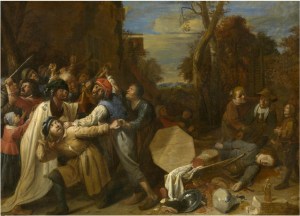
Death is Violent and Fast: Quarrel in a Pub, painting by Joos van Craesbeeck, ca. 1630 – 1635 PD|100 via Wikimedia Commons.

10 Comments

Filed under writing

Layers of a Scene #amwriting

I try to approach writing each dialogue scene as it would be portrayed in a movie. I think of each conversation as an event that must advance the story, so dialogue must do at least one (if not all) of these things:

  1. Offer information the characters are only now learning.
  2. Show the state of mind the characters are experiencing.
  3. Show the relationship of the characters to each other.
  4. Show the relationship of the characters to their world.

In the first stage of the rough draft, with those goals in mind, I sit down and picture the characters and their relationship. Then, I write just the dialogue for several back-and-forth exchanges. No speech tags, just the exchange. I do this in short bursts, to get the basic words down. It’s a two stage process—the scenery and background get filled in after the dialogue has been written.

“What are you doing?”

“Oh, just drawing.”

“Drawing what?”

“You’ll laugh or find a reason to mock me for it.”

Once I know what they are talking about and have the rudimentary dialogue straight, I add in the scenery and attributions, and the dialogue grows with each layer. This is because the scene has become sharper in my mind and I know more of the mental state my characters are in.

The next morning, when his stepmother came down for coffee, John was once again working on something in his notebook. He stood, gathering his pens.

“What are you doing?” Ann’s clipped tones cut the silence.

“Oh, just drawing.” The peace he’d sought had gone, earlier than he hoped.

“Drawing what?”

John’s normally open features were closed, inscrutable. “You’ll laugh or find a reason to mock me for it.” Closing his sketchbook, he attempted to leave but stopped when she put her hand on his shoulder.

“Show me. Now.” When Ann repeated her demand, he reluctantly opened the book. Page after page was covered in stylized dragons, leafy vines, and runes. “Why do you waste your time with this crap? You could be brilliant, but no! People want real art, not this drivel.”

“This is how I earn my living.”

Ann poured herself a cup of coffee, pausing only to sneer. “You don’t have a pot to—”

“Stop.” John reclaimed the sketchbook. “Coming back here was a mistake. I did it because Dad asked me to, and because it’s Christmas.” He crossed toward the dining room. “Enjoy your breakfast.” The kitchen door closed behind him, cutting off his stepmother’s rant.

We know the characters’ relationship to each other, and what their place in this environment is. The layers that form this scene are:

  1. Action: She comes down for coffee. He holds a notebook, gathers pens, and stands.
  2. Dialogue: shows long-simmering resentment between the two players and gives us a time reference—it’s Christmas.
  3. Environment: a kitchen, closed off from the rest of the house. In this story, the woman’s closed off kitchen is symbolic of her closed off personality. The place that is the heart of a home is closed off. She is at odds with her own son, as well as her stepchildren.

We work with layers to create each scene. With these layers, we show the reader everything they need to know about that moment in time.

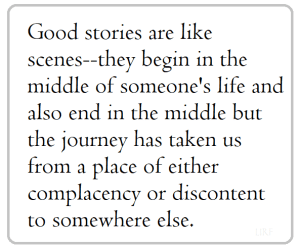
In many ways, each scene is a story-within-a-story, with a beginning, middle, and end. Every scene should have an arc, leading us to the next scene. We link the mini-stories together to form the larger story, pushing the characters to the final confrontation that ends the novel.

By beginning with the dialogue in each scene, I can get the words down and then concentrate on visualizing the setting where the conversation takes place. Over the course of a book, conversations take place in different settings, so readers are eventually shown the entire world these characters live in. They will see that world without our having to dump a floor-plan or itinerary on the reader. Remember our basic conversation?

“What are you doing?”

“Oh, just drawing.”

“Drawing what?”

“You’ll laugh or find a reason to mock me for it.”

Let’s put that dialogue and the notebook into a fantasy setting and change how the characters are related to each other:

At the end of her watch the next morning, Ann warmed the flatbread from the day before and filled it with goat cheese for breakfast. Traveling alone with John was different without the others, more difficult in ways she didn’t want to acknowledge. 

Clearly surprised at waking to a hot meal, John thanked her but remained on his side of the fire. He opened his journal and made an entry, then with his breakfast eaten, he began drawing something in his sketch book.

This time she decided to see what was so absorbing. “What are you doing?”

“Oh, just drawing.”

“Drawing what?” Ann couldn’t read his expression, and normally she could.

“You’ll laugh or find a reason to mock me for it.” Closing his sketchbook, John attempted to rise but stopped when she put her hand on his shoulder.

“Show me,” she commanded. “I promise I won’t mock you. I’m just curious.”

Now the look in his eyes confused her. It was guarded yet had the same quality he did after praying. Clearly against his better judgement, he opened his notebook.

Page after page was covered with portraits of all the members of their tribe, including her, all looking as full of life as if they could step off the page. Every messenger they had ever been sent was there, and people she didn’t know whom he must have met on his travels. She nearly wept on seeing the many portraits of her brother, handsome and laughing.

“These… they’re amazing. You’ve detailed our life for the last three years. And David… it’s the way I want to remember him. Thank you.”

John seemed confused by her approval. His gaze was far away when he answered. “I dream all night long, and then I have to draw. I don’t know why.”

We began with the same words and a notebook, and used the same names. But with different relationships, we ended up with different characters. They have a different quest, and their story is written for a different genre. However, the layers in this fantasy do the same work as in the contemporary piece. The layers that form this scene are:

Action: Ann prepares breakfast, something John is surprised to find her doing. He opens a notebook.

Dialogue: shows a wary interaction between two people who know each other well, and who may be entering a different stage in their relationship.

Environment: a campsite, an open fire. It is set in the wide outdoors, yet it is intimate.

The words are the same, the notebook is there, but the direction the conversation takes is different because the story is different.

By beginning with the conversation and envisioning it as if it were a scene in a movie, I can flesh it out and show everything the reader needs to hang their imagination on. Readers are smart and don’t want to be told what to think. The reader’s mind will supply the details of a kitchen or a campsite, depending on the clues I give.

How will you add the layers to your conversations? The possibilities are endless.

6 Comments

Filed under writing

World building: what was, what is, and what may be #amwriting

All novels are set in one of three time periods: the past, the present, or the future.

Readers are much smarter than we are, so knowing what you write about is critical no matter what the level of technology. Even when setting a novel in the present day, the actual technology available is an unknown quantity to most of us.

However, targeted research can shed some light on what was once possible, what is possible, and what will one day be possible. Here are some of my go-to sources of information:

The Past:

My best source of information on low-tech agrarian life and culture comes from a book I found at a second-hand book store in Olympia in the mid- to late-1980s. Lost Country Life by Dorothy Hartley is still available as a second-hand book and can be found on Amazon. This book was meticulously researched and illustrated by a historian who knew the people she was writing about.

What I find absolutely charming is the way the author used excerpts from medieval rhymes and literature to put their lives into context, forming a picture of how we really lived before the industrial revolution. In fact, many rural communities were still living this kind of life in the early twentieth century. The author knew and interviewed farmers whose lives had been spent working the fields and raising animals the old way.

Best of all, even though the book makes no apologies for being a textbook, Hartley’s prose is so enjoyable I found myself reading it with the sort of enjoyment one gets from a novel.

I also get a lot of information on how people lived from Wikimedia Commons.  There, under the heading  Category: Painters from the Northern Netherlands (before 1830) you will find the brilliant works of the Dutch Masters, artists living in what is now The Netherlands. In the course of their work these painters created accurate records of the everyday life of the common people, how they dressed, and what was important to them.

The Present:

You can Google just about anything. Fads, fashion, phone tech, current robotics tech, automobile tech—it’s all out there. If you need to know how many bodies you can fit into the trunk of a Mini Cooper, don’t guess. Look it up and write with authority. (The answer is NONE—Mini Coopers have no trunk.)

Available on the internet today:

TED Talks are a wonderful resource for information on current and cutting edge technology.

ZDNet Innovation is an excellent source of current tech and future tech that may become current in 25 years.

Tech Times is also a great source of ideas.

If you want to know what interests the people in the many different layers of our society, go to the magazine rack at your grocery store or the local Barnes & Noble and look at the many publications that are available to the reading public. You can find everything from culinary to survivalist, to organic gardening—if people are interested in it, there is a magazine for it.

Know what your community is interested in, and your setting will have depth.

The Future:

We can only extrapolate how societies will look in the future by taking what we know is possible today and mixing it with a heavy dose of what we wish were possible.

But many business people and scientists have incredible imaginations, and their life’s work is making the future knowable, and a reality.

SPACEX

NASA

Digital Trends

If you write sci fi, you must read sci fi as that is where the ideas are. Much of what was considered highly futuristic in the classic science fiction is now current tech—ion drive, space stations—these are our reality but were only a dream when science fiction was in its infancy. Think about it: your Star Trek communicator is never far from your side.

Do the right research, target it to your needs, and don’t allow yourself to be sidetracked by the amazing bunny trails that lead you away from actually writing.

Above all, enjoy the act of creating a world that a reader will want to live in, whether it is set in the past, the present, or the future.


Credits and Attributions:

Lost Country Life, by Dorothy Hartley, © 1981 by Pantheon, cover illustrated by Beatrice Fassell, fair use.

3 Comments

Filed under writing

The derailed plot #amwriting

You’re a pantser, not a plotter–you like to wing it when you write, just let the ideas flow freely. This can be liberating, but sometimes in the course of writing the first draft, we realize our manuscript has gone way off track and is no longer fun to write.

At this point, we must go back and find the point where the story stops working. We cut everything back to there and make an outline to build some structure into the manuscript.

Let’s say we are working on a manuscript titled “Dog Days of Summer.” We wrote most of it during November and are sixty thousand words in, but we aren’t even a third of the way to the finish. When we look back, the first twenty thousand words are exactly what we wanted the story to be. But at that point we became a little desperate to get our daily word count, and now we don’t know what to do or how to bring the story to its intended conclusion.

When this happens to me, I stop floundering and (literally) cut my losses. It needs to be cut back to the place where it dissolved into chaos. This is good – it’s called rewriting. Nearly every published novel has entire sections that had to be rewritten at least once before it got to the editing stage.

Much of what you cut out can be recycled, reshaped, and reused, so never just delete weeks of work.

  1. Save everything you cut to a new document, labeled, and dated: “OutTakes_DDoS_rewrite1_09-19-2018.” (Out Takes, Dog Days of Summer, rewrite 1, 09-19-2018)

Now, you must consider what will be the most logical way to get the plot back on track.

Sit down with a notebook (or in my case a spreadsheet) and make a list of what events must happen between the place where the plot was derailed and the end—a list of chapters with each the keywords for each scene noted:

15 Aeddie sick – Mendric can’t repair his heart-take him to Hemsteck 
16 Three days into the journey Elgar and Raj battle Thunder lizard
17 Star stone falls outside Waterston
18 Aeddie sick, nearly dies, Mendric nearly burns out gift keeping him alive
19 South of Kyran, water wraith
20 North of Kyran, mob attack
21 Nola – inn
22 Maldon, highwaymen, and William

You can go even farther and color code your scenes to show who the POV characters are, as was noted in my previous post, Author Simon Wood on Plotting.

What is the core conflict? Make a large note to remind yourself of what the central conflict is so that you won’t go off track again.

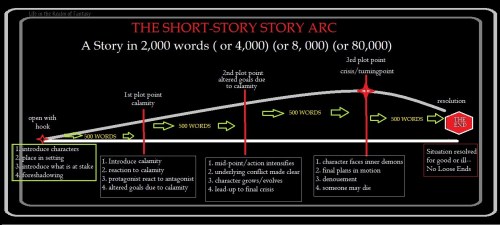
Pay close attention to the story arc. Make a “blueprint” of the intended story arc, an outline.

  1. Where does the inciting incident occur?
  2. Where does the first pinch point occur?
  3. What is happening at the midpoint? Are the events of the middle section fraught with uncertainty but still moving the protagonist toward their goal? If not, cut them and insert events that propel the story forward.
  4. Where does the third plot point occur?

What does each character desire? List each character and make a note of what they want at the beginning, what stands in their way at the middle, and what they get at the end.

  1. At the outset, what do the characters want?
  2. What are they willing to sacrifice to get it?
  3. How are their attempts to achieve it frustrated?
  4. Do they get it in the end, or do their desires evolve away from that goal as the story progresses?

Everything you write from the point of the inciting incident to the last page will detail that quest for the unobtainable something. At the outset, your protagonist must desire nothing more than to achieve that objective. Use whatever you can of the material you cut, and write new prose where you must.

By the end of the book, the internal growth of the characters may have caused them to change their personal goals, but something big and important must be achieved in the final chapters.

Where are they going? If they are traveling in a created world, draw a simple map for your own reference. Otherwise, use an atlas or Google Earth to keep your story on track.

Don’t be afraid to rewrite what isn’t working. Save everything you cut, because I guarantee you will want to reuse some of that prose later, at a place where it makes more sense. Not having to reinvent those useful sections will greatly speed things up, which is why I urge you to save them with a file name that clearly labels them.

Finally, don’t feel that, just because you wrote a wonderful section, it has to stay in the manuscript. If the story is stronger without that great scene, cut it. Use it as fodder for a short story or novella set in that world.

5 Comments

Filed under writing

Author Simon Wood on Plotting #amwriting

In my post, Theme and the Short Story, I discussed how, as part of my pre-NaNoWriMo exercise regimen, I create small outlines of the short stories I intend to write. Using an outline is also how I write novels.

  • First, I divide my story arc into quarters, so the important events are in place at the right time. When I try to “pants” it, I sometimes end up with a mushy plot that wanders all over the place and a story that may not be commercially viable.

  • What length am I writing to? Knowing the word count in advance will help you keep on track.
  • What will be the inciting incident? How does it relate to the theme?
  • What is the goal/objective? How does it relate to the theme?
  • At the beginning of the story, what could the hero possibly want to cause him to risk everything to acquire it?
  • How badly does he want it and why?
  • Who is the antagonist? What does he want and why?
  • What moral (or immoral) choice is the protagonist going to have to make in his attempt to gain that objective?
  • What happens at the first pinch point?
  • In what condition do we find the group at the midpoint?
  • Why does the antagonist have the upper hand? What happens at the turning point to change everything for the worse?

For novels, I make a larger outline, offering myself a more in-depth exploration of the intended story, and I discussed that process here: Jumpstart #NaNoWriMo2017, the Storyboard.

I do it this way because I can’t keep all the many threads on track if I don’t have some sort of a road map to follow. The outline is my literary GPS device.

Recently, at the Southwest Washington Writer’s Conference, I attended a two-part seminar on plotting, given by Simon Wood, author of such USA Today bestsellers as The One that Got Away.

Simon’s outline goes even deeper than mine. His outline is simple and linear, and color-coded to each character. Numbered from 1 to 80 (or however many scenes you have) each scene is listed with a sentence or two describing what happens at that point, something like Jack meets the dealer at the drop point. Argument ensues.

The sentences are small road maps from which he develops the entire scene. Each line is colored red, yellow, or green depending on whose point of view the scene is being shown from. Green is the protagonist’s point of view.

His outline doesn’t go into so much detail that the story is already written, but it ensures the plot goes in the intended direction with good pacing. Pacing is the reason why I outline—my earlier work was inconsistent.

What struck me in Simon’s seminar was the idea of color-coding each POV—when you have large stories encompassing the points-of-view for three or more characters, all it takes is a glance at your first-draft list of scenes to see if there is an imbalance in who’s talking.

Simon began this style of plotting in 1998, long before Scrivener. Some of you will say you use Scrivener for this, and to you, I say bravo! I find that program isn’t intuitive, is less than user-friendly, and is extremely annoying to try to learn. So, I have it, sitting in my computer taking up valuable real estate on my hard drive, going unused and unloved.

Simon writes thrillers, and I write fantasy, but we both create our outlines in Excel. However, this could easily be done in any word-processing or spread-sheet program (such as Google docs/sheets) or in Word, simply by changing the color of your fonts. You can even do this on colored post-it notes, as some authors do. For visual people who are not Scrivener savvy, being able to use the cut-and-paste function to move scenes around to where they are most effective is critical.

Simon was kind enough to answer a few questions via email about his process.

CJJ: First of all, what do you consider a scene? Is it a chapter or a portion of a chapter?

SW: A scene isn’t a chapter necessarily.  It may be made up of  2-3 scenes.  It depends on how the scenes connect.  Say the chapter was “Robbing a bank.”  To me that would be broken into three scenes: Getting into the bank, Getting into the vault, Getting the money out.  An over simplified answer but I hope it illustrates the point.

CJJ: How do you decide if a character is important enough to warrant a voice and becoming a viewpoint character?

SW: I just assess whether a particular character has valuable insight to share.  If a supporting character’s POV gives additional context to the relationship on how the protagonist and antagonist are behaving then their POV is valuable. Essentially a POV character has to add something to the story.

CJJ: How long are your scenes in terms of word count? For purposes of NaNoWriMo, 1,667 words a day is needed to reach 50,000 words by November 30th and some will plan to write a chapter a day.

SW: Usually my scenes are 1500 words.

CJJ: In your own experience, during the process of getting a novel to the final draft, how many times will the direction of the story and the outline change from the original?

SW: It all depends on how well I did my original outline or how well I had conceived the idea.  Sometimes it’s changed several times.  Others it’s pretty much stayed true to the original.  Usually a couple of times at least.

Thank you, Simon, for sharing your insights with us. For all who are curious about his process, Simon offers several wonderful seminars on writing craft, the links to which are at the bottom of this post. Do yourself a favor and sign up for one!

In the end, we as authors must each find our own best way to free the story from our creative minds. For some of you, a program like Scrivener might fill the bill, but for me, a simple outline to begin with, the willingness to change course when the intended storyline isn’t working, and sheer stubbornness are what it takes to get a book out.

You must give your plot structure. In other words, use an outline to create a good story arc at the outset, but within the structure of your outline, allow your characters to surprise you. We know that the way to avoid obviousness in a plot is to introduce a big threat. How our characters react to that threat should be unpredictable because they have agency.

When we give our characters agency, threats take away the option of going about life as normal and leave characters with several choices, all of which are consequential, the final one of which should be made in a stressful situation. I intentionally used the word consequential relating to the choices your characters must make. If there are no consequences for the bad decisions a character might make, what is the story about?

Simon’s idea of color-coding the scenes in the outline is a great addition to my writers’ toolbox. Being able to see at a glance if my story is imbalanced away from the protagonist’s thread will be a good way for me to avoid having to scrap a few months’ work to get a novel back on the right path.


About Simon Wood:

USA TODAY bestselling author, Simon Wood is a California transplant from England. He’s a former competitive racecar driver, a licensed pilot, an endurance cyclist, an animal rescuer and an occasional PI. He shares his world with his American wife, Julie. Their lives are dominated by a longhaired dachshund and six cats. He’s the Anthony Award winning author of The One That Got Away, Accidents Waiting to Happen, Paying the Piper, Terminated, Deceptive Practices and the Aidy Westlake series. His latest book is SAVING GRACE. He also writes horror under the pen name of Simon Janus. Curious people can learn more at http://www.simonwood.net.

Website: Simon Wood’s Web Hideout

Check out Simon’s workshops here: Simon Wood’s Workshops

Follow Simon on Twitter: https://twitter.com/simonwoodwrites

10 Comments

Filed under writing

What is NaNoWriMo and why bother with it? #amwriting

As most of you know by now, I regularly participate in the annual writing rumble known as NaNoWriMo (National Novel Writing Month). I’m a rebel in that I usually scratch out as many short stories as I am able in those thirty days.

I participate every year because for 30 precious days, writing is the only thing I “have” to do.

My friends and family all know that November, in our house, is referred to “National Pot Pie Month,” so if you drop by expecting a hot meal from Grandma, it will probably emerge from the microwave in the form of a formerly frozen hockey puck.

I usually have my “winners’ certificate” by the day they become available, but I continue writing every day through the 30th and update my word count daily.

NaNoWriMo is a contest in the sense that if you write 50,000 words and have your word count validated through the national website you ‘win.’ But it is not a contest in any other way as there are no huge prizes or great amounts of acclaim for those winners, only a PDF winner’s certificate that you can fill out and print to hang on your wall.

It is simply a month that is solely dedicated to the act of writing a novel.

Now let’s face it–a novel of only 50,000 words is not a very long novel. It’s a good length for YA or romance, but for epic fantasy or literary fiction it’s only half a novel. But regardless of the proposed length of their finished novel, a dedicated author can get the rough draft–the basic structure and story-line of a novel–down in those thirty days simply by sitting down for an hour or two each day and writing a minimum of 1667 words per day.

With a simple outline to keep you on track, that isn’t too hard. In this age of word processors, most authors can double or triple that. As always, there is a downside to this intense month of stream-of-consciousness writing. Just because you can sit in front of a computer and spew words does not mean you can write a novel that others want to read.

Every year many cheap or free eBooks will emerge testifying to that fundamental truth.

The good thing is, over the next few months many people will realize they enjoy the act of writing and are fired to learn the craft. They will find that for them this month of madness was not about getting a certain number of words written by a certain date, although that goal was important. For them, it is about embarking on a creative journey and learning a craft with a dual reputation that difficult to live up to. Depending on the cocktail party, authors are either disregarded as lazy ne’er-do-wells or given far more respect than we deserve.

As I said in my previous post on NaNoWriMo, more people do this during November than you would think–about half the NaNo Writers in my regional area devote this time journaling or writing college papers.

For a very few people, participating in NaNoWriMo will give them the confidence to admit that an author lives in their soul and is demanding to get out. In their case, NaNoWriMo is about writing and completing a novel they had wanted to write for years, something that had been in the back of their minds for all their lives.

These are the people who will join writing groups and begin the long journey of learning the craft of writing. Whether they pursue formal educations or not, these authors will take the time and make an effort to learn writing conventions (practices). They will attend seminars, they will develop the skills needed to take a story and make it a novel with a proper beginning, a great middle, and an incredible end.

They will properly polish their work and run it past critique groups before they publish it. They will have it professionally edited. These are books I will want to read.

The life of an artist or author is not one of constant accolades and fetes. After you have downloaded the PDF Winners’ Certificate from www.NaNoWriMo.org, you will rarely receive an award to show for your labors. Yes, some people will love and admire what we have created, but other times what we hear back from our beta readers and editors is not what we wanted to hear.

The smart authors haul themselves to a corner, lick their wounds, and persevere. They pull up their socks and keep to the path and don’t expect or demand overnight success.

When we write something that a reader loves—that is a feeling that can’t be described. That moment makes the months of intense work and financial sacrifice worth it.

And whether we go indie or the traditional route, writing is a career that will require financial sacrifice.

Most authors must keep their day jobs because success as an author can’t always be measured in cash or visibility in the New York Times bestsellers list. For most authors, success can only be measured in the satisfaction you as an author get out of your work. Traditionally published authors see a smaller percentage of their royalties than the more successful indies, but if they are among the lucky few, they can sell more books and earn more because of that.

The fact your book has been picked up by a traditional publisher does not guarantee they will put a lot of effort into pushing the first novel by an unknown author. You will have to do all the social media footwork yourself, tweeting, getting an Instagram account, getting a website, etc. You may even have to arrange your own book signing events, just as if you were an indie.

This is time-consuming, and you will feel as if you need a personal assistant to handle these things—indeed, some people rely on the services of hourly personal assistants to help navigate the rough waters of being your own publicist.

Every year, participating in NaNoWriMo will inspire many discussions about becoming an author. Going full-time or keeping the day job, going indie or aiming for a traditional contract—these are conundrums many new authors will be considering after they have finished the chaotic month of NaNoWriMo. While few of us have the luxury to go indie and write full-time (my husband has a good job), many authors will struggle to decide their publishing path.

However, if you don’t sit down and write that story, you aren’t an author. You won’t have to worry about it. With that in mind, November and NaNoWriMo would be a great time to put that idea on paper and see if you really do have a novel lurking in your future.

13 Comments

Filed under NaNoWriMo, writing

English, origins and style #amwriting

One of my favorite subjects is how English is and will always be an ever-evolving and ever-disintegrating language. The history of the evolution of English is intriguing.

In recent years scholars have determined that if you want to make Shakespearean poetry  and prose rhyme, it must be read with what is now a Scottish/Appalachian accent, as that was the accent of Renaissance England, and pronounce words the way they are spelled. To hear for yourself, go out to NPR’s Shakespeare’s Accent: How Did The Bard Really Sound? I found it to be a treat.

Jonathan Swift, writer and Dean of St. Patrick’s Cathedral in Dublin, complained to the Earl of Oxford in 1712: “Our Language is extremely imperfect. Its daily Improvements are by no means in proportion to its daily Corruptions; and the Pretenders to polish and refine it, have chiefly multiplied Abuses and Absurdities.” He went so far as to say, “In many Instances, it offends against every Part of Grammar.”

It was the linguistic wild-west, undisciplined and out of control. Slang words willfully forced their way into drawing rooms, newspapers, and books, and in the process they became part of our common usage. So, in an effort to tame our wildly evolving language, a group of clerks and clerics in the eighteenth century who wanted a more orderly language developed the rules for the “Queen’s English.”

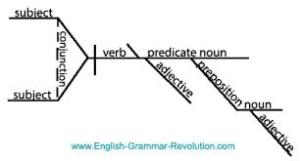
Unfortunately, they used the rules with which they were most familiar. Being men of the church, they borrowed them from Latin. This poor choice on their part is the source of much of our grammatical dysfunction.  These men applied the rules of a dead language, Latin, to an evolving language with completely different roots, Frisian, added a bunch of mish-mash words and usages invented by William Shakespeare, and called it “Grammar.”

Despite their origin, the rules have been consecrated, hallowed, and immortalized in hundreds of books on style, and repeated by scholars who ignore the scabrous history of our English language. Frisian evolved into Modern Dutch, and Latin evolved into Modern Italian, Spanish, French, Romanian—and several other modern languages. Yet, despite the wide linguistic differences in the two root languages, these hard-and-fast rules have been passed down by generations of schoolteachers in a vain effort to teach students how to write and speak our common language.

These rules of grammar are what we also refer to as style.

When we leave school and first begin to write seriously, we soon discover that we don’t really know how to construct a narrative that people would want to read. So, we need to further educate ourselves.

Despite the pox-ridden history of the English language, it helps to have a framework to go by when writing. I use a book of rules, the Chicago Manual of Style.  This book is used in the big publishing houses here in the US and is the manual of choice for most American editors of fiction and literary works. Referring to it when I have a question helps me to remain consistent in my punctuation, and ensures my personal style is comfortable for the reader.

You can use any style guide you choose, but you must remain consistent. Refer to your guide of choice whenever you are confused about punctuation or grammar. This isn’t a cure-all for bad writing. Many times, confusion can only be eliminated by rephrasing, deleting excessive descriptors, and by cutting long, compound sentences in half.

Knowledge of grammar is no substitute for talent, but it can help make talent readable.

If you are in the UK, you might want to invest in the New Oxford Style Manual.

If you are writing technical manuals, the Microsoft Manual of Style for Technical Publications would be a good investment for you.

If you are a journalism major, you may think Associated Press Style is the only style guide you’ll ever need, but you would be wrong. AP Style evolved for the printer setters in the newspaper industry and is intended to make the most efficient use of space in a column. It is not favored by the large traditional publishers and editors as the style guide for novels or short stories, which have different requirements.

For a good post on the major differences in these two very different American English styles, see this blog post written in 2016 by Acadia Otlowski for Hip B2B:

AP vs Chicago Manual of Style: Which Stylebook is Right for You?

I’ve seen AP and Chicago Manual users in hair-pulling matches over the Oxford comma, on-line disputes that were both embarrassing and needlessly troll-ish.

Regardless of your personal writing style, it’s a good idea to learn how to write and speak in your native language, as readers will be able to accept your personal style choices more easily if the larger elements flow as expected.

And that is the key word: expected.

We all habitually write in such a way that we consistently break certain rules. This is our voice and is our fingerprint. This does not mean you should throw grammar out the window—readers have expectations that authors will respect them enough to spell words properly, will understand the words they are using and use them correctly, and will insert pauses between certain clauses.

They don’t demand perfection, but they do want consistency.

A rudimentary knowledge of how your native language works is essential, so my advice is for you to invest in a few reference books and use them. Listed below are my go-to books.

If you are writing novels or fiction in the US, a handy book for you would be The Chicago Guide to Usage and Grammar by Bryan A. Garner. It is a more concise and to the point compilation of the important things than the big blue book that is the Chicago Manual of Style.

If you are in the UK, you should invest in The Oxford A – Z of Grammar and Punctuation by John Seely. I use this little guide when I am editing for my British clients.

A handy book for all who write in the many multi-national English dialects is The Oxford Dictionary of Synonyms and Antonyms – I find this book invaluable when I am stuck trying to think up an alternative word that won’t be awkward or pretentious.

I secretly love awkward and pretentious words, especially ones that rhyme. It embarrasses my children when I forget my manners and use them in public.


Credits and Attributions:

Quote from: A Proposal for Correcting, Improving and Ascertaining the English Tongue by Jonathan Swift, 1712, 2nd ed. Edited by Jack Lynch, Professor and chair of the English Department in the Newark College of Arts & Sciences at Rutgers University – Newark. (accessed Aug. 12, 2018).

7 Comments

Filed under writing

Things to check for before submitting to a beta reader #amwriting

When we finish writing a story, an article, or a novel, we feel a rush of pride. The urge to immediately send it to a magazine or contest is strong, but the wise author must overcome it.

Don’t even show it to your writing group at this stage, because you are too involved in it, and there may be some awkward flaws that were introduced into the narrative during the rush of creation. You want their feedback to be constructive and not focused on the editable flaws.

Set your manuscript aside for a week or so then come back to it and look for

  1. Dropped or missing words.
  2. Words that spell check won’t find because they are spelled correctly but are wrong: They went their for breakfast.
  3. Extra spaces in odd places, and after sentences. Editors want one (1) space after each sentence.
  4. The paragraphs are indented, NOT WITH TABS, but by formatting the paragraphs correctly.

Tabs >.< I feel it’s important to revisit this subject, as I have recently seen two manuscripts where authors used the tab key to indent their paragraphs.

That is a huge no-no, and screams “never done this before.” Ninety percent of publications and publishing houses want electronic submissions. Too many spaces messes up the final formatting. For this reason, make sure you have removed the tabs. You may have to do it by hand which is a daunting task no publisher or editor has time for.

You want your work to look professional, even if you are only submitting it to your writing group for a critique. Always format the paragraphs by either opening the home tab and choosing ‘normal’ from the styles tab on the ribbon OR format by using the simple formatting tool:

Step 1: On the home tab, look in the group labeled ‘Paragraph.’ On the lower right-hand side of that group is a small grey square. Click on it.  A pop-out menu will appear, and this is where you format your paragraphs.

Step 2: On the indents and spacing tab of the menu: Use standard alignment, align LEFT. The reason we use this format is we are not looking at a finished product here. We are looking at a rough draft that will be sliced, diced, and otherwise mutilated many times before we get to the final product.

Step 3: Indentation: leave that alone or reset both numbers to ‘0’ if you have inadvertently altered it.

Step 4: Where it says ‘Special’: on the drop-down menu select ‘first line.’ On the ‘By’ menu, select ‘0.5.’ (Some publishers will specify a different number, 0.3 or 0.2, but 0.5 is standard.)

Step 5: ‘Spacing’: set both before and after to ‘0.’

Step 6: ‘Line Spacing’: set to ‘double.’

To summarize, standard paragraph format has:

  • margins of 1 inch all the way around
  • indented paragraphs with no extra space between
  • double-spaced text
  • Align Left. This is critical.

Do not justify the text. In justified text, the spaces between words, and letters (known as “tracking”) are stretched or compressed. Justified text aligns with both the left and right margins. It gives you straight margins on both sides, but this type of alignment only comes into play when a manuscript is published, and at that point, the publisher will handle the formatting.

Also, I have two things for you to look for before you submit your work to a beta reader or writing group, much less a prospective agent or publisher.

First up: Dialogue.

  1. Make sure every spoken sentence is enclosed in double quotes. All punctuation goes INSIDE the closed quotes, and quoted dialogue is enclosed in single quotes, ALSO inside the closed quotes.

Good: “I’m sorry, Mary. Your punctuation is horrific. Jake said, ‘I won’t accept it,’” said Helen.

When using dialogue tags, the spoken sentence ends in a comma, inside the closed quotes, followed by the dialogue tag which is NOT CAPITALIZED.

Bad: “I’m sorry, Mary. Your punctuation is horrific. Jake said, ‘I won’t accept it.’” Said Helen.

Good: “I’m sorry, Mary. Your punctuation is horrific. Jake said, ‘I won’t accept it,’” said Helen.

Next up: Commas. If you have a basic grip on commas, perfection is not needed. But commas separate clauses and act as traffic signals for our words.

  1. Use commas to separate independent clauses when they are joined by any of these seven coordinating conjunctions: and, but, for, or, nor, so, yet.

Good: My dog has fleas, and he needs to go to the vet.

Do not join dependent clauses to independent clauses with commas.

Good: My dog has fleas and needs to go to the vet.

Avoid comma splices at all cost. Use conjunctions or semicolons to join related independent clauses, not commas.

Bad: My dog has fleas, he needs to go to the vet.

Good: My dog has fleas, and he needs to go to the vet. OR if you absolutely must use a semicolon, write it as, My dog has fleas; he needs to go to the vet.

By searching for these simple errors before you submit your work,there’s a good chance that an editor will read beyond the first page.

Even if you intend to hire an editor, if you have these sorts of major amateurish flaws in your work, the editor will most likely refuse to take on the task of editing your work, as it would be too difficult to complete in a reasonable amount of time.

If I receive a request from a prospective client to edit a manuscript, and a glance through the first few chapters shows a clear lack of knowledge of how to write, my policy is to refuse it. The author owes it to herself, and the craft in general, to learn how to write.

In these instances, I am always gentle, but firm. I usually suggest the author join a writing group and invest in some books on writing craft. Many times, I see wonderful, amazing stories that are so poorly written no editor would take them.

It’s important to remember that we all begin at that place. With practice and feedback from others, we grow. These first drafts of our writing life are the beginner stories, the ones that come from the heart and which we learn from. I have a desk full of examples of “What was I thinking?” Each one of those stories had great bones. They are the foundation of all my work.

16 Comments

Filed under writing

Character Growth/Arc #amwriting

When we think of epic fantasy, the first books that come to mind are J.R.R.Tolkien’s The Hobbit and The Lord of the Rings trilogy. Tolkien’s work was compelling not only for the quality of his prose and the events, but for the characters and how they grew and changed in the course of their adventures.

Genre authors spend a lot of time plotting the events a character will go through. Equal time must be given to character development.

A great story evolves when the antagonist and protagonist are strong but not omnipotent. Both the antagonist and protagonist must have character arcs that show personal growth or inability to grow.

Sometimes, an antagonist’s weakness is their inability to accept change and adapt to it. Other times, events cause them to devolve, sending them into a downward spiral. Either way, for the antagonist to be realistic, this must be clearly shown.

Once we meet the hero, small hindrances must occur between the larger events, frustrating their path to success. As each hindrance is overcome, the reader feels a small sense of satisfaction. Following the protagonist as he/she is negotiating these detours is what makes the story captivating, in my opinion.

  1. The story begins with the opening act, where the characters are introduced, and the scene is set. It then kicks into gear with the occurrence of the “inciting incident,” that first plot point at the ¼ mark that triggers the rest of the story. It is “the problem,” the core conflict of the story. This is where the protagonist is thrown into the action and is where they first find themselves blocked from achieving the desired object.

At this point, the protagonist is not fully formed—they must grow as a result of their experiences. They may make mistakes, cause themselves more trouble because they are untried and don’t know what they are doing.

Also, at this point, the protagonist may be confused as to what is really going on. This is a good place to introduce a mentor, someone who can offer a little wisdom or set the hero on the right path.

  1. Following the inciting incident is the second act: more action occurs which leads to more trouble, rising to a severe crisis. At the midpoint, the protagonist and friends are in grave difficulty and are struggling.

Each scene is a small arc of action that illuminates the motives of the characters, allows the reader to learn things as the protagonist does, and offers clues regarding things the characters do not know that will affect the plot.

Those clues are foreshadowing. Through the first half of the book, foreshadowing is important, as it piques the reader’s interest, and makes them want to know how the book will end.

The characters begin to be changed by the events they experience. How you show their emotional state is critical at this point because emotions engage readers. If you want your readers to feel the crisis, your characters must feel it and show their reactions to the reader.

We must contrast the relative security of the characters’ lives as they were in the opening paragraphs with the hazards of where they are now. We show the uncertainty, fear, anger, sense of loss they are experiencing.

  1. At the midpoint, another serious incident occurs, launching the third act and setting them back even further.

Now they are aware that they may not achieve their objectives after all. Bad things have happened, and the protagonists have to get creative and work hard to acquire or accomplish their desired goals. They must overcome their own doubts and make themselves stronger.

The midpoint is also where we really get to know the antagonist and learn what the enemy knows that the protagonists do not. We discover his/her motives and what they may be capable of.

First, we need to remember that very few people are evil for no reason at all. Sometimes they are likeable, people who appear innocuous, even loving. If this is the case in your story, you need to insert small clues for the reader about their personality into the narrative in the beginning pages.

Fleshing out the antagonist and making their motives realistic is important. He/she is as central to the story as the protagonist because their actions force the protagonist to grow as a human being.

  1. By the end of the third act, the protagonists are finding ways to resolve the conflict and are ready to commence the final, fourth act, where they will embark on the final battle. They will face their enemy and either win or lose.

By the end of the narrative, the protagonist has been through life changing events. They are no longer naïve but have knowledge and wisdom of their own. They are fit to be the mentors of the next generation.

It’s important to remember that at no point in the narrative can people be sitting around idly chit-chatting about the changes they have been through. The reader knows and doesn’t want to read a rehashing of events at the end of each chapter.

Many authors who are new to the craft say their characters just evolve with no thought ahead of time. As this lack of planning is clear in their muddy work, perhaps it’s a good idea to give a little thought to plotting the personal growth of the characters, how the experiences will change them. Readers become invested in the characters and want to see what happens next. Reward the reader by making the journey about the characters as much as you do about the events.


Credits and Attributions:

The Lord of the Rings The Fellowship of the Ring, 2001 theatrical poster, Copyright 2001, New Line Cinema, Fair Use

Wikipedia contributors, “The Lord of the Rings: The Fellowship of the Ring,” Wikipedia, The Free Encyclopedia, https://en.wikipedia.org/w/index.php?title=The_Lord_of_the_Rings:_The_Fellowship_of_the_Ring&oldid=853509330 (accessed August 5, 2018)

2 Comments

Filed under writing

Theme and the Short Story #amwriting

Even if you are a confirmed Indie author, as I am, you may feel the desire to write short pieces and submit them to anthologies, magazines, or contests. Writing a short story is an excellent way to explore in detail an idea that is inspired by your longer work, but that you don’t have room to include there.

If you are writing a series of speculative fiction novels set in a world of your creation, writing short stories is a good way to develop that world. You also have the opportunity to develop characters you can use later.

Once you submit your story, it will be up against many entries, so you must make yours as unique as is possible.

Anthologies are usually themed. According to Wikipedia:

A theme is not the same as the subject of a work. For example, the subject of Star Wars is “the battle for control of the galaxy between the Galactic Empire and the Rebel Alliance.”

The themes explored in the films might be “moral ambiguity” or “the conflict between technology and nature.”

If you intend to submit your work to an editor with an open call for themed work, you must demonstrate your understanding of theme as well as your ability to craft brilliant prose.

Analyze the theme and try to think creatively—think a little wide of the obvious tropes. Look for an original angle that will play well to that theme and then go for it. As an author, most of my novels have been epic or medieval fantasy, based around the hero’s journey, detailing how their experiences shape the characters’ reactions and personal growth. The hero’s journey is a theme that allows me to employ the sub-themes of brother/sisterhood, and love of family.

These concepts are important to me on a personal level, and so they find their way into my writing.

To support the theme, you must layer

  • character studies,
  • allegory, and
  • imagery

These three layers must all be driven by the central theme and advance the story arc.

The theme is introduced, either subtly or overtly, at the first plot point. In a really short story, this must happen on the first page. Many times, we are given a specific word count we cannot exceed, so lengthy lead-ins are not possible.

When writing a short story, it helps to know how it will end. I suggest you put together a broad outline of your intended story arc. Divide your story arc into quarters, so you have the important events in place at the right time. If you try to “pants” it, you might end up with a mushy plot that wanders all over the place and a story that may not be commercially viable.

When you assemble your outline, ask yourself

  • What will be your inciting incident? How does it relate to the theme?
  • What is the goal/objective? How does it relate to the theme?
  • At the beginning of the story, what could the hero possibly want to cause him to risk everything to acquire it?
  • How badly does he want it and why?
  • Who is the antagonist?
  • What moral (or immoral) choice is the protagonist going to have to make in his attempt to gain that objective?
  • What happens at the first pinch point?
  • In what condition do we find the group at the midpoint?
  • Why does the antagonist have the upper hand? What happens at the turning point to change everything for the worse?
  • At the ¾ point, your protagonist should have gathered his resources and companions and should be ready to face the antagonist. How will you choreograph that meeting?
  • How does the underlying theme affect every aspect of the protagonists’ evolution in this story?

In my own writing life, too much background info has been my greatest challenge. Writing short stories has helped me find ways to write more concisely. What is important for the reader to know? What is just info for me? Knowing what is important in my own work is difficult because it all seems so important.

Short stories follow a single thread in a character’s life. Each word must advance that one story thread. Work that wanders all over the place will be summarily rejected, and the editor will most likely not give more than a stock rejection.

Having your work beta read by your critique group will help you identify those places that need to be trimmed down. I have close friends who see my work first and who help me see what the real story is before I bother my editor with it. My beta readers are published authors in my writing group.

Because I am a wordy writer, I always have to keep in mind that info dumps about character history and side trails to nowhere have no place in short stories because every word is precious. By shaving away the unneeded info in the short story, the author has more room to expand on the theme of the story and how it drives the plot.


Credits and Attributions:

Wikipedia contributors, “Theme (arts),” Wikipedia, The Free Encyclopedia, https://en.wikipedia.org/w/index.php?title=Theme_(arts)&oldid=848540721(accessed July 29, 2018).


6 Comments

Filed under writing