
My dear friend (and one of my favorite indie authors) Aaron Volner is an amazing narrator. He has just posted on YouTube his incredible reading of the original manuscript of A Christmas Carol, written by Charles Dickens. Aaron’s interpretation of this classic is spot on. He has gotten all the voices just right, from kindly Fred down to Tiny Tim.
I think this is by far my favorite version of A Christmas Carol as it is the original manuscript and is one I will be listening to every year. The original version as it fell out of Dicken’s pen and onto the paper is far scarier than most modern versions, and Volner’s interpretation expresses that eeriness perfectly. Scrooge’s horror is visceral, and his redemption profound.
Charles Dickens would have been proud of this reading. I give Volner’s performance five stars—something I rarely do. You can find this wonderful reading at “A Christmas Carol” by Charles Dickens – YouTube
And this prompted me to revisit a post from a year ago: A Christmas Carol by Charles Dickens – a masterclass in structure #amwriting.
Another Christmas has joined the Ghosts of Christmas Past. Our post today explores my favorite Christmas story of all time, A Christmas Carol, by Charles Dickens.
 I have talked about this novella many times, as I consider it one of the most enduring stories in Western literature. The opening act of this tale is a masterclass in how to structure a story.
I love stories of redemption–and A Christmas Carol by Charles Dickens remains one of the most beloved tales of redemption in the Western canon. Written in 1843 as a serialized novella, A Christmas Carol has inspired a landslide of adaptations in both movies and books.
Charles Dickens was a master of storytelling, employing hooks and heavy foreshadowing to good effect. Let’s have a look at the first lines of this tale:
 “Marley was dead, to begin with. There is no doubt whatever about that. The register of his burial was signed by the clergyman, the clerk, the undertaker, and the chief mourner. Scrooge signed it. And Scrooge’s name was good upon ‘Change for anything he chose to put his hand to. Old Marley was as dead as a doornail.”
In that first paragraph, Dickens offers us the bait. He sinks the hook and reels in the fish (the reader) by foreshadowing the story’s first plot point–the visitation by Marley’s ghost. We want to know why Marley’s unquestionable state of decay was so crucial that the conversation between us, the readers, and Dickens, the author, was launched with that topic.
Dickens doesn’t talk down to his readers. He uses the common phrasing of his time as if he were speaking to us over tea — “dead as a doornail,” a phrase that is repeated for emphasis. This places him on our level, a friend we feel comfortable gossiping with.
He returns to the thread of Marley several pages later, with the little scene involving the doorknocker. This is where Scrooge sees the face of his late business partner superimposed over the knocker and believes he is hallucinating. This is more foreshadowing, more bait to keep us reading.
At this point, we’ve followed Scrooge through several scenes, each introducing the subplots. We have met the man who, as yet, is named only as ‘the clerk’ in the original manuscript but whom we will later know to be Bob Cratchit. We’ve also met Scrooge’s nephew, Fred, who is a pleasant, likeable man.
These subplots are critical, as Scrooge’s redemption revolves around the ultimate resolution of those two separate mini stories. He must witness the joy and love in Cratchit’s family, who are suffering but happy despite living in grinding poverty (for which Scrooge bears a responsibility).
We see that his nephew, Fred, though orphaned, has his own business to run and is well off in his own right. Fred craves a relationship with his uncle and doesn’t care what he might gain from it financially.
By the end of the first act, all the characters are in place, and the setting is solidly in the reader’s mind. We’ve seen the city, cold and dark, with danger lurking in the shadows. We’ve observed how Scrooge interacts with everyone around him, strangers and acquaintances alike.
Now we come to the first plot point in Dickens’ story arc–Marley’s visitation. This moment in a story is also called “the inciting incident,” as this is the point of no return. Here is where the set-up ends, and the story takes off.
Dickens understood how to keep a reader enthralled. No words are wasted. Every scene is important, every scene leads to the ultimate redemption of the protagonist, Ebenezer Scrooge.
This is a short tale, a novella rather than a novel. But it is a profoundly moving allegory, a parable of redemption that remains pertinent in modern society.
In this tale, Dickens asks you to recognize the plight of those whom the Industrial Revolution has displaced and driven into poverty and the obligation of society to provide for them humanely.
This is a concept our society continues to struggle with and perhaps will for a long time to come. Cities everywhere struggle with the problem of homelessness and a lack of empathy for those unable to afford decent housing. Everyone is aware of this problem, but we can’t come to an agreement for resolving it.
A Christmas Carol remains relevant even in today’s hyper-connected world. It resonates with us because of that deep, underlying call for compassion that resounds through the centuries and is, unfortunately, timeless.
 As I mentioned before, this book is only a novella. It was comprised of 66 handwritten pages. Some people think they aren’t “a real author” if they don’t write a 900-page doorstop, but Dickens says differently.
One doesn’t have to write a novel to be an author. Whether you write blogposts, poems, short stories, novellas, or 700-page epic fantasies, you are an author. Diarists are authors. Playwrights are authors. Authors write—the act of creative writing makes one an author.
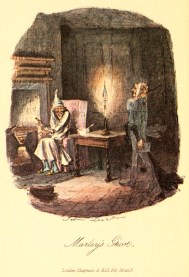
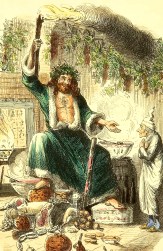
Today’s images are two illustrations by John Leech from the first edition of the novella published in book form in 1843. We’re fortunate that the original art of John Leech, which Dickens himself chose to include in the book, has been uploaded to Wikimedia Commons. Thanks to the good people at Wikimedia, these prints are available for us all to enjoy.
From Wikipedia: John Leech (August 29, 1817 – October 29, 1864, in London) was a British caricaturist and illustrator. He is best known for his work for Punch, a humorous magazine for a broad middle-class audience, combining verbal and graphic political satire with light social comedy. Leech catered to contemporary prejudices, such as anti-Americanism and antisemitism, and supported acceptable social reforms. Leech’s critical yet humorous cartoons on the Crimean War help shape public attitudes toward heroism, warfare, and Britain’s role in the world. [1]
Write what you are inspired to, and may the New Year offer you all the inspiration you need. May you be happy, healthy, and may you have many opportunities to tell your stories.
CREDITS AND ATTRIBUTIONS:
[1] Wikipedia contributors, “John Leech (caricaturist),” Wikipedia, The Free Encyclopedia, https://en.wikipedia.org/w/index.php?title=John_Leech_(caricaturist)&oldid=871947694 (accessed December 25, 2022).
Wikimedia Commons contributors, “File:Christmascarol1843 — 040.jpg,” Wikimedia Commons, the free media repository, https://commons.wikimedia.org/w/index.php?title=File:Christmascarol1843_–_040.jpg&oldid=329166198 (accessed December 25, 2022)
A colourised edit of an engraving of Charles Dickens’ “Ghost of Christmas Present” character, by John Leech in 1843. Wikimedia Commons contributors, “File:Ghost of Christmas Present John Leech 1843.jpg,” Wikimedia Commons, the free media repository, https://commons.wikimedia.org/w/index.php?title=File:Ghost_of_Christmas_Present_John_Leech_1843.jpg&oldid=329172654 (accessed December 25, 2022).

 To meet Alfredo, Grandma, and Sylvia Wannamaker, Dan’s next adventure, The Elevator Pitch, is
  I have planned the menu for Christmas Eve and Christmas Day, but a few things still need some forethought if I want those gatherings to go well. We’ve been invited to a New Year’s Eve potluck. I’m torn between making an avocado-cucumber-tomato salad or stuffed mushrooms—both are easy.
 No more tape in my hair, no more naughty words, and no more hunting for the scissors I just had in my hands.
 This is my recipe for the most delicious ONION AND MUSHROOM GRAVY:
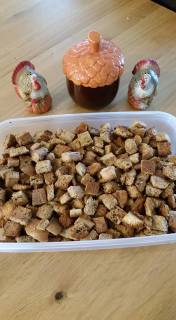 1 bag bread cubes for stuffing, or 10 cups 1/2 inch bread cubes from 1 large loaf of day-old wheat or other sandwich bread. Sometimes I bake my own bread, sometimes not.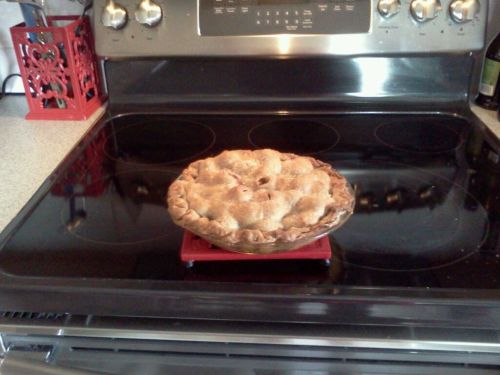
 That timeless story was written in 1843 as a serialized novella. It has inspired a landslide of adaptations in both movies and books and remains one of the most beloved tales of redemption in the Western canon.
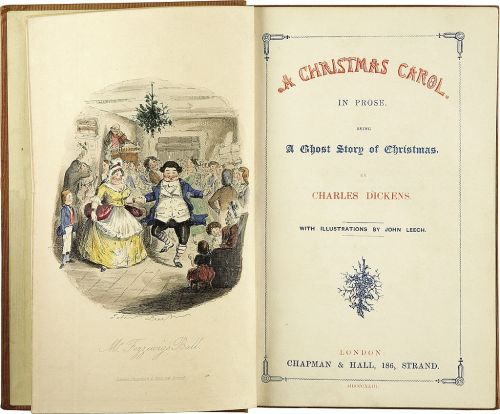 I wish he could have seen how beloved his creation is now, one hundred and eighty years later.
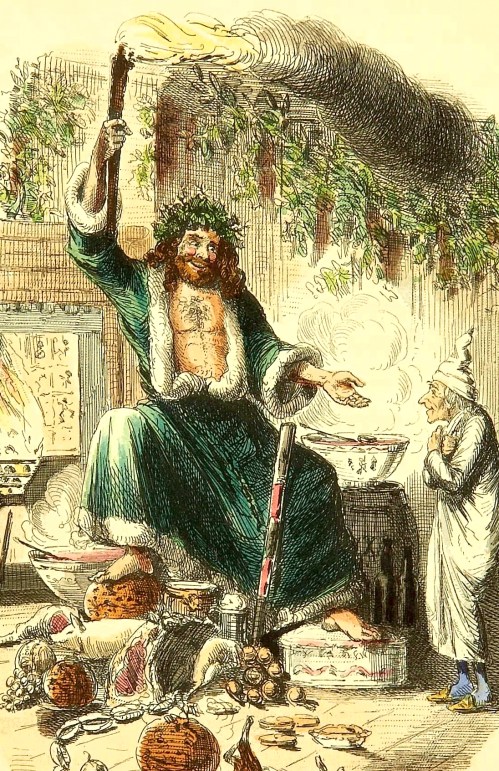 Charles Dickens showed us that charity and generosity to those less fortunate must become a year-round emotion. Our local community is a good place to start.
 However, this year, I am experiencing something I haven’t before—the post-NaNoWriMo slump. My creativity levels are low, and my words seem reluctant to join the party. I know many authors who suffer through this, but since I began this journey in 2010, I have never experienced it.
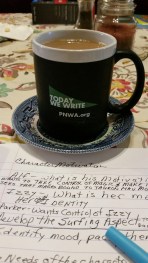 My first drafts tend to be ugly. The story emerges from my imagination and falls onto the paper (or keyboard), warts and all. Each first draft I can write “the end” on is a hot mess of repetitions, awkward phrasing, and cut-and-paste errors. I set them aside when they’re complete and often forget I’ve written them.
 Then, I turn to the last paragraph on the story’s final page and cover the rest of the page with a sheet of paper. I begin reading again, starting with the ending paragraph, working my way forward, and making notes in the margins.
 It works the same way for novels. I print out each chapter and go through the steps I described above. Then, I make the revisions in a new file labeled with the date and the word “revised.”
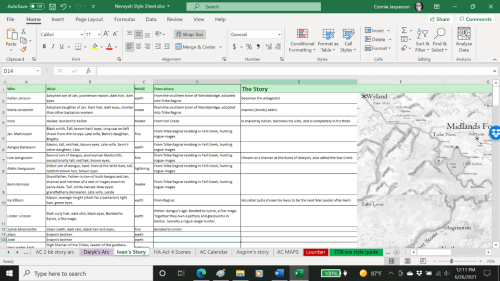 You can get fancy and use a dedicated writer’s program like
  But we’d prefer the snow to stay in the mountains where it belongs. Something about the slightest dusting sends the Pacific Northwest into a panic.
 BBC: From memoir and self-care books to comic novels, writing about our flaws and imperfections has never been so popular. But can failing ever be a success? Lindsay Baker explores this question. Read the story here:
  Also from Publishers Weekly: A confident mood prevailed among independent booksellers over this November holiday sales weekend. (…) Sales data from
  That question is a good place to start, but it is only the surface layer of the pond.
 It is a conversation scene, driven by the fact that each person in the meeting has knowledge the others need. Conversations are good when they deploy necessary information. Remember, plot points are driven by the characters who have critical knowledge.
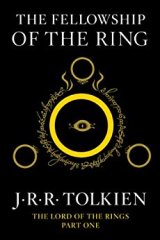
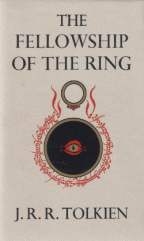 Information/Revelation: The Council of Elrond conveys information to both the protagonists and readers. It is a conversation scene, driven by the fact that each person in the meeting has knowledge the others need. Plot points are propelled by the characters who have critical knowledge. Again, limited information creates tension.
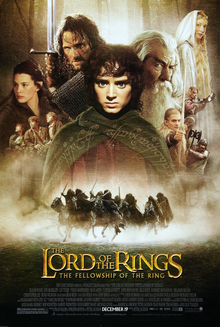 The movie portrays this scene differently, with Pip and Merry hiding in the shadows. Also, in the book, the decision about who will accompany Frodo, other than Sam, is not made for several days, while the movie shortens it to one day.
 We who write fantasy invent people and give them lives in invented worlds. Their stories involve them doing invented things. Unfortunately, there are times when we realize we have written ourselves into a corner, and there is no graceful way out.
 In 2019, I had accomplished many important things with the 3 months of work I had cut from that novel. The world was solidly built, so the first part of the rewrite went quickly. The characters were firmly in my head, so their interactions made sense in the new context.
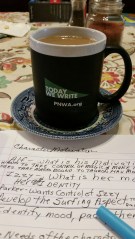 So, in 2019, I realized the novel I was writing is actually two books worth of story. The first half is the protagonist’s personal quest and is finished. The second half resolves the unfinished thread of what happened to the antagonist. Both halves of the story have finite endings, so the best choice is to break it into two novels.
 And a “passel” of short stories and novellas.
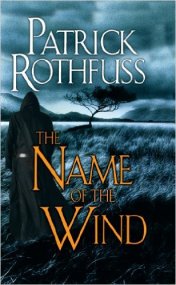 I think of
  When I can’t write anymore, I eat chocolate and read trashy romance novels about vampires.
 I need to spend several days visualizing the goal, picturing each event, and mind-wandering on paper until I have concrete scenes. I need to write a few paragraphs that will become the final chapters.
 My heroes and villains all see themselves as the stars and winners in this fantasy rumble. They intend to prevail at any cost. What is the final hurdle, and what will they lose in the process? Is the price physical suffering or emotional? Or both?
 My mental rambling is accomplishing something. My characters are all getting their acts together. They are finding ways to resolve the conflict and are ready to commence the fourth act, where they will embark on the final battle.
 I still had no idea there was a wider community of writers in my area, and even if I had, I wouldn’t have felt worthy of gate-crashing one of their meetings.
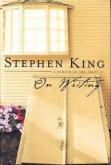 The next book I bought was in 2002:
 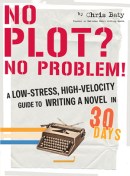 Finishing off the resources from the official NaNoWriMo store is Grant Falkner’s handbook,
 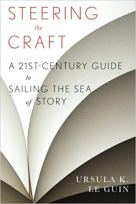 Damn Fine Story
 Many local libraries offer a service where one can submit a question and have it answered by email. If that isn’t an option and we’re feeling ambitious, you can check out eBooks on any subject.
 Here is a link to the great Neil Gaiman’s absolutely wonderful, infinitely comforting, yet utterly challenging advice for writers:
  In 2010, I gained a wonderful local group through attending write-ins for NaNoWriMo. Nowadays, we meet weekly via Zoom, as some members are now living far away from Olympia. My fellow writers are a never-ending source of support and information about both the craft and the industry. We write in various genres and gladly help each other bring new books into the world. But more than that, we are good, close friends.


 Life in the Realm of Fantasy