
I am drawn to books where the protagonist faces their personal demons and finds a hero within themselves. I love the story of someone who meets the unknown and finds the courage to do what they believe is morally right.
 This is a literary theme and is known as the hero’s journey. But it is only the overarching theme. For that hero’s main character arc to work, they need subthemes.
Subthemes are personal. In a movie score, a particular musical motif plays whenever a specific character enters the scene, and we feel their emotional state. When you discover a character’s void, the thing they lack, you have found the subtheme you need to expand on.
Here are three of the many themes that can help you shape a character’s arc of change:
- Learning to live with grief.
- Overcoming a lack of self-worth.
- Moving beyond an unrequited romantic love.
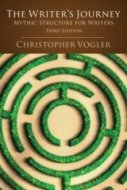 What is the “hero’s journey” and why am I so fond of it? Christopher Vogler broke it down for writers in his book, the Writer’s Journey. But what is essentially is is this:
The concept of the heroic journey was first introduced by the American mythologist, writer, and lecturer Joseph Campbell in The Hero with a Thousand Faces (published in 1949). In this ground-breaking work, he discusses the monomyth or the hero’s journey. He describes how this motif is the common template of a broad category of tales that involve
- a hero going on an adventure,
- and who, in a decisive crisis, wins a victory,
- and who then returns to his home, changed or transformed.
Take Tolkien’s masterpiece, The Hobbit:
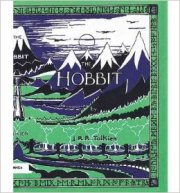 When Bilbo Baggins fights the giant spiders, he also faces his own cowardice and is amazed that he could do such a thing. This is only the first step in his personal arc. As the story progresses, he discovers that he has courage, which has nothing to do with the invisibility conferred on him by the ring he found earlier. Bilbo has courage, and yes, he is afraid. But he is not afraid to be courageous.
This is a core concept of this book and is the central theme of the entire Lord of the Rings series.
The theme of courage is one I find important and admirable, and it emerges in my writing. Courage is a strength beyond the physical. We’re often filled with self-doubt about our ability to do what might be needed in an emergency.
What genre are you drawn to read? That is most likely the genre in which you will write.
Some novels are set against the backdrop of a political power struggle. Political corruption, terrorism, and warfare are common themes. The characters within these stories have personal themes, voids they must overcome to resolve the situation.
Some novels focus on developing romantic relationships. The characters must have personal themes, inner voices they must overcome, as well as the external forces keeping them apart. The romance novel’s conflict and climax are devoted to the overarching theme of growing love. These novels might feature subplots that do not specifically relate to the main characters’ romantic love but enable them to overcome their voids. They must become strong enough to overcome the roadblocks to their happily ever after.
 Other novels are entirely character-driven, focusing on the protagonist of the narrative. Much thought is given to how prose is crafted stylistically, using a wide vocabulary. These novels feature thoughtful, in-depth character studies of complex, often troubled, characters. The story is in their day-to-day dealings with these issues. Action is less important than introspection, and the setting frames the characters and their arcs of growth.
The character arc is vital even if we’re writing science fiction. Yes, we want to set our characters in a realistic future based solidly on adequate knowledge of real-world science. If we intend to write hard sci-fi, we need a good understanding of the scientific method, so our plot doesn’t evolve into fantasy. Science and technology are dominant themes, but our characters are what will keep the readers reading. They will have personal voids, so sub-themes such as morality and love will arise, and the setting is only the backdrop.
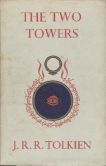 Let’s look again at J.R.R. Tolkien’s LOTR series. Personal growth and the many forms heroism can take are central themes of his stories. While many side-quests take the different characters away from the physical journey of the One Ring, Tolkien never strayed from the concept of the hero’s journey. The arcs of each character, as they go through their adventures and meet and overcome their personal void, support the overall theme of heroism in the face of death.
Any person’s fundamental fears and insecurities can become a character’s sub-theme, the thread you can expand on to shape their relationships.
On the surface, the many genres of books look widely different. However, they all have one thing in common–they have protagonists and side characters. These people will all have to deal with and react to the book’s overarching theme, but each will have their own story and personal journey.
The world in which a narrative is set is like a picture frame. It is the environment against which the story’s themes play out. The characters are shaped by a force beyond their control—the author.
The central theme of your story emerges when you are laying down the first draft. If your inspiration seems to faint somewhere in the middle, it may be that you have lost track of what you initially imagined your story was about. The characters no longer know what they are fighting for. Was it love? Was it destiny? Was it the death of hope?
 When we are constantly prodded to make our work focus on action and events, it becomes easy to forget that characters have an internal arc. They must grow for good or ill.
Ask yourself if the action has been inserted for its shock value. Or is this scene necessary to force change and growth on the protagonist and companions? How will their fundamental ethics and ideals be challenged by this event?
- If there is no personal cost or benefit to the characters, there is no need for that scene.
Remember, just because an idea no longer works for this novel doesn’t mean it won’t work in another. You never know when you will need those ideas, so don’t throw them away—always keep the things you cut in a separate file.
I label that file “outtakes,” and believe me, it has come in handy when I need an idea to jump-start a new story.
In many ways, writing genre fiction can become a trap. Sometimes we are so busy plotting roadblocks for our protagonist and his nemesis that the action takes over, and the main theme becomes tenuous.
- The action should force the character to change. If you absolutely must have that action, find a way for it to force growth on or otherwise affect the characters involved in it.
When we are deep in the creative process, it’s easy to forget that characters must evolve.
 I step away from my project for a week or two or even longer when stuck. When I come back to it, the characters and their journey is new again, inspiring me to finish their story. This is why I am a slow writer.
I write for a niche market–people like me. If I’ve learned nothing else over these last few years, it’s that as an indie, I have all the time in the world to get my work as right as I can make it.
Our next post will look at ways of discovering the personal void that initially holds our characters back, and how that void shapes them.
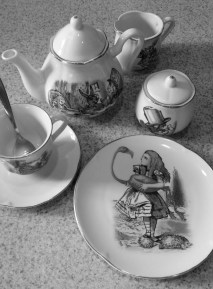
 It’s a mystery. The cup is full, and then it is empty, a Schrodinger’s cup of tea, there and not there.
 Humans are amused by things and incidents that violate the accepted way things should work and which do so in a non-threatening manner. We see the characters having difficulty in certain situations and find humor in the fact their dilemmas are so relatable.
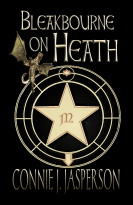 I like things that surprise me, situations that detour sharply from the expectations of normal. In
 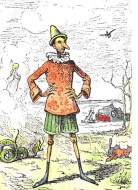 I do have a cruel streak when it comes to my written characters. The ability to laugh at oneself and to learn from missteps is critical in real life. Admitting you are the architect of your own disaster and accepting your own human frailty is a major step to adulthood.
 Do you write your heroes with few flaws, or do you portray them as “warts and all?” That becomes a matter of what you want to read.
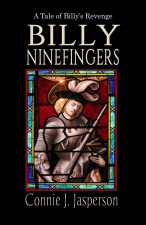 Still, I write stories about people who might have existed and have their own views of morality. In each tale, I try to get into the characters’ heads. I want to understand why they sometimes make terrible choices, acts that profoundly change their lives.
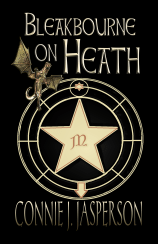 To me, the flawed hero has much to offer us. In my most recently published book, a stand-alone novel called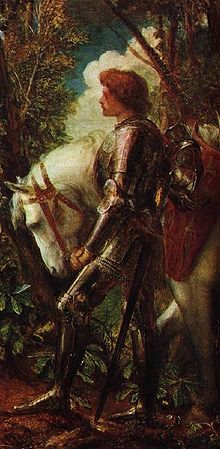
 The difference between the antagonist and the hero is the amount of grayness in their moral compass. When does the gray area of morality begin edging toward genuinely dark? What are they not willing to do to achieve their goal?
 One of my favorite authors writes great storylines and creates wonderful characters. Unfortunately, the quality of his work has deteriorated over the last decade. It’s clear that he has succumbed to the pressure from his publisher, as he is putting out four or more books a year.
 This frequently happens to me in a first draft, but whoever is editing for him is letting it slide, as it pads the word count, making his books novel-length. I suspect they don’t have time to do any significant revisions.
 When we lay down the first draft, the story emerges from our imagination and falls onto the paper (or keyboard). Even with an outline, the story forms in our heads as we write it. While we think it is perfect as is, it probably isn’t.
 Inadvertent repetition causes the story arc to dip. It takes us backward rather than forward. In my work, I have discovered that the second version of that idea is usually better than the first.
 You see things from a different angle when you start reading the chapter from the end and work your way toward the beginning. It’s amazing how many bloopers show up when you do this, even though you have already read it aloud. When you read it aloud you were going the direction you always go, the way you know so well. The mind tricks us, and we read what should be there instead of what is.
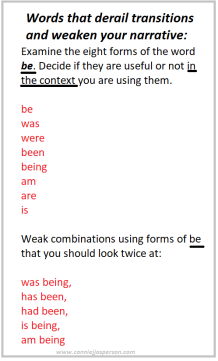 Here are a few things that stand out when I do this:
 If you have the resource of a good writing group, you are a bit ahead of the game. I suggest you run each revised chapter by your group and listen to what they say. Some of what you hear won’t be useful, but much will be.
 I am fortunate to have excellent friends willing to do this for me. Their suggestions are thoughtful and spot-on.
 In my work, the suggestions offered by the beta reader (first reader) guide and speed up the revision process. My editor can focus on doing her job without being distracted by significant issues that should have been caught early on.
 Characters: Is the point of view character (protagonist) clear? Did you understand what they were feeling? Were they likable? Did you identify with and care about them? Were there various character types, or did they all seem the same? Were their emotions and motivations clear and relatable?
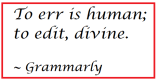 Editing is a process unto itself and is the final stage of making revisions. The editor goes over the manuscript line-by-line, pointing out areas that need attention: awkward phrasings, grammatical errors, missing quotation marks—many things that make the manuscript unreadable. Sometimes, major structural issues will need to be addressed. Straightening out all the kinks may take more than one trip through a manuscript.
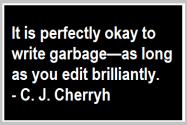 An editor is not the author. They can only suggest remedies, but ultimately all changes must be approved and implemented by the author.
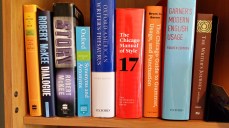 A reader won’t be familiar with it and will notice what we have overlooked.
 When observed by others, a person who is daydreaming appears lazy. Mind-wandering has no obvious purpose, but it is critical for creativity. Every groundbreaking discovery in science, every great invention we enjoy today—all were inspired by ideas that came to a person while thinking about something else or when they were mind-wandering.
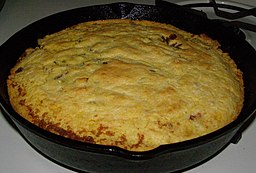 My oldest daughter, looking at our dinner, a casserole of beans with cornbread baked on top like a cobbler: “What the heck is that?”
 Perception is in the eye of the beholder. Observation and thought are seeds that inspire extrapolation, leading the viewer to come away with new ideas. When I see the story captured in a single scene by an artist, my mind always surmises more than the painting shows. I see the picture as depicting the middle of the story and imagine what came before and what happened next. Unintentionally, I put a personal spin on my interpretation, and ideas are born. I don’t mean to, but everyone does.
 This means that daydreaming is actually good for you. It boosts the brain, making our thought process more effective. Letting the mind wander allows a kind of ‘default neural network’ to engage when our brain is at wakeful rest, as in meditation, rather than actively focusing on the outside world. When we daydream, our brains can process tasks more effectively.
 You could be watching the birds, as my husband and I often do. Or maybe you’re perusing the display in a local art gallery or listening to music. I love all genres of music, but for writing I often find inspiration in powerhouse classical pieces such as Orff’s cantata,
  Today, however, I plan a long walk along the beach.
 I have no trouble selling my friends’ books – I’ve read them all and love them, and love selling them. Maybe I can sell their books because I’m not emotionally invested in their creation, but I am invested as a reader.
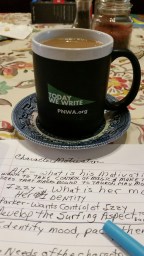 Next week on this blog we will talk about the creative process and the importance of mind-wandering. We’ll also talk about why it is important to beta read for your fellow writers, and how to be a good reader, one who gives positive feedback and offers constructive suggestions.
 I have “pantsed it” occasionally, which can be liberating but for me, there always comes a point where I realize my manuscript has gone way off track and is no longer fun to write. Then I must return to the point where the story stopped working and make an outline.
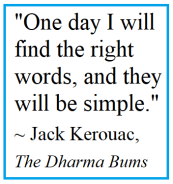 The first tool is a sense of balance. Every published novel has entire sections that were cut or rewritten at least once before it got to the editing stage.
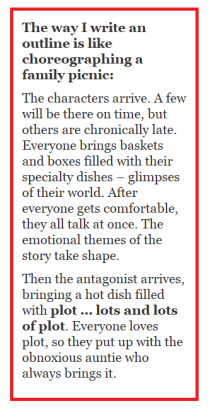
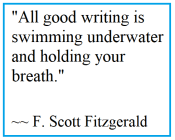 At first, the page is only a list of headings that detail the events I must write for each chapter. I know what end I have to arrive at. But the chapter headings are pulled out of the ether, accompanied by the howling of demons as I force my plot to take shape:
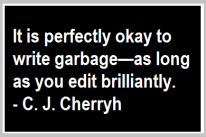 Don’t be afraid to rewrite what isn’t working. Save everything you cut because I guarantee you will want to reuse some of that prose later at a place where it makes more sense.
 Some novels are character-driven, others are event-driven, but all follow an arc. I’m a poet, and while I read in every genre, I seek out literary fantasy, novels with a character-driven plot. These are works by authors like
 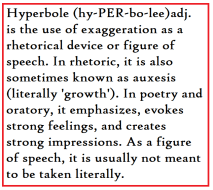 And the prose … words with impact, words combined with other words, set down in such a way that I feel silly even thinking I can write such works. Thankfully, my editor weeds out pretentious hyperbole and slaps me back to reality.
 This part of the novel is often difficult for me to get right. The protagonist must be put through a personal crisis. Their inner world must be shaken to the foundations.
 This emotional low point is necessary for our characters’ personal arcs. It is the place where they are forced to face their weaknesses and rebuild themselves. They must discover they are stronger than they ever knew.
 And what of my female protagonist? Where does her story begin?
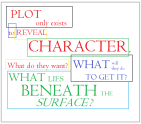 I must introduce a story-worthy problem in those pages, a test propelling the protagonist to the middle of the book. The opening paragraphs are vital. They are the hook, the introduction to my voice, and must offer a reason for the reader to continue past the first page.
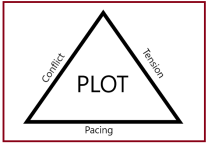 My favorite books open with a minor conflict, evolving to a series of more significant problems, working up to the first pinch point, where the characters are set on the path to their destiny.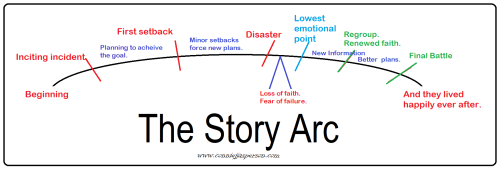


 Life in the Realm of Fantasy
.jpg&oldid=449104554)