
Our characters feel real to us, their creators, but the trick is making them seem natural to our readers.
 When I begin writing a first draft, I try to approach writing each scene as if I were shooting a movie. We know that each conversation is an event that must advance the story, but it must also give us glimpses of who each person is.
To that end, dialogue must do at least one (if not all) of these things:
- Offer information the characters are only now learning.
- Show the state of mind the characters are experiencing.
- Show the relationship of the characters to each other.
- Show the relationship of the characters to their world.
However, dialogue is only one layer of the scene. We try to establish the world environment in the opening pages but world-building is an ongoing task and is a foundational layer of each scene.
- We continue world-building by showing our characters as they interact with the immediate environment.
In the first stage of the rough draft, I sit down and picture the characters and their relationships, with those goals in mind.
- Then, I write just the dialogue for several back-and-forth exchanges. I use minimal speech tags for this because I want to get the discussion written down the way I hear it.
I do this in short bursts, getting the basic words down. It’s a two-stage process—the scenery and background get filled in after the dialogue has been written. Here is an example of four lines of dialogue:
Ann: “What are you doing?”
Jon: “Oh, just drawing.”
Ann: “Drawing what?”
Jon: “You’ll laugh or find a reason to mock me for it.”
 Having the fundamentals of the conversation to work with sharpens the scene in my mind, enabling me to frame it properly. Once I know what they are talking about and have the rudimentary dialogue straight, I add the scenery. Then, I insert the props and add the speech tags. The interaction grows, shedding more light on their relationship.
So let’s take those four lines of dialogue and set them in a kitchen. We have two characters who are wary of each other and have radically different views of their relationship.
The following day, when Ann came down for coffee, she found her stepson was once again working on something in his sketchbook. He stood when she entered, gathering his pens. “The coffee should be ready.”
“What are you doing?” Ann’s clipped tones cut the silence.
“Oh, just drawing.”
“Drawing what?”
Jon’s expression was closed, indecipherable. “You’ll laugh or find a reason to mock me for it.” He shut his sketchbook and stood, intending to leave her to her breakfast.
“Show me. Please.” When Ann repeated her demand, he reluctantly opened the book. Page after page was covered in stylized dragons, leafy vines, and runes. “Why do you waste your time with this crap? You could be brilliant, but no. People want real art, not fairies and dragons.”
“Art is not reserved just for some elite aficionado. Everyone has a different idea of it, and what appeals to you doesn’t appeal to everyone. This is how I earn my living, even though it’s not up to your standards.”
Ann poured herself a cup of coffee. “You could do so much better. I’ve tried to steer you toward success, but—”
“Stop it. I’m happy with my life.” Jon reclaimed the sketchbook. “Tim was right. Coming back was a mistake. We did it because Dad asked us to and because it’s Christmas.” He opened the door to the dining room. “Enjoy your breakfast, and don’t start in on Tim when he gets up.” The door closed behind him.
Ann gripped her cup. Where had she gone wrong? Why couldn’t the boys see how much she cared? All she had ever wanted was for them to be successful and happy.
 My above sample is not perfect, as it is from the first draft of a short story I never actually finished, but you get the idea. We learn more about the characters’ relationship with each other and see their place in this environment. The layers that form this scene are:
Action: Jon, one of our protagonists, has risen first and made coffee. He sits in the kitchen drawing in his sketchbook. An adversarial conversation ensues. Later he gathers his pens, stands, and leaves the room.
Dialogue: The conversation illuminates long-simmering differences between the two players and gives us a time reference—it’s Christmas. It also hints that the father wants the family to be reunited.
Internal Dialogue: Ann’s thoughts offer us the first glimpse of her reasoning. Tim and Jon are stepbrothers, but they were raised together and consider themselves brothers. Ann loves them fiercely, Jon as much as Tim, and we see the first indication of her inner battle in the story. We learn more about the family dynamics that must be overcome if their Christmas is to be saved.
Environment: a kitchen, closed off from the rest of the house. In this story, the woman’s closed-off kitchen symbolizes her closed-off personality. The place that is the heart of a home is closed off.
As the story progresses, we find Ann is at odds with her own son as well as her stepson and is gradually losing her husband to dementia. She’s afraid and needs emotional support from Tim and Jon but is her own worst enemy.
No matter the plot or setting, each scene we write should be formed of layers:
- environment
- props
- characters
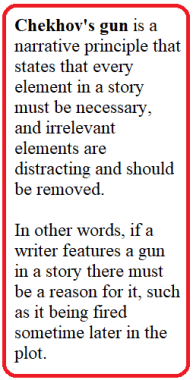 Set dressing (the props you place in the scene) shows the immediate environment. Having characters interact with props provides opportunities to insert hints that a deeper backstory exists. However, only have them interact with props that are organic or crucial to the story. This eliminates the problem of Chekhov’s Gun.
Because they are layered into the work, the scenery and props become unobtrusive. This allows the conversation to show the reader everything they need to know about our characters at a singular moment in time. It also gives us logical places for introspection and foreshadowing, integral aspects of pacing.
I can get the words down before I forget them by starting with the dialogue that will form the basis for each scene. Then I can concentrate on visualizing the conversation’s setting and decide what props to insert. The items I place in that scene must show something about the characters who interact with them.
As the story progresses along the plot arc, readers are gradually shown the world these characters live in. They will see that world without our having to dump a floor plan or itinerary on the reader. Remember our basic conversation?
“What are you doing?”
“Oh, just drawing.”
“Drawing what?”
“You’ll laugh or find a reason to mock me for it.”
We could put that exact dialogue and the notebook into a fantasy setting, sci-fi, or any other genre. The book’s plot would change what the conversation reveals about the two characters.
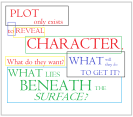
Each scene has a purpose, which is to reveal information and move the plot forward. All it takes is a few lines of dialogue and a moment of introspection on the part of the point-of-view character.
 By beginning with the conversation and envisioning each scene as if I were filming a movie, I can flesh it out and show everything the reader needs to hang their imagination on. The reader’s mind will supply the details of the immediate setting depending on the clues I give.
We try to layer conversations and world-building to bring depth to our characters. When we do it right, the possibilities are endless.
 Every writer knows the backstory is what tells us who the characters are as people and why they’re the way they are. At the beginning of our career, it seems logical to inform the reader of that history upfront. “Before you can understand that, you need to know this.”
 But knowing this and putting it into action are two different things.
 Be aware: if you are writing from an omniscient POV, this can be tricky and lead to “
 Romance novels average 50,000 to 70,000 words. In shorter novels, there is no room for sweeping, epic backstories. Instead, information and backstory are meted out only as needed through conversations and internal dialogue/introspection.
 Even with all the effort I apply to it, my editor will find things that don’t matter. She will gently take a metaphorical axe to it, highlighting that which doesn’t advance the story or add to the intrigue.
 In many thrillers and cyberpunk novels, the faceless behemoth of corporate greed is the overarching antagonist. It can be represented by characters who are portrayed as utterly committed to doing their job and loyal to their employer. In many cyberpunk novels, the antagonists tend to be goons-in-suits, enforcers who work for the corporation.
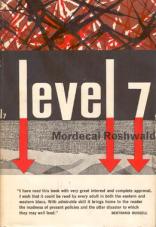 Level 7 is a 1959 science fiction novel by the Ukrainian-born Israeli writer
  This type of psychopathic antagonist is explored exceedingly well in George Saunders’ brilliant sci-fi short story,
 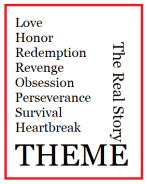 When evil is a behemoth on the order of a mega-corporation or a military coup, the villains who represent it all have reasons for their loyalty. They’re like the hero; they care intensely, obsessively about something or someone. They have logical motives for supporting what we are portraying as the enemy. Our job as authors is to make those deeply held justifications the driving force behind their story.
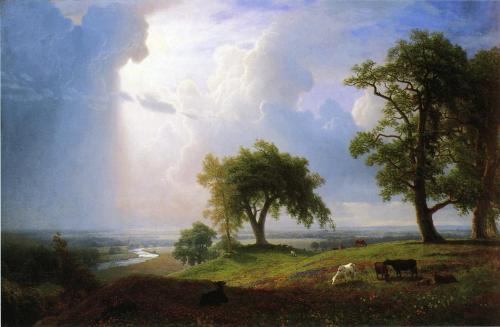 Artist: Albert Bierstadt (1830–1902)
 Volume control is a crucial part of the overall pacing of your story. “Loud” deafens us and loses its power when it’s the only sound. However, like the opening movement of Beethoven’s 5th Symphony, the entire range of volume can be effectively used to create a masterpiece.
 Dark emotions, such as depression, can be shown through a character’s reactions to things that once pleased them. Perhaps they no longer find beauty in the things they once enjoyed.
 Visceral reactions are involuntary—we can’t stop our face from flushing or our heart from pounding. We can pretend it didn’t happen or hide it, but we can’t stop it. An internal physical gut reaction is difficult to convey without offering the reader some information, a framework to hang the image on.
 Conflict keeps the protagonist from achieving their goals. Significant conflicts and emotions are easy to write about. But in real life, our smaller, more internal conflicts frequently create more significant roadblocks to success than any antagonist might present.
 In real life, we are drawn to certain people and get to know them better through conversations.
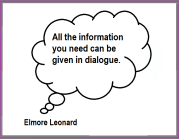 Good conversations and mental dialogues bring written characters to life and turn them into people we want to know, our closest friends.
 Internal dialogues (rambling thoughts) are often a thinly disguised info dump in my first drafts. I seek those out in the second draft and either cut them to a line or two or eliminate them entirely. I try to avoid italics if possible, so this is how I write thoughts nowadays:
 However, I have no problem understanding an accent and visualizing a character as foreign when the author consistently uses one or two well-known words that a non-native speaker might use, such as si, ja, or oui, in place of yes. Most English speakers recognize and know the meaning of these words when they see them. All it takes is a straightforward word to convey the proper foreign flavor.
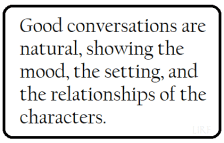 The laws of grammar sometimes break down on the quantum level in conversations with our friends. This is also true of written exchanges.
 Rule 3: Commas—Do not place a period between the closed quotes and the dialogue tag. Use a comma because when the speech tag follows the spoken words, they are one sentence consisting of clauses separated by a comma: “I’m here,” he said.
 Conversations, both spoken and internal, light up and illuminate the individual corners of the story, bringing the immensity of the overall story arc down to a personal level.
 In his book,
  Batman is a
  Apollo 13 (April 11–17, 1970) was the seventh crewed mission in the
  No matter what genre we write in, when we design the story, we build it around a need that must be fulfilled, a quest of some sort.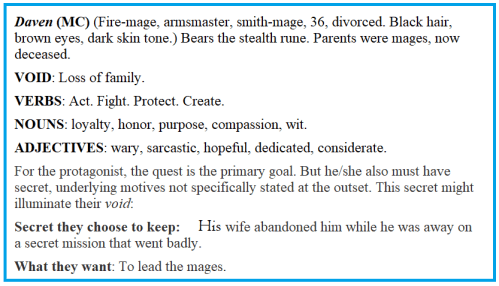
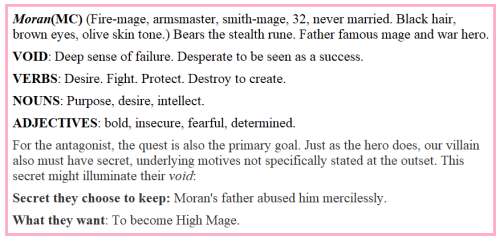
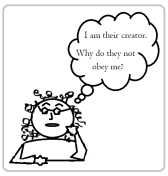 I recently had a manuscript undergo a complete change from what I originally planned. The original antagonist had such an engaging story that he had become more important to me than the protagonists.
 As a reader, I dislike discovering the author is at a loss as to what their protagonist wants. Without that impetus, they don’t have a good reason for the villain to be there either. Random events inserted to keep things interesting don’t advance the story, but motivation does.
 You’ve taken them through two revisions and think these characters are awesome, perfectly drawn as you intend. The overall theme of the narrative supports the plot arc, and the events are timed perfectly, so the pacing is good.
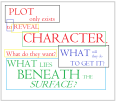 But in real life, I often find little distinction between heroes and villains. Heroes are often jackasses who need to be taken down a notch. Villains will extort protection money from a store owner and then turn around and open a soup kitchen to feed the unemployed.
 Both heroes and villains must have possibilities – the chance that the villain might be redeemed, or the hero might become the villain. As an avid gamer, I think of this as the “
 In Final Fantasy VII, the 1997 game that started it all, we meet Cloud Strife, a mercenary with a mysterious past. Gradually, we discover that, unbeknownst to himself, he is living a lie that he must face and overcome to be the hero we all need him to be.
 I try to keep the ensemble narrow in my work, limiting points of view to only one, two, or three characters at most. I keep the core cast limited to four or five, as it takes a lot of effort to show more people than that as being separate and unique.
 Moriarty’s characters are immediately engaging. They sucked me into their world in the opening pages. I couldn’t set the book down, as I wanted to know everyone’s dark secrets. I was hooked; I had to understand what led these people to book themselves into that exceedingly unusual health spa.
 The guests are immediately thrust into an unknown and possibly dangerous environment. The food they are offered is high quality but not what they are used to and varies from guest to guest.
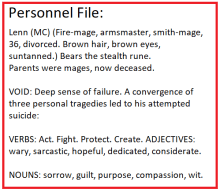 Character Names. I list the essential characters by name and the critical places where the story will be set.


 Life in the Realm of Fantasy