Tag Archives: writing

The Business Side of the Business: Managing Inventory #writerlife

Today’s post is a follow-up to Monday’s post by Ellen King Rice. It is tax season, and many people will begin trying pull together the numbers needed for their federal tax returns. If you sell books at book signing events or trade shows, you are in business for yourself, and Ellen’s post details what your responsibilities are.

Its a BusinessAuthors make readers when they do in-person book signings. We have the chance to connect with potential readers on a personal level, and they might buy a paper book. If we are personable and friendly, they might tell their friends how much they liked meeting us. Those friends will buy eBooks. (We hope!)

Most shows and events will require you to have a business license if you intend to sell books in person. This means you will have a small amount of paperwork after each in-person signing, so I am revisiting a post from 2022 detailing how authors can manage an inventory of books and have the right numbers for tax purposes.

For eBook sales, you have no obligation to report sales taxes, only your royalties as listed on the 1099 issued by Amazon or Draft2Digital, or other eBook sellers.

Whether you are traditionally published or indie, if you intend to make personal appearances at local bookstores, fairs, or conventions, you will have an inventory of books on hand to manage and account for at the end of the year. But more importantly, even if you are traditionally published, you pay for the books you sell at shows. 

The good businessperson has a spreadsheet of some sort to account for this side of the business, as it will be part of your annual business tax report. An excellent method for assembling the information you will generate for your tax report is discussed the previous post, The Business Sequence for Writers. Ellen King Rice has given us a great framework for keeping our business records straight.

There is only one more skill to have, and this is only for those who intend to sell books in person. A wise author understands that good records ensure a successful business and sets up the bookkeeping system before they go to book fairs. They have a list of the stock on hand, what books are on reorder, the day they were ordered, and how long it takes for them to ship. Also, you should keep an account of your cost for each book, both for tax purposes and insurance purposes, just in case the stock of books is lost or damaged in a house fire or flood.

You can do this on notebook paper with a pencil, a ruler, and a calculator.  I began working as a bookkeeper in 1982, using the industry-standard tools of the trade for the time. We noted each transaction with a red or black pencil in a green or yellow ledger book of varying sizes (2 to 32 columns). Then, we used rulers or yardsticks to ensure that we tracked a particular item on the correct line across all the columns. The handiest electronic device on my desk was the calculator with a printout tape.

The tools for this method of accounting are still available in the stationery section of any store and are quite affordable. I have used Excel since 1993 for all my accounting purposes, but no matter how you create your spreadsheet, each title you have on hand to take to book fairs or shows has several costs associated with it.

What follows are several screenshots of a simple way to organize a spreadsheet:

Picture1

The first column contains the heading Titles: under that heading, list each book you take to shows by the title. We will use Huw the Bard as our example book.

On the same line as the title, working to the right in column 2, write unit cost. This is the price you pay for each copy you must take to a show and varies from title to title by the length of the book and the trim size. On the same line as the book’s title, write the cost you pay KDP or Ingram Sparks or your publisher for that book: $4.99. (edited, thank you Judy!)

Column 3 is the current stock-on-hand at the end of the taxing quarter: Quantity in stock: 19

Column 4 is the sum of column three times column two: Inventory value: $89.11. That is what you would have to pay to replace those books. It is also what some Departments of Revenue may tax you on at the end of the year if the value of that stock is over a certain limit, say $5,000.00. My stock on hand never even approaches that limit.

This is why retail stores have end-of-the-year sales. They need to offload their inventory to keep their taxes low.

Column 5 is the retail price. This is what the book sells for at bookstores: $12.99. You set your retail price to cover the cost of replacing the book, with some revenue to cover table and vendor fees at shows and conventions, and still allow for a small profit.

Column 6 is the special show price (if you discount your books at shows): $12.00.

Column 7 is the retail value of your stock on hand. It is the sum of column 3 times column 6: $228.00.

Were you required to collect sales tax from your customers? When you apply for your business license, you will receive a pamphlet with all the taxing jurisdictions in your licensing area and their tax rates. These range between .08 and .11 here in Thurston County. Washington State has no income tax, so all our state’s revenues come from businesses and sales taxes collected at the time of purchase.

Make a note of the city or county where the books were sold, as you may be required to forward the taxes collected to the Department of Revenue or your local Business and Occupation tax collecting agency. If you are smart, you will make a second page with these columns:

Picture2

At the bottom of the page for both spreadsheets, total each column. That will give you the stock expenses for all your titles. There will be no scrambling at the end of the quarter for Business and Occupation taxes if you live in a state like Washington State or at the end of the year if you live elsewhere. Be smart and set the money collected as sales tax aside because it is not yours and shouldn’t be considered part of your income.

That way, you will have it at the end of the year if you only do a few shows a year like me, or quarterly if you are out there doing shows and signings every week.

The bookkeeping side of your business should take less than an hour after each show. If you have kept your spreadsheets updated, filling out annual business tax forms for your state and federal agencies will go quickly. You will have all the numbers you need to back up your reports if you are audited.

Also (and this is important), you will know the exact number of books you have on hand in each title. You will know when it’s time to reorder more stock. There is a two-to-three-week lag in printing and shipping time, so ordering books in advance is critical. You don’t want to waste money purchasing stock you have plenty of, but you need to have a supply of your better sellers.

My personal spreadsheet is a little more detailed and is saved in the cloud as are all my business and other records. It looks like this:

Dummy_Inventory_Spreadsheet

Something we rarely consider is the random natural disaster, but we must be prepared. If something should happen to your stock of books due to theft, fire, or flood, you will be able to claim your business loss. Many authors are more prolific than I am.  For most of us, replacing the stock of 1 to 30 titles is an expense that is difficult to carve out of the family budget unless we have sold enough to cover that cost.

Theft is rare, as people are usually quite decent at conventions and trade shows. I’ve only had one book stolen from a table at a show in all these years—a $15.00 (show cost) loss (or $6.80 my cost).

While it disturbed me on one level, I was a bit honored that someone wanted my book that badly. The experience left me confused as to how I was supposed to feel. But on the good side, it was nice to know that shoplifters are readers too!

5 Comments

Filed under writing

Revisiting the Business Sequence for Writers, guest post by Ellen King Rice #writerlife

Today I am revisiting a guest post from last year, written by Ellen King Rice. She has great advice about the business side of this business, and information we all can use. Ellen is a successful indie author of an engrossing series of mushroom thrillers set in the Pacific Northwest.

Its a BusinessShe also wrote the brilliant, hilarious standalone novel, Larry’s Post Rapture Pet Sitting Service. If you haven’t read that book, I highly recommend it. I laughed out loud and couldn’t set the book down.

And now, here is Ellen King Rice and her advice on how to treat this business like a business.

*** *** ***

Moving from hobbyist to professional can be challenging in any field. For indie authors, financial numbers and formal paperwork matter. There are several steps, and the sequence of them can make life easier or . . . not.

The first step in finding a path through the thicket of “business stuff” is to remember past challenges conquered. For many people this may be recalling a first bicycle ride or an early cooking effort. For others there may be a wince as we remember that first round of playing “Hot Cross Buns” on an instrument. Whatever your early challenge was, you didn’t know everything when you started, but you learned quickly.

Today, let’s build a ramp up to a business set up, including tax prep work.

  1. Author’s name.

Search your name on the internet. Make sure you are aware of other writers, activists, artists and business people who share your name. In my case, there were several, including one who shared my middle initial. After some agonizing, I decided my author’s name would be Ellen King Rice even as my friends and family know me as Ellen Rice.

  1. Publisher’s Name

I highly recommend that you chose something other than your author’s name. This gives the writer flexibility to write in more than one genre. There are also times when the publishing house name gives a bit more cachet to projects. I chose Undergrowth Publishing.

  1. Tax Number

This requirement will vary by nation. In the United States, you will want an EIN tax number from the Internal Revenue Service. There is an on-line application here: IRS EIN application online.

The EIN is a Federal Tax ID number used to identify businesses.

Having a Publisher’s name and Tax number helps with getting a business license and a bank account. Of course, I didn’t know this, so I did things backwards and sideways. I tried to get a tax EIN and failed when I was faced with the question “What is your name?”  I highly recommend brisk walks and much chocolate to break up paperwork-filing sessions.

  1. Business license

Again, requirements will vary by location and jurisdiction. If you are resident of the State of Washington, you can find the details here:

https://dor.wa.gov/open-business/apply-business-license

I chose Sole Proprietor for my business, but some writers choose to form a Limited Liability Company.

Do you need city or county licenses? In my area, obtaining a state business license triggered a letter from the city demanding I purchase a local license. It took some research, but I determined that the local vendor’s license did not apply to my circumstances (I live in the county, and I sell books on-line).

It’s wise to learn about your community rules, but often these rule sets only apply to those who are selling in person (i.e., your online sales aren’t part of the local tax structure). Even then, there are times when small vendors or special events like an arts fair are exempted.

  1. Bank account

With your writer/publisher names sorted, a Tax EIN and your business license number, getting a business bank account should be straightforward. Mine is with the Washington State Employees Credit Union. I was able to open the business account with $50 and a $5 savings reserve. This gives me an account for Amazon expenses and deposits. I also asked for a dozen checks, which the credit union provided as a courtesy.

Credit card? A business debit card is easy to request once your account is set up, but a business credit card is hard to get. So far, I’ve managed without one.

  1. Spreadsheet and Tax Forms

Last steps! At this point, it is wise to print off the small business end-of-year-tax form that you’ll be using so you can see the information required.

In the United States, this is the Schedule C “Profit or Loss from Business” form from the IRS website. We can use this form to set up a spreadsheet, by category.

We want things set up so a “Sum this category” command will make it easy to fill out the Schedule C at the end of the year.

Details matter. Take some time looking over the Tax form for your situation. Think of it as your End-of-Year Party destination. A party in the tropics requires different prep than a party with penguins. Knowing the lines to be filled makes for clever spreadsheet set up. And, yes, it feels wonderful to be fast and accurate at year’s end.

For Americans, pay attention to Schedule C, Part I which asks what your “gross receipts or sales” are (line 1) and your “cost of goods” (say, printing 30 copies of your book) for line 4.

Next look at Part II. Lines 8 to 27 list different expense categories you can report. Line 8 is Advertising, so I want an “advertising” category when I set up my writer’s spreadsheet for the year. Line 11 is “Contract Labor”, so I’ll set up that category too. My book cover designer fees can go here. Line 18 is “Office expense.”  I set up Office Expense as a category and that’s the designation to house all my paper and printer cartridge charges.

DEFINITELY check in with a qualified tax advisor (which I am not!) to make sure what you are doing is correct before you file your taxes. All I’m encouraging here is to use the Schedule C as a guide to setting up bookkeeping for easy end-of-year number crunching.
Once you have slogged your way through all six of these steps, you should be well on your way as a writing professional. Be sure to celebrate!

Footnote for American tax filers: What happens if I don’t make money? After filling in Part I (income) and Part II (Expenses), I typically show a Net loss (line 31).  That loss amount will go onto a Schedule One form, and from there to Line 8 of the 1040 form as a negative number, which will lower my taxable income.


Thank you, Ellen, for allowing me to reprint this wonderful and enlightening post. If we intend to sell books at book signings and conventions, we have a business. If we want to avoid problems with our respective taxing agencies, we must jump through the proper hoops.

The next post in this series will revisit my post discussing book signings and book fairs, and tracking inventory for both tax and insurance purposes. The pandemic has eased, and many authors have held signings and in-person events. It doesn’t matter if we are indies or traditionally published – if we sell books in person, we need to manage our costs and protect our investments.

This something we all need to consider no matter where we live in this ever-smaller world.


EKR_author_photo_2022About Ellen King Rice:

I am a wildlife biologist who suffered a spinal cord injury many years ago. Although my days of field work are over, biology continues to intrigue me.

I am fascinated by sub-cellular level responses to ecosystem changes. I also like the predictability of animal behavior, once it is understood.

A fast-paced story filled with twists is a fun way to stimulate laughs, gasps and understanding. I work to heighten ecological awareness. I want the details and your new insights to remain in your thoughts forever.

You can find me and my books at www.ellenkingrice.com

​Please join me on Instagram at:

https://www.instagram.com/mushroom_thrillers.

And on Facebook:

https://www.facebook.com/mushroomthriller/

EKR_3book_covers_01162022LIRF

7 Comments

Filed under writing

The Business Side of the Business: Finding places to submit your work #amwriting

Today, we’re going to explore the various forms of short fiction publishers are looking for and how the market drives what they will buy. Each publication only buys work they think will appeal to their readers, and each serves a different segment of the reading public.

Its a BusinessWe are looking for markets that will pay you for your work. They are difficult to get into, but once you are in, you will be offered more opportunities.

If you are writing science fiction, you most likely dream of having your work published in Analog Science Fiction and Fact. They are seeking work that is strictly science-based, because that is what their readers expect.

You might also want to submit to Uncanny, as they publish both sci-fi and fantasy. Their readers are more eclectic.

Apex Magazine publishes work that pushes the limits, and that is what their readers expect.

Cover_of_October_1952_issue_of_The_Magazine_of_Fantasy_&_Science_FictionFantasy & Science Fiction is one of the most respected publications in the business. They have published some of the industry’s most famous and award-winning short fiction. But they are highly selective as to what they will accept, so read their magazine and see what sort of work they buy.

Galaxy’s Edge publishes science fiction but is currently closed to new submissions. Keep checking to see when they will reopen.

One of the best resources for authors trying to sell their work is Reedsy. They have assembled a list of 58 reputable publishers seeking a variety of works in all genres and lengths:

58 Top Short Story Book Publishers in 2023 | Reedsy

Reedsy is a fabulous resource for writers, as well as for editors who are seeking clients. This is a good place to start if you are looking for an editor. As always, when you are looking to hire a professional, be sure to check their references.

Writing Tips Oasis also has an excellent list of publishers who pay well.

Many contests and publications use the Submittable platform to accept and review the large volume of manuscripts they receive from writers. When a publisher uses this platform, it’s great for us as authors. We can use their app to track what we have submitted and where it currently is in the process.

But what kind of work are these publishers seeking?

First, they want stories with strong plots and good character arcs. They want believable settings and well-developed themes.

Second, they want work that shows us a world we might find familiar but from a new and different angle.

300px-Astound5006Third, they want work that looks professional, as if the author read their submission guidelines for formatting the manuscript and followed them. Publishers have specific, standardized formatting they want you to use, and these guidelines are posted on their websites.

When a call for submissions goes out, their editors will have no time to deal with poorly formatted manuscripts. If you don’t follow their guidelines, they will assume you aren’t a professional and won’t read your work.

What are the formatting guidelines? Each publication has its own, but most follow this standard:

What goes on the first page? Your first page should include the following:

  • The story’s title.
  • The word count. Some will want an approximation, and others will expect accuracy.
  • In the upper left, your contact details should be formatted in the same font and size as the manuscript font. (See the image below.)

Formatted_fonts_03312019

For the most part, the requirements are basically the same from company to company, with minor differences. To ensure your work conforms to the intended recipient’s requirements, go to the publication’s website and read the standards they have laid out.

We know that selling our work to anthologies and magazines is the best way for an indie to build a reputation as an author. Remember, we’re competing with many other authors, some of them famous, and all of them as creative and talented as you are. Take the time to make your work look as professional as possible, and you will have an edge.

When we finish writing a story, an article, or a novel, we feel a rush of pride. The urge to immediately send it to a magazine or contest is strong, but the wise author must overcome it. Don’t even show it to your writing group at this stage because you are too involved in it, and there may be some awkward flaws that were introduced into the narrative during the rush of creation.

Set your manuscript aside for a week or so, then return to it. This will give you a more critical eye. You should look for

  1. Dropped or missing words.
  2. Words that spell check won’t find because they are spelled correctly but are wrong: They went their for breakfast.
  3. Extra spaces in odd places and after sentences. Editors want one (1) space after each sentence.
  4. Use the Read Aloud function or a narrator app to have the story read back to you.

While we all agree that only submitting work of the highest quality is critical, one thing is clear: the greatest hurdle Indie authors face is getting our work in front of readers’ eyes.

leaves of grass memeDon’t be discouraged by rejection. Rejection happens far more frequently than acceptance, even to famous authors. Don’t let fear of rejection keep you from writing pieces you’re emotionally invested in.

I always say this, but it is true: how you handle criticism and rejection tells editors what kind of person you are. Rejection gives you the chance to cross the invisible line between amateur and professional. Always take the high ground.

  • If an editor has sent you a detailed rejection, respond with a simple “thank you for your time.”
  • If it’s a form letter rejection, don’t reply.

When you receive that email of acceptance, do that happy dance, and don’t be shy about it.

There is no better feeling than knowing someone you respect liked your work enough to publish it.

Good luck and keep submitting no matter how many rejections you receive, whether you are trying to be published in a magazine or hoping to publish a novel.

Johnathan_Livingston_SeagullRemember, 18 publishers thought a story about a seagull was ridiculous before Richard Bach’s novella, Jonathan Livingston Seagull was finally picked up by MacMillan – and even they didn’t give it any real support.

Yet that novella is one that many people, myself included, consider a watershed moment in their reading lives. Keep writing, and may 2023 be a good year for us all.

10 Comments

Filed under writing

The Business Side of the Business – managing submissions #amwriting

Do you consider yourself a professional writer? If writing is your real career (regardless of your day job), this is a good time to consider your path. One of the best ways to get your author name out there is by having your work published in magazines and anthologies.

Its a BusinessA new year has begun, and open calls for spring and summer contests and anthologies will start appearing in various forums that I frequent. Finding places to submit your work can be challenging, but here are links to two groups on Facebook where publishers post open calls for short stories.

Open Submission Calls for Short Story Writers (All genres, including poetry)

Open Call: Science Fiction, Fantasy & Pulp Market (speculative fiction only)

  • You must apply to be accepted into these groups and answer specific questions to prove you are legitimately seeking places to submit your work.
  • Once approved, the rules of good conduct must be followed for a happy coexistence. Troublemakers and trolls are unceremoniously ejected.

Some will be open calls for anthologies that are not paid, and others will pay royalties. Be wary and carefully research the unpaid ones to ensure that the publisher is reputable and that there is a good reason why you are being asked to donate your work for no compensation.

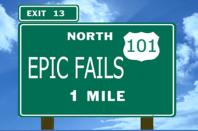
Don’t get sucked into submitting to “charity” anthology mills, no matter how fancy their website is. These publishers give legitimate charity anthologies a bad reputation. The only cause these vanity mills support is the publisher’s pocketbook, so they are thinly disguised vanity presses.

Despite their claims, many charity anthology mills are for profit, with less than 10% of any royalties going to the specified charity and the rest remaining as the publisher’s source of income. The only volumes they sell are the ones the individual authors can pressure their friends and families to purchase.

Epic Fails meme2

For those authors new to the mean streets of publishing, vanity anthology mills seem good because they’re guaranteed to be published by these predators. The publishers do little to no editing. So, you must ask yourself this: do you want your author name listed on the cover and forever associated with that pile of awfulness?

We must do a little research and only submit our work to publications that respect both the work they publish and their authors.

And on that note, be sure any contracts you sign limit the use of your story to that volume only, and you retain all other rights.

  • You should retain the right to republish that story after a finite amount of time has passed, usually 90 days after the anthology publication date.

SFWA has a list of predatory publishers you should avoid doing business with. They also have useful information on things that might be found in predatory contracts. You don’t need to be a member to access these. https://www.sfwa.org/

But there are legitimate calls for extremely short fiction by highly reputable publishers.

These publishers pay for the work they publish and offer reasonable contracts. The compensation will be small as the work they are buying isn’t long, but it is payment. Sometimes reputable publishers have open calls for charity anthologies and those are worth submitting to, with one or two well-known authors donating a short story and the rest will be work by up-and-coming writers.

You could be one of those up-and-coming authors–but you need to have written something that you can submit.

Writers gain proficiency in all aspects of writing fiction by writing short stories and essays. We increase our ability to tell a story with minimal exposition and learn ways to use intentional prose.

For practice, try picking a theme and thinking creatively. Think a little wide of the obvious tropes (genre-specific, commonly used plot devices and archetypes). Look for an original angle that will play well to that theme, and then go for it.

theRealStoryLIRF01102021My problem is this: all my stories want to grow longer than 1,000 words. It requires weeks of effort to get my work to fit within that parameter. So, I often write practice stories, limiting myself to telling the whole story in 1000 words or less. These practice shorts serve several purposes:

  1. I have a finite amount of time to tell what happened, so only the most crucial information will fit within that space.
  2. Space is limited, so the number of characters is restricted to just the important ones.
  3. There is no room for anything that does not advance the plot or influence the outcome.
  4. The fewer the words, the more important the theme becomes. One learns how to use a theme to their advantage.

Best of all, writing a new short story each week builds a reserve, a “bank” to draw on when I need a good piece to submit to a contest. If you select a different theme for each tale, and you may have just the right story in your files to submit to a themed anthology.

When you choose to submit to an open call for themed work, your work must demonstrate your understanding of what is meant by the word “theme.” This is as important as skill as your ability to write clean and compelling prose.

When you submit your work to various places, you need to keep a record of it. Most publishers won’t accept simultaneous submissions. To avoid that, you should list:

  • what was submitted,
  • links or email addresses of where it was sent to,
  • when submissions close,
  • what date the contest ends,

To that end, I suggest you create a database for your work. I use an Excel spreadsheet that lists the title, word count, completion date, where and when I submitted the work, how much I earned for it, etc.

Below is a screenshot of what my list of submitted work looks like. I started this file in 2015 and am still using this spreadsheet to track my submissions.

List of Submitted Work

I also suggest you track your productivity by keeping a daily log of your writing sessions, a writing journal. Each time you sit down to write, make a little note to yourself of how long your writing session was and your word count at the end of the session. Make a note of the time of day you were writing as well.

It’s fun to look back and see the ebb and flow of your productivity. It’s also an excellent way to determine what time of day is your most creative.

Writing is my job. I see this little productivity diary as my way of clocking in to work. It inspires me to develop a writing routine and encourages me to write at least 100 new words every day.

In extremely short fiction such as drabbles and other flash fiction, you must include only the most essential elements of a story.

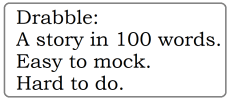
Drabble_LIRF_1_jan_2018_cjjapAs a poet, I find it far easier to tell a story in 100 words than in 1,000. That 100-word story is called a drabble and is an art form in itself.

You can find publications with open calls at Submittable. Unfortunately, that site is not as useful regarding speculative fiction as it was several years ago. However, I have seen anthology calls for spec fic there. Still, poetry collections, literary anthologies, and contests use Submittable, so that is an option. https://www.submittable.com/

Some more suggestions you could implement during the forthcoming year that fall under the heading of the business of writing are:

  • Find time for education—I attend writing conferences and seminars.
  • Find time for reading—I read for two hours every evening, often longer.
  • Follow editors on Facebook, Instagram, and also their Twitter feeds if you are still using that platform. Consider following the magazines you submit to (or would like to send work to) on each social media platform you use.

This is something a fellow author suggested: keep a networking notebook. It should include the names of people in the industry you have spoken to, who they work for (if an agent or editor), their emails and/or business cards, etc., as you never know when that contact will come in handy.

Finally, you must invest in your career, and that does require a little money. You must develop the habit of saving for future expenses, so I suggest you set aside two dollars for every day you write. That isn’t much, but it adds up and can help pay for a seminar or a conference, or any number of expenses that will come up.

coins That way, you won’t be left wondering how to attend a conference and still cover your household bills.

This list of suggestions is meant for authors who intend to write professionally. It’s a business, so these little bookkeeping habits help keep me focused and on track.

In my next post, I will explore the various forms of short fiction publishers are looking for and how the market drives what they will buy.


Credits and attributions:

Coins, courtesy of Microsoft content creators, accessed December 31, 2022. Non-commercial use.

18 Comments

Filed under writing

The Editing Process #amwriting

Self-editing is not an easy task. As a rule, I don’t recommend it because we authors see what we want to see. However, hiring an editor is out of reach for some people, and we will discuss that further in the second half of this article.

WritingCraft_self-editingThe publishing world is a rough playground. Editors for traditional publishing companies and small presses have a landslide of work to pick from and are chronically short-staffed. They can’t accept unprofessional work regardless of how good the story is.

Finding a freelance editor can be a challenge. A good way is to ask other authors who they recommend. Also, many freelance editors network through social media sites like Linkedin.

Another way is to google “how to find a freelance editor.”

Quill_pen smallBefore you hire an editor, check their qualifications and references. SFWA (Science Fiction & Fantasy Writers Association) has an article you should read regardless of the genre in which you write: EDITORS AND EDITING – SFWA

What to expect once you do hire an editor:

Many editors will ask for the first twenty pages of your manuscript at no cost to you. They will either accept your project or explain why it isn’t ready for editing. Submissions should be formatted as MS WORD documents using Times New Roman 12 pt. font. Some editors will ask for a different font, so format it in the style they require.

Using the ribbon at the top, on the far right-hand side of the home tab, click Select All. This will highlight your entire document. With the whole document highlighted, open the paragraph tab to drop down the formatting menu. The manuscript should be aligned left, creating a ragged right-hand margin. Sentences should be double-spaced with no extra space between paragraphs. The first line of each paragraph should be indented .5 and formatted using the ribbon (not the tab key).

formatting_paragraphs_word_doc2018_LIRF

If you have used the tab key to indent paragraphs, you can fix it by using one of the following ways.

To remove tabs from a manuscript in MS Word or most other word-processing programs, open the “Find” box (right side of the ribbon on the home tab). In the “Find” field, type in ^t. (Caret + lowercase t) (press the alt key 94 to make ^ and key the t). This only works if you have a ten-key (number pad) at the right side of your keyboard: ^t.

Then click “Replace.” In this field, type nothing. Click once on “Replace all,” and it will remove every tab.

remove_tabs

That will leave you with no indents whatsoever. Your manuscript will temporarily look like a wall of words, but you will resolve that.

Once the tabs are all removed, use the following instructions to format paragraphs.

FIRST: SELECT ALL. This will highlight your entire manuscript.

Step 1: On the Home tab, look in the group labeled ‘Paragraph.’ On the lower right-hand side of that group is a small grey square. Click on it. A pop-out menu will appear, which is where you format your paragraphs.

Step 2: On the indents and spacing menu: Use standard alignment, align LEFT. We use this format because we are not looking at a finished product here. We are looking at a rough draft that will be sliced, diced, and otherwise mutilated many times before we get to the final product.

Step 3: Indentation: leave that alone or reset both numbers to ‘0’ if you have inadvertently altered it.

Step 4: Where it says ‘Special,’ select ‘first line on the dropdown menu.’ On the ‘By’ menu, select ‘0.5.’ (Some publishers specify a different number, 0.3 or 0.2, but 0.5 is standard.)

Step 5: ‘Spacing’: set both before and after to ‘0.’

Step 6: ‘Line Spacing’: set to ‘double.’

If you don’t have a ten-key pad, you must remove each tabbed indent by hand. Beginning with the first paragraph on the first page, scroll down and use the backspace key to remove the tab indenting every paragraph.

The editor will probably use the track changes function in MS Word. They will return your manuscript with their suggestions for revisions, highlighted in red and noted in the review column on the right-hand side of the document. You will use the track changes function to accept or reject each suggestion. This is what track changes looks like when you get the manuscript back:

what track changes looks like

Also, you might receive a separate report detailing the editor’s overall impressions of your manuscript’s strengths and weaknesses.

During the editing process, a word-frequency report might be generated. A style sheet will probably be developed for usages and unique spellings that may pertain to your manuscript. Via email, you and the editor might discuss the names and usages that may differ from standard spellings to create that style sheet. A good editor will respond to your questions as soon as they receive your email.

We overlook many flaws when trying to self-edit our work because we are as immersed in visualizing the scene as we were during the moments when we first wrote it. Our eyes see what we imagine to be there rather than the typos or missing words.

steampunk had holding pen smallIf you’re a member of a writers’ group, you have a resource of people who will beta read for you at no cost. As a critique group member, you will read for them too.

Be careful how you phrase your comments on their work. Be accurate and find positive things to point out as well as areas that need work.

For those who can’t afford a full professional edit, there is a way to make a pretty good stab at editing your own manuscript. However, it is time-consuming, which is why an editor’s services are not cheap.

Open your Manuscript.

Break it into separate chapters by copying and pasting each individual chapter into a new document. Doing this preserves the original manuscript and breaks it down into manageable chunks.

Save the chapters in a new file labeled with the word “revisions.” Example: Barons_Hollow_revisions_12-22-2022

FileDocumentClearly and consistently label each chapter. Ensure the chapter numbers are in the proper sequence, and don’t skip a number. I would label my individual chapter files this way:

  • BH_ch_1

Print out the first chapter. Everything looks different printed out, and you will see many things you don’t notice on the computer screen.

Turn to the last page. Cover the page, leaving only the final paragraph visible.

  • Starting with the last paragraph on the last page, begin reading, working your way forward.
  • Look for typos and garbled sentences.
  • With a yellow highlighter, mark each place that needs correction.

I can’t stress the importance of the following observation strongly enough:

YOU MUST UNDERSTAND AND OBEY THE BASIC RULES OF GRAMMAR. Those who think the standard grammar rules don’t matter to readers are doing their work and reputation a disservice.

misuse_grammar_consistently_memeIf you are writing in the US, you might consider investing in Bryan A. Garner’s Chicago Guide to Grammar, Usage, and Punctuation. This is a resource with all the answers to questions about grammar and sentence structure. It takes the Chicago Manual of Style and boils it down to just the grammar.

For a quick one-page reference, here is a link to an article I posted on the basics of grammar:

Fundamentals of Grammar: seven basic rules of punctuation

Punctuation is not an area where we can cut corners. It serves as the traffic signals, affects pacing, and avoids verbal chaos. Most readers won’t notice the grammar if you have a good grasp of the basics and are consistent.

When you have finished, you should have someone you trust read it for typos and copy/paste errors you might have missed. It doesn’t have to be perfect, but readers want to enjoy the book, not struggle through garbled sentences.

The New Year approaches, and many books will be indie-published novels written during NaNoWriMo. Will they be readable and enjoyable? If the authors took the time to have their work edited and seen by their writing group first—then yes, probably so.

Whatever you write, and whatever your publishing path, I wish you a blessed New Year. May the well of inspiration never run dry!

christmas-holly-sidebar 2

30 Comments

Filed under writing

A Christmas Carol by Charles Dickens – a masterclass in structure #amwriting

Another Christmas has joined the Ghosts of Christmas Past—today is Boxing Day. Our post today explores my favorite Christmas story of all time, A Christmas Carol, by Charles Dickens.

My Sister's Ornament, cjjaspI have talked about this novella many times, as I think it is one of the most enduring stories in Western literature. The opening act of this tale is a masterclass in how to structure a story.

I love stories of redemption–and A Christmas Carol by Charles Dickens remains one of the most beloved tales of redemption in the Western canon. Written in 1843 as a serialized novella, A Christmas Carol has inspired a landslide of adaptations in both movies and books.

Charles Dickens was a master of storytelling, employing hooks and heavy foreshadowing to good effect. Let’s have a look at the first lines of this tale:

Christmascarol1843_--_040“Marley was dead, to begin with. There is no doubt whatever about that. The register of his burial was signed by the clergyman, the clerk, the undertaker, and the chief mourner. Scrooge signed it. And Scrooge’s name was good upon ‘Change for anything he chose to put his hand to. Old Marley was as dead as a doornail.”

In that first paragraph, Dickens offers us the bait. He sinks the hook and reels in the fish (the reader) by foreshadowing the story’s first plot point–the visitation by Marley’s ghost. We want to know why Marley’s unquestionable state of decay was so crucial that the conversation between us, the readers, and Dickens, the author, was launched with that topic.

Dickens doesn’t talk down to his readers. He uses the common phrasing of his time as if he were speaking to us over tea — “dead as a doornail.” This places him on our level, a friend we feel comfortable gossiping with.

He returns to the thread of Marley several pages later, with the little scene involving the doorknocker. This is where Scrooge sees the face of his late business partner superimposed over the knocker and believes he is hallucinating. This is more foreshadowing, more bait to keep us reading.

At this point, we’ve followed Scrooge through several scenes, each introducing the subplots. We have met the man who, as yet, is named only as ‘the clerk’ in the original manuscript but whom we will later know to be Bob Cratchit. We’ve also met Scrooge’s nephew, Fred, who is a pleasant, likeable man.

These subplots are critical, as Scrooge’s redemption revolves around the ultimate resolution of those two separate mini stories. He must witness the joy and love in Cratchit’s family, who are suffering but happy despite living in grinding poverty (for which Scrooge bears a responsibility).

We see that his nephew, Fred, though orphaned, has his own business to run and is well off in his own right. Fred craves a relationship with his uncle and doesn’t care what he might gain from it financially.

By the end of the first act, all the characters are in place, and the setting is solidly in the reader’s mind. We’ve seen the city, cold and dark, with danger lurking in the shadows. We’ve observed how Scrooge interacts with everyone around him, strangers and acquaintances alike.

Now we come to the first plot point in Dickens’ story arc–Marley’s visitation. This moment in a story is also called “the inciting incident,” as this is the point of no return. Here is where the set-up ends, and the story takes off.

Dickens understood how to keep a reader enthralled. No words are wasted. Every scene is important, every scene leads to the ultimate redemption of the protagonist, Ebenezer Scrooge.

This is a short tale, a novella rather than a novel. But it is a profoundly moving allegory, a parable of redemption that remains pertinent in modern society.

In this tale, Dickens asks you to recognize the plight of those whom the Industrial Revolution has displaced and driven into poverty and the obligation of society to provide for them humanely.

This is a concept our society continues to struggle with and perhaps will for a long time to come. Cities everywhere struggle with the problem of homelessness and a lack of empathy for those unable to afford decent housing. Everyone is aware of this problem, but we can’t come to an agreement for resolving it.

A Christmas Carol remains relevant even in today’s hyper-connected world. It resonates with us because of that deep, underlying call for compassion that resounds through the centuries and is, unfortunately, timeless.

Ghost_of_Christmas_Present_John_Leech_1843As I mentioned before, this book is only a novella. It was comprised of 66 handwritten pages. Some people think they aren’t “a real author” if they don’t write a 900-page doorstop, but Dickens says differently.

One doesn’t have to write a novel to be an author. Whether you write blogposts, poems, short stories, novellas, or 700-page epic fantasies, you are an author. Diarists are authors. Playwrights are authors. Authors write—the act of creative writing makes one an author.

Today’s images are two illustrations by John Leech from the first edition of the novella published in book form in 1843.  We’re fortunate that the original art of John Leech, which Dickens himself chose to include in the book, has been uploaded to Wikimedia Commons. Thanks to the good people at Wikimedia, these prints are available for us all to enjoy.

From Wikipedia: John Leech (August 29, 1817 – October 29, 1864, in London) was a British caricaturist and illustrator. He is best known for his work for Punch, a humorous magazine for a broad middle-class audience, combining verbal and graphic political satire with light social comedy. Leech catered to contemporary prejudices, such as anti-Americanism and antisemitism, and supported acceptable social reforms. Leech’s critical yet humorous cartoons on the Crimean War help shape public attitudes toward heroism, warfare, and Britain’s role in the world. [1]

Happy Boxing Day, my friends. Write what you love, and may the New Year offer you all the inspiration you need. May you be happy, healthy, and may you have many opportunities to tell your stories.


CREDITS AND ATTRIBUTIONS:

[1] Wikipedia contributors, “John Leech (caricaturist),” Wikipedia, The Free Encyclopedia, https://en.wikipedia.org/w/index.php?title=John_Leech_(caricaturist)&oldid=871947694 (accessed December 25, 2022).

Wikimedia Commons contributors, “File:Christmascarol1843 — 040.jpg,” Wikimedia Commons, the free media repository, https://commons.wikimedia.org/w/index.php?title=File:Christmascarol1843_–_040.jpg&oldid=329166198 (accessed December 25, 2022)

A colourised edit of an engraving of Charles Dickens’ “Ghost of Christmas Present” character, by John Leech in 1843. Wikimedia Commons contributors, “File:Ghost of Christmas Present John Leech 1843.jpg,” Wikimedia Commons, the free media repository, https://commons.wikimedia.org/w/index.php?title=File:Ghost_of_Christmas_Present_John_Leech_1843.jpg&oldid=329172654 (accessed December 25, 2022).

9 Comments

Filed under writing

Revisions #TheStruggleIsReal #amwriting

Making revisions is quite different from editing, although some people don’t see it that way. Editing is a process that begins when I send the final draft to my editor, usually a year or two out from when the story first lands on paper.

depthPart1revisionsLIRF05252021For me, revisions begin with the second draft and sometimes involve radical changes to the storyline or character arcs. I may take a manuscript through many drafts before finally getting the story right.

The process of revision starts when I write the final lines, finishing the first draft. I’m smarter now than I used to be, so I let that mess sit for a few weeks.

Then I go back and begin reading what I have written. As I read, I make corrections to typos and garbled sentences that I come across, although I miss as many as I catch.

I also notice plot holes, and this is where the second draft becomes work. This is where I might discover I have written myself into a far-fetched corner and my original solution was less than graceful.

Or I may find there is no tension, and the story is nothing but a series of character sketches.

Fortunately, much of what I have written can be recycled into a different project, should the need arise.

fileFolderNEVER DELETE months of work. Don’t trash what could be the seeds of another novel. Save it in an outtakes file and use it later. I give the subfile a name like HA_outtakes_20Dec2022. That file name tells me the cut chapters were last changed on December 20, 2022.

The old manuscript, version 1, will also be in that file in its original entirety.

FileDocumentThen, I give the second draft a new file name: Heavens_Altar_version_2, which becomes the version I work on out of the main file folder.

Why not just delete it? When I get to the second draft stage, I have accomplished many important things with the 3 months of work I might cut from that novel.

  • The world is solidly built.
  • The characters are firmly in my head, so their interactions will make sense in the new context.
  • Some sections I cut can be recycled into the new version, just in a different place.

Sometimes when I’m involved in creating characters, I overlook the misfortunes and struggles that create opportunities for growth. A good storyteller places obstacles on the path, events that must force a transformation upon the protagonists and their companions.

Catastrophes, even small ones on the most personal of levels, are the fertile ground from which adventure springs. When making revisions, we must ensure these growth opportunities are clearly defined, logical, and in the right place.

Events from which there is no turning back are the impetus of change, and that change is what the book is about.

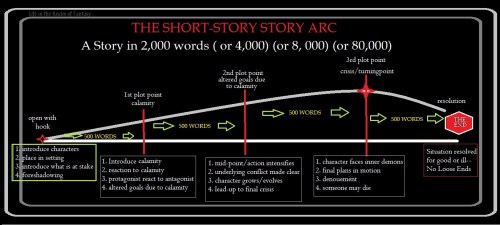
Midpoint in the story’s arc is often a place where a choice is made from which there is no turning back. From that point, the narrative rises to the third plot point, an event that is either an actual death or a symbolic death. If either of these events is a non-starter, I have to either improve them or find better catastrophes.

This major event is critical because it forces the protagonist to be greater than they believed they could be. Conversely, it can break them down into their component parts.

Author-thoughtsEither way, the characters will be profoundly changed from who they thought they were on page one, becoming who they are when the final sentence is written. The character arc is formed by their experiences.

How do I find those catalysts for change? Sometimes I need an external eye to point out where I have gone wrong, and I seek ideas from my writing group.

However, most of my writing disasters are preceded by one or more points of no return. Identifying and rectifying those moments takes time. It’s why I take so long to write a book.

When I finally see what must be changed, it may take several days to visualize how to resolve it. But that time spent mind-wandering on paper is not wasted. I will have a better plot arc for my characters and still arrive at the ending I want.

I believe in the joy of writing and the elation of creating something powerful. Sometimes we lose our fire for a story because another story has captured our imagination. If that happens, set the first one aside and write the story you are passionate about.

We who are indies have the freedom to write what we want, when we want. The only deadlines we have to meet are the ones we set for ourselves.

Book- onstruction-sign copyTrue inspiration is not an everlasting firehose of ideas. Sometimes there are dry spells. If you take another look at the work you have cut and saved in an outtakes file, you might see it with fresh eyes. You might see the seeds of a different story, and the fire for writing will be reignited.

I may take my first draft through many versions before I have the story written the way I want it. The end result should be worth it—I hope.

14 Comments

Filed under writing

Editing Software – the Pros and Cons #amwriting

Every year about this time, the question of purchasing editing software arises in one or another writers’ forum. These programs are expensive, but for me, they are a good investment. I have used ProWriting Aid in the past, but it didn’t play well with MS Word and often glitched.

WritingCraft_self-editingI understand that slight incompatibility has been resolved. In my opinion, both programs are good, and both have pros and cons.

I switched to Grammarly in 2016 because it worked well with MS Word. I know it also works well with Google Docs, as a friend of mine uses that program.

Grammarly is a tool I use to self-edit my blog articles in conjunction with the Read Aloud function that comes with MS Word. No matter how good we think we are, self-editing is problematic. We will overlook many flaws in our work unless we can view it from a different angle.

I use these two tools to turn out three articles each week, hoping to be as professional looking as possible.

I still miss obvious errors.

I find working with editing software as annoying as heck.

Editing software is good at alerting you to some errors. But these helpful programs are not as valuable as we wish they were. The suggestions they make concerning phrasing are based on algorithms and often make no sense.

What is an algorithm? Wikipedia says:

In mathematics and computer science, an algorithm (/ˈælɡərɪðəm/ is a finite sequence of rigorous instructions, typically used to solve a class of specific problems or to perform a computation. Algorithms are used as specifications for performing calculations and data processing. More advanced algorithms can perform automated deductions (referred to as automated reasoning) and use mathematical and logical tests to divert the code execution through various routes (referred to as automated decision-making). [1]

This means that editing software is defined by finite rules. Suggestions are made based on the placement of a word or punctuation. Editing programs will often strongly suggest changes that may not be right for that situation because software isn’t intuitive. It is unable to understand the fluid nature of creative writing and how the way we combine words evokes emotion.

powerwordsWordCloudLIRF06192021Most word processing programs have some form of spellcheck and some minor editing assists. Spellcheck is notorious for both helping and hindering you.

When a word is misused but spelled correctly, your word-processing program’s spellcheck may not alert you to an obvious error. But editing software probably will.

  • There, their, they’re.
  • To, too, two.
  • Its, it’s

The BIG problem for those who don’t remember the basics of grammar or were never taught them is this: editing programs cannot see the context of the work they are analyzing.

That is where your eye and understanding of context and grammar must prevail.

New writers must learn how their native language works. Editing programs are helpful but can mislead and confuse authors who are new to the craft and don’t understand the mechanics of grammar. One must know:

  • how to construct a sentence,
  • how to construct a paragraph,
  • how to write dialogue.

At this stage in our technology, understanding context is solely a human function. Context is defined as the parts of a written or spoken statement that precede or follow a specific word or passage, usually influencing its meaning or effect.

I find software for editing useful. I do rely on it as a way to turn out articles in a timely fashion.

strange thoughts 2You might disagree with the program’s suggestions. You, the author, have control and can disregard suggested changes if they make no sense. I regularly reject weird suggestions.

Each time the editing program highlights something, I examine the problem sentence. Knowing that how I phrased a sentence tripped the program’s algorithms encourages me to look at that passage with a critical eye.

I may not use the program’s suggestion, but something triggered the algorithm. I search for a better way to get my idea across.

Even editors must have their work seen by other eyes. My blog posts are proof of this, as I am the only one who sees them before they are posted. Even though I write them in advance, edit them, and then look at them again before scheduling them, I still find silly errors two or three days after a post has gone live.

Grammarly isn’t as helpful in my creative writing as it is for a blog post. It’s too difficult to ignore the oddball suggestions it makes while I’m writing, so I don’t waste time by running my raw work through that grinder.

Instead, I write a chapter or scene and move on. Later, I access the Read Aloud function and read that section along with the mechanical voice. It’s annoying and doesn’t always pronounce things right, but this first tool shows me many places that need rewriting.

I use this function rather than doing it myself, as I tend to see and read aloud what I think should be there rather than what is.

What does the Read Aloud function help me see?

  • I habitually key the word though, when I mean through. These are two widely different words but are only one letter apart. Most, but not all, miss-keyed words will leap out when you hear them read aloud.
  • Most but not all run-on sentences stand out when you hear them read aloud.
  • Most but not all inadvertent repetitions also stand out.
  • Most of the time, hokey phrasing doesn’t sound as good as you thought it was.
  • Most of the time, you hear where you have dropped words because you were keying so fast you skipped over including an article, like “the” or “a” before a noun.

chicago guide to grammarI am wary of relying on Grammarly or ProWriting Aid for anything other than alerting you to possible problems. If you blindly obey every suggestion made by editing programs, you will turn your manuscript into a mess.

Editing software in conjunction with a style guide can be a tool for learning if you really want to learn the fundamentals of your native language. If your native language is English and you wish to invest in editing software, you should also invest in one of two books, depending on whether you use American or UK English:

The Chicago Guide to Grammar, Usage, and Punctuation (American English)

OR

The Oxford A – Z of Grammar and Punctuation (UK English)

Both American and UK writers should invest in:

The Oxford Dictionary of Synonyms and Antonyms (UK and American English)

Each time the software makes a suggestion you disagree with but don’t know why—look it up in the grammar book. Learn why something looks right to you but is technically wrong. Then choose to write it the way you like it best. If you know the rules, you can break them with style.

oxford_synonym_antonymAlso, it never hurts to have a book of synonyms on hand. We all tend to inadvertently repeat ourselves, and the Read Aloud function will shed light on those crutch words. A dictionary of synonyms and antonyms can help us find good alternatives.

My best advice is to never stop learning about the craft of writing. I have taken advantage of every opportunity to learn, both from books and from my editor.

As you can see in the screenshot below, Grammarly points out things I need to reexamine. By the time the post goes live, it has been run though Grammarly, read aloud, and set aside for a day. Then I read it again, make more revisions, and schedule it.

Grammarly12172022LIRF


Credits and Attributions:

[1] Wikipedia contributors, “Algorithm,” Wikipedia, The Free Encyclopedia, https://en.wikipedia.org/w/index.php?title=Algorithm&oldid=1127589631 (accessed December 17, 2022).

11 Comments

Filed under writing

Post NaNoWriMo World Building  part 2 – Empaths and Healers #amwriting

Today we continue our discussion of extraordinary powers in a fantasy environment. We are diving into empathic abilities such as telepathy and empathic healing.

How the written universe works magic and superpowers1Our universe is a mysterious, stunning place. One puzzle that has occupied scientists for decades is the observable fact that our universe has more matter and energy than it should.

Wikipedia says: In physical cosmology and astronomydark energy is an unknown form of energy that affects the universe on the largest scales. The first observational evidence for its existence came from measurements of supernovas, which showed that the universe does not expand at a constant rate; rather, the universe’s expansion is accelerating. [1]

In other words, something we can’t see or measure is out there, shaping our known universe. For lack of a better term, scientists refer to it as “dark matter” and “dark energy.”

A common trope of fantasy and sometimes sci-fi is telepathy. Sci-fi novels will sometimes feature characters with telepathic gifts—the ability to read minds.

Fantasy takes telepathy one step further. It explores giving certain people the ability to manipulate healing on a cellular level, as well as reading minds and manipulating behaviors. Sometimes characters have a gift of prophecy.

This force is a trope that is often called empathy. It is the dark energy of a fantasy universe.

According to Wikipedia, the fount of all knowledge:

Telepathy (from the Greek τῆλε, tele meaning “distant” and πάθος/-πάθεια, pathos or -patheia meaning “feelingperceptionpassionafflictionexperience“) is the purported vicarious transmission of information from one person’s mind to another’s without using any known human sensory channels or physical interaction. The term was first coined in 1882 by the classical scholar Frederic W. H. Myers, a founder of the Society for Psychical Research (SPR), and has remained more popular than the earlier expression thought-transference.

Telepathy experiments have historically been criticized for a lack of proper controls and repeatability. There is no good evidence that telepathy exists, and the topic is generally considered by the scientific community to be pseudoscience. [2]

588px-John_William_Waterhouse_-_The_Crystal_BallSince mainstream science still pooh-poohs its existence, telepathy and empathic abilities are whatever we who write books decide they are. I choose to see telepathy as an extension of the dark energy that scientists admit is all around us. Some people can tap into it, but others can’t.

As I showed in the previous post, rules create limitations, requiring the characters to work harder. We care more about their struggle. But there is a more obvious reason. When we have rules, we can write a narrative without inadvertent contradictions.

What empathic gift does your character have: emotion reading, mind reading, healing, or foresight? How common or rare is this gift?

How did they discover they had an empathic gift? What can they do with it?

Conversely, what can they NOT do with it?

  • Is there formal training for gifts like theirs?
  • What happens to people who use their empathy to abuse others?
  • Has society made laws regulating how empaths are trained and controlled?

Now, let’s talk about the characters themselves. What are their views of how their talents should be used?

  • How important is human life?
  • How is using their talent to commit murder punished?
  • How do they view betrayal, hypocrisy, envy, and avarice?
  • What effect does drunkenness have on their gift?
  • What is their personal moral code?
  • How important is it to be seen as honest and trustworthy?
  • How many people can they control at one time?
  • What actions are seen as crimes by society?
  • How are they discovered, and what is the punishment?
  • Who tries and convicts empaths who go rogue?

This brings me to the final concept we must consider about personal power. What restrains an empath from seizing power?

Meriko's Eyes digital art by cjjasp © 2015If a real person had the kind of power that our fictional empaths wield, we would hope they were noble, compassionate, and above all, respectful of other people’s wish for privacy. We would want them to be principled, a person who would never rummage in people’s minds uninvited.

That is a critical plot point in my work. One way I have chosen to prevent unprincipled empaths from using their powers against my heroes, even the non-empaths, is to have their education involve learning how to raise barriers against telepathic attacks.

We need to talk about self-defense. Can healers in your universe use swords or other melee weapons or firearms? In my universe, healers on the side of good are unable to kill. Sleep is a spell they use against a predatory animal or an assailant.

I had to consider how close they might have to be to an enemy for the spell to work. The range varies with the strength of the individual. Also, the length of time they can render an aggressor unconscious varies with their power.

Now, we come to the flip side. If an empath has gone rogue, what is their kryptonite? For the heroes to prevail, there must be a weakness, a way to counteract or cut an enemy off from their powers.

In my written world, they have an herb – silf – that blocks mages and healers from sensing their gifts. In Mountains of the Moon, silf is used against the heroes, raising the tension.

How does empathic healing work in your world?

  • What spells and abilities do healers have?
  • Are they better at healing animals than people, or vice versa?

Some good abilities for people with healing gifts might be anesthetic—the ability to ease pain or put a patient to sleep.

In your universe, how does empathic healing work? A story is more believable when people have varying degrees of fighting skills. The same is true with magic and empathy. This is why I designed my system so that some can do more healing than others.

magicHow will you describe it when they are healing on a cellular level? Some authors describe the act of healing as evil-looking lights changing to a healthier color. Others describe healing as angry-looking threads that must be untangled. Still other authors describe it as a feeling of evil that must be smoothed away.

Or, you don’t have to be too descriptive. It’s up to you.

What does healing cost the healer? Does it exhaust them? Does some of the healing magic come from the patient? Does the patient or healer (or both) need to sleep afterward?

Other fantasy authors have contemplated and employed these questions of logic in their work.

An important thing to ask your story is this: can empaths also use battle magic? And can battle mages also be healers? Why or why not?

If you make rules and then choose to have one character who is an exception, why is the exception possible?

magicAs a younger reader, I gravitated to fantasy books that feature telepathy, healing, and magic. Two series with well-designed magic and empathic systems are:

Arrows of the Queen (Heralds of Valdemar Book 1) by Mercedes Lackey (3-book series, with other books set in that world.)

Magic of Recluce by L.E. Modesitt Jr. (book one of a 22-book series)


CREDITS AND ATTRIBUTIONS:

[1] Wikipedia contributors, “Dark energy,” Wikipedia, The Free Encyclopedia, https://en.wikipedia.org/w/index.php?title=Dark_energy&oldid=1084333120 (accessed December 13, 2022).

[2] Wikipedia contributors, “Telepathy,” Wikipedia, The Free Encyclopedia, https://en.wikipedia.org/w/index.php?title=Telepathy&oldid=1126914353 (accessed December 13, 2022).

Image: The Crystal Ball by John William Waterhouse, Public domain, via Wikimedia Commons

Comments Off on Post NaNoWriMo World Building  part 2 – Empaths and Healers #amwriting

Filed under writing

Post NaNoWriMo World Building part 1 – creating the physics of magic #amwriting

I read fantasy novels as much as I read in any other genre. In reading five books a week, I come across both indie and traditionally published work in all genres. Many are books I cannot recommend. A sad truth is, both sides of the publishing industry are guilty of publishing novels that aren’t well thought out.

How the written universe works magic and superpowers1Fantasy is and always has been my favorite genre. I became a fan when I first read the Hobbit at the age of nine. I have read countless works written by people who understood how to construct a plot and set it in a believable world. These classics trained me to notice contradictions in what I read, whether in a magic system or elsewhere in a book.

Inconsistencies are usually only one aspect of a poorly planned fantasy novel. One can see how an author was unaware of contradictions as they emerged during the writing process. They wrote the story as it came to them and didn’t check for logic or do much revising. They wrote the first draft, edited it, and published it, trying to keep to the three or four book a year schedule that many gurus tout as the way to gain readers.

I believe keeping to this kind of schedule is unreasonable and wish some of my favorite traditionally published authors weren’t contractually obligated to produce that many novels a year. It results in shallow, throw-away books written by people whose first books were brilliant, thought-provoking novels I wished I had written.

For me as a reader, the struggle is the story.

I like fantasy novels where the author has taken the time to devise a science of magic. When magic has limitations, story is forced to become character driven. It details how the protagonists develop the skills to overcome the roadblocks in their path and succeed in their quest.

Magic should exist as an underlying, invisible layer of your written universe, the way gravity exists in reality. We know gravity works and accept it as a part of daily life.

I use the physics of light photons as an example of how magic should behave. Photons can do some things, and they cannot do others. Magic is not science as we know it but should be logical and rooted in solid theories.

Several things to consider in designing a story where magic and superpowers are fundamental plot elements:

First, you must decide if the ability to use magic is either

  • learned through spells,
  • an inherent gift,
  • or both.

Your world should establish which kind of path you are taking at the outset.

magicI can suspend my disbelief when magic is only possible if certain conditions have been met. The most believable magic occurs when the author creates a system that regulates what the characters can do.

Magic is believable if 

  • the number of people who can use it is restricted to only a small number.
  • the ways it can be used is limited.
  • most mages are constrained to one or two kinds of magic.

It becomes slightly less believable when some mages can use every type of magic, but if the author explains that exception well and limits that kind of power to only a chosen few, I will keep reading.

Why restrict your beloved main character’s abilities? No one has all the skills in real life, no matter how good they are at their job.

Expertise in any field requires practice and dedication, working on the most minor details of technique.

  • Magicians and wizards should develop skills and abilities the way musicians do.

Virtuosity requires complete dedication and focus. Some are naturally talented but without practice they never rise to the top.

Magic becomes believable when the author defines what each kind of magic can and cannot do.

  • Those rules should define the conditions under which magic works.
  • The same physics should explain why it won’t work if those conditions are not met.

Are you writing a book that features magic? I have a few questions that you may want to consider:

  • Are there some conditions under which the magic will not work?
  • Is the damage magic can do as a weapon, or is the healing it can perform somehow limited?
  • Does the mage or healer pay a physical/emotional price for using or abusing magic?
  • Is the learning curve steep and sometimes lethal?

When you answer the above questions, you create the Science of Magic.

So, what about superpowers? Aren’t they magic?

scienceSuperpowers are both science and something that may seem like magic, but they are not. Think Spiderman. His abilities are conferred on him by a scientific experiment that goes wrong.

Like science and magic, superpowers are believable when they are limited in what they can do. These limitations provide excellent opportunities for plot development.

If you haven’t considered the challenges your characters must overcome when learning to wield their magic or superpower, now is a good time to do it.

  • Are they unable to fully use their abilities?
  • Why are they handicapped?
  • How does their inability affect their companions?
  • How is their self-confidence affected by this inability?
  • Do their companions struggle to master their skills too?
  • What has to happen before your hero can fully realize their abilities?

I want you to understand that these are only my opinions as a reader, and I employ these theories in my own work. The limits an author places on magic, science, or superpowers are barriers to success, and overcoming those roadblocks is what the story is all about

magicWhile an ordinary life is comforting to those of us who simply long for peace and stability in our daily lives, we read for adventure. The story must take an average person, someone who could be your friend, into an extraordinary future.

The struggle must push the characters we grow to love out of their comfortable environment. It must force them to be creative, and through that creativity, our favorite characters become more than they believe they are. I become invested in the outcome of the story.

The next post will delve into powers that are familiar tropes of speculative fiction and fantasy: healing and telepathy.

9 Comments

Filed under writing