Tag Archives: writing

The Plot Generator – a cure for boredom #amwriting

We all have moments where we can’t figure out what our characters need to do next. Sometimes, all we have is a character and a vague premise for the story. I’ve been invited to write a short story for a specific anthology, but all I have is the ghost of an idea.
plot is the frame upon which the themes of a story are supportedRather than obsess about my lack of creativity, I decided to have fun with it. Several young writers in my NaNoWriMo region have said they used a plot generator to jumpstart their ideas, so I thought I’d give that a try.

The internet has a plethora of plot generators – who knew there was such a demand for plots? I chose the top one because of the algorithms. Or perhaps it was at the top for something even more sinister – corporate bribery.

Either way, no problem. No matter how it got there, if it’s at the top of page one, it must be good, right? I believe everything I’m told by the internet, so I went with it.

The website opens with a template. You plug in a few words that pertain to what you think your story is, and presto! The internet generates your plot.

I thought I’d try that and see what it came up with. I invented two characters, John Smith and Morris Jones.

When asked what sort of dwelling they inhabited, I decided they lived in an inn.

The next spot in the template wanted a word that described what the dwelling meant to my characters.

“Well,” I thought, “it’s probably cold and rainy out there in Fantasy World, so an inn means ….”

  • Shelter

After that, the plot generator asked me for a list of keywords.

Well, that was both unkind and unfair.

I’m horrible at thinking up keywords. If I could think up keywords, I wouldn’t be consulting a plot generator. I’d be looking up my horoscope instead.

But the template was staring at me, demanding answers. I had a teacher who always looked at me that way, making me nervous, expecting results ….

So, I fired off the first words that popped into my head, most of them aimed at the stupid plot generator:
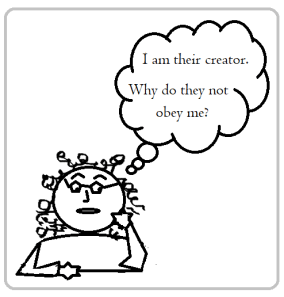
  • Author-thoughtsCursed
  • Lying
  • Worrying
  • False
  • Deceitful
  • Frantic (my state of mind)
  • Charming (me, if you actually know me)
  • Passionate (me, when it comes to chocolate)
  • wicked
  • Fake
  • Violent
  • Cold (how the search for keywords left me)

Then I was asked for three professions. By now, I was getting into the swing of things and having a good time. I decided to give John and Morris honest occupations:

  • Blacksmith (definitely honest).
  • Loan shark (definitely dishonest, but it popped into my head, so …).
  • Pharmacist (fairly random, but we had to pick up a prescription later, so it was on my mind).

Who were their companions? I had no clue, so I opted for generic:

  • Men
  • Mages
  • People

The generator asked what they might be searching for. I didn’t know my two characters were searching for anything. “Well,” I thought, “this is a fantasy, so ….”

  • Spells
  • Swords

Then the generator asked me to name a big battle. That stumped me. I figured that Waterloo was already taken, and the Battle of Hastings was too. So I went with a made-up name:

  • Shallowford

This is what the plot generator gave me:

In an inn there lived a deceitful, frantic loan shark named John Smith. Not a cursed charming, passionate inn, filled with charms and a worrying smell, nor yet a wicked, violent, cold inn with nothing in it to sit down on or to eat: it was a loan shark-inn, and that means shelter.

One day, after a troubling visit from the pharmacist Morris Jones, John leaves his inn and sets out in search of three false spells. A quest undertaken in the company of people, mages and fake men.

In the search for the mage-guarded spells, John Smith surprises even himself with his loyalty and skill as a blacksmith.

During his travels, John rescues a sword, an heirloom belonging to Morris. But when Morris refuses to try lying, their friendship is over.

However, Morris is wounded at the Battle of Shallowford and the two reconcile just before John engages in some serious lying.

John accepts one of the three false spells and returns home to his inn a very wealthy loan shark.

By golly, I think that’s the perfect plot for a story in five paragraphs, including a happy ending. The prose is … (insert superlatives here).
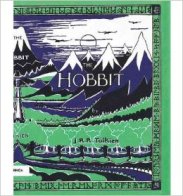
the hobbitThis plot generator has clearly been studying J.R.R. Tolkien, as it has managed to plagiarize the first paragraph of The Hobbit right down to the punctuation.

“In a hole in the ground, there lived a hobbit. Not a nasty, dirty, wet hole with ends of worms and an oozy smell, nor yet a dry bare sandy hole with nothing to sit on or eat: it was a hobbit-hole and that means comfort.”

J.R.R. Tolkien, The Hobbit, or There and Back Again, published 1937 by George Allen & Unwin.

Maybe I should write a Gothic romance next. I could probably use the same keywords.
18 Comments

Filed under writing

Verbs and the Nouns that Love Them part 2 #amwriting

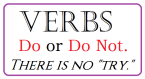
Verbs are the engine words of our prose. They show the action, but like all words, they have shades of mood, nuances that color the tone of my paragraphs. Verbs can either push the action outward from their partner nouns or pull it in.

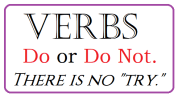
Verbs there is no tryWhen I write poetry, I look for words that contrast vividly against each other. I choose action words that begin with hard consonants, emotion words that begin with softer sounds.
If I can do this for poetry, I should be able to do this for narrative prose – but alas. For some reason, my poetic brain goes on vacation when I am trying to write a first draft. My work is filled with a bald telling of events.

But that’s okay. All I need at that point is to get the story written down.

But during revisions, when writing really becomes work, and I’m trying to turn that boring mess into something worth reading – that is when I need to use my words. Finding strong verbs and employing contrasts in my word choices becomes essential when embarking on the second draft.

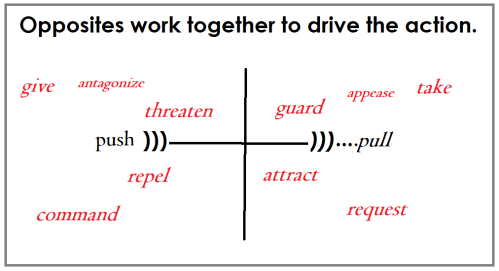
I know that power verbs push action outward from a character. Other word choices pull the action inward, and contrasting the two creates a feeling of opposition and friction. This contrast of opposites injects dynamism into a passage, a sense of vitality, vigor, and energy.

Readers are attracted to dynamic prose.

Note to self: write dynamic prose.

Verbs that push the action outward from a character make them appear authoritative, competent, energetic, and decisive.

Verbs that pull the action in toward the character make them appear receptive, attentive, private, and flexible.

I want to make my characters well-rounded but not quite perfect. I hope they are relatable and human. The way I show their world and their place in it must convey who they are.

opposites work togetherConcise writing is difficult for me because I love descriptors. So, I have to make my action words set the mood. To do that, I must use contrasts.
  • Brood
  • Deny
  • Embrace
  • Escape
  • Consent
  • Refuse
  • Agony
  • Ecstasy

A part of my life was burned away. I was destroyed, but now I was reborn in ways I’d never foreseen.

My action words are burn, destroy, and birth. This character’s entire arc is encapsulated in those three words. The contrasting words I choose throughout their story will make or break that novel.

Can I do it? I don’t know, but I’ll have fun trying. In the beginning, this character’s verbs will be darker, their actions more inward and brooding.

At the end of the story, events and interactions will alter them despite their desire to remain safely static. They will experience a renaissance, a flowering of the spirit.

But verbs and nouns by themselves don’t make engaging prose. They need modifiers and connectors.

I will have to select modifiers and connecting verbs to enhance contrasts. Since I can’t go wild with them, the few I choose must be power words.

Many power words begin with hard consonants. The images they convey project a feeling of power:

  • Backlash
  • Beating
  • Beware
  • Blinded
  • Blood
  • Bloodbath
  • Bloodcurdling
  • Bloody
  • Blunder

When things get tricky and the characters are working their way through a problem, verbs like stumble and blunder offer a sense of chaos and don’t require a lot of modifiers to show the atmosphere. When you incorporate any of the above “B” words into your prose, you are posting a road sign for the reader, a notice that ahead lies danger.

Here are some words to create an atmosphere of anxiety – words that push the action outward:

  • Agony (noun)
  • Apocalypse (noun)
  • Armageddon (noun)
  • Assault (verb)
  • Backlash (noun)
  • Pale (modifier)
  • Panic (verb or noun)
  • Target (verb)
  • Teeter (verb)
  • Terrorize (verb)

Here are some words that draw us in:

  • Delirious (intransitive verb)
  • Depraved (modifier)
  • Desire (verb)
  • Dirty (modifier)
  • Divine (modifier)
  • Ecstatic (intransitive verb)
  • Embrace (verb)
  • Enchant (verb)
  • Engage (verb)
  • Entice (verb)
  • Enthrall (verb)

Writing is an adventure, and I learn something new every day. Some days I like what I write; other days, not so much.

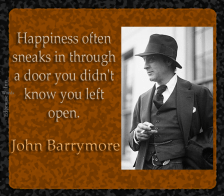
john barrymore memeThe drive to understand why some books enthrall me and others leave me cold keeps me reading and looking for new stories.
Life can be a bumpy road.

The key is to focus on the good things and laugh at the inconveniences. Make a little time to do something creative, and always make time for the people you love.

Comments Off on Verbs and the Nouns that Love Them part 2 #amwriting

Filed under writing

Verbs and the Nouns that love them #amwriting

This week we are continuing the discussion of verbs and how they shape the narrative. Last week I mentioned that I use verbs when creating a character, seeking out the action words each character embodies. Those words illuminate the gut reactions of each character and how they will act and react in each situation.

Verbs there is no tryNow that I have identified who most of my characters are, I am designing the structure of the plot. I need to use actions and events to show the story, but I also must bring out the backstory for my two MCs. I have to shed light on the friction and the attraction and force them together in situations they don’t want to be in. I also have to show them as individuals, independent of each other. As I work on the plot, the verbs that each character embodies will come to me.
Sentences are a marriage of words. A noun is one partner, and the verb is the other. The union of noun and verb will produce offspring—sentences. Modifiers are the in-laws, necessary but meddlesome. They often try to take over and guide the children against the parents’ wishes.

So, to minimize the damage done by intrusive modifiers, we rely on strong verbs and allow the modifiers to have their say only when necessary.

So why are verbs so crucial in shaping the tone and atmosphere of a narrative?

Think about this sentence: Nelson walked away.

We have three words indicating someone has departed, but they don’t show his mood.

Nelson is a person (noun). He performs an action (verb).

That action affects both Nelson and his objective: leaving. Away is an adverb (modifier) denoting distance from a particular person, place, or thing. It modifies the verb, giving Nelson a direction in which to go.

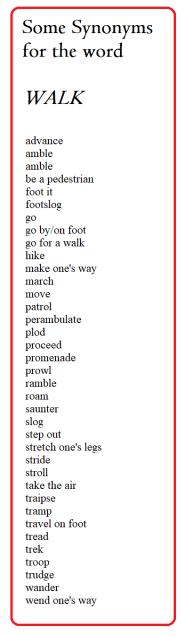
WalkWe can write it several different ways still using only three words, and all of them would indicate that Nelson has left the scene. Each time we substitute a synonym for the word walked, we change the atmosphere of that scene.
Nelson sauntered away. (He departed in a carefree, leisurely manner.)

Nelson strode away. (He walked decisively in a particular direction.)

Nelson stomped away. (Nelson left the scene in a bad mood.)

Nelson ambled away. (He walked slowly.)

Nelson slogged away. (He departed but had to work at it.)

Nelson slipped away. (Nelson departed, but sneakily.)

This is why it’s so important to have a good thesaurus on hand—I want my words to say what I envision. If I choose the correct verbs, my sentences will express my ideas with fewer modifiers.

Many verbs cannot impact a character or object directly. These are called intransitive verbs. They are just as important as transitive verbs because they show a mood or condition, a state of being, or a reflex (instinctive response).

Consider the word “mope.” Mope is an intransitive verb that means dejected and apathetic. It’s an action word that is going nowhere.

Nelson moped. (He was dejected and apathetic.)

We can have our character in a bad mood, but with many nuances that might say what we mean in a more particular way.

Nelson pouted. (He was whiney.)

Nelson languished. (He did nothing and stagnated.)

Nelson sulked. (He was angry and self-pitying.)

Nelson fretted. (He was in a neurotic mood.)

Some intransitive verbs in the family of “mope” are more robust and carry greater force:

Nelson brooded. (He was in a dark mood, obsessing.)

Nelson agonized. (He couldn’t stop thinking about it, suffering.)

When we add a strong intransitive verb to a powerful transitive verb, we have action and mood:

Nelson strode away, brooding. (He left the scene, and someone will suffer.)

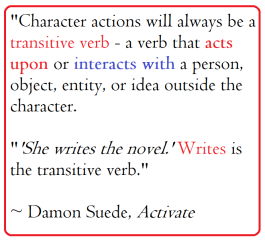
transitive verb damon suede quoteThe above examples are basic, a bald telling of actions and moods. They are the core of the paragraph, the central idea. When we strip away the surrounding words, we can see how the variations of a primary verb can change the reader’s perception of an action scene.
Every year, I write the first draft of a novel in November, starting the actual writing on November 1st.

I always begin with an idea for a plot. Usually, I can’t actually visualize how it works until I see who the protagonists are. So, I jot down the premise and start from there. I choose to create a plot with my cast of characters having their primary characteristics in place.

I hope the conflicts and roadblocks will appear to arise organically as if that is what would happen to those people. Up to the end, my MCs must feel uncertain about the outcome. They must fear that failure looms but can’t give up. They must have a well of determination to draw upon.

I must do a certain amount of prep work if I hope to have a coherent plot and believable situations on November 1st. I do this gradually, working on it whenever I’m at a standstill on the current work in progress.

Everyone has hiccups in life, things that take over temporarily and make creative thinking a bit tough. But my work moves ahead because I can always do the technical stuff like plotting and worldbuilding, even when I can’t figure out how to say what I mean.


Previous posts on this subject:

Verbs and Character Creation

Books I own and recommend for further research:

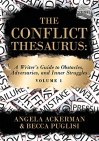
conflict thesaurusThe Conflict Thesaurus: A Writer’s Guide to Obstacles, Adversaries, and Inner Struggles (Volume 1) (Writers Helping Writers Series Book 8) by Angela Ackerman and Becca Puglisi.
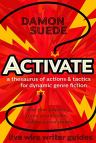
activateActivate: a thesaurus of actions & tactics for dynamic genre fiction by Damon Suede.
6 Comments

Filed under writing

Verbs and Character Creation #amwriting

This morning I am writing beneath an overcast sky to the sounds of seabirds and waves. It’s the perfect soundtrack for the moment. Later today, the sun will emerge from the mists, and the air will be full of laughter and excited chatter. Knots of parents, children, and dogs will dot the sandy shore, along with all the paraphernalia that goes along with a visit to the beach.

Words-And-How-We-Use-ThemUnfortunately, although we asked for a ground-floor condo, we were assigned a second-floor unit. My husband is managing the stairs – slowly. On the good side, we have the god’s-eye view of a wide stretch of beach, the perfect deck overlooking it all.
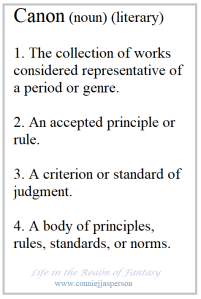
canon definitionWriting is going as well as ever, a little up and down. I’m building the framework for a new story, which I will begin writing on November 1st. The world is already built; it’s an established world with many things that are canon and can’t be changed. So, I’m working my way through the bag of tricks that help me jar things loose.
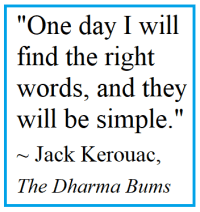
One thing that helps when creating a character is identifying the verbs embodied by each individual’s personality. I am searching for their motivation, the metaphorical “hole” in their life. What pushes them to do the crazy stuff they do? In several seminars I’ve attended, this aspect of character creation was referred to as their void.

Anyway, I’m thinking. I’m identifying the void that blights the lives of each character. I’m letting my mind off its leash and taking notes.

So let’s pretend we’re plotting a novel, and we’re going to use verbs to do it. It could be any kind of novel, but for the sake of this post, we’ll plot a romance novel.

Jack Kerouak on writing LIRF07252022Protagonist HER: Anna Lundquist, an unemployed game developer. She inherited an old farm and has moved there. She embarks on creating her own business designing anime-based computer games. Anna is shy, not good with men unless discussing books or computer games. VOID: Loss of family. VERBS: Create, Build, Seek, Defend, Fight, Nurture. Modifiers: Adaptable, ambitious, focused, independent, industrious, mature, nurturing, private, resourceful, responsible, simple, thrifty.
Protagonist HIM: Cameron (Cam) Berglund, a handsome and charismatic lawyer. His parents divorced, and he was raised in his mother’s home city. He inherited his father’s failing family law firm when his father committed suicide. VOID: Fears to trust. VERBS: Charm, Fix, Mediate, Heal, Advocate. Modifiers: Analytical, cautious, discreet, ethical, honorable, independent, just, pensive, observant, perceptive, private, proactive.

But if we’re writing romance, there must be a little drama before Anna settles on the right man:

Alternate Almost Protagonist HIM: Nic Jones is a ski bum and the charming owner of a coffee shop where Anna uses the internet for the first week until her cable is hooked up. He is writing a novel. VOID: Parents were killed in a plane crash. VERBS: charm, feed, desire, embrace. Modifiers: Ambitious, charming, courteous, disciplined, empathetic, flirtatious, imaginative, independent, pensive, persistent, private, quirky.

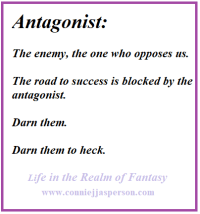
Two of Anna’s verbs are “fight” and “defend.” This forces us to ask ourselves why those verbs apply to her. Enter the antagonist:

antagonistAntagonist HIM: Matt Gentry, owner of MGPopularGames and Anna’s former boss, is angry at Anna for leaving his firm. On a skiing trip with an old fraternity brother who owns an art supply store in Starfall Ridge, he sees her entering Nic’s coffeeshop. Matt discovers that Anna is now living in that town. He learns she has started her own company and is building an anime-based RPG. He goes back to Seattle and files an injunction to stop her, claiming that he owns the rights to her intellectual property. VOID: Narcissist. VERBS: Possess, Control, Desire, Covet, Steal, Lie, Torment.


As we go through the process of sorting out the voids, verbs, and modifiers for these characters, we have some of the bones to form the skeleton of a novel. It’s still incomplete, but it’s a beginning. If we were actually writing this story, we would need to research how narcissists behave to ensure our antagonist fits the classic narcissist description but doesn’t become cartoonish.

In my current work-in-progress, a fantasy novel set in my world of Neveyah, the plot is going in the direction of a murder mystery. I haven’t identified the antagonist yet, but I’m inching closer.

I almost have a grip on my two main characters. I know their voids and main verbs, but their secondary verbs and modifiers are still eluding me. Lenn is a fire-mage, and his main verb is “act” (as in to take action). Dalya is an air-mage/healer whose main verb is “nurture.”

Both mages are members of a sect that hunts rogue mages when necessary and have certain powers that come along with that task. I will have my characters built and my plot fully outlined when NaNoWriMo begins. Ironing out this issue is the perfect excuse to sit and watch the seabirds quarreling with each other.

Next week I will continue thinking about verbs and how they do so much more than set a scene in motion. Some verbs push the action, some pull us in, and some don’t work as intended. All verbs set the mood, portraying the action in the light you, as their creator, envision.

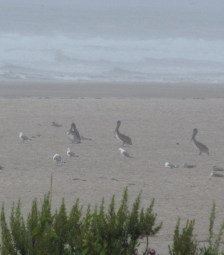
pelicans-seagulls-Cannon-Beach August 20, 2021

Pelicans and seagulls on Cannon Beach in August. © Connie Jasperson 2022

Right now, my personal verb is “observe.”

I know it looks like I’m sitting here doing nothing, just gazing at the wildlife with a silly grin.

But actually, I’m working. See this notepad and pencil? See the wind-sculpted Einstein-esque hairstyle I’m rocking? This is how great minds look when they’re working.

Honest.


Credits and Attributions:

The image of pelicans and seagulls in the fog on Cannon Beach is from Connie Jasperson’s private collection and is copyrighted.

11 Comments

Filed under writing

Sand and Surf #amwriting

This week I am writing from my favorite place, Cannon Beach, Oregon. Greg and I are on our annual family pilgrimage to where sand and sea meet grandchildren and dogs. We stay near the beach every year.

The-Largest-Needle-Haystack-Rock-Companion-Cannon-Beach-Oregon-05-August-2019

Sentinel, © 2019 Connie J. Jasperson

This year, we’re in an efficiency unit with a minimal kitchen (two burners, no oven), but I am managing. Once I know what to expect kitchen-wise, I know what to bring. We eat well, regardless.

Our condo is in the thick of things, so pizza night is easy to arrange, and a great pub is just around the corner. My sister-in-law and her husband are in a small house a bit further toward the other end of town.

We booked in January, and while we didn’t get our favorite condo, this one is right on the beach—and I mean ON the beach. The view more than makes up for the minimal kitchen. Besides, the restaurants here usually accommodate those of us on a plant-based diet.

2016-08-12 21.26.16

Sunset at Tillamook Head, Copyright 2016 Connie J. Jasperson

Cannon Beach is a beautifully laid out village, with flowers in every public place. These gardens are maintained by the city. It’s definitely a tourist town, easily walkable, and has a free transit system.

We visit the brewery and each of the several coffee roasters, window-shop in the numerous art galleries, and spend lots of dollars in the bookstores.

On Hemlock, the main street in town, we find a fabulous wine shop, my all-time favorite bakery, and an old-fashioned candy factory.

On years when we have grandchildren visiting, the most essential store sits just around the corner from our condo – Geppetto’s is every child’s favorite toy store. No grandparent can walk past it without stopping in. This store has a wide variety of board games and puzzles to keep everyone busy when the weather is more like fall than summer.

The weather is often cold and wet here, and those who vacation on the coasts of Oregon and Washington know to expect it. After all, we are on the eastern rim of the Northern Pacific, and the weather hits the coastline with all its force. Back home, we’ve had too many days above 90-degrees (over 32 degrees Celsius) so we’re enjoying the cool grayness of a normal summer. These last few years of heat and unpleasantness have not been my kind of fun.

I’m enjoying the cold grayness, but I admit that when the sun shines, it’s magic.

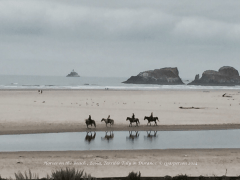
horses on the beach, Cannon Beach, Oregon by C.J. Jasperson 8-13-2014The view from our condo is one that never fails to soothe me. Tillamook Head is just off to the north. A mile out to sea, resting atop a sea stack of basalt, is the notorious Tillamook Rock Lighthouse, nicknamed “Terrible Tilly.” She’s had a long history of strife and tragedy. Although long closed to the public, she still stands today, battered and bruised. She stubbornly clings to life, providing a home for seabirds.
I spend a lot of time on the deck here at the condo, thinking, writing, and looking out to sea at my lighthouse friend. The Northern Pacific waters are wild and untamed. I watch the weather as it blows in, imagining stories about the pelicans and other seabirds who hang out on the sandbar opposite our condo. Seeing them, I think of what a beautiful world we live in.

My mind relaxes and plot knots that have driven me crazy for weeks untangle themselves.

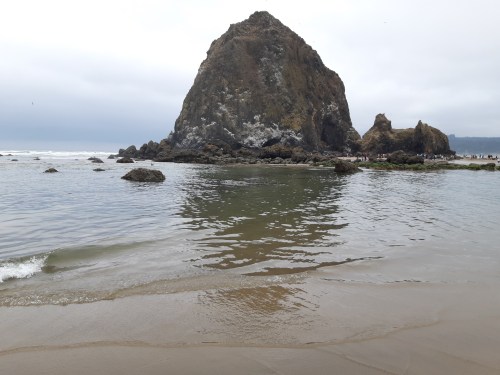
When the wind rises, I go to the water’s edge and fly my kite. While I do that, my husband watches the seabirds nesting on the God-rock of Cannon Beach, Haystack Rock.

Haystack_Rock_11AM_05_August_2019

Haystack Rock at high tide.

Winters on this coast are notoriously awful, as the battering of Terrible Tilly tells us. But August is peaceful, with mists rising at dawn, sun all afternoon, and stars falling over the vast ocean.

When we arrive back in our inland valley every year, I miss this place, my spiritual home. This week will shine in my memories, a sliver of paradise outside of the pandemic, global warming, crazy politics, and the lousy economy.

For my husband, who has a neurological disease called Parkinson’s, it’s a place of rest and rejuvenation where he can easily get around and do things he loves. For me, it’s a retreat where I can write and relax.

We can just be the happy old people that we are.


Credits and Attributions:

All images used in this post are the author’s own work and are copyrighted.

2 Comments

Filed under writing

Narrative Voice: Beliefs and Attitudes #amwriting

Today’s post is the final installment of the four-part series on narrative voice, or an author’s style. Over the last two weeks, we’ve discussed how the way we use punctuation, and how the habitual choice of words shapes the tone of our writing. Every story, poem, newspaper article, or song has a recognizable fingerprint: the author’s voice and style.

a writer's styleThe final aspect of narrative voice or style arises from our deeply held beliefs and attitudes. We may or may not consciously intend to do it, but our convictions emerge in our writing, shaping character and plot arcs.
Our values can be seen in the contrasts we employ in the setting and how we portray the layers of society. They are shown in the arc of growth we give each character, changing for good or bad as the story progresses. As a reader, I believe the characters are the story, and the events of a narrative exist only to force growth upon them.

The way a world is portrayed reflects the author’s innermost concerns and values. The author might have considered them at length or might not. Possibly they couldn’t explain them. However, these core values remain beneath the surface and influence how the written characters see their world. They shape a narrative’s actions, and reactions.

The hero embodies what the author considers right and moral, and the antagonist embodies the author’s perception of wrongdoing.

Some authors see good and evil as black-and-white. One is good or evil, with no middle ground. Often a simple story of good and evil is precisely what I want.

Other authors are more aware of the gray area between and write wonderful novels exploring that concept. Sometimes I’m looking for that sort of story.

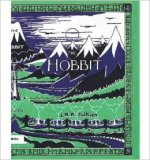
the hobbitWhether or not we are aware of it, our societal and religious beliefs emerge in our writings. Subliminal fears of climate change, worry about a world on the edge of economic collapse, and our hopes for a better society come out in our plot arcs and world-building. How they appear may have nothing to do with real life, but they add color to our worlds.
In many ways, writing is undertaking a pilgrimage. We go on pilgrimages for many reasons, often in search of moral or spiritual wisdom. Sometimes we go to a location that has significance to our beliefs and faith. Other times, we undertake an inner, symbolic journey. Creating a world and writing a society involves delving into our principles and values.

People are often changed by a journey to a different place and seeing how other people live. We evolve as human beings through our experiences and interactions.

Writing has the same effect on us as a journey. In the process of writing, we explore experiences that affect our emotions and challenge our values. We usually don’t realize it, but writing helps us identify our beliefs and firms our understanding of our own moral code. It’s as if we are brainstorming our principles and philosophies.

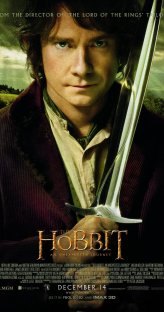
the hobbit movie posterWe each grow and develop in a way that is unique to us. Sometimes we are hardened by our life experiences, and our protagonists have that jaded sensibility. Other times, we accept our own human frailties, and our protagonists are more forgiving.

J.R.R. Tolkien wrote fantasy showing the evil the world was capable of in the first part of the 20th century. He also laid bare his hope for a better future. He understood how the masses are swayed by charismatic leaders and how tenuous the difference between what is right and moral and that which is expedient and easily glossed over can be.

He understood how societies lie to themselves and justify their actions.

In the Hobbit, J.R.R. Tolkien put a face on the Engine of War. In our real world, the Engine of War is an evil that seems unstoppable, an endlessly hungry entity made up of faceless soldiers acting on commands given by faceless leaders, committing unspeakable violence against faceless people.

Tolkien had been a soldier in one of the most horrific conflicts in history – World War One. He wrote about his experiences and how they had changed his values but framed them in fantasy. Bilbo is yanked out of his comfortable middle-class existence. Over the next year, he experiences many things. Where once our hobbit was a little xenophobic and slightly disdainful of anything not of The Shire, he discovers that other cultures are as valuable as his, meeting people of different races whom he comes to love and trust. He experiences the loss of friends and gains compassion.

When Bilbo returns to the Shire, he is a different person than he was when he ran out his front door without even a handkerchief.

Whether we write fantasy, literary fiction, comedy, sci-fi, or romance—our characters must be changed by their experiences. Their long-held views of morality must be challenged or put to the test. How they are changed by these experiences is up to us.

Most of us don’t intentionally write to preach to people, but the philosophies we hold dear do come out.

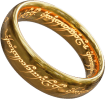
959px-One_Ring_Blender_Render

The One Ring, Peter J. Yost, CC BY-SA 4.0

The works that I love are those in which the events are the catalysts of personal growth for me, the reader, as well as the protagonist. In the process of writing, we might find ourselves looking at things differently. Our deeply cherished views might be challenged – and how will we react to that?

Historically, the authors whose works resonate down the centuries had opinions about politics, religion, and society in general. Their views were written into their work, sometimes more bluntly than others. Those values and motifs are why certain novels are considered classics despite having been written more than one or two centuries ago.

Wuthering Heights by Emily Bronte – Wikipedia challenges Victorian morality and addresses mental and physical cruelty, including domestic abuse.

A Christmas Carol by Charles Dickens – Wikipedia addresses society’s view of who is responsible for poverty and challenges the idea the poor are impoverished because they are lazy and deserve it.

The Hobbit by J.R.R. Tolkien – Wikipedia depicts how greed and selfishness are insidious and can destroy even good people. The Desolation of Smaug warns us against repeating the tragedies of WWI, which of course, we did, and do, and will do again.


CREDITS AND ATTRIBUTIONS:

Dustcover of the first edition of The Hobbit, taken from a design by the author, J.R.R. Tolkien.

The Hobbit – An Unexpected Journey, Theatrical release poster © 2012 New Line Cinema, Metro-Goldwyn-Mayer, WingNut Films, Distributed by Warner Bros. Pictures, Fair Use.

11 Comments

Filed under writing

Narrative voice: more words and how we choose them #amwriting

We all use the same words to tell the same stories.

Words-And-How-We-Use-ThemWhy do I say such a terrible thing? It’s true. All stories are derived from a few basic plots, and we have only so many words in the English language with which to tell them.
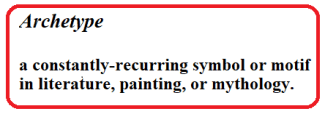
Plot Archetypes as defined by Christopher Booker in his work, The Seven Basic Plots:

  1. Archetype MeaningOvercoming the monster
  2. The quest
  3. Voyage and return
  4. Comedy
  5. Tragedy
  6. Rebirth
  7. The Rule of Three

The words we habitually use to show a scene will be recognizable as our voice. I know a lot of words and their alternatives, and I try to learn new ones every day. But I often find myself stuck when pounding out a first draft, using a particular word over and over. My brain knows what I’m trying to say but can’t be too creative.

Fortunately, this sin is noticeable when I get to revisions, and that is when I hunt down the synonyms, alternative words that mean the same thing.

Words with only a small number of alternatives become problems for me. This happens in my work with the word sword. The other options for the word sword are many. Unfortunately, most describe a specific type of weapon – epee, rapier, cutlass, saber/sabre, etc.

Unfortunately, my swords are only broadswords or claymores. Thus, I am limited to sword, blade, weapon … you get the drift. The lack of alternatives does one good thing, though – it keeps me from indulging in long, drawn-out fight scenes.

Other words cause problems too. Sometimes, the thesaurus available in my word-processing program doesn’t offer me enough substitutes to make a good choice.

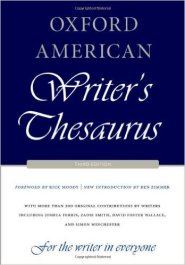
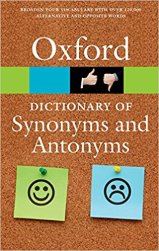
ozford-american-writers-thesaurusFor that reason, I have the Oxford Dictionary of Synonyms and Antonyms and Oxford American Writers’ Thesaurus near to hand. I also have a book called Activate, written by Damon Suede, a thesaurus of verbs, actions, and tactics. I refer to these books when I must search for an alternative to a word I am leaning too heavily on.

Which happens far too often.

Memory is a mushy thing. I prefer a hard copy reference book rather than the internet, as I remember what I read on paper better than what I read on screen. However, the internet is a perfectly reasonable cost-free alternative. I get sidetracked too easily when doing research on the net. Hard copies of reference books encourage me to do the research and get back to work.

So, we know that we all tell stories with fundamentally similar plots, and we all must use words with the same meanings.

But we sound different on the page. Why is this?

The way we habitually write prose is our unique voice. The word I select might mean the same as the one you use, but I might choose a different form.

When we write, we build a specific image for our readers. We select words intentionally for their nuances (distinctions, subtleties, shades, refinements, etc.).

We use words that convey our vision of the mood, atmosphere, and information. You and I may be writing the same plot, but my vision of it is different from yours.

Let’s write a story about a hero who finds a magical object and an evil entity who wants possession of it.

J.R.R. Tolkien may have used that plot in the Lord of the Rings, but what we write will be ours, not his. Your words will show the hero in a setting and communicate an atmosphere completely different from what my words express.

How do our word choices add depth to world-building? An example might be sound or color. How do you show an intense sound or color? Loud is a word that works for both sound and color.

Thunderous conveys more power than loud, even though they mean the same thing in the context of sound.

Lurid conveys more power than loud, and in the context of color, they mean the same thing.

Let’s look more closely at the word loud:

  • oxford_synonym_antonymNoisy
  • Boisterous
  • Deafening
  • Raucous
  • Lurid
  • Flamboyant
  • Ostentatious
  • Thunderous
  • Strident
  • Vulgar
  • Loudmouthed

These are only a few of the many options we have to work with. The website www.PowerThesaurus.com lists 1,992 alternatives for the word loud.

How about the word “disruptive”? It’s a straightforward, blunt adjective. Maybe you don’t want to say it bluntly. Would you choose the word obstreperous or the more common form, argumentative? They mean the same thing, but both begin with a vowel and feel passive.

Hostileconfrontationalsurly—many common words convey the information that a person is being difficult in a simple but powerful way. The synonyms for disruptive express many different shades of meaning and might be more appropriate to your narrative.

Use your vocabulary but don’t get too creative. Do your readers a favor and use words that most people won’t need a dictionary to understand.

I don’t mean to say that rarely used words should be ignored. Our prose should never be “dumbed-down,” but we shouldn’t use big words just to show how literate we are.

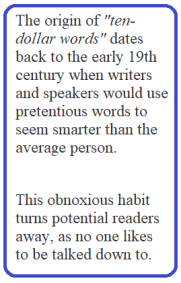
ten dollar wordsMy Texan editor refers to those convoluted morsels of madness as “ten-dollar words.” A ten-dollar word is a long obscure word used in place of one that is smaller and more well-known. This is why I probably wouldn’t use obstreperous in place of disruptive, but I might choose rebellious or confrontational.
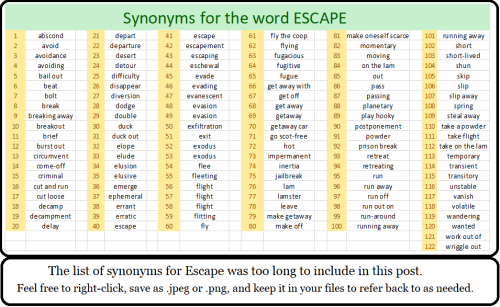
The problem is, sometimes, I can’t find the right words to show what I envision. I can see it but can’t express it. It annoys me to leave that scene and come back to it later.

Other times I have all the words I need, and those are the best days, the days I am glad to be a writer.

We imagine and assemble stories for other people’s entertainment. We paint those images with words carefully chosen to draw the most precise framework for the reader to hang their imagination on.

The real story happens inside the reader’s head.

The words we choose make the reader’s experience richer or poorer. As a reader, I live for those books written by authors who are bold when they choose their words.

Escape-synonyms-01112021LIRF

17 Comments

Filed under writing

Narrative Voice: Balancing Verbs, Modifiers, and Infinitives #amwriting

We are drawn to the work of our favorite authors because we like their voice and writing style. The unique, recognizable way they choose words and assemble them into sentences appeals to us, although we don’t consciously think of it that way.

In Monday’s post, Narrative Voice, an Author’s Style, I mentioned three components of an author’s voice:

  1. How the habitual choice of words shapes the tone of our writing.
  2. How the chronic use and misuse of grammar and punctuation shape the pacing of our sentences.
  3. How our deeply held beliefs and attitudes emerge and shape character and plot arcs.

Words-And-How-We-Use-ThemToday’s post focuses on word choice. What do you want to convey with your prose? This is where the choice and placement of words come into play. Active prose is constructed of nouns followed by verbs or verbs followed by nouns.
Where we choose to place the verbs changes their impact but not their meaning. Also, the words we surround verbs with change the mood but not their intention.

But let’s look at how modifiers and infinitives fit into the written universe and visualize their place in our prose.

  • Modifiers are words that alter their sentences’ meanings. They add details and clarify facts, distinguishing between people, events, or objects.
  • Infinitives are mushy words, words with no definite beginning or end.

Both modifiers and infinitives are useful, and both have the power to strengthen or weaken our prose.

When doing revisions, I look at how I have placed my verbs in relation to nouns, modifiers, and infinitives in the first draft. My outline told me what the scene should detail but the words were written the way they fell out of my head.

Which tends to be in a passive voice.

WordItOut-word-cloud-4074543The second draft revisions are where I do the real writing. It involves finetuning the plot arc, character arcs, and most importantly, adjusting phrasing.
The tricky part is catching all the weak phrasing. Those of you who write a clean first draft are rare and wonderful treasures – I wish I had that talent.

When I find a stretch of passive phrasing, I reimagine the scene. I want to see how to strengthen the narrative and still keep to my original intention.

At times, nothing will work, and the scene must be scrapped.

A passive sentence is not “wrong.” No matter how active the phrasing, a poorly written sentence is not “better.”

Too many passive sentences slow the pacing, and readers don’t like that – but they do like a chance to breathe and absorb what just happened. So we mingle active and passive phrasing to keep things balanced.

And despite what the self-proclaimed gurus on Reddit might rant, good writing is about balance.

The ways we combine active and passive phrasing are part of our signature, our voice. By mixing the two, we choose areas of emphasis and places in the narrative we want to direct the reader’s attention.

powerwordsWordCloudLIRF06192021Some types of narratives should feel highly charged and action-packed. Most of your sentences should be constructed with the verbs forward if you write in genres such as sci-fi, political thrillers, and crime thrillers.
These books seek to immerse the reader in the emotion generated by the action, so most sentences should lead off with noun – verb or verb – noun, followed by modifiers and infinitives. You will have more active phrasing than passive: push, push, glide. The reader will adjust to the pacing rhythm you establish if you are consistent.

In other genres, like cozy mysteries, you want to immerse the reader in the character’s emotions. You create a sense of comfort and familiarity by manipulating the mood. Perhaps you want to slightly separate the reader from the action to convey a sense of safety, of being an interested observer.

You want the reader to feel like they are the detective with an objective eye, yet you want them immersed in the romance of it. You balance the active and passive sentence construction, so the narrative is slightly more relaxed than a thriller.

Passive construction can still be strong despite being poetic. A poor choice of words makes a sentence weak.

Has someone said your work is too wordy? An excess of modifiers could be the offenders.

modifying-conjunctions-04262022What clues should you look for when trying to see why someone says you are too wordy?
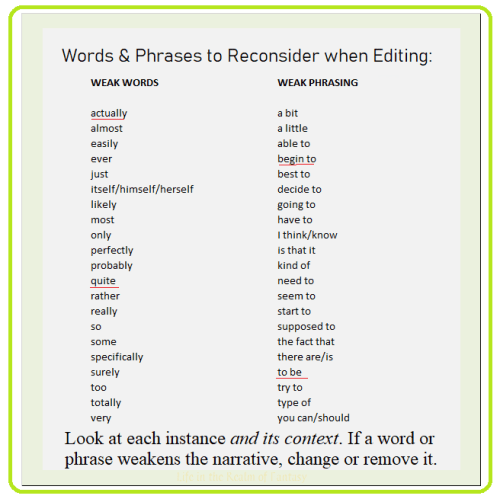
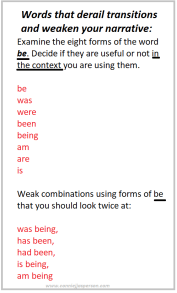
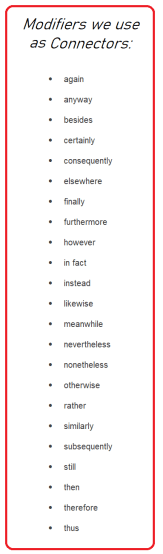
  1. Look for the many forms of the phrasal verb to be. They are words that easily connect to other words and lead to writing long convoluted passages.
  2. Look for connecting modifiers (still, however, again, etc.).

The many forms of to be (is, are, was, were) are easy to overlook in revisions because we habitually use them in conversation. They’re kryptonite in the prose of an action-based narrative.

In the first draft, I keep in mind that bald writing tells only part of the story. Regardless of my efforts, it slips in. This is because I am telling myself the story at that stage of development.

When revising the first draft, I sharpen my prose. I try to paint active word pictures of the mental images I visualized when I first wrote them, but without going overboard. I change the wording to use words that begin with hard consonants. They sound tougher and carry more power.

We all approach creativity differently, and what works for me might not work for you. However, the more you write, the more you will find your preferences and writing style changing in one direction or another.

One more thing about wordiness: the number of conjunctions and connecting modifiers we use contributes to wordiness and sentence length. My first drafts are littered with run-on sentences—me telling myself the story. I look for them when making revisions because long compound sentences can be confusing.

It’s a struggle. I rewrite some sections several times before I finally make them palatable.

If you are interested in a bit of homework, take a short paragraph from your work in progress and rewrite it. Try to convey that thought in both passive and active voice. Then blend the two. You might learn something about how you think as a writer when you try to write in an unfamiliar style.

I have posted the following list of words before. I habitually use these morsels of madness in a first draft but wish I didn’t.

It takes forever, but I look at each instance and decide if they should remain or if they weaken the sentence. Ninety times out of a hundred, I change or remove them.

In the interests of keeping the post down to a reasonable length, this list is a picture. If you want to copy it, right-click on it, select “save as,” and choose either .jpeg or .png.

weak-words-LIRF04262022

19 Comments

Filed under writing

Narrative Voice, an Author’s Style #amwriting

Every story, poem, newspaper article, or song has a recognizable fingerprint: the author’s unique voice or style. Voice and style consist of three aspects:

  1. The habitual choice of words shapes the tone of our writing.
  2. The chronic use and misuse of grammar and punctuation shapes the pacing of our sentences.
  3. Our deeply held beliefs and attitudes emerge and shape character arcs and plot arcs.

a writer's styleSome authors are forceful in their style and throw you into the action. They have an in-your-face, hard-hitting style that comes on strong and doesn’t let up until the end.
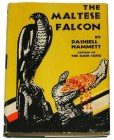
Dashiell Hammett perfected the crime noir novel with short, choppy sentences packed with power words:

Quote from TheMaltese Falcon:

MalteseFalcon1930“I’m going to send you over. The chances are you’ll get off with life. That means you’ll be out again in twenty years. You’re an angel. I’ll wait for you.” He cleared his throat. “If they hang you I’ll always remember you.” [1]
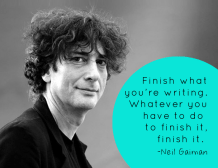
Other authors take you on a journey. They have a more leisurely, fluid style of writing. Neil Gaiman is poetic and thoughtful, leading you deeper into the story with each paragraph.

Quote from Stardust:

Are we human because we gaze at the stars, or do we gaze at the stars because we are human? [2]

When we first begin writing, our style is heavily influenced by the authors whose works we love. Our stories are an unconscious reflection of what we wish they would write.

We develop our own voice and style when we write every day or at least as often as possible. We subconsciously incorporate our speech patterns, values, and fears into our work, and those elements of our personality form the voice that is ours and no one else’s.

Developing a broad vocabulary is important because we are creatures of habit. When we want to express ourselves, we fall back on certain words and ignore their synonyms. This is where a good online thesaurus comes in.

oxford_synonym_antonymBut I prefer to keep my research in hardcopy form, rather than digital. The Oxford Dictionary of Synonyms and Antonyms is a handy tool when I am stuck for alternate ways to say something.
And it makes the perfect place to rest my teacup.

We all have “crutch” words. These are words we choose above others because they say what we mean more precisely, or they color our prose with the right emotion. Unfortunately, I can be repetitive with certain words when expanding on an idea. Having alternatives that express my idea does two things:

  • It often gives me a different understanding of what I am trying to say, which improves the narrative.
  • It makes my work less tedious. (I hope.)

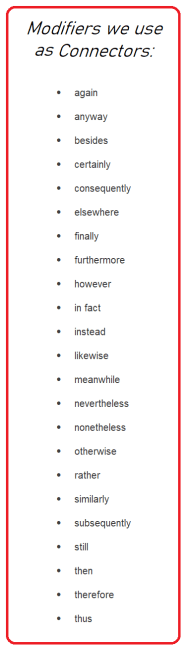
modifying-conjunctions-04262022As we become confident in our writing, we learn more about grammar and punctuation in our native languages. We learn to write so others can understand us.
The great authors use those rules to energize their prose. They are knowledgeable about sentence and paragraph construction and the fundamentals of grammar—the aspects of writing we call mechanics. They write to industry standards. When they break a rule, they do it deliberately and consistently.

Our word choices are a good indication of how advanced we are in the craft of writing. For instance, in online writing forums, we regularly are told to limit the number of modifiers (adjectives and adverbs) we might habitually use.

We are like anyone else. Our work is as dear to us as a child, and we can be just as touchy as a proud parent when it is criticized. We should respect the opinions of others, but we have the choice to ignore those suggestions if they don’t work for us.

Our voice comes across when we write from the heart. We gain knowledge and skill when we study self-help books, but we must write what we are passionate about. So, the rule should be to use modifiers, descriptors, or quantifiers when they’re needed.

How we use them is part of our style. Modifiers change, clarify, qualify, or sometimes limit a particular word in a sentence to add emphasis, explanation, or detail. We also use them as conjunctions to connect thoughts: “otherwise,” “then,” and “besides.”

Descriptors are adverbs and adjectives ending in “ly.” They are helper nouns or verbs, words that help describe other words. Some descriptors are necessary. However, they are easy to overuse and are sometimes reviled by writing groups on a mission.

When I begin revising a first draft, I do a global search for the letters “ly.” A list will pop up in my left margin. My manuscript will become a mass of yellow highlighted words.

I admit it takes time and patience to look at each instance to see how they fit into that context. If a word or phrase weakens the narrative, I change or remove it. If that descriptor is the only word that works, I leave it. Ninety percent of “ly” words get removed.

Quantifiers are abstract nouns or noun phrases. They’re used to convey either a vague impression or a nebulous quantity, such as: very, a great deal ofa good deal ofa lot, many, much. The important word there is abstract, which shows a thought or idea that doesn’t have a physical or concrete existence.

In some instances, we might want to move the reader’s view of a scene or situation out, a “zoom out” so to speak. The brief use of passive phrasing will do that.

ozford-american-writers-thesaurusHowever, quantifiers have a bad reputation because they can quickly become habitual, such as the word very.
When I am laying down the first draft of a story, quantifiers, descriptors, and modifiers fall out of my head and into the keyboard. They are a mental shorthand that tells the story in only a few words, which is essential when we are just trying to get the story down before we lose our train of thought.

They are subconscious signals to our future selves that indicate an idea needs expanding and rewording for impact. They tell us to rewrite that sentence to strengthen it.

Limiting descriptors and quantifiers to conversations makes a stronger narrative. We use these phrases and words in real life, so our characters’ conversations will sound natural. The fact we use them is why they fall into our first drafts. But they weaken the story’s impact if we let them bleed over into the narrative.

neil gaiman quote 2Our narrative voice comes across in our choice of hard or soft words and where we habitually position verbs in a sentence. Where we automatically place the words in the sentence is a recognizable fingerprint.
Sometimes I read something, and despite how well it is constructed and written, it doesn’t ring my bells. Maybe I’m not attracted to the author’s style or voice.

That doesn’t mean I think the work is awful. It only means I wasn’t the reader it was written for.


Credits and Attributions:

[1] Quote from: the Maltese Falcon by Dashiell Hammett, © 1930, published by Alfred A. Knopf. Fair Use.

Illustration, Original Cover of The Maltese Falcon by Dashiell Hammett, © 1930, published by Alfred A. Knopf. Public Domain.

[2] Quote from Stardust by Neil Gaiman and illustrated by Charles Vess, © 1999, published by DC Comics. Fair Use.

Illustration: Original Cover of Stardust by Neil Gaiman and illustrated by Charles Vess, © 1999, published by DC Comics. Fair Use.

6 Comments

Filed under writing

Narrative Time vs. Calendar Time #amwriting

Today we’re discussing narrative time, or what we call tense. Narrative tense subtly affects a reader’s perception of characters, an undercurrent that goes unnoticed after the first few paragraphs. Narrative time shapes the reader’s view of events on a subliminal level.

Time_Management_Quayle_QuoteIn grammar, the word tense indicates information about time. Tenses are usually shown by how we use the forms of verbs. The main tenses found in most languages include the pastpresent, and future.

Consider the following sentences: “I eat,” “I am eating,” “I have eaten,” and “I have been eating.”

All are in the present tense, indicated by the present-tense verb of each sentence (eatam, and have been).

Tense relates the time of an event (when) to another time (now or then). The tense you choose indicates the event’s location in time. Imagine a scene where two women meet. They know each other well but aren’t friends.

Firstperson, present tense:  At the fish market, I find Marie holding a fish, as if she knows what to do with it. I know she doesn’t. I ask, “Did your cook finally quit?”

First-person past tense: At the fish market, I found Marie holding a fish, as if she knew what to do with it. I knew she didn’t. I asked, “Did your cook finally quit?”

Third person omniscient (past tense): At the fish market, Vivian found Marie holding a fish, as if she knew what to do with it. She knew Marie didn’t. She asked, “Did your cook finally quit?”

The above examples detail the same scene but are set in different narrative times and narrative POVs. Each change of narrative time or POV alters the feel of the story.

weak-words-when-used-in-transitonsIf we write a sentence that says a character is hot and thirsty, we leave nothing to the reader’s imagination. However, when we change the tense, we are often inspired to rephrase a thought.

  • They were hot and thirsty. (were is a subjunctive verb – passive).
  • They trudged on with dry, cracked lips, yearning for a drop of water.
  • We walk toward the oasis with dry, cracked lips and parched tongues.

The way we show the perception of time for these thirsty characters is the same – the narrative is in the past tense in the first two cases and the present in the third.

Subjunctives (were, was, be, etc.) are small verbs of existence, but just like adverbs that end in “ly,” they are telling words. These words fall into our narrative in the first draft because they are signals for the rewrite.

The narrative time in which the story is set (past or present tense), verb choice, and the expansion of imagery combine to change how we see the characters and events at that moment.

However, there is more to time than the grammatical narrative tense. Calendar time can get a little sloppy when we are winging it through the first draft of a manuscript.

Readers don’t notice how time passes unless it becomes unbelievable. When the passage of time is a realistic, organic part of the scenery, readers accept it and suspend their disbelief.

We try to reveal aspects of the past that are relevant to current events as the story unfolds. You can do this in two ways:

In a chronologically linear plot, you can have the backstory revealed in conversations or letters, etc., and many authors succeed at this plotting style. A calendar is helpful for this.

Digital Clock FaceOther authors manipulate time. They may start with a chapter of action and commentary set in the past. The experiences shown in the prologue show the reason for present day events and actions that are yet to unfold.

Sometimes, past events require several chapters to show the root of the current-day problem and how things didn’t go well, a “Part One.” “Part Two” begins a new section set in the present time, with the characters shaped by those past events.

If you use that kind of opening, the relevance of those events must be made clear to the reader early on in the current time section. In one forthcoming novel, I’ve employed a three-part division of the book. Part one is set twenty-five years back in time and details the actions that broke my protagonist, a battle mage. It shows why even the thought of using certain elements (magic) as weapons brings on panic attacks. Overcoming his PTSD is crucial to advancing the story.

Other authors will employ mental flashbacks, moments of characters dwelling on past events. These scenes work if they are written as the events unfolded, detailing the moments as the character lived them. The past illuminates the present.

But only if we don’t dump the information in large chunks of exposition.

Meriko's Eyes digital art by cjjasp © 2015I’ve read some excellent narratives where the author uses the flashback to ratchet up the suspense in a danger scene. An example could be a character trapped in a small space while a killer searches for her. She remembers being a small child during the war and being hidden in a cupboard by her father when enemy soldiers arrived. Through the keyhole, she witnesses the slaughter of her family.
A flashback scene like that serves three purposes:

  • It reveals our hero’s severe claustrophobia to the reader and shows her as being human and having an Achilles Heel.
  • It ratchets up the tension. The unbidden memories and the hero’s visceral response heighten her panic.
  • It makes the tension feel intimate to the reader, as if they own those emotions.

Flashforwards move us in time, skipping over mundane travel and periods where the story would stagnate. A new chapter and a jump forward in time keep the story in motion—but only if it is clear that some time has passed, during which nothing out of the ordinary happened. These jumps require attention to how the transitions are handled. Mushy shifts between scenes will ruin the pacing of a story.

A calendar is crucial when you are manipulating time in your plot arc. Pacing becomes tricky when a plot calls for unusual timelines.

I enjoyed reading the Time Traveler’s Wife. The plot revolves around Henry’s genetic disorder, which causes him to time travel randomly and with no control, and Clare, his artist wife. She must understand the paradox and cope with his frequent absences.

It is written with alternating first-person POV. I feel the plot couldn’t advance as well if a different narrative mode had been used.

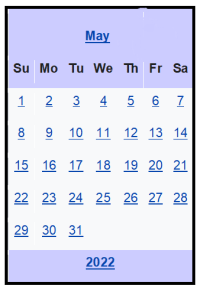
calendarNarrative time and calendar time are separate entities. Point of view and narrative time work together.

  • Calendar time is world-building. It sets the story in a particular era and shows the passage of time.
  • POV and narrative time shape the atmosphere and the ambiance of a scene.

We often “think aloud” in writing the first draft. We insert many passive phrasings into the raw narrative, words that I think of as traffic signals for future revisions. These words are a shorthand that helped us get the story down when we were writing the raw story, a guide that now shows us how we intend the narrative to go.

When you choose your grammatical tense, you have chosen a narrative time, a part of world-building that encompasses the past as well as the present and looks toward the future. It shapes the mood and atmosphere in subtle but recognizable ways.

Calendar time is the physical passage of our protagonists through the days and seasons of their stories.

5 Comments

Filed under writing