Tag Archives: writing

Narrative voice: more words and how we choose them #amwriting

We all use the same words to tell the same stories.

Words-And-How-We-Use-ThemWhy do I say such a terrible thing? It’s true. All stories are derived from a few basic plots, and we have only so many words in the English language with which to tell them.

Plot Archetypes as defined by Christopher Booker in his work, The Seven Basic Plots:

  1. Archetype MeaningOvercoming the monster
  2. The quest
  3. Voyage and return
  4. Comedy
  5. Tragedy
  6. Rebirth
  7. The Rule of Three

The words we habitually use to show a scene will be recognizable as our voice. I know a lot of words and their alternatives, and I try to learn new ones every day. But I often find myself stuck when pounding out a first draft, using a particular word over and over. My brain knows what I’m trying to say but can’t be too creative.

Fortunately, this sin is noticeable when I get to revisions, and that is when I hunt down the synonyms, alternative words that mean the same thing.

Words with only a small number of alternatives become problems for me. This happens in my work with the word sword. The other options for the word sword are many. Unfortunately, most describe a specific type of weapon – epee, rapier, cutlass, saber/sabre, etc.

Unfortunately, my swords are only broadswords or claymores. Thus, I am limited to sword, blade, weapon … you get the drift. The lack of alternatives does one good thing, though – it keeps me from indulging in long, drawn-out fight scenes.

Other words cause problems too. Sometimes, the thesaurus available in my word-processing program doesn’t offer me enough substitutes to make a good choice.

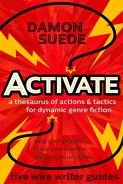
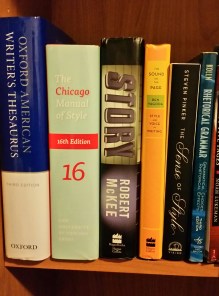
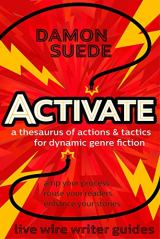
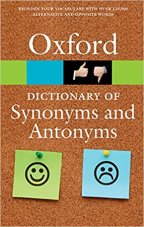
ozford-american-writers-thesaurusFor that reason, I have the Oxford Dictionary of Synonyms and Antonyms and Oxford American Writers’ Thesaurus near to hand. I also have a book called Activate, written by Damon Suede, a thesaurus of verbs, actions, and tactics. I refer to these books when I must search for an alternative to a word I am leaning too heavily on.

Which happens far too often.

Memory is a mushy thing. I prefer a hard copy reference book rather than the internet, as I remember what I read on paper better than what I read on screen. However, the internet is a perfectly reasonable cost-free alternative. I get sidetracked too easily when doing research on the net. Hard copies of reference books encourage me to do the research and get back to work.

So, we know that we all tell stories with fundamentally similar plots, and we all must use words with the same meanings.

But we sound different on the page. Why is this?

The way we habitually write prose is our unique voice. The word I select might mean the same as the one you use, but I might choose a different form.

When we write, we build a specific image for our readers. We select words intentionally for their nuances (distinctions, subtleties, shades, refinements, etc.).

We use words that convey our vision of the mood, atmosphere, and information. You and I may be writing the same plot, but my vision of it is different from yours.

Let’s write a story about a hero who finds a magical object and an evil entity who wants possession of it.

J.R.R. Tolkien may have used that plot in the Lord of the Rings, but what we write will be ours, not his. Your words will show the hero in a setting and communicate an atmosphere completely different from what my words express.

How do our word choices add depth to world-building? An example might be sound or color. How do you show an intense sound or color? Loud is a word that works for both sound and color.

Thunderous conveys more power than loud, even though they mean the same thing in the context of sound.

Lurid conveys more power than loud, and in the context of color, they mean the same thing.

Let’s look more closely at the word loud:

  • oxford_synonym_antonymNoisy
  • Boisterous
  • Deafening
  • Raucous
  • Lurid
  • Flamboyant
  • Ostentatious
  • Thunderous
  • Strident
  • Vulgar
  • Loudmouthed

These are only a few of the many options we have to work with. The website www.PowerThesaurus.com lists 1,992 alternatives for the word loud.

How about the word “disruptive”? It’s a straightforward, blunt adjective. Maybe you don’t want to say it bluntly. Would you choose the word obstreperous or the more common form, argumentative? They mean the same thing, but both begin with a vowel and feel passive.

Hostileconfrontationalsurly—many common words convey the information that a person is being difficult in a simple but powerful way. The synonyms for disruptive express many different shades of meaning and might be more appropriate to your narrative.

Use your vocabulary but don’t get too creative. Do your readers a favor and use words that most people won’t need a dictionary to understand.

I don’t mean to say that rarely used words should be ignored. Our prose should never be “dumbed-down,” but we shouldn’t use big words just to show how literate we are.

ten dollar wordsMy Texan editor refers to those convoluted morsels of madness as “ten-dollar words.” A ten-dollar word is a long obscure word used in place of one that is smaller and more well-known. This is why I probably wouldn’t use obstreperous in place of disruptive, but I might choose rebellious or confrontational.

The problem is, sometimes, I can’t find the right words to show what I envision. I can see it but can’t express it. It annoys me to leave that scene and come back to it later.

Other times I have all the words I need, and those are the best days, the days I am glad to be a writer.

We imagine and assemble stories for other people’s entertainment. We paint those images with words carefully chosen to draw the most precise framework for the reader to hang their imagination on.

The real story happens inside the reader’s head.

The words we choose make the reader’s experience richer or poorer. As a reader, I live for those books written by authors who are bold when they choose their words.

Escape-synonyms-01112021LIRF

17 Comments

Filed under writing

Narrative Voice: Balancing Verbs, Modifiers, and Infinitives #amwriting

We are drawn to the work of our favorite authors because we like their voice and writing style. The unique, recognizable way they choose words and assemble them into sentences appeals to us, although we don’t consciously think of it that way.

In Monday’s post, Narrative Voice, an Author’s Style, I mentioned three components of an author’s voice:

  1. How the habitual choice of words shapes the tone of our writing.
  2. How the chronic use and misuse of grammar and punctuation shape the pacing of our sentences.
  3. How our deeply held beliefs and attitudes emerge and shape character and plot arcs.

Words-And-How-We-Use-ThemToday’s post focuses on word choice. What do you want to convey with your prose? This is where the choice and placement of words come into play. Active prose is constructed of nouns followed by verbs or verbs followed by nouns.

Where we choose to place the verbs changes their impact but not their meaning. Also, the words we surround verbs with change the mood but not their intention.

But let’s look at how modifiers and infinitives fit into the written universe and visualize their place in our prose.

  • Modifiers are words that alter their sentences’ meanings. They add details and clarify facts, distinguishing between people, events, or objects.
  • Infinitives are mushy words, words with no definite beginning or end.

Both modifiers and infinitives are useful, and both have the power to strengthen or weaken our prose.

When doing revisions, I look at how I have placed my verbs in relation to nouns, modifiers, and infinitives in the first draft. My outline told me what the scene should detail but the words were written the way they fell out of my head.

Which tends to be in a passive voice.

WordItOut-word-cloud-4074543The second draft revisions are where I do the real writing. It involves finetuning the plot arc, character arcs, and most importantly, adjusting phrasing.

The tricky part is catching all the weak phrasing. Those of you who write a clean first draft are rare and wonderful treasures – I wish I had that talent.

When I find a stretch of passive phrasing, I reimagine the scene. I want to see how to strengthen the narrative and still keep to my original intention.

At times, nothing will work, and the scene must be scrapped.

A passive sentence is not “wrong.” No matter how active the phrasing, a poorly written sentence is not “better.”

Too many passive sentences slow the pacing, and readers don’t like that – but they do like a chance to breathe and absorb what just happened. So we mingle active and passive phrasing to keep things balanced.

And despite what the self-proclaimed gurus on Reddit might rant, good writing is about balance.

The ways we combine active and passive phrasing are part of our signature, our voice. By mixing the two, we choose areas of emphasis and places in the narrative we want to direct the reader’s attention.

powerwordsWordCloudLIRF06192021Some types of narratives should feel highly charged and action-packed. Most of your sentences should be constructed with the verbs forward if you write in genres such as sci-fi, political thrillers, and crime thrillers.

These books seek to immerse the reader in the emotion generated by the action, so most sentences should lead off with noun – verb or verb – noun, followed by modifiers and infinitives. You will have more active phrasing than passive: push, push, glide. The reader will adjust to the pacing rhythm you establish if you are consistent.

In other genres, like cozy mysteries, you want to immerse the reader in the character’s emotions. You create a sense of comfort and familiarity by manipulating the mood. Perhaps you want to slightly separate the reader from the action to convey a sense of safety, of being an interested observer.

You want the reader to feel like they are the detective with an objective eye, yet you want them immersed in the romance of it. You balance the active and passive sentence construction, so the narrative is slightly more relaxed than a thriller.

Passive construction can still be strong despite being poetic. A poor choice of words makes a sentence weak.

Has someone said your work is too wordy? An excess of modifiers could be the offenders.

modifying-conjunctions-04262022What clues should you look for when trying to see why someone says you are too wordy?

  1. Look for the many forms of the phrasal verb to be. They are words that easily connect to other words and lead to writing long convoluted passages.
  2. Look for connecting modifiers (still, however, again, etc.).

The many forms of to be (is, are, was, were) are easy to overlook in revisions because we habitually use them in conversation. They’re kryptonite in the prose of an action-based narrative.

In the first draft, I keep in mind that bald writing tells only part of the story. Regardless of my efforts, it slips in. This is because I am telling myself the story at that stage of development.

When revising the first draft, I sharpen my prose. I try to paint active word pictures of the mental images I visualized when I first wrote them, but without going overboard. I change the wording to use words that begin with hard consonants. They sound tougher and carry more power.

We all approach creativity differently, and what works for me might not work for you. However, the more you write, the more you will find your preferences and writing style changing in one direction or another.

One more thing about wordiness: the number of conjunctions and connecting modifiers we use contributes to wordiness and sentence length. My first drafts are littered with run-on sentences—me telling myself the story. I look for them when making revisions because long compound sentences can be confusing.

It’s a struggle. I rewrite some sections several times before I finally make them palatable.

If you are interested in a bit of homework, take a short paragraph from your work in progress and rewrite it. Try to convey that thought in both passive and active voice. Then blend the two. You might learn something about how you think as a writer when you try to write in an unfamiliar style.

I have posted the following list of words before. I habitually use these morsels of madness in a first draft but wish I didn’t.

It takes forever, but I look at each instance and decide if they should remain or if they weaken the sentence. Ninety times out of a hundred, I change or remove them.

In the interests of keeping the post down to a reasonable length, this list is a picture. If you want to copy it, right-click on it, select “save as,” and choose either .jpeg or .png.

weak-words-LIRF04262022

19 Comments

Filed under writing

Narrative Voice, an Author’s Style #amwriting

Every story, poem, newspaper article, or song has a recognizable fingerprint: the author’s unique voice or style. Voice and style consist of three aspects:

  1. The habitual choice of words shapes the tone of our writing.
  2. The chronic use and misuse of grammar and punctuation shapes the pacing of our sentences.
  3. Our deeply held beliefs and attitudes emerge and shape character arcs and plot arcs.

a writer's styleSome authors are forceful in their style and throw you into the action. They have an in-your-face, hard-hitting style that comes on strong and doesn’t let up until the end.

Dashiell Hammett perfected the crime noir novel with short, choppy sentences packed with power words:

Quote from TheMaltese Falcon:

MalteseFalcon1930“I’m going to send you over. The chances are you’ll get off with life. That means you’ll be out again in twenty years. You’re an angel. I’ll wait for you.” He cleared his throat. “If they hang you I’ll always remember you.” [1]

Other authors take you on a journey. They have a more leisurely, fluid style of writing. Neil Gaiman is poetic and thoughtful, leading you deeper into the story with each paragraph.

Quote from Stardust:

Are we human because we gaze at the stars, or do we gaze at the stars because we are human? [2]

When we first begin writing, our style is heavily influenced by the authors whose works we love. Our stories are an unconscious reflection of what we wish they would write.

We develop our own voice and style when we write every day or at least as often as possible. We subconsciously incorporate our speech patterns, values, and fears into our work, and those elements of our personality form the voice that is ours and no one else’s.

Developing a broad vocabulary is important because we are creatures of habit. When we want to express ourselves, we fall back on certain words and ignore their synonyms. This is where a good online thesaurus comes in.

oxford_synonym_antonymBut I prefer to keep my research in hardcopy form, rather than digital. The Oxford Dictionary of Synonyms and Antonyms is a handy tool when I am stuck for alternate ways to say something.

And it makes the perfect place to rest my teacup.

We all have “crutch” words. These are words we choose above others because they say what we mean more precisely, or they color our prose with the right emotion. Unfortunately, I can be repetitive with certain words when expanding on an idea. Having alternatives that express my idea does two things:

  • It often gives me a different understanding of what I am trying to say, which improves the narrative.
  • It makes my work less tedious. (I hope.)

modifying-conjunctions-04262022As we become confident in our writing, we learn more about grammar and punctuation in our native languages. We learn to write so others can understand us.

The great authors use those rules to energize their prose. They are knowledgeable about sentence and paragraph construction and the fundamentals of grammar—the aspects of writing we call mechanics. They write to industry standards. When they break a rule, they do it deliberately and consistently.

Our word choices are a good indication of how advanced we are in the craft of writing. For instance, in online writing forums, we regularly are told to limit the number of modifiers (adjectives and adverbs) we might habitually use.

We are like anyone else. Our work is as dear to us as a child, and we can be just as touchy as a proud parent when it is criticized. We should respect the opinions of others, but we have the choice to ignore those suggestions if they don’t work for us.

Our voice comes across when we write from the heart. We gain knowledge and skill when we study self-help books, but we must write what we are passionate about. So, the rule should be to use modifiers, descriptors, or quantifiers when they’re needed.

How we use them is part of our style. Modifiers change, clarify, qualify, or sometimes limit a particular word in a sentence to add emphasis, explanation, or detail. We also use them as conjunctions to connect thoughts: “otherwise,” “then,” and “besides.”

Descriptors are adverbs and adjectives ending in “ly.” They are helper nouns or verbs, words that help describe other words. Some descriptors are necessary. However, they are easy to overuse and are sometimes reviled by writing groups on a mission.

When I begin revising a first draft, I do a global search for the letters “ly.” A list will pop up in my left margin. My manuscript will become a mass of yellow highlighted words.

I admit it takes time and patience to look at each instance to see how they fit into that context. If a word or phrase weakens the narrative, I change or remove it. If that descriptor is the only word that works, I leave it. Ninety percent of “ly” words get removed.

Quantifiers are abstract nouns or noun phrases. They’re used to convey either a vague impression or a nebulous quantity, such as: very, a great deal ofa good deal ofa lot, many, much. The important word there is abstract, which shows a thought or idea that doesn’t have a physical or concrete existence.

In some instances, we might want to move the reader’s view of a scene or situation out, a “zoom out” so to speak. The brief use of passive phrasing will do that.

ozford-american-writers-thesaurusHowever, quantifiers have a bad reputation because they can quickly become habitual, such as the word very.

When I am laying down the first draft of a story, quantifiers, descriptors, and modifiers fall out of my head and into the keyboard. They are a mental shorthand that tells the story in only a few words, which is essential when we are just trying to get the story down before we lose our train of thought.

They are subconscious signals to our future selves that indicate an idea needs expanding and rewording for impact. They tell us to rewrite that sentence to strengthen it.

Limiting descriptors and quantifiers to conversations makes a stronger narrative. We use these phrases and words in real life, so our characters’ conversations will sound natural. The fact we use them is why they fall into our first drafts. But they weaken the story’s impact if we let them bleed over into the narrative.

neil gaiman quote 2Our narrative voice comes across in our choice of hard or soft words and where we habitually position verbs in a sentence. Where we automatically place the words in the sentence is a recognizable fingerprint.

Sometimes I read something, and despite how well it is constructed and written, it doesn’t ring my bells. Maybe I’m not attracted to the author’s style or voice.

That doesn’t mean I think the work is awful. It only means I wasn’t the reader it was written for.


Credits and Attributions:

[1] Quote from: the Maltese Falcon by Dashiell Hammett, © 1930, published by Alfred A. Knopf. Fair Use.

Illustration, Original Cover of The Maltese Falcon by Dashiell Hammett, © 1930, published by Alfred A. Knopf. Public Domain.

[2] Quote from Stardust by Neil Gaiman and illustrated by Charles Vess, © 1999, published by DC Comics. Fair Use.

Illustration: Original Cover of Stardust by Neil Gaiman and illustrated by Charles Vess, © 1999, published by DC Comics. Fair Use.

6 Comments

Filed under writing

Narrative Time vs. Calendar Time #amwriting

Today we’re discussing narrative time, or what we call tense. Narrative tense subtly affects a reader’s perception of characters, an undercurrent that goes unnoticed after the first few paragraphs. Narrative time shapes the reader’s view of events on a subliminal level.

Time_Management_Quayle_QuoteIn grammar, the word tense indicates information about time. Tenses are usually shown by how we use the forms of verbs. The main tenses found in most languages include the pastpresent, and future.

Consider the following sentences: “I eat,” “I am eating,” “I have eaten,” and “I have been eating.”

All are in the present tense, indicated by the present-tense verb of each sentence (eatam, and have been).

Tense relates the time of an event (when) to another time (now or then). The tense you choose indicates the event’s location in time. Imagine a scene where two women meet. They know each other well but aren’t friends.

Firstperson, present tense:  At the fish market, I find Marie holding a fish, as if she knows what to do with it. I know she doesn’t. I ask, “Did your cook finally quit?”

First-person past tense: At the fish market, I found Marie holding a fish, as if she knew what to do with it. I knew she didn’t. I asked, “Did your cook finally quit?”

Third person omniscient (past tense): At the fish market, Vivian found Marie holding a fish, as if she knew what to do with it. She knew Marie didn’t. She asked, “Did your cook finally quit?”

The above examples detail the same scene but are set in different narrative times and narrative POVs. Each change of narrative time or POV alters the feel of the story.

weak-words-when-used-in-transitonsIf we write a sentence that says a character is hot and thirsty, we leave nothing to the reader’s imagination. However, when we change the tense, we are often inspired to rephrase a thought.

  • They were hot and thirsty. (were is a subjunctive verb – passive).
  • They trudged on with dry, cracked lips, yearning for a drop of water.
  • We walk toward the oasis with dry, cracked lips and parched tongues.

The way we show the perception of time for these thirsty characters is the same – the narrative is in the past tense in the first two cases and the present in the third.

Subjunctives (were, was, be, etc.) are small verbs of existence, but just like adverbs that end in “ly,” they are telling words. These words fall into our narrative in the first draft because they are signals for the rewrite.

The narrative time in which the story is set (past or present tense), verb choice, and the expansion of imagery combine to change how we see the characters and events at that moment.

However, there is more to time than the grammatical narrative tense. Calendar time can get a little sloppy when we are winging it through the first draft of a manuscript.

Readers don’t notice how time passes unless it becomes unbelievable. When the passage of time is a realistic, organic part of the scenery, readers accept it and suspend their disbelief.

We try to reveal aspects of the past that are relevant to current events as the story unfolds. You can do this in two ways:

In a chronologically linear plot, you can have the backstory revealed in conversations or letters, etc., and many authors succeed at this plotting style. A calendar is helpful for this.

Digital Clock FaceOther authors manipulate time. They may start with a chapter of action and commentary set in the past. The experiences shown in the prologue show the reason for present day events and actions that are yet to unfold.

Sometimes, past events require several chapters to show the root of the current-day problem and how things didn’t go well, a “Part One.” “Part Two” begins a new section set in the present time, with the characters shaped by those past events.

If you use that kind of opening, the relevance of those events must be made clear to the reader early on in the current time section. In one forthcoming novel, I’ve employed a three-part division of the book. Part one is set twenty-five years back in time and details the actions that broke my protagonist, a battle mage. It shows why even the thought of using certain elements (magic) as weapons brings on panic attacks. Overcoming his PTSD is crucial to advancing the story.

Other authors will employ mental flashbacks, moments of characters dwelling on past events. These scenes work if they are written as the events unfolded, detailing the moments as the character lived them. The past illuminates the present.

But only if we don’t dump the information in large chunks of exposition.

Meriko's Eyes digital art by cjjasp © 2015I’ve read some excellent narratives where the author uses the flashback to ratchet up the suspense in a danger scene. An example could be a character trapped in a small space while a killer searches for her. She remembers being a small child during the war and being hidden in a cupboard by her father when enemy soldiers arrived. Through the keyhole, she witnesses the slaughter of her family.

A flashback scene like that serves three purposes:

  • It reveals our hero’s severe claustrophobia to the reader and shows her as being human and having an Achilles Heel.
  • It ratchets up the tension. The unbidden memories and the hero’s visceral response heighten her panic.
  • It makes the tension feel intimate to the reader, as if they own those emotions.

Flashforwards move us in time, skipping over mundane travel and periods where the story would stagnate. A new chapter and a jump forward in time keep the story in motion—but only if it is clear that some time has passed, during which nothing out of the ordinary happened. These jumps require attention to how the transitions are handled. Mushy shifts between scenes will ruin the pacing of a story.

A calendar is crucial when you are manipulating time in your plot arc. Pacing becomes tricky when a plot calls for unusual timelines.

I enjoyed reading the Time Traveler’s Wife. The plot revolves around Henry’s genetic disorder, which causes him to time travel randomly and with no control, and Clare, his artist wife. She must understand the paradox and cope with his frequent absences.

It is written with alternating first-person POV. I feel the plot couldn’t advance as well if a different narrative mode had been used.

calendarNarrative time and calendar time are separate entities. Point of view and narrative time work together.

  • Calendar time is world-building. It sets the story in a particular era and shows the passage of time.
  • POV and narrative time shape the atmosphere and the ambiance of a scene.

We often “think aloud” in writing the first draft. We insert many passive phrasings into the raw narrative, words that I think of as traffic signals for future revisions. These words are a shorthand that helped us get the story down when we were writing the raw story, a guide that now shows us how we intend the narrative to go.

When you choose your grammatical tense, you have chosen a narrative time, a part of world-building that encompasses the past as well as the present and looks toward the future. It shapes the mood and atmosphere in subtle but recognizable ways.

Calendar time is the physical passage of our protagonists through the days and seasons of their stories.

5 Comments

Filed under writing

Narrative point of view: who can best tell the story? #amwriting

Sometimes, one of the most difficult things for me when writing the first draft is getting the right narrative point of view. Usually, it unfolds naturally from the proper POV, but sometimes, it does not.

WritingCraftSeries_narrative modeSome stories work best with a first-person point of view, while others are too large and require an omniscient narrator.

I usually begin writing the story the way I see it in my mind’s eye, recording the events and conversations as if I were a witness.

But sometimes, I hit a wall – I can’t figure out how to show what I envision. It helps if I look at it from another perspective, a different narrative point of view. It’s surprising how the mood and direction of a story are altered when you view it through a different lens.

Every story is comprised of several narrative modes. Each is fundamental to the story.

A narrative point of view is the perspective, a “lens” (personal or impersonal) through which a story is communicated.

Narrative time is the grammatical placement of the story’s time frame in the past or the present, i.e., present tense (we go) or past tense (we went). We will talk about time in the next post.

Narrative voice is how a story is communicated. It is the author’s fingerprint. Next week, we will talk about voice and what that encompasses.

Other aspects of the story that are affected by the narrative mode:

  • Action
  • Description
  • Dialogue
  • Exposition,
  • Thought and Internal dialogues

Today, I’m working on the narrative point of view in one of my ongoing projects. I am trying to decide who can tell the story most effectively, a protagonist, a sidekick, or an unseen witness.

In this story, I have more than one protagonist, so I used an omniscient point of view in the first draft. Each character’s thoughts and conversations are separated by hard chapter breaks. I make hard scene breaks when the narrative point of view changes because it’s easy to fall into head-hopping, which is a serious no-no.

UntitledHead-hopping occurs when an author switches point-of-view characters within a single scene. It sometimes happens when using a third-person omniscient narrative because each character’s thoughts are open to the author.

The Third Person narrator has four main subsets. In writing, some people will use the words objective narrator (outside observer) and omniscient narrator (god view) to describe non-participant voices. This writer’s tool is like a good wrench: it can be used in several ways for our descriptive passages.

  • The third person point of view provides the greatest flexibility. It’s the most commonly used narrative mode in literature.
  • In the third person narrative mode, every character is referred to by the narrator as “he,” “she,” “it,” “they,” or other gender terms that best serve the story.

The third person omniscient narrative mode refers to a narrating voice that is not one of the participants. This narrator views and understands the thoughts and actions of all the characters involved in the story. This is an external godlike view.

I try to use a less expansive mode—third person limited. In this mode, the reader enters only one character’s mind. When I must change viewpoint characters, I start a new chapter and keep only to their POV for that entire section.

Third person limited differs from first person POV because while we see the thoughts and opinions of a single character, the author’s voice, not the character’s voice, is what you hear in the descriptive passages.

David remembered Selina’s instructions, but things had changed. He turned and dropped the gun into the nearest dumpster.

Some third-person omniscient modes are also classifiable as “third person subjective,” modes that switch between the thoughts, feelings, etc. of all the characters.

This mode is also referred to as close third person. At its narrowest and most personal, the story reads as though each viewpoint character is narrating it. Because it is always told in the third person, this is an omniscient mode.

Close third person is comparable to first-person in that it allows an in-depth revelation of the protagonists’ personalities but always uses third-person grammar. Remember what I said about head-hopping? This is the danger zone.

Rosler-LeFlaneur

Paul Gavarni, Le Flâneur, 1842.

The final aspect of the third-person narrative mode is often the Flâneur (idler, lounger, loiterer.) This is traditionally a form of third-person point of view found in more literary pieces, but it can work when setting a scene.

Sometimes an outsider’s perspective is the right one. If you have had some advanced writing courses or studied theater, you have heard of it as third person objective or third person dramatic.

The flâneur is the nameless external observer, the interested bystander who reports what they see and overhear from the sidewalk, window, garden, or any public place where they commonly observe the protagonists. They are an unreliable narrator, as their biases color their observations. In some of the most famous novels told by the flâneur, the reader comes to care about the unnamed narrator because their prejudices and commentary about the protagonists are endearing.

On Saturday mornings, at seven o’clock, Wilson passed my gate, walking to the corner bakery. He bought a box of pastries, which he carefully held with both hands as he returned. I imagined he served them to his wife with coffee, his one thoughtful deed for the week.

This brings up the two terms, reliable narrator and unreliable narrator. The first-person narrator and the flâneur are unreliable narrators, as are all participant narrators/observers.

The first-person point of view is common and is told from one protagonist’s personal point of view. It employs “I-me-my-mine” in the protagonist’s speech, allowing the reader or audience to see the primary character’s opinions, thoughts, and feelings.

I like writing in the first-person point of view. The story is revealed through the thoughts and actions of the protagonist within their own story, as if they are telling it to me.

Although it will involve a lot of re-writing, my current story needs to be told by the protagonist. I’ve tried to write it from an omniscient POV, but it just won’t come together.

But there is one more narrative mode to look at:

The second-person point of view is commonly used in guidebooks, self-help books, do-it-yourself manuals, interactive fiction, role-playing games, gamebooks such as the Choose Your Own Adventure series, musical lyrics, and advertisements.

Second-person POV is where we guide the reader using “you” and “your” rather than other personal pronouns. It is rarely found in a novel or short story. However, it can be an effective mode when done right.

IfOnAWintersNightOne example of a bestseller written in second person POV is If On a Winter’s Night a Traveler by the late Italo Calvino.

I have to say it is a brilliantly written book. I warn you, it is literary fiction written by an Italian author and translated from Italian to English. (It’s probably not everyone’s cup of tea. I’ve mentioned before that I am an Odd Duck when it comes to my reading material.)

Anyway, in second person POV, the reader sees the story unfold as if through their own eyes.

You think, “I could have changed that.” It doesn’t matter. Here you are, stumbling over the wreckage of your life.

When I am stuck trying to go forward in a first draft, I try changing the narrative mode. I am always amazed by how a story’s tone and direction are altered with each change of point of view.

9 Comments

Filed under writing

When Good Advice Goes Bad #amwriting

The craft of writing involves learning the rules of grammar, developing a broader vocabulary, learning how to develop characters, build worlds etc., etc. Most of us don’t have the money to embark on an MFA program in writing. Instead, we educate ourselves as well as we can.

Jack Kerouak on writing LIRF07252022Even if you have an MFA degree, you could spend a lifetime learning the craft and never learn all there is to know about the subject. We join writing groups, buy books, and most importantly, read. We analyze what we have read and figure out what we liked or disliked about it. Then, we try to apply what we learned to our work.

Most writing advice is good because it reinforces what we need to know about the craft, and simple sayings are easy to remember. They encourage us to write lean, descriptive prose and craft engaging conversations.

The same advice can be bad because it is so frequently taken to extremes by novice authors armed with a little dangerous knowledge.

  • Remove all adverbs.

This advice is silly. Without descriptors, you can’t show mood, atmosphere, or setting. Remember, not all adverbs end in “ly,” so use a little common sense and don’t use unnecessary adverbs.

I am a wordy writer and a poet. I love words in all their many shapes and forms. I know readers like lean prose, so I work to trim it, sometimes more successfully than others. In the second draft, I use the global search (find option) to look for each instance of ‘ly’ words and rewrite those sentences to make them more active.

Margaret Atwood on writing LIRF07252022

  • Don’t use speech tags.

Well, that makes things pretty confusing. Who said that, and why are there no speech tags in this nonsense?

  • Show, Don’t Tell. Don’t Ever Don’t do it!

We’ve all experienced intensely painful feelings, such as fear, sadness, and anger. If you have shared your work with a writing group, you have been admonished to show these emotions rather than saying, “Joe grew angry.”

You can see their point. So, you sit down and rewrite your scene graphically: Joe snarls, cheeks going hot, brows pulling together, eyes glaring, lips curling in a sneer, and fists clenching. Edith sits hunched in on herself with drooping shoulders, downturned quivering lips, shaking hands, nausea rising, and tear-streaked cheeks.

Maybe that much detail is necessary, but maybe it’s not. Set that scene aside and come back to it later. Then look at it with fresh eyes and decide what will be enough to show their emotions and what is too much.

An avalanche of microscopic showing can make your characters seem melodramatic and sometimes cartoonish. Truthfully, that much physical drama doesn’t show a character’s emotions. What is going on inside their heads?

You must either relay the thought process that led to those physical reactions or lay the groundwork with some crucial bits of exposition.

  • Write what you know.

Your life experiences shape your writing, but your imagination is the story’s fuel and source.

  • If you’re bored with your story, your reader will be too.

Flaubert on writing LORF07252022You have just spent the last year or more combing through your novel. This is another example of silly advice that doesn’t consider how complex and involved the process of getting a book written and published is. I love writing, but when you have been working on a story through five drafts, it can be hard to get excited about making one more trip through it, looking for typos.

  • Kill your darlings.

I’ve said this before, but it bears repeating. We can’t be married to our favorite prose. When a paragraph or chapter we love no longer fits the story, we must cut it, save it in a separate file, and move on.

However, cutting a passage just because you like it is stupid. Maybe it does belong there—maybe it is the best part of that paragraph.

  • Cut all exposition.

BE reasonable. Some background information is essential to making the story understandable to a reader. How, when, and where you deploy the exposition is what makes a great story. Hold the deep history back – like a magician, only produce the backstory at the time and place where the characters and the reader need to know it.

Good advice taken to an extreme has become a part of our writing culture. This is because all writing advice has roots in truth.

  • Too many descriptors can ruin the taste of an author’s work.
  • Too many speech tags can stop the eye, especially if the characters are snorting, hissing, and ejaculating their dialogue.
  • Too much telling takes the adventure out of the reading experience.
  • Too much showing can be tedious and is sometimes visually revolting.

Our task is to find that happy medium between too much and not enough. Our voice and writing style reflect our thought processes and the way we strive for balance.

Neil_Gaiman_QuoteWhen we first embark on learning this craft, we latch onto handy, easy-to-remember mantras because we want to educate ourselves. Unless we’re fortunate enough to have a formal education in the art of writing, we who are just beginning must rely on the internet and handy self-help guides.

Something to remember: most readers are not editors. They will either love or hate your work based on your voice, but they won’t know why. Voice is how you break the rules, but you must understand what you are doing and do it deliberately. Craft your work so it expresses what you intend in the way you want it said. So, the most important rules are:

  • Trust yourself,
  • Trust your reader.
  • Be consistent.
  • Write what you want to read.

F Scott Fitzgerald on Good Writing LIRF07252022We can easily bludgeon our work to death in our effort to fit our square work into round holes. In the process of trying to obey all the rules, every bit of creativity is shaved off the corners. A great story with immense possibilities becomes boring and difficult to read. As an avid reader and reviewer, I see this all too often.

Great authors work to learn the craft of writing and apply writing advice gently. Their work stays with the reader long after the last line has been read.

36 Comments

Filed under writing

5 thoughts for a Zen writing experience #amwriting

Every writer is different, with a unique approach to getting their work on paper. There is no one-size-fits-all method for taking a story from an idea, a “what if” moment, to a finished piece. Each of us has to find our own way. I have found a few tricks to jar things loose, organize my ideas, and make a coherent, logical arc out of a story.

But I’m like everyone else; I can’t write creatively when life is too stressful.

ICountMyself-FriendsHowever, I can always write a blog post—which is how I keep my writing muscles in “fighting form.”

When I reach a point in a manuscript where I’ve run out of ideas, I stop forcing it. As an indie, my deadlines are self-imposed, so my production timelines aren’t as finite as a writer who is under contract. I begin a different project and come back to the other one when I am inspired.

Thus, I always have several projects underway. Even if one goes unfinished, I can relax and enjoy the act of creating something from idea to completion. My goals are for me, not for anyone else. I choose to embrace a Zen writing life.

One book I began several years ago feels like it will never be finished because I’m stalled at the halfway point. I have a vague idea of how it has to end, but now that I’m halfway there, I don’t know how to arrive at the end. The original outline just doesn’t work.

So, one goal for that novel during the rest of this year (2022) is:

  • First: Get a new outline completed, with a choreographed ending.

In January, I hope to begin the next phase:

  • Second: Write and revise the manuscript.
  • Third: Self-edit the manuscript.
  • Fourth: Have the manuscript professionally edited.
  • Finally: Have the completed edits proofread.

Nowadays, I hang on to a finished manuscript, let it sit unread for a while, and go back through it a fifth time, looking for typos and cut/paste errors. Then, if I am happy with it, I will have it professionally formatted and will publish it.

Hydrangea_cropped_July_11_2017_copyright_cjjasperson_2017 copyI’m always learning. While I love to talk about writing craft, I am a far better editor than a writer. Free-lance editing is like being a hired gardener—with a bit of work, a trim here, pulling a few weeds there, you enable an author’s creative vision to become real.

Still, I need to write, so I do.

My work doesn’t appeal to readers of action adventure. My stories are internal; the characters and the arc of their personal journeys are the central elements of their stories. While I love the action and the setting, they are only the frame within which the characters live and grow.

The real action is in their heads. I write what I want to read, and I am an odd duck when it comes to literature.

So, I know my work is written for a niche reader: me. It’s not something everyone is looking for.

In the old days, I didn’t understand that. I rushed to publish my work when it wasn’t ready. Not only that, but I marketed it to the wrong audience. Readers of action and adventure aren’t interested in slower-paced work.

With each project that I complete, whether it’s poetry, blog posts, short stories, or novels, I grow in the craft of writing. Blogging about the art of writing from a reader’s and editor’s point of view offers me the chance to discuss the areas I am working on in my own writing journey. Writing craft is something I can write about when I am stalled on my other work.

cropped-cannon-beach-haystack-rock-2010.jpg

The Needles, Cannon Beach,  © Connie J. Jasperson

The first hard-earned bit of wisdom I have to share today is this: you must develop perseverance. No one will satisfy every reader, so write your stories for yourself and don’t stop trying.

The second bit is a little more challenging but is a continuation of the first point: Write something new every day, even if it is only one line. Your aptitude for writing grows in strength and skill when you exercise it daily. This is where blogging comes in for me—it’s my daily exercise. If you only have ten minutes free, use them to write whatever enters your head, stream-of-consciousness. Write a journal entry.

The third bit is a fun thing: learn the meaning of a new word every day. You don’t have to use it, but it never hurts to learn new things. Authors should have broad vocabularies.

The fourth thing: is don’t sweat the small stuff when you are just laying down the first draft. I know it’s a cliché, but it is also a truism. Let the words fall out of your head, passive phrasing and all, because the important thing is to finish the story. Don’t share that first draft with anyone you can’t unconditionally trust because it is yours and is still in its infancy stage.

The fifth thing to remember is this: every author begins as someone who wants to write but feels like an imposter. The authors who succeed in finishing a poem, a short story, or a novel are those who are brave enough to just do it. They find the time to sit down and put their ideas on paper. As time goes on, we overcome the roadblocks that life tosses at us, and we have more time for writing.

Sunset_Cannon_Beach_05_August_2019

Sunset Cannon Beach 2017 © Connie J. Jasperson

Every author I know has struggled in their personal life. Car wrecks, illness, divorce, fires, and floods–things come along. During the years I was raising my children, I had three failed marriages, worked three part-time jobs, and struggled to find time to write poetry. Just when life was getting better financially, two of my children developed adult-onset epilepsy.

Over time, I have learned not to “freak out” when I get the dreaded phone call letting me know something has happened. We pull through, but each episode interferes with my adult children’s ability to do many of the activities we take for granted. I keenly feel their stress, but I let them work it out for themselves.

My stress comes from forcing myself to not be an interfering mother.

For many of us, writing is a way to make sense of the twists and turns of our human experience. It helps me process the complications in a non-threatening way. I don’t write to win awards, and I don’t expect to earn a lot. I have the choice to write and not feel guilty about the goals I don’t achieve. The story is the goal; everything else is a bonus.

Oregon Sunset Taken August 12, 2016 CJJaspersonIn real life, nothing is certain. Adversity in life forges strength and understanding of other people’s challenges. Having the opportunity to make daily notes in a journal, to write poetry, blog posts, short stories, or novels is a luxury—one I am grateful for.

If I can make it a Zen experience, all the better.


Credits and Image Attributions:

The photographic images in today’s post are the work of the author, Connie J. Jasperson. The hydrangeas are from her front garden, and the ocean images were taken at various times in Cannon Beach, Oregon, USA.

10 Comments

Filed under writing

Pacing and the Function of the Action Scene #amwriting

I love writing action scenes. Even though the first draft is only the foundation of the bigger picture, it is fun to write because of the action and events.

ScenesHowever, (cue the danger theme music), once I have set it aside for a while, I will have to begin the revision process. That is when writing becomes work. This is the moment I discover the child of my heart isn’t perfect – my action scenes are a little … confusing.

As I mentioned in Monday’s post, Pacing and the Function of the Transition Scene, we don’t worry about the details when we are in the zone and writing the first draft. We just write it as quickly as possible and get the story’s basics down before we forget the good ideas we had while we were at the store.

It’s a little terrifying how many things I find in my early drafts that must be changed to enable a reader to see the story the way I envision it.

I think of a story as being like an ocean. It has a kind of rhythm, a wave action we call pacing. Pacing is created by the way an author links events and transitions. Now we are going to look at how each action scene flows.

Our raw manuscript has a beginning, middle, and ending. We have linked our scenes with transitions, but our manuscript is not ready for a reader. We still need to flesh that skeleton out.

The functions of the action scene are:

  • to propel the plot forward,
  • to provide stumbling blocks to happiness,
  • to force change and growth on the characters.
2560px-Sargent,_John_Singer_(RA)_-_Gassed_-_Google_Art_Project

Gassed, by John Singer Sargent, via Wikimedia Commons and Google Art Project, PD|100

Genre fiction has one thing in common regardless of the tropes: characters we can empathize with are thrown into chaos-with-a-plot. Scenes of conflict are crucial to the advancement of the story. They should be inserted into the novel as deliberately as if one were staging a pivotal scene in a film.

Arguments and confrontations in real life are chaotic, leaving us wondering what just happened. We want to convey that sense of chaos in writing, but we must consider the reader. Readers want to see the scene and understand what they just read.

Readers want to see the logic behind a book’s plot. So, we must design every action scene to ensure they fit naturally into a narrative from the first incident onwards.

  • Book- onstruction-sign copyWhat motivated the action?
  • Why was the action justified in the character’s mind?
  • What could they have done differently?

Clarity is crucial. Threats can’t be nebulous. Whatever you have the characters do, their reasoning, even if it is flawed, must be made clear to the reader at the outset.

Vague threats mean nothing in real life other than causing us to worry about something that will never happen.

I look for info dumps, passive phrasing, and timid words. These telling passages are codes for me, laid down in the first draft. They are signs that a section needs rewriting to make it visual rather than telling. Clunky phrasing and info dumps are signals telling me what I intend that scene to be. I must cut some of the info and allow the reader to use their imagination.

220px-Sir_Galahad_(Watts)

Sir Galahad, by George Frederick Watts, 1888. PD|100

So, did the knowledge our characters and readers require emerge gradually with each action and transition sequence? Did each clue and vital piece of knowledge fall at the right point in the arc of the scene?

Once you understand the ultimate threat to our characters’ survival, you can dole out the necessary information in small increments, teasers to keep the readers reading, and the plot moving along.

Rumors and vague threats should be the harbinger of future events. But they only work if the danger materializes quickly and the roadblocks to happiness soon become apparent.

Resolving disaster is the story. Once the inciting incident has occurred, hold the solution just out of reach for the rest of the narrative until the final confrontation. Every time our protagonists nearly have it fixed, they don’t, and things get worse.

I use a spreadsheet to design action sequences, which takes a little time. You can use any way that works for you, but I suggest you do it on a separate sheet and save it in your outtakes file with a name specifying what that page details. HG_Tor_vs_dragon_.docx (It signifies: High Gate scene, Torvald vs. dragon. I use MS Word, so its file extension is .docx).

When I put action into a scene, I hope the reader doesn’t say, “She wouldn’t do that.” Random gore and violence muddy the story. Nothing should be random; everything must fall into place as if the next event is inevitable based on what has gone before.

The arc of an action scene is like any other: it begins, rises to a peak, and ebbs, ending at a slightly higher point of the story arc than when it started.

LIRF07172022_B

Whenever you must write scenes that involve violence, ask yourself these questions:

  • Is this scene necessary, or am I desperate? Am I trying to liven up a stagnant story arc?
  • What does this scene show about the world my protagonist lives in?
  • Will this event fundamentally change my protagonist and affect how they go forward?
  • What does this event accomplish that advances the plot toward its conclusion?
  • Why was this event unavoidable?

Blood and sex are often featured in the most profoundly moving stories I have read. However, those scenes only worked for me because they occurred for a reason. They were watershed moments in the protagonists’ lives.

Action scenes are not only about violence and chaotic events. They can convey the setting and mood and offer information about relationships without bloated exposition. Scenes of quiet action can change everything and still act as transition scenes.

LIRF07172022

Here we have a character who wants no part of anything remotely hinting at romance. Yet, there is an attraction that must be shown. We have the warning that significant events will occur later, forcing them to work together. However, in the meantime, one character is standoffish.

I get the most mileage from transitions when I make them scenes of action and information, and I have less of a tendency to dump information – my personal curse.

Large, violent events demand a purpose. Scenes of nonviolent action used as transitions can provide the characters and reader with the reasons for that action.

That ebb and flow of upheaval and relative calm that occurs over the arc of the story is pacing.

storyArcLIRF10032021

6 Comments

Filed under writing

Pacing and the Function of the Transition Scene #amwriting

The transition scene is the most challenging part of the narrative for me to devise in the first draft. I get stuck, trying to decide what information needs to come out and what should be held back. I forget that the first draft is only the foundation of the bigger picture.

transitionsWe add the details when we begin the revision process. One of the elements we look for in our narrative is pacing, or how the story flows from the opening scene to the final pages.

Our manuscript is finished in the regard that it has a beginning, middle, and ending, but it’s not yet ready for a reader. Now that we have the story’s skeleton, it’s time to flesh it out.

Stories are comprised of a string of moments that are connected by common themes. These moments are scenes, and when you put them together in the right order, they combine to form a narrative.

story as an ocean of wordsThis string of scenes is like the ocean. It has a kind of rhythm, a wave action we call pacing. Pacing is created by the way an author links actions and events, stitching them together with quieter scenes: transitions.

Genre fiction has one thing in common regardless of the tropes: characters we can empathize with are thrown into chaos-with-a-plot.

But while the characters might be immersed in turmoil, the reader needs an underlying order in the layout of the narrative. This pacing is subliminal, but without it, the book is chaos.

  • action,
  • processing the action,
  • action again,
  • another connecting/regrouping scene

The scene’s arc is like any other: it begins, rises to a peak, and ebbs, ending at a slightly higher point of the overall story arc than when it started.

If you ask a reader what makes a memorable story, they will tell you that the emotions it evoked are why they loved that novel. They were allowed to process the events, given a moment of rest and reflection between the action. The characters can take a moment to think, but while doing so, they must be transitioning to the next scene.

While I am not always successful, I work hard to make each scene as emotionally powerful as possible without going overboard.

Here are a few things a transition scene can show:

  • Capitulation (defeat, surrender, change of heart, retreat, giving in).
  • Catalyst (spark, stimulus, goad, incentive, the means by which we can fire things up).
  • Confrontation (disagreement, opposition, conflict, dispute, sorting things out).
  • Contemplation/Reflection (thinking things through, analyzing, seeing events from a different perspective).
  • Decision (making a choice for good or ill).
  • Emotions (Feelings, passions, reactions, sentiments).
  • Information (receiving or offering knowledge, news, the data we must have to go forward).
  • Negotiation (mediation, arbitration, “I’ll do this if you’ll do that”).
  • Resolution (answer, solution, end, outcome, upshot).
  • Revelation (the “oh my god” moment).
  • Turning Point (the “it’s now or never” moment).

Make one or more of these functions the core of the scene, and you will have a compelling story.

Plot points are driven by the characters who have vital knowledge. The fact that some characters are working with limited information can create high emotional tension.

A scene comprised only of action can be confusing if it has no context. A properly placed argument or dispute gives the reader the context needed to process the action and understand why it happened. The reader and the characters should receive information simultaneously when they need it.

What concessions will have to be made to achieve the final goal? A transition scene must reveal something new and push the characters toward something as yet unknown, but which is unavoidable.

I picked up my kit and looked around. No wife to kiss goodbye, no real home to leave behind, nothing of value to pack. Only the need to bid Aeoven and my failures goodbye. The quiet snick of the door closing behind me sounded like deliverance.

The character in the above transition scene completes an action (departing for somewhere). It reveals his mood and some of his history in 46 words. Don’t waste words on empty scenes. This is why I find the revision process the most challenging aspect of writing.

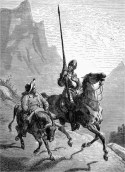
Don_Quijote_and_Sancho_Panza

Don Quixote and Sancho Panza, Gustave Dore PD|100

We can’t natter on about nothing, but conversely, we can’t have non-stop action. Pandemonium is exhausting to write and more exhausting to read. The characters and the reader both need to process information, so the character arc should be at the forefront during these transitional scenes. That period of relative calm is when you allow your characters’ internal growth to emerge.

We allow the characters to justify the decisions that led to that point and plan their next move, making it believable.

The transition is also where you ratchet up the emotional tension. Introspection offers an opportunity for clues about the characters to emerge. It opens a window for the reader to see who they are and how they react. It illuminates their fears and strengths. It makes them real and self-aware.

Keep the moments of mind wandering brief. Go easy if you use italics to set your thoughts off. A wall of italics is hard to read, so don’t have your characters “think” too much if you use those.

Characters’ thoughts must illuminate their motives at a particular moment in time and explore information not previously discussed.

conversationsInternal monologues should humanize our characters and show them as clueless about their flaws and strengths. It should even show they are ignorant of their deepest fears and don’t know how to achieve their goals. With that said, we must avoid “head-hopping.” The best way to avoid confusion is to give a new chapter to each point-of-view character. Head-hopping occurs when an author describes the thoughts of two point-of-view characters within a single scene.

Visual Cues: In my own work, when I come across the word “smile” or other words conveying a facial expression or character’s mood, it sometimes requires a complete re-visualization of the scene. I’m forced to look for a different way to express my intention, which is a necessary but frustrating aspect of the craft.

Fade-to-black is a time-honored way of moving from one event to the next. However, I don’t like using fade-to-black scene breaks as transitions within a chapter. Why not just start a new chapter once the scene has faded to black?

One of my favorite authors sometimes has chapters of only five or six hundred words, keeping each character thread separate and flowing well. A hard scene break with a new chapter is my preferred way to end a fade-to-black.

Chapter breaks are transitions. I have found that as I write, chapter breaks fall naturally at certain places.

The struggle to connect my action scenes into a seamless arc with good pacing is why writing isn’t the most uncomplicated occupation I could have chosen. But it is the best job I’ve ever had.

storyArcLIRF10032021

5 Comments

Filed under writing

Why you should consider writing a narrative essay #amwriting

Many highly respected, award-winning authors began as freelancer authors, writing narrative essays, and other articles, humorous or serious in nature. Narrative essays are drawn directly from the author’s real-life experiences but aren’t necessarily factual or accurate.

narrative essayThey often detail an experience or event and how it shaped the author on a personal level. For those of us who wish to earn actual money from writing, the narrative essay appeals to a broader audience than short stories, so more magazine editors are looking for them.

I have mentioned one of my favorite narrative essays before, 1994’s Ticket to the Fair (now titled “Getting Away from Already Being Pretty Much Away from It All“) by the late David Foster Wallace and published in Harpers. It is a humorous, eye-opening story of a “foreign” (east coast) journalist’s assignment to cover the 1993 Iowa State Fair. Wallace wrote it from his own point of view.

At the outset, Wallace tells us how he was born several hours’ drive from the fair but had never attended it. He was a slightly arrogant city boy without knowledge of farms, farm culture, or animals.

In pursuit of his dream, Wallace left the Midwest for the East Coast and never looked back after graduating high school and college. He was overjoyed when he was assigned to report on the fair for Harpers. As a naïve young correspondent, he didn’t think about the fair beyond the fact that he was getting his first official press pass, making him a “real” reporter.

Wikipedia summarizes Ticket to the Fair this way: Wallace’s experiences and opinions on the 1993 Illinois State Fair, ranging from a report on competitive baton twirling to speculation on how it represents Midwestern culture and its subsets. Rather than take the easy, dismissive route, Wallace focuses on the joy this seminal midwestern experience brings those involved.

He was shocked and repelled by some aspects of showing farm animals in a fair. Raising and caring for hogs or sheep can be a dirty business and he was unprepared for the sights and smells.

But he saw the joy and pride people have in their livestock and their skills. By connecting with their enjoyment, he was able to write a narrative that made his name as an author.

A-supposedly-fun-thing-first-edition-coverBut just what is an essay in the first place? The primary purpose of an essay is to offer readers thought-provoking content. The narrative essay conveys our ideas in a palatable form, so writing this sort of piece requires authors to have some idea of the craft of writing.

That means we must understand and write to the publishing industry’s standards of grammar and mechanics.

A narrative essay is a story that begins with an experience. You know how that experience began and ended, so you must plan how you want your account to be perceived. You must develop both content and structure.

Just like any other form of short fiction, a narrative essay has

  • an introduction,
  • a plot,
  • characters,
  • a setting,
  • a climax,
  • a conclusion.

It’s not a memoir, so we can’t ramble on. Authors must choose words that convey the intended mood concisely.

We must be intentional with how we phrase things because narrative essays often present profound and (sometimes) uncomfortable ideas. A skillful writer can offer these concepts in a way that the reader feels connected to the story, even if they disagree.

A good essay is a conversation in an entertaining form, one that expresses far more than mere opinion.

Names should be changed, for your protection, as narrative essays give readers the author’s personal view of the world, the places we go, and the people we meet along the way.

An honest narrative essay contains an author’s opinions. Sometimes those sentiments are not glowing accolades.

Those who write narrative essays can make a living because literary magazines have open calls for them. Editors and publishers are seeking well-written essays with fresh ideas about wide-ranging topics.

Some will pay well for first publication rights.

Original_New_Yorker_coverHOWEVER – if you want to be published by a reputable magazine, you must pay strict attention to grammar and editing.

Never submit anything less than your best work. After you have finished the piece, I suggest you set it aside for a week or two. Then come back to it with a fresh eye and check the manuscript for:

  • Spelling—misspelled words, autocorrect errors, and homophones (words that sound the same but are spelled differently). These words are insidious because they are actual words and don’t immediately stand out as being out of place.
  • Repeated words and cut-and-paste errors. These are sneaky and dreadfully difficult to spot. Spell-checker won’t always find them. To you, the author, they make sense because you see what you intended to see. For the reader, they appear as unusually garbled sentences.
  • Missing punctuation and closed quotes. These things happen to the best of us.
  • Digits/Numbers: Miskeyed numbers are difficult to spot when they are wrong unless they are spelled out.
  • Dropped and missing words.

If you want to work as a freelance author, don’t be afraid to use your words – readers of narrative essays have a wide vocabulary. That said, never use jargon or technical terms that only people in certain professions would know unless it is a piece in a publication geared for that segment of readers.

Above all, be intentional and active with your prose, and be bold. I enjoy reading works by authors who are adventurous in their prose.

And on that note, we must be realistic. At first, you will have trouble selling your work. This is because you haven’t gained a reputation yet, and your work might not appeal to the first editors you send it to.

If you put two people in a room and give them the most exciting thing you’ve ever read, you’ll hear two different opinions about it. They probably won’t agree with you.

1915NatGeog (2)Don’t be discouraged by rejection. Rejection happens far more frequently than acceptance, so don’t let fear of rejection keep you from writing pieces you’re emotionally invested in.

I always say this, but it is true: the way you handle critiques and rejections tells editors what kind of person you are to work with. Rejection gives you the chance to cross the invisible line between amateur and professional. Always take the high ground.

  • If an editor has sent you a detailed rejection, respond with a simple “thank you for your time.”
  • If it’s a form letter rejection, don’t reply.

When you receive that email of acceptance, do that happy dance, and don’t be shy about it.

There is no better feeling than knowing someone you respect liked your work enough to publish it.


Credits and Attributions:

Wikipedia contributors, “A Supposedly Fun Thing I’ll Never Do Again,” Wikipedia, The Free Encyclopedia, https://en.wikipedia.org/w/index.php?title=A_Supposedly_Fun_Thing_I%27ll_Never_Do_Again&oldid=1093971404 (accessed July 12, 2022).

6 Comments

Filed under writing