Tag Archives: writing

Update and Resolutions for 2019 #amwriting

Here in the Pacific Northwest, the year of 2018 is enjoying its last hurrah. People are getting ready for parties and counting both their successes and failures. It has been an eventful year for both my family and my writing life, so I am looking forward to what 2019 will bring.

My quest to complete the three-book literary fantasy series, Billy’s Revenge, will finally come to an end. Julian Lackland is on the home stretch and will go to the editor on February 1st. Depending on how quickly that goes, he will be published in June. Julian began life as my first NaNoWriMo Novel in 2010 and was picked up by a small press. Unfortunately, that didn’t go well.

It has taken me eight years to undo the damage they did and get this manuscript into proper shape. Julian Lackland is why I have been on this quest to educate myself about the craft of writing. I wanted to give Julian the kind of book he deserves, and judging by my beta readers’ comments, the effort has been worth it.

I am also closing in on finishing the first draft of a new duology set in Neveyah, the Tower of Bones world. One of the things I learned when I was trying to finish Valley of Sorrows, is that readers who begin a series want the next book in a timely fashion. They might wait a year, but after that, they will forget about it. It takes me four years to get a book from concept to publication, which can be a problem.

What I am doing differently with Alf’s story is this: I’m writing the first draft of the entire story arc before I begin revisions on the first book. So, this means I am writing a 250,000 word manuscript. Only when the entire first draft is finished will I begin the editing process. The manuscript will be broken in half and published as a duology, hopefully six months apart, assuming that editing goes smoothly when we get to that stage.

I am also finishing the stand-alone book that was begun as a serial in 2015, Bleakbourne on Heath. I have approximately 20,000 words left to write before it goes to the editor. Leryn’s story was so much fun to write. I had never done a serial, and unfortunately, I soon discovered I couldn’t keep up the daunting schedule I had set for getting my installments published. It was like “live television.” Whenever I sat down to write a chapter, I had no idea what was going to happen next.

One day I realized I had reached a creative plateau and had no idea how to finish the damned thing. Some people consider that writer’s block, but not me. When I can’t think of a way to advance a particular story, it’s time to rein it in and put it aside for a while to work on something else. So, I wrote a wedding scene, and ended the serial on a happy note, winding up most of the threads, but with the main quest still unfinished.

Last year was a good year for short stories, some of which found good homes in forthcoming anthologies. Also, two of my poems were selected for publication in the I Hear Olympia Singing poetry anthology and were chosen as the opening verses. I survived my first live poetry reading and met some amazing people in the process. Yay for that!

Despite cutting back on my professional editing schedule, I was privileged to edit several wonderful books for my clients—what a joy that aspect of my life is. I can’t completely drop out of that part of this business, as I love working with my clients, helping them to realize the vision they originally had for their book.

My resolutions for 2019 are to publish at least one novel, have a second one either published by the end of the year or ready to go in 2020, finish the first draft of my duology, and continue to write short stories and poetry, and continue to edit for my private clients.

I will keep writing new words every day, and I will remain involved in the local writing community. That connection with other writers feeds my creativity, offers me a sounding board, and keeps me working with good people who will read for me and show me what needs to be rewritten.

Thank you for being a part of my writing life. May the new year bring you good fortune, good food, and good friends. May the new year bring us all inspiration and determination—the two most important gifts a writer could have.


Credits and Attributions

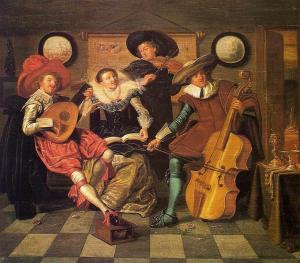
Wikimedia Commons contributors, “File:Dirck Hals – Musicians – WGA11043.jpg,” Wikimedia Commons, the free media repository, https://commons.wikimedia.org/w/index.php?title=File:Dirck_Hals_-_Musicians_-_WGA11043.jpg&oldid=253948561 (accessed December 31, 2018).
6 Comments

Filed under writing

Stormy Weather #amwriting

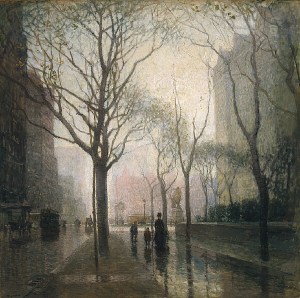
Today is one of the darkest days so far this winter. As I write this, it’s noon, but the sun struggles to penetrate the gloom. Wind-driven rain bullets pound at the windows and all I want to do is hibernate. The wind howls around my house, seeming like a living thing.

I am warm and snug and wrapped in a cozy, fleece-lined blanket, with a cup of hot tea in my hands. I sit with my eyes closed, imagining warmer places, lands where the sun shines every day, and a gentle rain only falls in the small hours before dawn.

Yep. I write fantasy.

This post was supposed to be about world building. I could probably look out my window and tell you what my world looks and feels like. I’d intended to show you how the rain and murkiness make the world seem two-dimensional, a study in shades of gray. I wanted you to feel the cold and damp working its way inside your hood, making walking to the store a misery. I should  warn you, though. Today is a bad day to walk anywhere. Flying branches and airborne trashcans might make your walk…an adventure.

Had we gone through the exercise that was planned, I would have asked you to talk to the friendly golden Labrador who lives inside the fenced yard on the corner and reassure him that his owner will indeed come home after work. The poor dog is doubtful, awash with separation anxiety despite the fact his owner has never failed to return.

But no.

I don’t think I will write a blog post today. Instead, I’m going to sit in my favorite chair and read. And when I put the book down for a moment, I will remember how warm the breezes of Oahu were, how different from my cold, dark, inland home. I’m going to think of Waikiki and mojitos at Duke’s Canoe Club. Sitting on the beach afterward and feeling the softness of golden sand against my bare feet. How gentle the surf seemed during our stay there, as compared to the chill of the wild North Pacific as it crashes into the Washington coast.

I’m going to remember the exhilaration of snorkeling in Hanauma Bay. The pictures didn’t do it justice, but it shines in my memory. And the next day? How do I show you the incredulous joy of sitting on a North Shore beach and being visited by giant tortoises?

Instead of being visited by thunder and lighting.

The storms may swirl and rage outside my house, but I am warm and cozy. I have orange spice tea to keep me warm and the memories of warmer places and gentler breezes to keep me company.


Credits and Attributions:

The Plaza After Rain, Paul Cornoyer [Public domain], via Wikimedia Commons

Waikiki Beach by Helen Whitney Kelley, c. 1900 [Public domain], via Wikimedia Commons

3 Comments

Filed under writing

Logic and the Deus Ex Machina #amwriting

I write fantasy novels, but I also write contemporary fiction.  All fiction, literary as well as fantasy, requires world building and a certain amount of planning as any novel or short story must have a logical story arc. Without a fundamental logic to the events, the reader can’t suspend their disbelief.

NaNoWriMo is prime “pantsing it” time. For those who don’t know that term, “pantsing” is writer-speak for “flying by the seat of your pants.” I always begin by writing to an outline, but in the mad rush to the finish, my story goes in directions I never planned for.

I outline in advance because (when writing in any genre) if you are pantsing your way through a story that encompasses 75,000 to 100,000 words, it is easy to get involved in large info dumps and bunny trails to nowhere. A loose outline will tell you what must happen next to arrive at the end of the book with a logical story set in a solidly designed world.

However, I’ve never yet written a story that stuck strictly to the original outline.

Characters develop lives and personalities of their own, and stuff happens that wasn’t planned for. When I finish the first draft, it always makes sense in my head, and I usually feel confident it can pass the logic test.

So, what is the logic test? Once you have the first draft written, let it sit for a few weeks, then come back to it. If I was smart, during my writing process I made notes where the scenes began deviating from the outline.

Screen writers have it right, so the layout of my outline is divided into acts and beats, the same as a screenplay would be listed with a brief description.

Act One

  • Opening scene–characters in “normal” environment–/ Hook
  • Inciting Incident–characters thrown out of “normal” and into new circumstances.
  • End of the Beginning

Act Two takes up 50% of the novel—it is the second quarter and third quarter combined.

  • Pinch Point #1
  • Midpoint
  • Pinch Point #2
  • Crisis

Act Three

  • Climax
  • Final resolution

Each section has a brief description of what occurs there, such as:

Act Three, scene 1

  • Leave Hemsteck
  • First campsite, Alf /Ronan talk. Dex overhears.

If I have made notes of my changes to the story line, I have a guide showing me what those changes were. I know where to go back and check to make sure the events are foreshadowed logically, and not a clumsy Deus Ex Machina. (Pronounced: Day-us ex Mah-kee-nah.) (God from the Machine.)

This is a plot twist that is used to miraculously resolve an issue. (Miraculous is the key word.) A Deus Ex Machina occurs when, toward the end of the narrative, an author inserts a new event, character, ability, or otherwise resolves a seemingly insoluble problem in a sudden, unexpected way.

So, let’s consider an indie novel I tried to read a week ago and didn’t finish. I was in the mood for a trashy  adventure/romance, and for the first few chapters, I was able to overlook some technical annoyances because the characters were hilarious. After thinking about it, I doubt the author intended it to be such a hilarious mockery of 19th century upper class mores, as everything was written so earnestly, so faux Charlotte Bronte.

The setting for the final incident that threw me out of the book completely is a grand ball at a Buckingham Palace. The main character, whom we just spent a chapter dressing in an excessive amount of detail, becomes involved in a quarrel. She draws her sword, and the fight is on.

Where did that weapon come from? Swords aren’t easy to conceal. It wasn’t part of the highly detailed scene where her maid was dressing her one layer at a time. Why was she wearing a sword at a formal event? Do all the ladies go armed at these events? If so, it should have been made a part of the choosing-the-gown scene. Give her a fancy scabbard to keep that handy  rival-stabber in, something that looks all bejeweled and goes with the outfit.

In late Regency/early Victorian times, officers wore ceremonial swords to formal events. Women were never armed openly. Any weapons they had would have been knives, poison, or pistols and would have been concealed, not hanging from their waist in a long scabbard. A pistol in her bodice would have almost logical. So, if you intend for her to draw her sword, there must be a logical reason for these men and women to be armed.

When I look back at my story’s outline, starting from the ending and working forward, does the characters’ journey to the final page make sense? If my characters must show up to a grand ball fully armed, it must be logical, a part of their culture.

Good writers don’t rely on miracles to ensure things work out to the main character’s advantage. They use logic and insert small clues and hints into the narrative, so the reader doesn’t feel cheated. To that end, I suggest keeping an updated outline of what happens in each scene.


Credits and Attributions:

Wikimedia Commons contributors, “File:Rembrandt – Rembrandt and Saskia in the Scene of the Prodigal Son – Google Art Project.jpg,” Wikimedia Commons, the free media repository, https://commons.wikimedia.org/w/index.php?title=File:Rembrandt_-_Rembrandt_and_Saskia_in_the_Scene_of_the_Prodigal_Son_-_Google_Art_Project.jpg&oldid=302686497 (accessed December 16, 2018).

4 Comments

Filed under writing

5 things I’ve learned #amwriting

I’ve been writing for all of my adult life, but for most of it, not professionally. For the majority of my writing life, I was new, untutored in the craft, writing words that shouldn’t have been shown to anyone. I didn’t have the information I needed to make my work readable and didn’t know how to get it.

I felt embarrassed for even thinking that I could be an author.

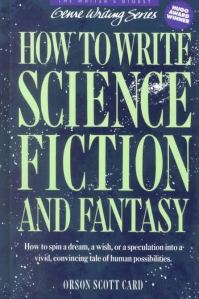
One day in 1990, I stumbled upon a book that was offered in the Science Fiction Book Club catalog: How to Write Science Fiction and Fantasy by Orson Scott Card. The day that book arrived in my mailbox changed my life. It was possible for me to become a writer, and one of my favorite authors was going to tell me how to do it.

In the years since that book, I have amassed a library of books on the craft. Some are brilliant, some not so much, but I always learn something from them. However, personal experience is a great teacher, and I’ve learned many things by trial and error.

So here in no particular order are five things I would like to pass on to you:

Make a style-sheet as you go, a glossary of words and spellings unique to your story, and be sure to list names especially. I use an Excel spreadsheet, but use anything you like, and that will help you stay consistent in your spellings.

Develop a good system for naming your files and save regularly. Save each version of your manuscript with a different name so you can go back and retrieve bits you may need later. I use a system like this:

Heavens_Altar_V5.docx

That stands for Heaven’s Altar version five, and I work out of Word, so the extension is automatically a docx.

Find a local group of writers to meet with and talk about the craft. Critique groups are great, but they are only one small part of the picture. Authors need to network with other authors because we need to discuss the craft with someone who doesn’t look at you with glazed eyes. I gained my extended author network for by joining The Pacific Northwest Writers Association and going to their conferences. This is how we educate ourselves. I also gained a local support group through attending Write Ins for NaNoWriMo.

Don’t even consider signing with any slick-talking publisher that contacts you out of the blue, saying they want your work if you haven’t submitted your work to them. How can they possibly want work they haven’t seen?

Make use of SFWA’s Writer Beware site. These predators want your work all right—and want to sell you publishing services you can do for yourself. You won’t benefit from the publisher’s “services,” but they will benefit from your desperation to be published. They will publish your work unedited, and your payment is the glory of having it published, as you will never see any royalties. They will expect you to market their product and offer you all manner of for-payment services that are dubious at best. Worst of all, you will have signed away the rights to your work for nothing.

Even though you are writing that novel, write short stories. Short stories are a training ground, a way to hone your developing skills. They’re also the best way to get your name out there. My advice is to build a backlog of work in lengths from 2000 to 5000 words ready to submit to magazines, anthologies, and contests. All those fabulous scenes and vignettes that roll though your head can be made into short pieces. Get the Submittable App and see who is asking for what sort of work, and start submitting.

These are five things that I wish I had known in 2010 but didn’t.

7 Comments

Filed under writing

The Functions of the Scene revisited #amwriting

We are at mid-month for NaNoWriMo, and I am not writing my novel. Instead, I am trying to write short stories, but my mind won’t cooperate. I keep waking up with new scenes filling my head, scenes that demand to be written for all my works in progress.

Scenes are what I want to talk about today, but I just discovered that I wrote a perfectly good post on them last year and can’t think of anything to add to it. So, we may as well revisit last year’s post on The Functions of the Scene. I hope you find it useful as your writing journey continues.

Keep writing, update your word count every day if you are participating in NaNoWriMo, and happy writing to you, whether you participate in that merry month of madness or not!


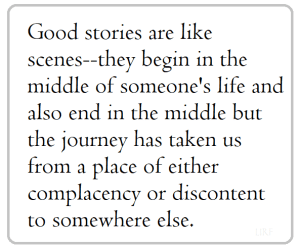
A great story consists of a beginning, a middle and an end, and is made of scenes. We have action, emotion, ups and downs, a plot all sewn together by the thread that is the theme. But the entire structure of the novel is built scene-by-scene, connected by transitions.

Scenes may consist of conversations, or they may be action sequences, but put them together in the right order, link them with a plot featuring a good protagonist and a worthy antagonist, they combine to form a story.

I perceive the scene as a small area of focus within a larger story with an arc of its own, small arcs holding up a larger arc: the chapter. So, scenes are the building blocks of the story. Strong scenes make for a memorable novel, and we all strive to make each scene as important as we can. Therefore, no scene can be wasted. Each scene must have a function, or the story fails to hold the reader’s interest.

Some things a scene can show:

  • Information
  • Confrontation
  • Revelation
  • Negotiation
  • Decision
  • Capitulation
  • Catalyst
  • Contemplation/Reflection
  • Turning Point
  • Resolution
  • Myriad deep emotions

Make one or more of these functions the core of the scene, and you will have a compelling story.

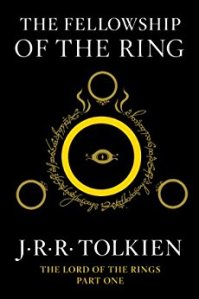
Let’s examine a watershed scene that occurs in the Fellowship of the Ring, book one of J.R.R. Tolkien’s Lord of the Ring series: The Council of Elrond. The scene is set in Rivendell, Elrond’s remote mountain citadel.

Each of those characters attending the Council has arrived there on separate errands, and each has different hopes for what will ultimately come from the meeting. Despite their different agendas, each is ultimately concerned with the Ring and protecting the people of Middle-earth from the depredations of Sauron, if he were to regain possession of it. This scene serves several functions:

Information/Revelation: The Council of Elrond serves the purpose of conveying information to both the protagonists and the reader. It is a conversation scene, driven by the fact that each person in the meeting has knowledge the others need. Conversations are an excellent way to deploy needed information. Remember, plot points are driven by the characters who have the critical knowledge.

The fact that some characters are working with limited information is what creates the tension. At the Council of Elrond, many things are discussed, and the full story of the One Ring is explained, with each character offering a new piece of the puzzle. The reader and the characters receive the information at the same time at this point in the novel.

Confrontation: Action/confrontation, conversation, reaction. A scene that is all action can be confusing if it has no context. A properly placed confrontational conversation (an argument/dispute) gives the reader the context needed to understand the reason for the action.

At the Council of Elrond, long simmering racial tensions between Gimli the Dwarf and Legolas the Elf surface. Each is possessed of a confrontational nature, and it isn’t clear whether they will be able to work together or not.

Other conflicts are explored, and heated exchanges occur between Aragorn and Boromir.

Negotiation: What concessions will have to be made to achieve the final goal? These concessions must be negotiated. Tom Bombadil is at first mentioned as one who could safely take the ring to Mordor as it has no power over him. Gandalf feels he would simply lose the ring, or give it away because Tom lives in a reality of his own and doesn’t see the conflict with Sauron as a problem. Bilbo volunteers, but he is too old and frail. Others offer, but none are accepted as good candidates for the job of ring-bearer for one reason or another. Each reason offered for why these characters are found to be less than satisfactory by Gandalf and Elrond deploys a small bit of information the reader needs.

Turning Point: After much discussion, many revelations, and bitter arguments, Frodo declares that he will go to Mordor and dispose of the ring, giving up his chance to live his remaining life in the comfort and safety of Rivendell. Sam emerges from his hiding place and demands to be allowed to accompany Frodo. This is the turning point of the story.

(The movie portrays this scene differently, with Pip and Merry hiding in the shadows. Also, in the book, the decision as to who will accompany Frodo, other than Sam, is not made for several days, while the movie shortens it to the one day.)

So, within the arc of the story are smaller arcs, arcs of conflict and reflection, each created by scenes. The arc of the scene is like any other: it begins, rises to a peak, and ebbs, ending on a slightly higher point of the overall story arc than when it began, leading to the brief transition scene.

Transitions can be as simple as a change of setting, one character leaving the room for a breath of air. They can be hard transitions, the scene ends and with it, so does that chapter. Within a chapter, conversations can serve as good transitions that propel the story forward to the next scene, offering a chance to absorb what just happened. If using a conversation as a transition, it’s important you don’t have your characters engage in idle chit-chat. In literary terms, a good conversation is about something we didn’t know and builds toward something we are only beginning to understand.

That is true of every aspect of a scene—it must reveal something and push the story forward toward something.

With each scene we are also pushing the character arc, raising the stakes a little. Our protagonist grows and is shaped by receiving needed information through action and conversation, followed by reaction and regrouping. This allows the reader to experience the story as the protagonist does, and then to reflect and absorb the information gained before moving on to the next scene.

All the arcs together form a cathedral-like structure: the novel. By creating small arcs in the form of scenes, we offer the reader the chance to experience the rise and fall of tension, the life-breath of the novel.


Credits and Attributions:

The Functions of the Scene, ©2017 by Connie J. Jasperson, first appeared here on Life in the Realm of Fantasy on November 22, 2017.

The Fellowship of the Ring by J.R.R. Tolkien, Houghton Mifflin Harcourt; Reissue edition (February 15, 2012) Fair Use.

3 Comments

Filed under NaNoWriMo, writing

About Dialogue #amwriting #nanowrimo

We who write must be able to visualize and describe conversations. We must do it in such a way that the reader forgets they’re reading a book and becomes engrossed in the discussion.

However, we don’t want to be completely accurate. How many people have mannerisms that impede their speech, uhhhhmming and aaahhhhing their way through each thought? And yet others may have a lisp or stutter that makes you have to listen more closely to them. These are normal parts of our lives but are things we don’t include in our written descriptions of conversations.

So how do we get the conversation down so the reader will enjoy it?

First of all, there are certain fundamental rules of the road that readers will expect authors to be educated in. When authors don’t obey these rules, readers put the book down, unfinished. The rules are clearly listed in the Chicago Manual of Style but can also be found in the Chicago Guide to Grammar, Usage, and Punctuation by Bryan A. Garner. These are two books authors should own and refer back to whenever they have questions about grammar.

On a side note, I was lurking in a writers’ forum when a new member boldly commented, “Why are you so concerned about this? Who the hell cares about grammar? We write what we want and to hell with rules.”

Wisely, I stayed out of that poo-storm. It is good for us to remember that “grammar-nazis” are not the only people who care about sentence construction and the mechanics of good writing.

Readers care. Words have intersections, and punctuation acts as a traffic signal, preventing jam-ups and wrecks. Authors who care take the time to learn a few basic rules, things that signal stop, go, slow down, and “someone is talking.”

Much of what follows has been written here before. So, if you have already seen this, thank you for stopping by!

Here are the rules of how to write readable dialogue:

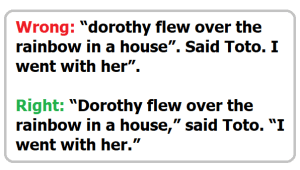
  1. Always begin what is actually spoken (dialogue) with a capitalized word, no matter where in the sentence it begins.
  • Gemma glanced over her shoulder and said, “I’m sorry. I can’t go with you.” 

However, interrupted dialogue, when it resumes, is not capped, although the rules of punctuation and quotation marks still apply.

  • “I’m sorry to tell you,” said Gemma, “but I can’t go with you.”
  1. Direct dialogue is someone speaking to you or someone else and requires quotation marks.
  • “I’m sorry. I can’t go with you,” said Gemma.

I’m a US author, so I used double quotes, also called closed quotes. The UK usage is different and often uses apostrophes, or what they call inverted commas.

Regardless of whether you are a UK or US author, be consistent and make sure ALL punctuation goes inside the quote marks.

Yes, I did say All punctuation.

  1. How does one set off a quote from someone else within dialogue?

Set it apart with single quotes (apostrophes, inverted commas) and keep it inside the closed quotes. You can do this in two ways:

  • Jason said, “When I asked her, Gemma replied ‘I can’t go.’ But I’m sure she was lying.”
  • Jason said, “When I asked, Gemma replied ‘I can’t go.’”

Note that in the second sentence 3 apostrophes are placed after the period (full stop): 1 apostrophe and 1 double (closed) quote mark. This is in keeping with the rule that all punctuation in dialogue goes inside the quotation marks.

  1. Indirect dialogue is a recapping of dialogue that someone previously spoke.
  • When asked, Jason said Gemma couldn’t go.

Note there are no quotes used in indirect dialogue. Also, in the above sentence, the word that is implied between said and Gemma.

Dialogue tags, or attributions (said, replied) can come before the dialogue, especially if you want the dialogue tag to be noticed. To make them less noticeable put them in the middle or at the end of sentences. In my own work, I want the dialogue and not the attribution to stand out. However, when more than two people are involved in a conversation, I move the dialogue tags further to the front, so the reader isn’t left wondering who is speaking.

  1. You can skip using dialogue tags altogether for a back-and-forth or two, but
  • not if there are more than two speakers in the scene, and
  • not for more than a few exchanges.

Readers want to be able to track who is saying what.

Sometimes it’s okay to miss a few beats. Beats are what screen-writers call the little bits of physical action that is inserted into dialogue. Small actions showing the mood of a character are often best placed where there is a natural break in the dialogue, as they allow the reader to experience the same pause as the characters. They’re an effective tool and are essential to good dialogue, but don’t overdo it.

If your characters are shifting in their chair, gazing into the distance, or opening their laptops between every second line of conversation, the scene becomes about the action and not the dialogue, and the impact is diluted or lost entirely.

When we add gestures and actions to the conversation, we want them to be meaningful.  Otherwise, just use a simple dialogue tag, like said, or replied.

Please don’t get rid of attributions entirely because the verbal exchanges become confusing and the action takes over, making the dialogue fade into the background noise of foot shuffling and paper rattling.

I’ve mentioned before that I prefer simple attributions such as said, replied, and answered because they are not as likely to stop the reader’s eye. Some things to consider:

  1. People don’t
  • snort,
  • smirk,
  • smile,
  • or frown dialogue as it is physically impossible.

They can say it with a smile, a frown, a smirk, or a snort, but while facial expressions convey emotion, they do not speak. Simple attributions in combination with lean, descriptive narrative are all you need.

  • “Oh, that looks nice.” Jenny snorted. “I wouldn’t be caught dead in it.”

Sometimes we have two ideas that we think are one, and we connect them with commas. But closer examination shows they are not.

  • “Hello, sir, we bathed your dog,” she said.

The above dialogue contains a run-on sentence, despite its shortness. We may actually speak it in this fashion, words run together, but for a reader, punctuation clarifies ideas.

The dialogue contains two separate ideas. “Hello, sir,” is an acknowledgment and a greeting. “We bathed your dog,” indicates an action was taken regarding his dog. It should be:

  • “Hello, sir. We bathed your dog,” she said.
  • “Hello sir,” she said. “We bathed your dog.”

To wind this up, authors can take some style and voice liberties with dialogue but must use common sense. Adhering to the accepted standard rules of punctuation makes your work readable by anyone who speaks or reads English.


Credits and Attributions:

Portions of this post have previously appeared here on Life in the Realm of Fantasy as The Mechanics of Writing Dialogue, posted December 14, 2016

Traffic Light, © Free Clip Art Now https://www.freeclipartnow.com/transportation/traffic-lights/

Researched Source: Section 13.13, Quotations and Punctuation, page 719: The Chicago Manual of Style, 17th Edition, University of Chicago Press, © 2017

8 Comments

Filed under writing

Many will begin, few will succeed #amwriting

Every year, many writers begin writing on November 1st, fully intending to get their 1,667 words (or more) written every day, to get their 50,000 words by November 30th. In my region last year, 245 writers created profiles and began an official manuscript at www.nanowrimo.org.

The reality sets in within the first week. Last year 64 writers in our region never got more than 5,000 words written.

Some are young people just out of school who “always wanted to write a book.” They usually don’t have any idea of what they want to write, and no clue of how to be disciplined enough to spend two hours a day writing any words, much less the number of words it takes to make a novel.

They start, get 30 to 1,000 words in, and realize they have nothing to say. But 34 people made it to the 10,000 word mark before they stopped writing. That is almost a novella.

Others do well for a week, or even two, and then, at the 20,000 word mark, they take a day off. Somehow, they never get back to it. Someday, they may actually succeed in finishing that book. Just not this year.

Even seasoned writers may find the commitment to sit and write 1,667 words every day is not doable for them. Things come up—life happens.

But 78 writers out of the 245 in our region made it to the 50,000 word mark, and 5 exceeded 100,000 words.

It takes personal discipline to write 1,667 new words every day. This is not revising old work—this is writing something new, not looking at what you wrote yesterday. This is starting where you left off and moving forward.

For me, having the outline keeps me on track.

I’m not a good typist. The words that fall out of my head during this month are not all golden, just so you know. Some words will be garbled and miskeyed. This means I sometimes have a lot of revising of the work I intend to keep.

Some of what I write will be worth keeping, and some not at all. But even among the weeds, some passages and scenes  will be found that could make a story work. I will keep and use them because they say what I mean to say, and the others I will revise.

One flash fiction that came out of November 2015 fully formed and required little in the way of revisions is The Iron Dragon. The story wanted to be told, and I wrote it in two hours one morning.

Yet another very short story came out of NaNoWriMo 2015, The Cat, the Jeweler, and the Thief. That story remained very much as it began, and also was written in one morning.

I had the prompts and basic ideas of what I intended to write when I sat down. The words fell out of my mind, and the stories told themselves.

For me, as a NaNo Rebel, this is my little vacation from the serious novels that take up most of my time. I don’t accept any editing clients during November or December—my attention is on writing in November and cooking in December.

It’s a matter of getting the ideas down and putting the words on paper. If you don’t get those ideas out of your head and onto paper, you can’t revise and reshape them into something worth reading.

How do we develop the discipline to write every day? This is my list of suggestions for how to have a successful NaNoWriMo, and end November with that winner’s certificate:

  1. Write at least 1,670 words every day (three more than is required) This takes me about 2 hours – I’m not fast at this.
  2. Write every day, no matter if you have an idea worth writing about or not. Do it even if you have to get up at 4:00 am to find the time and don’t let anything derail you.
  3. If you are stuck, write about how your day went and how you are feeling about things that are happening in your life, or write that grocery list. Just write and think about where you want to take your real story. Write about what you would like to have happen in that story. Soon, you will be writing that story.
  4. Check in on the national threads and your regional thread to keep in contact with other writers.
  5. Attend a write-in if your region is having any or join a virtual write-in at NaNoWriMo on Facebook. This will keep you enthused about your project.
  6. Delete nothing. Passages you want to delete later can be highlighted, and the font turned to red or blue, so you can easily separate them out later.
  7. Remember, not every story is a novel. If your story comes to an end, start a new story in the same manuscript. Use a different font or a different color of font, and you can always separate the stories later. That way you won’t lose your word count.
  8. Validate your word count every day.

These suggestions require you to actually sit in a chair and write. Talking about what you intend to write isn’t getting the book written—for that you must sit your backside down and write.

That is what NaNoWriMo is all about. Writing, and developing discipline.

Authors write. Authors have finished manuscripts to show for their efforts, whether they are good or bad.

If you don’t actually have time to write, you may be a dreamer and a story teller, but you aren’t an author – yet.

Set aside the time to write, develop a habit of writing, and don’t let anything get in the way of your writing time. Don’t allow your writing time to be infringed upon, but also, don’t let it eat into your family time. In 1989, as a single parent with one child still at home, I found myself writing on the bus as I rode to work. I hadn’t ever had the thought that someone would want to read my work, but I had one hour of peace and quiet each way in the morning and evening, and so I wrote in a notebook.

Find the least intrusive block of time for you to have to yourself. What would happen if you dedicated two hours an evening to writing your novel instead of watching TV? What if you got up an hour early and wrote before you went to work every day? Make it your rule, your daily habit to use that time to write 1,667 new words a day for the month of November.

That is how you can get your first draft of a novel written in 30 days and still have time for your family.


Credits and Attributions:

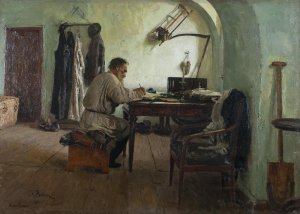
Leo Tolstoy by Ilya Repin [Public domain], via Wikimedia Commons

Notebooks, by L.Marie (https://www.flickr.com/photos/lenore-m/2812598573/) [CC BY 2.0 (https://creativecommons.org/licenses/by/2.0)%5D, via Wikimedia Commons

6 Comments

Filed under NaNoWriMo, writing

#NaNoWriMo2018 pre-planning

When I begin penning a story, the working title is usually just a handle, something to carry it by for the time being, and which will be changed when I rewrite it anyway. While the title might not actually exist, the story does, in the form of an idea, a prompt.

So, before I sit down to write anything, I answer a short list of questions about the overall story arc of my intended tale.

I mentioned a few post’s back that I keep a document pinned to my desktop, one that I write down topics and ideas for stories on. This list is crucial, and now, as part of my preparations for next month’s madness, I am taking each idea, and answering eight questions, and making a separate file folder for each story.

I have a master folder in my writing folder that is titled: NaNoWriMo2018. Within that folder are my small files, one for each story I plan to write.

For a novel, you only need two files: your work-in-progress document, and a document to keep all the back story in.

But I am a NaNo Rebel and so for me, at this point, there are fifteen file folders in that file. I will probably only get ten of them written at 4,000 to 10,000 words per story.

I title each story folder with a working-title, such as Mitzi.

The file contains two documents. The first one is blank except for one line, which is the prompt, the  premise of the story. It is labeled MITZIdraft1. That stands for Mitzi first draft. This document will be the manuscript for that story. Any subsequent revisions will be labeled title_draft2, etc.

At 12:01 a.m. in November 1st, I will open this document and begin writing Mitzi’s story. I think her tale will top out at about 4,000 words. Then I will open the next file: Doors. I’ll begin working on that short story, which I expect will top out at 5,000 words.

I doubt I’ll keep the title of Mitzi, but it’s about a dog who “lives” at about six different homes, who answers to six different names, and the people who think they own her.

I got the idea for that story from “Rufus,” the name I gave the cat who sleeps on my back porch all day, but who actually belongs to one of our neighbors. We don’t know his real name, or which neighbor owns him. We never have to feed him, and his vet bills are not an issue for us. We just get to enjoy his orange and white fur, all over our outdoor furniture.

I mentioned there were two documents in each file. The other document is the basic premise of the story, answered in eight questions. Each answer is simply one or two lines telling me what to write.

  1. Who are the players?
  2. Who is the POV character?
  3. Where does the story open?
  4. What does the protagonist have to say about their story?
  5. How did they arrive at the point of no return?
  6. What do they want and what are they willing to do to get it?
  7. What hinders them?
  8. How does the story end? Is there more than one way this could go?

The answers to these questions make writing the actual story go faster because I know what happened, what the goal is, why the goal is difficult to achieve, and how the story ends.

Once you have answered questions one and two, you know who you are writing about and which character has the most compelling story.

At that point, you must decide what will be your inciting incident. An event happens that throws them into the action. Now, what is their goal/objective?

At the beginning of the story, what does our protagonist want that causes them to risk everything to acquire it? How badly do they want it and why? The answer to that question must be that they want whatever it is desperately.

Question number six is an important thought to consider. What moral (or immoral) choice is the protagonist going to have to make in their attempt to overcome the odds and achieve their objective?

Many final objectives are not issues of morality, but all final objectives should have consequences and should involve a struggle.

The answer to question number seven is vitally important because the story hinges on how the protagonist overcomes adversity. What hinders them? Is there an antagonist? If so, who are they and why are they the villain of the piece?

Answering question eight is crucial if I want to complete my short story during November. Endings are frequently difficult to write because I can see so many different outcomes. Because it is NaNoWriMo, and every new word I write counts toward my goal, I write as many endings as I need to.

This is where making use of scene breaks can be your friend. For a short story, an ending is usually only 500 words or so. I simply head that section (in bolded front) with the words Possible Ending 1 or 2, or however many endings I have come up with.

Once I have finished my short story, I save that file, close it, and move on to the next. I have to keep that story factory working, because during the rest of the year, whatever novel I am writing takes priority in the writing queue.

But I always have time to revise something that is already written, especially if I have come to a stopping place in my novel.

Every evening, I copy and paste each day’s work into my NaNo Master Manuscript, which is also in my NaNoWriMo2018 file. This gives me the satisfaction of seeing my total word count growing day by day.  I upload that manuscript every night to the www.nanowrimo.org website so that my work is validated and my writing buddies can see I am meeting my daily word count goals.

November is the only time I can dedicate to exploring the many topics and wild ideas that come to me over the course of a year. On December 1st, I will go back to my usual routine, editing for clients in the morning and working on my novel after editing is done.

When I need a break and something new to work on, I will pull out my short story file, and begin revisions. The work I have planned for selected anthologies will be revised first, as they will have deadlines early in 2019.

This keeps me working and ensures I am being productive even when my novel is stranded in the desert of “Now What?”.

Pre-planning means I have a good system established for version control for my revisions, as each story has its own file and I don’t have to waste time dealing with that on the front end. As I say, this is my system, and it works for me. I use this system for all my work.

Develop your system, lay the groundwork for your novel. Create the master file, and in that file, include any sub-files that pertain to your novel. Do it now, well in advance of November 1st, so that all you have to do is write and save your work.

4 Comments

October 22, 2018 · 6:00 am

Layers of a scene: Action #amwriting

Scenes are often comprised of people talking, a little action, and then more talking. Sometimes the action is minor, taking the characters from one place to another. Two characters talking in a coffee shop would have minimal action, but a lot of dialogue.

Other times the dialogue is minimal, and the action is violence. It can be sudden, as in a car wreck, or planned as in a battle.

At the outset of any story, our characters are in a comfortable place. An incident/event occurs, throwing them out of what they know and into disarray, beginning the real story.

Once they recover from the first obstacle, they realize they must do or find something important. Only a certain object or person will resolve the situation. To acquire what they need, the protagonist and their companions must enter unfamiliar circumstances.

They must struggle and make mistakes until they become accustomed to their new situation. This is where the action comes into the story.

I have read books were the author was so involved in setting traps and roadblocks for the protagonist and their nemesis that the story line wandered off and got lost. The author failed to entertain me.

Action scenes must fulfil several requirements:

  • They must entertain the reader.
  • They must create new circumstances.
  • They must force the character to grow and change.

The events the protagonist experiences must push the plot forward. In the process, the action should force the characters involved in it to become greater than they were, to find something within themselves they didn’t know existed.

I’m just going to get this out into the open: long, drawn-out fight scenes bore me to tears.

So many authors get hung up on the technical side of the fight—how the combatants were dressed, who hacked, who slashed, and so on. Scenes involving fighting should be written as controlled chaos. They must be logical and real and must give the impression of a chaotic event. Just as if the physical dispute were a dance, we choreograph it.

We all know the common fundamentals of the fight scene:

  1. Physical violence/weapons
  2. Shouting/screaming/other loud noises
  3. Damage to the immediate environment
  4. Injuries/death

Those are part of the elements that comprise the “push” of the action—the chaos. It takes time, but over the course of several hours, you can put the skeleton of your fight scene on paper. What is physically possible and what is not?

But what of a non-violent action scene? Perhaps the characters are sneaking into a room or attempting to board a crowded train. What furnishings does the immediate environment contain, and how does that affect their movements? What hinders the characters moving within their space? What aids them?

For much of the morning they rode in silence. The path climbed more steeply than Alf had imagined a fully laden cart or wagon could manage. The vertical wall of the Escarpment on the left side of the trail and a waist-high stone barrier with a terrible drop on the right made him jittery. It occurred to him that the low wall was little more than a robust fence, knee high to his horse.

The next step, after the action is laid down, is fine tuning it, so the reactions and responses of your characters are natural and real. If the scene is about dialogue, insert the action so it is minimal. It can be a slight buzz in the background that serves as a speech tag:

He forced himself to loosen his grip on the reins. “I suspect the little barrier is there mainly to keep the wagons from sliding over the edge in the winter. It does provide some comfort to know that, while I would be launched amazingly far, my horse would likely be saved.”

Dex looked at him sharply. “Don’t tell me you’re afraid of heights. This is nothing compared to what we’ll deal with when we leave Hemsteck.”

After the push, comes the “glide” where the characters assess what just happened, tend to their injuries, and decide what to do next. They must catch their breath and figure out where they went wrong.

Every now and then a manuscript comes to me that is impossible to navigate because the author is afraid to let their characters rest and regroup, and it basically becomes a nonstop beating for the protagonist. The author may fear that the reader will find it boring if he pauses the action for any reason. That continual pressure on the protagonist is exhausting to me as a reader.

If you don’t allow your characters to process the violence they just experienced, the story gets lost in the chaos. Once the reader can no longer suspend their disbelief, you have lost them.

Most of us understand verbal disputes and how they are constructed. But if physical violence is involved and you are not a martial arts aficionado or a weapons specialist, you may wish to consult someone who is and have them look at your scene. They will tell you what is physically possible and what is not.

Once I have a fight scene choreographed, I run it past my writing friends, Dave and Lee, both of whom will point out the areas where it is no longer believable.

To wind this post up, a constant assault of random action, scene after scene, makes no sense unless you allow the reader to put the events into perspective. Scenes inserted for shock value and with no pause for rest and reflection don’t allow the protagonist to demonstrate personal growth.

As a reader, I will put that book down, unfinished.


Credits and Attributions:

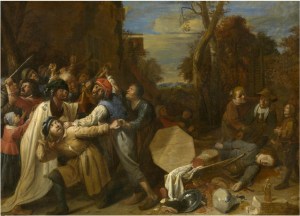
Death is Violent and Fast: Quarrel in a Pub, painting by Joos van Craesbeeck, ca. 1630 – 1635 PD|100 via Wikimedia Commons.

10 Comments

Filed under writing

Layers of a Scene—Immediate Environment #amwriting

While you are reading this post, you are probably sitting in a room, or perhaps sitting in some form of public transportation and reading on your phone. Wherever you currently are physically, you are reading a blog post. Because you are reading this post, your attention is in my room. The sounds of your environment have faded, and you are here with me, observing as I write about writing.

It’s 05:38 am, and my house is quiet, but not quite silent. It’s not a dark place, as the nightlight in the living room casts a warm glow, and the ceiling light in the room I call my “office” keeps me hitting the right keys, mostly. The furnace has come on, and the vents are making that familiar soft wooshing sound.

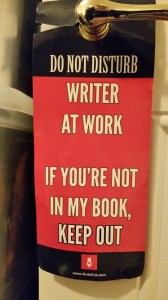
A cat once lived in this room, but she is gone, nine years now. Still, her spirit lingers among the dusty books and boxes of the storeroom that is my Room of Shame—a room no one is allowed to see when they visit. A sign on the door clearly warns, if you’re not in my book, keep out.

I wear a blue robe and ratty pink slippers. My feet are propped on a folding chair from Costco and the keyboard rests on my lap. Filing cabinets, boxes, shelves, dusty books, my husband’s citronella plants in the window, boxes and more boxes—this room is a cacophony of visual noise.

And yet this room is my haven, my quiet space, my room to write.

My keyboard has a certain rattle to it, a few keystrokes forward and the backspace key is pressed several times, then we go forward again. The end of a sentence arrives, and the punctuation is firmly added.

The aroma of fresh-brewed coffee calls to me. I set my work aside and go to the kitchen, the room that, despite its location in the rear corner of the house, is the center of my home. As I pour my first cup of coffee, my plan is to make a Sunday breakfast, bake bread, and maybe make oatmeal cookies with dried cranberries and walnuts.

But perhaps not. Perhaps after breakfast, I’ll return to the Room of Shame and write.

This is my immediate environment.

Our characters also occupy a particular environment at any given moment of their story. Whether they live in a condo, a house, or a caravan, their immediate environment reflects their personality.

The larger world is comprised of sound and scent as much as it is physical objects. The out-of-doors has a certain smell, perhaps of damp grass, or fresh-turned earth. In the city, smog has a scent all its own.

The smaller world, the immediate environment can be shown with brief strokes. My room has sounds that are unique to it: the furnace vents, the keyboard, the sound of the TV in another room. But some things are universal–coffee cups, small appliances, etc. We all have an idea of what a kitchen looks like. Place your character in a room with certain common props and the reader’s imagination will supply the rest of the scene:

Rick closed the drapes, which smelled faintly of cigarettes. He switched the TV on—for light or companionship? Maybe both. The hotel’s movie selection was minimal, but The Maltese Falcon seemed appropriate. Unable to relax, he sat on the worn sofa, waiting, his gun at the ready.

Whenever you mention an object in a scene, it becomes important. When you mention odors, they become important, as do sounds. This is why using your character’s senses is a part of world building. What they see, hear, and smell shapes the world the reader experiences.

As an exercise, picture your immediate environment. What are your impressions of the place where you are now? Write a brief word picture of those impressions. For me, the impressions of my immediate space are: Glow of monitor, rattle of keyboard, looming boxes, cooling coffee.

Those four things show my environment.

4 Comments

Filed under writing