Monthly Archives: January 2016

#FridayFiction: Meriko’s Eyes

Meriko's Eyes © cjjasp 2016

Meriko pressed against the wall, hiding ever deeper in the shadows.  One never knew what lurked in the streets of the city anymore. Since the change, things had been difficult. According to the internet, society was crumbling.

Of course, the web had always declared that.

The darkness in the alley emphasized the scarcity of electricity even though the grid was back up. Meriko’s own scant ration of wattage was reserved for her computer—her lifeline, her source of income and her only reliable link to the life she once had.

She knew things were still bad but had no idea how widespread the problems were. She hadn’t witnessed any violence outside her windows in weeks, but still, emails from her fellow employees at GiantSoft were rife with rumors of murder and worse, and now she went out only when she had no other choice. She wasn’t completely out of touch—she still had interactions with friends through emails and social media. Even if they never saw each other, the network of workers did have a kind of camaraderie.

It was just…she had found a solitary existence more difficult to endure than she had initially believed it would be.

Normally, she had everything delivered to her: food, clothing, everything. She never had to leave home.  However, her self-imposed solitude had at last driven her out of her flat; loneliness and the handsome face of a young man viewed from her window.

She emerged into the alley behind her building. The cool, damp air held a musty scent of mold and garbage mingled with other even less desirable odors, but she didn’t notice them, her senses open to other, worse things. Fortunately she didn’t sense the evil miasma of nightwalkers in the area. Nevertheless, she cleared her mind of any thoughts that might draw attention to her and quickly crossed the alley to the Double Joy restaurant, melting into the shadows. After a moment’s indecision, she entered the café through the backdoor.

Boldly walking as if she had simply been to the restroom, she sat on the only empty stool at the counter and ordered yaki-soba and bubble tea, adding a tip as she paid the bill.  Sipping her drink, she waited for her meal. Even if nothing came of her plan, it was good to be around real people, hearing real voices instead of virtual conversations through the social interface.

She had a flat full of cat statues to keep her company, but they only underscored her isolation, their marble features forever perfect and unchanging.

Meriko could barely tolerate the aromas of the restaurant, the scents of food mingled with the odors of others like her, people so desperate to escape their solitary lives that they would brave the shadowed streets just to dine in a sweltering café with strangers.

“How can you see with those dark glasses, girlie?” said the drunk next to her, with a leer.  The smell of stale beer made her ill, and reflexively, she leaned away from him.

“Oh, you know,” she said noncommittally. “It’s the fashion, so….”

“Hey there! Don’t be bothering the other customers,” the man behind the counter warned the drunk. “If you bother her again, you’re out of here.”

“I’m behaving, don’t worry,” the drunk mumbled, and after a few moments, he staggered out the front door into the night. As he left, fresh air came in, but it was quickly cut off by the slamming of the door.

“I hate drunks,” the man behind the counter said.  “They can eat elsewhere. I don’t need their money.” He busied himself with cleaning the counter and the soda machine.

Meriko pushed her food around the plate and stared through the service window at the young cook in the back.  He was why she came here, despite the danger in doing so.

Tonight she had come in close to closing time, and soon she was the only customer there. So she had timed it right.

She’d watched him come and go every night since he had started working there, observing him from the window of her flat.  The restaurant was just across the alley from her building, so much of her view was taken up by the alley and the back of this restaurant.

“May I have a box to take my leftovers home in?” The man behind the counter brought her a box. “Have a nice evening,” she said, as she walked out the front door.  She was so lonely.  Maybe tonight she would find a friend.  Other people had companions in their lives. Maybe this was the night for Meriko.

***

Ten minutes after closing the restaurant, the cook, a young man named Kai, walked down the dark city street to his bus stop. Usually he was the only one there, but tonight a girl was there, and a to-go box from his restaurant sat on the bench beside her.  He was sure she’d been in the café earlier. He’d seen her carrying the box as she left.

He’d noticed her because she was wearing dark glasses.

“Hello,” he said cheerfully. “Did I see you tonight in my restaurant? Well, it’s not mine, but I work there.”  His smile was unforced and honest, elevating his face from handsome to beautiful.

“Yes,” she said, smiling. “I go there often, but tonight I was later than usual. They were almost closed.”

“I only work the late shift, so that’s why I haven’t seen you before,” he said as he sat on the bench and checked his phone to see the time.  “My name is Kai.  What’s yours?”

“Meriko,” she answered, feeling happy for the first time in weeks.  He was so handsome!

They sat talking for five or so minutes.  Finally he asked, “Why do you wear dark glasses in the night? You wore them inside our restaurant.  I heard you tell the drunk that it was the fashion, but…well, maybe I am not up on the current trends or something.”

“Ah…it’s a genetic condition. My eyes are extremely sensitive to the light,” she told him. “Do you have any hobbies?” she asked, trying to distract him.

“Oh, so it’s painful to go without them,” he said, as if he understood. “So are you a vampire or something?” he joked. “That would be a hoot, me hanging out with a vampire.”

“No.” She laughed. “I’m not a vampire! I am just a girl, just a regular girl. Hobbies…I like collecting old Pokémon cards from before the change. Do you collect anything?”

“So let me see your eyes then, Meriko, who is just a regular girl,” he said, leaning forward to take the sunglasses off her.

“No! Don’t do that,” she said. But it was too late.

Meriko looked at the statue of the handsome young man sitting on a bus bench, holding a pair of dark sunglasses.  The lights of the approaching bus turned the corner as it made its way to her stop, but Meriko had already fled into the darkness, crying.

“Why do they always want to see my eyes?  Why can’t they ever just want to talk?”  Still sobbing, she crept through the shadows to her home.

Statues.  Meriko’s life was full of statues.


Meriko’s Eyes © 2016 Connie J. Jasperson, all rights reserved

Meriko’s Eyes was first published on WattPad in January 2013 as Fortune’s Fool. It was republished in March 2015 by Edgewise Words Inn, under the title Meriko’s Eyes.

8 Comments

Filed under Fantasy, writing

#amreading: the genesis of an author

Nymphenburg, View From the Seaside painting by Joseph Wenglein 1883

Nymphenburg, View From the Seaside painting by Joseph Wenglein 1883

I find the process of creativity as experienced by others intriguing, and am always curious about how they became authors.

My own journey to this place in my life was pretty tame. But some people  become authors via more adventurous, alternative paths.

This notion is explored in Elizabeth McKenzie’s frank, autobiographical post published on January 26, 2016, for LitHub.

Max Ernst, The Elephant Celebes 1921, Tate, London via WikipediaAppropriately titled “Surrealism and Decomposition. Or How I Wrote My Novel,”  McKenzie takes us on a journey through both her personal quest for enlightenment and creativity and the authors whose works colored her writing life. The quote that hooked me into reading this piece: “I read Rimbaud and Breton and Lautreamont and started according my dreams the respect I felt towards art. I wanted to have visions, I wanted, as Rimbaud put it, to take part in the systematic disordering of the senses.”

Her honest account of her sometimes psychedelic journey through alternate forms of consciousness and literary greatness is quite intriguing and took me back to my college days when many of my friends also chose that path for enlightenment.

Psychedelics were never an option for me, although in that way I was the odd one in my circle. The notion of them frightened me. Life in the early 1970s was surreal enough in its cold reality. My form of mind-expansion came in books.

The authors whose works influenced me as a young adult might surprise those who know me.

In my twenties, sci-fi and fantasy books were expensive and hard to get. The libraries stocked a few, but not as many as I required, as fast as I read.

When I was young, my parents were prolific readers and were members of both Doubleday Book Club and Science Fiction Book Club. They also purchased two to four paperbacks a week at the drugstore and subscribed to Analog and several other magazines.

samuel pepys diaryThere was always something new and wonderful to read around our house, and most of it was speculative fiction, although we had the entire 54 volume leather-bound set of the Great Books of the Western World, and our father insisted we attempt to read and discuss what we could.

Some were mostly understandable, such as William Shakespeare and Samuel Pepys.

Plato, not so much, and yet his work did influence me.

At the age of 14 I didn’t understand Pepys, but I read him, and while we were bass fishing on a Saturday morning, Dad would talk about the differences between life and morality in Pepys’ London and our life in suburban America in 1969. His thought was that I should learn about the 17th century and the Great Fire in London from an eye witness, just as I had learned about the war in the Pacific from John F. Kennedy‘s autobiographical novel,  PT 109.

But Pepys’ London of 1666 was so different from the ‘Mod’ subculture of the London of 1966 (and the Beatles) that I was familiar with thanks to Life magazine. To me, it was almost like speculative fiction. In many ways it was more difficult  for me to believe in historical London than Tolkien’s Middle-Earth.

When I married and left home, I still read every sci-fi or fantasy novel that came out in paperback, budgeting for books the way others of my acquaintance budgeted for beer. I read the classics for my irregular college classes, and learned to love Chaucer and James Joyce. For a variety of reasons I never earned a college degree, but I’ve never stopped reading and researching great literature.

But reading for entertainment was still my “drug.” I jonesed for new books by the great ones, Anne McCaffrey, Jack Chalker, and Roger Zelazny, reading and rereading them until they were shreds held together with duct tape.

As a married student attending college in Bellingham Washington, purchasing books for pleasure became a luxury. I found a secondhand bookstore where I could get a brown paper shopping bag full of novels in too poor a condition to sell on their shelves for $2.00 a bag if you had a bag of books to trade in.

As a college drop-out I went through a bag of books every week, and within a year, I had read every book they had.

Devils Cub Georgette HeyerThus, out of desperation, I discovered a whole new (to me) genre: regency romances written by Georgette Heyer, and other romance writers of that generation. Those books, along with beat up copies of bestsellers by Jack Kerouac, James Michener, and Jacqueline Susann began to show up in the pile beside my bed.

So at least some of my literary influences can be traced back to dragons, booze, morality, and England’s romantic Regency—lived vicariously through these authors’ eyes.

Always when the budget permitted, I returned to Tolkien, Zelazny, McCaffrey, Asimov, Bradbury, and as time passed, Piers Anthony, David Eddings, Tad Williams, L.E. Modesitt Jr., and Robert Jordan to name only a few.

And there were so many, many others whose works I enjoyed. By the 1990s, the genres of fantasy and sci-fi were growing authors like a field grows weeds, and I loved it.

All of the books I read as a child and young adult have influenced my writing. They still inspire me.

Nowadays I rarely am able to read more than a chapter or two before falling asleep. My Kindle is full of books, and I haven’t got the time to read them because I have to write my own story. Having the luxury to spend a day wallowing in a book is a treat to be treasured.

Old booksBut it is because of the uncountable authors whose works I have been privileged to read that I was inspired to think that my own scribblings might be worth pursuing.

Writing has always been necessary to me, as natural as breathing. In the beginning, my writing was unformed and was a reflection of whoever I was reading at the moment. As I matured and gained confidence, I found my own ideas and stories, and they took over my life.

Once that happened, I became a keyboard-wielding writing junkie.

Some days I write well, and others not so much, but every day I write something.

And every day I find myself looking for the new book that will rock my universe, a new “drug” to satisfy my craving, even if I know I won’t have time to read it.

I’m addicted to dreams and the people who write about them. Reading is my form of mind expanding inspiration. Without the authors whose books formed my world, I would never have dared to write.

Life would be so boring.

2 Comments

Filed under Publishing, writer, writing

#amwriting: Commas: Morsels of madness or necessary evils?

commaNothing gets certain people jacked up more than misplaced commas. Why this rabid hysteria? Personally, I have no energy to waste, so I’m selective about my frenzies.

But commacentric grammarians do raise a few salient points. Commas and the rules for their use exist for a reason, and if we want the reading public to understand our work, we need to follow them.

I am a decent structural editor, but I don’t claim to have any special knowledge about commas.

However, I do know a couple of things:

  1. Never insert commas “where you take a breath” because everyone breathes differently.
  2. Do not insert commas where you think it should pause, because every reader sees the narrative differently.

Commas are the rules of the road for writing. They are the universally acknowledged pausing and joining symbol. Readers expect to find their pauses between clauses and commas are sometimes the signifiers of those pauses.

One rule I had to unlearn the first time I sent my work to a professional line editor:

  1. Do not place a comma before ‘because’ unless the information that follows is necessary to the sentence.

What? That’s not what I was taught in school!

The Chicago Manual Online gives this example (and I quote):

He didn’t run, because he was afraid.

He didn’t run because he was afraid.

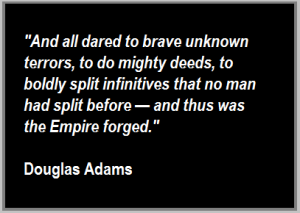
Douglas Adams quote, split infinitivesIn the first sentence, “because he was afraid” isn’t necessary. The main thing is that he didn’t run, and the reason is incidental. The second sentence, which omits the comma, is unclear. It might mean that he ran, but fear was not the reason he did so.

Mignon Fogarty, the Grammar Girl, explains this well. “You don’t automatically put a comma before the word because, but sometimes you need a comma there to make sure your meaning is clear.”

We do use commas to set off introductory clauses:

  1. In the first sentence, “because he was afraid” isn’t necessary.

I italicized the introductory clause in the above sentence to show that it is not a stand-alone sentence. This clause introduces the clause that follows it, and its meaning is dependent on that following clause.

Another thing I had to unlearn:

  1. Do not automatically place a comma before the conjunction ‘and.’

Compound sentences combine two separate ideas (clauses) into one compact package. A comma should be placed before a conjunction only if it is at the beginning of an independent clause. So use the comma before the conjunction (and, but, or) if the clauses are actually standalone sentences. If one of them is not a standalone sentence, it is a dependent clause, and you do not add the comma.

Take these two sentences: She is a great basketball player. She prefers swimming.

  1. If we combine them this way we add a comma: She is a great basketball player, but she prefers swimming.
  2. If we combine them this way, we don’t: She is a great basketball player but prefers swimming.

I hear you saying, “Now wait a minute! Mrs. Downing very clearly taught us to use commas to join clauses, and she was right.”

I’m sorry, but Mrs. Downing probably  explained that. It just didn’t stick in your memory.

Two complete ideas can be joined with ‘and.’ Did I just contradict myself?

Sort of.

Think of it like a list: if there are only two things (or ideas) in a list, they do not need to be separated by a comma. If there are more than two ideas, the comma should be used to separate them, with a comma preceding the word ‘and’ before the final item/idea.

Dogs, cats, rabbits, and birds.

Oh YES, we DO use serial commas to prevent confusion! You’ve all seen the meme:

serial commas meme, martha stewartOn a personal level, I do love cooking, my pets, and my family. (But not in the same pot.) They’re happy that I use serial commas.

One of my favorite personal failings is the notorious comma splice. Apparently it’s bad form to join two independent clauses with a simple comma. This error is called a comma splice.

I have it on good authority that a comma splice will not cause a tear in the space-time continuum. But since this breach of humanity occasionally sends commacentrics into a frothing frenzy, we will use the conjunction and give these poor wretches a break.

From Wikipedia, the fount of all knowledge: “A comma splice is the use of a comma to join two independent clauses. For example: It is nearly half past five, we cannot reach town before dark. Although acceptable in some languages and compulsory in others (e.g., Bulgarian or French), comma splices are usually considered style errors in English.”

chicago manual of styleCommas and their proper use can drive you crazy when you are trying to get your work in order. And quite frankly, the rules are a little confusing.

Consistency is critical. UK usage can vary from US usage in some ways. Find a style guide that you can understand and consult it. Once you have a guide you can work with, use those suggestions consistently in all your work.

I use the Chicago Manual of Style for my work because I am a US citizen, and for creative writing, this is the most comprehensive manual and is what publishers and editors use. If you are strapped for cash, you can often buy secondhand copies of this manual through Amazon.

Commas can easily get out of control for me because I have a tendency to hit the comma key whenever I pause in my thinking when I am in the first draft phase. At that point, I am more concerned with just getting the words down than I am form and style.

However, proper form and style must come into play when we get into the later drafts. Using established protocols for punctuation is important if you want your readers to understand what you meant when you wrote that amazing piece of literature.

14 Comments

Filed under writer, writing

#amwriting: the end: separation anxiety

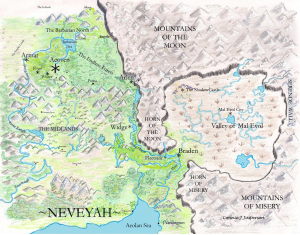
Map of Neveyah, for RizAeroNothing is more difficult (in my opinion) than finishing a novel that has been stalled for three years. My current work in progress has been through three different incarnations.

Two other books have been published during this time because  I couldn’t find a satisfying way to end this chapter in the history of Neveyah.  Perhaps it is a case of separation anxiety, but for one reason or another, it has never gotten to the true finish line.

My current focus is on finishing the final draft of this novel and getting it submitted to my editor. This book must wind up the Tower of Bones series, and it has to finish BIG.

While I am doing this, I confess I feel the same mix of feelings as I did when my youngest child left home–a sense of loss combined with pride and the thought that freedom looms.

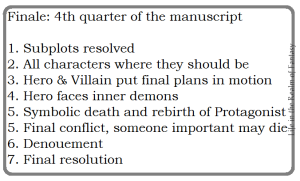
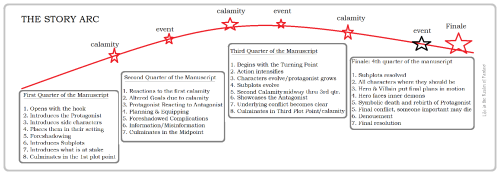
4th qtr of MSSo let’s talk about the all-important fourth quarter of the story arc.

At this point in the story arc, the final plans are in motion. We’ve met the enemy part 1 and survived the encounter. We’ve suffered a terrible setback. Now we’ve regrouped.

In the third quarter, major events have unfolded that point to the conclusion. Based on my structural editor’s suggestions, I  inserted new scenes into the existing narrative that drive the action to the final conflict. Those are all finished and are where they should be.

  1. At the outset of the 4th quarter, all my subplots are resolved and the final focus is on the Dark God’s move.
  2. The Dark God’s final pawn in this game must be exposed to the reader.
  3. The enemy’s plan and their true nature must be shown.
  4. Someone who was previously safe is now in peril. Their fate hangs on a thread and the outcome is unclear.
  5. The heroes must face the fact that their efforts to preserve their homeland has forced the enemy’s hand in a way they never expected
  6. The resolution for these characters is final, no loose threads can be left at the end of this book, as it completes the trilogy.

My work right now revolves around taking the new material and blending it into the existing story. Foreshadowing must be inserted and some otherwise great passages will be cut. This is because anything that does not drive the plot to this end is a side quest, and there can be no more of those.

This means one whole storyline that took six months to write will be cut, but it’s not a waste. There will be more opportunities for writing in this world, and that storyline could become a novella. These are great characters and the villains are as intriguing as the heroes.

As I said at  the beginning of this post, I am seeing this novel coming together at long last, and I am loath to let go of it. But I am excited to see it coming to this conclusion and feel good about it, despite having to shed some of the work that took so long to write.

The events have been detailed. Making sure this story flows seamlessly is time-consuming but it’s my obsession, so poring over the manuscript is what I am doing when I could be playing games. (Hear that Aveyond Stargazer?)

The Story Arc copy

4 Comments

Filed under Publishing, writer, writing

#amgaming: Review of Aveyond 4, Shadow of the Mist

Aveyond 4Before I get down to the nitty-gritty, let’s just get it out into the open:  I love RPG games as much as I love books. For a long time I was enthralled with the Final Fantasy games, but they lost me after the brilliant FFXII.

FFXIV was a huge failure in my opinion. If I can’t make headway beyond the first 4 hours of play, the game isn’t worth the investment of my time.

And for me, investment of time is a huge factor. I don’t watch television, but when I want entertainment I read or listen to audio books. For relaxation, I play old-school PC RPG games, because they don’t require as much of an investment of time to complete, and are immersive and fun.

Amaranth/Aveyond Kingdom and John Wizard are my 2 favorite game makers, and they frequently collaborate with each other. Their games are reminiscent of the old Square Soft games, for the Super Nintendo with strong stories and fun sidequests. They are as much fun as The Legend of Zelda or any early Final Fantasy game ever was.

Aveyond Kingdom’s Aveyond 4, Shadow of the Mist is in many ways, a more polished production than their earlier work.  The graphics and backgrounds are the best they have produced by far. The storyline is both deep and hilarious, and the characters are, for the most part, engaging.

But first, the Blurb:

boyle wolfbane aveyond 4 by amaranth gamesBoyle Wolfbane wanted to rule the world. He failed. Miserably. Forced into retirement early, Boyle now spends his days arguing with haunted trees and scaring off the occasional knight. At least he still has Fang, his loyal storm wolf. Things could be worse. He could have been born a hero.

My Review:

This game incorporates the traditional elements of puzzle-solving, action, and adventure into a neat and enjoyable package. There are the usual elements of high fantasy, with the characters ruthlessly poking fun at themselves. The enemies are creative and fun to fight.

Because they are failed villains, Boyle and Ingrid are unhappily in love, and that storyline adds ongoing humorous elements. Myst and Robin are naive and make good foils for Boyle and Ingrid. Hi’beru and Rowen arrive later in the game, and Phye arrives so late I did wonder why he was included at all. As a Draghar, Phye does have some power, but I think like a writer, so in my opinion, all the characters should be in place at the midpoint. Because he arrives so close to the end, we don’t get to know him as well as I would have liked.

I purchased the game the day it was released. I have played the game through to the end four times. The first time through, I had Ingrid join Lorelei’s coven and married her off to Boyle. With that scenario the game played smoothly with no glitches. I was in love with the game!

The second time through I had Ingrid join Jinx’s coven, but when I tried to complete the task of selling the craft in Robin’s store, the game froze and I had to take drastic measures to close the game down. No matter what I did,  in this scenario the game froze at that point every time.

So I went to their website and, following the suggestions in their forums, I reinstalled the game. I never got past that point on that particular attempt.

So I started a new game, and that time I had her join the transformations coven. This went well for the most part, but with one major flaw. Ingrid gained the ability to transform into a dragon, but the skill didn’t appear in her menu. When I went out to the forums to see how to solve that, the answer was that it would be resolved in the next build. I was disappointed, as I did want to have the ability to play her as a dragon.

Aveyond 4 ss-enviroment-3

The environments that the games is set in are lush and beautiful, dark and moody. The music is amazing and really contributes to the enjoyment of the game.

Overall, I can only give this game 4 stars at this time. Aveyond Kingdom clearly felt pressured by the fans to get the game out there. They didn’t do as thorough a testing period as they should have. I understand feeling rushed to publish, but that is never a wise thing.

If having to reinstall the game at various points bothers you as it does me, my recommendation is to wait until they come out with build B, and then buy it. The game is fun, hilarious, and when it works properly, it’s a great way to spend 25 or so hours.

Comments Off on #amgaming: Review of Aveyond 4, Shadow of the Mist

Filed under Adventure, Game Reviews

#amwriting: search and destroy

Timid Words

When we submit our work to writing groups, we may get our excerpts handed back with certain words circled or crossed out. Sometimes these are words that fluff the prose and add a timid flavor to the narrative.  When I see these in my own work, I look at the context and often change them, because ‘timid’ is not how I want my work perceived.

My current manuscript is genre fiction. This means I need to write active prose, and these words have no power behind them. When they are overused, they don’t add to the narrative and increase the wordiness. They can also separate the reader from the experience.

In my first draft, these words are like tics–they fall out of my fingers and into my keyboard randomly, and out of my voluntary control.

Now, in the third and final draft, I am in the process of a “search and destroy” mission, seeking out instances of these words. I look at each and see how they fit into that context. If they weaken the narrative, I change or remove them. Often simply removing them strengthens the prose.

I am preparing this manuscript to be edited professionally and want to make the process as smooth as possible. In order to find the offending words, I am doing  a “global search.”

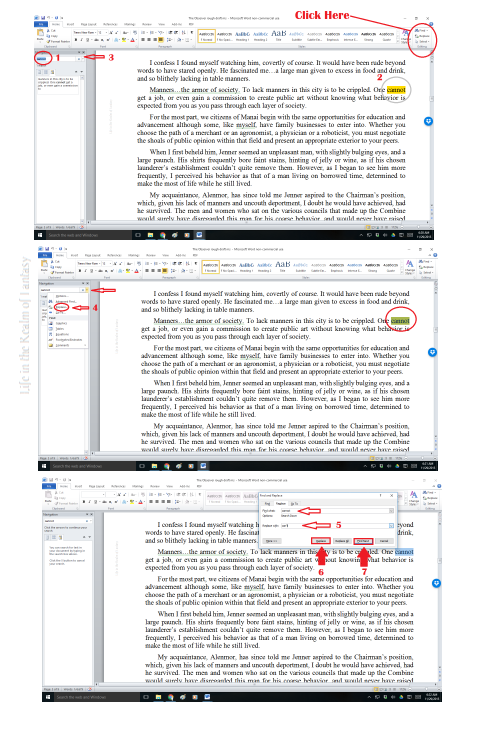
With your mouse or stylus, highlight the word you want to find every occurrence of. On the far right of the home tab, click ‘find.’ This will open the navigation pane.

Or, on your keyboard press the ‘ctrl’ key and the ‘f’ key at the same time. This is the keyboard shortcut to the navigation pane. Follow the instructions in this image:

LIRF Global Search all steps

Caution: if you are hasty or impatient a global search can be dangerous and can mess up an otherwise gorgeous manuscript.

First, the wise author realizes she is about to embark on a boring, time-consuming task. If you get hasty and choose to “Replace All” you run the risk of creating inadvertent bizarreness in your work.

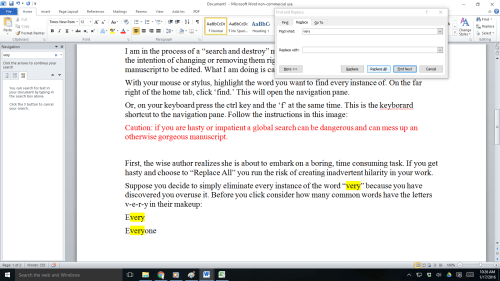
Suppose you decide to simply eliminate every instance of the word “very” because you have discovered you overuse it. You open the navigation pane and  the advanced search dialog box. In the ‘replace with’ box you don’t key anything, thinking this will eliminate the problem.

Global Search prnt scrn 2

Before you click ‘replace all’ consider how many common words have the letters v-e-r-y in their makeup:

  • Every
  • Everyone
  • Everything

You can see how that could mess things up on an incredibly large scale.

To avoid tragedy, take the time to look at each example of the offending words and change them individually. What’s a day or two spent doing the job right, as compared to the year or more you’ve already spent writing that novel?

As always, while I am going through this, I look for awkward phrasing and other things that pop up when you look at your manuscript from a different view.

stop don't click replace allSo is there a quick way to do this? I’m sorry, but if there is, I haven’t found it. Every aspect of getting your book ready for the reading public must be done with the human eye, patience, and attention to detail.

There are editing programs out there, Grammarly is one, but the problem is, these programs are unable to see context. They operate by finite rules and will often strongly suggest you insert an unneeded article, or change a word to one that is clearly not the right one for that situation:

“The tea was cool and sweet, quenching her thirst.” Grammarly suggested replacing quenching with quenched, I am not sure why.

Context is defined as the parts of a written or spoken statement that precede or follow a specific word or passage, usually influencing its meaning or effect. 

At this time in our technology, understanding context  is still a human function. Because context is so important, I am wary of relying on these editing programs for anything other than alerting you to possible comma and spelling malfunctions.

I don’t mind taking the time to visit each problem and resolve them one at a time. What I will never do again is ‘rush-to-publish,’ because that will only lead to tears. Readers can’t unsee work they despised. They won’t know how much you’ve improved because they’ll avoid all your future work like the plague.

12 Comments

Filed under writing

#amwriting: the dreaded zero relative pronoun

Epic Fails signOften, first-time authors will submit their work to a writing group, and immediately run afoul of the guru who ignores the story, but focuses on pointing out every instance of the word ‘that,’ snidely remarking “This is clearly a novice effort, so I won’t dig too deep.”

While this is an unpleasant experience, the guru does have a point. Certain uses of the words ‘that’ are unnecessary and bloat your narrative.

The word ‘that’ is known to editors and grammarians as the dreaded ‘Zero Relative Pronoun’ and it has siblings, ‘which,‘ and ‘who/whom‘.

As an editor, I often have to explain why I am suggesting the deleting of so many instances of the word ‘that,’ ‘which,’ or who(m)’ in a manuscript. At first glance, this seems nit-picky and can get new authors fired up, as they honestly don’t understand what the problem is.

The words ‘that,’ ‘which,’ and ‘who(m)’ have a unique place in our English language. They can be invisible—in most instances, we hear them, but we don’t see them.

According to WIKIPEDIA (THE FOUNT OF ALL KNOWLEDGE) (and I quote:)

Zero relative pronoun:

English, unlike other West Germanic languages, has a zero relative pronoun (denoted below as Ø) — that is, the relative pronoun is only implied and is not explicitly present. It is an alternative to that, which or who(m) in a restrictive relative clause:

*Jack built the house that I was born in. OR: Jack built the house Ø I was born in.

*He is the person who(m) I saw. OR: He is the person Ø I saw.

Relative clauses headed by zeros are frequently called contact clauses in TEFL (Teaching English as a Foreign Language) contexts, and may also be called “zero clauses”. (end quote)

Let’s examine Wikipedia’s examples more closely and in simpler language:

If you look at the words ‘that’, ‘which,’ and ‘whom’ as being implied, the above sentences would read like this:

*Jack built the house I was born in.

*He is the person I saw.

For the sake of simplicity, let’s focus on the word ‘that’:

Because the word ‘that’ is a zero relative pronoun, it usually can’t be the subject of the verb in the relative clause. Sometimes, though, prose demands a more wordy approach, and in such a case, the zero relative pronoun can’t be omitted because it is the subject.

*Jack built the house that sits on the hill.

*Jack built the house that was damaged by the tornado.

SO, in this case, we keep the word ‘that’.

*Jack built the house ___ sits on the hill.

*Jack built the house ___ was damaged by the tornado.

We don’t use zero relative pronouns in non-restrictive relative clauses, or in relative clauses with a fronted preposition, such as: From where did the idea come? The preposition ‘from’ begins the phrase and is a formal form of English.

We could say: Jack built the house in which we now live.

But it would be simpler to say: Jack built the house where we live.

However, zero relative pronouns can be used when the preposition is stranded:

*Jack built the house that we now live in.

These principles are also true of ‘which’ and ‘who/whom,’ so always keep in mind the implied words, and don’t bloat your prose by writing them out.

Grammar rules scare people because they tend to be phrased in complicated, hard to understand ways. But knowing a few of these rules will improve your skills. Your initial laying down of prose, or free-writing, will become instinctively better.

chicago manual of style

Understanding grammar rules  can be like trying to decipher the assembly instructions for a complicated  Swedish bookshelf from a big-box store.

But knowing a few of these rules smooths out the narrative. Your readers will easily understand what you meant, and will enjoy your work.

Some people have the luxury and the desire to take college level writing courses and learn about this and other writing techniques at the outset of their career.

Others, like me, are thrown into life and just begin writing in our spare time, putting the story down the way we see it. We have the hardest path, but by taking advantage of the free education offered by researching via the internet, and attending writing seminars as we can afford them, we are on the way to becoming better writers.

7 Comments

Filed under writing

#amblogging: WordPress Blues

wordpress logoWordPress people…you have pissed me off.

For a year now you have been trying to shove this new, less-than-useful dashboard down my throat, and for that same year, I have refused to use it. You allowed me the option to stay with the expanded version that played to my needs, and so I didn’t complain.

Today, however, you  cut off my simple access to the old, better-for-my-purposes dashboard, and forced me to hunt for a way to get back to it. So rather than the post I had intended, we are going to discuss how a determined blogger can get around your arbitrary decision.

I do not post my blogs from a cell phone. For those people who do, I am sure the bland wall of white fog that is the new default dashboard is fine, but for me it is NOT USEFUL.

First of all, the writing is pale blue and gray.

I have poor eyesight. This is a large world, so I am sure I am not the only blogger out there with compromised vision.

For me, pale blue on white becomes a vast expanse of bluish white, against which I have to strain my eyes to see what few buttons a blogger is allowed the use of.

WordPress new format screenshot empty post


Oh, sure, I posted a while back on how to use  this crappy new dashboard, and I CAN use it. See my post Blogging is Writing Too.

But just so you know, WordPress people, forcibly limiting my options is making me reconsider my loyalty to you.

However, being the stubborn old lady that I am, I have found a way to get back to the old dashboard. You have to know how WordPress works in the first place to find it, but I am tenacious.

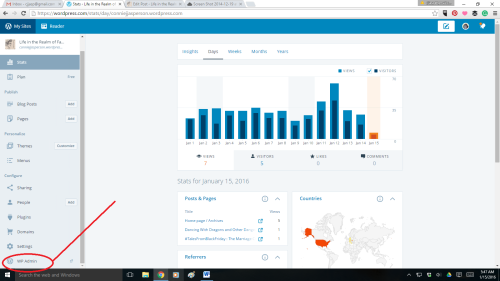
In the upper lefthand corner of the new default dashboard are the words “My Stats.”

Click on this, and it will take you to the stats page.

Stats page 01-15-2016

On the left side of the page is a menu, and at the bottom of that menu is the button for “WP Admin.”

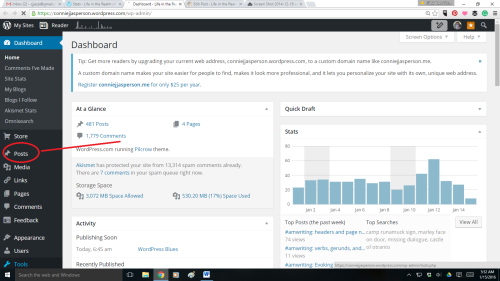
As this is my blog, I am that person and when I click on it, it takes me to this page:

Admin Dashboard 01-15-2016

This is the Admin Dashboard. You will note that in the center of the lefthand menu is the word “Posts.

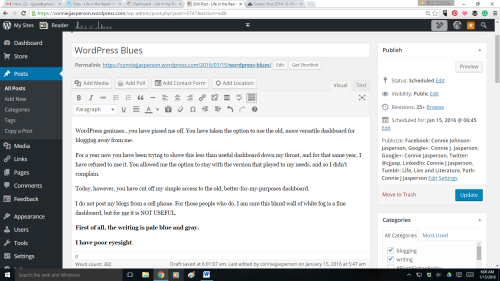
Click on that and you will find yourself able to access all the options you are used to having at your command.

Admin Dashboard with post 01-15-2016

I actually use my dashboard like a professional blogger. But I am also an old lady and when I am thwarted, I get angry.

When I am angry, I blog about it.

WordPress people–I’m sure you have a good reason for limiting a blogger’s ability to access all the tools they may need. However, and I am just guessing here, I suspect that the majority of bloggers are not posting blogs from their cell phones.

People at WordPress:  I suspect that the majority of your bloggers are sitting in front of a PC or laptop.

This blogpost is for all of those people.

106 Comments

Filed under blogging, writing

#amwriting: Evoking Atmosphere and Place

Several indie books I’ve read lately impressed me with the sense of atmosphere the author managed to pack into their work, and the sense of place.

a girl called wolfThe book I am currently reading  is a contemporary novel,  “A Girl Called Wolf” by Stephen Swartz. In the opening chapters, Swartz’s Greenland has a harsh, ethereal quality. The environment is shown as unearthly, beautiful, and deadly, as are the people. The story of his protagonist Anuka (later called Anna) and her early life stands out sharply against the nearly cinematic backdrop, yet Swartz shows it with an economy of words.

Later, when Anuka is forcibly taken to civilization, that village and its poverty, as compared to her prior life, is clear in the reader’s head. It is seen through her eyes, although the villagers themselves don’t see themselves as poor in comparison–just the opposite. Swartz manages to get that across without overstating it: it simply is.

Conveying the mood of a piece and evoking a real sense of place is where artistry and skill on the part of the author comes into play. A book can be a simple recounting of events, or it can be an immersive experience. When a reader can see the world, feel the wind or sun, that author has created ‘place.’

In literature, ‘atmosphere’ has a broad meaning, covering both the overall emotional mood of a piece and the setting as described by the mention of objects and furnishings of a room, or the visual cues that fill the larger environment.

Think about the Harry Potter books: we know Hogwarts as well as we know our own home because J.K. Rowling not only showed us the furnishings and the building itself, she showed us the emotional mood of the residents. She did this through her protagonist’s eyes.

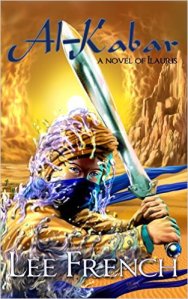
al-kabarA completely different kind of book from “A Girl Called Wolf,” is  “Al-Kabar” by Lee French. The tale is set in a mythical Persian-type of world, Ilauris.

“Al-Kabar” is unabashedly a fantasy, clearly a world of its own. As Stephen Swartz does with his work, Lee French conveys the world through her protagonists eyes. Fakhira’s world of Ilauris is harsh, and in this book, it is the characters that make it so. Fakhira experiences the world, and the reader does also, right alongside her.

What I like about Lee French’s approach in this tale is the way she conveys the environment: you the reader know this world because the protagonist knows it.

When it is done right, the emotional mood of the characters combines with the setting to create an atmosphere that pulls the reader in, making them forget they are reading. The trick is to dole out the scenery and the emotion as  needed. Treat them as you would the historical background information. If the character doesn’t need to know it at that moment, it probably does not belong in the scene.

the vision dean koontzDean Koontz is a master at this. Take this quote from “The Vision”published in 1986:

The woman raised her hands and stared at them; stared through them. Her voice was soft but tense. “Blood on his hands.” Her own hands were clean and pale.

Show us what the character sees, and feels. Show us only what needs to be there to advance the story. If the character doesn’t need to know it at that moment, it probably does not belong in the scene.

This aspect of the craft is what I am working on in my own writing.

10 Comments

Filed under Self Publishing, writing

#amwriting: headers and page numbers

Book- onstruction-sign copyI’ve blogged before on this subject, but it is time to talk about it again: making your manuscript ready for submission to an editor, agent, or a publisher. All agents, editors and publishing companies have specific, standardized formatting they want you to use, and these guidelines are posted on their websites.

The submissions page for TOR Forge, one of the Big Boys in the publishing world, clearly says: “Standard manuscript format means margins of at least 1 inch all the way around; indented paragraphs; double-spaced text; and Times New Roman in 12 pitch. Please use one side of the page only. Do not justify the text. Do not bind the manuscript in any way. Make sure the header of the ms. includes your name and/or the title of the book as well as the page number (on every page).”

For the most part this formatting is basically the same from company to company, so once you know what the industry standard is, it’s easy to make your manuscript submission-ready, at least in the area of formatting.

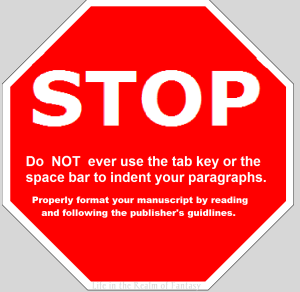
stopI’ve said this before, and I will say it again: Do NOT ever use the tab key or the space bar to indent your paragraphs. Many times publishers want electronic submissions and you have no idea what a crapped up mess (sorry for the editor-speak) using the tab key makes out of an electronic manuscript.  You most likely will have to go in and remove these tabs by hand and it’s a tedious job, but do it now, if you have been using the tab key.

You might say, “Well I only submit to traditional publishers who all want hard-copy.” That, my friends, it not true. The entire publishing industry is undergoing modernization, and while they do still accept hard-copy, electronic submissions are rapidly becoming the preferred method, even with the larger publishers. Don’t limit your options by refusing to learn a simple trick.

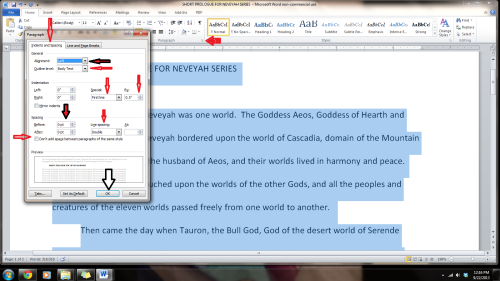
To format your paragraphs indents, first highlight the entire manuscript: on the far right side of the home-tab at the top of your page, click select all. Next,  still on the home tab,  click on the little box at the lower right of the box that says ‘Paragraph.’  This will open a whole new menu:

  1. On the indents and spacing tab of the menu: Use standard alignment, align LEFT. The reason we use this format is we are not looking at a finished product here. We are looking at a rough draft that will be sliced, diced and otherwise mutilated many times before we get to the final product. The following pictures are for WORD 2010, as I have not yet upgraded my MS Office program, but the basic ideas are the same.

paragraphs post 2 pof word series

  1. Indentation: leave that alone or reset both numbers to ‘0’ if you have inadvertently altered it.
  2. Where it says ‘Special’: on drop-down menu select ‘first line’. On the ‘By’ menu, select ‘0.5’
  3. ‘Spacing’: set both before and after to ‘0’.
  4. ‘Line Spacing’: set to ‘double’

Do not forget to click OK at the bottom of the menu.

But today we are going to talk about headers and page numbers:

The “Header” is the writing in the margin at the top of each page of a word-processed or faxed document, usually automatically inserted and, in this case, consisting of the title of the book and your name.

Publishers and editors want this because when they receive a print copy, they want them UNBOUND. Each page should be clearly marked with your name and/or the title of the book as well as the page number. Also, publishers and editors who ask for electronic submissions may need to print sections of your work for closer examination. Accidents happen: if the ms falls off a desk, it can easily be reassembled and the editor will always know that brilliant work was written by you.

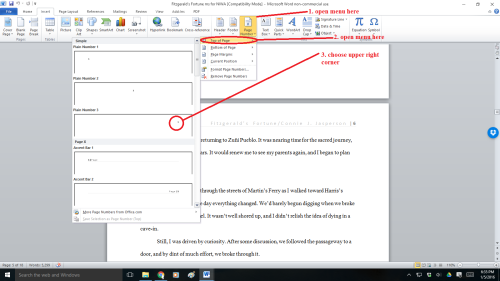
We begin by opening the “insert” tab, and clicking on “page number.”  This opens up a new menu. We add the page numbers using this menu.

Headers and Page numbers prnt sc 2

You will insert the Title of the Book and Your Author Name  just before the page number, so it will look neat and be aligned to the right. You can do this on the page number tab.

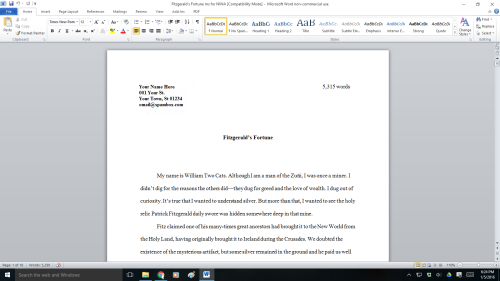
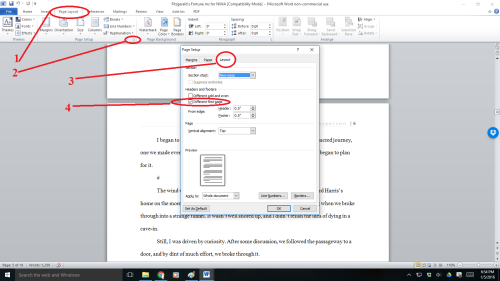
Sometimes, a publisher will specify that the first (title) page have no header or page number, but they want the header and page numbers to begin on page two.

Headers and Page numbers prnt sc 1

To make the page numbers begin on page two:

  1. Click anywhere in the document.
  2. On the Page Layout tab, click the Page Setup Dialog Box Launcher, and
  3. then click the Layout tab.
  4. Under Headers and footers, select the Different first page check box, and then click OK.

Headers and Page numbers prnt sc 3

Now your manuscript:

  1. is aligned left
  2. has 1 in. margins
  3. is double-spaced
  4. has formatted indented paragraphs
  5. The header contains title and author name and page numbers aligned right
  6. The first page contains your mailing address and contact information in upper left hand corner

For more on the subject of getting a manuscript ready for submission, check out my post of July 24, 2015, How to format your manuscript for submission.

43 Comments

Filed under Publishing, Self Publishing, writing