Monthly Archives: September 2017

#FlashFictionFriday: The Watcher


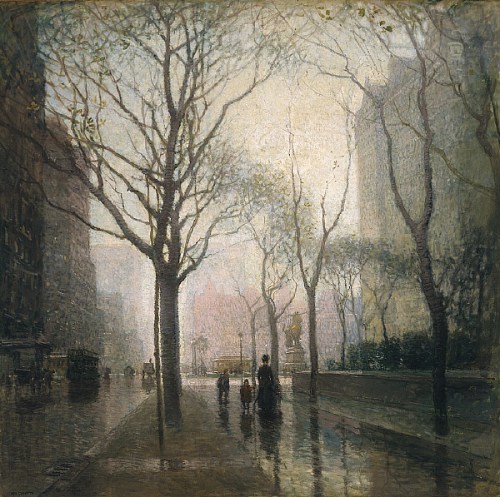
She stares out the window of her lonely room, watching the street below through the rivulets of water; blue and grey, washed away. Azure blue, the sky briefly shows itself and sunlight temporarily blinds her. Dry, elderly eyes watch as dark clouds once again overtake the blue. Rain pounds against the glass.

Rain beats down, and passersby on the street below vainly seek shelter beneath newspapers and fragile umbrellas, dodging under awnings, leaping into taxis waiting to whisk them away to distant places where the rains of March are just a rumor.

She looks down at the black of her dress. In her mind she sees him in the casket, looking as if he’d merely fallen asleep.

Her damp woolen coat lies on the bed, where sixty two years of her life were spent with him. Sixty two years of quarrels, of passion, sixty two years of love and jealous anger. Sixty two years of ties that bound them more securely than the mere vows of marriage two young people once took ever could.

Slightly ajar, the door of the closet reveals his clothes, suits and slacks hanging ready for the man who will never again wear them. The book he was reading rests on the nightstand by his pillow.

She stares out the window of her lonely room, watching the street below through the rivulets of water, blue and grey; washed away.

The sky weeps tears that faded blue eyes refuse to shed.


Credits and Attributions

The Watcher, by Connie J. Jasperson, © 2013-2017, Originally published on Wattpad March 21, 2013.

The Plaza After Rain, Paul Cornoyer, PD|100 via Wikimedia Commons

2 Comments

Filed under #FineArtFriday, #FlashFictionFriday

Drabbles: experimenting with POV and prose #amwriting

I love writing ‘drabbles,’ extremely short fiction because they offer the opportunity to write in a wide variety of genres and styles. Drabbles present the chance to experiment with point of view and prose. Often, these 100 – 200-word experiments become 1,000-word flash fictions, which are sometimes saleable.

In my files (to be worked on at a later date) is the rough draft of a short story that began as a brief exercise in writing from the point of view of the flâneur–the person of leisure, the idler, the urban explorer, the connoisseur of the street. They are the interested observer, a person who seeks much, knows a little, and is a (frequently unreliable) witness to the events of a story.

Click here for Scott Driscoll‘s great blogpost on the flâneur. In short, he tells us that: “With a flâneur narrating, you can remove the noticing consciousness from your point of view character to accomplish other purposes.”  

The flâneur is a character frequently found in literature from the 19th century. The story is filtered through his eyes and perceptions–it distances the reader from the immediacy of the scene, so be forewarned: genre-nazis and armchair editors who want the material delivered in 60 second sound bites of action won’t love it.

My flâneur is Martin Daniels, a wealthy, retired jeweler. He spends his time roaming his city’s streets, sitting in sidewalk cafés observing his fellow citizens, and making social and aesthetic observations. He regularly finds himself crossing paths with one man, in particular, Jenner: a self-made man who came up through the mines.

Jenner is battering against the prevailing social barriers which stand in the way of his achieving a political office that he covets, using whatever means at his disposal. He is uncouth, a barely civilized rough-neck with a bad reputation, but something about him draws Martin’s attention, and so he finds himself both observing Jenner and listening to the whispered gossip that surrounds the man.

One day, as Jenner is passing Martin’s table, his hat blows off, and Martin catches it, returning it to him. Jenner then introduces himself and admits that he has been watching Martin for some time. He has a task for Martin, one that intrigues him enough to bring him out of retirement. Thus begins an odd relationship.

When this twist happened, my flâneur ceased to be merely an observer and became my protagonist, yet he is reporting the events from the distance of his memory, so he is still the observer.

Literary fantasy, one of my favorite genres to read, is a great venue for the flâneur. It examines the meaning of life or looks at real issues, and I tend to write from that aspect. In my favorite works, the fantastic, otherworld setting is the frame that holds the picture. It offers a means to pose a series of questions that explore the darker places in the human condition.

Sometimes the quest the hero faces is, in fact, an allegory for something else, and the flâneur shows you this without beating you over the head with it. I read good literary fantasy—it tends to be written by men and women who write well and literately. Not only are the words and sentences pregnant with meaning and layers of allegory, but they are also often poetic and beautifully constructed.

I like to experiment with prose as well as style and genre, and writing drabbles offers that opportunity.

The character of the interested observer is not limited to a person walking the streets and making political or social commentaries on what is seen. Nor is the gender of the observer limited to that of a man. Any person can be the observer and serve in this role. The flâneur is great fodder for a drabble, so give it a try.

The modern flâneur is found in the office, the coffee shop, shopping at the mall or grocery store, waiting in line at the movies, even looking through the curtains of their front windows. These are venues they habitually visit and don’t go out of their way for, and are where they are likely to regularly see the person who piques their curiosity.

Writers are, by nature, observers of the human condition. When two friends sit in a Starbucks and play ‘the coffee shop game,’ the game where they see patrons and invent stories about who they are and what they do, they become the flâneur for a brief moment. Write those paragraphs and see what emerges.

Writing drabbles offers me the chance to write two or three paragraphs in a literary style, experiment with both point of view and prose, and allows me to play with words. I can imitate the style of my favorite authors and see what it is about their work that attracts me.

Any time you have a great little idea, pause for the moment and write a drabble about it. Save it in a file labelled ‘Drabbles.’ You never know when you may have the seeds of a great story in those two brief paragraphs.


Quotes and Attributions

Flaneur, try it and set yourself free by Scott Driscoll, © Oct 24, 2013,  https://scottdriscollblogs.wordpress.com/2013/10/24/flaneur-try-it-and-set-yourself-free/

12 Comments

Filed under writing

Creating Compelling Objectives #amwriting

At the outset of any good story, we meet our protagonist and see him/her in their normal surroundings. An event occurs, the inciting incident.

The inciting incident:

  • Happens to your protagonist
  • Disrupts your protagonist’s life
  • Is personal to your protagonist
  • Gives the protagonist an objective/quest

The hero is thrown out of his comfort zone and into the situation, which is the core idea of your plot. This is the circumstance in which your protagonist finds himself at the beginning of the story. The circumstance forces an objective upon the main character.

In the opening pages of The Hobbit, by J.R.R. Tolkien, a respectable hobbit, Bilbo Baggins, is living a comfortable life in a prosperous, sheltered village, and has no desire to change that in any way. However, a casual, polite greeting made to a passing wizard sets a string of events into motion that will eventually change the course of history for the world of Middle Earth.

The wizard, Gandalf, tricks Bilbo into hosting a party for Thorin Oakenshield and his band of dwarves, who sing of reclaiming the Lonely Mountain and its vast treasure from the dragon, Smaug. When the music ends, Gandalf unveils a map showing a secret door into the Mountain and proposes that the dumbfounded Bilbo serve as the expedition’s “burglar.”

The dwarves ridicule the idea, but Bilbo becomes a little indignant and agrees to do it despite his misgivings. The next morning he has second thoughts, but at the last moment Bilbo literally runs out the door with nothing but the clothes on his back.

  • You must have a strong, unavoidable event that is your inciting incident. Ask yourself:
  • What is the hero’s personal strength and health at the beginning?
  • How will his physical and emotional condition be changed, both  for better or worse? Will these changes be triggered by the hero himself or by the antagonist?
  • What could possibly entice the hero out of his comfort zone?

Now we come to the next part of the core of your plot: Objective

A protagonist has no business showing up on the page unless he/she has a compelling objective. If he doesn’t want something badly enough to do just about anything to achieve it over the next couple hundred pages, then he doesn’t deserve to have a story told about him.

Bilbo does have an objective. Once he gets past his feeling of having made a terrible mistake, he desires nothing more than to help his friends achieve their goal: that of regaining their lost kingdom.

Gandalf exerts a parental influence over Bilbo at the outset, guiding him and pushing him out of his comfortable existence.  But it is Bilbo who has common sense and compassion, who gradually takes over leadership of the party, guiding and rescuing them from their own greedy mistakes. This is a fact the dwarves can’t bear to acknowledge, and a fact he doesn’t realize himself.

Those turning points where with each adventure Bilbo gains confidence and a tool or weapon he will later need are what make up the best parts of the adventure. That is what you must inject into your story, be it a contemporary drama, an urban fantasy, a bedroom farce, or science fiction.

  • At the beginning of the story, what could the hero possibly want to cause him to risk everything to acquire it?
  • How badly does he want it and why?
  • What moral (or immoral) choice is he going to have to make in his attempt to gain that objective?

Perhaps your tale is set on a space station. What does your protagonist need that is in short supply? What does he have to do to get it?

Perhaps you are writing an urban fantasy. Perhaps your main character is a vampire. Vampires requires sustenance–what will she do to get it? Or conversely, if a human, what will she do to avoid becoming vampire-food?

Protagonists begin their tale in their current surroundings. They are thrown out of their comfortable existence by circumstances and forced to identify objectives they must achieve or acquire to resolve their situation.

Thus, whichever you conceive first, characters or objective, you need to know why your character is willing to leave his circumstances and embark on his adventure. That objective must be compelling enough for him to risk everything he values to achieve it.

But what if a side character has such a compelling story that the book becomes his story and is no longer about our hobbit? If you notice that is the case, rewrite your book so that the character with the most compelling story is the protagonist from page one.

The potential for gain must outweigh the potential for loss. The stakes must be high: perhaps they are headed into a life and death situation, or a couple finds their marriage on the rocks. Perhaps a young woman stands to lose her wealth and security. These are good core circumstances for plots, but for me, the greatest risk a hero faces is in moral coin. This is because personal values are fundamental to who we are as individuals, and when those intrinsic values are threatened, the risk is emotionally charged.

Emotionally charged stories are powerful.  Objectives create risk. Without great risk and potential for gain, there is no story.

3 Comments

Filed under writing

#FineArtFriday: Dietmar Rabich, Autumn in Börnste

The Wikimedia Commons Image of the Day for September 22, 2017.


Dietmar Rabich / Wikimedia Commons / “Dülmen, Börnste, Waldweg — 2015 — 4649” / CC BY-SA 4.0 

This image was selected as picture of the day on Wikimedia Commons for . It was captioned as follows:

English: Autumn in the hamlet Börnste, KirchspielDülmen, North Rhine-Westphalia, Germany

4 Comments

Filed under #FineArtFriday

Crafting the final act #amwriting

In this series on the construction of the novel, we have discussed creating a strong opening act, and a powerful, electrifying middle. So, let’s talk about the all-important fourth quarter of the story arc—the final act.

At this point, the enemy’s plans are in place. Our protagonists have met the enemy and survived the encounter, but now they know they may not prevail.

If your work is not speculative fiction or fantasy, perhaps they’ve suffered a terrible personal setback.

Regardless of the genre, at the outset of the fourth quarter, the protagonists are at their lowest point both physically and emotionally. From the midpoint crisis forward through the third quarter, major events have funneled the players down the path to the final conflict. Now, they are scrambling, working against time and perhaps, with fewer resources than the antagonist.

In these chapters leading up to the conclusion, the protagonists have been pressed to the breaking point. Now they are at the end of their journey. They must rediscover their courage, find a reason to continue the fight, resolve the loose ends, and appear at the final showdown ready to do battle.

If you were not careful in the setting up the events that form the middle of the narrative, the story could fall apart here. Listen to your beta readers’ comments: even in your third draft, you may have to insert new scenes into the existing narrative to drive the action to the final conflict.

  1. At the outset of the 4th quarter, all subplots are resolved, and the final focus is on the enemy’s move.
  2. The enemy’s plans and their true nature must be shown.
  3. Someone who was previously safe may be in peril. Perhaps their fate hangs on a thread, and the outcome is unclear.
  4. The protagonists must face the fact that their efforts have forced the enemy’s hand in a way they never expected.
  5. Your protagonist may achieve their goal, but they will pay a heavy price for it, and return home changed for good or for ill.

If your editor asks you to write new scenes to get a flat story arc back on track, and you agree it’s needed, your task is to blend the new material into the existing story.

  • You must go back and insert foreshadowing in earlier passages, and some otherwise great passages that now go nowhere will be cut.

This is most important: any event that does not drive the plot to the end is a distraction. All side quests are being wrapped up at this point so don’t introduce any new plot threads. Emotions are key–of course for the characters, but also for the reader.

  • The higher the emotional stakes when the protagonist meets the antagonist for the final showdown, the more emotionally satisfying the final resolution will be for the reader.

The resolution should be final, with no loose threads. Cliffhanger endings aggravate readers who don’t want to wait a year for the rest of the story, so even if your book is the middle volume of a series, give the reader some reward for their faithfulness, and resolve most of the subplots.

2 Comments

Filed under writing

Crafting the turning point #amwriting

Last week we discussed the opening scenes of your story, taking it to the inciting incident. Today we are talking about the middle, a section that takes up about fifty percent of your story.

The middle is comprised of two acts joined by a major plot point, the midpoint event. Following the inciting incident is the second act, comprised of reaction to the inciting incident, and action, and more reactions, all of which leads to more trouble, rising to a severe crisis. All the action should relate directly to the core trouble, the quest.

At the midpoint, the protagonist and friends are in grave difficulty and are struggling. The midpoint of the story arc is the turning point, the place where there is no going back.

Consider J.R.R. Tolkien’s The Hobbit: At the midpoint, Bilbo is committed to seeing the Dwarves regain their home, and Smaug is routed, but at great cost. Now, he only sees disaster ahead of them, if Thorin continues down the moral path he has chosen.  Bilbo has been changing, evolving in to a strong and moral character, but now he shows his true courage, by hiding the Arkenstone. Then he takes matters into his own hands to head off the impending war.  Bilbo tries to ransom the Arkenstone, but Thorin refuses to see reason. He banishes Bilbo, and the battle is inevitable.

This arc is the same in every good, well-plotted novel: everything starts relatively well, but events soon push the protagonist out of his comfortable life and into danger. This peril can be physical, or emotional–after all, many things rock our world but don’t threaten our physical safety. Either way, the threat and looming disaster must be shown. At first, emotions are high, and the situation sometimes chaotic, but the protagonist believes he had a grip on it.

The Midpoint is the place where the already-high emotions really intensify, and the action does too. Toward the end of this section,  the protagonist suffers doubt, fear they may not have what it takes, and their quest won’t be fulfilled. From this point on, the forces driving the plot are a train on a downhill run, picking up speed, and there is no stopping it or turning back now. The characters continue to be put to the test, and the subplots kick into gear.

Within the overall story arc, there are scenes, each of which propels the plot forward, moving the protagonist and antagonist further along the story arc to the final showdown. Each scene is a small arc of action that illuminates the motives of the characters, allows the reader to learn things as the protagonist does, and offers clues regarding things the characters don’t know that will affect the plot.

As I mentioned in the previous post on the opening act, those clues are foreshadowing. Through the first half of the book, subtle foreshadowing is important, as it piques the reader’s interest, and makes them want to know how the book will end.

At the midpoint, another serious incident occurs, launching the third act and setting them back even further. Now the protagonist and allies are aware that they may not achieve their objectives after all. Bad things have happened, and the protagonists have to get creative and work hard to acquire or accomplish their desired goals. They must overcome their own doubts and make themselves stronger.

Just when the characters have recovered from the midpoint crisis, another crisis occurs, the event that launches the final act.

Someone may die. But be aware, random action, blood and gore, or sex inserted for shock value or just to liven things up have no place in a well-crafted novel. Blood and sex do have their place in some of the best stories I have read, and they were watershed moments in protagonists’ lives. I want to make this extremely clear: If those events don’t somehow move the story forward, change the protagonist profoundly, or affect their view of the world, you have wasted the reader’s time.

The middle of the story is also where we get to know the antagonist and learn what the enemy knows that the protagonists do not. We discover his/her motives and what they may be capable of.

By the final quarter of the story, the protagonists should be getting their acts together. They are finding ways to resolve the conflict and are ready to commence the all-important, final act, the moment where they will embark on the final battle to achieve their goal. They will face their enemy and either win or lose.

1 Comment

Filed under writing

#FlashFictionFriday: Copper Starbucks Cup


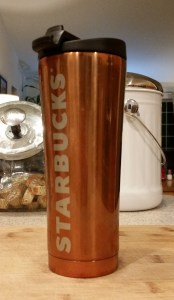
I carry my coffee in a Starbucks cup

To the silver minivan,

A kid-hauler, a family bus,

An old lady’s junk hauling van.

I carry my coffee in the copper colored cup

And hit the road again.


The smoothness of the new highway

Matching grayness of the sky

The scent of coffee in my cup

Feeding birds take wing and fly.

My coffee and the Starbucks cup

Passing cows and llamas by.


My copper colored Starbucks cup

Hurtling south, or north I go.

Grandma’s on the road again

Get in the van, let’s go.

Coffee, cows, birds, and fog

She can’t be stopped, you know.


Credits and Attributions

Copper Starbucks Cup © 2017 Connie J. Jasperson

image: Copper Starbucks Cup © 2017 Connie J. Jasperson (author’s own photo)

6 Comments

Filed under #FlashFictionFriday, Poetry

The Strong Opening Act #amwriting

Every story begins with the opening act, where the characters are introduced, and the scene is set. This is where the author establishes the tone of what is to follow. The intended impact of the book can and should be established in the first pages. In this chapter, we want to:

  • Introduce the protagonist(s). Who and what are they?
  • Introduce the setting. Where are they?
  • Introduce the conflict. What does the protagonist want? What hinders them?

The best stories then kick into gear with the occurrence of the “inciting incident,” which is the first plot point.

Novels are not unlike a gothic cathedral–they are created of small arcs supporting other arcs, combining to create an intricate structure that rises ever higher. Because the strength of the story arc depends on the foundation you lay in the first quarter of the book, it’s crucial that you introduce a story-worthy problem in those pages, a test that will propel the protagonist to the middle of the book.  This event isn’t the main event, but it gives the reader a taste of what’s in store for them.

This is the hook. The author raises a question and sets the protagonist on the trail of the answer. In finding that answer, the protagonist is thrown into the action.

  • I learned this the hard way—long lead-ins don’t hook the reader. Long lead-ins offer too much opportunity for the inclusion of insidious info dumps.

My favorite books open with a minor conflict, evolving to a series of ever greater problems, working up to the first pinch point, the place where the characters are set on the path to their destiny.

The inciting incident is where the protagonists first realize they’re blocked from achieving the desired goal. They must find a way around it, and that leads to another crisis scene. The story arc is comprised of scenes, each of which propels the plot forward, moving the protagonist and antagonist  toward the final showdown.

Open with a strong scene, an arc of action that

  • illuminates the motives of the characters,
  • allows the reader to learn things as the protagonist does, and
  • offers clues regarding things the characters do not know that will affect the plot.
  • The end of one scene is the launching pad for the next scene, propelling the story arc.

The clues you offer at the beginning are foreshadowing. Through the first half of the book, foreshadowing is important, as it piques the reader’s interest, and makes them want to know how the book will end.

In the opening, focus on the protagonist and introducing their problem. Subplots should be introduced after the inciting incident has taken place. If you introduce them too soon, they can distract the reader, making for a haphazard story arc. In my opinion, side quests work best if they are presented once the tone of the book and the main crisis has been established. Good subplots are excellent ways of introducing the emotional part of the story.

Even if you open the story by dropping the character into the middle of an event, you will need to have a pivotal event at the 1/4 mark that completely rocks his/her world. The event that changes everything is what launches the story.

Following the inciting incident is the second act: more action occurs which leads to more trouble, rising to a severe crisis. For the protagonist, personal weaknesses are exposed, offering the opportunity for growth. At the midpoint, the protagonist and friends are in grave difficulty and are struggling.

Or, if they aren’t, they should be—after all, the struggle is the story. How long do you plan the book to be? Take that word count and divide it by 4—place your first major event at the ¼ mark. The following two quarters are the middle, and if you have set your plot up right, the middle should fall into place like dominoes.

6 Comments

Filed under writing

#amwriting: SW Washington Writers Conference, What I learned from @RobertDugoni

This last weekend I attended the Southwest Washington Writers Conference. I was also privileged to attend a class called Creating Plots for Page Turners, given by the keynote speaker, Robert Dugoni.

I say privileged, for this reason. Robert Dugoni is a bestselling author of thrillers, My Sister’s Grave being the book that caught my attention several years ago. Dugoni understands what makes a gripping story.

As I sat in the class, it became clear to me that attention to writing craft is integral to his work, but he also sees it from a slightly different angle. While he covered many things which I will discuss in my next blog post, several things pertain to recent posts of mine, regarding the first draft.

Bob asked a question I found intriguing: “What is your purpose as an author?” There were several different replies. He said, “Your characters must entertain the reader. Never stop entertaining.”

That was my thought, exactly. So how do we entertain our reader? What should we avoid?

One of the main pitfalls of the first draft is the info dump. These boring stretches of background info are mostly for you, the author, and are meant to set the scene in your mind. You know the rules, and don’t want them in the finished piece, but they slip into your work in insidious ways:

  1. Is the information you are about to dispense relevant to the character and his/her immediate need? Does it advance the story?
  2. Resist the urge to include character bios and random local history with the introduction of each new face or place—let that information come out only if needed. Dispense background info in small packets and only as needed.
  3. Resist the urge to explain every move, every thought your character has. This is probably the most annoying thing an author can do.
  4. Is a flashback a scene or a recollection? Recollections are boring info dumps. Scenes take the reader back in time and make them a part of a defining moment. Write scenes, not recollections.
  5. Opinions about the scene or the character, or anything—author intrusion is to be avoided.
  6. Don’t be lazy—show the story, even when it is simpler to tell it.

Points 3, 4, and 5 were concepts I consider in my own work, but never really thought about and hadn’t articulated them. They are critical and do bear mentioning here.

A question Dugoni asked was one I have often considered and discussed here. “What is a story?” The answers varied, but the one he wanted, and with which I agreed, is the story is the journey.

Frequently, stalled creativity is the result of the author having lost sight of the character’s journey, both the physical and the emotional journey.

Dugoni offered a solution for when that is the case: Ask yourself, “What is the character’s physical journey/quest?” You must ensure each character has a journey, a quest, but Dugoni adds third aspect–a dream. That idea that the journey/quest is also a dream that must be fulfilled resonated with me.

Then, consider the emotional journey. Why do these people continue in the face of great challenges? Is it love, anger, fear, duty, greed, honor, jealousy, or some deeper emotion that drives them?

Find that emotion, and you will find your character’s motivation.

Then ask yourself what happens if they don’t succeed? What are the consequences of failure?

  1. What is the public risk?
  2. What is the private risk?

Something important is at stake, or there is no story. Once you discover what it is and how it affects the characters’ emotions, the story will come together.

Classes like this are why I attend writer’s conferences. Robert Dugoni, Scott Driscoll, Cat Rambo—these people have the knowledge I need, and they are wonderful, accessible people who freely discuss all aspects of the craft in seminars, frequently at conferences I can afford and which are near me.

The companionship and support of other authors has been invaluable to me, and I have made every effort to repay their many kindnesses by supporting them in their endeavors. The friends I have made through this career are as dear to me as any I grew up with, and that circle widens with every conference I attend.

You may meet writers who are local to your area, and they will know of good writing groups near your home. They will also know about resources you can draw on, reference books you may not have heard of. If you are serious about the craft, you will seek out the company of other writers.

Find a conference in your area, and see what turns up. You may find yourself learning from a master.

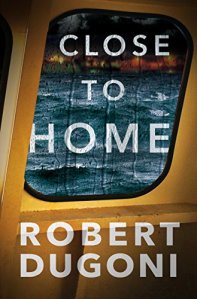
Robert Dugoni’s most recent book, Close to Home launched Sept 5th and has garnered well over 65 customer reviews on Amazon in the first week alone and maintains a 4.5 star rating.
THE BLURB:

New York Times bestselling author Robert Dugoni’s acclaimed series continues as Tracy Crosswhite is thrown headlong into the path of a killer conspiracy.

While investigating the hit-and-run death of a young boy, Seattle homicide detective Tracy Crosswhite makes a startling discovery: the suspect is an active-duty serviceman at a local naval base. After a key piece of case evidence goes missing, he is cleared of charges in a military court. But Tracy knows she can’t turn her back on this kind of injustice.

When she uncovers the driver’s ties to a rash of recent heroin overdoses in the city, she realizes that this isn’t just a case of the military protecting its own. It runs much deeper than that, and the accused wasn’t acting alone. For Tracy, it’s all hitting very close to home.

As Tracy moves closer to uncovering the truth behind this insidious conspiracy, she’s putting herself in harm’s way. And the only people she can rely on to make it out alive might be those she can no longer trust.

*

Robert Dugoni is the critically acclaimed New York Times, #1 Wall Street Journal and #1 Amazon Best Selling Author of The Tracy Crosswhite series, My Sister’s Grave, Her Final Breath, In the Clearing, and The Trapped Girl. The Crosswhite Series has sold more than 2,000,000 books and My Sister’s Grave has been optioned for television series development. He is also the author of the best-selling David Sloane series, The Jury Master, Wrongful Death, Bodily Harm, Murder One, and The Conviction. He is also the author of the stand-alone novels The 7th Canon, a 2017 finalist for the Mystery Writers of America Edgar Award for best novel, The Cyanide Canary, A Washington Post Best Book of the Year, and several short stories. Robert is the recipient of the Nancy Pearl Award for Fiction, and the Friends of Mystery, Spotted Owl Award for the best novel in the Pacific Northwest. He is a two time finalist for the International Thriller Writers award and the Mystery Writers of America Award for best novel. His David Sloane novels have twice been nominated for the Harper Lee Award for legal fiction. His books are sold worldwide in more than 25 countries and have been translated into more than two dozen languages including French, German, Italian and Spanish.

Comments Off on #amwriting: SW Washington Writers Conference, What I learned from @RobertDugoni

Filed under writing

#FineArtFriday: San Gabriel Mountains in the Haze


Today’s image is brought to you by Wikimedia Commons. It is an image of the San Gabriel Mountains in California rising out of the smoggy haze, taken by Doc Searls. In my mind it evokes a fairytale place, a somewhere full of possibilities. A writing prompt? Perhaps, but mostly it is a peaceful image, designed to rest the mind, a visual place where ideas are born.


S.GabrielHaze, by Doc Searls from Santa Barbara, USA – 2007_06_24_iah-lax_71.JPG, CC BY-SA 2.0, https://commons.wikimedia.org/w/index.php?curid=7737446

Comments Off on #FineArtFriday: San Gabriel Mountains in the Haze

Filed under #FineArtFriday, writing