Monthly Archives: December 2021

The Story Arc: delivering backstory #amwriting

Many writers who managed to write the entire story arc of their novel during November are now going back and looking at what they have written. This can be a dangerous moment in the life of your book.
Info DumpIn my last post, I talked about the good and bad aspects of two editing programs that I am familiar with, the things they do and don’t help us identify in our work. One more thing these wonderful programs can’t help us with is identifying bloated backstory.

Walls of fictional history muck up the transitions and flatten the story arc. They block the doors from one scene to the next.

Every story has a past, a present, and hopefully, a future. We write the story of our characters’ present moments, no matter what narrative tense we are using. Each character emerges from our minds with a personality. That personality was formed in some way by an unwritten past.

That history shaped the characters even though it isn’t written, and at first, we don’t consciously think about it. We open a document and start writing—we envision our characters with unique personalities the moment they step onto the first page.

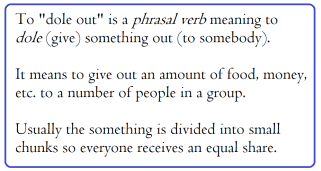
At some point, we realize that a bit of backstory is needed. But how much, and how should we dole it out?

This is where it gets dicey. In the revision process, it’s tempting to inform the reader of this history by placing blocks of information in the first pages. It seems logical: before a reader can understand this thing, they need to know this other thing.

We can provide the reader with the backstory in several ways:

  • In conversation.
  • Memory/flashbacks
  • A brief recap of events

Each of these methods is both good and bad. While a certain amount of backstory is necessary for character and plot building, too much outright telling halts the momentum, freezes the real-time story in its tracks.

The opening paragraphs must be active. The first lines must step onto the stage in a way that feels original, informative, and engaging. The passages that follow must reflect and build upon the tone and cadence of the opening lines.

Before we dump information, we should consider what must be accomplished in each scene and allow the backstory to inform the reader only when it’s necessary to advance the plot.
CAUTION INFO DUMP ZONE AHEADLook at the first scene of your manuscript. Ask yourself three questions.

  1. Who needs to know what?
  2. Why must they know it?
  3. How many words do you intend to devote to it?

Dialogue is the easiest way to dole out information.

It is also a great way to fall into an info dump.

Don’t allow conversations to deteriorate into bloated exposition detailing unimportant fluff just to fill up space.

“Jack, remember when you nearly blew up the ship? Remember how you spent two weeks in the brig?”

“Yes, Jill. That meant you were one gun short to save the day. I almost lost the war for you, but you prevailed. I’m lucky to be your sidekick.”

“Well, Jack, what we’re dealing with this time has nothing to do with that. I’m just pointing out the obvious.”

We’re all familiar with the term ‘flatlined’ as a medical expression indicating the patient has died. A story arc can flatline in two ways:

  • The pauses become halts, long passages of haphazard info dumps that have little to do with the action.
  • The action becomes random, an onslaught of meaningless events that make no sense.

One way to avoid a flatlined story arc is through character interaction. Your characters briefly discuss what happened and how to prevent it from happening again. Then, they bravely muck on to the next event.

Another way is to insert short moments of introspection between the action. Our character’s thoughts offer opportunities for doling out new information essential to the story.

Don’t ramble on, either in conversation or introspection. If you go on for too long, your reader will either skip forward or close the book.

When they are brief but informational, these moments open a window for the reader to see who the characters think they are. Their introspection illuminates their fears and strengths.

It shows that our characters have a sense of self.

The problem with conveying the backstory is that timing and pacing are essential. The moment to mention it in passing is when the character needs that information to make decisions as they go forward. If the character doesn’t need to know it, neither does the reader.

That way, you avoid the dreaded info dump, but the reader can extrapolate the needed backstory.

In the most gripping narratives I have read, character introspection is brief but delivers crucial information. Internal monologues are featured but are kept minimal, only addressing what is essential. They serve to illuminate a character’s motives at a particular moment in time.

So, conversation and introspection are where we only deliver information not previously discussed and that the reader needs to know at that moment. Repetition is monotonous and pads the word count with fluff.

I suggest you don’t stop the action with a prolonged recap of previous adventures. It’s all right to work in a brief mention. However, if the events were detailed in a previous book in that series, the reader will probably be aware of the history. As a reader, I can say that a longwinded rant about things I already know does not keep my interest.

No matter the genre, in all stories, complications create tension, and information is a reward.

A trick I have found for whittling down info dumps is this: look at the word count.
to dole out phrasal verbI look at each conversation and assess how many words are devoted to each character’s statement and response. Then, when I come to a passage that is inching toward a monologue, I ask myself, “what can be cut that won’t affect the flow of the story or gut the logic of the plot?”

Even with all the effort I apply to it, my editor will find places to shave off the unnecessary length.

Sometimes we write brilliantly, and those moments give us hope when we churn out less than stellar prose. Weeding that garden of words is not easy, but readers will be glad you tried.

2 Comments

Filed under writing

Editing Programs – the pros and cons #amwriting

With NaNoWriMo 2021 behind us, it’s time to talk about editing programs again. Several writers in our region have asked me if I use one in my own work.

MyWritingLife2021I do use Grammarly—but also, I don’t.

I rely on my knowledge of grammar and what I intend to convey more than I do an editing program. While they are good at alerting you to some errors, these helpful programs are not as useful as we wish they were.

No software can replace knowledge of grammar. An author must have confidence in what they intend to convey and how they wish to say it.

For this reason, editing software may not be a good tool for every author.

A person with no knowledge of grammar will not benefit from relying on an editing program for advice. There is no way to bypass learning the craft of writing.

You may have found that your word processing program has spellcheck and some minor editing assists. Spellcheck is notorious for both helping and hindering you.

they're their there cupSpellcheck doesn’t understand context, so if a word is misused but spelled correctly, it may not alert you to an obvious error.
  • There, their, they’re.
  • To, too, two.
  • Its, it’s

Grammarly is an editing program I use for checking my own work, in tandem with Pro Writing Aid. I pay a monthly fee for the professional versions of these two programs. Each one has strengths and weaknesses.

For me, especially in my first draft, some words are like tics—they fall out of my fingers and into my keyboard randomly and out of my voluntary control. I don’t self-edit as I go because, at that point, I’m just trying to get the story down. The second and third drafts are where I shape my grammar and phrasing.

I want to write active prose, so I don’t want to use words with no power behind them.

Often removing an adjective or adverb strengthens the prose. Descriptors are easy to find because these words frequently end with the letters ‘ly.’

You could do a global search for the letters ‘ly,’ and a list will pop up in the left margin of your manuscript.

However, the most ludicrous advice I’ve ever heard at a critique group came from an author who was about to publish his first book. He had a great deal of enthusiasm for the craft but was armed with too little knowledge: he told a new writer to remove all adverbs from her narrative.

Unfortunately, he forgot that words like “later,” or “everywhere,” or “never” or “alone” are also adverbs.

That sort of wrong-headed advice survives because it is based on a writing truth: unnecessary adverbs and adjectives inflate the word count but add no value. Worse, they sometimes fail to tell us something that we need to know.

In other words, use adverbs and adjectives when they are necessary and cut them when they aren’t.

In my own work, I seek out adverbs, descriptors, qualifiers, and “weed words.” I look at how they are placed in the context of the sentence and decide if they will stay or go. Many will go, but some must stay.

The BIG problem for those who don’t understand the basics of grammar is this: editing programs cannot see the context of the work they are analyzing.

In one of my older manuscripts, this sentence triggered the algorithm:

“The tea was cool and sweet, quenching her thirst.”

Grammarly suggested replacing quenching with quenched and then suggested a comma at the end instead of a period.

Pro Writing Aid made the same suggestion but didn’t tell me to add a comma.

These programs operate on algorithms defined by finite rules. They will often strongly suggest you insert an unneeded article or change a word to one that is clearly not the right one for that situation. That is where your eye and understanding of context and grammar must prevail.

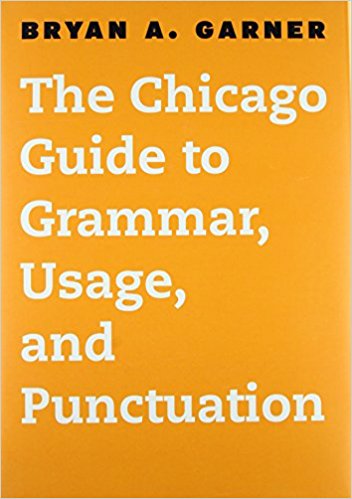
chicago guide to grammarNew writers should invest in the Chicago Guide to Grammar, Usage, and Punctuation and learn how grammar works. For people new to the craft and who don’t understand grammar or how to construct a sentence or a paragraph, or how to write dialogue, editing programs will confuse and mislead them.

To get the best out of editing software, you must know the basics of how to write.

At this stage in our technology, understanding context is solely a human function. Context is defined as the parts of a written or spoken statement that precede or follow a specific word or passage, usually influencing its meaning or effect.

A person with no knowledge of grammar will not benefit from relying on Grammarly or any other editing program for advice. There is no way to bypass learning the craft of writing.

Because context is so important, I am wary of relying on these editing programs for anything other than alerting you to possible comma and spelling malfunctions.

You might disagree with the program’s suggestions. You, the author, have control and can disregard suggested changes if, as illustrated above, they make no sense. I regularly reject weird suggestions.

However, when the editing program highlights something, I examine the problem sentence. Just knowing that the way I phrased a sentence tripped the program’s algorithms encourages me to look at that passage with a critical eye.

I may not use the program’s suggestion, but something triggered the algorithm. That means my phrasing might need work. I may need to find a better way to get my idea across.

Timid WordsEven editors must have their work seen by other eyes. My blog posts are proof of this as I am the only one who sees them before they are posted. Even though I write them in advance, go over them with two editing programs, and then look at them again before each post goes live, I still find silly errors two or three days later.
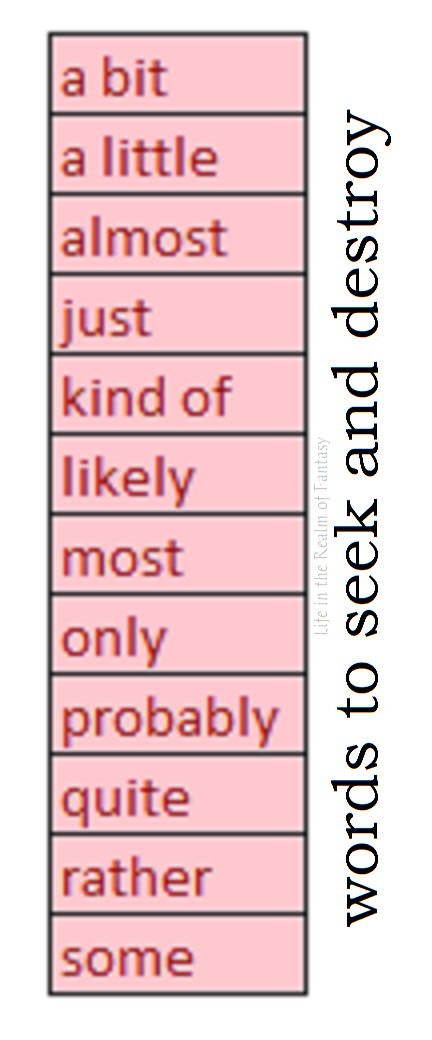
Certain words and phrases don’t add to the narrative and only increase the wordiness. Used too freely, they separate the reader from the experience.

In my first draft, these words are like tics. They fall out of my fingers and into my keyboard randomly and out of my voluntary control. I never self-edit as I write the first draft because I am just trying to get the story down. The second and third drafts are where you deal with grammar and phrasing.

When I begin revisions, I will seek out adverbs, descriptors, qualifiers, and other “weed words,” look at how they are placed in the context of the sentence, and decide if they will stay or go

You can’t take shortcuts. If you are too impatient and choose to “Replace All” without carefully thinking things through, you run the risk of making a gigantic mess of your work. Some weed words are parts of other words, for example:

  • very—every
  • has—hasten, chasten

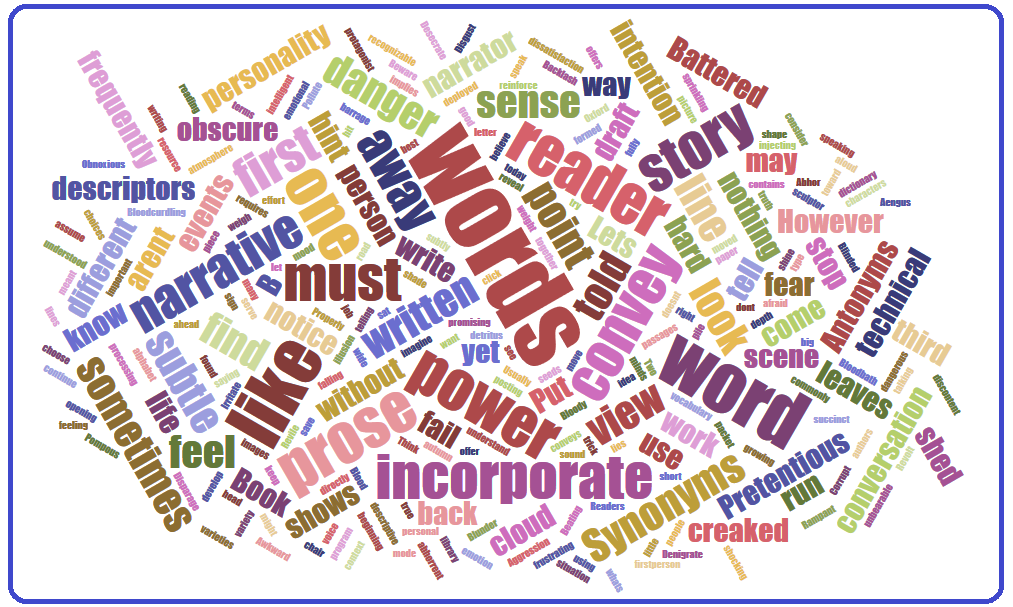
powerwordsWordCloudLIRF06192021If you have decided something is a “crutch word,” examine the context. Inadvertent repetitions of certain words are easy to eliminate once we see them with a fresh eye.
Context is everything.

I can’t stress this enough: take the time to look at each example of the offending words individually.

It’s unfortunate, but there is no speedy way to do this. You will be rewarded, though, when your book is finished to the best of your ability.


17 Comments

Filed under writing

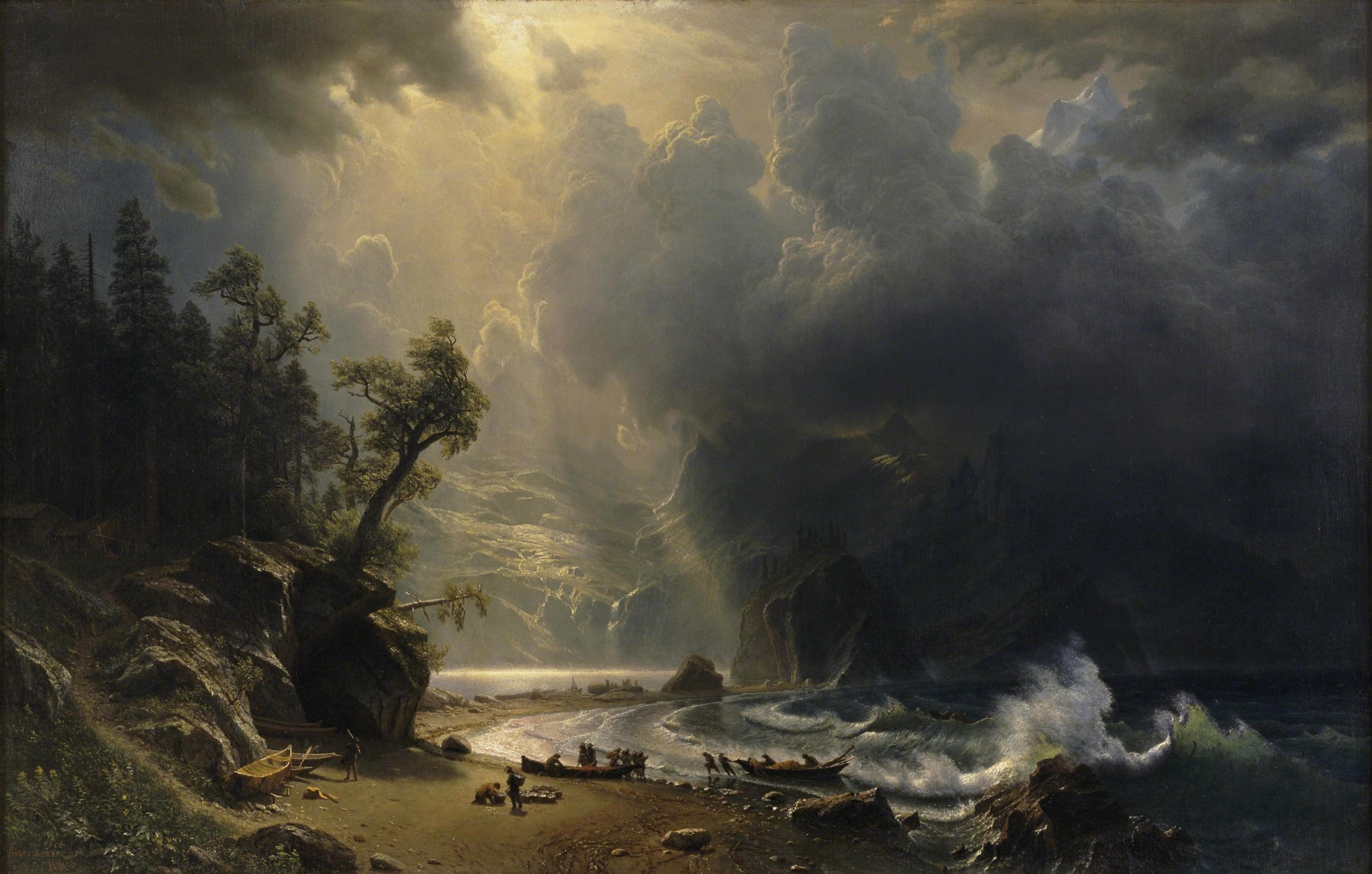
#FineArtFriday: Puget Sound on the Pacific Coast by Albert Bierstadt 1870 (reprise)

What I love about this painting:

I live on Puget Sound, and while the exact beach this image depicts likely does not exist, the cliffs are pretty accurate. I have seen many, many places here like it. The waters of the sound can get quite rough during storms, as this video shot three years ago by a storm chaser during a December storm shows: Wild Ferry Ride Across Puget Sound Dec. 16 2018.

Anyone who lives here will tell you, the view of the Olympic Mountains from over the sound is unparalleled.

At certain times of the year, rain sweeps in like a dark beast. I have often seen the sky as black and heavy as it is depicted in this painting. Shafts of sun between heavy rain squalls are frequent companions here. When the sun shines through the heavy clouds, the light looks very much the way he shows it.

A sky that looks like the one in this painting heralds a serious storm. If you are driving anywhere during this kind of weather, you are in for a slow, miserable trip.

Quote from http://www.SeattleArtMuseum.org, regarding Puget Sound on the Pacific Coast, 1870, which is now in their possession.

 “Bierstadt had likely not yet traveled to the Washington Territory in 1870. The painting was possibly a commission from a New York shipping magnate who had made his enormous fortune on the Pacific coast. Enterprising artist that he was, Bierstadt did not shy away from the challenge of painting a place he had not yet seen.”

I love that Bierstadt was a story teller as much as an entrepreneur in regard to his art. All the great artists were.

It has been suggested he put this picture together by piecing together places he had visited on the Lower Columbia River. Indeed, the trees and landscape there is much like that of Puget Sound, so it is possible. However, it would have been easy for him to have traveled north to the sound if he was on the  Lower Columbia—a matter of only eighty miles, so a week of travel for him by horse.

He was a man who traveled all over the west and painted what he felt as much as what he saw.

Wikipedia has this to say about Albert Bierstadt:

In 1867, Bierstadt traveled to London, where he exhibited two landscape paintings in a private reception with Queen Victoria. He traveled through Europe for two years, cultivating social and business contacts to sustain the market for his work overseas. His exhibition pieces were brilliant images, which glorified the American West as a land of promise and “fueled European emigration.” He painted Among the Sierra Nevada, California in his Rome studio, for example, showed it in Berlin and London before shipping it to the U.S. As a result of the publicity generated by his Yosemite Valley paintings in 1868, Bierstadt’s presence was requested by every explorer considering a westward expedition, and he was commissioned by the Atchison, Topeka, and Santa Fe Railroad to visit the Grand Canyon for further subject matter.

Bierstadt’s choice of grandiose subjects was matched by his entrepreneurial flair. His exhibitions of individual works were accompanied by promotion, ticket sales, and, in the words of one critic, a “vast machinery of advertisement and puffery.”

Bierstadt was highly successful in his day, which the more refined critics despised. Everything the critics mocked about his work are the aspects I love. The high contrasts of light and shadow, sweeping epic themes, and overblown romanticism—those are what I love about all his work.

In all his works, Bierstadt created an emotional landscape as much as a physical one.

Puget Sound on the Pacific Coast by Albert Bierstadt

  • Genre: landscape art
  • Date: 1870
  • Medium: oil on canvas
  • Dimensions: Height: 52.5 ″ (133.3 cm); Width: 82 ″ (208.2 cm)
  • Collection: Seattle Art Museum
  • Current location: Seattle Art Museum Downtown, Gallery Level 3, American Art

Credits and Attributions:

Puget Sound on the Pacific Coast, by Albert Bierstadt, signed and dated 1870 [Public domain]

Wikimedia Commons contributors, “File:Albert Bierstadt – Puget Sound on the Pacific Coast (1870).jpg,” Wikimedia Commons, the free media repository, https://commons.wikimedia.org/w/index.php?title=File:Albert_Bierstadt_-_Puget_Sound_on_the_Pacific_Coast_(1870).jpg&oldid=344396079 (accessed April 26, 2019).

Quote from the article: Puget Sound on the Pacific Coast, Seattle Art Museum website contributors, (accessed April 25, 2019).

5 Comments

Filed under #FineArtFriday

My Writing Life #amwriting

Someone recently suggested I write a post on the evolution of me as an author, so here it is.

MyWritingLife2021BFrom my earliest childhood, I always thought of myself as a writer. I just didn’t know how to write anything longer than a poem or a song in such a way that it was readable.

Most evenings, I listened to music on the stereo, writing my thoughts and ideas in a notebook while my kids did their homework.

My pen and ink ramblings weren’t “writing” as I see it now. They were more like frameworks to hold ideas that later became full-fledged stories.

Then, in 1987, my father bought me a secondhand IBM Selectric Typewriter, and my writing addiction took off.

For most of my writing life, I was like a five-year-old with a new set of paints. My enthusiasm for my stories was far greater than my ability to tell them.

I didn’t have the information I needed to make my work readable and didn’t know how to get it.

I felt embarrassed for even thinking that I could be an author.

orson_scott_card_write_scifi_fantasyOne day in 1990, I stumbled upon a book offered in the Science Fiction Book Club catalog: How to Write Science Fiction and Fantasy by Orson Scott Card. The day that book arrived in my mailbox changed my life.

I could become an author, and one of my favorite writers was going to tell me how to do it.

In the years since that book, I have amassed a library of books on the craft. Some are brilliant, some not so much, but I always learn something from them.

However, personal experience is a great teacher, and I’ve learned many things by trial and error.

So here in no particular order are six things I would like to pass on to you:

One: Make a style sheet as you go.

Build a glossary of words and spellings unique to your story and especially be sure to list names. I use an Excel spreadsheet, but you can use anything you like to help you stay consistent in your spelling.

And even though I think I am developing a thorough glossary, my editor will find many words to add to it.

Two: Develop a logical, consistent system for naming your files and save regularly.

Save each version of your manuscript with a different name so you can go back and retrieve bits you may need later. I use a system like this:

Heavens_Altar_V5.docx

That stands for Heaven’s Altar version five, and I work out of Word, so the extension is automatically a docx.

chicago guide to grammarThree: Find a local group of writers to meet with and talk about the craft.

Critique groups are great, but they are only one small part of the picture. Authors need to network with other authors because we need to discuss the craft with someone who doesn’t look at you with glazed eyes.

I gained a wonderful local group through attending write-ins for NaNoWriMo before the pandemic. While we haven’t been able to have in person meetings for a while, we meet weekly via zoom. They are a never-ending source of support and information about both the craft and the industry. We are a group of authors writing in a wide diversity of genres. We gladly help each other bring new books into the world, but more than that, we are good, close friends.

Four: Never stop educating yourself.

Learn how to say what you mean with your unique voice and your personal style. A college education is an expense we might not be able to wrangle. But you can buy books on grammar, books on style and substance, and books on writing craft.

Learn about structure and pacing from successful authors. Every coin you invest in your education will be returned to you with interest when your story makes a reader say they wished it hadn’t ended.

Self-education requires perseverance and a small investment of money, but you can do it.

storybyrobertmckeeSpend the money to go to conventions and attend seminars. You will learn so much about the craft of writing, the genre you write in, and the publishing industry as a whole—things you can only learn from other authors. I gained an extended professional network by joining The Pacific Northwest Writers Association and going to their conferences.
Five: Don’t even consider signing with the slick-talking publisher that contacts you out of the blue.

How can a publisher possibly want work they haven’t seen?

Make use of SFWA’s Writer Beware site. These predators want your work all right—and want to sell you publishing services you can do for yourself. You won’t benefit from the predator publisher’s “services,” but they will profit from your desperation to be published. They will publish your work in its raw unedited form, and you will never see a dime.

300px-Astound5006Six: My final suggestion is this: even though you are writing that novel, keep writing short stories too.

Short stories are a training ground, a way to hone your developing skills. They’re also the best way to get your name out there. My advice is to build a backlog of work from 2000 to 5000 words in length and keep them ready to submit to magazines, anthologies, and contests.

All those fabulous scenes and vignettes that roll through your head can be made into short pieces.

Get the Submittable App and see who is asking for the kind of stories you write. Start submitting your work, and don’t let rejections stop you. Just keep sending that work out to new places because someone will want it.

These are a few things that I wish I had known when I first started writing professionally but didn’t.

3 Comments

Filed under writing