Category Archives: blogging

Conveying the Mood

Something I’ve lately realized is that every author, even my favorite, has what I think of as ‘fall-back’ tricks they use when describing certain scenes, little quirks and twists of words that are as personal and unique as a signature. The great authors can get away with this, because their stories are just so darned compelling that we don’t notice or don’t care.

I’ve had to face it–when I, as an author, make a habit of resorting to writing my characters with excessive shrugging or sighing, it’s clear I’ve run out of ideas. I recently had a wonderful discussion with several other authors who have noticed this phenomenon in their own work. After that discussion, I found myself wondering how to maintain speed in my writing when I am in the zone, but still have a variety of words and ideas available to me for describing mood and emotion.

So–since tattoos are expensive, and my palm isn’t really large enough to contain a really good table of visual cues, I resorted to my handy-dandy Excel program, and created one there.

What I discovered while compiling this, is that my little brain is quite limited. I had to struggle to picture what these moods and emotions looked like.  Once I had the facial expression in my mind, it was easier to imagine how a character might appear to an observer.

What these cues do is help me come up with a fresh description when I want to show something that may happen frequently within a group of characters. I don’t necessarily use these cues verbatim as they are written here, but they do give my mind a jumping off point and I can extrapolate from there.

Please feel free to: right click> save as> png or jpeg and print it out for your own use.

Conveying Mood and Emotion in Writing


9 Comments

Filed under blogging, Books, Fantasy, Humor, Literature, Publishing, Self Publishing, Uncategorized, WordPress, writer, writing

Good bye my friend: a dialogue about depression and creativity

robin williamsWe have all been affected by the suicide of beloved comedian Robin Williams. His was a death that touched us as deeply as his life had. We felt we knew him on a personal level, and though we knew he battled demons, we somehow believed he had survived them, and that all was well at last for him.

But if there is one positive thing to come out of this sad end to a beautiful man’s life, it is that people are at last having a dialogue about clinical depression.

This is something I understand on a personal level. My mother suffered from clinical depression, to the point that many times she was incapacitated during my childhood, and my maternal grandmother stepped in to care for our home and for us all. It was the 1960’s and miracle drugs were prescribed right and left–and Mama was on all of them at on time or another with varying degrees of success.

I have fought depression all my life too, and know firsthand that there is no ‘cure,’ no ‘magic bullet,’ no one-size-fits-all pill to solve the problem. Telling yourself to just pull up your socks and get on with your life doesn’t help much either. Because my mother took so many medications, and they often worsened her condition, I have avoided them except at my worst, lowest point.

There is no way to express what clinical depression feels like to a person who has never experienced it.  You are not sad–that word is an approximation, but not an accurate description. There is sadness involved, but for me it was more a deep lethargy, a lack of interest in life. I wanted to participate in the world around me, but I couldn’t pull myself together enough to get dressed and go out the door. It was like being stranded at the bottom of a well of confused misery and I loathed myself for that, but there were times in my twenties when I was so paralyzed by this disease, I couldn’t scrape together the energy to clean my house. I had no idea what was wrong with me, or why I was such a failure.

Fortunately I had children. I refused to just stay in bed as my mother did at times. I forced myself to stay involved with them, only booked music gigs for early evening in places like Wolf Haven or coffee shops where I could take my kids, and I wrote short stories, fairy-tales for them. Having to provide a decent life for my children kept me going to work and functioning on a superficial level. For them, I could get up, go to work, and pay the bills, but it was a constant struggle and in the late nineties my third marriage fell apart and once again depression hit me hard.

In 1998 I began having severe panic attacks to the point I was unable to drive across town. I opted to go into therapy, in the hope I could learn ways to cope. Thanks to an extremely caring psychologist who was not afraid to try new ideas, I found the tools and skills I was looking for. He showed me simple ways to physically alter my brain’s chemistry without resorting to medications, and as along as I practice these techniques I do well. For me, this was an answer.

It was not as easy as it sounds, but now I have some way to deal with this. I have sort of gotten a handle on it, and writing is part of my therapy. Interestingly enough, I recently had the indignity of being denied affordable life insurance because of this diagnosis being in my medical record.

The Journal of Psychiatric Research recently published a study, “Mental Illness, Suicide, And Creativity: 40-Year Prospective Total Population Study,” examined 1.2 million Swedish patients from the country’s national registry and compared this sample against the entire Swedish population. The most interesting and surprising results related to authors. Writers were a whopping 121% more likely to suffer from bipolar disorder than the general population. Moreover, Simon Kyaga, the study’s lead researcher, said that authors had a “statistically significant increase” in anxiety disorders: 38% to be exact. Rates of alcoholism, drug addiction, and suicide also increased among writers.

Go figure.

In an interview on the website, Lit Reactor, Portland Oregon based author and psychotherapist, Philip Kenney, said: “It isn’t easy to see oneself, the strengths and weaknesses, the familiar imperfections, without a judgment that often spells, B-A-D. Inferior. I try to remember the beautiful patterns made by the cracks in the sidewalk. Practicing kindness is the best remedy.”

IMG727That is also my motto. Practicing kindness, forcing myself to be involved with life outside of my front door and pushing myself out the door to work in a coffee shop is an antidote for me.

I admit I am obsessive about my craft, and that has been both a curse and a boon.  It is a curse, because if I choose, I can use it as a reason to never go anywhere.  But it is a boon because through my involvement with  NaNoWriMo, Olympia Area Writers Co-opPNWA, and ABNA I am FORCED to leave the Room of Shame (my office) and through these organizations I have met some of the most wonderful, amazing people you can imagine.

And strangely enough–many of them frequently suffer from various forms of ill health, depression, and anxiety disorders. By staying involved, we raise each other up, and try to support each other when the road is hard.

I am grateful for my blessings, never more so than when someone  like Robin Williams, who gave us so much of himself, falls victim to the demons of evil, pernicious, clinical depression.

11 Comments

Filed under Battles, blogging, Books, Fantasy, Literature, news of the world, Publishing, Self Publishing, Uncategorized, writer, writing

Yes, but how do you really feel?

x - y chromosomesI love writing and I love my characters, but they are so stubborn about some things. Of course, many of them have ‘Y’ chromosomes, but still…. It’s frustrating because they don’t want to to talk about how they’re feeling.

Oh, for the love of Tolstoy–don’t they get it? I’m  a woman. I need you people to talk to me. Tell me what’s going on in your imaginary head.

It’s difficult to show the characters’ emotions and thought processes when it’s so much easier to just say he felt, or she was some emotion.  These thoughts and feelings are central to making our characters feel real. But describing them from a distance, as an author must do, may disconnect the reader from that character.

Sometimes, descriptions don’t allow the reader to experience the moment with the character. Instead, the author is telling them how the character feels.What we must ensure is that our readers remain immersed in the narrative, that no ‘speed-bumps’ come along to knock them out of it. Heart Search cover

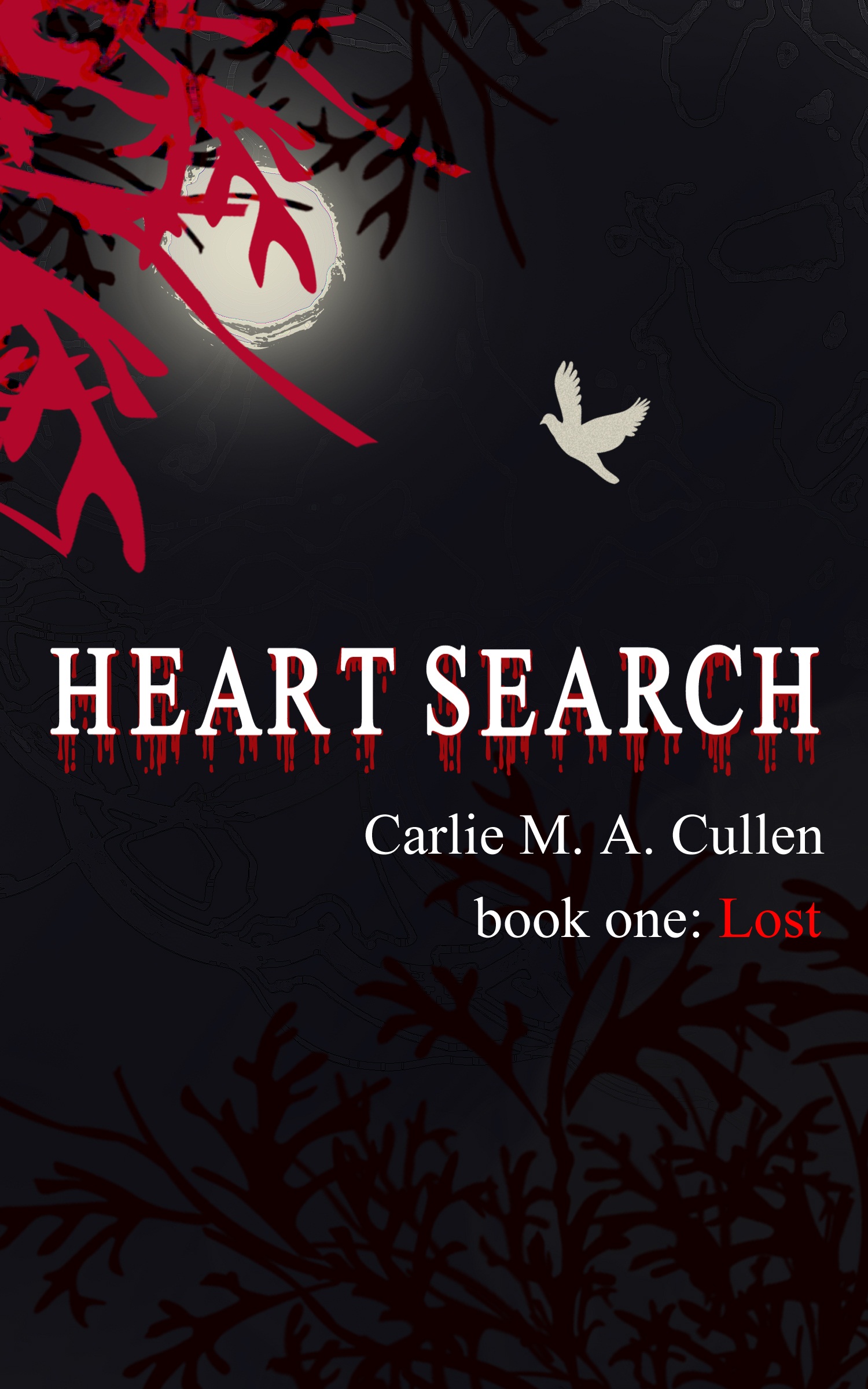
One of the best at this is Carlie M.A. Cullen, whose urban fantasy series Heart Search  featuring a coven of vampires is gaining in popularity. I think her books are so compelling because of her ability to draw a reader into the character without going over the top. So, how does she do it?

The opening line of chapter one of Heart Search Book 1, Lost reads like this: The sun, a ferocious golden orb, burnt into his skin as Joshua wandered aimlessly through the country park.

She could have just written The sun was hot and Joshua was killing time in a park.

But she didn’t, and the story is better for it–AND she showed you both the scene and Joshua’s mood in that one sentence.

So what can we learn from reading our favorite authors? We can see how they craft their tales, and we can learn those skills. Painters do this all the time, and we paint with words. 480px-Schmalz_galahad

Let’s pretend we’re writing a fantasy novel. We can go over the top, like a painting by Herbert Gustave Schmalz, or we can find a happy medium between too much and too little. There is no need to sink into overly sentimental and exaggerated pathos in order to inject feeling into our work.

Here we have a character who is on the run from a creature of some sort. 1. He was afraid. He was terrified to look back.

Example one tells the reader how the character feels. We might write this in our first draft when we are just trying to get the story out of our heads. An unskilled writer would consider it just fine the way it is, as it expresses his thoughts perfectly.

However, it tells the reader how to feel, and readers really don’t like being told what to do.

2. He wiped the sweat from his brow with a trembling hand, fear from his narrow escape coursing through his veins. Heart pounding, he leaned against the wall, listening for any sounds that shouldn’t be there before chancing a glance around the corner.

Personally, I would read book number two over book number one, because it’s more interesting and makes me want to know more about this character and his problems. We need to use physical symptoms a character might experience combined with their actions, but  we need to describe them in such a way that it is a natural part of the scene.

John slid down the wall, sitting in the mud, his breaths coming in hard, ragged gasps. Something trickled down his cheek, and wiping it, his hand came away with blood.

Another example: Theodor_Hosemann_Weinstube_1858

Lord Deccan’s fist hit the table. “Wine now, you miserable worm–or I’ll cut off your other ear!”

The one-eared innkeeper scuttled to the cellar. He quickly searched the shelves filled with dusty jars of cheap wine, settling at last on a vintage he thought might suffice.

Baldric’s guests normally drank from wooden tankards, but he knew that wouldn’t suit. There was a goblet, one he’d come by in a peculiar way, but it was a fine cup and would do well enough to stave off a tantrum of the lordly variety.

His shoulders hunched in anticipation of trouble, he approached the angry lord’s table. Setting the only goblet before the nobleman, he left the bottle and stepped away, bowing with feigned obeisance. Baldric had  survived  the  war with all but his left ear intact, and intended to remain that way.

Sir Paul McCartney, image from Rolling Stone MagazineWhat we are doing here is exactly like interpreting what our loved one is telling us, when he/she refuses to use their words. Seeing them sitting slouched in the chair, clicker in hand and numbly flipping through channels is a good indication of their mood. So we must picture the scene and describe it .

We must show the emotions as they are reflected by the physical cues our characters give us, but don’t tell them–a difficult trick to master but one we must all do if we want our work to engage the reader.

7 Comments

Filed under blogging, Fantasy, Humor, Publishing, Self Publishing, Uncategorized, WordPress, writer, writing

SomeWhen Over the Rain Clouds, Lisa M. Peppan interview

KCover-SWOtRCThe Pacific Northwest has been the home of many famous authors, Frank Herbert, Ken Kesey, Ursula K. Le Guin, and J. A. Jance among them.  There is something about the dark and the damp that encourages creativity. We have a huge community of authors, with critique groups and strong support for each other.

Recently one of my friends from Bellingham, Washington, author of historical fiction J. L. Oakley, introduced me to another friend of her’s, fantasy author Lisa M. Peppan. Lisa’s book, SomeWhen Over The Rain Clouds is an intriguing book I am currently reading on my vacation–I can’t put it down!

Here is the BLURB:

SWotRB blurb

Lisa has consented to answer a few questions about her writing process and where her book fits into the genre of fantasy.

CJJ: Tell us a little of your early life and how you began writing:

LMP: Once I got the hang of it, I became a voracious reader.  My favorite still is L. Frank Baum’s Oz books.  It’s his fault, me writing.  I tried my hand at a few short stories but it wasn’t until after reading a poorly written fantasy that I was inspired to write a better story.

CJJ: What are you currently working on?

LMP: While my cover-artist works on a cover for the sequel to “SomeWhen Over the Rain Clouds”, I’m working on a third book.  Might be a fourth, possibly a fifth.  Maybe more.  Same alternate universes and most of the same characters, all bundled together as The Geaehn Chronicles.  The Geaehn Chronicles has a Facebook page.

CJJ: Do you have a specific ‘Creative Process’ that you follow, such as outlining or do you ‘wing it’?

LMP: SomeWhen started life as 98 handwritten pages.  With a rough idea of the kind of people I wanted my characters to be, I ran astrological birth charts for them and compatibility charts for every possible combination of the four.  While mulling over potential plot complications, I wrote detailed biographies for my main characters, drafted maps, and re-read a selection of mythologies, and, well, once I knew my characters and the world I was sending them to, I wound them up and let them go.  So far, this has worked for two and half books.

CJJ: How does your work differ from others of its genre? Why do you write what you do?

LMP: In all the fantasy I’ve read, cab drivers were things that moved protagonists from Point A to Point B.  Three of my four main characters are Seattle cab drivers who recognize that they’ve become involved in a fantasy-novel-type situation; the fourth knows it’s so much more than that.   I drove a taxi cab for 11 years, did a little dispatching, and knew cab drivers were so much more than things (most of them), and wrote the kind of book I’d enjoy reading.

CJJ: I know why I chose the indie route for my work, but I’m curious as to why you’ve chosen this path.

LMP: In the Spring of 1984, on a particularly slow day as a taxi cab driver, SomeWhen Over the Rain Clouds was born.  Over the years, I got many really nice rejection slips.  Then along came a first novel contest on Amazon.  Though I shot myself in the foot for the contest (ask me why and how bad), I was among the 100 best entrants that year.  It also made me aware of that most marvelous purveyor of POD novels, CreateSpace.  When a long-published author friend went Indie, because it appeared to be the direction publishing was going, I took the plunge.

CJJ: What advice would you offer an author trying to decide whether to go indie or take the traditional path?

LMP: Most traditional brick-and-mortar publishers want to see smartly written synopses.  I tried but my best effort (to date) is 23 pages, and Indie doesn’t require one*.  Indie or traditional…?  If you write fantasy that you’ve given a truly fresh spin and you keep getting really nice rejection slips with handwritten notes saying things like, “Great premise” and “Best wishes finding a home for it!!”, go Indie.

*You won’t need the synopsis but you will want a snappy blurb for the back of the book

CJJ: Your experiences with traditional publishing rather closely mirror mine, Lisa!  Thank you for agreeing to be virtually here today, and for the insight into how your creative process works.

Here is a short excerpt of this wonderful book:

excerpt SWotRB

Intrigued?  Lisa’s book is SomeWhen Over The Rain Clouds and can be found at these fine stores — just click on the links:

www.amazon.com

Barnes & Noble

‘Like’ Lisa on Facebook

LMPeppan

Born in Seattle as the eldest of three, Lisa was a curious and adventuresome child who delighted in taking things apart to see just exactly how they worked.  It is a Testament to the Bravery of her parents that they went on to have two more children.

In 1981, after having held a number of jobs in a variety of fields, it was no real surprise to her parents or brothers when Lisa went to work as a cab driver for North End Taxi, a small mom-and-pop cab company in north Seattle.  During the summer of 1984, as a cab driver, after reading what she felt was a poorly written fantasy novel, she said, to no one in particular, “I can do better than that.”

Unplanned early retirement in 1992 gave Lisa time to learn about computers and html coding.  Armed with these new tools, she resumed her family research.  This led to a new hobby–19th century Living History–and from there she caught a glimpse of the scope and diversity of her Aboriginal heritage that spanned North America, north and south of the border.  What her father and his parents worked so very hard to hide, she works diligently to recover so the next generation will know who they are and where they came from; the time for hiding has passed.

When she isn’t reading, writing, researching, or playing in the past, Lisa enjoys quiet moments in the mountains, ferryboat rides on Puget Sound in November, windy days on any beach, hairy chests on men, rare steaks, and purple roses.

Lisa can be contacted at lisapeppan at gmail dot com

Comments Off on SomeWhen Over the Rain Clouds, Lisa M. Peppan interview

Filed under Adventure, blogging, Books, Fantasy, Humor, Literature, Publishing, Self Publishing, Uncategorized, WordPress, writer, writing

Don’t dump it-deploy it

CAUTION INFO DUMP ZONE AHEADMost of my work takes place in  a world I invented, right down to the religion. Because my world is very different, whenever I sit down to write, I have the most incredible urge to spew background information. I want my reader to understand the world I’ve created, so I want to give them information. Lot’s and lots of information. OMG, do I have information for you.

But is the information for you as the reader, or for me as the author? There you have it–writing it down cements the world in my head.  Now my info-dumps are cut and kept in a file that contains all my background information. I need that info to write the story, but the reader only needs enough bare bones to fire his imagination.

So how shall I do this? A prologue? Well, I’m leaning away from prologues nowadays, although it can be done–David Eddings did it really well in The Belgariad, and Anne McCaffrey also did in her Pern novels. In some cases a prologue sets the stage. But in online writing groups  I frequently  see that a large number of folks don’t bother to read prologues, preferring to get directly to the story. If folks aren’t going to bother reading it, why should I waste my time writing it?

The key to describing the fantasy setting and the social structure of that world is to let the story do it naturally. Deploy the info in small increments as the characters go through their daily life.

Let’s pretend we’re writing a detective novel:

Joe Stone stood, illuminated by the harsh light of the fridge, staring at the six-pack of beer that represented the sum total of his groceries. Grabbing one, he twisted the cap off, and took a long, desperately needed pull.

dump no infoA sour smell rose from his sink as he peered through the broken blinds, more concerned with the dead body in his rundown tool shed than the shabby state of his kitchen. He wondered who the stiff was, and how the dead man pertained to the divorce case he was investigating.

Most importantly, he wondered how he could avoid taking the rap for it.

That he was being deliberately set up was a given, but by who? Pulling his phone  from his pocket, Joe scrolled through his contacts. He had one last friendly ear at the police department, his old partner, Mike Copper. The question was, would Mike believe him or would he leap to the conclusion that Joe had snapped again? 

So, now you have a picture of Joe Stone. He’s probably single,  a private investigator, his home is in disrepair, his empty fridge tells us doesn’t eat at home very often, and he may drink more than is good for him.

Joe is an ex cop, possibly fired for use of excessive force, as he fears he has only one sympathetic ear there. He’s involved in a nasty private investigation, the corpse in the shed tells us that.

TRUST YOUR READERThere’s no need for an info dump to aid the reader in forming a picture of Joe. All that information was deployed by his actions, and while reading the events of the next 72 hours, more snippets will come out, and this complicated man and his world will become more clear to the reader.

Settings make no difference. Writing fantasy novels is the same thing as writing novels set in the real world. Assume your world is real and slip the info in the natural places.

Belnek knelt by the low fire in front of his hut, pulling the turnips out of the coals, brushing the burnt flakes away. His mouth watered, and he wished there had been meat to roast, but once again, when he checked his snares, they had been empty.

Realizing what he had just thought, he gasped,  fearing the god would interpret his thoughts as ingratitude and would make the harvest scant too. He raised his eyes to the east where the shining towers of the gods were said to be. Closing his eyes he, said a prayer to Osin, thanking him for the turnips, asking his blessing on the meal.

Book- onstruction-signNow you see a man who is not rich, but who has a hut and a fire, and has turnips to roast. Prayers come as naturally to him as breathing–he is a devout man, sure his god is all-knowing, and concerned that he is seen as a devoted, grateful man. His snares are apparently empty quite often, so game has become scarce, and it concerns him.

We have the basics of his world, low-tech, agrarian. In that small scene, intimate details of Belnek’s life is shown and in that way the reader has enough info to begin to picture the world outside Belnek’s hut. There is no need to dump a huge amount of information, because it will come out as his story unfolds.

For me the real trick is to rein it in, because I love every last little detail about my imaginary worlds. But that doesn’t mean my readers will love them. Most readers only need the skeleton of the world so that they can visualize it themselves. The hard part is finding that magic moment where you have given them exactly the right amount of details to involve the reader, but not so much they become bored.

Listen to your beta readers, and make adjustments accordingly. If they feel they can be honest with you, they will point out where you need to tighten the narrative, or expand a bit more on the details.


4 Comments

Filed under blogging, Books, Fantasy, Humor, Literature, Publishing, Self Publishing, Uncategorized, WordPress, writer, writing

My Writing Toolbox

xcg65LacAApparently, I think visually. Actually, I come from a family who, while we are quite verbal, all tend to think visually.

We are musicians, artists, engineers and authors. These are occupations where we create images and think in terms of a whole picture.

I recently read an article, written by Gerald Grow of the School of Journalism at Florida A&M University in Tallahassee. I was intrigued by his theory on how the type of thinker we are influences the way we write. He says, “Visual thinking produces whole, patterned expressions such as maps, symbols, and pictures. Verbal activity leads to sequences such as narratives and explanations.”  He goes on to say that visual thinkers tend to write briefly-evoked scenes about one another with little connective explanation. I don’t necessarily agree with him, but it’s a good topic to ponder.

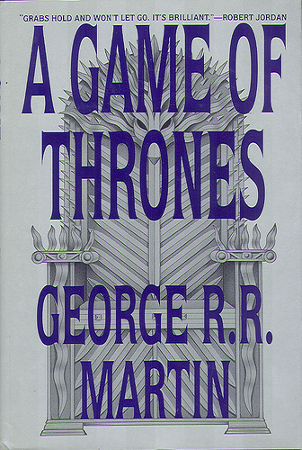
AGameOfThronesIndeed, a lot of what I read in genre fiction is written in 30-second sound-bytes, and it is because 3 generations of our society have become dependent on visual entertainment delivered in short segments–small pictures if you will. Reading is not as popular as it was, since many people think it’s much less work to watch A Game of Thrones than it is to read it.

I disagree–getting lost in a great book is not work at all! That reminds me, I should probably read that book. I own it, I started reading it in 1996, but had a hard time following the way it jumped around. I put it aside and never got back to it. But now I’m curious as to why folks are so crazy for it.

Anyway—

Gerald Grow also writes, “Since everything tends to happens at once and in present time to visual thinkers, they tend to choose static verbs, the passive voice, and heavily depend on forms of the verb ‘to be.’” 

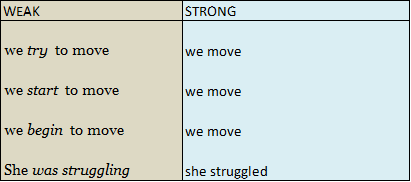
When we first start out in this craft  we tend to write weak sentences. This is because we are approaching it from the point of view of the story-teller. We sit down and tell the story, and that is quite verbal when you think about it. I think it has more to do with lack of experience than how a brain visualizes, because we all seem to start out that way.

Weak narrative happens when, as story-tellers, we are separated from the moment by words that block our intimacy with the action:

wak vs strong table

Many of us do not have an education in journalism, and yet we choose to write. As we grow in the craft, if we want our work to be enjoyed by many people, we train ourselves to craft stronger sentences.

We write short stories, and send them off. Sometimes they are rejected, and sometimes not. We write longer short stories, novellas. We write novels, sometimes with WAY too many words. Our writing groups give us support and good, honest critiques. We know they will not tell us our work is awesome, if it stinks like Bubba’s socks.

They may tear it apart. But we grow from this experience. We learn that opinions are subjective, and writers are opinionated prima donnas–and we will do anything to never have that experience again.

Learning the craft of writing  is like learning the craft of carpentry–if you want to craft beautiful work, you must choose to learn what the proper tools for the job are and how to use them. My toolbox contains:

  1. MS Word
  2. The Chicago Manual of Style
  3. The Oxford A-Z of Grammar & Punctuation
  4. The Olympia Writers Co-Op
  5. NaNoWriMo Write-Ins
  6. Trusted, knowledgeable beta-readers
  7. Good, well recommended editors
  8. online writing classes
  9. regularly attending seminars
  10. reading in my genre

nano_12_new_Come_Write_In_Logo1What is in your toolbox? You might be surprised at just what you have acquired in the line of tools for advancing in this craft. Whether you are a visual thinker or a verbal thinker, you have the ability to express your ideas.

It takes a lot of work to rise from apprentice to journeyman to master in any craft. I don’t know if I will ever achieve that status as an author, but I will keep working and learning. and above all, I will keep reading.


5 Comments

Filed under blogging, Books, Fantasy, Humor, Literature, Publishing, Self Publishing, WordPress, writer, writing

Crafting the scene

I often sit and stare out the window at some point or another during the day–a habit perhaps from the old days of being an ADD kid imprisoned in the basement classrooms of the old Michael T. Simmons Elementary school in 1965. Although that building has been long ago torn down and a new one now serves the community, I still remember sitting in Mrs. White’s overcrowded classroom, staring up at the small window, unable to concentrate on anything but the blue sky outside.  She was my favorite teacher, because she knew I needed extra help with math, and in a class with 42 children, she found the time to give it to me.

Amaranthus and Savvy at the needles by haystack rock cannon beach 2012I still stare out my windows when I am rolling a plot point over in my mind, and I sometimes notice what is happening in the neighborhood.  The window is closed, so I can’t hear their words, but I often see the children.

At first it looks as if they are all happily playing.  Then two of them stand up and from their posture you can see a quarrel is brewing. Suddenly one of them  clouts the other on the head with a toy sword, and another child intervenes. The angry child leaves, and the others are left to console the sobbing child with the bump on his head.

We know that what we have witnessed is not the whole story–there is a whole novel surrounding that interaction. If what I witnessed from my window was a book, this event would read this way:

1. Deciding to meet and spending the day playing in the neighbor’s yard is a chapter in the much larger story of how a group of children in one neighborhood spent their summer

2. The quarrel and resulting bump on the head with the final moments of consolation are one complete scene within that chapter, setting the stage for the next scene–tattling on and achieving penalties for the aggressor, who then apologizes and seeks acceptance back into the group. These two separate scenes comprise the whole chapter, Playing at So-and-So’s Yard.

The Arc of the StoryMost authors understand that there is an arc to the overall novel–the Story Arc,  which  consists of :

  • a. Exposition, where we introduce our characters and their situation.
  • b. Rising Action, where we introduce complications for the protagonist
  • c. Climax, the high point of the action, the turning point of the narrative
  • d. Falling Action, the regrouping and unfolding of events that will lead to the conclusion
  • e. Resolution, in which the problems encountered by the protagonist are resolved, providing closure for the reader.

However, within the larger story there are many smaller stories, all scenes created with this same arc, that come together to create this all-encompassing drama. The way these scenes unfold is what keeps our readers interested and invested in the narrative until the end of the book.

The main difference in the arc of the scene vs the overall arc of the novel is this: the end of the scene is the platform from which your next scene launches. 

This means each scene begins at a slightly higher point on the novel’s Narrative Arc than the previous scene did, pushing the narrative toward the climax.

876MilanoDuomoWhen you are structuring your novel, think of the way Gothic Cathedrals are constructed–smaller arcs of stone support the larger arcs until you have a structure that can withstand the centuries.

Like a Gothic cathedral, each small arc of the scene  builds and strengthens the overall arc of the greater novel. By creating small arcs in each scene, we offer the reader the chance to experience the rise and fall of tension, a pulse which never completely falls but is always increasing toward the high point of the book, giving the reader small rewards of emotional satisfaction along the way to the big event, the grand climax.

Better You Go Home, Scott DriscollAt the Pacific Northwest Writers Association Conference this last weekend, I went to a presentation by University of Washington Professor Scott Driscoll, who is a highly acclaimed author of literary fiction. His book, Better You Go Home is a gripping tale of a man in search of his roots and something more. Scott spoke at length on the importance of creating an arc within each scene, small arcs that propel the plot forward and hook the interest of the reader. In Scott’s work, each scene sets that hook just a little bit deeper.

Some authors make each individual scene a chapter, and some group several scenes with a common theme together to create a chapter. It’s your book–do it however suits you best.

The important thing to remember is that each scene that comprises the framework of the overall narrative arc must have its own arc–the Arc of the Scene.


4 Comments

Filed under blogging, Books, Fantasy, Humor, Literature, Publishing, Self Publishing, Uncategorized, WordPress, writer, writing

Pareidolia

Martian_face_vikingSo I was reading a rather badly crafted novel last night–one that was entirely forgettable other than this one word: pareidolia.  I tried to get my kindle to find the meaning, and it was unable to answer that question too.  But  Wikipedia, the fount of all knowledge, came to the rescue:

Pareidolia (/pærɨˈdliə/ parr-i-doh-lee-ə) is a psychological phenomenon involving a vague and random stimulus (often an image or sound) being perceived as significant, a form of apophenia. Common examples include seeing images of animals or faces in clouds, the man in the moon or the Moon rabbit, and hearing hidden messages on records when played in reverse.

The word comes from the Greek words para (παρά, “beside, alongside, instead”) in this context meaning something faulty, wrong, instead of; and the noun eidōlon (εἴδωλον “image, form, shape”) the diminutive of eidos. Pareidolia is a type of apophenia, seeing patterns in random data.

Sir Paul McCartney, image from Rolling Stone MagazineHuh. Who knew? Apparently people have been suffering from pareidolia  for thousands of years: seeing patterns in the stars and calling them constellations,  faces and images in clouds, and seeing the face of the Virgin Mary in the patterns on their french toast. They also hear the Beatles implying “Paul is dead” when you play their songs backwards.   The Rorschach inkblot test uses pareidolia in an attempt to gain insight into a person’s mental state.

330px-Francesco_Melzi_-_Portrait_of_Leonardo_-_WGA14795You aren’t crazy–you are extremely creative and able to visualize it pretty clearly. Even Leonardo Da Vinci understood the phenomenon–apparently he wrote of pareidolia as a device for painters, writing “if you look at any walls spotted with various stains or with a mixture of different kinds of stones, if you are about to invent some scene you will be able to see in it a resemblance to various different landscapes adorned with mountains, rivers, rocks, trees, plains, wide valleys, and various groups of hills. You will also be able to see divers combats and figures in quick movement, and strange expressions of faces, and outlandish costumes, and an infinite number of things which you can then reduce into separate and well conceived forms.”

Well, it’s a word I most likely won’t use, but there it is — pareidolia — a new word in my vocabulary.


10 Comments

Filed under Adventure, Battles, blogging, Books, Fantasy, History, mythology, Self Publishing, WordPress, writer, writing

Analog, I revile thee, or how The Martian redeemed my faith in science fiction

The MArtian Andy WeirI’m a book addict. Each time I crack open a book, whether in hard copy or on my Kindle, I’m hoping to be blown away by the imagery the author presents, hoping for that amazing high that comes from living a true classic. Lately I have been reading wide of my usual slot, not abandoning fantasy, but going back and seeing what I loved the most about the genre that was my first introduction to reading for pleasure. I recently had the experience of being completely and utterly blown away by a science fiction novel, The Martian, by Andy Weir.

It’s one of the best science fiction stories to come out of the last 20 years.  A real adventure story from the get-go, this story of an astronaut inadvertently left behind is gripping from page one. As a main character, Mark Watney is hilarious. He is the sort of man who gets through life by finding something positive in every disaster, and mocking the hell out of everything that is negative.

A horrendous storm destroys much of their base, and his team is forced to abort their mission.  During the emergency evacuation of the Ares 3 landing site, he is severely injured in an accident that appears to have killed him. His body is unretrievable, and unaware that he is still alive, he is left behind. His companions begin the long journey back to Earth, grief-stricken at his sudden death. THIS is an awesome, gripping, and hilarious story.

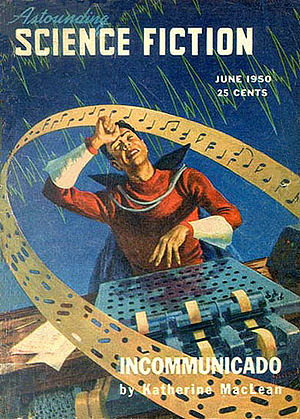
300px-Astound5006I’ve been a subscriber to a well-known science fiction magazine, Analog,  for many years. I am actually considering letting my subscription lapse, because for the last five years or so I have struggled to find something enjoyable in their magazine.  I no longer enjoy the work they are publishing and they no longer seem to care. While there are occasional nuggets, the majority of work they publish is frequently harsh, lifeless, depressing, and incomprehensible. The fact is, perhaps they have forgotten what real science fiction is about, what the average reader wants. Perhaps I am no longer smart enough for their publication–and I hate paying to be sneered at.

Despite the efforts of the publishing community, the genre of science fiction is not dead. Andy Weir ‘s brilliant work on The Martian proves that there are writers out there with exactly the sort of stories I am looking for.  And guess what–he published it in 2012 AS AN INDIE.  This is a really telling thing, that the watershed books are no longer being put out there by the Big Six, until they have proven their worth in the Indie market. Hugh Howey, A.G.Riddle, Rachel Thompson–INDIES, all of them.

In my sci-fi, I want human frailties, drama, adventure, intense life and survival against great odds, set against a backdrop of understandable and realistic science.

I want a Space Opera.  Andy Weir gave that to me.

It is that high drama that made the Star Trek empire what it is. High drama set in exotic places made George Lucas’s Star Wars series of movies the poster child for space operas. Those two series translated the intensity of feeling that the great authors of science fiction all brought to their work.

Over the years, I have written many short space operas for my own consumption. However, this fall I am embarking on the real test–putting my writing skill where my mouth is.  It just so happens that off and on for the last  3 years, I’ve been outlining a science fiction story.  Originally, I began this project  in preparation for NaNoWriMo 2013, but this will be the year to implement it, so in November this will be my work.

As a devoted fangirl of many well-known physicists, I’ve been doing  research for the last three years, and feel sure my science will hold up, which, in sci-fi, is key to the longevity of a tale. I have great characters, and a really plausible plot. I just have to spend 30 days stream-of-conscious writing to the prompts I have set forth and…well, that is the trick, isn’t it? But even if I fail to write anything worth publishing, I will have had a good time, and that is what this gig is all about: enjoying the ride.


2 Comments

Filed under Adventure, Battles, blogging, Books, Fantasy, Humor, Literature, Publishing, Self Publishing, WordPress, writer, writing

How dining in Bedlam taught me to write dialogue

Days of Wine and Roses quote copyThe family I grew up in is a loud, all-talk-at-once kind of a family, with a lot of talkative members. Family gatherings are absolute bedlam–large, loud, full of life and great food, and long on opinions and ideas. We are comprised of musicians, artists, and authors, along with engineers and software developers.

Above all, we are avid gamers of all kinds, from old-school Super Mario, to Grid Autosport, to Final Fantasy X/X-2, to Halo, to Assassin’s Creed, to  Dark Souls 2, to Minecraft–and we love to talk, loudly and all at once, about everything we love. Somehow, we all manage to have our say and allow the others have theirs, but it’s like living in a blender at times.

We, and our friends, are loud and passionate and most people love it, but every now and then a visitor can’t handle the hullabaloo.  Sometimes, less outgoing girlfriends or boyfriends don’t get it, and the general din intimidates them.

In fact most people carry on conversations, where one person says something, and the  other one answers, and this goes on like a tennis match until everything has been said.

Huh. Who knew?

So, that is how we want to write our dialogue. We want it to sound natural.

Writers need to keep in mind that when people talk, they rarely follow any grammatical rules. Any English class that writers have taken will have stressed the importance of using proper grammar and punctuation in their writing. However, when we attempt to write dialogue, those same rules should be thrown out of the window. Many times people speak in broken sentences, with pauses, and even use incorrect words.

  1. Don’t overuse character names in dialogue. People don’t use each other’s names in every sentence they speak, because it sounds silly. (“Helen, your hair is lovely.” “Thank you, Ralph.” “Do you want to watch a movie, Helen? “Sure, Ralph, but stop touching my hair.”) When you do use character names in dialogue, use them early in order to indicate to whom the speaker is talking, and after that, be sparing with the monikers.
  2. Avoid writing dialogue that’s really an excuse for “speechifying” (I love that word ♥.)  Avoid giving your characters long paragraphs with lines and lines and lines of dialogue that is uninterrupted.  In real-life conversations, people usually alternate in conversation, and like my family, they often interrupt each other. It is your job to capture the rhythm of real speech–but don’t make it choppy.
  3. The dialogue of one character shouldn’t repeat what was said by the other, unless it is for emphasis in that one instance. “So Helen, what you are saying is, ‘don’t be repetitive.'” “Yes, Ralph, don’t repeat my every word.” “Don’t repeat your sentences.”
  4. DON’T explain your dialogue by adding too many descriptors, such as: John shouted angrily, or Garran commented sulkily. If the meaning is effectively conveyed in what your characters are doing as well as saying, adding these descriptors undermines the dialogue and disengages the reader. Try removing the explanation and see if the meaning is still clear. If it isn’t clear, it’s time to rewrite. By letting the dialogue speak for itself, by describing it less and showing it more, you make it more compelling.
  5. DON’T get creative with your attributions, or ‘dialogue tags’ as we call them: stick to John said (not said John, which sounds archaic in modern literature.) Unless you absolutely need a John screamed or Edwin uttered (which you pretty much never do) just say it and let the reader do the rest. Fancy synonyms for ‘said’ are usually unnecessary and distracting.
  6. And now for my pet peeve:  people do not smile, snort or smirk dialogue. I mean really–“That’s a lovely dress,” snorted Clara. (eeew. )  In fact, it is often best to do away with attributions altogether for a few exchanges every now and then, if:  A. you have only 2 speakers, and B. you have established who is speaking.
  7. Most readers hope authors will avoid trying to convey accent by altering spelling. It gets tiresome to read an author’s attempt to rewrite the dictionary to fit a cockney or an Irish accent, so use colloquialisms and speech patterns instead. That said, if the character is making a MINOR appearance, using an accent will give the reader feeling that they know that character, without resorting to an info dump.
  8. Feel free to break the rules of grammar if your character shows a blatant disregard for what’s correct. If he wants to say, “I seen that movie last week. It were a real dud,” let him.  That is a way to show the description of your characters.
  9. Miss a few beats. Beats are little bits of physical action inserted into dialogue: John fell quiet and stared out the window. Marta turned and walked out the door. Used sparingly, these pauses serve to punctuate the dialogue, to give the scene movement, and to maintain a strong mental picture in the absence of description. They’re best placed where there is a natural break in the dialogue, because they allow the reader to experience the same pause as the characters. Pauses are essential to good dialogue, but don’t overdo it. If your characters are rattling pans, slicing apples or staring out the window between every line of dialogue, the scene becomes about the action and not the dialogue, and the impact of the conversation can be lost entirely.
  10. Once in a while, it is okay to have your characters tell a story within the story, but do it as naturally as possible. Speaking as an older person, I admit that some older character will be just dying to tell the younger ones how it really was. Please don’t use that plot twist as a crutch to dump a chunk of boring background. No one in real life wants to hear an old duffer go on about the good old days at Bob’s Fish Cannery, even if Skyler Webbley did lose a finger that was never found and didn’t notice it until his shift was over when he discovered his driving gloves didn’t fit right. (Just sayin’.)

In regard to proper use of punctuation: it is important to follow the rules in the general narrative but punctuation has a different role in dialogue. There are times when it is used to create pauses in dialogue.

Oh, dear. What have I done? Breathe, Irene, breathe! Inhale…exhale…it will be fine–it’s dialogue, for the love of  Chatty Cathy…we want it to sound normal, not necessarily literate. (Oh, dear, she’s turning blue… . Line editor down! Quick! Someone fan her with the Chicago Manual of Style!)

Or you can properly punctuate your dialogue to your heart’s content.  It’s your book, and your style–you make the decision.

Anyway, to write natural dialogue, observe others around you, see how they talk, what they do with their bodies, and where they pause. These are what you know of them as people, and are what you want to convey in your writing.  What we want our dialogue to do is  give the reader a clear visual of the scene, the characters and their environment. A truly great book is clearly visualized in the mind of reader, so give those clues and hints, but let the reader see for themselves the beauty or horror you are describing though good dialogue and properly setting the scene.

VOS QUOTE


20 Comments

Filed under Battles, blogging, Books, Fantasy, Final Fantasy, Humor, Literature, Music, Publishing, Self Publishing, Uncategorized, writer, writing