
Sue Vincent is an amazing writer and photographer. Images from her blog, Daily Echo, has kick-started my creative muse many, many times.
Category Archives: Books
#amwriting: Redemption and the Hero’s Journey
 Modern fiction often employs the motif of redemption–the notion that a person can counter a lifetime of misdeeds, but to do so, one must commit selfless acts of heroism.
Within the story arc, a fall from grace can make a protagonist more compelling, more multidimensional. A main-character who is not perfect is far more intriguing than a person with no flaws, because they are unpredictable. Nothing is worse than a predictable novel.
I see characters in books as if they were real people living through the events life hands them. When a character in a book experiences confusion, it’s an opportunity for them to learn new things. If they are frustrated, they must devise a way around that frustration, and if they are tested to the limits of their endurance, they will become stronger. Keep this in mind when you are writing. Don’t make things so easy for your beloved characters–their struggle is the story.
No tension equals boredom which equals no readers.
For today’s’ post I’m using a famous work of epic fantasy as my example, but everything that I am saying pertains to every kind and genre of book you will write, assuming it is a work of fiction and involves fictional people. (Does not pertain to technical manuals.) (Insert ‘lol’ here).
Tales that describe the hero’s journey have certain tropes: they all involve a person who goes on an adventure and, in a decisive crisis, wins a victory. He/she then comes home changed or transformed. This is a theme that most epic fantasy novels are built around, as is my medieval fantasy, Huw the Bard, and also my epic fantasy World of Neveyah books. However, every novel about people involves a journey of the human spirit, in one way or another.
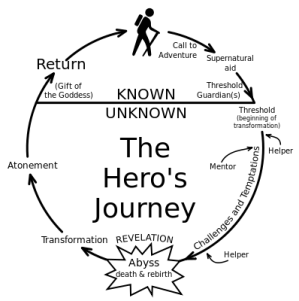
Hero’s journey by Christopher Vogler
So how does redemption fit into the hero’s journey? The events the protagonist experiences change his view of the world and his place in it.
Redemption can be portrayed many ways. A person who commits a terrible crime can do a heroic act, thus counter-balancing his prior sin.
Or there is the charming rogue: at the beginning,his life is focused solely on his own survival. Over the course of the story he gradually begins to care for his companions, and about the cause.
Then, there is the main character who begins the journey as a young and naive person. The first half of the book may show his fall from grace–he becomes disillusioned and callous. At the midpoint of the story arc he is once more transformed. This time events forge him into a hero.
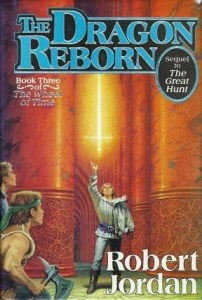
Let’s look at Rand al’Thor, Robert Jordan’s protagonist in the (15 volume) Wheel of Time series. The Wheel of Time has great villains–a LOT of them– which is what drives the highly convoluted story line. There are times when Rand is as villainous as those he battles.
When we first meet Rand he is a naive young man from a rural village, who is pledged to be married to Egwene al’Vere, his childhood sweetheart. Many things occur to change him over the course of the following two years–15 volumes worth of terrible changes, both physical and emotional. In just the first three books:
- Rand is forced to leave home in the dark of night for his own safety.
- He learns he can channel the male half of saidin (magic/the ‘one power’) which means he will go mad, and should be killed for everyone’s safety.
- He is branded on both palms by his blade during an epic battle
- He hears the voice of a long dead madman in his head, and is told he is the reincarnation of that man.
- He is at war with himself and his hated abilities as much as he is with the evil Forsaken.
- He falls in love with three women, who eventually become his three wives, none of whom are Egwene, his fiance. This love-quadrangle challenges his strict sense of morality, increasing his stress.
- He discovers the parents he was raised by were not his birth parents, and that he is the center of a prophecy.
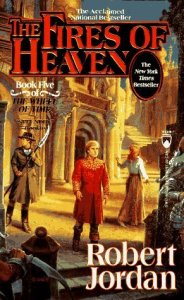 These things are just the tip of the iceberg that is the multitude of burdens carried by Rand al’Thor. As his story arc progresses, Rand starts out with well-meaning intentions, wanting to use his powers for good. As he gains power both politically and in the use of saidin, he becomes a tyrant in his own right. But he is still a good man despite his desire to feel nothing, and once again, though his own folly, he is completely broken down to his component parts. It is during the aftermath of his final breakdown that he is made a truly strong, competent leader.
Rand’s ultimate acceptance of who he is, the reincarnation of Lews Therin Telamon, is the key to his redemption. Only then does he have the chance of winning the prophesied battle against the Forsaken at Tarmon Gai’don.
When I read a book whose protagonists and villains challenge me I return to it later and analyze what it is about those characters that inspired such an emotional reaction in me. It always comes back to their many layers of good and bad traits.
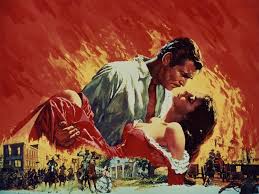 Consider Margaret Mitchell’s classic, Gone With the Wind: Rhett Butler is a man with many faults, but who is, underneath it all, a decent, likable person.
Characters that are multi-layered are intriguing, and will keep the reader turning the pages, to see what they will do next.
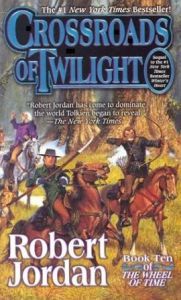 It is a rare person who is completely consumed by evil, and so when we see the softer side of the devil we grudgingly like him. Because of that idea, I’ve spent a lot of time looking at how Robert Jordan portrayed the Forsaken.
Lanfear and Asmodean were frequently pleasant, engaging people and one could feel a certain sympathy for them despite the knowledge that they had pledged their souls to serve evil. Even Demandred had a certain cachet that one could relate to. Each one had the potential and the latent desire for redemption–and each chose to grasp for greater power instead.
What kept Robert Jordan’s die-hard fans waiting patiently for him to finish the series was his compelling characters–and that was also Jordan’s weakness as an author. He fell in love with the minor players and soon the side characters became as important in his mind as Rand al’Thor.
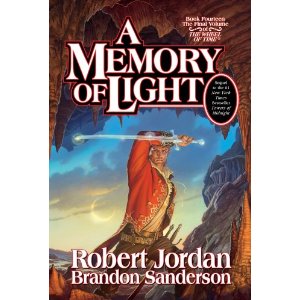 This chasing after so many character’s threads derailed the series for several books, because although they were entertaining books, they did not advance the story. Many readers lost interest by book six, and Brandon Sanderson had to really exercise restraint when, after Jordan’s death, he was tapped to finish writing the series (from Jordan’s copious notes).
Some characters in my own work also have story lines that feature elements of the hero’s journey, some experience a fall from grace, and find redemption. Character development within the core group and reining in my enthusiasm for the side characters is my current task, as I embark on the final draft of Valley of Sorrows.
Tempting though a “fifteen book trilogy” is, I vow that Edwin Farmer’s story will be completed within this last of the three books in the Tower of Bones series.
If the literary muses are willing, the side characters can have their own books, later.
Filed under Books, Fantasy, Literature, writing
Into the Woods, a fantasy anthology
 We at Myrddin Publishing Group are starting the new year with the launch of our anthology, Into the Woods. We’re even having an all-weekend-long Facebook party, with Myrddin Authors dropping in and out over the course of the next few days. There will be gifts, and prizes and just fun and games with the Myrddin crew. The online Facebook Party starts here, so stop on by and and hang out with us!
This collection of amazing tales came about almost by accident.
One day last summer I was looking through stock images I’d found for a cover I was designing for another author. I came across a wonderful image of a lonely house set in the woods. I’m not sure why, but suddenly, like the proverbial dog after a squirrel, I was off looking at images of houses in the woods–like that was going to get any work done.
Of course, my brain is hardwired to write stories, so I found myself imagining all sorts of scenarios and plots to go with these amazing images. Then, it occurred to me that if I was inspired to write by these images, my fellow authors here at Myrddin Publishing would also be.
I threw out a challenge to the group: Write a short story about a house in the woods. The only caveat was the tale had to fall under the genre of fantasy, and the theme was “a house in the woods.”
And wow! What a response– I received nine wildly different tales, ranging from humor to ghostly, to romantic, to horror. These ten tales are some of the best I have read.
In the first tale, “A Peculiar Symbiosis,” Alison DeLuca gives us a moving story of a man who discovers he loves his wife–but only after she is dead.
“The Forest House” is my own take on the Tam Lin tale. Tam Lin is a character in a legendary ballad originating from the Scottish Borders as collected by Francis Child, but there are many tales from all over northern Europe featuring variations on his name, and the story will have slight variations. It is also associated with a reel of the same name, also known as Glasgow Reel. I had always wondered if Tam Lin and the Faerie Queen had a child, and if they had, what would have happened to it when Janet rescued Tam?
In “A House in the Woods,” Stephen M. Swartz takes us back to the 1960s with this dark fantasy. Two boys playing in the woods come across an abandoned house, and discover a true ghost story.
Irene Roth Luvaul takes us deep into the forest in “The Guardian.” A woman discovers her family’s history, and the terrible secret a cabinet once held.
Ross M. Kitson offers up a “A Matter of Faith.” In this dark prequel to Kitson’s epic Prism series, an uptight paladin must find a way to work with a free-thinking druid, if he is to be successful in finding and killing a demon.
In “If I Have to Spell it Out” Austin musician and author Marilyn Rucker lightens things up with her hilarious take on two cousins quarreling over the tenancy of their family home, via letters.
“A Haunted Castle” by Lisa Zhang Wharton shows us that a house can can also be a haunted castle in the Bavarian Forest, in her hilarious, hallucinogenic tale of ghosts, rottweilers, and a costume party.
Myrddin Publishing Group’s own master of horror, Shaun Allan, swings us back to the dark side with a horrifying twist on the Hansel and Gretel tale, with “Rose.” Told with his usual flair for words and style, this is a chilling story of demonic magic. Definitely not your mama’s Hansel and Gretel!
In “Hidden,” Carlie M.A. Cullen takes us deep into the woods, where two young women take shelter from a storm in an abandoned house, with terrible consequences.
For the final tale in this treasury, fantasy author Lee French presents us with a post-Civil War tale of star-crossed love, in her magical tale, “Forever.” Tara and Marcus share a forbidden love–and only one place is safe for them.
I am continually amazed and awed by the talent of the wonderful authors I am privileged to work with at Myrddin Publishing Group. You can purchase this wonderful collection of short stories at Amazon by clicking on the buy button below:
Into the Woods: a fantasy anthology

Filed under Books, Fantasy, Literature, writing
#amwriting: Voice vs lazy writing
 I find it aggravating when I read a book where the characters “begin” to do things.
If you watch them in real life, people don’t “begin” to pick up that knife. They don’t “start” to walk away. They pick up the knife. They walk away.
Using “begin” and “start” to commence a “doing” scene is a lazy writing habit we have to train ourselves out of. We are thinking the tale, and writing it as it falls from our head. Because we get into storytelling mode, the dog begins to bark, and the neighbors start to complain.
A narrative where people begin and start to do things separates the reader from the story. And when we are in storytelling mode we pepper our manuscript with too many descriptors, and give too much information. All first drafts will have some instances of lazy writing–not because we’re lazy. It’s quicker to write your story down in this fashion and it gets the thoughts out on the paper before they vanish.
But these shortcuts are what we clean up in the second draft.
I let the words flow as they will when I am writing the story down. When an idea has me in its grip I don’t worry too much about phrasing. This is why first drafts are uneven and rough, and why they shouldn’t be shared with too many people. Sharing short snippets in your writing group is one thing, but for the love of Tolstoy, don’t publish that mess!
At the first draft stage, the most important thing is to simply get it out of your head and onto the paper. Once that is done, it’s time to go through the ms on a paragraph by paragraph basis and tweak the weak sentences, making the story become in reality what it is in your mind’s eye. This is the second draft, where we wrangle the tale into something a reader might want to “test-drive” for us. It may take more than two drafts to get a manuscript to that point. At least for me it frequently does.
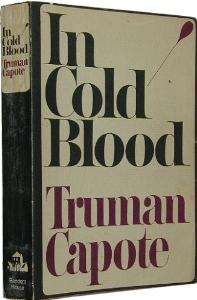 Every author, no matter how famous, has a unique way of getting the work out of their heads and on to the paper. Every author then has to go through the second phase of the process, which involves both cutting out whole sections, and tweaking what remains until you can’t see the forest for the trees. Truman Capote said, ”Editing is as important as the writing. I believe more in the scissors than I do in the pencil.”
Capote died at the age of sixty having written one of the most highly acclaimed works of our time, In Cold Blood. He’s gone, but his words live on and when you look at his work, you can see he put his philosophy to practice.
I regularly read the works of other authors. But what makes some work a memorable experience? Why are others are okay, but lacking something?
It’s not only a great plot, crucial though it is. Even bad books often have a good idea for a plot.
Also, it’s not just having great characters, although no book is worth reading without them, in my opinion.
Every gripping story has both of those crucial things, but also has a third thing, something that is indefinable and can’t be duplicated: a style that is recognizably that particular author’s voice.
That combination is what hooks and lands me as a reader.
These things are the holy trinity that combine to make a classic tale:
- gripping plot
- great characters
- unique voice
What is “Voice”? Wikipedia, the fount of all knowledge, says: The writer’s voice is the individual writing style of an author, a combination of their common usage of syntax, diction, punctuation, character development, dialogue, etc., within a given body of text (or across several works).
Use your voice to create strong sentences that intrigue and capture the reader. Passive, telling sentences lose the reader’s interest.
We all feel a flash of anger when certain flaws in our work are pointed out. However, when an editor corrects your lazy writing habits they aren’t trying to change your voice. They’ve seen something good in your work, and they’re pointing out places where you can tighten it up and grow as a writer. Remember, voice is how you use syntax, diction, punctuation, character development, and dialogue.
You have a unique voice. Hopefully, in your writing you also follow the commonly agreed upon rules of the English language (if your work is written in English). We shouldn’t write the way we speak. Our casual conversation is sprinkled with words and phrasing we shouldn’t use in our writing except in the dialogue portion of the manuscript. After all, we want our dialogue to feel comfortable when it is read aloud.
Lazy writers
- Use too many quantifiers “It was really big.” “It was incredibly awesome.”
- “Tell” the story instead of showing it: “Bert was mad.”
- Swamp the reader with minute details: “Mary’s eyebrows drew together, her lips turned down, and her cheeks popped a dimple.”
- Ruin the taste of their work with an avalanche of prettily written descriptors: “-ly” words
- Have their characters natter on about nothing just to kill time. It doesn’t show them as human, it shows them as boring.
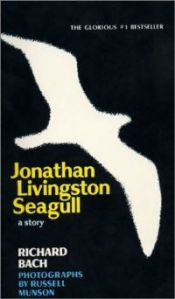 Whether you write essays, novels, technical pieces, or flash fiction you should write something new every day, even if it is only a short passage. Writing daily develops your skills and over time your prose becomes leaner and your voice becomes well-defined. Richard Bach, author of the amazing novella, Jonathan Livingston Seagull, said, “Never stop trying. A professional writer is an amateur who didn’t quit.”
Tighten that prose. Comb the manuscript for telling words and be sparing with descriptors.
And be prepared to see red ink when the manuscript comes back from the editor despite your efforts to craft perfect prose.
That is just a part of this process.
Filed under Books, Publishing, writing
#EveningWithTheAuthors: Upcoming events and new releases
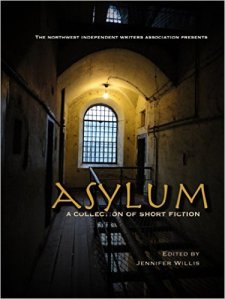 NIWA (Northwest Independent Writers Association) has published their second anthology, ASYLUM: a collection of short fiction.
But first, the blurb:
A religious refugee fleeing for his life in his own country. A trickster asking an enemy for safe haven. A horrific visit to a psychiatric ward overrun by its charges. An unexplained theft from a biomedical lab. The last known survivor of a mysterious plague. A wormhole to the most peaceful and secret place in the world. A detective on the trail of a human trafficker.
What does asylum mean to you?
In the 2015 anthology collection from the Northwest Independent Writers Association, seventeen authors explore the obvious and hidden meanings of this theme—from a werewolf on a mission and self-sacrifice in a post-apocalyptic world, to shadowy wizardry, a questing knight, and a gentle prison for geniuses.
Featuring stories by:
Jeffrey Cook • William Cook • Pamela Cowan • Jonathan Ems • Ginger Dawn Harman • Connie J. Jasperson • Madison Keller • Cody Newton • E.M. Prazeman • Katherine Perkins • Dey Rivers • Walt Socha • D.L. Solum • Laurel Standley • Rebecca Stefoff • Jennifer Willis • Matthew Wilson
The Northwest Independent Writers Association (NIWA) supports indie and hybrid authors and promotes professional standards in independent writing, publishing, and marketing. Learn more at NIWAwriters.net.
One of my short works, Billy Ninefingers: Fairybothering, has been included in this collection of terrific short stories. Huw the Bard makes an appearance, but the real story revolves around Billy Ninefingers, the Rowdies, and the fundamental idea of asylum–the concept around which the town of Limpwater has grown. The Fat Friar, Robert DeBolt, pushes Billy to widen his horizons and take on a bad job in this wandering tale of snark and strange majik.
>>><<<
 Also–my friends at Writerpunk Press are about to release their second charity anthology, with all profits going to benefit PAWS animal rescue and shelter in Lynwood, WA. If you are on Facebook, please come help celebrate the release of Once More Unto the Breach: Shakespeare Goes Punk, vol. II, follow up to Sound & Fury: Shakespeare Goes Punk with them.
The link for the Facebook event is: Release Party for Once More Unto the Breach: Shakespeare Goes Punk 2
The Blurb:
Welcome to the world of Shakespeare Goes Punk, where the Bard is remixed and nothing is sacred. Our fearless writers are back by popular demand to give you a ride on the punk train.
Five punked-up tales and three sonnets inspired by Shakespeare. All profits to charity.
As You Like It
The Tragedy of Livingston (Coriolanus)
Blast the Past: Fae and Far Between (A Midsummer Night’s Dream)
Dogs of War (Julius Caesar)
Hank (Henry V)
Clockpunk Sonnets (18, 105, 127)
Sounds intriguing! Along the way, there’ll be some great authors and contributors, some giveaways, and some fun people talking about the Writerpunk project.
>><<<
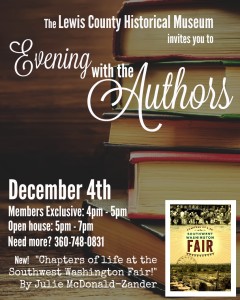 And last but not least–I will be signing books in Chehalis, Washington, at the Lewis County Historical Museum’s 5th Annual Evening with the Authors, on Friday, December 4th, 2015 from 5:00 pm to 7:00 pm.
Besides me, participating authors include Sandi Crowell, Jan Pierson, Mary Stone, Karen Frazier, Jake Blake, Roy Wilson, Buddy Rose, Julie McDonald Zander, Jennifer Shaw Wolf, Lisa Burnett, Michael Hurley, and many others.
This event will feature many genres of books from local history, fiction, non-fiction, inspirational, and children’s books.
Comments Off on #EveningWithTheAuthors: Upcoming events and new releases
Filed under Books, Publishing, Uncategorized, writing
#amreading: Mad Science Institute, by Sechin Tower
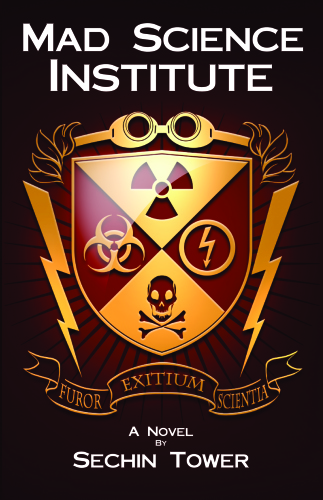 I have been catching up on my long-put off reading, starting with a book by fellow Northwest indie author Sechin Tower, Mad Science Institute . I had a great time reading this particular YA novel. But first, The Blurb:
Sophia “Soap” Lazarcheck is a girl genius with a knack for making robots—and for making robots explode. After her talents earn her admission into a secretive university institute, she is swiftly drawn into a conspiracy more than a century in the making. Meanwhile and without her knowledge, her cousin Dean wages a two-fisted war of vengeance against a villainous genius and his unwashed minions. Separately, the cousins must pit themselves against murderous thugs, experimental weaponry, lizard monsters, and a nefarious doomsday device. When their paths finally meet up, they will need to risk everything to prevent a mysterious technology from bringing civilization to a sudden and very messy end.
My Opinion: This book totally lives up to it’s promise. Soap is a great character, and so is Dean. She is a little too adventurous in the laboratory, and things sometimes go awry. The story opens with her, and immediately shifts to Dean’s story, but shifts back again.
Dean is older, is a firefighter who loves his work, and has relationship issues, which launch him into the thick of things.
Soap is a feisty girl, who is launched into a series of immersive adventures. She’s a bit testy and awkward when it comes to interpersonal relationships.
The author, Sechin Tower, is a teacher in his real life, and I think he must be pretty awesome in the classroom, because the story contains a lot of historical information imparted in regard to Nicola Tesla and his scientific legacy, presented in such an entertaining way the reader doesn’t realize they’re learning.
All in all, I have three grandkids who would really enjoy this book–and Santa will be obliging this year!
Comments Off on #amreading: Mad Science Institute, by Sechin Tower
Filed under Books, Humor, Uncategorized
#amwriting: keeping the Goliardic spark alive

The Battle of Carnival and Lent, Pieter Bruegel the Elder
I love ribald, rebellious humor in the works I read, and will go out of my way to read anything written by Sir Terry Pratchett, Douglas Adams, or Jasper Fforde. I admire their wit and ability to cause us to laugh at our own outrageousness.
Crazy humor at the expense of the establishment is nothing new. It’s part of the Human Condition. And to that end, I love goliardic poetry.
Carl Orff and his amazing cantata, Carmina Burana, catapulted me into the poetry of the Goliards. But who and what were the goliards?
During what we call the Middle Ages, noble and wealthy middle-class families had a tradition that the eldest son inherited everything, the second son went into the church, and the younger sons went to the crusades.
The old-fashioned practice of “primogeniture” or bestowing the rights of inheritance upon the eldest son, often leaving younger sons penniless, is responsible for some of the most ribald and hilarious poetry of the middle ages. This was because the church had far too many clergy who weren’t all that enthusiastic about having been forced into taking the ecclesiastical path, and who became, for lack a better definition, medieval frat-boys.
There was such an abundance of well-educated clergy that most were unable to gain a decent appointment within the church, despite good family connections.
Having been educated at the finest universities of France, Germany, Spain, Italy, and England these men weren’t content to spend their lives hidden away in a rural monastery painstakingly copying the great books written by others when they could be writing their own.
Going indie (or rogue) is nothing new.
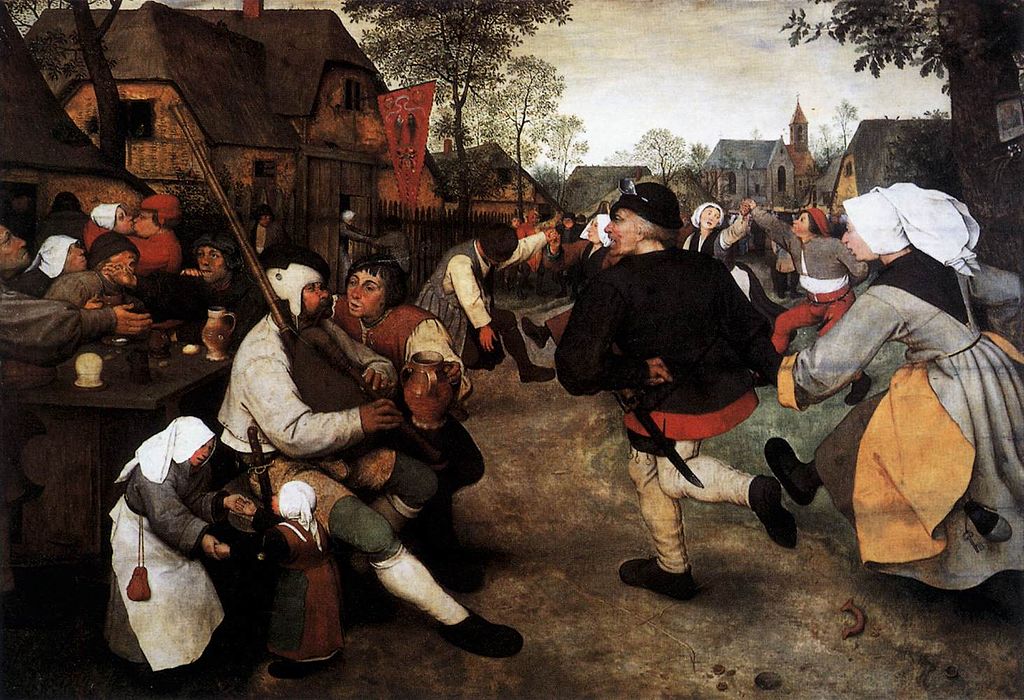
The Peasant Dance, Pieter Bruegel
They took their show on the road, going from town to town, protesting the growing contradictions within the church through song, poetry and performance.
The disillusionment and disappointment they experienced in regard to the hypocritical, abusive, greedy state of the hierarchy of the Catholic Church of that time, was fertile soil for medieval mockery on a grand scale.
Not unlike the current political climate here in the US.
Most goliardic poetry is written in Latin, as Latin was the language of commerce, and every educated person understood and read it. Remember, if someone could read, they were well off, and if they could read, they read Latin. Those were the people the indie was writing books for in the early Middle Ages.
Some of the goliards’ more popular church services when they would arrive in a new town included celebrating the annual Feast of Fools, a brief social revolution, where roles were reversed, and power, dignity and impunity was briefly conferred on the lowest of the social order. Thus, the town drunk, or the local fool would be made mayor for a day, feted and given the status of a lord for a day.
As you might imagine, the nobility was unimpressed with that particular “holy” festival, and rarely participated
Even less popular with those in power was the Feast of the Ass. From Wikipedia, the holy fount of all knowledge: A girl and a child on a donkey would be led through town to the church, where the donkey would stand beside the altar during the sermon, and the congregation would “hee-haw” their responses to the priest.
So, I guess you could say the goliards were a traveling Monty Python type of show, painfully hilarious and sometimes too good at what they did for the censor’s comfort.
Their point was that too much emphasis was placed on the pageantry and trappings of faith in Medieval Europe.
But they couldn’t run forever. Their satires were almost always directed against the church, attacking even the pope, and the church didn’t take that well. Heresy, during the Middle Ages, was not something you wanted to be accused of, as the famous heretic and collector of goliardic poetry, Peter Abelard would tell you. Yet, though he was harshly punished, he remains one of the most respected philosophers and free-thinkers of the Middle Ages.
By the 14th century, the word goliard had become synonymous with minstrel, no longer referring to this group of rebellious clergymen. However, a century after the overabundance of bored poor-little-rich-boy clergymen that spawned the goliards had been squashed by the church, that tradition of irreverence was carried on by Geoffrey Chaucer in his Canterbury Tales.
 For me, Orff’s cantata was a ‘gateway drug.’ From first becoming intrigued by the libretto to Carmina Burana, I moved on to “the hard stuff,” studying modern translations of the works of an author who was highly influenced by goliardic poetry, Geoffrey Chaucer.
Of course, eventually that meant I had to go to the source, learning a great deal about the roots of our modern English language at the same time.
Chaucer was unique, in that he wrote in Middle English, the vernacular of his time, rather than in Latin. Because of this, and the enduring hilarity of his works, Chaucer is considered the Father of English Literature.
The goliardic works that survive to this day still surprise us with how relevant the concepts put forth in those poems and tales are to contemporary society.
It is through the surviving literature and song that the truth of a past culture is discovered. The true nature of the common medieval man and woman survives in the rebellious, ribald literary tradition of the naughty clergy, the goliards.
We may be separated in time by centuries, but we are not too different from those ancestors of ours who survived the Dark and early Middle Ages by getting drunk and singing bawdy songs, and poking fun at the establishment.
Mapping the Story
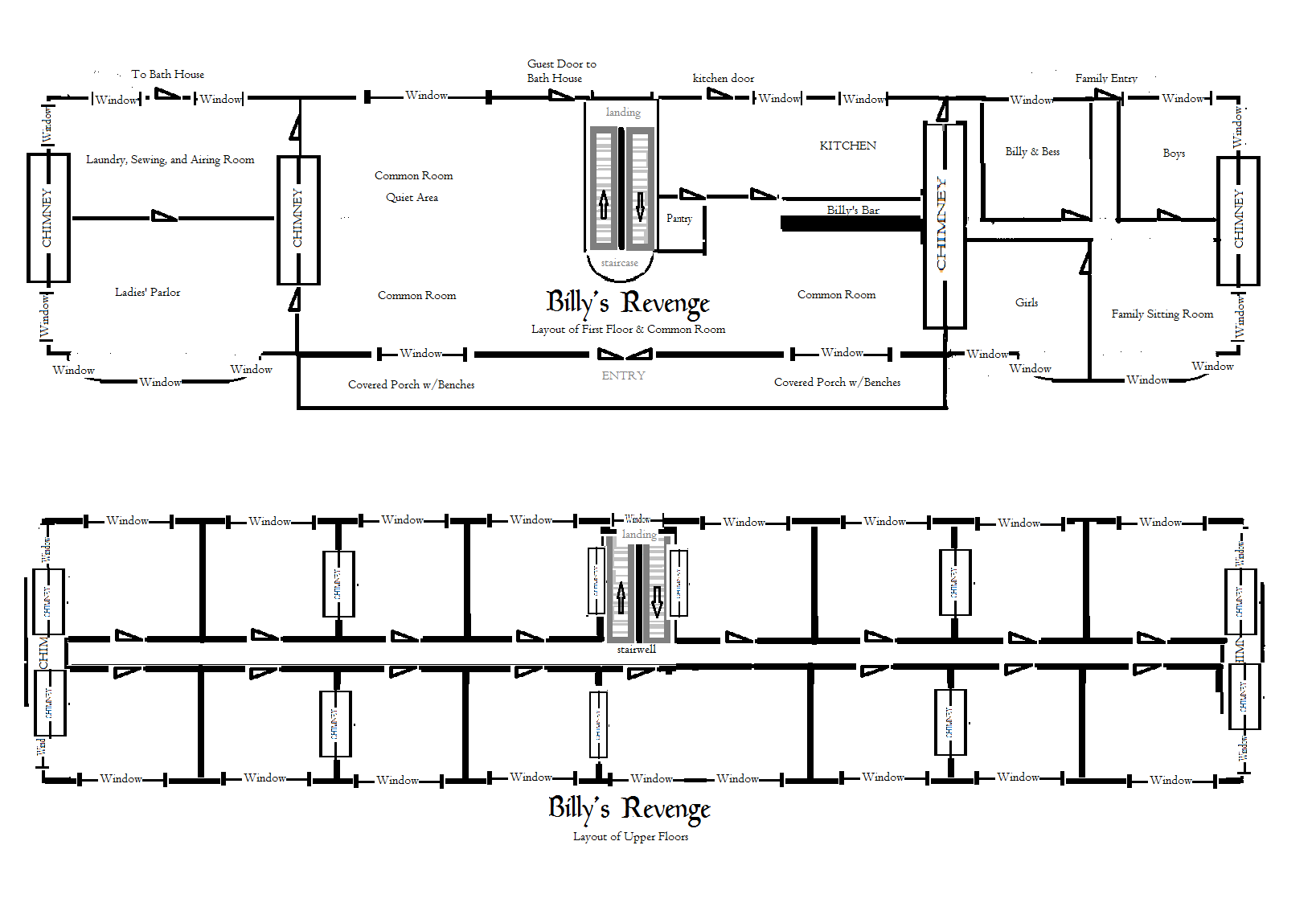
Billy’s Revenge © Connie Jasperson 2015
I was worried I wouldn’t have a blog post for today. The power was out most of Saturday due to a large storm here, and there have been times when that lasts three days here. When that happens I have no way to post my blog, although I hear you can post them from cell phones if you know the magic words.
I’ll just say that if I have to key my blog on a cell phone, it will take 5 years to get it ready for posting. I am the world’s slowest text-message-er. Of course, if you have predictive texting set up, and make good use of auto-fill, you could have some real fun, and do it quickly! But that was another blog post.
After the power outage, my printer/scanner was not speaking to my computer, so I couldn’t print or scan. I did behave, no temper tantrums here. My IT man, (a.k.a. my beloved, long-suffering husband with the patience of a saint) took the time to rectify that situation. I was at the limits of my endurance with that thing.
So, because our power was out, I worked on a pencil sketch of a new map for an upcoming novel, Billy’s Revenge. On Sunday, I digitalized it. It isn’t complete, and is out of proportion in some places but when it is finished, it will tell me everything I need to know about Limpwater.

Map of Limpwater, © Connie Jasperson 2015
I always have some sort of map to work with, even if it’s just scribbled, when I am writing in a world of my invention, and they all start out as pencil sketches. Eventually, they become the digital versions you see in my books.
That book will consist of 1 novel and 4 short stories that all revolve around the inn known as Billy’s Revenge. Huw the Bard returns, as does Julian Lackland. Billy Ninefingers has a few misadventures that threaten his career, mess with his chances to convince Dame Bess to marry him, and set him on a path he never thought he would find himself traveling.
In the opening short story, we meet Eddie, Billy’s father, and see the origins of the Rowdies. Eddie’s story sets the stage for Billy’s trouble with Bastard John. Several short stories that were cut from The Last Good Knight will be included at the end of Billy’s novel, as they don’t pertain to Julian Lackland as much as they do the entire group of Rowdies, Billy Ninefingers included, and they are fun stories.
BR Pub Sign © Connie Jasperson
I’ve had the sign that will hang over the porch in front of Billy’s inn ready for quite a while–hanging it is going to be the trick.
When the power went out, I had Photoshop open and was working on the cover for Valley of Sorrows. But while I know how the graphics will be and I am happy with their layout, I’m not really happy with the art I have located so far, but it’s still early days. I will keep searching, which I enjoy doing.
Anyway Saturday was not as productive as it could have been.
And Sunday was a busy, catch-up day. Fortunately, it rained off and on all day, so I was able to finish a lot of what I needed to get done. Today will be as crazy as any Monday ever is, and I will simply have to make time for revisions. All I need is an hour here and there. I am close to having it ready for editing. I will have Valley of Sorrows published in the spring of 2016, if all continues to go well.
Filed under Books, Publishing, Uncategorized, writer, writing
5 Books: Society’s Mirror
The Green Mirror, by Guy Rose PD|80 via Wikimedia Commons
Most authors do not sit down and say “I am going to write a novel and this will be the message.” However, as we progress in writing a given work, certain social themes that are important to us at that moment will emerge.
Most of the time social themes will emerge as a natural outgrowth of the creative process. That particular story may have begun as a a “what if” moment, which, during the process of writing, becomes a powerful story.
We don’t sit down to write with a particular moral or political agenda in mind, but our own values will come out in who the characters we create are, how they perceive their world, and in the society we create as the backdrop for them.
Some of the most gripping works of modern literature occurred when an author was particularly moved by a situation presented by the society in which he lived:
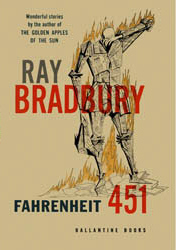 Fahrenheit 451 is a dystopian novel by Ray Bradbury published in 1953, the year I was born. It is regarded as one of his best works. The novel presents a future American society where books are outlawed and any that are found are confiscated and burned. The title refers to the temperature that Bradbury believed was the ignition point of paper.
Besides having an incredible cast of characters set in compelling situations, the novel discusses and exposes the role of book burning in suppressing dissenting ideas. In a 1956 radio interview, Bradbury stated that he wrote Fahrenheit 451 because of his concerns at the time (during the McCarthy era) about the threat of book burning in the United States.
Fahrenheit 451 remains a classic, because the societal pressures and fringe threats that inspired Bradbury to write this novel still exist, perhaps even more so than during the McCarthy era.
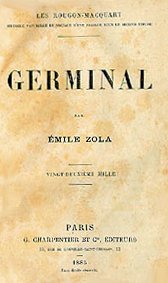 Germinal (1885) is the thirteenth novel in Émile Zola‘s twenty-volume series Les Rougon-Macquart. (From Wikipedia:) Often considered Zola’s masterpiece and one of the most significant novels in the French tradition, this novel is an uncompromisingly harsh and realistic story of a coal miners’ strike in northern France in the 1860s. It has been published and translated in over one hundred countries and has additionally inspired five film adaptations and two television productions.
Germinal is a brutal depiction of the poverty and wretchedness of a mining community in northern France under the second empire. At the center of the novel is Etienne Lantier, a handsome 21 year-old mechanic, intelligent but with little education and a dangerous predisposition to murderous, alcoholic rage. Germinal tells the parallel story of Etienne’s refusal to accept what he appears destined to become, and of the miners’ difficult decision to strike in order to fight for a better standard of life.
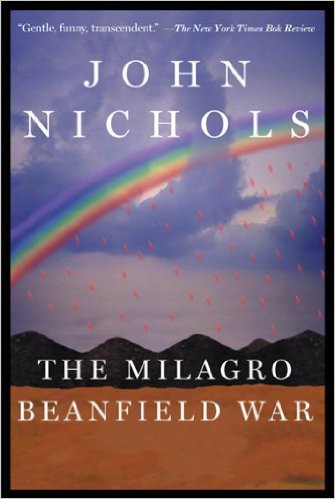 The Milagro Beanfield War, 1974, is the first book in John Nichols‘ New Mexico Trilogy. The book opens when Joe Mondragon, a feisty hustler with a talent for trouble, slammed his battered pickup to a stop, tugged on his gumboots, and marched into the arid patch of ground. Carefully (and also illegally), he tapped into the main irrigation channel. And so began-though few knew it at the time-the Milagro beanfield war.
But like everything else in the dirt-poor town of Milagro, it would be a patchwork war, fought more by tactical retreats than by battlefield victories. Gradually, the small farmers and sheep-men begin to rally to Joe’s beanfield as the symbol of their lost rights and their lost lands. And downstate in the capital, the Anglo water barons and power brokers huddle in urgent conference, intent on destroying that symbol before it destroys their multi-million-dollar land-development schemes. The tale of Milagro’s rising is wildly comic and lovingly tender, a vivid portrayal of a town that, half-stumbling and partly prodded, gropes its way toward its own stubborn salvation.
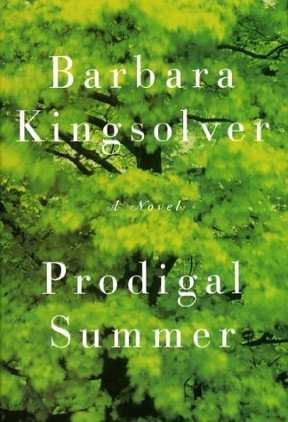 Prodigal Summer (2000) is the fifth novel by American author, Barbara Kingsolver. It is a hymn to wildness that celebrates the prodigal spirit of human nature, and of nature itself. It weaves together three stories of human love within a larger tapestry of lives amid the mountains and farms of southern Appalachia. Over the course of one humid summer, this novel’s intriguing protagonists face disparate predicaments but find connections to one another and to the flora and fauna with which they necessarily share a place.
The narrative follows Deanna, a solitary woman working as a park ranger, Lusa, a widowed farmwife at odds with her late husband’s tight-knit family, and Garnett, an old man who dreams of restoring the lineage of the extinct American Chestnut tree.
Kingsolver’s extensive education in biology is on display in this book, laden with ecological concepts and biological facts. Her writing also exhibits her knowledge of rural Virginia, where she grew up.
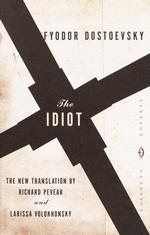 The Idiot, first published serially in The Russian Messenger between 1868 and 1869. is a novel written by Fyodor Dostoyevsky. (From Wikipedia:) The 26-year-old Prince Lev Nikolayevich Myshkin returns to Russia after spending several years at a Swiss sanatorium. Scorned by the society of Saint Petersburg for his trusting nature and naiveté, he finds himself at the center of a struggle between a beautiful kept woman and a virtuous and pretty young girl, both of whom win his affection. Unfortunately, Myshkin’s very goodness precipitates disaster, leaving the impression that, in a world obsessed with money, power, and sexual conquest, a sanatorium may be the only place for a saint.
Elizabeth Dalton wrote that in The Idiot, more than in any other of Dostoevsky’s works, we are shown the actual experience itself of one mind wrestling with the various tensions of life – rather than simply dwelling on intellectual speculation, as we see in Crime and Punishment and Notes from Underground.
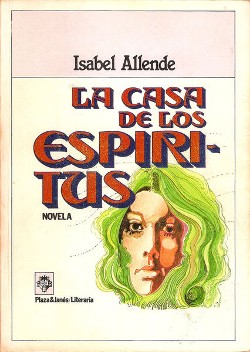 The House of the Spirits (Spanish: La casa de los espíritus, 1982) is the debut novel of Isabel Allende. In one of the most important and beloved Latin American works of the twentieth century, Isabel Allende weaves a luminous tapestry of three generations of the Trueba family, revealing both triumphs and tragedies. Here is patriarch Esteban, whose wild desires and political machinations are tempered only by his love for his ethereal wife, Clara, a woman touched by an otherworldly hand. Their daughter, Blanca, whose forbidden love for a man Esteban has deemed unworthy infuriates her father, yet will produce his greatest joy: his granddaughter Alba, a beautiful, ambitious girl who will lead the family and their country into a revolutionary future.
The House of the Spirits is an enthralling saga that spans decades and lives, twining the personal and the political into an epic novel of love, magic, and fate.
>>><<<
These stories are powerful because of the characters that were created when that “what if” moment occurred, and because of the societal pressure under which their stories unfold. They are considered among the greatest works in modern literature, and all of them are gripping, moving works of fiction, heavily laced with the social reality of the authors’ times.
All of these books are considered masterpieces, and each one struck a chord one way or another with me, although I confess, although each made a large impression on me, I have not reread most of them in recent years.
All of these books are available at your local library, or very reasonably priced at Amazon.com.
Filed under Books, Literature, Publishing, writer, writing
The clock, groceries, and a new thesaurus
 At times the world seems to be conspiring against me. I have to drop what I’m doing, load up the van, and head up to town for something as mundane as groceries. Food should order itself, deliver itself, and put itself away.
But no. Where is my android butler and why is he not doing the shopping? Just like the flying car I was promised when I was child, my android butler is in the Jetsons‘ style garage of my imagination.
But sometimes I get two or three pages of writing done in the 20 or 30 minutes before I have to leave the house for an appointment. There is something about the pressure of knowing I will have to quit at a certain time that forces me to be more productive than I would ordinarily be.
Why is this? When I am pressed for time I use every second to get those ideas out of my head. I don’t stop and research on the good, old, time-wasting internet, and I don’t worry about whether or not I am overusing a word in the narrative. This is a rough draft–all of that can be ironed out when I have more leisure–the next day usually.
 Some of my best ideas have come about under a time crunch. Normally when I am writing on a stream-of-consciousness level, I can key about fifty words a minute–paltry compared to today’s young-uns who grew up keying their homework rather than writing it in cursive.
I do admit that just because I can key those words does not mean they will all make sense, or be worth reading. But that again is why we are driven to look at what we just wrote the day after we wrote it–did it say what I meant? How many times did I use the word “noose” in that particular chapter and where am I going to find six different alternatives for such a unique word?

A little rephrasing here, cutting there, and voila! It looks like a poodle!
It’s a jungle in my head sometimes, and my ancient student edition of Roget’s Thesaurus is my friend. But neither the old student version of the thesaurus from 40 years ago, nor the modern, online version is cutting it for me right now.
I need more synonyms. Lots, and lots more!
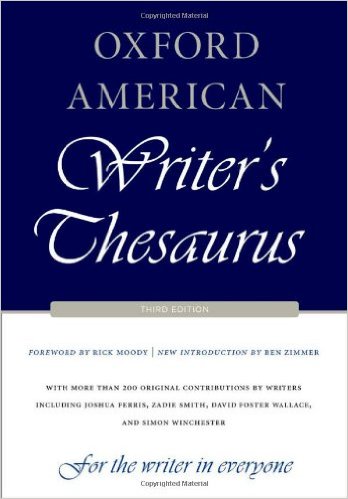
I have just now invested in a bigger, better, hardcover thesaurus. Thus I now have the Oxford American Writers’ Thesaurus winging it’s way to my doorstep. I expect the drone to drop it on Saturday.
 Some references have to be in hard-copy–such as The Chicago Manual of Style, which is the most comprehensive style guide geared for writers of essays, fiction, and nonfiction. Strunk and White’s Elements of Style is a good beginner style guide, but I found it hard to navigate and couldn’t always find what I wanted. The Chicago Manual of Style is written specifically for writers, editors and publishers and is the industry standard.
Just as a side note–if you are using AP style you are writing for the newspaper, not for literature–two widely different styles with radically different requirements. AP style was developed for expediency in the newspaper industry and is not suitable for novels or for business correspondence. For business, you want to use the Gregg Reference Manual.

Eternal Clock, Robbert van der Steeg CC|2.0 via Wikimedia Commons
All in all, I like the way being forced to produce words in a short time helps me lay down a rough draft. But being short on time is big pain when I am trying to revise and iron out stubborn, repetitive wrinkles in a narrative.
Summer is nearly over, and with that comes the long, dark days of the northern winter. I won’t be going as many places (I hope). But with the advent of September I will be spending longer hours editing for clients. My personal productivity will drop in regard to my own work, but I will still find time to write.
And I will also find time to revise. I am nearly at the end of two books written for the World of Neveyah series. Valley of Sorrows will wind up the Tower of Bones series–it is completed and is in revisions. The Wayward Son is nearly complete. While The Wayward Son is not actually a part of the Tower of Bones series, much of it does run concurrently with Forbidden Road, as it is the story of John Farmer’s redemption.
Today will be busy–groceries can wait until tomorrow. Today I am working as hard as I can, trying to get Valley of Sorrows ready to be edited, so that the ToB series will be complete, and also to get John’s story out there too.
Filed under Books, Humor, Literature, Publishing, writer, writing


 Life in the Realm of Fantasy