Category Archives: Literature

#Inspiration: Oppression, rebellion and art

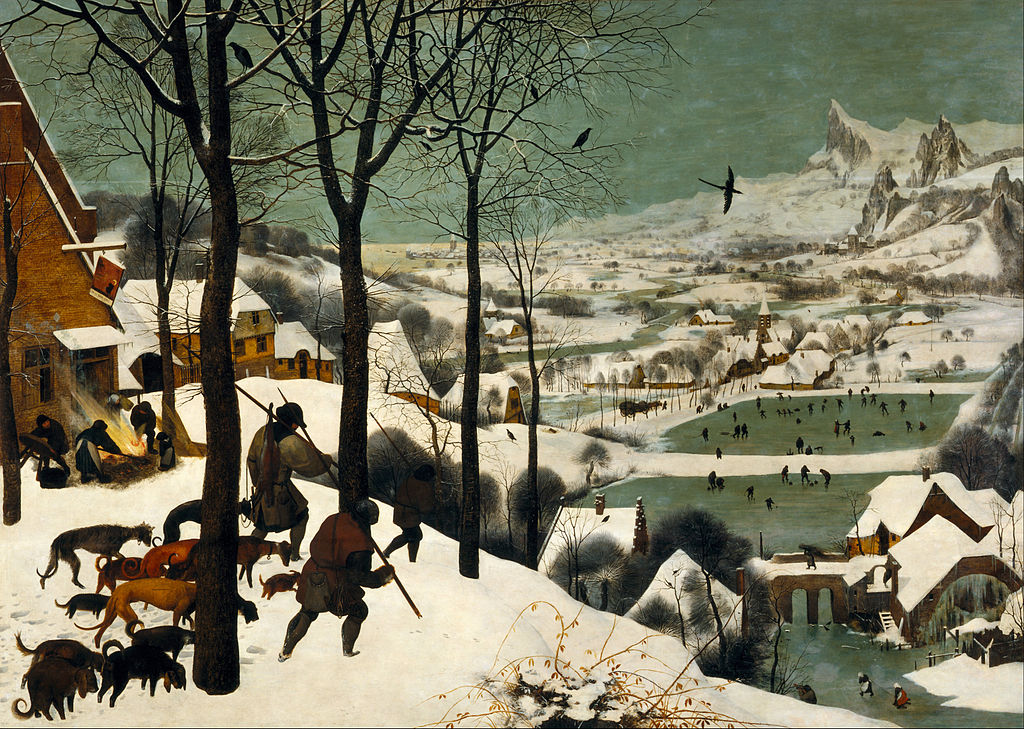
Hunters in the Snow, Pieter Bruegel the Elder, via Wikimedia Commons

Hunters in the Snow, Pieter Bruegel the Elder, via Wikimedia Commons

Writing, even writing fantasy, involves a certain amount of reality checking. You need to know how things actually worked.

Say you need to know what clothing the common European people wore during the renaissance looked like and how they dressed, both for celebrations, and for working.

I go to the 16th and 17th century painters and artists for that information. They always painted their subject with a heavy dose of religious allegory, but that was a part of village life–both the inquisition and the reformation was under way and the politics of religion was in the very air they breathed.

Any time you want an idea of average European village life in the Late Middle Ages through the 17th century, you need look no further than Wikimedia Commons.  There, under the heading  Category:Painters from the Northern Netherlands (before 1830) you will find the brilliant works of the Dutch Masters. These were artists living in what is now The Netherlands, and who were creating accurate records of the everyday life of the common people, along with stylized religious images.

During the 16th century, the Netherlands fought an 80 year war, trying to gain their independence from Spain, during the heart of the Spanish Inquisition. This was a period of extreme oppression and religious rebellion, and the art of times portrayed that very clearly.

I have learned, by rooting around the internet (so it must be true), that everything in the paintings of the time, no matter how commonplace, was allegorical, symbolic of some higher message. In art history (which I have always wanted to study), iconography is a visual language. This means that the way a subject is depicted and the way the image is organized, such as the number of figures used, their placing and gestures, all have specific meanings. The allegories they painted made heavy use of this visual language.

One particular family of of early Dutch painters from the county of Flanders pique my interest, the Brueghel Family. Five generations of their family were well-known painters, and print-makers.

One of my favorite early Dutch paintings is the Wedding Dance, by Pieter Brueghel the Elder:
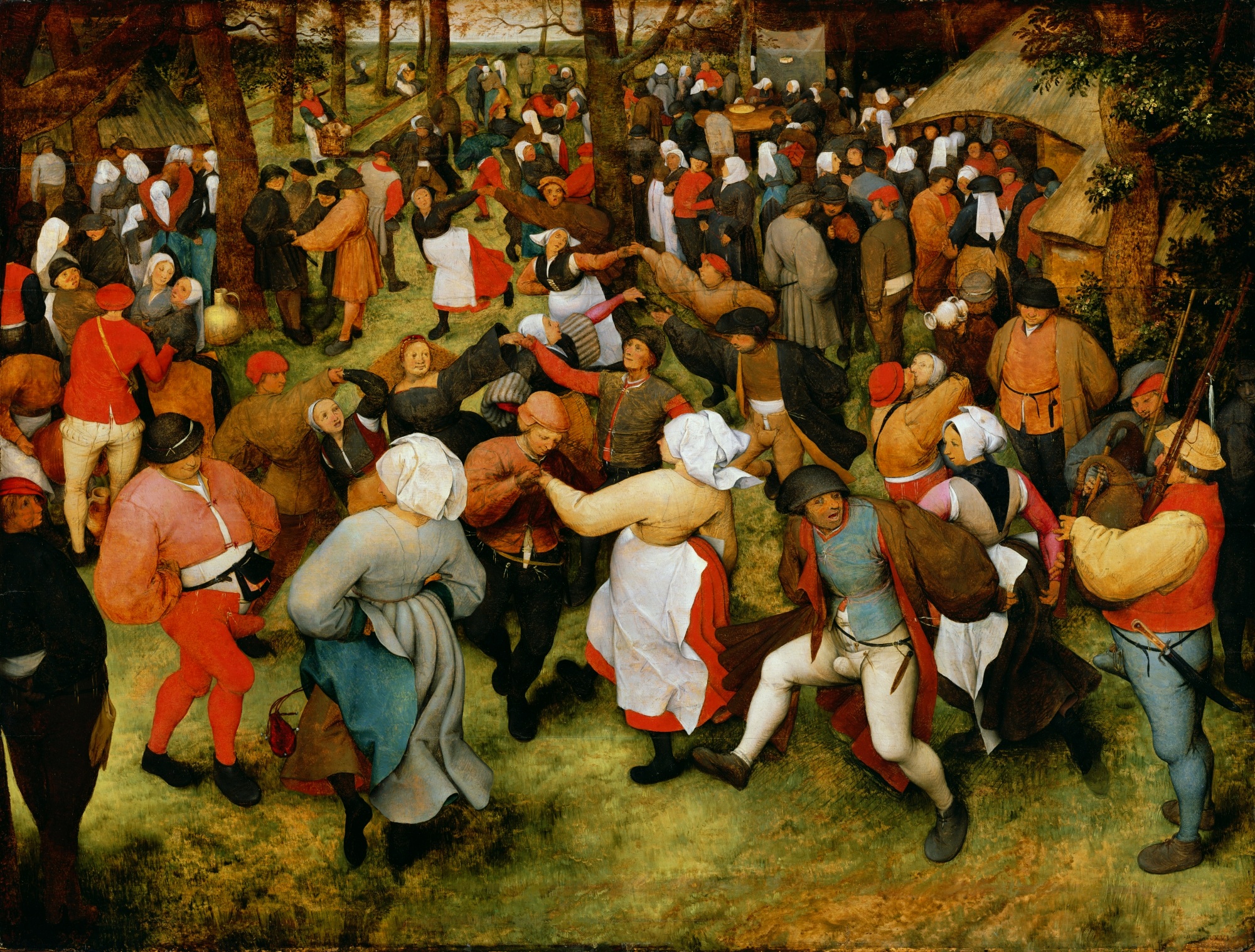
The Wedding Dance, c.1566 (oil on panel) by Bruegel, Pieter the Elder (c.1525-69)

The Wedding Dance, c.1566 (oil on panel) by Bruegel, Pieter the Elder (c.1525-69)

What makes this painting so spectacular to me is the amazing detail of the clothing. They loved color. From Wikipedia: The painting depicts 125 wedding guests. As was customary in the Renaissance period, the brides wore black and men wore codpieces. Voyeurism is depicted throughout the entire art work; dancing was tabooed at the time by the authorities and the church, and the painting can be seen as both a critique and comic depiction of a stereotypical oversexed, overindulgent, peasant class of the times.

All of these people are depicted as plump, which was a desirable trait–they were prosperous and not starving. All the things that (to this day) make a great party are there: music, food, and dancing. The men wear codpieces, emphasizing their male anatomy in the same way that in today’s society, women’s breasts are hyper-sexualized.  Perhaps codpieces should make a comeback in the men’s fashion world. I’ll show off my babyfeeders, if you parade your babymaker–that way we’ll both be sure we are getting something worth having. (or not.)

Anyway, back to the renaissance. They paid taxes, and this his how their IRS office looked to Brueghel’s eldest son, Pieter Jr. As you can see, not a lot has changed between then and now–we still pay in chickens and eggs. (heh heh.)

Pieter_Brueghel_the_Younger_(or_workshop)_The_Payment_of_the_Tithes_

The Payment of the Tithes (The tax-collector), also known as Village Lawyer, Pieter Bruegel, the Younger, signed P Brueghel

Brueghel’s eldest son, Pieter the Younger,  was never considered as fine a painter as his father or his brother, Jan Brueghel. He was considered a fine print-maker and his work shop was highly regarded. But he was not respected as an artist. Critics of the day felt he copied his father’s style, rather than developing his own. While he did paint in a folk-art style reminiscent of his father’s, his is sharper, more refined, taking it to the next level.

Notice how the people in the above picture are looking lean and ragged though, as opposed to the wedding picture painted by Pieter the Elder. The Little Ice Age had really gripped Europe, and times were hard.

So here is a painting by the second son of Pieter Brueghel the Elder, and a man who fathered his own dynasty of artists, Jan Bruegel the Elder. This is called People Dancing on a Riverbank and by their dress, with the neck-ruffs, you can see it depicts a wealthier class than his brother’s images, perhaps the merchant class rather than the peasants.

People_dancing_on_a_river_bank_by_Jan_Brueghel_the_elder

People Dancing on a riverbank, Jan Bruegel the elder, via Wikimedia Commons

One hundred years later, the Dutch were famous for their painters–and everyone wanted to own a Dutch masterpiece. Times had become quite hard, as the climate had cooled and crops regularly failed. Once-prosperous families often lived in the ruins of their family manors.
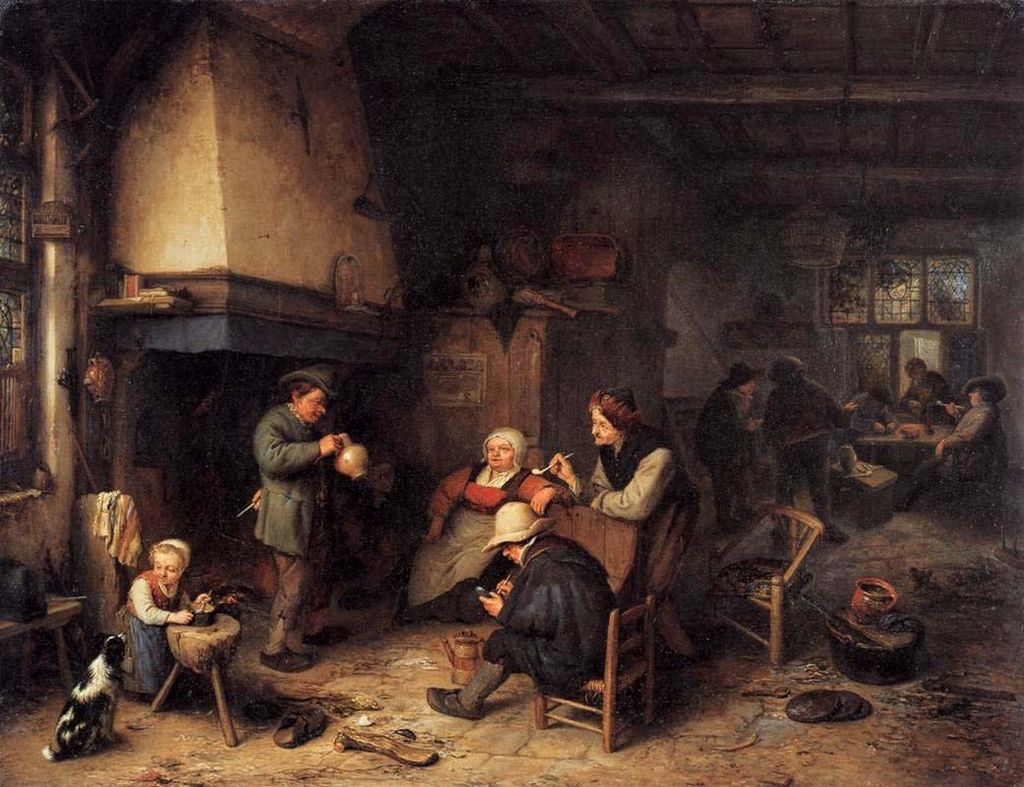
Peasants_in_an_Interior_(1661)_Adriaen_van_Ostade

Peasants in an Interior, Adriaen Van Ostade (1661) via Wikimedia Commons

In the above picture by Adriaen Van Ostade, these peasants are living in an enormous, decrepit farmhouse, almost like squatters. They are no longer plump, and are living in filthy conditions. The fire in the fireplace is very low, as if fuel was scarce.

Another famous Dutch painting, from the same time period but showing a different segment of society is The Milkmaid, by Johannes Vermeer. In this painting, Vermeer shows an everyday task, a small glimpse of something that occurred daily in every household, a woman cooking.
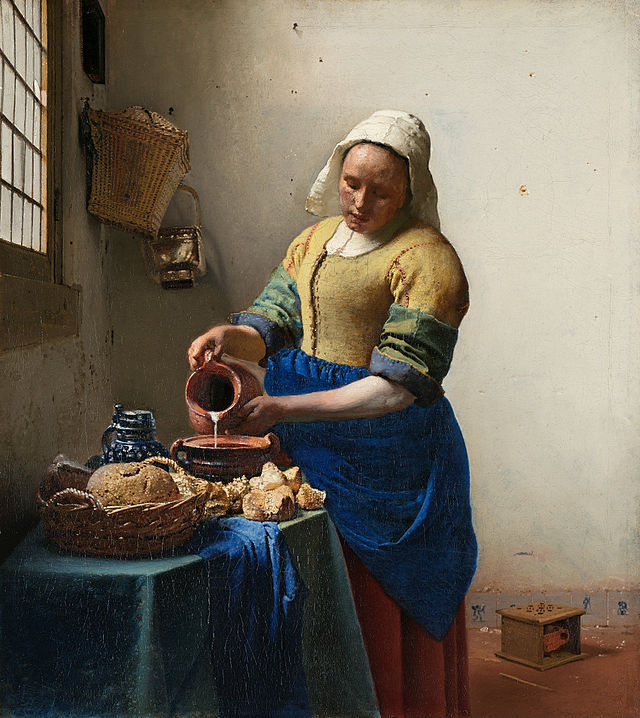
The Milkmaid, Johannes Vermeer, via Wikimedia Commons

The Milkmaid, Johannes Vermeer, via Wikimedia Commons

In the background on the floor is a foot-warmer which was filled with coals and was an essential luxury, showing this was one of the wealthier households.

According to Wikipedia, the fount of all knowledge: By depicting the working maid in the act of careful cooking, the artist presents not just a picture of an everyday scene, but one with ethical and social value. The humble woman is using common ingredients and otherwise useless stale bread to create a pleasurable product for the household.

I love art depicting the lives of ordinary people. I find the small details intriguing. It shows us that in many ways we are not that different than they were. We want food, decent shelter, and of course, stylish clothes to attract a mate.

And back then as it does now, a hint of anything taboo would most certainly find its way into even a religious painting.

The best part of all this is, a woman with an average education and on a tight budget (like me) can enjoy these wonderful works of art at will. I can examine them  in as much detail as I want, and take all the time I want, and no one will stop me or throw me out of their museum for loitering, because the internet is open all hours and is free.

Wikimedia Commons is a great resource to just roam around in, even when you are not looking for something specific.
8 Comments

Filed under Books, Humor, Literature, writer, writing

Beta Reading, or Editing–what’s the difference?

Book- onstruction-sign copyIndies rely heavily on what we refer to as beta readers to help shape their work and make it ready for editing. But in many forums, I’ve seen authors  use the term used interchangeably with editing, and the two are completely different.

And unfortunately, some indie published works are clear examples of work by authors who don’t realize the importance of working with an editor, although it is apparent that they have had assistance from beta-readers.

What is quite disappointing to me, is the many traditionally published works that seem to fall into the same lack-of-good-editing category, and I am at a loss as to why this is so.

So what is the difference between a beta reader and an editor?

Well, there is a HUGE difference.

Editing is a process, one where the editor goes over the manuscript line-by line, pointing out areas that need attention: awkward phrasings, grammatical errors, missing quote-marks or a myriad of things that make the manuscript unreadable. Sometimes, major structural issues will need to be addressed. It may take more than one trip through to straighten out all the kinks.

  1. In scholastic writing, editing involves looking at each sentence carefully, and making sure that it’s well designed and serves its purpose. In scholastic editing, every instance of grammatical dysfunction must be resolved.
  2. In novel writing, editing is a stage of the writing process in which a writer and editor work together to improve a draft by correcting errors and by making words and sentences clearer, more precise, and more effective. Weak sentences are made stronger, nonessential information is weeded out, and important points are clarified, while strict attention is paid to the overall story arc.
  3. The editor is not the author She can only suggest changes, but  ultimately all changes must be approved and implemented by the author.

Beta Reading is done by a reader. One hopes the reader is a person who reads and enjoys the genre that the book represents. Beta reading is meant to give the author a general view of  the overall strengths and weaknesses of his story.

The beta reader must ask himself:

  1. Were the characters likable?
  2. Where did the plot bog down and get boring?
  3. Were there any places that were confusing?
  4. What did the reader like? What did they dislike?
  5. What do they think will happen next?

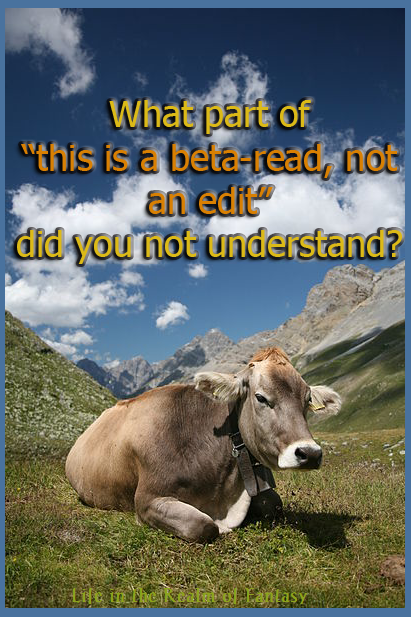
beta read memeBeta Reading is not editing, and  the reader should not make comments that are editorial in nature. Those kinds of nit-picky comments are not helpful at this early stage, because the larger issues must be addressed before the fine-tuning can begin, and if you are beta reading for someone, the larger issues are what the author has asked you to look at.

This phase of the process should be done before you submit the manuscript to an editor, so that those areas of concern will be straightened out first.

Editors and other authors make terrible beta readers, because it is their nature to dismantle the manuscript and tell you how to fix it. That is not what you want at that early point–what you want is an idea of whether you are on the right track or not with your plot and your characters, and whether or not your story resonates with the reader.

Do your self a favor and try to find a reader who is not an author to be a first reader for you. Then hire a local, well-recommended editor that you can work with to guide you in making your manuscript readable, and enjoyable.

If you notice a few flaws in your ms but think no one else will notice, you’re wrong. Readers always notice the things that stop their eye.

In my own work I have discovered that if a passage seems flawed but I can’t identify what is wrong with it, my eye wants to skip it. But another person will see the flaw, and they will show me what is wrong there.

That tendency to see our own work as it should be and not how it is, is why we need editors.

1 Comment

Filed under Books, Literature, Publishing, writer, writing

Mary Shelley and the Era of Romanticism

Mary_Shelley_by_Reginald_Easton.

Mary Shelley, by Reginald Easton

We often think that the great authors and artists of history were somehow wiser than we are.  We read their brilliant works, and they shine, as if they were slightly superhuman, and perfect in every way.

This is not always true. Sometimes they were wild teenagers with unrealistic ideals, haring off on adventures while their parents had nervous breakdowns over their behavior.

Mary Shelley , famous as the author of Frankenstein; or, The Modern Prometheus was born Mary Wollstonecraft Godwin on August 30, 1797. Her father was the political philosopher, William Godwin, and her mother was the philosopher and feminist, Mary Wollstonecraft. Both were famous in their day, and are still well known.

Mary’s mother died when she was eleven days old. Afterwards, Mary and her older half-sister, Fanny Imlay (her mother’s first child by an affair with a married man) were reared by their father. When Mary was four, her father married his neighbor, Mary Jane Clairmont. Mary Jane had a two year old daughter, Clara (Claire). Godwin considered all three girls his daughters and raised them accordingly.

William Godwin provided his three daughters with a good education, encouraging them to adhere to his liberal political theories, and values. He raised them to think independently, to his eternal regret.

Joseph Severn, 1845, Posthumous Portrait of Shelley Writing Prometheus Unbound in Italy.

Posthumous Portrait of Shelley Writing Prometheus Unbound in Italy, Joseph Severn, 1845

In 1814, at the age of seventeen, Mary Godwin began a romantic relationship with one of her father’s political followers, the married Percy Bysshe Shelley. Together with Mary’s stepsister, fifteen-year-old Claire Clairmont, Mary and Percy left for France and traveled through Europe.

Their relationship created a huge scandal among the nobility. Mary’s father completely disowned her, which both surprised and hurt her deeply.

Upon their return to England, Mary was pregnant with Percy’s child. Over the next two years, she and Percy faced social ostracism, they were in constant debt (often fleeing creditors), and they also suffered the death of their prematurely born daughter.

640px-George_Gordon_Byron,_6th_Baron_Byron_by_Richard_Westall_(2)

George Gordon Byron, 6th Baron Byron, by Richard Westall

In 1816, the couple famously spent the summer with Lord Byron, John William Polidori, and Claire Clairmont near Geneva, Switzerland. While the weather was horrendous, the summer was the most important, in literary terms, of any summer since.

This is where Mary conceived the idea for her novel, Frankenstein; or, The Modern Prometheus. It was also the infamous summer with no sun, a volcanic-winter event caused by the massive 1815 eruption of Mount Tambora in the Dutch East Indies (now known as Indonesia).  It was the largest eruption in at least 1,300 years, and, falling in the Little Ice Age as it did, caused worldwide famine in the year that followed.

They were prompted to go to Geneva by Mary’s stepsister, Claire Clairmont, who, in competition with her sister, had initiated a liaison with mad, bad, and dangerous to know Lord Byron the previous April.  Obsessed with him despite the fact that Byron’s interest in her had already waned, Claire used the opportunity of introducing him to the Shelleys to act as bait to lure him to Geneva.

The Shelleys and Byron rented neighboring houses on the shores of Lake Geneva. According to Wikipedia, the source of all knowledge:

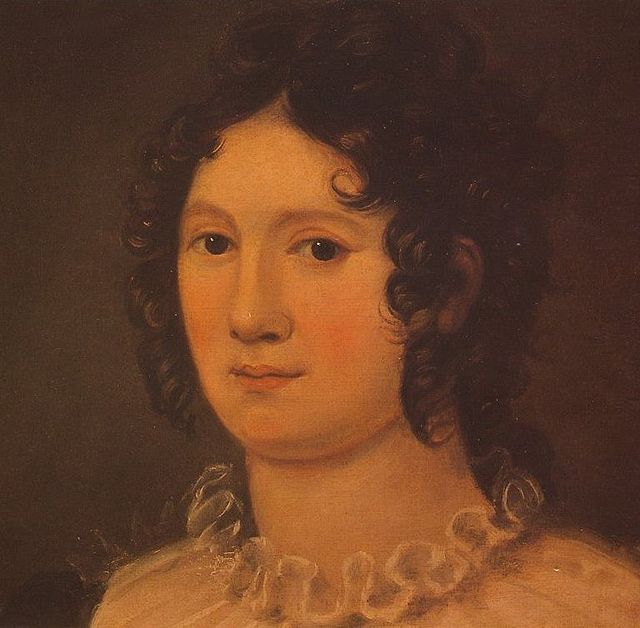
Claire Clairmont, by Amelia Curran

Claire Clairmont, by Amelia Curran

While on a boating tour the two took together, Shelley was inspired to write his Hymn to Intellectual Beauty, often considered his first significant production since Alastor, or The Spirit of Solitude. A tour of Chamonix in the French Alps inspired Mont Blanc: Lines Written in the Vale of Chamouni.

Shelley also encouraged Byron to begin an epic poem on a contemporary subject, advice that resulted in Byron’s composition of Don Juan.

Mary and Percy married in late 1816 after the suicide of Percy Shelley’s first wife, Harriet.

John William Polidori, by F.G. Gainsford

John William Polidori, by F.G. Gainsford

This reads more like a modern soap-opera than what we nowadays think would be the accepted behavior of well-to-do people living during the early 19th century.

But it was the Era of Romanticism.  Again, the Fount of All Knowledge, Wikipedia, has this to say about that:

The German painter Caspar David Friedrich said “the artist’s feeling is his law.”

To William Wordsworth, poetry should begin as “the spontaneous overflow of powerful feelings,” which the poet then “recollect[s] in tranquility,” evoking a new but corresponding emotion the poet can then mould into art. 

Wanderer Above the Sea of Fog, Caspar David Friedrich, 1818

Wanderer Above the Sea of Fog, Caspar David Friedrich, 1818

In order to express these feelings, it was considered that the content of the art needed to come from the imagination of the artist, with as little interference as possible from “artificial” rules dictating what a work should consist of. Samuel Taylor Coleridge and others believed there were natural laws which the imagination, at least of a good creative artist, would unconsciously follow through artistic inspiration if left alone to do so.

In other words–they were hippies, and it was the Regency equivalent of the summer of love.

The Shelleys left Britain in 1818 for Italy, where their second and third children died before Mary Shelley gave birth to her last and only surviving child, Percy Florence Shelley. In 1822, Percy Bysshe Shelley drowned when his sailing boat sank during a storm near Viareggio.

Mary Wollstonecraft Shelley was a prolific author. She wrote

  • History of a Six Weeks’ Tour (1817)
  • Frankenstein; or, The Modern Prometheus (1818)
  • Mathilda (1819)
  • Valperga; or, The Life and Adventures of Castruccio, Prince of Lucca (1823)
  • Posthumous Poems of Percy Bysshe Shelley (1824)
  • The Last Man (1826)
  • The Fortunes of Perkin Warbeck (1830)
  • Lodore (1835)
  • Falkner (1837)
  • The Poetical Works of Percy Bysshe Shelley (1839)
  • Contributions to Lives of the Most Eminent Literary and Scientific Men (1835–39), part of Lardner’s Cabinet Cyclopaedia
  • Rambles in Germany and Italy in 1840, 1842, and 1843 (1844)

She also wrote numerous short stories and articles that were widely published, along with many children’s stories, and numerous other unpublished work found in her papers after her death. After 200 years of being just Percy Shelley’s wife who got lucky with the popularity of Frankenstein, scholars now admit that Mary Shelley was a major figure of the Romantic Movement, significant for both her literary achievements and her political voice as a woman and a liberal.

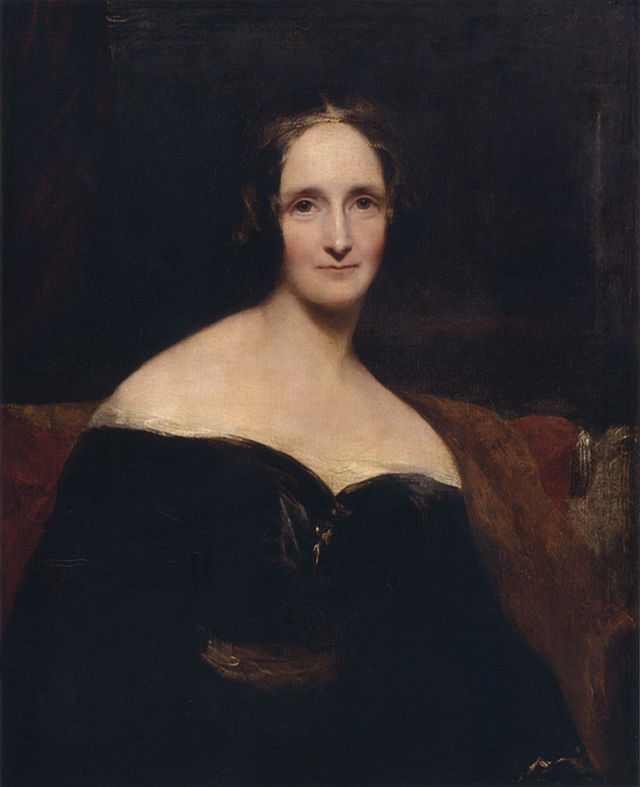
Mary Shelley, by Richard Rothwell

Mary Shelley, by Richard Rothwell

Mary Shelley died at the age of 53 from a brain tumor.

Her life was not long, by today’s standards, but she lived it to the fullest. She gave up everything to follow Percy, and while he loved her, she nevertheless had to sit by while he had affairs, even with her stepsister, Claire.

Mary suffered terrible personal losses, the deaths of her children and her husband, and her sister Fanny. She lived every day of her life with passion, and dared to write articles and stories with a sharp political edge, and she got away with it in an era when women had no voice. Percy Shelley himself called her a “child of love and light.”

9 Comments

Filed under Literature, Publishing, writer, writing

More Disintegrating Eglish…Enlish…#language

gibberish-american businesses onlineThis weekend I happened to be out on Facebook. A friend of mine had a fun thread going, regarding the way English seems to sliding in a new direction. I find this interesting in same the way a cat finds a snake intriguing.

I want to play with it, but it may bite me.

I’ve said it before and I will say it again, English is the ever-disintegrating language. The very roots of English encourage this continual evolution.

Think about it–a bunch of smart guys in Victorian England applied the rules of a dead language, Latin, to an evolving language with completely different roots, Frisian, added a bunch of mish-mash words and usages invented by William Shakespeare, and called it “Grammar.”

We had a short discussion about words that either signify lazy speech habits or a shift in the language and came up with this short list, that is only the tip of the pox-ridden iceberg:

gibberish quoteSupposably…oh wait, did you mean supposedly?

Liberry…no sir you must go to the library for those books–the liberry can only give you hives.

Feberry...I hope you mean it will happen in February, because Feberry will never come.

Honestness...In all honesty I am not sure what to make of that one.

But my particular favorite is Prolly, which my granddaughters seem to think means Probably, but in all honestness, doesn’t.

It’s not a new problem. Jonathan Swift, writer and dean of St. Patrick’s Cathedral in Dublin, complained to Robert Harley, 1st Earl of Oxford and Earl Mortimer, in 1712: “Our Language is extremely imperfect. Its daily Improvements are by no means in proportion to its daily Corruptions; and the Pretenders to polish and refine it, have chiefly multiplied Abuses and Absurdities.” He went so far as to say, “In many Instances, it offends against every Part of Grammar.”

Well, that is prolly a little harsh.

English is like water–it shifts, it flows, it steals what it wants from every other language it comes across. That is what makes it so fun to play with. And also is what makes it so difficult to work with.


4 Comments

Filed under Humor, Literature, Publishing, writing

The harsh truth, and cold comfort

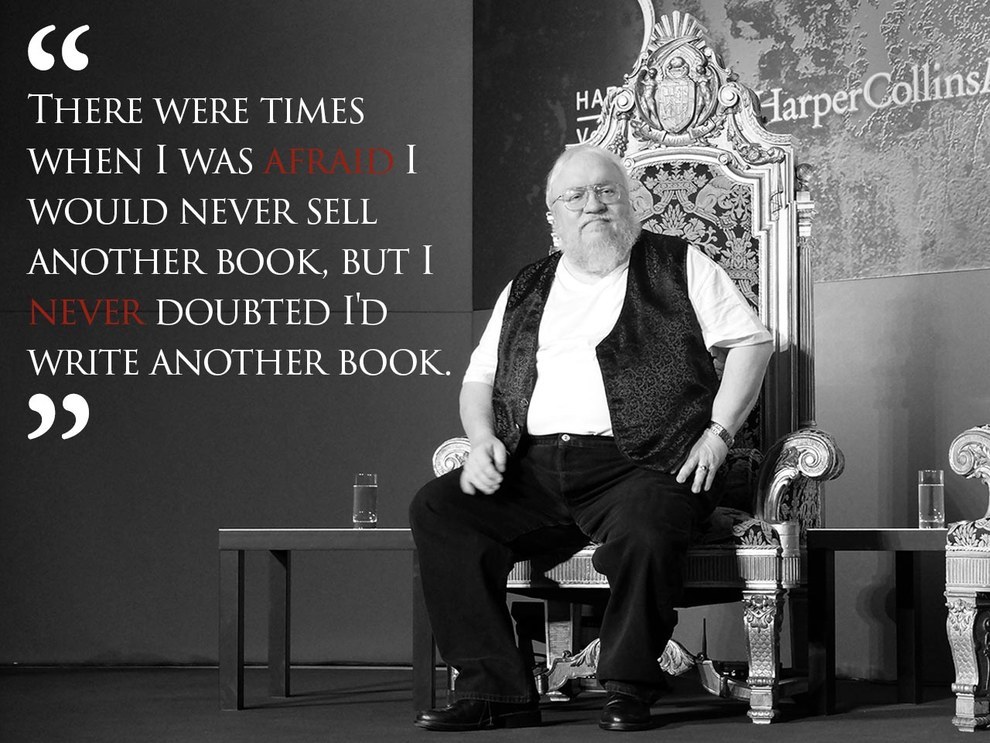
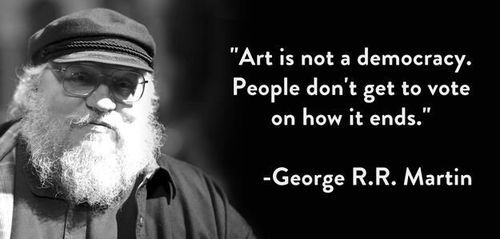
GRRM Meme 2Authors are not really great at social stuff. On top of that, we tend to be horribly insecure about our work, but it’s all we can think of to talk about.

We are thin-skinned and bleed profusely when you cut our work to shreds. Some of us handle that with grace and dignity, and others go ballistic and make an uncomfortable situation worse.

Now we come to a problem affecting a friend who lives far way from me–authors undercutting authors. She has left her writing group and will not be going back because one new member is harsh and unfair in the way they critique this author’s work–under the arrogant pretense of “just telling the truth.”

The new member is published, an indie, and seems to be selling a fair amount of books. She was invited to join a group of authors who are not not yet published, but who all hope to be. Each member is in various stages of courting agents and editors. An editor for a respected mid-sized press has shown interest in my friend’s manuscript. The new member started out friendly enough, but began by making belittling remarks about the way the group had been doing things, implying they were just playing at being authors. Then, suddenly feeling inferior and hoping to be more “legitimate,” the group allowed her to take charge. Things went downhill from there, with the new queen-bee as the center of attention.

quarrabtine symbol

Now I don’t know if my friend will ever write again. I do know she won’t join another group, which is sad, because MOST groups are not like that. Yes, they dig deep, and work on structural issues, but they don’t phrase their comments in a deliberately cruel manner. She knew her work wasn’t ready for publication, but she didn’t know it was “crap.”

And it isn’t crap.

I hate that she has put aside the makings of what could someday be a great novel, all because a person she respected as an author belittled her attempts in such a way that she is now afraid to share that most intimate part of her soul–her creativity.

But this is a problem that affects authors of all stations, not just indies and hopefuls. People feel its acceptable to say the most disparaging things, especially if an author has become successful, as if that author’s success negatively affects their own chances. And they seem to to take it beyond criticizing their work–they get personal about it.

Indie authors need to help each other advance, not tear each other down. The world is full of readers, so there is room for everyone, and if we ridicule each other and make disparaging, mocking remarks about the quality of others’ work just because we don’t care for their style of writing, shame on us.  There is an ocean of difference between badly crafted work, and work that is written in a style you don’t care for. I read many things written in a style I don’t care for, but if it is well-crafted and written with some attention to the aspects that make a good tale, I will give it a decent review, and I refuse say negative things about the author who wrote it, no matter how popular it may be to do so.

Successful author bashing has become an acceptable topic at parties due in part, I think, to the fact that with the rise of ebooks and Amazon’s eagerness for buyer reviews, any reader can become a critic, regardless of the quality of their “review.” This is both good and bad, because you do sometimes get a real-world view of what readers think of a book. But conversely an illiterate review that gives only one star and just says (in misspelled words) that they hated it and didn’t read the book doesn’t help help anyone.

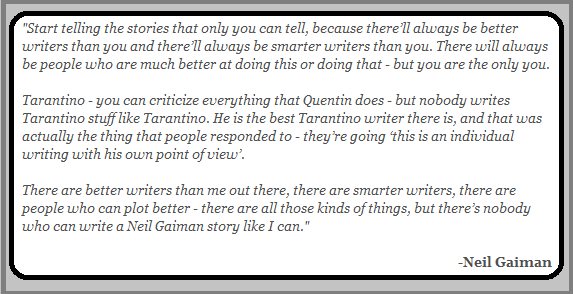
Neil Gaiman quote 3

Trolling and internet bullying has become an addiction for some people, and it’s apparent that their anonymity gives them a sense of power. To be able to destroy a person with a few well-chosen words–they see themselves as king-breakers, and they like that.

Even mega-successful authors like George R.R. Martin deal with an avalanche of poison and angst from trolls–I hope that what he deals with is not typical of what successful authors must endure, although Stephanie Meyer, E.L. James, and J.K. Rowling have all endured this sort of spew. Of course George’s TV series is the source of most of his grief, but still–these people show so little respect for a kind, decent man who sincerely cares about his craft and whose work has provided them with countless hours of entertainment.

GRRM Meme 3All that aside, NO author, no matter how famous, crafts perfect work that resonates with every reader, every time. We sometimes hit a pure note with one particular piece, but we will spend the rest of our writing lives trying to live up to the potential that piece had, with varying degrees of success. And when we were writing that story, perhaps it didn’t go the way the reader thought it should, and someone had to die.

That happens all the time, because the READER DOES NOT WRITE THE BOOK.  Readers who want to write the book badly enough become authors and DO it, instead of whining about it.

So we authors try to develop a thick skin and continue doing what we do. We keep learning. We keep working on the craft, and we never stop striving to be just a little better with our next short story or novel. And if, when you are in a writing group and another author makes cutting remarks in regard to your writing style, ask yourself why they feel that your style deserves harsh criticism. Don’t feel badly about walking away from that group before it gets to the level that my friend experienced, even if you like a few of the people who remain–because you won’t gain anything by staying around for more humiliation.

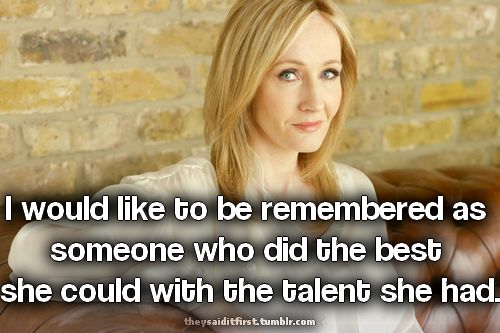
JK Rowling MemeMy friend–there will be other groups, and with a little checking around, you will find the one that welcomes you and your work.

Or maybe you need to go solo for a while.

That is cold comfort if someone you once respected has trashed your work and humiliated you, I know. But keep learning and keep writing. Rise above the naysayers and don’t let them steal the joy you have in your craft.

25 Comments

Filed under Literature, Publishing, writer, writing

Writers’ Resources

tumblr_ng6esx01YT1syd000o1_1280The internet is a wonderful place. You can find just about anything here, and you can get a complete education for FREE!

Of course, it’s not credited, but there is an incredible amount of information on just about anything for free, up to and including college level courses in various aspects of writing through Coursera.

Coursera is a wonderful organization. They are a for-profit organization but you can take online courses from major universities FOR FREE, and while you don’t receive a diploma, you do get a good education. Wikipedia tells us that: All courses offered by Coursera are accessible for free and some give the option to pay a fee to join the “Signature Track.” Students on the Signature Track receive verified certificates, appropriate for employment purposes. These students authenticate their course submissions by sending webcam photos and having their typing pattern analyzed. 

I’m not sure how that works, but I am all for it. What I really like is that Coursera offers specializations, set courses that help increase understanding of a certain topic. I’ve take a couple of medieval history courses from them and while I didn’t have the money to get the certificate, I really enjoyed them. Knowledge is such a useful thing!

But  for the financially strapped author wanting to increase their knowledge of the craft of writing, an amazing resource is the website Writers’ Digest. They are also for profit, but they offer an incredible amount of information and assistance FOR FREE.

So here, in no particular order, are my favorite sources of Online Information About Writing your novel:

www.writersdigest.com

PBS.org/GuiltyPleasures/HowToWriteRomanceNovel

The Creative Penn

Harlequin.com

Creative Writing Now

Harlequin has one of the best websites, for teaching authors how to develop professional work habits, which is critical to being productive. I highly recommend you go to websites that specialize in writing romance novels regardless of what genre you write in, because the romance publishers have it right: they want to sell books, and they want you to succeed and so they get down to the technical aspects of novel construction and offer many excellent tools for getting your work out the door in timely fashion–something I need to work on. They also offer tips on marketing your work.

They also give you all kinds of tips on how to create a writing space and organize your day so you can get good writing time in and still manage your family. I used to do my writing on an old IBM Selectric that was next to the gerbil cage–not a good environment for writing.

In regard to research, reading one Wikipedia article does not qualify you as an expert in your chosen subject, so go beyond the surface. Find the websites that really explain your subject and go to the local library to research. Once you know what you are writing about, you can mash it up any way you want to.

But even though we are educating ourselves about our novel’s setting and have gained an understanding of how the science that forms the core plot-point actually works, sometimes we hit a bit of sticking point in the creative process.

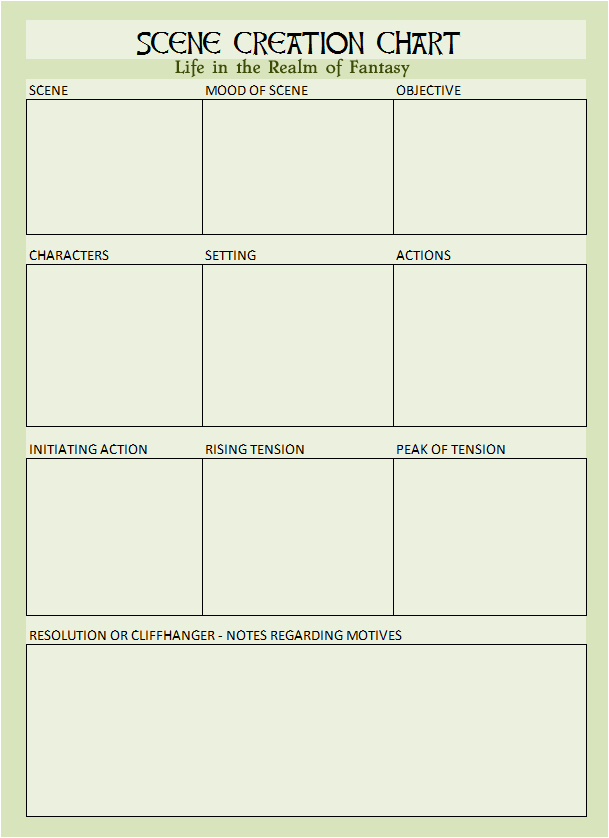
When that happens we can either drop out of writing mode (not an option for me) or we can find a way to yank that thought out of our head and identify what must happen to get that scene moving. I am a linear thinker, so after a little trial and error, and after seeing how other authors work, this is what I came up with, that works for me in regard to organizing a scene that I am having difficulty with. If it works for you, feel free to:

right click>save image as jpeg or png and save it to your hard drive to print out

Scene creation chartOnce I know how these seemingly disparate things fit together, the scene becomes unstuck, and I begin making progress again. Also, something about the process of spreadsheeting the scene gives me a little insight as to why a particular character might NOT need to be in that scene.

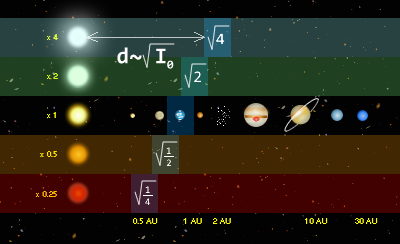
Sometimes just knowing who does and who doesn’t need to be in a scene is just as important as knowing where the nearest inhabitable (for humans) planet  might lie in a given star system.

Habitable_zone_-_HZ

1 Comment

Filed under Books, Humor, Literature, Publishing, Uncategorized, writer, writing

Baiting the hook

450px-Flyfishing wikipedia dot com

Flyfishing on river Sava Bohinjka, Slovenia photo by Ziga (PD)

You wrote the book. Your friends read it–you hope. At least they said they did, and they still like you. They tell you it’s a good book. They think it’s publishable, so you decide to go indie and self pub it. You spend the next year getting it edited and having a flashy cover designed. You even have a launch date picked out and feel reasonably sure you can get the book through the pipeline at CreateSpace by that date.

Now you are at the point where you must come up with some sort of a blurb.

This is where it gets fun.

Not.

There are many wonderful blurb-writing gurus out there on the internet, offering advice to those intrepid indies who would write that catchy morsel of blurbiness:

www.blurb.com

Marilyn Byerly 

Digital Book World

The Creative Penn

Yes, there are many websites offering us insight, and they all have great advice for us.  But putting that plethora of knowledge to practice is a bit daunting. 

They each approach it differently but when you distill it into a simple, linear form, it all boils down to variations on these concepts (in no particular order) for you to have in your head before you begin:

  • Use words that clearly evoke the genre
  • Keep it short– 100 to 300 words
  • Get the protagonist’s name out there early
  • Introduce the core conflict
  • Make it intriguing, mysterious–can this conflict be resolved?
  • Use a little hyperbole–stunning, denouement, and so on

The Internet Gurus also offer us this advice:

  • Don’t say what a great book it is
  • Don’t give spoilers
  • Don’t summarize the book (or even the first chapter)
  • Don’t be long-winded or wordy
  • Don’t say what a great writer you are
Back Cover of Mage-Guard of Hamor

Example of what NOT to put on back of book in lieu of proper blurb.

I would also offer this advice: keep it to less than 150 words and don’t skip writing the blurb. It has become popular for the Big 5 publishers to skip writing a blurb and just go with praises for the author’s other works, expecting that their name and fame will sell the book. This tells me that blurb writing is hard and even the the big guys don’t like it. Most big publishers, like Penguin, will have a marketing department.  Penguin puts blurbs on their books, so why the others can’t come up with a proper blurb is a mystery to me.

That might work for Stephen King or L.E. Modesitt Jr., but it won’t work for an unknown indie who is trying to build a reputation and a fan base.

Readers want to know what they are buying, and if they have no idea who you are, they don’t care what your friends think about your work. They aren’t going to touch it.

The blurb is a teaser.  It’s one part of a three-part lure, the only purpose of which is to entice a customer to buy your book.

Remember, you are fishing for readers and that blurb is part of the triangular bait:

  1. Part one is the flashy cover–even for ebooks that cover gets them to stop and look a bit closer, and
  2. the blurb is part two–the part that hooks them and gets them to crack it open.
  3. Part three of this lure is the words they read once they open the bookthat is when you land your fish, whether by ebook or by paperbook.

But until they have read your blurb, they won’t open the book, so they won’t know what wonder awaits them.

I am currently working on a blurb for a stand-alone book based in the world of Neveyah, the world the Tower of Bones Series is set in.  Where the Tower of Bones series can be rather dark, Mountains of the Moon has many comic elements.

Right now, this is my blurb. My head is numb, so I’m letting it sit for another week or so then I will revisit it and have my homies at Myrddin Publishing go over it one more time:

MOTM MAPHidden away in the Mountains of the Moon, the ruins of an immense castle harbor a dark secret: entire families have vanished from the valleys in the shadow of the mountains, leaving no trace. The elderly Baron Hemsteck hasn’t been seen for two seasons.

Four mages are sent to investigate. Wynn Farmer and his companions embark on a trek to learn the truth. Along their route, they must battle against the strange beasts controlled by a rogue mage and ultimately face an evil they never thought possible.

Danger, dark magic, and mystery await those who seek the truth in the Mountains of the Moon. The Gods are at war, and Neveyah is the battlefield.

We kept it down to 114 words, and managed to get the World of Neveyah series tag-line in on the end of it.

Sigh. I admit I am not good at writing blurbs for my own books, but I do have a large posse of author-friends who are more than willing to help me hone that blurb. When the back cover is finished, I will have a concise blurb that will hopefully entice readers to read my book.

Finally, at the end of June,  I will reveal the cover.  I am pretty excited about this new book. I can hardly wait!

6 Comments

Filed under Adventure, Battles, Books, Fantasy, Humor, Literature, Publishing, Uncategorized, writer, writing

Book signing events, the art of Paul Cornoyer, and inspiration

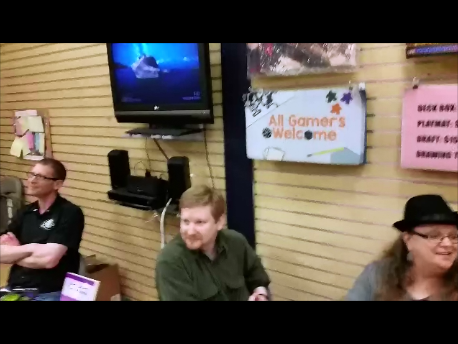
From left to right, Sechin Tower, Lindsay Schopfer and Connie J. Jasperson at Forever Knight Games 5-16-2015

From left to right, Sechin Tower, Lindsay Schopfer and Connie J. Jasperson at Forever Knight Games 5-16-2015

The signing at Forever Knight Games in Olympia went well. I met several wonderful authors I hadn’t had a chance to meet in person: Sechin Tower, Jolene Loraine, Rachel E. Robinson (Maquel A. Jacob), and Erik Kort. We were joined my my good friends, authors Lee French, Lindsay Schopfer, and Jeffrey Cook. These wonderful people write great books, and I was privileged to be counted among them!

We had a great time, and it was a good first event at that venue. I want to thank all my friends for coming out and meeting my favorite local authors. Tower of Bones was my big seller–which makes me happy.

paul cornoyer rainy day in madison square

Rainy Day in Madison Square, Paul Cornoyer

But then, after the big party was over (and it was a party–believe me) I had to drag myself back to reality. As I said the other day, sometimes my head isn’t in the right place for reading. At the event this last weekend, a friend asked me how that inability to read without the editor in my head making noise affects my ability to write. I had to answer that it does affect it to a certain extent.

The reason being in an editing frame of mind affects my writing is that while I am creative, it is like my creativity has to go through a maze to get to the ends of my fingers and into written form.

It’s a sloooooow process.

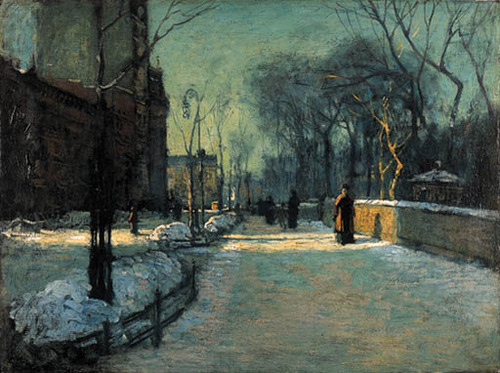
Paul Cornoyer Winter twilight along Central Park

Winter Twilight Along Central Park, Paul Cornoyer

I do a lot of things to jumpstart that creativity. I  clean things I don’t really care about under normal circumstances.  Something about a really orderly environment gets my mind relaxed enough to work properly.

Sometimes I write flash-fiction, 100 to 1000 word short stories.

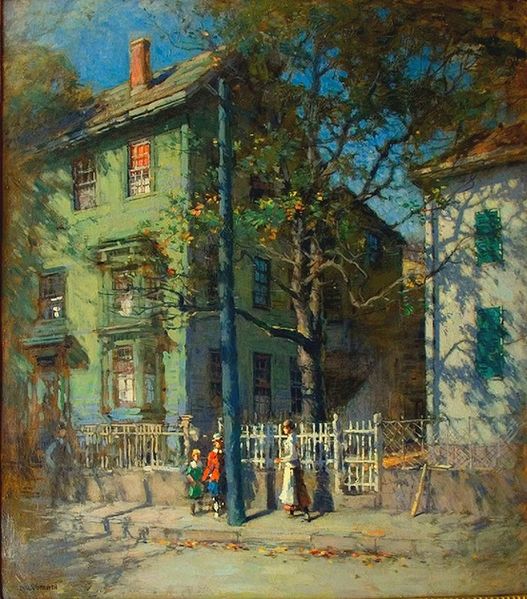
I find great art that really makes my mind click–Wikimedia Commons is awesome for that.  Today I came across a download of a picture that, two years ago, sparked a 250 word flash-fiction. That  image, which I will get to later, was painted around the year 1910 by an American artist, Paul Cornoyer.

Paul Cornoyer -Gloucester

Glouster, Paul Cornoyer

His work is quite intriguing, and much of is done in an impressionistic style.

According to the Fount of all Knowledge, Wikipedia, Impressionism is a 19th-century art movement. Impressionist painting characteristics include relatively small, thin, yet visible brush strokes, open composition, emphasis on accurate depiction of light in its changing qualities (often accentuating the effects of the passage of time), ordinary subject matter, inclusion of movement as a crucial element of human perception and experience, and unusual visual angles.

The thing about the impressionists that so inspires my writing is that they don’t give you all the details–they give you what they saw including the mood of the piece.

Paul_Cornoyer_-_The_Plaza_After_Rain

The Plaza After Rain, Paul Cornoyer

In so many ways, good literature is like good art–all the important things are there, everything the eye needs to have a perfect vision of the mood, the setting, and characters–everything is there within the piece, but with economy. When you limit yourself to expressing the complete idea of the story in less than 300 words, you discover just how well (or how badly you can write.)

This last picture is the piece that inspired one of my better, short pieces of Flash Fiction, which will be featured later this month on Edgewise Words Inn. I will post links to that here when it goes up

It is called The Plaza After Rain. I love it because, even though it depicts New York City in a different time, it shows the way rain is in the springtime. The sky is dark, but the trees are just beginning to leaf out. The streets are wet with rain, but a hint of blue is showing through the dark sky. When you see this painting, you feel like sunshine could happen any minute.

That is what we try to convey in flash fiction, and that is why it’s so important to practice writing in short, complete bursts. You never know when one will become a longer tale, so you will have a backlog of  fodder to fuel your creativity when you need a good story idea. Being able to create an entire story in 3 paragraphs is an art. Sometimes I can do well at that, and sometimes not so much.


Comments Off on Book signing events, the art of Paul Cornoyer, and inspiration

Filed under Battles, Blogger, Books, Games, Humor, Literature, Publishing, Uncategorized, writer, writing

Elements of the Story: Allegory

allegory

Proper use of the allegory is an integral tool in the author’s toolbox. An allegory is a metaphor, but it is not merely symbolism, although it is definitely symbolic. Authors, painters, and musicians can convey hidden meanings and discuss complex moral issues through the device of allegory.

Literary Devices.net describes  Edmund Spenser’s “Faerie Queen,” a moral and religious allegory, in this way:

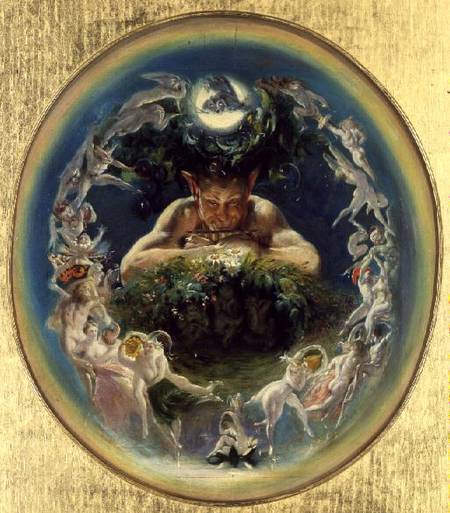
RAK9388 Faun and the Fairies, c.1834 by Maclise, Daniel

Faun and the Fairies, c.1834 by Daniel Maclise

“The good characters of book stand for the various virtues, while the bad characters represent vices. “The Red-Cross Knight” represents holiness while “Lady Una” represents truth, wisdom and goodness. Her parents symbolize the human race. The “Dragon” which has imprisoned them stands for evil. The mission of holiness is to help the truth, fight evil, and thus regain its rightful place in the hearts of human beings. “The Red-Cross Knight” in this poem also represents the reformed church of England fighting against the “Dragon” which stands for the Papacy or the Catholic Church.”

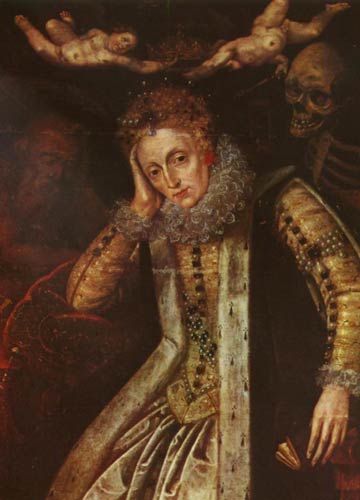
The Faerie Queene is an allegorical romance, and contains several levels of allegory, including praise for Queen Elizabeth I, who was Spenser’s great patron.

Elizabeth-I-Allegorical- painting  c.1610  by Unknown. Licensed under Public Domain via Wikimedia Commons

Allegory of Queen Elizabeth (c. 1610), with Father Time at her right and Death looking over her left shoulder. Two cherubs are removing the weighty crown from her tired head. Artist unknown.

Allegory is not always something that works well if you desire commercial success with your novels. This is because allegory is the sort of thing that only becomes apparent on further contemplation by the reader–which many casual readers don’t usually want to do and modern action-based literature does not encourage. A great many of today’s readers are action-junkies, so if you choose to present a moral concept through the use of allegory, you must take a page from Stephen King‘s work and  wrap it up in such a way that the average reader will enjoy it for the entertainment value, while the discerning reader will look deeper and find more layers to enjoy within your work.

ClassroomSynonym.com says: “At the foundation of a well-constructed allegory are carefully crafted parallels between two separate issues. To properly analyze an allegory it’s important to identify these parallels and explain why the parallels are such strong indicators that an allegory exists. Even though “The Crucible” is literally about a witch hunt, the unfair tactics for deciding who is a witch and who isn’t parallel the claims made during the McCarthy Era with little justification other than rumor and hearsay that certain people were communists. The unfair method of designation is the parallel.”

Crafting an allegorical narrative requires planning and intention. Clarity of thought on your part is absolutely crucial if your deeper story is to become clear to the reader. I suggest you outline so that the beginning, middle and end are clear before you begin.

An effective allegory narrative will have a clear moral or lesson that will become apparent at the end of the essay. Even if it is not stated directly the message will be implicit in the final resolution. You want to be sure that the ending reflects your final thought on the subject.

  1. Use Symbolism

The allegory is the symbol of your idea. This means your narrative or poem conceals the true theme you’re symbolizing. In other words, you are writing a cover story that will contain the primary one.

  1. Planning Your Characters Is Essential

Each character in an allegory represents an underlying element to your theme. Because the reader is expected to interpret the whole story and find what it means, no character can be introduced that does not directly pertain to and represent part of the underlying story. The moment you introduce a random character into it, your allegory devolves into chaos and your deeper meaning is lost.

  1. Planning Your Action is Essential

The arc of the scene becomes tricky. Every action is crucial–action must show something that pertains to the underlying theme, not just push the overlying story forward.

  1. Insert Hints Regarding the Deeper Meaning Into The Overlying Story

What that means is, you’ll be expected to leave evidence in your story for the discerning reader to grasp. Some authors have used irony, and sarcasm.  Others use large metaphors. No matter what you choose, subtle clues will guide the reader to the deeper story, and you want them to catch that underlying meaning, or you wouldn’t have written it. You don’t have to explain it baldly—readers love figuring out puzzles. But you do have to make sure a trail of breadcrumbs is there for your reader to follow.

E-how gives us this perfect, concise example: “For instance, if you want to show the damage done to the environment by humans, then the character symbolizing “everyman” could end up harming or hurting the character symbolic of the environment.”

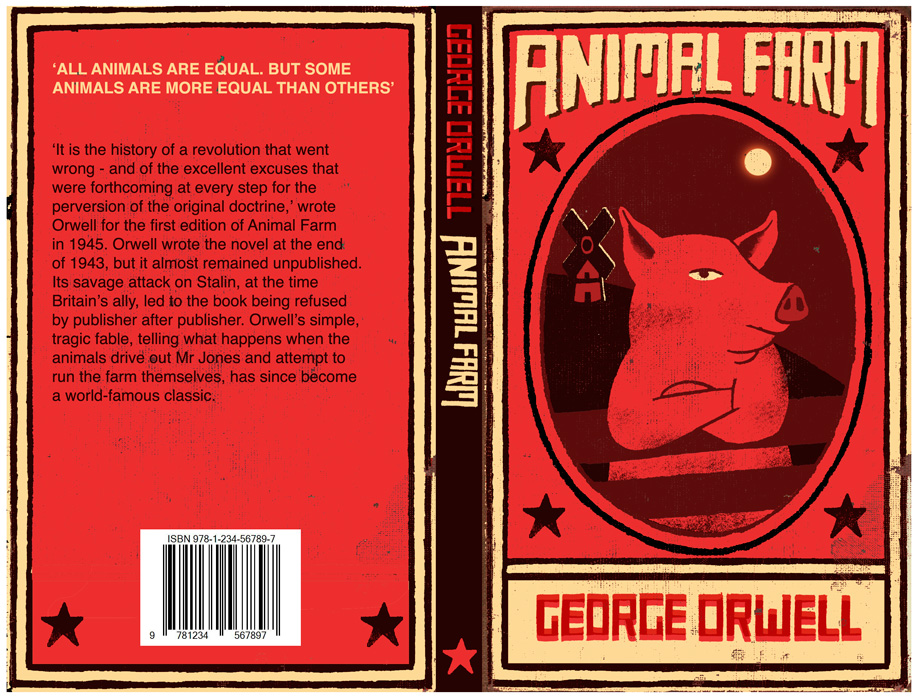
animal farm george orwellI love allegories, and I have written a great deal of poetry that is allegorical.

I have read The Faerie Queene and The Crucible, and was challenged by both, for different reasons. One reason for that challenge in The Faerie Queen is that Spenser used many words that were considered archaic even in Elizabethan times, so you have to interpret it as you go.

Some other famous allegorical novels I have read are:

Animal Farm by George Orwell

An allegorical and dystopian novella by George Orwell, first published in England on 17 August 1945. According to the author himself, the book reflects events leading up to the Russian Revolution of 1917 and then on into the Stalin era in the Soviet Union.

The Trial by Franz Kafka  Kafka’s descriptions of law and legality are considered allegories for things other than law, but it does clearly show how law and legality sometimes operate paradoxically.

Thinner by Richard Bachman (Stephen King writing under a pen name) Horror: An allegory about what lies beyond the limits of prosperous American complacency and where the responsibilities of human actions ultimately lie.

I will just say that allegorical novels are not written to be comfortable, cozy reads. They can be quite disturbing and thought provoking, as both Animal Farm and Thinner were to me. They were extremely disturbing, if you want the truth, but that was what makes them great literature. I was in the mood for a meatier read, and they took me out of my comfort zone, showing me disturbing aspects of the world I live in. These were things I could not change on a global level, but which I could possibly change within in my own sphere, thus my horizons were widened by reading them.

4 Comments

Filed under Adventure, Books, Fantasy, Humor, Literature, Publishing, Uncategorized, writer, writing

My Writing Life: David P. Cantrell

My Writing LifeToday indie author and blogger, David P. Cantrell, has consented to answer a few questions for us. Dave is a fellow staff-member at Edgewise Words Inn, a reader-oriented blog where Dave Cantrell, Lee French, and I post a variety of short articles, human interest stories, some short stories, memes, and generally have a great time just writing. At the end of this post, I will be reblogging Dave’s most recent post on Edgewise Words Inn, a little thing called “Ten Things I’ve learned as a Quadriplegic.” I think you’ll find that post as interesting and inspiring as I did.

But first, my virtual interview with Dave:

CJJ: Tell us a little of early life and how you began writing:
DPC: I grew up in Southern California after immigrating from Indiana at age five. I was a mediocre student in grade school, sports were much more interesting, but sadly, I was a mediocre athlete too. I wasn’t horrible at either of them, mind you—I got by.

I’ve often wondered where I’d be today if my family hadn’t moved to a new school district. I had completed one semester of eighth grade before the summer of the move. The new district couldn’t accommodate split semesters and required me to restart the grade. I became very bored in math and petitioned to join an experimental math class (eighth grade algebra—it sounds quaint now.)

The math teacher let me in for a semester with the proviso that I earn a Cee or better, otherwise it was back to regular math. I struggled, but the teacher worked with me, and I didn’t want to be put back. I think she took pity on me when she wrote a Cee on my report card. Whether she did or not, I’ll never know, but that Cee changed my life. Ultimately, I got a Bee in the subject, and took Geometry during the summer following middle school—No I wasn’t that nerdy, my girlfriend wanted company. I started high school taking a junior level math class.

I learned to enjoy reading in eighth grade. It’s difficult to remember which book lit the flame, but I think it was I Robot by Isaac Asimov. At any rate, reading eventually ignited the writing flame.

CJJ: You are right–the love of reading is the jumping-off-point to attempting to write. I happen to know what you are working on, but my readers don’t, so let’s talk about your current work in progress. 

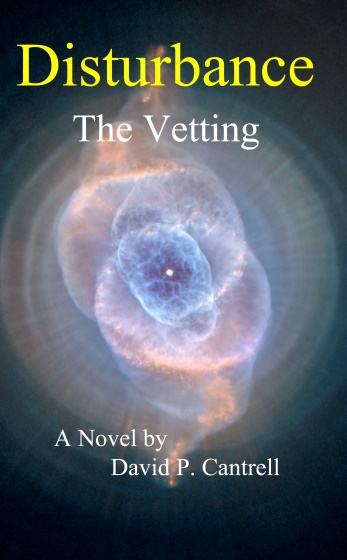
Disturbance - the VettingDPC: My one and only book is a work in progress. I published part one, Disturbance: The Vetting, in July 2014 and took it off the market in January 2015. The initial publishing was a mistake, but I’m glad I made it. I’ve learned a good deal about the process of writing, formatting and editing because of the mistake. I’ve met wonderful, supportive authors from around the globe as a result of it too.

CJJ: How did you come to write this novel?
DPC: Well-meaning idiots made me do it. That’s mean, but true in a sense. I started posting short “Slice-of-Life” stories on Facebook, items like “The Chicken Parmesan Saga.” I was encouraged to create a blog and gave it a go. I beta read Sci-Fi novels for a talented author, Jasper T. Scott. His comments gave me the idea that I might be able to write. I jumped into the deep-end.

CJJ: I’m mostly an outliner, myself. Do you have a specific ‘Creative Process’ that you follow, such as outlining or do you ‘wing it’?
DPC: Please define creative process. I tried to outline, but got hung-up on the order of things. What comes first, character or story? Can they exist independently? I’m a wing-it writer that prays for an outline to magically appear, and in it does sometimes.

CJJ: This is the question I hate to be asked, but here I am asking you: how does your work differ from others of its genre?
DPC: I want to write stories that make the reader think or learn something new. I love action oriented stories as much as the next person, but I want to write page turner’s that make the reader stop and think about what they’ve just read every once in a while. I get frustrated by the mantra to keep the story moving forward, if the words don’t keep it moving they are useless, not necessary.

CJJ: Why do you write what you do?
DPC: I write for the joy of research (I love an excuse to learn new things) and the hope to touch a stranger with my words.  Touching strangers is why I smile and say hello to them as they walk their dog down my block. Their response makes me feel good.

I recall a day my wife asked me to pick up something from our local grocer on my way home from work. It must have been summer because daylight abounded. I was a middle aged over-weight man walking across a parking lot and saw a stunning mid-twenties women dressed to the nines walking to her own car with a bottle of wine.  I worried if I said anything she’d think I was perverted. As I passed her we made brief eye contact and I said, “You look beautiful the evening.”  The smile on her face brings tears to my eyes as I write this.

CJJ: I like that little vignette you just painted for us, and feel somewhat the same myself when it comes to making people smile. So, when it comes to publishing, I know why I chose the indie route for my work, but I’m curious as to why you’ve chosen this path.
DPC: Is there a better way for an unknown to get their work before a world audience? I don’t care if I make a lot of money selling books. Don’t get me wrong, I’d love to do it, but it isn’t why I’m writing. I want to touch others, and honestly, I want the ego stroke that comes with it.

CJJ: What advice would you offer an author trying to decide whether to go indie or take the traditional path?
DPC: If money is your goal, try the traditional path. No one can promise better odds of making money on that path, but if you don’t give it a go you’ll always think you should have.

Dave Cantrell Author pictureDavid P. Cantrell lives with his wife of nearly four decades in the beautiful coastal community of Arroyo Grande< California. He is a retired CPA, enthusiastic (but not particularly good) home cook and avid reader. He enjoys history, historical novels, science fiction, non-fiction, fantasy, crime, thrillers, contemporary fiction and even a western now and again.

Before a spinal cord injury in 2009, he spent his creative efforts writing IRS defenses for his clients and on woodworking; building a variety of items, from chessboards to a Murphy Bed. The spinal cord injury left him paralyzed from the neck down, but with the help and love of his wife and caring therapists, he was able to recover significant function. Woodworking was behind him, and he accepted that.

Thank you Dave—you are a joy to know and to have as a friend, and you are an integral part of my personal writing life.

And now, “Ten Things I’ve learned as a Quadriplegic” By David P. Cantrell

(Reblogged from Edgewise Words Inn)

Being a quadriplegic (aka tetraplegic) is a learning opportunity. I found my opportunity when a confluence of events left me prostrate. Actually, I don’t remember being on the floor, I learned it later from my wife. She also told me I repeatedly asked if I’d had a heart attack while in the local ER. I don’t remember that either, but I’m not surprised. After all, I was an overweight, hypertensive, diabetic, chain-smoking CPA working on a deadline.

The first thing I clearly remember is the voice of an EMT talking to his ambulance driver as we arrived at a bigger hospital. I wasn’t sure why I was in the ambulance, but I knew something very strange was happening. I learned a good deal about myself over the following months.

  1. Paralyzed means: Crap, I can’t move and I don’t mean immobile.
    There’s a big difference between the two. Immobile means I can’t move right now because I’m drugged, strapped down or really-really sleepy, perhaps all three. Paralysis means so much more.
  1. Disrespect or abuse of a good woman’s love and support deserves retribution.
    If I’ve done either, shame on me. The memory of ICU, day one, is vague, but real. My teary-eyed wife held my hand, which I could not feel, and said, ‘I have your heart and your mind, that’s all I need.’ To this day, it’s our motto ….(To read the rest, click here to be transferred to Edgewise Words Inn and the rest of Ten Things I’ve Learned as a Quadriplegic)

Comments Off on My Writing Life: David P. Cantrell

Filed under Adventure, Battles, Books, Fantasy, Humor, Literature, Uncategorized, writer, writing