Category Archives: Fantasy

Mucking out after the dragon

MH900053412I thought I had The Last Good Knight all cleaned up. I was SURE I had it as straight as could be! Many eyes have looked at it, and still there are places that need attention!  Fortunately, Carlie Cullen is applying her red pen to the hitches and halts in the flow, without changing the story or the structure since it has been published for so long.  It’s a good story, probably my favorite but it has had a rough life.

This is the one tale that never had a real line-edit, and I was so new to this business that I thought the brief once-over my former publisher gave it was a true edit.  They were new at the business too, and were learning a lot as they went along. It was a good edit, in that it cleaned up certain obvious things, but it was very quick and not a true, in-depth edit. I was not involved in the actual edit, as the changes that were made were not offered to me for my approval. Thus, getting that book re-edited so that it reads more easily is somewhat like mucking out after a dragon.  Just about the the time I think it’s all done, there is another steaming pile of…goodness…look at the time, I should be cooking dinner.

Having worked with two editors since leaving the former publisher, I now see what was NOT done for The Last Good Knight the first time, and thank god, one of my editors, Carlie Cullen is giving it her attention. The biggest challenge is dealing with these things and moving on, instead of banging my head on my desk in frustration when she points out something I should have seen.

But that is why these sorts of edits are SO critical. We, as authors, only see what we THINK we wrote. This is something I can’t stress strongly enough–get an independent eye on your work.  If you have a friend who has worked as a paralegal for her entire career, proof-reading lawyers briefs as Irene Luvaul did, even better!  If you can’t find an editor you can afford, you can do this: Print your work out one chapter at a time, and sit down with the yellow high-lighter. take an envelope and go down the page one line at a time. You will catch a great deal that way!

I don’t feel nearly so badly about TLGK once I take a close look at my earlier works though – those tales who began their lives on performa-630-192the old Mac  in the mid nineties. Once they were transferred to disc and then transferred again to PC they were put away and forgotten.  Some have great storylines, and really fun characters, but I would have to completely rewrite them in order to make a silk purse out of the sow’s  ear they are right now.  There must be an entire library of badly written prose on those old mac floppies.

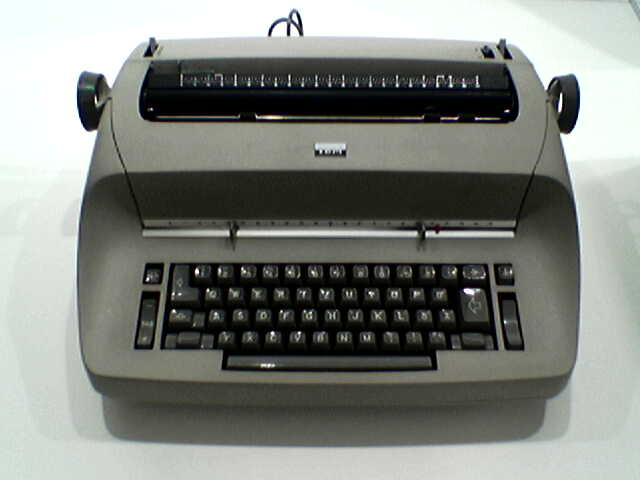
There are many flaws in my earlier works, especially the ones going back to my days of pecking them out on the old IBM Selectric.They are rife with misspellings, poor grammar, clichés, head-hopping, and hokey dialogue.  But underneath all the bad fluff I see the bones of the story I was so proud of having written in the first place, and I realize that there was spark there.  This is why I say don’t be discouraged by your first initial draft of any work.  All it needs is a lot more attention from you and the eye of an editor.
IBM_SelectricI was once a singer in a heavy metal band, and the opening lines of one of the songs I wrote went like this:

“It’s a cold and lonely morning, the sky dawns bland and white.

The emptiness inside my heart is as chilling as the night.”

It was cheerful little tune (NOT!) but with my ex-husband’s awesome guitar solos it was quite popular among our friends. We were very hip and very serious about the craft when we played. Of course I was 26 at the time, and quite sure I was the next female Ronnie James Dio. The band as a whole took ourselves far too seriously, and it soon got to the point where it wasn’t fun anymore.    It was a long time before I realized exactly why we fell apart the way we did, when we were having such a good time playing  small gigs as a local band. We became too caught up with the art of the music, instead of getting on with it and we forgot why we were doing it in the first place.

I admit that I don’t need serious anymore.  I don’t need to take my writing so seriously that it’s not fun.

With that said, I do need to turn out the best finished product I am able to do, and that means allowing someone I trust to look at it and say, “This just doesn’t read right. Maybe if you change this a little….”   I am not married to my prose, although I am sure it is the finest prose  in the world. Oh, look…more dragon poo.

3 Comments

Filed under Adventure, Books, Dragons, Fantasy, Humor, Literature, mythology, writer, writing

The Terry Pratchett School of Prose

The Color of Magic_cover terry pratchettOne of the earliest influences on my sometimes smartassed style of writing was Sir Terry Pratchett, O.B.E.‘s watershed fantasy series, Discworld. Sir Terry takes  J. R. R. Tolkien, Robert E. Howard, H. P. Lovecraft and William Shakespeare, as well as mythology, folklore and fairy tales, and mashes them up in this hilarious series of tales. There are 39 books in this trilogy!  Talk about prolific!

Discworld is a flat disc balanced on the backs of four elephants which, in turn, stand on the back of a giant turtle, Great A’Tuin. Oh my goodness – what opportunities for mayhem were locked in that kernel of a plot!  The series begins with “The Colour of Magic.”

One of my favorite books in the series is “Mort.” It is the 4th book and is the first to give Death the main storyline.

As a teenager, Mort had a personality and temperament that made him rather unsuited to the family farming business. Mort’s father, named Lezek, felt that Mort thought too much, which prevented him from achieving anything practical. Thus, Lezek took him to a local hiring fair, hoping that Mort would land an apprenticeship with some tradesman; not only would this provide a job for his son, but it would also make his son’s propensity towards thinking someone else’s problem.

The conversation between Lezek and his brother Hamish as they discuss Mort’s future in the opening pages is hilarious and quite revealing in its simplicity. In this snippett, Lezek and Hamish are observing Mort as he attempts to frighten some birds away from the crop.

“He’s not stupid, mind” said Hamish. “Not what you’d call stupid.”mort - terry pratchett

“There’s a brain there all right,”Lezek conceded. “Sometimes he starts thinking so hard you has to hit him round the head to get his attention. His granny taught him to read, see? I reckon it overheated his mind.”

At the job fair, Mort at first has no luck attracting the interest of an employer. Then, just before the stroke of midnight, a man concealed in a black cloak arrives on a white horse. He says he is looking for a young man to assist him in his work and selects Mort for the job. The man turns out to be Death, and Mort is given an apprenticeship in ushering souls into the next world (though his father thinks he’s been apprenticed to an undertaker).

I love the snarky way Pratchett takes clichés and runs with them. He grabs the boring, bland, overdone themes of western literature by the tail and swings them.  When he sets them down they are SO much more fun to watch!

What I have learned from the Terry Pratchett school of prose is that dialog tells us as much about the speaker himself as it does about the words expressed.  In the quoted passage above we see enough of the two men who are speaking to have some idea of who they are.  Pratchett gives us the personality and demeanor of the character in those simple lines.  We can see them, fully formed in our minds eye as they speak. .

That is the hand of the master, and it is what I someday hope to be able to bring to my own work.  The important thing to remember is you must read the works of the masters, because if you have no idea of what good writing really is, you can’t write it. Read the best works in your genre and continue writing your own stories and never let the struggle of getting your work out there take away the joy of writing it. It’s not easy, going indie, but it is so rewarding!

11 Comments

Filed under Books, Fantasy, Humor, mythology, writer, writing

Oh, the Agony

The Aspirin Shop © 2012 Connie J Jasperson All Rights Reserved

The Aspirin Shop © 2012 cjjasp All Rights Reserved

Yes, we now find ourselves in the deepest depths of January. The days are short and dark, and my desk is piled high with the visions and revisions of my current works-in-progress. I stare at the mountain of work that demands my attention and my mind is consumed with solving that eternal paradox,  “Who gave me this damned cold? Which little germ-factory that I call a grandchild is the culprit?”

Alas, the responsible party is most likely sitting in his kindergarten class having a snack and discussing tactics for beating “Lego Star Wars”  with his mates while Grandma suffers the agonies of the damned.

In the meantime, cold or no cold, I must somehow wind up the tale before me. My characters have already been through quite a lot, and they aren’t in tip-top condition. Still, they have a job to do and they are going to do it or die in the process.

At this juncture my characters are lurking high in the  branches of fir trees outside the stone walls of a mountain keep, observing the small village surrounding the castle they need to enter. They need to decide how to enter the haunted castle, and they need to make a plan for getting to the rogue-mage and eliminating him.  Once he is dead, the spells he’s layered over his guards will be broken and my team should be able to leave safely.

Once inside the keep, they will have to make their way through the halls, killing off the bespelled guards as they come to them until they have finally met the mage they have been sent to kill.

They’ve already fought a dragon and been caught in an avalanche. They’ve fought many other elemental creatures and each other.

Now here they are, poised on the edge of finishing this adventure and Grandma’s too stoned on NyQuil to concentrate long enough to get them to where they can kill the evil bad dude.

This could take a while.

It’s just so much wo-o-o-ork…..

Actually this game looks fun. I think I’ll just rest in the play-room for a moment….

lego-star-wars-the-game desk top wall paper

3 Comments

Filed under Adventure, Battles, Dragons, Fantasy, Humor, knights, mythology, Romance, writing

Party On!

472px-Judith_Leyster_Merry_TrioHappy Christmas and Merry New Year!  As my favorite author of all time, Charles Dickens,English novelist (1812 – 1870), wrote in his epic novel, A Tale of Two Cities, “It was the best of times, it was the worst of times, it was the age of wisdom, it was the age of foolishness, it was the epoch of belief, it was the epoch of incredulity, it was the season of Light, it was the season of Darkness, it was the spring of hope, it was the winter of despair, we had everything before us, we had nothing before us, we were all going direct to heaven, we were all going direct the other way – in short, the period was so far like the present period, that some of its noisiest authorities insisted on its being received, for good or for evil, in the superlative degree of comparison only.”

If that doesn’t describe 2012, nothing does!  So, let the revels begin!  I will be celebrating the New Year with a small dinner party as I finally make that commitment to go fully vegan for the 31 days of January.  If I find my health improves I will stay on the vegan diet permanently.  It just so happens that this group is evenly divided between carnivores and vegans with those bearing the Y chomosomes being the carnivores.

So on Dec. 31st I will spend the day making a dinner for the husbands AND a dinner for the wives!  This will be an adventure.  I curry and sweet potato soupwill make a chicken marsala, and mashed red potatoes with grilled asparagus for the men and a curry and maple sweet potato soup for the ladies, along with salads and fruit for everyone.  I make my bread vegan now anyway. I will keep you all posted on my progress with this new (to me) way of eating.

So put on your party hats and bring out the noisemakers!  What better way to start the New Year than to enjoy a fine dinner, a brisk game of Monopoly and the company of friends?


2 Comments

Filed under Battles, Books, Final Fantasy, knights, Literature, Uncategorized, writer, writing

Charles Dickens was an Indie Author, Too

achristmascarol George C ScottFew people are aware that one of the most famous and inspirational books in the English language was originally self-published, and didn’t do as well as the author intended. Charles Dickens began to write A Christmas Carol in September 1843, and completed the book in six weeks with the final pages written in the beginning of December. Unfortunately he was feuding with his publisher over the meager earnings on his previous novel, Martin Chuzzlewit. Because of that, Dickens declined a lump-sum payment for the tale and chose a percentage of the profits in hopes of making more money. He then published the work at his own expense. It was as expensive then as it is now to publish quality print books and high production costs netted him only £230 (equal to £19,128 today) rather than the £1,000 (equal to £83,164 today) he’d hoped and needed, as his wife was once again pregnant. A year later, the profits were only £744 and Dickens was deeply disappointed.

Formatting was as tough in those days as it is now and Dickens was unhappy with the first edition of the tale. It contained drab, olive colored endpapers that Dickens felt was unacceptable. The publisher, Chapman and Hall, quickly replaced them with yellow endpapers but those clashed with the title page which was then redone. The final product was bound in red cloth with gilt-edged pages and was completed only two days before the release date of 19 December 1843.

I take comfort in knowing that the man who wrote the most powerful story of redemption in my personal library was an indie author too. Self-Alastair Sims - A Christmas Carolpublishing is much easier nowadays, but nevertheless it too is fraught with costs and formatting difficulties.  I have one last little formatting issue to solve in the Tower of Bones on page 361, and then I will be able to okay the final print version of it.  Wonky formatting is the curse of my life!

This is the time of year when I watch every single version of A Christmas Carol that can be found. Alastair Sims, George C. Scott, Patrick Stewart, Mr. Magoo and now Jim Carey occupy the small screen and remind me of what is really important in life – love and family.  Even Mickey Mouse has warmed the cockles of my heart in the role of Bob Cratchitt.

And now, I must go wrap presents by the flickering light of my television, as once again the Ghost of Christmas Present leads Mr. Scrooge to see what he should have seen all along – that Christmas Spirit is a year-round emotion, and has less to do with cash flow and Black Friday Shopping and more to do with charity of spirit.

If you are feeling charitable, I would recommend these fine charities:

The Salvation Army

The Union Gospel Mission

Clean Water for the World

Patrick Stewart - A Christmas CarolThere are so many worthy charities, and any gift you make to them will benefit millions of people.  I live in the lap of luxury, and I know it. I have a good roof over my head, a reliable income and a healthy family. I am grateful for all these blessings, and if you are similarly blessed, I encourage you to make some donations to your local charities as a way of giving thanks!

3 Comments

Filed under Adventure, Books, charity, Fantasy, Humor, Literature, Uncategorized, writer, writing

Punish me no More

Paradise Lost  wikimedia commons Gustave Dore PD ArtI was reminded about the book, Finnegans Wake, in a blog I regularly read.  James Joyce wrote the classic novel, and James was a man who loved words.  He loved words the way I love Ritchie Blackmore and Reese’s Peanut Butter Cups.  He couldn’t get enough of them and when old words didn’t suffice, he invented new ones. Puns, those low class examples of verbal violence, became an art form under the pen of James Joyce.

Robert MacLean’s most recent post for his fascinating blog on morality, humor, and art, ‘The Devil’s Pleasure Garden’ is on Fellini, and Shakespeare.  He rambles though Shakespeare’s Hamlet, Fellini’s 8 ½ , and lightly touches on Luis Bunuel.  I enjoy MacLean’s morality crises – his angst has led to some of the finest blog posts on creativity out there!

MacLean also mentions James Joyce’s incredible monster-piece, Finnegan’s Wake, quoting the delicious pun “…when they were jung and easily freudened.”  I realized when I was re-reading MacLean’s blog today that the reason so many people despise puns is that for a pun to be funny one has to know what the pun is about. If a reader has never heard of Carl Jung or Sigmund Freud that pun will go right over their head. They get a sour look and say “I despise James Joyce – I don’t know what people are thinking calling him a genius.”

When people don’t understand something that makes other people laugh, they feel somehow inferior and they hate it. So my job is to not make my readers feel ignorant, and yet still write in such a way that my work is not ‘dumbed-down’.  Humor is essential, and I usually love a good pun, but since the key to enjoying a good pun is knowledge and you can’t guarantee your readers will have that knowledge, it’s best to avoid puns when writing.

But for me, humor is crucial to keeping me interested in the characters. If you are going to have your characters grimly going about their work, with nothing to brighten the mood you have immediately lost me.51EwwPIAJbL__BO2,204,203,200_PIsitb-sticker-arrow-click,TopRight,35,-76_AA278_PIkin4,BottomRight,-64,22_AA300_SH20_OU01_

Shaun Allan’s brilliant work, Dark Places, is a classic example of how an author can blend humor into the darkest events, and keep his readers’ eyes on his book.

I find myself injecting humor into my work, not in a calculated way, but because it naturally flows there.  Macabre humor is what keeps my family together at times—that ability to laugh at the worst times keeps us slogging through the strangest twists and turns of life. Oh, it’s a little embarrassing at times, but it gets you through it. And that is what happens with my characters. Lackland, Huw the Bard and indeed all the Rowdies rely on their sense of humor as the way to find logic in the worst of events.

In Tower of Bones, the sense of the ridiculous surfaces several times when the characters are under the most stress. Friedr is one of my favorite characters in the TOB series, as he is the most in touch with his sense of humor and his frequent lack thereof. Christoph was born with a joke falling out of his mouth, and humor is his armor.

Good grief!  I just said “one of my favorites” – all of my characters are my favorites! Even the evil ones!

1 Comment

Filed under Adventure, Battles, Books, Fantasy, Humor, Literature, Romance, writer, writing

The Alternative Guide to Alternate Realities

The Infinity Bridge by Ross M KitsonToday we are going on a voyage, visiting three very different realities, or as I like to think of them, Blogs.  We are on a progressive blog tour, guided by the incredible Ross M. Kitson, author of the Steampunk fantasy, The Infinity Bridge.  Part I of this tour is today, here on Life in the Realm of Fantasy

Part II will be tomorrow Dec 13, 2012 at  www.alisondeluca.com – Alison Deluca’s wonderful blog.

Day III will be at Ross’s own blog http://rossmkitson.blogspot.co.uk

I encourage you to check out these blogs and follow this post through all the realities it travels through!

>>><<<

Alternative guide to Alternate Realities 1: Literature

By

Ross M. Kitson

One of the key aspects of my latest book, The Infinity Bridge, is the existence of parallel universes or alternate realities. As the book is written for the teen market upwards (MG/YA is the latest term, to avoid the patronising ‘kid’s book’ I suppose) I spent a good while musing about whether to include a meaty information dump in the next about the ideas of alternate reality. And here’s an odd thing- the more I thought about it, the more I realised that as an idea in fiction/TV/film it is so thoroughly established that I didn’t need to bother!

I think my first exposure to the idea of alternate reality came in the form of comics (which was pretty much my first form of literature anyhow). I’m going to ramble about those in a separate post—for this one I’m going to focus on alternate reality in books.

The idea that history may have taken a different course, and the ramifications of that, have been a popular theme for centuries. The first works about the topic popped up in Victorian literature (N Hawthorne’s short story ‘P Correspondence’ and C Holford’s ‘Aristopia’) but the real boom in the topic came in the pulp science fiction of the forties and fifties. During this time some awesome writers, including Heinlein, L Sprague De Camp, Poul Anderson, Andre Norton and Larry Niven turned their hand to the topic. In many of these works we have protagonist able to cross between the alternate realities, often armed with knowledge of their own historical variant, via portals or machines. In some tales they are ‘police’ figures (the best example of this being H Beam Piper’s Para-time books, which I read recently and absolutely loved) trying to address some renegade or some disruption, whereas in others the individuals are more passive in their roles, thrown into the new reality and learning of its variance as the reader dose.

The concept of parallel worlds and alternate history progressed from the pulp SF realm and into that of more popular and conventional literature. A recurrent favourite of the genre is the course of World War 2 being changed: Philip K Dick ‘The Man in the High Castle’ describes the Axis powers winning WW2 (and has a character in it who writes a book about the Allies winning!); Robert Harris ‘Fatherland’ is a similar very popular example. I’ve yet to read one where Adolf has a better moustache, however.

In MG-YA books the theme is quite a popular one too. I recently read Time Riders by Alex Scarrow in which three teens are recruited by a futuristic agency to help ‘mend time.’ The first novel explores the idea that time travellers go back in time and assist Hitler by stopping him attempting to invade Russia. The ramifications are that an alternate timeline is created, which alters the present in which the heroes occupy. My 10 year old son took the plot in his stride, and when we talked about it had no issues about the whole concept!

Purists of the SF genre would ponder whether works of alternate histories are fantasy or SF, namely is there any science behind it (I feel like Jennifer Aniston in a shampoo advert… ‘now here comes the science’).

Semantics would argue ‘alternate histories’ are not the same as ‘parallel universes.’ The idea is that parallel universes co-exist, namely they run along at the same time, whereas only one ‘alternate history’ can exist, i.e. the history has changed and continues along its new course. For me this is pretty pedantic, but since I grew up with the ideas in Star Trek, Dr Who and comics I’m hardly a hard-core sci-fi buff…

There is a school of thought in Quantum physics that gives a degree of theoretical credence to parallel worlds and alternate histories: the Many-Worlds Interpretation, or the ‘relative state formulation.’ It’s the sort of quantum theory advanced since the 1950s and sufficient to make you reach for a large spliff and say ‘Hey, man’ as someone in a brown corduroy jacket begins to explain it. Its basic tenet is familiar though- every event even at a quantum level, can go a number of ways. As a result there are a myriad set of possibilities that extend out from each other in a never ending tree. There was a famous thought experiment to do with a cat, a radioactive isotope and a vial of poison (Schrodinger’s Cat, not to be confused with Schroder’s piano in Charlie Brown). I’ve rambled enough now, so I’ll leave you to seek that one out yourself (or follow Douglas Adam’s Dirk Gently’s Holistic Detective Agency where the cat had got bored and simply wandered off).

To me the popularity of the alternate history is that it forces us into questioning our world, querying about how things came to be how they are, and extending that idea from simple practical aspects (what if we flew around in airships not planes) to greater moral and ethical considerations (what if the philosophy of the Nazis were part of our own daily belief structure; what if the Americans lost the War of Independence and remained a colony of Europe, how would it alter their perspective of the world and their Constitution-based beliefs?).

I think that the idea of alternate reality, alternate history and parallel worlds is so ingrained now in our literature that it hardly needs explanation and I think a massive part of that is the progression of the idea from 50s sci-fi into the popular realms of TV and Film.

And in my next post on the topic, I’ll explore that some more….

>>><<<

Part II will be posted tomorrow Dec 13, 2012 at  www.alisondeluca.com – Alison Deluca’s wonderful blog. http://alisondeluca.blogspot.com/2012/12/the-inspiration-behind-adventures-of.html

Day III will be at Ross’s own blog http://rossmkitson.blogspot.co.uk and will run on December 14, 2012!

>>><<<

Ross M. Kitson

Author Bio

Ross M Kitson is a published author in the fantasy genre, with an ongoing series (The Prism Series), a number of short stories on Quantum Muse web-zine and several stories in Steampunk and fantasy anthologies.

His debut series for Myrddin is due for release in October 2012, and is a sci-fi series set in modern day York. It is written for ages 12+, although its combination of killer androids, steam-powered airships, kick-ass heroines and action packed chases will appeal to all ages.

Ross works as a doctor in the UK specializing in critical care and anaesthesia. He is happily married with three awesome children, who nagged him incessantly to write something that they could read. His love of speculative fiction and comics began at a young age and shows no signs of fading.

You can Follow Ross on Twitter:   @rossmkitson

You can find him on Facebook  http://www.facebook.com/TheNuKnights http://www.facebook.com/ross.kitson.9

Ross M Kitson’s Books are available at Amazon.comUS and Amazon.comUK.

4 Comments

Filed under Adventure, Battles, Books, Fantasy, Humor, knights, mythology, Steampunk, Uncategorized, writing

Billy’s Revenge

HTB full cover for create space copyThe Billy’s Revenge series takes place in one of my favorite places: The wayside inn known as Billy’s Revenge.  Irene Luvaul is currently editing the first book in the series, Huw the Bard,  and I am making revisions per her kind-but-firm direction. I have begun work writing Book 2, Billy Ninefingers. It’s good to back among my close friends at Billy’s Revenge!

In regard to the Tower of Bones series, book 1, Tower of Bones is currently in the final stages of review and will be available in print by January 1st, 2013.  Forbidden Road is being prepped for publication and will be available in both print and Kindle format by the end of January 2013, barring any formatting issues. Carlie Cullen and I finished the fourth and final edit and Sherrie DeGraw is proof-reading the final edited version. I have made great headway on book 3 in that series, Valley of Shadows and also am nearly done with a stand-alone novel, Mountains of the Moon.

Writing consumes me – I have more ideas and stories than I have time to write them. I have a large number of works in progress at all times so that when I run out of ideas in one tale I can move on to another, and my creative mind is always flowing.

Irene Luvaul has given me some excellent advice in regard to keeping things straight.  If you have a made-up word, write it on a list of names and words you are using in that tale so that your spellings and capitalizations remain consistent throughout the work.  This is a really good idea for me, as I have a LOT of invented and fractured names in all my work!  I have done this, and I refer to it frequently.  When I find myself keying something wrong, I do a control-f search (find and replace) and make sure every instance of that word is consistent within the manuscript.  Irene is currently on a ‘which’ hunt.

*sigh*

In the course of editing Tower of Bones and Forbidden Road, I was rudely surprised by the number of instances of ‘had been’, ‘that’, and ‘very’ salting my first draft.  I’ve conquered the urge to fall back on those words to a certain extent, but now ‘which’ has become the bugaboo word for me! What happens is we use words repetitively and don’t realize it.  Carlie Cullen in the Tower of Bones Series and Irene Luvaul in the Billy’s Revenge series both keep me on track and out of trouble.  As I always say, writing is a journey and I never know what is around the corner.

At least everything is finally back on track and going forward as well as is possible in both series.  I also have my book of fairy-tales inching toward completion, and hopefully by June they will be ready to be published. There is a time-traveling story about Galahad, a modern take on a Snow White mashup along with several traditional style tales, all of which are nearly complete and will need editing soon. Writing the tales for that book is a great deal of fun, because telling the tales with a traditional, Brother’s Grimm style of narrative is rather liberating.  The tales are not for children.  If you think about it, most fairy-tales are extremely violent and involve adult situations.  I’ve always thought they were tales for grownups, anyway!

4 Comments

Filed under Adventure, Battles, Books, Dragons, Fairies, Fantasy, Humor, knights, writer, writing

‘Like’ me, please…

Berry-ellen-mcclung-by-branson Public Domain Art -Wikimedia CommonsSocial networking has always been important for girls–invite me to your birthday party and I will invite you to mine.  We both gain that way. After all, you get a present and I get a cupcake!  In childhood the little bits of social networking we did led to tears as often as it did to cupcakes, but now we’re grownups and we have a book or a music cd to market.  We can’t afford to shed tears over this.

Whether it is music or books, if you are an indie, you must take responsibility for your own marketing.

1. Decide what you are marketing.  This sounds like a no brainer, but many people are blurry on this, and they apply a lot of energy and get nowhere.  I know many people who  write, paint and ALSO make music.  If you are doing multiple things, separate your website into different pages for each aspect of your career, with a good home page that directs your prospective client to the product they are looking for.   I really like the website which Blackmore’s Night has put up, and I also like Mercedes Lackey’s website.  Both are professionally done, but a free WordPress Blog can be utilized to good advantage by a determined self-promoter.  The lovely folks at WordPress give you all the tools you need to learn how to do this!

2. Make regular posts and updates, to keep your blog fresh.  After all – we’ve all clicked on links in the google list that take us to abandoned virtual warehouses, with out of long out of date information and links to nowhere!

3. Use Twitter well and sparingly.  Twitter can easily become a spam-fest, so be careful how you use it.  Be sure to retweet your twitter-friend’s important events, and they will return the favor.  Once in a while, post your homepage, your professional Facebook page and links to your books or your music, but be wise and respect your friends.

4. The eternal sunshine of the Facebook page – again, be careful not to spam the world everyday with your links on your personal page, because your highschool chums and distant cousins won’t pay anymore attention to them than they do Aunt Caro’s constant barrage of invitations to play Farmville. In fact, they may unsubscribe from you. This is where having a professional page comes in handy. After you send out ONE invitation to your family and friends to ‘LIKE’ your professional fb page, you are good to go. Maybe in a few months, re-post the link on your personal wall, but don’t beat folks over the head with it. Do tweet the links to it once in a while, and post them on your blog/website. Page Owners need to make sure their content is interesting and in that way they are encouraging Likes, comments and Shares so that their posts continue to show up in their Fans’ News Feeds, but they MUST NOT SPAM.

BTW – My Facebook page is at https://www.facebook.com/cjjasperson and I would be awfully happy if you would stop by and ‘like’ me… I’ll save you a cupcake at my next birthday party! (…hmm…should I use ‘lol’ here or is that too hokey?) (I’m not really joking, so maybe ‘lol’ is appropriate… it’s jaunty and pretends I’m not serious…)

lol.

It’s tough trying to learn the ropes in the world of self-promotion.  There really is no handbook, because the social-network scene is always changing.

One thing hasn’t changed though and that is business etiquette. Trying to walk that fine line between getting your name out there and being that annoying acquaintance who deluges his casual acquaintances with constant demands that they buy his wretched cd or book is difficult.  I think this is where our manners come into play–what would you like your friends who are self-promoting to do? Behave the way you want them to behave for you and hopefully you will still have friends in a year!

lol. (I mean it this time.)

I do have some acquaintances on Facebook who bury me with spammy demands to push their product, and I have friends who only ask to have a product pushed once in a while.  Guess who I am always happy to help? Not Spam-the-Man Jones and their sad book of badly conceived, not-so-erotic, pornographic haikus.

Now that might actually sell.  (Note to self–consider writing a collection of seventeen-syllable erotic poems…)

Nah. lol.

5 Comments

Filed under Adventure, Books, Humor, Literature, writer, writing

The Descriptive Balancing Act, Maria V.A. Johnson

Today’s guest post is by Maria V.A. Johnson, poet and editor. Maria was the editor on Carlie M.A. Cullen’s novel of paranormal love and adventure, ‘Heart Search: Lost’. Maria can be found blogging at http://mariavajohnson.com

Maria is discussing the fine balancing act an author has when it comes to description.  For me, description is like hot-sauce. I love it, even when my lips are on fire, but I fear going over-board with it so when I am cooking, I don’t go there as often as I should.

>>><<<

The Descriptive Balancing Act

One of the hardest parts about writing is getting the level of detail correct. If you don’t describe something well enough, how are the readers supposed to connect to it? On the other hand, if you describe too much they will give up reading it completely.

It has always been a balancing act, between description and plot. One thing you need to remember though is that a story should always be either plot or character driven; it cannot be driven on description. The whole point of description is to paint the scene. Think of a painting of a woman. Is it interesting if she is standing in a white canvas, nothing around her? Not really. But is it interesting if she is standing in the middle of a huge crowd, or a forest, so you can barely see her? No. An author has to try to find the middle ground, just like with that painting.

So how do you use enough description to show the scene without overwhelming it?

Step One. Focus on telling the story. You can always go back and add more detail later if it’s needed.

Step Two. Try to be realistic. Don’t put in fancy words and elaborate phrasing just because it sounds good or you think it will stun the reader with your eloquence. Look at this phrase from the Bulwer-Lytton Fiction Contest. http://www.bulwer-lytton.com/2011win.html

The Los Angeles morning was heavy with smog, the word being a portmanteau of smoke and fog, though in LA the pollutants are typically vehicular emissions as opposed to actual smoke and fog, unlike 19th-century London where the smoke from countless small coal fires often combined with fog off the Thames to produce true smog, though back then they were not clever enough to call it that.

Now a) this sentence is way too long, which makes it difficult to follow from one end to the other, and b) you only need the first 8 words. Who doesn’t know what smog is? Who doesn’t know this author is referring to the car emissions? It is unnecessary detail. And the reference to 19th-century London? This would only be relevant if this were in a Historical Fiction novel or something similar, rather than being a throw-away comment on what real smog should be.  The author should just say “The Los Angeles morning was heavy with smog,” and then move on with the story. We all know what it looks like, and those 8 words conjure enough of a picture for us to understand the scene.

Step Three. Think about your characters. How do they act, think, feel? When they do or say something can you see their personality, their motivation, their feeling behind it? You don’t need whole paragraphs to do this unless it is a scene that calls for it, e.g. when someone is crushed by grief and the emotions are overwhelming everything – including the story, sometimes all you need is a word or two. Look at this example from Heart Search: Lost by Carlie M. A. Cullen.

“I don’t know what to say,” he moaned, anguish still apparent in his tone.

The male protagonist has just accidentally hurt his partner. You can see with just a few words how much it has affected him and how he feels about it. This tells you a lot about his character, how caring and gentle he is, and how much he loves her.

Step Four. Before sending it off to an editor, give it a read through and ask yourself “Is this something I would like to read?” If the answer is no, then ask yourself why.

Four easy steps to follow towards a balanced story. Of course, there are exceptions to every rule, but even for the exceptions there is a rule.

The Rule. If you are going to break a rule, make sure you do it well enough that nobody cares!

Let’s look at two classic examples of this – C. S. Lewis and J. R. R. Tolkien. Tolkien is known for his amazing scenes. Pick up The Lord of the Rings and you will find description on top of description. Even when they take up the entire page, it doesn’t feel too heavy. This is partly because of the length of the book, and partly because of the way he makes the scenes come to life. You don’t notice how long the descriptive passages are when you are lost within the world he has created.

On the south-eastern side the ground fell very steeply, as if the slopes of the hill were continued far down under the trees, like island-shores that really are the sides of a mountain rising out of deep waters.

Lewis is the exact opposite. Read The Chronicles of Narnia and you will see how little description he actually uses. The fact that this is a children’s book helps. A person’s imagination is most vivid as a child. He gives just enough detail to release the child to see the rest. He makes the reader the describer, letting them go where they want with only a little nudge. In The Lion, The Witch and the Wardrobe most things and people are described, but not until you are half-way through the final chapter do you learn anything about the four main characters.

And they themselves grew and changed as the years passed over them. And Peter became a tall and deep-chested man and a great warrior, and he was called King Peter the Magnificent. And Susan grew into a tall and gracious woman with black hair that fell almost to her feet … Edmund was a graver and quieter man than Peter, and great in council and judgement. He was called King Edmund the Just. But as for Lucy, she was always gay and golden-haired…


So now you know the steps to follow, you are half-way to having a decent novel which will engage your readers. Don’t forget that you should ALWAYS send it off to a professional editor – NEVER try to do it yourself!

Remember The Rule and happy writing!

1 Comment

Filed under Adventure, Books, Fantasy, Humor, Literature, Uncategorized, vampires, writer, writing