Category Archives: #FineArtFriday

The Catskills, by Asher Brown Durand 1858

Quote from Wikimedia Commons on The Catskills: This painting was commissioned by William T. Walters in 1858, when the 62-year-old Durand was at the height of his fame and technical skill. The vertical format of the composition was a trademark of the artist, allowing him to exploit the grandeur of the sycamore trees as a means of framing the expansive landscape beyond. Durand’s approach to the “sublime landscape” was modeled on that of Thomas Cole (1801-48), founder of the Hudson River school of painting. The painters of this school explored the countryside of the eastern United States, particularly the Adirondack Mountains and the Catskills. Their paintings often reflect the Transcendental philosophy of Ralph Waldo Emerson (1803-82), who believed that all of nature bore testimony to a spiritual truth that could be understood through personal intuition.

>>><<<

Quote from Wikipedia (the fount of all knowledge): Asher Brown Durand is remembered particularly for his detailed portrayals of trees, rocks, and foliage. He was an advocate for drawing directly from nature with as much realism as possible. Durand wrote, “Let [the artist] scrupulously accept whatever [nature] presents him until he shall, in a degree, have become intimate with her infinity…never let him profane her sacredness by a willful departure from truth.”

Like other Hudson River School artists, Durand also believed that nature was an ineffable manifestation of God. He expressed this sentiment and his general opinions on art in his essay “Letters on Landscape Painting” in The Crayon, a mid-19th century New York art periodical. Wrote Durand, “[T]he true province of Landscape Art is the representation of the work of God in the visible creation…”

I grew up in a forested place, not unlike that depicted here. That sentiment has endeared this style of art to me. I have become attached to the modern fantasy painters, those modern artists like Michael Whelan and the late Darrell K. Sweet, who paint images in this style for fantasy novels and RPG games. Their style is called Imaginative Realism.

What strikes me the most about this particular painting is not only the attention to detail, but the fairy-tale quality of Durand’s vision of realism. Viewed as a whole, this composition has an otherworldly quality to it, almost as if Elrond or Galadriel lurk just out of view, beyond the edges.


Credits and Attributions

Wikipedia contributors, “Asher Brown Durand,” Wikipedia, The Free Encyclopedia, https://en.wikipedia.org/w/index.php?title=Asher_Brown_Durand&oldid=845716778 (accessed June 14, 2018).

Wikimedia Commons contributors, “File:Asher Brown Durand – The Catskills – Walters 37122.jpg,” Wikimedia Commons, the free media repository, https://commons.wikimedia.org/w/index.php?title=File:Asher_Brown_Durand_-_The_Catskills_-_Walters_37122.jpg&oldid=164572034 (accessed June 14, 2018).
4 Comments

Filed under #FineArtFriday, writing

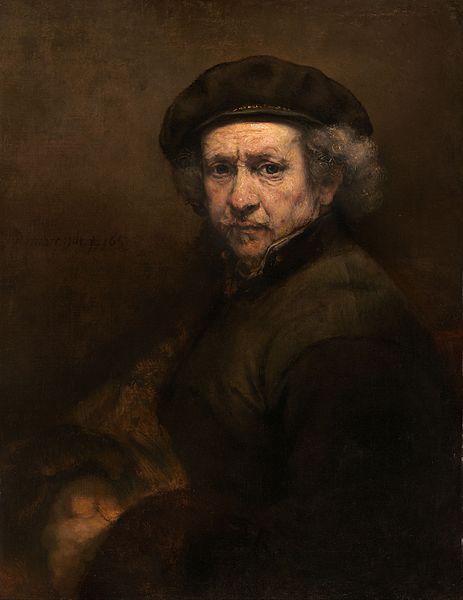
#FineArtFriday: Rembrandt through his own eyes, 1659

Rembrandt Harmenszoon van Rijn, commonly known simply as Rembrandt, is considered the finest artist of the 17th century. Some art historians consider him the finest artist in the history of art, and the most important artist in Dutch art history.

Speaking strictly as a Rembrandt fangirl and abject admirer, I consider his self-portraits to be more honest than those of any other artist.

Quote from Wikipedia: His self-portraits form a unique and intimate biography, in which the artist surveyed himself without vanity and with the utmost sincerity.

This honesty comes across in all his works featuring himself as the subject, even those where he portrays himself as a shepherd or the prodigal son. Each portrait shows an aspect of his personality, his sense of humor, his affection for Saskia who was the love of his life, and his wry acceptance of his own human frailties.

Rembrandt knew he was talented, but didn’t see himself as a creative genius. He was just a man with a passion for art, who lived beyond his means and died a pauper, as did Mozart, and as do most artists and authors.

I feel I know this man, more so than I do the person he was in his earlier self-portraits. He’s matured, lost some of the brashness of his youth. When I observe the man in this self-portrait, painted ten years before his death, I see a good-humored man just trying to live a frequently difficult life as well as he can. His face is lined and blemished, not as handsome as he once was. But his eyes seem both kind and familiar, filled with the understanding that comes from living with all one’s heart and experiencing both great joy and deep sorrow.

The art of Rembrandt van Rijn shows us his world as he saw it. Others may disagree with me, but I feel his greatest gift was the ability to convey personality with each portrait. This gift allowed him to portray every person he painted as they really were, blemished and yet beautiful. This is a gift he taught his students, and they were able to copy his style quite effectively, making discerning his true work difficult even for the experts.


Credits and Attributions:

Wikipedia contributors, “Rembrandt,” Wikipedia, The Free Encyclopedia, https://en.wikipedia.org/w/index.php?title=Rembrandt&oldid=844357531(accessed June 8, 2018).

Wikimedia Commons contributors, “File:Rembrandt van Rijn – Self-Portrait – Google Art Project.jpg,” Wikimedia Commons, the free media repository, https://commons.wikimedia.org/w/index.php?title=File:Rembrandt_van_Rijn_-_Self-Portrait_-_Google_Art_Project.jpg&oldid=292800848 (accessed June 8, 2018).

4 Comments

Filed under #FineArtFriday

#FineArtFriday: After the Hurricane, Bahamas by Winslow Homer

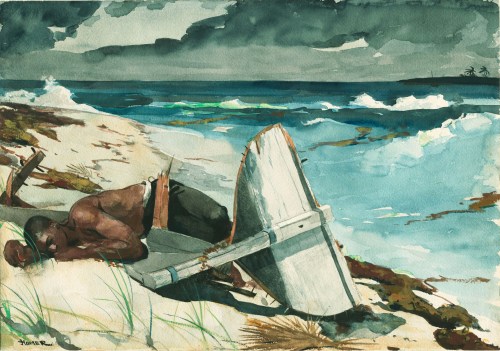
After the Hurricane, Bahamas is a watercolor painting by the American artist, Winslow Homer. It shows a man washed up on the beach after a storm, surrounded by the fragments of his shattered boat. The wreckage of the boat gives evidence of the severity of the powerful hurricane, which is retreating. Black clouds still billow but recede into the distance, and sunlight has begun to filter through the clouds.

The man may have lost his boat, but he has survived.

I love the way the whitecaps are depicted, and the colors of the sea are true to the way the ocean looks after a severe storm. Winslow Homer’s watercolor seascapes are especially intriguing to me as they are extremely dramatic and forceful expressions of nature’s power. The beauty and intensity of Homer’s vision of “ocean” are unmatched—in my opinion his seascapes are alive in a way few other artists can match.

This painting was done in 1899 and marked the end of Homer’s watercolor series depicting man against nature. That series was begun with Shark Fishing in 1885, the year he first visited the Caribbean and is comprised of at least six known paintings. The most famous of these watercolor paintings is The Gulf Stream, which was also painted in 1899. After the Hurricane, Bahamas is the last of the series.


Credits and Attributions:

After the Hurricane, Bahamas by Winslow Homer, [Public domain], via Wikimedia Commons

Comments Off on #FineArtFriday: After the Hurricane, Bahamas by Winslow Homer

Filed under #FineArtFriday

#poppies #poetry In Flanders’ Fields, by John McCrae

The beautiful image of poppies that graces this post is by Tijl Vercaemer from Gent, Flanders and was found on Wikimedia commons. The beauty and serenity of the poppies, rising from the fields where such terrible conflict once happened, is a fitting accompaniment for the poem, In Flanders Fields, by John McCrae, the text of which follows the picture.

From Wikipedia:  “In Flanders Fields” is a war poem in the form of a rondeau, written during the First World War by Canadian physician, Lieutenant-Colonel John McCrae. He was inspired to write it on May 3, 1915, after presiding over the funeral of friend and fellow soldier Alexis Helmer, who died in the Second Battle of Ypres. According to legend, fellow soldiers retrieved the poem after McCrae, initially dissatisfied with his work, discarded it. In Flanders Fields was first published on December 8 of that year in the London-based magazine Punch.

In Flanders Fields and Other Poems, a 1919 collection of McCrae’s works, contains two versions of the poem: a printed text as below and a handwritten copy where the first line ends with “grow” instead of “blow.” (…)

In Flanders fields the poppies blow
Between the crosses, row on row,
That mark our place; and in the sky
The larks, still bravely singing, fly
Scarce heard amid the guns below.

We are the Dead. Short days ago
We lived, felt dawn, saw sunset glow,
Loved and were loved, and now we lie
In Flanders fields.

Take up our quarrel with the foe:
To you from failing hands we throw
The torch; be yours to hold it high.
If ye break faith with us who die
We shall not sleep, though poppies grow
In Flanders fields.

While bed-ridden and recovering in the Veterans Administration Hospital in Vancouver, Washington, after World War II, my father had little to do but read or crochet afghans. To keep busy, he and the other recovering soldiers in his ward made endless numbers of Remembrance Poppies to commemorate fallen American soldiers. Dad always wore his poppy on his left lapel, as it was close to his heart.

Memorial Day is more than just the official launch of Summer here in the US, more than just an Indy car race. Families have always cared for their family graves, but it became a designated day after the American Civil War in 1868, established  as “Decoration Day.” It was a specific time for the nation to decorate the graves of the war dead with flowers. Every family had soldiers who served and gave their lives in the never-ending wars, as we do today.

Officially, Memorial Day is the last Monday in May. In the US, it is a 3-day holiday weekend. Banks are closed on Monday, and the US Postal Service is also closed. The American flag is traditionally set at half-staff until noon to honor all those whose lives have been given in the service of our country. At noon, it is raised to the top of the staff, signifying that we, as a nation, will rise again.

My paternal grandmother never failed to keep our family’s graves neat and tidy, bringing flowers every week for my uncle, who had died while serving in the Korean War. As she got older, this tradition aggravated my father, who just wanted to listen to the Indianapolis 500 car race on the radio. He couldn’t bear dwelling on the loss of his brother, or the friends he had lost in France in WWII.

But he took her to the cemetery, anyway.

After each great and terrible war of the last two centuries, the hope was always that we had fought a “war to end all wars.” World War I, also known as The Great War, was spoken of in literature as just that: a war to end all wars.

With each conflict we still hope, but we are less able to believe it, today less than ever.


Sources and Attributions

In Flanders Fields, by Lieutenant Colonel John McCrae, MD, PD|75 years

John McCrae died of pneumonia January 28, 1918, near the end of the Great War. In Flanders’ Fields is a staple poem for Memorial Day services.

Wikipedia contributors. “In Flanders Fields.” Wikipedia, The Free Encyclopedia. Wikipedia, The Free Encyclopedia, 1 May. 2018. Web. 24 May. 2018

Poppies Field in Flanders, image By Tijl Vercaemer from Gent, Flanders #Belgium. File:Poppies Field in Flanders.jpg. (2018, January 13). Wikimedia Commons, the free media repository. Retrieved 15:55, May 24, 2018.

2 Comments

Filed under #FineArtFriday, #FlashFictionFriday, Poetry

#FineArtFriday: The Merry Family, by Jan Steen

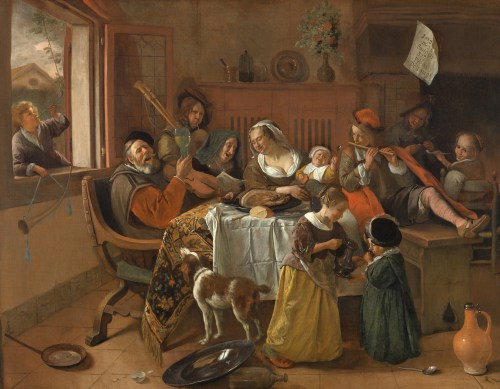
Jan Steen was fond of painting peasants and ordinary people, and this picture is a good example of that.

What I love about this image is the chaos. The clutter of pans and dishes heedlessly fallen to the floor, the boisterous enjoyment of wine and song, and the obvious lack of parental restraint is wonderfully depicted. The numerous children are smoking and drinking to excess, vices that weren’t acceptable diversions for youngsters then any more than they are now. The baby is exceedingly chubby, which was uncommon and represents the vice of gluttony–in one hand it holds bread and in the other it waves a spoon.

I suspect the children grew up with a similar love of wine and song as their parents.

The note on the wall contains the moral of the story. According to the Rijksmuseum website, “The note hanging from the mantelpiece gives away the moral of the story: ‘As the old sing, so shall the young twitter.’ What will become of the children if their parents set the wrong example?”

The Age of the Puritan had swept across Europe and while it was waning in the mid-seventeenth century, puritanism had influenced life in Holland as much as elsewhere. This painting is a wonderful visual exhortation reminding the good people to live a sober life. Steen himself was not a puritan, as he was born into a family of brewers and ran taverns and breweries off and on throughout his life. But he did need to sell his paintings as he was never a successful businessman, and his allegorical paintings were quite popular.

Quote from Wikipedia: Daily life was Jan Steen’s main pictorial theme. Many of the genre scenes he portrayed, as in The Feast of Saint Nicholas, are lively to the point of chaos and lustfulness, even so much that “a Jan Steen household,” meaning a messy scene, became a Dutch proverb (een huishouden van Jan Steen). Subtle hints in his paintings seem to suggest that Steen meant to warn the viewer rather than invite him to copy this behaviour. Many of Steen’s paintings bear references to old Dutch proverbs or literature. He often used members of his family as models, and painted quite a few self-portraits in which he showed no tendency of vanity.


Credits and Attributions:

The Merry Family, Jan Steen, 1668 PD|100 via Wikimedia Commons

Moral (English translation) quoted from Rijksmuseum website,  https://www.rijksmuseum.nl/en/collection/SK-C-229, accessed 17 May 2018.

Wikipedia contributors. “Jan Steen.” Wikipedia, The Free Encyclopedia. Wikipedia, The Free Encyclopedia, 3 Jan. 2018. Web. 17 May. 2018.

2 Comments

Filed under #FineArtFriday

#FineArtFriday The Painter in his Studio by Adriaen Van Ostade

In “The Painter in his Studio” by Adriaen Van Ostade (1663), we see a self-portrait of the artist, sitting with his back to us. He is at his easel, and his brush hand rests on a ‘maulstick,’ a stick with a padded head used by painters to support the hand holding the paintbrush.  In the shadowed background, a pupil is at work, possibly preparing a palette, or maybe preparing colors.

The window, the floor with all its debris, the walls, and the ceiling are depicted with great detail. The artist and his pupil are less detailed.

The studio is untidy, with brushes fallen on the littered floor. The room is cluttered with numerous odd objects and tools of the trade, including the head of a broken bust beneath a table. On the ceiling above the artist, a canvas canopy is tacked up, possibly to protect the artist’s work area from leaks, or perhaps falling dust.

A skull of some sort hangs near the window, and antlers also decorate the ceiling. The painter’s mannequin poses near the stairs, and an indistinct trunk stands open in the background.

The room is in desperate need of a good sweeping. The large leaded-glass window, however, is clean and lets in good light. It shows us how the artist saw himself and his work space.

A Netherlandish contemporary of the Flemish painters David Teniers the Younger and Adriaen Brouwer, Van Ostade was inspired by the work of Rembrandt.

As Rembrandt did, Van Ostade painted people who had seen hard times. They were often old, sometimes ill-favored, and not always beautiful. He painted dark interior scenes, where shadows are often the dominant features. He also painted the interiors of taverns and the homes of ordinary people, so through his work we who write can see how people really lived.

Van Ostade lived and painted in Haarlem. His subjects and the mood of his work is darker than that of his Flemish contemporaries, as hard times had fallen on the people of Holland, and  Haarlem in particular.


Credits and Attributions:

Wikimedia Commons contributors, “File:Adriaen van Ostade – The Painter in His Studio – WGA16748.jpg,” Wikimedia Commons, the free media repository, https://commons.wikimedia.org/w/index.php?title=File:Adriaen_van_Ostade_-_The_Painter_in_His_Studio_-_WGA16748.jpg&oldid=270705051 (accessed May 10, 2018).

3 Comments

Filed under #FineArtFriday

#FineArtFriday: The Netherlandish Proverbs by Pieter Brueghel the Elder

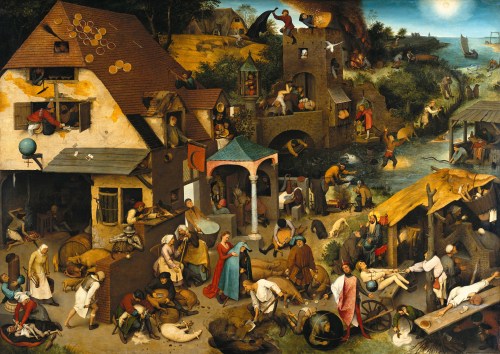
One of the best allegorical paintings of all time is The Netherlandish Proverbs (also known as The Dutch Proverbs) by Pieter Brueghel the Elder, which was painted in 1559. A master at humor, allegory, and pointing out the follies of humanity, Brueghel the Elder is one of my favorite artists.

Quote from Wikipedia:

Critics have praised the composition for its ordered portrayal and integrated scene. There are approximately 112 identifiable proverbs and idioms in the scene, although Bruegel may have included others which cannot be determined because of the language change. Some of those incorporated in the painting are still in popular use, for instance “Swimming against the tide”, “Banging one’s head against a brick wall” and “Armed to the teeth”. Many more have faded from use, which makes analysis of the painting harder. “Having one’s roof tiled with tarts”, for example, which meant to have an abundance of everything and was an image Bruegel would later feature in his painting of the idyllic Land of Cockaigne (1567).

The Blue Cloak, the piece’s original title, features in the centre of the piece and is being placed on a man by his wife, indicating that she is cuckolding him. Other proverbs indicate human foolishness. A man fills in a pond after his calf has died. Just above the central figure of the blue-cloaked man another man carries daylight in a basket. Some of the figures seem to represent more than one figure of speech (whether this was Bruegel’s intention or not is unknown), such as the man shearing a sheep in the centre bottom left of the picture. He is sitting next to a man shearing a pig, so represents the expression “One shears sheep and one shears pigs”, meaning that one has the advantage over the other, but may also represent the advice “Shear them but don’t skin them”, meaning make the most of available assets.

You can find all of the wonderful proverbs on the painting’s page on Wikipedia, along with the thumbnail that depicts the proverb.

My favorite proverbs in this wonderful allegory?

Horse droppings are not figs. It meant we should not be fooled by appearances.

He who eats fire, craps sparks. It meant we shouldn’t be surprised at the outcome if we attempt a dangerous venture.

Now THAT is wisdom!


Credits and Attributions:

The Netherlandish Proverbs (Also known as The Dutch Proverbs) by Pieter Brueghel the Elder 1559 [Public domain], via Wikimedia Commons.

Wikipedia contributors, “Netherlandish Proverbs,” Wikipedia, The Free Encyclopedia, https://en.wikipedia.org/w/index.php?title=Netherlandish_Proverbs&oldid=829168138  (accessed May 3, 2018).

4 Comments

Filed under #FineArtFriday

#FineArtFriday: The Caves, by Robert S. Duncanson


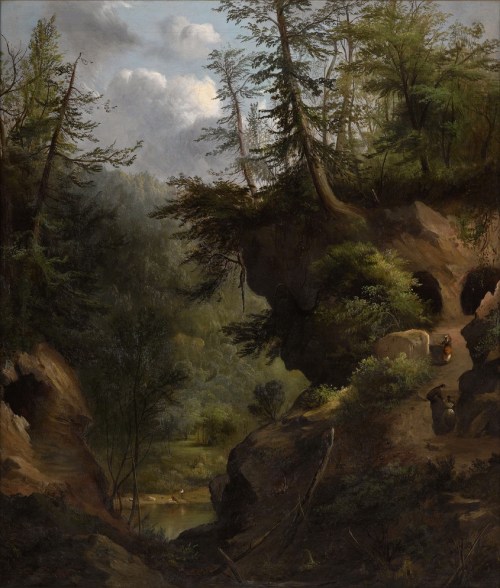
The Caves, by Robert S. Duncanson, 1869 is thought to depict Hocking Hills State Park in Ohio. Three caves are shown with people climbing to the caves on the right. In the center background on the shore are tiny human figures. A self-taught artist, Duncanson was inspired by the Hudson River School, a mid-19th century American art movement embodied by a group of landscape painters  whose artistic vision was heavily influenced by romanticism.

From Wikipedia:

Robert Seldon Duncanson was one of few African American landscape painters of the nineteenth century, and he achieved levels of success unknown to his contemporaries. Richard Powell of American Visions says that Duncanson’s success is a “victory over society’s presumptions of what African-American artist should create.” Duncanson became nationally and internationally known for his landscape paintings modeled after the Hudson River School tradition, and is credited with developing the regional Ohio River Valley art form.  Art historian Joseph D. Ketner claims that Duncanson’s greatest contribution to art was “his distinctively picturesque-pastoral vision of landscape painting with allusions to popular romantic literature.” 


Sources and Attributions:

Wikipedia contributors, “Robert S. Duncanson,” Wikipedia, The Free Encyclopedia,  https://en.wikipedia.org/w/index.php?title=Robert_S._Duncanson&oldid=827763141  (accessed April 13, 2018).

Comments Off on #FineArtFriday: The Caves, by Robert S. Duncanson

Filed under #FineArtFriday

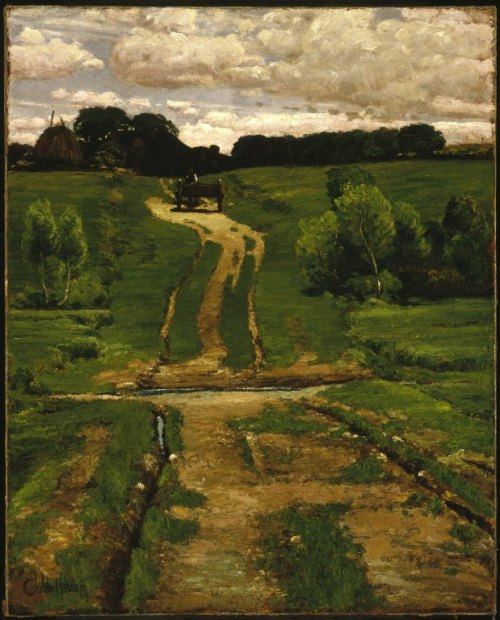
#FineArtFriday: A Back Road, by Childe Hassam

If you want to know what a road looked like to travelers before the advent of blacktop and concrete made the modern freeways and highways possible, turn to art. The above painting by Frederick Childe Hassam, shows what a good road looked like.  It goes across the land, cut into the earth by the travelers who use it. Along the better roads, such as this one, ditches were dug to enable drainage.

No bridge crosses the small creek–travelers must cross the water on foot or in the wagon. In winter it becomes a mushy, muddy track, and in summer it’s sun baked and hard. In spring, the grass grows green, making it a pleasant place.

A Back Road (1884) was painted in his early years, while Hassam was still influenced by the works of William Morris Hunt, who like the great French landscape painter Jean-Baptiste-Camille Corot, emphasized the Barbizon tradition of working directly from nature.

From Wikipedia: In 1885, a noted critic, in part responding to Hassam’s early oil painting A Back Road (1884), stated that “the Boston taste for landscape painting, founded on this sound French school, is the one vital, positive, productive, and distinctive tendency among our artists today…the truth is poetry enough for these radicals of the new school. It is a healthy, manly muscular kind of art.”

I like the composition of this piece, the way the land is larger than the sky. The grass feels damp and the clouds herald more spring rain–this painting has life.

In his later years, Hassam moved away from realism and became known as one of the best of the American impressionists.


Credits and Attributions:

A Back Road, Childe Hassam 1884 [No restrictions or Public domain], via Wikimedia Commons

Wikipedia contributors, “Childe Hassam,” Wikipedia, The Free Encyclopedia, https://en.wikipedia.org/w/index.php?title=Childe_Hassam&oldid=831999910 (accessed April 6, 2018).

2 Comments

Filed under #FineArtFriday

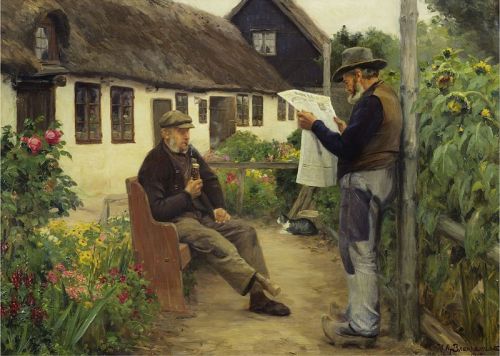
#FineArtFriday: Two Paintings by H. A. Brendekilde

There is a story in this painting. I particularly like the details—the patched trousers of the gardener, the mud on his clogs, the other man’s wooden leg—juxtaposed against the lush spring garden and prosperous village life of Denmark in 1912. Their hands and clothes indicate they have stopped work to read the newspaper. Both men seem stunned. Are they perhaps reading of the death of King Frederick VIII, who died on 14 May 1912? Whatever they are reading, the cat remains undisturbed by the news.

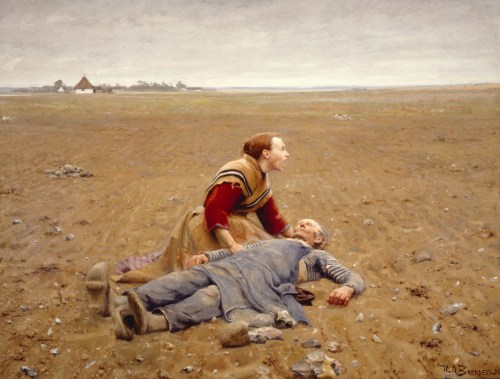
H. A. Brendekilde was a forerunner of the social realist style, embraced by Diego Rivera. His early work often depicted the daily lives of the rural working class. One of his most famous paintings, “Worn Out” (1889) shows an elderly man lying fallen on his back in the plowed field. Has he worked himself to death? Will he recover? His entire world is this rocky barren field.  A story is in this stark painting.


Credits and Attributions:

While reading the newspaper news by H. A. Brendekilde 1912 [Public domain], via Wikimedia Commons

Worn Out by H. A. Brendekilde [Public domain], via Wikimedia Commons

Comments Off on #FineArtFriday: Two Paintings by H. A. Brendekilde

Filed under #FineArtFriday