Category Archives: Humor

Analog, I revile thee, or how The Martian redeemed my faith in science fiction

The MArtian Andy WeirI’m a book addict. Each time I crack open a book, whether in hard copy or on my Kindle, I’m hoping to be blown away by the imagery the author presents, hoping for that amazing high that comes from living a true classic. Lately I have been reading wide of my usual slot, not abandoning fantasy, but going back and seeing what I loved the most about the genre that was my first introduction to reading for pleasure. I recently had the experience of being completely and utterly blown away by a science fiction novel, The Martian, by Andy Weir.

It’s one of the best science fiction stories to come out of the last 20 years.  A real adventure story from the get-go, this story of an astronaut inadvertently left behind is gripping from page one. As a main character, Mark Watney is hilarious. He is the sort of man who gets through life by finding something positive in every disaster, and mocking the hell out of everything that is negative.

A horrendous storm destroys much of their base, and his team is forced to abort their mission.  During the emergency evacuation of the Ares 3 landing site, he is severely injured in an accident that appears to have killed him. His body is unretrievable, and unaware that he is still alive, he is left behind. His companions begin the long journey back to Earth, grief-stricken at his sudden death. THIS is an awesome, gripping, and hilarious story.
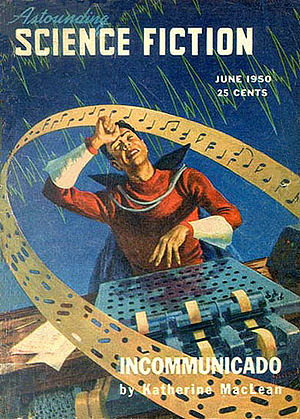
300px-Astound5006I’ve been a subscriber to a well-known science fiction magazine, Analog,  for many years. I am actually considering letting my subscription lapse, because for the last five years or so I have struggled to find something enjoyable in their magazine.  I no longer enjoy the work they are publishing and they no longer seem to care. While there are occasional nuggets, the majority of work they publish is frequently harsh, lifeless, depressing, and incomprehensible. The fact is, perhaps they have forgotten what real science fiction is about, what the average reader wants. Perhaps I am no longer smart enough for their publication–and I hate paying to be sneered at.

Despite the efforts of the publishing community, the genre of science fiction is not dead. Andy Weir ‘s brilliant work on The Martian proves that there are writers out there with exactly the sort of stories I am looking for.  And guess what–he published it in 2012 AS AN INDIE.  This is a really telling thing, that the watershed books are no longer being put out there by the Big Six, until they have proven their worth in the Indie market. Hugh Howey, A.G.Riddle, Rachel Thompson–INDIES, all of them.

In my sci-fi, I want human frailties, drama, adventure, intense life and survival against great odds, set against a backdrop of understandable and realistic science.

I want a Space Opera.  Andy Weir gave that to me.

It is that high drama that made the Star Trek empire what it is. High drama set in exotic places made George Lucas’s Star Wars series of movies the poster child for space operas. Those two series translated the intensity of feeling that the great authors of science fiction all brought to their work.

Over the years, I have written many short space operas for my own consumption. However, this fall I am embarking on the real test–putting my writing skill where my mouth is.  It just so happens that off and on for the last  3 years, I’ve been outlining a science fiction story.  Originally, I began this project  in preparation for NaNoWriMo 2013, but this will be the year to implement it, so in November this will be my work.

As a devoted fangirl of many well-known physicists, I’ve been doing  research for the last three years, and feel sure my science will hold up, which, in sci-fi, is key to the longevity of a tale. I have great characters, and a really plausible plot. I just have to spend 30 days stream-of-conscious writing to the prompts I have set forth and…well, that is the trick, isn’t it? But even if I fail to write anything worth publishing, I will have had a good time, and that is what this gig is all about: enjoying the ride.

 

2 Comments

Filed under Adventure, Battles, blogging, Books, Fantasy, Humor, Literature, Publishing, Self Publishing, WordPress, writer, writing

How dining in Bedlam taught me to write dialogue

Days of Wine and Roses quote copyThe family I grew up in is a loud, all-talk-at-once kind of a family, with a lot of talkative members. Family gatherings are absolute bedlam–large, loud, full of life and great food, and long on opinions and ideas. We are comprised of musicians, artists, and authors, along with engineers and software developers.

Above all, we are avid gamers of all kinds, from old-school Super Mario, to Grid Autosport, to Final Fantasy X/X-2, to Halo, to Assassin’s Creed, to  Dark Souls 2, to Minecraft–and we love to talk, loudly and all at once, about everything we love. Somehow, we all manage to have our say and allow the others have theirs, but it’s like living in a blender at times.

We, and our friends, are loud and passionate and most people love it, but every now and then a visitor can’t handle the hullabaloo.  Sometimes, less outgoing girlfriends or boyfriends don’t get it, and the general din intimidates them.

In fact most people carry on conversations, where one person says something, and the  other one answers, and this goes on like a tennis match until everything has been said.

Huh. Who knew?

So, that is how we want to write our dialogue. We want it to sound natural.

Writers need to keep in mind that when people talk, they rarely follow any grammatical rules. Any English class that writers have taken will have stressed the importance of using proper grammar and punctuation in their writing. However, when we attempt to write dialogue, those same rules should be thrown out of the window. Many times people speak in broken sentences, with pauses, and even use incorrect words.

  1. Don’t overuse character names in dialogue. People don’t use each other’s names in every sentence they speak, because it sounds silly. (“Helen, your hair is lovely.” “Thank you, Ralph.” “Do you want to watch a movie, Helen? “Sure, Ralph, but stop touching my hair.”) When you do use character names in dialogue, use them early in order to indicate to whom the speaker is talking, and after that, be sparing with the monikers.
  2. Avoid writing dialogue that’s really an excuse for “speechifying” (I love that word ♥.)  Avoid giving your characters long paragraphs with lines and lines and lines of dialogue that is uninterrupted.  In real-life conversations, people usually alternate in conversation, and like my family, they often interrupt each other. It is your job to capture the rhythm of real speech–but don’t make it choppy.
  3. The dialogue of one character shouldn’t repeat what was said by the other, unless it is for emphasis in that one instance. “So Helen, what you are saying is, ‘don’t be repetitive.'” “Yes, Ralph, don’t repeat my every word.” “Don’t repeat your sentences.”
  4. DON’T explain your dialogue by adding too many descriptors, such as: John shouted angrily, or Garran commented sulkily. If the meaning is effectively conveyed in what your characters are doing as well as saying, adding these descriptors undermines the dialogue and disengages the reader. Try removing the explanation and see if the meaning is still clear. If it isn’t clear, it’s time to rewrite. By letting the dialogue speak for itself, by describing it less and showing it more, you make it more compelling.
  5. DON’T get creative with your attributions, or ‘dialogue tags’ as we call them: stick to John said (not said John, which sounds archaic in modern literature.) Unless you absolutely need a John screamed or Edwin uttered (which you pretty much never do) just say it and let the reader do the rest. Fancy synonyms for ‘said’ are usually unnecessary and distracting.
  6. And now for my pet peeve:  people do not smile, snort or smirk dialogue. I mean really–“That’s a lovely dress,” snorted Clara. (eeew. )  In fact, it is often best to do away with attributions altogether for a few exchanges every now and then, if:  A. you have only 2 speakers, and B. you have established who is speaking.
  7. Most readers hope authors will avoid trying to convey accent by altering spelling. It gets tiresome to read an author’s attempt to rewrite the dictionary to fit a cockney or an Irish accent, so use colloquialisms and speech patterns instead. That said, if the character is making a MINOR appearance, using an accent will give the reader feeling that they know that character, without resorting to an info dump.
  8. Feel free to break the rules of grammar if your character shows a blatant disregard for what’s correct. If he wants to say, “I seen that movie last week. It were a real dud,” let him.  That is a way to show the description of your characters.
  9. Miss a few beats. Beats are little bits of physical action inserted into dialogue: John fell quiet and stared out the window. Marta turned and walked out the door. Used sparingly, these pauses serve to punctuate the dialogue, to give the scene movement, and to maintain a strong mental picture in the absence of description. They’re best placed where there is a natural break in the dialogue, because they allow the reader to experience the same pause as the characters. Pauses are essential to good dialogue, but don’t overdo it. If your characters are rattling pans, slicing apples or staring out the window between every line of dialogue, the scene becomes about the action and not the dialogue, and the impact of the conversation can be lost entirely.
  10. Once in a while, it is okay to have your characters tell a story within the story, but do it as naturally as possible. Speaking as an older person, I admit that some older character will be just dying to tell the younger ones how it really was. Please don’t use that plot twist as a crutch to dump a chunk of boring background. No one in real life wants to hear an old duffer go on about the good old days at Bob’s Fish Cannery, even if Skyler Webbley did lose a finger that was never found and didn’t notice it until his shift was over when he discovered his driving gloves didn’t fit right. (Just sayin’.)

In regard to proper use of punctuation: it is important to follow the rules in the general narrative but punctuation has a different role in dialogue. There are times when it is used to create pauses in dialogue.

Oh, dear. What have I done? Breathe, Irene, breathe! Inhale…exhale…it will be fine–it’s dialogue, for the love of  Chatty Cathy…we want it to sound normal, not necessarily literate. (Oh, dear, she’s turning blue… . Line editor down! Quick! Someone fan her with the Chicago Manual of Style!)

Or you can properly punctuate your dialogue to your heart’s content.  It’s your book, and your style–you make the decision.

Anyway, to write natural dialogue, observe others around you, see how they talk, what they do with their bodies, and where they pause. These are what you know of them as people, and are what you want to convey in your writing.  What we want our dialogue to do is  give the reader a clear visual of the scene, the characters and their environment. A truly great book is clearly visualized in the mind of reader, so give those clues and hints, but let the reader see for themselves the beauty or horror you are describing though good dialogue and properly setting the scene.

VOS QUOTE


20 Comments

Filed under Battles, blogging, Books, Fantasy, Final Fantasy, Humor, Literature, Music, Publishing, Self Publishing, Uncategorized, writer, writing

Purple Prose

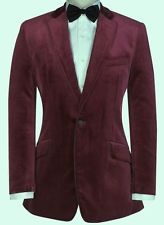
purple velvet blazerMmmm…everyone loves the lush feel of velvet, the way the texture imparts a depth to any color.

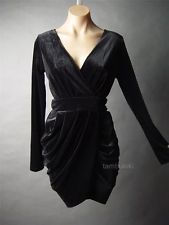
Black velvet feels cool, sophisticated and sexy, a little black dress and a vampire kind of cool.

Purple velvet, can feel royal, rich, but is frequently a bit too over-the-top for me.

Red velvet signifies something daring, just a bit risqué. This opulent fabric evokes emotion in us when we see and touch it.

In my mind, words are like velvet.  They evoke feelings and memories, and can alter our mood just by the way they are used. When we craft our narrative we aim to please our readers, to make them want to read it again.  To convey the atmosphere of our setting,  we use descriptors. We also use descriptors to show our characters, to indicate they are long-haired, dark-eyed, or bearded.

Good prose contains a certain amount of  descriptors, and like Goldilocks, we want to make it just right–not too little and not too much.

Too little, and the narrative is flat, uninvolving. To much and the reader finds themselves gagging.  This heavy, cloying style of writing is called “Purple Prose.”

Like purple velvet, a little goes a LONG way. “But wait, ” you’re saying, “aren’t you being a little hypocritical? What about your love of all things Dickens?  His work is rife with overblown, hyperdramatic descriptions.”  Cool your jets, kids–that was the style when he was alive and rocking out the paranormal fiction. People wanted to spend an entire day savoring the well-crafted poem. That style of writing has a place, but not in the current culture of commercially viable novels.

If you want to sell books, you must walk the fine line between overblown prose and its antitheses, eviscerated, flat narrative

The Elements of Style calls “Purple Prose” “hard to digest, generally unwholesome, and sometimes nauseating.”  To be fair, purple prose is subjective and each reader has a different level of tolerance for it, but it is something we definitely don’t want.

Plain: He set the mug down. (my choice)
Somewhere in the middle: He eased the tankard onto the table.
Bleah: Without haste, the tall, blond barbarian set the immense, pewter, ale-filled cup with a wooden handle onto the stained surface of the rough, wooden table.

Spare me the ‘creamy-blue eyes as deep a shade of amethyst as the lush, purple, velvet drapes.”

There is a tipping point where good, descriptive prose becomes distracting and cloying to the modern reader. I opt for a lean style in the majority of my own work, because, while I adore Charles Dickens,most readers just want a good novel that will provide a small diversion from the everyday grind.

Purple Prose done wrong bullies the reader into seeing only what the author tells them to see, and leaves no room for imagination. Telling the reader what to think forces her to walk away rather than suffer a moment longer. That book goes into the recycling bin, or gets deleted from my Kindle.

What I, as the author, think is good and beautiful may be ugly to you, as the reader.

Author Stephen Swartz recently posted a great blogpost on this very subject–available at Deconstruction of the Sekuatean Empire.  He loves the nuances of the english language as much as I do, but understands how to create lean narrative that allows a reader to see the scene, but leaves room for the imagination to fill in the gaps.

Right off the top of my head, I can think of many authors who manage to walk the line between purple and eviscerated prose, among them Ross M. Kitson, Shaun Allan, Neil Gaiman, and yes, you too, Stephen Swartz.

black velvet dressThese authors give you the framework around which your imagination builds the image, and they place that framework in well-crafted sentences that tease you, inviting you to read more. Like that  little black dress made of velvet, their work is lush, sleek, and sophisticated.

My advice is to read, read, read. If you like a certain style, write in such a way to evoke the feeling the author of that work raised in you. But never , never force the minute details of your vision on your readers. When you bludgeon your reader with the minutiae of your vision, you lose the beauty of story, and you lose your reader.

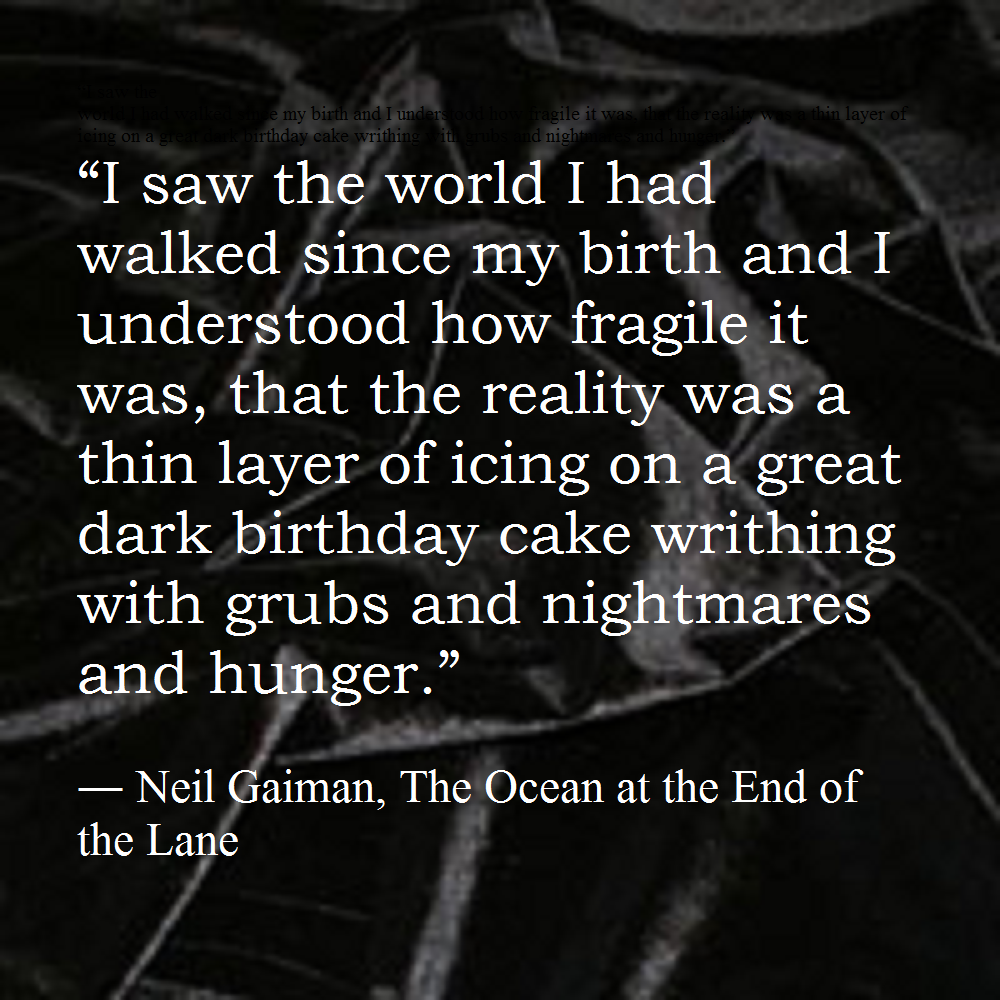
I think Neil Gaiman nails that fine distinction in this quote from “The Ocean at the End of the Lane:”

Neil Gaiman Quote

Creepy and to the point–and allows us to envision the shock the main character feels at the realization he knows nothing of his past, without beating us over the head with it.

My goal is to write with an economy of words, yet give enough description that my readers can build the environment in their own minds.

10 Comments

Filed under blogging, Books, Fantasy, Humor, Literature, Publishing, Uncategorized, vampires, writer, writing

What does “Submission-Ready” mean?

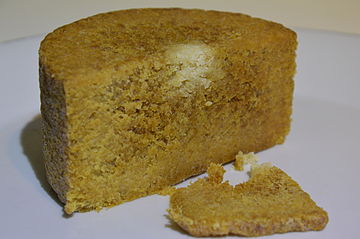
Gamalost-NorwegianOldCheeseI’m not talking bondage here, friends, so get your mind out of the erotica.

I’m talking about a manuscript with the potential to be made into something publishable.

I see a lot of manuscripts. Some are quite promising, some not so much. Literally anyone can write and publish a book nowadays, but not everyone can write a book others will want to read–THAT is a craft, and there are many who don’t feel the need to learn it before they submit their work to an editor or a publisher.  The quality of their work stinks like gamalost cheese, but they have the gall to wonder why the Big 6 haven’t snapped it up.

gibberish-american businesses onlineIt is important to learn the craft of writing, if you want readers to enjoy your work. Spend the time to learn the mechanics of the language you are writing in. However, if you are simply writing a pretentious pseudo-literary art piece, fine–go on and have at it–no one will ever read it, and you can feel superior for having written it. If you dare to compare yourself to James Joyce I will run you out of the writing group quicker than you can say Ulysses.

Before you submit your manuscript, take the time to make it submission-ready:

1. Properly format it: Set the indents, use a serif font of .11 or .12, double-space it with no extra space between the paragraphs, and do not justify it.

2. Hire an editor to help you straighten out the flaws YOU can’t see.

3. Go to the publisher’s website and find out what their submission guidelines are and FOLLOW THEM. (Yes, they apply to EVERYONE, no matter how famous, even  you.) If you skip this step, you will wait a year to hear that your ms has been rejected, and they won’t tell you why.  It’s not worth their time to teach you how to be a writer–you have to learn that on your own.

For a more in-depth description of this whole process, see my series “WORD-A Shifty Beast.”

learn something newTry to learn something new every day in your writing life, and with each success you have, try to keep some humility.  You will grow as an author, your work will remain fresh, and I will continue to beg to read it.

If you read the kind of work you want to write, you will gain inspiration from the masters in your genre. When I am not writing or editing, I am reading. And when I have the chance to read for pleasure, I read epic fantasy, paranormal fantasy and science fiction. When I find a book that rings my bells, I talk about it, and blog about it. Conversely, if I hated it, I never mention it again.

Yep–I’m that kind of a reader.


3 Comments

Filed under Blogger, blogging, Books, Fantasy, Humor, Literature, Publishing, Self Publishing, Vegan, WordPress, writer, writing

It may be rattlesnake, but it tastes like chicken

MSClipArt MP900390083.JPG RF PDWriting the first draft of your novel is a lot of fun, but there are times when getting your phrasing right is confusing. Wrangling words is not for the faint of heart! Many frequently used words are what is called “homonyms” — soundalike words.

Yeah–you know that casserole contains rattlesnake surprise, but it tastes like chicken, so the kids haven’t a clue.

You as the author, do not always see the rattlesnakes among the chickens in your work.

You MUST NOT expect an editor to straighten out a mess that you can take of with a little attention on your part, so it is important to do your  research, and learn your craft. Submitting a mess to an editor will result in rejection, as it is an expensive waste of time to try to teach a would-be author how to write a book.

At times, only a homonym, a word that sounds very much like another, can be used in a sentence. That similarity makes it hard to know which word is the correct word in a given circumstance, and when you are spewing the first draft of a manuscript, autocorrect may “help you” by inserting the wrong instance of those words. If their meaning is similar but not exactly the same, negotiating the chicken-yard of your manuscript in the second draft becomes quite tricky.

For instance, take this sentence from my current work in progress, where Friedr is explaining the events that led to Christoph’s sacrifice, speaking to Dane: “With Zan’s assistance, Edwin modified the parasite that will ensure no Bear Dogs can ever survive in Mal Evol ever again…”

Now I wasn’t sure that ensure was the correct word to express what I wanted to convey, because there are three words that could work and they sound alike, and have similar but different meanings.  So I did my research:

Assure: promise, as in I assure you the house is clean.

Ensure: confirm, as in Ensure that you have set the burglar alarm before going on a long trip.

Insure: protect with an insurance policy, as in Insure your home for your peace of mind.

Hmmm.  2 of these words will convey an intent that would work, but I think I will stay with my original idea– Ensure as in Confirm.


Some other oft confused soundalikes are ( these are borrowed directly from the Purdue Online Writing Lab)

  • advise = verb that means to recommend, suggest, or counsel:

advise you to be cautious.

  • advice = noun that means an opinion or recommendation about what could or should be done:

I’d like to ask for your advice on this matter.

  • advise = verb that means to recommend, suggest, or counsel:

advise you to be cautious.

  • advice = noun that means an opinion or recommendation about what could or should be done:

I’d like to ask for your advice on this matter.

Conscious, Conscience

  • conscious= adjective meaning awake, perceiving:

Despite a head injury, the patient remained conscious.

  • conscience = noun meaning the sense of obligation to be good:

Chris wouldn’t cheat because his conscience wouldn’t let him.

Idea, Ideal

  • idea = noun meaning a thought, belief, or conception held in the mind, or a general notion or conception formed by generalization:

Jennifer had a brilliant idea—she’d go to the Writing Lab for help with her papers!

  • ideal = noun meaning something or someone who embodies perfection, or an ultimate object or endeavor:

Mickey was the ideal for tutors everywhere.

  • ideal = adjective meaning embodying an ultimate standard of excellence or perfection, or the best:

Jennifer was an ideal student.

Its, It’s

  • its = possessive adjective (possessive form of the
    pronoun it):

The crab had an unusual growth on its shell.

  • it’s = contraction for it is or it has (in a verb phrase):

It’s still raining; it’s been raining for three days.

(Pronouns have apostrophes only when two words are being shortened into one.)

Lead, Led

  • lead = noun referring to a dense metallic element:

The X-ray technician wore a vest lined with lead.

  • led = past-tense and past-participle form of the verb to lead, meaning to guide or direct:

The evidence led the jury to reach a unanimous decision.

Than, Then

Than used in comparison statements: He is richer than I.
used in statements of preference: I would rather dance than eat.
used to suggest quantities beyond a specified amount: Read more than the first paragraph.
Then a time other than now: He was younger then. She will start her new job then.
next in time, space, or order: First we must study; then we can play.
suggesting a logical conclusion: If you’ve studied hard, then the exam should be no problem.

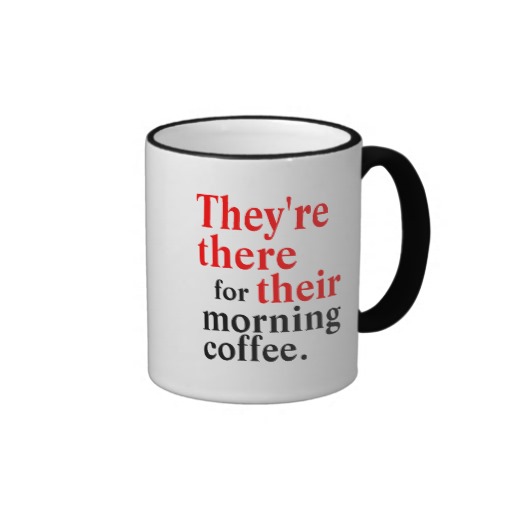
they're their there cupTheir, There, They’re

  • Their = possessive pronoun:

They got their books.

My house is over there.

(This is a place word, and so it contains the word here.)

They’re making dinner.

(Pronouns have apostrophes only when two words are being shortened into one.)

To, Too, Two

  • To = preposition, or first part of the infinitive form of a verb:

They went to the lake to swim.

  • Too = very, also:

I was too tired to continue. I was hungry, too.

  • Two = the number 2:

Two students scored below passing on the exam.

Twotwelve, and between are all words related to the number 2, and all contain the letters tw.

Too can mean also or can be an intensifier, and you might say that it contains an extra o(“one too many”)

We’re, Where, Were

  • We’re = contraction for we are:

We’re glad to help.

(Pronouns have apostrophes only when two words are being shortened into one.)

Where are you going?

(This is a place word, and so it contains the word here.)

  • Were = a past tense form of the verb be:

They were walking side by side.

Your, You’re

  • Your = possessive pronoun:

Your shoes are untied.

You’re walking around with your shoes untied.

(REMEMBER: Pronouns have apostrophes only when two words are being shortened into one.)

Special thanks to the Purdue Online Writing Lab for posting these amazing hints, and SO much more information crucial to the craft of writing. If you go out to their website you will find it chock full of really good lessons for you to use to improve your skill at the craft of writing.

to, too, twoIt seems like a no brainer when you are reading it, but when you’re in the throes of a writing binge these little no-no’s will pop up and confuse you the second draft. The problem is, you will see it as you intend it to be, not as it is written, so these are words you must pay attention to. Sometimes, doing a search will locate these little inconveniences.

Some are obviously wrong and stick out like sore thumbs, like improperly used they’re, their, and there but some like accept and except are so frequently confused and misused in our modern dialect that it is best to simply look it up to make sure you are using the right word for that context. If you search for these now, you will save your editor having to do this for you, and your edit will be much more productive.

Searching for these bloopers is what I like to think of as sorting the rattlesnakes out of the chicken yard, and is part of making your manuscript submission-ready.


2 Comments

Filed under blogging, Books, Fantasy, Humor, Literature, Publishing, Self Publishing, WordPress, writer, writing

Nurturing the Muse

photo ©Leah Reindl 2014 used by permission

photo ©Leah Reindl 2014 used by permission

I come from a family whose creative muse is frequently expressed in music or in art. Musicians and artists dot the landscape of the old family tree. So far as I know, other than my daughter Leah, I am the only one who writes novels, but it may be that I am the only one who ever had the time to spend on such an endeavor.

When I watch children at play, I see the creativity that all musicians and artists know, that wonderful sense of “Ah ha! This is fun!” that comes with making something that exists only to bring pleasure to those who hear or see it. I see this sense of “I can do it!” in all the children, but by the time they are teenagers, much of that joy in creativity has been trained out of them. I wonder why and how it happens.

When I was young and working at dead-end jobs, I would come home and while my children did their homework or played, I would write, draw, or play the guitar. It was selfish, yes–in that it gave me pleasure. But it was not selfish, as it didn’t take me out of their world, and was something we could share. It taught them that they could take the time to be creative.

If there is any advice I would give young parents, it is to be creative in the presence of your children. You go to work every day, and by that you are teaching them that one must earn a living, yes, but the reward of earning that living is a life of love and creativity.

Some people will say bitterly that their job has burned all their energy and creativity from them. I say this is not necessarily so–you must take the time and energy you expend on hating your circumstances, and convert it into something creative. It’s amazing how many people I know who tell me they aren’t creative, but they doodle the most amazing  little pictures on the handouts during those requisite boring meetings-to-nowhere that we all endure in Corporate America.

That is creativity trying to get out.

The reason children are so creative is that they don’t do it for other people, they are doing it solely for the fun of it. Get out the crayons and a blank sheet of paper for a child who hasn’t been to school yet, and watch what happens. Add old magazines, round-end scissors, and mix up some flour & water paste, and the possibilities are endless. But once that child gets into a social environment where he begins to feel less talented than the child next to him, he shuts that creativity down.

science of relationships dot comInside every adult at the water cooler is kindergartner with a picture to draw, a song to sing, or a story to tell. Somewhere along the line, they began to fear they weren’t good enough and put it aside. Soon they have an “I can’t do it” attitude, because they fear failure and embarrassment. They have forgotten the joy of making a good, creative mess. They don’t remember how they learned as much from the failures as they did from the successes.

Don’t let the fact you have no money stand in your way. It takes very little money to draw a picture, or to write a story. You don’t need an expensive computer program–all you need is a pencil and paper.  And music?  You don’t need to play an instrument to sing. If you always wanted music lessons but couldn’t afford them, a great way to learn is to join a community choir. It’s free, and takes a little time away from your TV, but it is a way to jumpstart your joy of making music.

Our children are all artistic and creative in the most amazing (to me) ways, and I think that is because I never stopped making art or music.  They all sing or play instruments, or create art. Our older son, Billy, and youngest daughter, Meg, are working musicians. Billy is a drummer in a band with my ex-husband and my brother. Meg is a young mother and a working musician with several mp3s to her credit. If you are curious, here is her Facebook page where you can hear her work: Meg is Singing.

Meg and Billy are both incredible musicians, playing the drums, the guitar, keyboards, and in Meg’s case, the flute. Music is their passion. Son Dan is a guitar virtuoso, but he plays for his own pleasure. He is an incredible sports photographer, and his work can be seen here: SpotKazu

Christy and Leah express their art in other ways. Christy is an engineer who deeply loves her craft, and brings her sense of beauty into her home, designing an environment that is both serene and filled with color. Leah is an artist, one of her pictures can be seen at the top of this page, and a hair-dresser. She loves her craft as much as Christy does hers. They go to work, and art is expressed in their daily lives, enriching the lives of their children.

This is why I am and have always been a happy person despite the bumps and hardships of life–I did what I had to do to put food on the table, but I played and sang and wrote poems and goofy stories in my free time. My children were my audience and my co-creators. My husband’s children were raised in the same sort of environment (he is a trumpet player and she is an actress) and all 5 of our kids are sheer genius to me. They far outstrip me with their talents and abilities, and with their drive and ambition.

Tower of Bones Trailer, Music by MEG

2 Comments

Filed under blogging, Books, Fantasy, Humor, Literature, Music, Publishing, Self Publishing, Spirituality, writer, writing

Update from the Realm of Fantasy

cover_art_Billy_39_s_RevengeI live in a fantasy world, hence the name of this blog. What better way to immerse one’s self in fantasy than in a good book? I love to read, and everyone who follows this blog knows I read anywhere from 1 to 6 books a week.

I also love writing, and right now I have 4 projects in the works:

1. The remastering of Tower of Bones  at the very capable hands of Eagle Eye Editors.

2. Finishing the final draft of Julian Lackland so that it can be made submission-ready.

3. Finishing writing the first draft of Valley of Sorrows.

4. Getting Mountains of the Moon through the editing process at Eagle Eye Editors.

These projects take all my time that isn’t occupied with publicizing Huw the Bard (or editing for other authors, or blogging , or beta-reading, or…)

IMG727Just so you know that I really am writing when I am holed up in the Room of Shame (my office.)

Many of the stories in Julian Lackland evolved from The Last Good Knight, and while there is a great deal that is new, it incorporates all but two chapters of the old book. It details the large events from his life, covering 40 years, beginning as he is leaving court as a very young man, hoping to join Billy Ninefingers and the Rowdies.

Young Julian is a strange mix–incredibly naive about how the world really works but at the same time he is quite worldly-wise about the way people are, and incredibly forgiving. He has a wide view of sexual morality, and a sharply defined view of good and evil.

The other writing project that occupies my time is Valley of Sorrows, the third book in the Tower of Bones series.  I have struggled with that tale, trying to keep it confined into one book.  However, there will be a fourth book that comes out of the mountain of words I have written here. Edwin’s quest will be resolved first, and I hope to get it into print in 2015.

It’s a crazy existence, being a writer, but it’s so fulfilling. I wonder how I ever survived before I had such a wonderful way to spend my time.

Comments Off on Update from the Realm of Fantasy

Filed under Blogger, blogging, Fantasy, Humor, knights, Literature, Publishing, Self Publishing, Uncategorized, writer

On Happiness

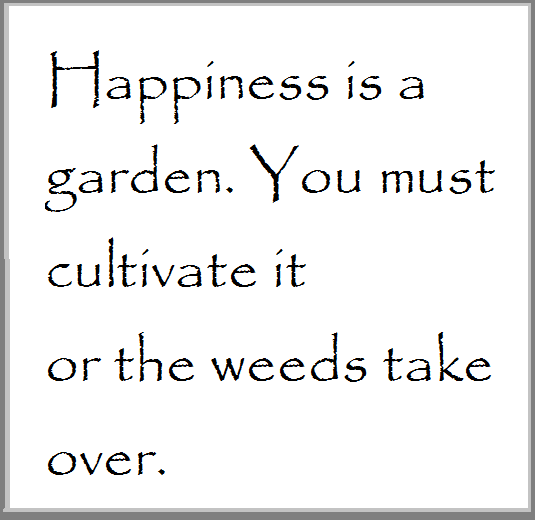
Be KindHappiness is like dark-matter. It is all around us, permeates and surrounds us.  You cannot measure it–it’s something that can’t be seen by human eyes, but once you know it’s out there you can look for and measure its effects.

1. Attitudes are muscles. The way we use them is the way they grow strongest.

In the beginning, you must consciously exercise a positive attitude at all times but as time goes on it become natural, a part of who you are. Project positivity at all times, and see how the environment around you changes.

be happy 22.Miserable people are poisonous. They want to spread the poison as far as they can, because they don’t know anything different. In order to remain happy in an environment where miserable people are lurking you must  accept the fact you cannot change toxic people. You can only step away from them.

Love them, pray for them, but hold them away from from you as you guide them to cultivate a positive outlook. Embrace them and comfort them, but do not allow them to infect you, because misery is a parasite always looking for a new host. You may have to love them from a distance.

be happy 33. Share your bounty with those who have less. Never lend money–if you have it to spare, and and want to give it to a needy loved one, GIVE it. Never LEND anything. Give it and do not expect to receive it back, with or without interest. Instead, give it as a gift and ask that they one day do the same for someone else. Conversely, do not become a private bank for anyone, no matter how beloved they are, as this will make them weak. Give to local charities or give to the world charities. Living a life of generosity is a key to true happiness.

Three small ideas, but three ideas that made all the difference in my life.


2 Comments

Filed under blogging, Fantasy, Humor, Literature, Publishing, Self Publishing, Spirituality, Uncategorized, Vegan, writer, writing

Dear Sir or Madam

GerundsThere are times when the vagaries of modern English (previous error in capitalization edited by Stephen Swartz) get in the way of reading what could be a great novel.  Some weeks I see six or seven books, both indie and traditionally published, before I find one book worth reviewing for my book review blog, Best in Fantasy.

As authors, we are all overcome with the urge to shout to the world, to immediately show the world our precious child, to rush to publish it now.  It is the rare author who can write prose that is fit to read in his first draft–if that author actually exists, I’ve never read his work.

For the indie, this is fatal.

This is why I highly recommend hiring a reputable editorial service to go over your manuscript, even if you plan to submit it to a publisher. After all, why not submit the best work you can, rather than risk being stuck in the slush pile?

An editor will have several reference manuals at his/her hand, and will help you realize your vision, whittling away at the block of granite you gave birth to and love so much, carving away the unnecessary and extraneous words and cliches  until the book emerges in all its glory.

honorificsWhen I am editing, I refer to The Chicago Manual of Style, the Oxford A-Z of Grammar & Punctuation, and of course, Strunk and White’s Elements of Style. As I have been through the process of being edited and hate that horrible feeling of being called to task on silly things, I often refer to these books when I am second guessing myself in my own work.

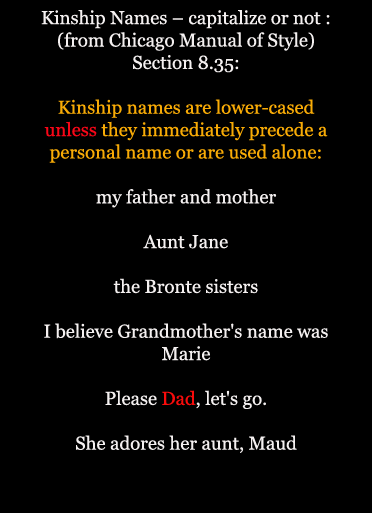
What are the silly things, you ask?  They are things we learned in grammar school but forgot as we grew older and didn’t use them.  Small things like when to capitalize an honorific title, and when not to–something that crops ups regularly in my work as I often write in a medieval setting.

I’ve found it helpful to use the control -f (find) function in WORD to locate every possible mangling I might have made of a particular word. Then I look at and replace each instance on an individual basis. (NEVER click replace all!)

KinshipConsistency is important, so  we must know when to capitalize titles and honorifics–words like king, and majesty, or even lord. Also, when to capitalize familial titles such as father, mother, son and aunt.  If you are determined to do it wrong, at least have your roommate ensure that you have done it that way throughout the entire manuscript, rather than sometimes one way and sometimes another, which is the normal, natural way to write a first and even second draft.

Editors not only correct grammar, they check for consistency. They are worth their weight in gold. They’re more important than the fine artwork for the cover, more critical than the catchy blurb. We live in the wild west of the publishing business, and we find ourselves doing whatever we can on the cheap to get our book published. DON’T skimp in this area, if you value your reputation. Once you have published, it’s a pain in the backside to unpublish, have it edited, reformat it, and go through the launch all over again. Remember, we see what we meant to write, not what is actually there.

But you don’t have to listen to me–experience is the great humiliator.

2 Comments

Filed under blogging, Books, Fantasy, Humor, Literature, Publishing, Self Publishing, Uncategorized, writer, writing

la vie fantastique

Map-pugetsoundMy hubby and I went to Victoria, British Columbia (Canada) over this last weekend. It was a wonderful two days, spent in a town that exists partly to govern the Province of British Columbia, but mostly to help you lighten the burden in your pocket book, and make you beg to let them do it again.  We got up at 3:00 a.m. and left our house at 4:45.

(Gah!)

I am often up at that time of the day, but not intentionally, so it was no surprise to me that I could hardly pry my eyes open. Then we drove up to Seattle, collecting two of his sisters along the way.

It’s amazing how little traffic is on I5 at that time of the morning–perhaps I will do all my traveling at ungodly hours. And parking…OMG, it was heaven.

(Sorry, too much texting the GKs lately. Makes me want to lol out loud. Might write my next book in textspeak.)

Anyway, I had my pick of prime spots in the parking garage, and found one I was easily able to maneuver the old minivan into with no trouble. I hardly gave my poor brother-in-law, Dave, a heart-attack  at all on the way up to Seattle. He  is a sweetheart of a guy but the man is a nervous and verbal passenger.  The trip back–well lets just say he wanted me to take the Alaskan Way Viaduct, and I didn’t want to.

I’m sorry, Dave. I’m afraid I can’t do that. 

I don’t trust the viaduct. It’s as shaky and narrow as a one-legged ladder.  I’d much rather drive in aimless circles around downtown Seattle hunting for a southbound freeway on-ramp, counting the number of times we pass Nordstrom’s and he doesn’t see the fun in such an exercise. But that’s another post (the one on how our family puts the fun in dysfunctional.)

Catamaran_Victoria_Clipper_IVSo we got on the Victoria Clipper at 7:30 a.m., which is definitely the way to go if you are traveling from Seattle. Victoria Clipper catamarans typically complete a one-way trip in less than 3 hours, in our case, 2 hours and 45 minutes.   To drive there would take 6 hours from our house anyway and we would still have to take a ferry, so why not just leave the car in Seattle and go in style? And we were flying over the water, traveling at 30 knots, which is just a hair over 34.5 miles per hour in landlubber-speak. That’s cruising pretty fast on the inland Salish Sea.

Then we toured the Butchart Gardens. THAT place is most definitely a fairyland.  I can’t even find the words to explain how beautiful it is.  My cellphone photos suck, to use a technical term, so I am using images cadged from WIKIPEDIA to illustrate this:

1200px-Butchart_Sunken_Gardens


1200px-Butchart-gardens-002

Needless to say, after a long day of hiking the most gorgeous gardens, and then trundling all over the downtown, spending money like water in Victoria proper, I was SO ready for a lovely meal in what is really a lovely, vegan-friendly city. A long soak in the hotel hot tub, and followed by gin & tonic in the hotel lounge (light on the gin and lots of lime wedges, thank you) and this old lady was ready for bed.  I got on the internet just long enough to check my email.  I wasn’t completely out of writer-mode–I did note my ideas down in my little book while I was on the ferry.

So, while I didn’t get any writing done I had a wonderful time with my in-laws, and that’s paradise, to me.

Victoria_harbour_-_Victoria,_British_Columbia_-_2014

4 Comments

Filed under Adventure, Battles, blogging, Fairies, Fantasy, Humor, Literature, Publishing, Self Publishing, Vegan, WordPress, writer, writing