Category Archives: Poetry

#flashfictionfriday: Old Peoples’ Gardens

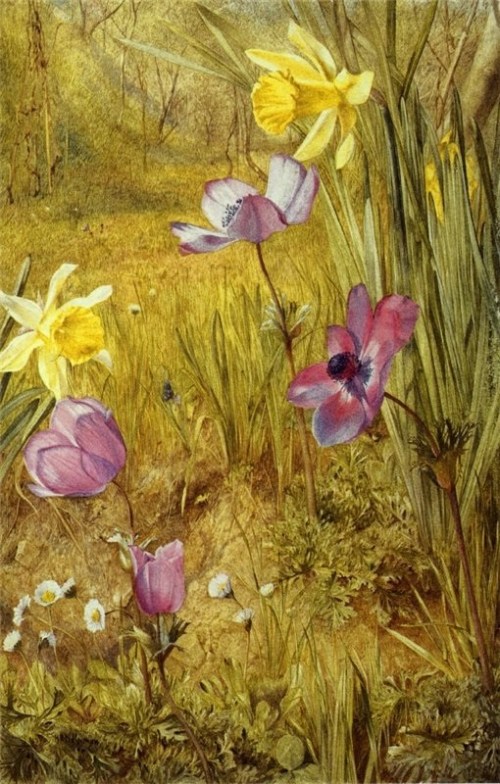
Henry_Roderick_Newman_-_Anemones_and_Daffodils_(15815149940)

Chill and rainy, spring has come

The Ides of March are near.

And all around the garden brown

Shades of green appear.

Though wind and rain still beat the ground

And mud does claim the day,

A secret green lies tightly furled

And soon will have its say.

In gardens up and down the street

Are hints of green and gold.

In old peoples’ gardens, Daffodils

Are shining proud and bold.

Old people’s gardens keep the faith,

Their greening shrubs declare,

That Winter’s grip must surely fade

For Spring is in the air.


Old Peoples’ Gardens, © 2017 Connie J. Jasperson, All Rights Reserved

Anemones and Daffodils, Henry Roderick Newman (1843 – 1917) [CC BY 2.0 (http://creativecommons.org/licenses/by/2.0)%5D, via Wikimedia Commons

1 Comment

Filed under #FlashFictionFriday, Poetry, writing

#FlashFictionFriday: Winter in the Northern Garden


ice_crystal_on_barberry

In winter, my Northern garden

Languishes, ragged and shabby,

Unlovely, decaying, and

Uncomfortably aware she’s grown old.


The remains of Summer’s glory beckons,

Begging to be told she is still beautiful,

Still young and fascinating,

Still the object of desire.


Ever the gallant gentleman,

Winter obliges, and with a kiss

Ice crystals decorate each twig and branch

Gracing her with radiant beauty.


Ruby-red barberries set against crystalline diamonds,

Ice catching the light, scattering it.

Jewels decorating decrepit limbs,

Dazzled, we bow to her wondrous splendor.


Beneath the litter of leaves dead and brown,

A new Spring waits,

Lurking in the wings, biding her time,

Politely allowing the old dame one last encore.


Winter in the Northern Garden © Connie J. Jasperson 2017

Ice Crystal on Barberry, By Sahehco (Own work) [CC BY 3.0 (http://creativecommons.org/licenses/by/3.0)%5D, via Wikimedia Commons

2 Comments

Filed under #FlashFictionFriday, Poetry, writing

#FlashFictionFriday: The Cat was a Bastard

I love rhyming poems especially those with a simple, traditional feeling meter. And, every now and then I get in a silly mood, a moment where a single line will stick in my head, a simple, off-the-wall sentence that becomes something upon which to hang a comic poem. When that happens, all bets are off and this sort of thing is the result.

In this case, it was the stray memory of a joke my late father frequently told (and my mother deplored), “Home is where you can spit on the floor and call the cat a bastard.” This inappropriate oneliner morphed in my head to: The Cat was a Bastard, an equally inappropriate poem, displaying my low origins and affection for gallows humor.


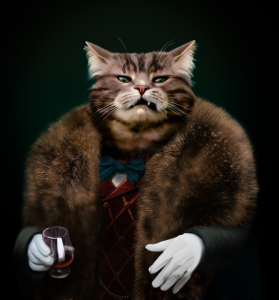
boss-cat-id-72054715-mariia-sigova-dreamstime

The Cat was a Bastard


Around the corner and down the lane

Hurtled my car through hard, driving rain.

And from the brush near the verge of the road

Came running a cat, now dead as a toad.


I stopped the car, to check on the corpse,

A cottage did see, the cat’s home of course.

And bearing the body through pouring down rain,

I pressed on the doorbell, and then pressed again.


A lady quite elderly, shriveled, and old,

Opened the door and eyed me, quite cold.

“Your cat, I presume?” I gravely inquired.

“He’s met his end, with the aid of my tire.”


Her gaze was quite steely, as coolly she said,

“And what’s it to me that the old wretch is dead?

“I always knew his would be a bad end,

“His tomcatting ways he never would mend.”


Mystified, I thought an error had been made

For she looked like a cat-lady, proper and staid.

“Are you speaking of this cat, Madame?” I said,

“This flat-headed cat, who surely is dead?”


“The cat was a bastard,” the woman replied.

“We’re glad to see the old lecher has died.

“An untidy end for the bastardly cat,

“The lazy old thing who ne’er caught a rat.”


Shocked, I just stared, then set down the corpse

And turned to depart, bewildered, of course.

Let this be a lesson to tomcats who stray,

Don’t cross the road on a cold, rainy day.


The Cat was a Bastard © Connie J. Jasperson 2017, All Rights Reserved

Stock Illustration:

Boss Cat ID 72054715 © Mariia Sigova | Dreamstime.com

3 Comments

Filed under #FlashFictionFriday, Poetry, writing

#FlashFictionFriday: In February the House is Smaller

white-cat-470px-franz_marc_013

In February the house is smaller,

Shrinking to just my office, nearer the furnace.

The Room of Shame, decorated with

Files and dusty computers, books, and cat fur,

From Yum Yum the Cat, dead these seven years.

She was old, even in cat years, and

This was her domain.


Like Jacob Marley and Scrooge’s knocker,

Her ghost inhabits this room,

Lurking behind boxes filled with books

And lit by the glow of the computer’s screen.

Little tufts of white fur hiding in places

The vacuum can’t reach,

A dusty memory keeping me company as I

Write novels that may or may not be read.


Four inches of snow fell last night, wet and heavy with water

And then froze, solid.

An iceberg enshrouded my bungalow, overtook my mini-van,

And weighs heavily on the rosemary shrubs.

And I am safe and warm inside this much smaller house

With my books and my computer,

And the ghost of my feline, past.


Attributions:

In February the House is Smaller,  Copyright © 2017 Connie J Jasperson, All rights reserved

Cat on Yellow Pillow, Franz Marc 1912 [Public domain or Public domain], via Wikimedia Commons

2 Comments

Filed under #FlashFictionFriday, Poetry, writing

#FlashFictionFriday: Bond and Free, Robert Frost

Admiring the Galaxy |CCA 4.0 ESO/A. FitzsimmonsBond and Free

Love has earth to which she clings
With hills and circling arms about-
Wall within wall to shut fear out.
But Thought has need of no such things,
For Thought has a pair of dauntless wings.

On snow and sand and turf, I see
Where Love has left a printed trace
With straining in the world’s embrace.
And such is Love and glad to be.
But Thought has shaken his ankles free.

Thought cleaves the interstellar gloom
And sits in Sirius’ disc all night,
Till day makes him retrace his flight,
With smell of burning on every plume,
Back past the sun to an earthly room.

His gains in heaven are what they are.
Yet some say Love by being thrall
And simply staying possesses all
In several beauty that Thought fares far
To find fused in another star.


I have always loved this poem for iLouis_Français-Crépusculets complex serenity–the narrator is at peace within himself and accepts his turbulent nature.

Frost’s poems were a large part of my early life. I grew up in a house in the woods at the edge of a lake. It was quite rural, and the 1/4-mile long driveway leading from our house up to the road was a pleasant place to walk at any time of the year. Winter was especially beautiful, as the woods seemed to be peaceful, resting. When a blanket of snow had covered them they had a magical quality, one Frost had felt and written of so eloquently.

While many of Robert Frost’s poems show the tranquility of being in a quiet place close to nature, this poem, Bond and Free, is an internal poem, examining the soul and heart of a person.

When I walk in the woods or along the beach my mind strays to many places, absorbing both the sights and sounds, but also touching on ideas not previously thought of, small discoveries of “me.” Robert Frost was able to write about this simple yet complicated process, and have it make sense.

Quote from GradeSaver: The narrator describes the difference between Love and Thought. Love clings to the earth in such a way that makes it a denial of freedom and imagination. Thought, on the other hand, has cast aside the shackles of the tangible world and travels throughout the universe with a pair of wings. Yet, for all the freedom that Thought seems to have, the safe environment of Love is far more liberating.


Credits:

Bond and Free by Robert Frost, PD|1916

Images:

Admiring the Galaxy |CCA 4.0 ESO/A. Fitzsimmons

Crépuscule (Dusk) Louis Français, PD|100, By Ji-Elle (Own work) [CC BY-SA 3.0 (http://creativecommons.org/licenses/by-sa/3.0)%5D, via Wikimedia Commons

Vincent, Caitlin. Jordan Reid Berkow ed. “Robert Frost: Poems “Bond and Free” (1916) Summary and Analysis”. GradeSaver, 12 May 2009 Web. 6 January 2017.

Comments Off on #FlashFictionFriday: Bond and Free, Robert Frost

Filed under #FineArtFriday, #FlashFictionFriday, Poetry

#ClasicalPoetry & #FineArtFriday: Night, by William Blake

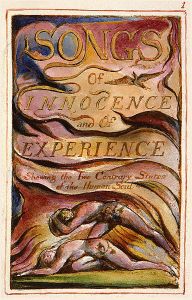
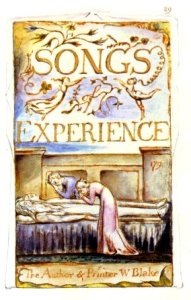
384px-songs_of_innocence_and_of_experience_copy_aa_object_1

Songs of Innocence and of Experience Showing the Two Contrary States of the Human Soul title page

Night

The sun descending in the west;

The evening star does shine;

The birds are silent in their nest,

And I must seek for mine.

The moon, like a flower

In heaven’s high bower,

With silent delight

Sits and smiles on the night.


Farewell, green fields and happy groves,

Where flocks have took delight,

Where lambs have nibbled, silent moves

The feet of angels bright;

Unseen, they pour blessing,

And joy without ceasing,

On each bud and blossom,

And each sleeping bosom.


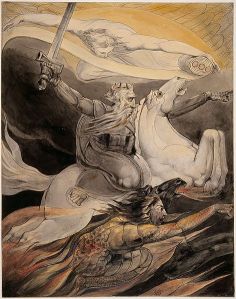
william_blake_-_death_on_a_pale_horse_-_butlin_517

Death on a Pale Horse, painting by William Blake (medium pencil, pen, and water color)

They look in every thoughtless nest

Where birds are covered warm;

They visit caves of every beast,

To keep them all from harm:

If they see any weeping

That should have been sleeping,

They pour sleep on their head,

And sit down by their bed.


When wolves and tigers howl for prey,

They pitying stand and weep;

Seeking to drive their thirst away,

And keep them from the sheep.

But, if they rush dreadful,

The angels, most heedful,

Receive each mild spirit,

New worlds to inherit.


And there the lion’s ruddy eyes

Shall flow with tears of gold:

And pitying the tender cries,

And walking round the fold:

Saying: ‘Wrath by His meekness,

And, by His health, sickness,

Is driven away

From our immortal day.


blake_experience_29

Blake’s title plate (No.29) for Songs of Experience

‘And now beside thee, bleating lamb,

I can lie down and sleep,

Or think on Him who bore thy name,

Graze after thee, and weep.

For, washed in life’s river,

My bright mane for ever

Shall shine like the gold,

As I guard o’er the fold.’


Night, by William Blake PD|100

[First published 1789 in Songs of Innocence and Experience, collected poems written and illustrated by William Blake.]

Title Page Illustrations by William Blake

Painting: Death on a Pale Horse, Commissioned from Blake and acquired by Thomas Butts c. 1800 (via Wikimedia Commons)

Comments Off on #ClasicalPoetry & #FineArtFriday: Night, by William Blake

Filed under #FlashFictionFriday, Fantasy, Literature, Poetry

#flashfictionfriday: Frost at Midnight, Samuel Taylor Coleridge

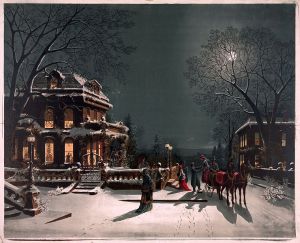
740px-No_Known_Restrictions_Christmas_Eve_by_J__Hoover,_no_date_(LOC)_(2122063062)

The Frost performs its secret ministry,

Unhelped by any wind. The owlet’s cry
Came loud—and hark, again! loud as before.
The inmates of my cottage, all at rest,
Have left me to that solitude, which suits
Abstruser musings: save that at my side
My cradled infant slumbers peacefully.
‘Tis calm indeed! so calm, that it disturbs
And vexes meditation with its strange
And extreme silentness. Sea, hill, and wood,
This populous village! Sea, and hill, and wood,
With all the numberless goings-on of life,
Inaudible as dreams! the thin blue flame
Lies on my low-burnt fire, and quivers not;
Only that film, which fluttered on the grate,
Still flutters there, the sole unquiet thing.
Methinks, its motion in this hush of nature
Gives it dim sympathies with me who live,
Making it a companionable form,
Whose puny flaps and freaks the idling Spirit
By its own moods interprets, every where
Echo or mirror seeking of itself,
And makes a toy of Thought.


Continue reading  Frost at Midnight  at

Frost at Midnight by Samuel Taylor Coleridge

Comments Off on #flashfictionfriday: Frost at Midnight, Samuel Taylor Coleridge

Filed under #FlashFictionFriday, Poetry

#flashfictionfriday: When You are Old, by W. B. Yeats

maude_gonne_by_sarah_purser_1898

Maude Gonne, by Sarah Purser, 1898

WHEN you are old and grey and full of sleep,

And nodding by the fire, take down this book,

And slowly read, and dream of the soft look

Your eyes had once, and of their shadows deep;


How many loved your moments of glad grace,

And loved your beauty with love false or true,

But one man loved the pilgrim soul in you,

And loved the sorrows of your changing face;


And bending down beside the glowing bars,

Murmur, a little sadly, how Love fled

And paced upon the mountains overhead

And hid his face amid a crowd of stars.


When You Are Old,  by W.B. Yeats, first appeared in The Rose, a collection of twenty-two poems published by William Butler Yeats in 1893. His works entered the public domain in 2010, 70 years after his death.

Many poems in the collection, The Rose, express Yeats’ unrequited love for Maude Gonne. Though she had resisted his courtship at the time  The Rose was published, it is understood that her rejection of him was not complete, and during those years he did have some small glimmer of hope.

1 Comment

Filed under Poetry, writing

#FlashFictionFriday:1998 Boxing up Michael

paul cornoyer rainy day in madison square

1998 Boxing up Michael

Putting his things in boxes,

Placing them on the wet grass by the street,

Rain on my face, stinging.

Tears in my eyes, also stinging.

Anger, hot in my heart because, stupidly

I believed.

Changing sheets, changing locks,

Changing passwords, changing banks.

Doubt should have prevailed.

Sanity could have prevailed.

My trust was his tool and, stupidly

I believed.

His books and tools and clothes resided

In open boxes on rain-damp grass,

And later he found them on Sylvia’s grass

Because some things never change.

He was a lesson learned because, stupidly

I believed.


1998 Boxing Up Michael by Connie J. Jasperson © 2016 All Rights Reserved

2 Comments

Filed under #FlashFictionFriday, Poetry

#FlashFictionFriday: Ode to Autumn, by John Keats

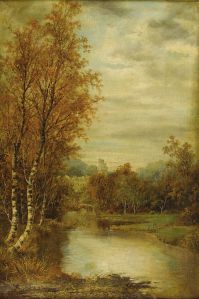
Autumn_Landscape_With_Pond_And_Castle_Tower-Alfred_Glendening-1869Autumn officially begins on Sept. 21, 2016. In honor of the changing season, and because it is Flash Fiction Friday, I bring you a classical poem, written by one of the mainstays of the Romantic movement in the arts and literature, John Keats. When Keats died of tuberculosis at the age of 25, he had been writing poetry seriously for only about six years, and publishing for only four.

In his lifetime, sales of Keats’s three volumes of poetry amounted to around 200 copies. Yet this Indie author is one of the most celebrated and studied poets of the last three hundred years.

>>><<<

Ode To Autumn – Poem by John Keats


Season of mists and mellow fruitfulness,

Close bosom-friend of the maturing sun;

Conspiring with him how to load and bless

With fruit the vines that round the thatch-eaves run;

To bend with apples the mossed cottage-trees,

And fill all fruit with ripeness to the core;

To swell the gourd, and plump the hazel shells

With a sweet kernel; to set budding more,

And still more, later flowers for the bees,

Until they think warm days will never cease,

For Summer has o’er-brimmed their clammy cell.


Who hath not seen thee oft amid thy store?

Sometimes whoever seeks abroad may find

Thee sitting careless on a granary floor,

Thy hair soft-lifted by the winnowing wind;

Or on a half-reaped furrow sound asleep,

Drowsed with the fume of poppies, while thy hook

Spares the next swath and all its twined flowers;

And sometimes like a gleaner thou dost keep

Steady thy laden head across a brook;

Or by a cider-press, with patient look,

Thou watchest the last oozings, hours by hours.


Where are the songs of Spring? Ay, where are they?

Think not of them, thou hast thy music too,—

While barred clouds bloom the soft-dying day,

And touch the stubble-plains with rosy hue;

Then in a wailful choir, the small gnats mourn

Among the river sallows, borne aloft

Or sinking as the light wind lives or dies;

And full-grown lambs loud bleat from hilly bourn;

Hedge-crickets sing; and now with treble soft

The redbreast whistles from a garden-croft,

And gathering swallows twitter in the skies.

>>><<< 

He writes, “Where are the songs of Spring? Ay, where are they?” and I know what he feels. I look forward to the changing of the seasons, the the colors of fall, the red of sumac and vine-maple, but  I confess, I will miss the summer. Sometimes, the cold dark, rain of the Northwest winter lacks appeal. I treasure the occasional patch of blue sky and the glimpse of sun.

When I read Keats, I am awed by the bold confessional tone of his prose. He is filled with emotion and passion—and expresses it with no filters. Consider the last five lines of the sonnet Bright Star:

Pillow’d upon my fair love’s ripening breast,

To feel for ever its soft fall and swell,

Awake for ever in a sweet unrest,

Still, still to hear her tender-taken breath,

And so live ever–or else swoon to death.

This is a bold confession of both sexual desire and romantic love—topics that, in polite society, were discussed behind closed doors. The poet was unafraid to say what most young men of his time felt, and he said it so beautifully it connects and resonates with modern readers.

Quote from Wikipedia (the fount of all knowledge):John Keats (Oct. 31, 795-Feb 23, 1821) was an English Romantic poet. He was one of the main figures of the second generation of Romantic poets, along with Lord Byron and Percy Bysshe Shelley, despite his work having been in publication for only four years before his death.[1]

Although his poems were not generally well received by critics during his lifetime, his reputation grew after his death, and by the end of the 19th century, he had become one of the most beloved of all English poets. He had a significant influence on a diverse range of poets and writers. Jorge Luis Borges stated that his first encounter with Keats’s work was the most significant literary experience of his life.[2]

The poetry of Keats is characterized by sensual imagery, most notably in the series of odes. This is typical of romantic poets, as they aimed to accentuate extreme emotion through the emphasis of natural imagery. Today his poems and letters are some of the most popular and most analyzed in English literature.


Ode to Autumn, John Keats PD|100

Bright Star, John Keats PD|100

Comments Off on #FlashFictionFriday: Ode to Autumn, by John Keats

Filed under #FlashFictionFriday, Poetry