Category Archives: Publishing

#amwriting: too many words

My Writing LifeI have been accused of using too many words to say what I mean—and my critics were right. For the last four years, I have been on a quest to learn how to convey a story and keep my reader involved. I’ve had some successes and also failures. The successes keep me going, and every failure inspires me to figure out what went wrong.

Most of the time it was my love of playing with words that derailed my story. Today’s example is a passage from an early work of mine. I will be rewriting this book over the course of the next few years, once the three books I am currently working on are published.

When I rewrite this book, I will eliminate the verbosity. I won’t change the basic story, only pare down the wordiness. This book was written for my first NaNoWriMo and was completely unplanned. I had no idea of what I was going to write until 12:01 a.m. on Nov. 1st, when I began writing it. In the back of my mind lurked Fritz Lieber’s great character, Fafhrd, although he’s not represented in this tale. Yet, Fafhrd and the Grey Mouser influenced this tale.

It still shocks me that over the course of 21 days, a 92,000 word story about a group of mercenaries in a medieval Alternate Earth emerged from my subconscious mind.

The original manuscript is a great example of everything that is both wrong and right about a  stream-of-consciousness first draft.

  1. Positive: It has a great, original plot,
  2. Positive: It has wonderful characters,
  3. Positive: It (surprisingly to me) has a basically good story arc.
  4. Positive: It ends well.
  5. Negative: I led off with an info dump.
  6. Negative: I used no contractions (Doh!)
  7. Negative: I made way too free with my adverbs and modifiers. This fluffed up the word-count by about 15,000 unnecessary words.
  8. Doubly negative: I used hokey phrasing, because I was trying to write well.
  9. Negative: Oh, and another info dump was inserted toward the end.

The example:

“I’ve brought along something so that we shall not have to boil the water to drink it,” ventured Lackland as he uncorked a bottle of wine. “Chicken Mickey was right about the trots you know, but I will never tell him that; the old thing enjoys mothering us so. It would take away the joy of nagging us to death if he thought we were able to care for ourselves.”

What? We shall not? From what hell hath this beast arisen? Still, once the hokey crap is pared away, something worth reading can be found.

SO, let’s take that unwieldy, 70-word behemoth of a paragraph apart and trim it down.

“I brought something so we won’t have to boil water to drink.” Lackland uncorked a bottle of wine. “Mick was right about the trots you know, but I’ll never tell him. It would take away the joy of nagging us to death.”

_72982736_vikings courtesy of BBCI trimmed it from 70 words to 42, and made it stronger without changing the meaning or intention. I changed the way Lackland refers to an absent friend, Chicken Mickey, the Rowdies’ supply-master. By this point in the ms, there is no need to use his full mercenary nickname every time he’s mentioned. Everyone knows Mick’s nickname and why he has it (he retired from the Rowdies to be a chicken farmer for a while, but that didn’t work out) so going with the short version of his given name, “Mick,” immediately helps that paragraph.

In the process, I axed one of my favorite sentences: “The old thing enjoys mothering us so.” It’s redundant as the sentiment is expressed in the sentence that follows, which also shows Mick’s character despite his absence.

Also of great benefit is the cutting away of unneeded words: along, to drink, ventured, as—these are words that can “go without saying” in the context of that paragraph. The reader understands they are there as silent partners: unwritten but understood. At this point, I feel that no dialogue tag is needed because Lackland has an action to perform, showing both who speaks and setting the scene.

Using contractions makes dialogue more natural. Some people would go even further than I did, and make “It would” a contraction. I don’t like the way “It’d” looks or sounds so I won’t do that—and that is part of what I think of as my voice. It is a deliberate usage choice, one that I prefer.

When I wrote the first draft of this manuscript, I was at a different stage in my writing development than I am at now. I had never been involved with a writing group, and I had never studied the mechanics of writing. The rudimentary skills I had were developed from trying to copy the styles of my favorite authors, but I had a limited understanding of the mechanics of writing fantasy fiction. The only writing I had done was for myself and my children, although I had done a lot of that.

While I had a standard high-school education and some college and had done a bit of writing in the course of my work, I realized I was woefully uneducated about the craft of writing. I made it my business to get an education, via the internet. It’s free and available to anyone who wants to learn. You just have to want to learn.

I began attending seminars, and writer’s conventions. I scavenged garage sales for books on the craft of writing and I joined local writing groups. I found other writers and made life-long friends, learning a great deal from them.

Nowadays, I have my own voice and my own style. I write far leaner prose in my first draft than I did in those days, and the editing process is not nearly such an ordeal as it was the first time I had one of my manuscripts edited professionally. I continue trying to learn the craft, updating my education constantly.
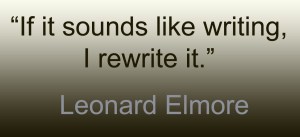
leonard elmore quoteChoose your words carefully, so they express what you want to say clearly, and in as few words as is possible, while still conveying the atmosphere and mood.

  1. Nothing can be included that does not advance the plot.
  2. There can be no idle conversations “just to show they’re human”: conversations must advance the story.
  3. We don’t need a chapter detailing the history behind the core conflict. Let that emerge as needed.
  4. Never use three words when one suffices.
  5. If you’re in love with a passage you wrote because it’s “great writing,” it probably should be cut.
  6. Ax all redundancies. It only has to be said once, unless the character has forgotten it, and that “forgetting” is a core part of the plot.
  7. Adverbs are important. They need to to be chosen carefully and used sparingly.
  8. If you occasionally love to wax poetic, go ahead and write poetry—just not in the middle of your political thriller. You have permission to love action-oriented genre fiction written with lean, mean prose, and still appreciate (and write) poetry.

What I didn’t know when I first began this journey is this: deleting the excess verbiage will add up to large gains, reducing the overall length of the book, increasing readability and (hopefully) the reader’s enjoyment.
9 Comments

Filed under Publishing, writing

#amwriting: squinting modifiers

Squinting ModifiersThis week we are going to look at two structural errors that introduce ambiguity into our narrative.

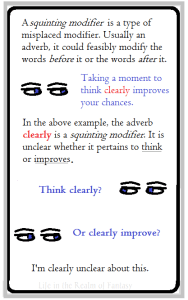
First up is the hilariously named squinting modifier.  Who thinks up these things? The first time I came across that expression, I thought it was a joke. However, in the world of writing, a “squinting modifier” is simply a type of misplaced modifier. According to Neal at Literal Minded, the term can be traced back to George Campbell’s The Philosophy of Rhetoric, published in 1776.

It is a common error that can be difficult for the author to spot in their work because the author’s mind sees what was intended, not how it appears to an unbiased eye.

This structural error introduces ambiguity:  it seems to qualify the words both before and after it.

  • Students who skip classes rarely are reprimanded.

Does this mean students who rarely skip classes are reprimanded? Or, perhaps those students are rarely reprimanded.

Mignon Fogarty, the Grammar Girl, offers this example:

  • Children who laugh rarely are shy.

Is the author talking about children laughing rarely, or rarely being shy?

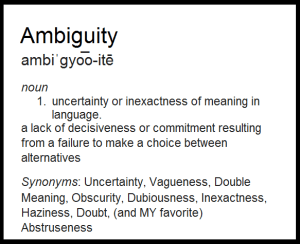
ambiguityMisplaced modifiers (frequently adverbs) make our work unclear, or “ambiguous.” The best way to avoid that ambiguity is to move the modifier so that your meaning is clear, or completely reword the sentence.
  • Children who laugh are rarely shy.
  • Students who skip class are rarely reprimanded.

When you introduce a large number of modifiers into your work you run the risk of

  • Introducing passivity to your narrative
  • Unintentionally introducing ambiguity

If you haven’t figured it out by now, there is an easy way to identify adverbs. Most, but not all, end in the letters “ly.” Knowing this makes it fairly easy to identify adverbs in sentences.

As I said, not all adverbs end in “ly.” Some frequency adverbs, do not follow this rule.

  • always
  • never
  • often
  • sometimes
  • seldom

Still, knowing that ‘ly’ at the end of a word indicates an adverb will help you avoid overusing them.

You may wonder why we want to limit the modifiers in our prose—and it’s a good question. How we use modifiers is part of the voice of our work.

If we are writing genre fiction (i.e. romance, mystery, sci-fi, fantasy) your prospective readers will not endure fluffed up prose written for the beauty of the words. They want lean prose, with an active voice, and to achieve that active phrasing, we cut back on the “ly” modifiers. Instead of telling you how the scene looks, an active voice shows you what the protagonist sees.

Telling: The night was hot and damp. Darren entered the alley, which was awfully dark and smelly. “Rafe?” he asked quietly.

“Over here,” said Rafe. He was all raggedy and dirty.

Showing: Darren entered the alley, his eyes adjusting to the darkness. The odors of overripe privies and decomposing garbage lingered in the humid air, along with the reek of despair. “Rafe?” he whispered.

A pile of rags stirred and a familiar voice said, “Over here.”

When we use active phrasing, we are better able to convey atmosphere.

Adverbs ending in “ly” are often called “adverbs of manner.” Despite the rants of some self-proclaimed gurus in certain writing forums, these words have a place in active prose, and anyone who says they don’t is not fully informed.

This is where it becomes a matter of style and the author’s voice. We choose our words deliberately to convey the story the way we see it, precisely placing modifiers to achieve a certain effect.

Perhaps you are trying to convey a character’s lack of conviction regarding his plan of action: Rafe is a down-on-his-luck confidence man, a reformed scam-artist drawn in to do a job only he has the skills for.

“I’m fairly sure this will be safe.” Rafe crossed his fingers for luck. “It’s not that much dynamite.”

Several authors I know well would never use the word “fairly” because its an indecisive word. That indecisiveness is what I want to convey. This is the difference in our “voices.”

The way I see it: Rafe could say “I’m almost sure” but to me, that phrasing feels clunky and obvious–it does show his doubt. But, in  my opinion, what it doesn’t convey is Rafe’s desire to sell his reluctant partner the plan he has little confidence in. He has to convince Darren to go along with it because they have no other option. Rafe is a conman, trying to reform. He has an important reason to not just lie about it, so he wants to be as truthful as he can be and still sell Darren on the plan.

Writing involves words of all kinds and using them properly.

Adverbs are a powerful seasoning to add to your prose–be sparing and make the best use of them. Those you do use should go unnoticed in the narrative.

Your readers will thank you.

List of common adverbs

5 Comments

Filed under Publishing, Self Publishing, writer, writing

#amwriting: son and sir: to capitalize or not?

Tom Hiddleston MemeTerms of endearment are often used in casual conversation. Each has their own implications which are highly dependent on tone of voice, body language, and social context.

They can be fairly impersonal, denoting a friendship. Conversely, they can be intimate, indicating a close relationship.

Used by perfect strangers they can also be patronizing and rude.

These words vary in creativity from the sublime to the ridiculous:

  • dear
  • mate
  • chum
  • darling
  • honey
  • baby-cakes
  • sweetheart
  • sugar
  • wuvvy-dovey

From Wikipedia, the fount of all knowledge: Saying “Hey baby, you’re looking good” varies greatly from the use “Baby, don’t swim at the deep end of the pool!” Certain terms can be perceived as offensive or patronizing, depending on the context and speaker. (end quoted text.)

This brings us to the word “son.” Again, as in so many other aspects of the writing craft, context is everything.

  • “I love you, Son,” said the doting father.

The_Chicago_Manual_of_Style_16th_editionFrom the Chicago Manual of Style, Section 8.35: Kinship names are lower-cased unless they immediately precede a personal name or are used alone:

  • my father and mother
  • Aunt Jane
  • the Bronte sisters
  • I believe Grandmother’s name was Marie
  • Please, Dad, let’s go.
  • She adores her aunt, Maud

But, in the past, instead of a boy’s name, men commonly called boys boy, kid or son, not as a name but as a neutral term of endearment. My interpretation of the word “son” in casual conversation is like this: I feel it should not be capitalized if it is being used to indicate friendship, or in a patronizing fashion.

Wikipedia claims that in an informal setting, such as a pub or gym, the use of terms of endearment is a positive politeness strategy among men. A term like “mate” or “son” shifts the focus toward the friendship existing between the speakers, yet maintains a slight emotional distance.

The problem here is the term “son.” In some cases, it is used when speaking to a man not related, but indicates friendship on the part of an older speaker in regard to a younger companion. I feel that, when used as a neutral form of endearment, the word “son” falls into the same class as:

  • Hand me the scissors, darling.
  • Have a beer, mate.
  • Gloria, dear—how’s your mother?
  • Grab that remote for me, love.
  • How’ve you been, old son?

The above endearments are not between speakers with a deep emotional attachment. They indicate camaraderie and nothing more–they are neutral. Therefore, “son” should not be capitalized if it is being used as a neutral term of endearment when speaking to a person you are not related to.

  • “Okay, son. Tell your ma I stopped by,” said his neighbor.
  • “Get off your high-horse, son,” said man next to him.

As stated above, The Chicago Manual of Style’s preference has always been to lowercase pet names, (which are terms of endearment) but in reality, you can’t go wrong unless you’re inconsistent, since the issue is guided by preference rather than rule.

The word preference means:

  1. a greater liking for one alternative over another or others.

synonyms: liking, partiality, predilection, proclivity, fondness, taste, inclination, leaning, bias, bent, penchant, predisposition

So, if you do choose to capitalize the word “son” when used as a term of endearment, be consistent. But also be aware that it’s not necessary.

Then there is the question of the word “sir.” It is an honorific. From the Chicago Manual of Style section 8.32

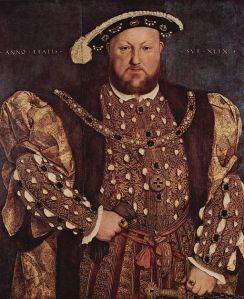
Portrait of Henry VIII (1491-1547) by Hans HolbeinHonorific titles and respectful forms of address are capitalized in any context with several exceptions:

  • sir
  • ma’am
  • my lord
  • my lady

Always capped:

  • Madam Speaker
  • Your Honor
  • Your Excellency
  • Her (His, Your) Majesty; His (Her, Your) Royal Highness
  • The Most Reverend William Ronstadt (Roman Catholic Bishop)
  • Lord John Davies; Lady Mary Shelton
  • The First Gentleman; the First Lady
  • The Right Honourable John Carter

Where king/queen is used as part of someone’s name, it is always capitalized:

  • King Bob, and Evelyn, the Queen of Darkness

Where king/queen is used as part of a general reference it is lower-cased:

  • “Hello,” said the king.

Should one capitalize the word sir when it’s used in dialogue? Which of the following would be correct? “Yes, sir.” OR “Yes, Sir.”

Paul-McCartney-on-playing-Rock-BandIf the reply is to a respected person in general, it is written with no capital, as it’s not a formal name. But you do need a comma just as you would with a formal name:

  1. “Yes, sir.” (General politeness.)
  2. “Yes, Sir Paul.” (Formally agreeing with a knight.)
  3. “Yes, Larry.” (Proper use of comma.)

When writing dialogue: if your speaking character is in the military and the person he/she is addressing has a military rank above them, THEN you must capitalize it.

If you are writing about Sir Paul McCartney’s favorite brand of socks, capitalize it.

You must also capitalize the words “sir” and/or “madam” when beginning a letter or an email. My favorite internet example of this is:

Dear Sir or Madam,

I am writing to inform you that you a related to a Nigerian prince. (Grammar Party Blog)

Just refer to me as “my lady” from here on out. Email doesn’t get better than that!

6 Comments

Filed under Publishing, writing

#amwriting: World building: Society, and Magic

Today we will examine society and magic, two disparate concepts with one thing in common: both require a solid framework to imagine the story around. In other words, you have to understand them well.

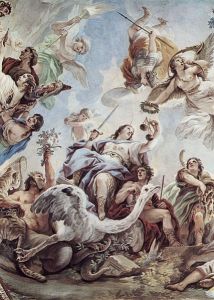
Luca Giordano, Frescoes in the gallery of the Palazzo Medici-Riccardi in Florence, Scene - Justizia ca 1584

Luca Giordano, Frescoes in the gallery of the Palazzo Medici-Riccardi

First let’s discuss religion and society: Who are the movers and shakers?

In all societies, there is a hierarchy of power. Someone is at the top and someone else is at the bottom.

As I create the political power-structure, I find that the opportunities for creating tension within the story also grow. I keep a list of those ideas so that when I run short on creativity I have a bit in the bank, so to speak.

When you are building a world that only exists on paper, you have a microcosm of space in which you can convey the social, religious, and political climate of your story.  You show this in small ways, with casual mentions in conversation when it becomes pertinent, and not through info dumps.

However, in order to convey that information logically and without contradictions, you must have an idea of how things work.

  • Who has the power and privilege in that society, and who is the underclass?
  • How is your society divided? Who has the wealth?
  • Who has the power? Men, women—or is it a society based on mutual respect? Is one race more entitled than another?
  • Who wants power, and what lengths are they willing to go to gain it?
  • What place does religion have in this society? Is it central to the governance of the society, or is it a peripheral, perhaps nonexistent thing?
  • What passes for morality? Is sex before marriage taboo? What constitutes murder and how is it viewed? Remember, you only need to worry about the moral dilemmas that come into your story.
  • If a character goes against society’s unwritten or moral laws what are the consequences?

This creates atmosphere. This is knowledge the characters have but the reader does not. There is no need to have an introductory chapter describing the laws and moral codes of the religious order of Grok, or the political climate of West Berlin in 1961. The way you convey this is to show how these larger societal influences affect your character and his/her ability to resolve their situation.

Consider this story: a woman is separated from her husband by the Berlin Wall.  Every day, on her way to her job, she rides her bicycle past the wall, knowing that on the other side, less than a block away, is her husband. Yet the couple is divided by an impassable barrier. How the wall affects her is shown in her everyday life. In this story, the history of how the wall came into existence isn’t as important as how its presence destroys her family. The wall represents the ideology of those who rule in her divided city, so the reader comes to know the politics of both East and West Berlin by her experiences in trying to cross that barrier.

And now for the magic:

If magic is central to your story, it is critical that you have finite rules for limiting how magic works. If you make your characters too clever, readers won’t be able to relate to their story. 

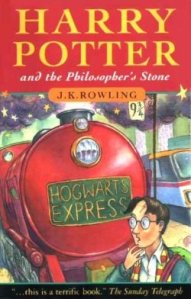
Harry_Potter_and_the_Philosopher's_Stone_Book_CoverWhen magic is part and parcel of a story, rules and limitations create the tension that moves the plot forward. J.K. Rowling’s Harry Potter series is an excellent example of this. No one character has all the power. The two most powerful wizards, Dumbledore and Voldemort, are evenly matched, but neither one is all-powerful. Both wizards want something from Harry. Harry has to work hard to gain his the full use of his abilities.

Harry’s struggle is the story.

  • Who has the magic, and what social power does this give them?
  • What are the limitations of his/her powers?

Each time you make parameters and frameworks for your magic you make opportunities for conflict within your fantasy world. Conflict is what drives the plot.

What challenge does your character have to overcome in regard to his magic?

  • Is he unable to fully use his own abilities?
  • If that is so, why is he hampered in that way?
  • How does that inability affect his companions and how do they feel about it?
  • Are they hampered in anyway themselves?
  • What has to happen before your hero can fully realize his abilities?

Without rules, there would be no conflict, no reason for the hero to struggle, and no story to tell.

Merlin, by Douglas Baulch, Via Wikimedia Commons

Merlin, by Douglas Baulch, Via Wikimedia Commons

I have three worlds with three radically different systems of magic. My serial, Bleakbourne on Heath, is set in a parallel earth that is one shadow away from this one. Bleakbourne, situated on the Heath River, is where the fey and the mortal worlds meet. Leryn, my main character, has many adventures with people who have certain parallels with our history and who are drawn from Arthurian legend, but who are given my own particular twist.

I had to sit down and write out the rules for Merlin’s magic. In Bleakbourne’s world, wizards are born with the latent ability to wield magic, but it is considered a science, and craftsmanship is valued above all else. Skill is what gives a sorcerer power. Certain rituals must be observed.

  • Spells work two ways, and the second way always reverses the first way—this is called symmetry.
  • The words used in spells are of the old, dead, Romani language. Unwords are syllables that have a null meaning and are often inserted for symmetry.
  • All the Romani words with more than one meaning must be chosen carefully because they can be either too short or too long for symmetry. Too long a word will not work at all as you can lengthen, but not shorten them. The sorcerer must choose a shorter word, which requires him/her to insert an extra, closing unword, or the two spells wouldn’t be symmetrical. There are four unwords to choose from, but only three chances to get the spell right

In the Bleakbourne series, the use (and abuse) of magic is the underlying theme.

In creating both social and magic systems, you are creating a hidden framework that will support and advance your plot. Within your magic system, there can be an occasional exception to a rule, but there has to be a damned good reason for it, and it must be clear to the reader why that exception is acceptable.

The only time the reader needs to know these systems exist is when these institutions affect the characters and their actions. Dole this information out in conversations or in other subtle ways and it will become a natural part of the environment rather than an info dump.

1 Comment

Filed under Fantasy, Publishing, writing

#amwriting: the author’s voice

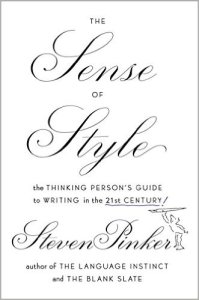
The sense of style steven pinkerAnyone who is a member of a writing group is regularly beaten over the head with certain basically good, but occasionally clichéd, rules. Improperly applied, this mindless interpretation of proper grammatic style can inhibit an author’s growth.

These rules are fundamentally sound, but cannot be rigidly applied across the board to every sentence, just “because it says so in Strunk and White.” I rely on the Chicago Manual of Style, but I also understand common sense.

English is a living language. As such it is in a continual state of evolution and phrasing that made sense one-hundred years ago may not work well in today’s English.

We may be writing a period piece, but we are writing it for modern readers.

You can split an infinitive: it is acceptable to boldly go where you will.

You can begin a sentence with a conjunction if you so choose. And no one will die if you do.

Stephen Pinker discusses many rules in his controversial book, The Sense of Style, and finds that some of them no longer make sense.

For example, Pinker points out that “The prohibition against clause-final prepositions is considered a superstition even by the language mavens, and it persists only among know-it-alls who have never opened a dictionary or style manual to check.” 

He notes that rigidly following “the rules” would have you doing silly things like turning “What are you looking at?” into “At what are you looking?”  I don’t know about you, but for me the first example is preferable.

In the example, the word at is a preposition, and placing it after looking makes it a clause-final preposition.  Such a construct is technically a no-no, but I suggest you break that rule.

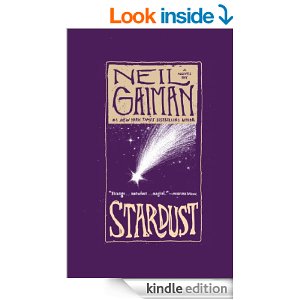
Stardust, Neil GaimanWe are constantly told that we need to make our verbs active, rather than relying on passive constructions, and for the most part, this is true. But Pinker reminds us that “The passive is a voice and not a tense.” There are times when the use of passive phrasing is appropriate.

Consider the difference between ‘the cat scratched the child’ and ‘the child was scratched by the cat.’  The second sentence is written in the passive voice, and in this context the active voice is the one I would choose because it is simpler and less fluffy.

Pinker agrees with me that there are contexts in which the passive is preferable. Quote from The Sense of Style: “Linguistic research has shown that the passive construction has a number of indispensable functions because of the way it engages a reader’s attention and memory.”

And in writing, context is everything. 

For most genre work, editors push for active voice, but truthfully, mainstream fiction and literary fiction can use the passive voice and still sell boatloads of books. Some of the most beautiful prose out there in genre fantasy mixes passive voice in with the active, and when done right  it is immersive.

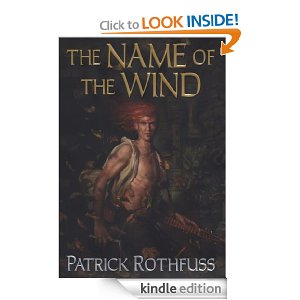
name of the wind -patrick rothfussPatrick Rothfuss’s Name of the Wind is one example, and Neil Gaiman’s Stardust is another.

These books are best sellers because both Rothfuss and Gaiman understand how to craft prose that mingles passive and active phrasings, drawing us into their work. They choose when to use passive phrasing, and apply it appropriately so the narrative is a seamless blend of properly constructed sentences chosen to reflect their distinct voices.

The modern prohibition against passive phrasing exists for a reason: improperly and excessively used, the passive voice can weaken your narrative.

Knowledge of grammar and sentence construction is critical if you are an author: Sloppy grammar habits show that your work is badly crafted.

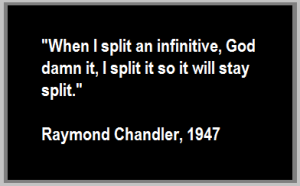
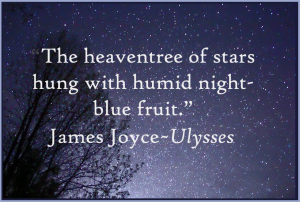
Your voice is the way you habitually phrase things despite your vast knowledge of how grammar is correctly used. Take a look at the great authors: Raymond Chandler, Ernest Hemingway, F.Scott Fitzgerald, and James Joyce: these authors each had such a distinctive voice that when you read a passage of their work, you knew immediately who you were reading.

They ALL broke the rules in their work and were famous for doing so.

Raymond chandler quote split infinitivesHowever, they understood the rules they were breaking and broke them deliberately and selectively in the crafting of their narrative.

Imagine a story set in an expensive restaurant. This story revolves around a marriage that is disintegrating. The couple, Jack and Diane, dine in silence. The food is important, but only because of what it represents. How do you convey this?

The steak was well-prepared and melted in Jack’s mouth. Nevertheless, Diane wielded her knife like a surgeon, cutting her meat into tiny, uniform chunks, chewing each bite slowly before swallowing. Jack imagined her carving his heart similarly, chewing it carefully and then spitting it out.

800px-Night_Sky_Stars_Trees_Quote“The steak was well-prepared and melted in Jack’s mouth” is written with a passive voice, and that is okay. The important thing is Jack’s observation of Diane and her mad knife skills. You don’t need to say “The chef had prepared the steak perfectly.” Unless he is having an affair with Jack or Diane, the chef who prepared the tender steak is not important and doesn’t need to be mentioned.

Steven Pinker has some words of wisdom for would-be editors: “It’s very easy to overstate rules. And if you don’t explain what the basis is behind the rule, you’re going to botch the statement of the rule—and give bad advice.”

Knowing what the rule is and why it exists allows you to choose to break it if that is your desire.

Writing style is a combination of so many things. It is how you speak through your pen or keyboard. Craft your prose with an eye to what is important to your story, and say it with your voice. With that said, your voice should not be so distinct and loud that it makes your prose obnoxious. A good editor will understand the difference and guide you away from bad writing, helping you find your voice in such a way that your work will be a joy to read.

8 Comments

Filed under Fantasy, Publishing, writing

#amwriting: stylesheets

IBM_SelectricWriting a fictional novel is really the same as telling a whopping lie that you believe in with all your heart and keeping it straight for 80,000 words or more.

Everyone knows how lies evolve in the telling. That tendency to elaborate and embellish is the eventual downfall of even the most believable of liars.

What the writer has going for them that the average liar doesn’t is paper. We write the falsehood down on paper the way we pretend it happened. Once the fabrication is complete we have the luxury to go back and forth over it, making sure we haven’t contradicted ourselves, and then we dare the reader to believe it.

I posted a blog to this effect on November 9, 2015: 3 steps for keeping the story straight. One step that I discussed is what editors refer to as the “stylesheet.”

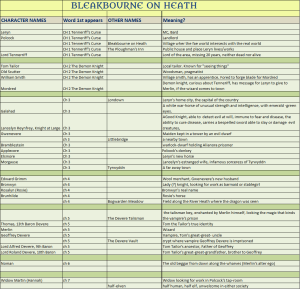
Bleakbourne Style SheetWhen a manuscript comes across their desk, editors and publishers create a list of names, places, created words, and other things that may be repeated and that pertain only to that manuscript. This is called a stylesheet.

The stylesheet can take several forms, but it is only a visual guide to print out or  keep minimized until it’s needed. I copy and past every new word or name the first time they appear in the manuscript, and if I am conscientious, I’ll be less likely to inadvertently contradict myself later on in the tale.

Many people use a program call Scrivener for this and they are happy with it, but I found it didn’t mesh well with the way MY mind works, so I went back to my one-page list and hand scribbled map.

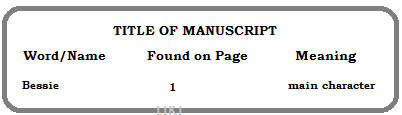
Regardless of how you create your stylesheet, I suggest you include these elements:

  • Word/Name
  • Page it first appears
  • Meaning

Stylesheet_example_LIRF_cjjasp

This is especially crucial for fantasy authors because we invent entire worlds, creating names for people, places, and creatures.

Take my own work-in-progress: it is the final volume of the Tower of Bones trilogy, and has people with names that can be spelled several ways, and when I am in the throes of writing the first draft I fling them out any old way.

Thus, a character named Linette on page one can become Lynette by page six. Kalen can become Kalin. Place names become mushy, and any word that is important or invented can evolve over the course of a manuscript.

Now I am in the final stages of making the manuscript submission-ready. I have completed a global search for every possible variant of the words on my list, and replaced the incorrect instances with the version I like best.

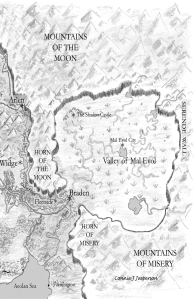
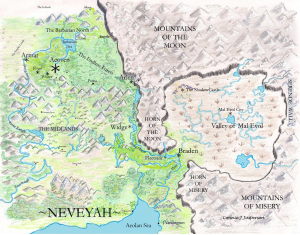
Valley of Mal Evol ©Connie J. Jasperson 2016Place names evolve too, so maps are essential tools when you are building a world. Places written on a map tend to be ‘engraved in stone’ so to speak. Readers will wonder where the town of Maudy is when the only town on the map at the front of the book that comes close to that name is listed as Maury.

To prevent that from happening, double check what you have written on the map, and then do a global search for every possible variant.

Just because you invented the world doesn’t mean you know it like the back of your hand. That world is constantly evolving in your mind. I have been writing in the world of Neveyah since 2009, and still I find that I frequently contradict myself, which is why the stylesheet is so important.

11 Comments

Filed under Fantasy, Publishing, writing

#amreading: the genesis of an author

Nymphenburg, View From the Seaside painting by Joseph Wenglein 1883

Nymphenburg, View From the Seaside painting by Joseph Wenglein 1883

I find the process of creativity as experienced by others intriguing, and am always curious about how they became authors.

My own journey to this place in my life was pretty tame. But some people  become authors via more adventurous, alternative paths.

This notion is explored in Elizabeth McKenzie’s frank, autobiographical post published on January 26, 2016, for LitHub.

Max Ernst, The Elephant Celebes 1921, Tate, London via WikipediaAppropriately titled “Surrealism and Decomposition. Or How I Wrote My Novel,”  McKenzie takes us on a journey through both her personal quest for enlightenment and creativity and the authors whose works colored her writing life. The quote that hooked me into reading this piece: “I read Rimbaud and Breton and Lautreamont and started according my dreams the respect I felt towards art. I wanted to have visions, I wanted, as Rimbaud put it, to take part in the systematic disordering of the senses.”

Her honest account of her sometimes psychedelic journey through alternate forms of consciousness and literary greatness is quite intriguing and took me back to my college days when many of my friends also chose that path for enlightenment.

Psychedelics were never an option for me, although in that way I was the odd one in my circle. The notion of them frightened me. Life in the early 1970s was surreal enough in its cold reality. My form of mind-expansion came in books.

The authors whose works influenced me as a young adult might surprise those who know me.

In my twenties, sci-fi and fantasy books were expensive and hard to get. The libraries stocked a few, but not as many as I required, as fast as I read.

When I was young, my parents were prolific readers and were members of both Doubleday Book Club and Science Fiction Book Club. They also purchased two to four paperbacks a week at the drugstore and subscribed to Analog and several other magazines.

samuel pepys diaryThere was always something new and wonderful to read around our house, and most of it was speculative fiction, although we had the entire 54 volume leather-bound set of the Great Books of the Western World, and our father insisted we attempt to read and discuss what we could.

Some were mostly understandable, such as William Shakespeare and Samuel Pepys.

Plato, not so much, and yet his work did influence me.

At the age of 14 I didn’t understand Pepys, but I read him, and while we were bass fishing on a Saturday morning, Dad would talk about the differences between life and morality in Pepys’ London and our life in suburban America in 1969. His thought was that I should learn about the 17th century and the Great Fire in London from an eye witness, just as I had learned about the war in the Pacific from John F. Kennedy‘s autobiographical novel,  PT 109.

But Pepys’ London of 1666 was so different from the ‘Mod’ subculture of the London of 1966 (and the Beatles) that I was familiar with thanks to Life magazine. To me, it was almost like speculative fiction. In many ways it was more difficult  for me to believe in historical London than Tolkien’s Middle-Earth.

When I married and left home, I still read every sci-fi or fantasy novel that came out in paperback, budgeting for books the way others of my acquaintance budgeted for beer. I read the classics for my irregular college classes, and learned to love Chaucer and James Joyce. For a variety of reasons I never earned a college degree, but I’ve never stopped reading and researching great literature.

But reading for entertainment was still my “drug.” I jonesed for new books by the great ones, Anne McCaffrey, Jack Chalker, and Roger Zelazny, reading and rereading them until they were shreds held together with duct tape.

As a married student attending college in Bellingham Washington, purchasing books for pleasure became a luxury. I found a secondhand bookstore where I could get a brown paper shopping bag full of novels in too poor a condition to sell on their shelves for $2.00 a bag if you had a bag of books to trade in.

As a college drop-out I went through a bag of books every week, and within a year, I had read every book they had.

Devils Cub Georgette HeyerThus, out of desperation, I discovered a whole new (to me) genre: regency romances written by Georgette Heyer, and other romance writers of that generation. Those books, along with beat up copies of bestsellers by Jack Kerouac, James Michener, and Jacqueline Susann began to show up in the pile beside my bed.

So at least some of my literary influences can be traced back to dragons, booze, morality, and England’s romantic Regency—lived vicariously through these authors’ eyes.

Always when the budget permitted, I returned to Tolkien, Zelazny, McCaffrey, Asimov, Bradbury, and as time passed, Piers Anthony, David Eddings, Tad Williams, L.E. Modesitt Jr., and Robert Jordan to name only a few.

And there were so many, many others whose works I enjoyed. By the 1990s, the genres of fantasy and sci-fi were growing authors like a field grows weeds, and I loved it.

All of the books I read as a child and young adult have influenced my writing. They still inspire me.

Nowadays I rarely am able to read more than a chapter or two before falling asleep. My Kindle is full of books, and I haven’t got the time to read them because I have to write my own story. Having the luxury to spend a day wallowing in a book is a treat to be treasured.

Old booksBut it is because of the uncountable authors whose works I have been privileged to read that I was inspired to think that my own scribblings might be worth pursuing.

Writing has always been necessary to me, as natural as breathing. In the beginning, my writing was unformed and was a reflection of whoever I was reading at the moment. As I matured and gained confidence, I found my own ideas and stories, and they took over my life.

Once that happened, I became a keyboard-wielding writing junkie.

Some days I write well, and others not so much, but every day I write something.

And every day I find myself looking for the new book that will rock my universe, a new “drug” to satisfy my craving, even if I know I won’t have time to read it.

I’m addicted to dreams and the people who write about them. Reading is my form of mind expanding inspiration. Without the authors whose books formed my world, I would never have dared to write.

Life would be so boring.

2 Comments

Filed under Publishing, writer, writing

#amwriting: the end: separation anxiety

Map of Neveyah, for RizAeroNothing is more difficult (in my opinion) than finishing a novel that has been stalled for three years. My current work in progress has been through three different incarnations.

Two other books have been published during this time because  I couldn’t find a satisfying way to end this chapter in the history of Neveyah.  Perhaps it is a case of separation anxiety, but for one reason or another, it has never gotten to the true finish line.

My current focus is on finishing the final draft of this novel and getting it submitted to my editor. This book must wind up the Tower of Bones series, and it has to finish BIG.

While I am doing this, I confess I feel the same mix of feelings as I did when my youngest child left home–a sense of loss combined with pride and the thought that freedom looms.

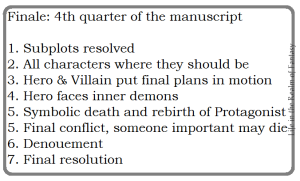
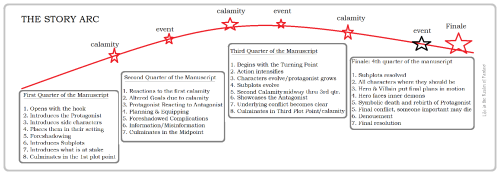
4th qtr of MSSo let’s talk about the all-important fourth quarter of the story arc.

At this point in the story arc, the final plans are in motion. We’ve met the enemy part 1 and survived the encounter. We’ve suffered a terrible setback. Now we’ve regrouped.

In the third quarter, major events have unfolded that point to the conclusion. Based on my structural editor’s suggestions, I  inserted new scenes into the existing narrative that drive the action to the final conflict. Those are all finished and are where they should be.

  1. At the outset of the 4th quarter, all my subplots are resolved and the final focus is on the Dark God’s move.
  2. The Dark God’s final pawn in this game must be exposed to the reader.
  3. The enemy’s plan and their true nature must be shown.
  4. Someone who was previously safe is now in peril. Their fate hangs on a thread and the outcome is unclear.
  5. The heroes must face the fact that their efforts to preserve their homeland has forced the enemy’s hand in a way they never expected
  6. The resolution for these characters is final, no loose threads can be left at the end of this book, as it completes the trilogy.

My work right now revolves around taking the new material and blending it into the existing story. Foreshadowing must be inserted and some otherwise great passages will be cut. This is because anything that does not drive the plot to this end is a side quest, and there can be no more of those.

This means one whole storyline that took six months to write will be cut, but it’s not a waste. There will be more opportunities for writing in this world, and that storyline could become a novella. These are great characters and the villains are as intriguing as the heroes.

As I said at  the beginning of this post, I am seeing this novel coming together at long last, and I am loath to let go of it. But I am excited to see it coming to this conclusion and feel good about it, despite having to shed some of the work that took so long to write.

The events have been detailed. Making sure this story flows seamlessly is time-consuming but it’s my obsession, so poring over the manuscript is what I am doing when I could be playing games. (Hear that Aveyond Stargazer?)

The Story Arc copy

4 Comments

Filed under Publishing, writer, writing

#amwriting: headers and page numbers

Book- onstruction-sign copyI’ve blogged before on this subject, but it is time to talk about it again: making your manuscript ready for submission to an editor, agent, or a publisher. All agents, editors and publishing companies have specific, standardized formatting they want you to use, and these guidelines are posted on their websites.

The submissions page for TOR Forge, one of the Big Boys in the publishing world, clearly says: “Standard manuscript format means margins of at least 1 inch all the way around; indented paragraphs; double-spaced text; and Times New Roman in 12 pitch. Please use one side of the page only. Do not justify the text. Do not bind the manuscript in any way. Make sure the header of the ms. includes your name and/or the title of the book as well as the page number (on every page).”

For the most part this formatting is basically the same from company to company, so once you know what the industry standard is, it’s easy to make your manuscript submission-ready, at least in the area of formatting.

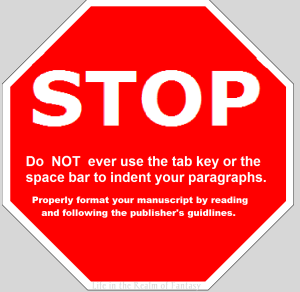
stopI’ve said this before, and I will say it again: Do NOT ever use the tab key or the space bar to indent your paragraphs. Many times publishers want electronic submissions and you have no idea what a crapped up mess (sorry for the editor-speak) using the tab key makes out of an electronic manuscript.  You most likely will have to go in and remove these tabs by hand and it’s a tedious job, but do it now, if you have been using the tab key.

You might say, “Well I only submit to traditional publishers who all want hard-copy.” That, my friends, it not true. The entire publishing industry is undergoing modernization, and while they do still accept hard-copy, electronic submissions are rapidly becoming the preferred method, even with the larger publishers. Don’t limit your options by refusing to learn a simple trick.

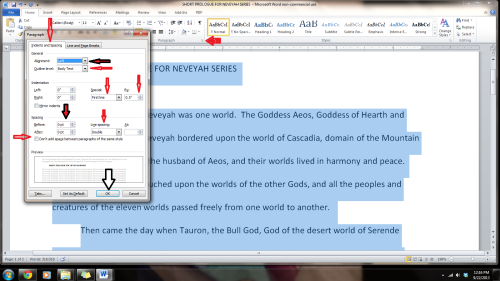
To format your paragraphs indents, first highlight the entire manuscript: on the far right side of the home-tab at the top of your page, click select all. Next,  still on the home tab,  click on the little box at the lower right of the box that says ‘Paragraph.’  This will open a whole new menu:

  1. On the indents and spacing tab of the menu: Use standard alignment, align LEFT. The reason we use this format is we are not looking at a finished product here. We are looking at a rough draft that will be sliced, diced and otherwise mutilated many times before we get to the final product. The following pictures are for WORD 2010, as I have not yet upgraded my MS Office program, but the basic ideas are the same.

paragraphs post 2 pof word series

  1. Indentation: leave that alone or reset both numbers to ‘0’ if you have inadvertently altered it.
  2. Where it says ‘Special’: on drop-down menu select ‘first line’. On the ‘By’ menu, select ‘0.5’
  3. ‘Spacing’: set both before and after to ‘0’.
  4. ‘Line Spacing’: set to ‘double’

Do not forget to click OK at the bottom of the menu.

But today we are going to talk about headers and page numbers:

The “Header” is the writing in the margin at the top of each page of a word-processed or faxed document, usually automatically inserted and, in this case, consisting of the title of the book and your name.

Publishers and editors want this because when they receive a print copy, they want them UNBOUND. Each page should be clearly marked with your name and/or the title of the book as well as the page number. Also, publishers and editors who ask for electronic submissions may need to print sections of your work for closer examination. Accidents happen: if the ms falls off a desk, it can easily be reassembled and the editor will always know that brilliant work was written by you.

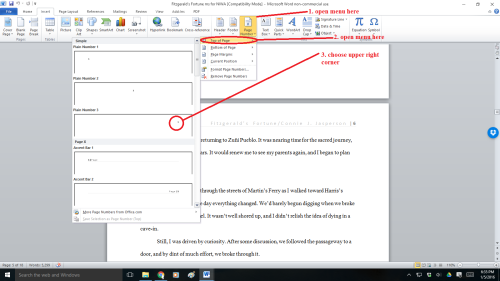
We begin by opening the “insert” tab, and clicking on “page number.”  This opens up a new menu. We add the page numbers using this menu.

Headers and Page numbers prnt sc 2

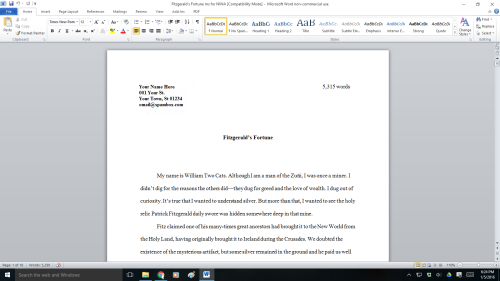
You will insert the Title of the Book and Your Author Name  just before the page number, so it will look neat and be aligned to the right. You can do this on the page number tab.

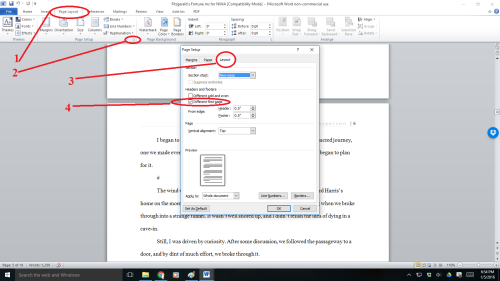
Sometimes, a publisher will specify that the first (title) page have no header or page number, but they want the header and page numbers to begin on page two.

Headers and Page numbers prnt sc 1

To make the page numbers begin on page two:

  1. Click anywhere in the document.
  2. On the Page Layout tab, click the Page Setup Dialog Box Launcher, and
  3. then click the Layout tab.
  4. Under Headers and footers, select the Different first page check box, and then click OK.

Headers and Page numbers prnt sc 3

Now your manuscript:

  1. is aligned left
  2. has 1 in. margins
  3. is double-spaced
  4. has formatted indented paragraphs
  5. The header contains title and author name and page numbers aligned right
  6. The first page contains your mailing address and contact information in upper left hand corner

For more on the subject of getting a manuscript ready for submission, check out my post of July 24, 2015, How to format your manuscript for submission.

43 Comments

Filed under Publishing, Self Publishing, writing

#amwriting: L.E. Modesitt Jr.: creating depth without dumping info

Fall of AngelsOne of the most difficult aspects of writing is creating the sense of history without resorting to an info dump. It is a fine line to walk, because too much information will cause the reader to stop reading, and not enough will also make them close the book. What we are looking for is a happy medium, a narrative that incorporates some history, but only the bits that are needed to move the story forward.

That ability to create the past while describing the present is one that author L. E. Modesitt Jr. has, and is shown to its best advantage in his masterpiece Fall of Angels. Written in 1997, this is the sixth installment in one of the most enduring fantasy series of modern times, The Saga of Recluce.

This saga takes place over many generations and explores both sides of the conflict, with not usually more than two books dealing with a particular protagonist.

Modesitt Jr. knows his world. It is clear when you read his work that he understands the environments and societies he is writing about, and he knows the moral values of the three cultures who clash in this series of books. In Fall of Angels he takes the reader back  a thousand years, to the origins of the conflict that is explored in the previous five books, but the world the angels find themselves stranded on feels familiar–because the author knows every aspect of his world.

In this series as a whole, Modesitt Jr. examines two radically different magics–the black of order vs the white of chaos. This is the central theme of each tale in the saga, and the protagonist is either of the black or white persuasion. In a few books there is a grey area of magic where the protagonist embodies both, but always the price of magic and the responsibility of those who wield it is a central theme in this series.

In Fall of Angels, Modesitt explores the side of order, the black magic of healing and building.

The story opens on the bridge of a battle-cruiser, the Winterlance. The crew is human, and are in the military service of the UFA, which is comprised of the planets of Heaven.

The crew of the Winterlance is from the various cold planets of Heaven. Most are from Sybra, the coldest planet, but a few are from Svenn, a more moderate planet. This limits where the Angels can comfortably live, making high altitudes their favored homes.

They are about to enter a battle from which they will likely not return, fighting  against the Rationalists, the humans from warmer planets, and with whom they have been warring for thousands of years. The Rationalists are an extremely patriarchal society, and are also known as Demons.

In the opening pages we meet a crew that, by happenstance, is made up of women, with only three male crew members. Nylan is the ship’s engineer, and, as are all the officers, he is connected into the ships neuronet, the mental command center that completely controls the ship and its environment.

Ryba is the ship’s captain, and while she and Nylan have a sexual relationship, there is no doubt that she is in command. I didn’t say romantic, because though they sleep together and care for each other, there is no romance involved.

The energies expended during the battle are such that the Winterlance is thrown into an alternate universe, above a strange planet. With no way to return, they are forced to land.

Unfortunately the first thing that happens is they have landed on a world previously colonized. It probably happened in the same way, but by the Rationalists of the warmer worlds of Hell. The lord of the land immediately attacks them, and the conflict is on.

All Angels are not equal. Nylan is half-Svenn. The Sybrans cannot take the heat of their new world and are pretty much trapped in the cool mountains, but he can go lower, into the warmer areas, although he too suffers from the heat.

While the maps in this series are not very good, or really even useful, I feel sure the author must have a file with worldbuilding information for this series in it. Some forethought and planning went into creating Recluce, Candar, and the other continents that become locales for action in this series.

One type of tree is deciduous, with triangular gray leaves, and only loses half of them during the winter, the others curling up and remaining on the tree though the bitter cold. He knows the plant-life, and the animals native to this new world, and he knows the terrain and doesn’t contradict himself over the course of his narrative.

Modesitt Jr. shows us all of this, without resorting to telling. Information about the worlds of both Heaven and Hell and how the struggle to survive on the world of Recluce affects the marooned crew is doled out as needed, in conversations. The knowledge is dispensed organically, in such a way that the reader doesn’t see it as backstory.

Modesitt Jr. takes the concepts of traditional gender roles and twists them inside out. If she hadn’t been thrown out of her universe, Ryba would never have had the chance to rise any higher than she already had, as women are considered technically equal, but there is a glass ceiling that women rarely break through.

In their new world, Ryba makes sure the three men know they are now the ones with lesser stature. After viciously trouncing him bare-handed when he challenges her, Ryba coldly tells Gerlich, “I could amputate both your arms and you would still retain your stud value.” This comment is all we need: Ryba is determined to build a culture where women have all the power and men are simply a means to reproduction. She is deadly, calculating, and will ruthlessly use anyone to achieve her goal.

Her actions show us this. 

Nylan is a strong man but he is not a leader, and feels like he has no other options, other than to march along with plans Ryba sets down for them. Using their failing technology he forges the weapons and builds their tower so they can survive the first winter in their mountain home. Ryba develops a talent for prophecy and becomes a slave to ensuring her own visions come true, while Nylan develops the foundations of order magic.

the chaos balance l.e. modesitt jrAs events unfold and his relationship with Ryba disintegrates, he grows confused and unsure of what to do. He is a man with a temperate mind, believing in equality with neither sex having the upper hand. A few of the women feel the same way he does, but all are unwilling to go against Ryba, believing that while she is hard and unforgiving, she is better than the society created by the Rationalists, where women are property.

The characters themselves tell us this in their conversations, so the author doesn’t have to dump information.

Modesitt Jr. gives us a morality tale, as true speculative fiction does. But, rather than spelling everything out, he dishes it up through actions and conversations in such a way that the reader makes the connections themselves. While in many of his books Modesitt Jr. can be too cryptic, giving the reader little to no backstory to explain things, in Fall of Angels he strikes the perfect balance between too much information and not enough.

This balancing act between too much backstory and not enough creates a depth to the story that draws the reader in, suspending their disbelief, and holding their attention for the entire novel.

Comments Off on #amwriting: L.E. Modesitt Jr.: creating depth without dumping info

Filed under Publishing, writing